The Week of Magical Eating Day Two: Belated Valentine

Belated Valentine, from my kitchen to you:

I am a big believer in comfort food.  For me, mashed potatoes are a comfort food that are impossible to get tired of.  They can be made in so many ways: with butter, with olive oil, with sour cream, whipped, blended, smashed, gravy-ed.  Two things seem to remain true about them.  1.) there are never enough, and 2.) they get cold too fast.  How to combat this?  It helps that I am only cooking for two, but had my first lessons, triumphs, and failures in a kitchen that fed four nightly.  I haven’t yet mastered the downsizing process, but in cases like mashed potatoes, N. and I actually benefit from my over exuberance.

The key element to mashed potatoes, I think, is including enough fat.  Otherwise all you end up with is crumbly boiled potato.  I take my fat options extremely seriously, and in considering all the creamy options, I decided to play with ricotta cheese during this round.  Not only would this add a cheesy dimension, which is almost never a bad thing, but would contribute a velvety texture and give the potatoes a way of clinging together as they crumbled under the force of my masher.

I dropped a bag of baby Yukon golds into a pot of half salted water, half leftover chicken broth that didn’t get stirred into the risotto from the previous night’s adventure.  Then, in a moment of sudden, startling inspiration, I cracked three whole, unpeeled garlic cloves off the bulb and tossed them in too.  Considering the plans for the following night, these paper-wrapped, pungent little cloves could tie the whole week together.

While the potatoes boiled, I considered their final destination.  Ricotta cheese is nice, but it certainly could be improved upon.  I chopped up a good handful of dill and Italian parsley, and on sudden urge, grated a handful of parmesan cheese too.

I like my mashed potatoes chunky, and I know that most of a potato’s nutrients are found in its skin, so I like to make mashed potatoes with new or fingerling potatoes, or with red-skinned potatoes, which all have thin skins with unobjectionable flavors.  This adds to the nutritious value of the final result, and it saves me time because I don’t have to peel a bunch of potatoes in preparation.  Additionally, the skins add a nice textural element as they yield their hold on the starchy interior and shred through the pot upon mashing.
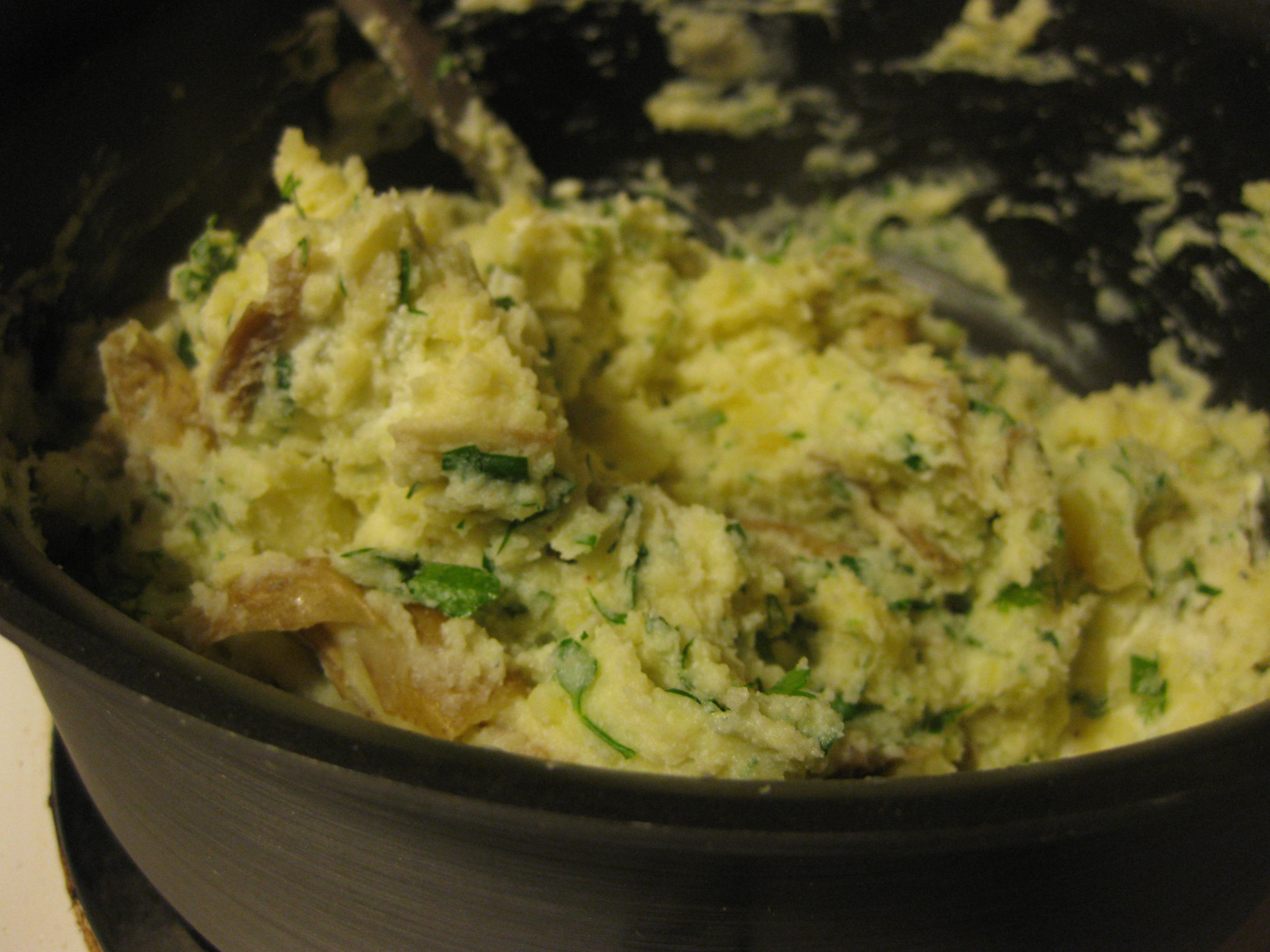
After draining and peeling the garlic cloves, I added and gently mashed together the following with the softened soldiers:

  • 4 TB butter
  • ½ cup milk
  • 8 oz. part-skim ricotta cheese
  • ¼ – ½ cup grated parmesan cheese
  • ¼ cup roughly chopped fresh parsley
  • 2-3 TB chopped fresh dill
  • Sea salt and black pepper

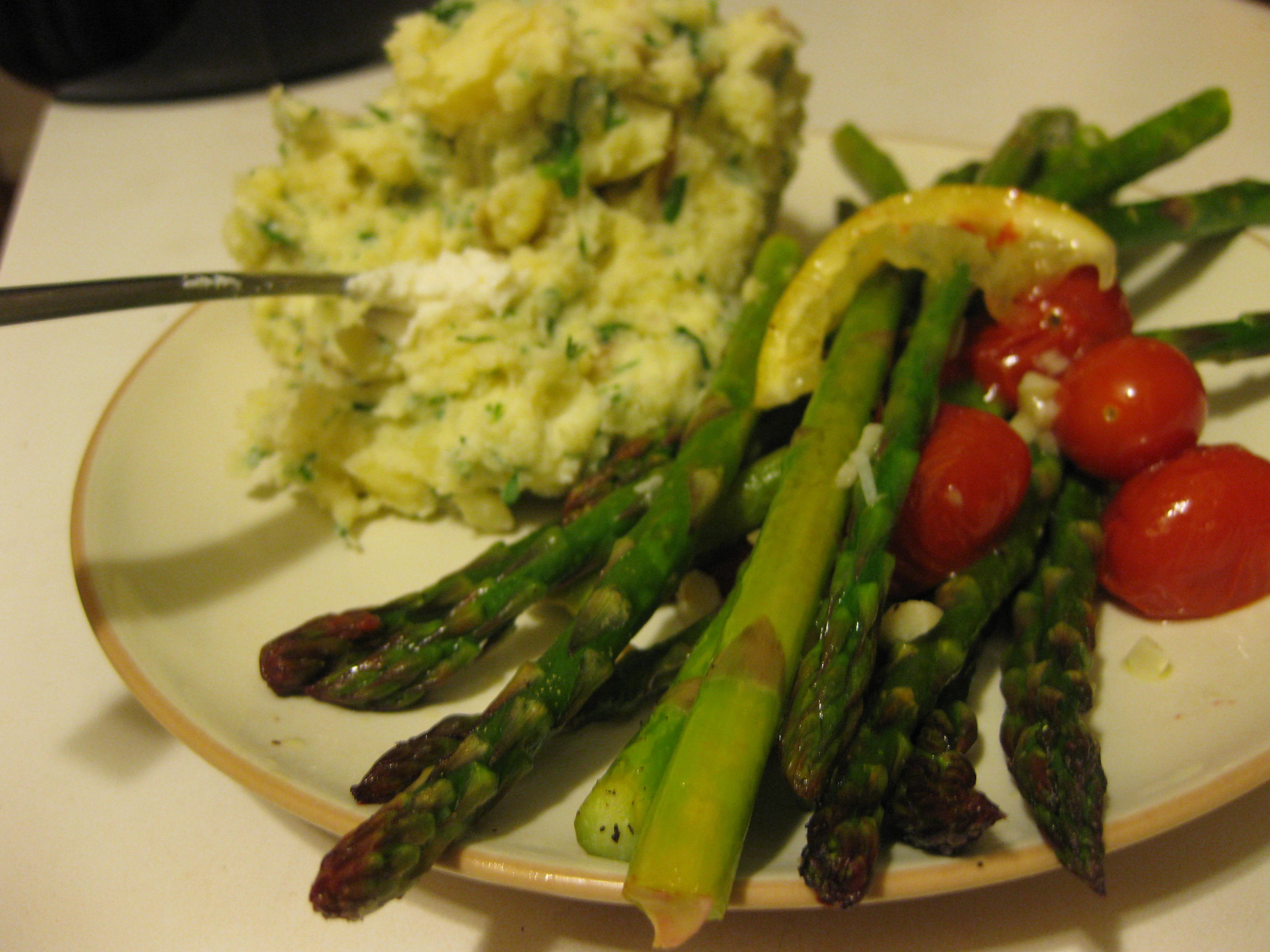
Using a plastic masher is invaluable because you can do your mixing and mashing right in the pot, which ensures that the potatoes stay hot longer.  We mounded ours up on warm plates and ate them alongside roasted asparagus.  The ricotta was a great addition; it was not super cheesy, but recognizably creamy and smooth.  It definitely added richness and tamed the starchiness of the potatoes.  The combination of herbs was a success.  With the additional richness of the cheese, having bright pops of green both visually and orally made the dish feel, not exactly healthy, but not overbearing.  Besides, with a side of asparagus and burst cherry tomatoes, we weren’t being all that bad…
Excuses and slow-roasted salmon

I know, I know, I broke my once-a-week resolution.  But you see, I have this exam hanging over my head.  It’s a two part oral examination that involves me reading a paper I’ve written about a 14th century poem, and a committee of three professors listening and then quizzing me both about the paper, and then in the second part of the exam, about medieval literature in general, based upon a hundred-or-so item list I have put together.  My exam is next Friday.  It’s a little intimidating.

But I don’t want to talk about that now.  I want to talk about salmon.  Even if you are not a seafood person, chances are you are okay with salmon.  It’s a beautiful fish.  It’s meaty and rich and juicy and can be cooked in a number of ways.  One of our treats in the last few days of the winter break was slow roasting a huge filet of it.

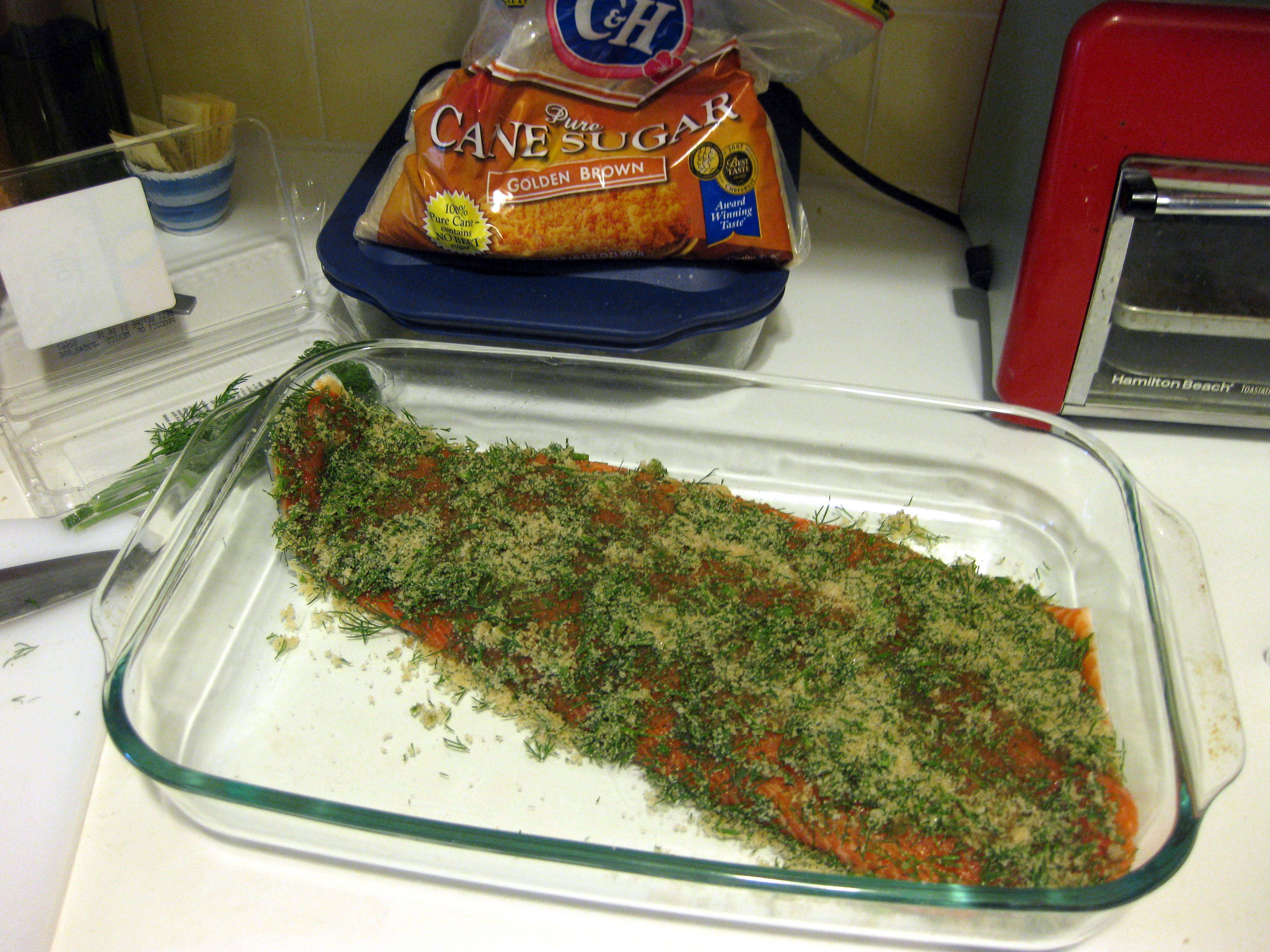
I had never experimented with slow roasting like this before.  Per my recipe’s directions, I stirred together brown sugar, sea salt, and a big handful of fresh, finely chopped dill.  I love dill.  It has this fresh green smell to it that makes me feel alive and happy, and mixing it with sugar had to be a good thing.  Once combined, I sprinkled the mixture over the fish and packed it in, rubbing and pushing the herbed sugar against the flesh so the flavors could penetrate.  Then I slapped plastic wrap over the top of my baking dish and stowed it in the fridge for 5 hours.

With eons to go before dinner, I preheated the oven to 175F, unwrapped the baking dish and transferred the fish to a cookie sheet before sticking it in the barely-warmed oven and leaving it for over an hour.  Over an hour!  For fish!  I could hardly believe it either.  Trusting in the recipe, I left it alone for what felt like forever.  After a time, the smell of roasted fish and caramelizing sugar started to fill the house, and this wasn’t a briny, salty, fishy kind of smell, this was almost like a thick roast of red meat.  Once in a while there was a crackling noise from hot fat oozing out of the fish and sizzling against the cookie sheet.

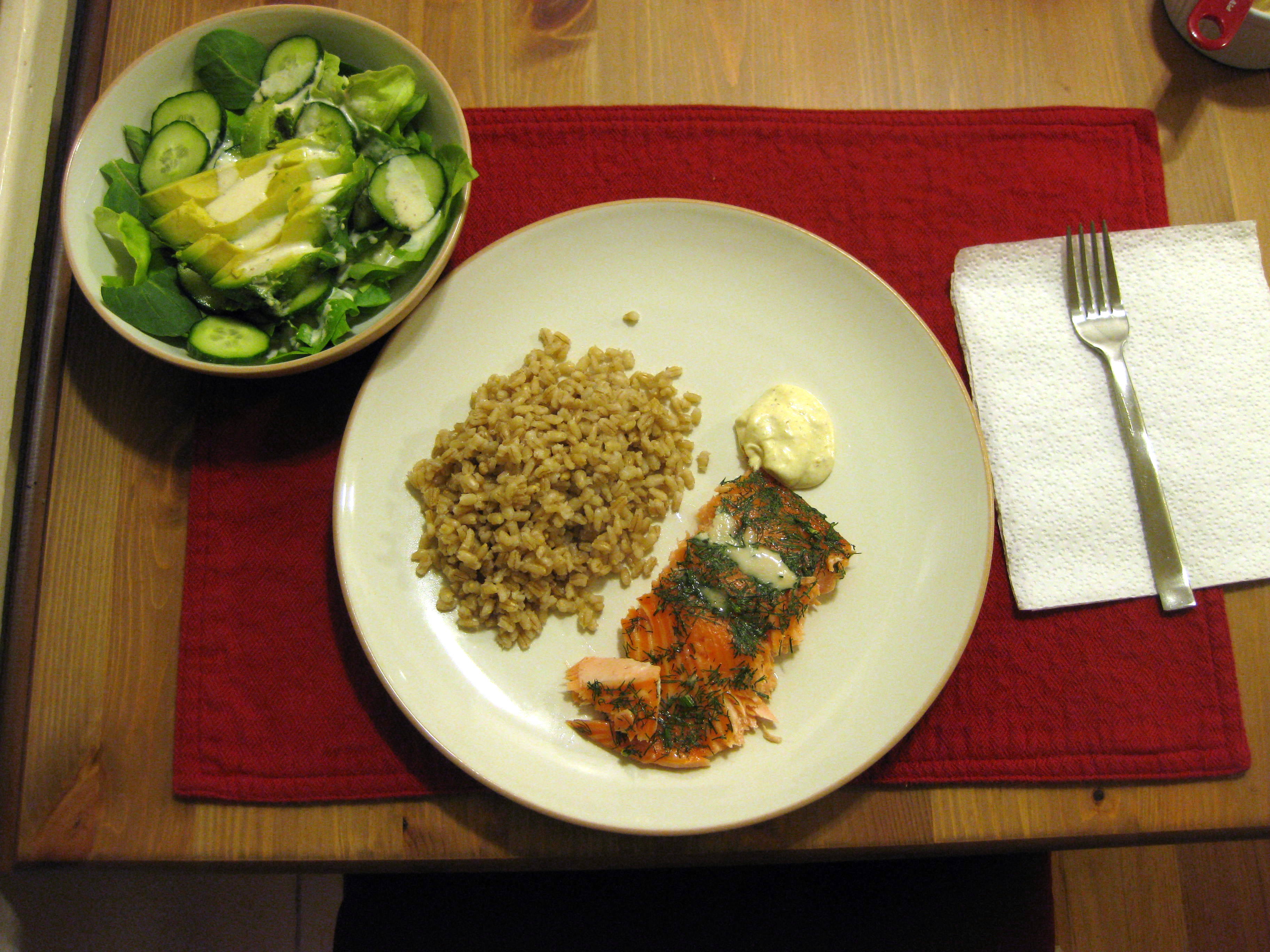
Meanwhile, I prepped our side dishes: barley simmered in chicken broth and a green salad of butter lettuce, cucumbers, and sliced avocado.  As the fish recipe called for a dipping sauce of mayonnaise and whole grain mustard, I made a salad dressing with the same two flavors, adding white wine vinegar to thin it out, and a drizzle of honey to prevent it from being too bitter.  Hooray for tying flavors together!

When the timer went off for the fish, I opened the oven door and despaired.  The little cracks in the sugar coating that I could see fish through looked bright pinky-red still, as if the fish was quite raw.  Gulping back disappointment, I gently flaked into the filet with a fork and almost had to pick myself up off the floor, where my knees were threatening to melt into a puddle.  The fish was perfect.  It was cooked, and the texture was silky but firm and buttery smooth.

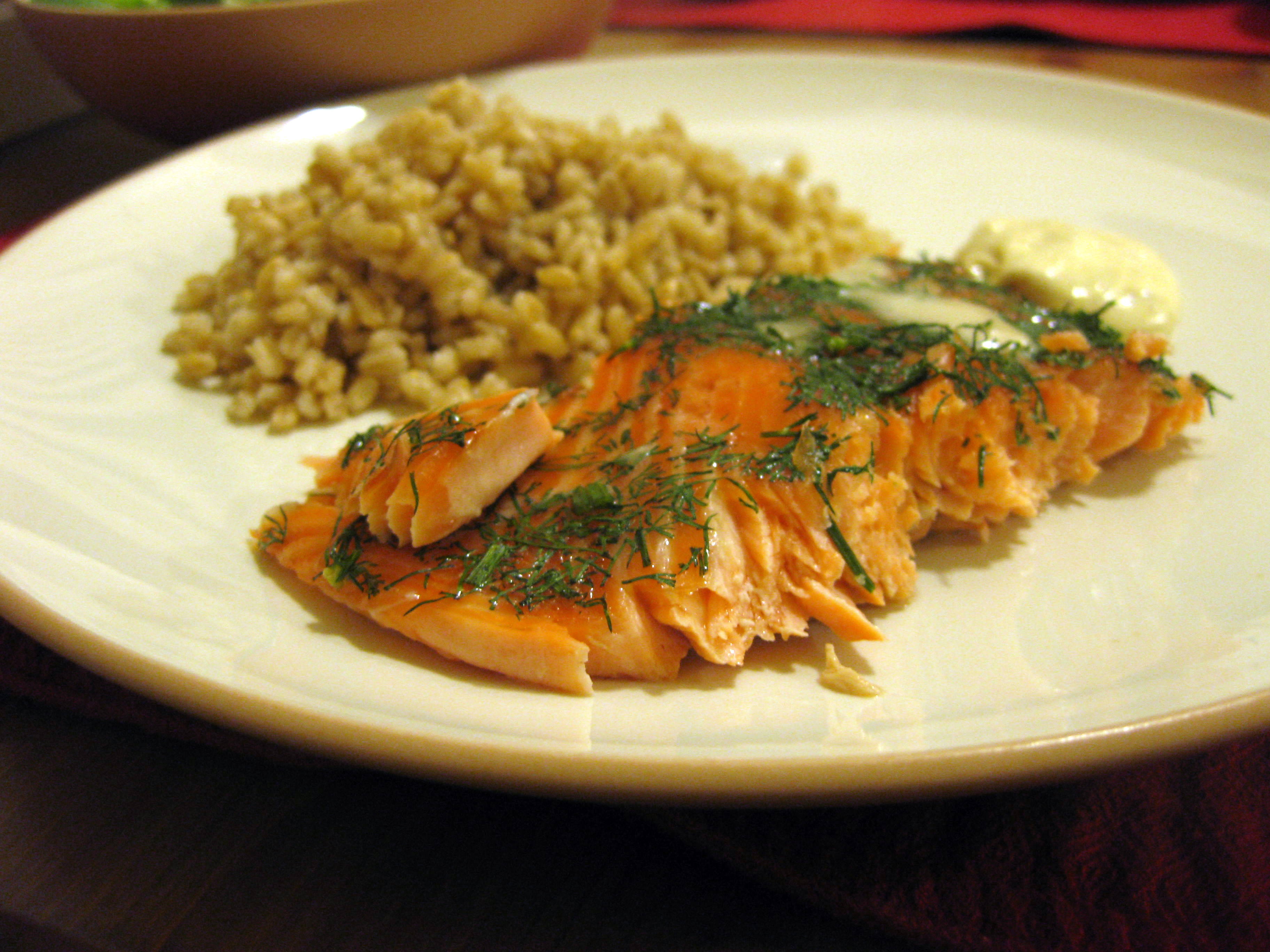
We ate.  The salmon was remarkable.  Though I only had it in the refrigerator for five hours (hey, we were hungry!) and the recipe called for eight, the meat was on its way toward the texture of smoked salmon, rather than baked or roasted.  I don’t know what the slow heat did, exactly, but the fish peeled off its skin in perfect fork sized chunks.  It was so rich and smooth that it was almost like eating a slice of warm butter.  The sugar surprisingly did not overpower the taste of the fish, and the mayonnaise-mustard sauce was tangy and added just the perfect touch of acid.  I was surprised that it wasn’t too creamy, with the silkiness of the salmon, the smooth mayonnaise, and the sweet sugar, but the punch of chewiness from the barley leant a nice contrast in texture, and the crisp butter lettuce and cucumbers in our salad didn’t hurt either.

Let’s see a close-up:

I think if the fish had chilled and marinated inside its sweet rub for a full eight hours before getting the slow heat treatment, the texture would have been even more pleasing.  N., who isn’t a big seafood fan, pronounced this a tentative success the first night, but the next day, when he had a cured salmon sandwich with thinly slice cucumbers, mayonnaise sauce, and a crisp leaf of lettuce on toasted sourdough, he was a complete convert.  We will have this again, when my exam is over and time operates normally again.  When I have time to devote to a dinner I begin almost ten hours ahead, and time to linger over it when it is finally, triumphantly ready.  Here’s the recipe I used, if you want to give it a try yourself.

Turkey Pot Pie

I have discovered that, much as I enjoy baking, I am not and may never be a master of the finicky, temperamental beast that is homemade pie crust.  Fortunately, this did not hinder me when I embarked on my major repurposing-Thanksgiving-leftovers meal last week.  No, I shamelessly bought a package of pre-made pie crusts to lovingly enclose a turkey pot pie.

We had a big turkey this year, and after stripping off the meat and making stock from the bones, I decided both could be put to good use in a pie.  Since the weather has been so chilly, baking is a good way of warming up the house and therefore a good way of choosing dinners.  Never having attempted pot pie before, I surveyed a few likely looking sources for potential recipes before scrapping them all and making it up myself.  Here’s how it went down:

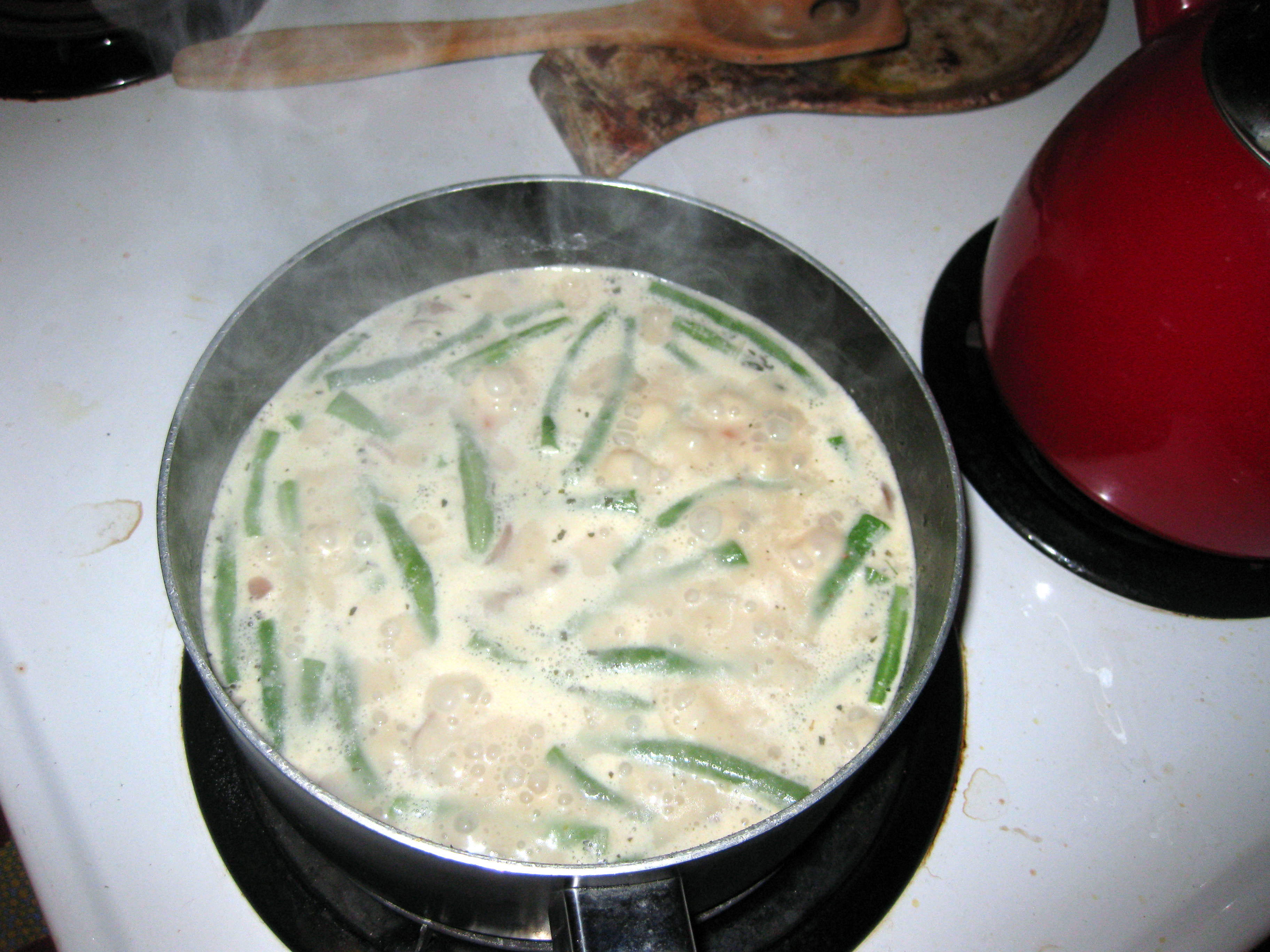
I chopped up three or four cloves of garlic, about ¼ cup of onion, and five or six cremini mushrooms, which I sweated down in olive oil until they were soft.  While this was happening, I chopped up a couple of carrots and a handful of fingerling potatoes into small pieces.  I tossed these into the pot with the aromatics along with some poultry seasoning and a splash of white wine, and then added about 2 cups of turkey stock and heavy cream stirred briefly together.  In a flash of genius, I realized this was an opportunity to use up the mushroom gravy my mom had made for the big Thanksgiving meal.  Everyone seems to stress about gravy – avoiding lumps, getting the right consistency, producing a good flavor without drowning the sauce in salt, and then it doesn’t get used up.  It coagulates into a strange, meaty jelly in the refrigerator and just doesn’t microwave right.  Most years we throw the leftovers away.  But mixed into my pot pie filling, it melted back into a slightly thickened liquid, bringing all its flavor with it.  I added some extra poultry seasoning and slapped the lid of my pot on to let the vegetables cook.

In the mean time, I assessed the crust situation.  Thanks to one of my cookbooks, I had decided to do a lattice top crust.  I’ve never made a lattice top crust before.  It looked daunting.  Helpfully, I found a diagram of how to do it, so while the potatoes and carrots slowly softened I cut my top crust into about twelve strips of semi-even thickness with the tip of one of my sharper knives.

When the potatoes and carrots were almost done, I added a handful of green beans to the filling, probably around a cup of frozen peas, and about two tablespoons of cornstarch mixed with water.  That way the filling could thicken while the green beans cooked.  When things were thickened up nicely, I carefully slopped the steaming filling into the bottom pie crust, which I had carefully laid into my pie plate.

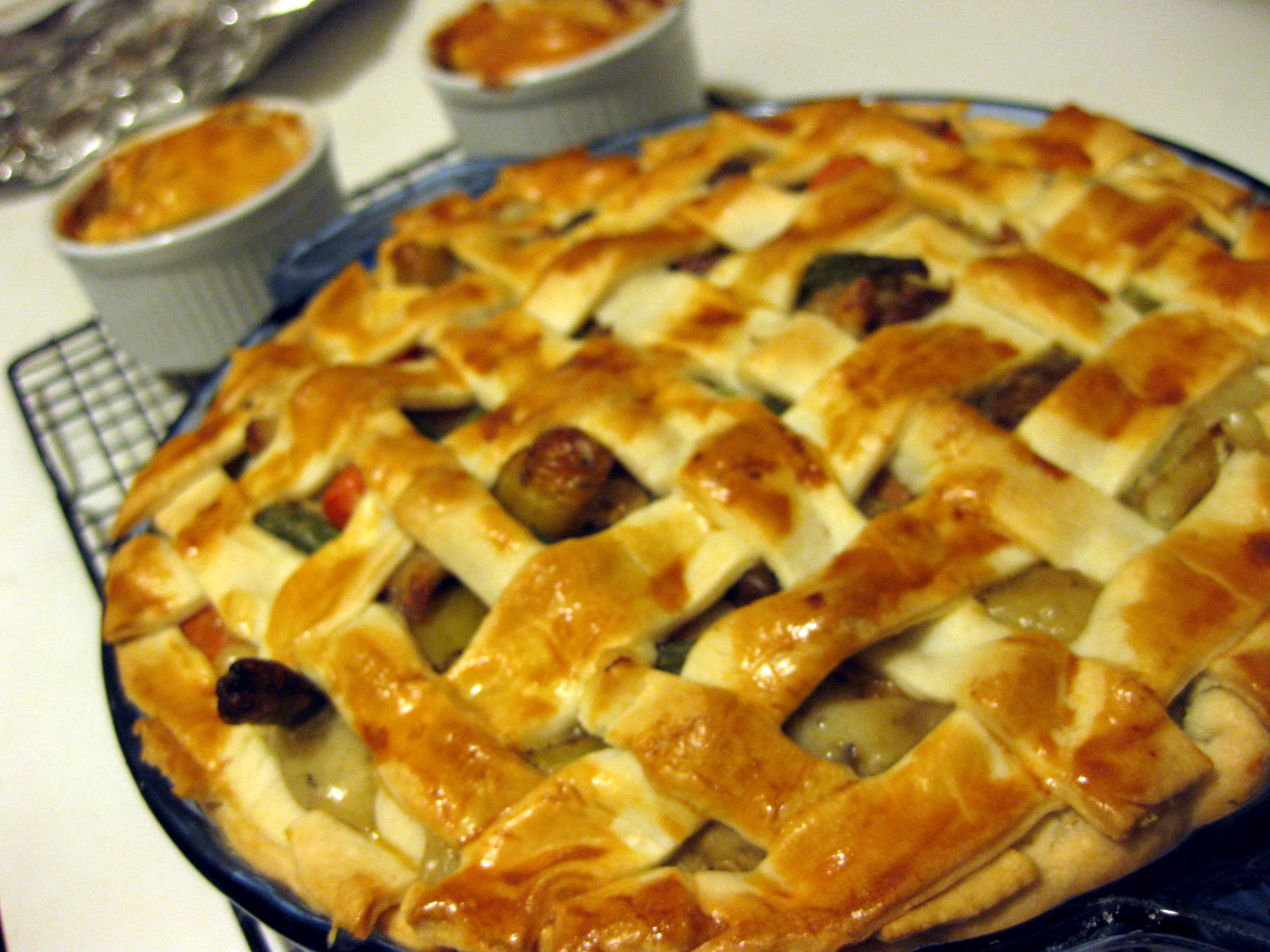
I carefully completed the lattice-work top (I don’t think I can explain without step-by-step pictures, which I unfortunately neglected to take, but it’s not quite as complicated as it looks) and then brushed it with an egg wash.  There was a little bit of filling and a few strips of crust left, so I made two mini-pot pies in tiny corningware dishes to use up the remainders before putting everything into the oven.

After 40 minutes or so at 425F, the pot pie was done.

The crust was golden and crunchy, the insides smelled delicious, and even though the whole first piece I cut fell completely apart, it was glorious.  Though N. enjoys my cooking, he is usually demure about his compliments, but not this time.  He proclaimed “I think I love this,” after only a bite or two, which I interpreted as ultimate triumph.  The veggies were tender but not mushy, the sauce had bubbled up on the sides and had a rich, meaty flavor, and the turkey itself was as delicious as it had been fresh off the bird.  I used only dark meat, which I think kept things moist and extra flavorful.  We glutted ourselves on turkey pot pie, and life was good.

Dinner for one

At the beginning of October, N. went to a literary conference in Spearfish, South Dakota.  That’s right, Spearfish.  For almost a week.  Now, I don’t even like eating dinner alone, much less rattling around the empty (all-but-dog) house in the evening and settling into bed by myself (again, aside from the dog who spent each night usurping more of my blankets).  You hear the creaking and settling of an old house much more clearly when something is out of the ordinary.

To assuage my loneliness, of course, I turned to food.  There are several items in this wonderful culinary world that N. doesn’t like.  One of them is shrimp.  I know, I must be crazy for having married him with such a deficiency (another of his dislikes is coconut.  Crazy!), but otherwise he’s pretty perfect.  So in his absence, I ate shrimp.  A recent issue of Cooking Light had a wonderful looking shrimp pasta recipe that I wanted to try out, and with the crustacean hater a full time zone away, this was my opportunity.

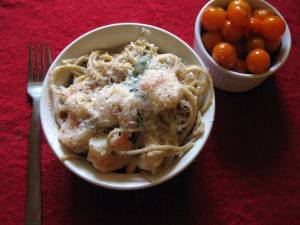
Shrimp, pine nuts, a little white wine, basil, and some nutmeg and pepper spiced cream made the sauce, and I tossed spaghetti into it and folded the creamy sauce around the long strands of pasta before adding a generous grating of Parmesan cheese.  Though this sounded like an excellent meal all on its own, I have been making an effort lately to be sure I include some kind of vegetable (or fruit) material in my meals, and a few julienned leaves of basil wasn’t going to cut it on this one.

I turned to tomatoes.  Our sungold cherry tomato plant, with which I’ve been having a serious love affair all summer, provided me with several generous handfuls of tiny, deep orangey-gold spheres of sweet juicy flavor explosions.  I drizzled a little olive oil over them in a small skillet and agitated them in the pan until they started to burst their skins.  Then I added salt, pepper, and two big glugs of balsamic vinegar and let it heat through until barely simmering.  Then I couldn’t stand it anymore, and ate a huge helping of tomatoes and pasta.

It was delicious.  The sauce for the pasta was creamy and luscious, punctuated by bursts of freshness from the basil, and deep, complex buttery nuttiness from the pine nuts and nutmeg.  The tomatoes, meanwhile, were tart and sweet – almost sweet enough to be dessert.  When I went back for a second helping (what can I say, I was all by myself with no one to help me enjoy the feast!), an amazing thing had happened.  Though I had turned off the stove (safety first!), I had left the pan containing the tomatoes on the cooling burner, and there was enough residual heat to begin to reduce the balsamic vinegar.  What remained was a slowly thickening syrup of balsamic and sweet cherry tomato juice, sticky and oozing among the deflating tomatoes.  I couldn’t stand it, I gobbled up the remaining spoonfuls and left the rest of the pasta for another day.

At my house, dinner for one looked like this:

IMG_1796

Roast Chicken, part II

With the falling temperatures and rising rains of autumn comes another unfortunate event.  Well, it’s unfortunate in the sense that it interrupts me from my otherwise regularly schedule internet time.  So that means it’s unfortunate for the regular updating of this blog, because I stop posting.

School.

We’re in the middle of the third week now, and this is the first time I’ve really had the chance to sit down and get back to the story.  It’s all being sitting on the back burner up until now.  Which is oddly appropriate, given our current topic.

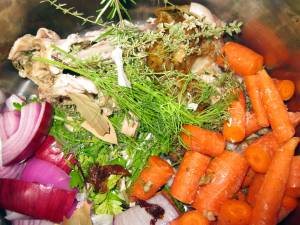
You’ll remember that when last we met, my first roast chicken had been liberated of meat.  The carcass itself I lowered into my gigantic gleaming aluminum pasta pot.  I added roughly chopped red onion chunks and quartered carrots.  Then I tossed in a liberal mix of herbs: thyme, sage, parsley, rosemary, dill, two or three bay leaves, and a small cupped handful of black peppercorns.  I finished by cracking a head of garlic and strewing several cloves, paper wrapped still, around the carcass.  I added probably twelve cups of water, and lidded the whole pot up to simmer for two and a half hours.

IMG_1770

When I strained out the bones and wasted vegetables, I was able to pour ten cups of rich, buttery-colored stock into my largest Tupperware.  At Ina Garten’s helpful suggestion courtesy of the Food Network website, I stowed the container in the fridge overnight, and was rewarded the next morning by a thick layer of fat across the top of the broth, which I scooped off before portioning out the golden liquid into smaller amounts in freezable containers.  Though I will not use it for everyday applications that only call for a cup or half a cup of broth, now I will have homemade chicken broth for clear soups and risottos.  You can bet that if this roast chicken obsession continues, I will need to start saving every lidded container that goes through my kitchen.  Scrubbed and labeled, yogurt and cottage cheese containers alike will be homes to ice-crystalled, rock hard pints of lovingly simmered stock.  C’mon, winter cold, I dare you to take on my broth base.

Roast Chicken, part I

Last night I faced another one of my food anxieties and bravely roasted a whole chicken.  This doesn’t sound like much, but for a girl who is capable of producing every side dish in a Thanksgiving feast but is afraid of the turkey, it was kind of a big deal for me.  First, I did my research.  And my research, I mean I asked around for suggestions on Facebook.  I got two recommendations, both from clever friends.  A. told me to stuff an herb and garlic mixture under the skin and into the cavity.  J. told me not to skimp on the rosemary.  I heeded their words.  At about 4 o’clock yesterday afternoon, I traipsed out to the garden in the misting spurts of drizzle and picked a big handful of parsley, pineapple sage, silver thyme, and several large twigs of the tiny rosemary bush I am so proud of.*

Back in the kitchen, I chopped the herbs roughly, threw them into a container with four cloves of garlic, a few tablespoons of butter, salt, pepper, and a splash of olive oil, before attacking the whole mixture with my immersion blender.  What resulted looked and tasted like the best spread for garlic bread there has ever been.

IMG_1756

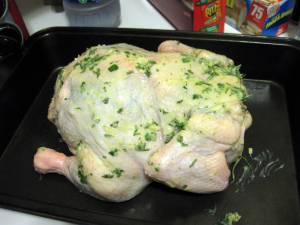
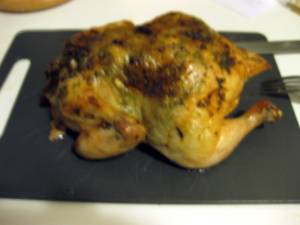
The next part was probably the most fun, though it could also be construed as the most icky, depending on how you feel about raw chicken.  To get the best flavors going, I carefully loosened the skin of the chicken from the meat by jamming my fingers in between them and breaking through the thin layer that attaches the skin to the muscles.  When I had loosened quite a bit of the skin on the chicken’s back (I have adopted my mom’s suggestion to roast poultry breast-side down, so the white meat doesn’t dry out as much), I shoved several fingerfuls of my herb butter mixture underneath the chicken’s skin, massaging the flavor into the meat.  The mixture was visible from the outside, making the chicken look like it had grown green spots.  It was like some strange miniature speckled pterodactyl.

IMG_1759

With the tiny bit of leftover butter mixture, I coated the inside of the cavity before placing my 4-pounder in the oven at 350F.  Almost exactly 90 minutes later, it was done.  I pulled it out and admired the crisp, brown skin for a few moments before quickly tenting it with aluminum foil to stay warm while I made our side dishes.

I steamed a bunch of asparagus to provide some greens, and then, with reverence, sliced up our first gigantic Brandywine tomato for caprese salad.  We wanted to be sure and put this first huge beautiful heirloom to good use, since our bush is only promising a few choice specimens, and with the weather as schizophrenic as it usually is at this time of year, we may not get many more.  Caprese seemed noble enough.  I layered the thick, meaty slices of tomato with fresh mozzarella and just-picked basil, then sprinkled the whole thing with salt and pepper before giving it a healthy drizzle of olive oil and balsamic vinegar.

IMG_1763

Gorgeous, no?  Who needs lettuce?

We dug in.  The caprese was marvelous; the acidic sweetness of the tomato juice mingled with the balsamic vinegar into a beautiful sweet-tangy jus that soaked into the fresh mozzarella, which had enough creaminess to stand up to the firm, meaty flesh of the tomato slices.  It was perfect.  And then it was gone.

The chicken was delicious as well.  It was moist and savory, and the herbs both added some welcome flavors and made it smell really enticing.  I forced myself not to eat more than a bite or two of the skin, which was crispy and golden and marvelous.  It’s a shame that fat tastes so wonderful, because it is always difficult for me to avoid it.  I love that marbling in any cut of meat, and I’m a fiend for the thigh and leg on poultry both because it is moister meat, but also because the skin often gets left on the leg, and I get to chew on some of it as a special treat.

IMG_1767

Dinner was delectable, but almost more exciting than dinner was the fate of the leftovers.  There was plenty of meat left over after we were finished; even at our hungriest, I doubt that N. and I could polish off a 4 pound chicken with just the two of us, so I picked the carcass pretty thoroughly and will use the meat again soon.  As for the carcass, all I can tell you is to stay tuned for “Roast Chicken, part II.”

*Early this spring, I picked a sprig of rosemary from a bush in the neighborhood that was leaning out over the sidewalk.  I put it in a vase (read: cleaned and dried empty artichoke hearts jar) and waited.  It took about three weeks, but it sprouted roots and I, holding my breath, planted it in a small pot outside.  It flourished.  It is still pretty small, probably because I keep using its fragrant, pine-scented leaves to cook with, but next spring I will re-pot it to really let it go wild.