Hindsight

One of the valuable lessons this Bittman project is teaching me is flavor combinations.  I like to think I am a pretty good cook, and lord knows I can follow a recipe (well, when I’m paying attention…), but I am still learning how to put ingredients together without a guide.  Mark Bittman’s 101 is teaching me about this in two ways.  First, he provides me with glorious combinations of ingredients to try out.  Second, because I am not serving these dishes each week with “Thanksgiving dinner,” I am learning that before I make each item, I am only guessing how well it will match with the rest of the meal I’ve envisioned.  This week, we took on acorn squash, which is one of my favorites:

“45. Render some chopped bacon in a bit of oil, then add apple chunks; cook until nearly soft.  Meanwhile, bake halved and seeded acorn, butternut, or delicata squash until they start to soften.  Fill squash with apple mixture and finish baking.”

Much as I love winter squash, I was faced again with the difficulty of deciding what else to serve with what I hoped would be boats of delight.  Because our last squash experiment had needed something more substantial than the quinoa I paired it with, I decided this time on organic chicken sausages with roasted red pepper and garlic.

Bacon and apples sounded amazing and decadent, but I decided to add a little to Bittman’s foundation.  Here’s what I used:

1 acorn squash, halved and seeded
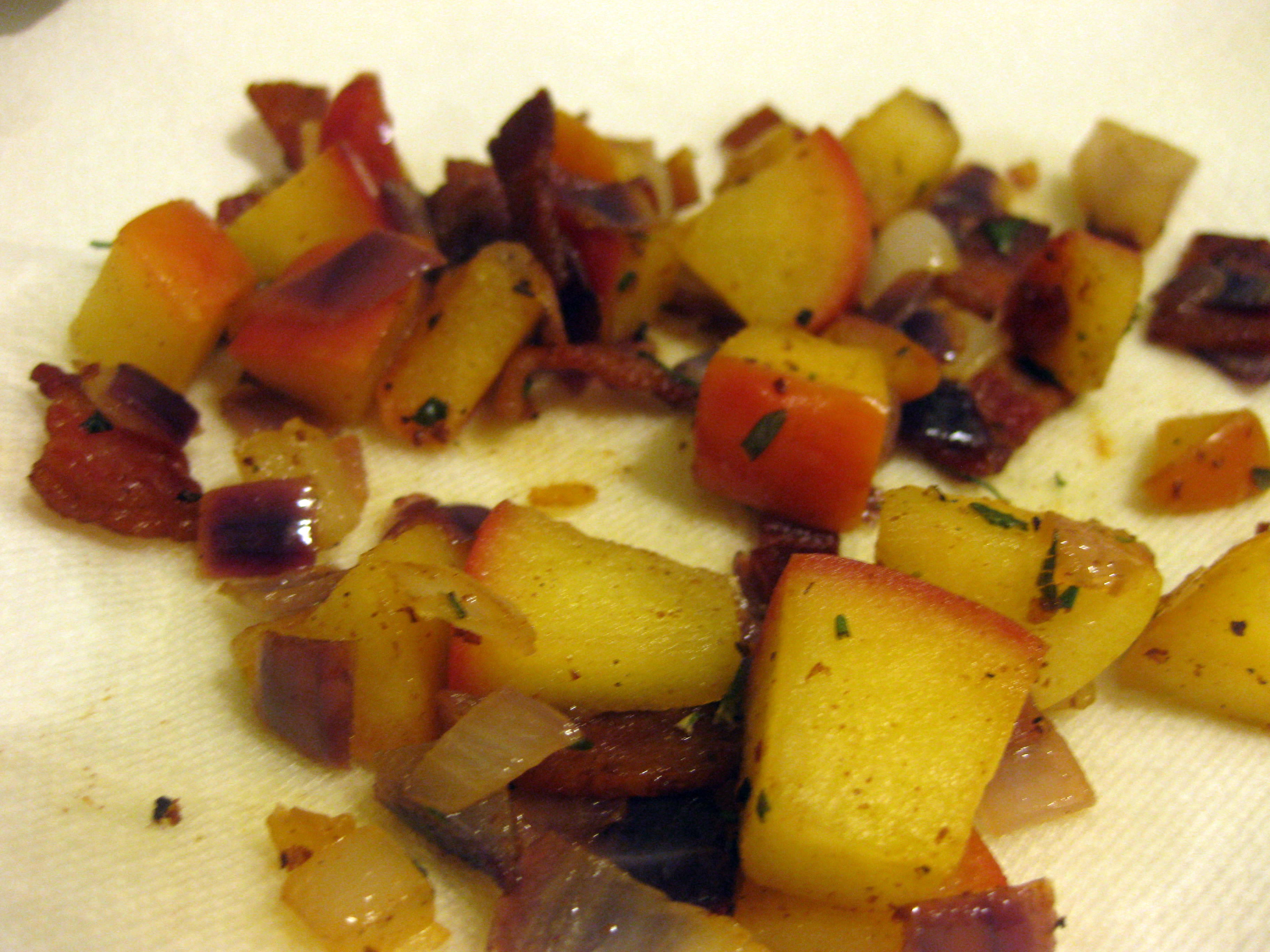
½ lb bacon, chopped

2 apples, skin on (I used Braeburns), quartered, cored, and chunked

½ a medium onion, diced (red onion added mild flavor and nice color)

1 tsp fresh rosemary, finely chopped

Salt, pepper, and olive oil

I preheated the oven to 400F for the squash.  To keep them standing upright, I sliced a very thin piece off the “bottom” of the rind where I wanted it to sit.  Just a little peel off the rind made a flat surface for the squash to balance on.  I wedged the halves into a cake pan and sprinkled liberally with salt, pepper, and olive oil.  I put them into the oven for about 20 minutes and concentrated on the stuffing.

I decided to eschew the extra oil, and put my squares of bacon into a dry pan on medium.  While it sizzled, whining and complaining about the heat, I chopped the apples and onions.  With the bacon halfway to crisp, I dropped in the onions, wanting to give them time to grow tender and sweeten.

When the bacon was teetering on the edge of barest crispness, I added the apple chunks.  They only needed five minutes to begin to soften before I turned the stove off.  Because I knew they were going to continue cooking in the oven, I didn’t want them to lose all their texture in the pan.

In three quick sweeps, I folded the rosemary into my apple mixture, slipped the squash out of the oven, and packed the boats full, no, overflowing.  They looked beautiful, and it was difficult to say goodbye as the oven door closed between us for another 20 minutes.

With sausages sizzling and charring and smoking ever so slightly on the stovetop, I liberated the stuffed squash and loaded them onto our plates.  The smell was wonderful, and the flavor matched.  The squash and apples were sweet, but had soaked up some of the bacon fat, which complicated their flavor.  The bacon itself was meaty and fatty and crispy and salty (I love bacon, can you tell?) and perfect.  It was a nice textural component as well, as the squash was beautifully soft and creamy, and the apples were barely toothsome.  As I had hoped, the sharp piney flavor of the rosemary kept the dish from being too rich.  It was a lovely herbal note.
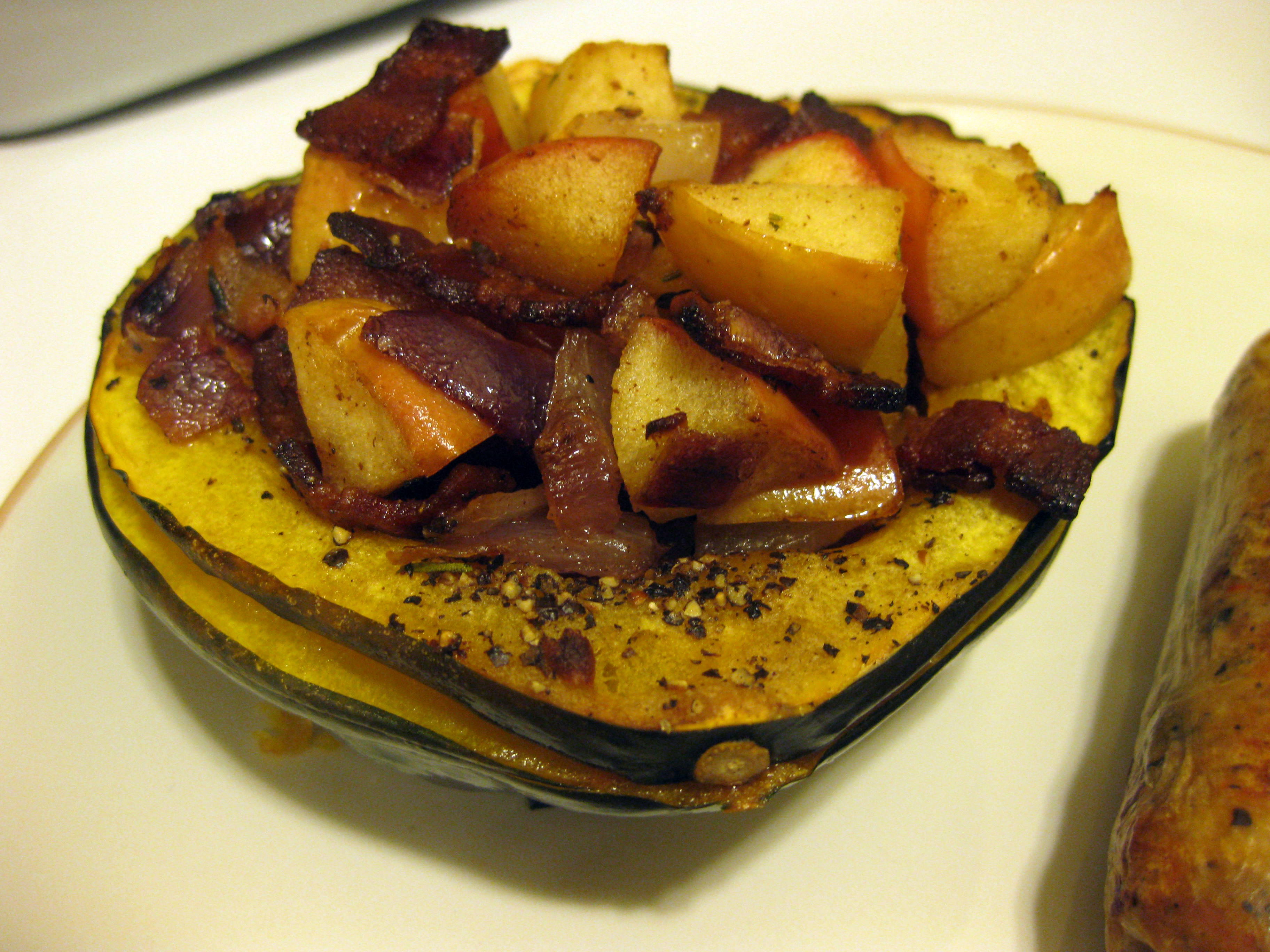
Because I packed the boats so full, the bacon in the dish was more than just an accent, as I had somehow expected it would be.  Therefore, the side of chicken sausage I had chosen was not the best possible pairing.  It was not until the next day as I heated up the leftovers and ate them alongside a corn muffin we’d had as a side earlier in the week that I realized what would have been perfect: golden circles of baked or fried polenta.  I chose meat when I should have chosen starch.  But as I am learning with this project, there was really no way I could have known the perfect side until I had tasted the dish.  That means to get it perfect we will have to have this again.  “What a shame!” she exclaimed with a wink and a smirk.

This is absolutely a recipe to keep and try out.  I’d imagine the ingredients you stuff the squash with could be changed up: apples could be replaced with pears, bacon with prosciutto, or you could go more savory and add leeks or garlic, but if your squash boat includes bacon I’d recommend serving with a starchy side rather than meat – polenta, cornbread, maybe even buttered noodles or gnocchi.  My 20/20 hindsight says it would be better balanced.  And in a meal in which the vessel threatens to fall over and spill its rich treasures across your plate if you don’t take measures to keep it upright, balance is a necessary thing.

Currying flavors

The thing about Mark Bittman’s make-ahead sides is that they are all ostensibly created with a main of turkey in mind.  They are, after all, Thanksgiving inspirations.  Therefore, when I ask myself the inevitable question each week “what should I serve this with?”, I suppose I shouldn’t be surprised when the first thing that pops into my head is “that would taste really good with roast fowl!”  Of course it would.  That plays into the composition of Bittman’s list.

But we don’t want turkey every week, or chicken, for that matter.  Lately, both for ease, for cleanliness, for cost, and in some minor and embarrassingly halfhearted respects for moral and environmental concerns, I’ve been more drawn to vegetarian fare.  Potatoes, rice, grains, beans: these guys don’t cross-contaminate my kitchen.

So I’m having to be unusually creative in my search for accompaniments for the accompaniments I’m cooking.  This week N. chose, from a short list, an interesting combination:

“43. Toss chunks of butternut squash with butter and curry powder.  Roast until half-tender, then stir in chunks of apple and some maple syrup.  Cook, shaking the pan occasionally, until everything is nicely browned and tender.”


The mystery about butternut squash is, for me, as with some other orange produce, whether to treat it as a starch or a vegetable.  It seems to occupy some strange and unnecessarily cryptic middle ground.  It’s not green or leafy, but it’s also clearly not a tuber, no matter how much its deep autumnal color reminds me of a good hearty yam.  Yet, if I’m not serving meat with dinner, pairing a butternut squash roast with  vegetables seems not substantial enough, but opting to serve it alongside, say, mashed potatoes, seems excessively filling and somehow repetitive.

I opted for another strange middle ground and went for sauteed red chard stirred into quinoa.  As a nod to the seasonal intentions of the squash dish, I cooked my quinoa in turkey broth I made and froze a day or two after Thanksgiving.  I like the deeper, richer flavor that results from cooking grains and small pastas in broth or milk rather than water.  So our dinner basically consisted of two side dishes, but I decided I didn’t really mind.

Here’s how it went:

1 medium butternut squash, peeled, seeded, and chopped into small chunks

2 apples (I used Braeburns) quartered, cored, and chopped into chunks

1 onion, diced (I thought the extra savory flavor would be nice, since apples and squash are so sweet)

1 TB curry powder

2 TB melted butter

1-2 TB maple syrup

I tossed the chunks of squash on a cookie sheet with melted butter and curry powder, then slid it into a preheated 375F oven to roast for 20 minutes.  Meanwhile I prepped my apples and onions.  After 20 minutes when the squash chunks were just beginning to give, I pulled the pan out of the oven and added the apples, onions, and maple syrup – a decadent drizzle over the top that I hoped would pair well with the curry – mixed it all around together, and dropped it back in the oven for another 20 minutes (but really, it took almost half an hour).

While the roasting fruits softened and the maple syrup made suggestions of carmelization on their corners, I addressed our other side dish.  I stripped the chard leaves from the stems, chopped the stems into a fairly small dice, and plunged them into a pot with a couple teaspoons of olive oil.  I sauteed them over medium heat until they were just beginning to soften, then added the quinoa.  In one of my favorite quinoa recipes, Danny (the Chef of Gluten-Free Girl and the Chef ) suggests toasting the quinoa before adding any liquid, much as you toast the rice in a risotto before deglazing the pan.  I toasted for a few minutes, then poured in the turkey stock and clapped on the lid.  When there were only five minutes left on my timer, I added the chopped chard leaves into the mix, stirred it together well, and replaced the lid so it could finish cooking.  It worked perfectly.  The chard had just enough time to steam as the final few tablespoons of water were absorbed, but not enough time to overcook and lose all semblance of texture.  I can’t stand that sliminess that greens sometimes get after too much contact with the heat.  To my delight, the quinoa had taken on a lovely deep rosy color thanks to the chard stems, and the toasty nutty crunch of the grain worked really nicely with the healthful greenness of the chard leaves.

When I pulled the butternut and apple mixture out of the oven, all I could smell was sweetness and curry.  The maple syrup had thinned in the heat, but cloyed onto the chunks of fruit as it cooled again.  The mixture was really nice.  Butternut squash and apples are very good friends, and leaving the skins of the apples on was a wise choice because it added textural interest to the dish.  The curry made the flavors deep and warm and spiced, and the maple syrup was a nice hit of sweetness.  This one I would make again with no reservations, and only one (okay, maybe two) changes.  I put the diced onions right onto the cookie sheet, raw from my cutting board.  When I make this again, I will soften them lightly in butter first.  They didn’t roast quite long enough to quell the astringent tang onions sometimes have, and I could feel them in the back of my throat afterward.  Mellowing them out on the stovetop first would be the right thing to do.

To change it up from curry, I think garam masala would also be delicious on this mixture, and fortunately (and conveniently!) enough, Aarti of aarti paarti has just posted suggestions for making your own!  How timely!  How fortuitous!  Let’s make some!  And then, make this autumnal dish.  Maybe with turkey.  Maybe with chicken sausage.  Maybe, as I realized only after dinner was over, with potato masala burgers from Trader Joe’s.  What a congenial blend of spices that would be to curry favor with your family!

Apologies for the punning… I couldn’t resist.

Homecoming

Bodily home from vacation, but my mind is refusing to admit that it’s time to work again. With two writing related project deadlines in September, the beginning of the new school year, and that looming dissertation thing in the background, the time for reluctance and inactivity is over.

Yeah, tell that to my sunbathing motivation and my zinc-nosed inspiration. Since returning home, my productivity has been almost nil.

Far opposite holds true in my backyard. Despite a very, very slow start and still largely unresponsive tomatoes, the garden has rebounded and seems determined to make up for its early uncertainty. Every one of our eight peppers has a small green bell swelling on it. Tiny might-be tomatillos are forming inside wasted flower buds on each of the two plants. Cucumbers and zucchinis, oddly shaped but still tasty, are pushing their way out into the sun. Even the eggplants are growing and fruiting! But the real stars, the real miraculously successful, grocery-store quality items are my pole beans. The first sowing was a failure (too cold), but in the second sowing ten or twelve leaves pushed up out of the ground, and on Monday, as we crawled out of the car after a punishing nine hour drive, at least two pounds of ripe, juicy, six-inch long green beans hung ready from the vines.

What could be better, I thought as I looked at them with grinning awe, than a garden-fresh stir-fry to welcome us home? After two weeks of rich food and restaurant dates, we needed some vegetation in our systems, and here was our own garden graciously willing to oblige!

I started some sticky rice in the rice cooker and ran outside to divest our leafy residents of their harvest.

Eggplant and green bean stir-fry seemed to be the obvious menu choice. I simmered water in a skillet and tossed in the halved green beans, cooking them until they were just tender. Then I drained off the water, added vegetable oil and sesame oil, and tossed in chunks of eggplant and some white sesame seeds. Six minutes later, when the eggplant was juicy and soft and the beans had taken some dark marks from the heat of the pan, I scooped big spoonfuls onto a bed of fresh hot rice, and we ate without talking until every bite was gone.

It’s nice to be home.

Breakfast for Dinner

I have a curious relationship with breakfast food.  The heavy kind, the kind you get from a diner or a good bed-and-breakfast or a hotel, doesn’t sit well with me in the morning.  It’s too much, it weighs me down.  But it’s food I love.  Potatoes, eggs, bacon, quiche, pancakes, cinnamon rolls… the list goes on.  So I take full advantage of every opportunity I get to eat this kind of food later in the day.

Enter Friday, April 2nd:  for the third year running, N. and I are hosting a Breakfast for Dinner potluck.  We try to host one party per term, usually with some loose theme, and I think this one is my favorite.  My mouth is already watering at the possibilities.

Here’s a preview of my own menu for the evening: 

Ph-Ph rice pudding

Jalapeno cheese grits casserole

Cranberry donuts

Deviled eggs

Spiked hot apple cider

Mimosas

Yum.

The Week of Magical Eating, Day Five: Phoebe-Phriendly

I realized recently that if I lived alone, I would not cook the way I do now.  I would eat scrambled eggs, I would eat yogurt and granola and pasta.  I would cook occasionally, but what I do now built out of a desire to care for my then-boyfriend, now-husband.  Some of it was, admittedly, to impress him, because he was eating microwave dinners and frozen bagged teriyaki concoctions.  But some of it was born from a desire to nurture him, because he was eating microwave dinners and frozen bagged teriyaki concoctions!
Somewhere along the line, I discovered that I really liked this whole cooking thing.  It became challenging but fulfilling, stress-relieving and relaxing, but also a self-induced obligation.  Deep within these seemingly-contradictory-but-somehow-harmonious-co-existing attributes, the urge to feed and nurture remained.  I cook because I love.  It is the best, most sincere, heartiest way I know how to show my deep affection and fierce warmth.  If I cook for you, it means I care about you.
As I have mentioned on this blog before, I have a friend Ph. who presents some challenges to my ordinary routine.  She is a good friend.  I care about her.  Therefore, I want to feed her.  But her particular dietary needs present me with unusual requirements.  Not only does she eat gluten-free, but dairy-free, corn-free, and nut-free.  This has, much like the Caesar dressing in my previous post, become a minor obsession for me.  I never realized how much of my love involved cheese, milk, and butter, to say nothing of wheat products.  But I care, and I feel driven, and I want to cook for her.  It has become a kind of mission for me.  So I have been educating myself; experimenting with alternative flours, rejoicing in olive oil, learning about how soy milk reacts differently than cows’ milk.  I have done some reading, found some new “friends” online, and discovered with delight how many flour and starch options exist in the bulk foods section of Market of Choice.
Despite all this, I haven’t done much baking yet.  I find myself a little intimidated because I don’t like failure.  I don’t know how these new ingredients react to each other yet, and I dislike the idea of presenting substandard or imperfect food.  But I bucked up my courage recently and made my way through my first bag of rice flour.  One semi-triumph was a version of Elana’s “Magically Moist Cherry and Apricot Cake” from Elana’s Pantry.  Since Elana uses almond flour as her primary gluten-free alternative, I cannot use her recipes verbatim.  Ph. cannot eat tree nuts.  Additionally, Elana uses alternative sweeteners, and I have not yet delved into the mysterious world of agave nectar.  So some amendments needed to be made.
For a girls’ TV night, to which Ph., ironically enough, was not able to attend, I attempted Elana’s cake.  I used white rice flour instead of almond flour, and sugar instead of agave.  Since the resulting clumpy, bumpy batter would not have poured, per the directions, if I’d pointed a gun to my bowl, I added a few splashes of soy milk until things loosened up a bit.  I smoothed the dough out in my pie plate and stuck it in the oven.  Thanks, I suspect, to the soy milk addition, I had to up the cooking time by ten minutes or so, and when I took it out of the oven, it certainly didn’t look like Elana’s.  Hers looked moist with a lovely crumb and a golden crust.  Mine hadn’t lost the spatula-smoothing strokes I’d used to even out the batter.  I broke off a clumpy edge and took a taste.
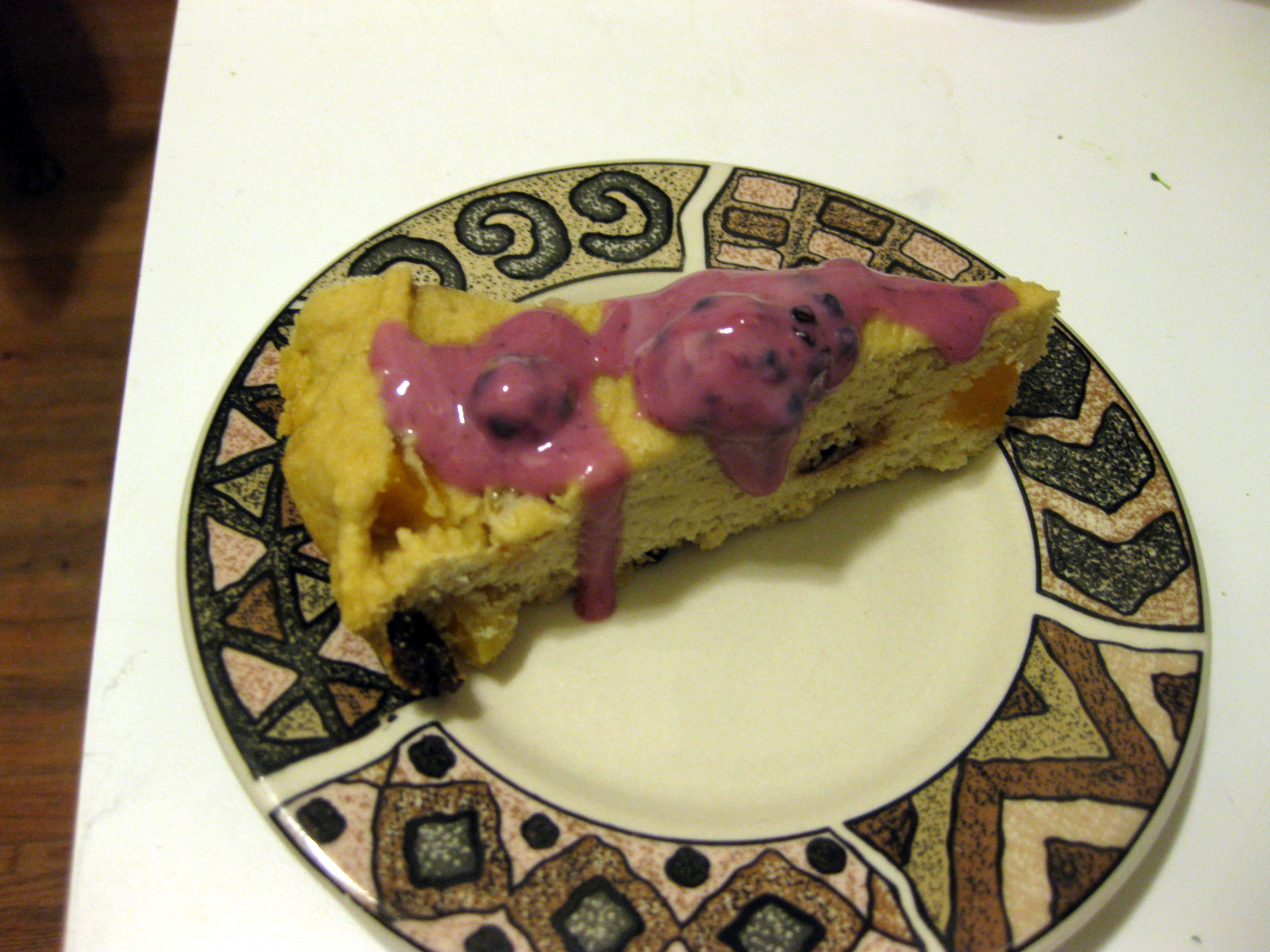
It was tasty, if different.  Rice flour seems to contribute a grainy texture that I’m not thrilled with, so I know that more experimentation awaits.  But the cake was not as dry as I had feared it would be.  Finally, a baked good that Ph. could eat safely and enjoy (she loves dried fruit).  Since, as it turned out, she was not able to partake on that evening, I broke all my rules to make the dish completely Ph-Phriendly, and made a yogurt glaze to drizzle over the top.  Vanilla yogurt, defrosted frozen blackberries, and a tiny splash of creme de cassis.  This added just the moisture the cake seemed to need.  A few days later I had a slice spread with cream cheese.  That was good too.  Oh what would I give for nondairy cream cheese?
So experiment #1 is complete.  Next up, new flours, mixes of flours, and maybe a fruit crisp.  Doors are opening, and I’m on a mission.

Roast Chicken, part II

With the falling temperatures and rising rains of autumn comes another unfortunate event.  Well, it’s unfortunate in the sense that it interrupts me from my otherwise regularly schedule internet time.  So that means it’s unfortunate for the regular updating of this blog, because I stop posting.

School.

We’re in the middle of the third week now, and this is the first time I’ve really had the chance to sit down and get back to the story.  It’s all being sitting on the back burner up until now.  Which is oddly appropriate, given our current topic.

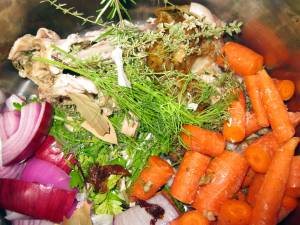
You’ll remember that when last we met, my first roast chicken had been liberated of meat.  The carcass itself I lowered into my gigantic gleaming aluminum pasta pot.  I added roughly chopped red onion chunks and quartered carrots.  Then I tossed in a liberal mix of herbs: thyme, sage, parsley, rosemary, dill, two or three bay leaves, and a small cupped handful of black peppercorns.  I finished by cracking a head of garlic and strewing several cloves, paper wrapped still, around the carcass.  I added probably twelve cups of water, and lidded the whole pot up to simmer for two and a half hours.

IMG_1770

When I strained out the bones and wasted vegetables, I was able to pour ten cups of rich, buttery-colored stock into my largest Tupperware.  At Ina Garten’s helpful suggestion courtesy of the Food Network website, I stowed the container in the fridge overnight, and was rewarded the next morning by a thick layer of fat across the top of the broth, which I scooped off before portioning out the golden liquid into smaller amounts in freezable containers.  Though I will not use it for everyday applications that only call for a cup or half a cup of broth, now I will have homemade chicken broth for clear soups and risottos.  You can bet that if this roast chicken obsession continues, I will need to start saving every lidded container that goes through my kitchen.  Scrubbed and labeled, yogurt and cottage cheese containers alike will be homes to ice-crystalled, rock hard pints of lovingly simmered stock.  C’mon, winter cold, I dare you to take on my broth base.