Zucchini Crepes with Mascarpone Almond Cream

food-blog-february-2017-0288There is no way I can connect this recipe with Black History Month. I’ve tried. The transition just isn’t there. But when this issue of The New Yorker showed up on our doorstep, with this beautiful new imagining of the iconic Rosie the Riveter staring confidently back at me on the front, I wanted to make sure you saw her. Clearly a response to the Women’s March, she is also a powerful image of intersectional feminism, replacing the white WWII era working woman with an African American marcher, pink pussy hat and all. And though the cover doesn’t bear Rosie’s original accompanying phrase – “We can do it” – there’s no way to divorce that message, with all its connotations, from this new version.

There is so much to do, but we can do it.

food-blog-february-2017-0260These started not as crepes but as a desire to modify my favorite zucchini spice bread recipe into a pancake (I told you there was no transition. I just wanted to show you my magazine cover and remind you about the history we should be celebrating this month). There would be nutmeg and cinnamon, there would be caramelized crisp edges, there might be golden raisins… and then I made the mistake of searching for “zucchini bread pancakes” online, and of course the first hit was Deb’s recipe, deepening, as ever, my intense love-hate relationship with her and her site. Let me be clear, before you start emailing me: I adore Smitten Kitchen (look, Deb, I’m even giving you traffic!). I have the cookbook, I went to a signing and thoroughly embarrassed myself, and I trawl through her archives all the time, because she has tried everything! But there’s the hate part (or, at least, the jealous part): she’s tried everything! I certainly wasn’t going to make zucchini bread pancakes if she already had the consummate version (which, of course, I just automatically assume she does. Being a jealous fan-girl is weird).
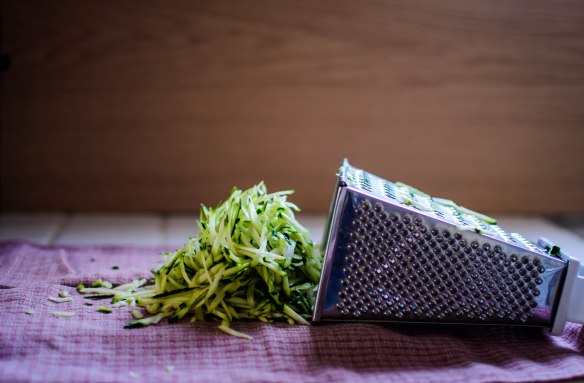
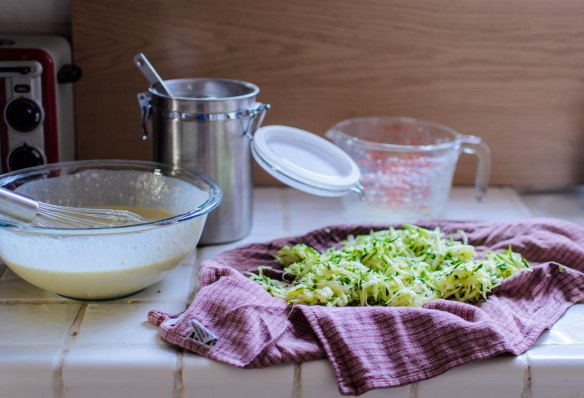
food-blog-february-2017-0263food-blog-february-2017-0267So I had to go with something different, and somehow something different became crepes. I wasn’t sure how they would work, given the sodden heaviness large quantities of shredded zucchini often contribute to a dish, but the zucchini were already in the fridge and the milk on the door was begging to be used, so the experiment had to move forward.
food-blog-february-2017-0255I’m calling these crepes, but they don’t share ratio or ingredient quantities with other crepe recipes. My grandfather called them Swedish pancakes, probably more because he was Swedish than due to any recipe authenticity. They are a bit moister than some crepes – a little less papery around the edges, maybe a bit heavier, and we’ve never been particularly fussy about getting them wafer thin. Here, the addition of the zucchini makes these qualities important, since the batter has to be substantial enough to hold up to the extra weight of the vegetation.

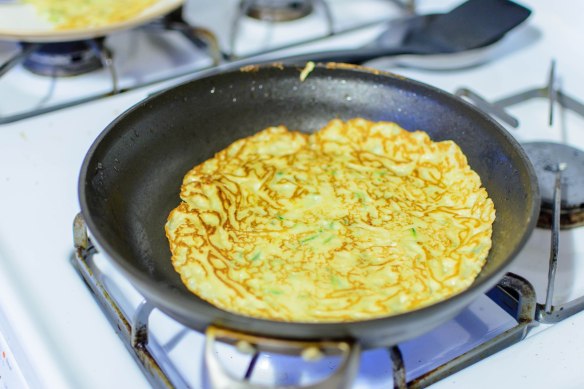
food-blog-february-2017-0268food-blog-february-2017-0272As I always yell at food competition contestants when they scrunch or tear or mangle their first crepe, the first one probably is going to be ugly. Maybe the second one too. But you have to persist. Crepes require a bit of a rhythm – you have to get a feel for how much batter goes into the pan, how steeply to tilt your pan while you swirl to get an even coating of batter, and how long it really does need to cook before you can flip that delicate, eggy circle. And ultimately, really, it’s okay when that first one rips, because now you get to eat it surreptitiously and make sure it’s good. Cook’s prerogative.

food-blog-february-2017-0277These were indeed good. The zucchini is mild, so don’t worry if it’s not your very favorite vegetable flavor, but it cooks so quickly that every bit of grassy rawness was gone. They could go in a sweet or a savory direction, but I opted for sweet, whisking mascarpone cheese with some honey, some lemon, and roughly chopped toasted almonds for a bit of crunch. Lemon and zucchini play well together, as do zucchini and almonds, and it’s nice to have some texture in with the softness of the cheese and the pliable delicacy of the pancake.
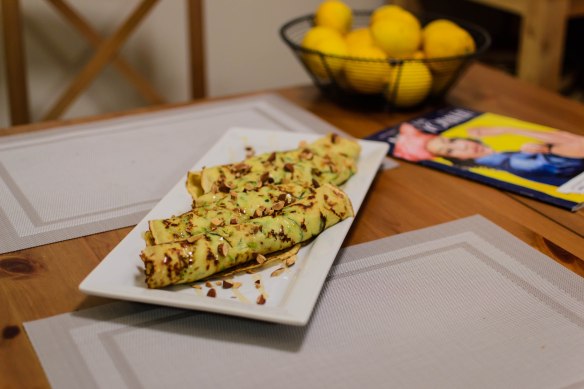
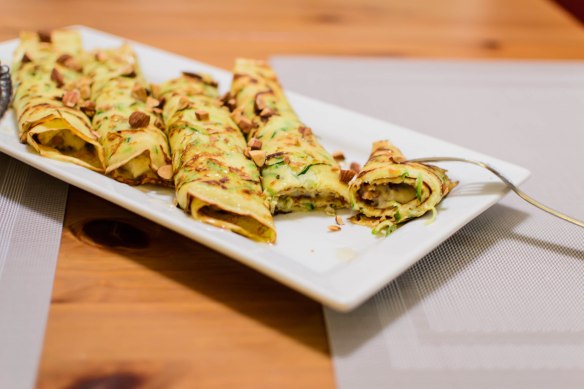
food-blog-february-2017-0280We had these for dinner as a decadent response to a rainy day, but they would make an indulgent breakfast or a superb brunch course as well. You can fold the crepes up into a triangular, handkerchief-like packet with a mound of cheese inside, or you can roll up into a cylinder, which is what my family has always done. I found I liked a few almonds sprinkled over the top, and an extra drizzle of honey as well. Any extra crepes keep fine covered in the fridge for a day or two, until you take them out, reheat them with a bit of salted butter, and smother them with cinnamon sugar, because some days require that kind of solid self care, so you can get out there and keep going.
food-blog-february-2017-0293

Zucchini Crepes with Mascarpone Almond Cream
Makes 10-12 crepes in a 10-inch skillet
30-40 minutes
For the filling:
½ cup whole raw almonds
8 ounces mascarpone cheese
1 tablespoon heavy cream
2 tablespoons honey
zest of one lemon
1-2 teaspoons lemon juice
additional honey, to drizzle
For the crepes:
2 cups shredded zucchini, from 2 medium zucchinis
2 cups milk
2 tablespoons melted butter
3 eggs
1½-1¾ cups all-purpose flour
1 teaspoon sugar
⅛ teaspoon salt


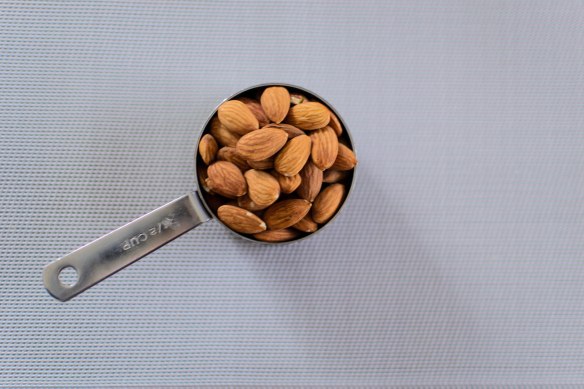
  • First, make the filling. Preheat the oven to 350F. While it heats, roughly chop the almonds – it’s okay to have some uneven sizing. Spread them out on a baking tray and toast in the oven 10-15 minutes until they are golden brown. Start checking at 10 minutes; keep in mind they will continue to cook after you take them out of the oven.
  • In a bowl, whisk the mascarpone cheese and the heavy cream together until light and fluffy (I used the whisk attachment of my stand mixer). Add the honey, the lemon zest, and the lemon juice, whisk again and taste for seasoning – you are looking for something lightly sweet, and rich but not overwhelming. When the almonds cool, fold ¾ of the amount into the mascarpone mixture, reserving the remainder to sprinkle atop the crepes.
  • To make the crepes, shred the zucchini in a food processor or with the large holes on a box grater. Collect them on a clean kitchen towel and squeeze to remove as much liquid as possible. Let it sit for 2 minutes, then squeeze once more.
  • Warm the milk slightly in a bowl or large glass measuring cup and add the melted butter, stirring to incorporate. This ensures the butter will integrate evenly, rather than hardening back into chunks. Let cool to room temperature and whisk in the eggs, then 1½ cups of the flour, the sugar, and the salt. Finally, whisk in the zucchini shreds. You should have something like a thin cake batter, probably thinner than your average pancake batter. If it seems too liquid, add the remaining ¼ cup of flour.
  • To cook the crepes, heat about 2 teaspoons butter in a 10-inch skillet or crepe pan over medium-high heat. Pour in about ⅓ cup of batter, turning and swirling the skillet as you do so to allow for a thin layer of batter to coat the entire surface. Try to spread out the zucchini a bit – it has a tendency to clump up in the middle, which results in uneven cooking.
  • Cook 1-2 minutes per side, until golden and almost dry. Don’t be alarmed if the first crepe tears or is otherwise mangled – they are delicate, and you have to get a rhythm going. After every two crepes, add another few teaspoons of butter to the skillet.
  • As you finish cooking each crepe, remove from the skillet to a covered plate to keep them warm. They won’t stick together – there’s enough fat in them to prevent clinging.
  • To serve, spread out one crepe on a flat surface and spread a few tablespoons of the mascarpone and almond mixture in a line a bit to the left of the center. Use the tines of a fork or your fingers to lift the edge of the crepe over the mascarpone filling, then continue rolling up into a tight burrito shape. Remove to a serving plate and continue with remaining crepes and filling. Sprinkle the finished rolls with the remaining almonds, and if desired, drizzle with more honey before serving.
Split Pea and Ham Soup with Collard Greens

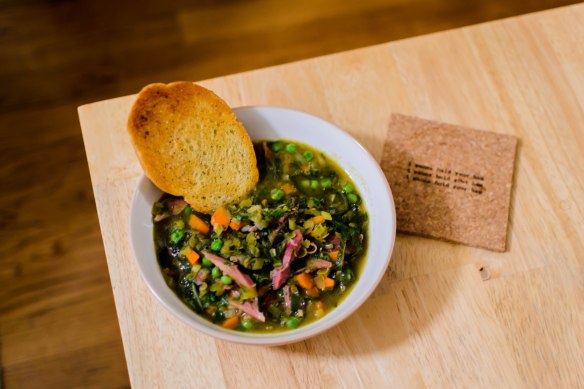
food-blog-february-2017-0318Two things come to mind when I think of split pea soup, both from childhood. In the real world, I think of my mom and sister – R. ate a lot of Campbell’s soups for lunch when she was little, and I remember Mom asking her whether she wanted some “hammy pea soup.” On screen, I remember the charming little clip from the beginning of Disney’s The Rescuers Down Under depicting how the fancy restaurant Bernard and Bianca go to gets its soup course to the table. Both memories charm me more than the actual product, so I decided, as a first real dip into the soup project, in a February that veers wildly between dreary and bright (and not just on a meteorological front), making this one over would be a rewarding project.

food-blog-february-2017-0307I’ll be honest, though, right out of the gate: this is indeed a project. This is not a soup you’ll have on the table, or in a mug curled up on the couch, in a half hour or so. This is a multi-step, multi-hour prospect.

Are you still here?

Good.

food-blog-february-2017-0294The average split pea soup is not unlike a dreary February day, the kind where you feel pressed into the couch by lack of motivation, or just unable to move away from your newsfeed. It is thick and heavy and sometimes muddy in flavor, as pulse-based soups can be. There are, I think, two ways to amend this. One is to go the daal route, amping up the spice quotient. The other, the one I chose, is to add freshness near the end of the cook time, forcing the wintry brew toward something springy, no matter what Punxsutawney Phil had to say this year.

food-blog-february-2017-0295My method of freshening was almost entirely though association of the two major players. Split peas are a starchy, dry, processed product. Why not take them to a family reunion with their plump, sweet, former selves? A cup of frozen peas would jangle in at the end to brighten things up. The other major ingredient in the mix – the ham – is usually in the form of a “ham hock,” the lower part of the leg, smoked, with the skin and bone still present. Ham hock reminded me of collard greens, and I started wondering how some ribbons of greens, cooked until tender but not decimated, would do in this soup. Pairing collard greens with starchy legumes is hardly new – food historian Michael Twitty writes this important discussion of the cultural background of collard greens, including their frequent matching with peanuts in the cuisine of the African diaspora.

food-blog-february-2017-0296Split pea soup usually has some other starchy ingredient in it – most often potatoes. I opted to omit this entirely, but you could certainly add some back in, or change it up and use celery root instead for a more herbaceous flavor. Instead, I made my base simple: carrots for sweetness and color, leeks for a mild onion-y punch, and just a bit of garlic to keep things savory. At the last minute, I stirred in a handful of parsley for a final bright burst.

food-blog-february-2017-0302As I noticed when I consulted a few recipes for inspiration, differences in procedure really lie in how you treat the vegetables. Some recipes brown them first, then add the peas and broth, but this can result in disintegrated veg by the time the soup is ready. Some, to prevent this over-softening, add the vegetables part way through the cooking, but then the soup doesn’t benefit from the extra flavor a bit of caramelization and initial browning provides. The New Best Recipe cooks the vegetables in a separate vessel before adding them to the soup, and that would be fine if you don’t object to extra dishes… but I always object to extra dishes. I would rather it take longer and have less to wash up.

food-blog-february-2017-0308In my procedure, we cook everything in the same pot. First, brown the exterior of the ham hock first (I used a smoked pork shank, but they are almost the same thing). Once it is crisp and golden on the exterior, the vegetables get browned in the residual fat (plus some fatty bits and pockets, if you want to carve any off and add them), then set aside until the final twenty minutes of simmering, so they retain some texture and have the extra flavor from the pork fat. Yes, this adds some time, but you’re prepped for a project anyway, right?

I have to admit, though I always want to like what I make, I wasn’t expecting to be crazy about this soup. With the dreary, February-gloom hanging around my expectations despite attempts to create brightness, I thought I would like it but not love it.

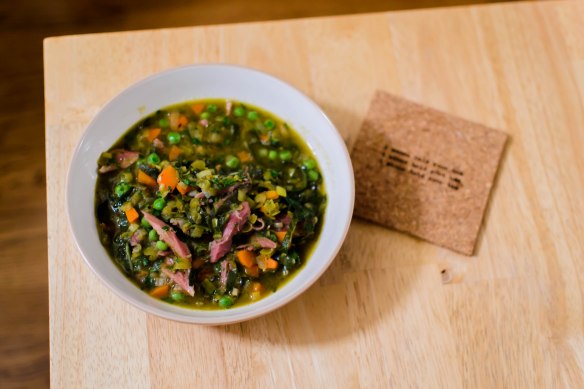
food-blog-february-2017-0312It’s nice to be wrong sometimes, isn’t it? This soup exceeded my expectations by leaps and bounds. The play between the two kinds of peas – creamy and starchy on one hand and barely cooked pops of sweetness on the other – was delightful. The ribbons of collard greens were perfect: vegetal and tender, good flavor companions with the peas and the shreds of ham. Sometimes when I make a soup I end up freezing half of it and planning in vain to use it again, but this one we scarfed down the night of, and then for lunch the next day, and then for lunch again, and it was gone, and our bellies were warm and bolstered against the gloom of February.

food-blog-february-2017-0318This will keep in the fridge for 4-5 days in a sealed container, and reheats easily in the microwave or on the stove. You might need to add a drizzle or two of extra broth when reheating, since the peas suck up a lot of the liquid as they cook and as they cool. Delightfully, this is one of those soups that, while it’s delicious the first day, improves as it sits and its flavors mingle.

food-blog-february-2017-0320* yes, that coaster does say “I want to hold your ham.” It’s from a set my sister gave me that features misheard song lyrics, the technical term for which (can I tell you how much I love that misheard lyrics have a technical term?!) is mondegreen.


Split Pea and Ham Soup with Collard Greens
3-4 hours
Serves 6
1 tablespoon olive oil
¾-1 pound ham hock, smoked pork shank, or bone-in picnic ham
2 leeks, white and pale green sections only
3 carrots, stem end lopped off, peeled
2 cloves garlic, crushed, papery skins removed
6 cups water, broth, or stock. I used my roasted vegetable broth
2 bay leaves
2-3 sprigs fresh thyme
½ pound green split peas (a little more than 1 cup)
ground black pepper to taste
salt to taste
1 bunch collard greens, tough stems removed
1 cup frozen green peas
¼ cup chopped fresh parsley


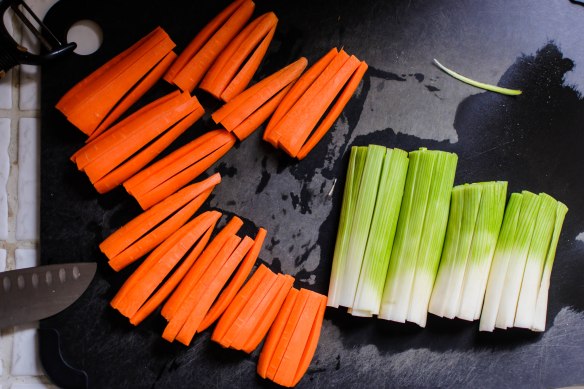
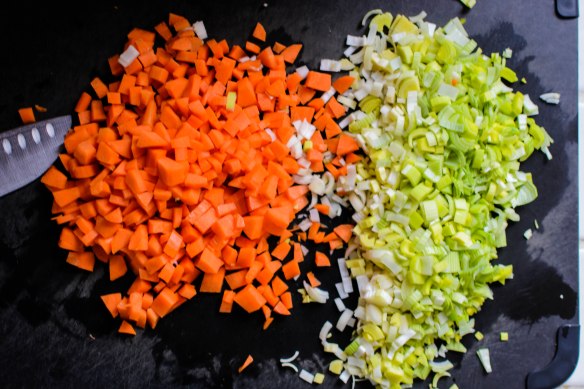
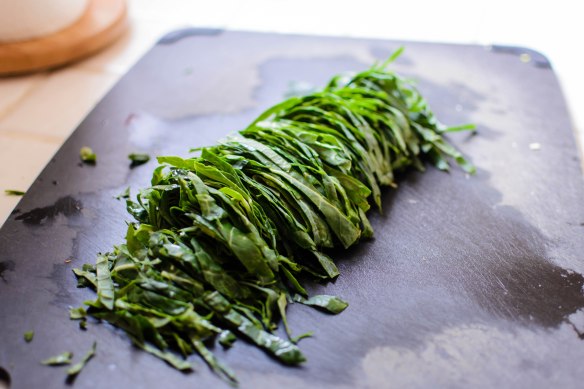
  • Begin by prepping the vegetables. You’ll be happier later. For the leeks, slice off the root end, then cut vertically so you have two half-moon shaped logs. Rinse these under water, working your fingers between the layers to excavate hidden dirt. Shake vigorously. Set on your cutting board with rounded sides up, then cut in half vertically, then in half again so you have four piles of thin strips, as in the photo above. Slice across these strips to produce small squares. For the carrots, cut each in half horizontally, then in half vertically. Treat these like the leeks, slicing each rounded half-log into four thin strips, then cutting across the strips into small pieces. For the collard greens, once you have removed the tough stems, stack the leaves in a pile and roll them up tightly into a fat log. Slice across the log into thin ribbons. You can cut those into smaller pieces if you want to, but I liked the look and feel of the ribbons.
  • In a large pot, heat the olive oil over medium high heat. When it is shimmering, add whatever sort of ham you’re using and cook until all sides are nicely browned: 2-4 minutes per side. Remove the meat and set aside. Lower the heat to medium and add the prepped carrots, leeks, and garlic. If the ham has some pearly fatty bits, carve those off and add them to the pot with the vegetables to continue rendering. Cook, stirring, until nicely caramelized: about 10 minutes.
  • Remove vegetables and fat scraps to a plate. Discard the fat scraps, if there were any, but reserve the vegetables. In the pot, add the stock or broth or water, the ham again, and the bay leaves. Cover the pot, turn the heat up to medium high until you reach a boil, then reduce heat to a simmer, cover the pot, and simmer until the ham is tender and pulling away from the bone. For me, this took about 90 minutes. It may take you up to 2 hours, depending on what kind of meat you are using.
  • When the ham is quite tender and pulling away from its bone, remove it from the fortified cooking liquid and set it aside until it is cool enough to handle. After it cools, separate the meat from the bone and shred the meat. Discard any rind or fatty bits.
  • To the cooking liquid in the pot, add the thyme sprigs and the green split peas. Keep the liquid at a simmer for 45 minutes, until the peas are tender but not dissolved. Once you’ve shredded the ham, you can add the bone back into the cooking liquid if you wish. Season to taste with salt and pepper, keeping in mind you’ll be adding ham back in, which can be quite salty.
  • With the peas tender and just beginning to fall apart, add the reserved vegetables, the prepared collard green ribbons, and the shredded ham to the pot. Return to a simmer for 20 minutes. Many of the split peas should now have collapsed into a creamy mess.
  • Finally, add the frozen peas to the pot and cook just until they are hot – another 5 minutes at maximum. Remove the bay leaves, the crushed garlic pieces, and the ham bone, if you put it back in there. Stir in the parsley, taste for seasoning once more, and serve, preferably with a piece of garlic-rubbed toast to dip.

Save

Save

Save

Grape and Cherry (Tomato) Avocado Toast

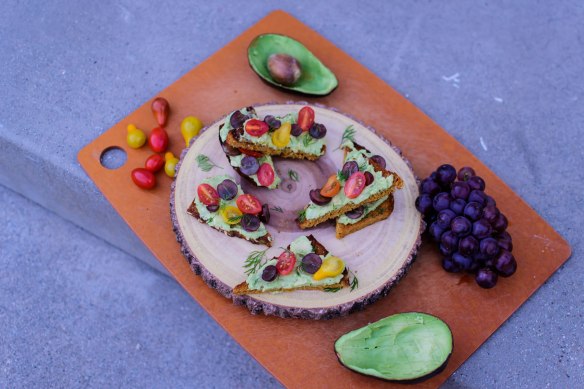
food-blog-january-2017-0152This one is a restaurant recreation from a spot we like in Culver City. These guys appreciate the lux/simplicity combo that is avocado toast; in fact, they are also the inspiration for my last foray into this ever-so-trendy meal base.

food-blog-january-2017-0136Cherry tomatoes and grapes seemed like a strange combination, and I was dubious about how well grapes would play with avocado, but it all works. The tomatoes are bright and acidic, and the grapes are tart enough that, with a squeeze of lemon and flake or two of salt on top, they toe the savory/sweet line successfully.
food-blog-january-2017-0157

I hope all is well in your world.


Grape and Cherry (Tomato) Avocado Toast
Serves 2 as an appetizer; 1 as a light lunch
About 15 minutes
4 thin slices sourdough or French bread (you can remove the crusts if you want more uniform toasts)
Olive oil spray, or 1-2 teaspoons olive oil
1 teaspoon coarse sea salt, divided
1 ripe avocado
1 tablespoon lemon juice, divided
freshly ground black pepper to taste
12 cherry tomatoes, halved (I like a mix of colors)
12 red grapes, halved
1 teaspoon fresh dill sprigs
1 teaspoon finely chopped chives
  • Preheat your broiler to high and prep the bread by spraying or brushing it with the olive oil on both sides. Sprinkle ¼ – ½ teaspoon coarse salt evenly over both sides of all four slices (that is, ¼ – ½ teaspoon for all four, not ¼ – ½ teaspoon per slice). Set the slices on a broiler tray or a wire oven rack set over a cookie sheet and broil on high, flipping each slice over once, until nicely browned and quite crisp on both sides. Don’t step away or try to prep other ingredients while you broil; the bread can burn very quickly. Once you have crisp, golden toast, set it aside to cool slightly.
  • In a small bowl, smash up the avocado with 1-2 teaspoons of the lemon juice. Add black pepper to taste, and slightly underseason with salt (we’ll be adding more to finish). You can go with a perfectly smooth mixture if you want, but I like to leave a few small chunks of avocado for extra texture.
  • Smear ¼ of the avocado mixture in an even layer onto each piece of toast. Then cut each slice on the diagonal and arrange it on a plate or serving platter. Arrange the halved grapes and tomatoes on each piece – aim for even distribution. Scatter the chives and dill sprigs over the top, then squeeze on the remaining 1 teaspoon lemon juice and a very light sprinkle of coarse sea salt. That way we get a crunch and salty kick with each piece.
  • Serve immediately – underneath the weight of the avocado, the toast will soften very quickly.

Save

Project Soup Foundations: Roasted Vegetable and Chicken Stock/Broth

food-blog-january-2017-0245This last week has been a lot. A new president, an elderly dog with suddenly severe mobility challenges, a new president, a state that seemed to offer a pointed meteorological response, particularly on inauguration day (and then clear, sun-swept skies for the women’s march the next morning – what up, universe!), oh, and that whole new president thing. I opted, as is my usual practice, to respond in part by shuffling into the kitchen. Cooking doesn’t do a great deal on a large scale, but it makes me feel safe and in control, and it is with those feelings that I gain a foundation of strength and confidence to undertake other, more consequential actions. So let’s talk foundations. The foundation – the basis – of soup is liquid. That’s not always the part you add first, and it often doesn’t feel like the most interesting part,* but it’s what separates soup from puree, or pasta, or pile-of-diced-vegetables-with-some-beans-and-meat-or-maybe-potatoes.
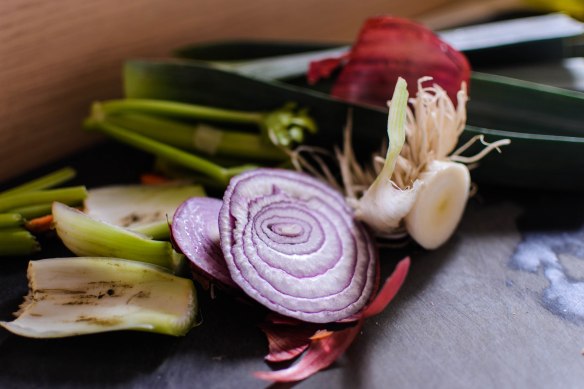
food-blog-january-2017-0163food-blog-january-2017-0169food-blog-january-2017-0175Obviously you have a lot of choice when it comes to choosing this liquid. You could, of course, work with plain old water, and per some rational arguments this does work, but most soups advocate for a stock or broth of some sort – usually the variety that most closely matches the “star ingredient” in the finished dish. I’d wager a guess that chicken and vegetable are the most common, with beef coming in a wavering third. There are many good options in the aisle at the store for all of these varieties – when I go with store-bought I opt for low-sodium – but what fun would it be if I told you to go out and buy the base of our project for the whole year? Nope. Doesn’t sound like me. We need a strong foundation. We’re going to make it ourselves.
food-blog-january-2017-0182food-blog-january-2017-0184The first hurdle to surmount is the question of broth vs. stock. These terms get used pretty interchangeably, but there is a difference. Harold McGee offers mostly an etymological distinction, citing the latter as deriving from “an old Germanic root meaning ‘tree trunk’” and the former as “more specific and ancient,” going back to the turn of the first millennium with the root bru, which means “to prepare by boiling” – quite similar to our word “brew” (599). Alan Davidson agrees, adding that though broth or bru at its inception just meant the liquid and its contents, in recent centuries the word has implied the presence of meat. A broth could be the resulting liquid of brewing down these ingredients, or a finished product in itself, like the broth of a soup. Stocks, on the other hand, Davidson positions as less finished, component parts of a dish-to-be (108).

food-blog-january-2017-0197More recently, though, at least in American cooking parlance, stock vs. broth tends to be a question of bones vs. meat. A broth is a liquid made from meat that has been simmering, usually along with vegetables and herbs for flavor. Stocks are made from bones as well as connective tissue, along with vegetables and aromatics for flavor, and the collagen extracted from the bones during the simmer results in a product with more body – a heft or thickness absent from broth. As Alton Brown notes, it is hard to remove all meat from bones when you are making a stock, which means that many homemade stocks are actually a hybrid between the two bases; that may be in part why we tend to use the words interchangeably. At least, that’s the answer I’m going for.
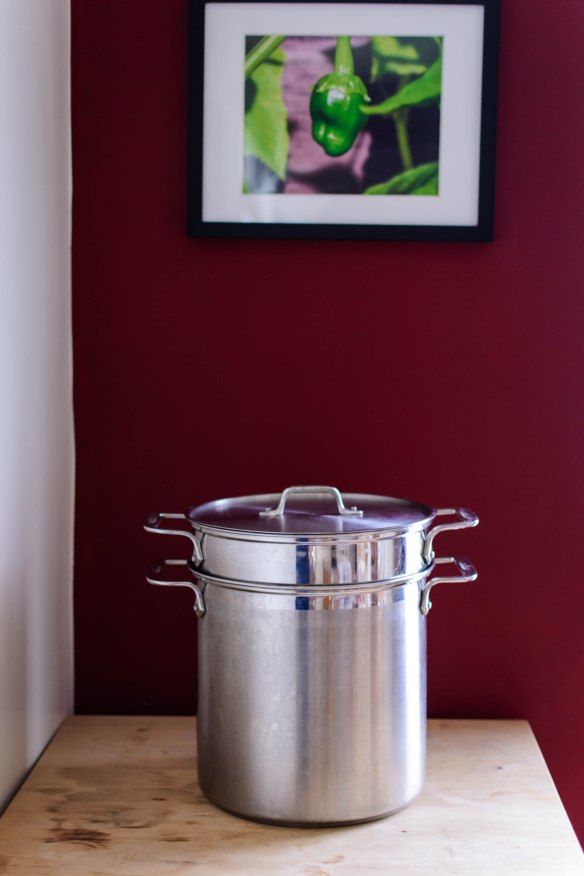
food-blog-january-2017-0199food-blog-january-2017-0223food-blog-january-2017-0235According to these defining principles, then, what we’re going to make here is one broth (no bones; all vegetables), and one stock (well, broth-stock. Brock? Stoth?). The ingredient lists are similar and the procedure is easy, if a little time-consuming: roast some veg or a chicken, pop the roasted veg or bones in a big pot, add flavoring agents, cover with water, simmer long enough to produce a bronzed, aromatic liquid. Strain, cool, and store. That’s it. Yes, it’s an additional step or two on your quest for soup, but it makes plenty, and then you’re set for a few months, depending on the frequency of your broth needs. Call it a project for a rainy day, which we seem to be having plenty of lately.
food-blog-january-2017-0210food-blog-january-2017-0207I particularly like making the effort just after Thanksgiving, when the bones and trimmings of that turkey carcass make enough meaty, strengthening, belly-consoling stock to service my soup, stew, risotto, couscous, and arroz con pollo needs for at least a quarter of the year.**


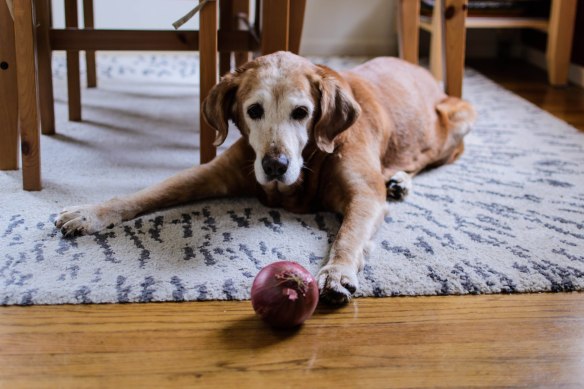
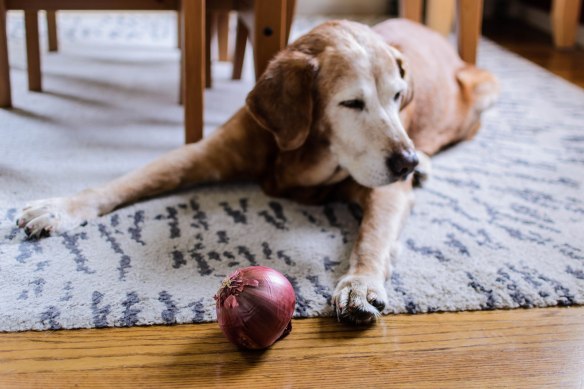
food-blog-january-2017-0213food-blog-january-2017-0211* it’s also not the most interesting or sexy thing to take photos of, so I hope you appreciate Lucy’s willingness to help out by posing with various vegetables (she couldn’t be bothered with the celery, so we stuck with onion and carrots).

food-blog-january-2017-0218** with the Thanksgiving turkey carcass, I increase the amount of water in the mix, but tend to leave the other ingredient quantities about the same.
 

Roasted Vegetable Broth
Makes 10-11 cups, depending on how much evaporation takes place
About 2 hours, if you are organized
The mushrooms and soy sauce here produce a final product that is darker in color than the broths you might be used to, but I like including them because they contribute such deep, earthy flavors. Don’t worry about the saltiness of the soy sauce – it’s only a few tablespoons in a tremendous three quarts of water. This leaves the finished broth slightly under-seasoned, so you can reduce it down into a sauce without worries, or add salt to taste as you use it for other dishes.
1 onion, stem end and root stub removed, papery skins still on, quartered
1 leek, dark green leaves removed, roots lopped off, halved and rinsed well between the layers
3 thick carrots, stems lopped off, cut in thirds
3 celery stalks, top and bottom tips removed, rinsed free of dirt, cut in thirds
2 tablespoons olive oil
1 teaspoon salt
8-10 garlic cloves, skins on
8-10 shiitake mushroom stems or 4-5 whole shiitake mushrooms (you could use crimini instead, if you prefer, but I had shiitakes. Just go for a dark, flavor-rich mushroom that you like.)
¼ – ½ bunch of parsley, stems and leaves
2-3 big sprigs of thyme (2-3 inches each)
1 tablespoon whole black peppercorns
2 bay leaves
3 tablespoons soy sauce
12 cups (3 quarts) cold water


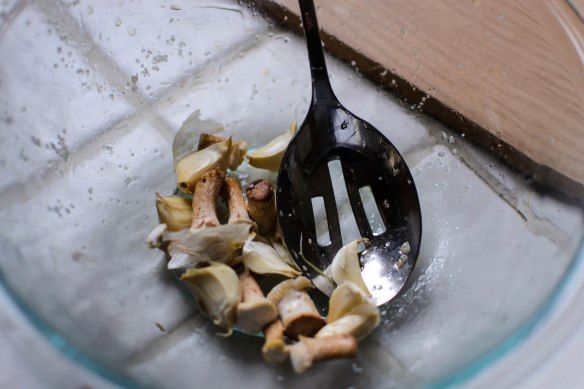
  • Preheat the oven to 375F while you prep the vegetables. In a large bowl, toss the onions, leeks, carrots, and celery with the 2 tablespoons olive oil and 1 teaspoon salt. Line a large cookie sheet with aluminum foil and scoop the vegetables onto it using a slotted spoon. Roast at 375F for 30 minutes. Meanwhile, add the garlic cloves and the mushrooms or mushroom stems to the bowl and toss around a bit to coat them with the remaining olive oil and salt.
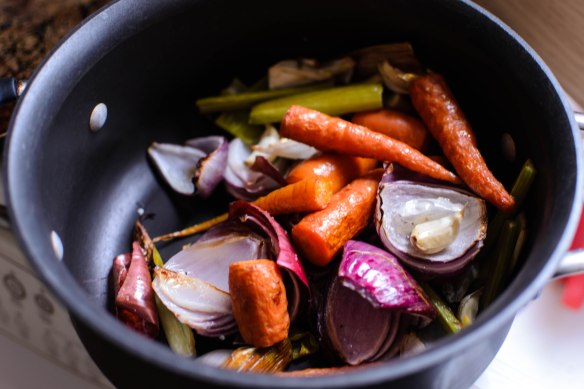
  • After half an hour, remove the cookie sheet from the oven, toss the vegetables around a bit to prevent sticking and encourage even browning, and add the mushroom stems or whole mushrooms and the garlic. Put the cookie sheet back into the oven and roast another 20 minutes, until the edges of the onions and leeks are deeply browned and a bit crisp.
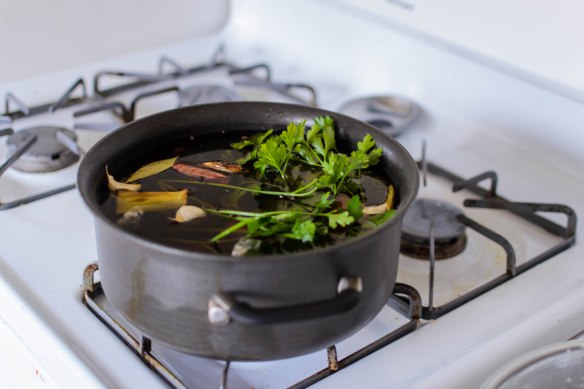
  • Put the roasted vegetables into a large stock pot or dutch oven (if you’re careful, you can just lift the whole sheet of aluminum foil and dump them straight in). Add the parsley, the thyme, the peppercorns, the bay leaves, and the soy sauce. Dump in the water, turn the heat on high, and clamp on the lid.
  • When the liquid in the pot reaches a boil, turn the heat down to medium low or low and keep it at just a simmer for 60 minutes.
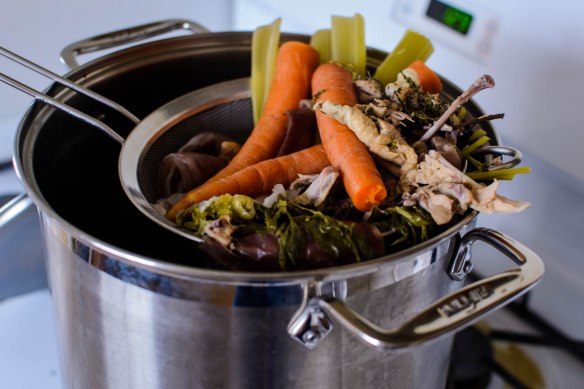
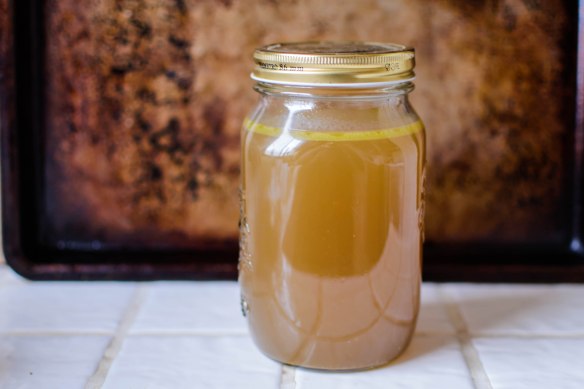
  • After an hour, turn off the heat and use a strainer or fine mesh sieve to scoop out the vegetables and peppercorns. Let the remaining liquid cool, then strain into your chosen storage containers. I like to use clean large yogurt containers – I portion out about 3 cups per container.
  • Roasted vegetable broth can be stored in the refrigerator for one week, or frozen for several months. Use as needed for soups, stews, deglazing vegetables; anything that needs a rich, earthy liquid as a base.


“Everyday” Chicken Stock
Makes 14-15 cups, depending on how much evaporation takes place
About 2 hours (not counting the time required to roast and pick the chicken)
Here we leave the vegetables in bigger pieces since we will simmer for a bit longer – that way they won’t break down entirely as the hot water extracts the necessary flavor and collagen from the bones. I use skin as well in the mix, because I like the extra flavor and seasoning it contributes. You can leave it out if you wish. I’m calling this “everyday” because though I realize you won’t make it every day, it is nice to have access to on a daily basis, which is why always having a few quarts stashed in the freezer is one of my kitchen goals.
Carcass (and remaining skin, if desired) from a 4½-5½ pound chicken, picked reasonably clean of meat (save for chicken tacos, or pot pie, or sandwiches, etc.)
3-4 whole carrots, stem ends lopped off
3-4 stalks celery, leaves and all (rinse or brush off any dirt at the root end if needed)
1 onion, stem and root ends removed, quartered (you can use or discard the papery skin; I’ve done both and there isn’t much difference to the resulting product)
10-12 cloves garlic, papery skins still on
½ bunch parsley, stems and all
3 thyme sprigs (2-3 inches each)
3 sage sprigs (2-3 inches each)
3 rosemary sprigs (2-3 inches each)
1 tablespoon whole black peppercorns
2 tablespoons coarse sea salt
2-3 bay leaves
16 cups (4 quarts) cold water. We want to cover the ingredients by an inch or two (though some of the vegetables will float), but not add so much water that the final product is diluted – the bones can only give up so much flavor.


  • Place all ingredients together in a large pot. I like to use a big pasta pot with the removable strainer insert. You could, I suppose, make use of the strainer insert, but some of the smaller pieces (i.e. the peppercorns) are going to fall through, so I just use the empty pot. Saves at least one dish to wash later.
  • Cover the pot and bring the liquid to a boil over high heat, then reduce to low or medium-low and simmer for 1½-2 hours, until the liquid is golden and aromatic, and the vegetables are extremely tender but not yet falling apart.
  • Use a fine mesh sieve or strainer to remove and discard the bones, vegetables, and peppercorns. Let the remaining liquid cool, then strain into a large pitcher and store in the refrigerator overnight. Excess fat in the stock will float to the top and solidify; scoop it off and discard it the next day.
  • Once the fat is discarded, strain the stock into your chosen storage containers. I like to use clean large yogurt containers – I portion out about 3 cups per container.
  • Homemade chicken stock can be stored in the refrigerator for one week, or frozen for several months. Use as needed for soups, stews, risottos; anything that needs a fragrant, golden, poultry-flavored liquid as a base.


Carrot Soufflé

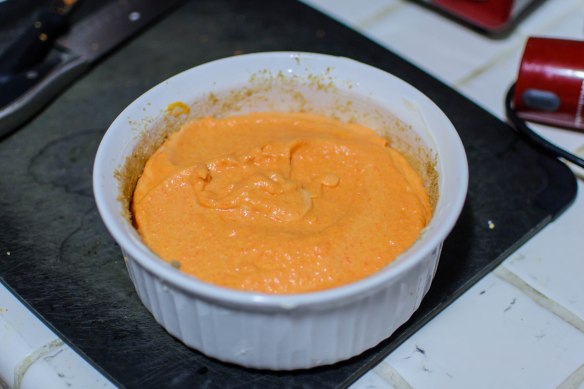
2016-food-blog-photo-december-7A few weeks ago, I got my “what to blog about” inspiration from the unlikely source that is the Trader Joe’s samples counter. They were demo-ing carrot soufflé, a bright orange spoonful of light, sweet puree that I immediately wanted to play with. I’ve done a sweet potato soufflé before, and I thought a carrot version would work equally well as a semi-sweet holiday side dish, bumped up with a few flavor partners these bright, knobbly spears play well with.

2016-food-blog-photo-december-0684I’m not usually a fan of oranges in holiday dishes (especially the aforementioned sweet potatoes: keep that orange juice out of my carbs!), but carrots and orange are too chummy to keep separated for long. Ginger seemed like another good guest to invite to this party, and a good squeeze of maple syrup to add a burnished kind of sweetness in there.

2016-food-blog-photo-december-5Soufflé carries with it a reputation of delicacy and fussy fragility, and in some ways this is true. The elegant, gravity defying puff that is its signature is in part a result of egg whites beaten just so, but also of careful handling and a patient, even leisurely attitude. And sometimes it just falls. When that happens, you just have to shrug and accept it. Maybe have another glass of eggnog.

2016-food-blog-photo-december-0697This is a (reasonably) convenient soufflé recipe in that it involves an equal number of egg whites and egg yolks. There’s a bit of fussiness with separating, ensuring you haven’t tainted the pristine whites with even a breath of yellow, or they won’t rise up into that spongy cloud you need. But scrupulous attention helps with that, and a dash of cream of tartar ensures a quicker, fluffier snowdrift of whipped whites.

2016-food-blog-photo-december-6Apart from that, it’s just a question of integration. The carrots, after a softening boil in water and orange juice, get blended with flavoring agents, yolks, and a glug or two of cream, and then it’s just a question of folding in those whites carefully and gently, trying not to deflate anything. I’ve explained my method in the step-by-step below, but here’s another excellent reference from the kitchn, if you want more detailed guidance.

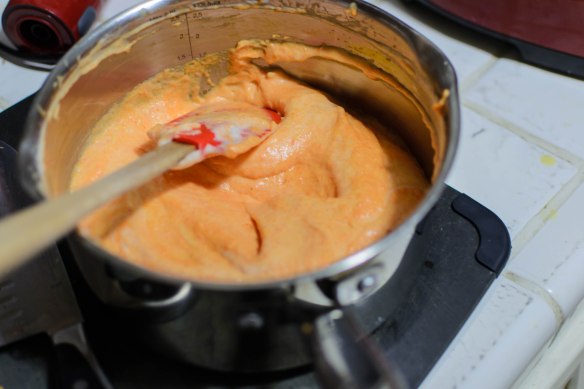
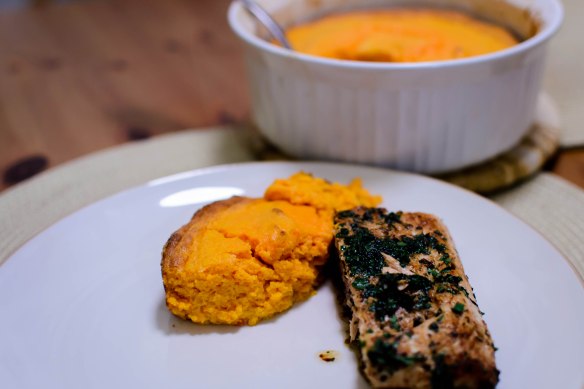
2016-food-blog-photo-december-7After a careful deposit into the oven (we want all the air we can keep in this dish of orange velvet), you are rewarded with a bronzed puff, heavier than meringue or mousse, lighter than custard – that impossible, almost strange, texture only a soufflé has – and you scoop out great spoonfuls because it’s so light, and brightly carrot-y, enhanced by the orange and the ginger and luxurious from the cream. I think this would go well with a turkey or ham-based holiday menu, but we had ours with herb and butter basted salmon, and found we didn’t miss having a starch component. Besides, it left room for a dessert I’ll show you next week: another puff, but of a very different sort, equally on board for the impending holidays.

2016-food-blog-photo-december-8

Carrot Soufflé
80-90 minutes, including cooling time for the carrots
Serves 4
2½ cups peeled, 1-inch carrot chunks (6-7 medium carrots)
zest from one large orange
¼ cup fresh orange juice from one large orange
2 cups water
1 teaspoon salt
2 tablespoons butter
1 tablespoon brown sugar
1 tablespoon grated fresh ginger
¼ cup maple syrup
½ cup heavy cream
3 eggs, separated
¼ teaspoon cream of tartar, optional


  • In a medium pot with a lid, combine the carrots, orange juice, water, and salt. Plonk in the juiced halves of the orange too (reserve the orange zest for later). Pop on the lid and bring to a boil over medium high heat, and boil until the carrot pieces are tender but not falling apart: 10-15 minutes, depending on the size of your carrot chunks. Drain and cool to just above room temperature (we’re going to add raw egg yolks and don’t want them to scramble).
  • While the carrots are cooking and cooling, preheat your oven to 375F and prepare your baking dish: use the 2 tablespoons butter to grease a 1½ quart round baking dish with straight sides (by all means use a proper soufflé dish for this if you have one; I don’t. But hey, it is almost Christmas…). Sprinkle the brown sugar over the buttered sides of the container, then stow it in the freezer for 5-10 minutes. The sugar sanding creates texture to help the soufflé climb the walls of the container, and freezing it makes it take longer to dissolve in the heat of the oven, so you’re giving your puff a head start.
  • In the pot with the cooled carrot chunks, add the fresh ginger, the maple syrup, the heavy cream, the reserved orange zest, and the 3 egg yolks. Use an immersion blender (or transfer the whole mix to a blender or food processor) to break down into a smooth puree. Be sure no carrot hunks remain.
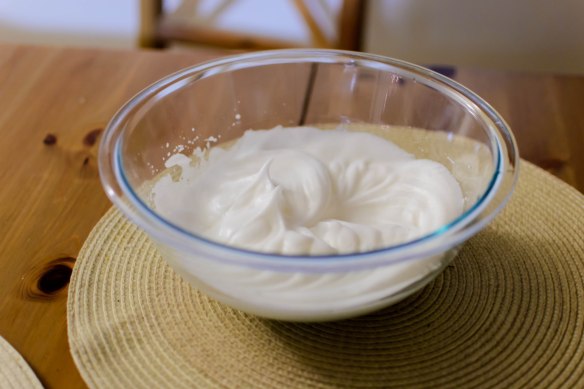
  • In a separate bowl, add the cream of tartar to the egg whites. Using a handheld electric mixture (or a whisk, if you need to work on your arms), beat the whites at first over medium, then high speed until medium peaks form. The whites will foam, and then become pure white, and finally begin to stiffen like a good whipped cream. To determine the stiffness of your peaks, turn off the beaters and lift them straight out of the whites. If you get little hills that collapse back into the mixture, you have soft peaks. If you get little tips that fold over just a bit when you pull the beaters away, you are looking at medium to stiff peaks, which is what we want.
  • Using a rubber spatula, scoop about ⅓ of the egg white fluff into your carrot puree base and stir until no white streaks remain. No need to be careful with this part – full integration is just fine.
  • Now, slide the other ⅔ of the whites into the sweet potato mixture and fold in gently until just combined – some white streaks may remain and that’s fine. I like to fold by drawing my spatula around the edge of the bowl in a horseshoe shape, then pulling it back toward me in a straight line.
  • Retrieve your frozen baking dish and fill with the soufflé mixture, being careful not to let it plop from too high (in case of deflation). Smooth off the top the best you can – this seems fussy, but it will aid in even rising.
  • Bake in a preheated 375F oven keeping the door closed the whole time for 35-45 minutes, until the edges are nicely browned and the soufflé has puffed up in the center as well as the sides. For maximum wow factor, transport carefully and immediately to the table, so your fellow diners can appreciate your soufflé skills before it deflates. Dig in with a large spoon and enjoy.

Braised Lamb on Kale and Avocado Toast

2016-food-blog-november-0420Are you tired of turkey yet? Good, me neither. But just in case you want an indulgent break, may I suggest lamb instead? The inspiration for this recipe comes from three places: a restaurant near our house that does a braised lamb dip with kale and a garlic jus, the intense obsession of the last few years that is avocado toast, and Ina Garten. Ina doesn’t offer me any dish in particular, but does often take luxury ingredients and serve them in a very simple, homey way, and that’s exactly what happens here.

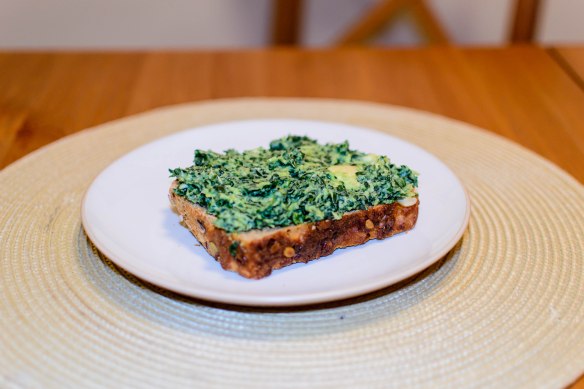
2016-food-blog-november-0395The first few times I watched a Barefoot Contessa episode that did this, I was annoyed. Like Ina’s penchant for advocating “best quality” base ingredients (read: expensive), I found the idea somehow pretentious. If I’m going to spend the money on fancy ingredients, then I want a fancy dinner! But contemplating this dish, it somehow seemed right. Let’s slow braise some lamb with aromatic vegetables and a good splash of wine until it collapses and shreds eagerly, bake a loaf of nicely seeded bread and cut it into thick slices, and spread that bread with a smash of avocado and kale, dosed with a good squeeze of lemon to keep it bright before draping on a healthy pile of the lamb. Fill the belly and keep the darkness away.

2016-food-blog-november-0391In determining how to go about this, I turned to yet another inspiration: the marvelous food mind that is Michael Pollan. In his book Cooked, which I’ve written about before, he spends a chapter discussing braising as a cooking method, and offers a mentor chef’s procedure in seven steps. Though I’ll give you the full recipe below, here’s what he recommends in my own order:

  1. salt the meat, then brown it
  2. finely dice some onions
  3. sauté onions and other aromatic vegetables
  4. place all the ingredients in a covered pot
  5. pour the braising liquid over the ingredients
  6. simmer, below the boil, for a long time
  7. remove pot from oven. If necessary, skim fat and reduce liquid. Bring to the table and serve.

As you can see, this is a procedure rather than a recipe – it’s the kind of steps a grandmother well acquainted with her own methods would give, and answer questions like “how many onions” with “enough,” or the precise temperature at which to braise with “oh, pretty low.”

2016-food-blog-november-0401Within the chapter itself, though, Pollan does give a bit more. Since the section of the book is the look at “Water,” he discusses the merits of using water rather than some other liquid to braise. Though we are always tempted to use broth or stock or wine, he notes that water retains a purer flavor – the meat is not in competition with the flavors of the liquid you’ve chosen. I bore this in mind, but wanted some red wine richness and tang anyway, so I settled for half and half water and wine. Only part way through the miracle, I suppose you could say.

This is a long project. The braise itself takes 2-3 hours all on its own, and that’s after you’ve let the onions cook down slowly for 30 minutes, then allowed the other vegetables to mingle another 15. Plus, as if all that wasn’t enough, you give the lovely, heady broth another good half hour to boil to create your final jus. And if you’re baking the bread yourself (in for a penny, in for a pound, right?), you’re looking at another multi-hour ingredient. You could, it seems, spend the entire day in the kitchen, lazily cooking your way toward dinner. Add some Edward Sharpe and the Magnetic Zeros, and that sounds like the day of my dreams.

2016-food-blog-november-0408When you’re finished, even though the resulting product looks humble, the reward is anything but. The lamb falls apart, and you stand there over the bowl you’re shredding it into trying not to stuff too many pieces straight into your mouth. It is meaty and savory and slightly gamey, and you taste lamb, but also wine and dark, piney, peppery herbs, and a subtle sweetness that comes from the vegetables. And then you pile it onto freshly toasted bread that you’ve smeared with the grassy, fatty spread you’ve made of kale and avocado, and you dribble over some of the juice left behind in the pan, and you eat it. And that was your day: making food, eating food, letting the aroma of the long braise fill your nostrils and your house, and you sleep happy.

2016-food-blog-november-0412Not that you need telling what to do with leftovers as luxurious as braised lamb, but if you aren’t sure, I think they would make amazing filling for tacos, perhaps with some shredded cabbage and feta cheese, and maybe a dollop of sour cream or yogurt, thinned with a squirt of lime and sprinkled with wafer thin slices of jalapeno and radish.

2016-food-blog-november-0420

Braised Lamb on Kale and Avocado Toast
Approximately 5 hours
Serves 4 + leftover lamb
2 tablespoons salt
2 pounds lamb leg or shoulder, in one piece (i.e. not in chunks)
¼ cup olive oil
2 white or yellow onions, finely diced
3 large or 4 medium carrots, finely diced
3 ribs of celery, finely diced
8 garlic cloves, smashed, skins removed
2 bay leaves
1 tablespoon whole peppercorns, optional
2 inch sprig rosemary, optional
2 cups dry red wine
2 cups cold water
2-3 ounces kale, leaves only – tough stems removed – finely chopped
1 ripe avocado
2 tablespoons lemon juice
1 tablespoon chives or green onion tops, very thinly sliced
salt and pepper to taste
thick slice of seeded toast for each diner
optional: finely sliced pickled radish or onion, to garnish


  • Sprinkle the salt evenly over both sides of the lamb. It will seem like a lot. Don’t worry. This is seasoning the entire 2 pounds of meat AND the broth. Let it sit for at least ten minutes, or up to a few hours.
  • When you are ready to cook, heat the olive oil in a dutch oven or other large, steep-sided pot with a lid over medium-high heat until it is shimmering. Carefully add the lamb (the oil may spit) and let it sear until well browned, then flip and repeat until all sides are nicely browned: about 2-4 minutes per side. Remove to a plate.
  • Turn the heat down to medium low or low and add the onions. We are looking to sweat them, not brown them. They will pick up some color from the lamb, but don’t actually let them sizzle too much after adding them. Cook, stirring frequently, until they are very tender and translucent, about 30 minutes.
  • Add the carrots, celery, and garlic cloves, stir to combine, and cook another 15 minutes.
  • Add the bay leaves, the rosemary and peppercorns, if using, and settle the lamb on top of the vegetables. Pour the wine and water in around the lamb as well as any meat juices that collected on the plate while the lamb rested, add the lid, and turn the heat up to medium high. Bring to a simmer, then turn back down to medium low or low – we want to keep the liquid below a simmer – only the barest bubble every so often.
  • Cook, keeping just below a simmer, until the lamb is very, very tender: 2-3 hours.
  • When the lamb falls apart at the slightest fork provocation, hoist it out to a bowl and turn up the heat on the pot to high. Boil the cooking liquid about 30 minutes to reduce it, then strain out the vegetables and, if you wish, pour the remaining jus into a gravy boat to serve.
  • While you wait, make the kale and avocado spread: scoop the avocado out of its skin and smash it up with a fork or spoon. Squeeze in the lemon juice, add the kale and chives and mix well, then taste and add salt and pepper to your liking.
  • Toast the bread and smear on thick, equal portions of the kale and avocado spread.
  • Just before serving, shred the lamb using two forks or, if it has cooled enough, your fingers. Pile a good helping onto the toast, then scoop or pour on a few tablespoons of the jus. Eat immediately.