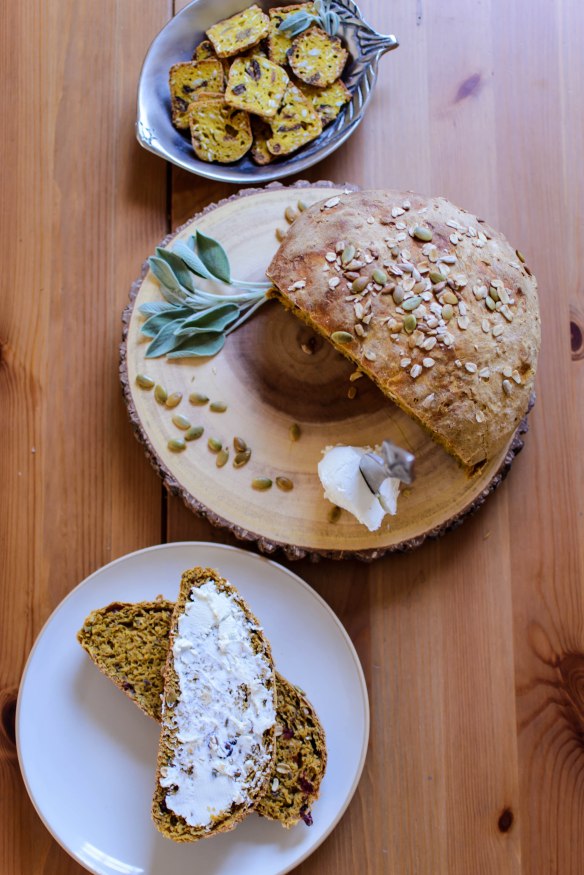
Dried Cranberry and Seed Pumpkin Loaves

As I noted a few weeks ago, all I want to do in my kitchen, still searingly bright with sunlight from Southern California’s misguided attempts at “fall,” is bake. Luckily, one of the few cool weekend days we’ve had since then corresponded with a break in grading, and I had a chance to see if my dough skills are still in there somewhere.

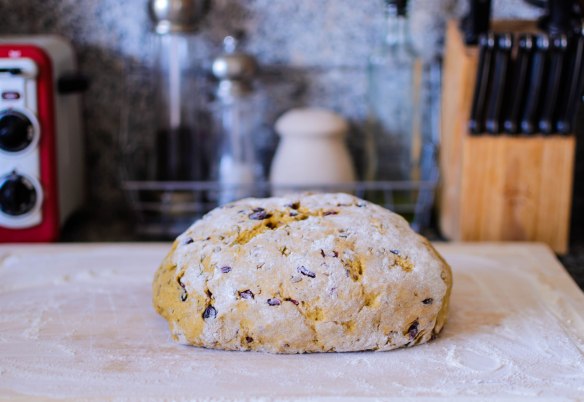
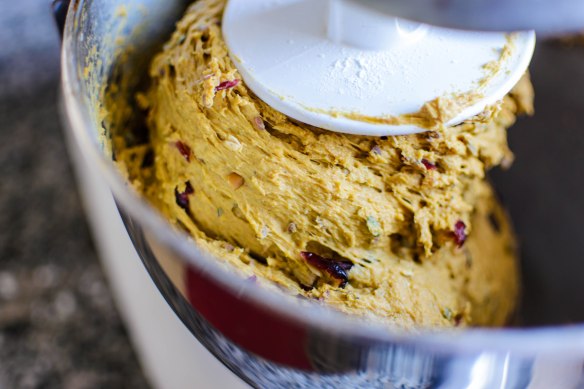
Inspiration for these pretty, autumnal loaves came from a seasonal box of those lovely raincoat crisp crackers Trader Joe’s puts out, these a bright, turmeric-esque orange from pumpkin and flavored with dried cranberries and sunflower seeds. I decided to see if I could translate them into a bread. The ingredient list on the box of crackers served as my starting point, but for quantities I returned to these loaves from last year, replacing the rye flour with whole wheat, dolling them up with the dried cranberries, a few additional seeds, and some fresh herbs, and running some of the seeds through the dough itself rather than reserving them all for the top. As before, though, the secret is cooking down the pumpkin puree first to dry it out. It adds a little time to the whole endeavor, but makes the dough much more manageable and more aggressive in pumpkin flavor.

The dough here is soft and elastic and slightly sticky, even after its first rise, and the hardest part of the process is convincing yourself not to use too much flour on your board when you shape them, because the dustier with flour they are, the harder it will be to get seeds to adhere to their surface.Internet forums abound with how to get seeds to stick to the outside of a shaped dough-ball; the easiest and most effective method seems to be dampening the surface of the dough slightly by spraying or brushing with water, then gently pressing it into the mixture of seeds and, in this case, oats. It doesn’t guarantee they won’t tumble off while you’re carving thick slices, but at that point, you at least have the option of spreading the slice generously with cream cheese* and sprinkling the rebels back on, where they are sure to adhere.
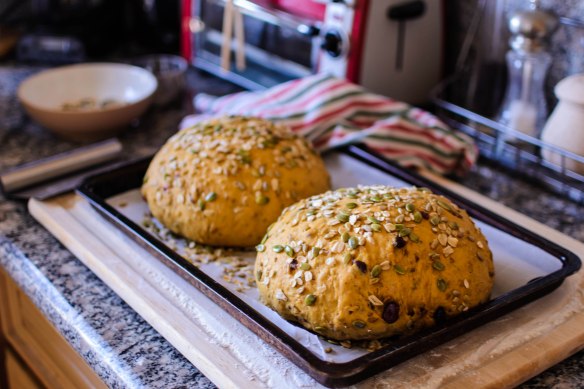
As for flavor, these delightfully toe the line between sweet and savory. Pumpkin is so commonly paired with sweet flavors, and the dried cranberries and nutmeg seem to push it in that direction, but the woodsy herb flavor (the crackers use rosemary, which I think I’d prefer, but in the moment I only had sage) and the nudge of heat from the black pepper keep it from feeling dessert-like. I’m not sure you would want to use this for sandwiches, but I could imagine it being a starchy side for a roast chicken or a big dinner salad. I find, though, as with many freshly baked loaves, I want it most in mid-afternoon, when it is still just warm from the oven, and I am slightly peckish and starting to dream about dinner.

*goat cheese is nice too, and though I suppose you could make it into frozen slices a la this peanut butter “hack” the internet responded to with hilarity a few weeks ago to prevent tearing your bread, you could also just let the goat cheese come to room temperature, at which point it smears pretty easily across the tender slice.

Dried Cranberry and Seed Pumpkin Loaves
Makes 2 round loaves 7-8 inches in diameter
4 – 4 ½ hours
1 15-ounce can of pumpkin puree (not pumpkin pie filling)
1½ cups warm milk
pinch granulated sugar
1 tablespoon active dry yeast
¼ cup molasses
2 tablespoons melted butter
1¼ cups rolled oats, divided
1½ cups whole wheat flour
2-3 cups bread flour
1 cup dried cranberries
¾ cup sunflower seeds, divided
¼ cup flax seeds
2 tablespoons finely chopped rosemary or sage
1 teaspoon ground nutmeg
1 teaspoon ground black pepper
1 tablespoon salt
½ cup raw pumpkin seeds


  • In a small skillet, cook the pumpkin puree over high or medium-high heat for about 15 minutes, stirring frequently, until the color has deepened and the puree has dried and has a texture something like a thick frosting. Set aside to cool.
  • While the pumpkin comes to room temperature, add the pinch of sugar to the warm milk, then stir in the yeast and let it sit to burble for 5-10 minutes, until it is bubbly and smells like bread.
  • Pour the yeast and milk mixture into the bowl of a stand mixer fitted with the paddle attachment. Add 1 cup of the oats, all of the whole wheat flour, the molasses, the melted butter, and the cooled pumpkin. Stir with the paddle attachment to combine.
  • Now add 1½ cups of the bread ½ cup at a time, paddling in between, until a soft, sticky dough is formed. Dump in the rosemary or sage, the nutmeg, the pepper, the salt, the dried cranberries, ½ cup of the sunflower seeds, and all of the ¼ cup flax seeds, and paddle again just until integrated.
  • Switch to the dough hook and knead at medium speed until it comes together into an elastic but slightly sticky dough, 8-10 minutes. If it doesn’t seem to be coming together, continue adding the bread flour ½ cup at a time as needed, kneading a minute or two in between each addition. You may not need all of the bread flour.
  • Cover the bowl of kneaded dough with plastic wrap and set aside in a warm spot to rise until it has doubled, 60-90 minutes. While this is happening, combine the remaining ¼ cup rolled oats, ¼ cup sunflower seeds, and the ½ cup pumpkin seeds in a large, shallow bowl.
  • After it has risen, punch down the dough by gently depressing your fist into the center of it. Pour and scoop it out of the bowl onto a lightly floured board and divide in half using a dough scraper. One at a time, shape each half into a round by holding the dough ball in your hands and stretching the top taut, tucking the excess underneath. Each time you stretch and tuck, turn the dough a quarter turn or so. You can also do this while the dough is resting on your board, turning it and tucking the excess, which will form something that looks like a balloon tie or a belly button underneath. Check out this series of photos from the kitchn for helpful illustrations.
  • When you have a round loaf that is reasonably taut across its domed top, spray or lightly brush it with water, then gently press all sides of it into the mixture of oats and seeds you’ve prepared. Repeat with the other half of the dough.
  • Gently place the seeded loaves on a baking tray lined with parchment paper, lightly cover them with plastic wrap or a clean kitchen towel, and set them aside to rise again for about 45 minutes. Meanwhile, preheat the oven to 375F.
  • After 45 minutes, with the loaves swollen, place them carefully in the oven and bake at 375F for 35-45 minutes, until they reach an internal temperature of 180-200F.

Corn and Onion Crispy Rice

My Food Network obsession remains, as it was a few weeks ago when I offered you these fridge pickles sweetened with melon liqueur, Beat Bobby Flay (or, as I like to call it, Beat Up Bobby Flay). There are many reasons for this, though I think it ultimately comes down to our penchant for rooting for the underdog: Flay is accomplished and talented and usually wins (plus he presents as somewhat arrogant, which makes unseating him that much more satisfying), so we want the challenger chefs who strut into the arena to throw him off.

Anyway, when the challenger presents a dish that involves rice, BFlay’s typical move is to cook the rice just to, or even a little under, chill it, then pop it into hot cast iron for a minute or two right at the end to achieve crispy bits. Achieving a crispy bottom layer on rice, far from the universal disaster we might conceive of when addressing the burnt lacquer bottom of what was supposed to be a fluffy potful, is a sought-after result in a number of cultures. Tahdig, socarrat, xoon: when the phenomenon has its own name, you know it’s something worth emulating.

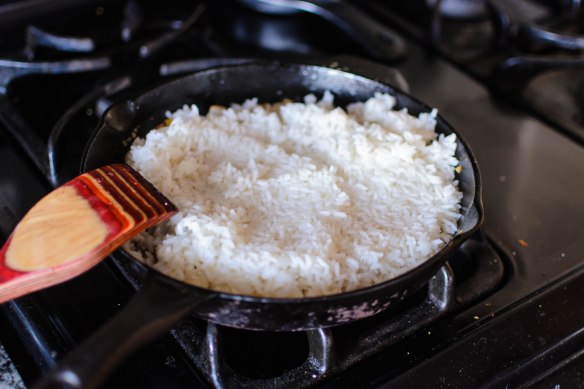
Hot off the crunchy corners of a baked pasta dish, I started eyeing the rice in my pantry for all its crispy potential. This is a loose remaking of my “‘stuck pot’ red rice” from a few years ago, but faster, with fewer ingredients, and easier to throw together: the rice gets parboiled – just ten minutes in the water so it’s still chalky in the center – while corn and onions sauté until toast-brown in a mixture of butter and olive oil. The rice, along with a few spices and some lime zest, gets stirred in with the corn and onions, we splash on a little tomato and lime juice, and then the whole mess gets pressed and cooked until a crusty bottom layer forms. Then, we scrape, flip, and cook again. By the time there’s sufficient crispiness, the rice is fully cooked and flavored with the acidic liquids we added.

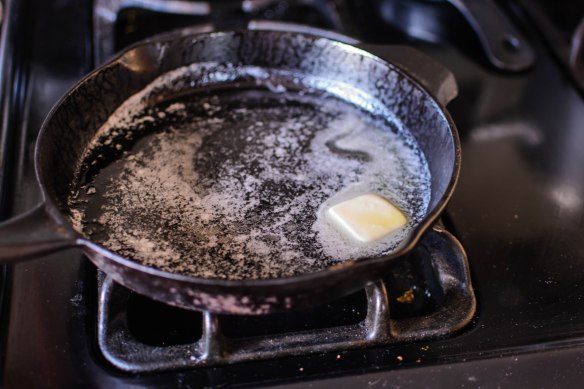
This works best in cast iron, but if you don’t have a cast iron skillet, regular non-stick would probably be fine too. If you do have a cast iron skillet and never use it, for fear of improper “seasoning” or sticking or cleaning procedures, don’t look to the internet to make you feel better. There are pages and pages of complex instructions for prepping, cooking in, and maintaining your cast iron cookware, enough to whiz you right around the wheel from encouragement to intimidation. Instead, I have found what works best is my friend M’s casual, summer morning advice: “just cook eggs in it all the time with lots of butter. Or meat.” I laughed, but then I tried it, and my skillet is now no longer patchy and sticky with attempts to bake on an oil layer, but smooth and barely shiny, and when I went to flip this rice, not a single grain stuck to the pan surface, but lifted smoothly away with only a wooden spatula.

We had our crispy rice piled high next to bean and cheese tacos, but it would be equally good with grilled or roasted chicken, well-seasoned white fish, a tangled pile of charred vegetables or, as my sister declared when I described it, “I want to eat that with some salsa verde carnitas.” So do I, sister-friend. So do I.

Corn and Onion Crispy Rice
Serves 4-6 as a side
20-25 minutes
1 cup long grain white rice
1 cup corn, fresh or frozen and defrosted
1 cup frozen and defrosted pearl onions
2 tablespoons butter
2 tablespoons olive oil
1 teaspoon whole cumin seeds
zest of one lime
1 teaspoon smoked paprika
juice of half a lime, or to taste
¼ cup tomato juice or v8
1 tablespoon each fresh oregano, fresh chives, and fresh cilantro, finely chopped
additional lime wedges to serve


  • Bring a large, lidded pot of salted water to a full boil, then add the rice. Boil 10 minutes, then drain and set aside. The rice will be underdone; this is what we want.
  • While the water is warming and the rice is cooking, heat the butter and olive oil over medium high heat in a large skillet, preferably cast iron. When the fat mixture shimmers, add the fully defrosted corn and onions, sprinkle on a little salt and pepper to taste, and toast until caramelized, stirring and tossing frequently, 10-15 minutes. As the vegetables start to brown, add the whole cumin seeds and stir well to distribute.
  • When the cumin starts to smell toasty and the vegetables are nicely browned, add in the rice, the paprika, and the lime zest and stir well to distribute the spices and veg evenly. Stir in the tomato juice and the lime juice, then press the rice down into a compact layer.
  • Continue to cook over medium high heat until crusty bits begin to form on the bottom, 4-5 minutes. In sections, turn the rice and expose the top layer to the skillet surface for another 3-4 minutes until this, too, gets a little crunchy.
  • When the rice has crisped to your liking, remove from heat, scatter the finely chopped herbs over the top, and serve with additional lime wedges for squeezing.

Save

Salad rules

As you can tell, I’ve been busy. My mom commented, on our weekly call Sunday morning, that she knew I’d been busy because one week I posted a recipe without photos, and the next week I added photos but no new recipe. Some of this is the time of the semester, some is what is happening in our country and world, and some is just that, even when I do have a free half hour or hour to devote to the kitchen, I don’t have a second (or third) to take and edit photos, or even to brainstorm a new dish that seems, as I like to put it, “blogworthy.” Combine that with the final dregs of summer weather Los Angeles is throwing at me, and I’m stuck on a loop of old, reliable meals, when all I really want to do, I realized yesterday at the point that our car thermometer read 92F in the Costco parking lot, is bake.

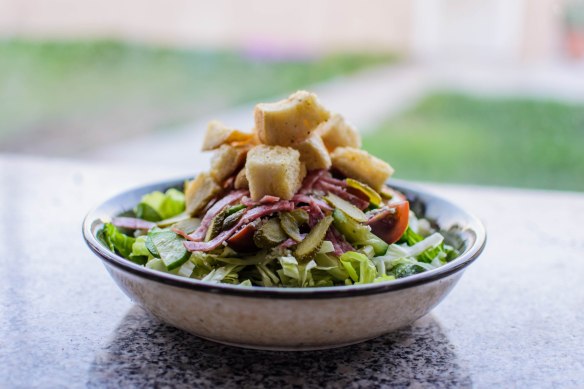
So this isn’t a recipe so much as a method. One of my go-tos for warm weather in the past few months has been a big chopped salad. It’s quick, it’s satisfying, it doesn’t heat up the kitchen, and it’s a great way to use up the last few whatevers you have knocking around in the fridge. Nothing fancy or difficult about it, and no set recipe – mine are always slightly different, but in making these semi-monthly since last spring, I’ve realized a few key components that result in a really good, satisfying salad, so that’s what I’m prepared to offer you today.

1.) you need a mixture of greens. Ours this weekend sported four kinds: romaine, arugula, spinach, and thinly shredded cabbage. That is perhaps a bit excessive, but the combination of lettuce varieties is really key, and the cabbage in particular is the extra I won’t go without. I like red cabbage best, but that’s more for the dramatic color than any significant flavor difference.

2.) fresh vegetables. Tomatoes and cucumbers are standards, but I love thinly sliced radishes in many things, and a big salad is no exception. Sugar snap or snow peas would be perfect too, and sometimes I like chives, or the greens of green onions, very thinly sliced. Canned vegetables like drained and rinsed artichoke hearts are also a good addition.

3.) blanched green beans. I know, another vegetable, but this is a separate requirement because it adds something different and, to me, utterly necessary. Just drop a handful in salted, boiling water for no more than 90 seconds, then rinsed or cooled in an ice bath until you are ready to add them to the salad. The combination of raw and cooked vegetables is a nice contrast.

4.) some kind of pickled vegetable. We’ve done fresh, we’ve done cooked; the briny pickle crunch keeps the salad exciting. I like a sprinkling of pickled onions, but if I have pickled carrots or radishes or green beans, that works too. Last night I had none of these, so I settled on thinly slicing a few cornichons, and though this wasn’t my favorite option, it did the job.

5.) sliced hard boiled egg. Enough said.

6.) meat and cheese, or, if you don’t do meat, some well seasoned tempeh crumbles would do nicely here. I like chiffonaded salami the best, but I’ve also been happy with strips of grilled chicken. I want the cheese to be cut in small cubes, and to be something medium-soft and creamy, like a gouda or fontina, to add a different texture.

7.) something crunchy that is not a vegetable. This ranges for us from toasted walnuts to croutons to well oiled and browned breadcrumbs, but the starch- or nut-based crunch, especially if the nuts or croutons are slightly warm, is so welcome.

8.) a tart but creamy dressing. My favorite is a squeeze of Dijon and honey – just a teaspoon or two – whisked up with some cider vinegar or lemon juice, and a few tablespoons of mayonnaise. Maybe some grinds of black pepper. Make the dressing just a hair more acidic than you think you’ll want, since look at all the components it will be flavoring! The tartness will be cut once it’s draped across cheese and greens and nuts and everything else.

There. Pile, stack, dress, toss, and you have the perfect salad. All you need now is a cold glass of rose, and the rest of the weekend back…

Save

Save

Photos!

No new post today, I’m afraid; grading and home owner duties took over my weekend. But I did manage to do a little photo editing, so what I can offer is an update to last week’s waffles: now with images! Here’s one to whet your appetite. Scroll on down and have a look-see at the rest, if you’re into it.

Corn and Green Onion Waffles

I have, I promise you, a beautiful recipe for today that churns out beautiful waffles. But this weekend being what it was, I had to make a choice between editing photos and grading papers. I chose the responsible option. (At least, between those two choices. Other choices this weekend were less responsible. Related: holy god, do you guys remember how GOOD frappucinos with whipped cream are?!)

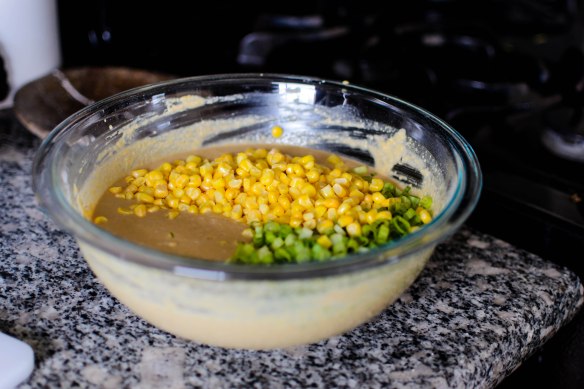
At any rate, I’ll get right to the meat – as it were – here, and promise weakly that images will follow. These are my standard beer batter waffles, except that half the flour is replaced by cornmeal, resulting in a crisp finish on the ridges and squares that even stands up to melted cheddar cheese (more on that in a tic). Before letting them sit to rise, you stir in a heap of corn kernels and green onions, and you end up with something that, depending on your currently location’s definition of “autumn,” could be a lovely alternative to cornbread to balance against your steaming bowl of chili, or a substantial side for a crisp salad like this one.

Because waffles cook one at a time, if you want to eat with your dining partners, instead of taking turns, it’s handy to have a system for keeping them warm. My favorite is to preheat the oven to 250F with a wire rack resting over a cookie sheet inside. As each waffle is done, I sprinkle on a few tablespoons of grated cheddar cheese and stow the laden circle in the oven. While the remaining waffles bake, the cheese melts into a perfect gooey layer, and the waffle, with its cornmeal armor, stays crisp and light underneath.

Corn and green onion waffles
Makes about 8 5-6-inch waffles
Approximately 2½ hours, including rising time
1½ cups (12 ounces) beer, the darker the better
1½ teaspoons active dry yeast
3 tablespoons maple syrup
6 tablespoons (3 ounces) melted butter, cooled
1 teaspoon salt
2 large eggs
1 cup all-purpose flour
1 cup cornmeal
1 cup corn kernels, fresh or defrosted
6 large green onions, pale and dark green parts only, thinly sliced
Optional: grated cheddar cheese


  • In a 2 cup glass measuring cup, or a small microwave safe bowl, heat the beer until just warm to the touch, about 40 seconds. Add yeast and the maple syrup and let them mingle for 5-10 minutes. The yeast will foam up considerably, thanks to the extra sugars and yeast already in the beer.
  • While the yeast proofs, whisk together the cooled melted butter, the salt, and the eggs in a large bowl. Be sure there’s room for the batter to expand.
  • Add the beer and yeast mixture and whisk to combine, then add the flour and cornmeal a little at a time, whisking to combine thoroughly. Add the corn kernels and green onions and whisk again until only vegetable lumps – not flour lumps – remain.
  • Cover the bowl with plastic wrap and set it on the counter for 1-2 hours.  The mixture will slowly develop lethargic bubbles and begin to smell quite bready.
  • Once it has had a chance to rise for an hour or two, either stow in the refrigerator overnight, or preheat your waffle iron!
  • Drop the batter in generous batches (mine can take about ⅔ cup at a time) onto a preheated, greased waffle iron. Close the lid and cook for the recommended amount of time, or until the waffle is crisp on the outside and deeply golden. Mine take about 6 minutes.
  • As you finish each waffle, you can either drop it directly onto some lucky person’s plate, or stow it on a wire rack in a preheated 250F oven. If desired, sprinkle each waffle with 1-2 tablespoons grated cheddar cheese before placing them in the oven, so the cheese can melt before serving.


Roasted Apple and Onion Biscuits

I think it’s like this every year. I’m sure I’ve said that before. The first week of the semester goes by and I think “well, that was fun,” and then I think “oh, I have to do that fifteen times more in a row!” The second week goes by, and I’m exhausted, but grateful for the bonus day Labor Day provided.

Then week 3 hits. The add period is over, so my classes stabilize and become the “real” group that will soldier through the semester with me. The serious assignments begin. The bedtime and alarm start to feel like normal and not like torture.

But the work. At this point, yes, classes have stabilized, but in almost all cases they are still at their enrollment caps, which means the first paper I collect comes in a dose of sixty. And even when you parse that out in stacks of ten, boy does it feel like a lot. By the time the weekend following week 3 hits, I need comfort food.

Fortunately, our weather has cooled into something that feels surprisingly like fall. Mid September is usually stifling, but we are descending into temperatures in which it’s not suicidal to have the oven on for a half hour or so. When I saw that windfall on our weather forecast, I thought of biscuits.

I realize, of course, that there is no shortage of biscuit recipes here, and if I’m quite honest with you, almost every one has the same base. The magic, though, is in what extra flavoring agents you add. This time around, the fall combination of apples and onions hit me hard. I’ve done this before, in a meatball that was really just an excuse to eat more breakfast sausage, but in biscuits I wanted less tartness, less crisp-tender bite, and just melting sweetness with a touch of roasted flavor. Green apple and red onion get roasted in chunks for a half hour before they are tossed with the dry ingredients, then blended in with butter and buttermilk or soured cream. Roll, fold, and punch out rounds from the wet dough, and you are only fifteen minutes from hot, flaky biscuits.

As we chatted during our weekly viewing of Project Runway, my friend T. and I speculated additions to these biscuits. You could add plenty of black pepper, or amp up the savory with herbs: sage is quintessentially autumnal, and thyme also goes well with apple and onion. Where our minds went immediately, though, was blue cheese. Think about it: crumbles in the mix leaking out during baking to form little lacy puddles around the edges of the finished biscuit. Or, if you don’t want more busyness in the biscuit itself, T. suggested blue cheese butter to spread in the center.

These are not doctored, though, any further than the original pairing, and honestly, they don’t need to be. Even the tartest apple, as were the two tiny granny smiths I cubed up, mellows as it cooks, playing with and enhancing the sweetness of the onion. You could have them as we did: the “bread” of a breakfast-y sandwich (I mixed bulk sausage with maple syrup, red pepper flakes, and a squeeze of Dijon before frying in patties to put in the center), but I bet, especially if we are thinking seasonally, that they would be perfect cut a little smaller and swaddled in a basket to be served alongside a Thanksgiving turkey.

Roasted Apple and Onion Biscuits
About 60 minutes, including cooling time
Makes 14-15 2½ inch biscuits
2 small or 1 large tart green apple (I like granny smith), skin on, cut into small cubes
½ large red onion, skin, root, and stem ends removed, cut into large chunks
2 tablespoons olive oil
¼ teaspoon salt
¼ teaspoon pepper
2 cups all-purpose flour + more for sprinkling on your board
2 teaspoons sugar
1 teaspoon salt
2 tablespoons baking powder
6 tablespoons cold butter, cut into chunks
6 ounces buttermilk, or whole milk or cream soured with about a tablespoon of vinegar


  • Preheat the oven to 400F. On a baking tray lined with aluminum foil, toss the apple and onion chunks with the olive oil, the ¼ teaspoon salt, and the pepper. Roast for 15 minutes, toss gently with a spatula, then roast another 15 minutes, until just a few edges are taking on a toasty brown color. Remove from the oven and set aside to cool.
  • While the apples and onions cool, combine the flour, sugar, 1 teaspoon salt, and baking powder in a medium bowl. I like to use a whisk for this to keep it all light and well mixed.
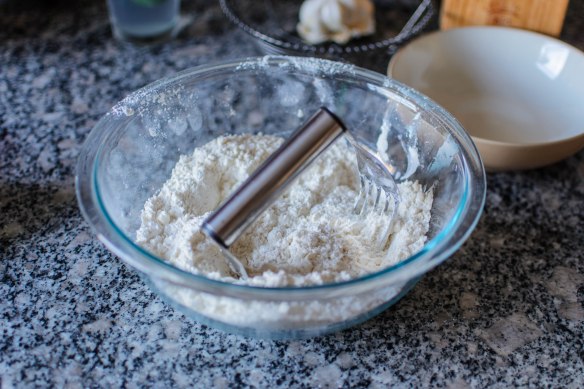
  • Add in the cooled apple and onion pieces and toss to ensure they are well coated with flour – this will help them stay evenly distributed in the biscuits rather than sinking to the bottom. Dump in the cubes of cold butter and use a pastry blender or your fingers to work the fat into the flour mixture. You are looking for butter bits the size of small peas.
  • Pour in the buttermilk or soured cream and use a fork or your fingers to mix it through the flour and butter mixture and bring the whole thing together into a shaggy, soft ball of dough (if it seems too dry and is not coming together, just set it aside for a minute or three – this will give the flour time to absorb the wet ingredients a bit more).
  • Turn the dough out onto a well floured board, sprinkle some more flour on top, and knead with your hands two or three times just to catch any loose bits. With a rolling pin or your hands, press or roll the dough into a rough rectangular shape about ½ an inch thick. Fold the dough into thirds, then roll out again. Repeat, again folding the dough into thirds and then rolling it out; this creates more flaky layers. If the dough sticks to your board, use the flat blade of a butter knife or a pastry scraper to help you lift it free. This is a fairly wet dough, so you’ll need to be stern with it, and you may need to sprinkle on more flour as you go.
  • After you’ve rolled and folded, rolled and folded (so you’ll have done a total of six folds), roll out once more, this time to a thickness of 1 inch, and use a 2½-inch round cutter (or the floured lip of a glass) to punch out biscuits. Push the cutter straight down through the dough; don’t twist until you are all the way through to the board, or you’ll crush the flaky layers! Repeat until you can’t punch out any more rounds. Re-roll the dough scraps (no need to fold again unless you want to) and repeat – with a 2½-inch cutter, you should be able to make14-15 biscuits around an inch in thickness.
  • Replace the aluminum foil sheet on your baking tray with parchment paper, and arrange the biscuits on it, evenly spaced. I like to do about 8 at a time, but they don’t spread much, so you can crowd them a little. Bake 15 minutes (still at 400F), until they are puffed and the tops are golden and slightly dry. These won’t climb sky high because the apples and onions are wet and add extra weight, but they will still rise a bit.
  • Let cool for a minute or two, then serve warm (see suggestions above for accompaniments).