Carrot Soufflé

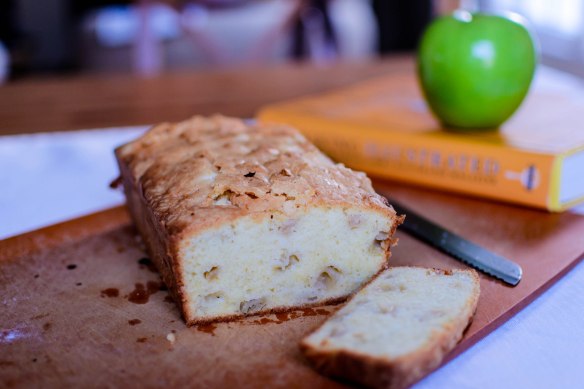
2016-food-blog-photo-december-7A few weeks ago, I got my “what to blog about” inspiration from the unlikely source that is the Trader Joe’s samples counter. They were demo-ing carrot soufflé, a bright orange spoonful of light, sweet puree that I immediately wanted to play with. I’ve done a sweet potato soufflé before, and I thought a carrot version would work equally well as a semi-sweet holiday side dish, bumped up with a few flavor partners these bright, knobbly spears play well with.
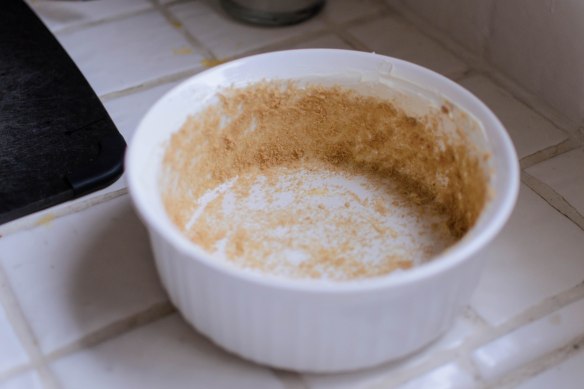
2016-food-blog-photo-december-0684I’m not usually a fan of oranges in holiday dishes (especially the aforementioned sweet potatoes: keep that orange juice out of my carbs!), but carrots and orange are too chummy to keep separated for long. Ginger seemed like another good guest to invite to this party, and a good squeeze of maple syrup to add a burnished kind of sweetness in there.
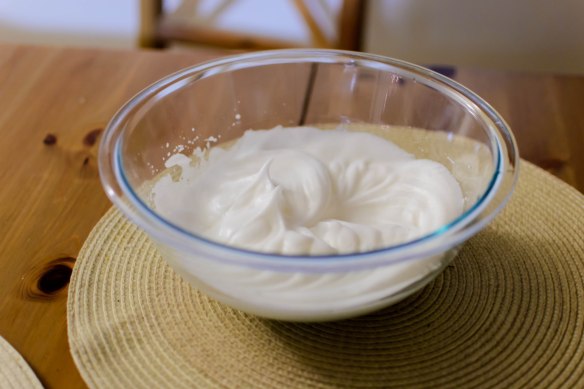
2016-food-blog-photo-december-5Soufflé carries with it a reputation of delicacy and fussy fragility, and in some ways this is true. The elegant, gravity defying puff that is its signature is in part a result of egg whites beaten just so, but also of careful handling and a patient, even leisurely attitude. And sometimes it just falls. When that happens, you just have to shrug and accept it. Maybe have another glass of eggnog.
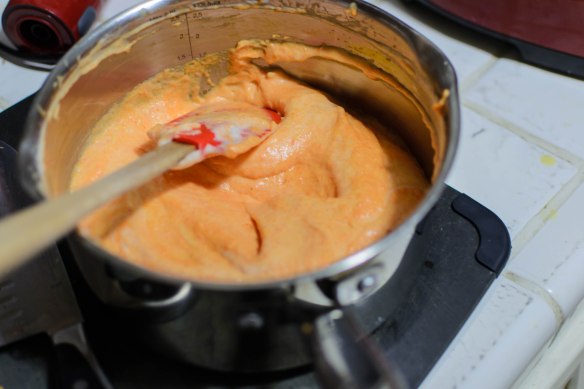
2016-food-blog-photo-december-0697This is a (reasonably) convenient soufflé recipe in that it involves an equal number of egg whites and egg yolks. There’s a bit of fussiness with separating, ensuring you haven’t tainted the pristine whites with even a breath of yellow, or they won’t rise up into that spongy cloud you need. But scrupulous attention helps with that, and a dash of cream of tartar ensures a quicker, fluffier snowdrift of whipped whites.
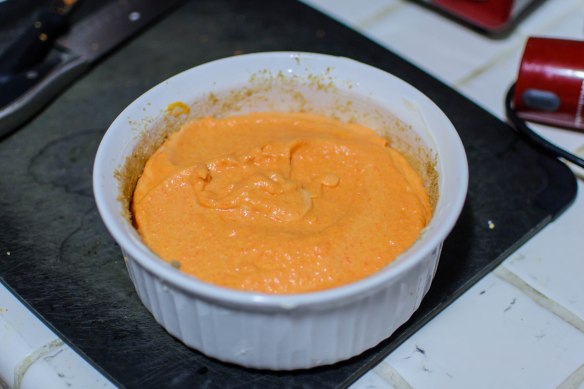
2016-food-blog-photo-december-6Apart from that, it’s just a question of integration. The carrots, after a softening boil in water and orange juice, get blended with flavoring agents, yolks, and a glug or two of cream, and then it’s just a question of folding in those whites carefully and gently, trying not to deflate anything. I’ve explained my method in the step-by-step below, but here’s another excellent reference from the kitchn, if you want more detailed guidance.

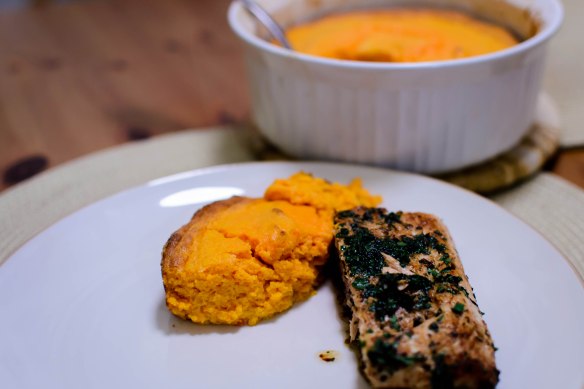
2016-food-blog-photo-december-7After a careful deposit into the oven (we want all the air we can keep in this dish of orange velvet), you are rewarded with a bronzed puff, heavier than meringue or mousse, lighter than custard – that impossible, almost strange, texture only a soufflé has – and you scoop out great spoonfuls because it’s so light, and brightly carrot-y, enhanced by the orange and the ginger and luxurious from the cream. I think this would go well with a turkey or ham-based holiday menu, but we had ours with herb and butter basted salmon, and found we didn’t miss having a starch component. Besides, it left room for a dessert I’ll show you next week: another puff, but of a very different sort, equally on board for the impending holidays.
2016-food-blog-photo-december-8

Carrot Soufflé
80-90 minutes, including cooling time for the carrots
Serves 4
2½ cups peeled, 1-inch carrot chunks (6-7 medium carrots)
zest from one large orange
¼ cup fresh orange juice from one large orange
2 cups water
1 teaspoon salt
2 tablespoons butter
1 tablespoon brown sugar
1 tablespoon grated fresh ginger
¼ cup maple syrup
½ cup heavy cream
3 eggs, separated
¼ teaspoon cream of tartar, optional


  • In a medium pot with a lid, combine the carrots, orange juice, water, and salt. Plonk in the juiced halves of the orange too (reserve the orange zest for later). Pop on the lid and bring to a boil over medium high heat, and boil until the carrot pieces are tender but not falling apart: 10-15 minutes, depending on the size of your carrot chunks. Drain and cool to just above room temperature (we’re going to add raw egg yolks and don’t want them to scramble).
  • While the carrots are cooking and cooling, preheat your oven to 375F and prepare your baking dish: use the 2 tablespoons butter to grease a 1½ quart round baking dish with straight sides (by all means use a proper soufflé dish for this if you have one; I don’t. But hey, it is almost Christmas…). Sprinkle the brown sugar over the buttered sides of the container, then stow it in the freezer for 5-10 minutes. The sugar sanding creates texture to help the soufflé climb the walls of the container, and freezing it makes it take longer to dissolve in the heat of the oven, so you’re giving your puff a head start.
  • In the pot with the cooled carrot chunks, add the fresh ginger, the maple syrup, the heavy cream, the reserved orange zest, and the 3 egg yolks. Use an immersion blender (or transfer the whole mix to a blender or food processor) to break down into a smooth puree. Be sure no carrot hunks remain.
  • In a separate bowl, add the cream of tartar to the egg whites. Using a handheld electric mixture (or a whisk, if you need to work on your arms), beat the whites at first over medium, then high speed until medium peaks form. The whites will foam, and then become pure white, and finally begin to stiffen like a good whipped cream. To determine the stiffness of your peaks, turn off the beaters and lift them straight out of the whites. If you get little hills that collapse back into the mixture, you have soft peaks. If you get little tips that fold over just a bit when you pull the beaters away, you are looking at medium to stiff peaks, which is what we want.
  • Using a rubber spatula, scoop about ⅓ of the egg white fluff into your carrot puree base and stir until no white streaks remain. No need to be careful with this part – full integration is just fine.
  • Now, slide the other ⅔ of the whites into the sweet potato mixture and fold in gently until just combined – some white streaks may remain and that’s fine. I like to fold by drawing my spatula around the edge of the bowl in a horseshoe shape, then pulling it back toward me in a straight line.
  • Retrieve your frozen baking dish and fill with the soufflé mixture, being careful not to let it plop from too high (in case of deflation). Smooth off the top the best you can – this seems fussy, but it will aid in even rising.
  • Bake in a preheated 375F oven keeping the door closed the whole time for 35-45 minutes, until the edges are nicely browned and the soufflé has puffed up in the center as well as the sides. For maximum wow factor, transport carefully and immediately to the table, so your fellow diners can appreciate your soufflé skills before it deflates. Dig in with a large spoon and enjoy.

Braised Lamb on Kale and Avocado Toast

2016-food-blog-november-0420Are you tired of turkey yet? Good, me neither. But just in case you want an indulgent break, may I suggest lamb instead? The inspiration for this recipe comes from three places: a restaurant near our house that does a braised lamb dip with kale and a garlic jus, the intense obsession of the last few years that is avocado toast, and Ina Garten. Ina doesn’t offer me any dish in particular, but does often take luxury ingredients and serve them in a very simple, homey way, and that’s exactly what happens here.

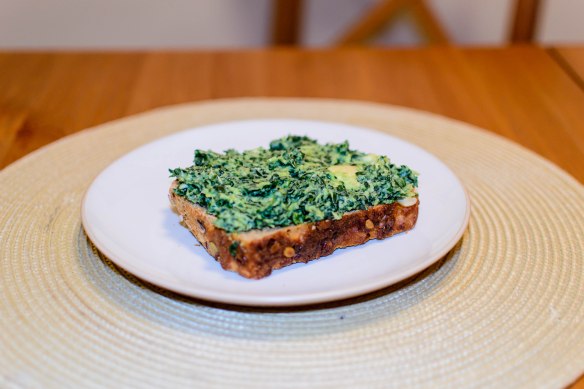
2016-food-blog-november-0395The first few times I watched a Barefoot Contessa episode that did this, I was annoyed. Like Ina’s penchant for advocating “best quality” base ingredients (read: expensive), I found the idea somehow pretentious. If I’m going to spend the money on fancy ingredients, then I want a fancy dinner! But contemplating this dish, it somehow seemed right. Let’s slow braise some lamb with aromatic vegetables and a good splash of wine until it collapses and shreds eagerly, bake a loaf of nicely seeded bread and cut it into thick slices, and spread that bread with a smash of avocado and kale, dosed with a good squeeze of lemon to keep it bright before draping on a healthy pile of the lamb. Fill the belly and keep the darkness away.

2016-food-blog-november-0391In determining how to go about this, I turned to yet another inspiration: the marvelous food mind that is Michael Pollan. In his book Cooked, which I’ve written about before, he spends a chapter discussing braising as a cooking method, and offers a mentor chef’s procedure in seven steps. Though I’ll give you the full recipe below, here’s what he recommends in my own order:

  1. salt the meat, then brown it
  2. finely dice some onions
  3. sauté onions and other aromatic vegetables
  4. place all the ingredients in a covered pot
  5. pour the braising liquid over the ingredients
  6. simmer, below the boil, for a long time
  7. remove pot from oven. If necessary, skim fat and reduce liquid. Bring to the table and serve.

As you can see, this is a procedure rather than a recipe – it’s the kind of steps a grandmother well acquainted with her own methods would give, and answer questions like “how many onions” with “enough,” or the precise temperature at which to braise with “oh, pretty low.”

2016-food-blog-november-0401Within the chapter itself, though, Pollan does give a bit more. Since the section of the book is the look at “Water,” he discusses the merits of using water rather than some other liquid to braise. Though we are always tempted to use broth or stock or wine, he notes that water retains a purer flavor – the meat is not in competition with the flavors of the liquid you’ve chosen. I bore this in mind, but wanted some red wine richness and tang anyway, so I settled for half and half water and wine. Only part way through the miracle, I suppose you could say.

This is a long project. The braise itself takes 2-3 hours all on its own, and that’s after you’ve let the onions cook down slowly for 30 minutes, then allowed the other vegetables to mingle another 15. Plus, as if all that wasn’t enough, you give the lovely, heady broth another good half hour to boil to create your final jus. And if you’re baking the bread yourself (in for a penny, in for a pound, right?), you’re looking at another multi-hour ingredient. You could, it seems, spend the entire day in the kitchen, lazily cooking your way toward dinner. Add some Edward Sharpe and the Magnetic Zeros, and that sounds like the day of my dreams.

2016-food-blog-november-0408When you’re finished, even though the resulting product looks humble, the reward is anything but. The lamb falls apart, and you stand there over the bowl you’re shredding it into trying not to stuff too many pieces straight into your mouth. It is meaty and savory and slightly gamey, and you taste lamb, but also wine and dark, piney, peppery herbs, and a subtle sweetness that comes from the vegetables. And then you pile it onto freshly toasted bread that you’ve smeared with the grassy, fatty spread you’ve made of kale and avocado, and you dribble over some of the juice left behind in the pan, and you eat it. And that was your day: making food, eating food, letting the aroma of the long braise fill your nostrils and your house, and you sleep happy.

2016-food-blog-november-0412Not that you need telling what to do with leftovers as luxurious as braised lamb, but if you aren’t sure, I think they would make amazing filling for tacos, perhaps with some shredded cabbage and feta cheese, and maybe a dollop of sour cream or yogurt, thinned with a squirt of lime and sprinkled with wafer thin slices of jalapeno and radish.

2016-food-blog-november-0420

Braised Lamb on Kale and Avocado Toast
Approximately 5 hours
Serves 4 + leftover lamb
2 tablespoons salt
2 pounds lamb leg or shoulder, in one piece (i.e. not in chunks)
¼ cup olive oil
2 white or yellow onions, finely diced
3 large or 4 medium carrots, finely diced
3 ribs of celery, finely diced
8 garlic cloves, smashed, skins removed
2 bay leaves
1 tablespoon whole peppercorns, optional
2 inch sprig rosemary, optional
2 cups dry red wine
2 cups cold water
2-3 ounces kale, leaves only – tough stems removed – finely chopped
1 ripe avocado
2 tablespoons lemon juice
1 tablespoon chives or green onion tops, very thinly sliced
salt and pepper to taste
thick slice of seeded toast for each diner
optional: finely sliced pickled radish or onion, to garnish


  • Sprinkle the salt evenly over both sides of the lamb. It will seem like a lot. Don’t worry. This is seasoning the entire 2 pounds of meat AND the broth. Let it sit for at least ten minutes, or up to a few hours.
  • When you are ready to cook, heat the olive oil in a dutch oven or other large, steep-sided pot with a lid over medium-high heat until it is shimmering. Carefully add the lamb (the oil may spit) and let it sear until well browned, then flip and repeat until all sides are nicely browned: about 2-4 minutes per side. Remove to a plate.
  • Turn the heat down to medium low or low and add the onions. We are looking to sweat them, not brown them. They will pick up some color from the lamb, but don’t actually let them sizzle too much after adding them. Cook, stirring frequently, until they are very tender and translucent, about 30 minutes.
  • Add the carrots, celery, and garlic cloves, stir to combine, and cook another 15 minutes.
  • Add the bay leaves, the rosemary and peppercorns, if using, and settle the lamb on top of the vegetables. Pour the wine and water in around the lamb as well as any meat juices that collected on the plate while the lamb rested, add the lid, and turn the heat up to medium high. Bring to a simmer, then turn back down to medium low or low – we want to keep the liquid below a simmer – only the barest bubble every so often.
  • Cook, keeping just below a simmer, until the lamb is very, very tender: 2-3 hours.
  • When the lamb falls apart at the slightest fork provocation, hoist it out to a bowl and turn up the heat on the pot to high. Boil the cooking liquid about 30 minutes to reduce it, then strain out the vegetables and, if you wish, pour the remaining jus into a gravy boat to serve.
  • While you wait, make the kale and avocado spread: scoop the avocado out of its skin and smash it up with a fork or spoon. Squeeze in the lemon juice, add the kale and chives and mix well, then taste and add salt and pepper to your liking.
  • Toast the bread and smear on thick, equal portions of the kale and avocado spread.
  • Just before serving, shred the lamb using two forks or, if it has cooled enough, your fingers. Pile a good helping onto the toast, then scoop or pour on a few tablespoons of the jus. Eat immediately.

Pumpkin Oatmeal Rye Bread

2016-food-blog-november-0522I’ve felt pressed since summer, when it comes to posting – I’ve been, all too often, a negligent blogger. There are many reasons for this, especially in the past few weeks, but I realized part of the reason lately, and that reason is the absence of a group. I liked the challenge of a monthly bread assignment, and between the dissolution of the Twelve Loaves baking party, heat, and busyness, I haven’t been doing as much experimental bread baking as I used to. I looked back, for another cooking project a week or two ago, at the notes I’d made about Suzanne’s site in my Five Seed Loaves post, and was reminded of the idea for a bread – inspired by hers – that incorporated rye flour, and canned pumpkin, and maybe some rolled oats for heft. With a long weekend looming and the season of pumpkin upon us, it seemed like the right thing to do.

2016-food-blog-november-05012016-food-blog-november-0504The problem with canned pumpkin, as anyone knows who has grown frustrated by repeated testing of that pumpkin chocolate chip bread that just will not finish baking, is its incredible water content. It keeps baked goods amazingly moist, but it also is a sopping, wet, hard-to-deal-with mess if you aren’t careful, especially in dough.

2016-food-blog-november-32016-food-blog-november-0498Irvin helped me solve this problem, with the ingenious tip he discovered of cooking down your canned pumpkin first, to eliminate some of that pesky moisture and concentrate the flavor. A quick, hot fifteen minutes of near-constant stirring and folding results in a thick, deeply sunset orange pan of something the texture of thick frosting that adds flavor and richness, but won’t bog down your mixture. I foresee many pumpkin-centric baking projects in the future, now that I know this helpful little extra step.

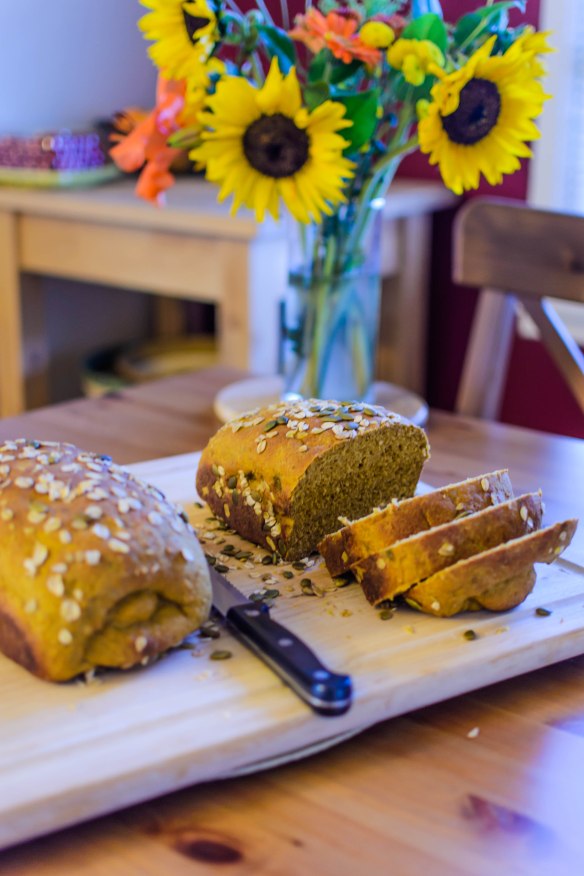
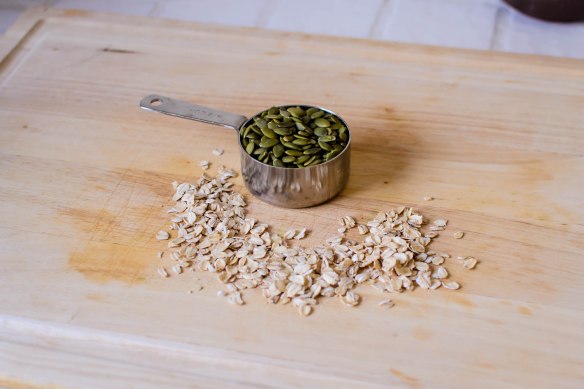
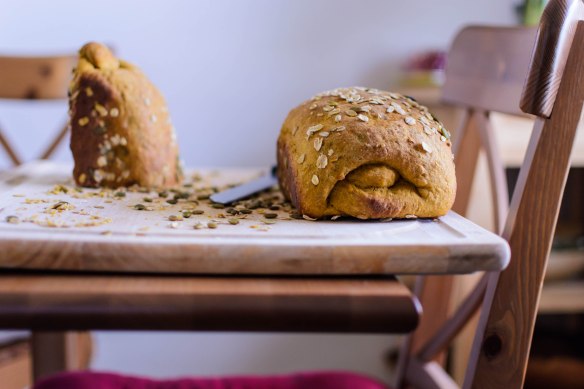
2016-food-blog-november-0507As with most breads, this one involves a substantial knead, a long first rise, a punch and a shape and – after a roll in some pumpkin seeds and rolled oats for texture and indication of predominant ingredients – a second rise before baking for a little over half an hour. These loaves incorporate some molasses for sweetness and color, and milk rather than water.

2016-food-blog-november-0525I must admit, the rye flavor doesn’t come through overly much here, though I suspect it added to the substance and of course to the lovely toasty color of the finished loaf. The pumpkin is mild as well, but you can taste it despite the absence of the telltale wintry spices that usually accompany this big squash. It’s satisfyingly orange inside (which makes photo editing tricky, by the way!), and it is a rich autumnal flavor I already want to taste again. The oats all but disappear into the dough as it bakes, and they contribute to the pleasant, spongy density of the thick slices you’ll be carving off to slather with cream cheese.

2016-food-blog-november-0529

Pumpkin Oatmeal Rye Bread
Makes 2 9×5 inch loaves (though mine were a little stubby from overly tight loaf shaping)
4-5 hours, approximately
15 ounce can of pumpkin puree (not pumpkin pie filling)
1½ cups warm milk
small pinch white sugar
1 tablespoon active dry yeast
1½ cups rolled oats, divided
2 cups dark rye flour
¼ cup molasses
1 tablespoon salt
2 tablespoons melted butter
2-3 cups bread flour
½ cup raw pumpkin seeds


  • Cooked the canned pumpkin in a skillet over high heat for 10-15 minutes, stirring frequently to avoid burning, until it is thick and reduced and takes on the consistency of a thick, spreadable frosting. You should wind up with only about ¾ cup left. Let it cool to room temperature.
  • While the pumpkin cools, combine the warm milk with the yeast and sugar, stirring briskly, then let sit for about 10 minutes to allow the yeast to activate. The surface of the milk will get bubbly and smell bread-y.
  • In the bowl of a stand mixer, combine the yeasted milk, 1 cup of the oats, the rye flour, the molasses, the melted butter, the salt, and the cooled pumpkin. Use the paddle attachment on low to medium speed to combine.
  • Now begin adding the bread flour ½ cup at a time, paddling in each addition, until a soft dough forms that pulls and tears away from the side of the bowl. You may not need the entire 3 cups of flour – I ended up using about 2½ cups total.
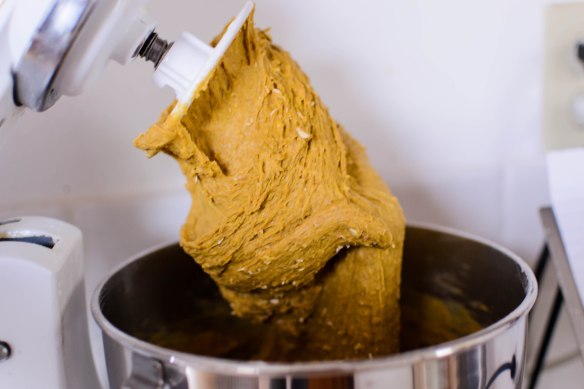
  • Switch to the dough hook and knead on medium speed for about 5 minutes. The resulting dough will be soft and sticky – a play-dough that clings to your fingers – but that’s okay. The oats need time to absorb the liquid so it will become less tacky as it rises.
  • Spray the inside of the bowl with a non-stick spray or olive oil, flipping over the dough so both sides are coated. Cover the bowl with plastic wrap and set it in a warm place to rise until doubled; 60-90 minutes.
  • When the dough has doubled, punch it down by depressing your fist gently into the middle, then let it sit to get its breath back for about 10 minutes. While it rests, spray two 9×5 inch loaf pans with non-stick spray and start the oven preheating at 375F. Combine the pumpkin seeds with the remaining ½ cup of oats and spread out on a flat, rimmed surface like a cookie sheet.
  • Carefully dump the risen dough out onto a very lightly floured board. The more flour you use, the more trouble you’ll have getting the seeds and oats to stick. Divide the dough into two equal hunks, then form each into a loaf and roll it through the seed and oat mixture before settling it into its respective loaf pan. If you have a lot of trouble getting the oats and seeds to stick, spray the loaf with nonstick spray or olive oil first, then have another go.
  • Cover the loaf pans with plastic wrap and set the loaves aside to rise again for about 45 minutes.
  • When the loaves have just about doubled in size again, remove the plastic wrap covering them and carefully set them into your preheated oven to bake until their central temperature reaches 180-200F; about 35 minutes.
  • Let the loaves cool in their pans about 10 minutes, then remove to a wire rack to cool completely.

Save

Save

Brown Butter Apple Pound Cake

I’ve tried to start this post three or four times now. The first time I tried to skirt the events of the last week entirely, but that felt like lying. The second time I was overtly political, explaining exactly how I felt and why. That felt more honest, but it didn’t feel like the right move. The third time I tried to be conciliatory, citing concerns on both sides.

2016-food-blog-november-0385In the face of change, particularly because it is not the sort of change I agree with or was hoping for, I retreated to comfort. I know this is not particularly useful. I know I am reasonably safe for a number of reasons, and closing the blinds and wallowing is not helping the people who are – or soon may be – not so safe, but I did it anyway. Finally, I decided I need more time to process what I want to say, so I’ll offer this instead, as unhelpful and uninspiring as it might be: this week was rough. Let’s have cake.

2016-food-blog-november-03382016-food-blog-november-0329For me, the deepest and firmest food comfort is baking. It makes me think of being a child, it makes me think of warmth and sweetness; it makes me feel sound. In his examination of sugar and its coming to and impacts on Europe, particularly England, Sidney W. Mintz suggests that perhaps the reason we are so attracted to sugar, especially when we are young, is because human breast milk is sweet. So it makes sense that when we are troubled, or we feel that we need safety and security, we turn to sweet foods.

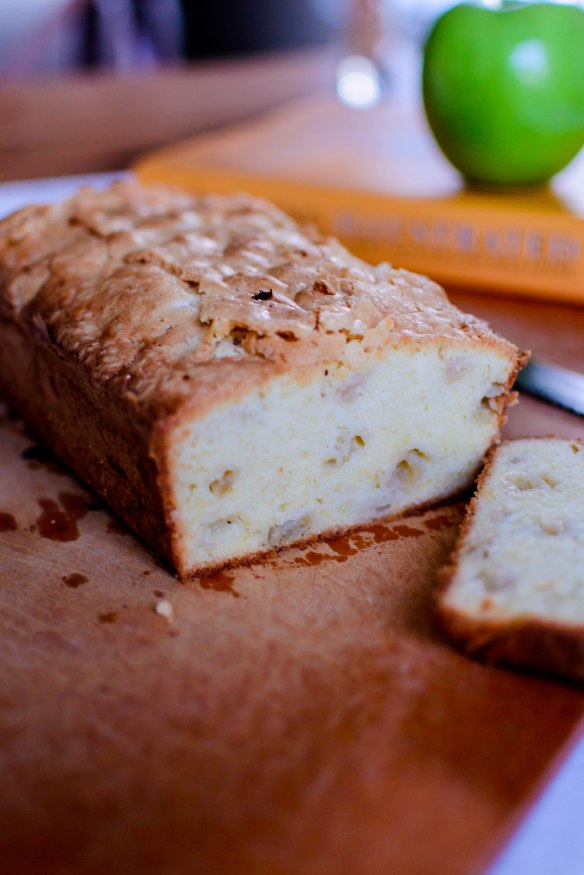
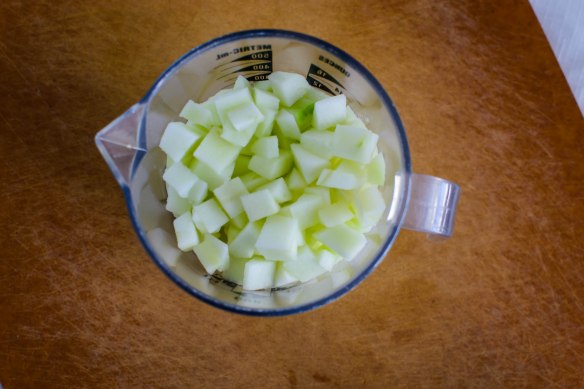
2016-food-blog-november2016-food-blog-november-0356The original inspiration for this cake came from Starbucks. A few years ago as part of their fall line-up of baked goods, Starbucks rolled out a brown butter pound cake spiked with Washington apples, and after sampling the dense crumb and the wet, almost too sweet apple chunks, I wanted to do my own version. For the base recipe, I went with that great baking bible Baking Illustrated, by the same cooks and recipe testers as Cooks Illustrated. Their pound cake uses cake flour for a tight but tender crumb, plenty of butter, and the richness and color and emulsifying power of extra egg yolks, rather than all whole eggs. Mine adds the extra step of browning the butter first (which then necessitates refrigerating it back into solidity before creaming it with the sugar), and a generous two cups of apple cubes – granny smith, for the tartness and minimal juice expelled during baking.

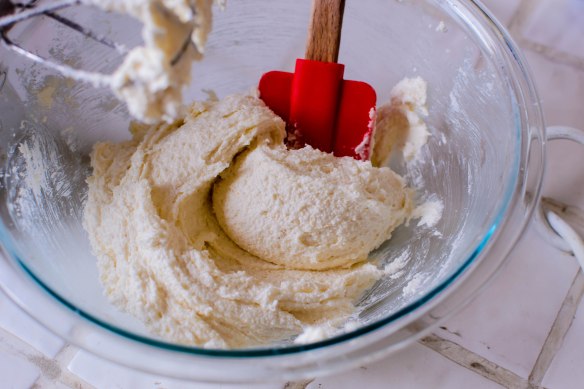
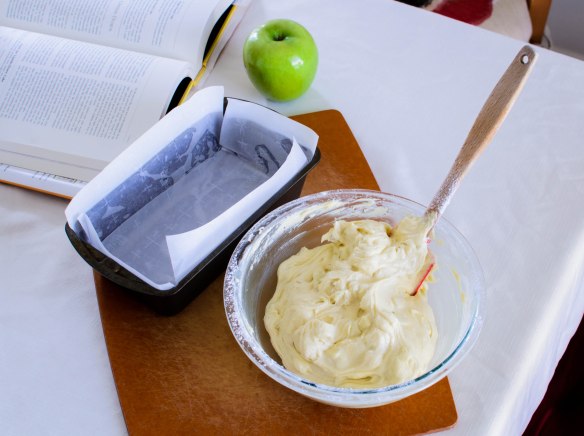
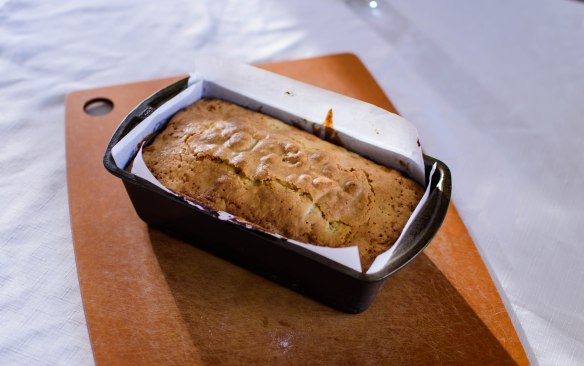
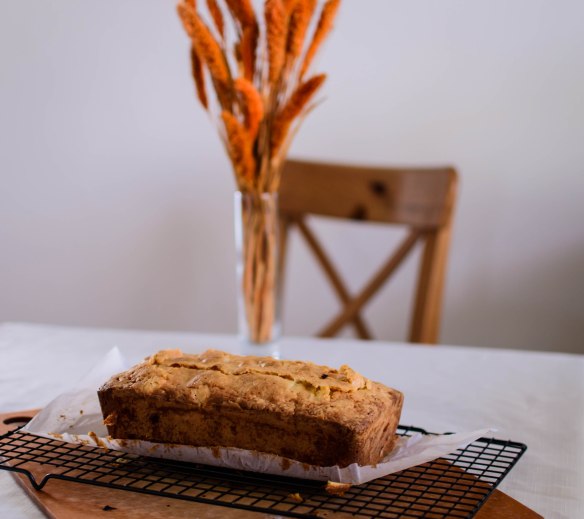
2016-food-blog-november-03462016-food-blog-november-0352Most pound cakes have a soft top that splits as it bakes, and this one did offer that classic cleaving in the center, but the rest of the top – the browned exterior on either side of that tender split, was crisp and delicate and almost wafer-like – think of the top shiny, flaky layer of an excellent pan of brownies – perhaps because I was so enthusiastic in creaming the butter and sugar and then beating in the eggs. My batter looked like a good fluffy buttercream in its initial stages.

2016-food-blog-november-0363I usually bring my baked offerings to work with me, leaving only a serving or two to enjoy at home, and this was no exception, but we were sorry about that. Especially as the week wore on, we wanted more of this comforting, moist-but sturdy, not-too-sweet confection, preferably in thick slices. But alas, it lasted only a few hours in our mailroom.

2016-food-blog-november-0368It’s funny in that uncomfortable way, but the last time I made a pound cake was also a heavy time. It’s an uncomfortable metaphor – perhaps I should start perfecting an angel-food cake recipe instead – but hindsight is what it is, and here we are. Cake.

2016-food-blog-november-0371Maybe the best way I can conclude today is with Kurt Vonnegut. In his novel God Bless You, Mr. Rosewater, one character offers the following as a baptismal statement to a pair of brand new twins: “Hello babies. Welcome to Earth. It’s hot in the summer and cold in the winter. It’s round and wet and crowded. On the outside, babies, you’ve got a hundred years here. There’s only one rule that I know of, babies – ‘God damn it, you’ve got to be kind.’”

2016-food-blog-november-0386

Brown Butter Apple Pound Cake
Makes 1 9x5x3 inch loaf
About 90 min
16 tablespoons unsalted butter (2 sticks)
1⅓ cups sugar
3 large eggs + 3 large egg yolks, all at room temperature
1½ teaspoons vanilla
1½ teaspoons water
½ teaspoon salt
1½ cups cake flour
2 cups ½-inch cubes of granny smith apple; 1 large apple or 2 small

  • First, brown the butter. In a small saucepan, preferably with a light colored bottom so you can see what is happening, melt the butter over medium heat. As it melts, it will foam up. Keep swirling and checking the color underneath that foam; it will gradually darken from yellow to golden, and the foam will recede a bit. Watch very closely at this point, occasionally tipping the pot to see the bottom – little white solids will have collected. When these begin to turn brown, the butter will smell toasted and nutty. Take it off the stove and stow it in the refrigerator until it has solidified but is not too hard – your thumb should still press in easily.
  • While the butter cools down again, preheat the oven to 375F and prepare a loaf pan by spraying with non-stick spray and lining with parchment paper. Prep the apple by peeling it, quartering and coring it, and then slicing and cubing into ½ inch pieces.
  • In a mixing bowl (Baking Illustrated recommends using a stand mixer, but I used a glass bowl and my regular electric mixer and it was fine), combine the re-solidified butter and all of the sugar. Mix at medium speed until very light and fluffy, at least 3-4 minutes. Really. That long. It will take on a texture much like a slightly grainy buttercream frosting.
  • Beat the eggs with the egg yolks, the water, and the vanilla and, with the mixer still running, dribble in this egg mixture until all is well combined. At this point the batter will be very thick and glossy and still a bit reminiscent of frosting.
  • Now, sift in ½ cup of the flour with the salt right over the top of the batter. Once it is all snow-drifted on top there, use a rubber spatula to fold it in. Once fully combined, repeat the sifting and folding with the second ½ cup of flour.
  • Sprinkle the apple cubes over the batter, then dust with the remaining ½ cup flour. Giving the apple chunks a little flour coating helps them stay suspended in the batter during baking, rather than sinking to the bottom. Repeat the folding process one final time, being sure the flour is fully incorporated and there are no dry pockets.
  • With your rubber spatula, pour and scrape the batter carefully into the prepared loaf pan. Smooth off the top if you like, then stow in the preheated oven for 45-55 minutes, or until a toothpick insertted comes out with just a few damp crumbs.
  • Let the loaf cool in the pan on a wire rack for 5 minutes, then use a second wire rack placed over the top of the pan to invert. The loaf will plop right out, upside down, onto this second rack. Carefully remove the pan from the loaf and flip the loaf back over top-side-up to cool completely. Peel off the parchment paper, transfer to a cutting board, and slice up thickly to eat.

Save

Save

Save

Rain check + Photo… Monday?

I haven’t been the most reliable of posters lately, I know, but it is “that time of the term.” Next week there’s a long weekend, which I’m using to do a little recipe developing. Till then, as a consolation prize, here are a few non-recipe related photos I’ve played with and liked the looks of. Enjoy, and have a lovely week!

2016-food-blog-march-0530Lots ‘o lemons

2016-photo-fridaysLoved the mix of browns and the uneven curve of the bowls in my cabinet.

2016-photo-fridays-2Playing with depth of field.

2016-photo-fridays-0268Strange layers and crevices of a brainy head of cauliflower.