Fig and Brie Flatbread #TwelveLoaves September

When I was a kid, my parents made me cassette tapes from several Disney albums to listen to in the car.  I mean real albums: records.  45s and 78s, that spun, some wobbly and warping, on a turntable at a speed that, when I was much smaller, seemed unreal.  But the cassette tapes were for long car trips, and we all learned every word in every song (this wasn’t so bad, according to my parents, with the Disney songs.  One of the other tapes – a John Denver greatest hits album – wasn’t so lucky.  I requested it so many times that the tenuous black strip of tape got tangled in the player, and even after attempts to repair it by winding it manually back into the plastic casing, one day it mysteriously disappeared.  I’m still convinced that my dad, sick to death of hearing the plaintive desire for country roads to take us home, chucked it out the window).

Interestingly, one of my favorite songs from that collection was from a movie I’ve never seen: Disney’s The Happiest MillionaireThe song, “Fortuosity,” was a happy ditty about luck and opportunity, and “fortuitious little happy happenstances,” and I loved it.  It’s an idea that I like, and the song itself comes back to me every once in a while at random moments, most often when I think about the word “fortuitous,” with which the song obviously plays, and when I remember road trips with my family.
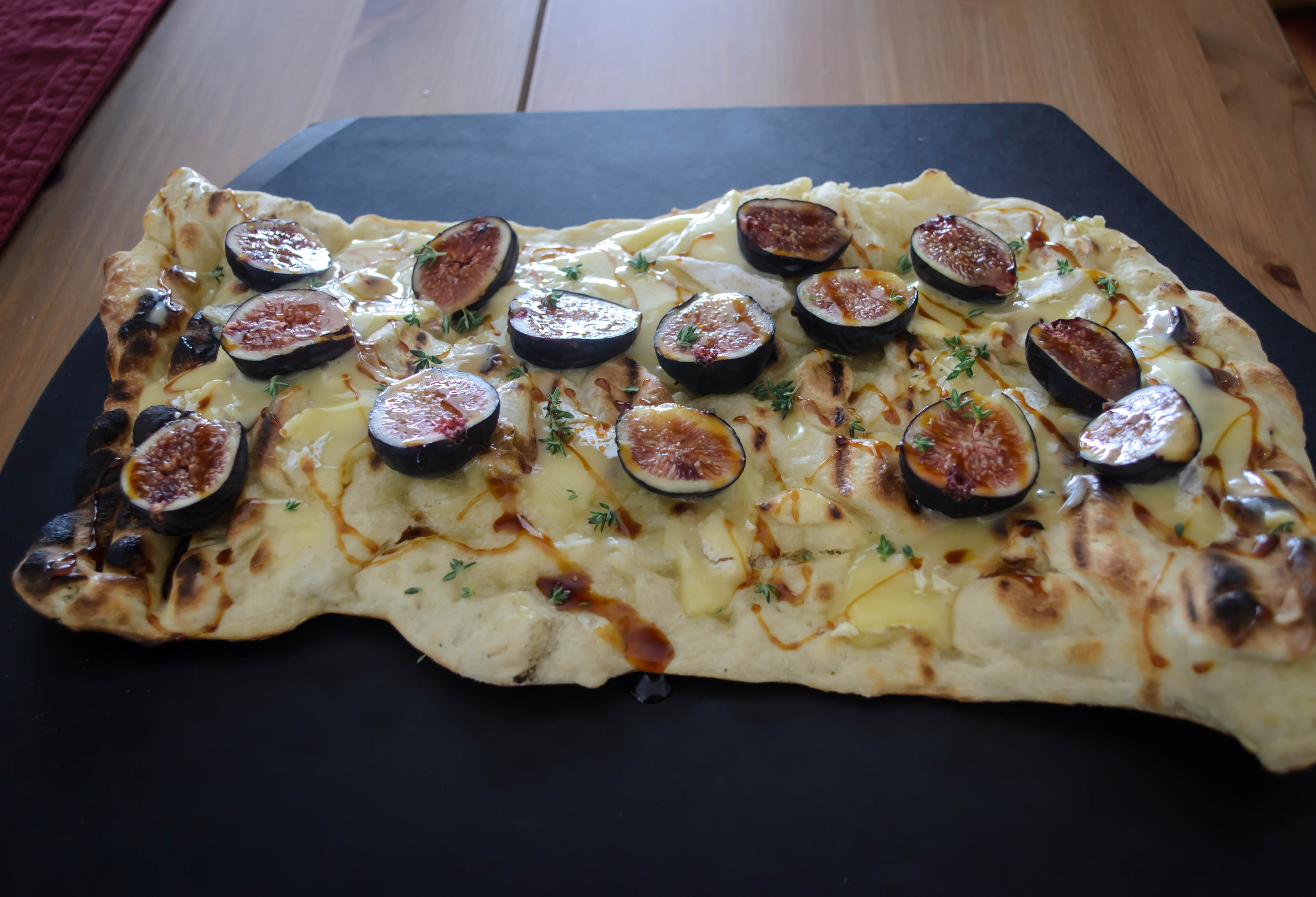
Food Blog September 2013-2570This is a long-winded way of introducing the idea that this week’s post, and this month’s Twelve Loaves challenge, aligned entirely by fortuitous coincidence.  Last week I asked N. to grill up some leftover pizza dough, which I smeared with double cream brie, nestled in some halved figs straight from the farmers’ market, and drizzled with barley malt syrup and sprigs of fresh thyme.  Then I checked the Twelve Loaves challenge only to see that September’s theme is Farmers’ Market food.  Fortuosity indeed.
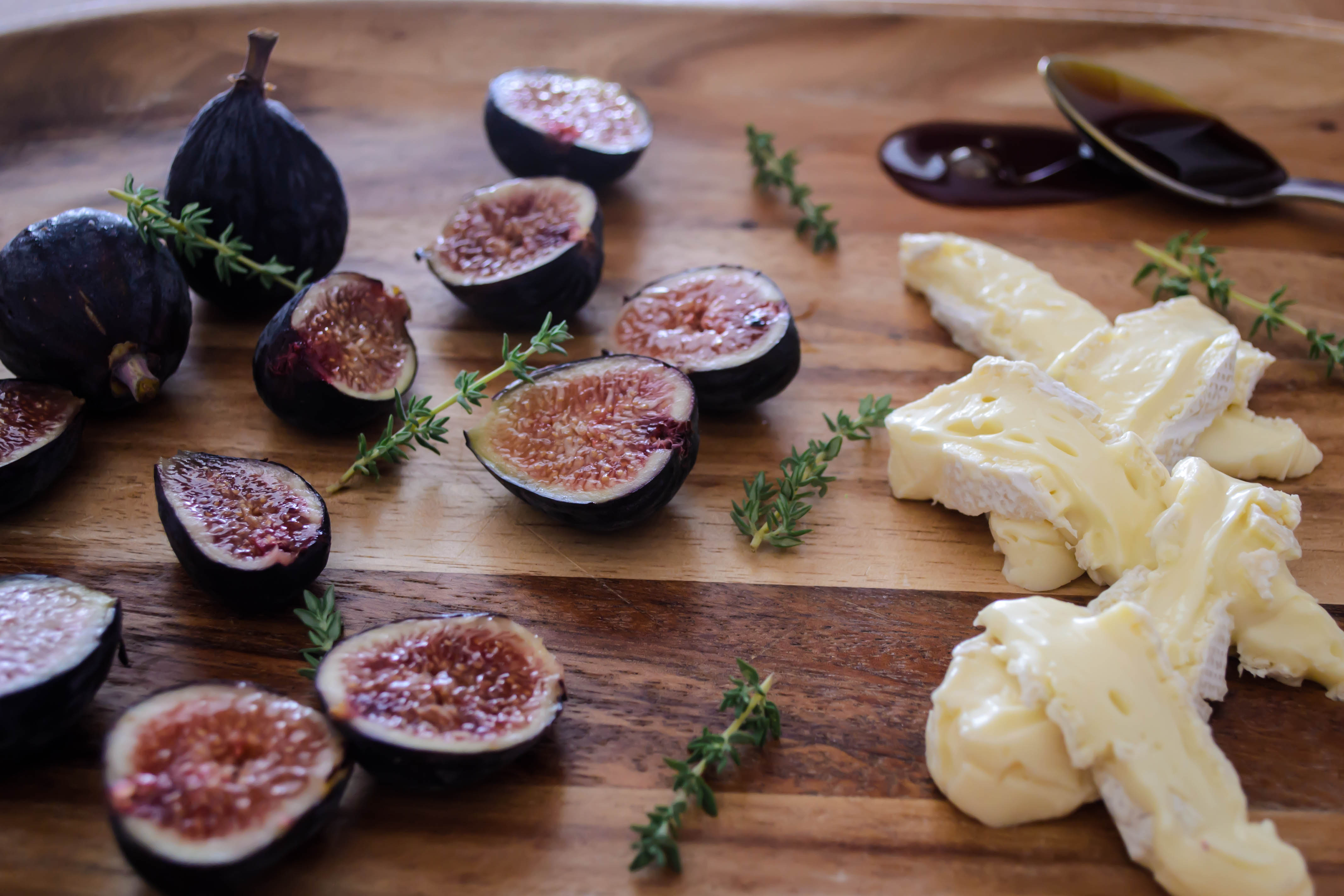
Food Blog September 2013-2566The idea for this combination – creamy cheese, soft, sweet figs, and a hit of herby freshness, came from a party N. and I attended recently.  Our hostess, who works with N. (we should have them over soon, N., if you’re reading this…), had quartered some black mission figs, settled them in around a wedge of brie, and dosed both liberally with honey and thyme.  My spin was based on the desire to use more of the barley malt syrup I bought for last month’s bagel experiment, and the obsessive love we have for homemade pizza, which means there is frequently a ball of dough either in the fridge or in the freezer, hoping to be put to tasty use.

Summer 2013-2503

Visitor to our thyme bush. I named him Algernon, because he looked like he might be impersonating someone.

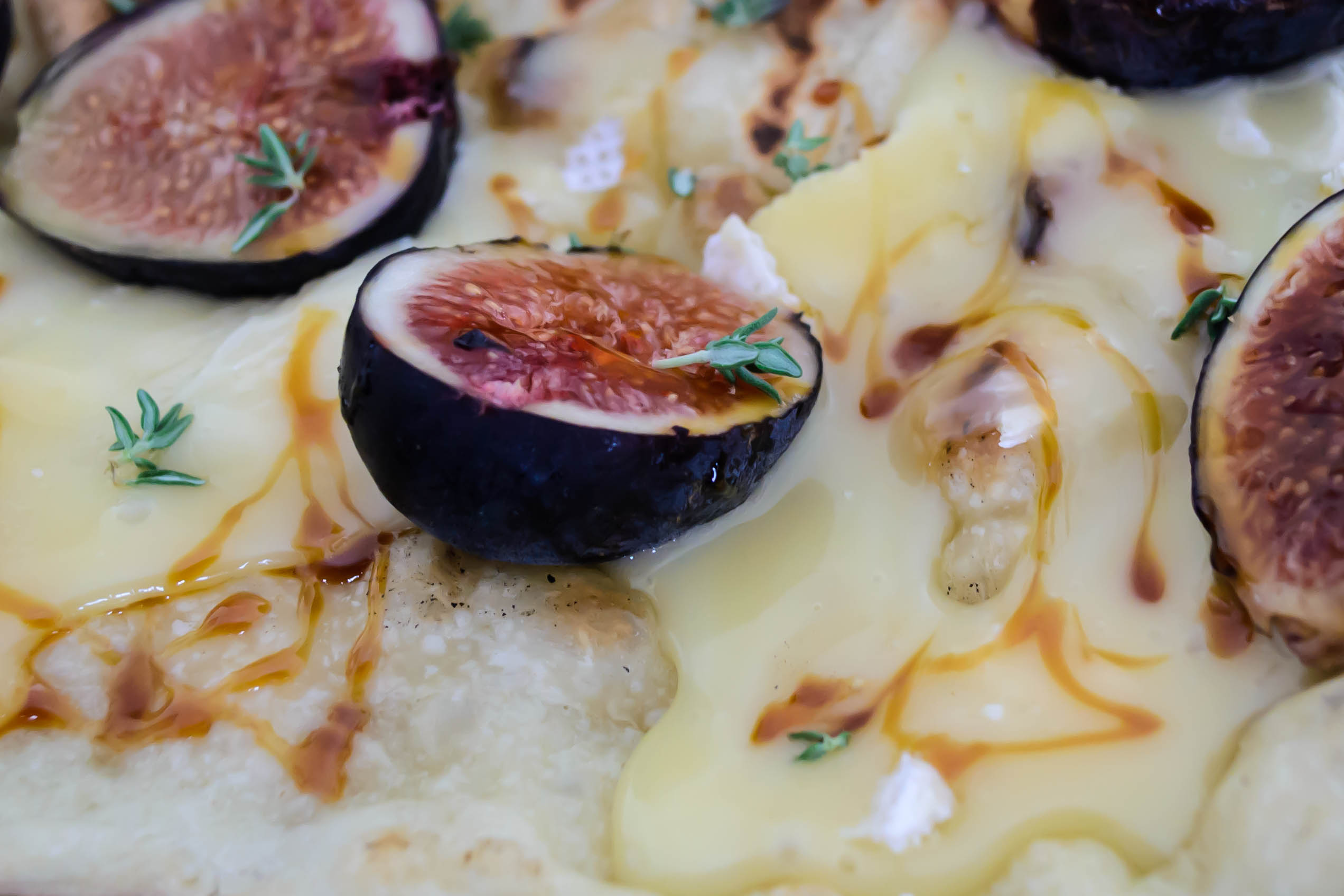
We loved this combination.  The barley malt syrup is a roastier contestant than, say, maple syrup, and was therefore a welcome balance.  It is sweet, but there is an almost bitter edge to its flavor – no doubt the malt part.  It is, in fact, just a lower grade extract than what brewers use for beer, so the darker component makes good sense.  Drizzled judiciously across the blistered surface of our cheese and fruit studded flatbread, it enhanced both main players.  Though Los Angeles played some mind games with me last week, cooling off just as I published a post asserting that autumn hadn’t arrived yet, it has warmed up again.  Since this flatbread cooks on the grill, it’s perfect for a warm evening when you can’t bear the idea of firing up the oven.  But if you don’t have a grill, and you’re willing to risk the house-heating power of indoor cooking, I’ve also included directions for the oven.  Food Blog September 2013-2574
Food Blog September 2013-2569
Fig and Brie Flatbread
Serves 3-4 as an appetizer; 2 as a main course
Directions for grilling adapted from Elizabeth Karmel and Bob Blumer’s Pizza on the Grill
12 oz. ball of pizza dough, purchased or homemade (I’m still working on perfecting my recipe; once it’s foolproof, I’ll post it for you)
Olive oil for stretching dough
6-8 fresh black mission figs, halved from stem to blossom end
8 ounces brie cheese, cut into thick slices
2 tablespoons barley malt syrup or your favorite honey
2 teaspoons fresh thyme leaves (in small sprigs is fine – the stems are tender enough to eat near the end of the sprig)
  • If your dough is in the refrigerator, remove it about half an hour before you intend to cook it and let it rest, unwrapped, on a lightly floured or oiled surface.
  • While the dough rests, preheat your oven or grill.  For a gas grill, this will take about 10-15 minutes with the burners set on high.  Once the grill has preheated, turn down the burners to medium.  For a charcoal grill, this will take a little longer – perhaps up to 30 minutes for the coals to begin turning gray.  For an oven, preheat to 500F (or as close to this as your oven will go!).
  • Once you’ve got your heat source preheating, prep your toppings.  Halve the figs, slice the cheese, pinch the thyme into individual leaves or small clumps.  This is all going to go pretty quickly once we start cooking, so you’ll want to be ready.
  • When the dough has rested, set a 9×13 inch glass baking dish bottom side up on your counter.  Rub the bottom (now facing upwards) with olive oil, then push and stretch your pizza dough out on the bottom of the dish so it hangs over all edges, creating a rustic but relatively even rectangle.  If it springs back or threatens to tear as you stretch it toward the edges of the dish, let it rest a bit longer and then try again.
  • Bring your dough, still on the bottom of the baking dish, out to the grill.  If the dough is sturdy enough to lift without tearing, pick it up by two ends and lay it across the grill grates, flopping the sides drooping below your hands toward the back edge of the grill, in the same motion you would use to swing a tablecloth over a table.  If the dough is not so sturdy, put some gloves on, and carefully invert the baking dish only an inch or so above the surface of the grill. The dough will slowly disengage and drop gracelessly onto the grill grates.  Once dough and grates are in contact, close the lid of the grill and leave it closed for about 3 minutes, or until the bottom side of the dough is well browned with nice grill marks.
  • Use a pair of long-handled tongs to transfer the flatbread to a pizza peel or a rimless baking sheet.  Use the peel or baking sheet to help you flip the rectangle of dough over and slide it back onto the grill, unmarked side down.  Close the lid of the grill and leave it closed for another 3-5 minutes, or until the whole thing is browned, marked, and nicely puffed.  I like the look of a few big airy blisters on the surface.
  • If you are using an oven, flop your dough onto a preheated pizza stone or the bottom of an oiled cookie sheet and bake for 10-12 minutes.
  • Once your flatbread crust is browned and blistered to your liking, transfer it from the grill or oven to your cutting surface.  Smear the whole top of the dough with the slices of brie cheese (I used the back of a spoon.  You could also use a spatula).  Nestle the figs in, spacing them evenly over the surface.
  • Drizzle the barley malt syrup over the top of the flatbread in a thin stream.  Don’t overdo it – the stuff is sweet.  You might not need the full 2 tablespoons.  You just want a light zigzag of caramel over figs and cheese alike.
  • Sprinkle on the thyme leaves, slice, and consume.

* You could, I suppose, top the dough either before cooking, if you are using the oven method, or immediately after flipping, if you are using the grill, and cook the toppings.  I didn’t do this, because I wanted the freshness of the figs, and knew the heat of the bread itself would be enough to melt the cheese.  If you choose to cook the toppings and you are using a grill, add the toppings after flipping, but turn off the burners on one side of the grill to create indirect heat, and cook your topped flatbread over the unlit burners for 7-10 minutes. This will allow the toppings to cook and the cheese to melt without burning the dough.
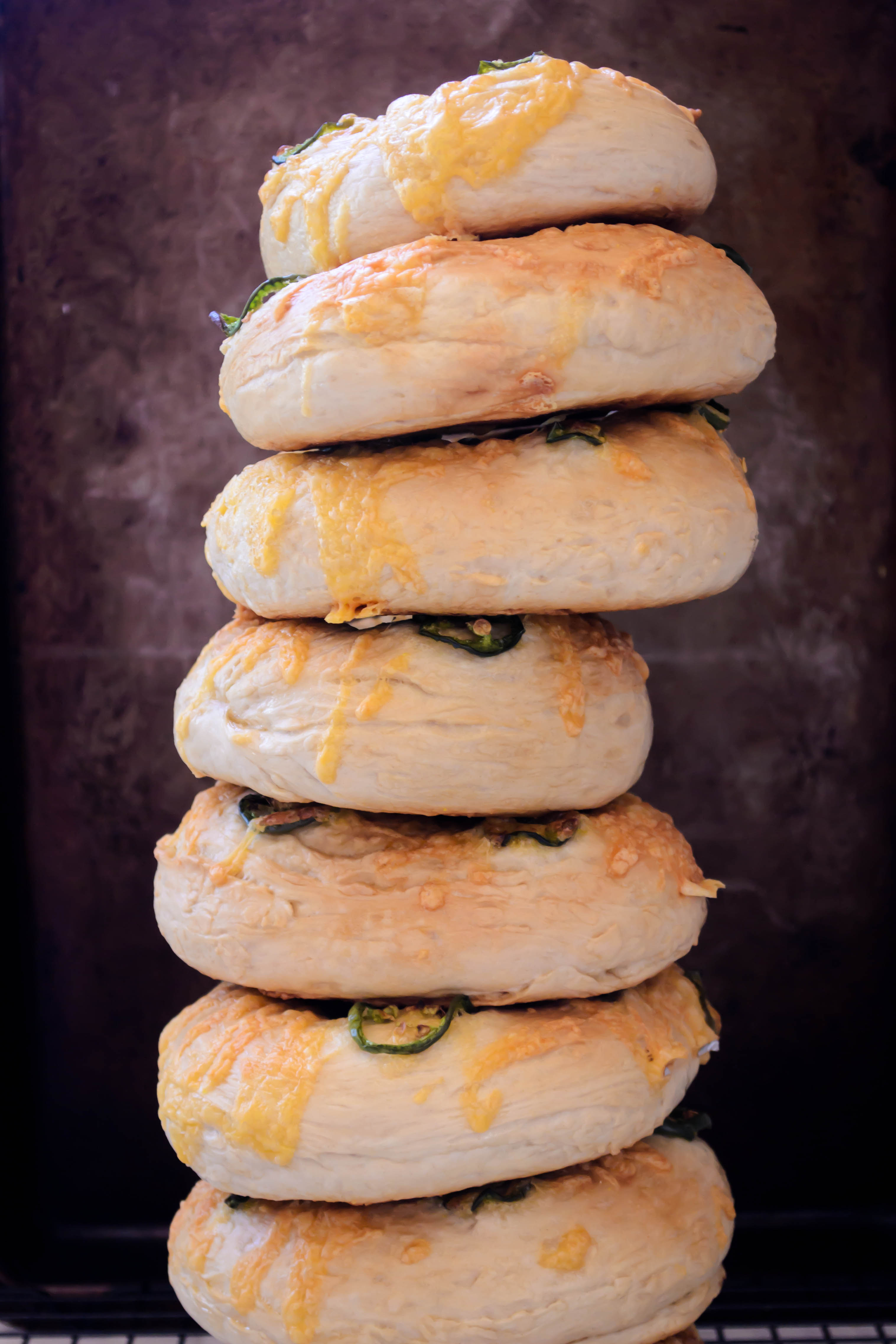
Jalapeño Cheese Bagels

August 2013-2541Seeing as it’s now been more than half a year since I started this dough resolution, I think it’s high time for a check-in.  When I began this project, I was afraid of pie crust.  I found baking bread an intimidating procedure: proofing yeast was a touchy business; sticky dough made me wring my hands in despair.  My first few loaves came out with black bottoms, and I didn’t have a real sense of the difference between bread flour and all-purpose.

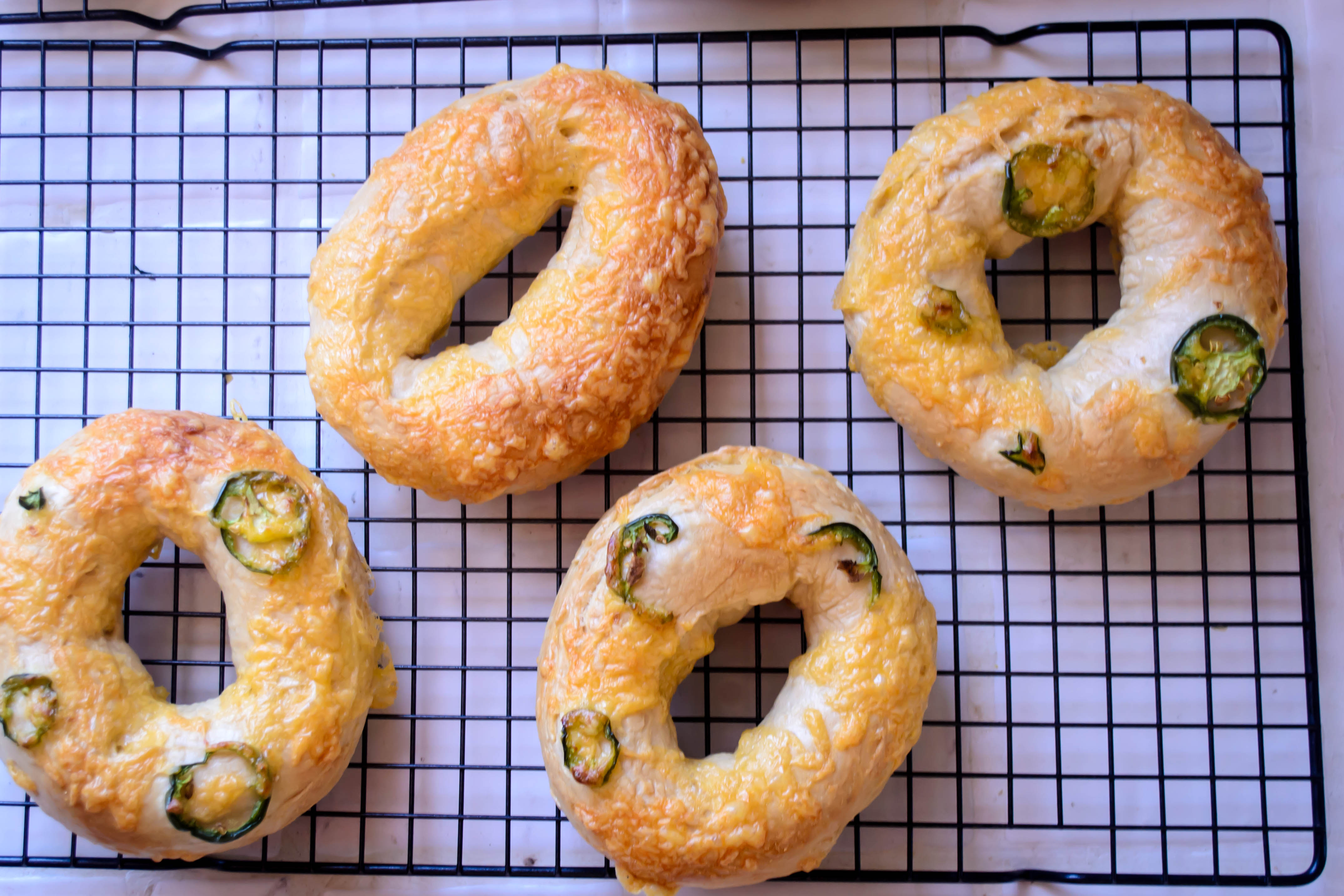
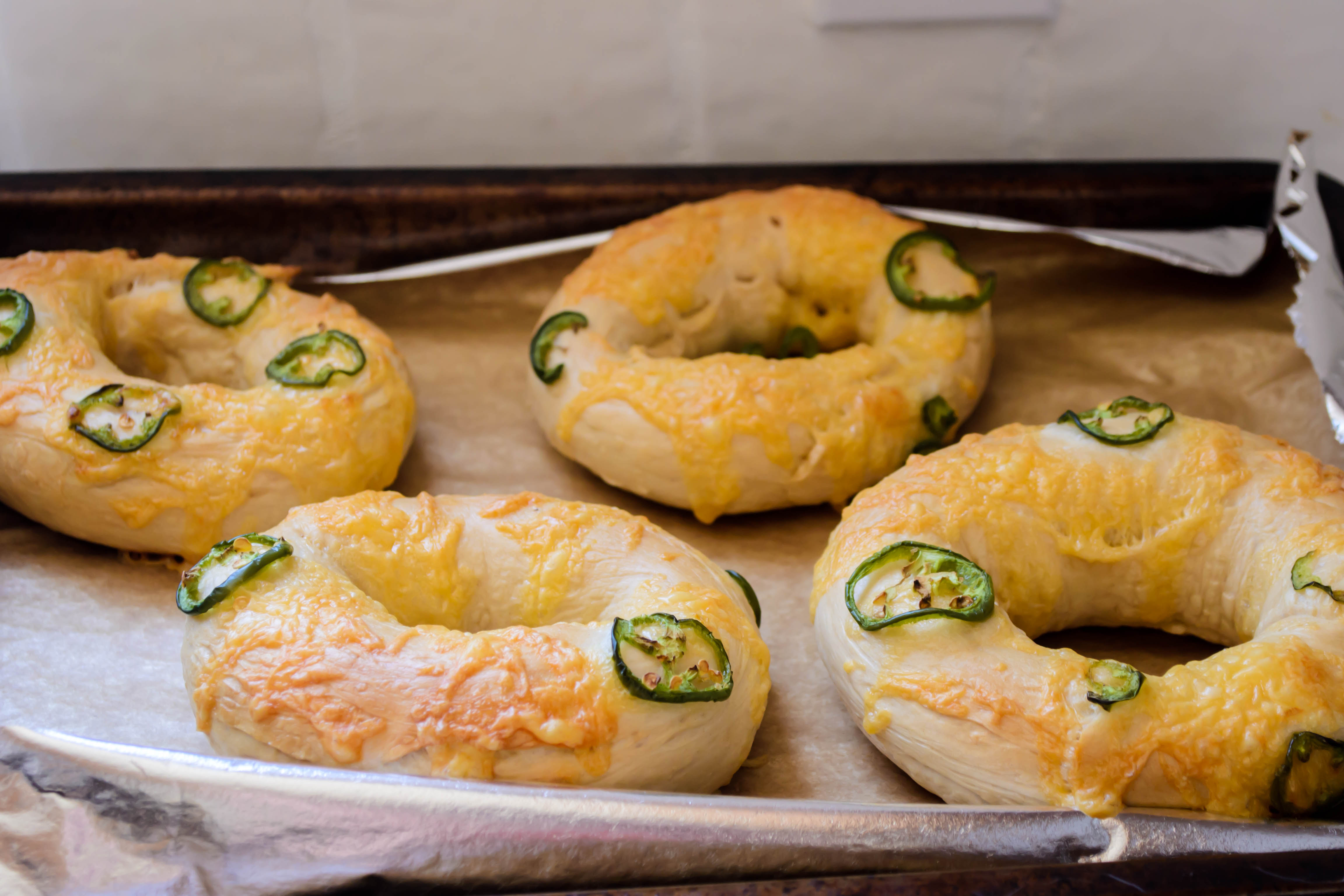
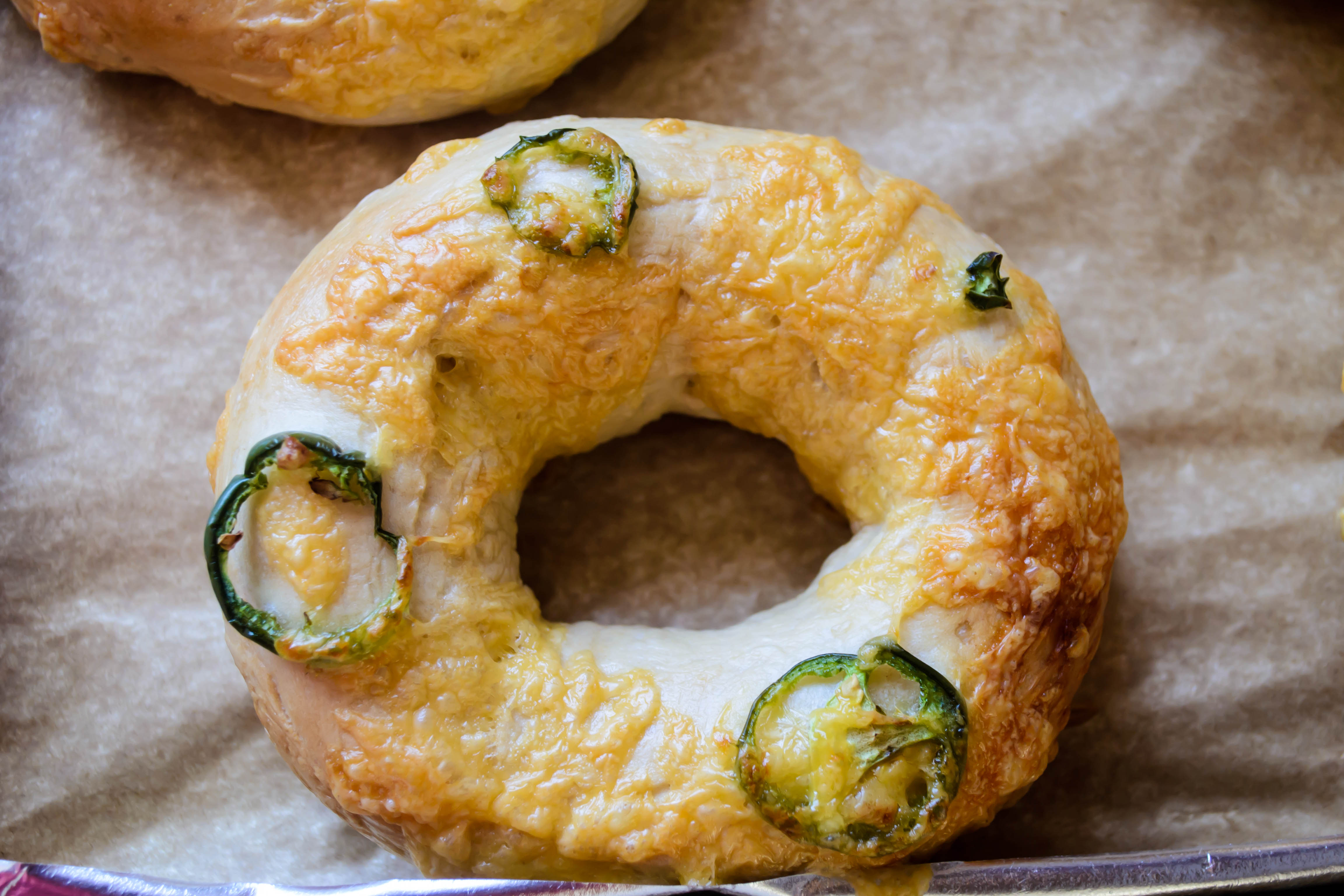
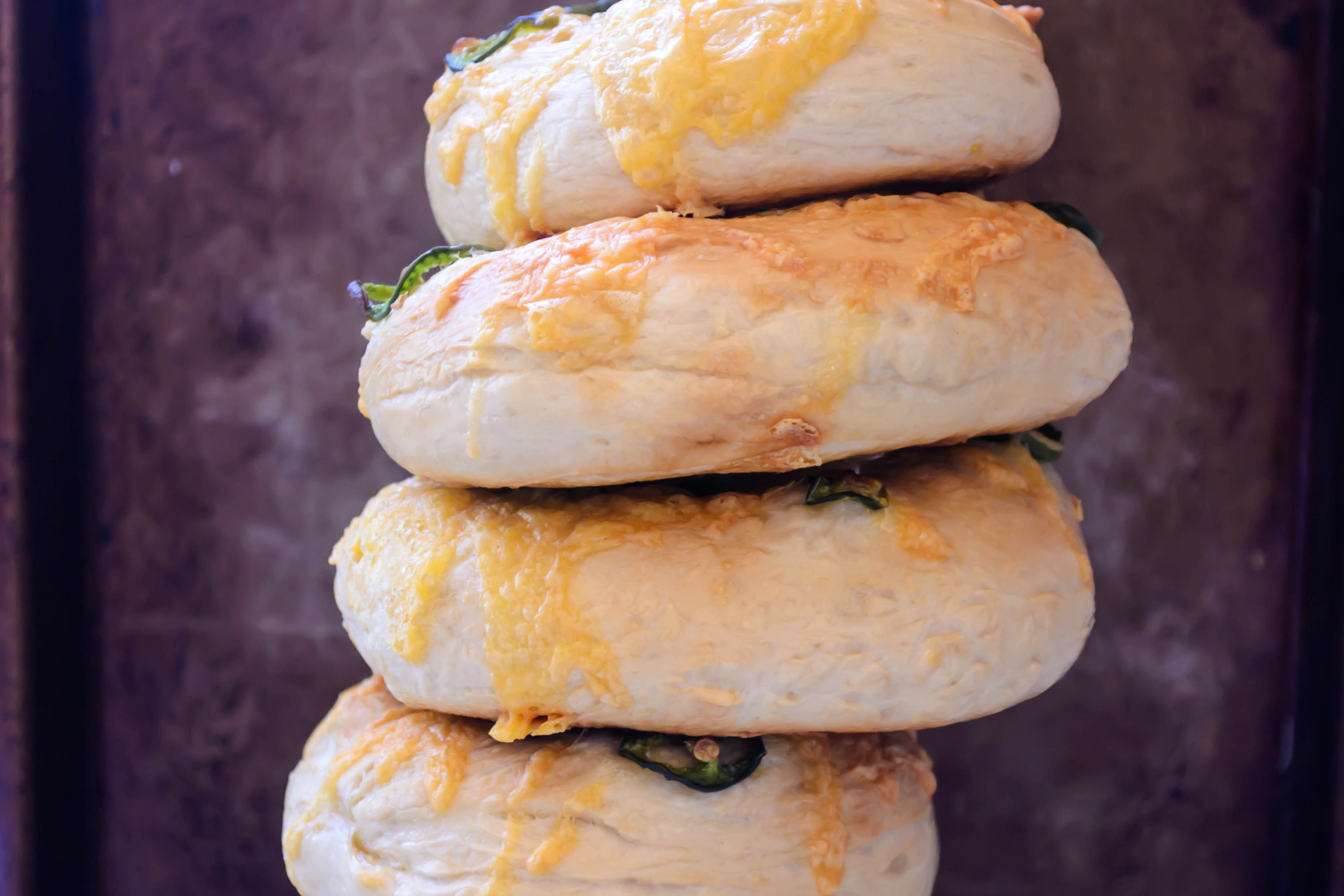
August 2013-2537Fast forward.  This past weekend, I made bagels.  Real, crisp crusted, chewy, bagel-y bagels, studded with jalapeño slices and dripping with sharp cheddar cheese.  I’d been thinking of making them anyway, but when this month’s Twelve Loaves challenge came along with a demand for savory breads, it sealed the deal.  I know, I’ve used this flavor combination before.  In fact, I used it for another Twelve Loaves challenge.  You could say I’m rather fond of it.  Maybe I need a bit of an intervention.  But… jalapeño and cheese!  How can you resist?  See, the cheese transforms into a delicate crackling lace encasing the top of the bagel, and the pepper slices roast and shrivel in the oven’s high heat, and the whole thing becomes just so savory and interesting, that I want to put it on everything.

August 2013-2534Bagels are an odd-ball bread.  The additional protein of plain old bread flour is not enough for them – they require the even heavier duty high gluten flour, and sweetener in the form of barley malt syrup, both products I’d never heard of (see note on ingredients below).  After a lengthy turn with a dough hook that I thought would break my stand mixer (the heaving strain of the machine was almost too much to take), the stiff, dense dough gets portioned out, rolled into wormy logs, curled and pressed and sealed into rings, and then refrigerated overnight to allow for a long, slow rise that enhances the flavor and texture of the finished product.  Upon retrieval from the chill-chest, the rings are plunged into a vat of boiling water before being sprinkled with toppings and levered into a hot, hot oven to bake up shiny and crisp and chewy.

(Obligatory apology for the weird lighting in the pre-topped, pre-baked photos.  That’s what happens when you bake at night…)

August 2013-2516 August 2013-2518 August 2013-2519 August 2013-2520 August 2013-2521 August 2013-2522 August 2013-2523These are not the easiest baked good I’ve tried.  They involve odd ingredients, special equipment (I can’t imagine kneading this dough by hand.  Baking Illustrated, my guide for this recipe, says you shouldn’t even try), and considerable time.  They require not one, but two methods of cooking, and they make a lot of dishes for a willing but sometimes reluctant dishwasher sous chef helper to wash up.

August 2013-2524 August 2013-2525Yet I think, if you are up for the challenge, that you should take it on.  Watching them transform from a scrappy, tough dough into firm rings, and then seeing the crust take on that glossy shine and texture surrounding a chewy, densely-spongy interior, is not far short of amazing.  Several times during the process, astounded by how bagel-like they actually were, I said to N., “I can’t believe I’m making bagels!  Actual real bagels!”  The finished product is a far cry from the soft, fluffy offerings you’d find on a grocery store shelf.  The extra labor and the strain they put on my stand mixer (seriously, guys, you should have heard the motor.  I thought it was going to die on me right there) make these only a truly special occasion project, but one that was certainly worth doing.

August 2013-2528 August 2013-2530Note on ingredients: I couldn’t find high gluten flour, but Baking Illustrated told me it could be readily ordered from King Arthur flour, if you have that kind of time, and the sweet, helpful woman who swept in to help me navigate the rows of flour in our Whole Foods market said it was sometimes at “crunchy granola” sorts of markets.  I used, at her recommendation, a combination of bread flour and a few tablespoons of vital wheat gluten instead.

Barley malt syrup is a sweetener made from sprouted barley with an intriguing, earthy taste, less saccharine than white sugar or honey, not nearly as intense as molasses.  I found it at my Whole Foods, but again, if you can’t find it, you might try a natural foods store or the internet.

August 2013-2542Jalapeño Cheese Bagels
Adapted from Baking Illustrated
Makes 8 bagels
4 cups high-gluten flour OR 3 ¾ cups bread flour and ¼ cup vital wheat gluten (22 oz)
2 tsp salt
1 TB barley malt syrup
1 ½ tsp yeast (I used active dry yeast; you could also use instant)
1 ¼ cups water (at 80 degrees – it should feel just barely cool to the touch)
3 TB cornmeal, for dusting the baking sheet
1 cup shredded extra sharp cheddar cheese
1 green jalapeño, sliced wafer thin


Day 1:

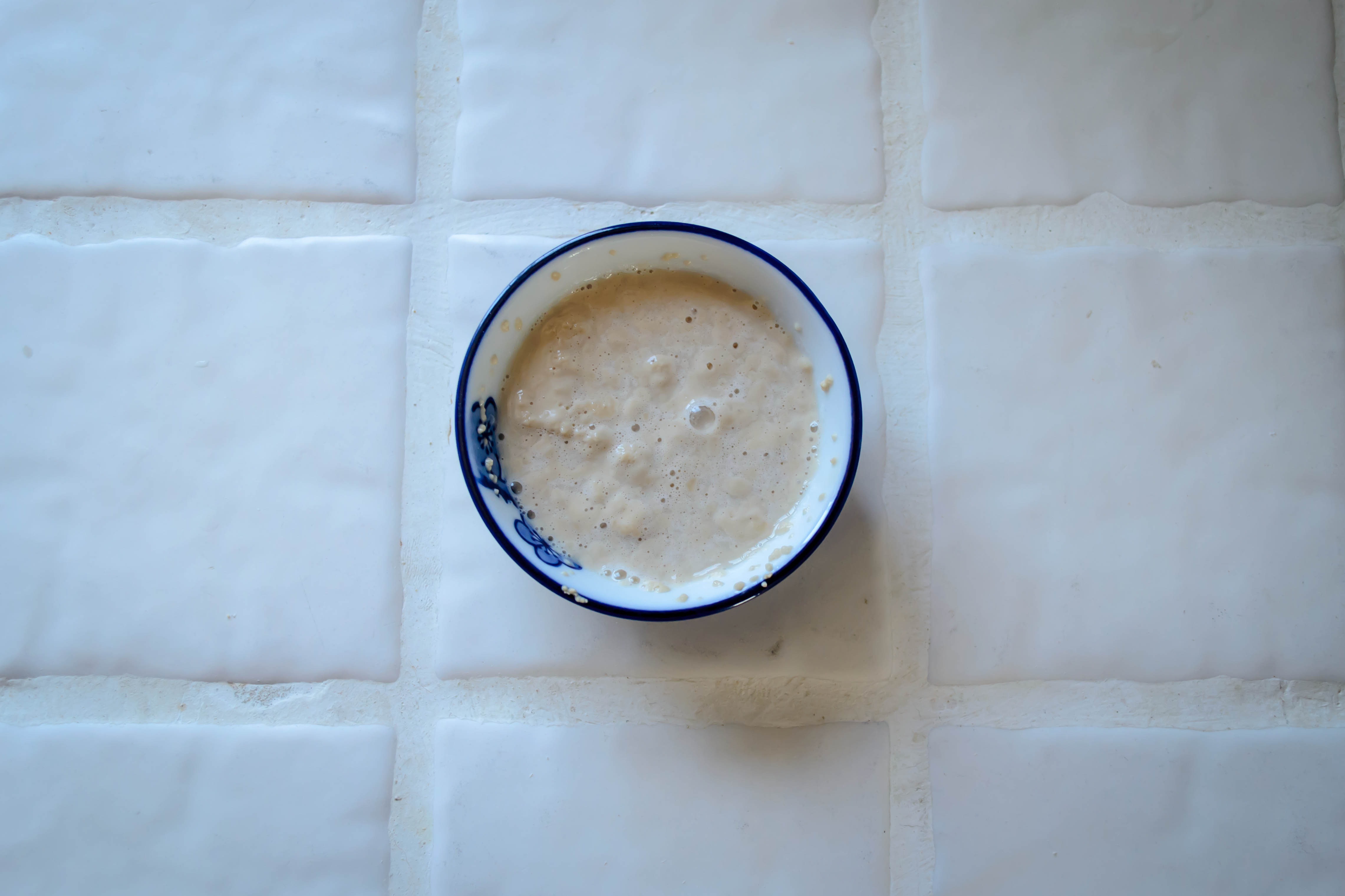
  • If you are using active dry yeast, sprinkle it over the water and leave it to burble for a few minutes while you collect the rest of your ingredients.
  • Combine the flour, salt, and barley malt syrup in the bowl of your stand mixer with the paddle attachment.  Add the yeast and water (if you are using instant yeast, skip the proofing step and measure it straight into the bowl) and mix on the lowest setting with the paddle attachment for about 4 minutes, until the dough is in dry tangles.  Baking Illustrated says until it “looks scrappy, like shreds just beginning to come together,” which is a perfect description (124).
  • Exchange the paddle attachment for the dough hook, and continue to knead on medium-low speed until the dough comes together into a stiff but slightly elastic ball, about 8 to 10 minutes more.
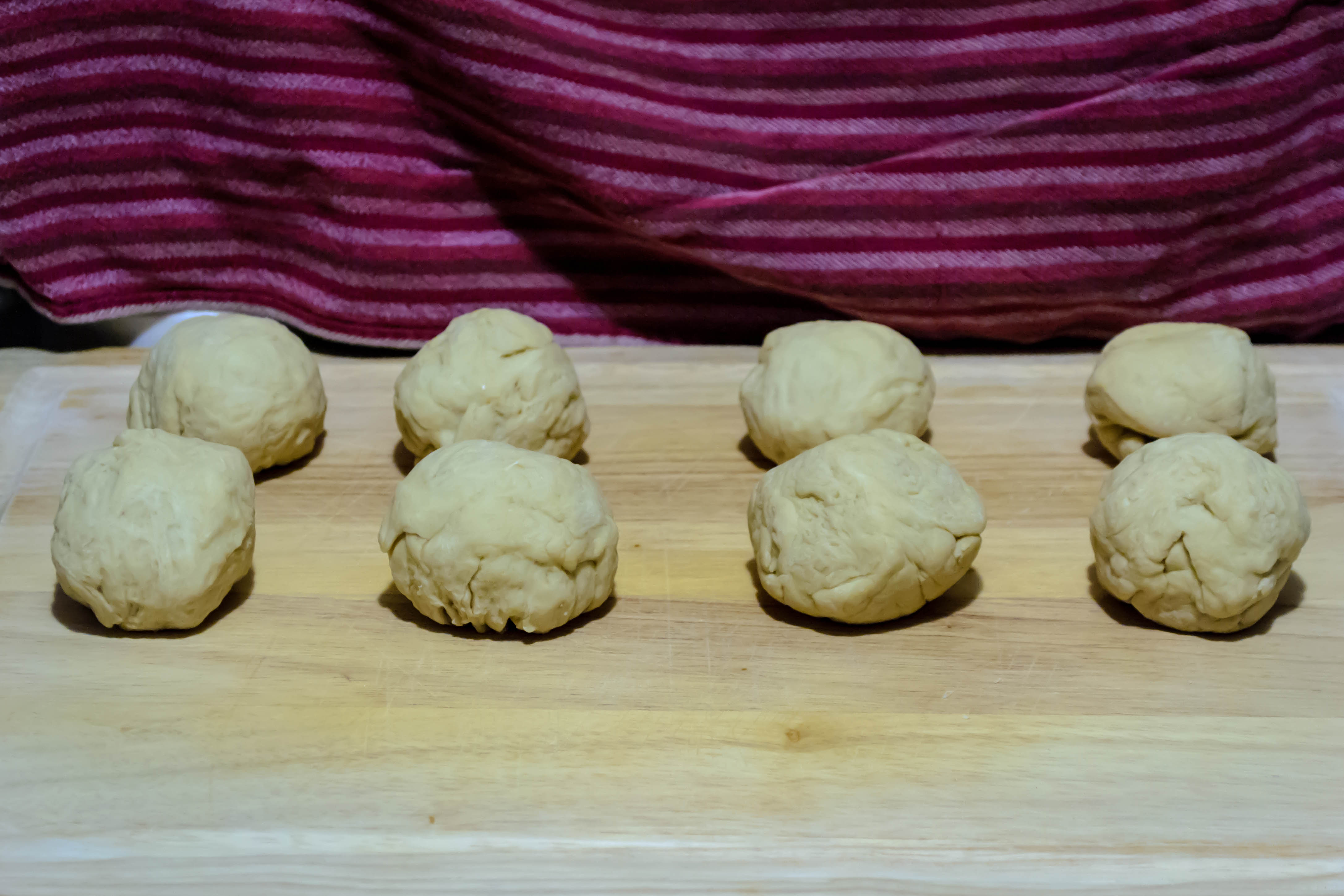
  • Turn the ball of dough onto a work surface.  It won’t be very sticky, so you probably won’t need to flour your board at all.  Divide the dough into 8 even portions, roll each one into a smooth ball and cover them all with a towel or plastic wrap for 5 minutes.
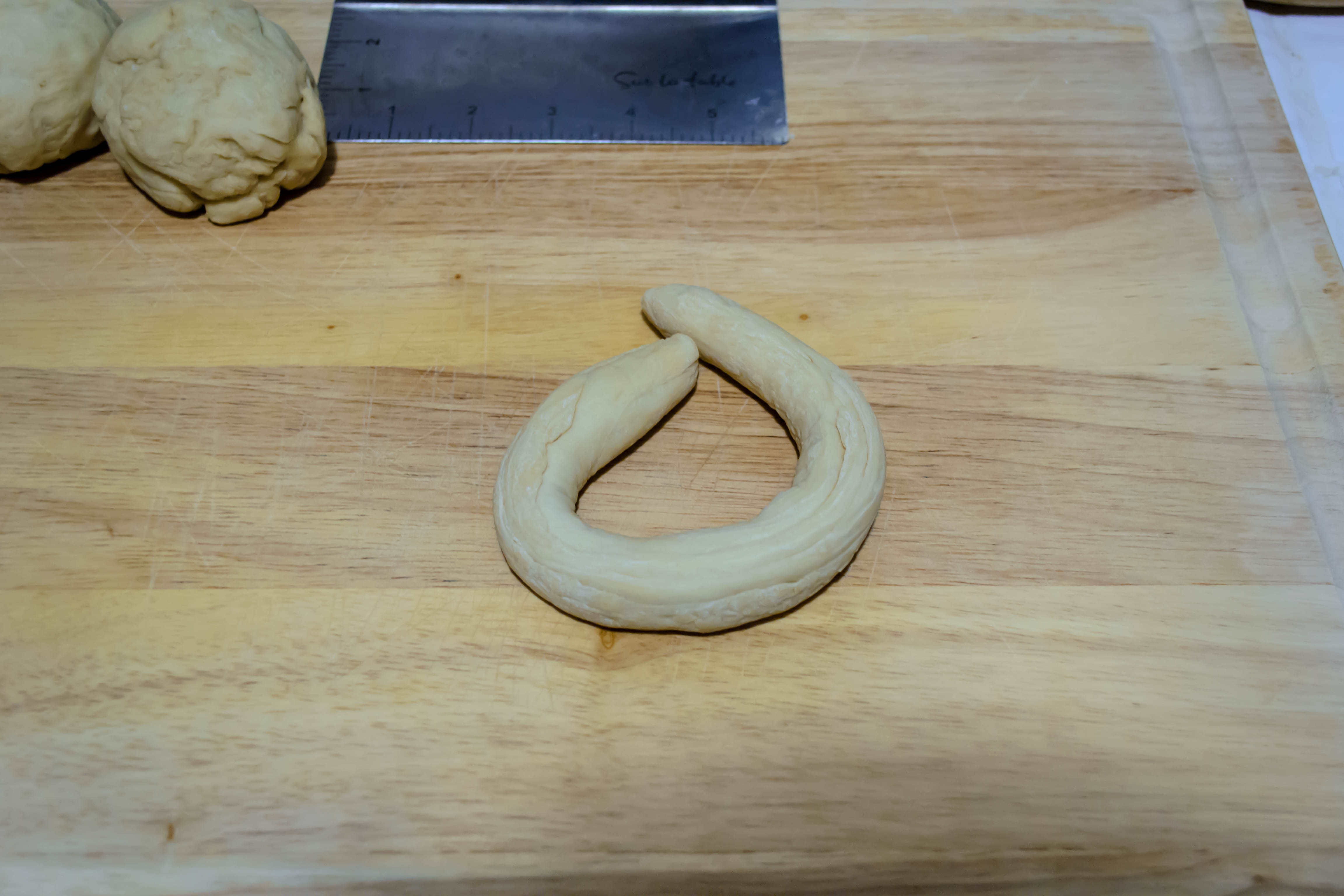
  • Once the dough balls have rested, form each one into an 11 inch rope of even thickness by firmly rolling from the bottom joints of your fingers down to the heel of your hands.  I found I had the best luck angling my hands slightly away from each other and pushing down and forward, which helped lengthen both sides of the rope simultaneously.
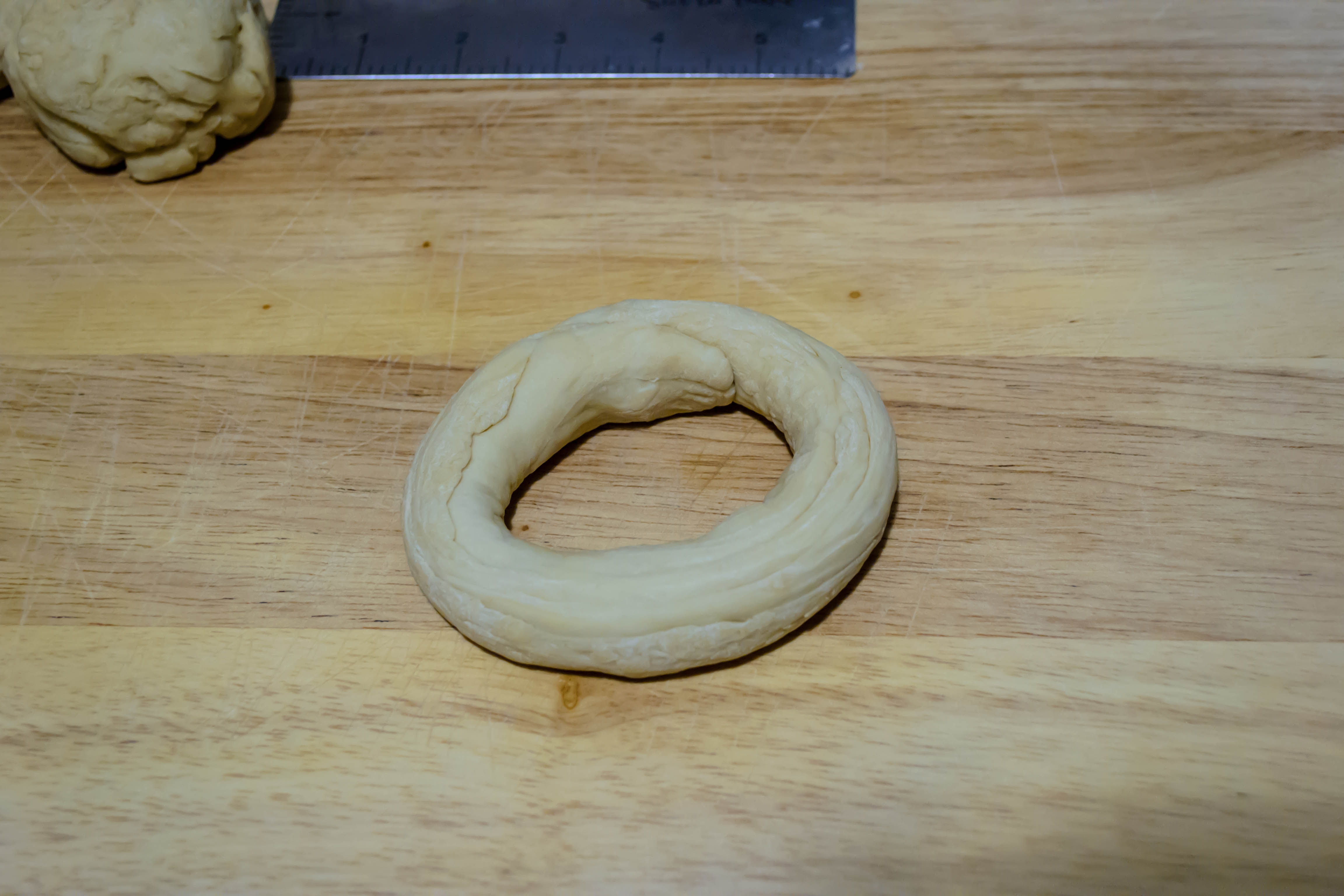
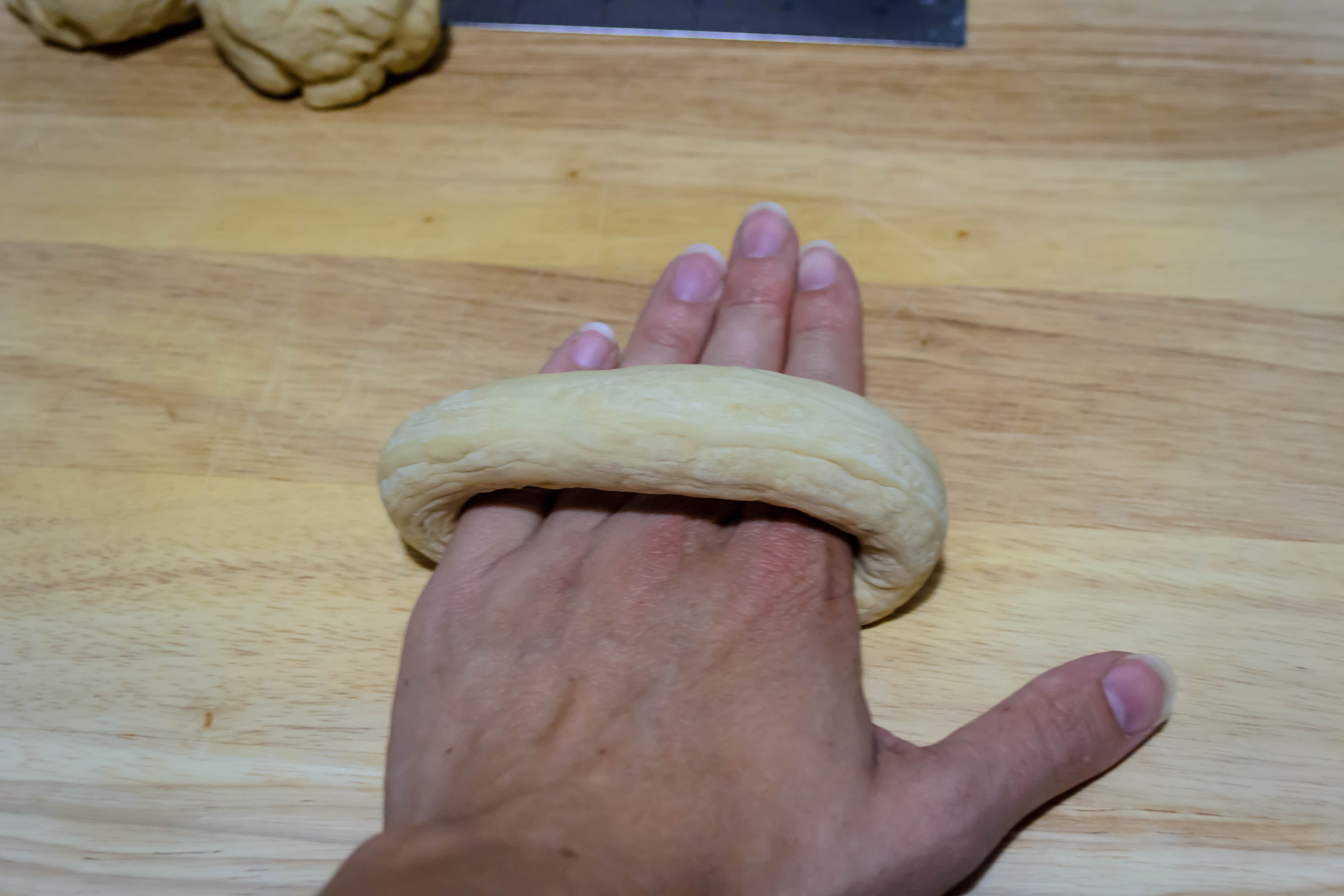
  • Shape each 11 inch rope into a circle, allowing for a 1-2 inch overlap.  Dampen the dough surface where it will overlap, and press together, squeezing and pinching tightly to seal the edges.  To secure the seal, put your fingers through the dough ring, resting it at the base joint where your fingers meet your palm, and roll the dough circle over the board a few times with the overlapped portion against your palm.
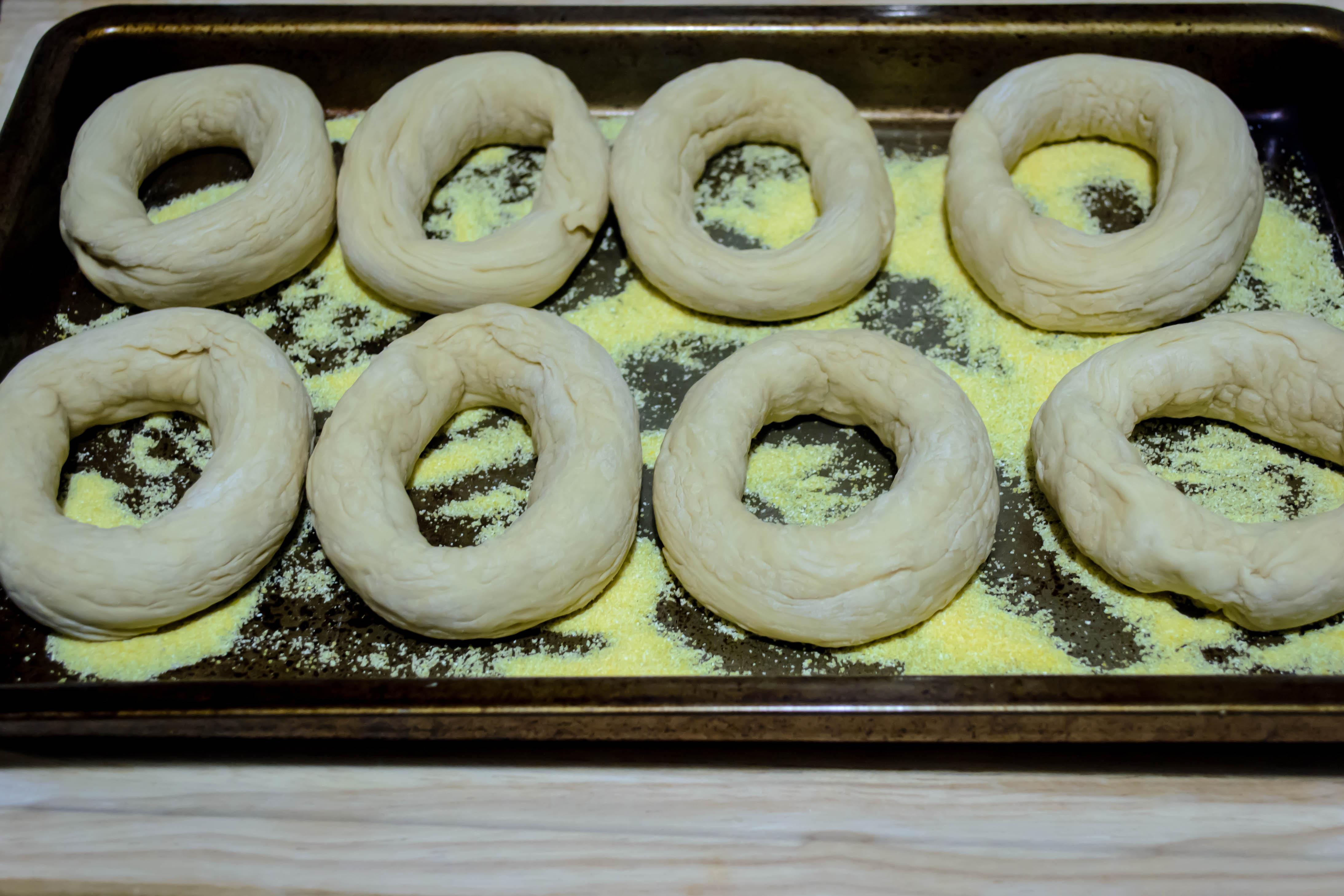
  • Dust a baking sheet with the cornmeal, evenly space the dough rings on it, and cover securely with plastic wrap.  Refrigerate for 12-18 hours.


Day 2:

  • 20-30 minutes before baking, remove the baking sheet from the refrigerator to let the dough rings warm up just a bit and get the yeast ready for quick action.  With the rack in the middle position, preheat your oven to 450F.  Pour water into a large stockpot or a wok to a depth of about 3 inches and bring it to a boil.
  • With the water boiling, drop the dough rings 4 at a time into the water; stir and submerge them with tongs, a slotted spoon, or a little skimmer for about 30 seconds.  They will puff very slightly as the yeast expands and then is extinguished by the heat.
  • Remove the dough rings from the boiling water and drain them on a wire rack, bottom-side down.
  • While the rings are still wet, sprinkle them with the cheese and stud them with jalapeño slices, then transfer each to a cookie sheet lined with parchment paper.
  • Bake 14 minutes, or until they are crisp and golden, and the cheese has transformed from drippy and melted to lacy and crunchy, and the jalapeños are just toasty and shriveled.  Transfer to a wire rack to cool before serving.

Plum Upside Down Irish Soda Bread Cake #TwelveLoaves

Food Blog July 2013-1940As you can perhaps intuit from the title of this post, this month’s Twelve Loaves challenge was just that for me: a challenge.  Called upon to incorporate stone fruit into a bread item, my mind went in a thousand directions at once and came up blank.  For me, stone fruits belong in pies and cakes.  The idea of combining cherries, or peaches, or apricots, or nectarines with the slow, yeasted rising of a bread was an odd one (although now that I’ve considered it, chocolate and cherry bread sounds fantastic.  Inspiration, if anyone still needs an idea for this month?).  So I struggled.  I wrote down ideas that sounded like madness:

Caramelized apricot yeasted mini loaves, baked in muffin tins  too weird.

Plum cobbler  not really a bread.

Peach upside down cake  not a bread at all!

Irish soda bread with… stone fruit… somehow…

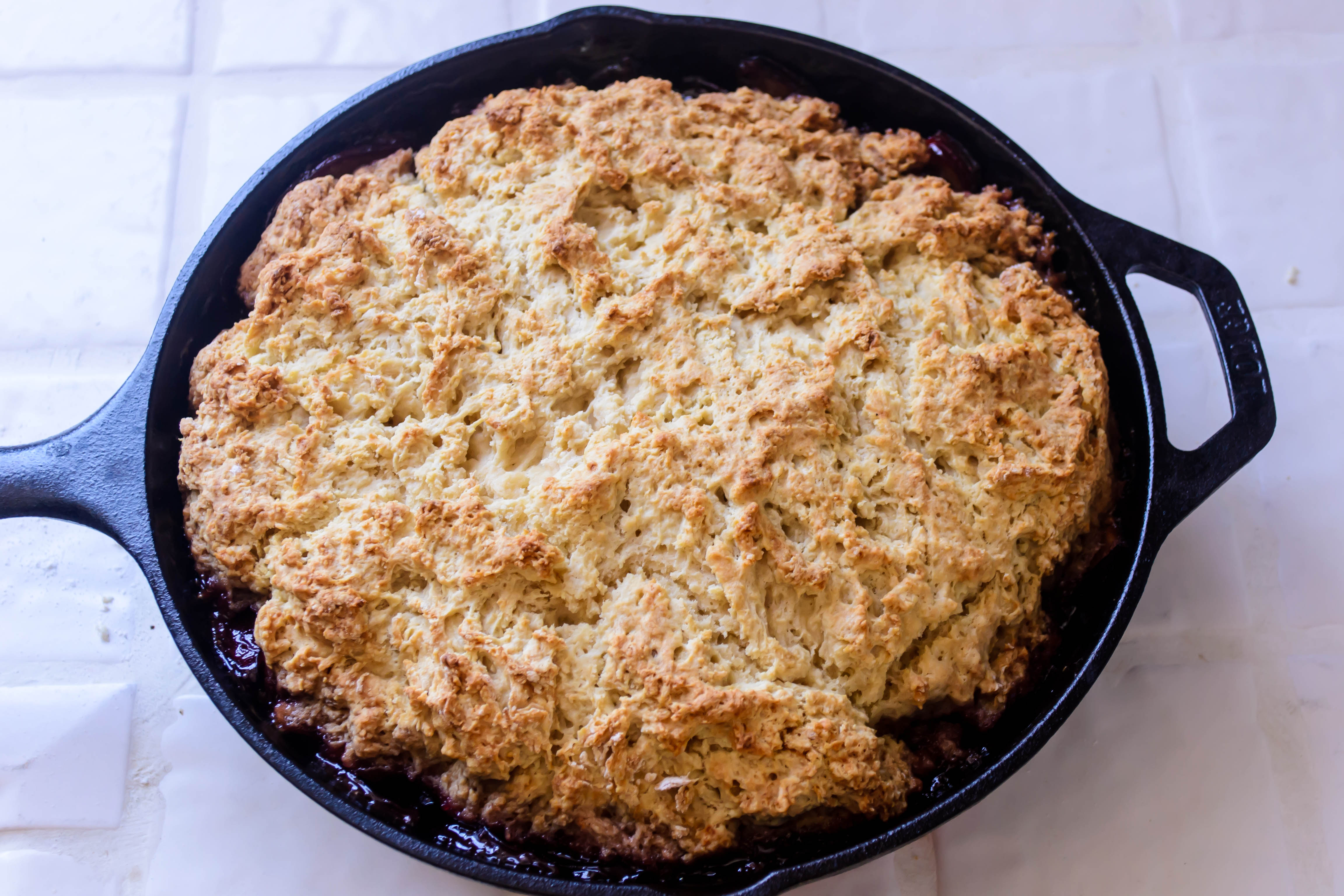
And that was where I landed, nibbling at the edges of this idea.  It would be, I decided, a skillet bread: fruit caramelized in the bottom of a cast iron skillet, soda bread dough mounded atop it and then baked and flipped, like the weirdest version of a pineapple upside down cake bread you’ve ever heard of.

Food Blog July 2013-1919Once this weirdness was determined, I settled immediately on plums as my fruit choice.  I always forget how much I love plums as a cooked component.  None of the insistent fuzziness of peaches to deal with, but bursting with juice, brightly veined, and hiding just the right hit of tartness in that secret microscopically thin layer between skin and flesh.  I love that part.

Food Blog July 2013-1923Food Blog July 2013-1926Food Blog July 2013-1929I envisioned bubbling slices of that sweet tartness in a slick of butter and brown sugar, mounding on heaps of gussied up Irish soda bread dough and baking the whole thing into a puffed, flippable cake/bread to have for breakfast, afternoon “tea” (N. and I rarely drink hot tea in the 3pm hour, but love the idea of stopping for a bit of a snack), or maybe even wedges wrapped up in wax paper to take on the road as we head into vacation.

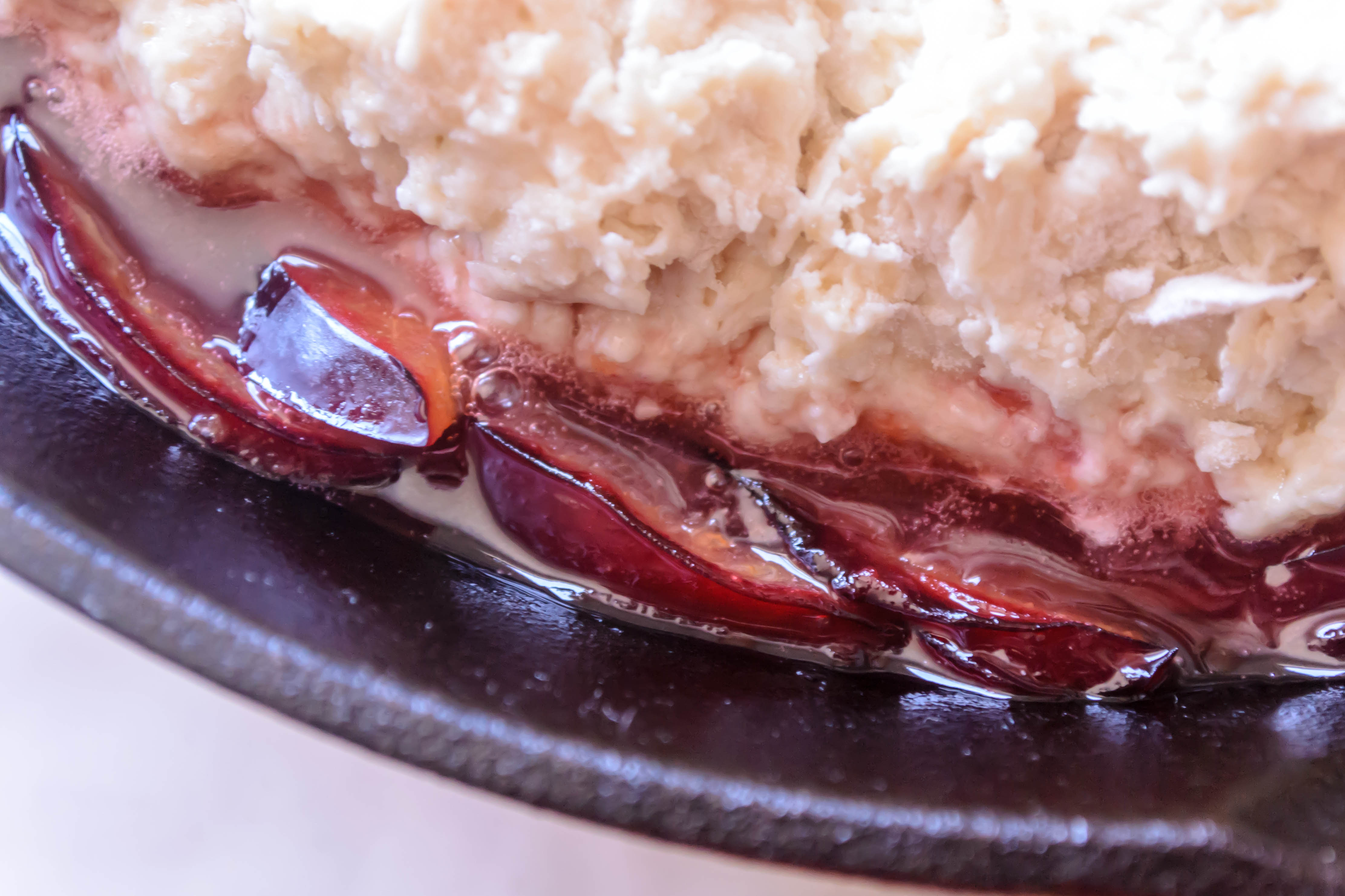
Food Blog July 2013-1931Food Blog July 2013-1932What I got was a stunner-in-progress.  I’m going to give you the recipe for exactly what I made, but I know this is not the final iteration of this dish for me.  The plums were perfect: juicy, melting into the caramel and the bottom of the bread, sticky and jammy and reminiscent of a triumphant batch of plum butter my mom made one summer with pounds and pound of plums delivered to our door in a brown paper bag straight from a neighbor’s tree.  The bread itself was good: solid Irish soda bread, a little richer and a little sweeter from the addition of brown sugar, extra butter, and an egg, perfect for the breakfasts and snacks I envisioned, and better the second day than the first.  But as I dug in, I found myself wanting the bread part to be more like cake: more egg, less flour, a hint of vanilla or nutmeg or maybe cardamom.  The plums were so good, so gloriously gooey and tooth-sticking-ly caramelized, that they deserve a proper dessert – something you can watch a scoop of ice cream melt over.
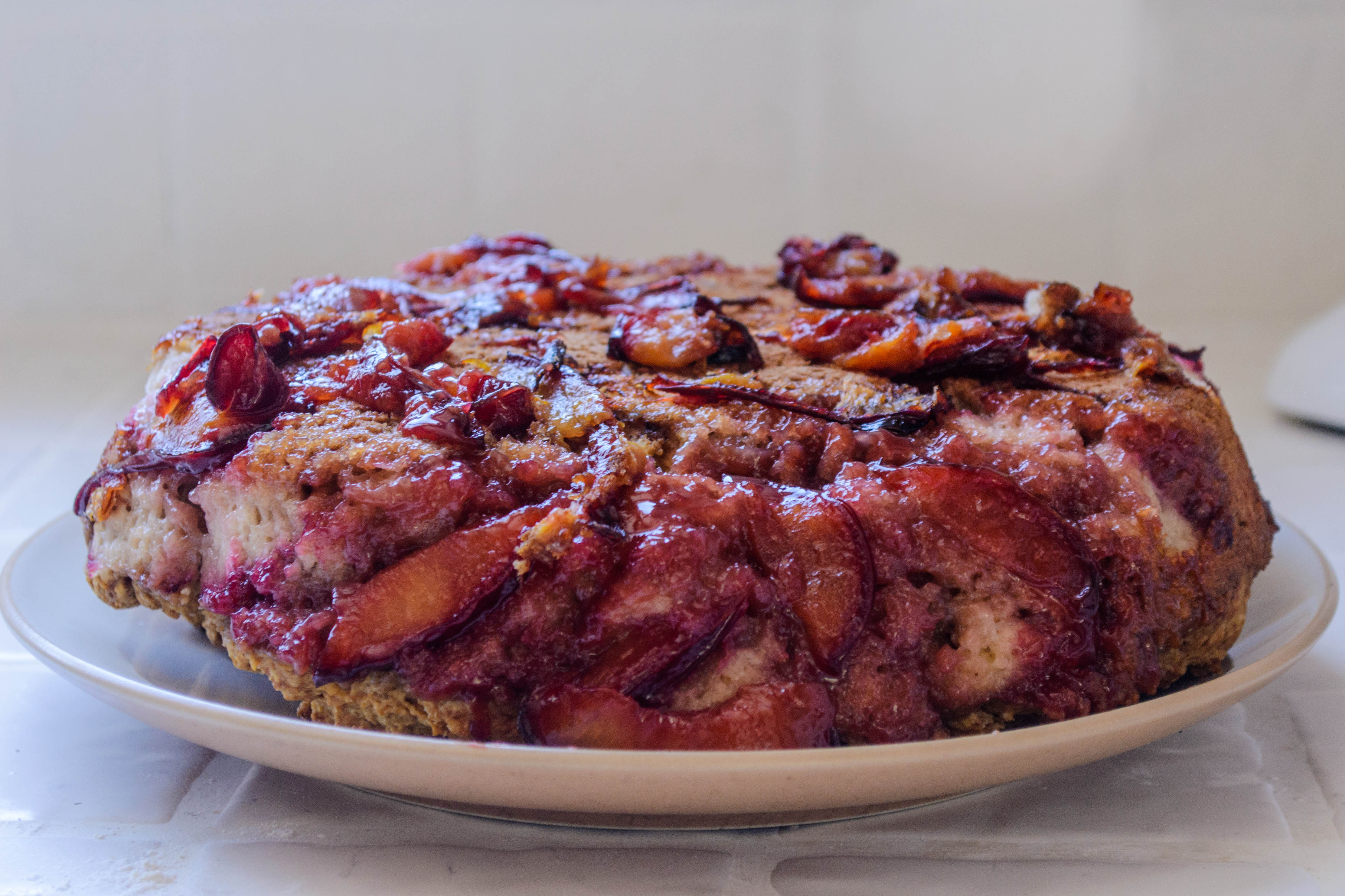
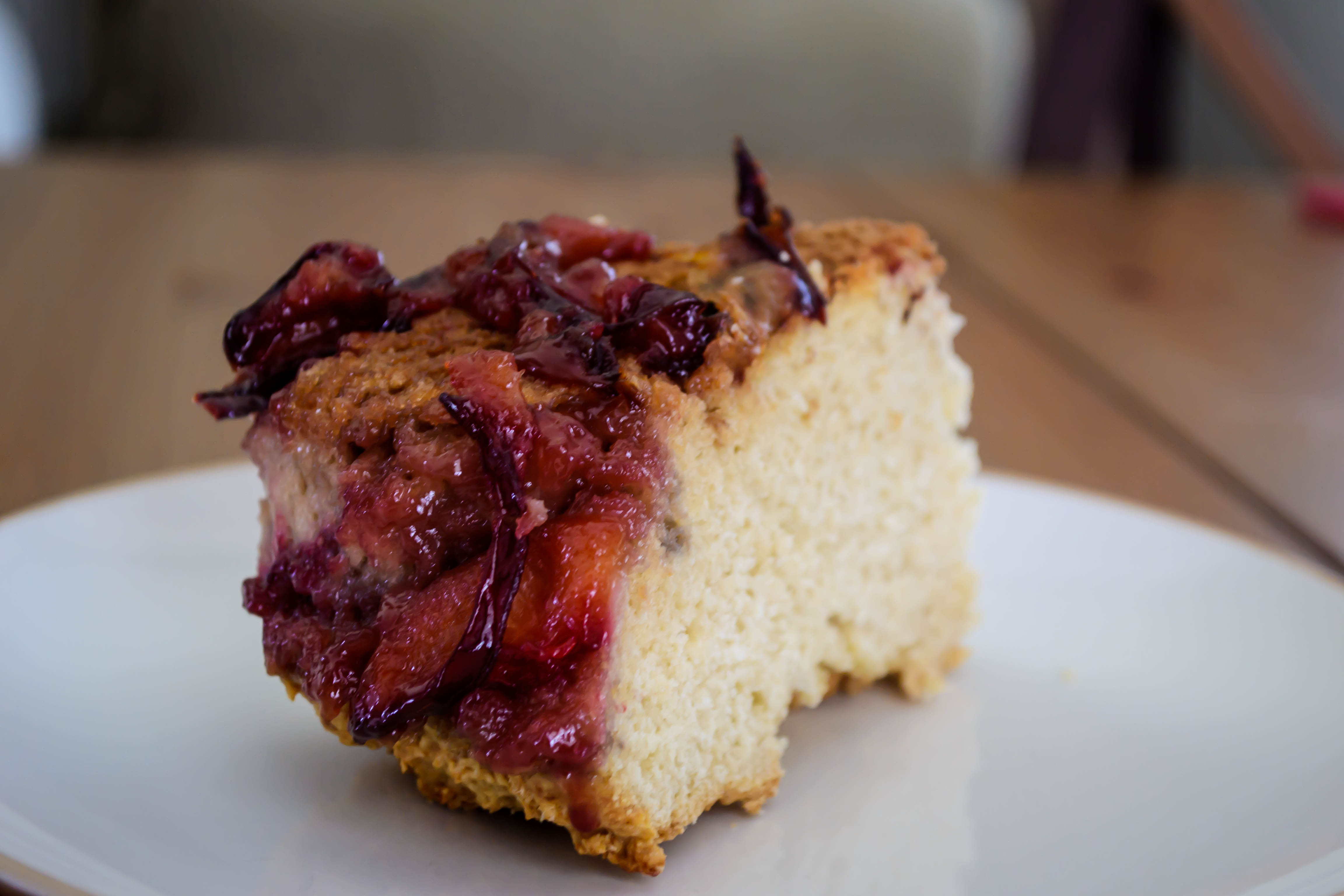
Food Blog July 2013-1938Make this.  It’s solid and scrumptious: the perfectly not-too-sweet energy boosting slice.  But consider yourself warned: this won’t be the last time you see upside down plum something here…

Food Blog July 2013-1945

Plum Upside Down Irish Soda Bread Cake
Serves 8-10
2-3 plums, thinly sliced
2 TB butter
¼ cup brown sugar
2 cups all-purpose flour
2 cups cake flour (this adds some lightness – if you don’t have cake flour, you can use all AP flour instead with slightly denser results)
¼ cup brown sugar (again)
1 ½ tsp baking soda
1 tsp salt
¼ cup melted butter
1 ½ cups buttermilk
1 egg


  • Preheat the oven to 400F.
  • In a cast iron skillet (or other oven-safe skillet), melt the 2 TB butter and toss in the first ¼ cup brown sugar.  Stir around until butter and sugar melt together into a sticky, bubbly mass.
  • Pull the skillet off the heat and add the plums in an even, single layer right on top of the caramel you’ve created.  You can place them in concentric rings if you want, for aesthetics, but so long as you have a complete single layer, you’re in good shape.  Set the skillet aside.
  • In a medium bowl, whisk the flours, the remaining ¼ cup brown sugar, the baking soda, and the salt until well blended.
  • In a small bowl or a 2-cup glass measuring cup (I like it easy), combine the melted butter, buttermilk, and egg.  Beat thoroughly with a fork.  Some of the melted butter will solidify again when the colder buttermilk hits it, but that’s okay.  It will all work out.
  • Pour the liquid mixture into your whisked dry ingredients.  You can make a well in the center first if you want, but the important thing is just to get them in there.  Combine with a fork, as you would with the liquid in biscuits, just until everything is incorporated into a rough, lumpy heap of dough.
  • Plop the dough onto the layer of plums and use a spatula or your hands to press it down a bit into an even layer that covers the fruit below.
  • Bake in a 400F oven for 30-40 minutes, until the bread is puffed, golden, and reaches an internal temperature of about 180F.
  • When the bread is done, let it cool for 5-10 minutes.  You can use this time to gather your courage, because the step that comes next is a little bit scary.
  • Place a large plate over the top of your cast iron skillet.  Being very careful, and using pot holders because that sucker is still smokin’ hot, invert the plate-skillet contraption so that the skillet is resting on the plate, bottom side up.  What we’re after is for the bread to give up its hold on the skillet and drop gently onto the plate with the plum layer on top.  This may take another 5-10 minutes.
  • Once the loaf has unstuck itself from the skillet and landed on the plate, remove the skillet and scrape out any remaining plum slices to add to the top of the cake itself.
  • Serve warm, room temperature, or cold, but I think this bread tastes better on day two, when the flavors have had time to meld and deepen a bit.

Jalapeño Cheese Rolls #TwelveLoaves June

Food Blog May 2013-1439Last week I presented you with something both vegan and gluten-free.  Dietary allergen-buster, that’s me!  This week, to prove that I’m a fickle  equal opportunist  flexible sort of cook, I’m giving you something that is neither.  But really, this is the kind of food person I am, and I’ve been thinking about this lately, especially given this post from Shauna at Gluten-Free Girl.  I’ve thought, over this past year as I finished my Bittman Project and moved on to my exploration of dough, what kind of food blog this is, anyway.  I don’t follow a specific dietary regimen.  I don’t cook – or eat – specifically one type of food.  So what am I?  As I wrote to Shauna, what drove me to her blog, and what drove me to one of my own, was the expression of joy through food.  I want food that tastes good and brings joy.  And then, because it has given joy to the tongues and teeth and bellies of the people I made it for, I want to pass that on to people who weren’t in our little house with us.  That’s you, people.  So I guess what it comes down to is: this is a blog about food that brings you joy.  At least, that’s what I hope you feel when you read, and when you eat, if you end up using the recipes here (and if you do, will you tell me?  I’d love to know what you guys think).

These little rolls brought us considerable joy.  They are cheddar infused, jalapeño studded puffs somewhere in between a rich, buttery brioche and a stern, crusty, segmented Kaiser roll.  They are also, given this month’s Twelve Loaves assignment of buns, the perfect choice to slice equatorially, layer with mayonnaise or hot sauce or pickles or onion rings or dripping fresh tomato slices and then cram with a burger of your favorite juicy variety.

Food Blog May 2013-1410I started with my Nana’s sweet roll dough, replacing the sugar with a smaller amount of honey, opting for the tang of buttermilk rather than the roundness of whole milk, and injecting wafer-thin slices of jalapeno and cheddar cheese so sharp it made me – let’s not lie – basically drool when I sampled some.

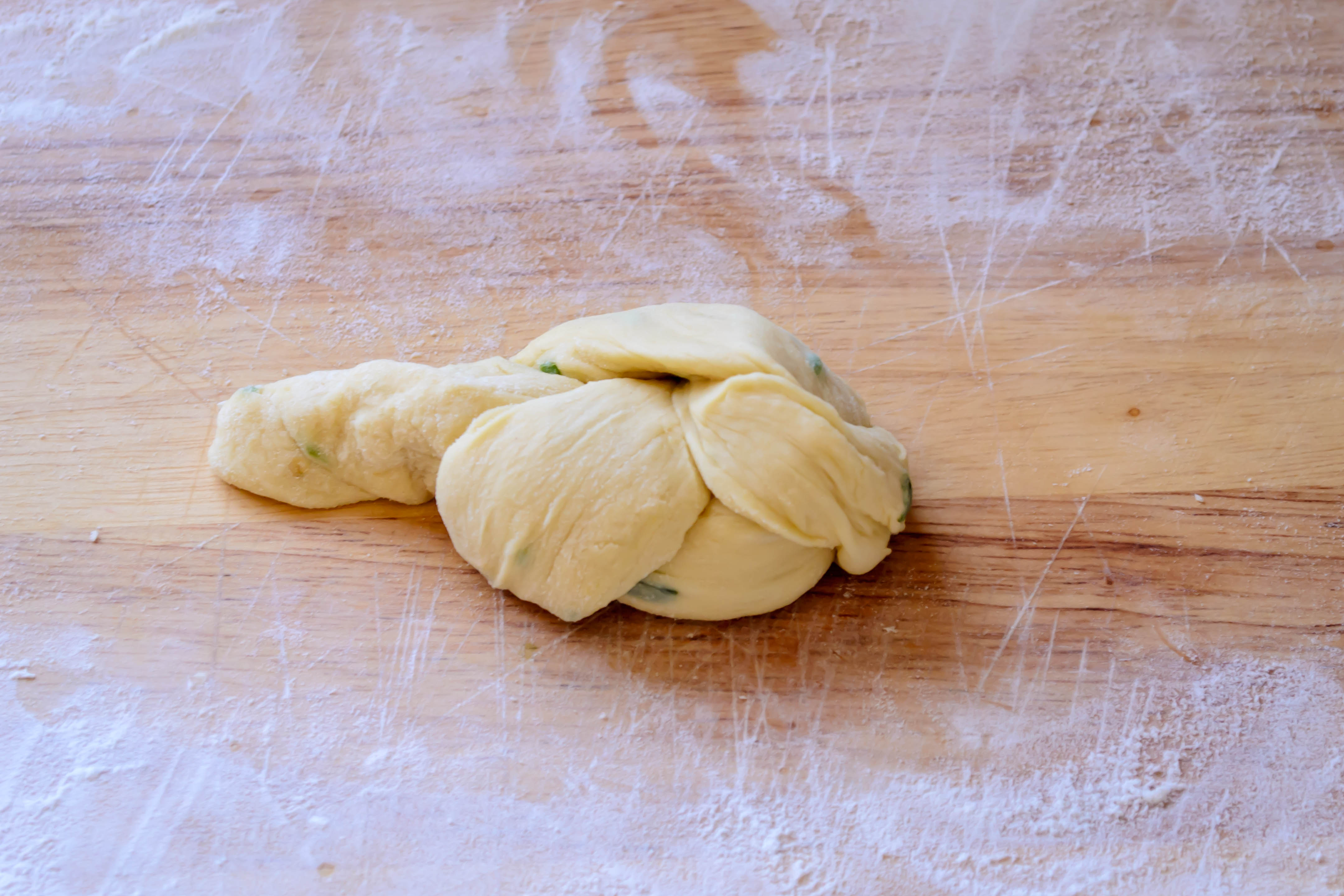
Food Blog May 2013-1414Food Blog May 2013-1415Though you could just divide your dough into equal sections and let these rise into sweet, uncomplicated burger buns, I decided to take on the familiar lobed shape of a Kaiser roll.  This is, as you might expect, not the most straightforward approach, mostly because there are numerous methods for achieving that instantly recognizable shape.  You can score the dough as it rises, you can use a special press that creates the petal shape, can follow a complex procedure of folds, or, as I learned and executed to my delight, you can roll the dough into ropes, tie them in a simple overhand knot, and then tuck up the ends.  I’ve attempted instructions and accompanying pictures below, but if you are lost, try this recipe, which explains the knotting and tucking process pretty clearly.

Food Blog May 2013-1425Food Blog May 2013-1429Sprinkled with more sharp cheddar and topped with a few more, probably gratuitous slices of pepper (you have to know what you’re in for, I think), these bake into all but perfect imitations of the jalapeño cheese rolls N. and I used to buy from Market of Choice as the occasional treat after a perfect sunny afternoon trip to the dog park in Eugene.  We never put burgers on those, because they never made it through the whole ride home.  But these little Kaiser-roll-buns of mine, burnished with cheddar and lip-tingling with heat, will carry anything you load them with.

Food Blog May 2013-1435Food Blog May 2013-1433Summer’s coming.  That should bring you joy.  If you can stand more, make these for your next barbeque.  This recipe can easily be doubled, and once baked, these will keep in the fridge for a few days or, securely wrapped in airtight packaging, in the freezer for much longer.
Food Blog May 2013-1441Jalapeño Cheese Rolls
makes 8 petite rolls, or 6 larger ones
 2 tsp active dry yeast
1 TB warm water
½ cup warm buttermilk
2 TB honey
¼ cup room temperature butter
1 egg
1 tsp salt
2 cups flour (I like bread flour best for these, because it has a high protein content that stimulates gluten production.  But I think all-purpose would create similarly fantastic rolls)

1 cup shredded extra sharp cheddar cheese, divided
1 medium jalapeño pepper, thinly sliced


  • Stir the yeast gently into the warm water, set aside for five minutes to let the yeast wake up.
  • Add butter and honey to the warm buttermilk, stirring them together until incorporated.  This will make the honey and butter easier to integrate into the dough, and cool the buttermilk so it won’t kill the yeast or scramble the egg.
  • Pour the puffy, bready yeast, the buttermilk mixture, and the egg  into a large bowl (I use the bowl of my electric stand mixer), and whisk or stir together with a wooden spoon or the paddle attachment of your stand mixer.
  • Add the flour and salt to the mixture, and stir just until roughly combined.
  • Add ¾ cup of the cheddar cheese and half of the jalapeño slices to the rough dough and stir again, just until the cheese and peppers are well distributed.
  • If you are using a stand mixer, replace the paddle attachment with the dough hook and knead on medium speed for 8-10 minutes. If you are not using a stand mixer, turn the dough out onto a floured board and knead by hand for about 10 minutes.  Though I think kneading by hand will work fine here (I haven’t tried it, so I’m not positive), there are two things to take into consideration.  First, this dough has cheese it in, so that may make it messier to work with than your average burger bun dough.  Second, it contains jalapeño peppers, which can leach capsaicin onto your hands and sting delicate skin (read: don’t forget and wipe your nose!), so be absolutely certain you wash your hands really well after handling this dough.
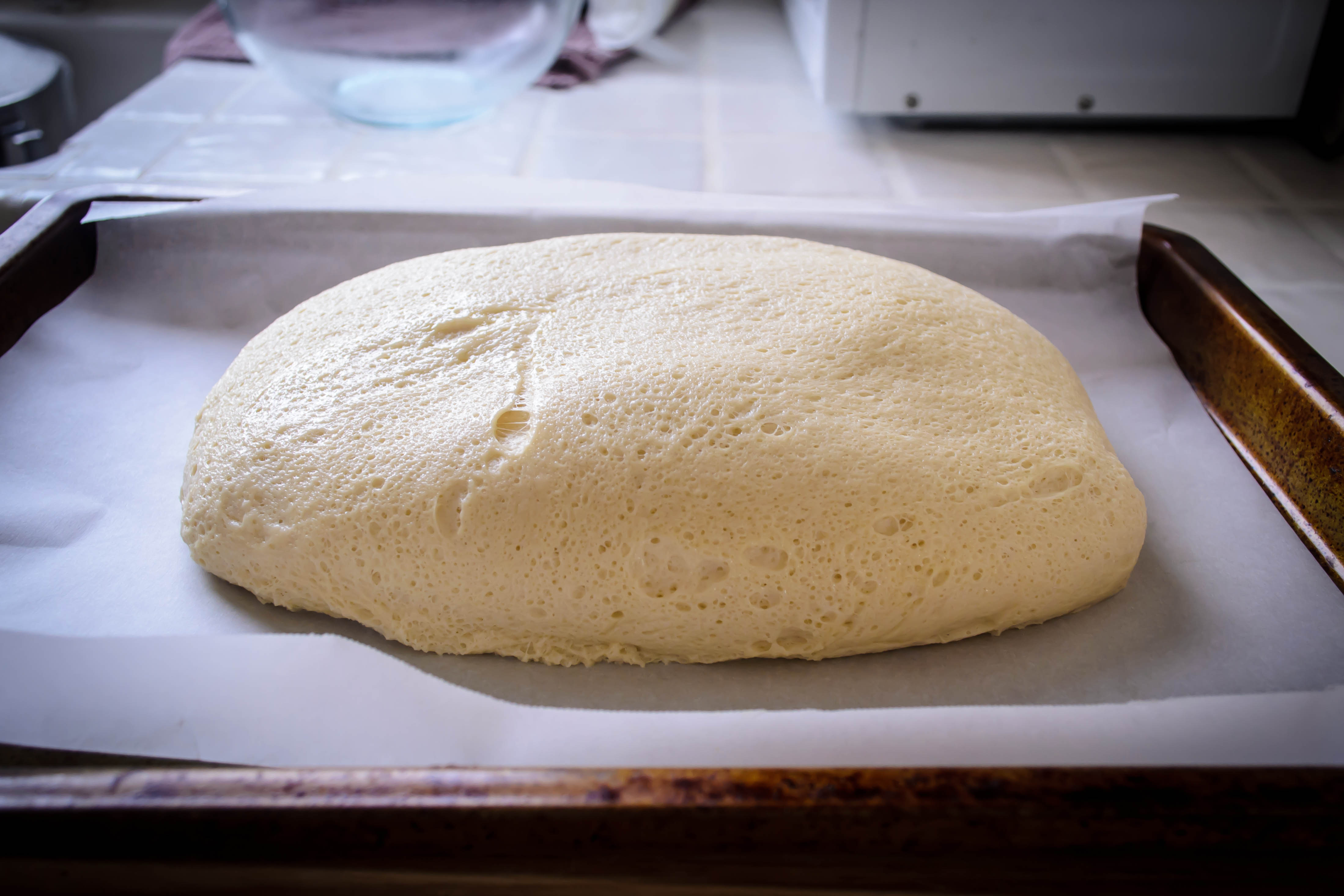
  • In either case, the dough starts out sticky, but becomes smooth and stretchy as you continue to work it. Once it is elastic and supple and lovely, place it in a lightly oiled bowl, cover with plastic wrap, and set aside in a warm room (if you have one handy) for an hour and a half, or until it has doubled in volume.
  • Remove the plastic wrap and punch down your doubled dough by gently but firmly pressing your fist into the center.  It will almost gasp as the built-up gasses are released.
  • Divide the dough in 8 equal pieces (for petite buns), or 6 equal pieces (for big, beefy buns).
  • Now would be a good time to do some prep, while the dough-balls get some breath back.  Preheat your oven to 350F.  Line two baking sheets with parchment paper.  If you haven’t already, dust a bread board with flour.
  • Working one at a time, roll each dough ball into a 6-8 inch rope (Picture 1).
Food Blog May 2013-1419

Picture 1: dough rope

Food Blog May 2013-1420

Picture 2: overhand knot

Picture 3: tuck right side into top middle of knot

Picture 3: tuck right side into top middle of knot

Food Blog May 2013-1426

Picture 4: tuck left side under and into bottom middle of knot

  • Tie the rope into a simple overhand knot (the same way you would begin tying a shoelace).  I tie mine left side through right side, probably because I am left-handed.  If you are right-handed and you tie your knot the opposite way, reverse the L and R in the directions below.  You will have a knot in the middle and some lanky excess on either side (picture 2).
  • Now, to form the segmented shape of a Kaiser roll, lift the length on the right side of your knot (which started out as the left end of your original rope) and pull it up over the knot, shoving the end of it down into the middle of the knot itself and pressing lightly to secure (picture 3).
  • Next, lift the left side and tuck it under the knot, pushing it up through the middle from the bottom.  Sometimes it will poke through and make a little button in the top of the roll; sometimes it won’t.  Either is okay (picture 4).
  • With all of your rolls knotted and tucked, set them on your prepared baking trays, spaced evenly.  I did four per sheet tray.
  • Sprinkle each roll with cheddar cheese from the remaining ¼ cup.  Top each with 1-2 slices of reserved jalapeño.  Cover trays with a clean kitchen towel and let rise for 30 minutes.
  • Remove kitchen towel, admire the puffy little buns you’ve created, and bake in your preheated, 350F oven for 20 minutes.  The cheese will melt, the dough will rise, the color will deepen to a lovely golden brown, and the thinnest of your jalapeño slices will barely begin to caramelize.
  • If you eat these immediately, you will burn your mouth.  And it won’t just be the good burn from the jalapeño.  So do what you can to let them cool a little, and then load them up, or just eat them plain.  I think you’ll be happy either way.

Peanut Butter and Jelly Bread #TwelveLoaves May

When it comes to cooking, I don’t mind a little complexity.  You can call it fuss if you want.  I’m not put off by a picky technique or an extra step.  Separate the eggs?  Okay.  Toast the nuts first?  Sure thing.  If it adds to the flavor of the finished dish, I’m on board.  But when it comes to eating, I like things simple.  I love appetizers because your gratification arrives in a single bite.  I dig pizza because the toppings all come at you together.  A drumette of roasted chicken sitting precariously atop a mound of braised greens in a puddle of puree?  I’m sure it’s delicious, but it’s a little fancy for me.  At the point that it comes off the heat, I’m ready to put it in my mouth, plating-be-damned (obligatory self-deprecating note: it’s clear, given this, why I haven’t yet managed to squirm my way onto Tastespotting or Foodgawker).

Food Blog May 2013-1298So this week, faced with this month’s Twelve Loaves challenge of baking a loaf of my choosing, I started thinking about the humble sandwich.  Now, I know, a sandwich isn’t exactly challenging to put together.  But I’m a little anal-retentive about some things, and one of them is the old classic pb&j.  Here’s the issue: I like my peanut butter on both sides.  That means you have to put it on first.  But then, you can’t just dunk that peanut-buttery knife into your jam jar!  Cross-contamination!  So you have to decide: do I get a different knife?  Or do I take an extra few seconds and rinse off the peanut butter knife (and peanut butter doesn’t just rinse off like that, you know)?  I know, this is a silly non-problem to have.  But it led to a delicious idea: what if the bread itself were already infused with peanut butter and jelly, making spreading, smearing, and layering all unnecessary?

Food Blog May 2013-1293

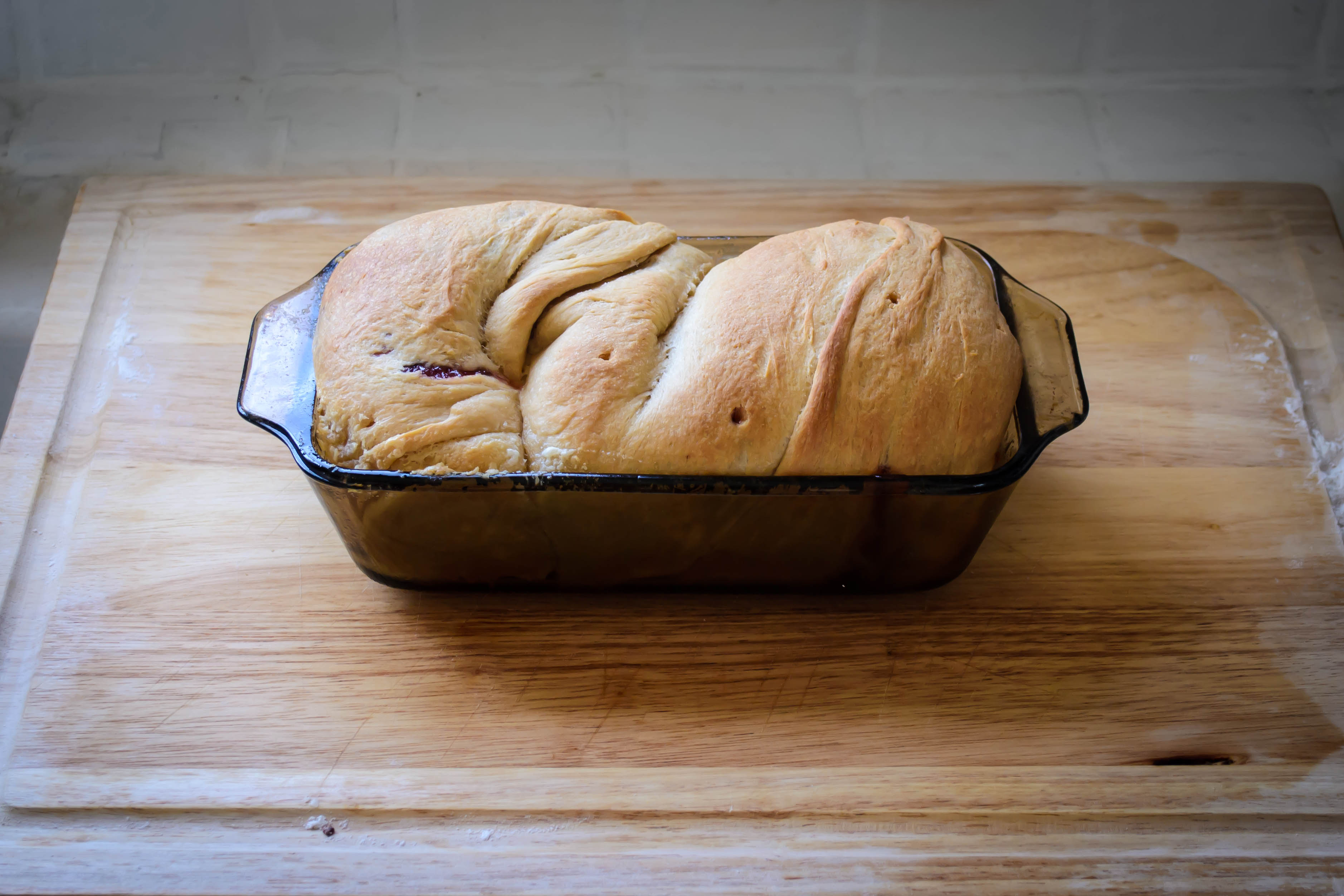
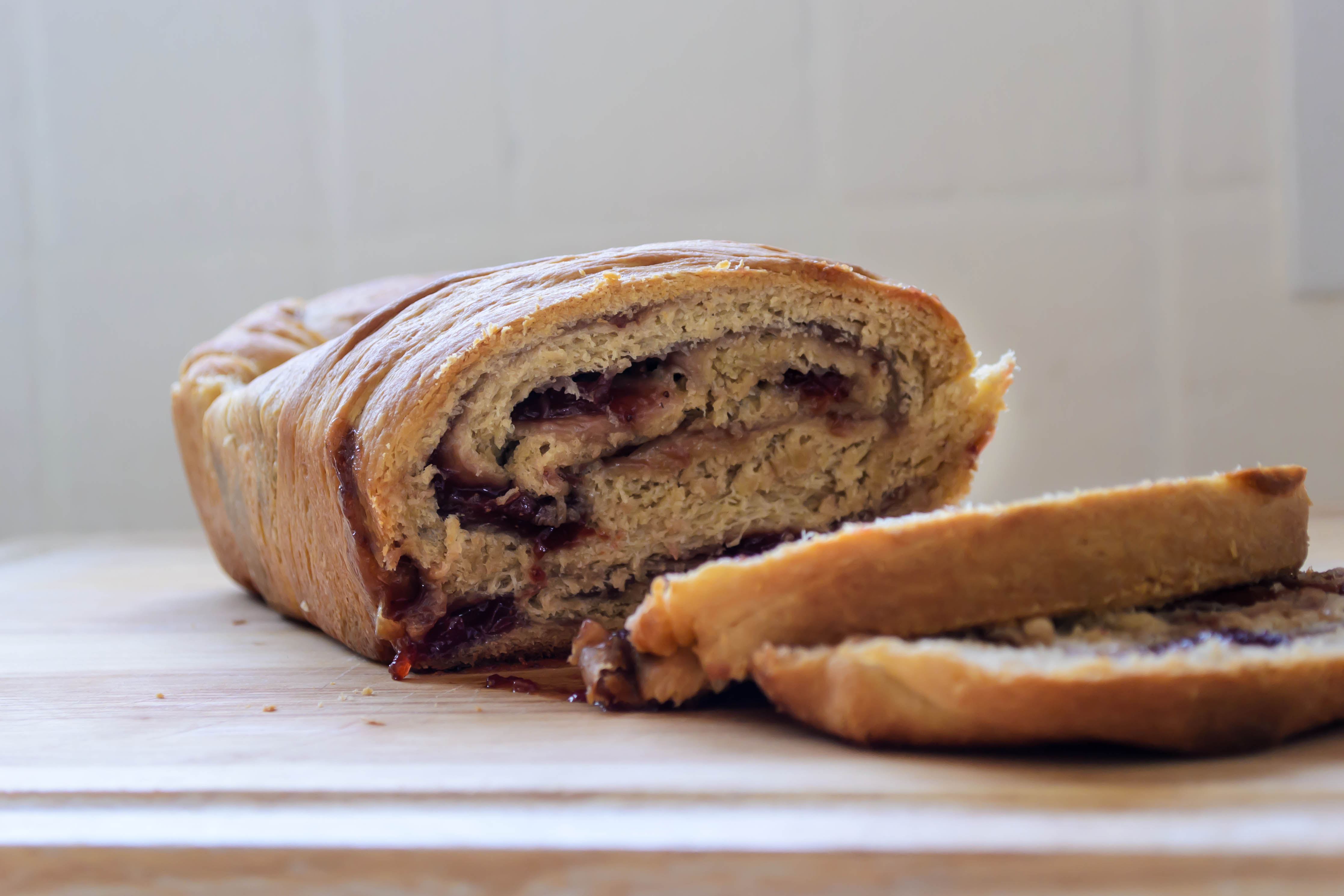
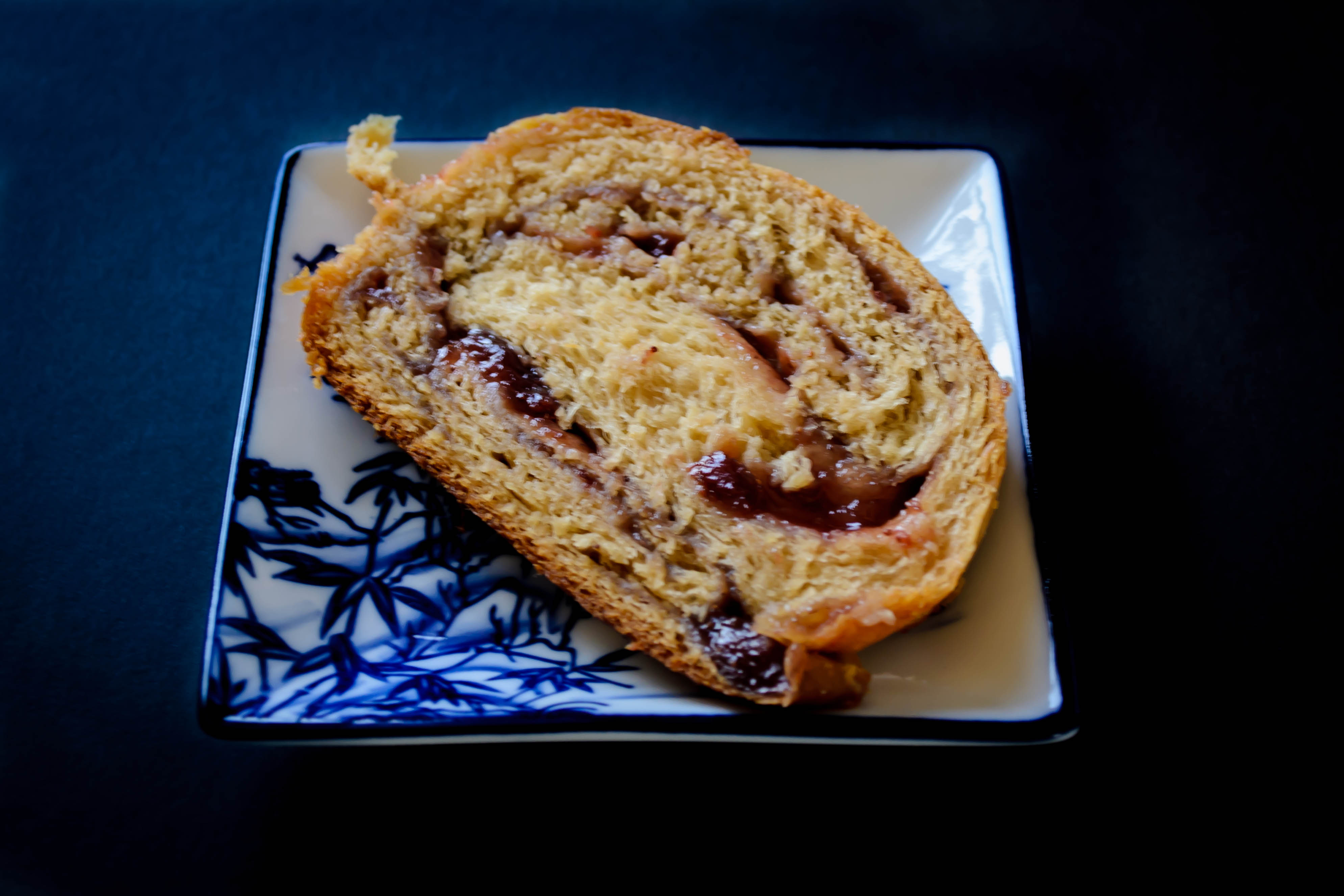
Food Blog May 2013-1297What arose from this self-indulgent, first-world-problems sort of pondering was a moist, deeply tawny loaf, dense in the best kind of way, with a mild but definite peanut flavor.  I flattened it into a rectangle and spread it thickly with jam before rolling it up and twisting it to create a swirl: a thick artery of gloppy, sticky strawberry so pervasive it cracked the crust and oozed forth into barest caramelization.  The borders of the jam swirl maintained just a little doughiness from the extra moisture, echoing the effect the jam would have on the bread after sitting in your lunchbox all morning, and at these doughy, almost under-baked pockets, the peanut butter taste was most pronounced.  With butter, peanut butter, an egg, and milk in the dough, this is a rich bread, though not as indulgent as brioche.  It’s a perfect mid-morning or mid-afternoon snack, and the best news of all is: it’s instant gratification – a sandwich in one step!  No spreading required; all you have to do is cut a slice.

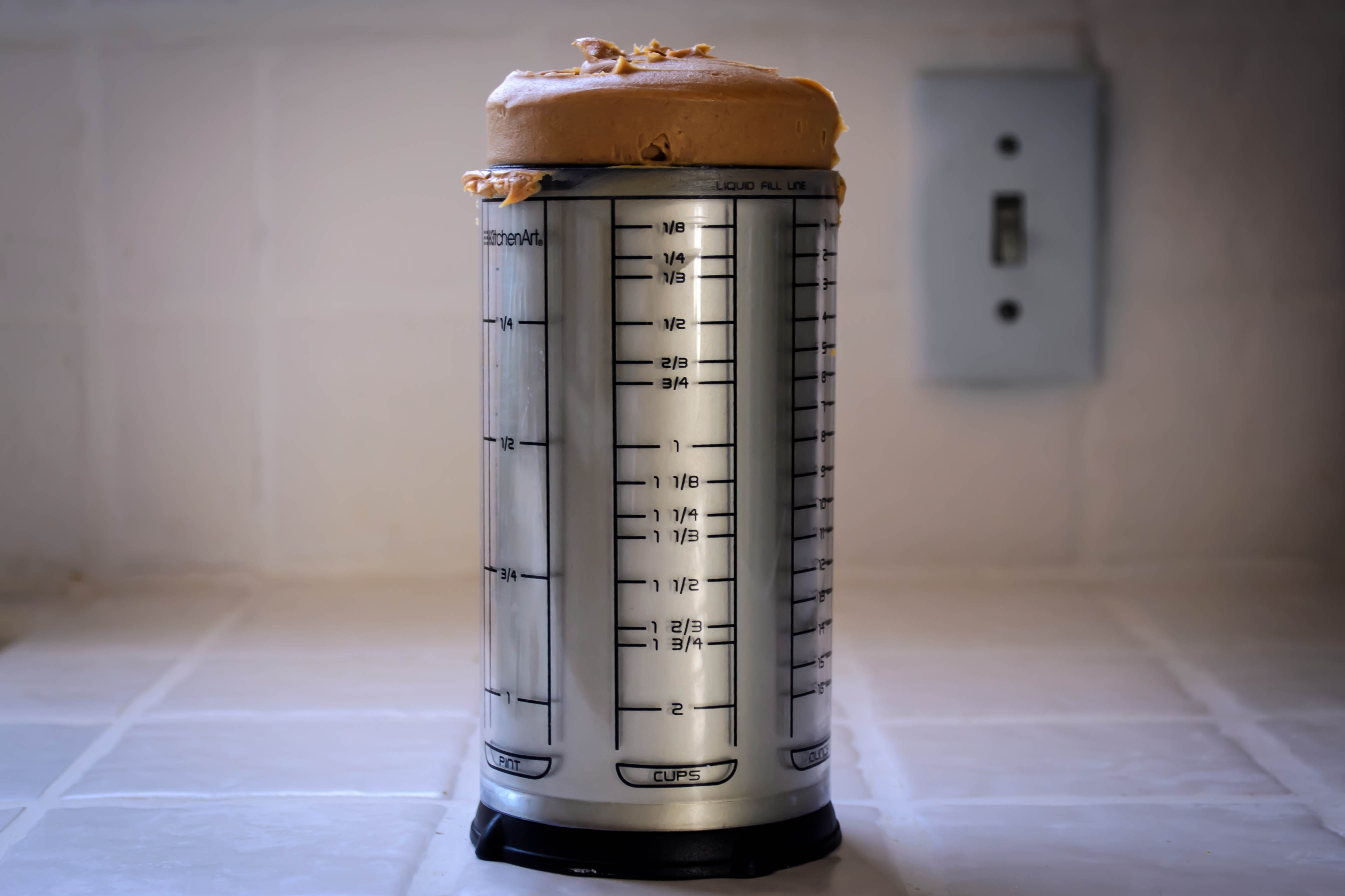
Note: I do not like, nor have I ever liked, crunchy peanut butter.  I don’t even really care for peanuts in their original form (I know, the fact that I like peanut butter despite this makes me a bit odd.  On the flip side, I could go the rest of my life without tomato sauce but I can’t wait for the first big brandywine or sweet Cherokee purple heirloom of the summer.  Go figure).  However, if you wanted to ramp up the peanut flavor in this bread, I’d advise you to do one of two things: 1.) instead of smearing the top of the loaf with butter just before baking, smear it with chunky peanut butter you’ve heated in the microwave for a few seconds (heating it will help it spread better).  2.) if the idea of smearing melty, sticky peanut butter doesn’t appeal to you, use regular butter, but drizzle on a few tablespoons of finely chopped peanuts.  This will give you a crunchy peanut-y hit every time you take a bite of crust.  Food Blog May 2013-1262

Food Blog May 2013-1266Peanut Butter and Jelly bread

¼ cup warm water

2 tsp yeast

2 tsp sugar

¼ cup scalded milk, cooled (microwave or heat on the stovetop until the barest simmer, then cool.)

½ cup very soft butter, divided

¼ cup smooth peanut butter

¼ cup sugar

1 egg

2 tsp vanilla, divided

1 tsp salt

2-2¼ cups bread flour

1 cup strawberry preserves, or your favorite flavor

Food Blog May 2013-1270

  • In the bowl of your stand mixer (or a large bowl), combine the yeast, 2 tsp sugar, and warm water.  Let stand 5 minutes or so until the yeast becomes bubbly.
  • Meanwhile, scald the milk, then let it cool.  I like to add the peanut butter and a ¼ cup of the butter to it and stir – this helps incorporate them into the dough more easily AND it cools the milk down faster.  Double duty is always good!
  • When the milk has cooled to just above room temperature and the yeast is bubbly and smells like baking bread, add the milk, peanut butter, ¼ cup of the butter, egg, remaining sugar, and 1 tsp vanilla to the yeast and mix with the paddle attachment or a sturdy whisk until incorporated but still lumpy.
  • Add the salt and about 1½ cups of the flour and mix again, still using the paddle attachment, until the flour is evenly damp.  If you are using a stand mixer, switch to a dough hook and begin kneading on medium-low speed.  If you are not using a stand mixer, dump the dough out onto a well-floured board, sprinkle it with a bit more flour, and begin kneading by hand.  If the dough is too sticky to knead productively, add flour ¼ cup at a time until it is workable.  I ended up using a total of 2 cups of flour.

Food Blog May 2013-1271

  • Knead for 8-10 minutes, or until the dough becomes smooth, shiny, and elastic.  At this point, relocate it to a lightly oiled bowl and cover it with a taut layer of plastic wrap.  Let rise in a warm place for 2 hours.  It will double or almost double in size in this time.
  • When the dough has risen and is close to double the size of the original ball, deflate it gently with your fist and then let it sit for 10 minutes.  While it gets its breath back, place the jam or preserves you’ll be using in a small bowl and heat it just until it loosens up a bit – this will make it easier to spread.  Add the remaining 1 tsp vanilla to the warm jam and combine with a fork.

Food Blog May 2013-1274

Food Blog May 2013-1276Food Blog May 2013-1277

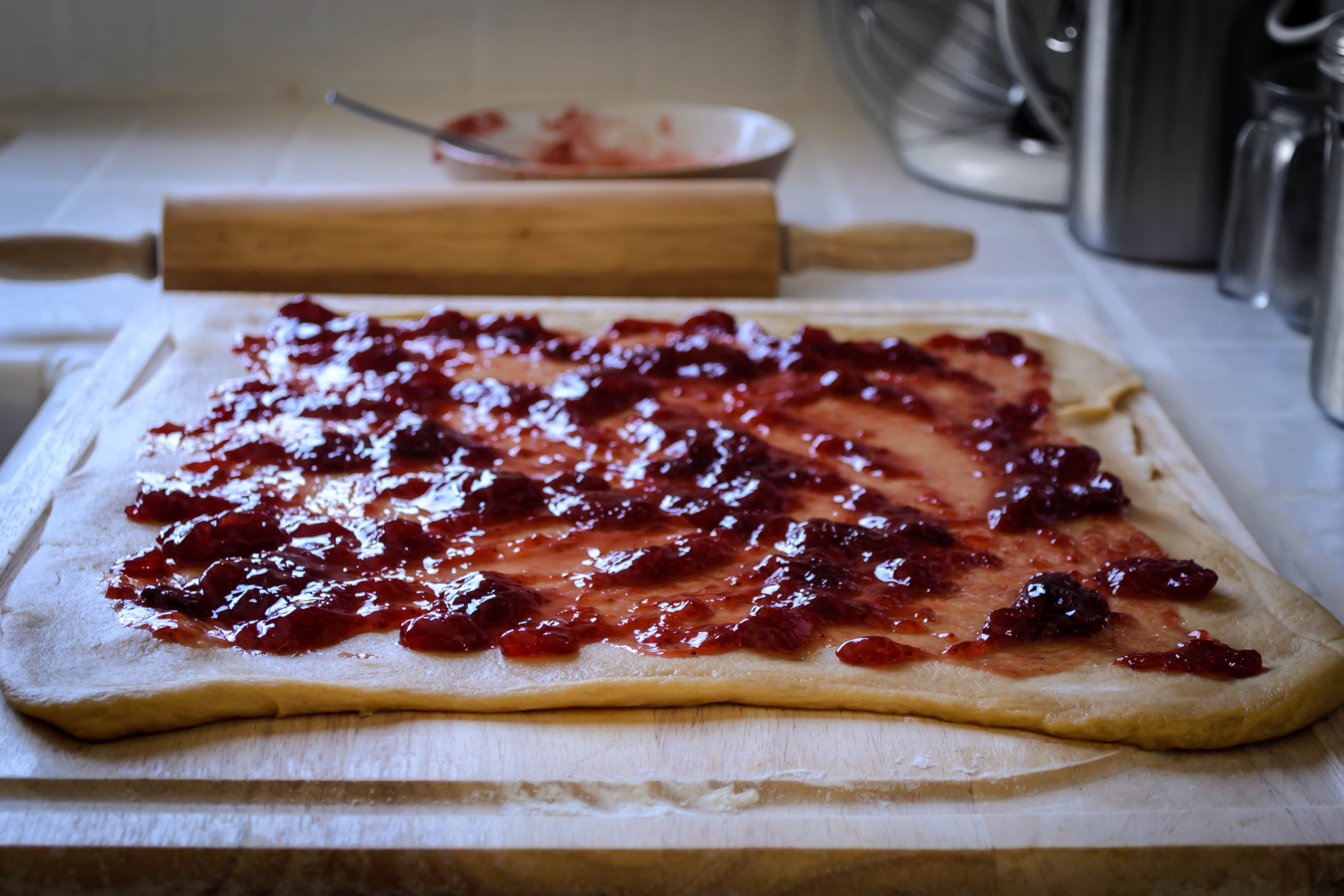
  • Once the dough has rested, turn it out onto a floured board and roll it into a rectangle of about 12×18 inches.  Spread this rectangle with the jam mixture, leaving a border of at least ½ an inch on all sides.  This will prevent the filling from leaking out as you roll it up.
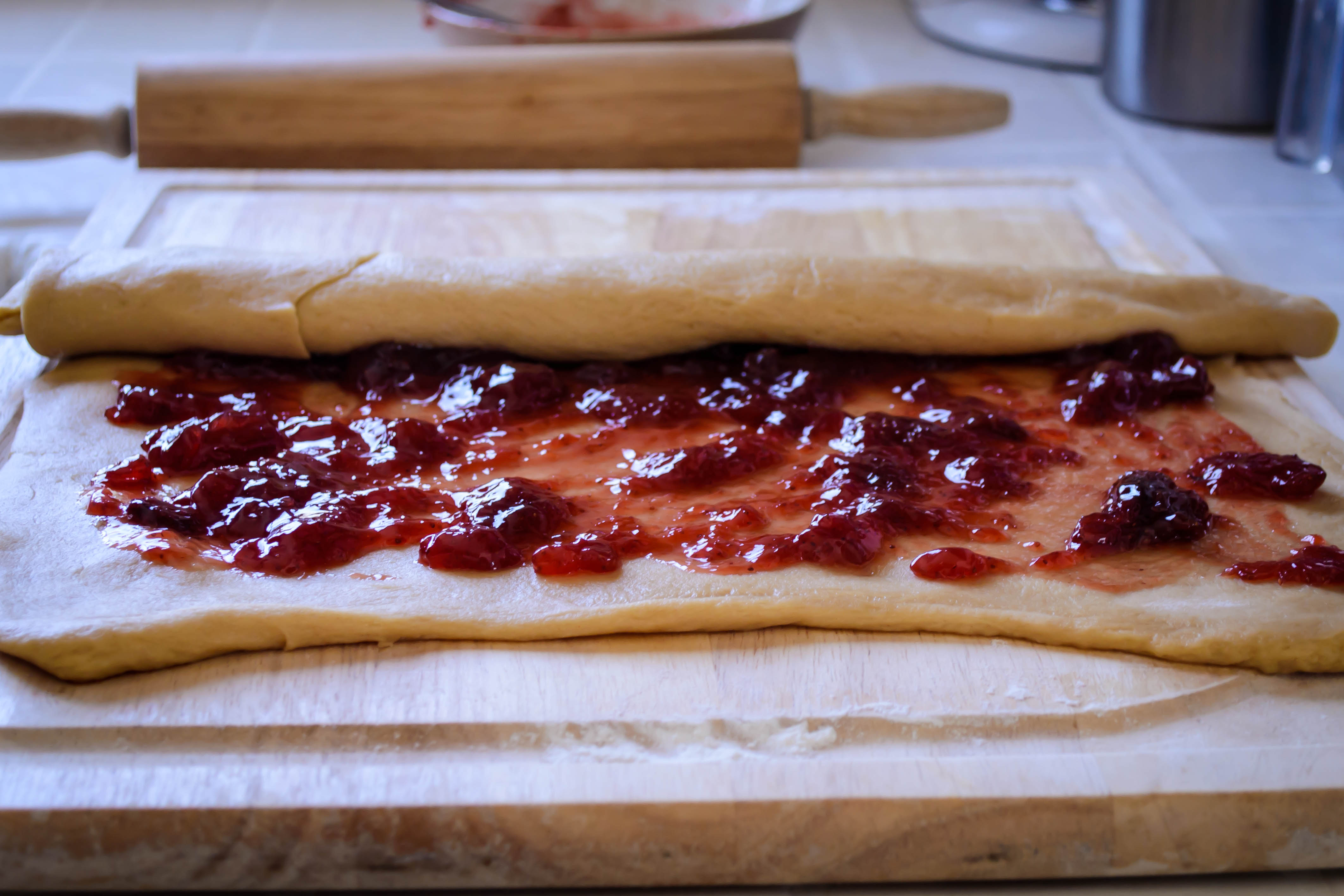
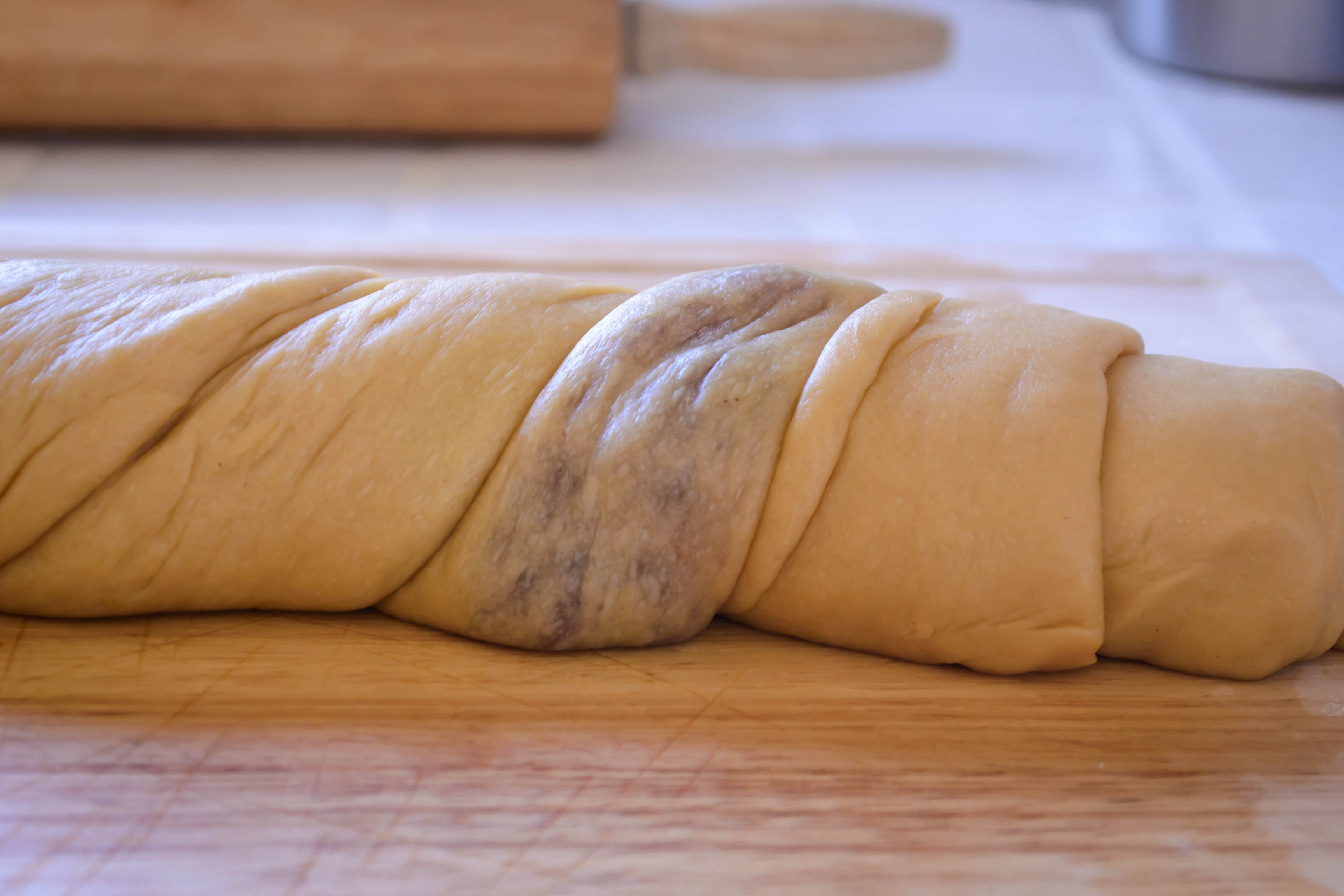
  • Starting on the shorter edge in the middle (so you’ll end up with a log about 12 inches long), begin rolling up the dough into a tube, moving back and forth between middle and ends to create an even log.  When you get to the end, seal the long edge by pinching the dough together with your fingertips.  This will keep the loaf together as it bakes.

Food Blog May 2013-1279

  • Twist the whole log six or seven times.  This distributes the jam through the center of the dough, so that your baked loaf will have a beautiful sweet swirl throughout.

Food Blog May 2013-1280Food Blog May 2013-1282Food Blog May 2013-1283

  • Smear a 9×5 inch loaf pan with about 1 TB of the remaining butter, then snuggle the log of dough into it.  Scrunch it up a bit – that’s okay, it will fill out the pan when it bakes – and set it aside to rise again for 30 minutes.

Food Blog May 2013-1284

  • While the dough rises, preheat your oven to 350F.

Food Blog May 2013-1288

  • When the dough has risen, rub the top with the remaining 3 TB butter (or chunky peanut butter, if you wish), and bake for 30-45 minutes.

Food Blog May 2013-1294

Note: this bread’s doneness is difficult to test.  Because the jam is interspersed throughout, the finished loaf can seem a bit doughy.  If you have an instant read thermometer, try to insert it in an area that is just bread, not jam.  (I had some difficulty doing this, as you can see from the small holes on the top of the loaf in some of the photos above.)  You are aiming for a temperature of between 190-200F.  I must admit, though, I don’t mind this loaf a bit underdone – I think it captures the softness and almost-soggy glory of a simple pb&j from childhood.  And really, that’s what this bread should be about.

Food Blog May 2013-1300

Mom’s Challah

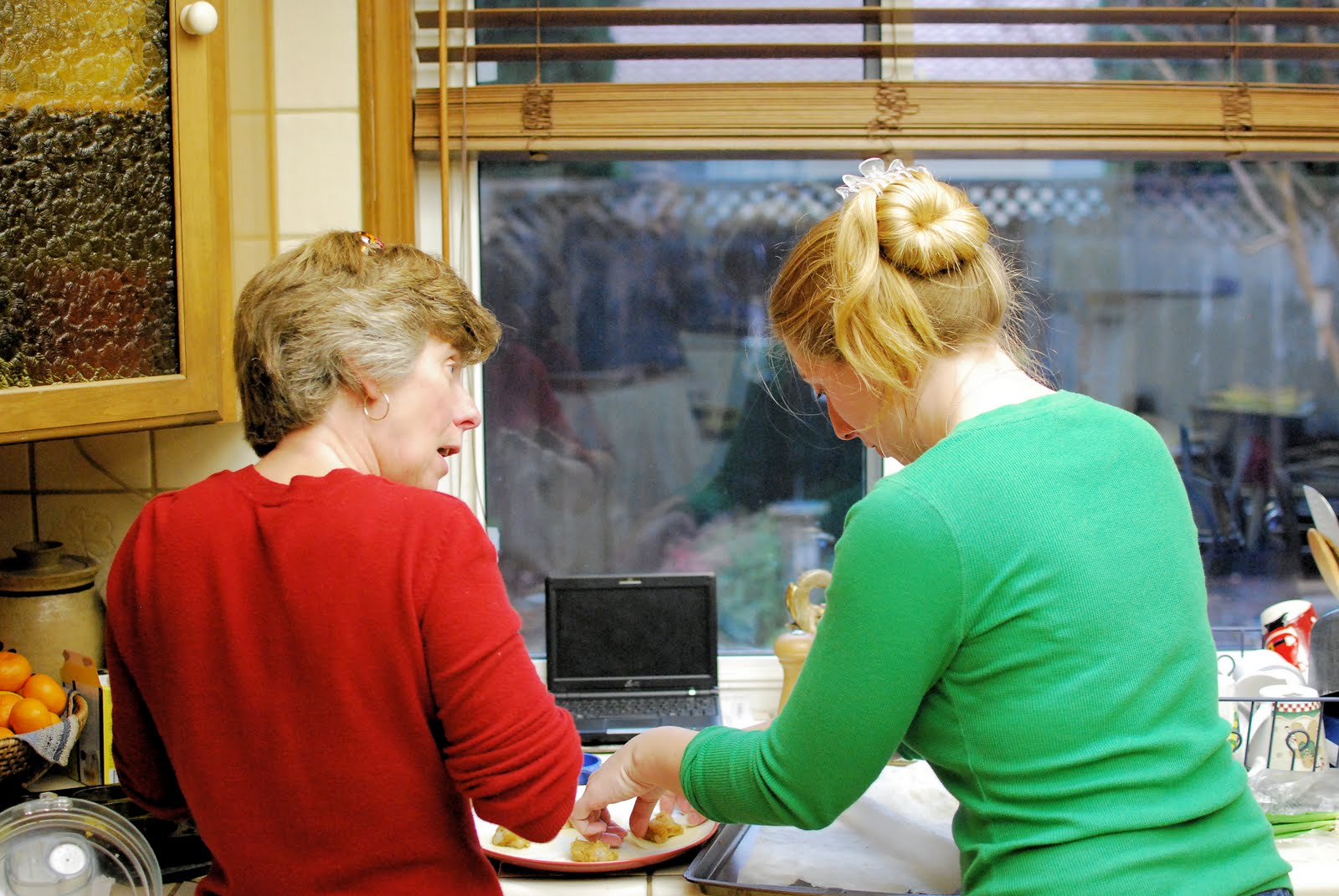
Friends, this is the motherlode.  Or, if you’ll forgive the terrible pun, the Mother loaf.*  In that same red binder of recipes I received as a wedding gift that contains my Nana’s sweet roll dough recipe, my mom included her “secret” recipe for challah (in my recipe collection, Mom promises that she’s only given this challah recipe to one other person.  This, as it turns out, has become a lie.  Both my Aunt Nancy and my cousin Julie have this recipe.  Who knows how many other people do too, by now!).  When she was much younger (read: before two children kept her waking hours a blur of busy), Mom baked bread a lot.  I don’t know where she got this recipe for challah, that wonderful, doughy, braided loaf of egg bread traditionally prepared for Jewish holidays and the sabbath, but even in our gentile household it became a holiday essential for us.
Food Blog March 2013-0971
For the past few years, my sister has taken up the challah mantle and has been preparing it, with Mom’s help, on Christmas Eve so we could slather it with apple butter or cinnamon sugar or honey to enjoy on Christmas morning.  It’s not an easy bread (are any of them, really?).  With an incredibly sticky dough, not one or two, but three rises, and a tendency to overbake, it has always intimidated me.  At any phase of the process, something could go wrong!  If I could master challah, I thought privately, I would really have a handle on this bread thing.
So, a number of loaves under my belt, with Easter coming up, and this month’s Twelve Loaves challenge of holiday breads, it seemed like the right time.  Friday morning, after quizzing my mom on a few details, I pushed my sleeves up, swallowed the disparaging warnings of that little gargoyle of doubt who often sits on my shoulder, and dove into Mom’s recipe.
Food Blog March 2013-0920Food Blog March 2013-0930Food Blog March 2013-0932
This is, as I mentioned above, a sticky dough.  After kneading it becomes elastic and smooth, but there is still a tackiness about it that leaves your bowl streaked with gummy strands and your hands, if not well floured, stringy with delicious remnants.  It takes a long time – with three rises averaging over an hour each, you aren’t starting this loaf in mid afternoon and expecting it to be ready for dinner.
Food Blog March 2013-0933Food Blog March 2013-0935
I’ve seen plenty of recipes suggesting overnight refrigeration time – Michael Ruhlman’s blog, in fact, has a guest post on challah by Marlene Newell that begins the night before it is baked – but Mom has never done it that way.  If you’ve scheduled a lazy day at home, or perhaps a day punctuated by laundry, tidying up, and the odd brief errand carefully placed during a rise, this could just become your best friend.  It’s soft, it’s rich and tasty, it looks impressive (even if, like me, you only do a three strand braid instead of the more traditional six strand), and it keeps fairly well, provided you wrap it well in aluminum foil.  I find plastic storage gives the crust an unpleasing texture.  Of course, it’s so tasty that I can’t imagine it needing to keep well – it will be gone within a day or two.  On that topic, I’ve never understood the comments that it makes wonderful french toast.  In our house, the full loaf has dwindled to half by lunch time, and as the afternoon wears on slice after slice seemingly evaporate, until the bread board contains only a lonely half heel and a small pile of crumbs.  This is the first time I can remember, with only N. and me indulging (Lucy asked with pleading eyes of liquid velvet, but it’s too good to share), that the loaf has made it to day three of existence.
DSC_0910
Despite my lingering doubt, I had only a few moments of anxiety as I put together this loaf.  The stickiness of the dough stressed me out a little – even after adding the full amount of flour in the recipe (as I will note again below, you only incorporate part of the flour at first, adding in additional ¼ cups at a time as needed to work the dough), thick gobbets clung to the sides of my mixing bowl, my dough hook, and my fingers.  One rise down, however, and the stickiness diminished.
Food Blog March 2013-0937Food Blog March 2013-0940Food Blog March 2013-0943
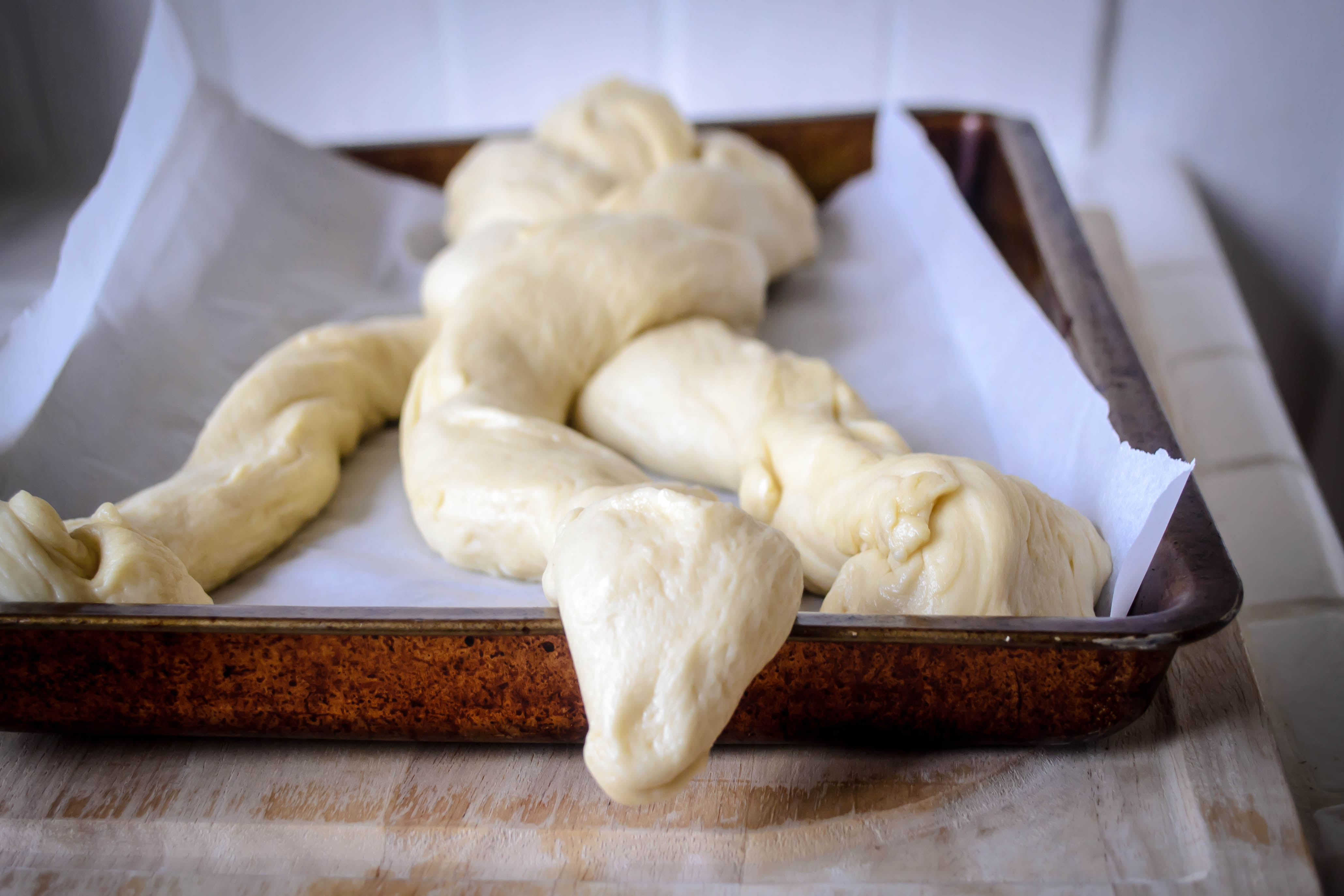
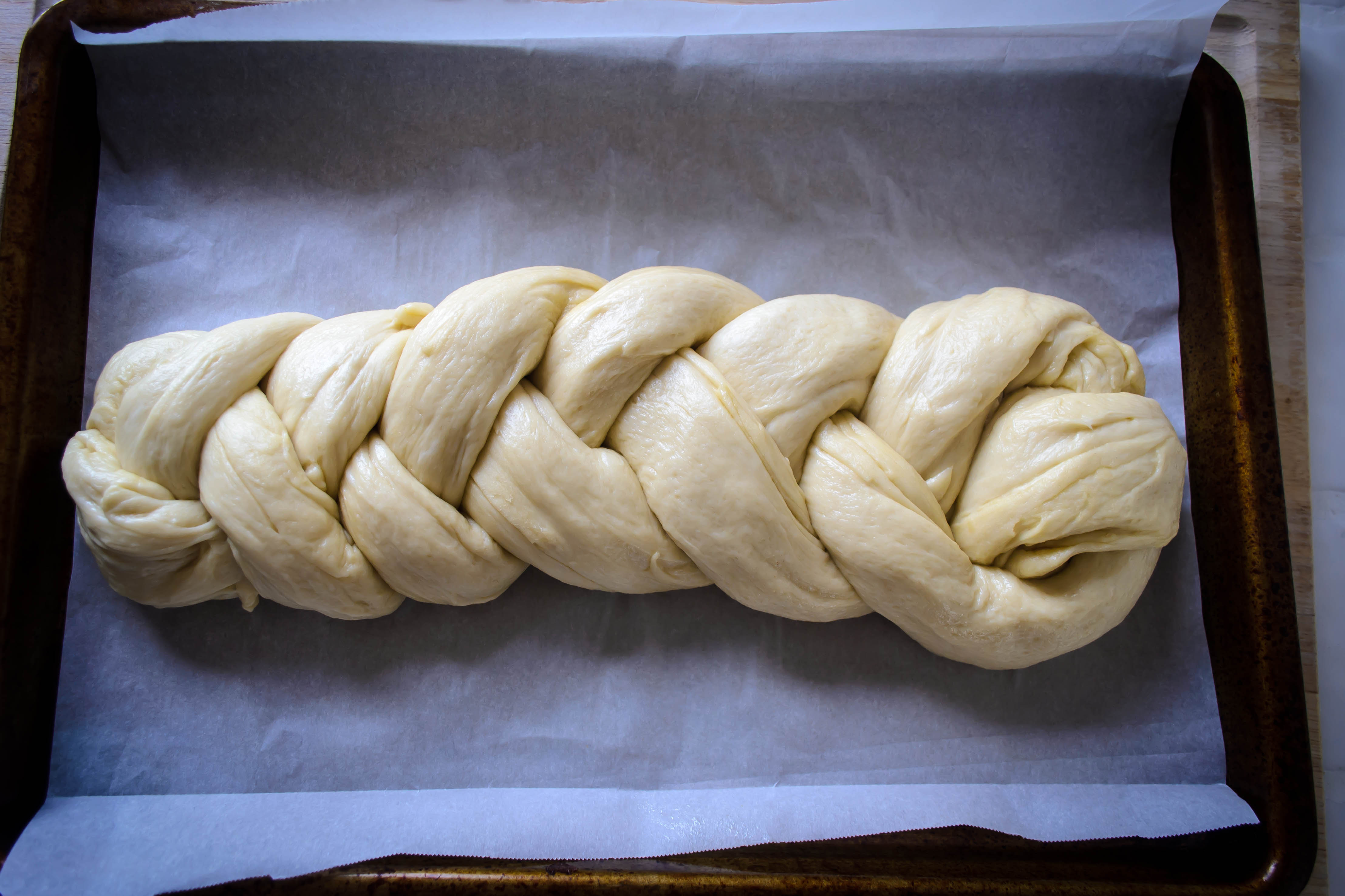
Faced with three thick strands of dough, I forgot how to braid for a moment.  Heavy, stretchy worms of raw dough are a far cry from pigtails or Barbie hair, my braid targets in a past life.  But braid made and ends tucked under, I had something that actually looked like my mom’s longed for loaf.
Food Blog March 2013-0944Food Blog March 2013-0949
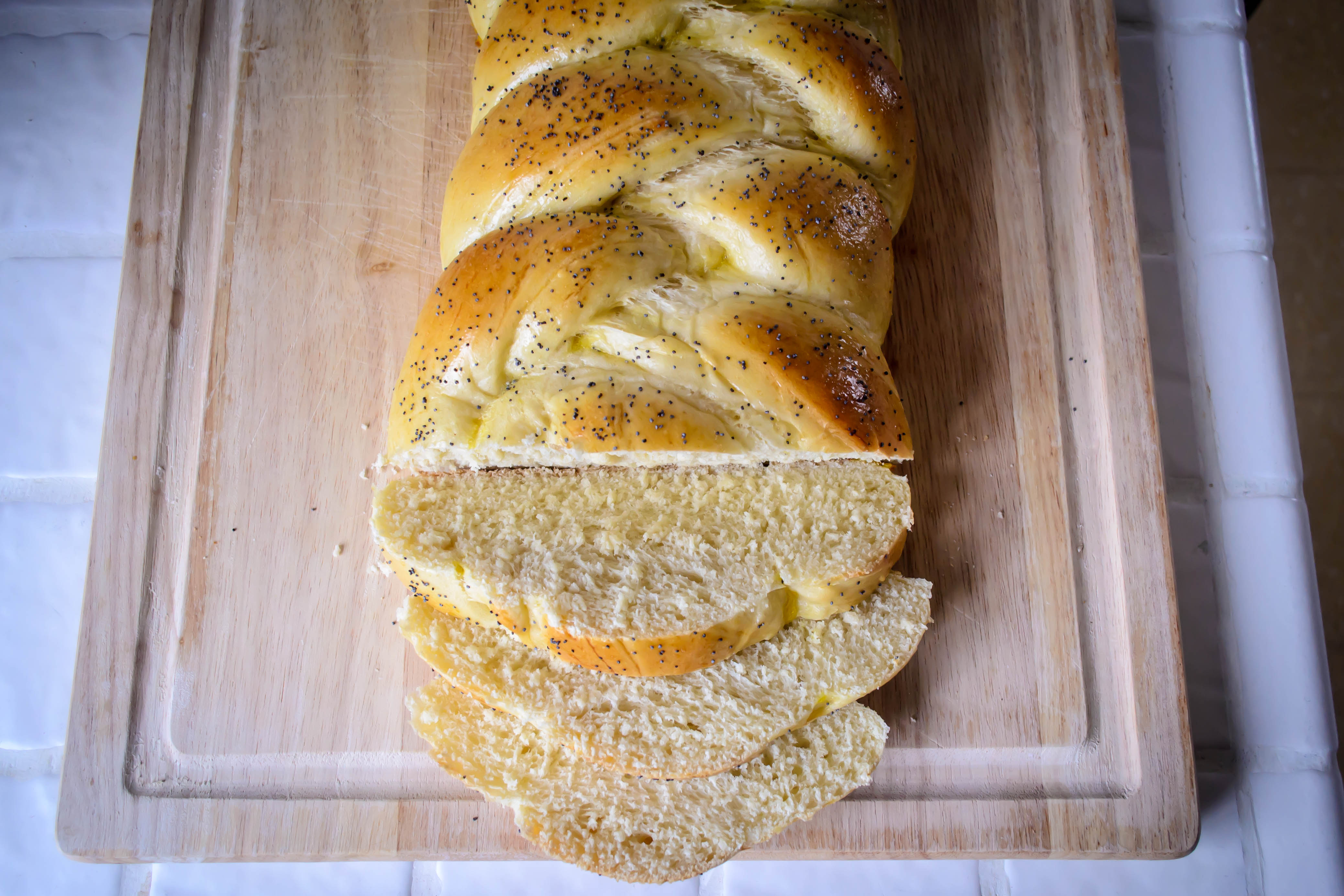
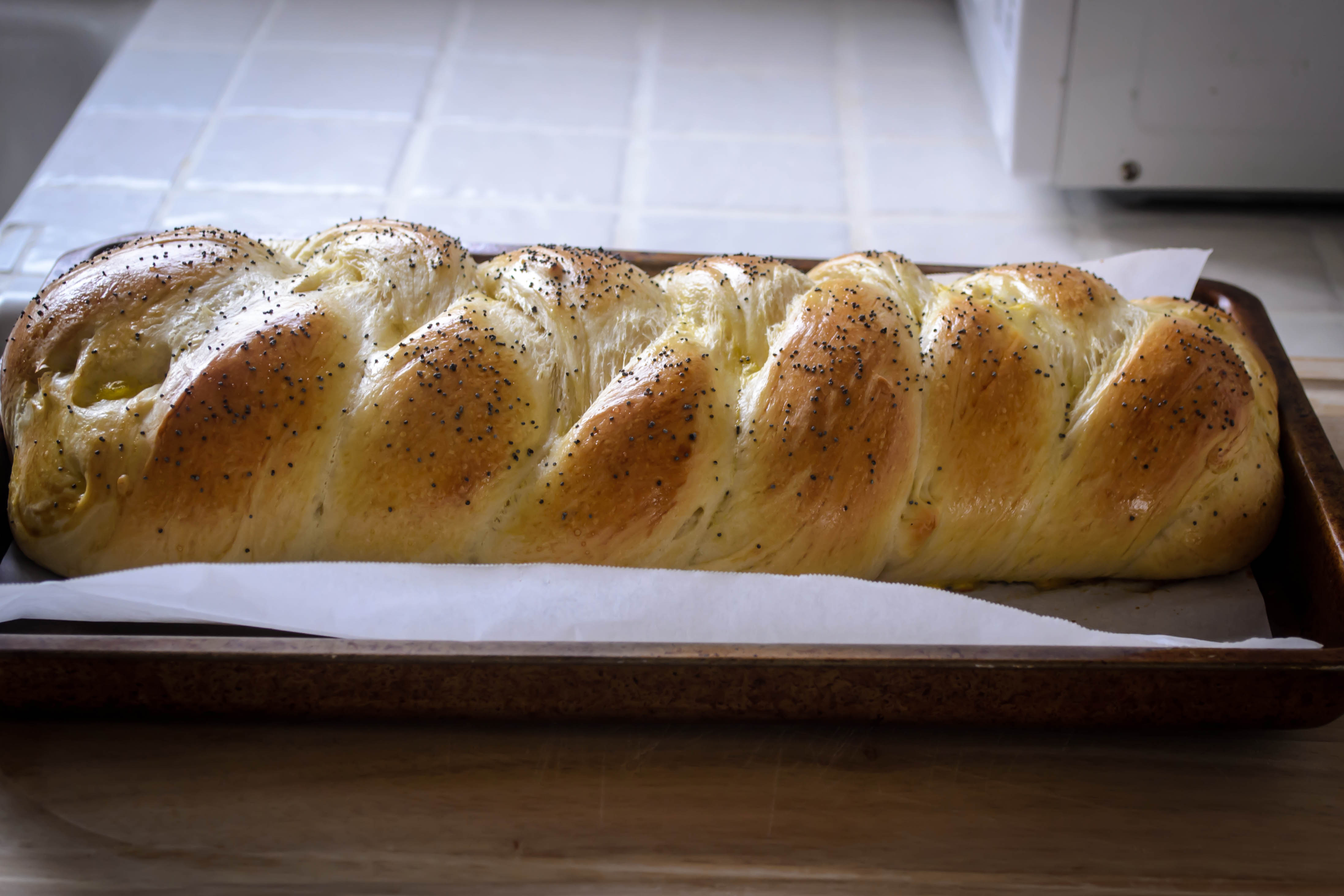
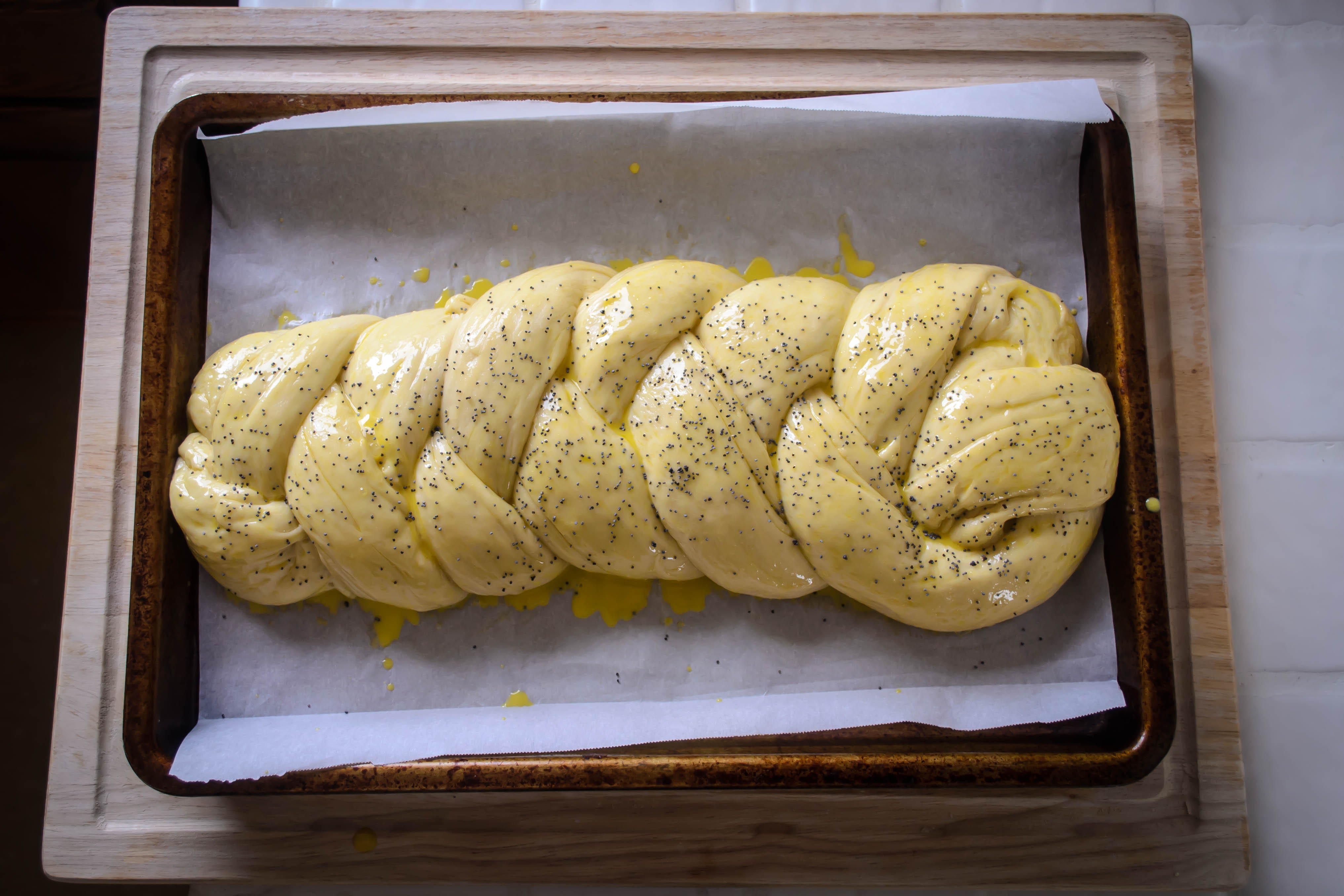
A quick glaze of egg wash and a generous sprinkle of poppy seeds, and I started getting excited.  A quick, almost half hour in the oven later (the loaf goes from moist and springy to overbaked in what feels like an instant), and I was staring at a near perfect replica of Mom’s bread.
Food Blog March 2013-0958
It’s hard to wait the requisite 15-20 minutes to let the bread cool and the internal structure solidify, but you should.  It makes slicing much more successful.  And once you have waited, you should cut thick slices, and garnish them with butter or jam or just your own teeth and tongue.  Happy Sunday, whatever you might be celebrating.
Food Blog March 2013-0966
Mom’s Challah
1 tsp + 1/4 cup sugar, divided
½ cup warm water
2 tsp active dry yeast (or 1 package, which contains 2 ¼ tsp)
½ cup vegetable oil
½ cup warm water (again)
2 tsp salt
2 eggs, lightly beaten
3 ¾ – 4 cups flour (I used bread flour, but Mom has always used all-purpose)
Poppy seeds or sesame seeds for sprinkling
1 egg yolk beaten with 1 TB water


  • Dissolve the sugar in the first ½ cup warm water in a large bowl (or the bowl of your stand mixer, if you are using one).  Sprinkle yeast on top and let it stand to burble and breathe for about 10 minutes.
  • When your yeast has woken, and smells like bread and beer, use your paddle attachment (if you are using a stand mixer) to incorporate the oil, second ½ cup of warm water, sugar, salt, and beaten eggs.
Food Blog March 2013-0928
  • Add 3 cups of the flour and beat well.  The dough will be very sticky, but as Mom says, that’s okay.  Cover the sticky mass with a cloth and let it rest for 10-20 minutes.
  • If you are using a stand mixer, exchange your paddle attachment for the dough hook and begin kneading at low to medium speed.  As needed, add the additional flour by ¼ cups at a time.  Knead for 8-10 minutes or until the dough passes the windowpane test.  When I asked Mom about this, she looked at me like I was speaking a different language, then said “I always use the baby’s bottom test,” which got the same look back from me.  She was talking about smoothness and texture, but considering she often gives the dough a little smack when she’s done kneading it, I wondered about the ethics of this measuring device…
  • If you are kneading by hand, turn the sticky mass out onto a well floured board.  With equally well-floured hands, knead for 10 minutes, incorporating more flour as needed, until the dough is smooth and has a shiny surface (and feels, apparently, like a baby’s bottom).
  • In either case, now is the time to place the ball of dough into a lightly oiled bowl and stow it in a warm place to rise for 1-2 hours.  I like to use my oven, letting it heat for 5 minutes and then turning it off for 5 minutes before putting the dough inside.
  • After the dough has risen to double in size, punch it down (Mom notes “this is fun!”), cover it with a clean cloth, and let it rise again until doubled again – about 45 minutes.
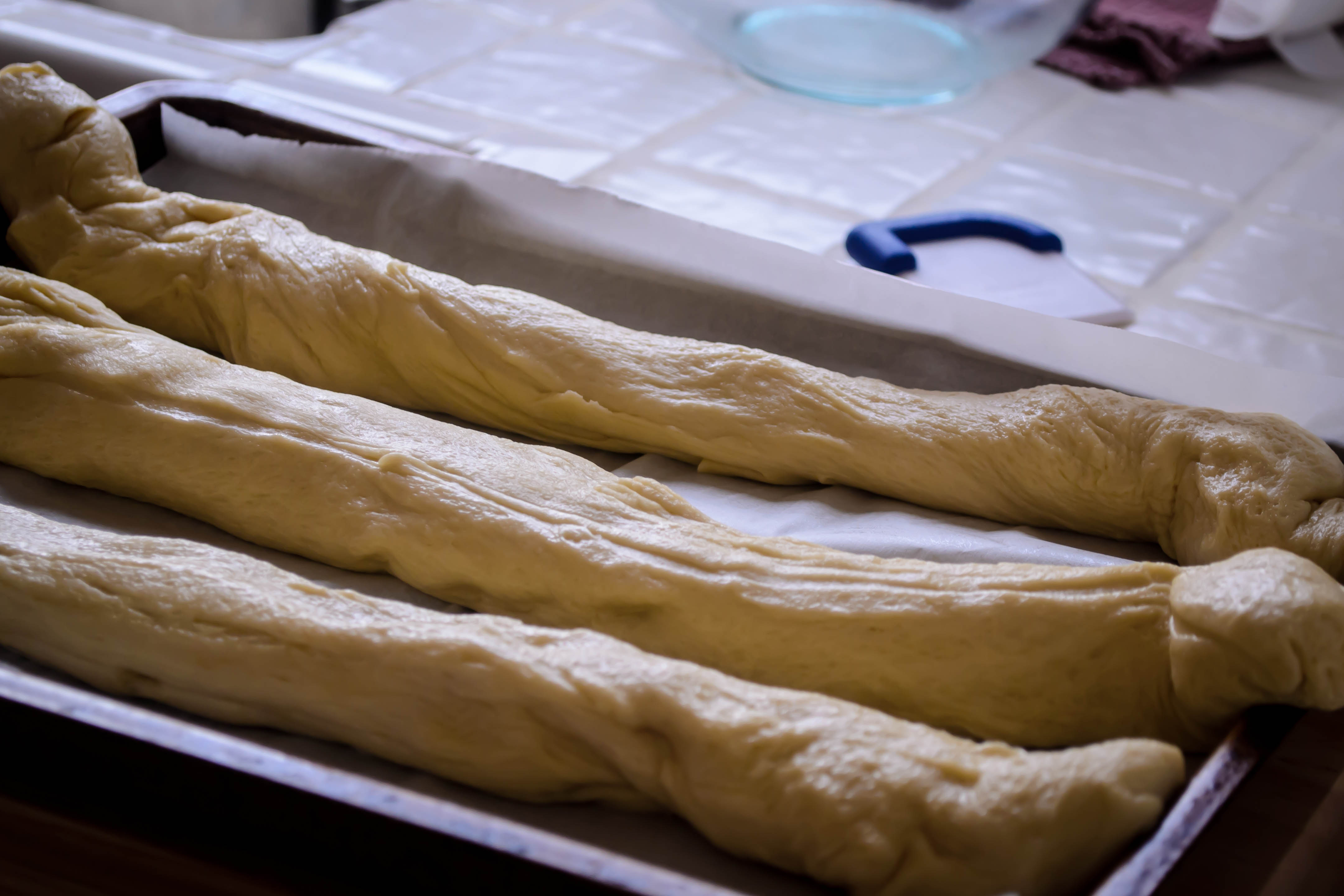
  • Divide the dough into three equal parts.  Shape each third into a long rope, place on a greased or parchment lined baking sheet and braid together loosely, pinching the ends firmly and tucking them under on each side.  Cover with a cloth or kitchen towel and, once again, let it rise for 45 minutes to an hour.  See why you need all day for this loaf?
Food Blog March 2013-0947
  • When the braid has swollen again, preheat the oven to 350F.  While you wait, beat an egg yolk with about a tablespoon of water to make an egg wash.  Brush the top and sides of the braid with your egg wash, then sprinkle with poppy or sesame seeds (we prefer poppy, in our house).
Food Blog March 2013-0951
  • Bake in your preheated oven for 30 minutes, or until the internal temperature of the bread is 180-190F.  The top will be golden brown and the bottom will feel delicately hollow when thumped.  Hot ovens tend to overbake this bread, so be sure to check at 30 minutes, or even just before.
  • When the bread tests done, take it out of the oven and let it cool on its baking sheet for 15-20 minutes, to allow the delicate internal crumb structure to firm up a bit.  This will make for easier slicing.
 Food Blog March 2013-0965
Thanks, Mom!

DSC_9042

* still not as bad as N.’s pun: he keeps saying “holla for challah!” and even though he admits this is neither in good taste nor particularly funny, finds he can’t stop doing it…