Arugula and Feta Pasta with Lemon Garlic Crumbs

2015 Blog August-0259I know what you must be thinking. I rhapsodize about meatballs, toss around semi-exotic ingredients you might have to go to multiple stores to obtain, advocate that you turn zucchini into noodles, and then disappear for almost three weeks with only a few photos to tide you over.

2015 Blog August-0227During those weeks, I must admit I didn’t cook much. We were traveling, making our annual pilgrimage to Oregon where we attended a wedding, stayed with good friends, single-handedly prevented the Cascadia quake by staying in a hotel that overlooked the ocean, N. bought a banjo, and I pulled a muscle in my back. (We also discovered the glory that is a chocolate stout float, but more on that in a few weeks.)

2015 Blog August-0237Not much makes you look forward to an eight-hour car ride less than having a pulled muscle in your lower back. Apart from trying to get comfortable and working to stay awake through the muscle relaxers I was taking (man do those things knock you out!), I sorted through what had become unexpectedly difficult to accomplish without the muscle just left of your spine: spitting out toothpaste without dribbling it down your front. Shimmying into a pair of shorts – your feet and ankles are suddenly so far away! Rolling over in bed. Hobbling across the street at a snail’s pace while the kindly drivers on either side regret waving you forward. Filling and then draining off a pot of pasta water.
2015 Blog August-0240Cooking, thus, when we got home, had to be simple at first, and required some of N.’s help for the parts that had become surprisingly heavy. Fortunately, I’d been hoping to repeat this simple little pasta dish: capellini, also known as angel hair, tangled together with lightly wilted arugula and salty crumbles of feta, topped with an aromatic, heavy dose of crunchy breadcrumbs flavored with garlic and lemon zest. The whole thing only uses two pans, it requires only a handful of ingredients, none particularly exotic, and it takes a mere twenty minutes or so to throw together, since most of the prep and cooking of the breadcrumbs can be done while you’re waiting for the pasta water to boil.

2015 Blog August-02422015 Blog August-0243

2015 Blog August-0246If you aren’t accustomed to having arugula in your fridge, you should be – it’s a wonderful go-to green for salads and a refreshingly different take on pesto. Delicate but peppery, it’s also called rocket and is one of my favorite salad bases. As for the topping, I’m using panko – those delightfully brittle shards that are Japan’s answer to the breadcrumb, and unquestionably my favorite type. You wouldn’t want them for your meatballs, where the goal is light, springy absorbency, but once toasted, they make an addictively perfect crisp topping for basically anything. Since they don’t taste like much, I’ve bumped up the flavor with lemon zest, a healthy bit of grated garlic, and some red pepper flakes for N., who likes that hit of warmth on the back of the throat.

2015 Blog August-0249Coming home at the beginning of August is a bittersweet proposition, because at once it means a glory of summer fruits and more vegetables at the Farmers’ Market than my market bag or my wallet can handle, but it also means the first day of classes looms ever closer on the horizon. And as nice as it is to be home, the fact that it will be at least another year before we see all the friends we just hugged goodbye is a pang quite different from my slowly healing back muscle. This week, then, we’ve covered a bit of the bitter, with the peppery greens and the briny sharpness of the cheese. Next week, inspired by a bourbon-loving friend I didn’t get to see on this trip, I want to make up for it with something sweet.

2015 Blog August-0252

Arugula and feta pasta with lemon garlic crumbs
Serves 4 very hungry diners, or 6 less hungry diners
6 tablespoons olive oil, divided
1 cup panko breadcrumbs
¼ teaspoon salt
¼ teaspoon red pepper flakes
1 tablespoon grated garlic (from about 4 cloves)
1 tablespoon lemon zest (from 1 large or 2 small lemons)
8 ounces capellini or angel hair pasta
¼ cup fresh lemon juice (from 1 large or 2 small lemons)
5-6 ounces baby arugula
4 ounces feta, crumbled


  • Heat a large, lidded pot of well-salted water over high heat. When it comes to a boil, add the capellini and cook according to package directions. While you wait for the water to boil, however, make the breadcrumbs and prep the other ingredients, as detailed below.
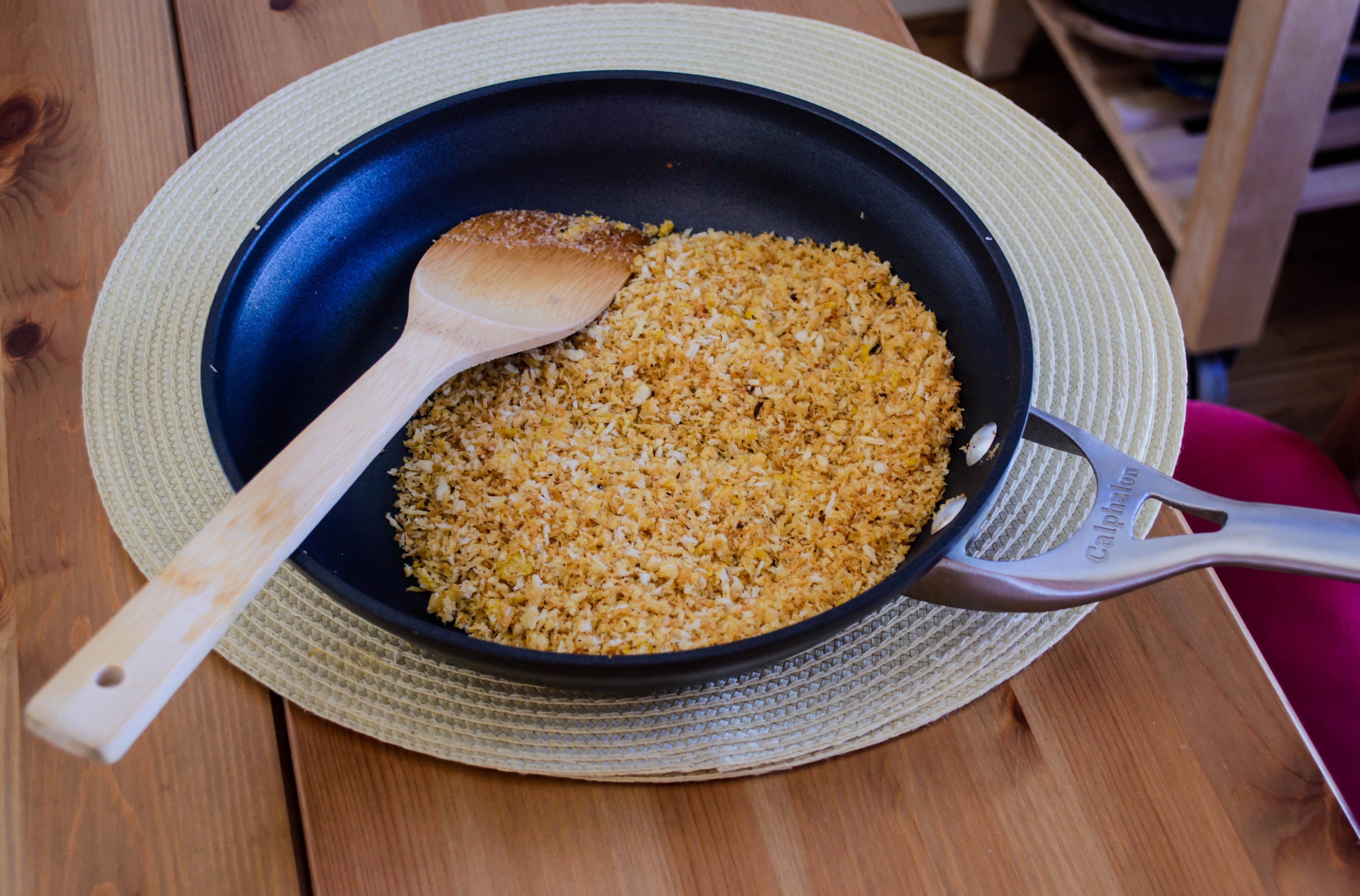
  • Heat 2 tablespoons of the olive oil in a 10-inch skillet over medium heat. When it is shimmering, add the panko breadcrumbs, the salt, and the red pepper flakes. Toast over medium heat, stirring almost constantly to brown evenly and prevent burning.
  • When the crumbs are golden, which for me was about 2-3 minutes, add the grated garlic and lemon zest and stir well to evenly distribute. The zest and garlic will want to clump up, so stir assertively. Cook, stirring, for another 1-2 minutes until the mixture is fragrant and nicely browned. Remove from heat and set aside.
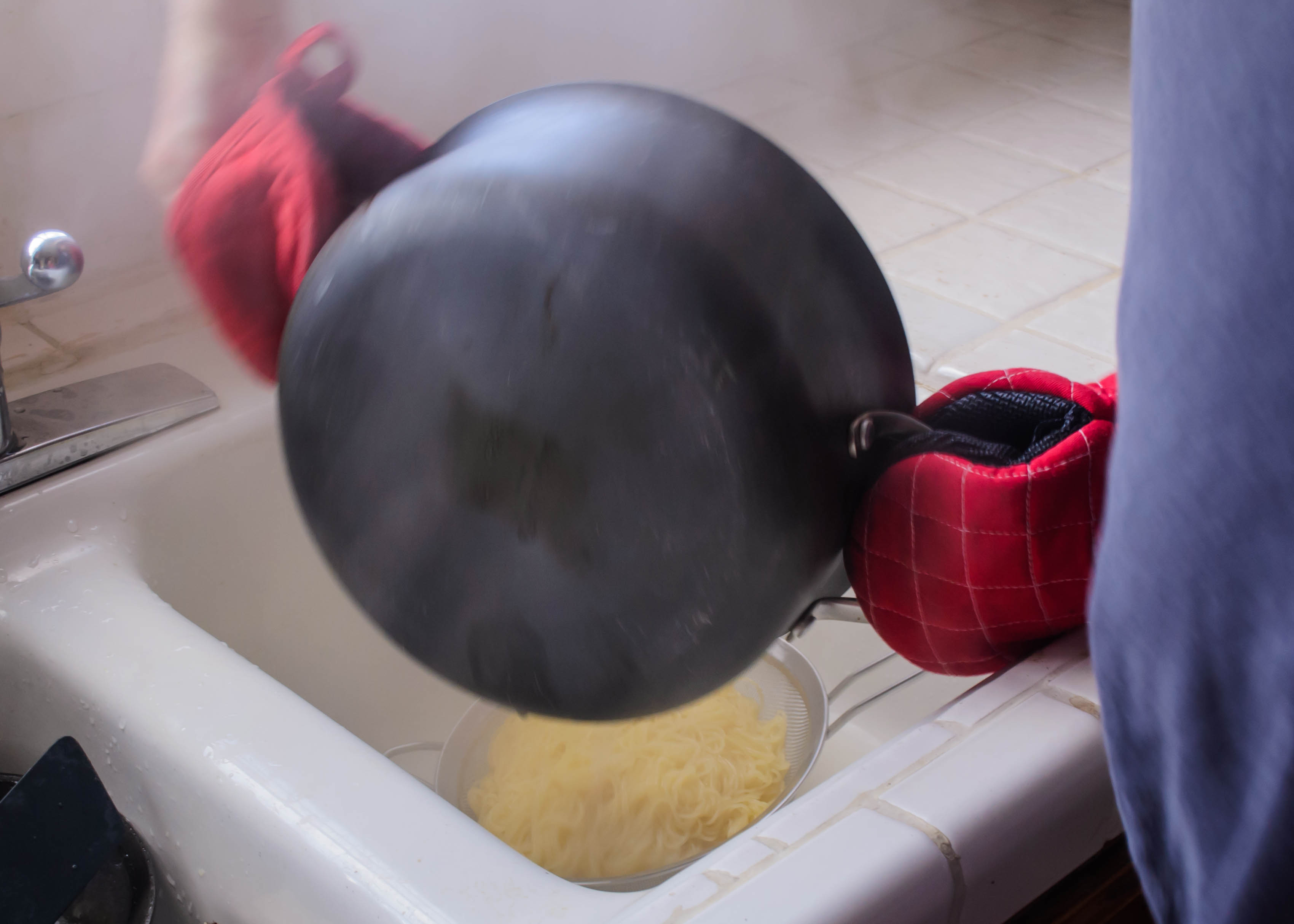
  • By now, your water should be close to or already boiling. Add the pasta and stir to submerge it. Cook with the lid off to al dente, following the package directions. As soon as the pasta is done, drain immediately into a colander or strainer.
  • Add the remaining 4 tablespoons of olive oil to the now-empty pasta pot and swirl it over medium-low heat to evenly coat the bottom of the pot. Add the lemon juice, then the pasta, and toss with tongs to coat evenly with oil and lemon juice.
  • Dump in the arugula and use the tongs to gently integrate it with the pasta. When the arugula is gently wilted, turn off the heat and sprinkle in the crumbled feta cheese. Use tongs again to toss so the cheese is evenly distributed.
  • Serve hot in large, shallow bowls, and top each serving with about 2 tablespoons of the crumbs.
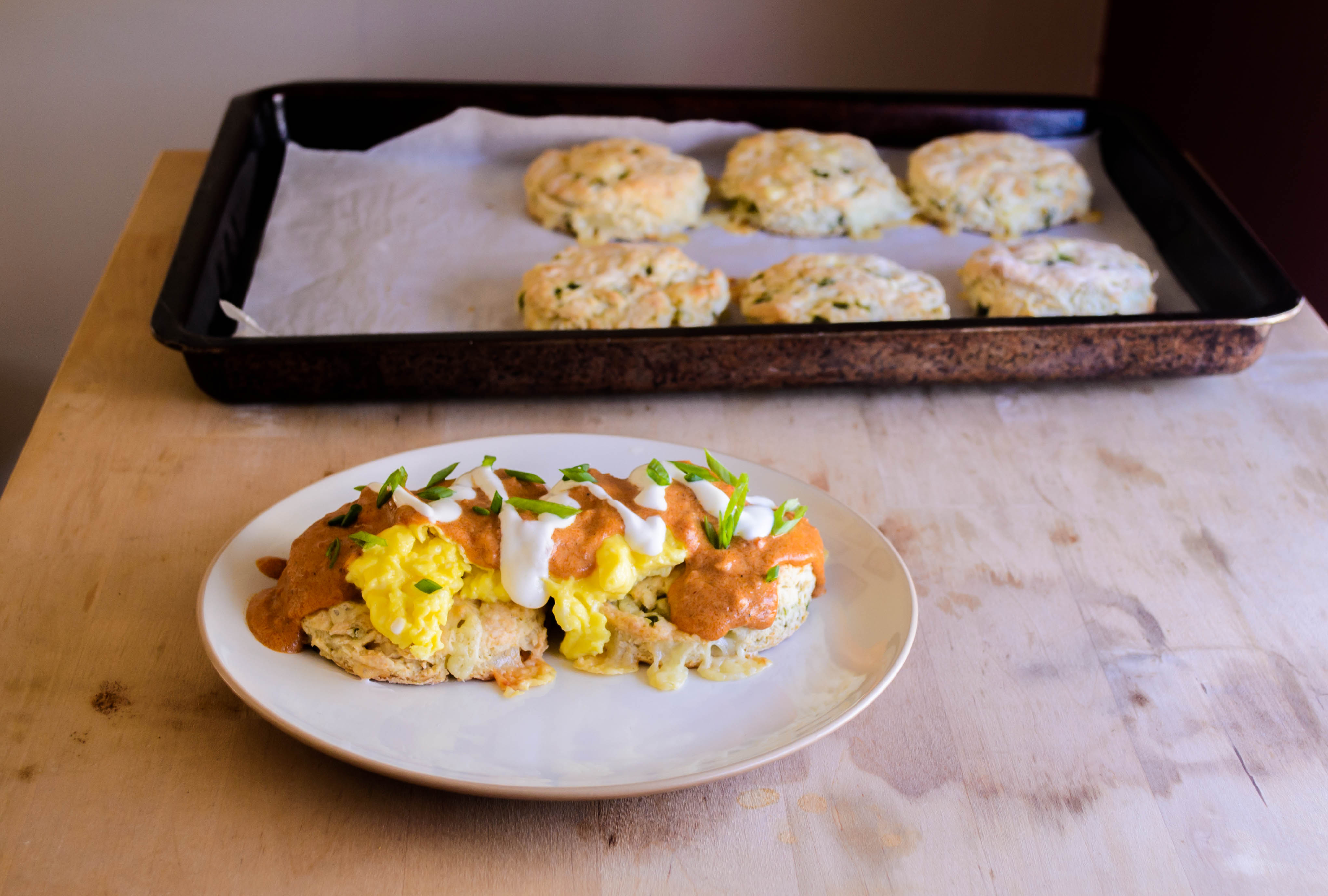
Los Feliz Biscuits and Gravy: poblano and white cheddar biscuits with chorizo gravy

Food blog July 2015-1117According to adage, breakfast is “the most important meal of the day,” and while the heavy, sweet or savory, sometimes grease-laden offerings that make up a truly excellent breakfast are some of my favorite meal options out there, if I eat them first thing in the morning I’m going to feel ill. Give me a bowl of bran flakes or a slice or two of toast in the morning, then move to the eggs, the bacon, the biscuits, the sausage, the waffles, as the day eases on. That’s why I get so excited, and wax eloquent so often here, about breakfast-for-dinner.

Food blog July 2015-1100But for a 30-something living in an urban area like Los Angeles, breakfast food of this ilk means something else: brunch. Food that is fatty and greasy in the best possible way washed down with a mimosa or three to compensate for the previous night’s revelry – this is the true calling of a large plate of breakfast meats, scrambles, and toasted, syrup-bearing stacks. And here, at least, walking into a restaurant for brunch entails working your way through a crowd of plaid and maxi skirts, tilted fedoras, gladiator sandals, and the occasional waxed mustache. So, you know, hipsters.
Food blog July 2015-1104A few months ago, N. and I wandered through a little enclave called Los Feliz just south of Griffith Park after a failed attempt to visit Griffith Observatory (on a temperate weekend, with clear skies, there’s zero chance of finding parking there more than half an hour after it opens. What fools, we). On our way to a local bookshop, we ran into one of his coworkers and her wife having brunch, and it suddenly seemed like exactly the right thing to do. We unofficially added “eat brunch at every restaurant in Los Feliz” to our LA-to-do list.

Food blog July 2015-1109Brunch in Los Feliz – like many places east of Hollywood as highway 101 cuts south toward downtown – means hipster paradise with a heavy dose of East LA flavor: huevos rancheros, chilaquiles, chorizo folded into a thick, fluffy omelet. The Mexican and Latin influence on that side of the city makes for a glorious contribution to any brunch (or, as my sister put it, a meal that is perfect for “a Sunday at 11AM or any night at 8PM or later”).

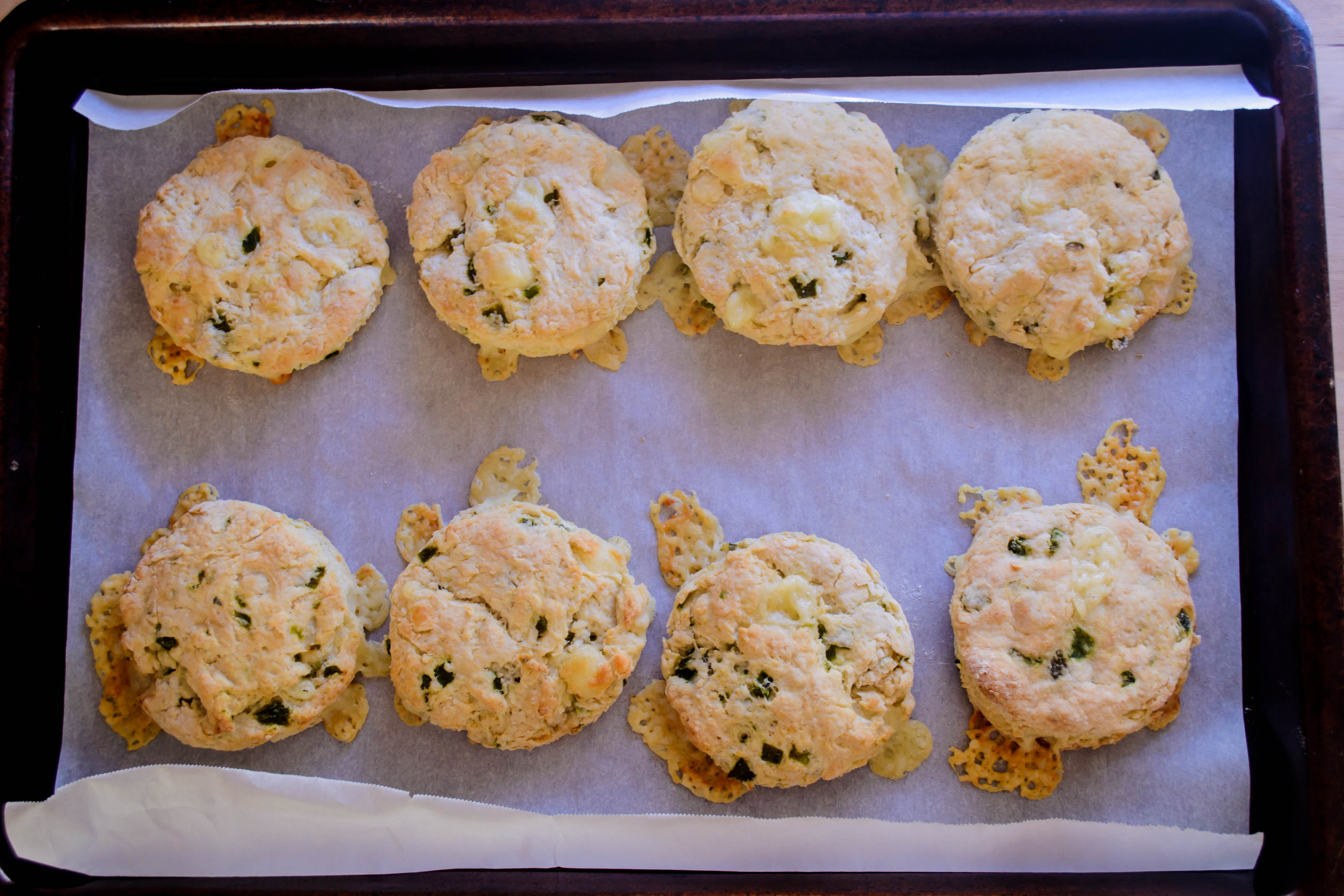
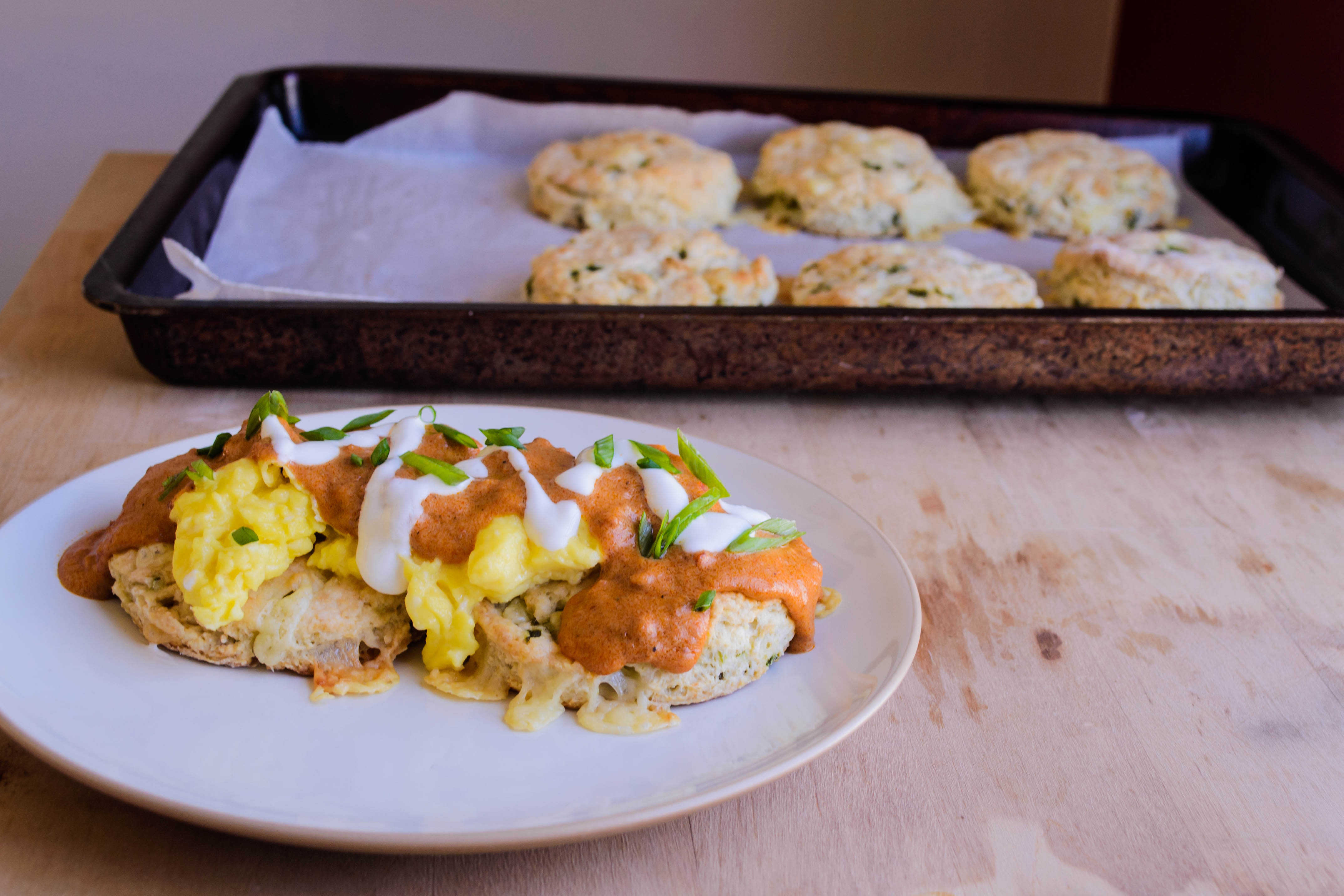
Food blog July 2015-1106Our first entrée (haha) into the Los Feliz brunch scene was late on a Sunday morning, seated outside, as you always should be, so you can watch the show walk past: rompers and sundresses, stilettos surely too high and too spiky for church, bowties and converse all-stars worn un-ironically on the same person. Some passersby are accompanied by their pit bulls and chihuahuas, who often sport their own wardrobes, and pause to jangle their collars against the metal water bowls left outside for them by many of the businesses along the main drag. But once our food came, I don’t think we noticed another single pedestrian. N. had huevos rancheros, and we agreed they were a good representation – the black beans were meaty and savory and well-seasoned, and the fresh salsa was good – but my dish was the real star: poblano and white cheddar biscuits with scrambled eggs and a chorizo gravy. Flaky, cheesy mounds draped in a bright orange, lightly spicy sauce that, even though we’d promised to share, made me reluctant to relinquish my plate. Think classic biscuits and sausage gravy, but with neighborhood flavor.

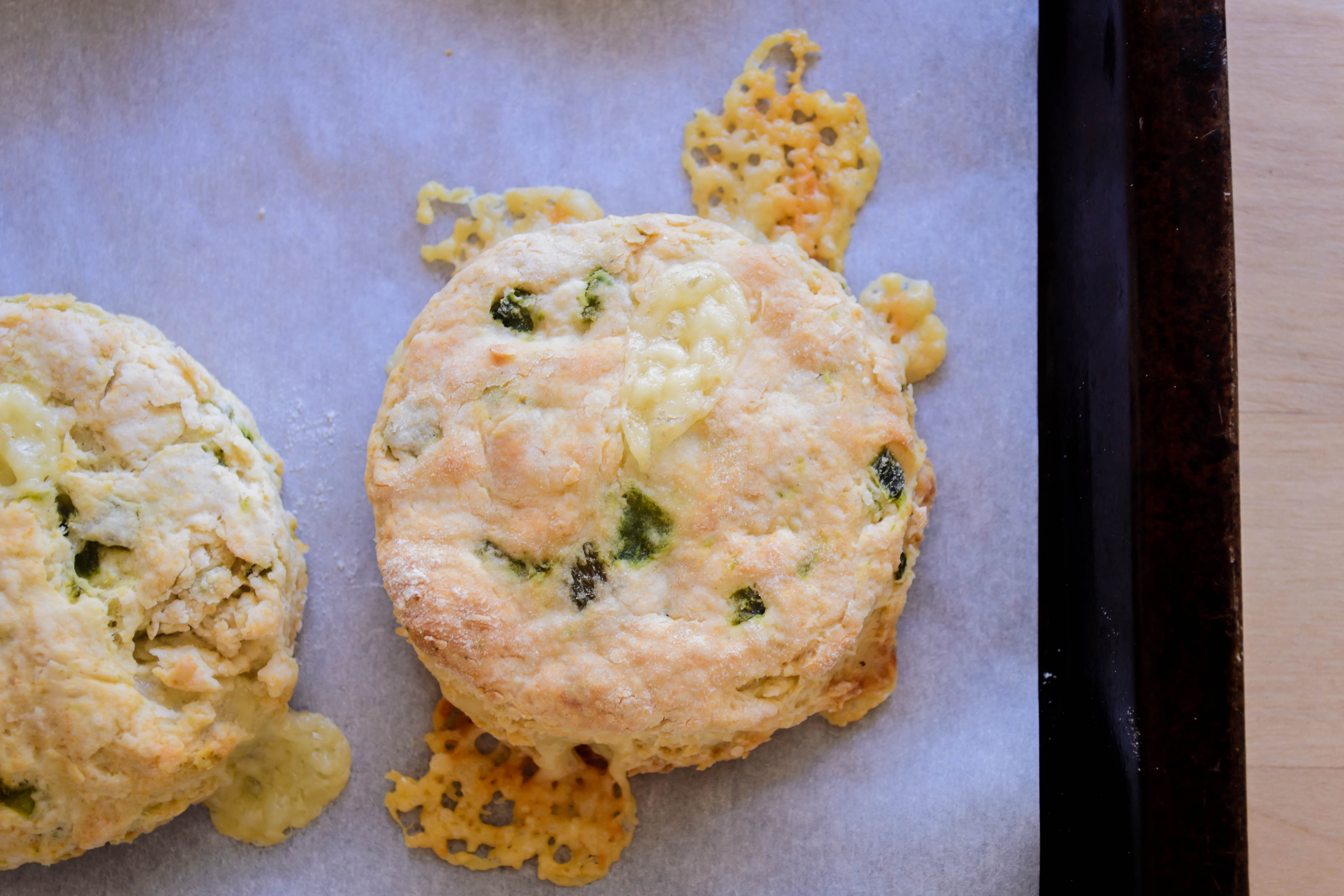
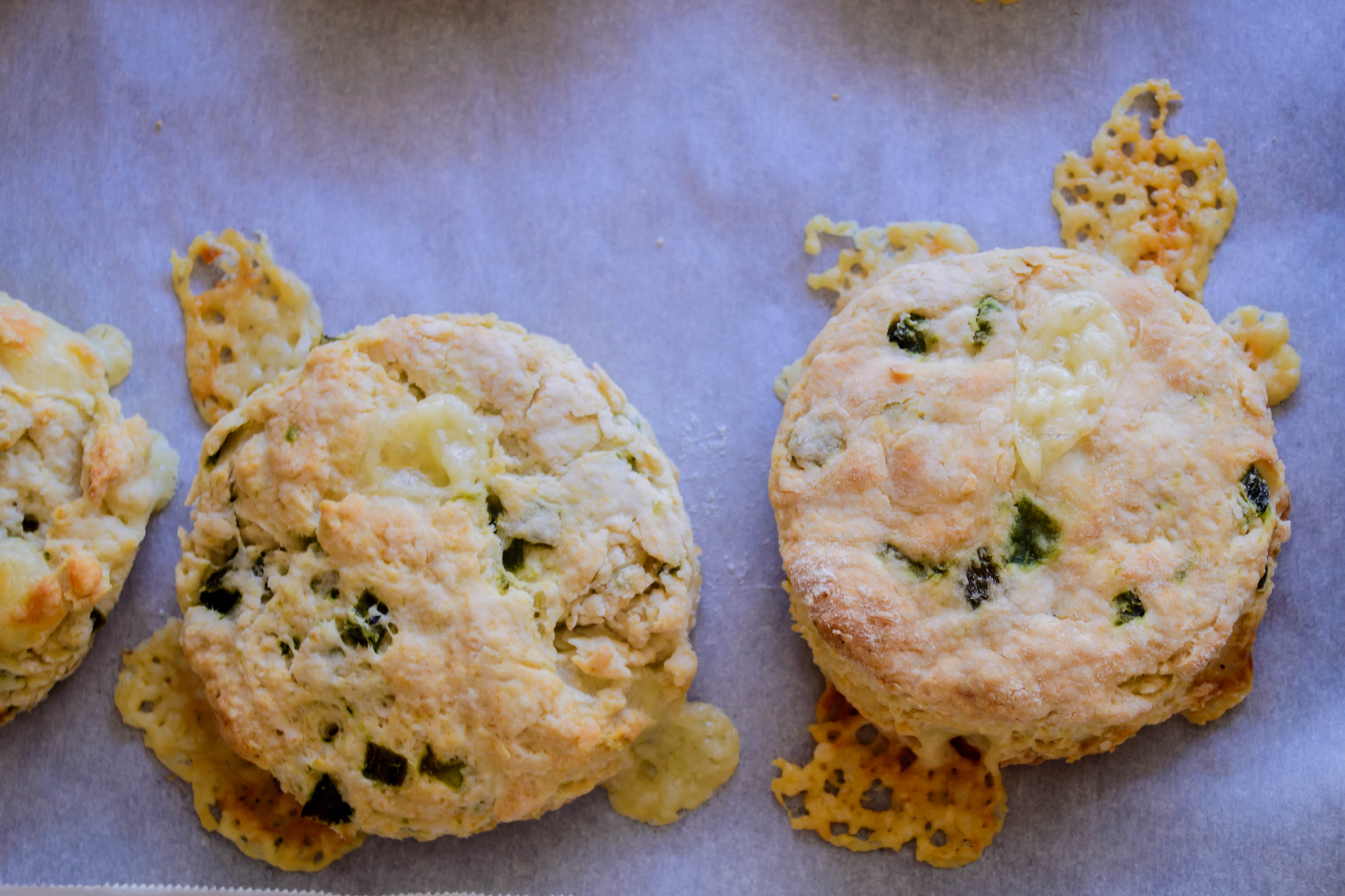
Food blog July 2015-1107A dish like that only means one thing: restaurant recreation. Even as we asked for the check, I was already considering how I would make this at home. I wanted cheesier biscuits, more roasted poblano, and a stronger chorizo presence in the gravy. This resulted, in my version, in a gravy stronger in flavor but a bit less rich, and biscuits to rejoice over – flaky, crisp and golden on top, aggressively cheese-laden with obvious hits of smoky poblano inside. Plus, once punched out the biscuits freeze perfectly, so it makes sense to bake just what you need and save the rest for another lazy morning. It’s a brunch (or lunch, or dinner) option that will remain permanently on our rotation.

Food blog July 2015-1112Brunch in Los Feliz was, then, a successful voyage in many ways, and clearly our real challenge will not be exploring the area for its brunch options, but convincing ourselves to order something different every time, because once you’ve found an option as fulfilling as this, trying something new is a gamble I’m sometimes unwilling to take.

Food blog July 2015-1113Serving suggestions: because the restaurant’s offering was pretty perfect as it was, I copied their addition of scrambled eggs between the biscuit and the gravy, but the eggs are really just an extra luxury. You could also easily pair this with a pile of crispy hash browns or homefried potatoes, which would be an excellent match for the gravy. Though I don’t have much experience with soy-based sausages, a good soyrizo or chipotle field roast sausage would likely make an excellent vegetarian sub for the chorizo, if you want to go meatless. You might have to add a little extra fat to the pan, though, when you cook them.

Food blog July 2015-1114This dish is best, of course, the first day. The biscuits are never as crunchy and warm after that, and the gravy does tend to do that thing gravy does where it gets thicker but also separates overnight in the fridge. But I think, with four diners round the table and ten biscuits to share between you, the last drippings of gravy won’t be long for this world.

Food blog July 2015-1124

Los Feliz biscuits and gravy
Serves 4
For biscuits:
1 poblano pepper (¼ – ⅓ cup, when chopped)
2 cups all-purpose flour
2 teaspoons sugar
1 teaspoon salt
2 tablespoons baking powder
6 tablespoons cold butter, cut into chunks
6 ounces buttermilk (about ¾ cup)
1 cup extra sharp white cheddar cheese, grated or in small cubes
For chorizo gravy:
9 ounces chorizo
2 tablespoons flour
2 cups whole milk, warm or at room temperature
salt and pepper to taste (depends on your chorizo – mine didn’t need any)
To serve:
softly scrambled eggs: 2 per person
2 tablespoons sour cream
1-2 teaspoons milk or cream
1-2 tablespoons thinly sliced chives or green onions, dark green part only


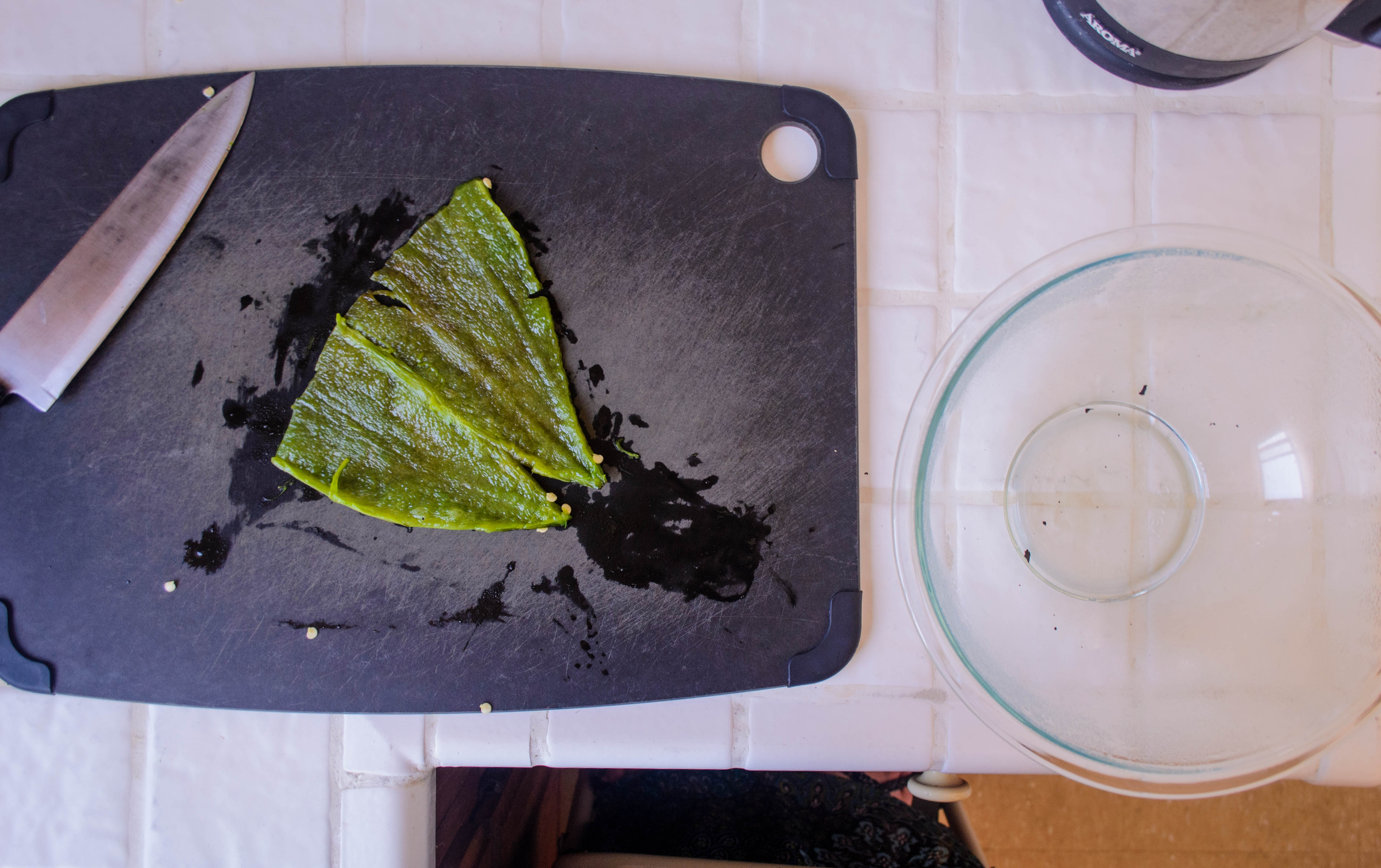
  • Roast poblano pepper over a grill or gas flame – about 10 minutes, turning when needed – until the skin is almost entirely blistered and black. Place in a glass bowl, cover tightly with plastic wrap, and let it steam for 20 minutes to loosen the skin and soften the flesh. After 20 minutes, remove the pepper from the bowl and use a paper towel, knife blade, or your hands to scrape off the skin (some illustrative photos here, if you need them). Remove stem and seeds as well, then dice finely for ¼ – ⅓ cup of roasted pepper bits. The pepper pieces should be room temperature when added to biscuit dough – plan accordingly.
  • Preheat the oven to 400F and line a baking sheet with parchment paper. To make the biscuits, whisk together the flour, salt, sugar, and baking powder in a medium bowl. Blend in the cubes of cold butter using a pastry cutter or your fingertips. Butter bits should be the size of small peas. Add the cooled diced poblano and the cheese and use a fork to integrate, then pour in the buttermilk and, using a fork or your fingers, bring together into a ball of soft dough.
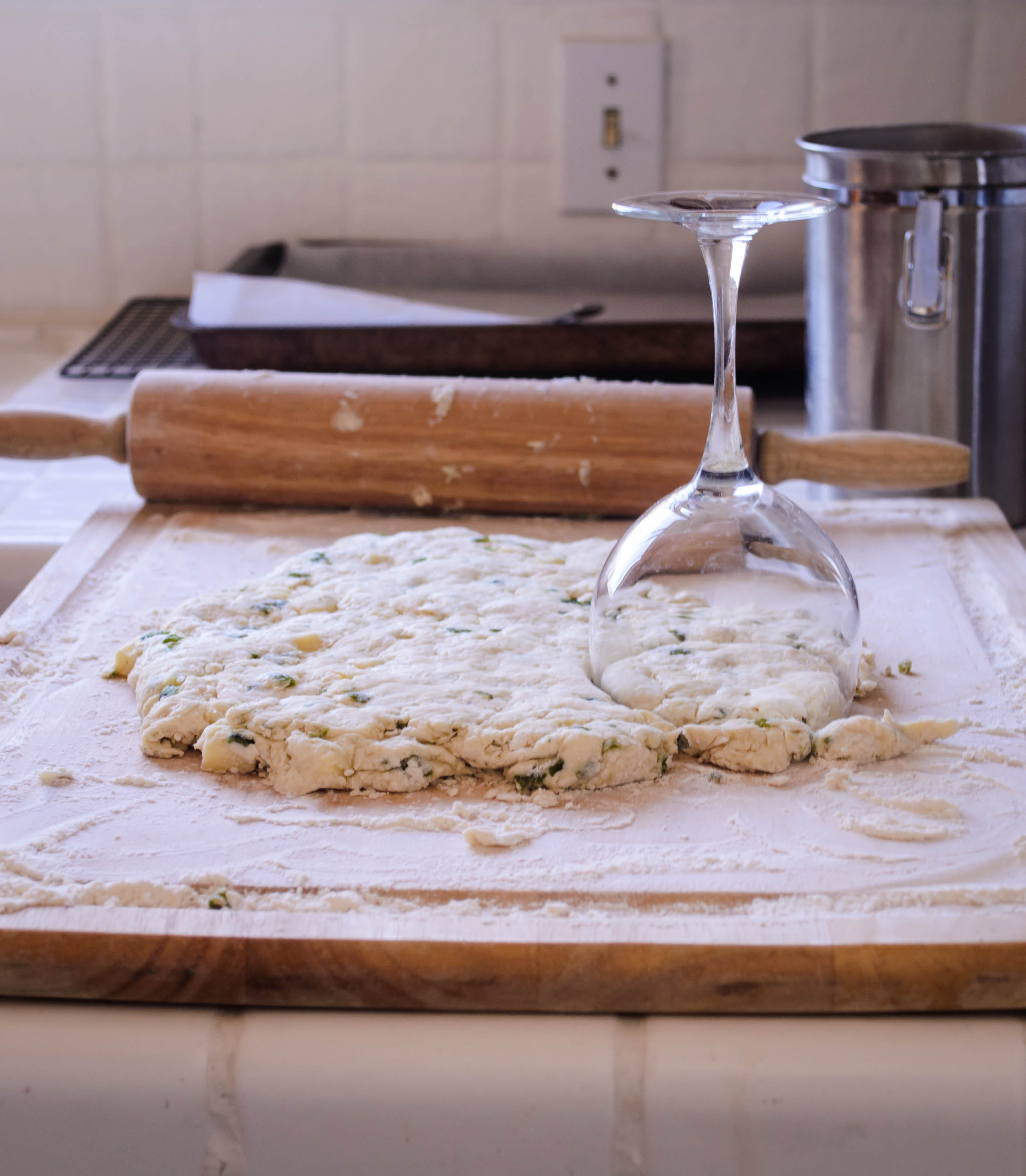
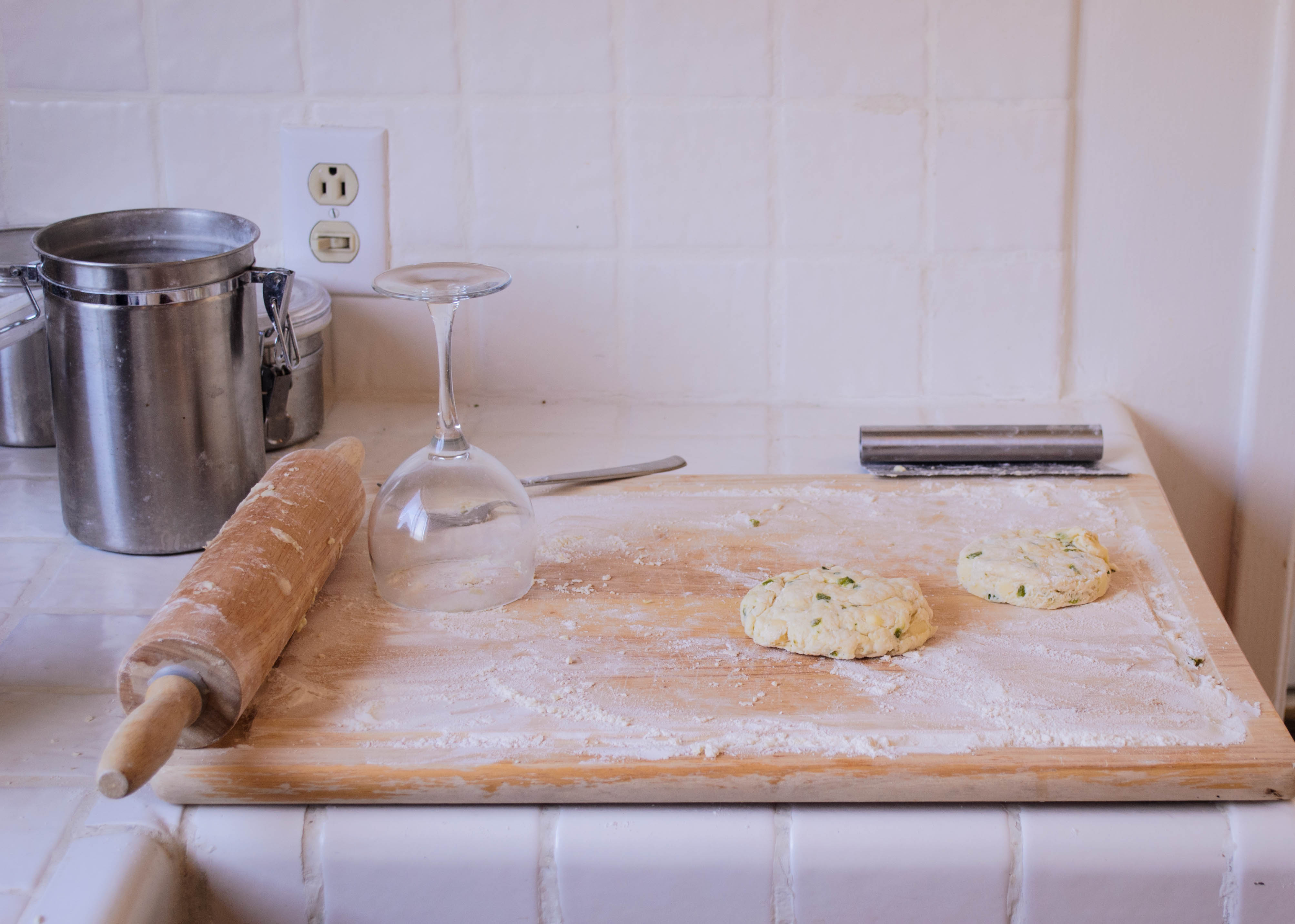
  • Turn the dough out onto a well-floured board and use a floured rolling pin or the palms of your hands to roll or press the dough into a rectangle about ½ an inch thick. Fold the dough into thirds, then roll out again. Repeat, again folding the dough into thirds and then rolling it out; this creates more flaky layers. If the dough sticks to your board, use the flat blade of a butter knife or a pastry scraper to help you lift it free.
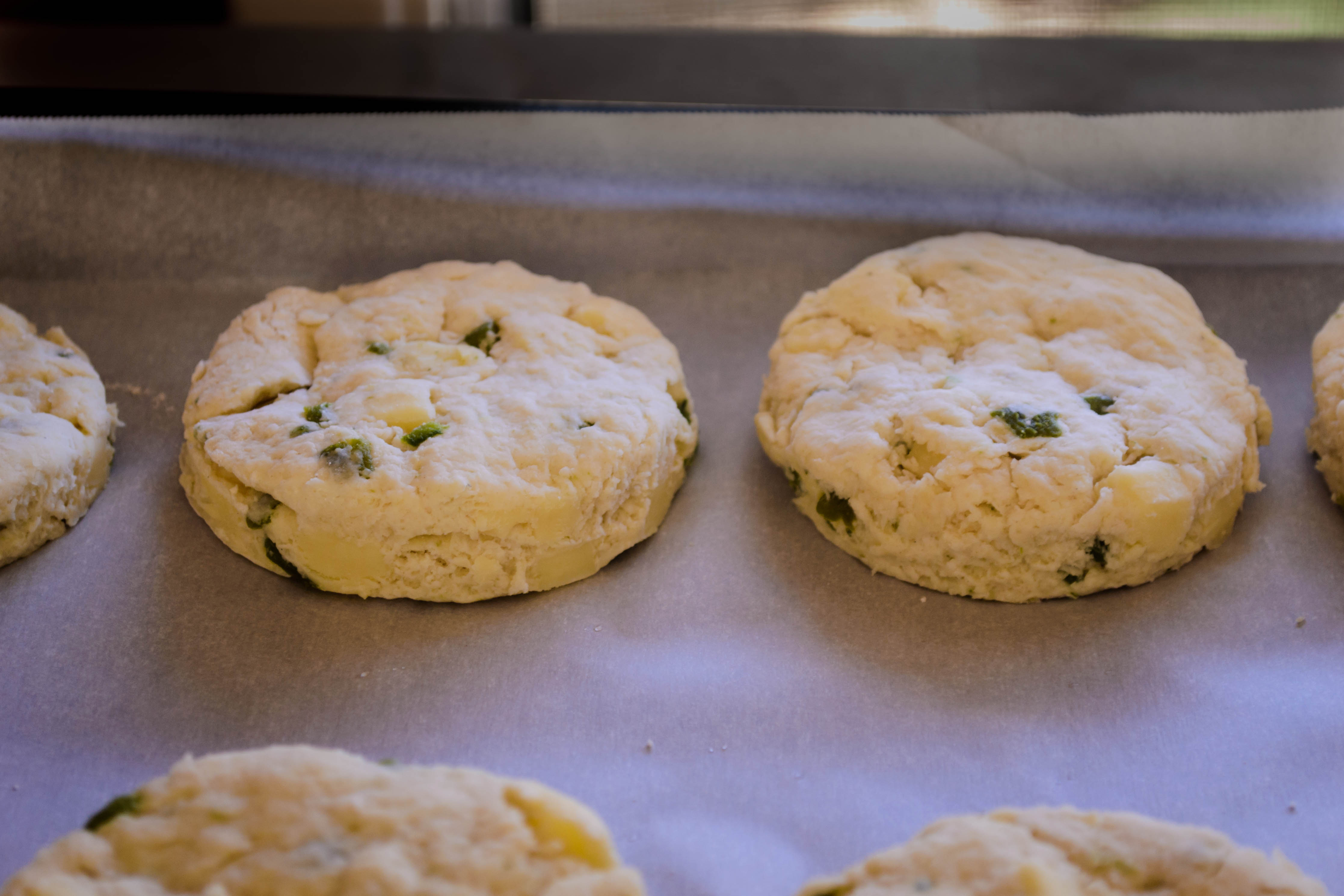
  • After you’ve rolled and folded, rolled and folded, and rolled once more (so you’ll have done a total of six folds), use a round cutter (or the lip of a glass) to punch out biscuits. Push the cutter straight down through the dough; don’t twist until you are all the way through the dough, or you’ll crush the flaky layers! Repeat, placing the biscuit rounds on your parchment lined baking sheet, until you can’t punch out any more rounds. Re-roll the dough scraps and repeat – with ½ inch thick dough, using a 3-inch cutter, you should be able to make about 10 biscuits.
  • Bake biscuits at 400F for 20 minutes, until their tops are golden and some cheese has oozed out to make lacey crisps around their edges.
  • While the biscuits bake, make the chorizo gravy: in a medium skillet, cook the chorizo over medium heat, stirring occasionally, until it is cooked through and nicely browned. This is difficult to see on some chorizos, because they are quite wet and reddish orange in color; look for a textural difference to determine that it is cooked.
  • When the chorizo is cooked through with brown bits and lightly crusty, chewy bits, sprinkle the flour over it and stir through to combine. Cook the flour with the chorizo for 1-2 minutes, then slowly begin adding the milk, whisking constantly as you do so. I like to pour in about ¼ cup at a time, whisk until the mixture is homogenous again, then add the next installment of milk.
  • With all the milk added, continue to whisk slowly until the mixture comes to a simmer. You will notice it thicken as it warms, but it won’t reach its final viscosity until it comes to a boil. At that point, lower the heat to a simmer, taste for seasoning, and add additional salt and pepper if your taste buds require it.
  • To serve, combine 2 tablespoons sour cream and 1-2 teaspoons milk or cream in a small dish or in a squeeze bottle. Place two biscuits on each plate, top with scrambled eggs, ladle on some gravy, and squirt or drizzle the sour cream sauce on top. Sprinkle with chopped chives or green onion, and serve immediately.

Peach Caprese Toasts

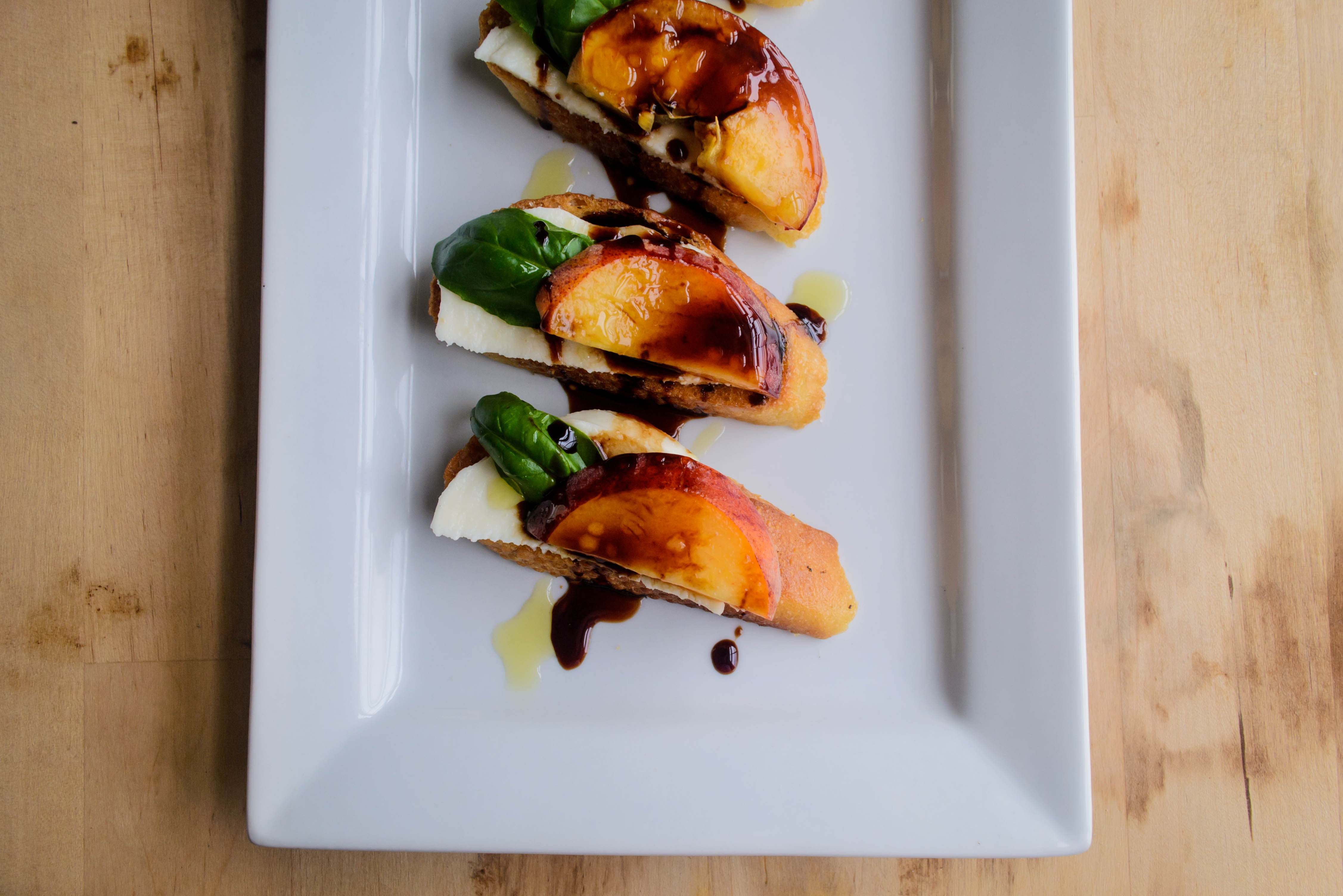
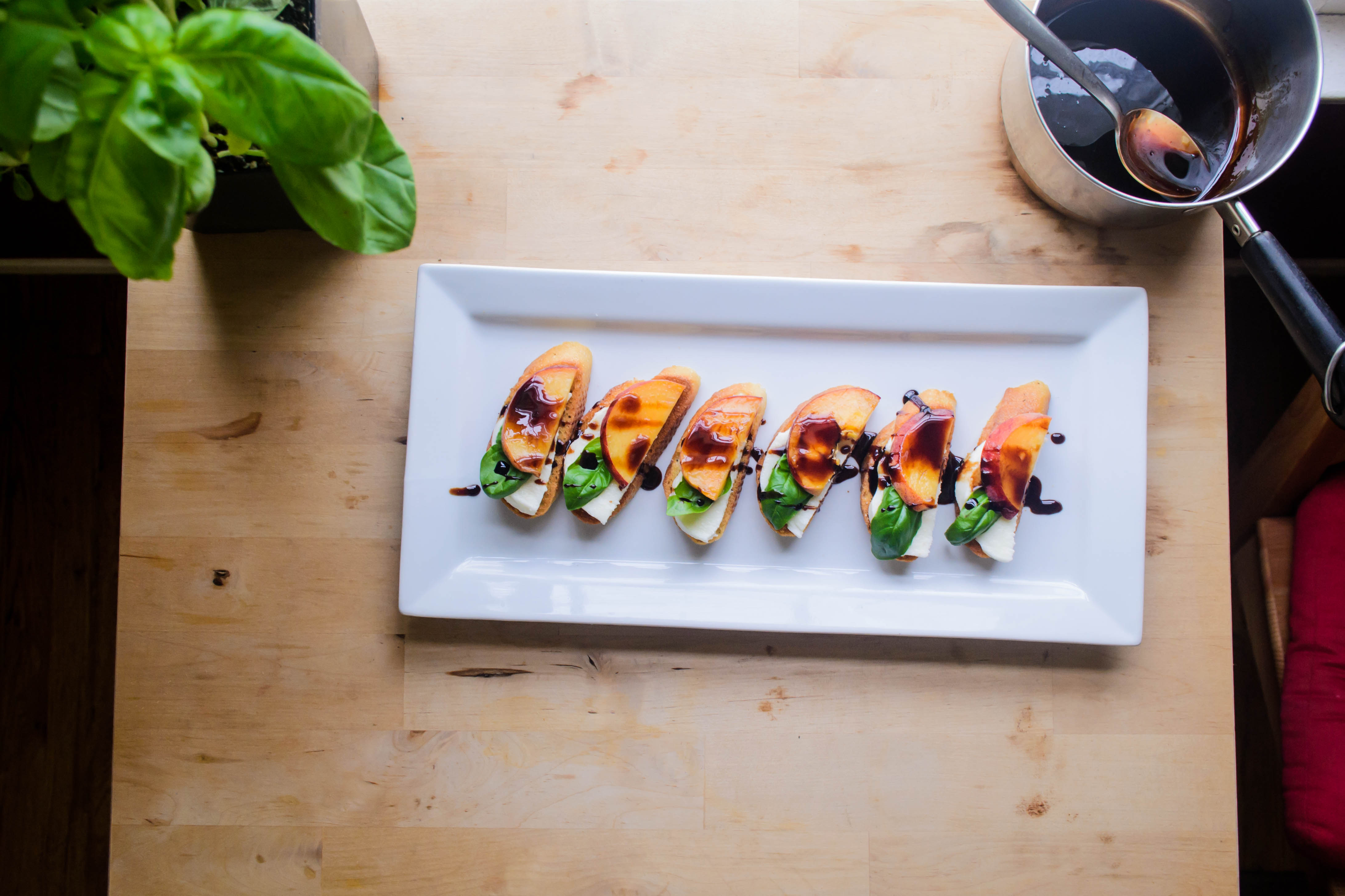
Food blog June 2015-0973If I were a TV chef, this would be one of those dishes I would cook outside. I’d greet you from my back patio kitchen (because of course I’d have one of those, complete with a great beehive shaped brick pizza oven), offer you a virtual cocktail, and commence a cheery narrative about summers in France when I was a kid, or how this particular combination of ingredients speaks to some cherished family memory. The peaches would have come from my backyard tree, I’d delight you by plucking the basil myself from a tiered herb garden right next to the outdoor bar, and obviously the mozzarella would have come from some local artisan selling fresh knobs of it at the local farmers’ market.

Food blog June 2015-0947But seeing as I don’t have an outdoor kitchen, and since I’d be a terrible TV chef (uncoordinated, messy, with a penchant for cooking in ripped jeans), I’ll admit that this lovely little snack emerged because I’m basically obsessed with caprese right now. After the triumphant caprese inspired meatballs of two weeks ago, my brain catapulted into summer, and all I want is fresh produce and grilled everything. Nothing says summer to me like a wide tray of gushing tomato wedges, mozzarella almost too soft to slice, and torn basil. If you add a drizzle of thick, syrupy balsamic, you’d better pour me a glass of wine, too, because I’m staying for a while.

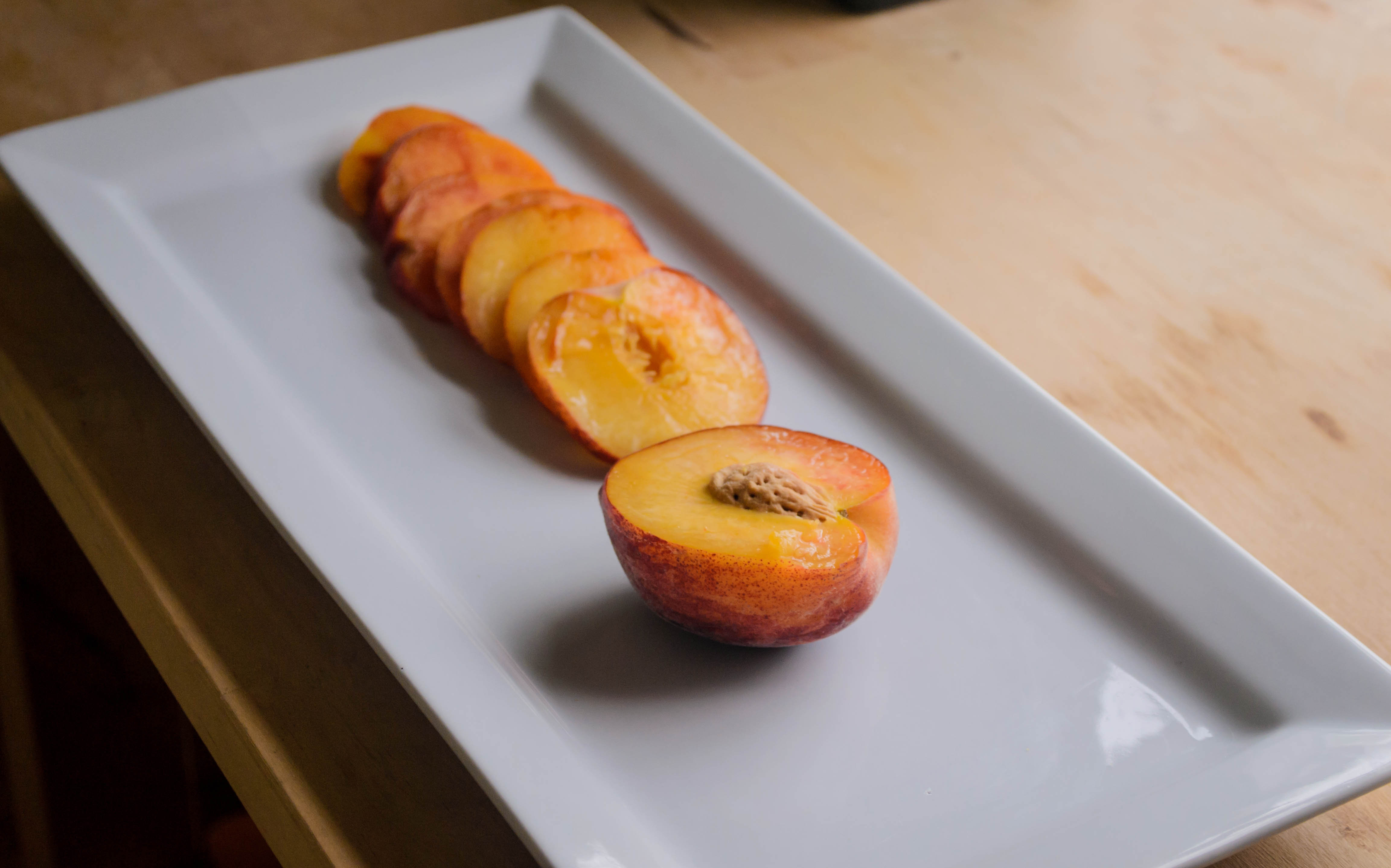
Food blog June 2015-0954Despite the whole Southern California thing, though, I’m not ready to buy tomatoes just yet. Not even at our local farmers’ market (where I shamefully wasn’t locavore enough to look for mozzarella cheese). It’s just not time yet. There is, though, a vendor whose stall is always packed that had a nice selection of stone fruits this week. It seems a bit early for these as well, but when I could smell the peaches from a few feet away, I decided to risk it.

Food blog June 2015-0960Food blog June 2015-0962Though this rarely happens, these turned out exactly how I’d imagined them. Usually I can’t help myself from changing something as I go along, or skipping over or adding a step or ingredient, and it’s hard to stop the universe from offering up its own brand of “help” to produce unexpected results.

Food blog June 2015-0967Not this time. The peaches were juicy, the mozzarella was creamy and perfect, the basil was fresh and crisp, and I didn’t even burn the toast (believe me, that’s an accomplishment). I reduced my balsamic vinegar with a tablespoon of brown sugar, and I may never do it any other way; the sugar thickened it up faster, and it played well with the peaches, eliminating just the edge of the puckering tartness balsamic can have. Obviously, the whole thing went perfectly with a glass of cold, cold, slightly effervescent pink wine.

Food blog June 2015-0968Suggestions: as we were eating these, I was already talking about alternatives. You could, for example, add the cheese 30 seconds or so before removing the toast from the broiler, to start it melting into the bread for a softer end product. You could grill the peach slices, with or without a brush of butter or brown sugar, for a caramelized fruit flavor. You could even eschew the toast altogether and just offer a platter of layered peach and cheese slices with basil tucked in, as you would with a traditional caprese, and serve it up alongside whatever you’d grilled in your outdoor kitchen. Maybe even add in some cucumber slices for extra crunch. And not that it’s likely you’d have leftovers, but if you, say, casually stacked the peach slices and remaining balsamic syrup over a scoop or two of vanilla ice cream, and then you called me, I’d be happy to come and share it with you.

Food blog June 2015-0980

Peach Caprese Toasts
Serves 2-3 (easily doubled or tripled… go crazy!)
Most quantities here are according to your tastes (translation: approximate). Take the basics and do them up the way you like them best. No fuss. It’s summer.
½ cup balsamic vinegar
1 tablespoon brown sugar
12 slices of baguette, about ¾ inch thick (French or sourdough)
olive oil for drizzling
salt and pepper for sprinkling
2 small peaches
ball of fresh mozzarella (burrata would also be lovely, though a touch messy)
12 leaves fresh basil


  • Preheat your broiler. While it warms, make the balsamic syrup. Pour the balsamic vinegar and the brown sugar into a small pot and cook over medium heat until it comes to a boil. Lower the heat and simmer until the mixture reduces by half, then turn off the heat and let it sit. It won’t seem very thick during the boil, but just wait! It thickens as it cools into a tart, glossy syrup.
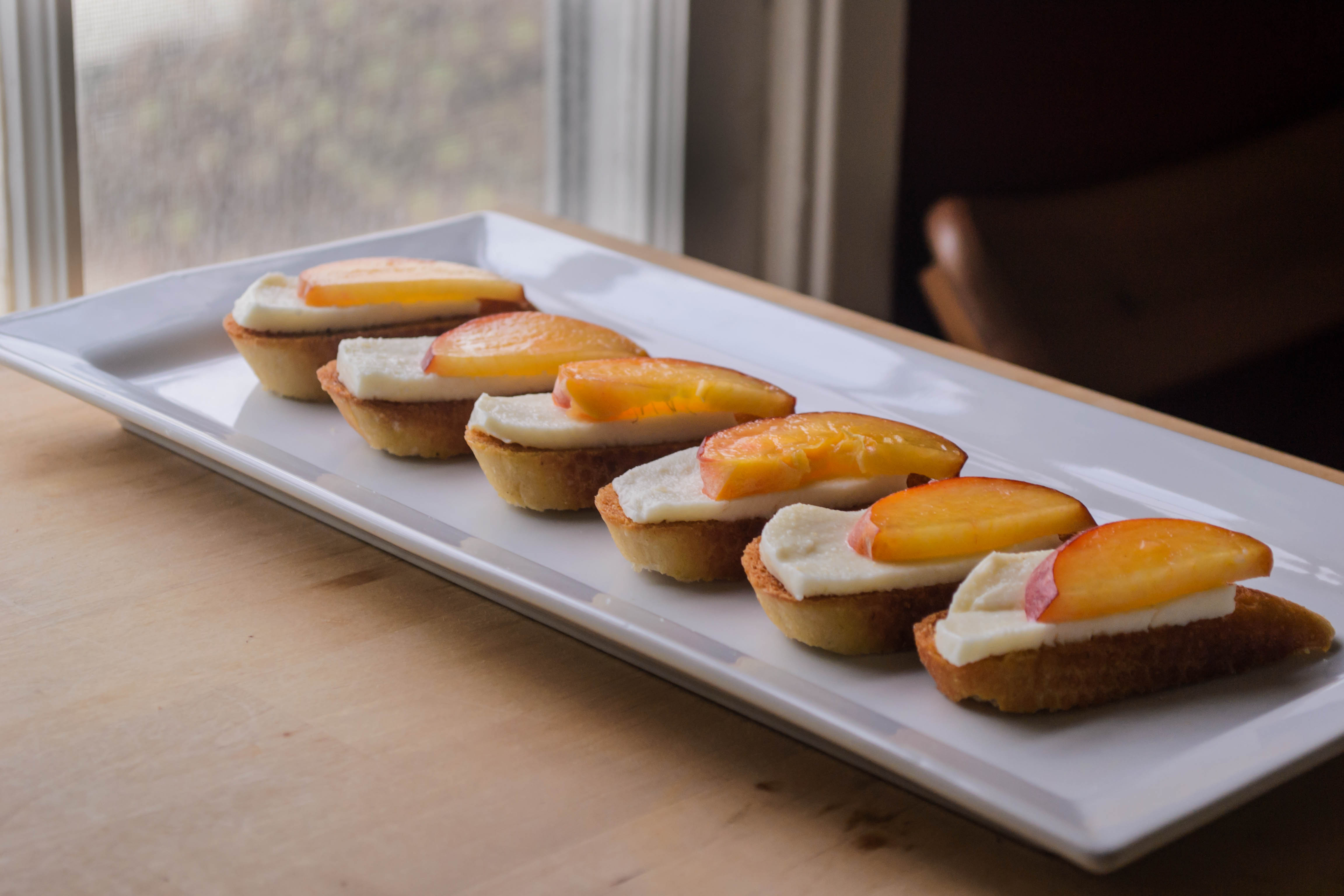
  • Spread baguette slices out on a cookie sheet and drizzle them with olive oil, salt, and pepper. You want a fairly even coating of oil for even browning. Broil, watching carefully to prevent burning, until the toasts are golden and crisp on top to your liking. For me this took about 3 minutes. Remove and let cool slightly, OR top each toast with mozzarella slices and broil just another 30-60 seconds until the cheese begins to melt.
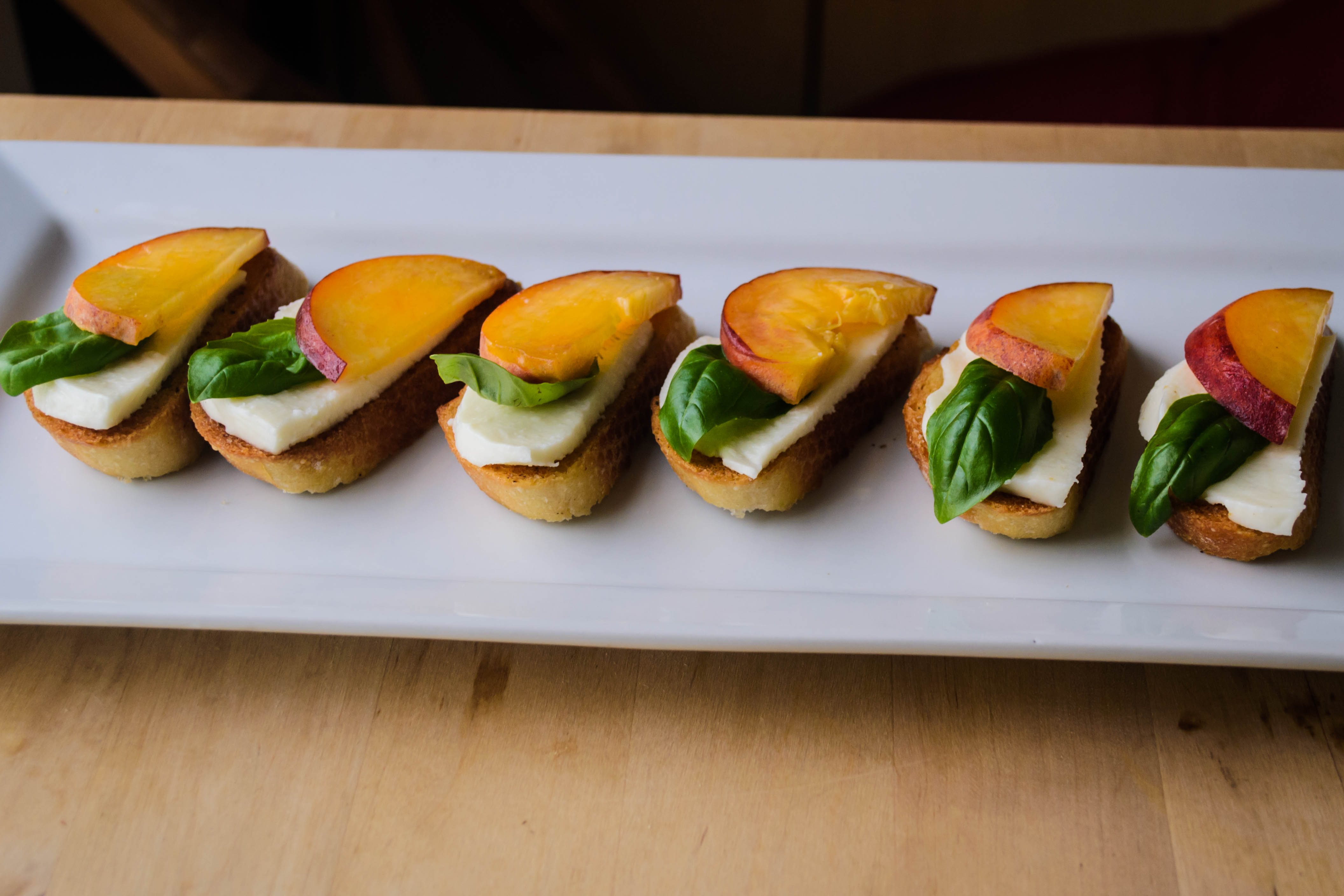
  • To assemble, place a slice of mozzarella cheese on each toast (unless, of course, you already did with the melted option). Top that with a basil leaf, then a peach slice. Place on a platter or serving dish.
  • Use a spoon to drizzle on some of the balsamic syrup – I like a thin striped pattern back and forth across the whole thing.
  • If desired, you can also drizzle the top of the toasts with olive oil, and sprinkle with sea salt for a little extra lushness.
  • Serve immediately as an appetizer, preferably with something sparkling to drink.


Caprese Meatballs

Food blog May 2015-0898You may have noticed there was no recipe post on Monday. I could, were I a bit less honest, have sold you on the idea that this was related to the holiday weekend, or me traveling, or some such minor fabrication. But I don’t have a great poker face, so I’ll admit it was in fact because I’ve been feeling a bit of whatever the cook’s version of writer’s block might be called. I had cloudy ideas of things I could cook, I just didn’t really feel like figuring them out.

Food blog May 2015-0876Then I went to a wedding in Sacramento on Sunday, and saw a friend I realized I’ve known for over a decade, despite last seeing him something like seven or eight years ago. As we caught up, he told me he’d had to stop reading this blog because it always made him hungry, and licking his computer screen seemed like a bad idea. Despite the concerning image this conjured, it tripped something in my brain. Making you hungry is just what I’m after! That means – at least in his case – this blog is doing its job.

Food blog May 2015-0877Thereafter, the block was broken. On the drive back to Los Angeles (only while I was a passenger, of course), I kept having to text myself food ideas. One was these meatballs, which I’m posting off-schedule because I have to get them in while it’s still May! I know you aren’t reading this, J., but I hope you would want to eat them anyway, since it’s your fault thanks to you that they came to be.

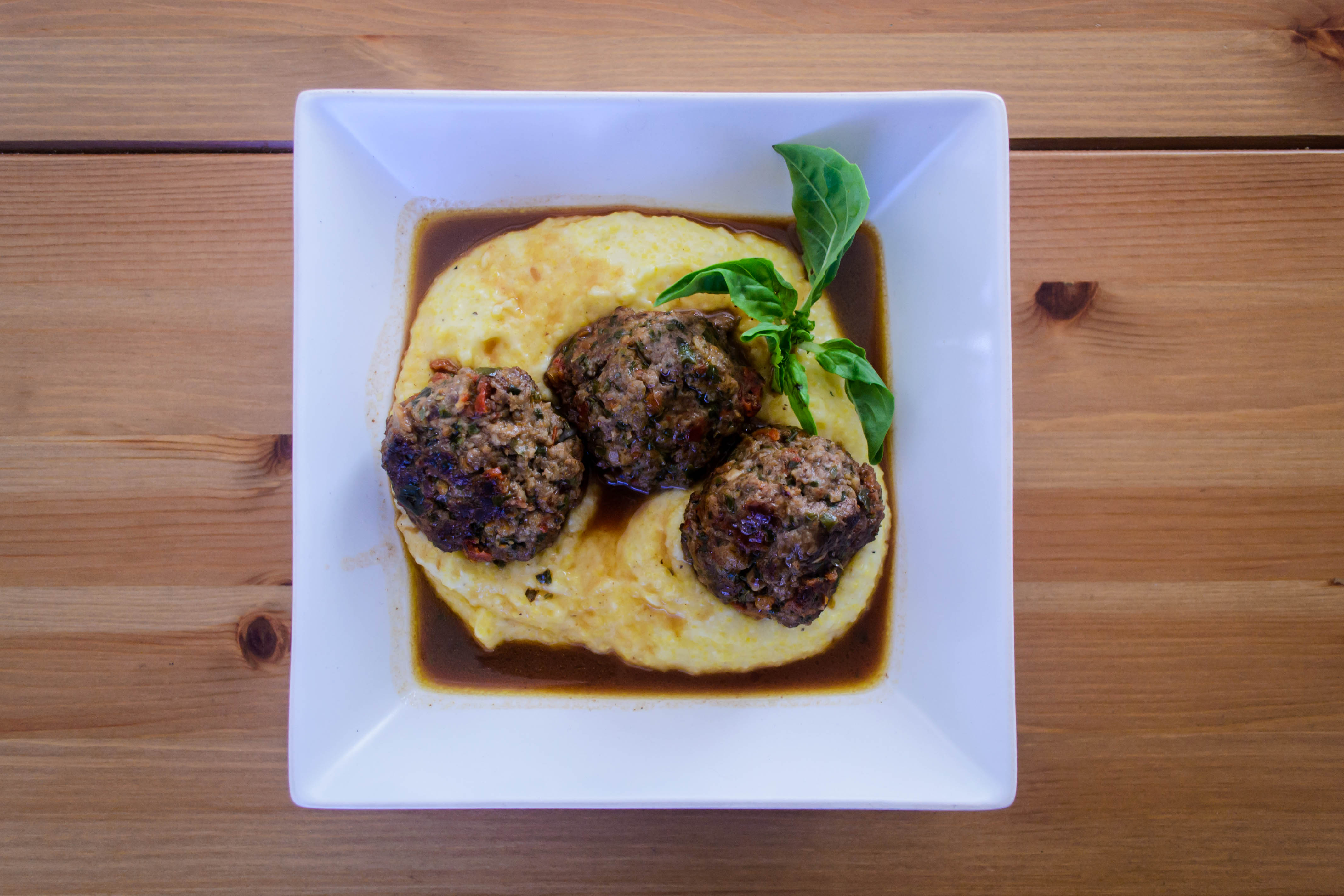
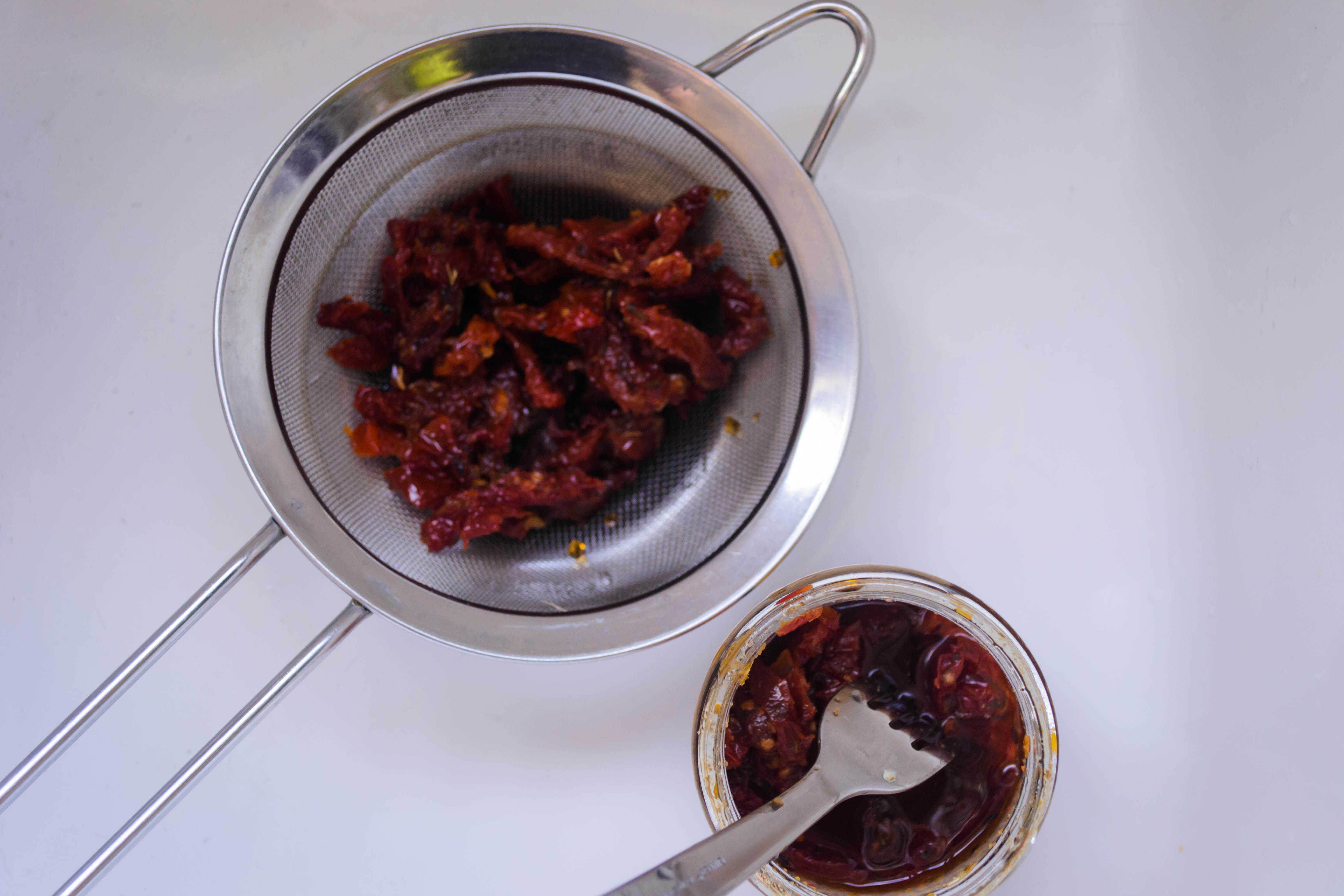
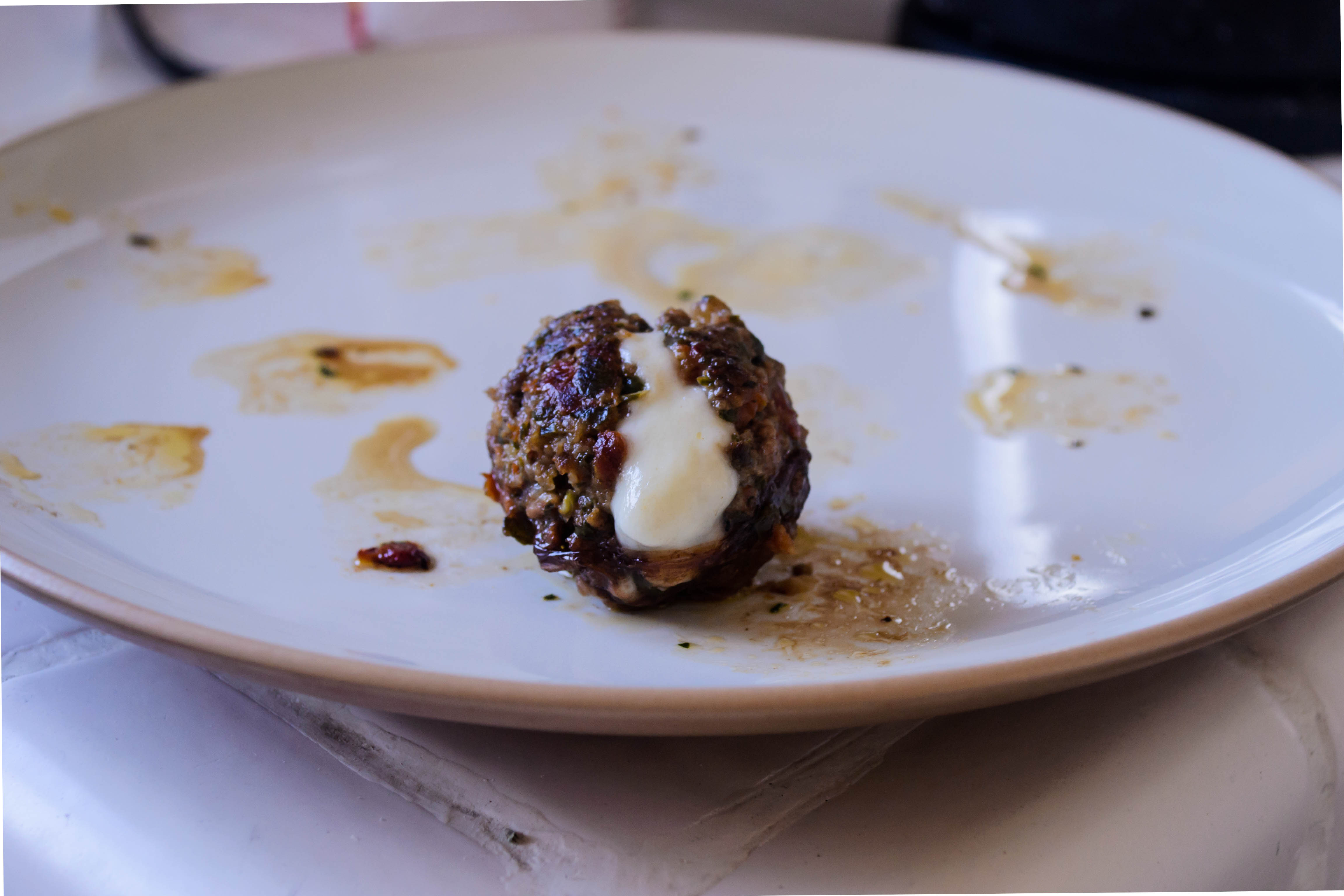
Food blog May 2015-0878Previous to my little block, my sister and I had a rapid-fire email exchange of meatball ideas. One of her suggestions – a bruschetta meatball – eventually morphed into what I came up with here: a nod to a caprese salad in a moment when the juicy, swollen garden-ripe tomatoes of your dreams are far from ready. A beef meatball shot through with sundried tomato chunks, ribbons of basil, and roasted garlic. Seared and then simmered in a balsamic vinegar and red wine sauce. And then, the pay-off: the glorious goo of melted mozzarella cheese oozing out from the inside. We snuggled them down in a pillow of soft polenta and gobbled them up before the cheese inside had time to cool.

Food blog May 2015-0886Food blog May 2015-0885Though I prefer these meatballs piping hot with a molten center of oozing cheese, they are also tasty as part of a sandwich or an antipasti platter. In fact, they basically are the platter – tomato, herbs, cheese, and meat already included. They just need a drizzle of olive oil, maybe a few torn leaves of fresh basil or parsley, and a glass of wine to complete the picture.

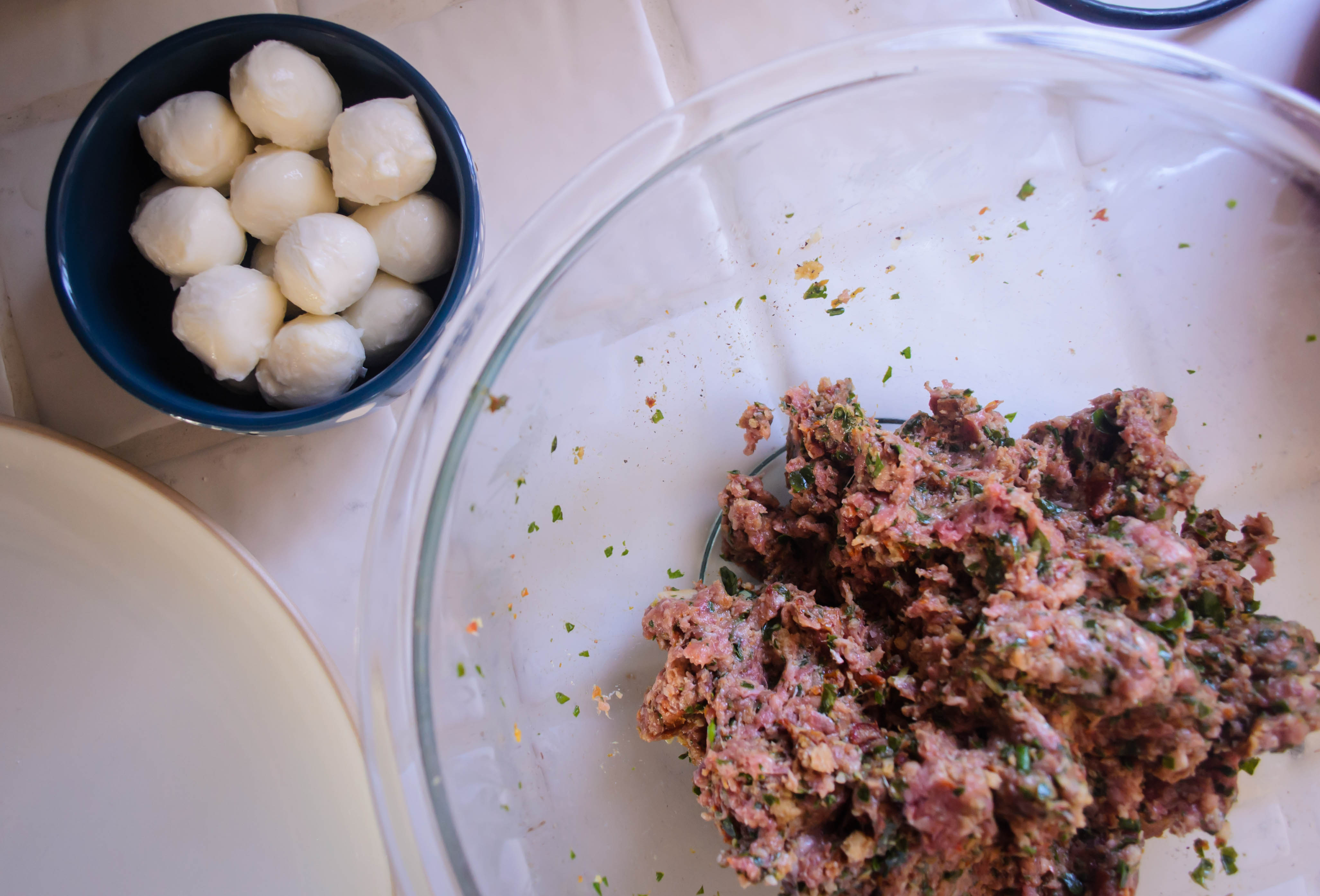
Food blog May 2015-0889A word: as you’ll see from the procedure, these are delicate little beasts. I made mine without the egg I’ve added to the ingredient list here, and half of my meatballs were oozing cheese before they completed their simmer. They were still good, but didn’t have the melty surprise factor I was hoping for. The addition of egg should make the meat and crumbs bind more securely. Still, though, be gentle as you work with these, and be doubly triply sure the cheese is completely enclosed inside the meat mixture before you introduce them to the heat. Food blog May 2015-0901Food blog May 2015-0903

Caprese Meatballs
Makes 10-12 large meatballs
For meatballs:
4 cloves garlic + a splash of olive oil
½ cup fresh bread crumbs
½ cup milk or cream
½ cup oil-packed sundried tomatoes, well drained
1 cup loosely packed basil leaves
1 tablespoon finely chopped chives – I like to use my kitchen scissors
1 teaspoon salt
½ teaspoon pepper
12 ounces (3/4 lb.) ground beef, at least 15% fat
1 egg, beaten
10-12 room temperature miniature mozzarella balls, or 10-12 small cubes of fresh mozzarella cheese
3 tablespoons olive oil
For sauce:
Meatball drippings
1 tablespoon flour
1 ½ cups beef broth or chicken broth
1 cup dry red wine
¼ cup balsamic vinegar
salt and pepper to taste
1-2 teaspoons brown sugar or honey, optional
To serve:
Soft polenta, cooked according to package directions with water, milk, or broth
A few sprigs of basil for presentation, if desired


  • Place garlic and splash of olive oil in a small oven-safe dish. Cover with aluminum foil and roast at 300F for 20-25 minutes, until garlic cloves are soft and fragrant inside their skins. When cool enough to handle, remove and discard the skins.
  • Once you’ve ground your fresh bread crumbs in the food processor, combine them with the milk or cream in a small bowl and let sit for 10 minutes or so to soak.
  • In the belly of the food processor, combine the sundried tomatoes, basil, cooled and peeled garlic cloves, and chives. Pulse at 3 seconds intervals until all ingredients are very finely chopped. They won’t quite form a paste because there’s no liquid in the mix, but they should all be in very small pieces for easy meatball integration.
  • Dump the tomato and herb mixture into a mixing bowl. Drain the bread crumbs by squeezing them out with your hands, then add the crumbs to the tomato and herb mixture. Add the salt, pepper, ground beef, and egg, and use your fingertips to lightly combine into a fairly homogenous mixture.
  • (If you want to check for seasoning at this point, heat a very small puddle of olive oil in a large skillet over medium high heat and drop in a teaspoon or two of the meat mixture. Let it cook, then taste. Adjust salt and pepper as needed.)
  • When you are ready to form the meatballs, flatten about 2 tablespoons of the meat mixture in your hand, then enclose it around one of the room temperature mozzarella balls. It’s important for the cheese to be room temperature because otherwise it might not melt completely inside the meatball during the simmer. Be sure the cheese is completely sealed inside the meat layer; structural integrity is important! Repeat until meat mixture is used up, setting each meatball on a plate once formed.
  • Heat 3 tablespoons of olive oil in a large skillet over medium-high heat until shimmering. Gently add the meatballs in a single layer and allow them to sear undisturbed for about 2 minutes per side. When nicely browned on all (or at least most) sides, remove to a clean plate while you make the sauce.
  • Reduce the heat on the skillet to medium and sprinkle 1 tablespoon of flour over the remaining oil and meatball drippings already in the pan. Whisk the flour into the drippings and let cook for a minute or two into a soft golden smear.
  • Slowly add the broth, whisking continuously to ensure no lumps form, then add the red wine and the balsamic. Cook, whisking occasionally, until the liquid reaches a simmer. Simmer for 5-10 minutes, turning the heat down if needed. The sauce will take on a velvety appearance and thicken slightly. Now give it a taste, and season with salt and pepper as needed. If it is too acidic for you, add 1-2 teaspoons brown sugar or honey, but remember it will be less intense once ladled over meatballs and polenta.
  • When the sauce is velvety and slightly thickened, add the meatballs back in. Be gentle! We don’t want them to crack open.
  • Simmer the meatballs in the sauce, basting often (but not flipping – again, structural integrity!), for 15 minutes. Serve immediately over soft polenta with a spoonful or two of sauce.

Green bean and roasted red potato salad with blue cheese

Food blog May 2015-0733As buried in pages as I am, it’s difficult to believe that I’m only one week away from “summer.” Well, four days of class and about 120 mixed papers and exams. This is difficult to bear – something about this semester has been more burdensome than usual. It’s hard to know how to feel when there is so little time but so much work between me and those glorious two and a half months of no work but also no paycheck.

Food blog May 2015-0705As if matching my own cloudy-with-a-chance-of-vacation feeling, our weather lately has taken turns back and forth between what looks like summer and what, for here, passes as wintry. Typically June mornings in Southern California are overcast such that they even have their own nickname: June gloom. We’ve hit this a trifle early, it would seem, with the last week sporting what my officemate helpfully titled “May gray,” and temperatures barely grazing 70F. This is, it would seem, an uncertain entree to summer.

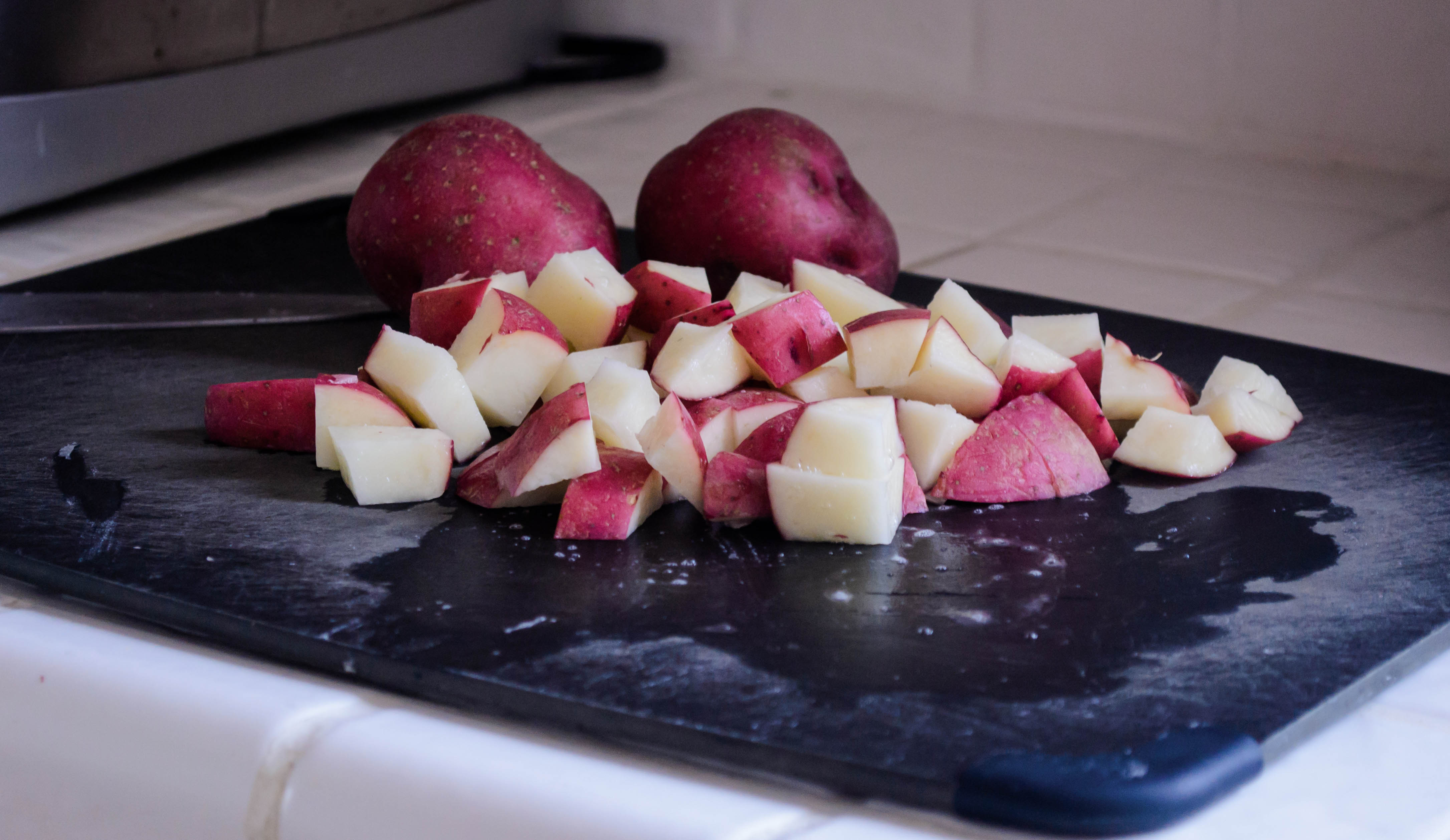
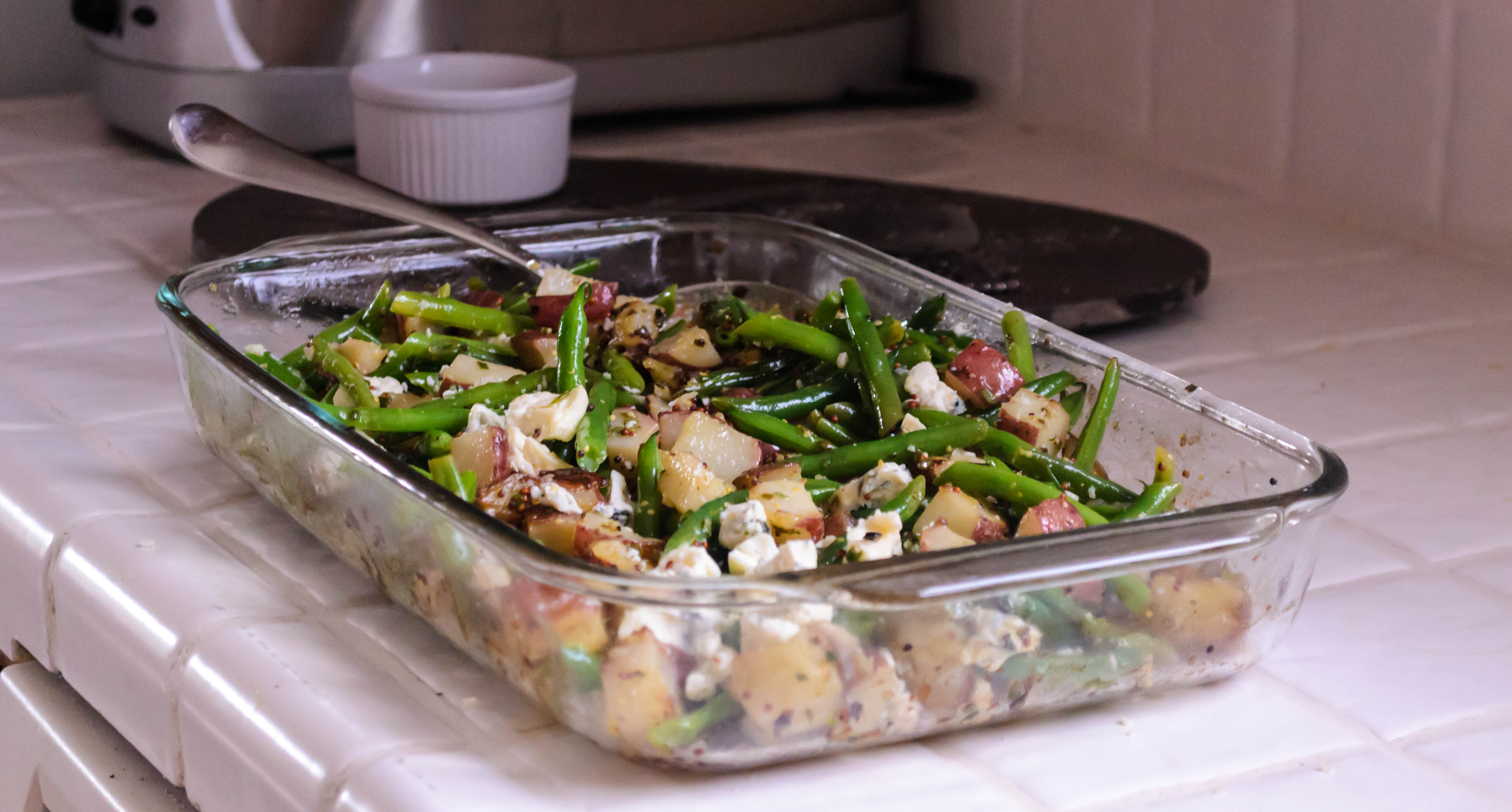
Food blog May 2015-0707Speaking of entrees, let’s talk food. Specifically, let’s talk potato salad. It’s not summer just yet, so it’s a little soon to dive into a platter of mayonnaise-robed spuds shot through with crisp cubes of onion and pickle. But because I surely am not the only one longing for everything a good potato salad represents, this adaptation from The Bon Appétit Cookbook is a perfect compromise. Here, roasted potatoes provide warmth and comfort, all caramelized edges and creamy softness, but a sharp, tangy mustard vinaigrette and crisp-tender green beans push the dish salad-ward.

Food blog May 2015-0711To fill my yen for green vegetables, I’ve doubled the amount of green beans and reduced the quantity of oil from the original. I’ve also eliminated walnuts and changed up the herbs to suit my fancy, and gone with whole grain rather than dijon mustard, because I like the tart pop of the little seeds. This can be eaten at room temperature as well as slightly warm, but because a generous scattering of blue cheese adds a creaminess and funk to the party, you don’t want things too heated, lest melting commence.

Food blog May 2015-0717This is the kind of dish that contents me as an entree. I suspect it would happily welcome a handful of crisp crumbled prosciutto or diced hard salami, if you want a little meaty component. If you’re treating it as a side dish, I highly recommend sausages of any variety to round out the plate, or a nicely roasted or grilled pork tenderloin.

Food blog May 2015-0725As most things are, this was just as good on day two heated up just enough to take the chill off, and topped with a fried egg still runny enough in the yolk to offer a velvet golden cascade that turned the salad into something more like a hash, my own ideal of comfort food. It’s the very thing you need, when you know summer is coming but you can’t quite see the light yet.

Food blog May 2015-0738

Green Bean and Roasted Red Potato Salad with Blue Cheese
Adapted from The Bon Appétit Cookbook
Serves 6 as a side dish
For dressing:
¼ cup whole grain mustard
3 tablespoons white wine vinegar
½ cup olive oil
3 tablespoons finely minced chives
2 teaspoons finely minced sage
For salad:
2 pounds red skinned potatoes, cut into 1-inch chunks
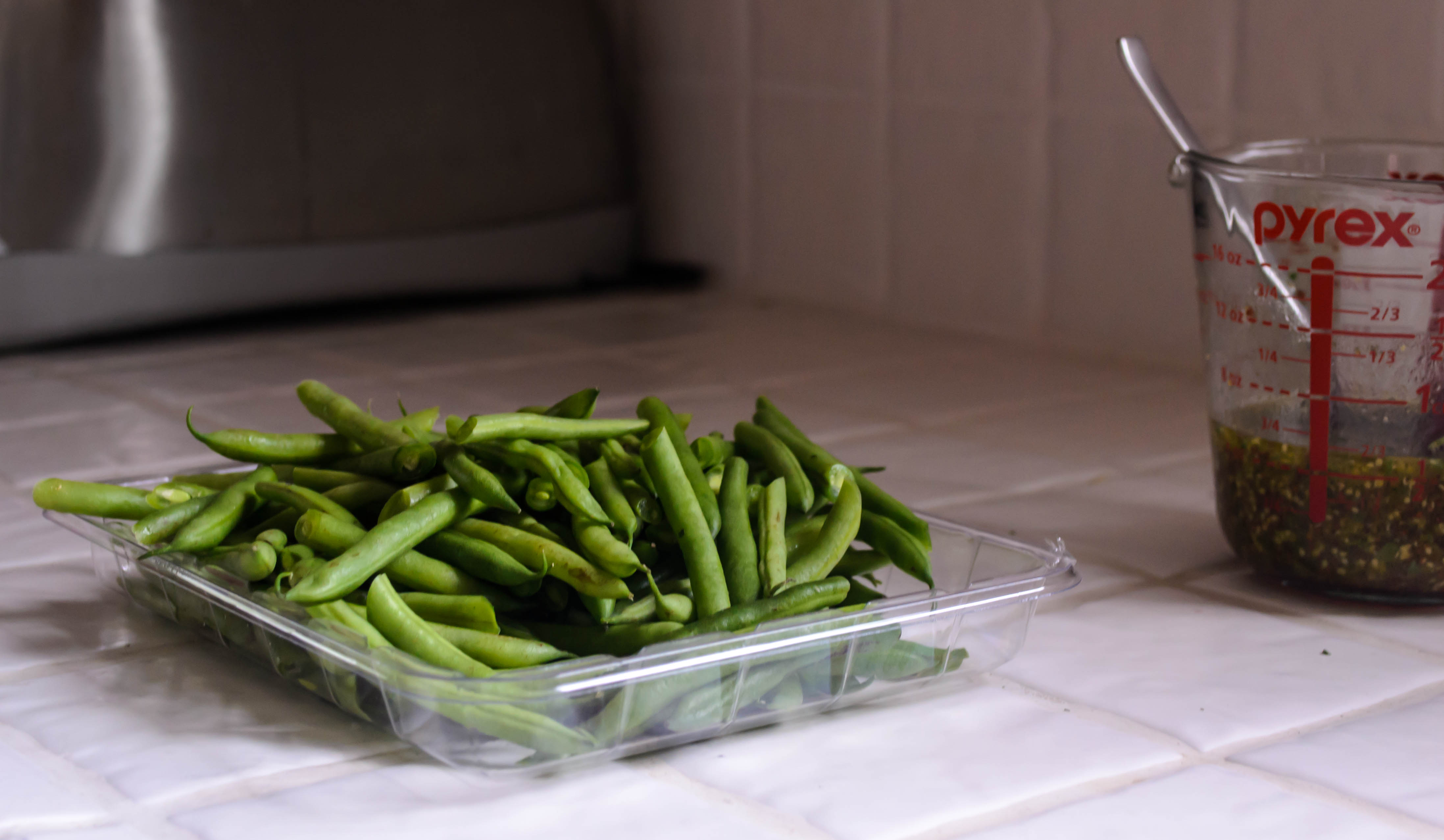
16 ounces green beans, trimmed of stem ends and halved on an angle
⅔ cup crumbled blue cheese


  • For the dressing, combine the mustard and vinegar in a 2-cup measuring cup or a small bowl. Gradually whisk in the oil until well emulsified. Add the herbs and season to taste with salt and pepper, keeping in mind the flavor will be much sharper alone than when it’s coating the salad.
  • Preheat oven to 450F. Toss the potato chunks with ¼ cup of the dressing in a 9×13 inch baking dish. Roast for 20 minutes at 450F.
  • After 20 minutes, reduce the oven temperature to 375F. Shuffle the potatoes around for even browning, then roast 30-45 minutes more, until tender. Stir and shake once or twice during the cooking process to minimize sticking and ensure even cooking. When potatoes are tender, remove from oven and set aside to cool slightly.
  • While potatoes cook, bring a large skillet of salted water to a boil and drop in the green beans. Cook until crisp-tender, 2 to 3 minutes, then drain and cool.
  • When the beans and potatoes are still warm but not piping hot, combine in a large bowl (or just keep them in the original baking dish, as I did), add cheese and ¼ cup of the dressing (you may need to re-whisk the dressing first, as it will separate as it sits), and toss gently. Taste for dressing and seasoning, and adjust to your preferences (I added about 2 tablespoons additional dressing and a bit of black pepper).
  • Serve warm or at room temperature.

Cheddar Dill Twists

Food blog April 2015-0691It seems fitting that I should do my first post along with the Twelve Loaves bakers during a month that celebrates cheese. On any given day, you can find between three and six different kinds of cheese in the tiny drawer in my refrigerator. My last two posts have featured it as a key ingredient, and in both I’ve waxed eloquent about using not just some, but MOAR. I seriously love cheese. It’s the primary reason I could never go completely vegan. I could give up meat with very little trouble (though I would miss bacon, I must admit). I could wave a cheerful goodbye to fish, to beef, to chicken, and stock my cupboards with vegetable broth and my freezer with coconut based ice cream. I already use soy rather than regular milk on my cereal and in my weekend chai. But I would have serious problems bidding farewell to cheese.

Food blog April 2015-0666Food blog April 2015-0670Food blog April 2015-0674Even though I know this isn’t true – they had their ingredient chosen long before I came into the picture – it feels almost like the Twelve Loaves baking group planned this month’s post just for me. Bake with cheese. Yes. I. Will. Cooking with cheese is exciting because the ingredient offers such variety. Do you want something mild, or so sharp it makes your mouth water? Do you want a familiar flavor, or something tart or funky or stinky like last month’s socks? And then there’s texture. Cheese already runs the gamut from so soft it seems already melted to the firmness of parmesan that requires a knife point to dismantle. Add to that the different reactions it has to heat: some cheeses sigh into liquid. Some pull into foot-long strings. Some – and this is one of my favorite results – some flatten and solidify and transform into crunchy little cheese crisps suitable for nothing fancier than jamming into your mouth as quickly as you can.

Food blog April 2015-0677Food blog April 2015-0680With all of these options to work with, I was surprised by how quickly I landed on a choice. I’ve been playing around with a pairing of dill and cheddar, and this seemed like the perfect opportunity to showcase it. Dill goes really well with yogurt, so for a different source of fat and moisture, I decided to use some thick, tangy Greek yogurt instead of butter in my dough. The tartness of the yogurt would be nice with the rich sharpness of the cheddar. And since I like to be fancy, I decided to make little twists, rather than a standard loaf.

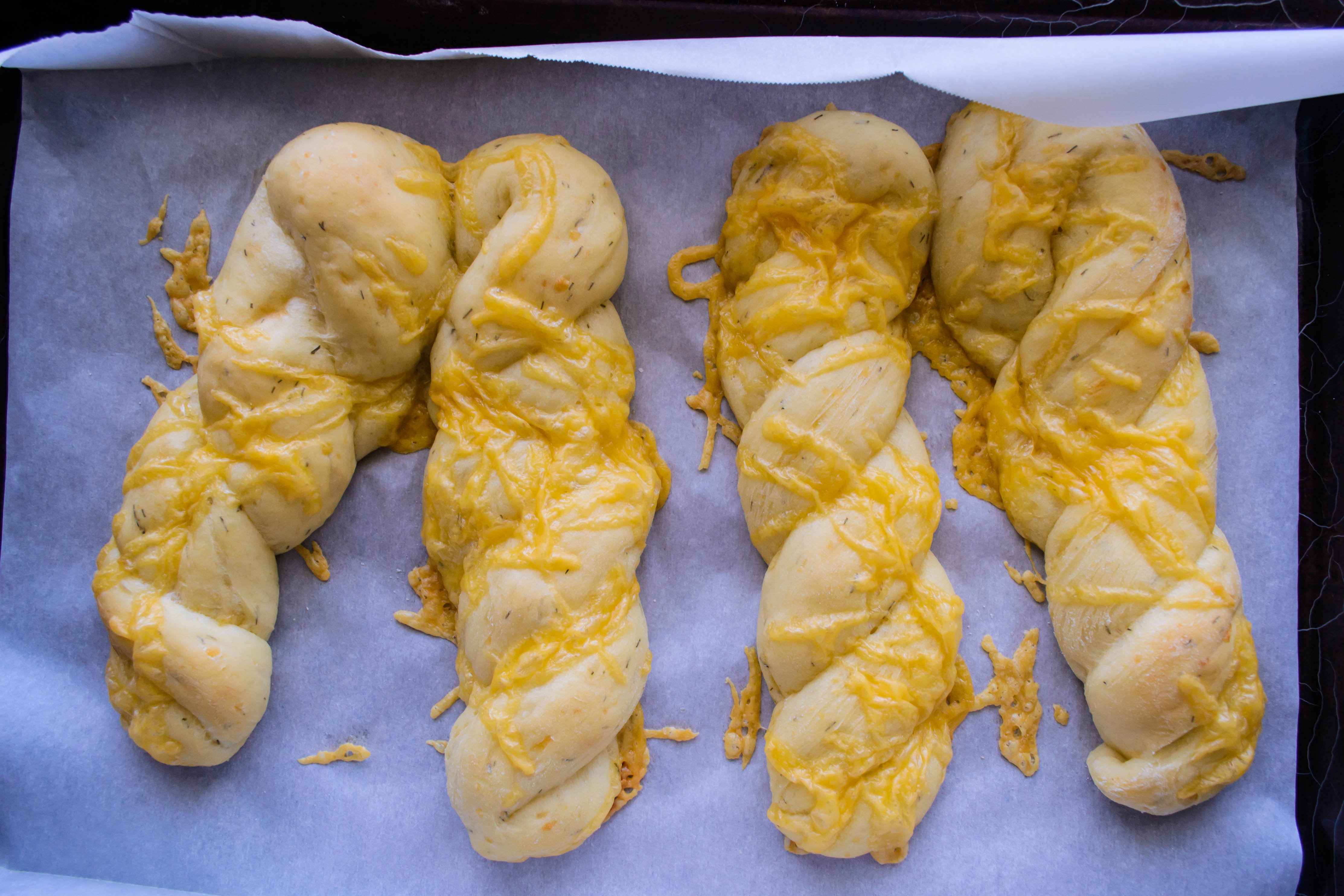
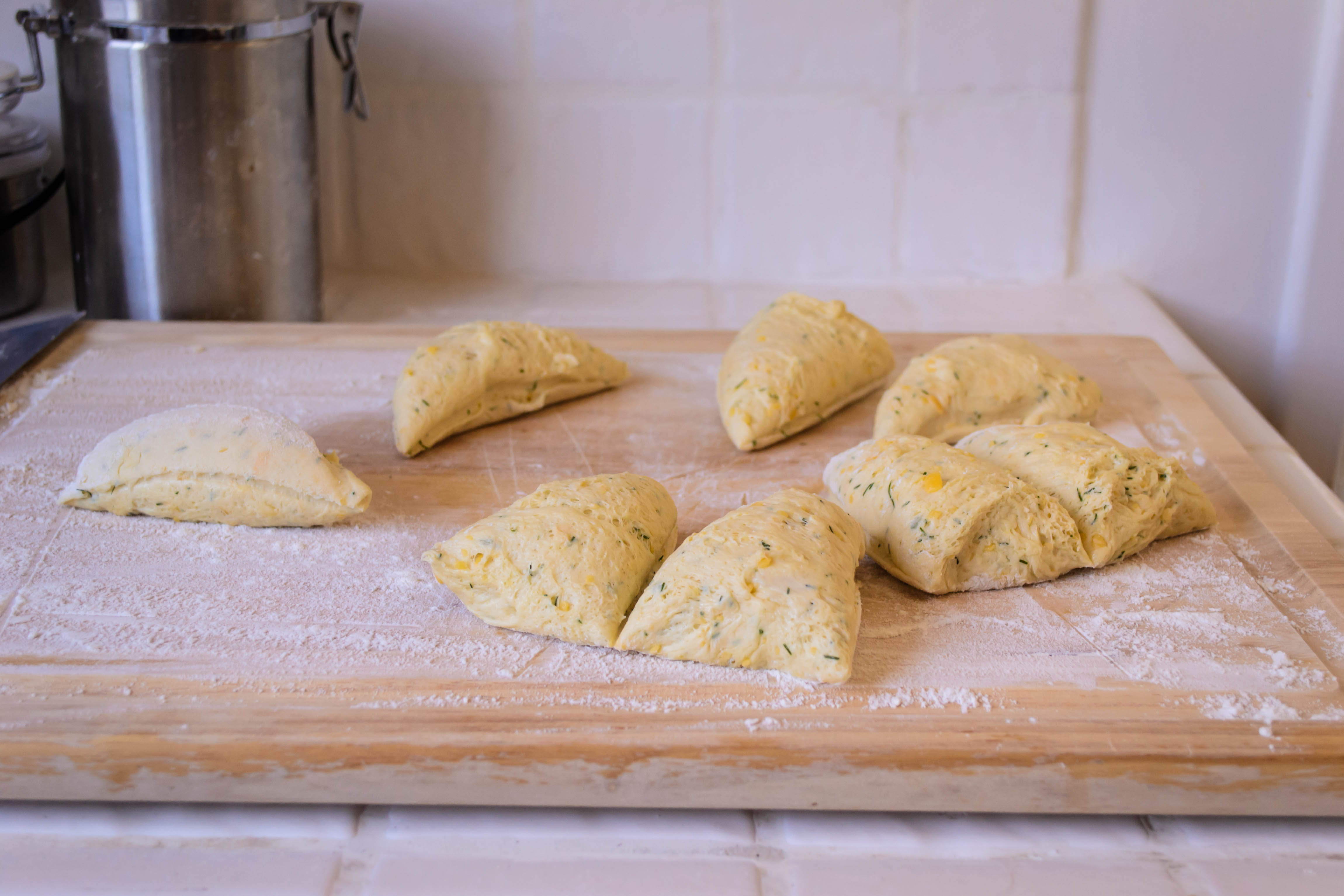
Food blog April 2015-0681 Food blog April 2015-0682 Food blog April 2015-0683 Food blog April 2015-0684 Food blog April 2015-0685Guys, these are definitely the right thing to do. The dill-cheddar-yogurt trio is a chamber group on a good night. They bounce off each other in such a lovely way. But it can’t be denied that the star here is the cheese. It melts into little orange pockets while the dough turns into bread, and the smell of it while cooking makes a better homecoming than much else I can think of. I made one tray of twists with cheese sprinkled on top and one without, just to see which was better. As you might expect, more cheese won the day. It drips over the edges into crisp little crackered pieces you can snap off and crunch through before you dive into the main event.

Food blog April 2015-0687 Food blog April 2015-0689I had the idea that these would make fantastic extra-large tea sandwiches: halve them into long pieces, toast lightly, slather with cream cheese, then layer with long strips of cucumber. Cheese on cheese is rarely a bad thing, and the cucumber would nod to the dill and provide a crisp freshness and a lightness for the perfect spring lunch. Alas, when I reached into the fridge drawer jammed with vegetables, not cheese, my cucumbers were past their prime. So I had to settle for cream cheese alone, with a side of Caesar salad. I can’t say I ended up disappointed.

Food blog April 2015-0699Serving suggestion: these are perfect all on their own straight out of the oven. But they do make a nice, roll-sized vehicle for anything sausage shaped, and I can’t see many people objecting to using this as the base for a good solid cheesesteak sandwich. If you really wanted to get decadent, the twists could be split lengthwise, spread with a garlic butter, and broiled into a dreamy take on garlic bread.

To capitalize on the tea sandwiches idea, you could make them even smaller, dividing into 16 or even 24 pieces, and creating miniature twists to serve as part of an appetizer spread with the requisite cream cheese and cucumber filling. I haven’t tested this smaller size so I can’t be sure how much to reduce the baking time – start with 12 minutes and go from there.
Food blog April 2015-0693

Cheddar Dill Twists
Makes 8 sandwich sized twists
2 teaspoons yeast
1 tablespoon brown sugar
½ cup lukewarm milk
½ cup plain, unsweetened Greek yogurt (you could use regular yogurt too, but you might need additional flour)
1 large egg
2 – 2½ cups bread flour
1 teaspoon salt
2 tablespoons finely minced fresh dill
1 cup grated cheddar cheese, if not topping the twists. 1-½ cups grated cheddar, divided, if topping the twists
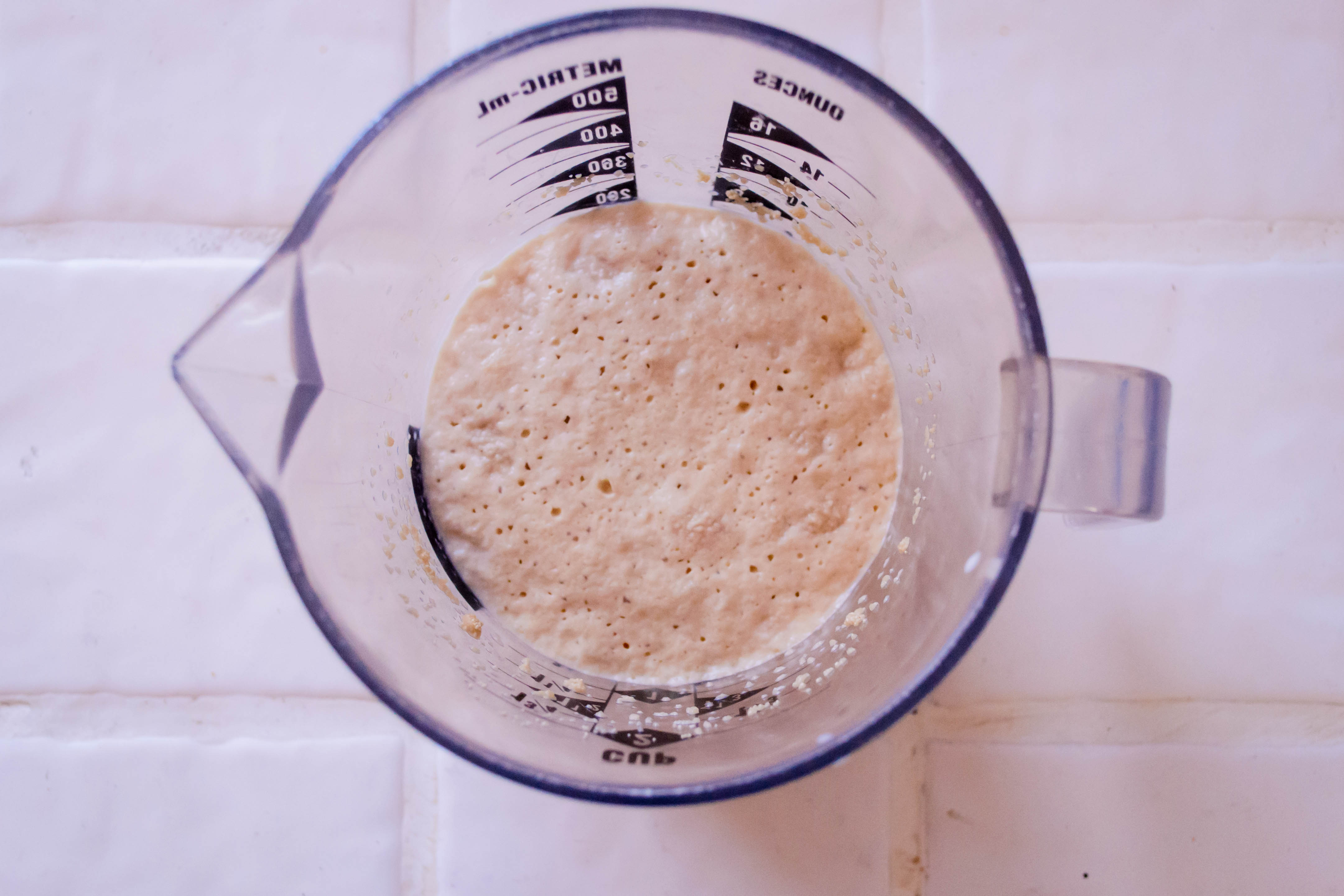
  • In a bowl or a 2-cup glass measuring cup, combine the yeast, brown sugar, and lukewarm milk. Stir, then set aside for 5-10 minutes until bubbly and smelling of bread.
  • In the bowl of your stand mixer, or another large bowl, stir together the egg and the yogurt (use the paddle attachment, if you are working with a stand mixer). Add in the milk and yeast mixture, stirring well, then add 2 cups of the flour, the salt, the dill, and 1 cup of the cheddar cheese. Mix until the dough comes together into a rough ball.
  • Switch from the paddle attachment to the dough hook and set to medium, if you are using a stand mixer. If you are mixing by hand or with a wooden spoon, turn the dough out onto a floured board. In either case, knead into a smooth, slightly sticky ball with some elasticity. If it seems too sticky to work with, add more flour 2 tablespoons at a time. This unfortunate stickiness may increase as the cheese softens; don’t despair.
  • Plop the kneaded dough in an oiled bowl (I just spray down the sides of my stand mixer bowl and flip the dough ball over a few times), cover tightly with plastic wrap, and leave it to rise for 60-90 minutes, until doubled. Punch it down by gently pressing your knuckles into the center, then let it rest for 5 minutes.
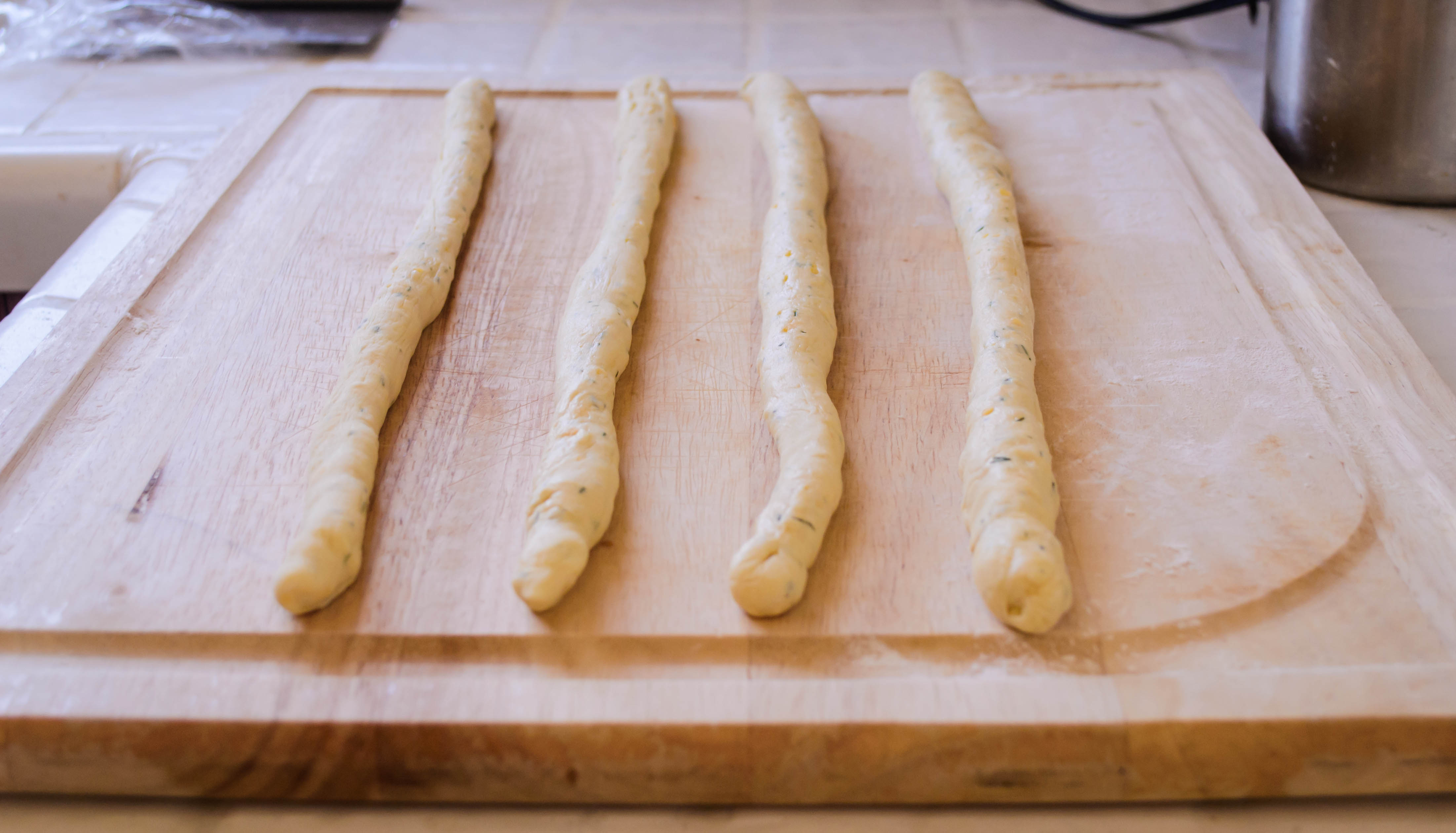
  • Turn the dough out onto a lightly floured board and divide into 8 equal pieces. Using the palms of your hands, roll into 18-inch long ropes. As you roll, the middle will get thin and the ends will plump up. Prevent this by pushing outwards toward the ends of the rope (so your hands are moving slightly away from each other) as you roll.
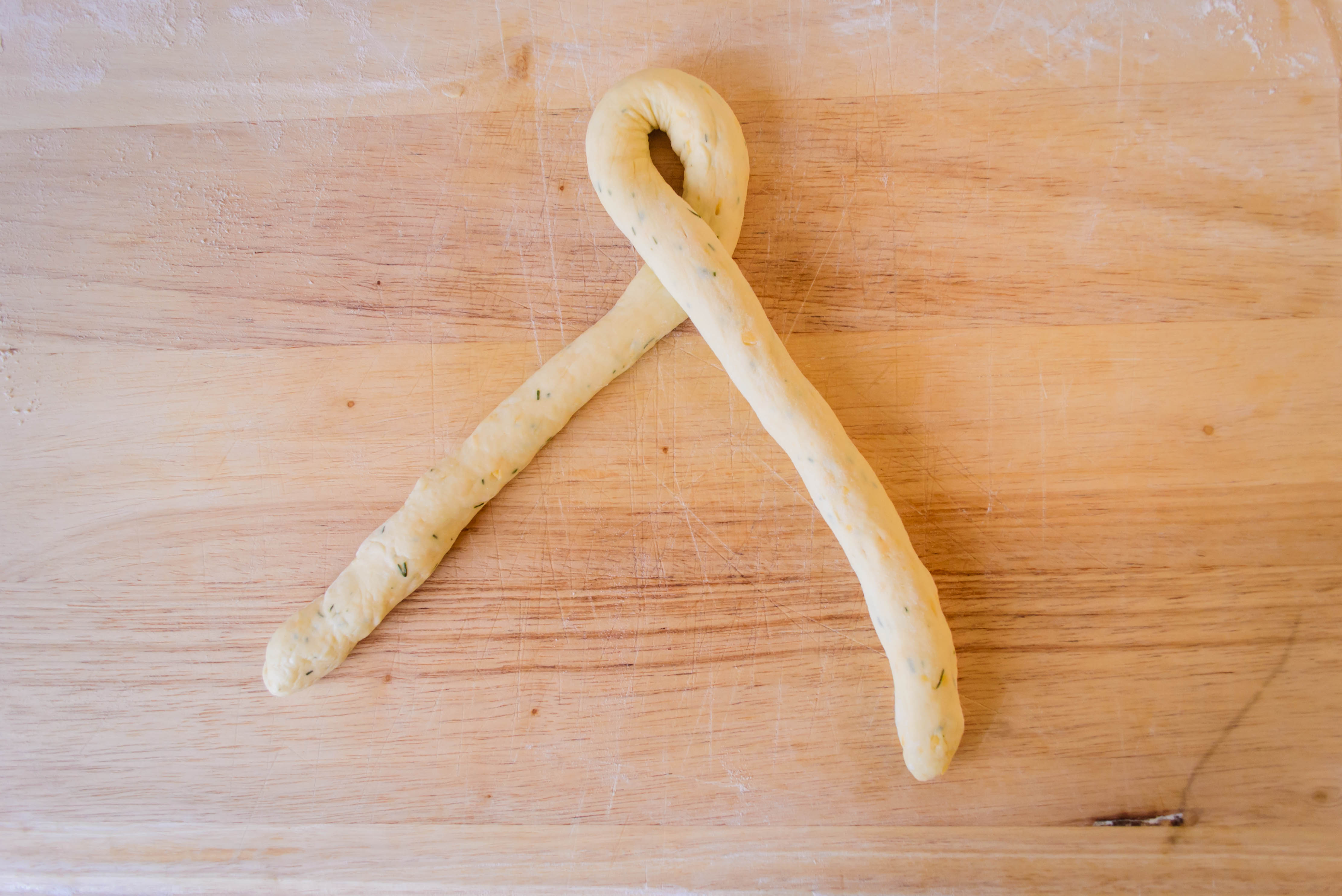
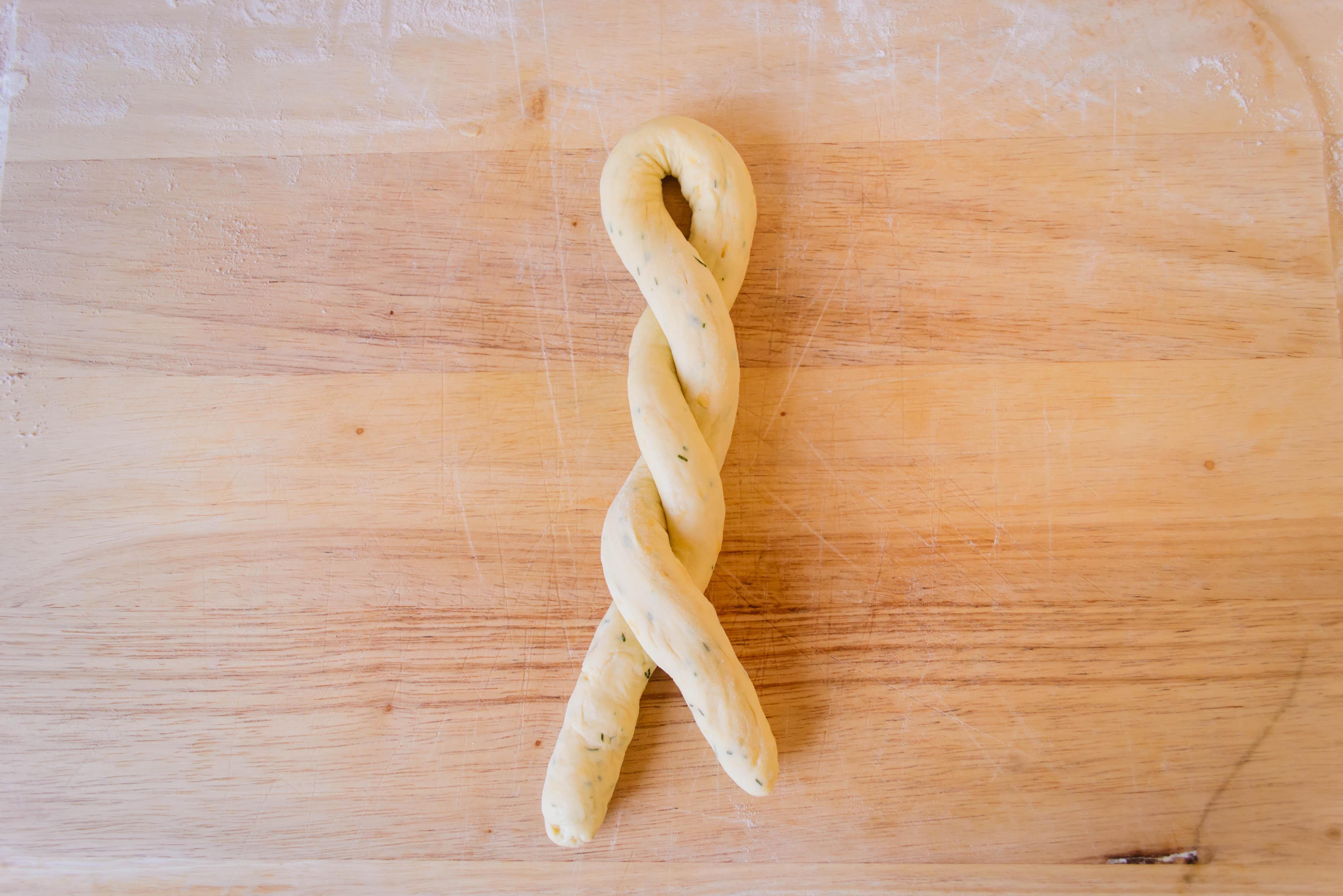
  • Fold the rope over into a long horseshoe shape, then twist or “braid” it by lifting one side over the other in 3 or 4 tight twists, as in the photos above. When you reach the ends, crimp them together and tuck them under for neatness.
  • Transfer each twist to a baking sheet lined with parchment paper, settling them at least 2 inches apart, and let rise again for 45-60 minutes, until noticeably plumped but not quite doubled.
  • At least 30 minutes before cooking, preheat the oven to 350F.
  • When you are ready to bake, if you want to top the twists with cheese, sprinkle the remaining ½ cup of cheddar in equal amounts over each – this will be about a tablespoon per twist.
  • Bake at 350F for 18 minutes, until the twists are golden and the top layer of cheese is melted and slightly crisp.
  • Cool for 5-10 minutes, if you can, before removing to a rack or directly to your mouth.


#TwelveLoaves is a monthly bread baking party created by Lora from Cake Duchess and runs smoothly with the help of Heather of girlichef, and the rest of our fabulous bakers.

Our host this month is Robin from A Shaggy Dough Story, and our theme is CHEESE. For more bread recipes, visit the #TwelveLoaves Pinterest board, or check out last month’s mouthwatering selection of #TwelveLoaves enter last month’s Italian Breads!

If you’d like to bake along with us this month, share your CHEESE bread using hashtag #TwelveLoaves!