Breaking Bread

Last week I tallied up what remained on my Bittman Sides project and discovered, through careful calculations that included pointing to my calendar and counting on my fingers, that if I make two selections from the list every week, I will be finished with the whole thing at the end of the year.  And I mean the end.  The very last week.  Ambitious, yes?  I decided I could do it.

Guess how many I made this week?

Yeah.

One.

So I’m not starting out well with this, but I’m going to try anyway.  I’m years overdue from my original goal anyway.  And in my own kind of backwards reverse engineering, I try to make up for this how?  By posting twice in one week.  So it goes, I suppose…

87. Combine 2 cups whole wheat flour with 2 cups white flour and 1 teaspoon each baking powder, baking soda and salt in a food processor. Pour in 1½ cups buttermilk or thin yogurt, and pulse until a ball is formed. Knead for a minute (fold in ½ cup raisins or currants if you like), shape into a round loaf, slash the top in a few places and bake on a greased sheet for about 45 minutes, or until the bottom sounds hollow when you thump it.

I’ve tried bread in the food processor before and it didn’t go very well (what does “when the dough is shaggy” mean anyway?), but I was willing to give this a shot.  It looked like a basic Irish soda bread recipe, and though I’ve never put that in the food processor, I have made it with success on multiple occasions.  So, I pulled down my food processor, opened my pantry, and collected

2 cups wheat flour

2 cups white flour

1 teaspoon baking powder

1 teaspoon baking soda

½ cup Greek yogurt whisked with 1 cup whole milk (I had neither buttermilk nor thin yogurt – this seemed like a happy medium)

½ cup craisins

I followed Bittman’s directions to near disaster.  Either my food processor is too small, or this method isn’t all that reliable, because the dough never formed a ball.  Half of it just clumped into a solid mass in one side of the processor bowl and refused to budge.  I said some words in the quiet of my own brain and then held my breath while I tumbled the half-mixed contents out onto a floured board.

This is certainly not a ball.  But I sprinkled on half a cup of craisins and started kneading anyway, trying to ignore the hateful feel of dry dough on my hands.  After a minute or two I determined that things were just not coming together.
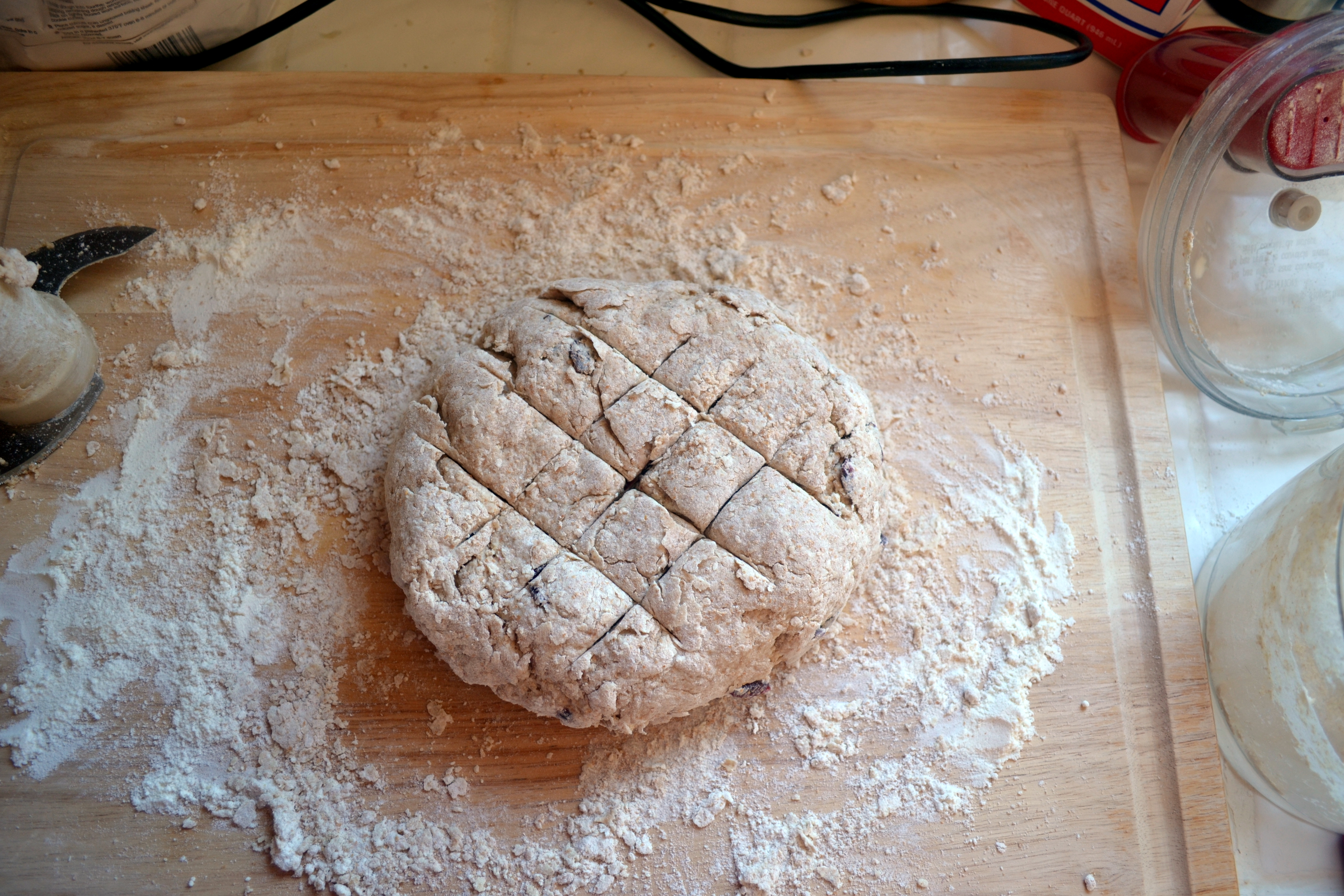
Flour-streaked hands reached into the refrigerator and pulled out the milk, dribbled a few tablespoons into a hollow in the dough, and tried again.  This time, things started to stick, to smooth, to pull into a ball.  I patched, I patted, I pushed and knuckled, and finally plopped one of the homeliest loaves ever made onto a greased baking sheet.  Slashed, scored, and enclosed in a warm oven, and I’d done all I could.

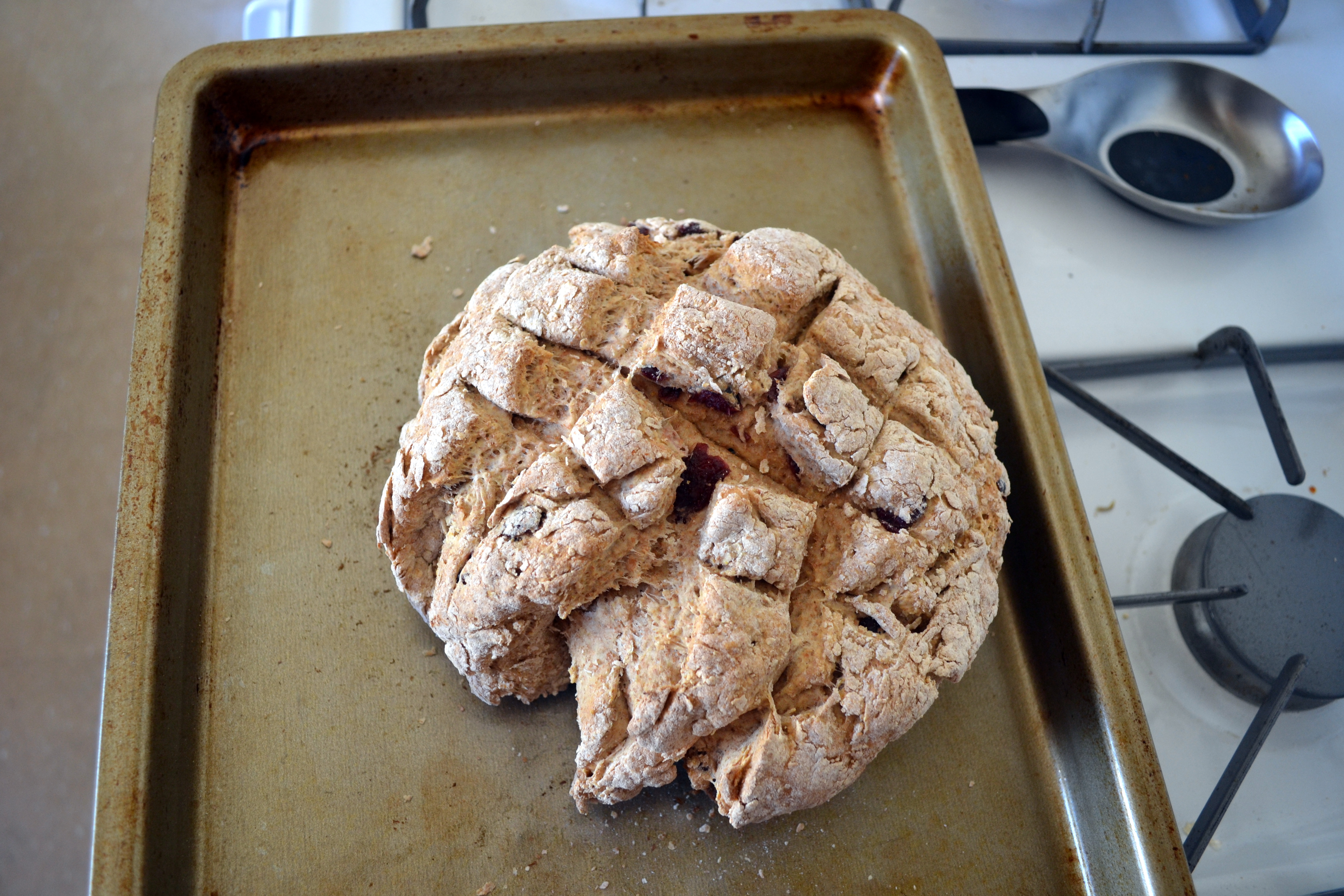
Bittman didn’t specify a temperature, but I estimated 375F and returned to grading papers for the better part of an hour.  The timer’s buzz 45 minutes later called me back to a crusty, mottled, flour-speckled loaf that sounded empty when I thumped the bottom, and smelled like humble sour sweetness.
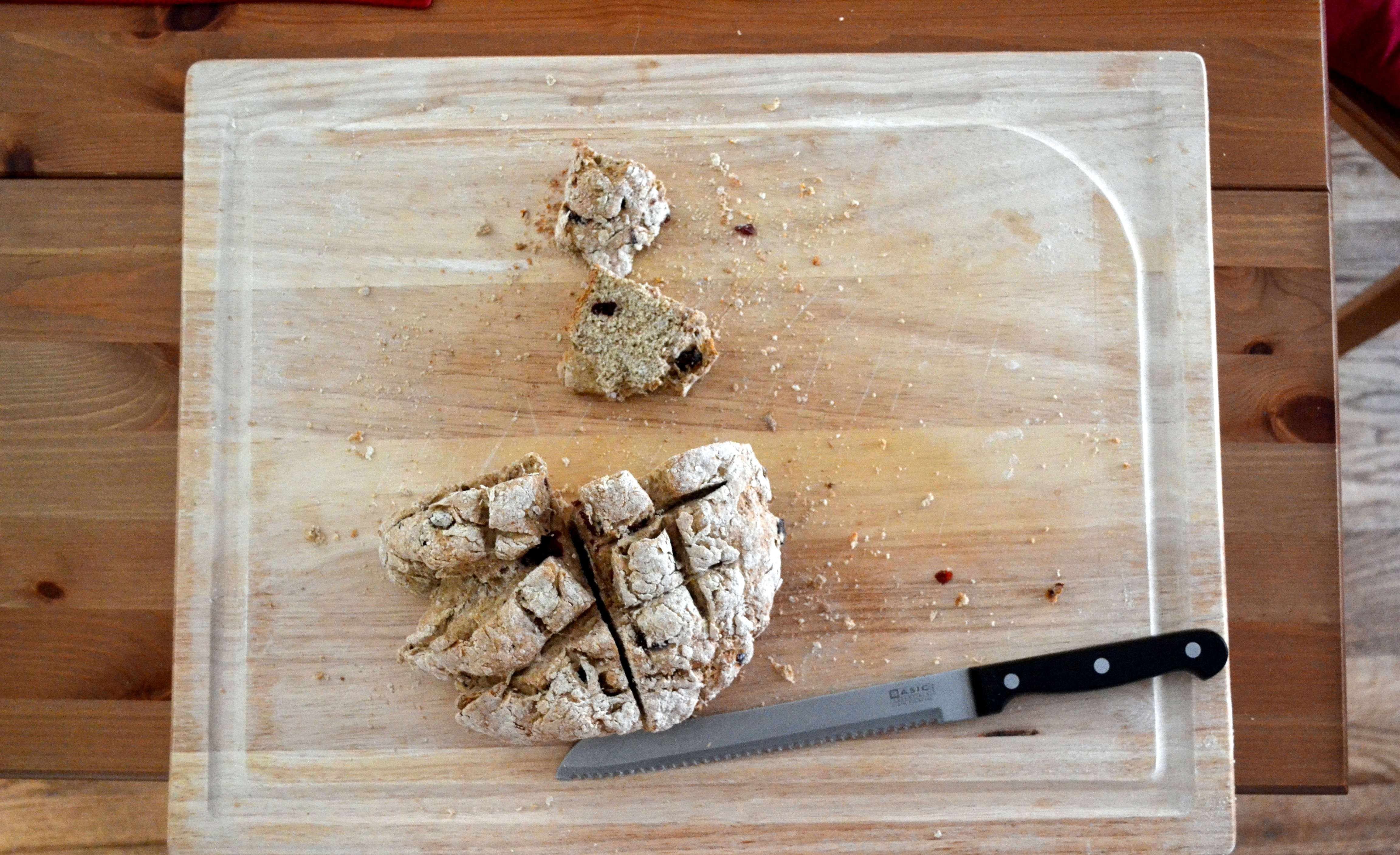
I waited a few hours to try some.  When I cut into it, my knife scraping through the crust and scattering crumbly bits across the board, the interior was dense and moist and still just warm.

It tasted good.  A bit heavy, from the whole wheat flour, and not suitable for eating in large chunks like the one I’d carved off for myself.  But the craisins added a welcome punch, and I think if I’d used all buttermilk instead of my odd mixture of milk and yogurt, the tang would have come through and broken some of the one-note density of the texture.  This would be good, I suspect, toasted and buttered, or maybe – if you’re the daring type – transformed into French toast.  It might also be good made with 3 cups of white and 1 cup of wheat flour, rather than equal parts.
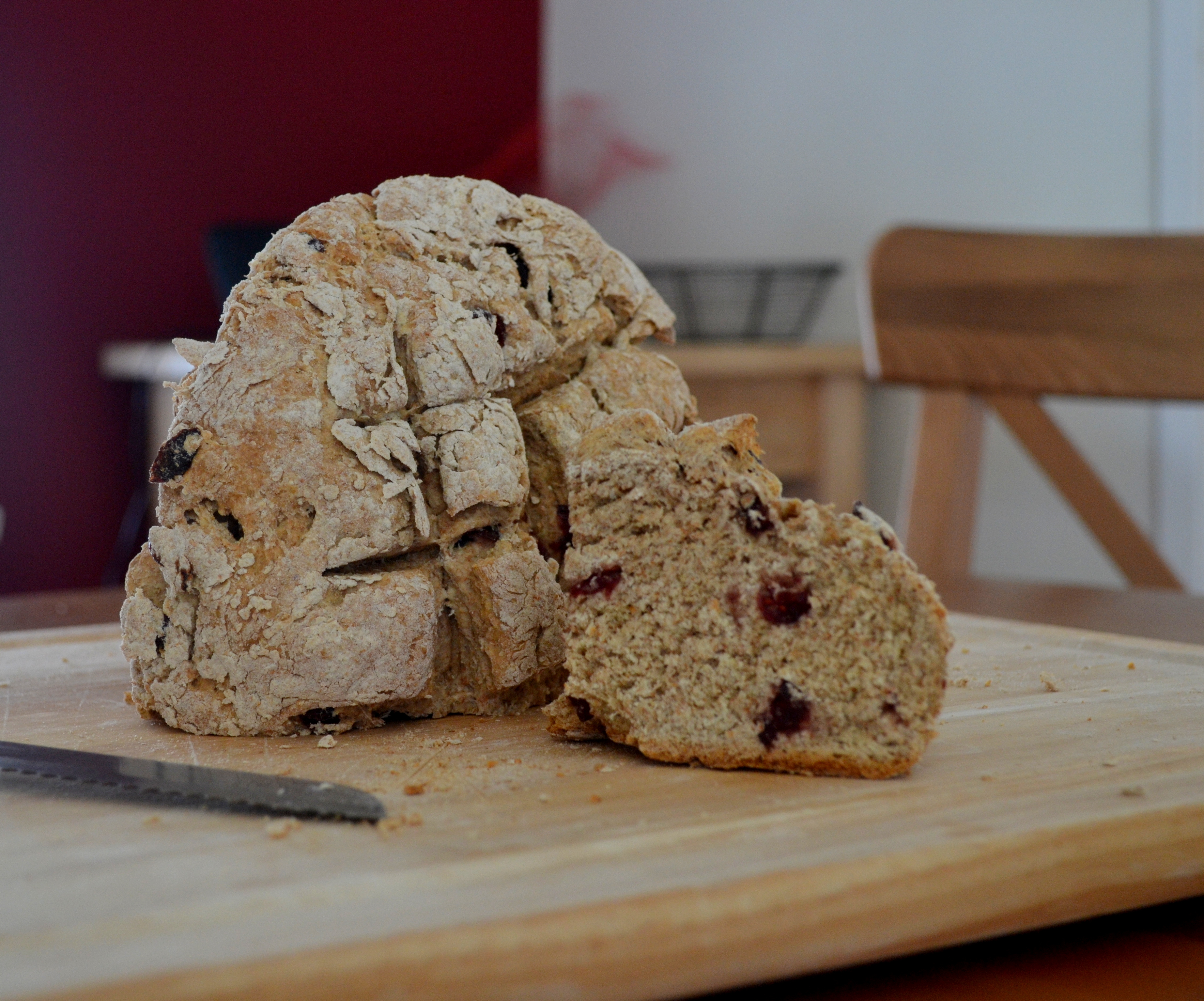
Both N. and I have some Irish blood, and although it doesn’t show too often (unless you count his beard and my very occasional temper), by strange coincidence we ended up eating this bread as part of an accidentally, avant-garde-ly “Irish” dinner: pan fried gnocchi and sauteed cabbage.  Potatoes, cabbage, and Irish soda bread.  If only we’d had corned beef, I told N., and a horseradish sauce to moisten it.

But here’s the good news: smeared with cream cheese, the bread was tasty and chewy and wholesome, with bright pops of cranberry sweetness here and there.  Shallow fried in a mixture of butter and olive oil, the gnocchi were amazing.  Tongue searingly hot, their exteriors crisped and browned like the perfect roasted potato.  Their interiors remained soft and creamy and rich, but the contrast of crusty brown outside to creamy chewy perfection inside was unbelievable.  I could eat these every day.  I could eat them for every meal.  Fried and rolled, still blisteringly hot, in cinnamon sugar, I would scarf these for breakfast alongside a glass of milk like tiny churros.  Tossed with pesto or roasted red pepper sauce, I would gulp them for lunch.  Folded into a mornay sauce with too much extra cheese, I would sub these for pasta in a beautiful perversion of oven-baked macaroni and cheese.  And well salted and perhaps tossed in garlic powder or red pepper flakes, I would happily substitute these for popcorn during a movie.  I might be obsessed.

So with one Bittman down for the week and an intense regimen in store for the rest of the year, it turns out I’m more interested in fried potatoes.  And I’m tempted to ask: who wouldn’t be?  But then I wonder… is that just the Irish in me talking?

Just peeking in…

Hello friends.  Is the world still the same place?  I’ve been offline for a full week now, as part of my move from Oregon to California.  I’m now settled somewhere in Los Angeles, my eyes startled by constant sun, my ears tender against the sounds of traffic, my taste buds clamoring to explore.  I am working on a post – I’m tremendously behind, I know – and  I have things to share with you like cobb salad with glazed bacon, and homemade crackers, and a recipe for rosemary and orange zested white bean dip I can’t stop thinking about.  Oh, and the little wedding cake thing I made a few weekends ago…

But all that takes time.  And there are still boxes everywhere I look.  So just as a taster, to keep your appetites primed, here’s a glimpse or two of how my big project turned out:


Back with more soon…

Emptying the Fridge

Big news, oh friends: come July, N. and I are moving.  We’re leaving Eugene, OR and heading south for Los Angeles, where N. landed a great job.

I’m sad about this, of course.  I love Eugene.  I love its beauty, and I’ve made some of the best friends and eaten some of the best food of my life here.  I don’t love the way the weather lately has been playing winter/spring/winter/spring/summer/winter on us, and I’m terrified it will pour on graduation day in a week or so.  But mostly I love it.

Yet this move presents the potential for plenty of new delights.  LA is a foodie paradise.  A quick search on Yelp for our new area revealed restaurants serving every kind of food I could possibly crave, and some I’ve never tried before.  Ethiopian will be new to me, as will Caribbean (outside of the ubiquitous and usually inauthentic jerk [insert your protein of choice here]).  The idea of being back in a place with excellent Chinese and Mexican food is overwhelming.  But it’s not just restaurant food that I’m looking forward to.  The Willamette Valley in Oregon boasts great growing conditions for lots of foods, including berries of all kinds, hazelnuts, and plenty of local produce.  But Southern California has so much, given its balmy temperatures year round, that buying and eating local food will suddenly become much easier – not even from farmers’ markets and farm stands, but even from the grocery store.  Avocados, citrus, grapes, all no longer destroy the locavore dream.  Even the backyard of the house we will be moving into has a lemon tree.  A lemon tree!  This excites me almost more than anything else about the whole situation!

Our upcoming relocation also presents a challenge.  N. and I have lived in our current home for four years.  We have lived in Eugene for six.  Over that much time, things accumulate.  Not just house things, like forgotten books and extra sweaters and skillets I shoved in the back of that cabinet N. hates when I replaced them with Circulon non-stick wonders.  Food things.  We have so many half-empty jars of condiments.  So many bags of frozen vegetables bought on a buy-one-get-one sale.  Blackberries from last summer and cranberries from Thanksgiving, carefully preserved on the shelves of my freezer.  Canisters of rice, and brown rice, and millet, and dried beans, and barley, and noodles in the pantry.  It’s a lot of stuff.

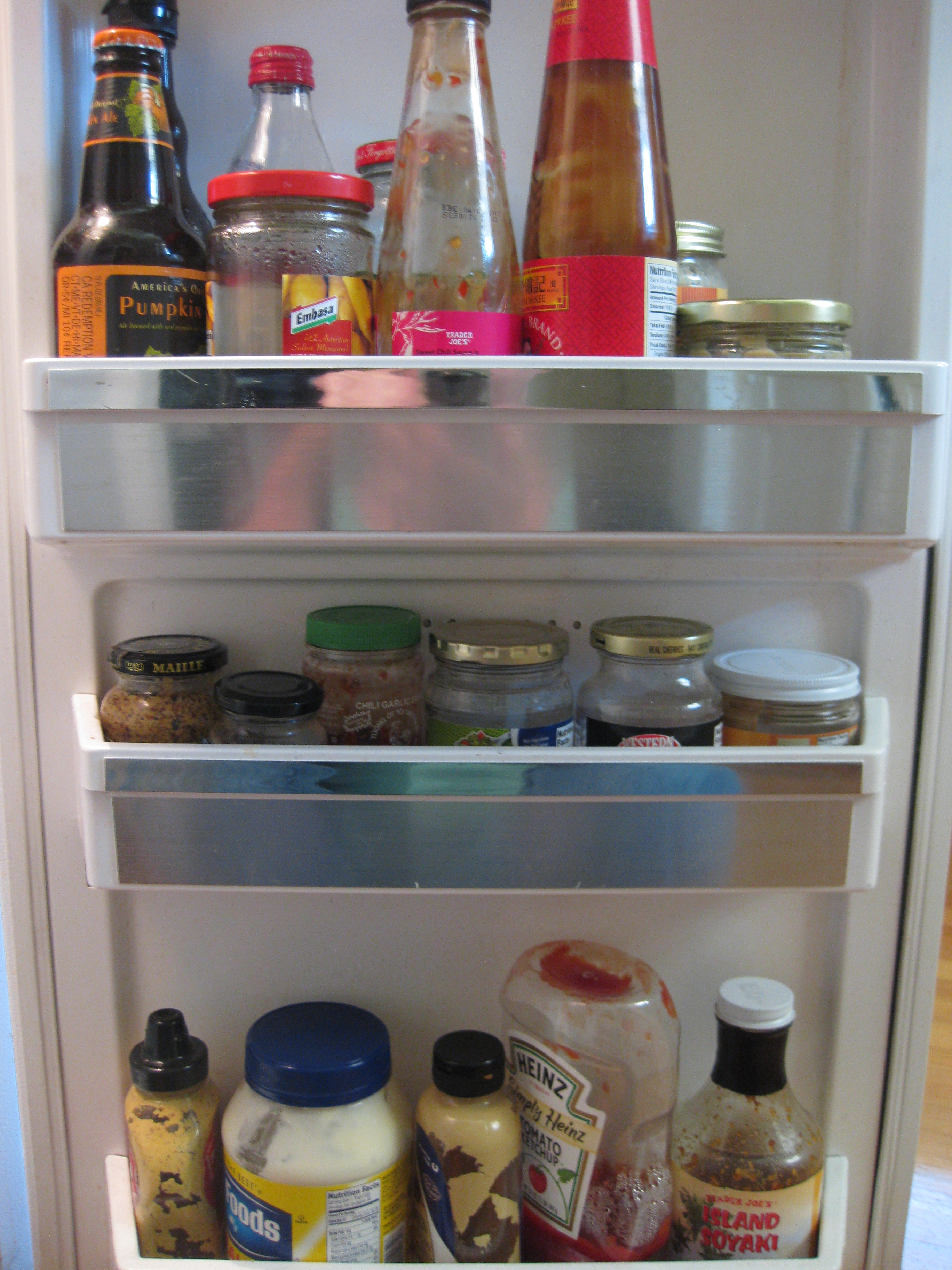
So here comes the challenge: interspersed with regular food posts and wedding cupcake practice and the occasional, still-kicking-because-I-can’t-bear-to-abandon-it Bittman dish, I will be instituting a new project.  I’m calling it “Emptying the Fridge.”  Each week when I make our menu plan, I’m going to try to incorporate at least one dish that requires the remnants – or a good quantity – of at least one refrigerator, freezer, or pantry item.  I’m not talking about things we use all the time, like yogurt or bread or eggs.  I’m talking about the minimal use items, like anchovy paste, or capers, or champagne honey mustard, or chili garlic paste.

This week, I have plans for several items, and though I may not eliminate them, I will at least make a dent in several jars.  After a barbeque a few weeks ago featuring a peanut noodle side dish, I decided I want to make Ina Garten’s Szechuan Noodles.  This requires a whole cadre of ingredients including peanut butter, soy sauce, rice vinegar, and various vegetables.  It also, of importance to this project, requires hot chili sauce and tahini.  Both of these items currently languish on my refrigerator door, awaiting stir-fries and hummus.  But this week, they will shine and diminish simultaneously. 

Other plans include a white bean puree I will invent (and post the recipe for, if it turns out well) to work on using up the four cans (four?  How can I possibly have four?) of white beans in my pantry, and peanut butter energy bars, which will help eliminate the giant canister of oats I’ve gotten too stubborn to turn into oatmeal.  At a certain point, you have to eat like it’s summer, even if the sky says it isn’t, don’t you?  But snack bars are a worthy and not-un-spring-like application.

This project is, I think, a combination of homestyle Iron Chef and Chopped.  Not only are there feature or star ingredients, but after a while the pairings of available options will become unusual and require a certain amount of ingenuity to use up.  I like this, because it prepares me for the Food Network show I will never have, which I would call “Empty Fridge.” EF would consist of me trying to use limited pantry and refrigerator items to create something delicious without having to make an extra trip to the store, so in essence it’s Chopped-at-Home.  The difference with my current project, though, is that I am not prohibited from shopping, and am in fact planning ahead based on the contents of my condiment collection to determine our dinners.

Come August, you can expect an abundance (after a short hiatus, most likely – moving and blogging don’t necessarily mesh well) of drooling and groveling over our new location and its diverse and numerous highlights.  But until then, you can look forward to quarter jars of mustard, forgotten marinated artichoke hearts, and hidden canned peaches in various applications.  Hopefully, in this case, not in the same meal…

Quick, quick!

So I’m behind again.  I have been cooking, I just haven’t been posting.  It’s funny, the cooking part feels necessary and timely because hey, it’s dinner!  But the posting part – if I’m typing something these days, it had better be either my dissertation or a PowerPoint slideshow for the class I’m teaching.  If it’s something else, Puritan guilt sets in.

But I have so much to share that I had to start working through the backlog.

“32. Cook couscous in stock or water. With a fork, stir in cinnamon, chopped mint, lightly sauteed pine nuts and melted butter.  Bake in an oiled dish or use as stuffing.”

The players:

1 box plain couscous

2 cups water

pinch salt

¼ cup pine nuts

¼ cup butter

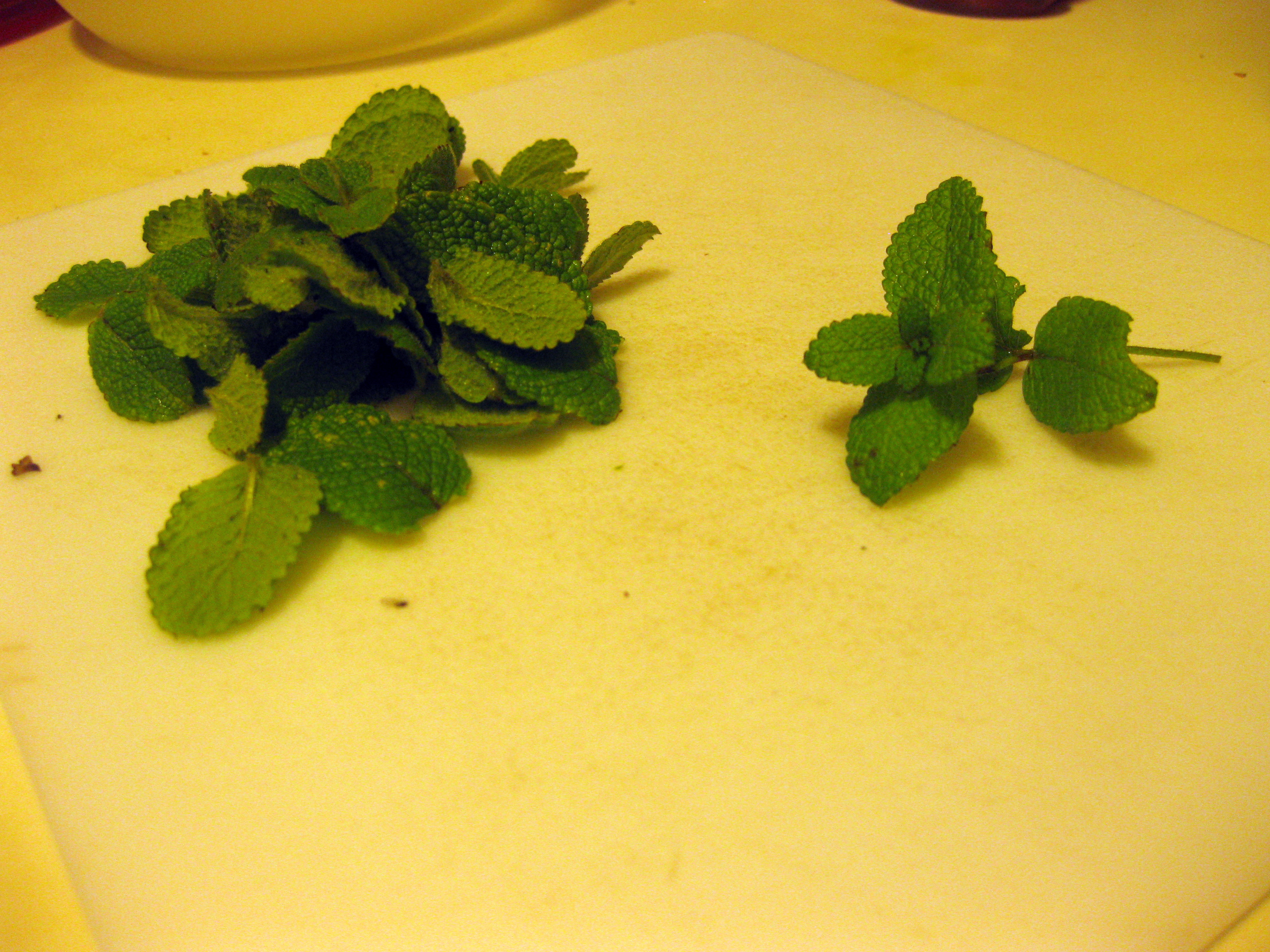
¼ cup chopped mint

2 tsp cinnamon

salt and pepper to taste

The process:

Preheat the oven to 375F

Cook couscous in water with a pinch of salt according to package directions.  If you have vegetable broth or chicken broth, use that.   

While the couscous cooks, chop the mint, melt the butter in a small skillet and add the pine nuts.  Sizzle over medium-low until the pine nuts are barely browned.

When the couscous is done, fluff it with a fork, toss in remaining ingredients, and stir together.  Transfer to your oiled baking dish and bake for 25-30 minutes, or until the top is just crunchy and golden.

We had this with smoked apple and chardonnay chicken sausages and some steamed broccolini and it was tasty, but not stellar.  The pine nuts were roasty and delicious, and the cinnamon added a nice flavor twist, but it seemed to be missing something.

My theories are as follows:

1.)    This would be better as a stuffing than as a side; I’m thinking stuffed pork chops or turkey.

2.)    It would be an awesome base for a tagine of chicken or lamb.

3.)    Dried fruit mixed into the couscous blend would add a sweetness for the cinnamon to play with.

I did only one of these things to the leftovers, and it made a definite improvement.  Diced dried apricots rounded out the flavors nicely and made it seem almost like a pilaf.  Chopped dried figs, dates, or currants would also be delightful.


I have so much more to tell you.  Cross your fingers I can make it through enough of my academic work to check in again next week!

Revisions

At this point in the dissertation process, I am nearing the point where the researching will be finished, the drafting will be done, and the most hated part will begin: revision. Sometimes things don’t seem to need to change – to have a new vision, a “re” vision, is a strange and uncomfortable thing. It’s a painful process to re-imagine arguments, to rephrase key passages, whether they are written eloquently or clumsily. Cutting out words, sentences, whole paragraphs deemed “unnecessary” or “wordy” is as painful as amputation at the worst, and stings like picking a scab at best. Adding in new material and knitting new transitions is almost as bad. And at the end, you give it away to be read by others, who tell you what else needs to be done with it. There isn’t, at this stage, much savoring.

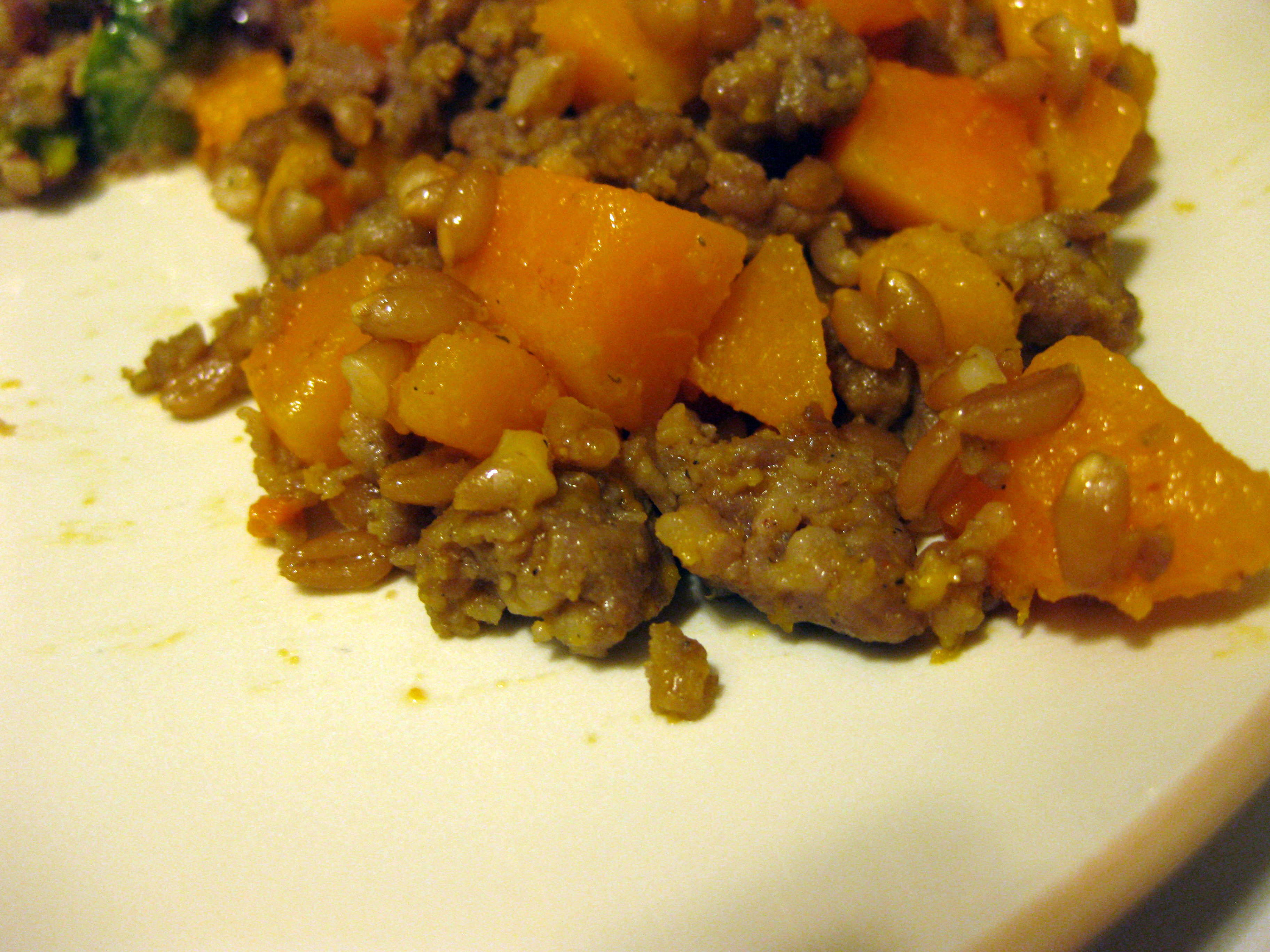
Thank goodness cooking isn’t like that. I love revising what I’ve done in the kitchen. So here, instead of telling you what I did (which involved undercooked ingredients and a side of roasted brussels sprouts in gorgonzola sauce), I’m going to tell you what I should have done. I’m going to tell you how to make this Bittman dish into a fantastic breakfast-for-dinner hash.

37. Sauté crumbled sweet Italian sausage with cubes of butternut squash in a bit of oil. Toss in cooked farro and dress with more oil and lemon juice. Serve as a salad or toss with grated Parmesan and use as a stuffing.

Here’s how it should have gone down:

1 cup emmer farro

2 cups water

4 cups chicken or vegetable broth

1 small butternut squash, peeled, seeded, and cut into 1-inch chunks

16 oz. pork sausage

4 eggs, or as many people as you intend to serve

2 cups baby spinach or chopped kale leaves, hard stems removed

Juice from ½ a lemon

Salt and pepper to taste

The night before you want to eat this, put the farro in a pot with the water and leave it overnight. This starts to break down the grains.

After the farro has soaked overnight (and most of the next day probably won’t hurt), add it to boiling broth and simmer for two hours, or until the grains have bloomed and softened. In the last few minutes, add the spinach or kale and cook just until wilted. The farro will still be a bit crunchy, and may or may not have absorbed all the broth. If not, drain the pot and set aside.

While the farro cooks, preheat the oven to 400F. Toss the butternut squash chunks with olive oil, salt and pepper, and roast until the squash is tender.

In a large skillet over medium heat, crumble and brown the sausage. When it is fully cooked, drain off some of the grease, then add the farro, greens, and squash to the skillet and toss together, just to let the grains and vegetables soak up some of the sausage fat and flavor. Squeeze in the lemon juice and season to taste with salt and pepper.

In another, smaller skillet, heat the reserved sausage grease and fry your eggs sunny side up, until the yolks are barely runny and the whites’ edges are frizzled and beautifully brown.

Serve your hash with a fried egg on top.  With a side of sourdough toast rubbed with garlic, if you like.  Let the yolk mix with the squash and sausage and hearty grain.  It won’t take much; you’ll quickly be full. Full of warmth and goodness. It’s the right kind of meal for winter.

Sick soup

Clearly the past week did not go as planned. No Bittman posts appeared here, and no new recipes were made. Until today at lunch.

I don’t get sick very often. When I do, it’s usually a head cold that lasts mayyyyybe three or four days until I get frustrated with it and flood myself with so much liquid that the cold just gets flushed right out of me. This week was different. I don’t know whether this thing that hit me was cold or flu, but it knocked me over, dragged me around for a while, and then pummeled me almost senseless.

My wonderful husband has been nursing me on simple, nutritious dinners and generally keeping me out of the kitchen, which has been a strange experience. But as this morning wound to a close, with husband and dog-daughter out on a walk, I was suddenly struck with a craving for – of all things – Cup’o’noodle soup. You know, the kind in the styrofoam cup with the peel-back paper top, packed with noodles and freeze-dried vegetables and crusty little shrimp? Yeah, I wanted that for the first time in probably ten years. Maybe more.

Of course we don’t have Cup’o’noodle in the house. But we did have frozen turkey broth, made from the carcass of our Thanksgiving turkey. And I had the memory of my friend M.’s suggestion for “garlic tea” as a cold remedy. I went to work in slow, hobbling steps.

In a pot, I put:

3 cups turkey broth (shlooped out of a freezer container in one icy cylinder)

6-10 cloves of garlic, well smashed

2-inch knob of ginger

½ tsp red chili flakes

I turned the heat up and let this come to a boil, where I left it rolling for about 10 minutes to let the garlic and ginger flavors really permeate the broth.*  Then I added:

1 cup loosely packed torn kale leaves

1-2 TB soy sauce

¼ lemon (I squeezed out the juice and then added the wedge of lemon as well)

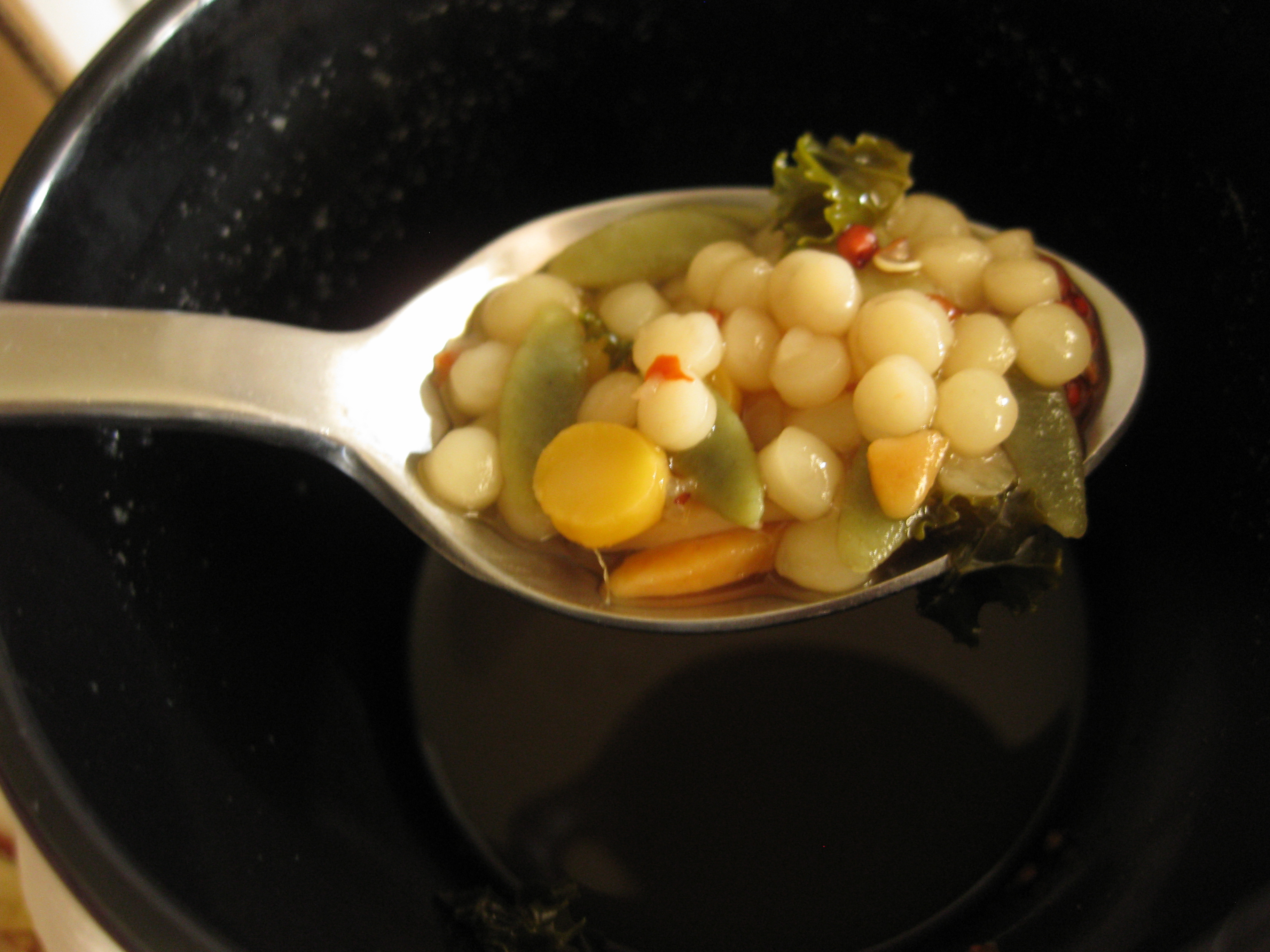
½ cup Trader Joe’s harvest blend (Israeli couscous, split peas, red quinoa, and orzo)

I let this simmer away for 10-15 minutes, until the kale was wilted and the grains were cooked.

Then I ate the whole pot. 

It was delicious. It wasn’t the over-salted, noodle-y guilty-awesome of Cup’o’noodle, but it was comforting and satisfying and spicy and rich and felt healthy. The lemon juice added a necessary brightness, and the grains blend made it filling enough for lunch. The garlic, the ginger and the chili flakes all have their own kind of spiciness, and all were welcome and throat-soothing and tummy-warming.

If you’re not feeling well (or even if you are!), make yourself a pot of this. To bulk it up, add more grains, or sub that out for noodles, or add some pre-cooked shredded chicken or squares of tofu. If you don’t like kale, add some spinach in the last five minutes instead. Using vegetable broth would easily make this vegetarian and vegan, and using tofu or rice noodles instead of the grains blend would easily make this gluten-free.


* At this point, you could strain out the garlic and ginger, and add the vegetables and grains to a clear broth. I didn’t, but then again, I’m the sicko.