Chai Spiced Sweet Rolls

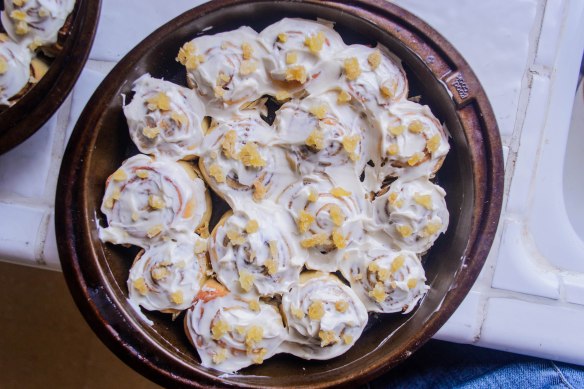
2015 Food Blog December-0645Last week the Twelve Loaves bakers turned out an impressive collection of holiday breads. I had my plan in place, but as I noted on last week’s cheat entry, holiday weekends ironically don’t always allow for baking projects. Now that I’ve had an extra week to get myself in order, I can show you what I intended to contribute: tiny sweet rolls, one to two bites for easier consumption, threaded through not with the classic pairing of cinnamon and brown sugar, but a more complex combination of spices drawn from the wonderful, warming blend that is masala chai, or chai tea. It’s not a traditional holiday bread, but the layering of slightly spicy flavors in chai has always reminded me of gingerbread. By the power of association, then, here we are.
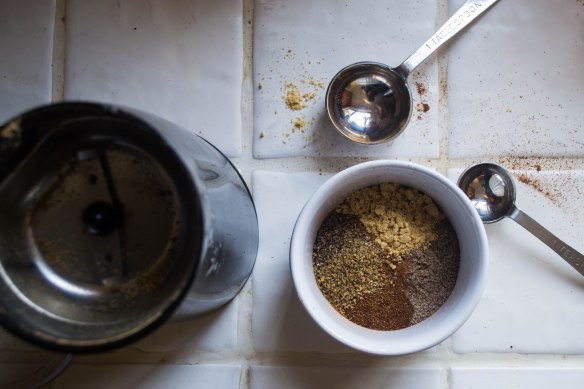
2015 Food Blog December-0619Like many spice mixtures, chai does not have a set blend – many warm notes are added to the black tea leaves to produce the complex, slightly spicy flavor. Cardamom plays a dominant role, and cinnamon, ginger, and black peppercorns are usually present as well. Star anise contributes a subtle licorice note, and cloves and fennel also sometimes make an appearance.

2015 Food Blog December-06262015 Food Blog December-0633For mine, since I used standard aniseed instead of the more traditional star anise (sometimes the grocery store is out and you’re too lazy busy to walk down to the Indian market), I omitted the fennel – a breath of licorice flavor is more than enough for me. Balancing these strong spices can be a tricky task – I wanted my blend to lead with the sweeter cardamom and cinnamon, and be backed up by the depth of the cloves and aniseed. The black pepper and ginger should be subtle – a warming heat rather than aggressive spiciness.
2015 Food Blog December-06272015 Food Blog December-0630I used my Nana’s sweet dough recipe for the base here, amping up the butter a bit and adding an extra egg, but I substituted honey for the sugar the original recipe calls for, since my favorite chai blend incorporates it. The floral notes of the honey make for a slightly more flavorful dough. A splash of vanilla, too, plays well with the spices and the honey.

2015 Food Blog December-0635Many cinnamon rolls are dripping with melted brown sugar and pack a sugar-overload punch that can get you through an entire crowded mall and its parking lot at Christmastime before you come down from your high. These tiptoe a bit more subtly into the holiday air. They are sweet, yes, but tempered. The spices come through, but you can still taste the honey and vanilla in the dough.

2015 Food Blog December-0637These would be perfectly fine on their own – in fact, N. and I bull-dozed through three of them quite unadorned when we did our quality control test, but I can’t help feeling, since they are inspired by a call for holiday breads, that a little excess is needed. A cream cheese frosting, then, lightly sweetened with honey and vanilla, seemed appropriate to smear over the top. And lest it begin to feel too heavy, a scattering of finely chopped crystallized ginger or orange zest brightens them up so you can almost – almost – get away with calling them breakfast.

2015 Food Blog December-0643

Chai Spiced Sweet Rolls
Makes 32-36 mini rolls
Approximately 3 ½ hours start to finish (unless you refrigerate overnight for the second rise)
For dough:
½ cup warm milk
pinch granulated sugar
2 teaspoons active dry yeast
¼ cup honey
1 teaspoon vanilla
2 eggs
¼ cup room temperature or just melted unsalted butter
2-3 cups all-purpose flour (you may not use all of it)
½ teaspoon salt
For filling:
¼ – ½ cup unsalted butter, melted
½ cup brown sugar
1 tablespoon cardamom
1 tablespoon cinnamon
1 teaspoon ground ginger
¾ teaspoon ground star anise or ½ teaspoon ground aniseed (be sparing; it’s strong stuff)
½ teaspoon ground black pepper
½ teaspoon ground cloves
For frosting:
8 ounces full fat cream cheese, at room temperature
¼ cup honey
1 ½ teaspoons vanilla
1 tablespoon milk (optional – to thin)
1-2 tablespoons finely chopped crystallized ginger or orange zest, optional
  • In a 2-cup glass measuring cup, warm the milk to just about body temperature (when you dip your finger in, it should feel neutral or barely warm). Sprinkle in the pinch of granulated sugar and the active dry yeast, stir briefly, and set aside to bubble for about 10 minutes.
  • In the bowl of a stand mixer, use the paddle attachment to combine the honey, vanilla, eggs, and softened butter. Once the yeast and milk mixture is bubbly and smells like bread, add it to the other wet ingredients and combine.
  • Now add 2 cups of the flour and the salt, and mix with the paddle attachment until evenly moistened. Switch to the dough hook and knead on medium speed for about 5 minutes, adding more flour ¼ cup at a time if the dough seems too wet. I used just over 2 ½ cups of flour. When adequately kneaded, it will be the consistency of slightly sticky play-dough.
  • Spray or oil the inside of your bowl with non-stick spray, turn the dough ball over to coat it, and then cover the bowl with plastic wrap and set it aside, preferably in a warm place, to rise until doubled: 1 ½ – 2 hours.
  • While the dough rises, prepare the filling ingredients. Melt the butter, measure out the brown sugar, and combine the cardamom, cinnamon, ginger, star anise, black pepper, and cloves in a small dish. This is also a good time to butter or grease two round 9-inch cake pans.
  • After the dough has doubled in size, punch it down by depressing your fist into the center to release the air, then let it rest for 5-10 minutes. This will make rolling much easier. Turn it out onto a floured board and cut in half with a dough scraper or a sharp knife. Return one half to the mixing bowl and, with a floured rolling pin, roll out the other as thin as possible without tearing, or at least to a 12×16 inch rectangle. If it seems sticky, use a dough scraper to release it from the board, sprinkle a little flour underneath, and rotate the dough 180 degrees before rolling again.
  • Smear your 12×16 inch (or bigger) rectangle with melted butter, then crumble on half of the brown sugar in an even layer. Sprinkle on a heaping tablespoon of the chai spice mixture, then use your fingers to spread the spices and sugar evenly over the surface, leaving a ½ inch border on one long edge of the dough. This will be the end of the roll.
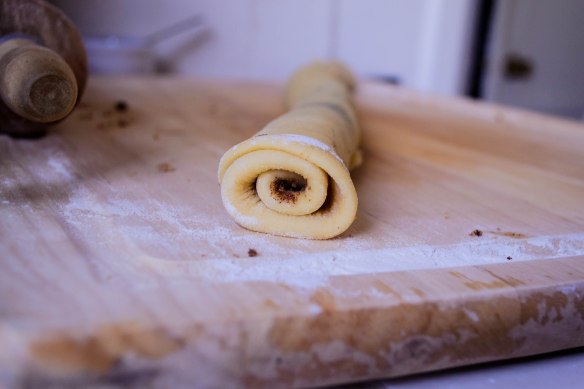
  • Starting in the middle, begin rolling up the long edge of the dough (opposite the side on which you left the border), moving outward to the edges and trying to keep the roll even. You want to roll this tightly – the tighter the roll, the better it will stay together when sliced. As you get to the end of the roll, start to stretch the edge on which you left the border up over the existing roll, pinching it lightly into the roll to adhere. When finished, you should have a long, skinny log only an inch or two in diameter.
  • To slice, use a serrated knife and saw back and forth applying as little pressure as possible. Slice the long log into 1-inch segments, and position each cut side up in one of your prepared 9-inch cake pans, spacing them slightly to give them room to puff.
  • Repeat with the other half of the dough.
  • Cover the filled cake pans with plastic wrap and let rise for 45-60 minutes until doubled again, or, if you are short on time, stow them in the refrigerator overnight (bring to room temperature before baking).
  • 30-40 minutes before baking, preheat the oven to 375F. When the little sweet rolls are puffed and ready, remove the plastic wrap and bake until pale gold on top and just barely set in the middle: 10-12 minutes.
  • While the rolls cool, make the frosting. Use a handheld electric mixer, or a stand mixer with the whisk attachment, to blend together the cream cheese, honey, and vanilla until fluffy. This will take 1-2 minutes, and at first the cream cheese will get clumpy and look separated – don’t worry! Just keep mixing and it will come back together. If it seems too thick, dribble in 1 tablespoon of milk and mix again to desired consistency.
  • When the rolls have cooled, spread on the cream cheese frosting using a small rubber or offset icing spatula. If desired, top each with a spare sprinkle of finely chopped crystallized ginger or grated orange zest.
  • Best served warm or at room temperature.
Dill and Cream Cheese Crust

I’ll be the first to admit that this post is totally cheating. Despite my plans to participate in December’s Twelve Loaves project (they are cooking holiday breads and I can’t wait to check out the offerings tomorrow), amidst cleaning and cooking and family and tree hunting (since we visit family during the actual Christmas holiday, I like to get my tree early so I can enjoy it for a couple weeks first), there was also a pile of grading to be done, and oh, right, lesson planning so I know what I’m doing in class this week would be good too, and there simply weren’t enough hours in any of these glorious days to include several rises, and shaping, and spicing, and glazing, and all those steps I’d intended to embark on to have something sweet and festive to share with you today (no spoilers, though, only hints, because I still want to make them…)

Instead, here’s a cheat post to tide us all over. There are no photos (besides the one from Instagram yesterday; take a peek down on the right side of the page), and only a quick little recipe, but if you, like me, struggle endlessly with pie crust, you might want to give this one a try. It is decadent but simple, since all the work is done in a food processor, it rolls out like a dream, and I even managed to keep it flaky! I’m including suggestions for both savory and sweet below, and feel free to omit or change out the herbs to your liking. I used the sweet variety for my Thanksgiving pumpkin pie on Thursday, and the savory for a turkey pot pie on Saturday.

Both recipes are adapted from Shirley O. Corriher’s wonderful book Bakewise, and make enough for 1 single-crust 9-inch pie. Including chilling time for the dough, they take a little under 90 minutes, and the procedure is exactly the same.

Cream Cheese pie crust
1 cup flour
For savory: 1 tablespoon finely chopped fresh dill
For sweet: 1 tablespoon granulated sugar
1 teaspoon salt
4 ounces full fat cream cheese
4 ounces cold, unsalted butter, cut into slices
1-2 tablespoons very cold water


  • In the belly of a food processor, pulse the flour, dill or sugar (depending on whether you’re making sweet or savory), and salt until evenly distributed. Add the cream cheese and let the mixer run until the mixture is homogeneous – it will be the texture of barely moistened sand and stay together only a moment when pressed between thumb and fingertip.
  • Dump in the slices of butter and pulse in 1 second intervals until most of the butter is broken up and, when tested, the mixture stays together when pressed between thumb and fingertip.
  • Drizzle in 1 tablespoon of the cold water and pulse again briefly once or twice. We are looking for the mixture to just start to come together into a rumbling ball in the belly of the machine. If the mixture seems too dry, add the second tablespoon of water and pulse again briefly to bring together.
  • Stretch out a piece of plastic wrap on your countertop and dump the contents of the food processor onto it. Remove the blade and use the plastic wrap to help you shape the dough into a disc 4-6 inches in diameter. Try to handle as little as possible to keep it tender. Wrap it up and stow it in the fridge for at least an hour.
  • About ten minutes before you are ready to roll out the crust, remove the chilled disc from the refrigerator and set it on the counter. The fats inside the dough need to warm just a little bit to make rolling easier. When ready, dust a bread board generously with flour, unwrap the disc of dough and sprinkle it with flour as well.
  • With a floured rolling pin, roll out the dough in a rough circle. Start in the center and push forward, then back again toward you. If the dough cracks, don’t worry, just keep rolling and it will usually come back together.
  • After one or two rolls in one direction, turn the dough 90 degrees and flip it over, then roll again. Continue this process, rolling, turning, and flipping, and rolling again, until you have a circle about 11 inches in diameter. Re-flour the board, the crust, or the rolling pin in between if things start to get sticky.
  • Carefully drape about half the dough over the rolling pin and quickly move it to your 9-inch pie plate. Settle it in gently, easing it into the bottom edge of the pan, and rather than cutting off the excess, fold it back and wedge it between the pie plate and the crust itself. A little extra crust at the top is always a good thing. Use your thumb or a fork to press the edges at the top for a decorative border.
  • Fill and bake as directed, and enjoy.

Pumpkin Chocolate Cupcakes with Spiced Cream Cheese Frosting

2015 Blog November-0577The beauty of having a perfect chocolate cake recipe, as I do, is that it’s always there in the back of your memory, ready for any holiday, any event, any Wednesday evening you really need a piece of cake. It’s always tender, it’s always moist, it tastes refreshingly of cocoa but is not overly sweet. It is easy to make – 45 minutes from empty bowl to tins hot out of the oven if you’re organized, and its recipe is easily halved and quartered for when you want a single layer, and when you just need a 6-inch cake for you and somebody you’re willing to go halfsies with right out of the cake tin.

2015 Blog November-05572015 Blog November-0560Because this recipe is so dependable, because it is so easy and so well loved I’ve learned the measurements by heart, I’ve basically come to the conclusion that it is magic. It’s delicious, it’s quick, it’s vegan (until you drape it in whipped cream), which also means it’s cheap. But most magically, it is easily modified in dozens of ways, and every time it seems to come out right. I’ve made it gluten-free, I’ve soaked it in liqueur, I’ve added coffee, I’ve used olive oil instead of vegetable oil, I’ve switched out the type of vinegar, I’ve turned it into cupcakes; somehow, it just always works.

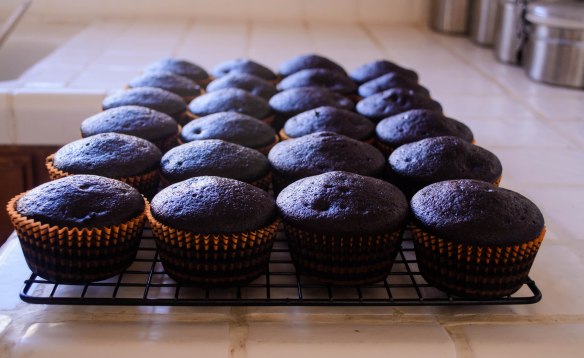
2015 Blog November-05622015 Blog November-0563Here, in the ultimate experiment, I added an entire cup of pumpkin puree without adjusting any of the other ingredient values, and it STILL WORKED. That shouldn’t be possible. Pumpkin is so wet that dumping in such a healthy portion of it should require some tweaking. But because this cake is magic, it produced more than two dozen deeply dark, tender, moist cupcakes within an hour and a half.

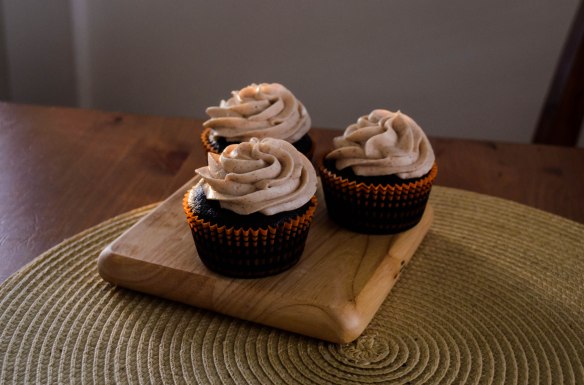
2015 Blog November-05642015 Blog November-05662015 Blog November-0569Though I usually fill and slather this cake in an unapologetically thick layer of whipped cream, for cupcakes, I wanted to play with the subtle pumpkin flavor by spiking the frosting with the spices of pumpkin pie. Cream cheese frosting is a perennial favorite of mine, though for some reason I always forget about it when I’m not addressing a carrot cake. Here, though, it works perfectly: the tang of the cream cheese prevents the frosting from getting too sweet too fast, and it can hold up to the strong flavors of the spices that get whipped in.

2015 Blog November-0573Plus, bonus, cream cheese frosting is easy to pipe because it remains nice and stiff, which means you end up with professional looking cupcakes you can impress your coworkers or your Thanksgiving guests with. You know, if you feel like sharing.

2015 Blog November-0575

Pumpkin Chocolate Cupcakes with Spiced Cream Cheese Frosting
Makes 28
60-90 minutes (plus at least 30 minutes cooling time for cupcakes)
For cake:
3 cups flour
2 cups sugar
2 teaspoons baking soda
1 teaspoon salt
½ cup unsweetened cocoa powder
⅔ cups vegetable oil
2 teaspoons white vinegar
1 teaspoon vanilla
1 cup unsweetened pumpkin puree (NOT pumpkin pie filling)
2 cups cold water
For frosting:
16 ounces (2 packages) plain, full-fat cream cheese, at room temperature
4 ounces (8 tablespoons or 1 stick) unsalted butter, at room temperature
1 tablespoon vanilla
2-3 cups powdered sugar
1 teaspoon cinnamon
½ teaspoon cardamom
¼ teaspoon nutmeg
¼ teaspoon ginger
  • Preheat the oven to 350F and spray or line a 12-cup muffin tin with cupcake wrappers. Set aside.
  • In a large mixing bowl, or the bowl of a stand mixer, whisk together the flour, sugar, baking soda, salt, and cocoa powder. It turns a lovely pale pinkish color when the cocoa is fully integrated.
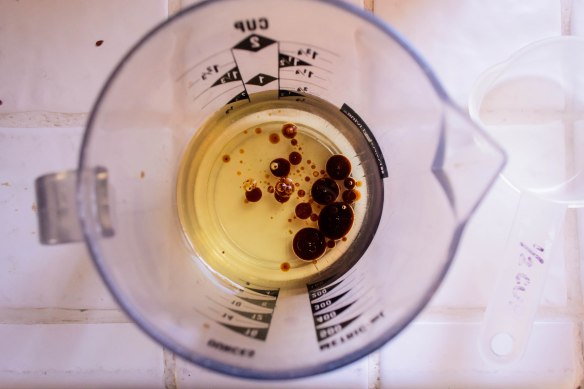
  • In a 2-cup glass measuring cup, measure out the vegetable oil and stir in the vinegar and the vanilla. Carefully add the pumpkin puree and whisk together. Add to the dry ingredients and use the stand mixer or an electric handheld mixer to combine – it will form a wet, clumpy mess.
  • With the mixer running on low, slowly add the 2 cups of cold water. As the batter loosens you’ll want to add no faster than a trickle lest the now suddenly deep, deep cocoa-brown batter splatters.
  • Once all the water is added, continue mixing until well combined – at least a minute. Be sure to scrape the bottom of the bowl with a spatula to ensure no hidden pockets of dry ingredients.
  • When the batter is fully mixed, scoop ⅓ cup into each cavity of your prepared muffin tin. I use an ice cream scoop that holds ⅓ cup and has one of those trigger pieces that sweeps across and cleans out the scoop – I highly recommend this. It’s very convenient.
  • Bake for 18 minutes or until a toothpick or cake tester inserted comes out with only a moist crumb or two. Cool in muffin tin for 5-10 minutes, then remove to a wire rack to cool completely. Repeat with remaining batter until all cupcakes are baked and cooled.
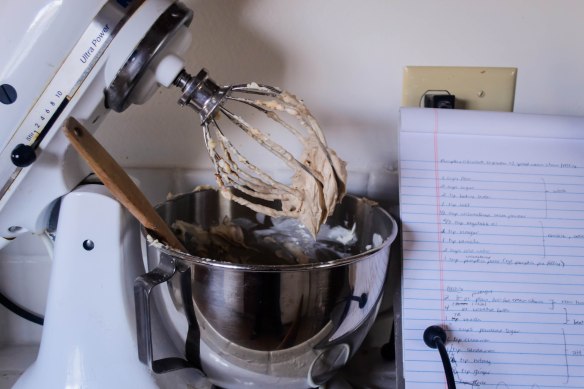
  • To make the frosting, drop the cream cheese into a large bowl and beat well with an electric handheld mixer or the whisk attachment on a stand mixer. When the cream cheese is looking fluffy, scrape down the sides, add the room temperature butter, and beat again until mixture is thick and fluffy. Scrape down the sides, add the vanilla, and beat once more.
  • Now, sift in the powdered sugar ½ cup at a time, beating well in between each addition. You will want to start with slow speed each time to avoid a powdered sugar cloud. Once you’ve hit the 2 cup mark, let the mixer run for 2-3 minutes until the frosting becomes very thick. Give it a taste to check for sweetness and texture. If it seems thick enough for your purposes, add the spices, beat to integrate fully, and you’re done (I found 2 cups was perfect in flavor and texture). If the frosting is not thick enough, add the remaining powdered sugar ½ cup at a time, beating well, for additional stiffness. Then add the spices, beat to integrate fully, and prepare to frost the cupcakes.
  • If you have a piping bag, fit it with a star shaped tip and use a rubber spatula to fill it halfway with frosting. If you don’t have a piping bag, cut the bottom corner off a gallon sized zip-top freezer bag and slide in a star shaped tip (or just leave it open for a less defined swirl of frosting). Half fill with frosting. Use your fingers to gently smoosh the frosting toward the bottom of the bag. Twist the top (empty) half of the bag around two or three times.
  • To frost the cupcakes, hold the filled half of the bag in your dominant hand and a cupcake in your other hand. Without touching the icing tip to the surface of the cupcake, squeeze the bag gently and move your hand in a clockwise circle, letting the frosting ooze out and create a curlicue of frosting on top of the cupcake. Repeat until all cupcakes are frosting, refilling the bag when needed. You’ll likely have some extra, which seems to me like a terribly good thing, and which apparently freezes quite well.
  • Refrigerate cupcakes until ready to serve – they keep just fine overnight (and, in fact, were still moist and tender into day three).

Thanksgiving Meatballs

2015 Blog November-0596I realize that it may be tantamount to sedition to suggest to most Americans that they consider having meatballs for Thanksgiving. Thanksgiving is sacred: though there might be ham, there MUST be turkey. Sometimes it is packed full of cornbread or sourdough stuffing; sometimes the stuffing gets baked separately and the turkey cavity is jammed with herbs and a half a lemon (that’s the way it usually goes in our house). There are potatoes of some sort – if you are my sister, they are always these chipotle mashed sweet potatoes, originally from Cooking Light. Gravy is less important to me than to some people – I realize there are secret recipes generations old, and then there’s that sludgy stuff that pours right out of a jar. As long as the turkey is moist, I tend not to fuss about the gravy. Cranberry sauce, however, is a must, and so are vegetables, though variety is much more acceptable here than in other parts of the meal. Later, if you can find a corner of room, there’s pumpkin pie, or perhaps pumpkin cheesecake, and maybe some sort of rum-drenched dessert drink.

2015 Blog November-05862015 Blog November-0584Given all that (are you hungry yet?), you might not want meatballs for Thanksgiving. But these are Thanksgiving IN a meatball. Everything – with perhaps the exception of the pumpkin pie – is accounted for: finely whirred onion and celery from the stuffing, soaked bread crumbs, gently sautéed herbs, even the occasional tart-sweet stab of a bit of dried cranberry. They get simmered in gravy that is lightly seasoned with rosemary and a few lemon slices, to keep it bright, and nestled tenderly in a bed of mashed potatoes. It’s all there. Even the eternal quandary that is Thanksgiving veg is factored in: a crisp tumble of fried brussels sprout leaves cascading over the top.

2015 Blog November-05812015 Blog November-0587The vegetable component here is inspired by several restaurants we’ve eaten at recently, which offer fried brussels leaves as an appetizer – a kind of alternative to a bowl of french fries or maybe, just maybe, an evolution of the ubiquitous kale chip. At first I was reluctant to pay $8.00 for a paper-lined dish of these crisp little things (oh Los Angeles), but the flavor – a toastiness that almost invokes sesame oil – and the salty goodness that makes me want to finish the whole bowl, usually wins me over. Besides, several experiments to perfect them for this dish have taught me that they are only deceptively pricey – the patience and time it takes to coax off individual leaves without damaging them makes it worth occasionally paying other people to do it.

2015 Blog November-0590Still, though, the crispy fried leaves add a really necessary textural component to this whole dish. The mashed potatoes are soft, the meatballs are moist and tender, the gravy is velvety; it needs a crunch. Even though it takes a while to produce enough leaves to be worth it, and even though the frying process itself is terrifying – the leaves have a high water content, so the oil fizzes up tremendously when you first add them – they are the perfect final garnish to the plate.

2015 Blog November-05952015 Blog November-0602I’m waxing ridiculous about the brussels sprouts, I know, so let me just say: the meatballs and the gravy they simmer in are delicious too. The vegetables inside keep things moist, and the hints of sweetness from the cranberries are a nice touch. I presume they would be tasty over noodles of some sort, or perhaps on a slider or crostini. But since this is about Thanksgiving, I couldn’t see deviating from the classic mashed potato. I’m not including a potato recipe here; you should make them however you like them. I will say, though, a crumble of goat cheese melted in at the last second is never a bad thing…

2015 Blog November-0603

Thanksgiving Meatballs
Makes 18-20 meatballs (about 2 tablespoons each)
60-90 minutes
1½ cups fresh bread crumbs (from 1-2 slices of bread)
1 cup whole milk or half and half
¼ cup grated yellow or white onion (about ⅓ of a large onion)
¼ cup grated celery (about 2 stalks of celery)
4 tablespoons butter, divided
1 teaspoon finely minced fresh sage
1 teaspoon finely minced fresh thyme
2 tablespoons finely minced fresh parsley
2 tablespoons finely chopped dried cranberries
⅛ teaspoon black pepper
1 teaspoon salt
1 pound ground turkey, dark meat preferable
2-3 tablespoons olive oil
2 tablespoons flour
¼ cup dry white wine, optional
2 cups low-sodium turkey broth
2 inch sprig of fresh rosemary
3-4 thin slices of lemon
1½-2 cups vegetable oil
2 cups brussels sprout leaves
Additional salt and pepper to taste
Mashed potatoes, made your favorite way


  • To make the bread crumbs, whir the slices of bread in a food processor into small, fluffy crumbs. Combine these crumbs in a small bowl or 2-cup glass measuring cup with the milk or half and half, and let soak at least 10-15 minutes while you prep and cook the vegetables.
  • Add the onion and celery into the food processor (no need to wash it out in between; everything’s going to the same place!), and let run until the vegetables are very finely minced.
  • Heat 2 tablespoons of the butter in a 12-inch skillet over medium-low heat and add the onions and celery. Sweat gently until the onion pieces are translucent and the celery is tender; 5-8 minutes. In the final minute, add the finely minced sage and thyme leaves. Turn off the heat, transfer cooked vegetables and herbs to a medium bowl, and let cool for about 10 minutes.
  • Once the vegetables have had a chance to cool a bit, add the parsley, chopped cranberries, pepper, and salt to the bowl. Gently squeeze out the bread crumbs that have been soaking in milk and add them as well; they don’t have to be squeezed dry, but ideally they should be no longer dripping. Add the turkey meat and use your fingertips or a fork to combine and evenly distribute all ingredients.
  • In the same skillet you used previously, heat the remaining 2 tablespoons of butter and the 2-3 tablespoons of olive oil over medium-low heat. While it warms, roll the meat mixture into balls about 2 tablespoons each. You should get 18-20 meatballs out of this quantity. As you roll each, place it on a clean plate.
  • When all meatballs are rolled, turn the heat under the skillet up to medium and gently add as many meatballs as will fit in a single layer, not touching each other. Brown for 2-3 minutes, then flip over and repeat once or twice more on the other “sides” of the meatball.
  • Once meatballs are browned on 2 or 3 sides, remove this first batch to a clean plate and repeat, until all meatballs are browned.
  • In the empty skillet, sprinkle the flour over the remaining fat and whisk into a golden bubbling sludge, then let cook 1-2 minutes. Add the dry white wine, if using, whisking immediately and constantly to integrate the flour evenly. When the wine is incorporated, slowly add the turkey broth, again whisking constantly, until no lumps remain.
  • Bring the liquid mixture to a simmer, whisking occasionally. Gently add the meatballs back in along with any liquid they have generated, clamp on a lid, and simmer for 15 minutes.
  • After 15 minutes, use a spoon or a pair of tongs to gently flip over each meatball. Add the sprig of rosemary and the lemon slices to the liquid in between the meatballs, then replace the lid and cook another 15 minutes.
  • During the cooking, prepare your mashed potatoes any way you like them.
  • To make the brussels sprouts, heat 1½-2 cups vegetable oil to 350F in a heavy, straight-sided pot. The weight is important because we want it to be stable. When it reaches 350F, carefully add the brussels sprout leaves. The oil will immediately bubble up furiously, so again, be careful.
  • Fry the leaves for 2-3 minutes, frequently agitating them with a skimmer or a kitchen spider. When a few tester leaves feel crisp, carefully skim them out onto a double layer of paper towels or a brown paper bag. Immediately sprinkle with salt and reserve until ready to serve. It is best to do these as close to the last minute as possible for heat and crispness.
  • To serve the whole dish, place a healthy serving of mashed potatoes into a shallow bowl. Spread them out a bit to form a well in the center. Spoon in a few tablespoons of the meatball gravy, then nestle in the meatballs – I recommend 4-5 per person. Add a bit more gravy over the top if desired, and shower with a crisp handful of fried brussels sprout leaves.

Almond Raisin Roasted Cauliflower

2015 Blog September-0517This week, Los Angeles finally had some mercy on us and allowed the temperatures to drop just a bit. My building at work turned off the air conditioning in our offices. I didn’t change into shorts immediately upon getting home. In fact, I actually – and you might be shocked here, so get ready for it – I actually put on a sweatshirt and wore it quite comfortably for several hours. I dug my bedroom slippers out from the dust-bunny-laden corner of the closet and slid grateful, almost chilly, feet into their old embrace.

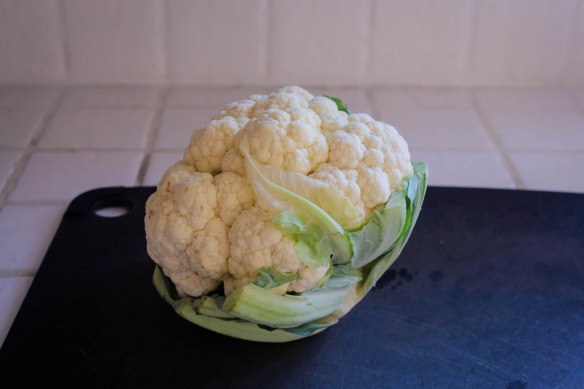
2015 Blog September-0501Of course, since this relief might not last very long, I did the only sensible thing I could, which was to buy a head of cauliflower and shove it into a high-temperature oven. Cauliflower and I were never friends in childhood, but Mark Bittman changed all that for me by offering a high-heat roast, rather than a steam or a boil, as the plan of attack. In fact at this point, I think N. and I would happily eat a tray of roasted broccoli and cauliflower three or four nights a week, without much to accompany them.

2015 Blog September-0502On occasion, though, a bit of accompaniment is nice. Though my typical procedure is just salt, pepper, and plenty of olive oil, I wanted to give the cauliflower some friends to play with as it bronzed slowly over the flames. The vegetable itself has such a mild flavor that it can easily go in a sweet or a savory direction, and I decided I wanted to play with these borders. Adopting a vaguely Mediterranean direction, after the first blast of roasting I scattered a handful each of golden raisins and sliced almonds over the cauliflower. Back it went just long enough for the florets to brown and the almonds to toast, but not quite long enough to burn the nuts or the delicate raisins. On the contrary, the raisins plump up a bit as they suck in some of the oil and moisture released from the cauliflower. A quick shower of chopped parsley as the tray leaves the oven, and the dish is ready.

2015 Blog September-0506The flavors here are perfect, and it’s hard to describe perfection, but my unexpected favorite thing about this dish was the play of textures. The cauliflower gains an almost-crisp crust on its exterior, but the inside is meltingly soft in an entirely pleasant way. The raisins don’t stay plump for long after exiting the oven, but they provide a subtle chewiness I enjoy, and the almonds are a perfect crunch.

2015 Blog September-0509I usually try to give you pairing suggestions, and while I think this would be good with everything from turkey to lamb, I feel no shame in admitting that, since I was dining solo, I just ate the whole tray and called it a night.

2015 Blog September-0511

Almond Raisin Roasted Cauliflower
Serves 2-3 as a side, 1 as a main
45-50 minutes, mostly unattended
¼ cup olive oil
1 teaspoon salt
¼ teaspoon pepper
1 medium head of cauliflower
generous ⅓ cup golden raisins
generous ⅓ cup sliced untoasted almonds
¼ cup roughly chopped fresh parsley


  • Preheat the oven to 450F with a foil-lined 9×13 inch baking tray inside. We want to preheat the cooking surface as well as the oven to start the cooking process immediately.
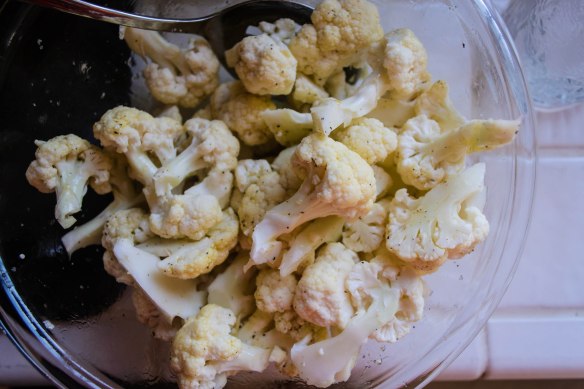
  • While the oven heats, whisk together the olive oil, salt, and pepper in a large bowl. Cut the cauliflower into medium florets (a large bite-size) and toss in the seasoned oil for even coating.
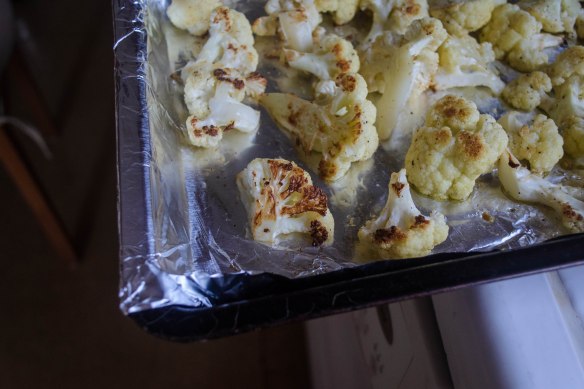
  • Carefully remove the preheated baking tray from the oven and dump on the oiled florets, arranging them in a single layer. Return to the oven and roast for 20 minutes, during which time you can assemble and prep the remaining ingredients.
  • After 20 minutes, take the tray out of the oven and, using tongs, flip over the florets. Yes, each one. Yes, it’s tedious, but it will make for a better end product. Push them back into the oven and roast for another 10 minutes.
  • Remove the tray from the oven again and scatter the raisins and then the almonds over the cauliflower. This protects the raisins a bit and ensures the almonds toast nicely. Back into the oven once more for a final 10 minutes, then remove, scatter with chopped parsley, and serve hot or warm.


Beef Stroganoff Meatballs

2015 Blog October-0554These are the meatballs that started it all. On a whim, in a post I wrote to publicize Shauna’s (at the time) most recent cookbook, I mentioned off-hand the idea of roasting the mushrooms in the Russian classic beef stroganoff – a savory stew of long-cooked beef with onions and mushrooms, often draped over egg noodles or mashed potatoes.

2015 Blog October-05462015 Blog October-0548Somehow, as it simmered in my head, the concept of roasted mushrooms, well, mushroomed, and turned instead into adapting the whole dish into a meatball. Onions and mushrooms, sautéed down in butter until tender and moist, studding a beef meatball floating in a beefy wine sauce, finished with a generous dollop of sour cream. It sounded exactly right, and though a few ingredients added themselves to the mix – thyme in the meatballs, a bay leaf in the sauce and a sprinkling of fresh herbs of the top – they stayed in basically the same form as the year stretched on. From there, in fact, they launched the whole meatball project: if beef stroganoff could be remade in meatball form, why couldn’t other classic dishes? And if I could come up with enough of those, I was set with a project for the year. It became a plan.

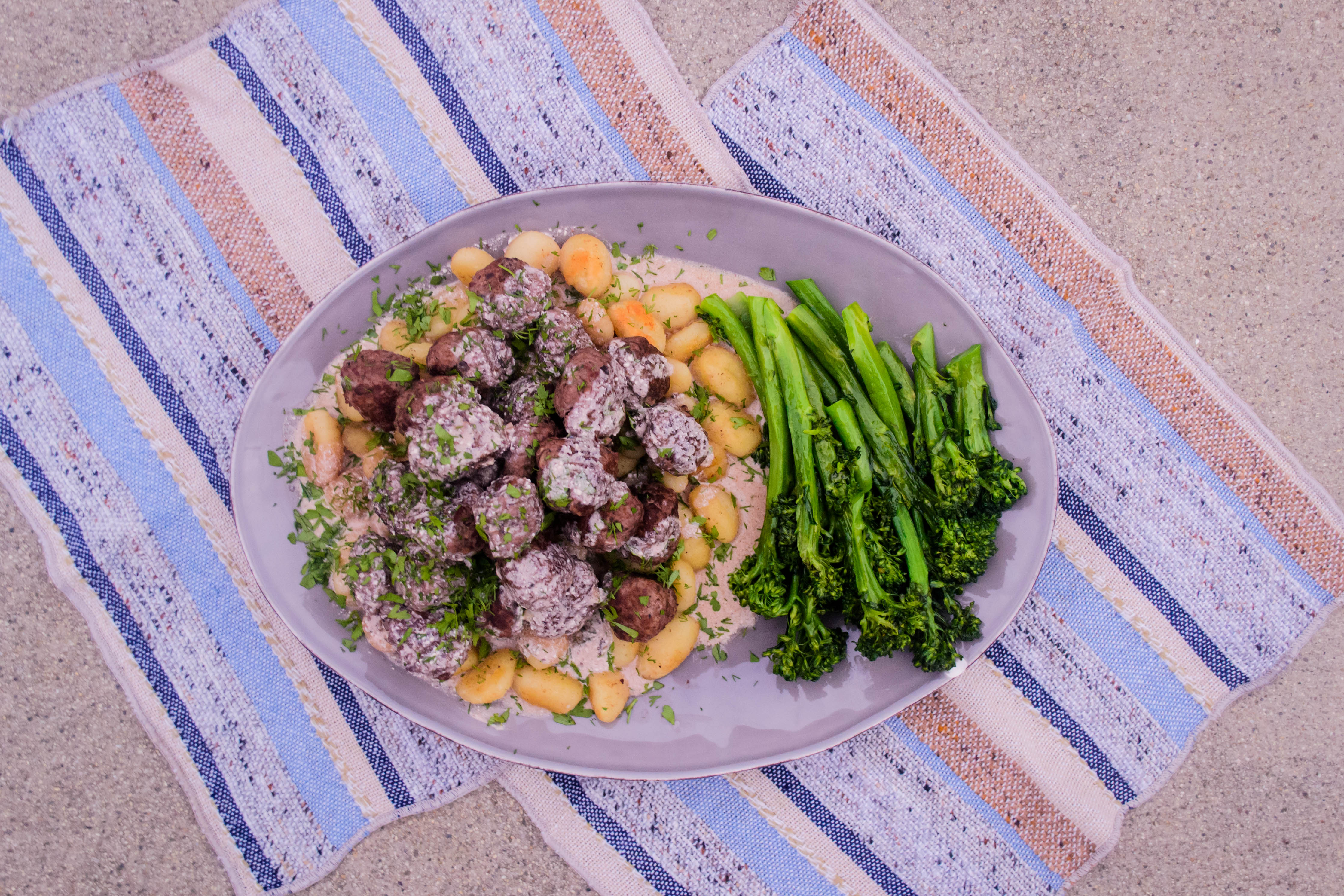
2015 Blog October-05492015 Blog October-0551As ideas came thick and fast, and the seasons grew warmer, stroganoff was put off month after month. Finally, in a rare cool weekend, I was able to return to the idea and let me tell you, it was a worthy origin story. My sauce broke, but yours won’t, because you will start with your sour cream at room temperature and add it slooooowly with the heat off, won’t you? And your meatballs will be tender and moist, after simmering but not boiling in the rich, slightly thickened sauce. And though you can certainly serve these as we did, piled atop pan-toasted gnocchi, a pillow of sour cream mashed potatoes or a bowl of egg noodles would be equally welcome.

2015 Blog October-0552

Beef Stroganoff Meatballs
Makes 24-28 tablespoon sized meatballs
45-60 minutes, very approximately
4 tablespoons olive oil, divided
2 tablespoons butter
½ cup minced white onions
1 cup minced mushrooms (I like crimini)
¼ teaspoon freshly ground black pepper
1 teaspoon fresh thyme leaves
1 pound ground beef, preferably 85% lean / 15% fat (any leaner and the meatballs run the risk of being dry)
1 teaspoon salt
2 tablespoons dijon mustard
1 egg
1 cup red wine
2 cups low-sodium beef broth
1 bay leaf
¾ cup full-fat sour cream, at room temperature
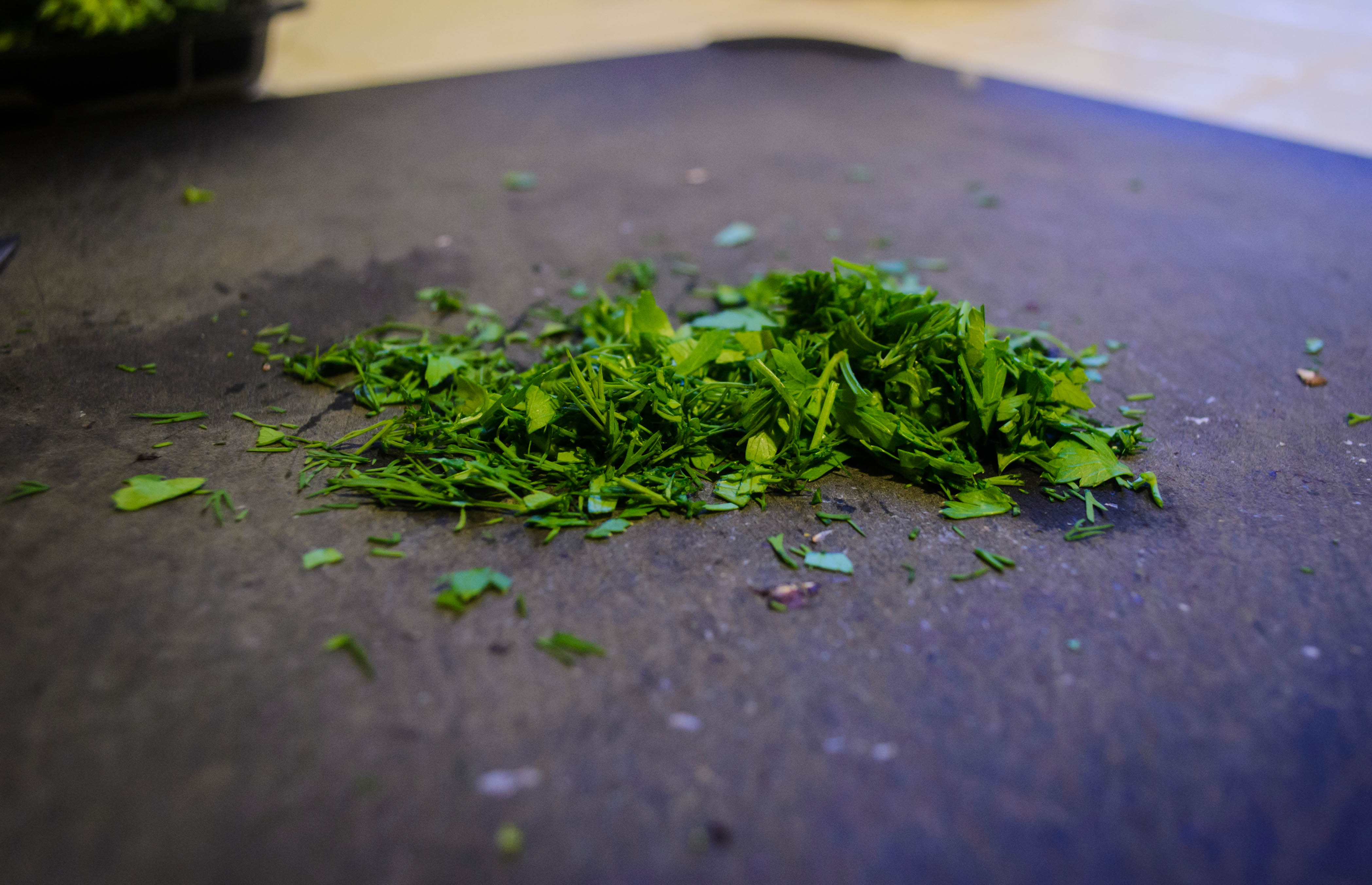
1-2 tablespoons each minced dill and parsley, to garnish
pan-fried gnocchi, egg noodles, or mashed potatoes, to serve


  • In a large skillet, heat 2 tablespoons of the olive oil with the butter over medium-low heat. Add the onions and stir once, then let cook gently while you prepare the mushrooms.
  • Add mushrooms, ¼ teaspoon pepper, and the thyme to the gently cooking onions and raise the heat to medium, then cook, stirring frequently, until tender and lightly browned – around 5-8 minutes. Let cool.
  • In a medium glass bowl, combine ground beef, salt, mustard, egg, and the cooled mushrooms and onions. Use your fingertips (preferable) or a spatula to lightly bring everything together; we are aiming for a mixture in which the aromatics and seasonings are evenly distributed.
  • In the same skillet you used for the onions and mushrooms, heat a few drops of olive oil over medium heat. When it is shimmering, add a teaspoon-sized patty of the meat mixture and cook on both sides until done. Taste for seasoning and adjust for the rest of the mixture, if needed.
  • Using moistened hands, roll tablespoons of the meat mixture into tight but tender spheres, setting each on a plate until all are rolled. In the same large skillet, heat the remaining 2 tablespoons of olive oil over medium heat. Add the meatballs in a single layer, not touching each other (this will probably take at least two batches). Cook until browned on all sides (2-3 minutes per side), then set aside on a clean plate. Repeat until all meatballs are browned.
  • When all meatballs are browned and set aside, add the red wine all at once and use a wooden spoon or spatula to loosen the browned bits from the bottom. This is called fond, and it contains a lot of flavor. Add the beef broth and the bay leaf, and bring to a boil, then reduce the heat and let the broth and wine mixture simmer for 10 minutes.
  • Carefully add the browned meatballs back into the liquid and return to a simmer, letting the meatballs roll in their broth and wine bath for 10 minutes. At this point, it would be wise to get the starch component ready as well.
  • When the meatballs are cooked through, dish them out with a slotted spoon to a temporary storage plate. Turn off the heat and slowly whisk in the sour cream ¼ cup at a time. Don’t add it all right away, and by all means don’t add it straight out of the refrigerator – this will cause it to turn grainy and look curdled (though it will still taste okay). Slow incorporation is key.
  • Once sour cream is fully incorporated, return skillet to low heat, add the meatballs back in once more, and cook just until sauce and meatballs are warmed through.
  • To serve, pile meatballs with a healthy helping of sauce atop pan-fried gnocchi, mashed potatoes, or egg noodles, and garnish with a sprinkle of fresh dill and parsley.