Finish line

The problem with cramming for final exams – as many of my students were doing only a few weeks ago – is that you end up trying to process too much information, and just as quickly as you learn new things, the old things you thought you knew start sliding away. That’s the glory and the power of writing. Once it’s on the page, it’s solid. No matter how many holiday dinners you eat (I’m onto my third or fourth at this point), those words will still tell you exactly what you did and (sometimes) how you felt about it.

I feel like I’m cramming for my final. Last week, before the holiday, before the family time, before the outpouring of memories and laughter and swallowed tears of all kinds and barking and yelling and joy, I made three Bittmans in a desperate bid to stay on top of the project.

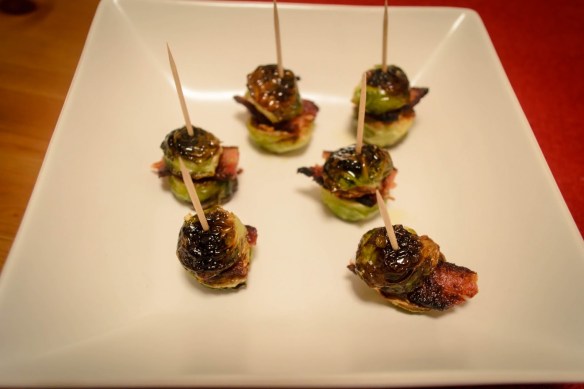
42. Brussels Sprout Sliders: Trim and halve large brussels sprouts, toss with olive oil and roast at 400 degrees until tender but not mushy. Using the brussels sprout halves as you would hamburger buns, sandwich them around a piece of crispy bacon or ham, maybe a little caramelized onion, and a dab of whole grain mustard. Keep everything in place with toothpicks.”

I always intended to make this one for a Halloween party. It seemed fitting: for some, brussels sprouts are a frightening, disdained vegetable. But this new perspective on them makes them fun and perhaps even appetizing to those disbelievers who see them only as a bitter waterlogged grenade of disappointment. But I never did. So they became an appetizer for two:

6 brussels sprouts, trimmed and halved

2 strips bacon, cut into eight even pieces (you’ll use six for the brussels. Eat the other two, or share with a tall, handsome somebody who shows up in the kitchen when the smell becomes too enticing to ignore)

dab (maybe 1 tsp total?) whole grain mustard

Preheat the oven to 400F.

Line a small baking dish (I used a 9” cake pan) with aluminum foil and drizzle the foil with olive oil. Brush or rub the olive oil into an even layer so every millimeter of foil is covered.

Set the sprouts, cut side down, on the oiled foil, spacing them evenly so none are touching. This will ensure even roasting rather than steaming.

Food%2520Blog%25202011-2013-0204

Roast for 15 minutes, until the cut edges are browned and just crisp. Using tongs, flip over each sprout so they teeter on their curved sides. Roast for another 15 minutes.

While sprouts are roasting, cook the bacon. Mine was already cooked – saved from another porky occasion – so during the last five minutes of sprout roasting I added the bacon pieces to the pan to heat them up a little.

When the sprouts are browned and lightly tender, set them aside until they are cool enough to handle. As soon as you can bear to touch them, add a tiny spread of mustard across one cut edge, seat the bacon atop it, and place another sprout half on top to complete the sandwich. Drive a toothpick through the whole thing and serve as an hors d’oeuvre.
Food%2520Blog%25202011-2013-0205

We gobbled these down like we hadn’t eaten in weeks. They were delightful and I highly recommend them as a party item: crisp bacon, zesty mustard, and the nutty crunchy slight bitterness of roasted brussels sprouts, all collected together in one perfect bite. Perhaps a New Year’s Eve treat to help the hours pass.

Food%2520Blog%25202011-2013-0210


Soup and bread seemed like a good meal to follow our sprouts.

82. Cornmeal Flatbread with Onion and Sage: Mix 1 cup cornmeal with 1 teaspoon salt; slowly whisk in 1½ cups water. Cover and let sit for an hour (or up to 12 hours in the refrigerator). Put ¼ cup olive oil in a 12-inch ovenproof skillet along with a thinly sliced red onion; stir. Heat the skillet in a 400-degree oven for a few minutes, then stir and pour in the batter. Bake at 375 degrees until the flatbread is crisp at the edges and releases easily from the pan, about 45 minutes.”

I followed these directions fairly exactly, with the exception that I used only half an onion. The olive oil and onion went into the oven for five minutes at 400F, at which point the onion slices were sizzling and the oil was shimmering beautifully.

Bittman neglects to note where and when to add the sage, so I stirred a tablespoon of finely chopped fresh sage into the batter just before adding it to the skillet.
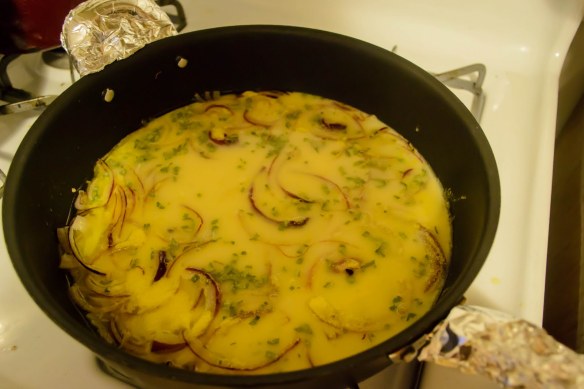
Food%2520Blog%25202011-2013-0203

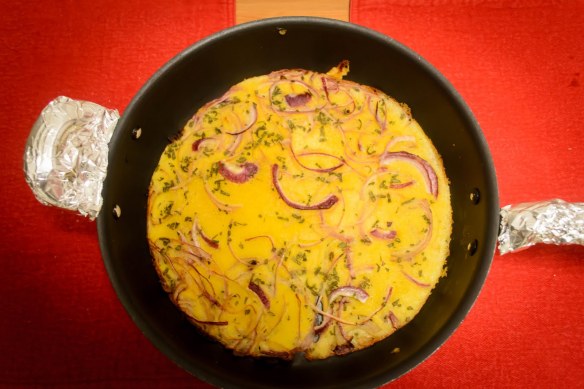
This concoction baked for 45 minutes, until it was set, the onions were crisp-tender, and the whole thing loosened easily from the skillet and slid almost gracefully onto a serving tray.
Food%2520Blog%25202011-2013-0212

We cut large wedges and tasted. It was unlike any other bread I’ve come across – more like baked squares of polenta than anything else, which made sense when I stopped and thought about it. Were I renaming this dish, I think I would call it Polenta Pizza. It was well oiled and spongy in texture, squishing pleasingly between our teeth and driving us back for additional tastes. N. wasn’t sure he liked it at first, but then he went back for a second slice and then a third. When I ribbed him about this, he said he was still deciding what he really thought, and needed more samples to truly make up his mind.

Food%2520Blog%25202011-2013-0214

This odd little bread course could easily be dunked in saucers of warmed marinara sauce, or sprinkled with mozzarella or parmesan for a pleasing salty bite. Though the onions and sage were good, you could probably saute almost anything in that skillet before adding the batter: sausage, peppers, mushrooms… anything you’d put on a pizza.

A decadent appetizer and a well-oiled pizza/bread need a sober, sensible kind of soup to balance them out.

19. Saute chopped onions, garlic, celery and carrots in olive oil, then add chopped tomatoes (boxed are fine) with their juice, lentils and stock or water to cover. When everything is soft, add a squeeze of lemon juice or a splash of red wine vinegar. Garnish with parsley.”

Since we were leaving town the next day, I didn’t want huge quantities. (This still made enough for four, but I froze the leftovers so nothing was lost)

½ red onion (left from the flatbread, so convenient), diced

4-6 small cloves garlic, minced

1/3 cup each celery and carrots, sliced

¾ cup lentils

13.5 oz can petite diced tomatoes

2½ cups chicken broth (or vegetable broth, or water)

1 TB lemon juice

2 TB fresh, finely chopped parsley

salt and pepper to taste

I heated 2 TB olive oil over medium heat, then tossed in the onions to sweat for a minute or two before adding the garlic and the other vegetables. When the onions were translucent and tender, I added the tomatoes, lentils, and broth and turned the heat up to medium high until the whole pot came to a boil.

Once boiling, I gave it a healthy stir and then turned the heat down so the soup would just simmer, letting the lentils soften gently and the vegetables tenderize.

Simmer for at least 35 minutes, then taste the lentils to see if they are tender enough for your taste. We like them soft but not mushy, with minimal resistance but still able to hold their shape.

Just before serving, squeeze in the lemon juice, stir gently, and dip into serving bowls. Scatter the surface with a grassy sprinkle of parsley.

Food%2520Blog%25202011-2013-0215

We liked this, though it wasn’t the best lentil soup I’ve ever had. The flavors were enticing and the lemon juice made it a bright, rather than heavy, soup. The problem with it was that I like my lentil soup more like a stew or a chili. The brightness of the lemon made the shower of shredded pepperjack cheese I was considering adding seem extraneous and out of place, and I tend to get crotchety when denied cheese. But alongside the flatbread and the richness of the brussels sprouts, it was hearty but didn’t weigh us down.

2012 is fading like the last sheen of daylight across the hills in winter. 2013 charges toward us, all mystery and sharp promise. I thought about cheating and saying I was done; these three dishes are the final three, I made it, all boxes are checked, all questions answered, funtoosh, kaput (extra points if you can name my source!), but I just can’t. I’m too close. This final exam is too important. This resolution needs to be one I keep. I have two dishes left. I have two days, one of which will be spent driving from the Sierra Nevada foothills where N.’s parents live back to Los Angeles and my little house. I hope I’m going to make it. The finish line is in sight. Now I just have to stagger across it.
Cold Comfort

Tragedy, when it strikes, whether it be national and sweeping or personal and held tight against you – and I have experienced both this week – plunges you into strangeness.  There is shock, there is disbelief, there are weighty moments of contemplation, there is knowledge of helplessness.  There is the feeling of being alone.

When I feel the chill and the incomprehensible wounding of tragedy, I want my belly full of warmth and familiarity and comfort.  And while it may seem trivial or even juvenile to want to write about food in the aftermath of gut-twisting pain, I think there is an important connection to be made.  As Shauna said shortly after Hurricane Sandy, one of the ways food is important is that it brings us together.  Her post moved me deeply, and made me feel that it’s not trivial or disrespectful to feel the need to talk about humble little food in the aftermath of disaster.  The loneliness and helplessness of pain can be beaten back by community.  When we come together, we are able to offer one another comfort, even if it is slight, and the metaphorical warmth of our togetherness can often eclipse physical heat.  Food bridges that gap.  It offers a physical warming, yes, in that it nurtures us and fills us and helps us carry on as individuals.  But it also links us – we eat together, we break bread, and in eating together we share ourselves with each other in meaningful ways, even if we didn’t realize that sharing took place.  It binds us in communities, however small, and having fellows in a bad situation, whether they are fellow mourners or whether they are comforters and supporters, gives us the opportunity for light and warmth, if we are able to feel that connection.

So when I talk about food today, I want to talk about food that warms us.  I want the fullness of soup and the richness of dessert.  I want the clinking of spoons and the sprinkling of spice that stabilizes and relaxes and envelopes us.  I want us to be able to feel the warmth of love which, to me, is most easily expressed through a transfer of food: if I feed you, it’s a good bet I care about you.  It’s a small thing, and you may think it’s a silly thing or an unimportant thing, but it is perhaps the only thing I can do in this moment to reach across the feeling-less blips of the net-scape and offer you warmth.  But I mean it.  Take this warmth.

“95. Indian Pudding: Combine 3 cups of milk and 1/3 cup of cornmeal in a saucepan over medium heat. Bring to a simmer; stir in 1/3 cup of molasses, 1 tablespoon sugar, ¼ teaspoon salt, 1 teaspoon ginger and ½ teaspoon cinnamon and simmer, stirring occasionally, until thick. Add 1 tablespoon of butter and stir until melted. Pour pudding into buttered baking dish and bake at 300 degrees for about 2 hours, uncovered, until golden brown and set in the middle. Serve with ice cream or whipped cream.

Food Blog 2011-2013-0169

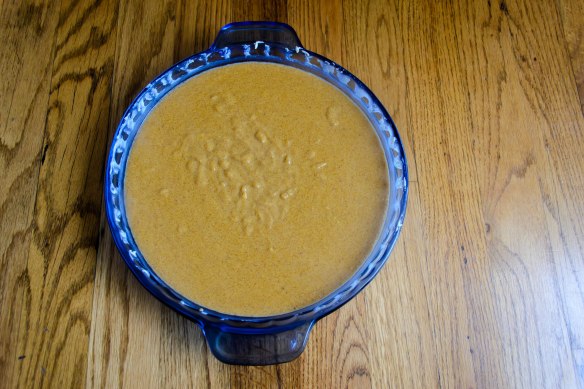
Stirred sternly, this mixture took on the texture and the color of pumpkin pie filling.  It began to spit and burble like a pot of grits (which, in a somewhat removed way, it was), and I decided it had done its time.  Into the oven with it.

I think I overbaked this.  Just the barest firmness across the top, like a good cheesecake, is what is needed.  Mine was stiffly set.  I also think I chose the wrong cooking vessel.  I used a glass pie dish.  Serviceable, sturdy, but too wide.  The pudding came out an odd inch or so thick.  A deep mass of wobbly richness would have been preferable.

Food Blog 2011-2013-0172

Despite these fallbacks, it was still very, very good.  Perhaps it was the color and the texture, but it really did remind me of crustless pumpkin pie.  The cornmeal and milk became a custard, and the rich deepness of molasses and autumnal spices left me wanting to douse this with a healthy dollop of Reddi-whip.  I settled for vanilla ice cream instead.

Food Blog 2011-2013-0174

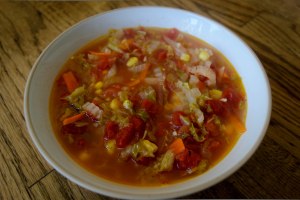
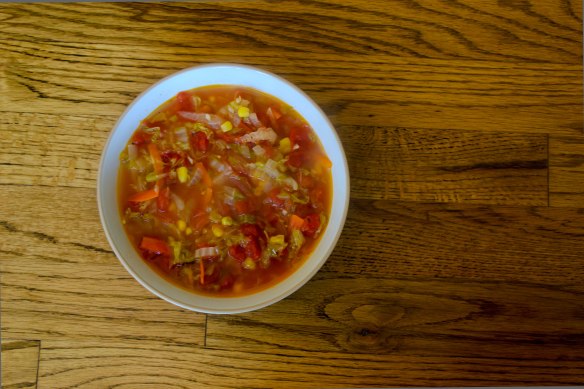
“18. Hot and Sour Vegetable Soup: Sauté chopped onions and garlic in vegetable oil until soft. Add chopped or shredded carrots, cabbage, and daikon or turnip, frozen corn, chopped boxed tomatoes with their juice and stock to cover; bring to a boil. Simmer for 15 minutes, then finish with about a tablespoon of rice wine vinegar per 2 cups of soup and loads of black pepper.”

Soup warms the belly like very little else.  This one, with the copious quantities of black pepper and the inevitable sour burn of the rice vinegar, promised a cauldron of comfort.  Quantities listed here make enough for two large bowls – quite enough for a deep December lunch.

2 TB vegetable oilFood Blog 2011-2013-0179

¼ large onion, diced

4 cloves garlic, minced

1 carrot

½ medium turnip

8 napa cabbage leaves

½ cup frozen corn kernels

14.5 oz can of petite diced tomatoes

2-3 cups chicken or vegetable broth

2 TB rice vinegar

½ tsp salt

½ pepper to start – add more to your liking

Heat the vegetable oil over medium heat and sauté the onion and garlic for a few minutes, until the onions just begin to pick up color.

Meanwhile (or beforehand, if you are not speedy with your vegetable prep), peel the carrot and turnip.  Once you have disposed of the scraps, continue to peel the carrot into thin strips with your vegetable peeler.  Cut the pile of ribbons in half or in quarters to create bite-sized pieces.

Cut the turnip in half from root to tip, then crosswise into thin slices.  Julienne each thin slice so you have slim matchstick pieces.

Stack the napa cabbage leaves, then roll into a thick cigar and slice as thinly as possible.

Add the vegetables to the onion and garlic.

Add the corn kernels and the broth and simmer the whole pot for 15-20 minutes, or until all vegetables are tender and everything is warmed through.

Add the rice vinegar, salt, and pepper, stir gently, and serve.

I loved everything about this soup except the tomatoes.  They weren’t a bad addition, there were just too many of them.  Were I making this again, I might decrease the quantity, or just drain the can and add only the liquid for the color and acidity.  The strings of carrot and turnip kept a minimal bite, and the combination of vinegar and pepper was near perfect.  The puckering sourness played against and contributed to the bland crunch of the vegetables, and alongside a hastily prepared hunk of garlic toast, this was a satisfying lunch on a chill day: it was heat, and comfort, where both were needed.

Food Blog 2011-2013-0178

Be well, all.

Giving thanks

The house feels empty.  Wednesday through Saturday, my family visited for Thanksgiving.  This morning, with them on the road home, fog hovering sticky in the sky, the cheery burgundy tablecloth in the washing machine, and a stack of lingering dishes I’m trying to ignore proclaiming themselves from the sink, our little home was stark and cold.  I could say that the memories of the holiday will keep me warm, but that would only be true in a metaphorical sense.  What I really want is another baked apple.

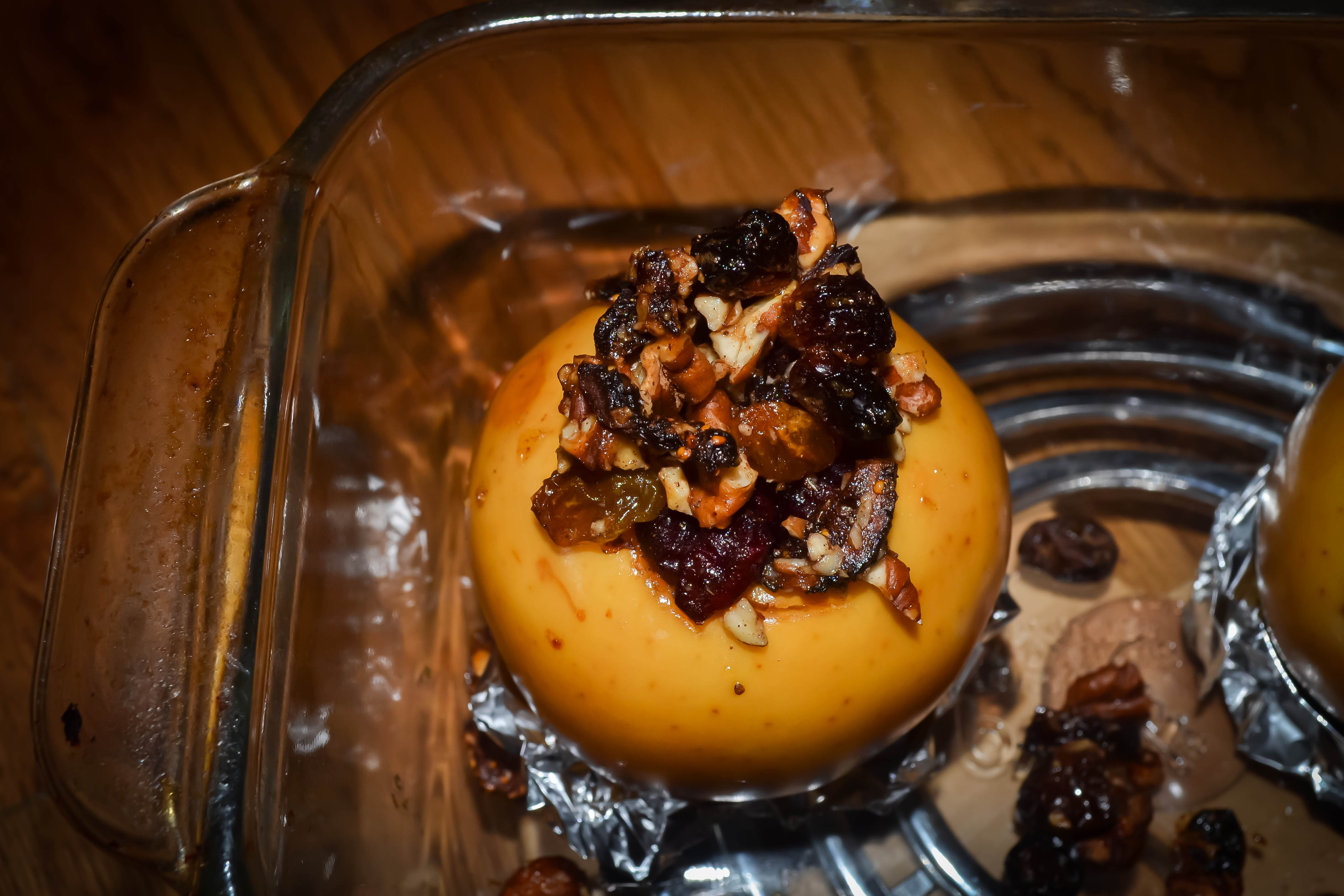
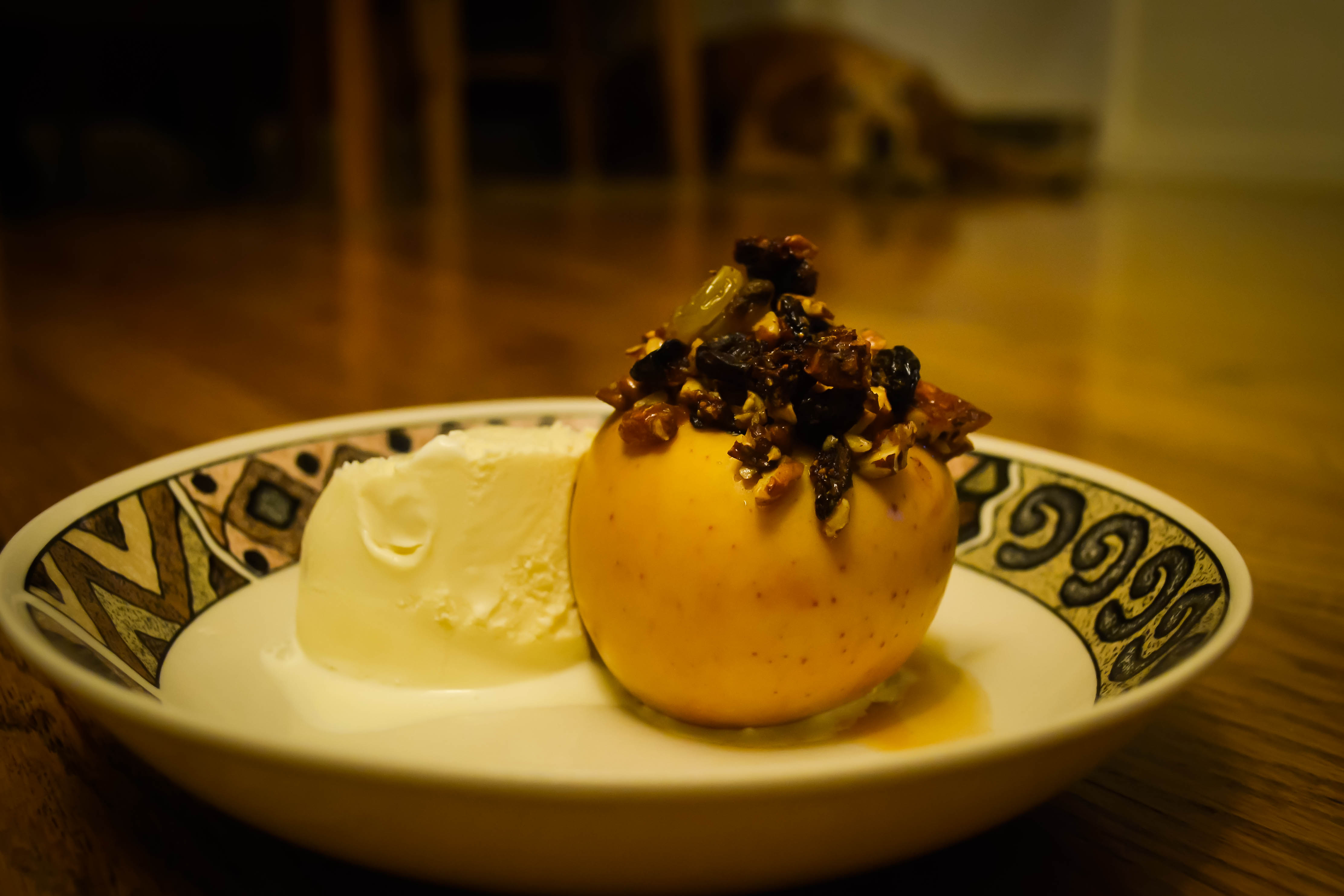
90. Baked Apples: Combine chopped pecans and chopped dried fruit (raisins, dates, figs, cranberries all work) and toss with maple syrup and a sprinkle of cinnamon, allspice or nutmeg or all three. Fill the cavities of cored apples with the fruits and nuts, dot each with butter, put into a baking dish and roast about 30 minutes, until tender. Better with vanilla ice cream.”

We had a few small apples from our local Farmers’ Market waiting for attention in the fruit bowl, so I set about collecting partners for them to make a dessert for two.

2 small apples

¼ cup chopped pecans

¼ tsp pumpkin pie spice (I agree with Joy the Baker that we should probably just make our own, but if you, like me, purchased some in a moment of confused weakness, this seems a harmless way to put it to use)

1-2 TB each:

chopped dried figs (I used black Mission, my current favorite)

craisins

golden raisins

3 TB maple syrup

Preheat the oven to 350F.

Core the apples, keeping the bottoms intact if you can.  If you can’t, just wrap the bottom quarter or so in aluminum foil and set them in a baking dish.  This will keep the filling from escaping.

In a small bowl, combine the nuts, fruit, and spice(s).  Drizzle in the maple syrup and stir gently to combine – you want even stickiness throughout.

Using a small spoon, or your fingers, insert as much filling as you can into the cored apples.  You will notice that this quantity makes about twice as much as you need for 2 small apples.  That’s okay.  The leftovers are a fantastic topping for oatmeal the next morning.

Once full, stow your apples in the oven for 30 minutes, or until they are tender when pierced with a knife.  Liberate, evacuate to a dessert plate, and pair with vanilla ice cream.

These were a lovely dessert.  They felt light, because they were primarily fruit, but were still sweet enough to satisfy that after-dinner craving.  The apples still had some resistance, but were warmed through and starting to collapse into themselves.  The ice cream was a perfect accompaniment – I wouldn’t want this dessert without it.  I might ideally have chosen an apple with more tartness to contrast against the sweetness of the syrup and dried fruit, but in such a case, especially if the apple were on the large size, I would advocate a longer baking time.  If the fruit and nuts protruding from the top of the apple start to brown too much, give them a tinfoil hat to hide beneath.


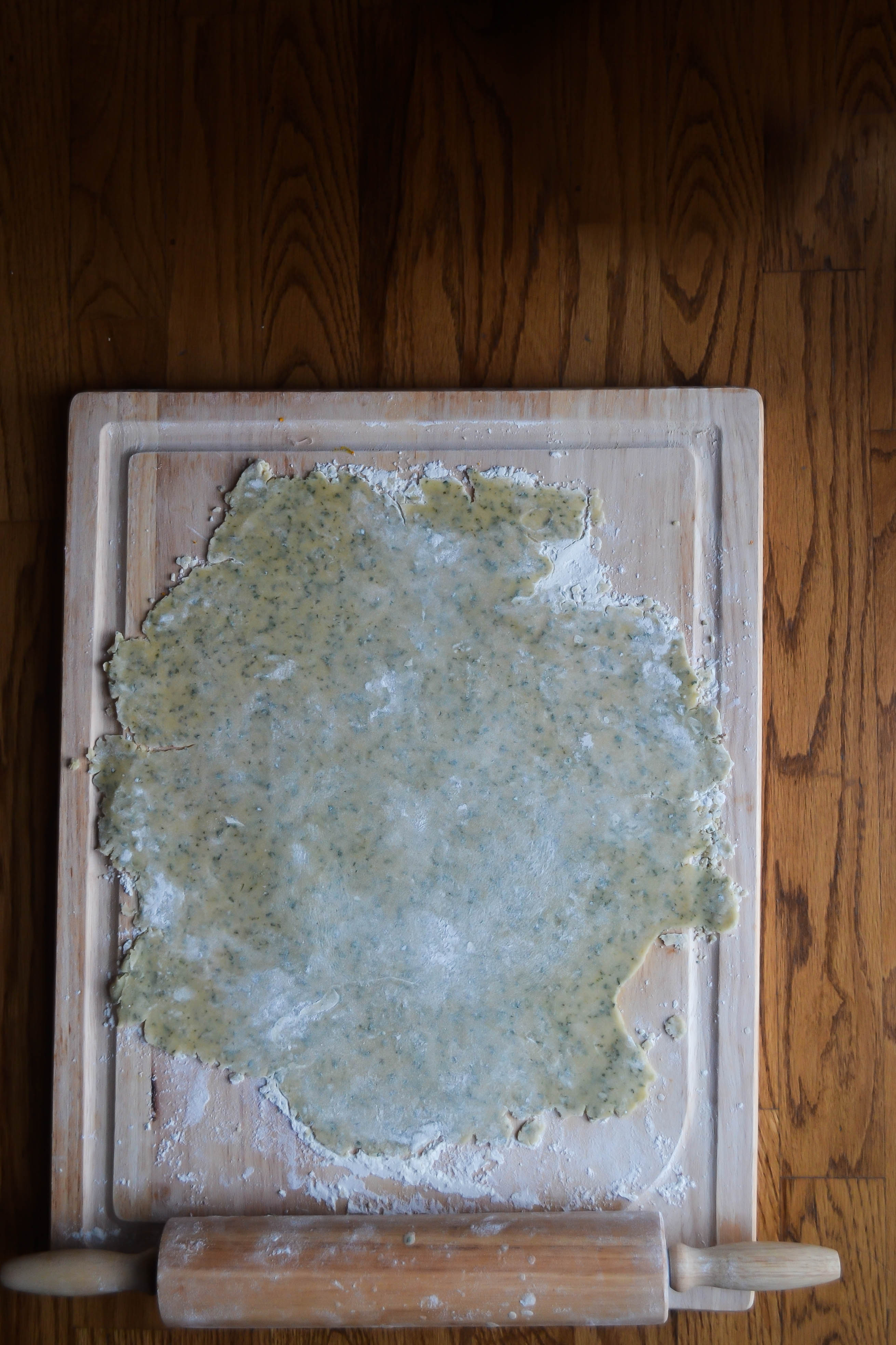
“84. Sage Crackers: Pulse 1 cup flour, 1 teaspoon salt, ½ cup Parmesan and 4 tablespoons cold butter in a food processor. Add ¼ cup cream and 1 tablespoon finely chopped sage.  When just combined, roll as thinly as possible, score into squares, sprinkle with salt and bake at 400 degrees until golden.  Let cool, then break into pieces.”

I’ve always liked a nice cheese-and-crackers platter as an appetizer option, and these seemed like a good option to lead into the big Thanksgiving meal: relatively easy to make, but impressive – who wouldn’t be staggered by the effort of making homemade crackers even with a homemade feast to produce as well?

Bittman’s directions and quantities here are pretty specific, so I just followed his directions.  I omitted the salt, because Parmesan carries so much of its own tangy hit, and my parents are not big salt eaters.  It should also be noted that pulsing this mixture until just combined does not create a rollable dough, unless my idea of “just combined” is different from Bittman’s.  However, turning out the just-clinging crumbs onto a floured board and kneading for only a minute or two does produce a nice textured ball of dough that can be rolled out with minimal sticking.

I’d recommend aiming for a shape as close to a rectangle as possible.  Further, roll that rectangle to the size of your biggest cookie sheet.  That way you can carefully transport onto the greased or parchment-lined sheet tray by draping the dough loosely over the rolling pin.  Score it very gently into rectangles or squares of your chosen size (cut halfway through the dough with a knife, not all the way through), and into the oven with it!

When I checked these 20 minutes later, they were a little more golden than I wanted.  They were, in fact, heading toward a burnished bronze (is that not the kindest way ever of saying they were all-but-burned?).

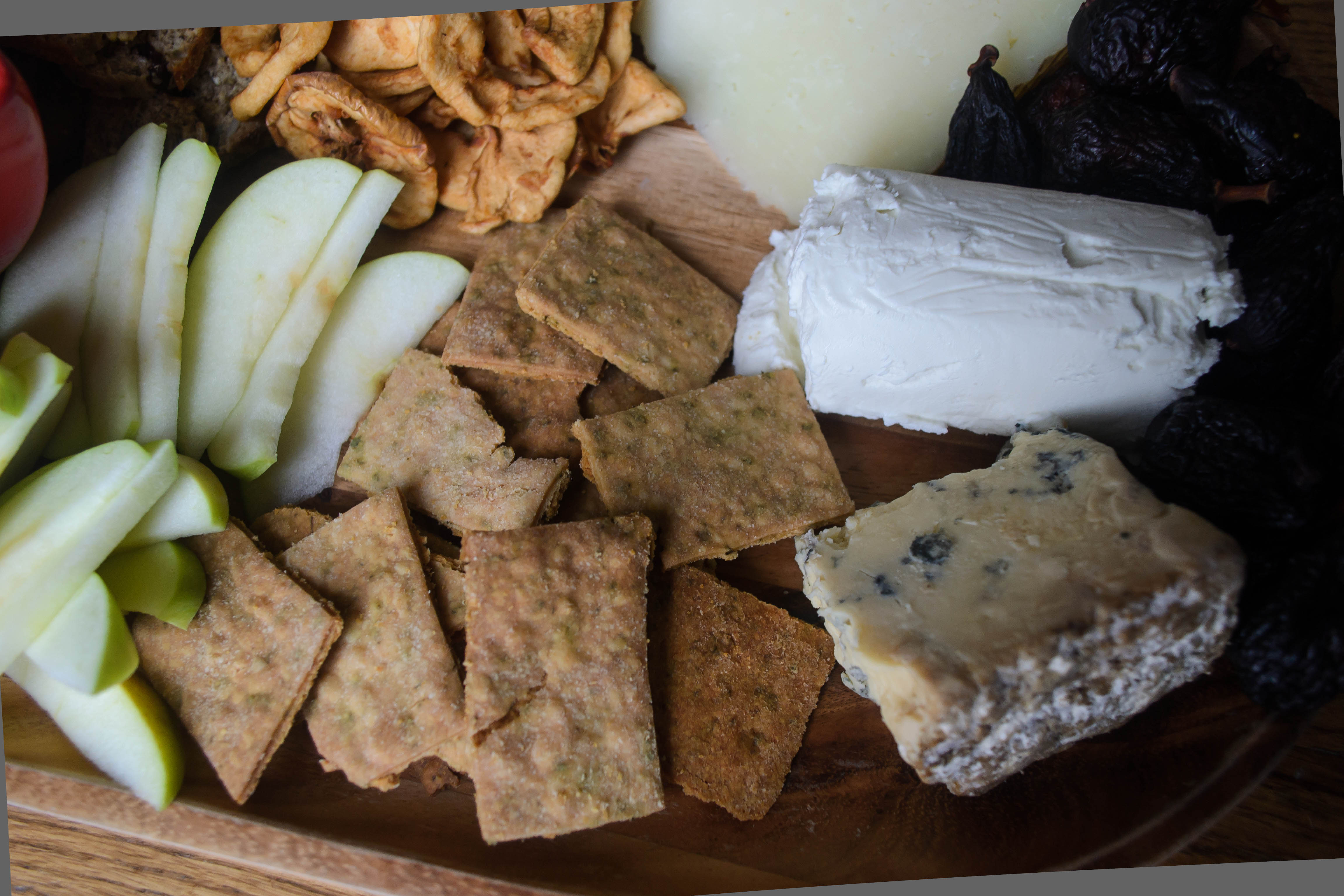
After the cracker sheet had cooled for a few minutes, I broke it along the scored lines into neat (mostly) rectangles and we passed around a few samples.  The outside edges, which were thinner, had a slightly over-toasted flavor we didn’t love.  The inside rectangles, though, were crisp and flavorful, with a flaky – almost chalky – texture reminiscent at once of pie crust and shortbread.  My dad in particular, who enjoys this texture, thought they were great.

And now the confession: my final Bittman for this week is a bit of a cheat.  But I’m okay with that, because I also think it was a bit of a cheat for him, though in the best and most useful way.

“101. Buy some cheese. Unwrap it and put it on a plate with some walnuts and fruit; let come to room temperature. Serve with good bread.”

This is the final numerical entry of the list, and that means it’s in the dessert category.  While I accept that some people prefer a cheese course to dessert, I’m not sure I consider this an acceptable option for Thanksgiving.  It is, however, acceptable as an appetizer idea, as I mentioned above.  So that’s what I did.  In addition to the sage parmesan crackers above, I made my favorite craisin rosemary biscotti-style crackers with white bean and almond dip, and set them all out with some creamy Stilton, a nice rich chevre, and a wedge of Manchego obtained from a stand at the Farmers’ Market where we finally decided we’d had too many samples to feel right about not purchasing.  Surrounding these, I added dried apple rings, black Mission figs, and a fresh Granny Smith cut into slim slices.  The walnuts, which I was ready to add as well after a brief toasting, were subjected instead to accidental scorching, and had to be sacrificed.  We will speak of them no further.

What can you say about a cheese platter, besides that it was delicious?  We adored the Manchego, and soft crumbles of Stilton paired well with the fresh apples.  I tried fig and goat cheese together, and now I think chevre-stuffed-figs sounds like an amazing experiment.  We decimated the platter in little over ten minutes, but thankfully were not too stuffed to take full advantage of the turkey dinner that followed.

With Thanksgiving handled, that leaves only five weeks of 2012, and only twelve Bittman selections to go!  New Year’s Eve is on a Monday, but that still counts as this year if I need to jam in a few final selections, right?

I think I can, I think I can, I think I can…

Last salad

I think Fall has finally found Los Angeles, and only a week and a half to go before Thanksgiving.  Within a week, we went from temperatures in the mid-80s to a high of barely 70F.  My living room went from a comfortable lounging 75F to barely hitting 70 despite blinds wide open to catch the sun all day.  Thankfully, the items I have left on my Bittman list accommodate this weather change.  Today I have to report the last salad of the list, and a foray back into desserts.  Both have decidedly autumnal collections of flavors (I wrote “flavor profile” first, and then I thought, “who do you think you are?”).  Many of the food blogs I read have been reporting for the past week or two on Thanksgiving recipes, and I thought about doing that too.  But then I remember that Bittman’s entire list is conceived as Thanksgiving sides, so if you’ve been following this little blog for any length of time, you’ve been seeing Thanksgiving options – with only a few disruptions – for the past two years!

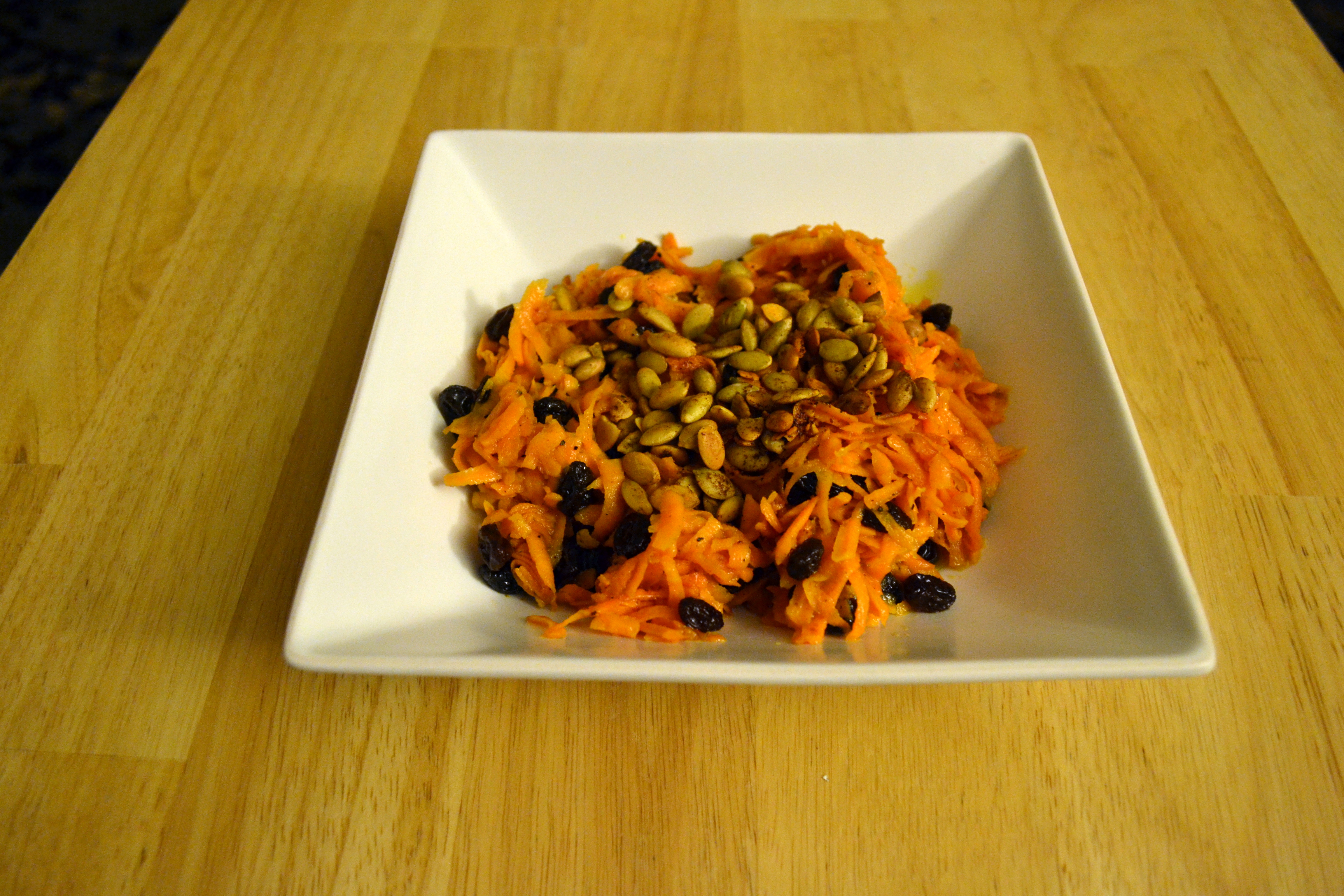
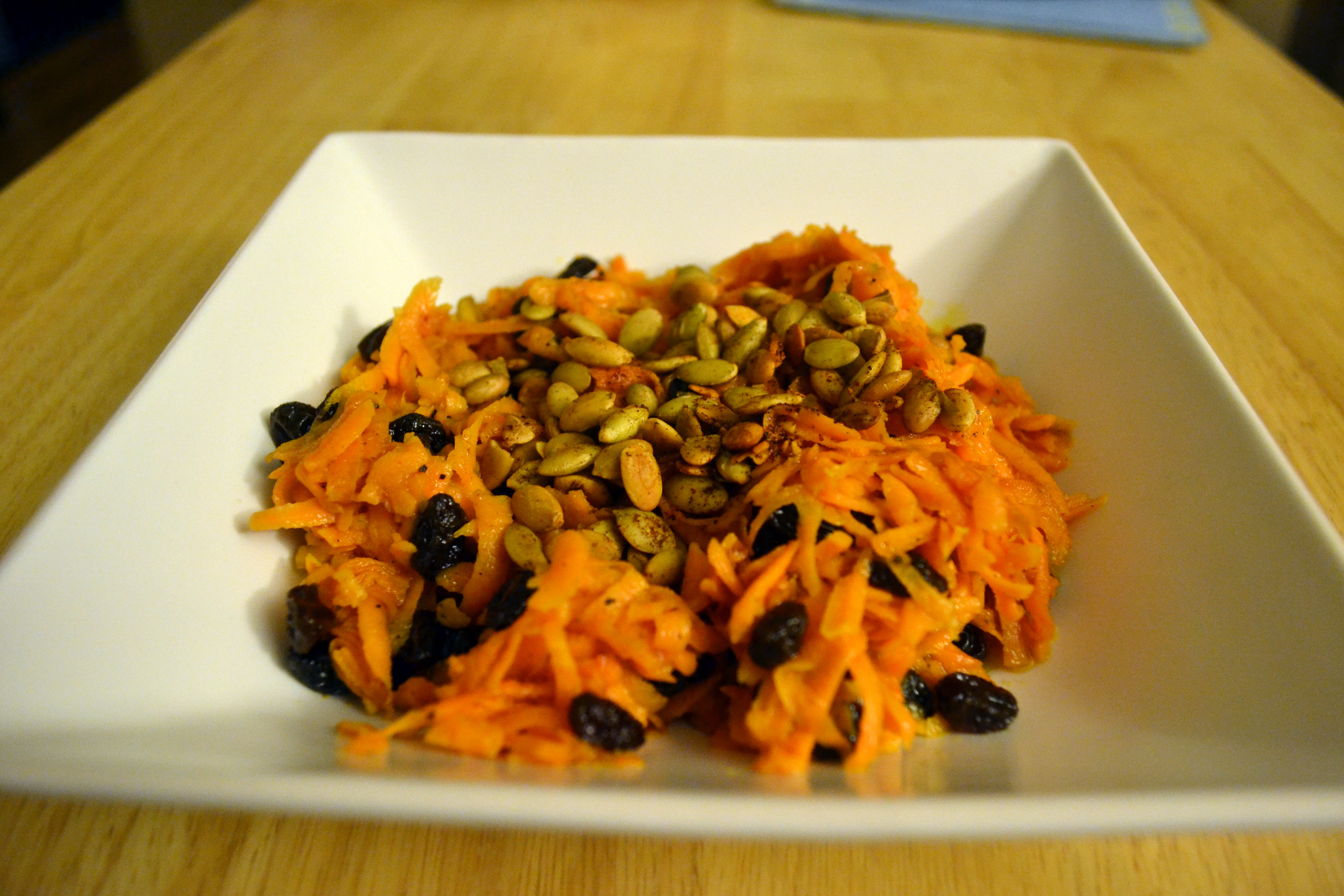
“67. Sprinkle shelled pumpkin or squash seeds with a little chili powder; roast, shaking occasionally, until lightly browned. Combine with grated sweet potatoes (raw or lightly sautéed in butter or oil), raisins and a vinaigrette made with red wine vinegar, olive oil, Dijon mustard, a touch of honey and maybe a little more chili powder.

I gathered:

1 small sweet potato

1 TB pumpkin seeds

chili powder to taste (mine is really mild – I probably used about a teaspoon)

2 TB butter

2-3 TB raisins

These measurements look small, but I was planning this for just the two of us and didn’t want any leftovers.

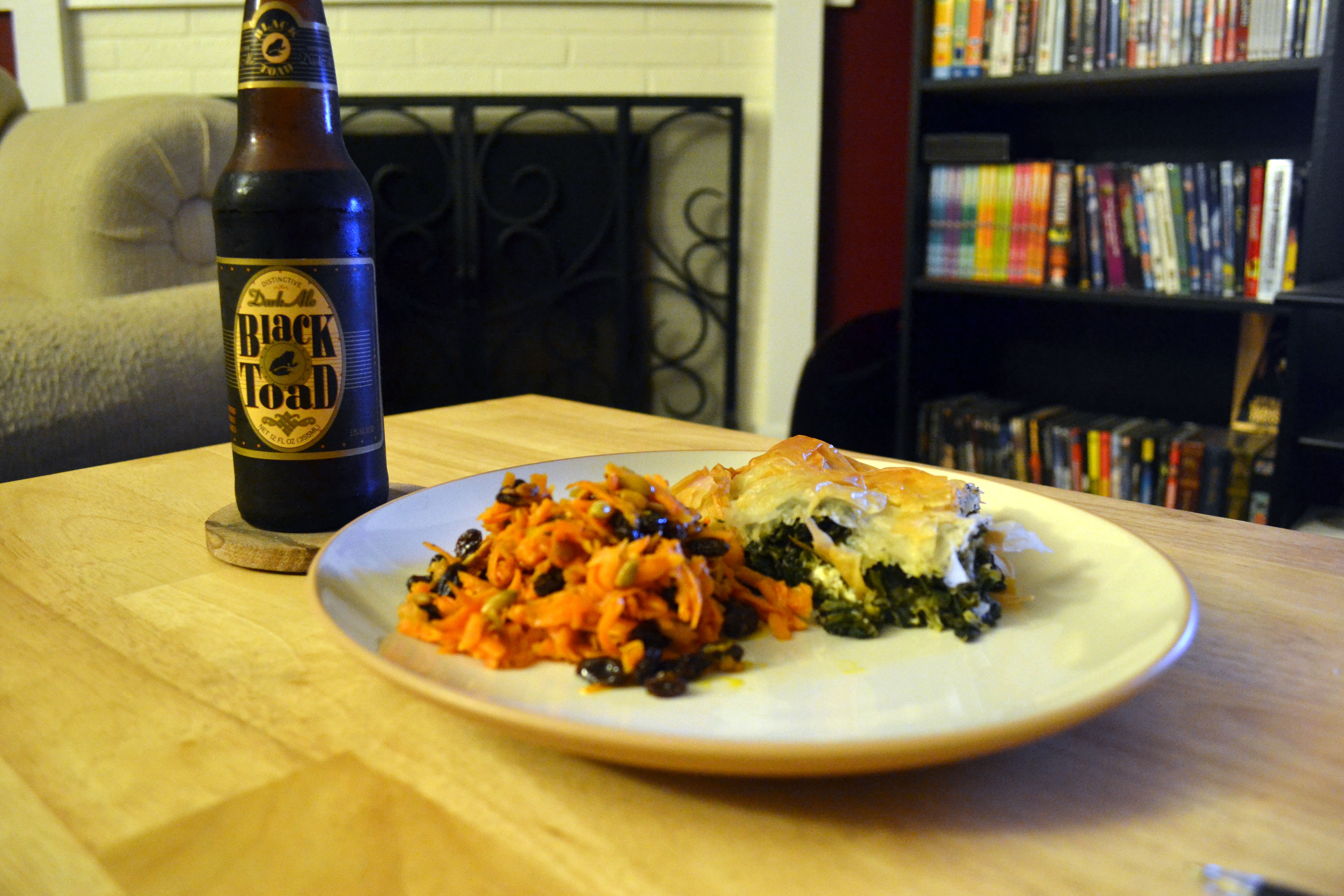
We were having this “salad” with spanakopita, so I decided to capitalize on the heat of its baking.  I popped the pumpkin seeds onto a baking tray, drenched them with chili powder, and tucked them into the oven for a few minutes.  When you hear the first couple of pops, they are done.  Don’t leave them too long – not only will they burn, they will propel themselves all over your oven.

I set aside the lightly toasted seeds and turned to the sweet potato.  N. and I proved in earlier experiments that we don’t like it raw – the starchy feel when you chew is just too much – so I was glad Bittman allowed for a cooked option.  I melted the butter while I grated the sweet potato, and tossed the shreds of bright orange onto the fizzing fat.  If you have more patience than I do, you might wait for the butter to brown a bit to add nuttier, deeper flavor to the sweet potatoes.

I let the little ribbons of sweet potato cook for a few minutes over medium heat.  The goal was not to brown them, just to lightly cook them through.  When I estimated them to be two minutes from done, I tossed in the raisins and folded the mix together.  This gave the raisins time to match the sweet potatoes in temperature, and it allowed them to plump up and take in some buttery flavor.

Heat off, I turned to the dressing.  Whisk together:

1 TB red wine vinegar

1 tsp honey

1 tsp dijon mustard

sprinkle of chili powder

2 TB olive oil

I tossed this lightly with the sweet potatoes and raisins, then topped them with the pumpkin seeds (which I almost forgot AGAIN!  What is it with me and missing the crunch?) and it was ready for tasting.

We liked this.  I’m not sure it read as a salad – in fact I’m not sure what it read as at all.  At once, it was not quite a salad, but also not quite a vegetable side, and not quite a chutney.  But it was tasty.  The red wine vinegar was acidic enough to counter the sweetness of the potato and raisins nicely.  It was a refreshing bite against the richness of our spanakopita.  The crumbling cubes of feta hidden in the spinach blend imparted the final necessary taste: a briny saltiness so welcome to the rest of this sweet and butter-drenched meal.

I took my next choice (partly made because it sounded delicious, but partly to use up the phyllo) to an election party.

“93. Pumpkin-Raisin-Ginger Turnovers: Mix pureed cooked pumpkin, raisins, chopped crystallized ginger and sugar.  Brush a sheet of phyllo with melted butter and cut lengthwise into thirds. Put a spoonful of the filling at the top of each strip. Fold down to make a triangle and repeat, like folding a flag. Repeat with remaining filling. Brush the tops with butter and bake 20 to 30 minutes. Dust with powdered sugar.

Whether you are elated, distraught, or ambivalent about the results of the vote, these little turnovers were worth celebrating over.

1 15 oz. can pumpkin puree

½ cup sugar

½ cup raisins

¼ cup finely minced crystallized ginger (or you could try grating this on your microplane.  I’m not sure how that would work, but since candied ginger is gummy and hard to chop, it might be helpful)

butter

phyllo dough

I couldn’t resist adding about a teaspoon of cinnamon.

First, I preheated my oven to 375F and put the butter into a small pan, which I set over low heat so it would melt but not brown.

I shlooped the pumpkin from the can to a bowl and whisked in the sugar and fruit.  I suggest you use a fork for this, not a traditional whisk.  The mixture clumps and sticks in the slender spokes and results, if you are at all like me, in cranky frustration.

When everything is well mixed, turn to the phyllo.  If you’ve never worked with it before, don’t be afraid.  The amazing way it changes from dry papery sheets to flaky, buttery pastry is worth the challenge.  Here’s what I do:

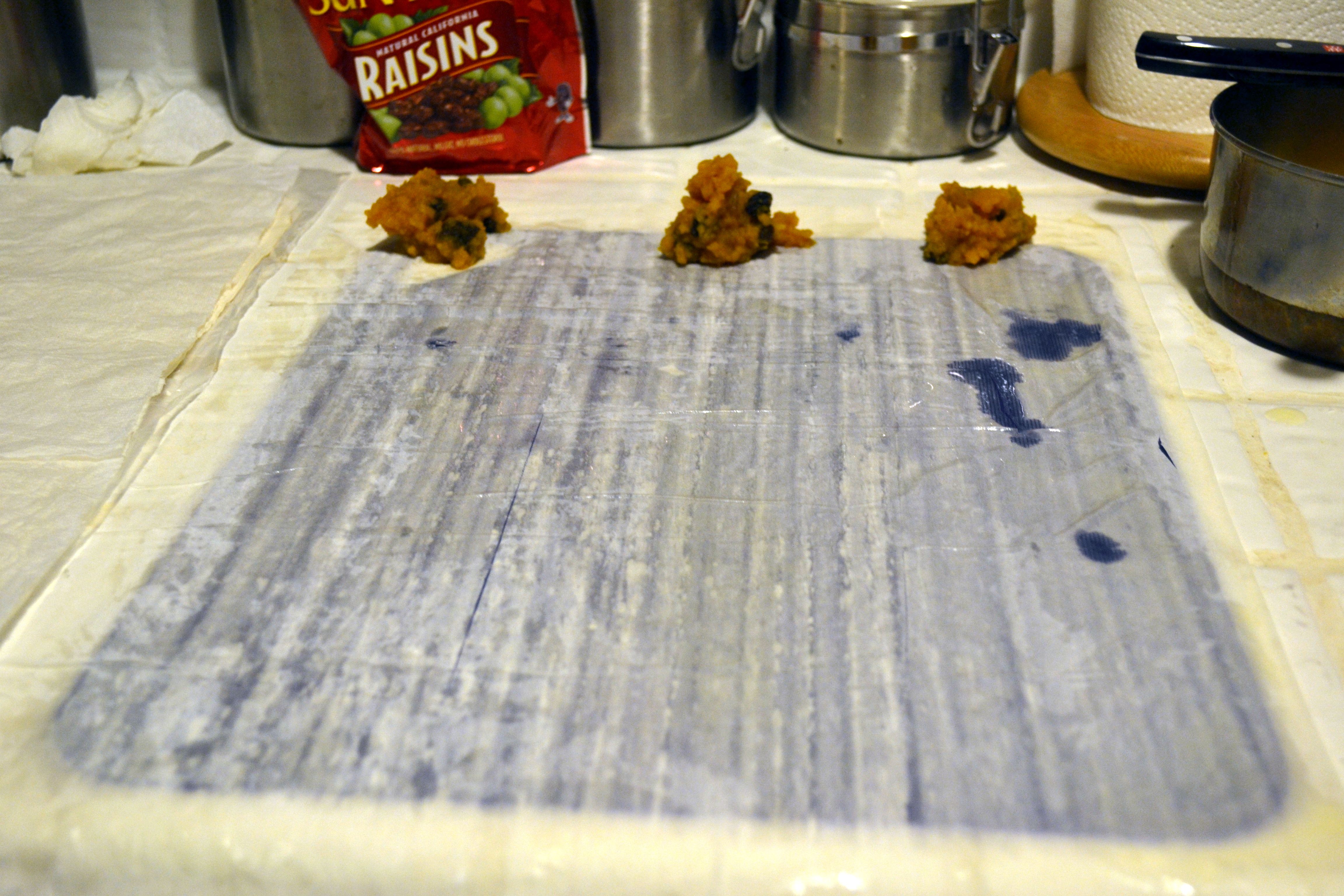
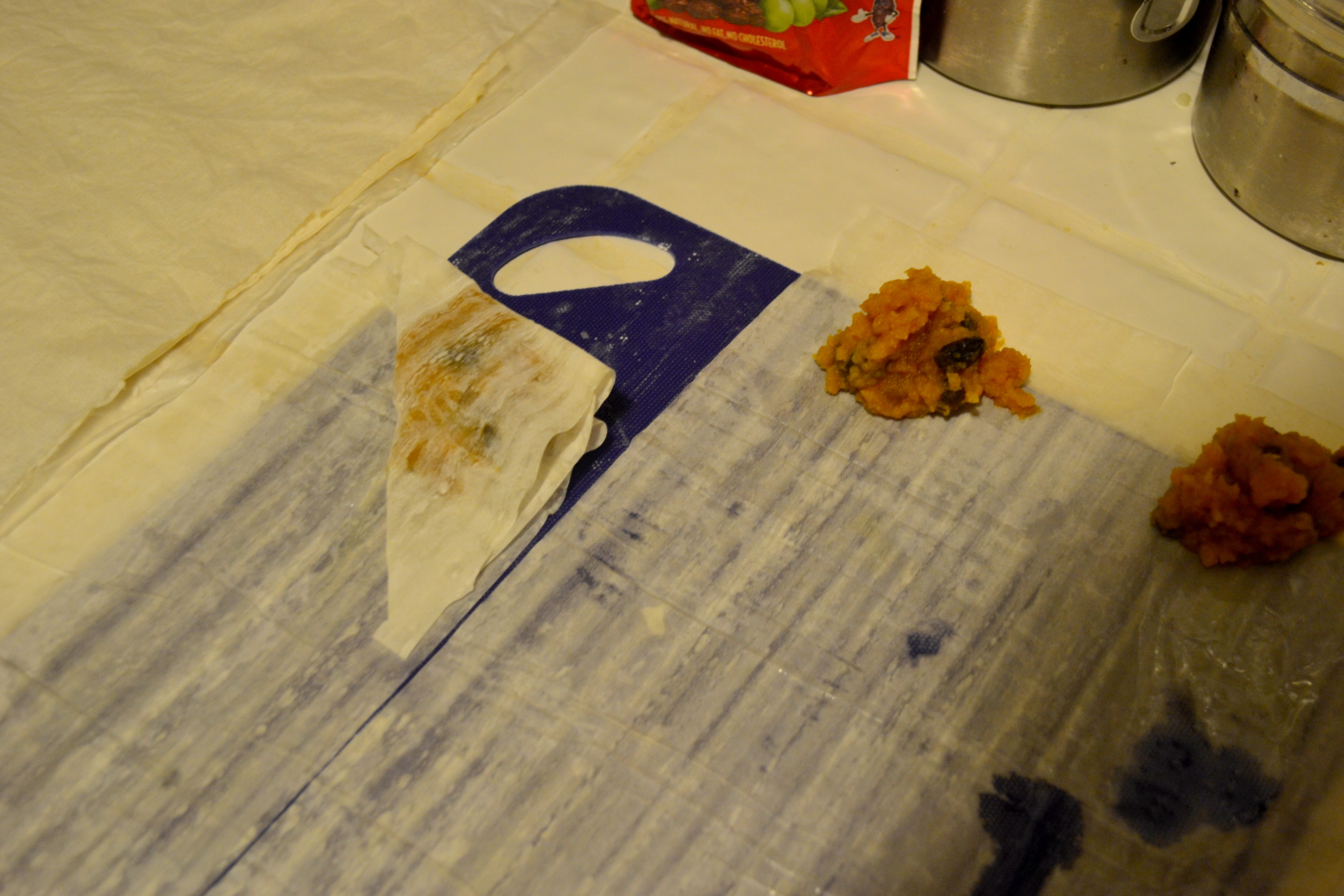
Set up an assembly line on your counter.  At one end, unroll the phyllo and set a just-damp kitchen towel (or couple of paper towels) over the top.  This will help, if you are a slow worker, to prevent it from drying out and breaking.  Next to that, you need a board big enough to accommodate one sheet of phyllo.  Next to that, place your butter, followed by your filling, followed by the final resting place for your wrapped confections.

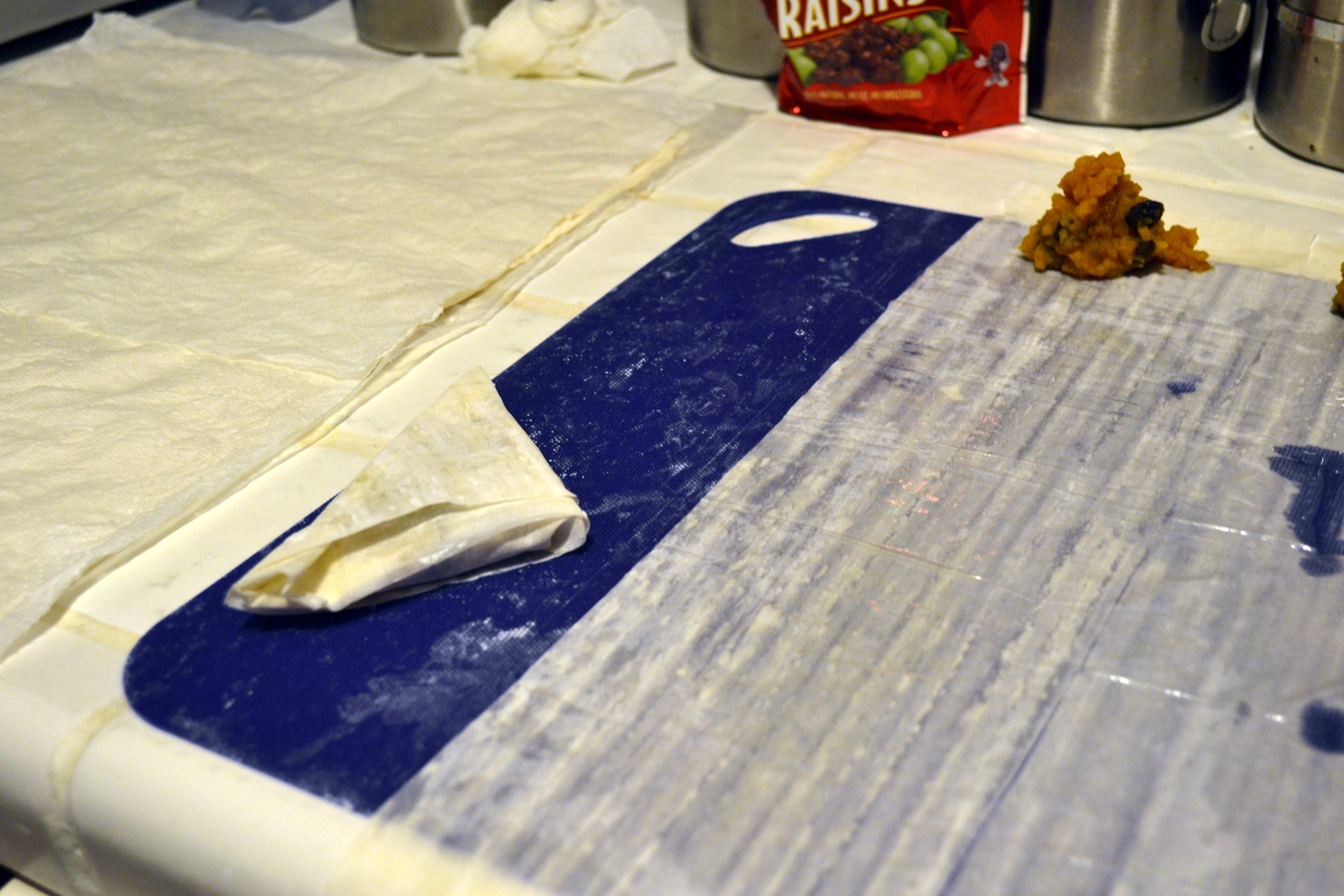
Carefully peel off one sheet of phyllo and place it on your board with the shorter end facing you.  Recover the remaining stack with the damp towel.  Using a pastry brush, brush the whole sheet with butter.  Cut it in long thirds (you’ll begin your cuts on the short edge of the rectangle, so that you create three long, thin strips, as opposed to three short, squat strips).  Then, place about two tablespoons of filling at the top of each strip, and begin to fold in triangles.

To make the first fold, bring one corner down to the opposite edge of the strip.  Don’t press too hard, or the filling will ooze out everywhere.  The second fold will be straight down: the remaining corner (now doubled because you’ve folded over your first triangle) folded down onto the same edge.  Continue to fold, keeping your filling in the center of a triangle, until you reach the end of the strip of phyllo.

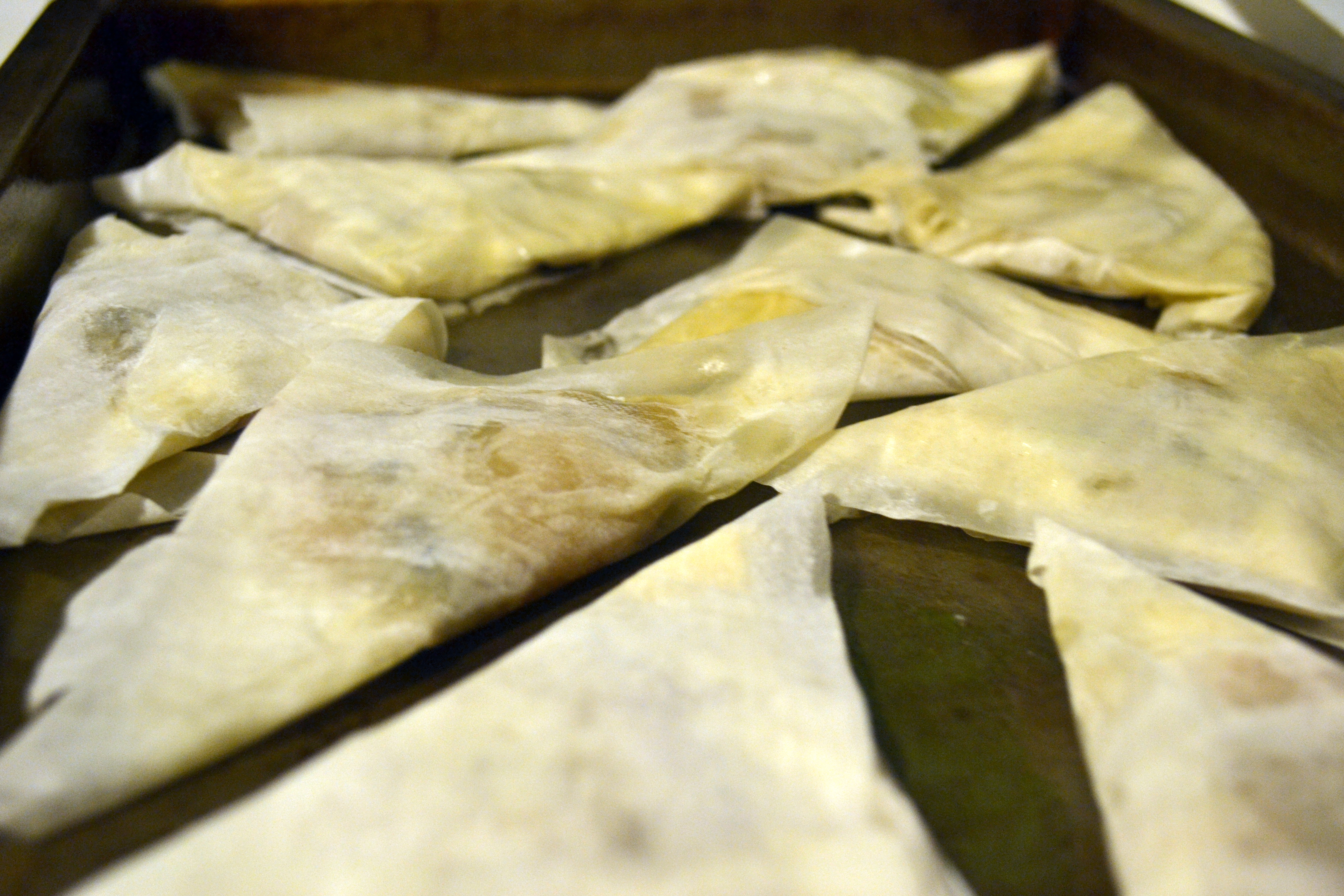
Place that on a parchment-lined or greased baking sheet and brush the top with a little more melted butter.  Repeat until you run out of filling.  Since these won’t rise or spread, you can place them quite close to one another on the baking sheet.  Don’t overlap them, though, because only the dough exposed to the air will brown.

This sounds complicated, but once you get into a rhythm it’s relatively easy and quite satisfying.  You end up with two trays of sweet little parcels that you can stow in the oven for 20-30 minutes until they become magically golden and flaky.

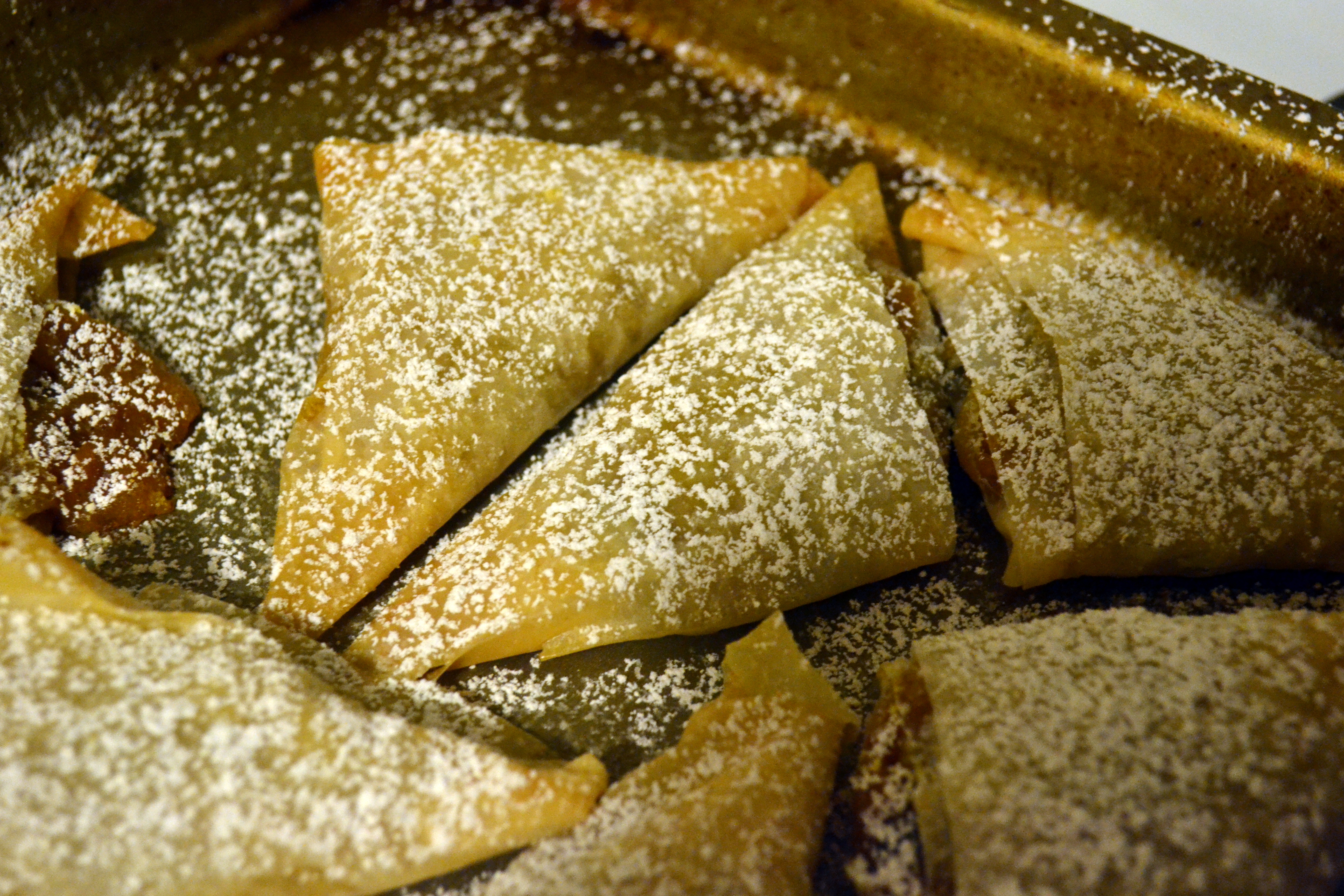
When they were done, I dusted them liberally with powdered sugar and tented them with aluminum foil to take to the party.  I brought home an empty, sugar dusted tray with a lone raisin abandoned in one corner.

They were so tasty.  The pumpkin-raisin-ginger combo was insane: earthy and sweet and, with the addition of the cinnamon, warmly spiced.  Inside the phyllo, it was a contest of texture too: unremittingly soft pumpkin with the occasional chewy juicy punch of raisin, against sharp flaky crunch of sugar-dusted pastry.  We couldn’t resist tasting a few before dinner, and then we had to revisit them again for dessert.  These will, I suspect, make repeat appearances in my kitchen.  They could probably be made a few hours ahead as well, or transported and baked on location: wrap them up, dredge them with butter, and store them under a damp towel or some plastic wrap until ready to bake.  If you don’t like pumpkin pie, or you’re tired of it (I know, heresy!), these might be a fun alternative Thanksgiving dessert option.

Trick or Treat

Halloween is easily in my top three holidays.  I have to give the prize to Christmas, because it means family and love and sweaters, but Thanksgiving and Halloween chase each other in circles to gain second place.  Despite that love (overwhelming in some cases, especially if you, like N., are not invested in costuming yourself at every possible occasion), this is the first year in almost a decade that I’ve done nothing to celebrate.  No costume.  No party.  No decorations.  We bought candy for the six kids that showed up (only six!  The whole evening!  Was it just because it was a Wednesday, or do kids not trick or treat like they once did?) and I definitely listened to the Halloween party mix my friend D. made for me a few years ago, but it felt a bit like a lost holiday.

I did embrace the season, though, the following day.  Having Thursdays off gave me the opportunity to do something I’ve been wanting to do for years: pillage Target’s day after Halloween sale for leftover clearance items (read: treats!).

The tricks began when I began work on the evening’s dinner.  It was, I realize in retrospect, a bit of a Chopped style enterprise: appetizer, entree, and dessert, each made with ingredients I’d not expected to meld.  In each case, however, the “trick” aspect of the dish was my doing, not the recipe’s.

“12. Garlic-Rosemary Figs: Soak dried figs, stems removed, in warm water until plump; drain and halve. Heat rosemary and lightly smashed (and peeled) garlic with olive oil on medium-low heat, until softened. Add figs, along with some fresh orange juice. Cook until saucy.

Pairing figs, garlic, and orange juice seemed odd.  Nevertheless, I collected enough for one portion (this was not N.’s kind of dish):

6 dried black mission figs

1-2 tsp fresh rosemary

2 smashed, peeled garlic cloves

1 TB olive oil

juice from 1 small orange (⅓ – ½ cup juice)

I heated some water in my teakettle and poured it over the figs (which I’d halved prematurely.  Apparently paying attention to the directions is kind of important), which I let stew on the counter for half an hour.

Figs vaguely plumped, I drained them and set them aside, then put the garlic cloves, rosemary, and oil into a cold pan.  I heated it over medium for five minutes or so – just until the rosemary started to sizzle and the garlic turned a little blonde.  Then I added the figs and orange juice, and simmered for fifteen minutes or so, until the orange juice had reduced considerably.

I plated, I ate, and I considered.  This didn’t taste bad, but it didn’t marry absurdly well either.  The rosemary and the figs were lovely.  The orange juice and figs were fine (though the orange was a bit overpowering).  The garlic and figs were… unobjectionable.  They just weren’t my favorite.

I must say, though, I recalled while I was cleaning up after dinner that this entry was in the “Sauces and Relishes” category.  I had eaten it straight.  This was, perhaps, why I wasn’t enamored of it.  Therefore, I’d recommend spooning this over lamb chops, or pork tenderloin, either of which would add some savory notes to make the garlic feel less anomalous.

Though this “appetizer” wasn’t fantastic, I ate it with a fantastic grain-salad-turned-hash inspired by Smitten Kitchen.  I want to revisit this hash, because I think it could use some additions, but here are the basics:

Line a baking sheet with aluminum foil.  Set it in the oven and preheat to 400F.  Yes, you are preheating the pan along with the oven.

Peel and halve a butternut squash.  Seed half of it and cut that half into small cubes.  In a bowl, toss the cubes with salt, pepper, and olive oil, then tumble onto the baking sheet (where they will sizzle immediately – this is a good thing) and stow back in the oven for 35-45 minutes, or until they have golden edges and creamy soft middles. 

During the last ten minutes of squash roasting, push the squash to the sides of the pan (or just grab another pan, if you aren’t invested in avoiding dishes, like me) and stack 4 cups or so of trimmed, cut kale that has also been tossed in olive oil, salt, and pepper.  The kale and squash will cook down a little more together, and you will be left with something not quite like kale chips, but a bit more textured than if you’d boiled or steamed it.

While the squash and kale roast, cook 1 cup of bulgur wheat in chicken (or vegetable) broth.  When done, fluff gently with a fork and toss with squash and kale.

During the last few minutes of roasting time, toast 2 TB pumpkin seeds in a dry pan until they begin to snap and crack.*  Be careful not to burn them.  Toss with bulgur and vegetable mixture.

In the pumpkin seed pan (again, avoiding dishes), heat an egregious quantity of butter until foamy and crack in an egg to fry until the edges frizzle and brown and crackle.  Despite a few careful taps, on this egg of all eggs – the egg I wanted to photograph quivering atop my hash, the egg I wanted to show just cut and lusciously runny – I somehow shoved my thumb through the yolk and it broke all over the pan.  Nasty trick, egg.

Nevertheless, I piled my hash up on my plate, carefully laid the fried egg over it, and dug in.  It was a hearty, pretty, perfectly autumnal dish.  It needs some tweaking before I’m thrilled with it – perhaps some sautéed leeks folded into the bulgur, or some light spices on the butternut squash – but this was a delightful start.

I turned to dessert:

“96. Sweet Autumn Gratin: Combine cubed pumpkin or sweet potato with cranberries and hazelnuts in a buttered baking dish. Sprinkle with brown sugar and toss. Drizzle cream all over, dot with butter and bake until soft, bubbly and browned, 50 to 60 minutes. Re-warm before serving if you like.

I’m going to give you a list not of my ingredients and procedure, but of what I should have used and done.

1 big sweet potato, peeled and diced

½ cup dried cranberries (I didn’t have fresh, so I don’t know what they would be like.  Presumably more successful because they would emit, not swallow, liquid)

½ cup walnuts, coarsely chopped (I couldn’t find hazelnuts anywhere – who would have thought this would be the food item I would miss most from Oregon?!)

¼ – ½ cup brown sugar, depending on how sweet you like it

¼ cup heavy cream

¼ cup butter

Preheat the oven to 400F.  Butter a 9×13 inch pan (my round, much smaller dish was a poor choice).

Toss the sweet potato chunks, cranberries, and walnuts with brown sugar.  Spread them out in the pan in an even layer.  Pour on the cream, then pinch off pieces of butter and dot them over the top.

Bake for an hour, or until the sweet potato pieces are fully cooked.

I did few of these things.  My sweet potatoes were in bigger-than-they-should-have-been chunks, piled up in a small casserole dish, starving for cream (I only had a tablespoon or two) and shorted on sugar.  As a result, at the end of an hour they were hot but still resistant in texture.  I think what you want is melting, creamy softness.

Tricked again.

To remedy this problem, I tried several things.  First, I made a bourbon hard sauce (equal parts sugar and water, stir to melt.  Add ¼ cup butter, stir carefully until it melts.  Add a shot or two of bourbon, cook just a minute or two to take the edge off) to pour over the top.  This helped, and I willingly ate a serving, but it was lacking whipped cream or ice cream or, bizarrely, pie crust.


I didn’t figure out the pie crust thing until the next day when I was making empanadas for dinner.  As I pressed my fork into the edge of the dough to crimp it, I was flooded with the right answer: tiny hand pies stuffed with my sweet potato mixture!

This was clearly the right thing to do.  Saturday afternoon, I unrolled a pie crust on my counter, cut out 3 inch circles, and proceeded to fill them with a teaspoon or two each of the gratin, which I’d mashed with a fork to make smoother and therefore more manageable.

Once filled, fold in half, press and then crimp with a fork, and brush with egg wash (1 egg yolk + 1 TB water).  Sprinkle with turbinado or other raw, chunky sugar, and bake in a preheated 400F oven for 15 minutes, or until the tops are golden brown and the dough is flaky.

These make lovely, tiny snacks.  The craisins give a punch of tartness to the sweet, earthy, almost heavy sweet potato and walnut pairing.  There are subtle floral hints in there, because before putting it away that first night I admit to dumping the bourbon sauce over the whole thing, but this adds a flavor I wouldn’t change.  The dough is buttery and flaky and collapses easily around the filling, and it’s difficult to prevent yourself from standing over the pan as it comes steaming out of the oven and eating four or five in a row, scalding your tongue and not caring at all.

Perfect November treat.


* You could, I suppose, use butternut squash seeds, if you are the sort of person with the forethought to save, rinse, and dry the seeds while you clean your squash.  I, clearly, am not.

Smitten

There were always only two marginally clever possible titles for this post.  I chose this one for several reasons.

One.


Two.


Three.

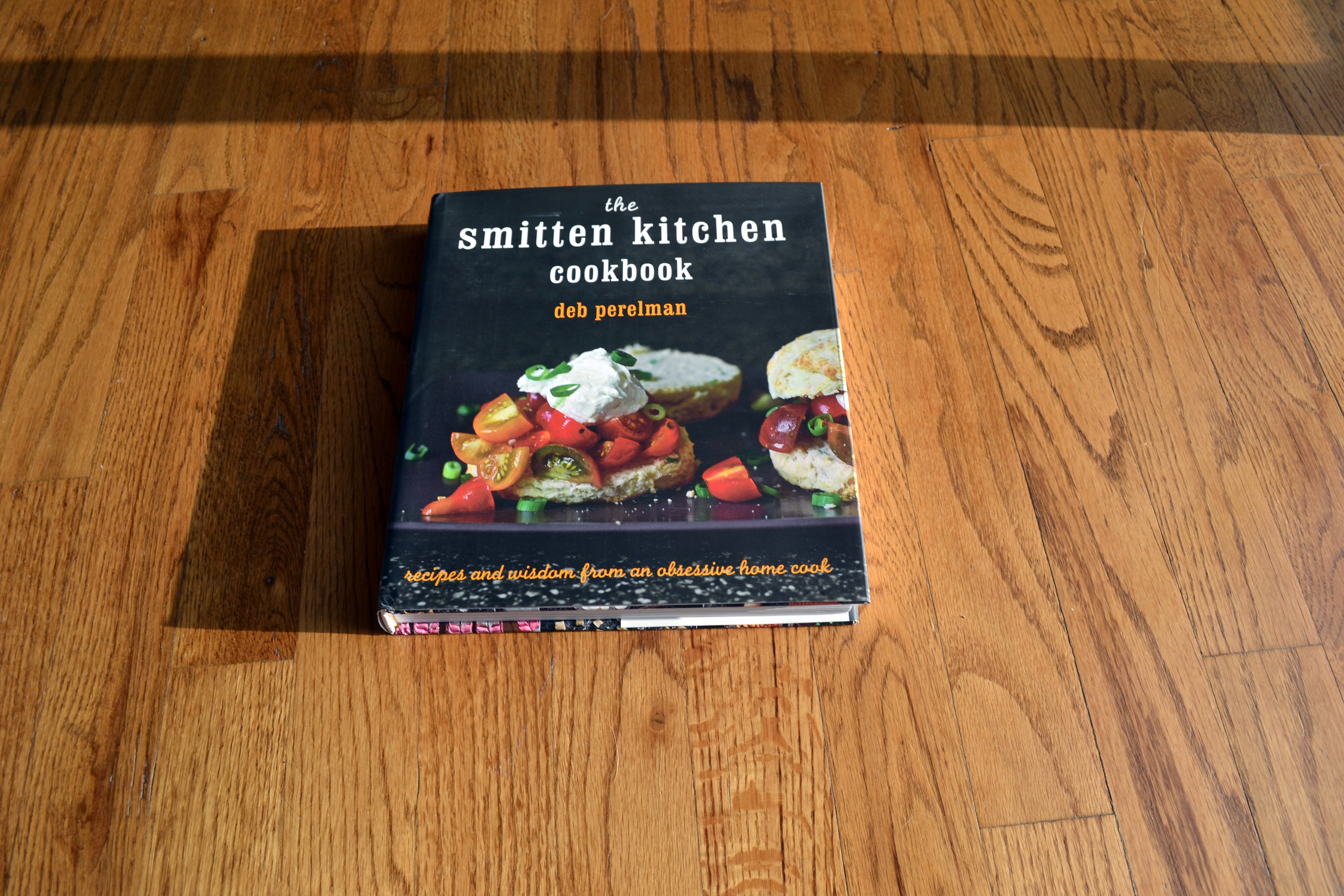
This week Deb Perelman’s “The Smitten Kitchen Cookbook” arrived to me, unceremoniously dumped in its delivery box over my porch railing (our mail carrier is not the most careful, as the wads of advertisements half-shoved into our mail slot prove).  That was the last blasphemous treatment it received, however.  I went through it page by page, almost shouting at nearly every recipe, because all sound delicious, and many are simply brilliant.  Her combinations are unexpected but make complete sense, and her writing is so human and real and honest – on the site as well as in the book – that I can’t stop picking it up and flipping through it again.  It doesn’t matter which page I open to.  I’m drawn in by the food but also by the language, and together they make me want to run to the kitchen every time.

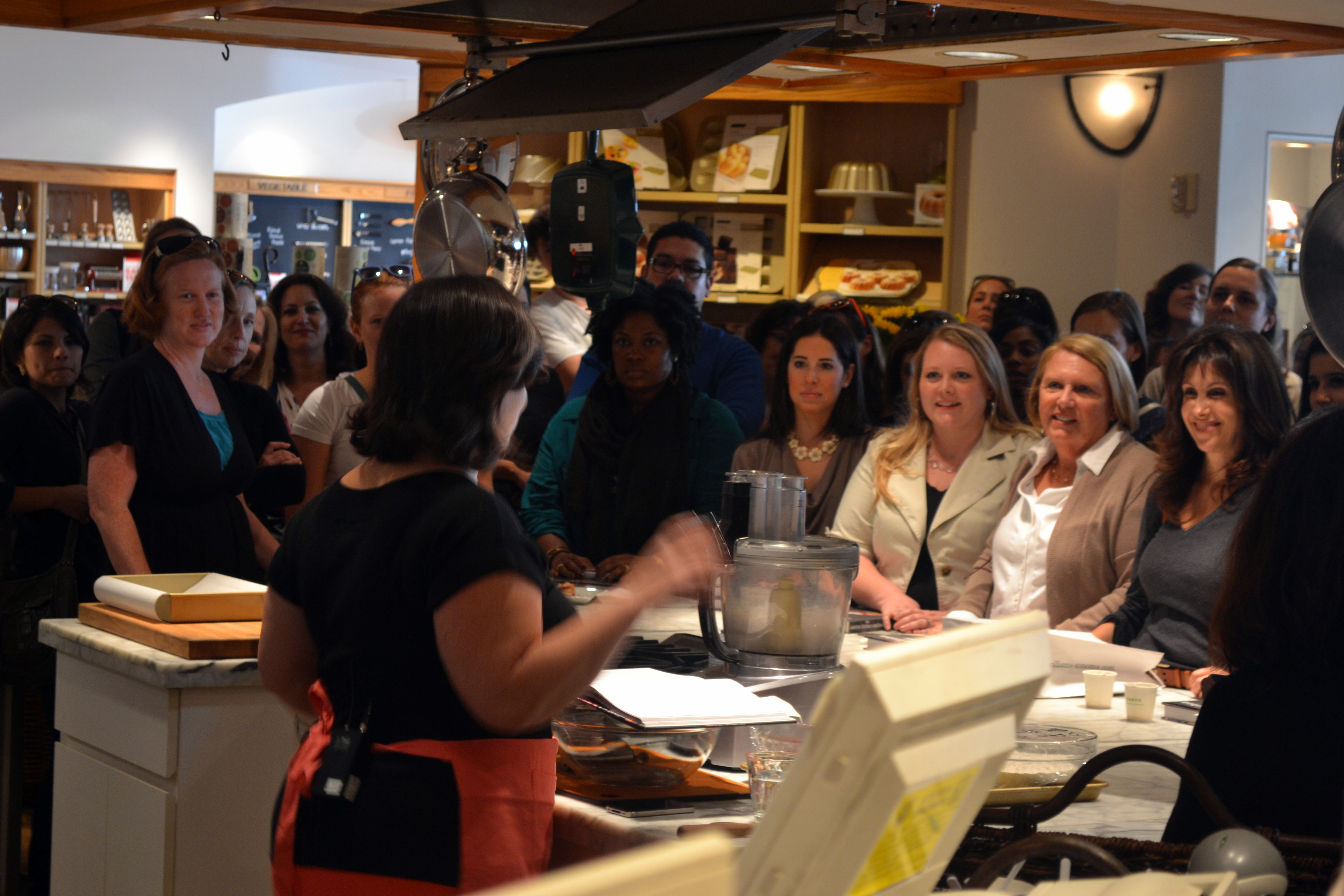
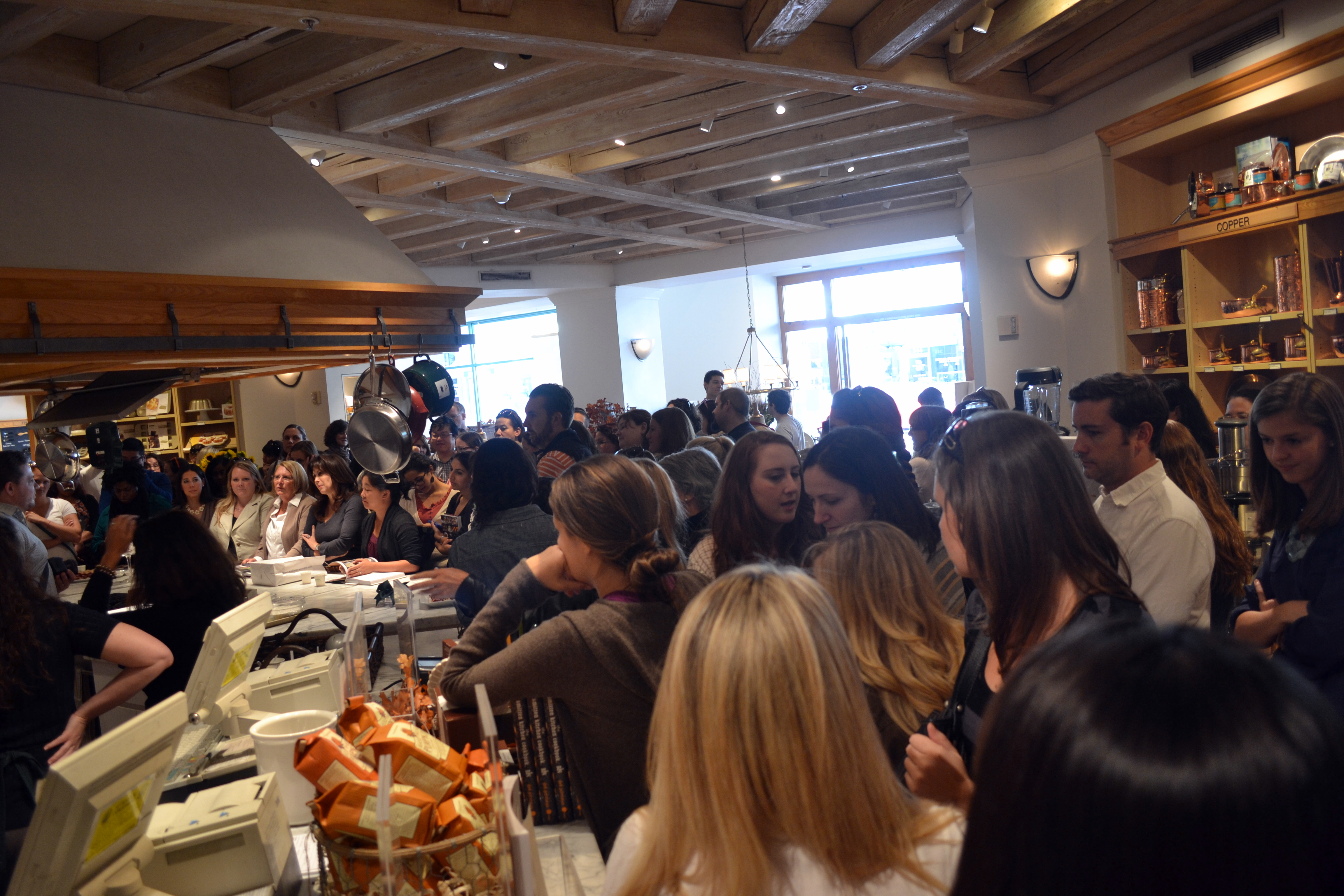
That was Tuesday.  By Friday, I already had a plan to make every last thing in that cookbook (my first choice involves eggplant, and chickpeas, and tahini, and cumin…), and after a quick round of grading and laundry, I was in the car on my way to Beverly Hills, where Deb was doing a cooking demo and cookbook signing at Williams-Sonoma.

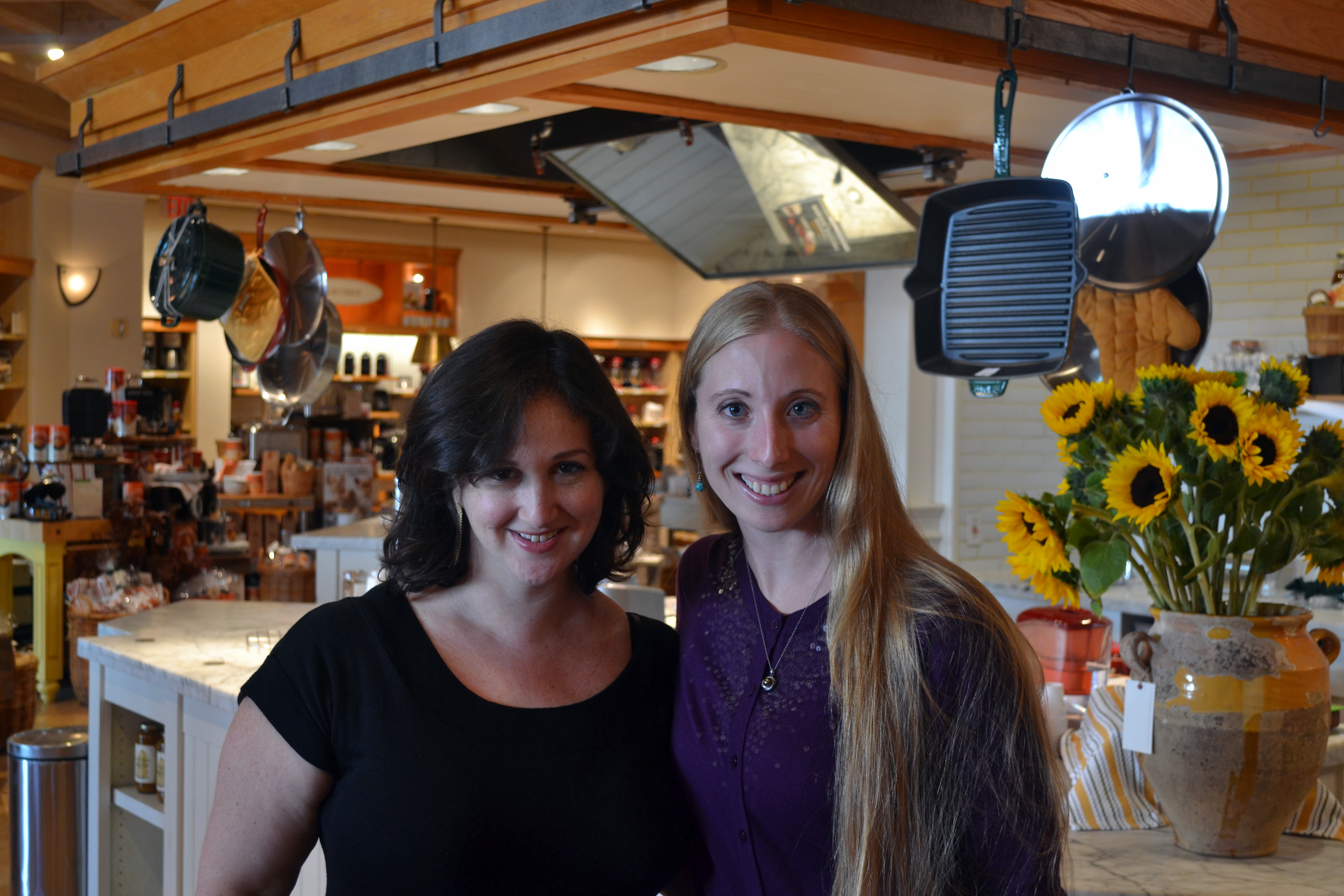
Without having this sound weird and stalker-ish (I’ve apparently become a fan-girl, what can I say?), Deb is lovely and I’m so glad I had a chance to meet her.  (I also spotted Joy the Baker in the larger-than-Williams-Sonoma-anticipated crowd, and eventually awkwardly introduced myself.  She was lovely as well).  I got to ask a question that came out somewhat awkwardly and – I think, though N. keeps telling me this is silly – sounded like I was asking how much I would have to adapt a recipe in order to avoid plagiarizing someone else, which by extension (only in my over-analytical brain, I suspect) sounded like a passive-aggressive suggestion that no one is capable of original recipes, no matter how they might try.  Sigh.  Not what I meant, of course.  What I was trying to ask was motivated by the teacher and scholar in me: we are taught simultaneously that there is nothing new under the sun, AND that we must be original in our thoughts and products.  But chocolate cake isn’t new.  There’s a formula for it that, yes, can be tweaked and fiddled and caressed into something a bit new, but at what point does that start being yours, instead of the recipe you learned from?  I suppose it comes down to a question of copyright, and I don’t know how that works in the world of food.

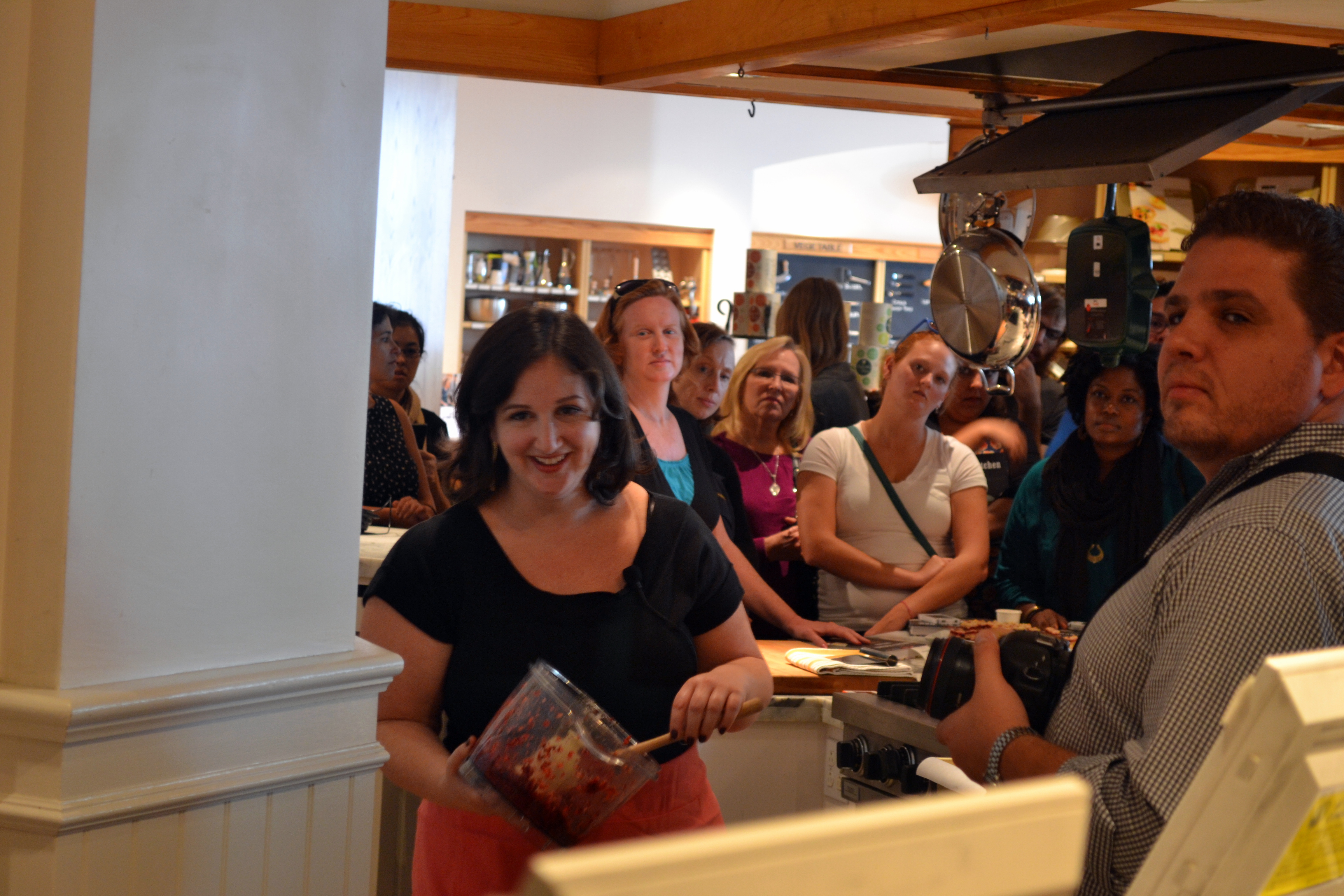
Talking AND stirring

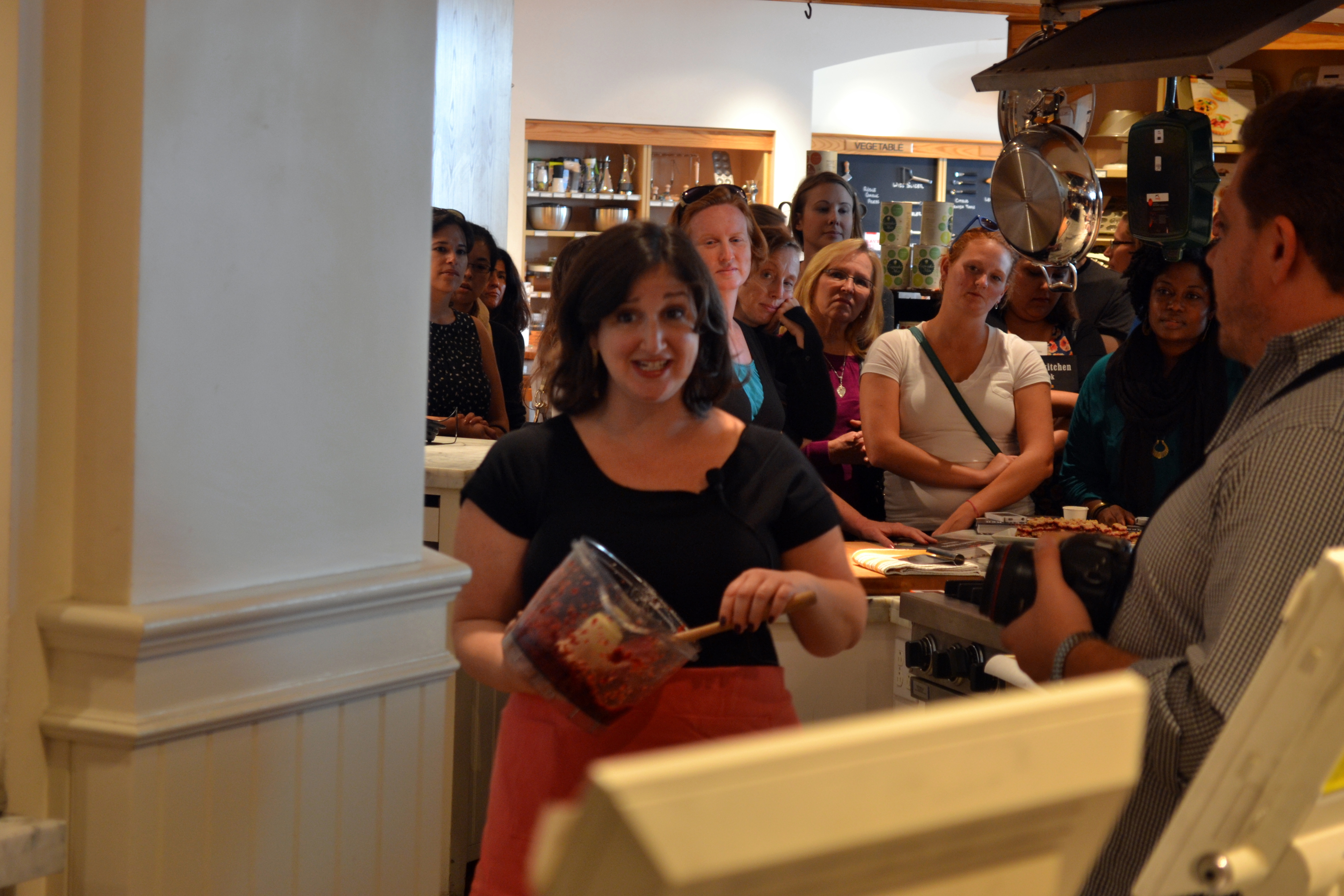
Concerned or confused by our questions?

Despite my clumsy question, which came out sounding – at least to me – somewhat combative, Deb said she thought it was more about technique and writing style than about complete recreation.  If you introduce a helpful method within the confines of the recipe, or if you write the directions or description in your own fresh way, the dish becomes yours through your additions to the conversation.  You become, I suppose, an author rather than a reader.  It’s very medieval, in a way: authors were “auctors,” or authorities, but to gain that authority they pulled from other sources.  Only God was the true, original creator.  Men could only imitate and produce imperfect copies.  That’s why I think the combination of cooking and literary studies meshes well for me: it’s all about reading, or chewing, mulling things over in your mind (and mouth) to see what you think of them.  Once you have had some thoughts of your own, once you have digested your meal, you have an opportunity to create: writing becomes cooking becomes writing.  You string carefully chosen words together and cultivate them into the form you want before sending them off to be read – consumed by your audience.

Deb made cranberry crumble bars, one of the recipes in her new book, before stationing herself at a little table to sign book after book after book.  One of the WS employees made rounds sharing samples of three different recipes from Deb’s book.  These sustained us during the 90 minute line snaking (or snailing?) through the store, passing walls of such debatably ingenious gadgets as a banana slicer, a juice squeezer for single slices of lemon, and a coil potato masher (this one was pretty cool, though.  I must admit to wanting one).

And then we were around the corner and Deb was signing my little placard from WS (they ran out of books long before the event started, and this was their work-around: order a copy, get a placard, stick it into the book yourself when copies arrive.  I already had a copy, but I wanted a signature, so it looks like someone’s getting a tasty Christmas gift…) and chatting, and asking me the name of my blog(!), and then N. and I were tasting apple cider caramels and glowing back into the sunlight of Beverly Drive.

I have Bittman reports to share with you – figs and orange juice and sweet potatoes and bourbon – but I think this deserves to exist on its own.  More tomorrow.

Lucy is unimpressed by my new acquisition, unwilling to look at the camera, but still insistent to get my attention in any way possible.  Sometimes I wonder whether she’s actually part feline.  Don’t tell her I said that.