Honesty and Irish Soda Bread

Food Blog March 2013-0878
It seems like admission and honesty are the motifs of the moment in many of the blogs I read.  A few weeks ago Joy the Baker created a beautiful list of things to remember while blogging – things like despairing over the cuteness of other people’s pages isn’t worth it.  Things like not stressing over ratings, and remembering that the internet is always changing, which means it’s okay to not be involved in every single new trend.  She has just ended a week on that most humble and most basic of vehicles for deliciousness: toast.  Simple.  Honest.  Real.  (Also, can you tell I’m kind of crushing on Joy the Baker right now?  This is about honesty, after all…).  Shauna on Gluten-free Girl and the Chef has been writing for herself lately, not for ratings or comments or trends.  In fact, she has closed comments on her blog; she’s writing in the undisturbed beauty of what is important to her, not what is important to others making demands on her.  Just Monday, Irvin at Eat the Love published a beautiful, real, excruciatingly honest piece he’d been sitting on for over a year about jealousy and perfection and measuring up in the blogging world.  (Lately I’m crushing on Irvin too; he just seems so nice!  And sometimes he responds to my tweets!  Squee…).
Food Blog March 2013-0854These are courageous posts.  It’s hard to be real here in this virtual world.  It’s hard to admit to imperfection or doubt or dissatisfaction or envy.  These are ugly ideas.  Yet we have them, and our impulse is to hide them behind the veneer of beautifully crafted pages, or photos with the white balance adjusted, and cropped just right to edit out the dish soap we forgot to move, or fluffy, romantic sentences with words like “mouth-feel” or “buttery crumb” or “silky texture.”
Food Blog March 2013-0858
And I do it too.  Despite my assertion that you are going to see imperfect products or read about unsuccessful attempts, of course I want every item I post about here to be beautiful and balanced and insurmountably delicious.  Of course I don’t want to admit to the doubts and worries and sneaky hate spirals that sometimes result from something as simple as turning away from grading papers to bake a loaf of bread and then half an hour later I’m trembling before a monster of despair that maybe by cooking instead of researching I’m throwing away all that work I did on my PhD because my dissertation might never become a book.  That by insisting on making dinner every night and posting every week, I’m sabotaging my own search for a better job and therefore I’m never going to “make it” in the adult world.  That I’m wasting my time as a blogger because I don’t have – and will likely never have – the same kind of following as Deb or Ree.  That there are a billion food blogs out there and I’m just adding to the clamor without bringing anything original or special or any of the things I hoped to be when I started writing.

Food Blog March 2013-0861

But I don’t want to tell you all that.  Despite my doubts, I, too, want to be a “good blogger,” a “popular blogger” with a following and cooing comments over the little messes I arrange just right so they look like masterpieces on screen, so I try to do the things that will make this happen.  I want to be an authority.  I want to spring to people’s minds when they think of food sites they like.  I want to talk about food and I want to be real, but I still want to find that magical, imaginary combination of words and photos and style and design that pulls people here in droves.  Those days where my little stats bar doesn’t even tick from zero to one are too real.  I never tell you that.
Food Blog March 2013-0862But I think this desperate, ugly, gasping kind of honesty can be a good thing, even if it only emerges now and then.  It’s a sign of strength and a sign of independence.  It forces you – it forces me – to reassess, to remember that I am doing what makes me happy for the reasons it makes me happy.  And maybe that is part of what Spring is about: cleaning out your assumptions.  Stripping down the need for perfection and presenting a more naked, more truthful, more real version of yourself to your audience.  Even if that version is a little ugly.
Let’s call it mental Spring cleaning.
Food Blog March 2013-0851

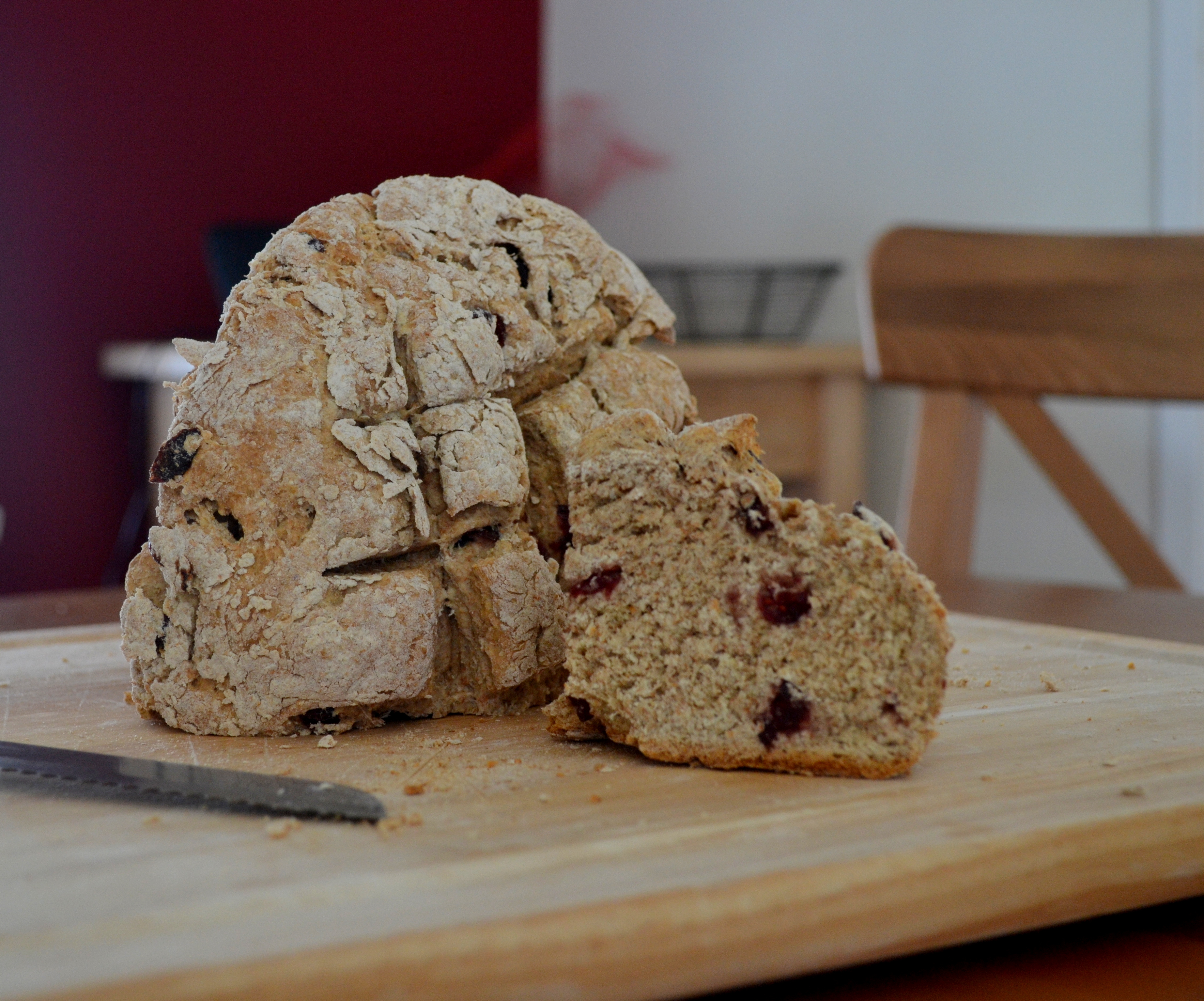
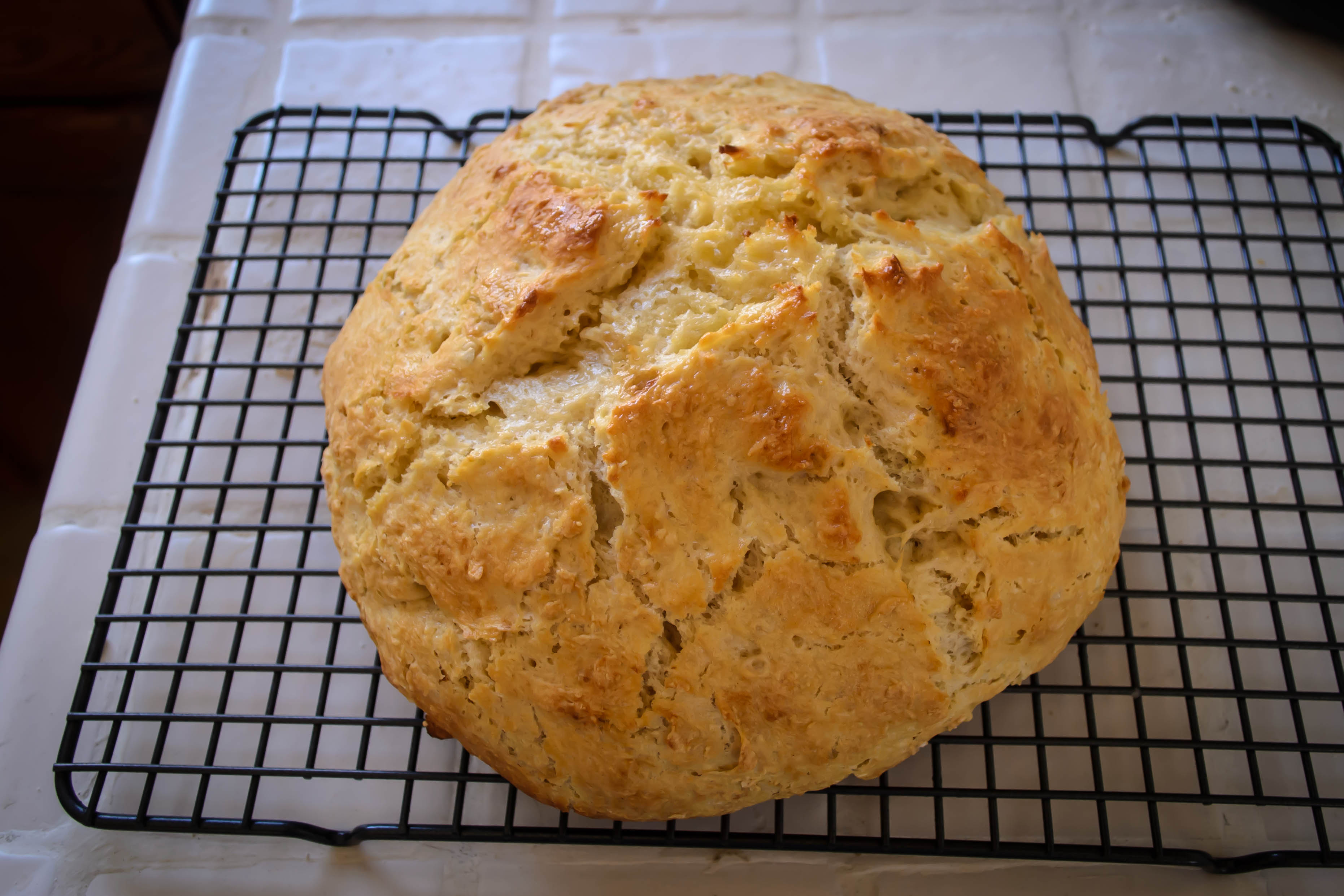
This week I made Irish Soda Bread.  Simple, rustic, honest.  Lumpy.  Rough.  Uneven.  No yeast, no eggs, no herbs or dried fruit or fancy techniques or browned butter or sifting.  I didn’t even wipe down the counters first to make you think my kitchen is always spotless.  I shuffled through a few recipes and found suggested combinations like golden raisin and rosemary, or candied orange peel and bittersweet chocolate.  Those didn’t feel truthful.  They were too dressed up – too showy.  So I turned to the most basic, most honest cookbook I have: Baking Illustrated.  BI is willing not only to present you with a recipe, but to explain why they made the choices they made, and what happened when they tried things in other ways.  They talk about the cakes that came out gummy or runny.  They talk about overly eggy batters and dry loaves and dense biscuits.  They show you what a less-than-perfect product looks like.  And then they tell you how to fix it.  This was the kind of Springtime honesty I needed.

Food Blog March 2013-0866

I changed very little from the original recipe, only using brown sugar in place of white granulated sugar for a deeper flavor, and taking up the suggestion to bake the loaf in a deep covered pot to enhance the texture of the crust.  Since I’ve been doing that with success in my yeast experiments, it seemed worth trying out here too, and I have to recommend it highly.  Our loaf was surprisingly tender – almost like a giant scone – and the crust was springy and buttery – it felt like it must be loaded with eggs even though there are none in the recipe.  I like the flavor the baking soda provides, which is a different kind of tangy breadiness than yeast.  After weeks of churning out loaves that require hours and hours and multiple rise times, it was nice to have a quick-bread that rose just enough on baking time alone, and left behind concerns like proofing and kneading and windowpanes and tucking and shaping.  Honestly.
 Food Blog March 2013-0868
Irish Soda Bread
adapted from Baking Illustrated
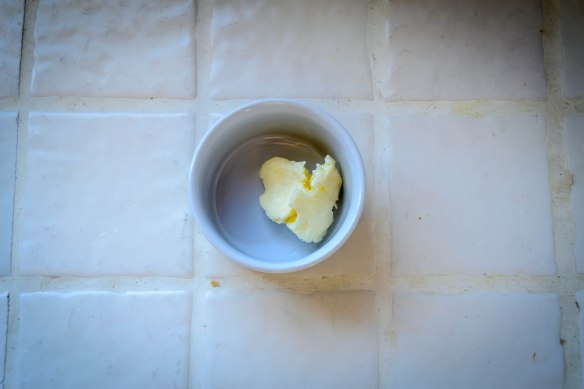
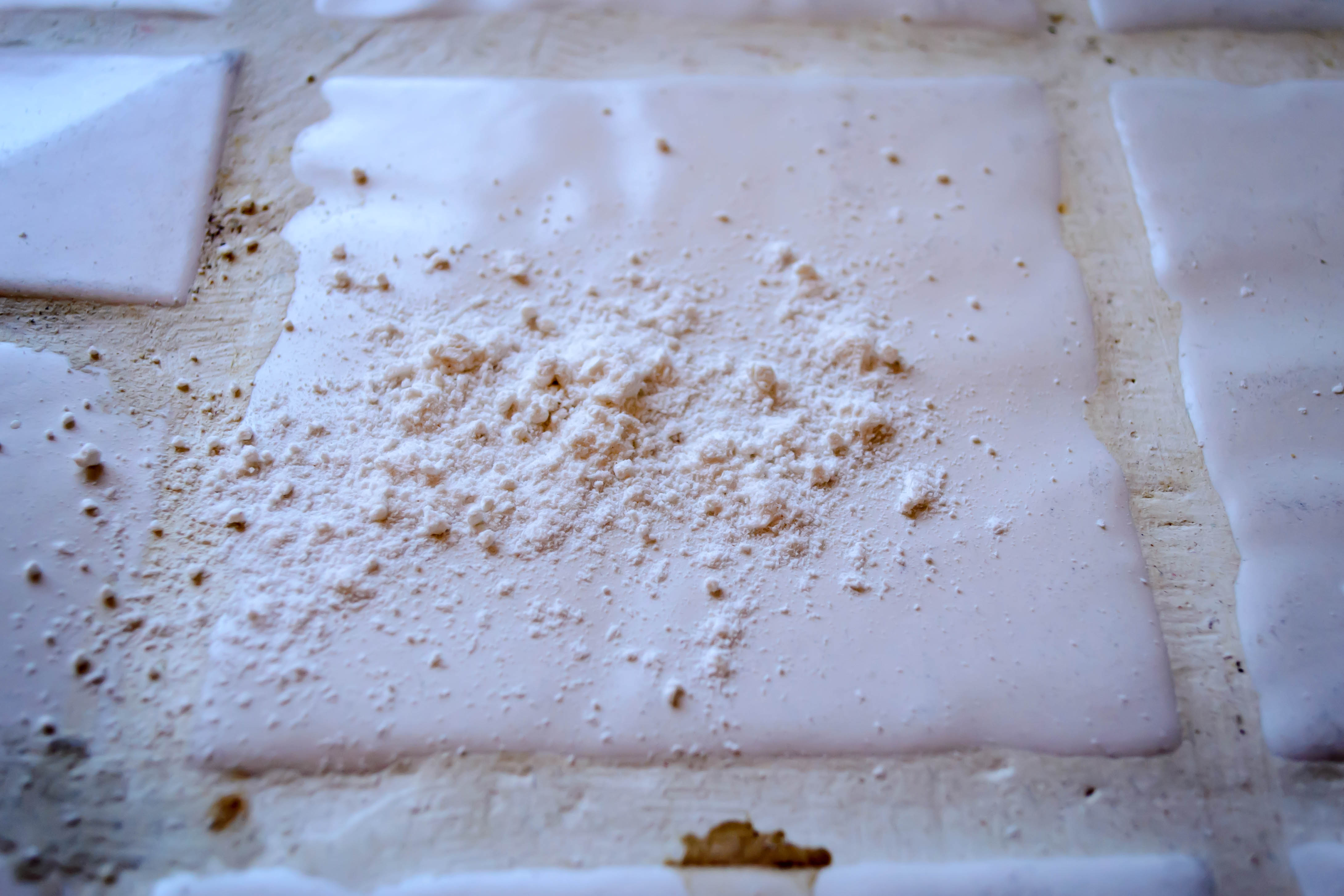
3 cups all-purpose flour (BI recommends one with a relatively low protein content, like Gold Medal or Pillsbury) plus a scattering for your work surface
1 cup cake flour (even lower protein, which makes for a more tender end product)
2 TB brown sugar
1½ tsp baking soda
1½ tsp cream of tartar
1 tsp salt
2 TB softened butter
1½ cups buttermilk
3 additional TB butter, divided
Food Blog March 2013-0872

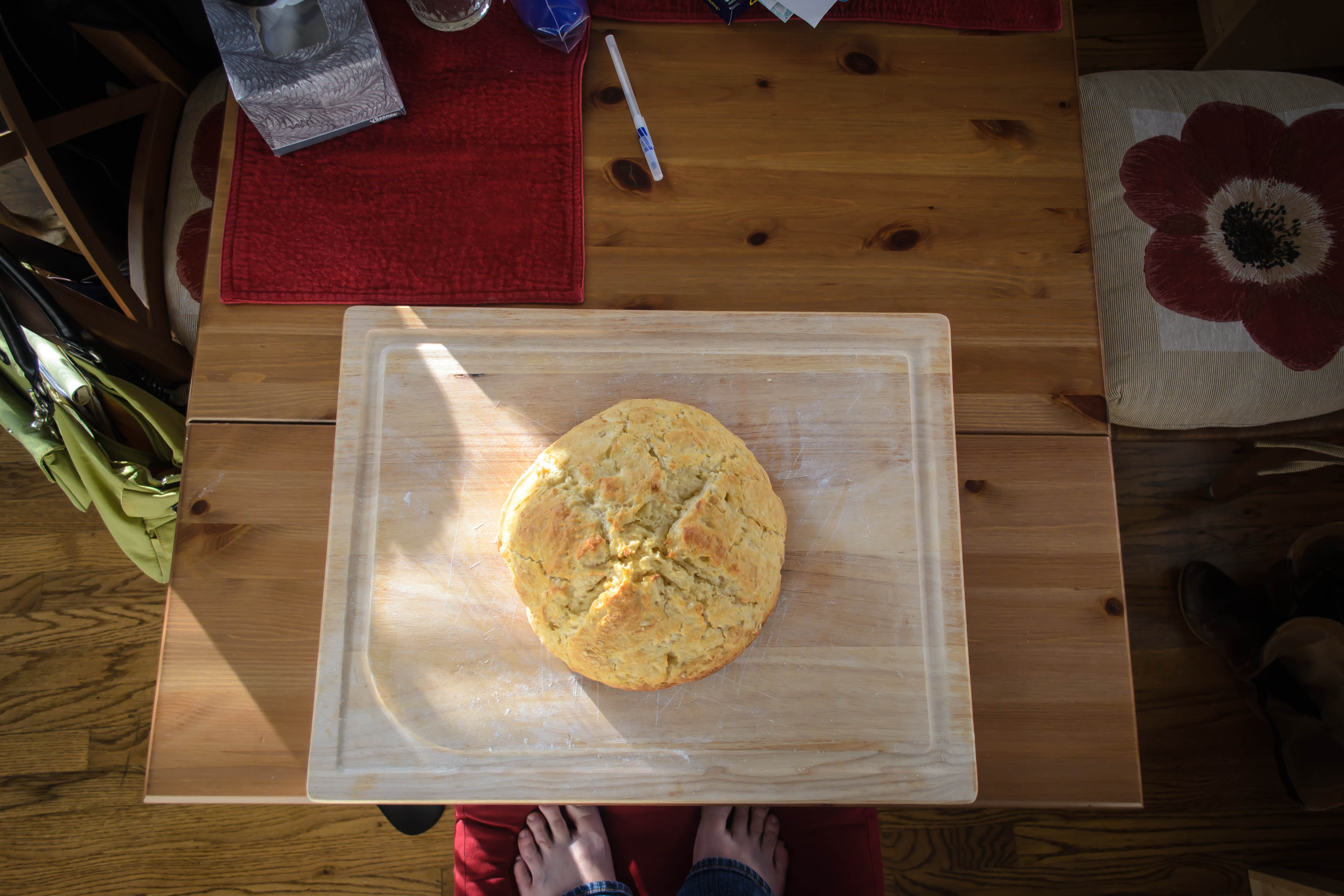
Here’s the final product, when I edit and trim.
Food Blog March 2013-0873

But since we’re being honest here, this is the set-up; I just push all that other stuff aside and crop it out…

Preheat your oven to 400F.  BI says to position a rack in the upper middle portion of your oven, but I left mine near the bottom and things turned out fine.
Whisk the dry ingredients together in a large bowl.
Cut in the softened butter with a fork, your fingers, or a pastry blender until it is distributed in small crumbly bits.  The mixture, BI says, should resemble coarse crumbs.
Add the buttermilk and combine with a fork just until the mixture begins to come together – the coarse crumbs should clump into slightly wet crags.
Turn out onto a floured board and knead slightly – 12 to 14 turns – just till the dough becomes “cohesive and bumpy” (43).  You don’t want to overknead this bread because it will become tough.  The intent here is not to stimulate gluten production, as it would be in a yeast dough.  We just want a homogenous mass that stays together.
Pat the dough into a 6 inch round (about 2 inches high) and score an X in the center with a sharp knife; use 2 TB of the additional butter to grease the bottom and sides of a dutch oven or similar covered pot.  Place the loaf carefully inside, cover, and bake with the lid on for 30 minutes.  Then remove the lid and continue baking for an additional 10 minutes, or until the internal temperature is 180F.
Melt the final TB of butter.  As soon as you remove the loaf from the oven, brush the top with the melted butter to keep the crust soft and tender.
Wait about half an hour before you attack it – this bread is delicate and it needs the extra structural support gained by cooling.  Earlier slicing will result in squashing and crumbling, and as honest as that is, we’d rather have nice slices or, as N. and I prefer, thick wedges for dunking.

Food Blog March 2013-0875Food Blog March 2013-0877

Orange Marmalade and Almond Sweet Rolls

Food Blog February 2013-0720
Guys, I’m pretty excited about this one.  It’s a mile marker for me in a couple of ways.  One, it’s a sweet application of yeast dough, which I’ve never tried before.  Two, I’m well into the second month of this project and I haven’t had any true disasters yet or fallen off the horse, which buoys my confidence.  Three, except for temperature and cooking time, which I had no idea about, I didn’t consult the internet a single time for clues about how to make this.  But four, and unquestionably most important, this is an adaptation of one of my Nana’s recipes, and I made it successfully.
Food Blog February 2013-0632
Nana was a cook.  She was an old-fashioned, from home, meat/starch/veg-that-sometimes-came-from-a-can kind of cook.  She was a clean-your-plate-before-you-can-have-dessert and sometimes a there-are-starving-children-out-there kind of cook.  But that was her era.  She raised her three kids on three square meals a day plus cookies.  She taught my two aunts how to cook, she cooked for our Pap almost up until the day he died, and she sent out a yearly box of Christmas cookies until I was almost through college.  My freshman year I remember getting a slip in my mailbox that meant I had a package to pick up, and finding, after returning to my room and tearing at it feverishly, that it was filled with sweets.  Chocolate dipped apricots, cream horns, which we called ladylocks, nut rolls, seven layer bars, pizzelle; these were how Nana sent us her love.  I always meant to send one back to her, when I was “grown up.”  It tugs at me a little that I never did.
Food Blog February 2013-0648
When she heard I was learning how to cook, she gave me my first cookbook: The Complete Guide to Country Cooking, along with a subscription to Taste of Home magazine.  One summer when we came to visit, I offered to help with the menu and she told her friends her granddaughter was going to be her cook for the week.  She said it was good, too.
In 2007, when I was about to get married, I received a large red photo album from my female relatives, featuring favorite recipes from their own kitchens.  Nana couldn’t attend my wedding – she was on oxygen and too weak for the plane ride across the country from Pennsylvania – but she had contributed recipes to this book, and even as I cherished her contributions I never thought I would make most of them myself: I was too inexperienced to try these dishes she had clearly mastered – lemon meringue pie and yeasted sweet dough were beyond my capabilities.
Food Blog February 2013-0628
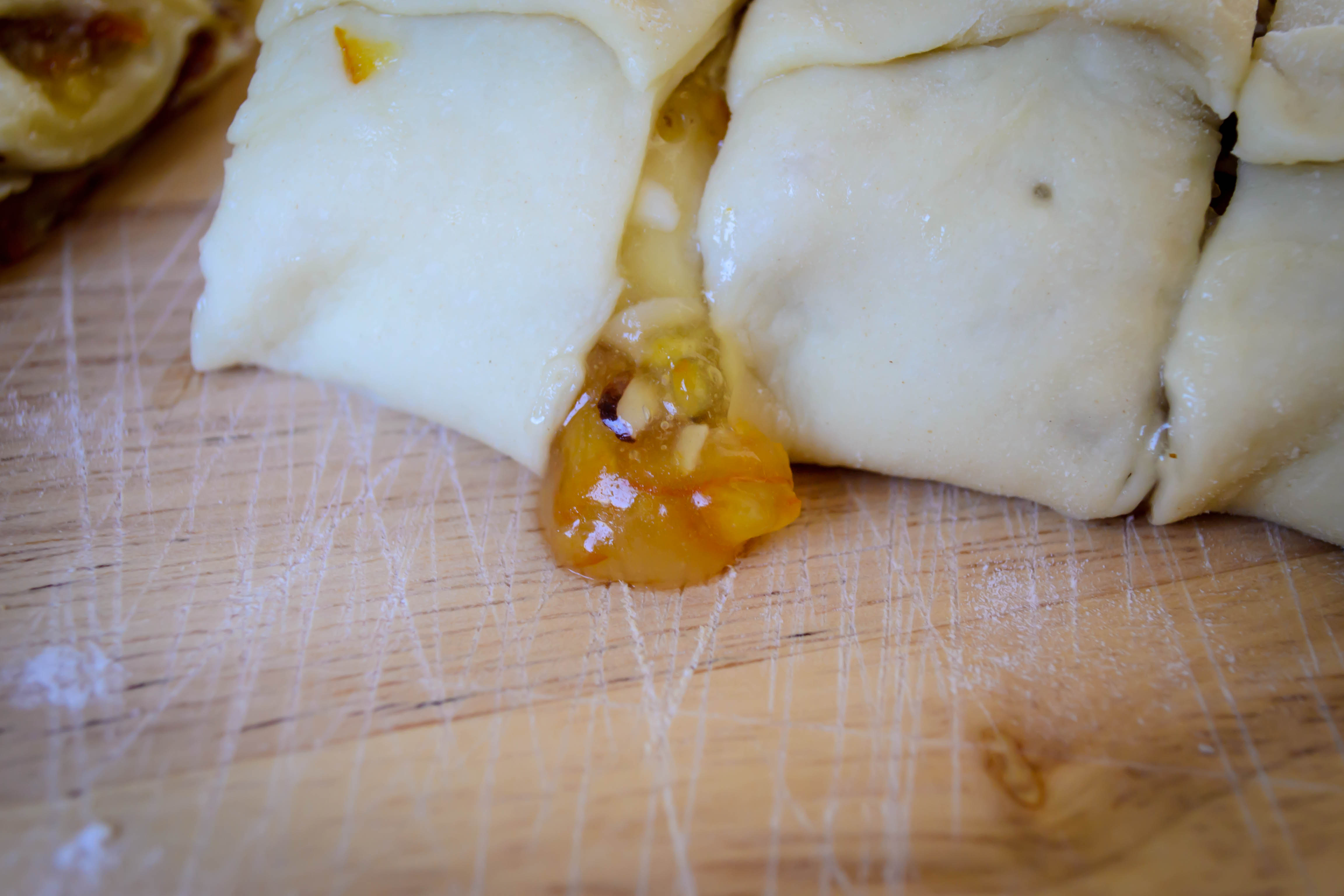
But when I thought about cooking this past week, I thought about that stretch of dough from my dill bread and in its place saw cinnamon rolls.  They are, after all, filled and constructed in a similar way.    I love cinnamon rolls, but sometimes the dripping gush of cinnamon pooled in pounds of sugared butter is just too sweet for me.  Orange marmalade came into my mind, and with it, almonds.  They seemed like such a nice pairing, and as I wondered how to make them I found myself back in Nana’s section of my big red cookbook, staring at directions that now seemed less intimidating than they did six years ago.
Food Blog February 2013-0657
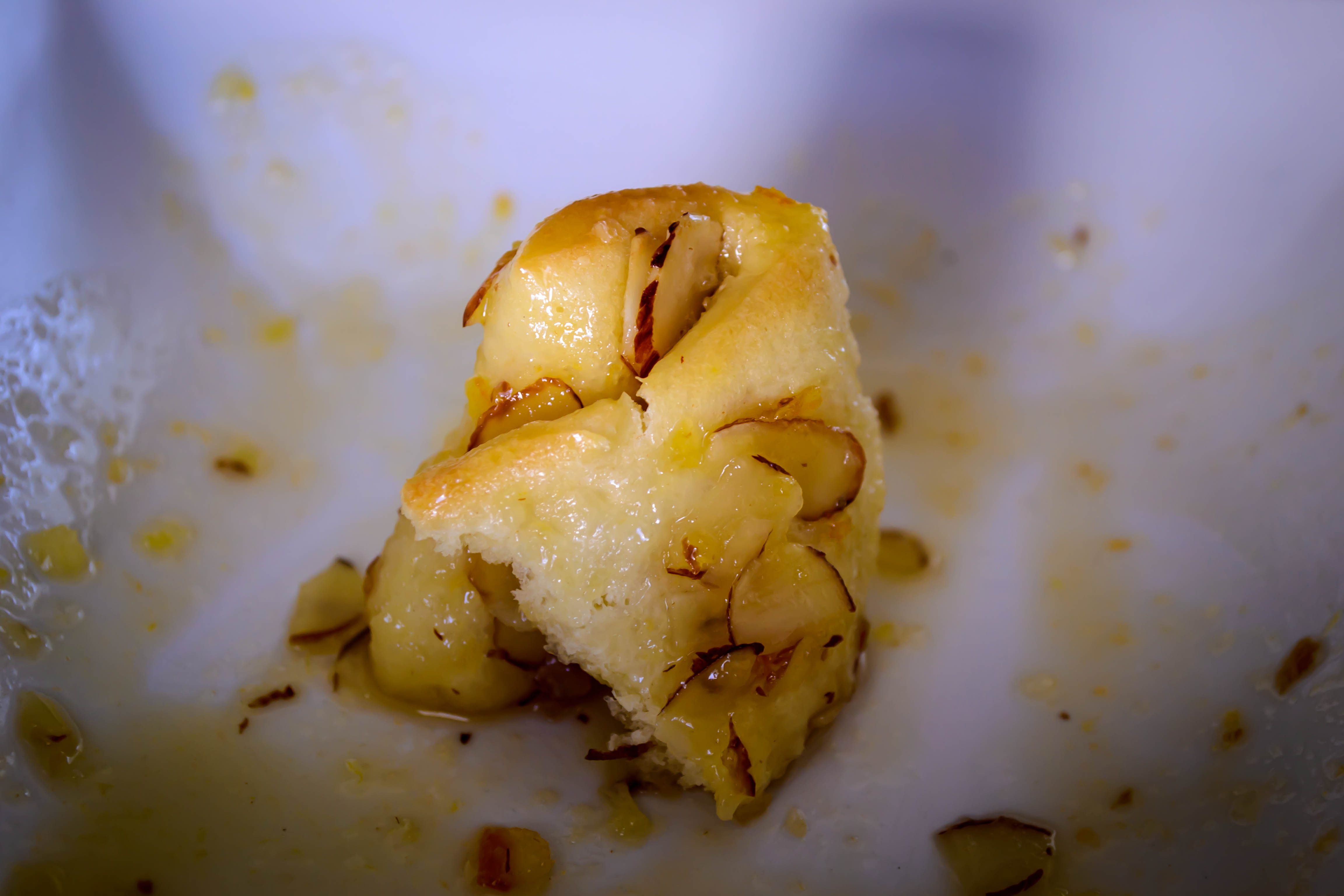
This is a beautiful, elastic, slightly sweet dough.  It is smooth and rich and expansive, and it makes a glorious roll.  It sighs like a feather pillow when you punch it down.  It wants very little from you – just a massage with melted butter, a liberal smear of marmalade and almonds, and gentle, careful rolling.  Inside, after baking, the orange and almond marry well, since the jammy part of the marmalade pools against the dough, but the zest and the almonds retain texture for the teeth to play with.
I doused one pan with a glaze made from fresh orange juice and powdered sugar, but I think that overdid the sweetness factor a bit too much: the glaze tasted like liquified orange Pez.  Better, I would say, would be a slick of soft cream cheese, perhaps whipped with a little brown sugar if you absolutely must.  But plain, browned, warm out of the oven, and a little sticky with its own sweetness, is just perfect all by itself for breakfast, for dessert, for mid-morning snack.  For any time that is right now, really.  Thanks, Nana.
Food Blog February 2013-0697
Orange Marmalade and Almond Sweet Rolls
Dough:
¼ cup warm water
2 tsp yeast
¼ cup scalded whole milk (heated to just below boiling – 45 seconds in the microwave does the trick)
¼ cup sugar
½ tsp salt
1 egg
¼ cup soft or melted butter
2 ¼ cups flour (you probably won’t need all of it – I ended up using a total of 1 ¾ cups)
Filling:
¼ cup melted butter
1 cup orange marmalade, warmed slightly
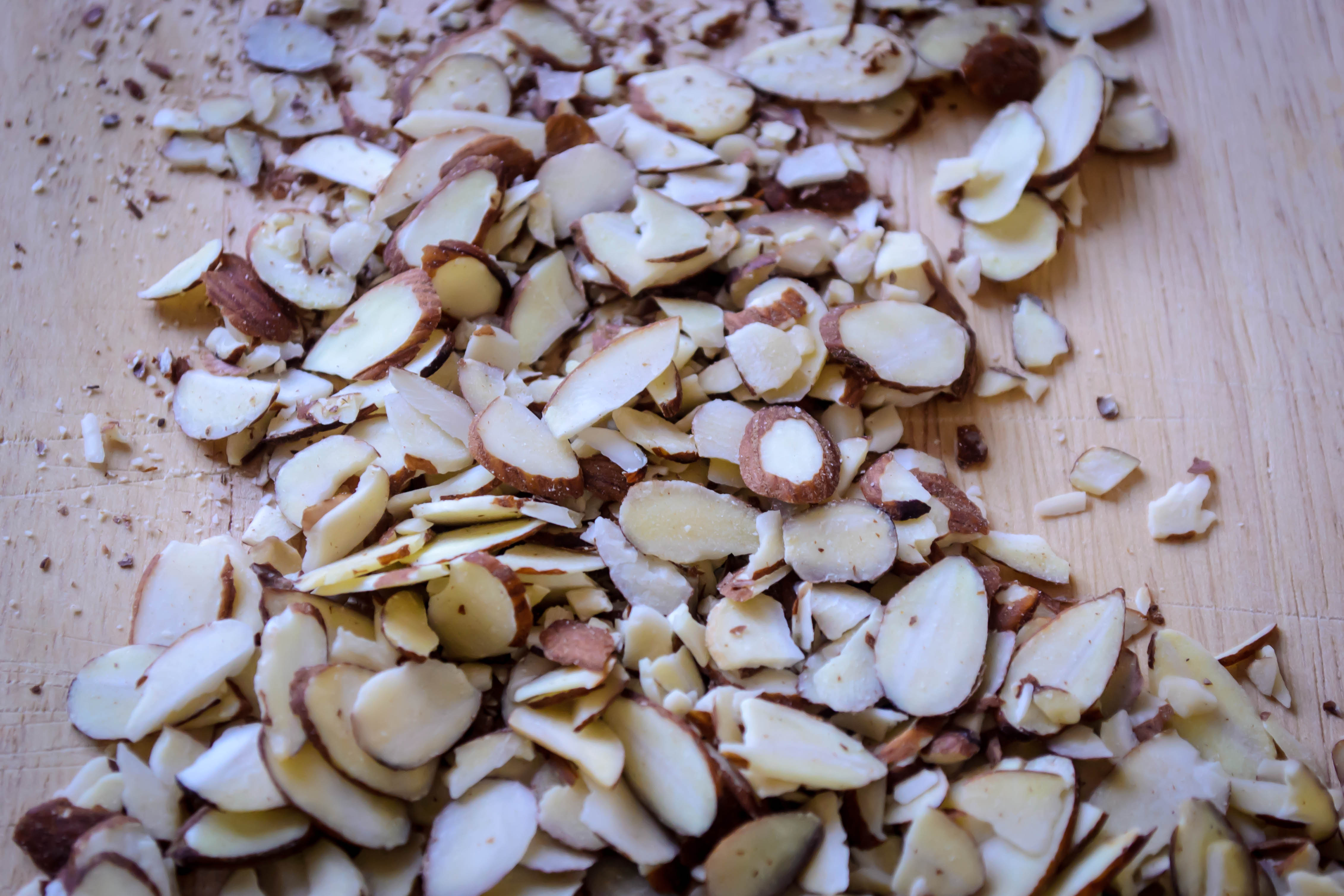
1 cup sliced almonds
Food Blog February 2013-0682
In the bottom of your mixing bowl, combine the yeast and water and stir gently.  Let it sit for at least 5 minutes so the yeast wakes up a bit.
Meanwhile, heat your milk, then cool it down.  You can hasten the cooling process if you forgot to soften your butter: just drop the still-cold stick right into your warm milk and swirl.  You’ll cool the milk and soften the butter simultaneously.
When the yeast bubbles and smells bready, add the cooled milk, softened or melted butter, sugar, and egg.  Stir to combine.  When the mixture has homogenized a bit, add 1 cup of the flour and the salt and stir again.  You will have a soggy, unworkable mixture.
Continue to add the flour ¼ cup at a time, stirring after each addition (if you are using a stand mixer, use the paddle attachment and just keep it on low speed until things come together).  When it starts to look like bread dough – pieces begin to have that floured, torn texture and hold together – and becomes just workable, don’t add any more flour to the mix.  Switch to your dough hook or a well floured board, and knead until smooth and elastic, about 5 minutes.
Once kneaded, put your shiny, smooth ball of dough in a lightly greased bowl and roll it over so all sides are moistened by the oil.  Let it rise in a warm place until it doubles – at least an hour and a half.  I like to heat my oven to 200F (my lowest setting) for a few minutes, then turn it off and let it cool for another few minutes before stowing my dough inside.
Food Blog February 2013-0658
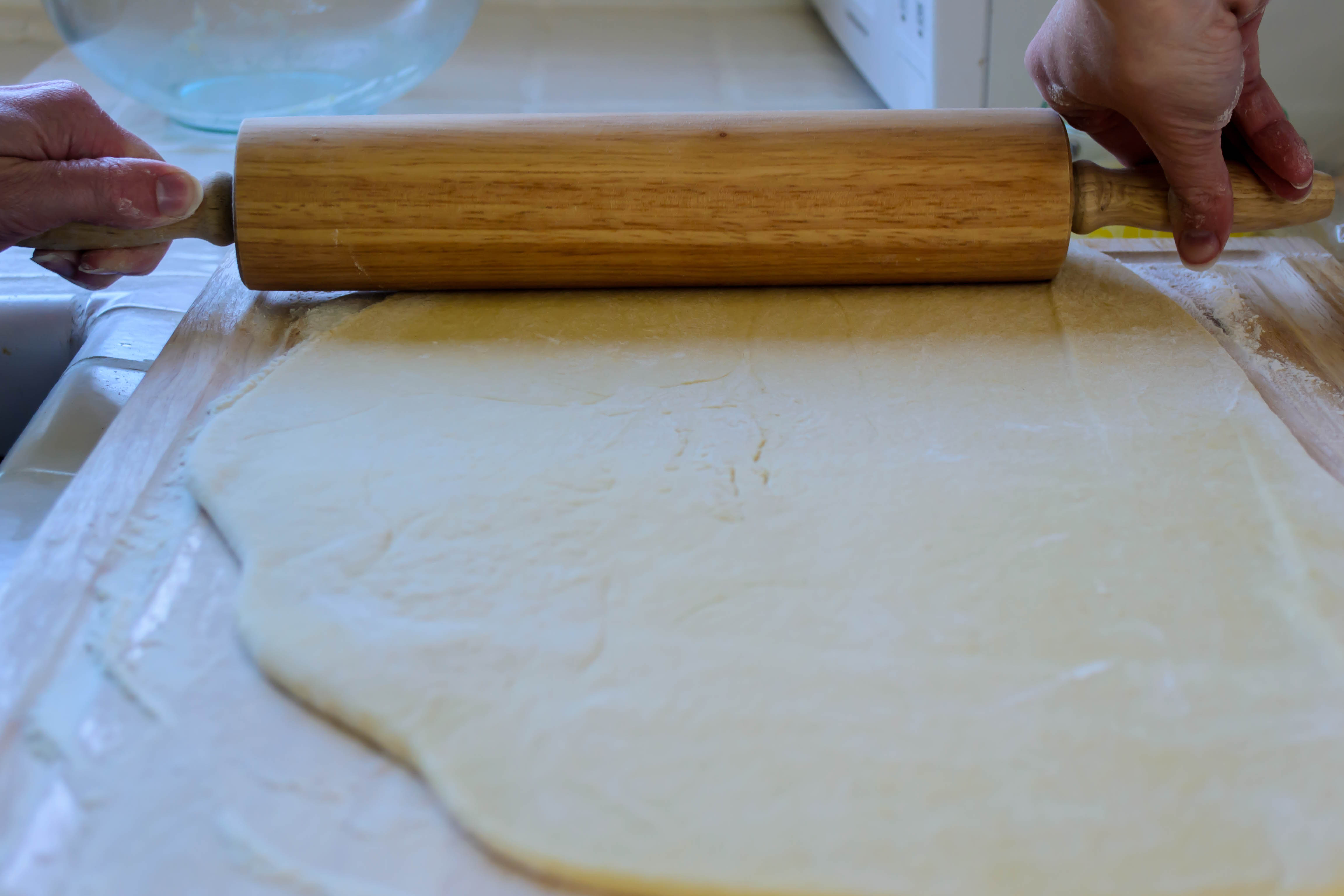
When the dough is ready, it will have doubled in size, and the bottom will be covered with puffy little bubbles like the ones that let you know your pancake is ready to flip.  Punch it down by pushing your fist gently into the middle to let the gas escape.  Turn it out onto a floured board and roll gently, forming a rectangle of probably 2 feet by 3 feet.  Maybe 3 by 3, if it seems willing.  It should be ¼ – ½ inch all the way around.  My board was, clearly, a bit on the small side for this undertaking.
Food Blog February 2013-0663
Food Blog February 2013-0664
Give your layer of dough a massage with the ¼ cup melted butter, spreading it evenly over the surface until it’s gleaming, but leaving an inch or so margin around the edges.  This will help prevent spillage of the inevitable ooze when you start rolling.
Food Blog February 2013-0666
Spread the warmed marmalade over the buttered dough, again respecting the inch margin.  Warming it up by microwaving it for just 30 seconds or so helps it spread more evenly.  Sprinkle on the sliced almonds and get ready to roll.
Food Blog February 2013-0668
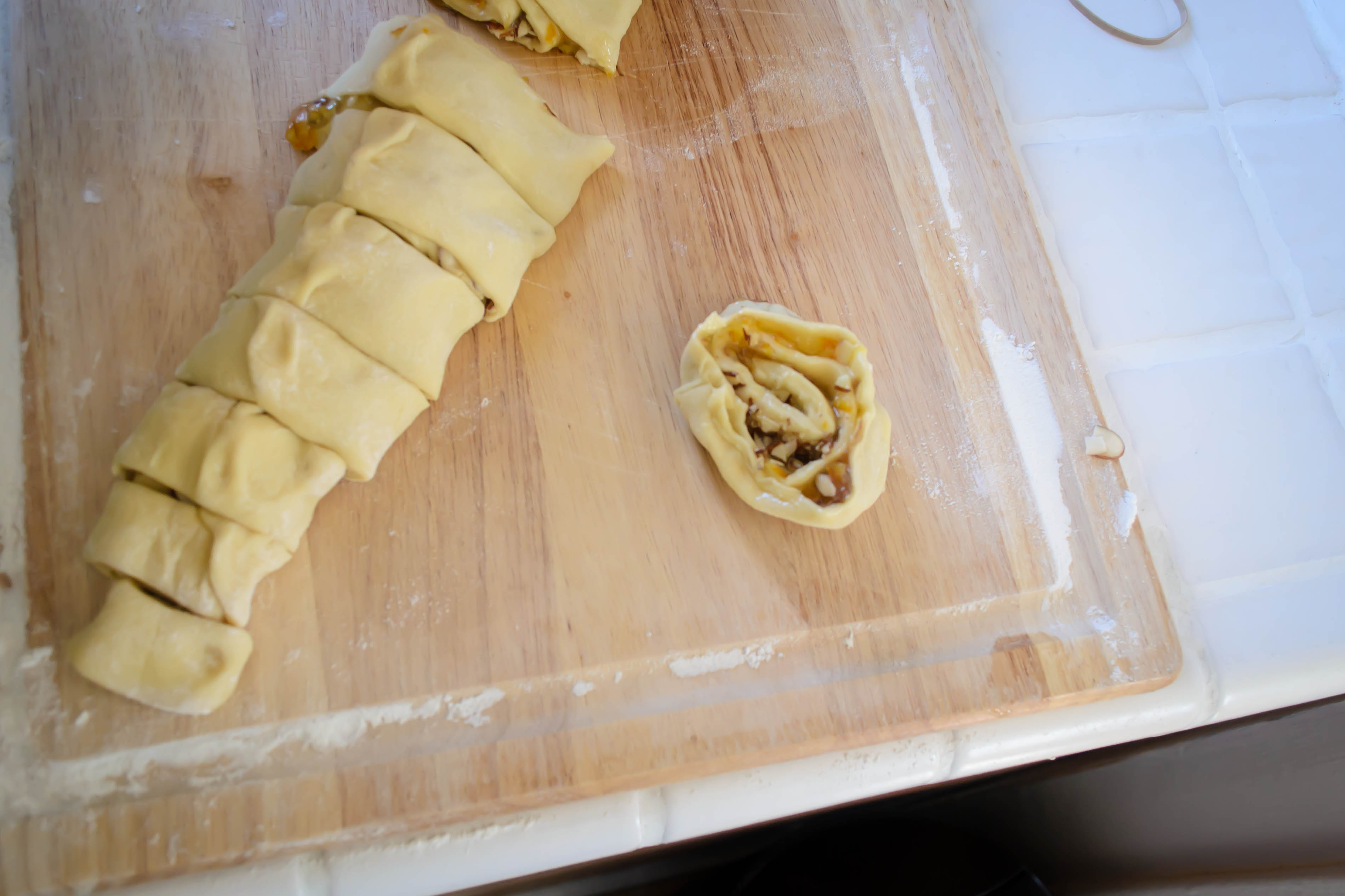
Food Blog February 2013-0675Food Blog February 2013-0677You have to do the rolling in small stages, I found.  Begin at the middle of the longer edge of your dough rectangle and make a few tight rolls, but then move to the edges and help them catch up.  They don’t roll on their own, since the piece of dough you are working with is so big, so your fingers will be busy (and no doubt sticky) flying from side to middle to side again.  Continue this process until you have created a long, tight roll of dough.  Some filling will unavoidably ooze out the ends, but if you’ve left a margin around all sides this should be minimal.  Turn the tube gently so the outer edge faces up, then pinch it gently into the next layer to create a seam so your rolls don’t become unrolls.
Food Blog February 2013-0679
Food Blog February 2013-0680
Carefully slice your rolled tube into individual portions.  I ended up with about a dozen squashy, messy, less-than-round offerings.  Deb at Smitten Kitchen suggests using a serrated knife and sawing gently, letting only the weight of the knife move down through the dough, to prevent the squashing I experienced.
Food Blog February 2013-0684Food Blog February 2013-0687Food Blog February 2013-0691
Nestle your rolls filling side up in greased baking trays – I used 9 inch cake pans – and let them rise again for 30 minutes.  This would also be a good time to preheat your oven to 375F.
Food Blog February 2013-0702Food Blog February 2013-0706
Stow your pans in the preheated oven for about 18 minutes, at which point the tops will be golden, the exposed marmalade will be somewhere between dripping and caramelizing, and the edges of each roll will have puffed against each other, some adhering thanks to the sticky filling.
Food Blog February 2013-0708
While they are warm, you can drench them in glaze or icing if you wish, or you can just gently liberate them from their pans and eat them with fork or fingers.  I like to unroll mine as I eat, saving the extra buttery, extra jammy middle bit – which everyone knows is the best part – for absolutely last.
Food Blog February 2013-0714Food Blog February 2013-0725
Most of the photo credit on this one goes to N., who got really into his job as stand-in photographer this week!  Thanks, honey.

Lemon Ginger Shortbread with Hazelnut “Crust”

Inspired by numerous sources, but mostly the deep golden orbs on my backyard lemon tree and a winter-blues-banishing post from Hannah at Inherit the Spoon, this post had to be about shortbread.  This is a cookie of the most basic sort, crisp and sandy, with only the three essentials: flour, butter, and sugar.  No leavening to worry about, no eggs to tussle with (incidentally, do you know how hard it is to crack eggs without making a mess when you’ve sliced the tip of your thumb and  it’s therefore awkwardly bandaged?), just the base, the sweetener, and the fat.
Food Blog February 2013-0584
These are, as Ruhlman points out in Ratio, an “adult” sort of cookie.  Dry, unadorned, plain, but equally ideal for a dunk in tea or chocolate ganache, and amenable to all sorts of attempts to “play dress-up,” which makes them  not just easy and tasty, but suitable for kids-at-heart.
Recently I’ve become obsessed with the combination of lemon and ginger.  Hannah’s citrus shortbread and my tree with its laboring, weighty boughs all but begged me to try this combination.  When a quick web search turned up only recipes featuring one or the other, I knew I had to insist on their marriage in my version.

Food Blog February 2013-0480

Then insanity struck.  I got the ridiculous notion that I wanted to create a hazelnut “crust” for these cookies.  Yes, that’s right, I decided to add a crust to a cookie that is commonly used itself as a crust.  I’m not sure where this idea came from, although if I must place blame it’s going to be on my sister, who commented at Thanksgiving that I should pursue the lemon-ginger-hazelnut flavor combo because it sounded so outstanding.  So really, R., these are for you.
Food Blog February 2013-0484I scoured multiple recipes to put this dough together, checking the likes of Martha Stewart, Ina Garten, Paula Deen (who I was surprised doesn’t have more sweet versions), and of course Deb Perelman.  But with the exception of a few technique ideas, I came back to Ruhlman’s basic 1-2-3 cookie dough as my backbone (1 part sugar, 2 parts fat, 3 parts flour).
The butter, I decided, needed to be browned (another recent obsession).  This would add depth and nuttiness in case the crazy hazelnut idea didn’t work out.  The ginger would be candied and minced into a sticky pile, and the lemon would be zested into mild spritzy confetti.  This made for a dough that, while delicious, was perhaps not the easiest to work with – I refrigerated it too long and was then impatient to roll it out, so there were cracks.  I rolled it quite thin, which made the cracking worse, and created a painfully delicate cookie.  The chunks of ginger, too sticky to mince very finely, stood up like carbuncles through the buttery dough and made slicing difficult.

Food Blog February 2013-0574

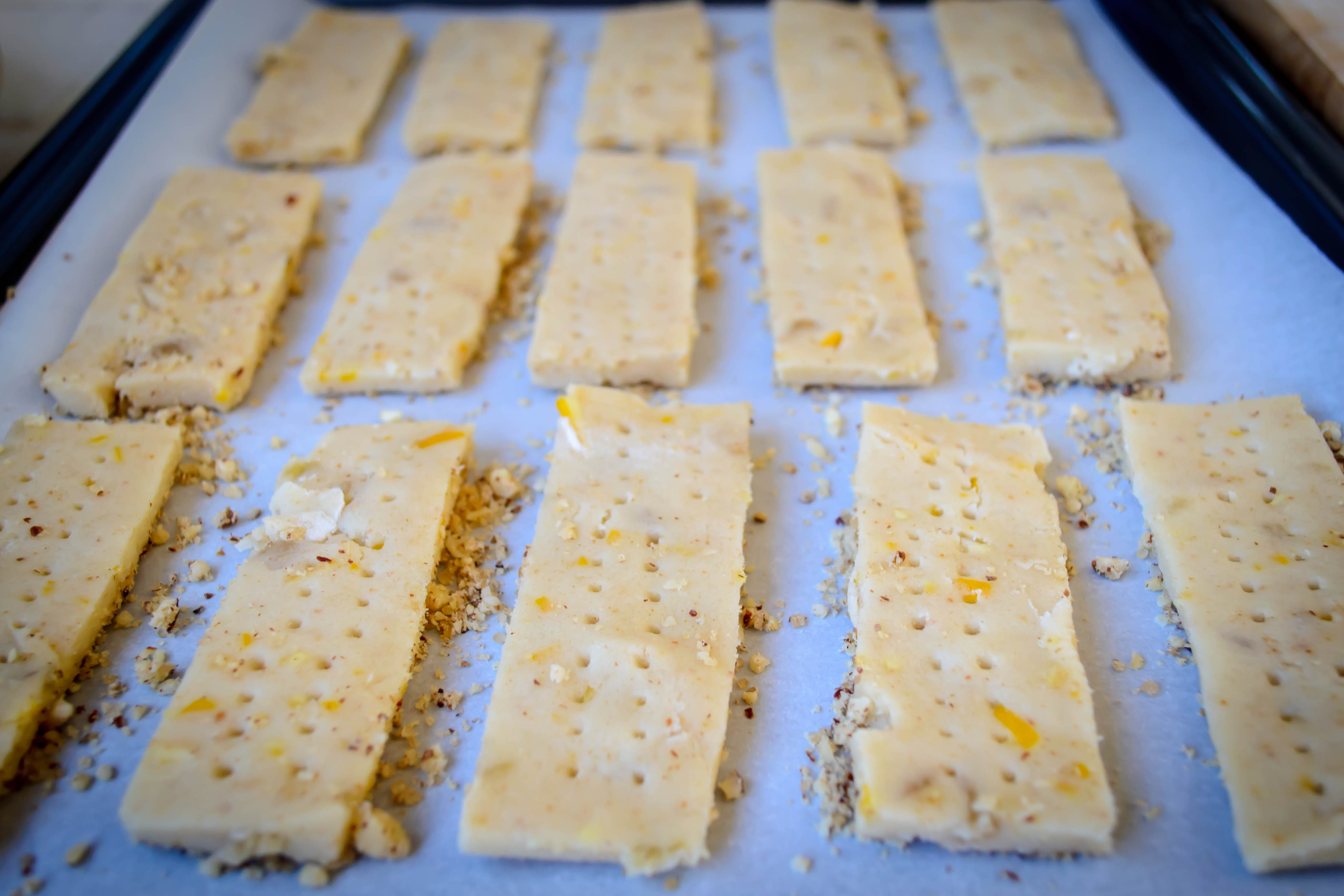
The hazelnuts I pulverized in the food processor with some ground ginger (in case the candied chunks didn’t come through) and a healthy sprinkling of turbinado sugar.  Faced with a bread board of delicate cookies on one side and a pie plate full of hazelnut crumbs on the other, I almost opted to forget the whole “crust” idea altogether, but I’m glad I didn’t.  You can transfer crumbs to cookie in a number of ways, including pressing the cookie into the crumbs, which I don’t recommend  (they adhere only reluctantly and the raw dough tends to break), or mounding crumbs on top of the cookies and pressing them in with a rolling pin, which I do recommend.  Then you can gently lift the cookie and flip it quickly and firmly onto a parchment lined baking sheet so the hazelnut layer is on the bottom.  The crumbs will try to scatter.  Don’t let them!  Press the cookie down lightly but firmly back into the crumbs, and they will adhere as they bake.
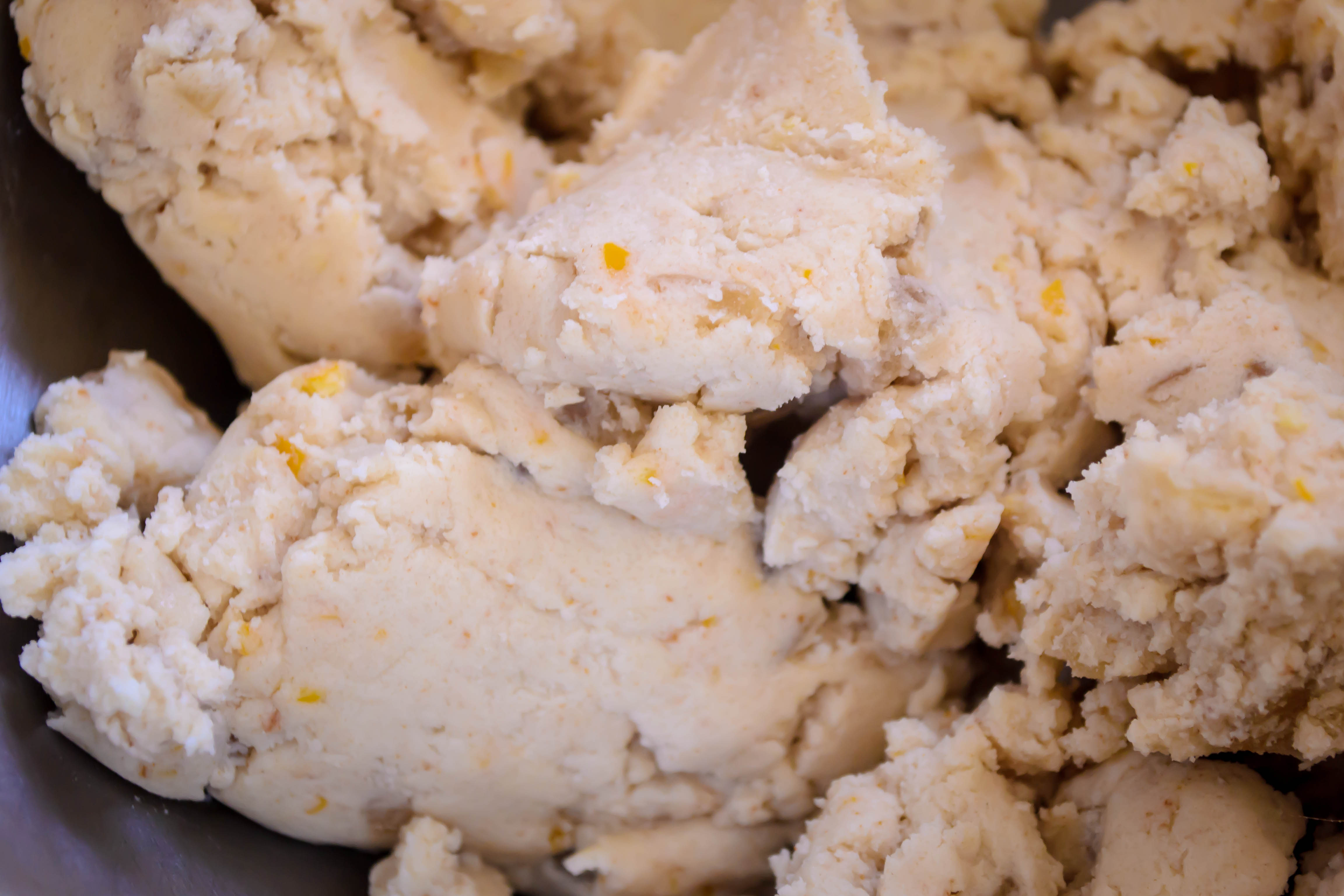
When they came out of the oven, they were too soft to move.  They needed a good five minutes alone on their baking sheet, undisturbed, to cool and crisp.  But once crisp, they were perfectly sandy and satisfying, tasting of – I can’t think of a better description – powdered butter.  At first I couldn’t detect the ginger or lemon, aside from the now chewy bits of candy distributed through the dough, but a day later, and then two days later, the more delicate flavors started to shine past the overwhelming richness of the brown butter.  The hazelnuts, with their earthy crunch, were perfect the whole time.  You could probably mix the nut crumbs in with the rest of the ingredients and save yourself a bit of time and frustration, but I loved the way they looked as a crisp layer on the bottom.  Cookies with their own crust.  Glorious.  My sister got to taste them during an unexpected visit, and pronounced them delicious.  The lemon-ginger-hazelnut trifecta is a triumph.  And the leftover ginger-spiked hazelnut crumbs make an excellent topping for oatmeal.
 Food Blog February 2013-0578
Lemon Ginger Shortbread with Hazelnut “Crust”
8 oz. butter (1 cup, or 2 sticks)
4 oz. sugar (1/2 cup + 1 TB)
12 oz. flour (2 – 2½ cups)
½ cup chopped candied ginger
Rind from 1 lemon, finely chopped (some pith is okay)  (about ¼ cup)
1 cup hazelnuts
1 TB ground ginger
2 TB raw sugar, like turbinado or demerrara
Melt the butter in a small saucepan, swirling gently on occasion, over medium to medium-low heat.  Once melted, the butter will foam up, then clear slightly, and then the magic: the solids will sink to the bottom of the pan and begin to brown slightly.  At this point, turn off the heat.  You want this beautiful browning, but you don’t want those solids to burn.  There is only a small window between browning and burning, so watch carefully as the butter reaches this stage.
Pour the melted butter and browned bits (which you may have to scrape off the bottom of the pan) into the bowl you will use to make the cookies.  I used my stand mixer bowl.  Stow it in the fridge for 10-15 minutes, or until the butter gets sludgy.

Food Blog February 2013-0562

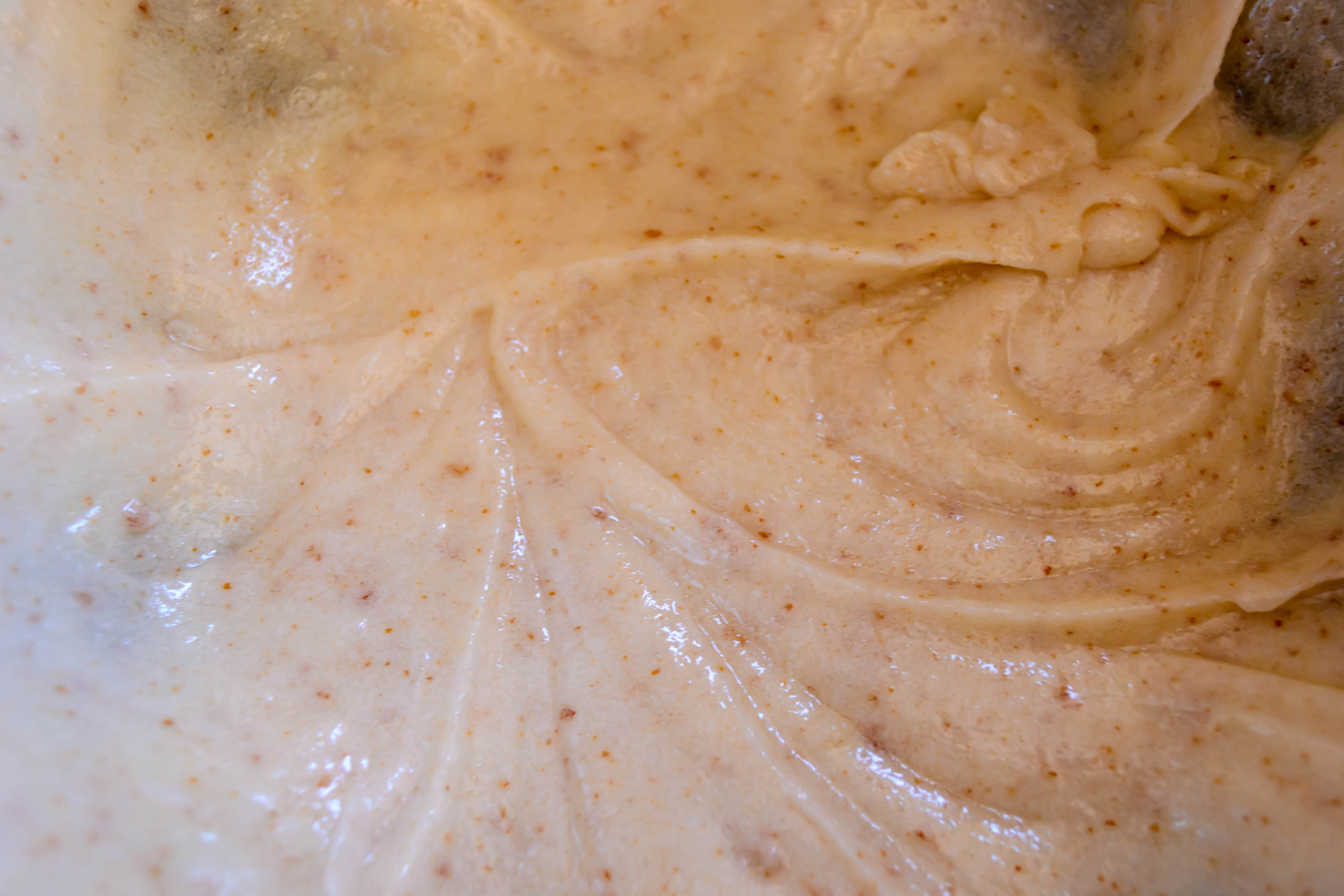
When the butter has solidified a bit, pull it back out and add the sugar, then cream (or goo) well until everything is incorporated and has become a beautiful flecked mixture the rough consistency of frosting.
Add the flour and mix until crumbly.

Food Blog February 2013-0563

Add the lemon zest and the ginger and mix again.  First the dough will become large crumbs, then come together into something more like wet sand.  This takes a minute or two.  If it isn’t coming together right away, don’t worry.  The wet sugar and butter mixture needs some time to moisten the flour.

Food Blog February 2013-0564

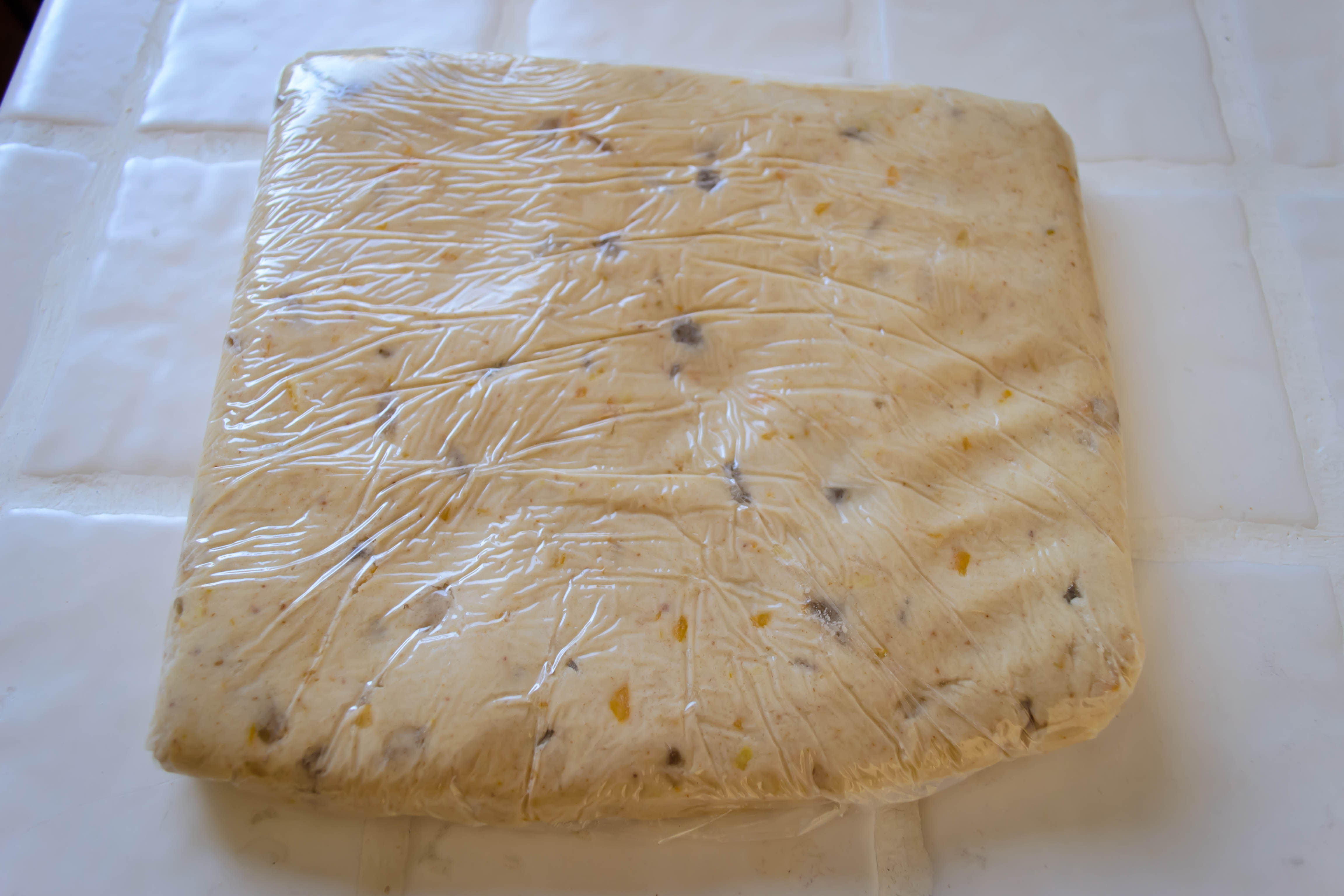
Once the dough is the consistency of wet, packable sand, dump it out of the bowl onto a sheet of plastic wrap.  Using the plastic wrap to help you, shape the dough into a rectangle of 5×8 inches or so, wrap up securely, and refrigerate for about 30 minutes.

Food Blog February 2013-0568

While the dough chills, pulverize the hazelnuts, ground ginger, and raw sugar crystals in a food processor (or chop finely with a sharp knife) until some of the hazelnuts are reduced to powder and some remain in very small bits.  Don’t overprocess – you don’t want this to turn into nut butter.  Stop before it becomes moist.
When your dough has had a chance to chill, unwrap it onto a floured board and roll or press out to about ¼ inch thick.  This takes a bit of patience, especially if you, like me, let it chill for too long and try to roll it out before it’s ready.  Cold rolling results in cracking.  Just relax, let the dough warm up a tiny bit, and roll gently with a floured rolling pin, patching cracks as you go.  This would also be a good time to preheat your oven to 350F.

Food Blog February 2013-0570

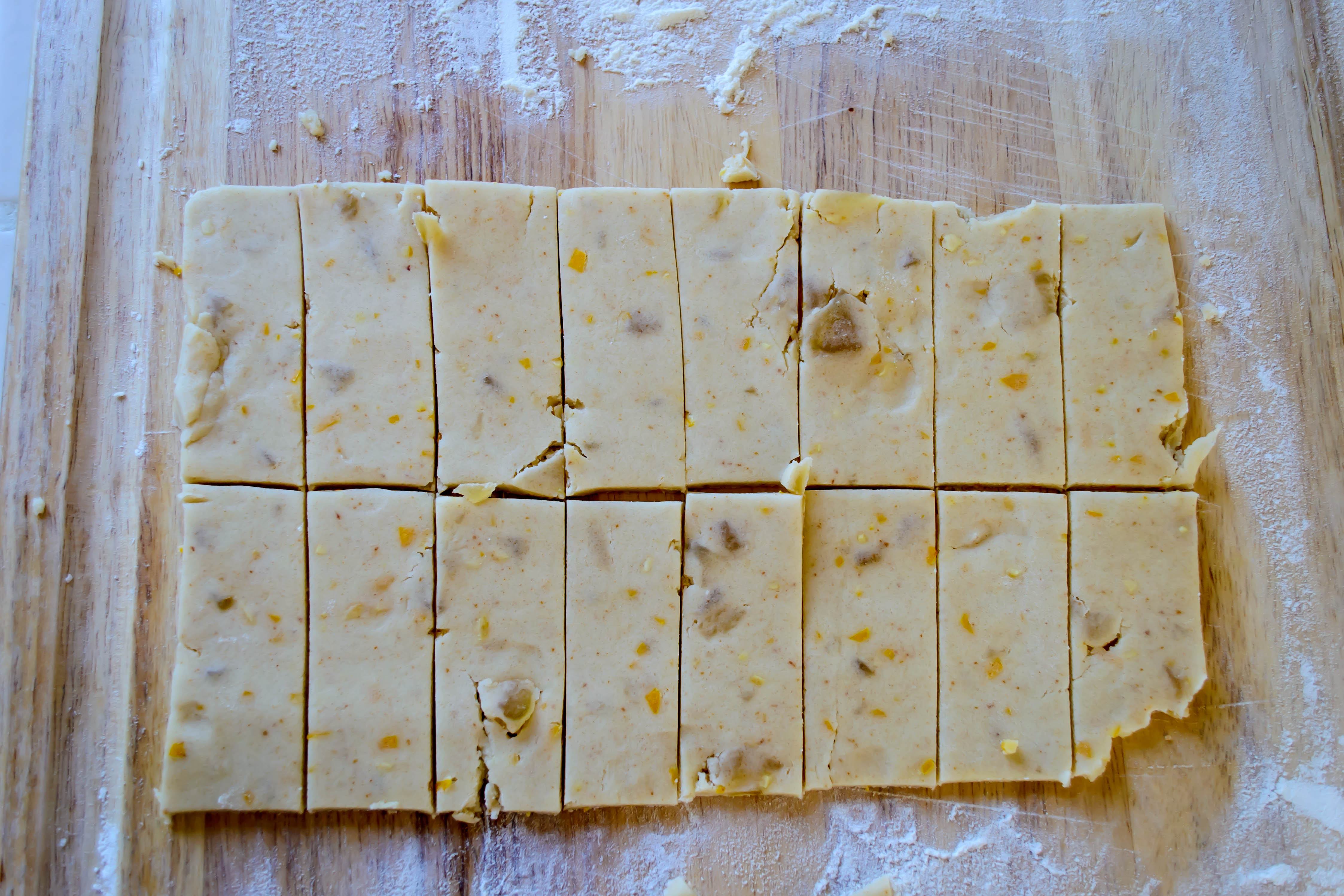
Once you’ve achieved even thickness (minus the odd tall chunk of ginger), use a pizza cutter to trim off uneven edges, and slice the remaining rectangle into smaller rectangles the size of your choosing.  Mine were probably about 1×3 inches, which seemed like a nice sized cookie.
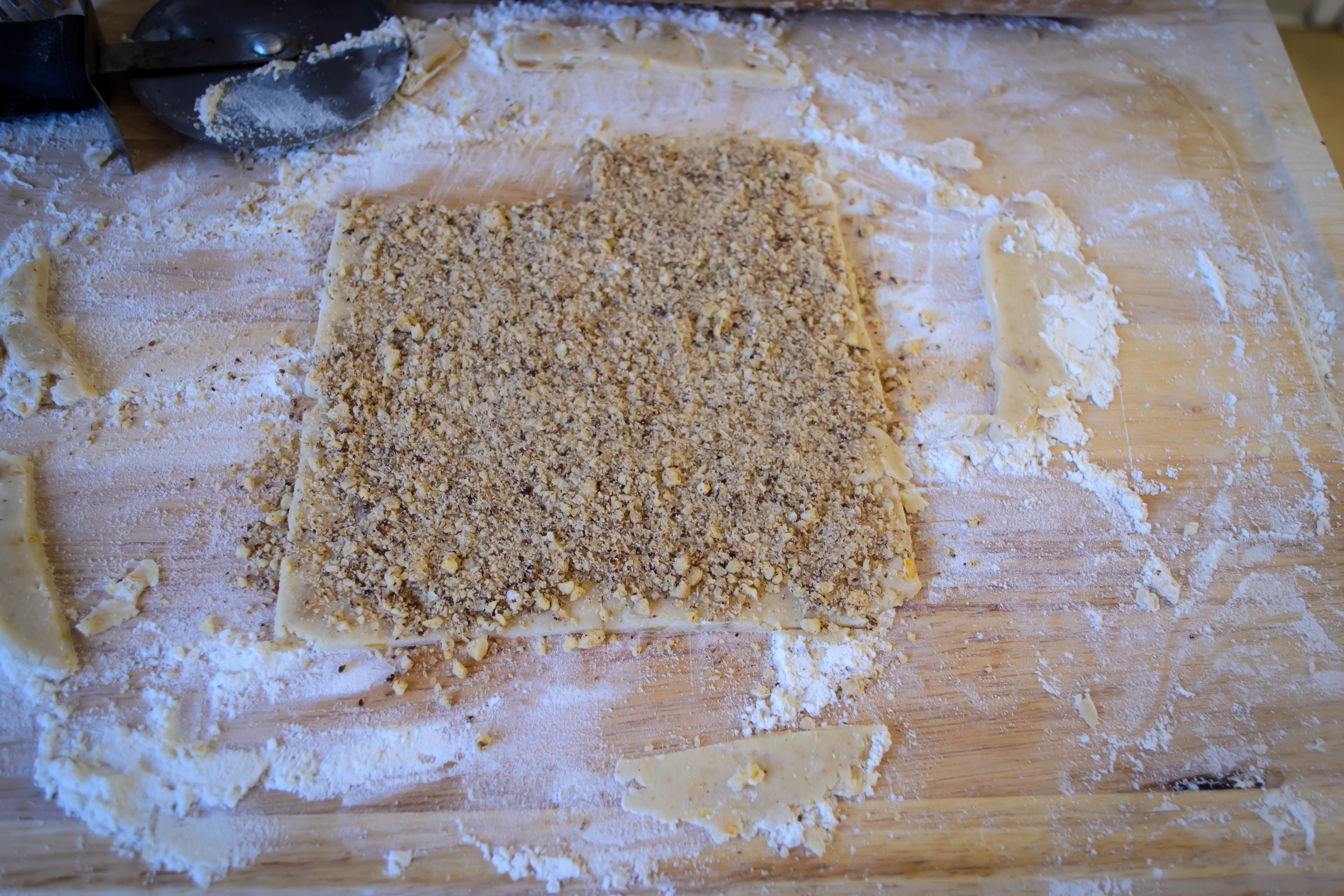
Now it’s time to add the hazelnut crust.  As noted above, you can do this in a number of ways.  You can, if you wish, lift the cookies, place them into a dish of crumbs, and press down, hoping for adherence without breaking the cookie itself.  This method requires almost excruciating gentleness.  You can also press handfuls of the hazelnut crumbs down on top of the cookies on the board, applying firm but gentle pressure, and then lift the cookies one at a time and invert them onto a parchment lined baking sheet.  As you flip, some of the hazelnut crumbs will loosen.  That’s okay.  Just get your cookie settled on the baking sheet and then press down again gently but firmly to re-stick the crumbs.  They will adhere better as they bake.

Food Blog February 2013-0571

Once you have a full baking sheet (mine each fit 15-18 cookies in various arrangements), pierce the cookies gently with a fork to achieve that pricked look so popular in shortbread, and bake for 18 minutes.  The cookies will become lightly golden all over, and the hazelnut crumbs will darken and get a bit toasty.

Food Blog February 2013-0576

At 18 minutes, take them out of the oven, set the baking sheet on a cooking rack, and walk away.  The cookies need 4-5 minutes to set before you try to move them.  They are much too soft at their moment of emergence to transport intact.  As they cool, they will deflate and crisp up a bit, and you can move them to a cooling rack or a marble countertop or surface of your choice.

Food Blog February 2013-0583

You can certainly eat these warm, but I liked them better completely cooled.  In fact, I liked them better the next day, once the flavors had melded and developed.

Food Blog February 2013-0580

Stored in an airtight container, these keep deliciously for over a week.  They even, wrapped carefully, stay crisp and fresh through the mail.
This recipe probably made about 3 dozen cookies, and could have made more if I had eaten less of the dough scraps.  I, alas, didn’t make a count before I started sampling, which is always a tasty, tasty mistake.

Smoked Salmon Burgers and Not-Ciabatta

In 2009, as N. and I were working through the Oral Examination phase of our graduate program – one of the most difficult aspects, as far as I’m concerned – a little restaurant opened on the south side of town.  Sharing space with a small bakery called the Humble Bagel, and run by the bagel shop owners’ daughter Anni and her husband Ari, the Humble Beagle quickly became our favorite restaurant in Eugene.  The feel is an intriguing blend: casual neighborhood gastropub, seasonal local food, layered with Israeli influence.  Macaroni and cheese, Caesar salad with amazingly lemony dressing, or penne with fresh pesto share menu space with shakshuka, house made pita, and lamb pizza dolloped with labneh.  In the summer, weekly specials are determined by what is producing best in Ari and Anni’s backyard garden.  In the winter, Ari makes his own pastrami and quick pickled cabbage for their take on a reuben.  The beers on tap are mostly from Oregon, and even the soft drink selection is carefully chosen for its local, natural ingredients.  The check comes with homemade, sugar dusted shortbread cookies.  It’s a pretty good example of the slow food movement in delicious action.  If you want a quick meal, don’t bother.  You’ll be there at least two hours.  If you want a place to bring your sixteen unannounced relatives, don’t show up without reservations.  This is a small, local pub, not a diner or high volume chain.  If you want tasty, thoughtful, belly-warming food at a relaxed pace, get in your car right now.  For a while, as N. and I neared the dates of our respective exams, we were going to the Beagle every Friday evening for dinner.  Almost without exception, I got the Fisherman’s Stew, a lovely collection of shellfish and moist, flaky halibut in a tomato and fennel broth with garlic aioli melting achingly over the top.  We could barely afford the luxury of these weekly visits, but we also couldn’t stay away.

The Beagle entertained us for the next three years.  We went there for birthdays – N.’s 30th, when Ari let me bring a cake I’d made at home, gave me the biggest chef’s knife I’ve ever seen to slice and serve it, and then took a leftover piece back to the kitchen where he shared it with the cooks.  We went there for the yearly day-after-Thanksgiving meal with my family.  One year, fifteen minutes into the meal we were the only patrons, and it was like our own private restaurant.  Ari came out and told us stories about his family’s holiday, and we were suddenly not in a restaurant anymore, but in the home of our friend.  We went there for dinner after my dissertation defense too, and even though we ended up being an annoying group – people arriving late and leaving early, special menu substitutions and requests, perhaps slightly-too-boisterous behavior – our server said it was okay, and that Ari had told him we were royalty.

On their Summer 2010 menu, the Beagle introduced an item I was instantly drawn to and still haven’t gotten enough of: the Smoked Chinook Patty.  This was a salmon burger on fresh ciabatta (made in the bakery next door), but what pulled me in was its blend of fresh and smoked salmon.  It’s immediately richer, deeper, brinier than any other salmon patty I’ve tasted.

This week, needing both a new dough challenge and a taste of that chilly, rain-soaked, allergen-laden city I still think of as home, I decided a recreation was in order.

Food Blog January 2013-0478

The Beagle’s patty comes on freshly made, perfectly crusted, well-toasted ciabatta rolls.  Looking in Ruhlman’s Ratio this week, I noted that the only difference he gives between ciabatta and a standard baguette or boule is the shape and cooking time.  This seemed promising and so, despite my claims last week about fear and being unready, I decided to dive in.  What else is a Thursday morning for?

Food Blog January 2013-0439

I dutifully mixed, then kneaded, bread flour, water, yeast, and salt.  I tore off a chunk to perform the windowpane test, and I cuddled my ball of smooth, elastic dough in an oiled bowl to rest and rise.

Food Blog January 2013-0446

Ruhlman doesn’t give any suggestion of how long to bake individual ciabatta rolls, only a full loaf, so I went to the internet for help.  I quickly discovered that what I was making wasn’t going to be the bread I’d had in mind: the tremendous bubbles that bake into cavernous holes, the flour-dusted, almost gravely crunch of the crust, and the soft, perfectly chewy texture of the interior are achieved through a slightly different ratio of ingredients, and a more involved process, as this article on The Kitchn depicts.  Since I was starting on the day of baking and didn’t have a biga waiting in the wings, I was just going to have to work with my mix.

Food Blog January 2013-0449

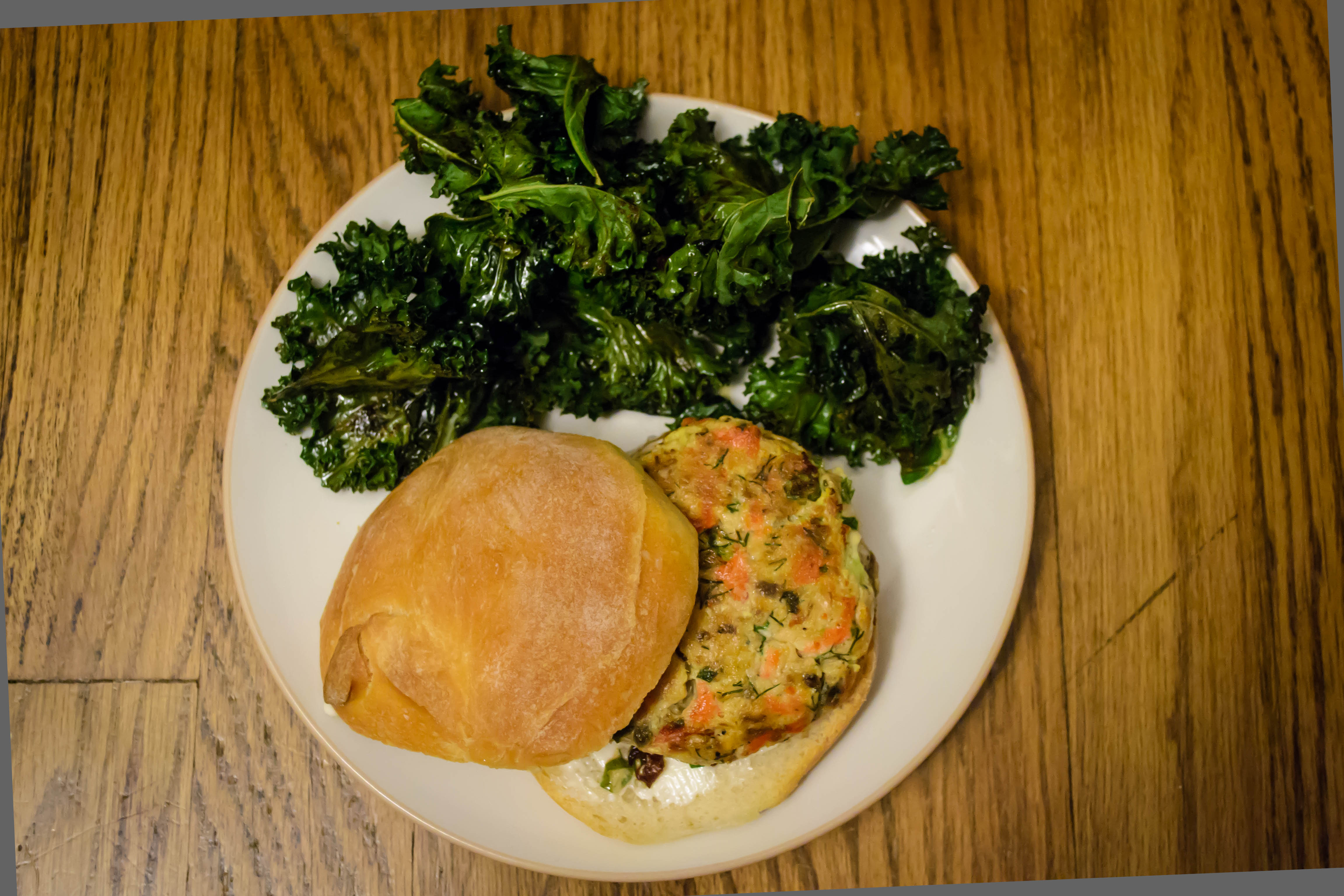
Ultimately, though what resulted was more like a super crunchy, slightly flat mini boule, it was crisp and buttery golden delicious and an excellent vehicle for the smoky/briny/rich/tastes-like-home burger it enclosed.

Food Blog January 2013-0456

Not-Ciabatta

10 ounces bread flour (or 2 cups)

6 ounces warm water

1 teaspoon salt

½ teaspoon active dry yeast

Sprinkle the yeast over the surface of the water and set it aside for five minutes or so to come back to life.

While you wait, whisk flour and salt in a mixing bowl.  Make a little well in the center and pour in the yeasted water.  If using a stand mixer, beat with the paddle attachment just until things come together, then switch to the dough hook and knead at medium speed for 10 minutes.  I had never executed this switch between tools before, but it worked really well.

After 10 minutes, the dough should be stretchy and lovely and firm, and all traces of unincorporated flour on the sides of the bowl will be gone.  Do the windowpane test to see if the bread is ready.  If it’s not, continue kneading.  If it is, transfer the ball of dough to a lightly oiled bowl and place in a warm, draft-free place to rise.  I like to put it in an oven that’s been warmed for five minutes, then turned off for five minutes.

Let the dough rise until doubled in size – mine took 1 hour and 45 minutes.

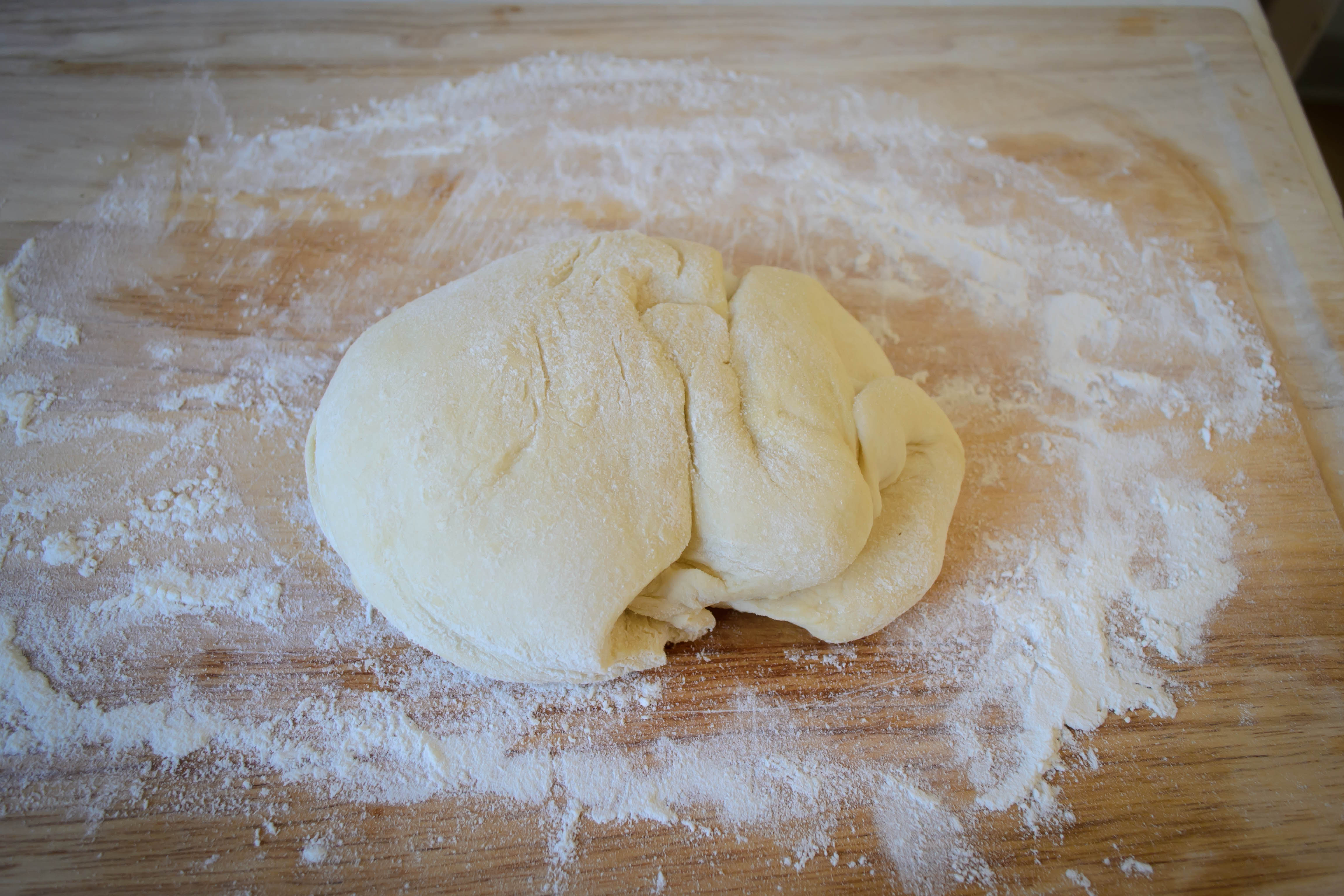
Punch down the dough gently and then knead it on a floured board for a minute or two to deflate it a bit.

Let it rest for 15 minutes.

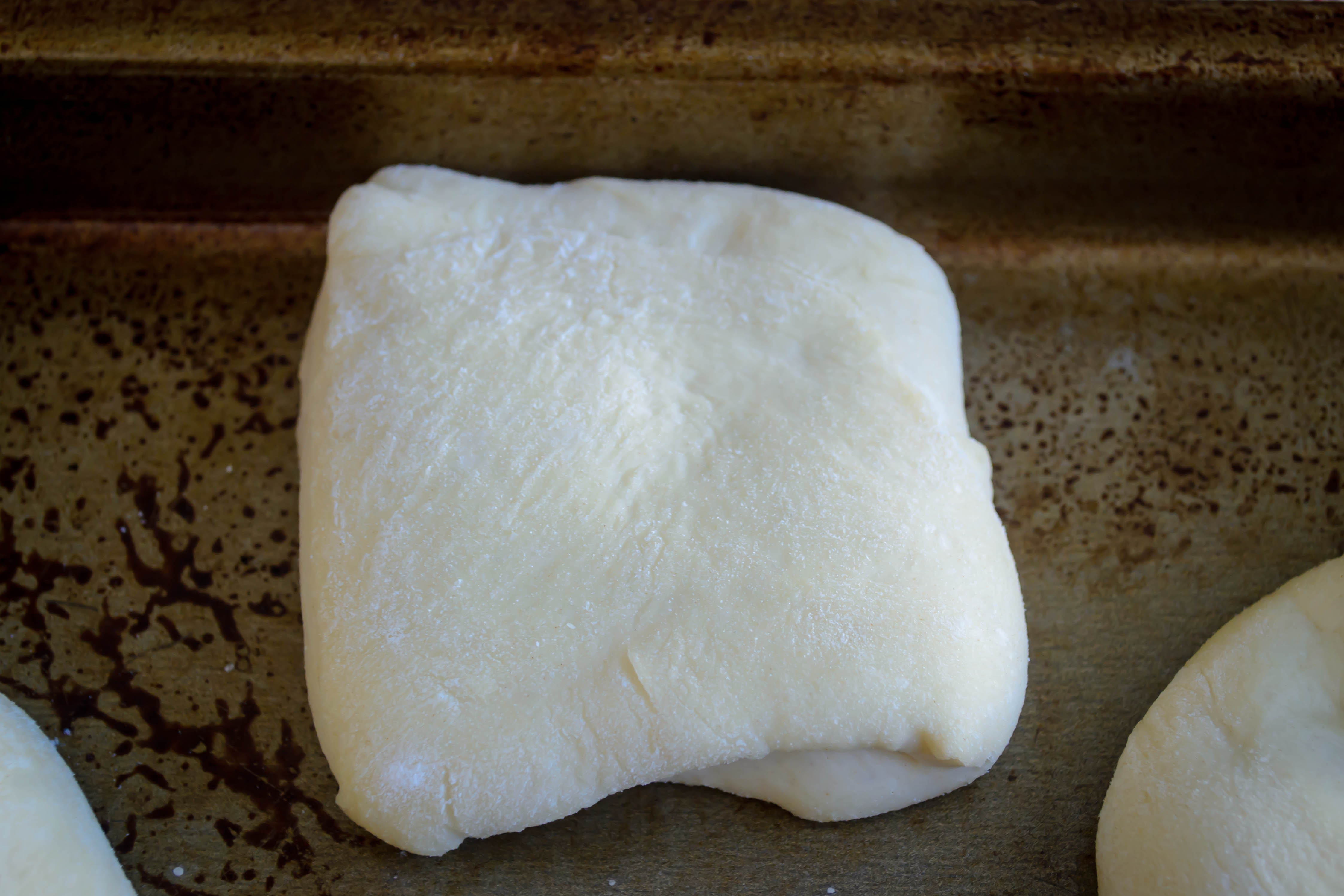
At this point, divide the dough, shape it into the bun shapes you want, and let it rise on an oiled baking sheet for another 1½ – 2 hours.  I ended up with seven mismatched, homely little balls, but I lovingly covered them with a clean kitchen towel and went about my business.  (I think I went about my business a bit too long – 2 hours became almost 3½, and the resulting buns didn’t puff much during baking because they’d expended so much of their rising power as they sat on my counter.)

Food Blog January 2013-0448

When the buns have risen again, drizzle them with olive oil and bake in a preheated 450F oven for 10 minutes, then turn the heat down to 375F and continue baking for another 20 minutes, or until golden brown and done in the center (with a full-size loaf you can thump the bottom and if it sounds hollow it’s done, but I suspect these are too small to yield satisfying results with this method.  Since I had 7, I just tore into one to see if it was done, and when it was, I ate it.  No one else has to know).

Food Blog January 2013-0461

Set aside to cool while you make the salmon patties.


Smoked Salmon Burgers

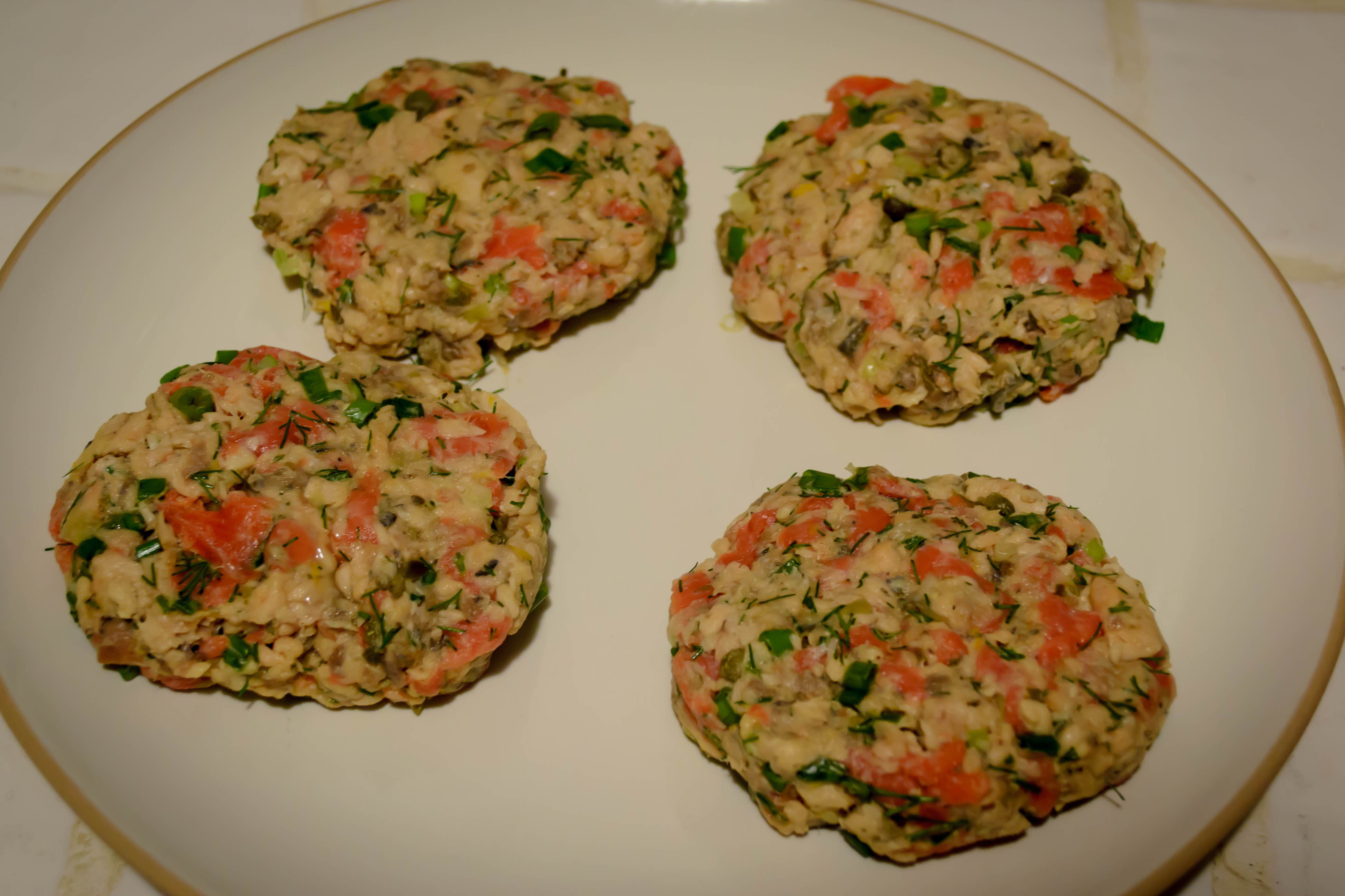
These are robust in flavor but, especially if you are using canned salmon, must be handled with some delicacy to prevent breakage.  They are, I think, a perfect blend: rich, fatty salmon, salty smoky deepness, and the sour zesty bite of capers and lemon.  If you don’t want to bother with the buns, you could certainly encase these in crisp leaves of butter lettuce.

15 oz. canned salmon, picked through and bones removed, or about 1 lb. fresh, finely chopped

4-6 oz. smoked salmon, flaked with a fork

2 cloves garlic, *pasted with salt or grated

3 green onions, finely diced

1 TB capers, minced

1 TB fresh dill, minced

1 tsp each lemon zest and lemon juice

Pepper to taste

1 egg, lightly beaten

If you are using canned salmon, combine all ingredients except the egg and taste for seasoning.  That way your mixture is perfectly seasoned before adding raw egg to the party.  You will likely not need any additional salt, because the smoked salmon and capers are briny already, and if you paste your garlic you will already be adding salt to the mixture.

Food Blog January 2013-0463

If you are using fresh salmon, combine all ingredients, mix well, and then fry about a tablespoon of the mixture until cooked through to taste for seasoning.

*To paste the garlic, mince cloves, then sprinkle with salt.  Using firm pressure, draw the blade of your knife across the garlic on the board several times.  It will begin to lose its integrity as the salt breaks it down, until you are left with a paste that is much easier to incorporate into your salmon mixture.

When it is seasoned to your liking, quarter the mixture and form four equal sized patties of 3-4 inches in diameter.  Pop these in the refrigerator for at least half an hour to let them firm up and meld – they will hold together in the pan much better this way.

Food Blog January 2013-0470

Before cooking, let your refrigerated patties stand at room temperature for about 10 minutes, just to take the chill off.

Food Blog January 2013-0468

Warm olive oil in a skillet over medium heat and gently fry the patties.  They should take 5-8 minutes per side.  Cooking time will depend upon whether you have used canned or fresh salmon and how plump your patties are.

To serve, enclose in buns lovingly with some spring mix and your choice of condiments.  I suggest horseradish or wasabi mayonnaise.  If you had homemade mayonnaise that would be a lovely splurge here.

Food Blog January 2013-0474

We had ours with paprika spiced kale chips, but to really get the Beagle experience you would need to serve with garlic French fries.

Food Blog January 2013-0479

Parsley Pie Crust

Food Blog January 2013-0412

I’ve never been one to start at the beginning.  Stories require backing up and wait- wait- let me explain who that was.  Dreams are recalled near the end, and only slowly do the initial details return.  Directions often skip a step or come in fuddled order.  I don’t know whether this is a consequence of a disorganized brain, or whether it’s a signal of confused genius (hah!).  The Odyssey, with its in media res trope, was an enormity to my teenage brain when I first encountered it during high school.  What a wonderful way to present information, and how validating and revelatory it was to find out that this was a classical method!

So it was no big surprise that, when facing the first week of my dough challenge, I couldn’t start at the beginning.  Ruhlman arranges Ratio with doughs first, true, but he seems to traverse the category in a solids-to-liquids order.  Bread comes first, pate-a-choux closes the chapter.  To me, this was even more intimidating than the idea of tackling dough at all.  Bread is something I want to build toward, not race into headfirst.

I flipped ahead in the book to take on my own personal Waterloo: pie crust.  Supposedly “easy as.”  But I’ve never found it that way.  My crust is somehow tough AND crumbly.  It collapses, it sticks, it refuses to roll in a smooth circle, it requires patching and crimping and pressing and it’s just easier to buy Pillsbury.  But now I’m in it, and I’ve got to conquer this thing.

Despite this personal beginning, it wasn’t enough for me to just make a pie crust.  You guys have probably all made pie crust.  How boring would it be for me to just report on the quiche I made?  At the end of the pie crust section, Ruhlman lists a number of alternatives and additions.  Ground nuts, cracked peppercorns, a dusting of spices, parmesan cheese?  I had never considered this.  I had to try it out.

Our quiche would have a parsley crust.  Coincidentally, this made my experimentation a perfect candidate for submission to Weekend Herb Blogging.

(I started with parsley, and then I started imagining adding lemon zest, and big particles of cracked black pepper, and then I realized that I just wanted some of the herbed buttermilk biscuits I so heralded when I made them for my Bittman project.  Biscuits are in our future, friends.)

The ratio for pie dough – at least this one – is 3, 2, 1.  Three parts flour, two parts fat, one part water.  This is by weight.  The problem here is, despite my desire to conquer this beast, and despite the impressive (read: verging on ridiculous) collection of kitchen tools I’ve amassed over the years (pot sticker press, anyone?), I don’t have a kitchen scale.  That makes it hard to work in weights.

Food Blog January 2013-0385

Fortunately, though he advocates it persistently, Ruhlman provides the general weight range for a cup of flour, so I worked with that.

Every pie crust recipe I’ve ever read, Ruhlman’s ratio included, calls for the water to be ice cold.  I get this: you want the fat to remain cold during this construction phase so it can melt and leave flaky pockets as it bakes.  Ice water keeps things frosty.  I decided to skip the ice cube middle man and stuck my water in the freezer for a few minutes.

Food Blog January 2013-0396

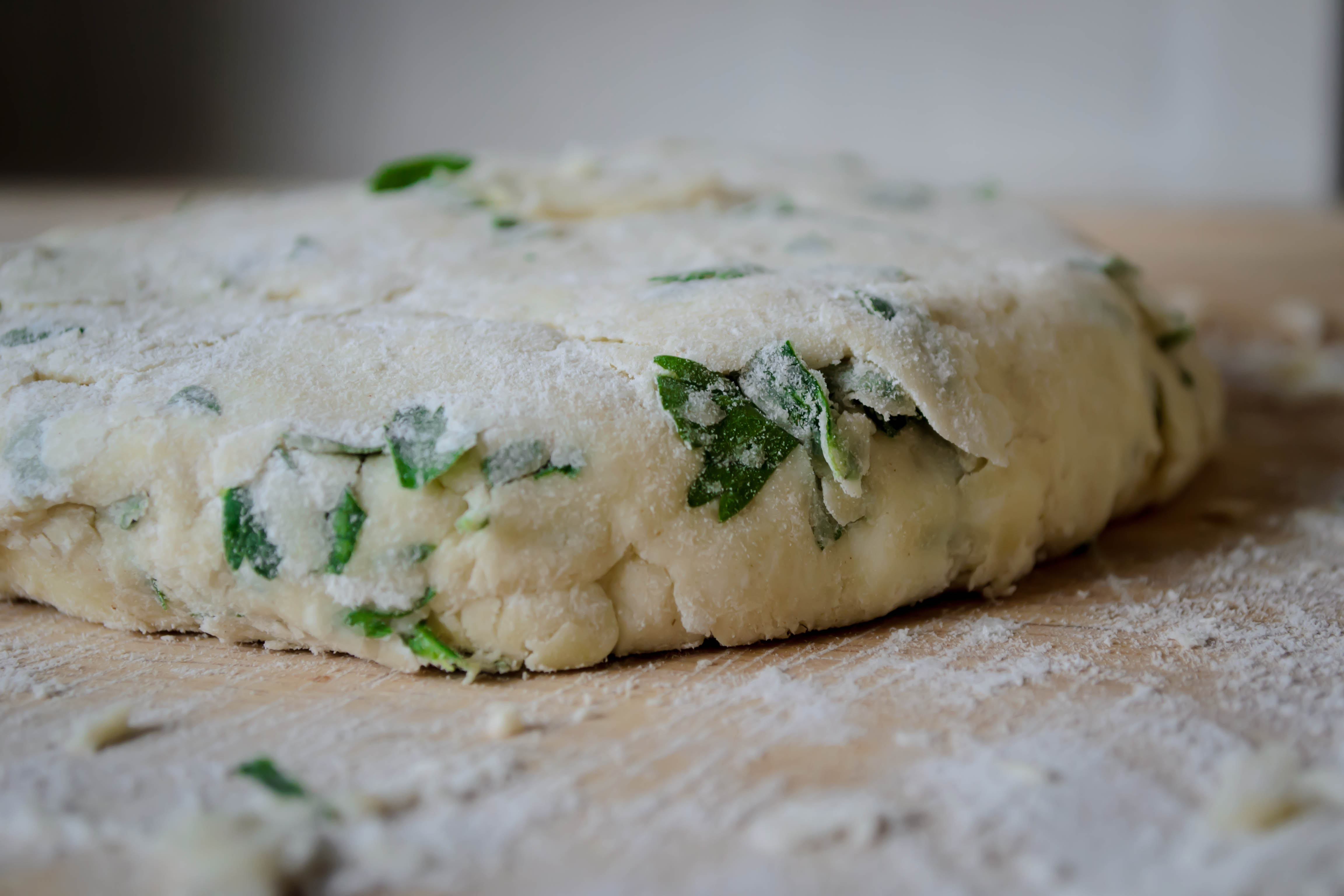
Usual procedure here: cut in the butter, add salt (and parsley, in this case), incorporate just enough water to bring things together, form into a disk and refrigerate to firm the fat back up.  Then you can roll out, fill, and bake.

Food Blog January 2013-0398

Food Blog January 2013-0401

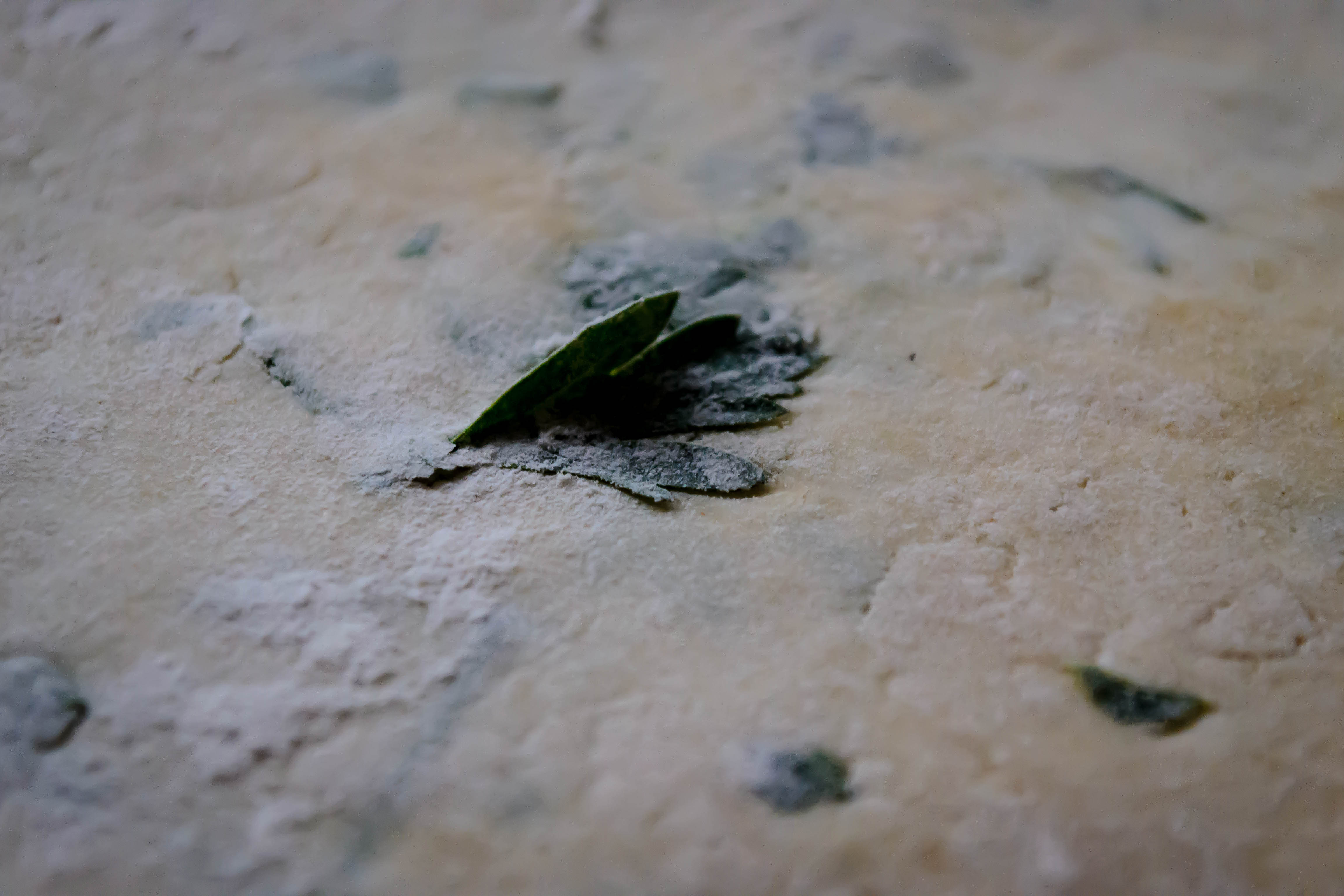
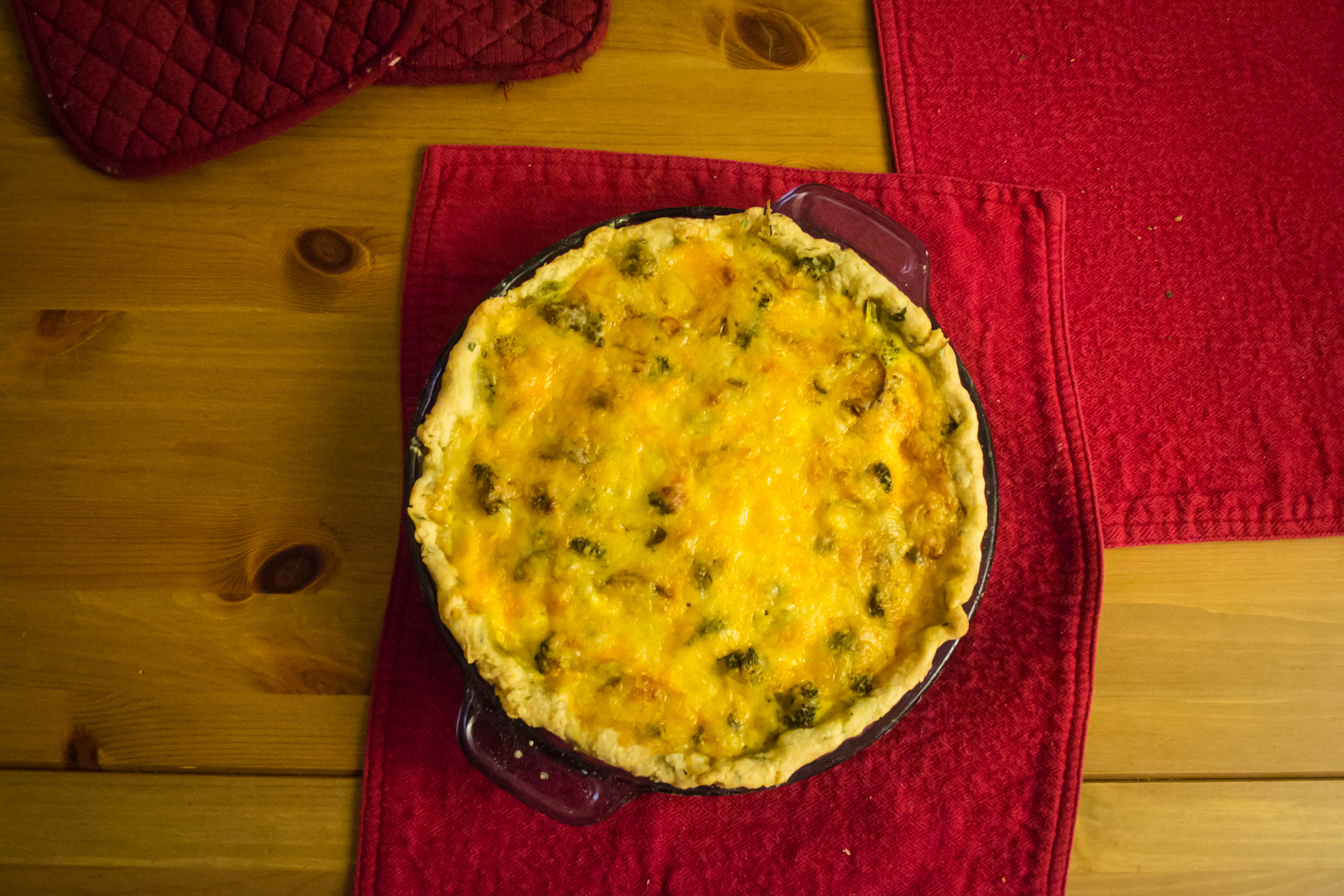
That all sounds pretty simple, but somewhere in there things tend to go wrong for me.  This crust was (relatively) easy to work with.  It didn’t disintegrate, it didn’t melt, it didn’t even crack in too many places.  I think playing with biscuit and cracker doughs this past year accustomed me to the feeling and delicacy required to not destroy a circle of dough.  It was barely moist and not exactly elastic, but it did have a bit of give.  It baked to a lovely golden color, the flecks of green were intriguing and special, and the quiche that rested just wobbling between its sturdy walls was delicious.

Food Blog January 2013-0407

But the crust was tough.

I can assume a few reasons for this.

1.) It’s possible my ratio was off.  Because I didn’t weigh my flour, I may have had too much or too little in the mix.

2.) More likely, I overworked the dough.  I pressed and kneaded and folded until the dry bits at the bottom of my mixing bowl were willing to play along, and perhaps I was too insistent about that demand for inclusion.

Food Blog January 2013-0408

Like everything else, it seems pie crust needs a revisit to get it right.  The feeling of the dough between my fingers is familiar, but I have to learn its textural intricacies.  How much water is just enough?  How crumbly can it be and still hold together?  How much of the dryness do the fat and water absorb while the wrapped disk rests?  Without another attempt or three, I won’t know.

But it tasted good.  It crunched against the quiche and while it didn’t shatter at the slightest fork pressure, it did have that dryness against the teeth you expect from crust.  The parsley contributed a grassy freshness and made the flavor more complex, especially the following day.  I could see this working similarly well with dill, or thyme, or maybe even marjoram, all of which pair nicely with broccoli and mushrooms.

Onward, then.

Food Blog January 2013-0417

Broccoli mushroom quiche with parsley pie crust

(The quiche recipe is my mom’s.  I’m sure she got it from somewhere, but I don’t know that she even knows where anymore.  I’ve changed very little here, though her version usually contains bacon instead of mushrooms)

Crust:

1 heaping, lightly fluffed cup of flour (or 6 oz., if you’re doing this properly)

1 stick (8 TB, 4 oz., etc) butter, cut into 16 or so pieces

2-4 oz. very cold water

Pinch salt

2 TB chopped parsley (or dill, or oregano, or marjoram, or thyme… whatever you like best, I expect)

Filling:

1 cup small broccoli florets

6-8 crimini mushrooms, sliced thinly

¼ cup green onions, diced

Olive oil

Salt and pepper to taste

4 eggs

1 cup milk

1 ½ cups grated extra sharp cheddar cheese

½ cup grated swiss cheese

First, make the pie crust.  Measure out your water and put it into the freezer while you assemble your other ingredients.

In a bowl, combine the flour and butter pieces.  With your hands or a pastry blender (I always use the pastry blender – I hate the too-dry feeling of slowly crusting flour on my hands), cut the butter into the flour until it is pea-sized chunks and smaller.  Add the salt and herbs and combine gently.

Dribble in some water – 2 oz. to start with – and combine.  If the dough really isn’t coming together, add more water.  When you can press a few teaspoons of the dough between your fingertips and it stays together, turn the whole mass out onto a floured board and work lightly to bring it together into a disk.

Wrap the disk in plastic wrap and stow it in the fridge for half an hour or so.

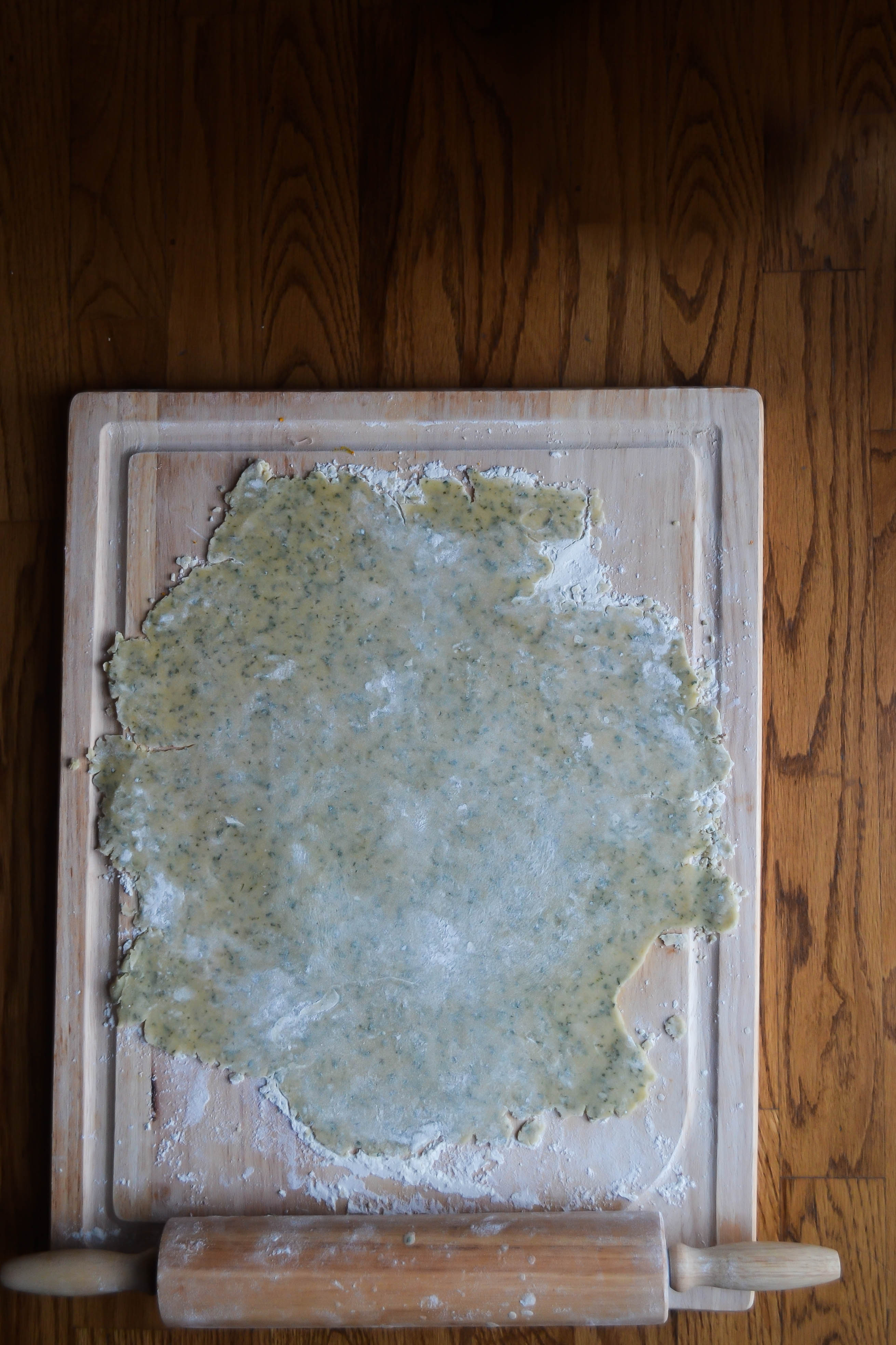
When the dough disk is cold and firm, bring it back to your floured board and remove the plastic wrap.  Roll it out, moving a rolling pin (or wine bottle) in a few strokes straight away from you and back toward you only.  Avoid diagonal movements.  The dough will become a long oval.  Then, flip the dough over and turn it 90 degrees so you are facing a fat, flour-drenched oval instead.  Roll again, still moving the rolling pin straight away from and back toward you.  Repeat this process until you have a rough circle an inch or two larger than the diameter of your pie plate.

Lightly roll half of the dough around your rolling pin and drape it loosely into the pie plate, unrolling as you go, letting the crust settle into the dish.  Trim, crimp, or fold over any dangling edges as aesthetically as you are able.

Set aside (or perhaps return to the refrigerator?) while you make the filling.

Preheat the oven to 350F.

Heat some olive oil in a skillet over medium-high heat.  When it is shimmering, add the mushrooms and give them a good stir, taking care that as many as possible have contact with the bottom of the pan (that is, don’t leave them piled atop one another if you can help it).  Then leave them alone for a good five minutes, or until they begin to develop a golden crust.

While the mushrooms are getting golden, steam or microwave the broccoli florets until they are just crisp-tender and still very bright green.  Set them aside.

Turn your mushrooms and let them sizzle for another five minutes or so.  When they are golden on both sides, turn the heat down to medium and add the onions.  Cook until soft and translucent.  Toss the broccoli in the pan, then add salt and pepper to taste.  Mom often adds tarragon or marjoram at this point as well – start with ½ tsp and see what you like.  Remove from heat and set aside to cool for a few minutes.

While the vegetables cool, beat the eggs and milk together.  Add a dash of grated nutmeg, if you like, or some cracked black pepper.  As the quiche bakes, this will become a lovely firm custard.

To assemble, fill the pie crust with the vegetables, spreading them in an even layer.  Gently pour the custard over the vegetables.  Toss the shreds of cheese together and spread them evenly across the top of the filling.

Bake for 50-60 minutes, or until the cheese is golden and the quiche has puffed in the middle.  If it’s not puffed yet, it’s not done.  The ingredients will be cooked through, but when you cut into it you will find a disappointing watery layer at the bottom.  Give it another few minutes.

With the center puffed and the cheese sizzling, remove the quiche from the oven and let it sit for 5-10 minutes so the cheese can solidify a bit and doesn’t string all over when you try to cut through it.

Slice and serve. Food Blog January 2013-0418

Rolling in Dough

Okay, 2013, here we go.

OLYMPUS DIGITAL CAMERA

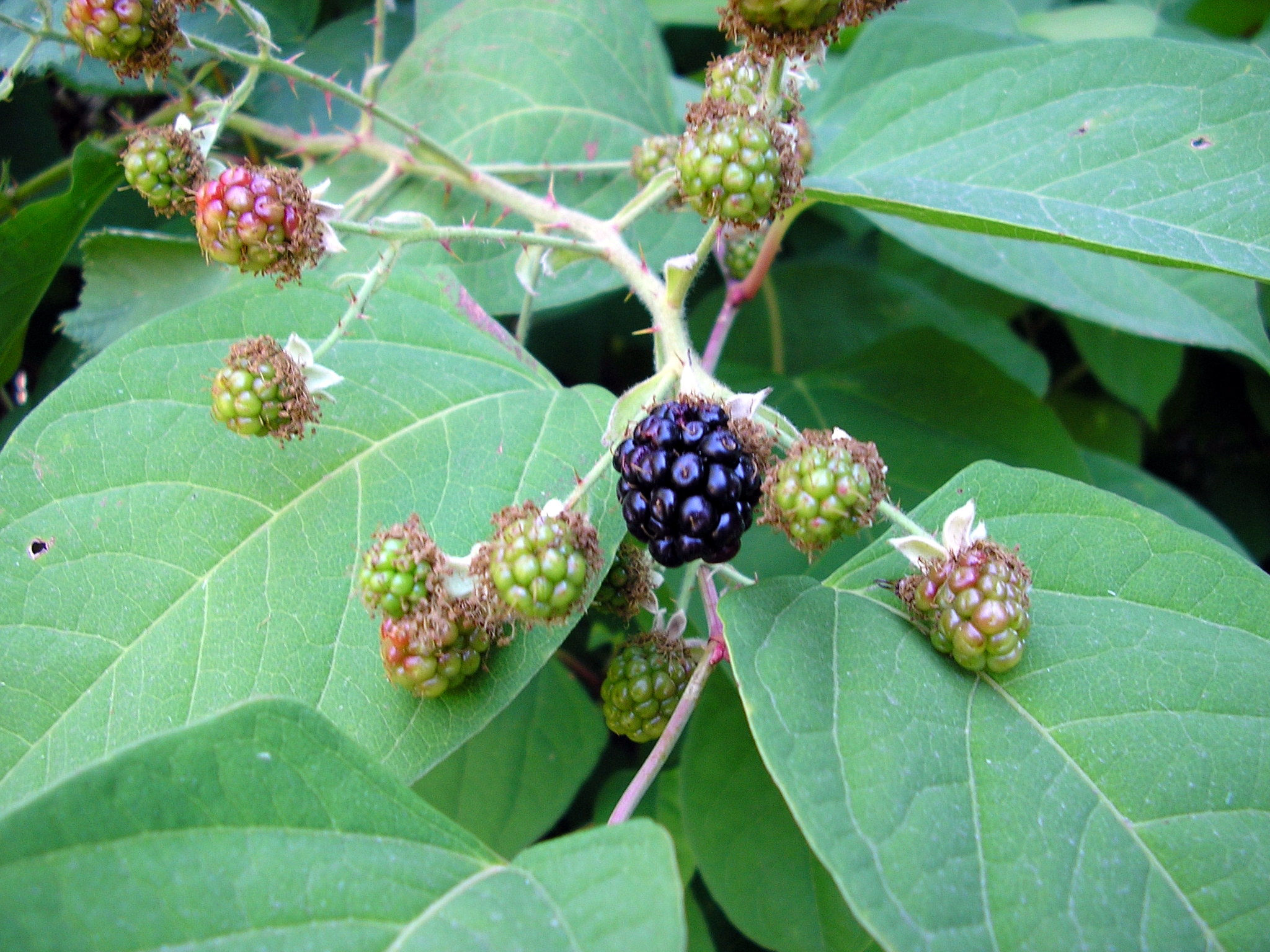
This year, I have a few changes to announce.  First, you may have noticed that we’re at a new address.  Update your bookmarks, if I’m lucky enough to be there, to http://blackberryeating.com.  As I understand it, the old address will still work, it will just redirect you here.  As I mentioned a few days ago, I’ve been wanted to upgrade to an address that makes more sense for what I’m doing here.  Blackberries, their mystery and decadence, remind me of all that is good about food: what is sweet, what is juicy, what is challenging, what is delicate, what is persnickety and strong.  The Galway Kinnell poem from which the title of this blog is taken celebrates juxtaposition and excess, likens these jeweled fruits to words and the consumption of those fruits to the search for meaning and significance.  This is a little piece of significance for me – this collection of words thrust with crossed fingers and squinted eyes out across the internet – and so I wanted to make it more connected, more applicable, but really, more mine.

Who ever thought so much consideration could go into a new address?

With the Bittman project over and a new address settled, it’s time to submerge myself in a new challenge.  As you know if you’ve been reading for a while, dough – particularly pie dough and yeasted dough – is one of my big fears.  What if it doesn’t rise?  What if it crumbles apart?  What if it tears or burns or collapses or comes out tough or doesn’t bake right?  What if it’s (gasp) imperfect?

DSC_0949

I decided I need to get over this.

This year, each week, I will make something out of dough.  It might be pie crust.  It might be cookies.  It might be pizza or foccaccia or flatbread.  It might, as terrifying as this is to me, be a real, honest-to-goodness loaf of bread, bloomed and kneaded, baked until crusty in a loaf pan.  I have a crazy notion that I want homemade bagels.  I have a yen to make doughnuts, and not just cake doughnuts, but the beautiful puff and chewy crumb of a good yeasted twist.

I don’t – and this is important to note – promise absolute success.  You’re going to see what crumbles along the way.  You’re going to see the scraps and scrapes and disasters I produce.  I think this is an important part of learning, and that’s part of what this blog is for me.

I have a few guides in this project, one hoped for and long awaited, one unexpected but delightful.  From my in-laws, I received Michael Ruhlman’s genius book Ratio.  This isn’t a cookbook.  It’s more than that.  It’s more exciting, it’s more foundational, and ultimately, I think, it’s more useful.  It doesn’t tell you how to make cherry pie, it tells you the essential equation of pie dough.  Three parts flour, two parts fat, one part water.  That will always equal pie dough.  Suddenly, you can use any kind of flour – more than one kind, if you want.  You can use lard instead of butter.  You can make one pie or you can make thirty-five pies, and you don’t have to think as hard about multiplying or adding or fractioning.  You have a ratio, and it is always going to work.

That’s the theory.  And I believe it, but I haven’t tried it out just yet.

From my parents, I received a bread machine.  I’ve never used a bread machine before, and while my immediate thought is that to really master dough, I will also have to make it by hand so I understand the kneading and the cycles of rising, and so I will come to know the feeling of the right kind of stretch and the windowpane test and the knowledge beneath my fingers that yes, this is bread, having a machine help me along the way is going to be nice.  The idea of dumping, in pajamas at 10pm, a series of ingredients into a pan, plugging in a machine, and telling it I want a fresh, hot loaf of bread at 7am, delights and astounds me.  I want to understand, but I also want the magic.

So that’s the plan.  If all goes well, it will mean more of this:

Food blog 2011-0097It will certainly mean more of this:

DSC_0959

It may even mean some of this:

IMG_0698

I don’t expect it will mean all dough, all the time, just as the past two years were not exclusively Bittman concoctions.  If something amazing comes along that doesn’t involve flour or eggs or butter, I will still report on it.  But the goal this year – the resolution, if you will – is to conquer this dough thing.  I want to have conversations with you about it.  I want your feedback and advice and experiences.  And I hope you enjoy.