Photo Fridays!

New feature: Photo Fridays!

I’ve been itching to post for you more often, but you know how life gets in the way… not to mention, having more than one delicious, visually appealing recipe every. single. week. is, for me, an intimidating prospect.  So I’m going to try this instead: part of blogging about food (in my case, at least) is being able to take beautiful photographs of it.  I’ve been working hard at this, spurred along by helpful tools like my Nikon D3100 (man I love this thing), and Adobe Lightroom, but what I need more than anything else is practice.

This is going to help me practice.

I will still do recipe posts on Mondays, but every Friday I will try to do a photo post – just a shot or two of something food related, to practice my skillz.  I hope you enjoy it.

Here’s the first one: such delicious promise in just lemon and garlic…

Food Blog Photo Fridays 2013-0771Have a wonderful weekend!

Elsie’s Rhubarb Cornmeal Cake

Blogs have birthdays.  Who would have imagined, a mere decade ago, that the little space we write in daily, or weekly, or monthly, or whenever we can, would become so important in our lives that we would want to celebrate its anniversary?

Food Blog June 2013-1512As I look back, it turns out that I started writing in my own little space almost five years ago.  But I haven’t celebrated its bloggy birthday, nor will I when I do roll over the half-decade mark, because my schedule of blogging was, at least near the beginning, so sporadic.  It doesn’t seem like I’ve really been writing here for five years when for three of those five, you were lucky to get a post a month.  The nice thing about WordPress, though (which I’ve been using quite happily for all of those almost-five-years), is that it tells you how many posts you’ve actually made.  And this, friends, against all belief, is number 200.  Two hundred!  That, to me, calls for a bit of celebration.  Let’s have cake!

Food Blog June 2013-1506Food Blog June 2013-1509This cake needs to be about the edging warmth of late spring, and freshness.  It needs to be something I could never have imagined making 200, or 150, or even 100 posts ago.  It needs to be original and tart-sweet and humble but delicious.  It’s not a show-off cake, but it stands up for itself.  It’s simple and tasty and equally good as afternoon snack, as dessert, and as a bit of a naughty breakfast.  It also, as it turns out, needs to be dairy-free.  Let me explain.

A few months ago, my aunt asked me to make something sweet.  But her granddaughter, Miss Elsie, can’t have dairy products.  No milk, no cheese, no butter.  No whipped cream.  No gelato!  I’ve met Elsie once.  We went on a glorious, sunshiney, beachy, too-much-food-and-certainly-too-much-wine family reunion trip.  The twelve of us – sisters, cousins, uncles, husbands, nieces – shouted and guffawed and flip-flopped our way up and down the three stories of a pool-bearing beach house in North Carolina for the better part of a week, and in the middle of this trip, Elsie tasted her first ice cream.  It was dark chocolate, made entirely with coconut milk, and her first taste, once the chill evaporated, was the purest expression of joy I’ve ever seen.  The kid was hooked.  The shirt she was wearing – white and pink with docile little flowers – was never the same.

Would I come up with something sweet, my aunt asked, that she could make for Elsie?  You got it.  This is an easy little cake, with just a bit of cornmeal for texture.  Butter and milk are replaced by applesauce for moisture and olive oil for deep, rich flavor.

But it couldn’t be just a cake.  If it was already going to be about family, I decided, I needed to go whole hog.  Our reunion trip was, in part, a joyous memorial for my grandparents, who used to vacation in North Carolina many, many years ago.  Transported by this connection, I was pulled back into their old backyard, and I could see Nana’s rhubarb bush at the back corner of the house.

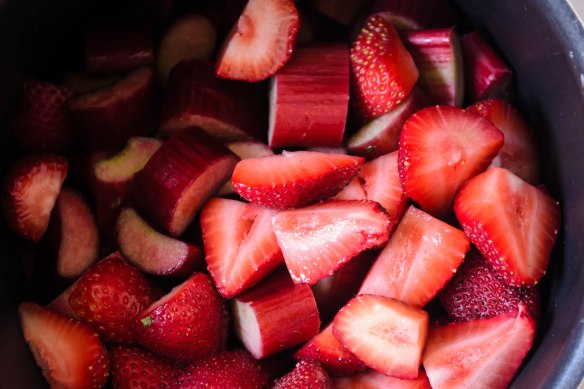
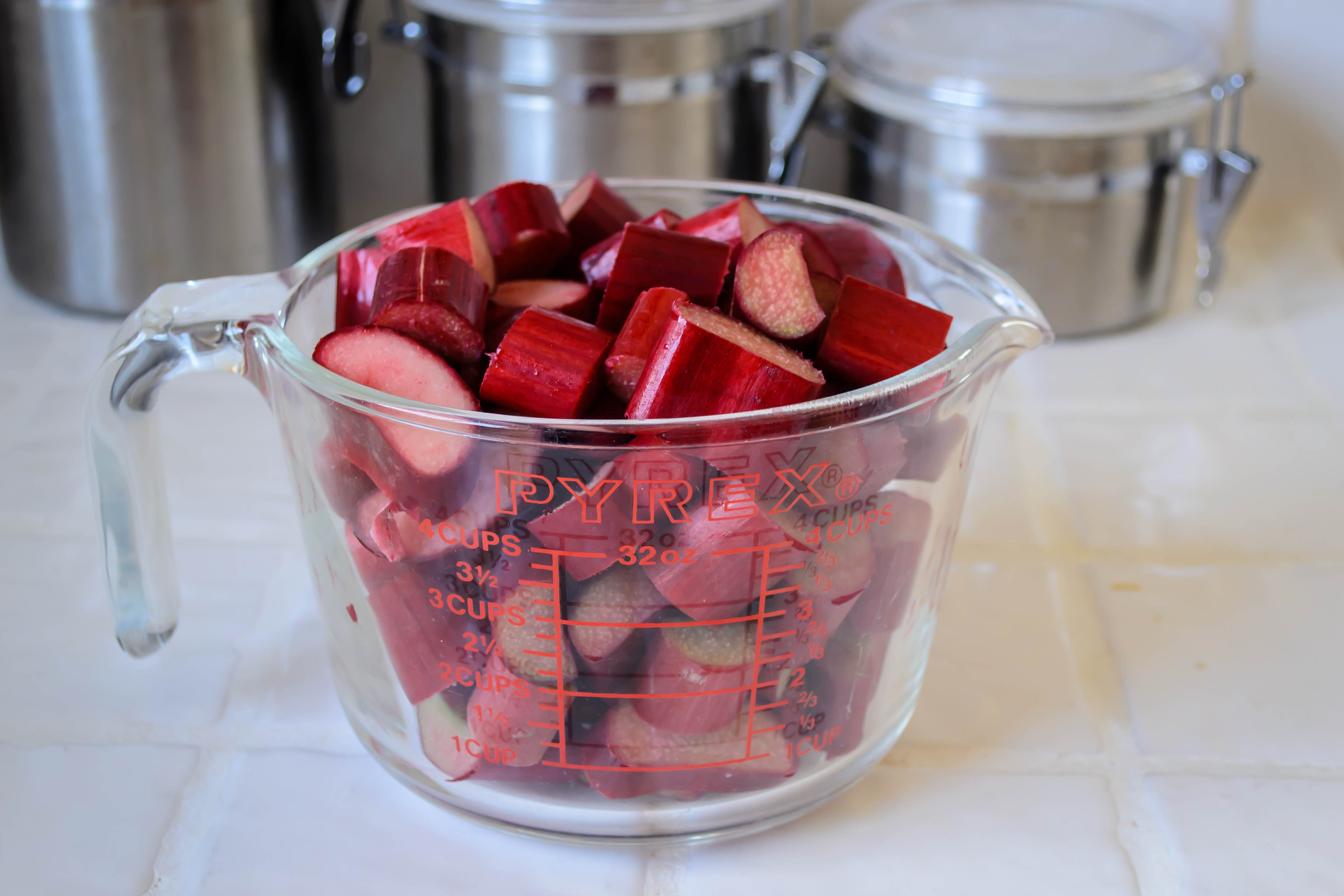
Food Blog June 2013-1458Food Blog June 2013-1461I don’t know whether Elsie likes rhubarb, but from that moment on, rhubarb was it.  I chopped and simmered down a heap of the strange, red stalks, with some quartered strawberries for a different kind of sweetness, and a shower of sugar until it collapsed into a thick, stringy jam.  Think rhubarb floss, but in the most delicious possible way.

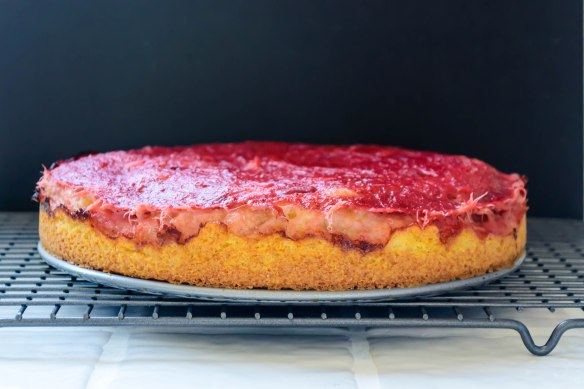
Food Blog June 2013-1462Food Blog June 2013-1474Once cooled slightly, a respectable layer of the strawberry rhubarb compote gets smoothed over the top of the bright golden cake, and then baked.
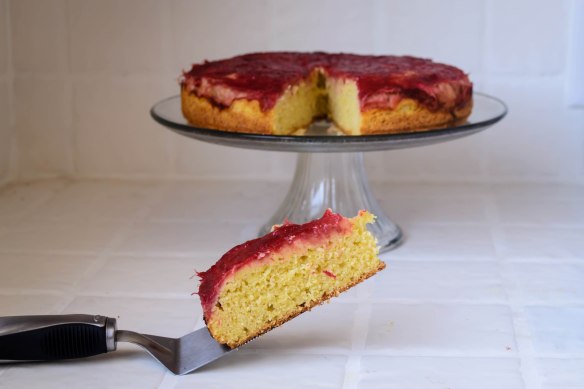
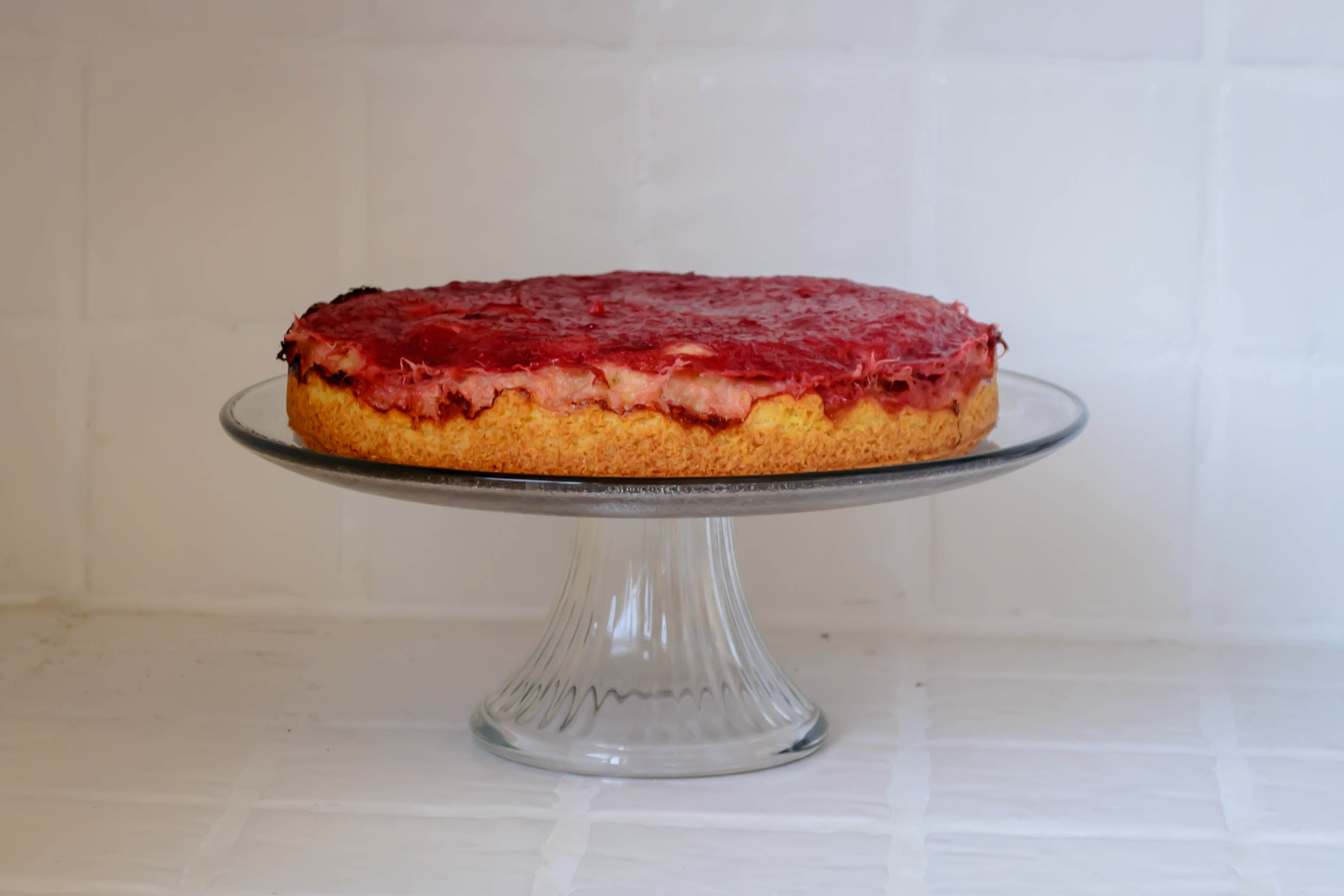
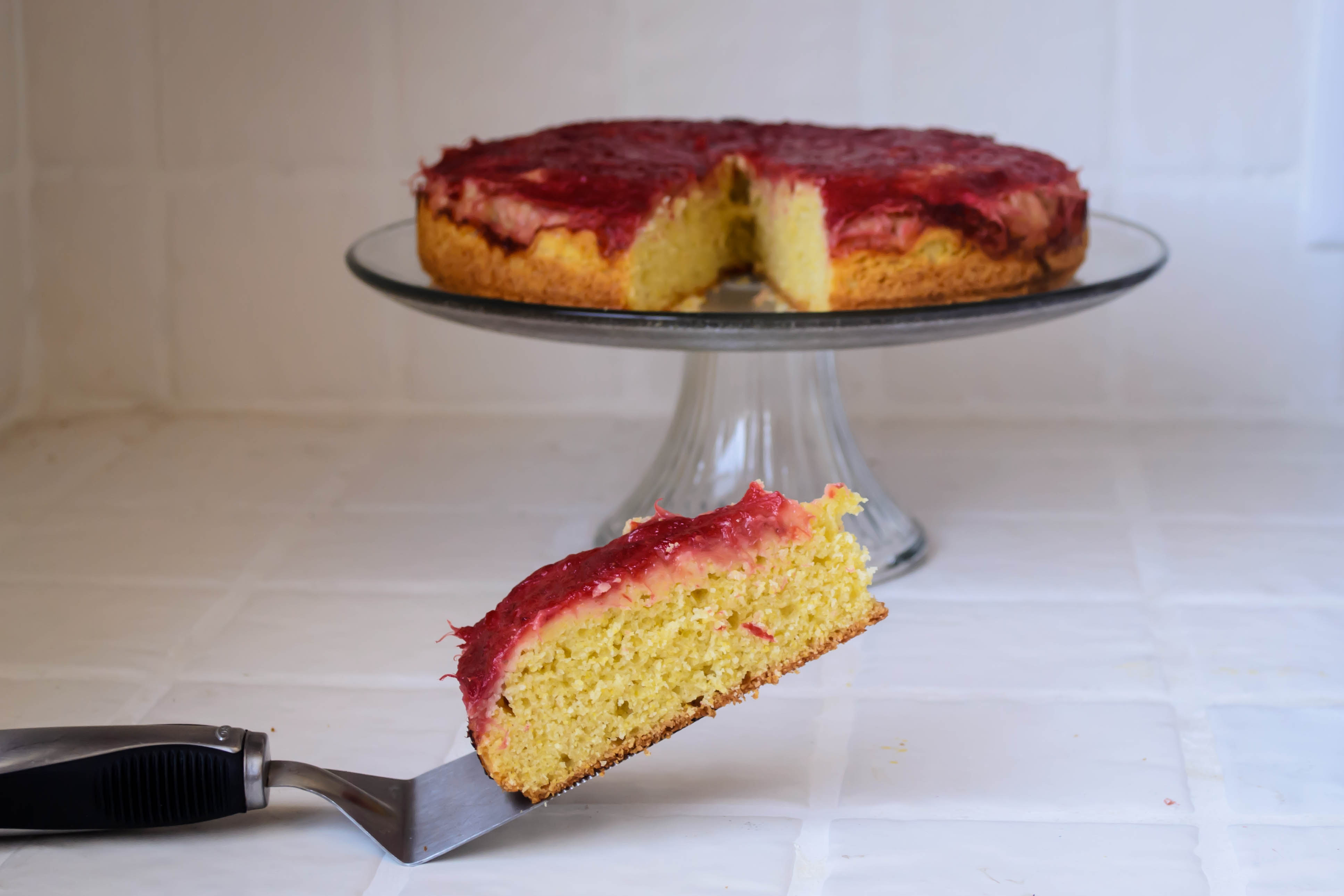
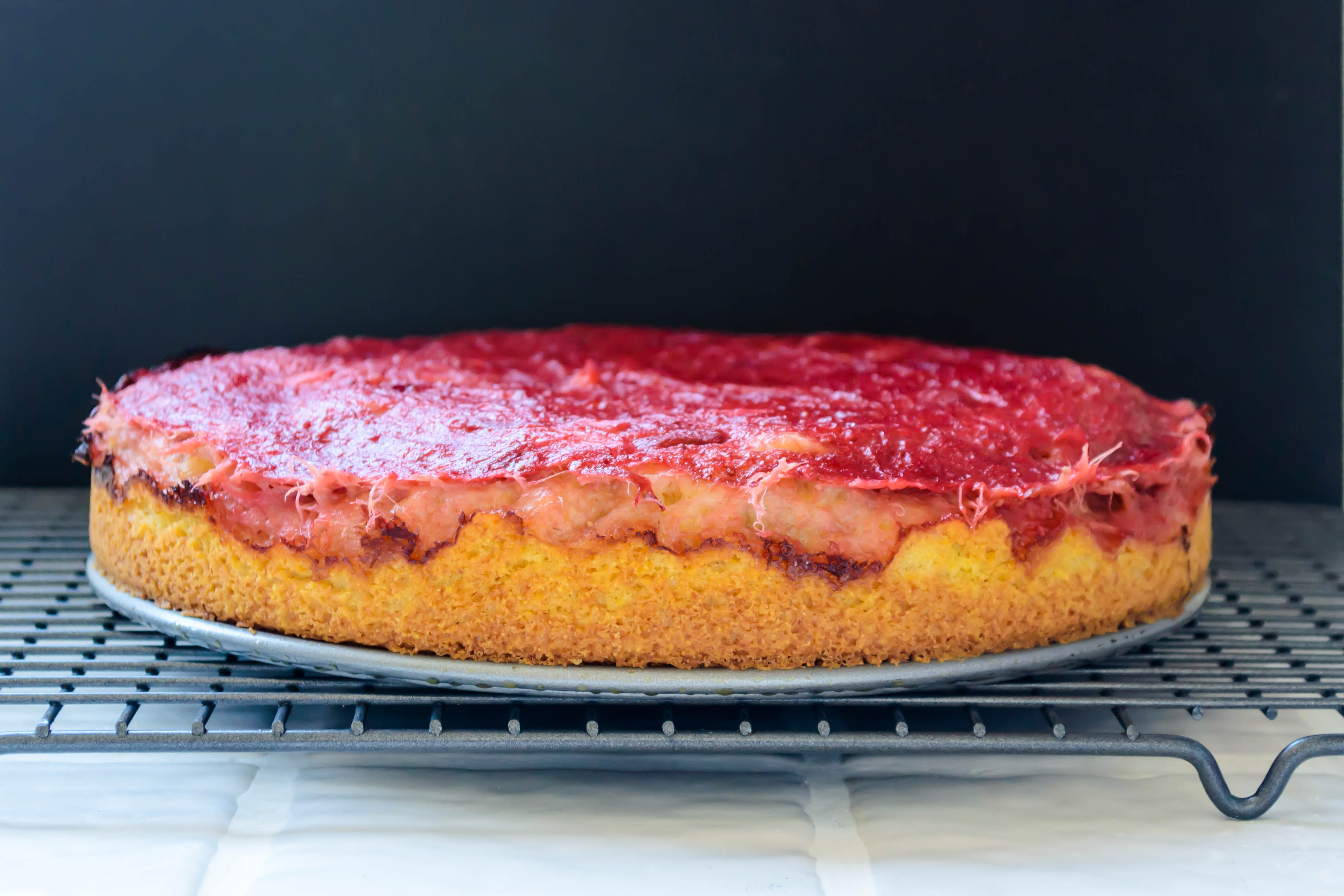
Food Blog June 2013-1483Food Blog June 2013-1489In the oven, the cake puffs and firms, but the rhubarb layer keeps it moist.  The fruit itself, exposed fully to the heat, gets sticky and slightly caramelized, and the edges turn almost molasses-dark.  This is a great, easy cake for a simple dinner party, in part because it is gorgeous – the dark pink top layer looks glossy and impressive – but just as importantly because this cake actually tastes better on the second day.  The compote cools and mellows, and the hit of vanilla in the cake is so right against the rhubarb.

Food Blog June 2013-1494I know rhubarb season is ending, but if you find some in your grocery store and can’t decide what to do with it, make this cake.  It’s easy and pretty and delicious, and it looks as at home, I think, on a simple plate as it does on a cake platter.  And if you miss the rhubarb, try straight simmered strawberries, or slices of plum, or maybe even peach jam, and take this cake directly from spring to summer.

Here’s to 200 more.  I hope you come along for the ride.
Food Blog June 2013-1501Elsie’s Rhubarb Cornmeal Cake

Makes one 9” cake

Strawberry rhubarb compote
5 cups rhubarb chunks from 1-2 lbs rhubarb
1 pint strawberries, washed, hulled, and quartered
½ cup sugar
  • Tumble the fruit into a medium pot, shower on the sugar, and cook over medium heat, stirring occasionally, until the fruit collapses into a stringy, jammy puddle.  This should take 20-30 minutes, depending on the size and depth of your pot.
  • Set the compote aside to cool while you mix up the cake batter.
Cornmeal Cake
1 ½ cups flour
½ cup cornmeal
2 tsp baking powder
½ tsp salt
2 eggs
½ cup sugar
½ cup smooth applesauce
½ cup olive oil
1 tsp vanilla extract
  • Preheat your oven to 350F and grease the bottom and sides of a springform pan with olive oil or nonstick spray.
  • Whisk together the flour, cornmeal, baking powder, and salt in a medium bowl.
  • In a large bowl (I used the bowl of my stand mixer), beat the eggs and sugar until the eggs become pale yellow and increase in volume; about 2 minutes.  This extra volume – air you’ve beaten into the eggs – contributes to the structure of the cake.
  • Add the olive oil, applesauce, and vanilla, and mix to combine.
  • Add the dry ingredients to the wet mixture in thirds, beating just to combine after each addition.  This helps hydrate the batter more evenly, and it gives you a fighting chance of emerging from this baking session without getting flour all over yourself, your countertop, your floor… Not that this sort of thing ever happens to me…
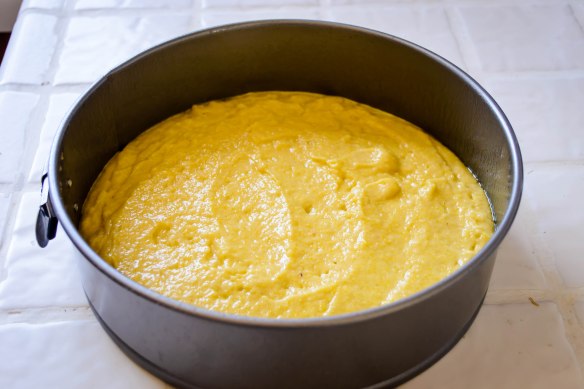
  • Scrape-pour the thick, gloppy batter into your prepared springform pan and use a spatula to smooth it into an even layer.
  • Strew about 1 ½ cups of your now-cooled compote over the top of the cake, creating a thin but complete layer across the batter.  You will have plenty of leftover compote, which is a wonderful thing because it is delicious on top of toast, or bagels, or ice cream, or straight off of a spoon.
  • Carefully place your now-loaded springform pan in the oven and bake for 35-45 minutes, or until a toothpick inserted in the middle of the cake comes out with just a few gummy crumbs clinging to it.  Transfer to a wire rack and pop the spring to let the cake release from the sides of the pan.
  • Cool completely, then refrigerate – this cake is best the day after baking.  Bring it to room temperature before serving.

*Word of warning: it is easy to overbake this cake, because the semi-liquid layer of rhubarb means the top of the cake will not brown.  Thus, it will seem like it’s still underdone.  Remember, though, this cake is better after it has spent the night in the fridge.  As it sits on your counter, cooling off for its sleepover, it will continue cooking for a while.  So even if your toothpick seems to be telling you that all is awry, chances are things are going to be okay.  Try a cautious prod closer to the edges if you need some reassurance.
Peanut Butter and Jelly Bread #TwelveLoaves May

When it comes to cooking, I don’t mind a little complexity.  You can call it fuss if you want.  I’m not put off by a picky technique or an extra step.  Separate the eggs?  Okay.  Toast the nuts first?  Sure thing.  If it adds to the flavor of the finished dish, I’m on board.  But when it comes to eating, I like things simple.  I love appetizers because your gratification arrives in a single bite.  I dig pizza because the toppings all come at you together.  A drumette of roasted chicken sitting precariously atop a mound of braised greens in a puddle of puree?  I’m sure it’s delicious, but it’s a little fancy for me.  At the point that it comes off the heat, I’m ready to put it in my mouth, plating-be-damned (obligatory self-deprecating note: it’s clear, given this, why I haven’t yet managed to squirm my way onto Tastespotting or Foodgawker).

Food Blog May 2013-1298So this week, faced with this month’s Twelve Loaves challenge of baking a loaf of my choosing, I started thinking about the humble sandwich.  Now, I know, a sandwich isn’t exactly challenging to put together.  But I’m a little anal-retentive about some things, and one of them is the old classic pb&j.  Here’s the issue: I like my peanut butter on both sides.  That means you have to put it on first.  But then, you can’t just dunk that peanut-buttery knife into your jam jar!  Cross-contamination!  So you have to decide: do I get a different knife?  Or do I take an extra few seconds and rinse off the peanut butter knife (and peanut butter doesn’t just rinse off like that, you know)?  I know, this is a silly non-problem to have.  But it led to a delicious idea: what if the bread itself were already infused with peanut butter and jelly, making spreading, smearing, and layering all unnecessary?

Food Blog May 2013-1293

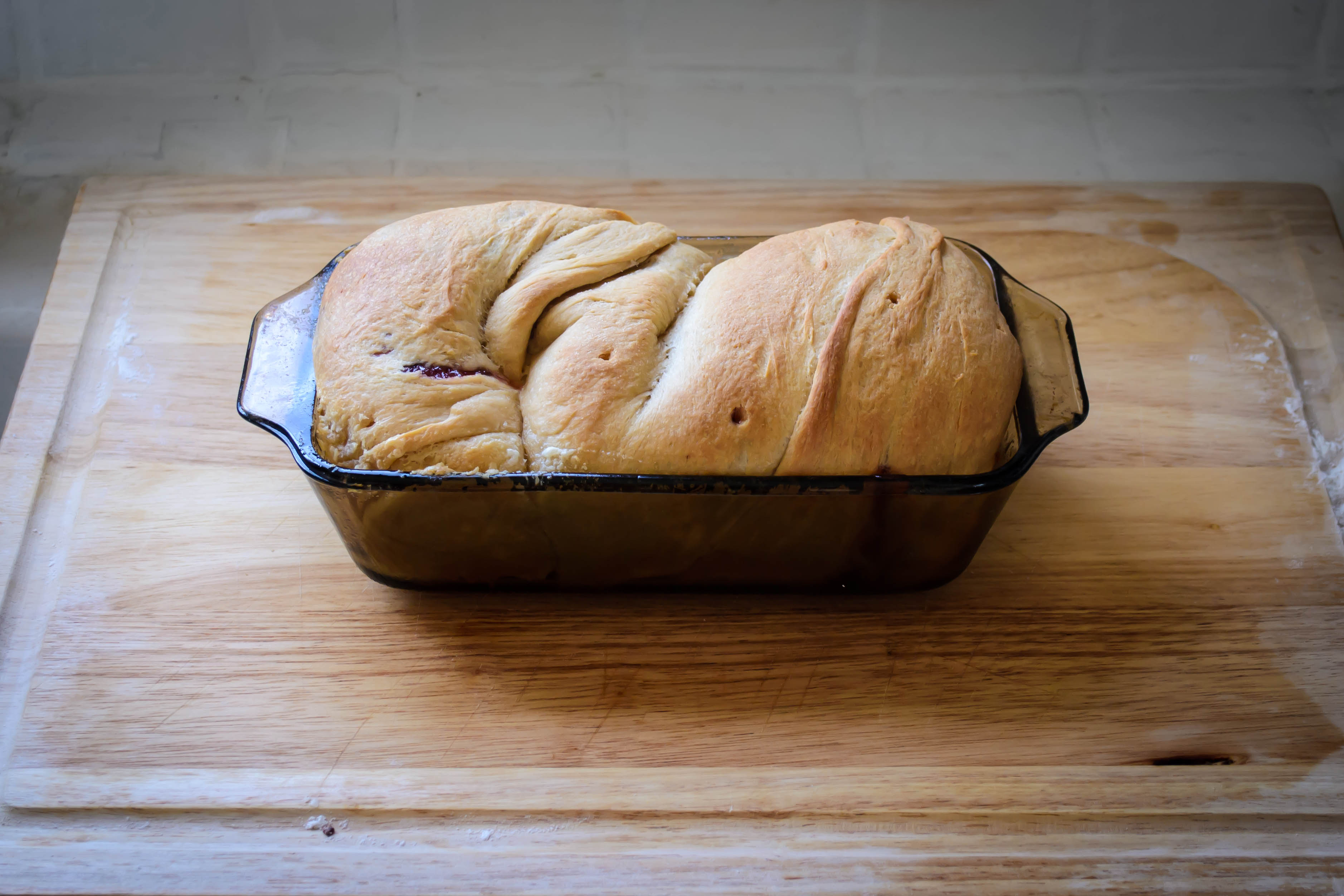
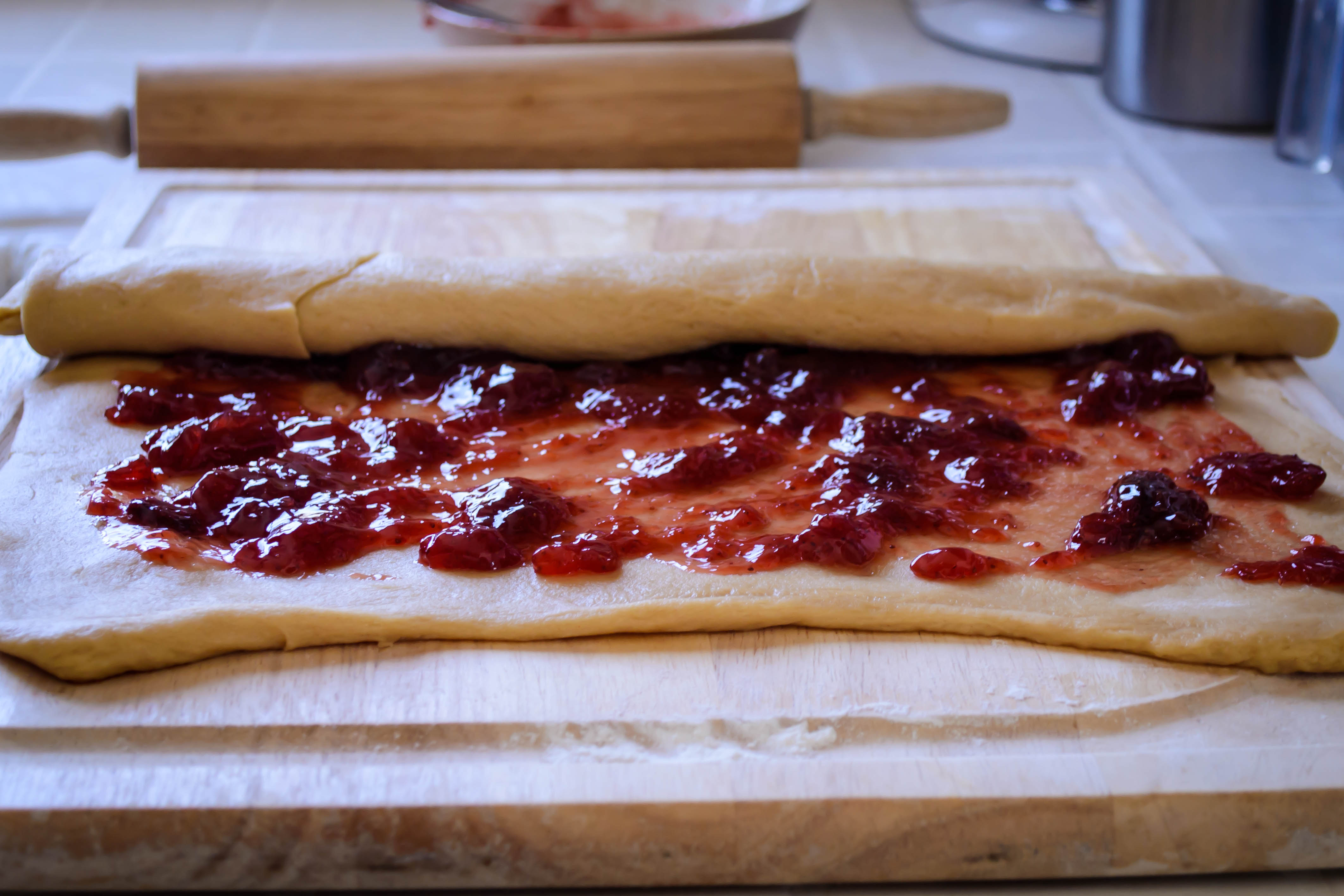
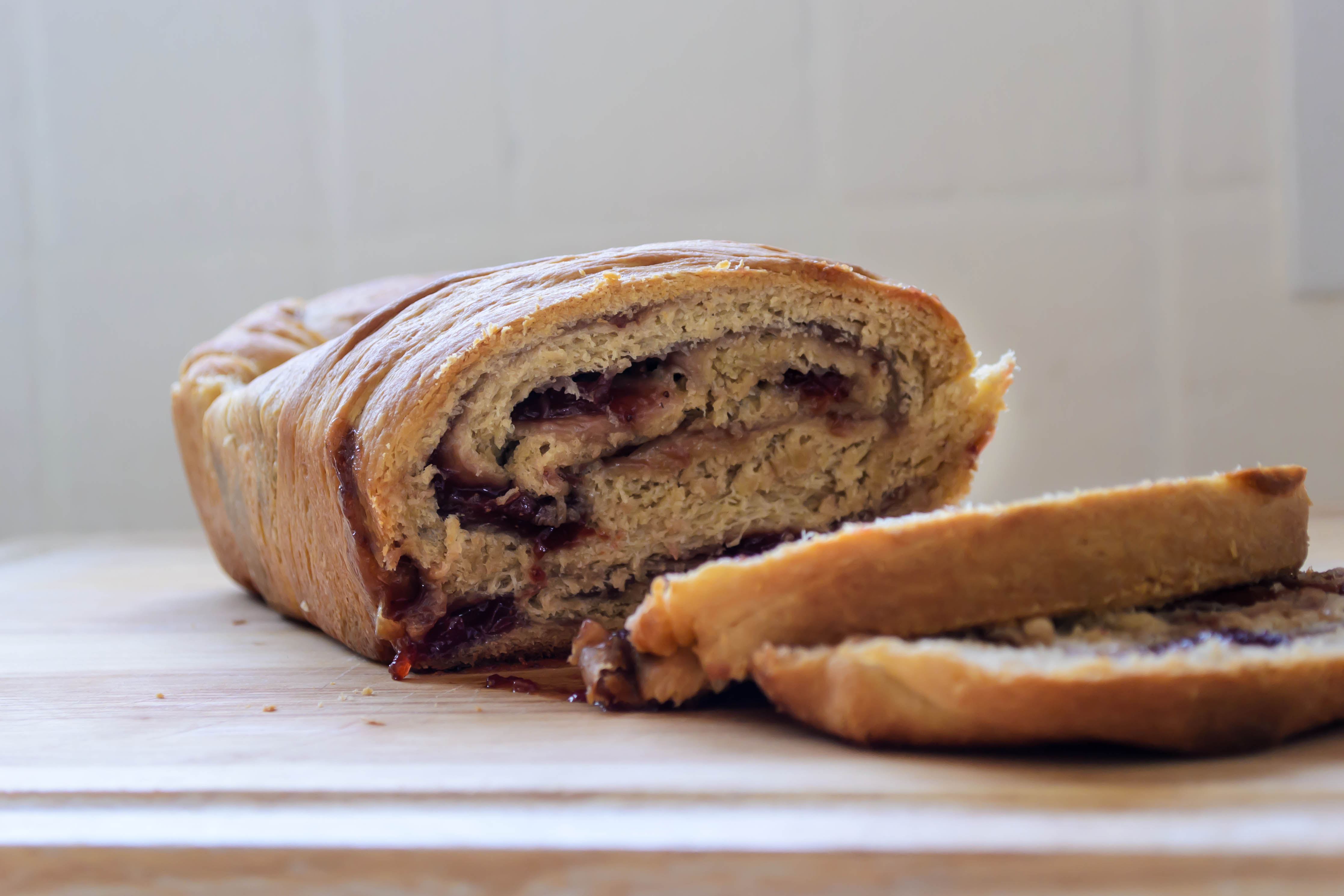
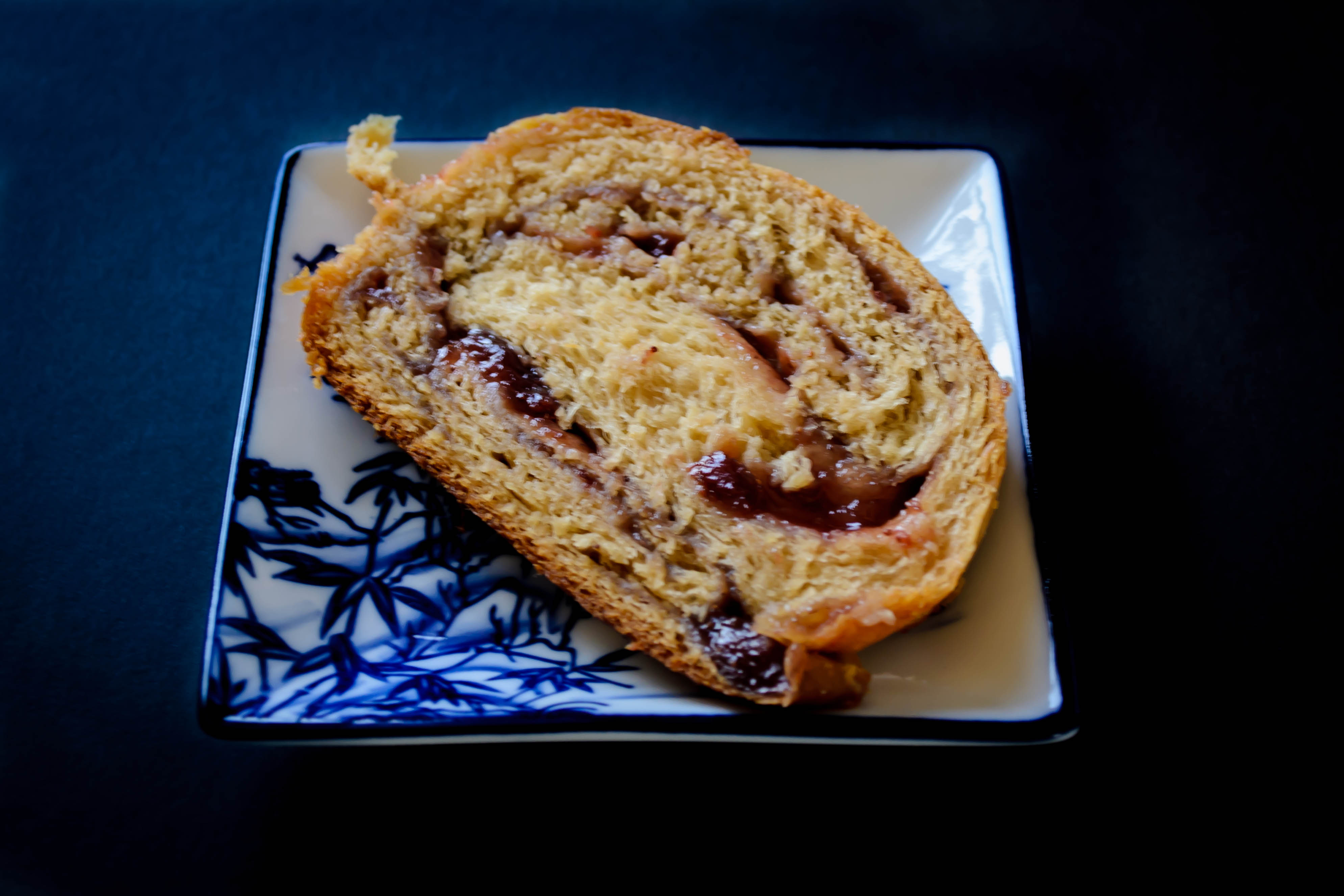
Food Blog May 2013-1297What arose from this self-indulgent, first-world-problems sort of pondering was a moist, deeply tawny loaf, dense in the best kind of way, with a mild but definite peanut flavor.  I flattened it into a rectangle and spread it thickly with jam before rolling it up and twisting it to create a swirl: a thick artery of gloppy, sticky strawberry so pervasive it cracked the crust and oozed forth into barest caramelization.  The borders of the jam swirl maintained just a little doughiness from the extra moisture, echoing the effect the jam would have on the bread after sitting in your lunchbox all morning, and at these doughy, almost under-baked pockets, the peanut butter taste was most pronounced.  With butter, peanut butter, an egg, and milk in the dough, this is a rich bread, though not as indulgent as brioche.  It’s a perfect mid-morning or mid-afternoon snack, and the best news of all is: it’s instant gratification – a sandwich in one step!  No spreading required; all you have to do is cut a slice.

Note: I do not like, nor have I ever liked, crunchy peanut butter.  I don’t even really care for peanuts in their original form (I know, the fact that I like peanut butter despite this makes me a bit odd.  On the flip side, I could go the rest of my life without tomato sauce but I can’t wait for the first big brandywine or sweet Cherokee purple heirloom of the summer.  Go figure).  However, if you wanted to ramp up the peanut flavor in this bread, I’d advise you to do one of two things: 1.) instead of smearing the top of the loaf with butter just before baking, smear it with chunky peanut butter you’ve heated in the microwave for a few seconds (heating it will help it spread better).  2.) if the idea of smearing melty, sticky peanut butter doesn’t appeal to you, use regular butter, but drizzle on a few tablespoons of finely chopped peanuts.  This will give you a crunchy peanut-y hit every time you take a bite of crust.  Food Blog May 2013-1262

Food Blog May 2013-1266Peanut Butter and Jelly bread

¼ cup warm water

2 tsp yeast

2 tsp sugar

¼ cup scalded milk, cooled (microwave or heat on the stovetop until the barest simmer, then cool.)

½ cup very soft butter, divided

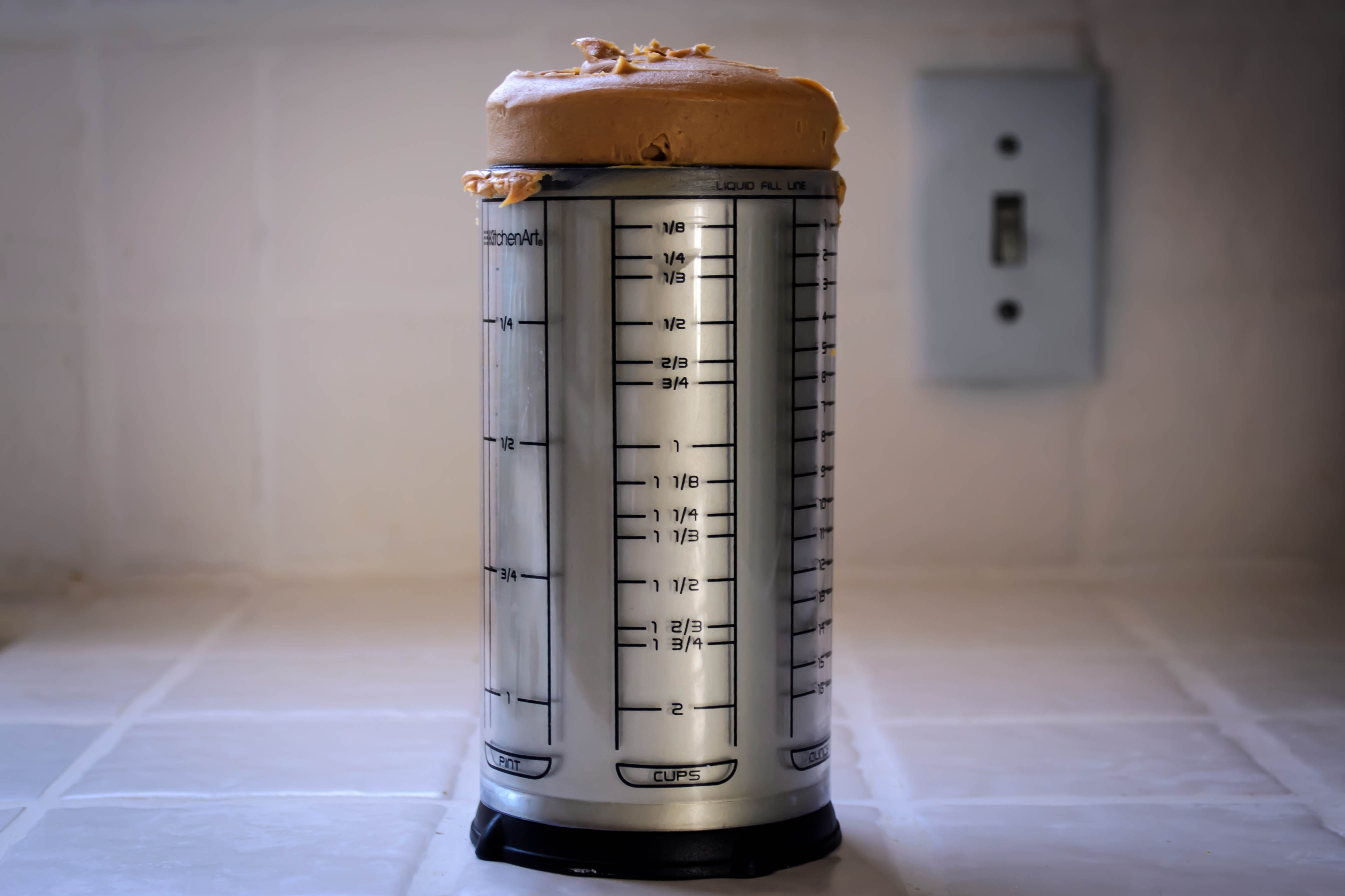
¼ cup smooth peanut butter

¼ cup sugar

1 egg

2 tsp vanilla, divided

1 tsp salt

2-2¼ cups bread flour

1 cup strawberry preserves, or your favorite flavor

Food Blog May 2013-1270

  • In the bowl of your stand mixer (or a large bowl), combine the yeast, 2 tsp sugar, and warm water.  Let stand 5 minutes or so until the yeast becomes bubbly.
  • Meanwhile, scald the milk, then let it cool.  I like to add the peanut butter and a ¼ cup of the butter to it and stir – this helps incorporate them into the dough more easily AND it cools the milk down faster.  Double duty is always good!
  • When the milk has cooled to just above room temperature and the yeast is bubbly and smells like baking bread, add the milk, peanut butter, ¼ cup of the butter, egg, remaining sugar, and 1 tsp vanilla to the yeast and mix with the paddle attachment or a sturdy whisk until incorporated but still lumpy.
  • Add the salt and about 1½ cups of the flour and mix again, still using the paddle attachment, until the flour is evenly damp.  If you are using a stand mixer, switch to a dough hook and begin kneading on medium-low speed.  If you are not using a stand mixer, dump the dough out onto a well-floured board, sprinkle it with a bit more flour, and begin kneading by hand.  If the dough is too sticky to knead productively, add flour ¼ cup at a time until it is workable.  I ended up using a total of 2 cups of flour.

Food Blog May 2013-1271

  • Knead for 8-10 minutes, or until the dough becomes smooth, shiny, and elastic.  At this point, relocate it to a lightly oiled bowl and cover it with a taut layer of plastic wrap.  Let rise in a warm place for 2 hours.  It will double or almost double in size in this time.
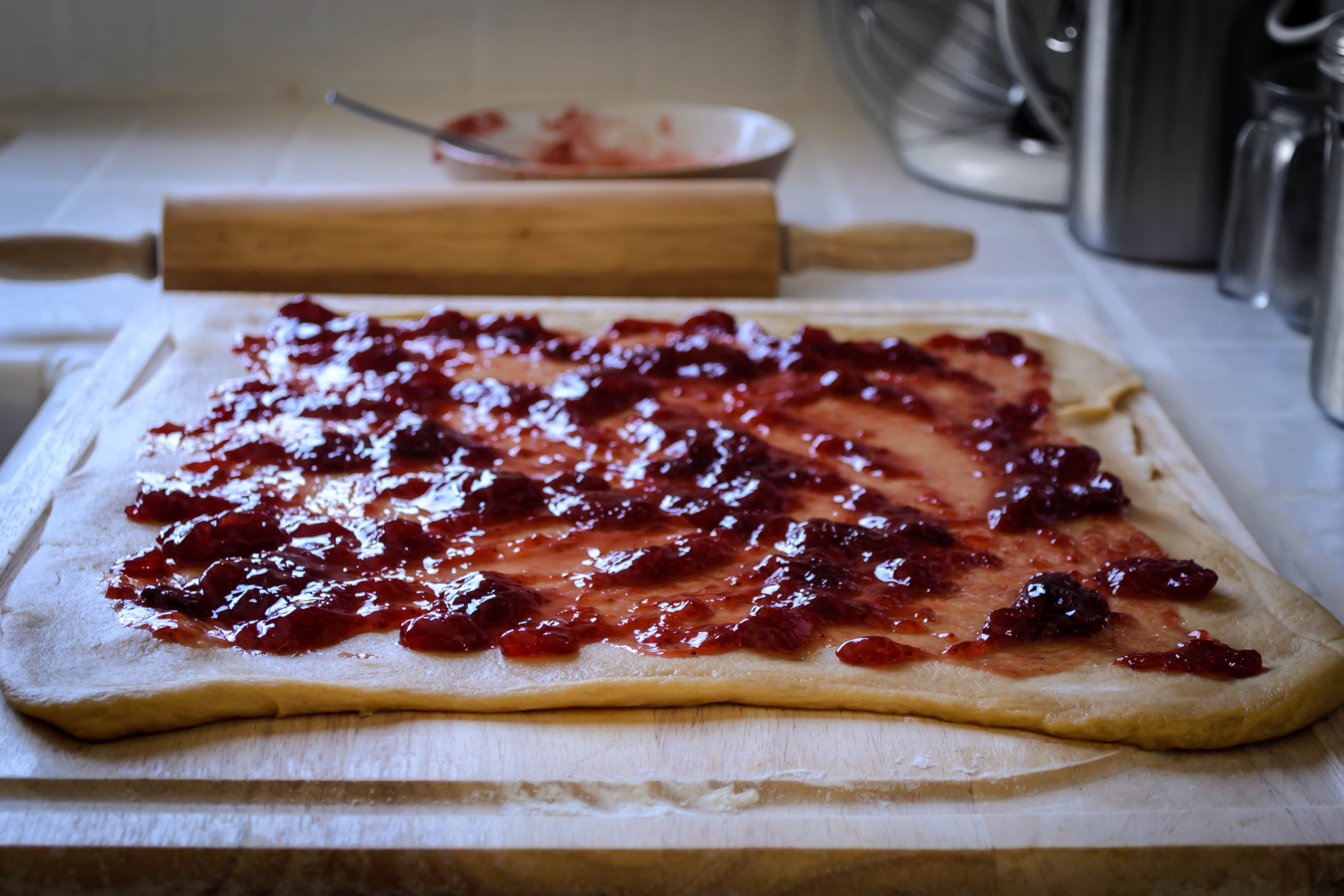
  • When the dough has risen and is close to double the size of the original ball, deflate it gently with your fist and then let it sit for 10 minutes.  While it gets its breath back, place the jam or preserves you’ll be using in a small bowl and heat it just until it loosens up a bit – this will make it easier to spread.  Add the remaining 1 tsp vanilla to the warm jam and combine with a fork.

Food Blog May 2013-1274

Food Blog May 2013-1276Food Blog May 2013-1277

  • Once the dough has rested, turn it out onto a floured board and roll it into a rectangle of about 12×18 inches.  Spread this rectangle with the jam mixture, leaving a border of at least ½ an inch on all sides.  This will prevent the filling from leaking out as you roll it up.
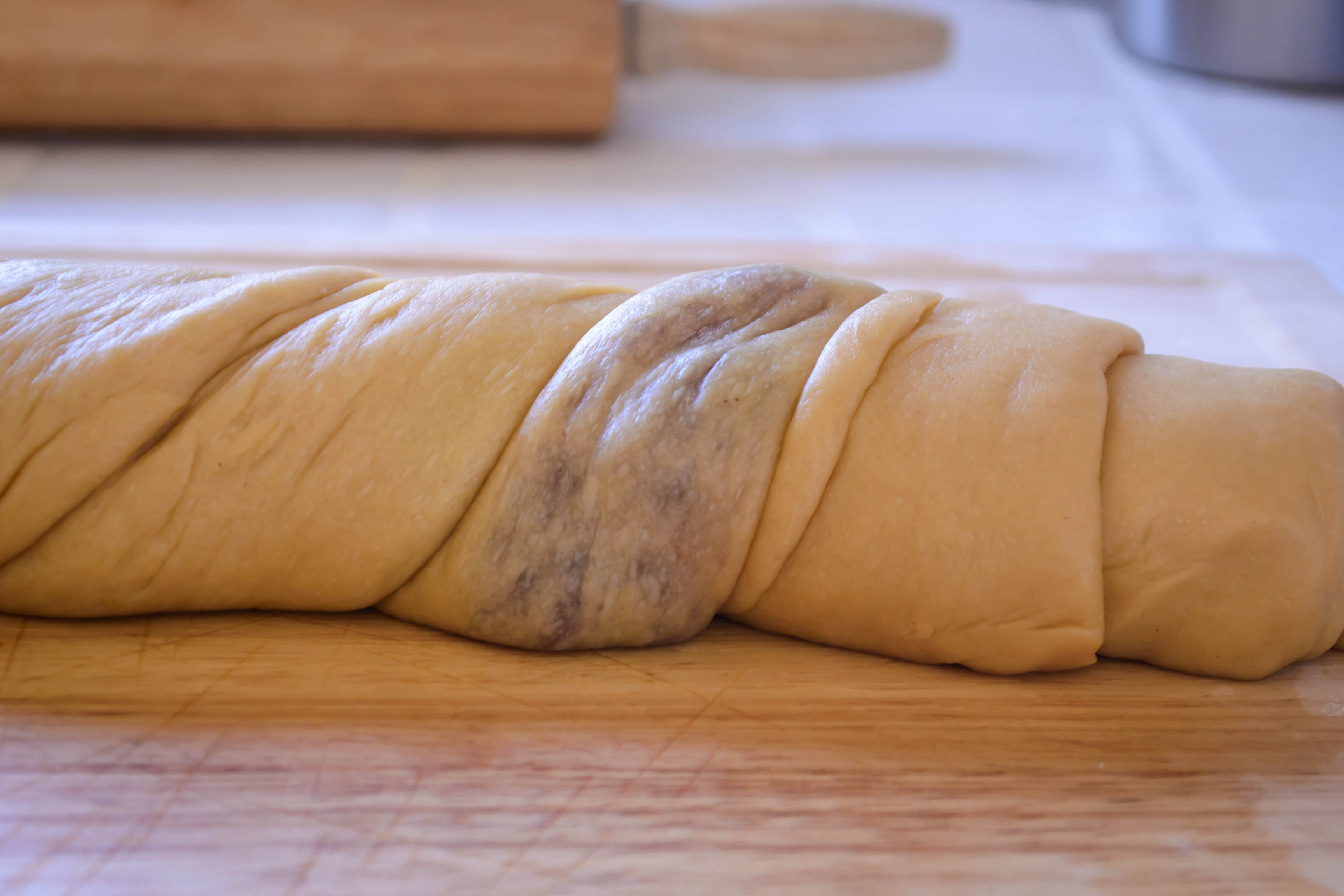
  • Starting on the shorter edge in the middle (so you’ll end up with a log about 12 inches long), begin rolling up the dough into a tube, moving back and forth between middle and ends to create an even log.  When you get to the end, seal the long edge by pinching the dough together with your fingertips.  This will keep the loaf together as it bakes.

Food Blog May 2013-1279

  • Twist the whole log six or seven times.  This distributes the jam through the center of the dough, so that your baked loaf will have a beautiful sweet swirl throughout.

Food Blog May 2013-1280Food Blog May 2013-1282Food Blog May 2013-1283

  • Smear a 9×5 inch loaf pan with about 1 TB of the remaining butter, then snuggle the log of dough into it.  Scrunch it up a bit – that’s okay, it will fill out the pan when it bakes – and set it aside to rise again for 30 minutes.

Food Blog May 2013-1284

  • While the dough rises, preheat your oven to 350F.

Food Blog May 2013-1288

  • When the dough has risen, rub the top with the remaining 3 TB butter (or chunky peanut butter, if you wish), and bake for 30-45 minutes.

Food Blog May 2013-1294

Note: this bread’s doneness is difficult to test.  Because the jam is interspersed throughout, the finished loaf can seem a bit doughy.  If you have an instant read thermometer, try to insert it in an area that is just bread, not jam.  (I had some difficulty doing this, as you can see from the small holes on the top of the loaf in some of the photos above.)  You are aiming for a temperature of between 190-200F.  I must admit, though, I don’t mind this loaf a bit underdone – I think it captures the softness and almost-soggy glory of a simple pb&j from childhood.  And really, that’s what this bread should be about.

Food Blog May 2013-1300

Dried Fruit and Ginger Scones

Food Blog April 2013-1194

This month’s archive makes it look like I’m harboring a bit of a sweet tooth.  Nothing wrong with that, necessarily, but I should tell you this week’s entry is actually at N.’s (indirect) request.  A month or two ago, my beloved aunt sent me some specialty King Arthur flour, and along with the packages of semolina and European style AP blend came a catalog.  Naturally, this has become my bedtime reading (what, you don’t read cookbooks and kitchen magazines in bed?), and on Monday night as I dawdled longingly over a blurb about Double Devon Cream, N. surfaced from internet-land and glanced at the facing page.  “That,” he said, and pointed at a photograph of some cranberry orange scones.  “You want scones?”  A silly question, apparently.  “That.”  So here they are.

Food Blog April 2013-1189

I did some research (i.e. food blogs and recipe comparisons from the other cookbooks stacked on my nightstand) and found, as usual, that Deb has all the answers.  Seriously, is there anything the woman hasn’t made?  I adore you, Deb, but really – a person can only repress the green-eyed monster for so long…   This adapts her recipe for “Creamy, Dreamy Scones,” which she got from the America’s Test Kitchen Cookbook.  I’ve used a combination of cake flour and all purpose flour for a lighter texture, allowed turbinado sugar to stand in for the regular sugar, and replaced some (okay, most) of the cream with whole milk, because I lost my mind this week and, forgetting the intended use of that little container, dumped most of it into an unholy-but-oh-so-heavenly conglomeration of chard, bacon, and bourbon.

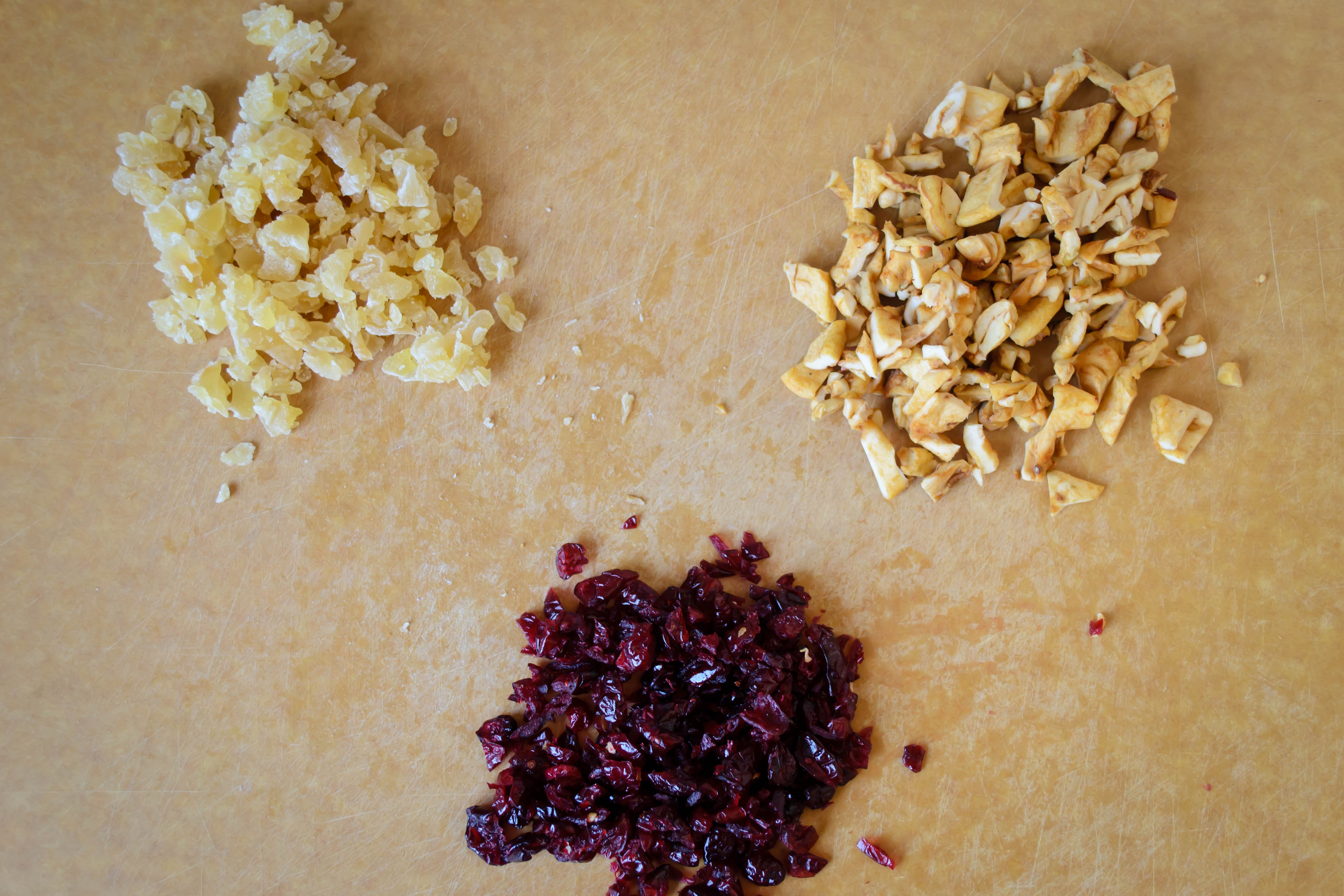
These scones take advantage of the bags and bags of dried fruit that inevitably collect in my pantry.  You could probably add other flavors as well, but I thought apples and cranberries, and the candied ginger I’ve been obsessed with for at least a year now, would play well together.  Apricots would probably be beautiful too (unless you are, like one of my family members who shall remain nameless to protect familial harmony, freaked out by dried apricots because they apparently bear an uncomfortable resemblance to mouse ears).

Food Blog April 2013-1170

Scones come together much like biscuits: whisk the dry ingredients, cut in the butter, stir the milk/cream/buttermilk and flavor additions in with a fork.  But then, and this is where things can go awry, you have to pat it into a circle and either punch out rounds with a biscuit cutter, or slice the whole thing into triangles.  I chose the latter.

Food Blog April 2013-1177Food Blog April 2013-1182

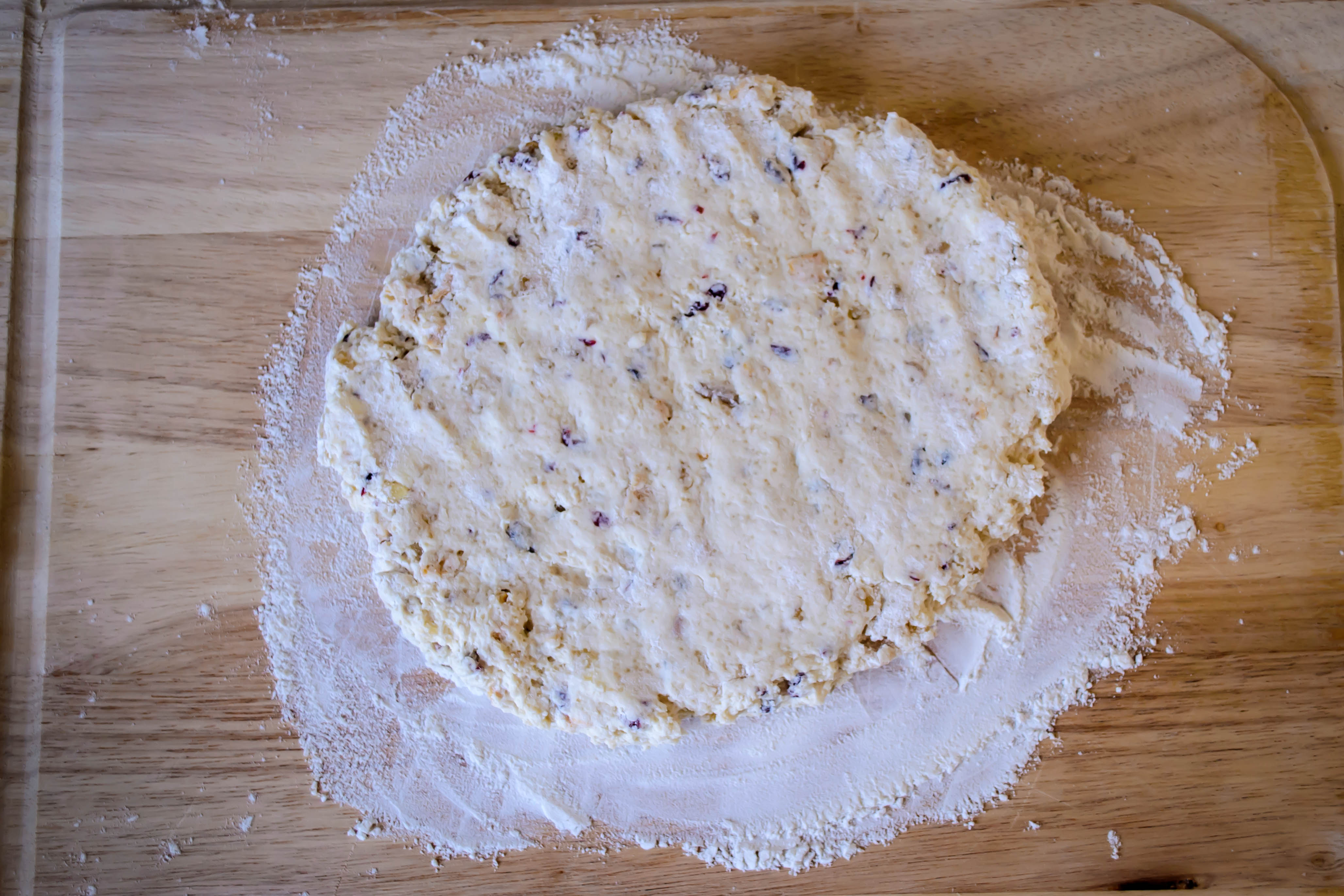
This dough is, if we’re honest with each other, an almost unmanageably sticky mess.  Resist the temptation to mix more flour into the dough, because the more flour you add, the less tender the finished scones will be.  But do be prepared to sprinkle flour over everything it will come in contact with.  I used a floured pizza cutter to slice it into eight pieces, which tore up edges and corners even while the dough clung fiercely to the board below.

Food Blog April 2013-1178

Food Blog April 2013-1180

Food Blog April 2013-1185

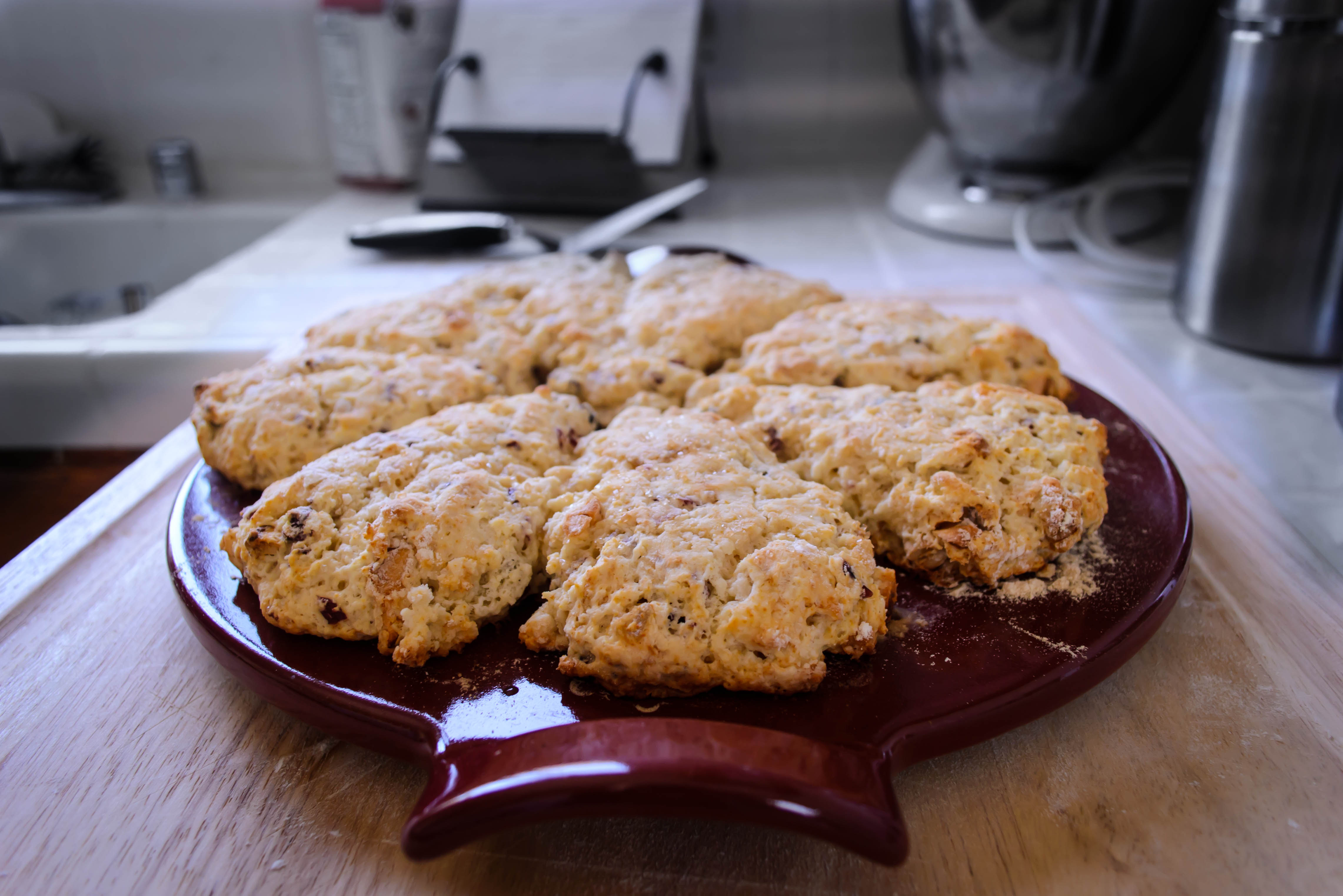
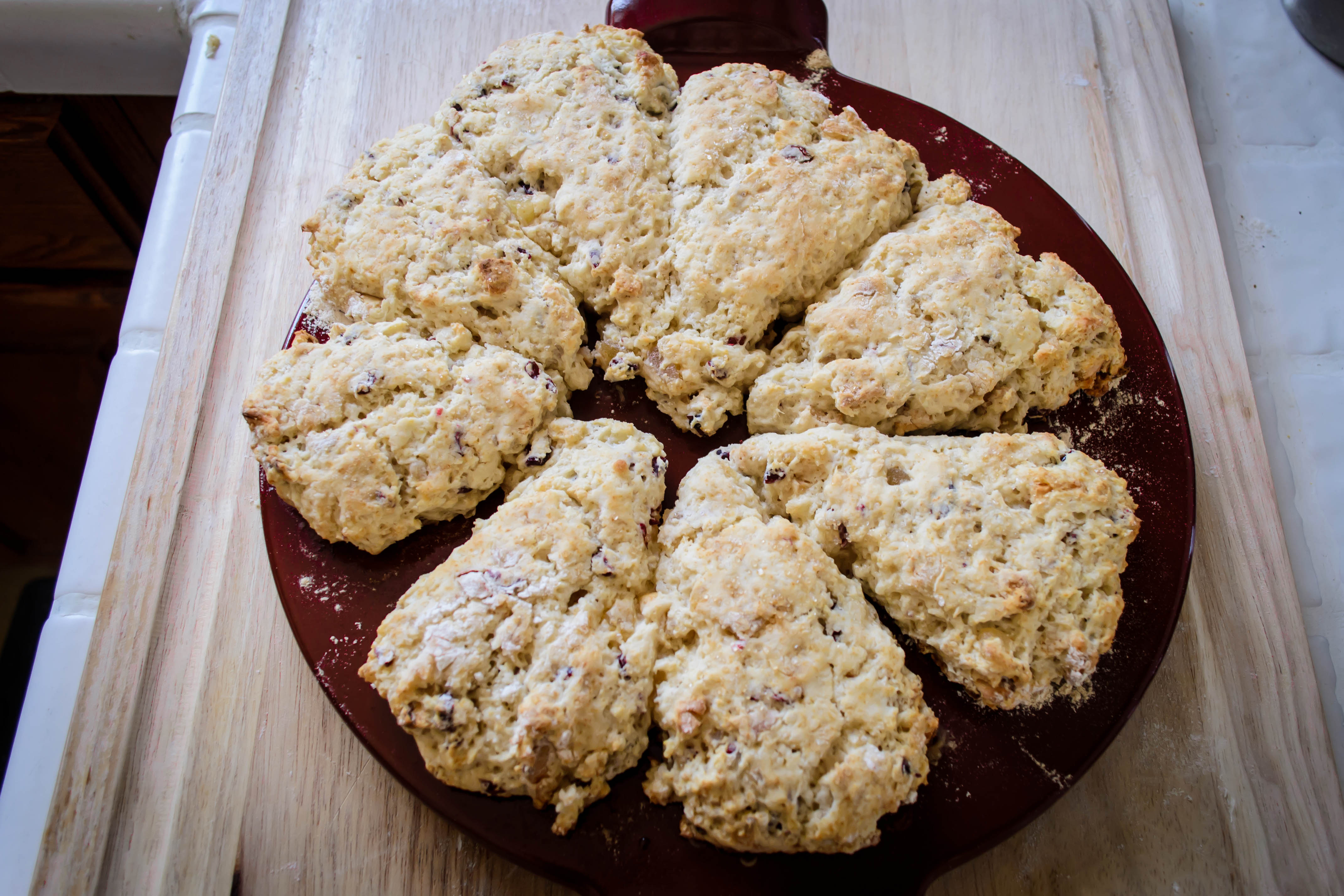
A bench scraper tool is really helpful for transferring your scones to their cooking vessel – a parchment lined baking sheet would be fine, but I used my brand new enameled pizza stone because I’m so jazzed about it.  This, because I preheated it along with the oven, made the scones sizzle as I levered each one onto its surface, and rather than sticking (which I was dreading, since I realized only after they’d been in the oven for five minutes that I hadn’t greased or floured the cooking surface AT ALL), produced a crisp bottom crust.

Food Blog April 2013-1190

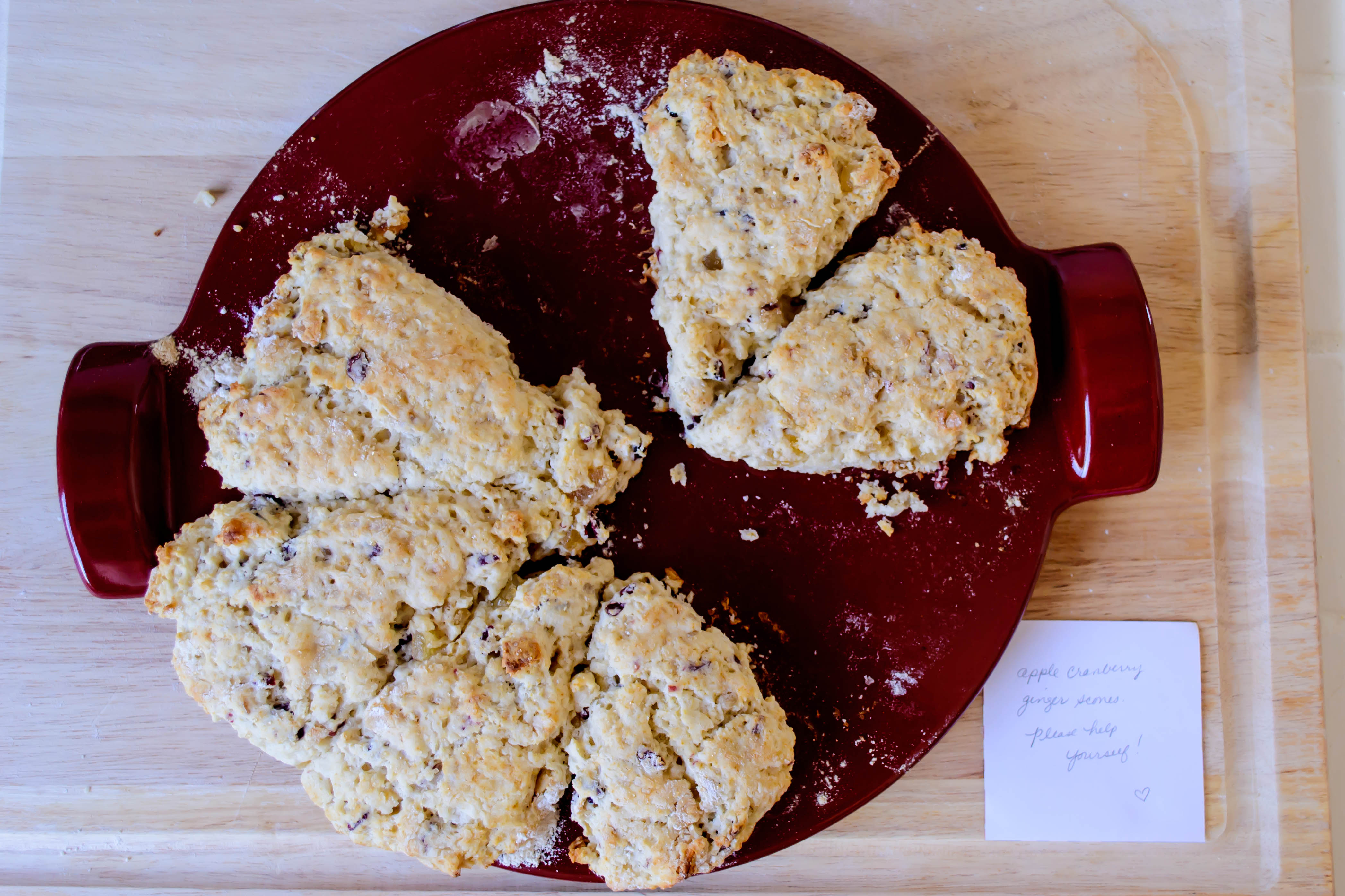
I left my offering on the pizza stone to cool while I took the dog for a walk, and returned to find it had been accepted.

Food Blog April 2013-1191

An hour or so later, it had been accepted again.

Food Blog April 2013-1192

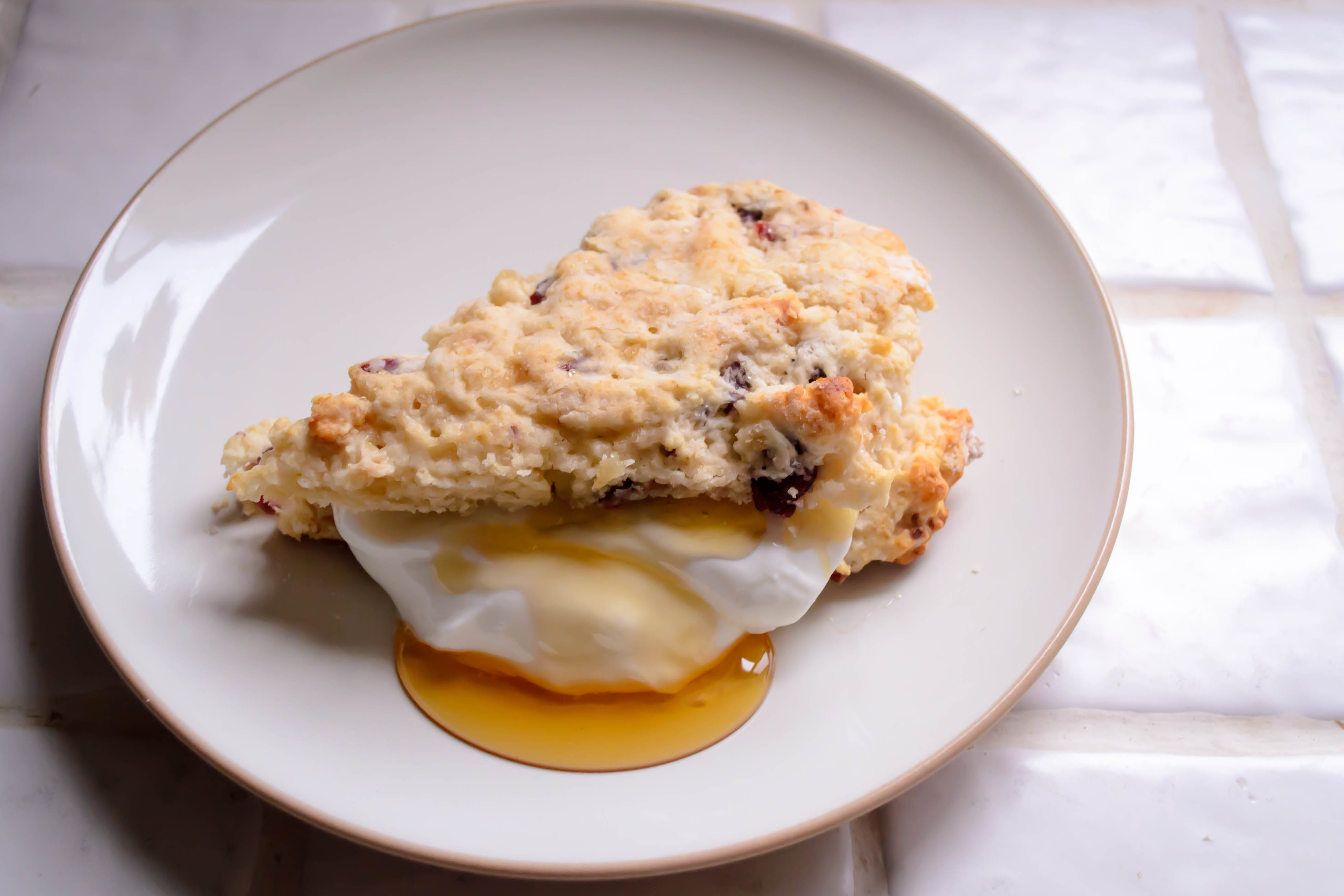
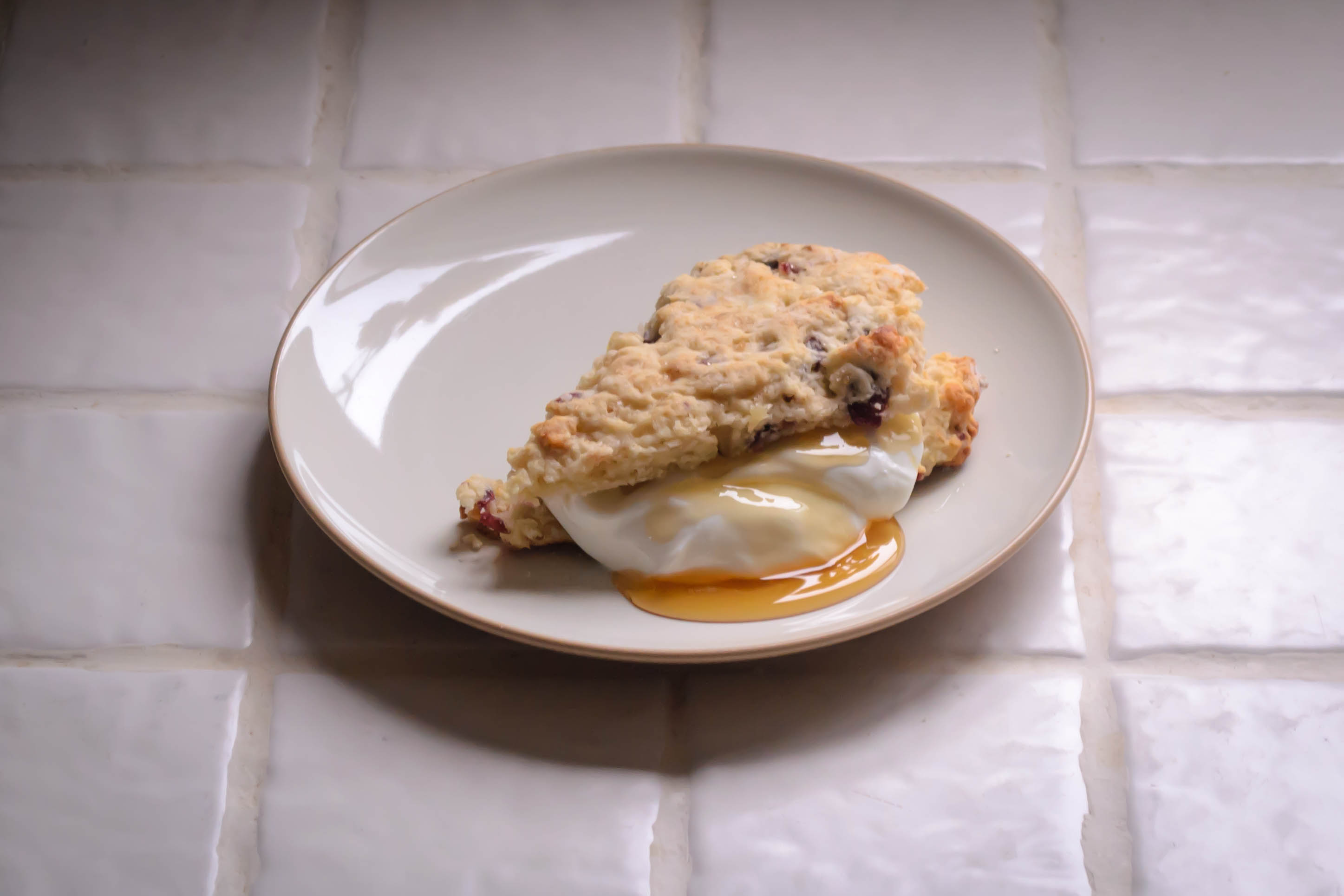
These are best on the first day, but will keep acceptably for two or three days if they are well wrapped in aluminum foil and stored at room temperature.  Chances are – if your family is anything like mine – this short storage period won’t be an issue.  Still warm, these make perfect hand-held afternoon pick-me-ups (the ginger really zings you out of the 3 o’clock slump), but if you want to go the extra mile, I recommend slicing them in half so you have two triangles, stuffing them with Greek yogurt and a decadent ooze of local honey, and attacking with a fork for breakfast.

Food Blog April 2013-1197

Apple Cranberry Ginger Scones

Adapted from Smitten Kitchen, who used America’s Test Kitchen Cookbook. 

1 cup all-purpose flour

1 cup cake flour

1 TB baking powder

4 TB coarse sugar, divided (I used turbinado because that’s what was in my baking cupboard)

½ tsp salt

5 TB butter, cut into cubes

¼ each chopped dried apples, chopped dried cranberries, and chopped candied ginger

¼ cup heavy cream

¾ cup whole milk

  • Position a rack in the middle of your oven and preheat to 425F.  If you will be baking on a pizza stone, put it in the oven to preheat as well.  If you will be using a cookie sheet, line it with parchment paper and set it aside.
  • Whisk together the flours, baking powder, 3 TB of the sugar, and salt in a medium bowl.
  • Cut in the butter using a pastry blender, two knives, or your fingers, until the largest chunks of butter are the size of small peas (sidenote: “peas” seems the universal size for butter chunks – why is that?  Is there no other pea-sized object so regular and recognizable in size that we could call upon?  Ball-bearings?  Corn kernels?  Canine teeth?).
  • Pour in the cream and milk (or just use all cream, if you have it) and mix it around with a fork until an evenly hydrated, extremely sticky dough forms.
  • Add the fruits and mix again until evenly distributed (you may have to work a bit to break up the ginger pieces).
  • Dump the sticky mass out onto a well-floured board.  Sprinkle a little flour on top as well, then pat the dough out into a circle about 1-inch thick.  Try not to add too much flour, lest they become dense and tough.
  • Dip a pizza cutter or other thin, sharp knife into flour, then cut the circle into 8 equal sized pieces.  You may need to scrape off and re-flour your slicing instrument between slices.
  • Using a bench scraper, a thin spatula, or (if you are brave) your hands, relocate your 8 scones to your prepared baking vessel, spacing them a half inch or so apart (they will puff and rise a little bit, but not tremendously).  Sprinkle the tops with the remaining 1 TB of sugar.
  • Bake for 13-15 minutes, or until lightly golden on top and cooked through.
  • Cool at least 10 minutes before removing to a wire rack.  Eat warm or cool.

Blackberry Bourbon Bread (#Twelve Loaves April)

I’m a sucker for alliteration.  Call it having been an English major for so many years.  So when I read on April’s Twelve Loaves challenge that the objective was berry bread, I may have freaked out a little.  And when the idea of blackberries and bourbon zinged into my brain – dark, sultry, tartly perfumed – I may have freaked out a little more.  Food Blog April 2013-1083

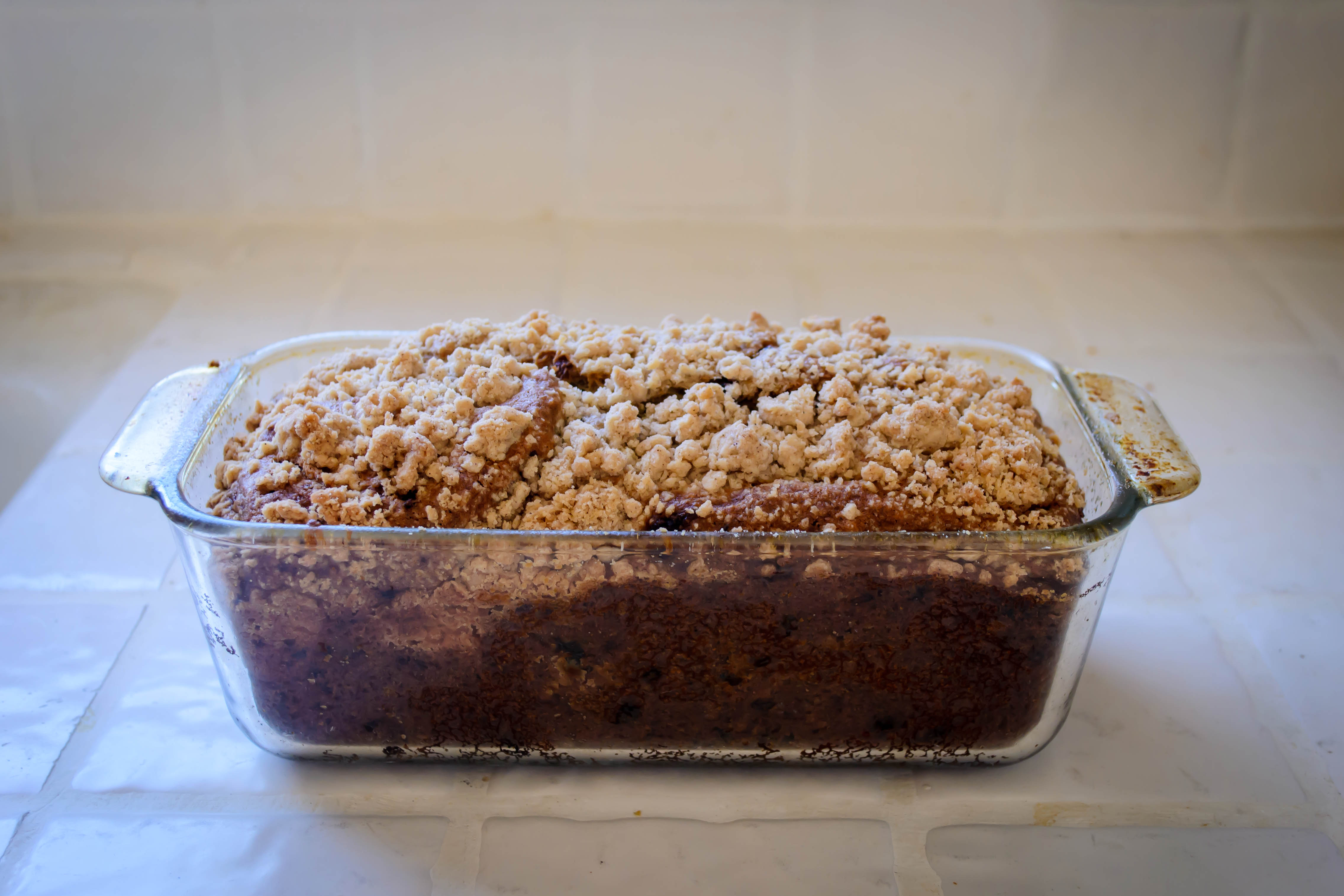
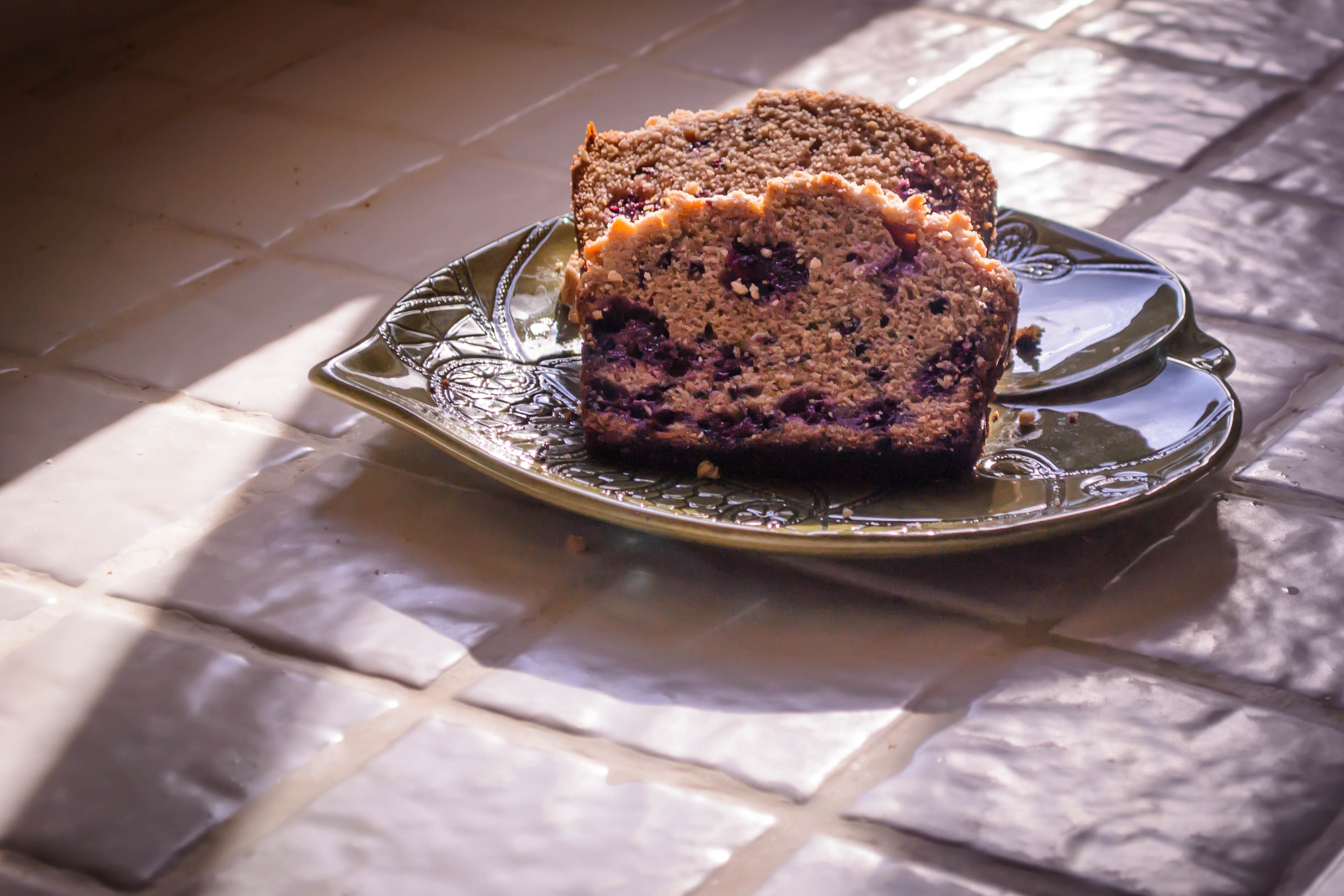
Blackberries, bourbon, yogurt, and crumbly pebbly streusel all done up in a quickbread that we’ll pretend isn’t really an excuse for cake.  How could you want anything more?  Well, maybe a warming breath of cinnamon.  Granted.  And maybe some browned butter. Food Blog April 2013-1138

Just as this is barely a bread, it’s also barely a dough.  It only fits into my dough challenge by virtue of its attachment to the idea of bread, which, as I’ve noted, isn’t a very strong attachment at all.  Aren’t “quickbreads” really just desserts that we like to eat at non-dessert hours of the day?  But it is delicious, and warm, and comforting, and I think we could all do with a bit of that after this week.

Food Blog April 2013-1110Yogurt, browned butter, blackberries, bourbon, streusel, and cinnamon all in the same bread sounds a bit overwhelming, but really, all of the components played very well together.  Blackberries and yogurt scream breakfast, and mixed in a thick batter with plenty of melted butter they produce a moist, slightly dense loaf splotched with purple pockets of jammy tartness.  But the addition of bourbon makes this a naughty thing to consider having a slice of too early in the morning (unless you are still up from the night before, I suppose).  When I tasted the batter, I was concerned about how assertively the alcohol came through, but after baking what lingers is a lovely floral aroma – all the peaty, throat-searing headiness fades (and honestly, it left me wondering whether another tablespoon or two of bourbon might be welcome in the recipe).  Really, this is a loaf perfect for that most wonderful of British institutions we are sadly lacking in the U.S: afternoon tea.  And if you slathered a thick slice with clotted cream, I don’t think anyone would complain. Food Blog April 2013-1115

Blackberry Bourbon Bread

Makes 1 large 9×5 loaf

For the bread:
1 ½ sticks butter (12 TB, or ¾ of a cup)
2 eggs
1 ½ cups sugar
1 tsp vanilla
¼ cup bourbon (I like Knob Creek)
½ cup Greek yogurt, though likely any plain, unsweetened yogurt would do
2 cups flour
1 tsp salt
1 tsp cinnamon
1 tsp baking soda
12 oz. blackberries, rinsed and air-dried (I realize this is an odd quantity, but that’s how much was in the container I found.  The advantage here is that it means you can start with two pints [16 oz.], and the inevitable handful you end up eating by sneaking “just one more” at a time will leave you with just the right amount!)
Food Blog April 2013-1123For the streusel:
½ cup flour
½ cup powdered sugar
½ tsp cinnamon
4 TB (½ a stick) cold butterFood Blog April 2013-1124
  • First, you’ll need to brown the butter for the bread.  In a small saucepan, preferably not black (it’s harder to see the browning against a dark background), melt the butter over medium heat.  Continue cooking, occasionally swirling gently, as it foams up.  That’s the water separating and steaming away.  After a few minutes, the solids will start to collect on the bottom of the pot, and begin to darken to gold and then coppery brown.  When that happens, turn off the heat.  It’s amazing how quickly those cooking solids go from perfectly brown to burned.  Set the pot aside to cool while you work with the other ingredients (I stuck mine in the freezer on top of a pot holder to chill down quickly).
  • While your butter cools, preheat the oven to 350F and prepare a 9×5” loaf pan by rubbing the bottom and sides with butter or spraying with a non-stick spray.
  • In a large bowl (or the bowl of your stand mixer), beat the eggs until slightly foamy.  With the mixer running (you could do this by hand with a whisk, I suppose, but an electric mixer of any kind will make it much easier), add the sugar ½ a cup at a time, integrating it completely before the next addition.  When all of the sugar is added, continue mixing for another 2 minutes, or until the mixture has become quite pale in color and increased in volume.
  • Add the vanilla, bourbon, yogurt, and cooled butter, and mix until well combined.  The yogurt may break up a bit and make things look curdled, but don’t worry.  Once you add the dry ingredients everything will be fine.
  • In a medium bowl, whisk together the flour, baking soda, salt, and cinnamon.  Add 1/3 of the dry mix to the wet ingredients, mixing on low speed just until the flour is integrated.  Add another 1/3 of the dry mix and combine again.
  • When you have just 1/3 of the dry mixture left, toss the blackberries in it gently.  This will help keep them evenly distributed in the batter as it bakes, rather than all sinking to the bottom.  Add this final portion of flour, with the berries, to the batter and fold it in gently with a spatula.  This is harder to do evenly, but will keep the berries intact better than using a mixer blade.  The resulting batter will be quite thick.
  • Scrape-pour the batter into your prepared loaf pan.  Mine got tremendously full, and to prevent any chance of overflow during baking, I relocated some of the batter to a 6-inch cake pan instead.  If you are concerned about overflow, I suggest filling the loaf pan only about 2/3 full, and make muffins or tiny cakes out of the rest of the batter. Food Blog April 2013-1116
  • For the streusel, which I insist you use because it adds such a nice textural contrast, combine the flour, sugar, and cinnamon in a small bowl.  Using a fork to whisk them together works nicely.
  • Rub in the butter with your fingers or a pastry blender until it is very well integrated.  Ordinarily I use a pastry blender for this sort of thing, but here I think your fingers really do work best, since you can squash and smoosh the butter more efficiently.  You want tiny pebbles – the biggest should be smaller than peas and the smallest like grains of couscous.
  • Sprinkle the streusel over the surface of your bread in an even, thick layer.  You will probably have a bit extra, but I think that’s hardly a bad thing. Food Blog April 2013-1117
  • Deposit your loaf in the oven and bake for 80 minutes, or until a toothpick or cake tester inserted in the middle comes out with only a few moist crumbs clinging to it.  Since ovens are all different, I recommend you first test for doneness at 60 minutes, just to be safe.
  • Remove and cool in the pan on a wire rack until you can’t stand it any longer.  Then slice and enjoy with tea, with cream, with a dollop of yogurt, or just all on its own. Food Blog April 2013-1160

Go-to Dough III – Orange and Rosemary loaf

First, thank you.  Thank you to you lovely people and the lovely way you responded to last week’s post about my sweet rolls and my Nana.  Old friends, new friends, family, it warmed me to see your comments.  I so appreciate you making yourselves known and sharing your own experiences and memories – I’m motivated to delve into more old family recipes and more new experiments.  That probably sounds a little cheesy, but I mean it.


Food Blog March 2013-0755
So I suppose you could call this a thank you loaf.  It was delicious, it was easy (well, as easy as baking bread can be, I suppose), and I made it for you.
I wanted, as I’ve noted, a basic recipe, though I can’t resist adding a tweak or two to keep things interesting.  My first boule was overbrowned; my second utilized an overnight leavening procedure I didn’t think added all that much to the final product.  So the third had to be just right – the charm, you might say – and I really do think it was.  Goldilocks bread.


Food Blog March 2013-0761
I went back to Ruhlman’s directions for cooking the loaf in a pot.  This strategy for maintaining the shape and for holding in moisture by using a lid makes so much sense, and I wanted to give it another shot.
This time I decided to add some fat to the bread in the form of olive oil.  This made the crumb a bit moister and I think it kept the bread tasting fresh longer.  To make the yeast extra happy, I proofed it (them?  Is yeast grammatically plural?) with a few tablespoons of honey.  This didn’t contribute noticeable sweetness to the final product, but it did make for an extra foamy yeast party.  You could probably increase the honey if you wanted a sweeter end product.  Since I was still on a high from the orange marmalade triumph, I decided this bread would benefit from some orange zest and, just for fun, some fresh rosemary too.  I ended up with a really beautiful loaf: puffed, thin but crisp crust, moist dense crumb.  The orange and rosemary creep up on you – perfumed subtlety lingering in the background until you’re almost finished chewing.  Then they suddenly become present.  It’s not a punch, it’s a slow sloping into flavor.
This was perfect for sopping up sauce from baked beans (it would make stellar toast for beans on toast), complementing the sweetness and the fatty bacon flavor with its subtle herbaceousness.  I could see adding some dried cranberries to the dough for a wintry take on a breakfast slice.  It dances well with a slick of salted butter, plain and simple, but its shining moment this week was as an open faced sandwich spread thickly with cream cheese and fig preserves.  The orange and rosemary played beautiful back-up to the cream cheese and the fig, and I bolted it before I even considered taking a photo to share the triumph.  If you make this bread – and you should, oh you should – don’t miss this combination.


Food Blog March 2013-0738
Orange and Rosemary loaf
12 oz. warm water
2 TB honey
2 tsp yeast
2 TB olive oil
20 oz. bread flour (or 4 cups, give or take)
2 tsp salt (I’m currently obsessed with a gray French sea salt, which I found at Cost Plus World Market)
2 TB fresh rosemary leaves, minced
zest from 2 oranges


Food Blog March 2013-0740
Combine the warm water, honey, and yeast in a small bowl or a measuring cup, and stir lightly.  Set aside for 5 minutes or so to let the yeast revive from its hibernation.


Food Blog March 2013-0741
In a medium bowl (I use my stand mixer), combine the flour, salt, orange zest, and rosemary.
When the yeast is bubbly and smells of bread and beer and awesome, add the olive oil to the wet mixture and stir lightly.
Pour the wet yeast mixture carefully into the dry ingredients, then stir to combine until you have a wet, shaggy mixture (if you are using a stand mixer, try the paddle attachment.  I know it’s one extra thing to wash, but it brings the mixture together much more quickly than a dough hook).
Once the dough is shaggy but workable, knead for 8-10 minutes or until a small knob can be stretched gently between your fingers to a point of translucency.  This is called the windowpane test.  If you’re getting help from a stand mixer, use your dough hook and knead on medium speed, checking after 6-7 minutes.
Your dough should be warm, elastic, and smooth.  Turn it into an oiled bowl and flip it around until all sides are lightly oiled.  Let it rise in a warm, draft-free environment until doubled, 60-75 minutes (My preferred method is to turn my oven on for five minutes, turn it off, wait for five minutes, and then put the dough inside.  This creates an environment warm enough to help it rise, but not warm enough to start it cooking already).
After the dough has doubled in bulk, push it down gently with your fist to release the gasses trapped inside, then let it rest for 10 minutes to get its breath back.
On a floured board, shape your bread.  Since we are going for a round loaf, spin the dough in a circle, pushing it away from you with one hand, and using the other hand to tuck it under so you form a smooth, round ball.  (There are a lot of videos and complex step-by-step series for this procedure, involving pinching seams, smoothing and pulling, spreading and folding and turning the dough, and a host of others to prevent the loaf from spreading rather than maintaining its round shape.  Letting it rise and then baking it in a round pot takes care of many of these concerns.  I haven’t been particularly firm about pinching seams, and my loaves have turned out nicely rounded.)


Food Blog March 2013-0746
Transfer the loaf to a dutch oven or similar lidded pot and let it rise for another 90 minutes.  I lined my baking vessel with parchment paper this time so I wouldn’t have to use olive oil, which I suspect made my previous attempt too brown on the bottom.  This seemed to work fairly well.
When your dough has risen again, it will be puffed and pushing against the sides of the pot.  It’s now time to score it with a sharp knife, drizzle it with olive oil and sprinkle it with salt, then bake it with the lid on in a preheated 450F oven for 30 minutes.  Keeping the lid on traps some of the moisture inside, so you don’t have to bother with flicking or spraying the inside of the oven, or even with adding a pan of water.
After half an hour, remove the lid and continue baking for 15-30 additional minutes, or until the bread is done (it should register 180-200F on an instant-read thermometer and sound hollow when you tap the bottom).  Mine only took an additional 15 minutes before it tested done.


Food Blog March 2013-0751
Let the bread cool for 10-15 minutes, if you can stand it, before slicing.  This gives the center time to cool a bit and helps it stay together better.


Food Blog March 2013-0760
Or, you know, just tear off chunks and eat them blisteringly hot.  I won’t tell anyone.


Food Blog March 2013-0764