Counting Down

It’s interesting that as I left my 20s behind chronologically, I entered my 20s in this Bittman project.  As of this moment, on this particular Sunday afternoon, I have 25 Bittman concoctions left to make, most of them soups and desserts.  At a rate of two per week, I will finish by the end of this year.  This means we’re getting toward some major milestones, some very big deals, some lasts on the list.

The first of this pair is one such last.

“34. Combine cooked bulgur with chopped or grated apple, minced orange rind, grated ginger and chopped parsley. Back in an oiled dish, use as stuffing or serve as a salad.”

This was the final remaining entry on the “Stuffings and Grains” list. We left it till last for no particular reason, but during a week in which a collection of Valencia oranges sat languishing in our fruit bowl, it seemed like the right thing to do.

I’ve been fairly good lately about writing down ingredient quantities as I add them, but for this entry I never even lifted a pen.  It happens.  I can own up to it.  A week of non-stop grading, perhaps, made me leery of that inky instrument.  Or maybe it was our relative rush: leave it to me to design a complex, glaze-bearing dinner on a night we needed to eat early.  Some things must get sacrificed, and it turns out it’s not the glaze, it’s the notations.

Here are my approximations:

1 cup bulgur wheat

2 cups water, stock, or a combination of the two

1 large fuji apple, diced into small squares

2-3 TB finely minced orange rind

1 TB grated ginger (this is really easy to do when the ginger is frozen)

¼ cup chopped parsley

salt and pepper to taste

Cooking bulgur is very similar to cooking rice.  I poured the wheat and the water into a pot and let it come to a boil before simmering for 15 minutes or so while I prepped my other ingredients.

After dicing the apple, grating the ginger, and chopping the parsley, I turned to the oranges.  Since Bittman specified “rind” and not “zest,” I used a y-shaped potato peeler to remove long, brilliant segments of rind.  I slid a sharp knife carefully between the rind and any white pith that got caught in the peeling, and then sliced into very thin strips, rotated them 90 degrees, and sliced again so I was left with tiny squares.

Before these happy bright piles all nestling on my cutting board got too comfortable, I tipped them into the pot of bulgur and carefully folded them in for even distribution with some salt and pepper to taste.  The experience of the still-chilly ginger hitting the hot bulgur was sinus-clearingly intense, but lovely.  An aroma-only aperitif.

With everyone incorporated, I dumped the pot’s contents into a greased baking dish and stowed it in a 350F oven for half an hour.

Orange and ginger suggested an Asian flavor profile, even though apples and parsley didn’t.  I decided to work with the dominant elements, though, and so I paired the bulgur with salmon and spinach.  The salmon would be rubbed with sesame seeds, powdered ginger, and orange rind bits before receiving a heavy sear and then an orange-juice glaze.  The spinach would be sauteed with garlic chips and sesame oil.

As with all things, this didn’t happen exactly as imagined.  It takes a long time, as it turns out, to simmer the juice of six oranges down into a thick glaze without burning their sugars.  Similarly, it takes time and babysitting to ensure garlic chips that are crisp, not charred.  And when you are trying to do all this on the same night as a homecoming football game you’ve promised to attend, certain shortcuts must be taken.

The salmon, while it seared beautifully, received not so much a glaze as a flood of boiled, ginger infused orange juice.  Still, when this liquid hit the hot salmon pan, it did bubble down into something thick and rich (if a little darker than intended).

The spinach, rather than the crunchy, spicy accoutrements I intended, had to settle for a last-minute sprinkle of sesame seeds to keep it company.

Still, the meal was overwhelmingly successful.  The salmon was outrageously delicious, and I’m going to have to make it again, writing down the procedure this time so I can share it with you.  The orange sauce perfumed the fish and kept it moist and buttery and tender.  Even though it was a bit darker than I’d planned for, the sauce took on caramel notes that seemed utterly intentional.
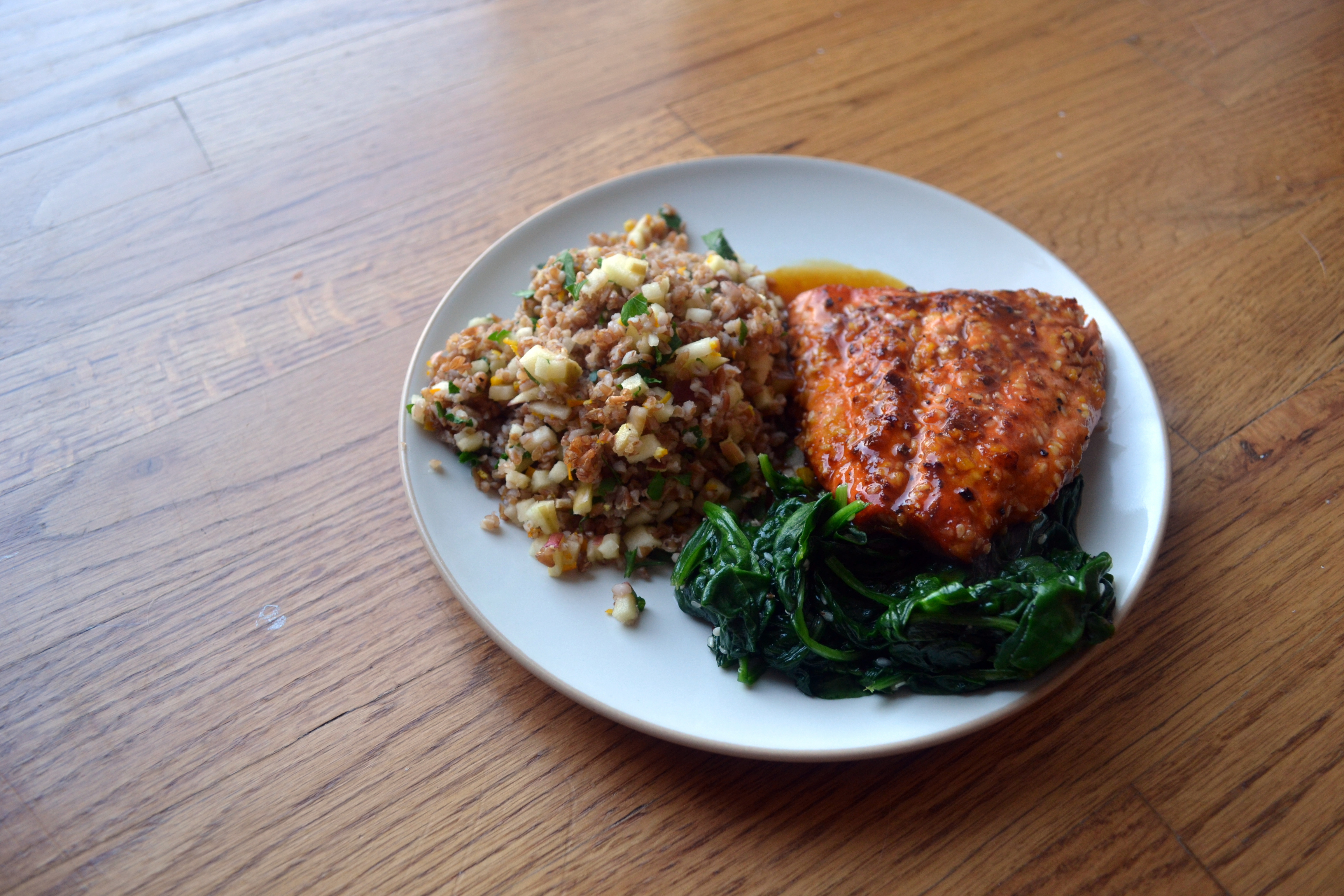
The bulgur was lovely.  It was toasty and fluffy and well seasoned.  The apple had cooked lightly as the dish baked, leaving it just softened but not without resistance.  The orange rind was delightfully not overpowering, but gave a warm spiciness to the grain.  It was good with the salmon, but would also be delicious with pork chops (playing on the traditional applesauce pairing) or, if you replaced the parsley with mint, a lovely side for leg of lamb.

In summary, a triumphant triumph: not only is the Stuffings category successfully completed, but it was completed with a success.


With the weather cooling (finally!) and the Soups category still looming largely untasted before me, I decided to try one to close out the week.

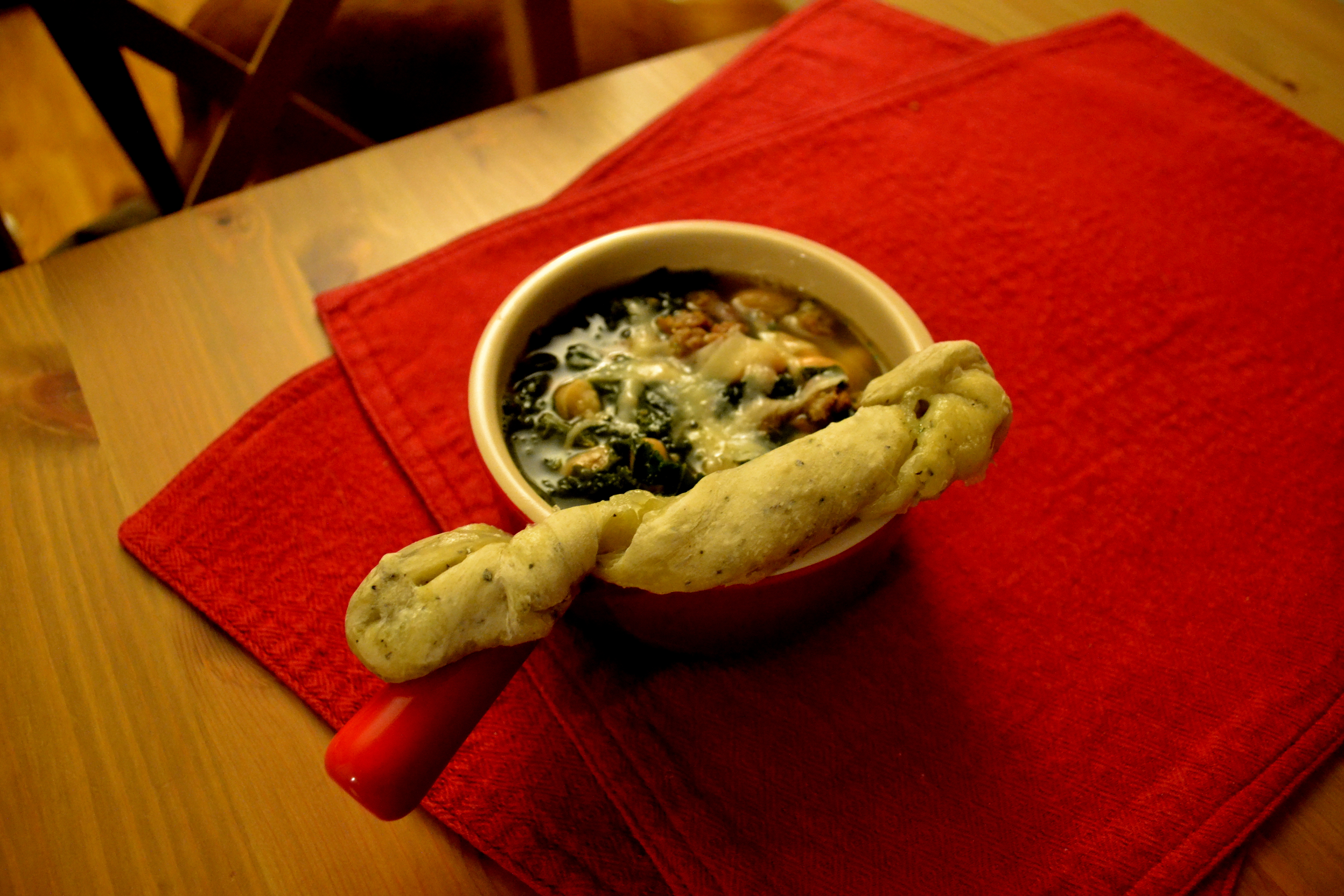
“21. Brown a little crumbled or sliced sausage in olive oil; a sprinkle of fennel seeds is good, too. Add chopped escarole, cooked white beans with their juice, and stock or water to cover. Simmer until the greens are tender and the beans are warmed through. Garnish with olive oil or Parmesan.”

I must admit I made some changes to these directions based on availability and personal taste.  I don’t like fennel.  It’s one of a very few spice flavors I just can’t take.  Over-fennel-ed sausage – like the kind that appears on many chain pizza restaurant pies – just doesn’t appeal to me, and the idea of fennel seeds crunching between my teeth and filling a mouthful of soup with their anise awfulness made their addition out of the question.

As for the escarole, I could find none.  I searched through mountains of salad greens at several local markets and this particular strain was resolutely absent.  But I did find a really beautiful bunch of kale and decided it would be a satisfactory substitute.

So here’s what I ended up with:

8 oz. bulk sausage

1 big bunch kale (chopped, this was probably 6-8 cups)

3 cloves garlic (some spice to replace the abhorred fennel seemed appropriate)

1 15 oz. can white beans with their liquid

2 cups chicken broth

salt and pepper to taste

Eschewing olive oil, I squeezed the sausage into a pan and let it brown over medium heat, separating and crumbling it as it cooked with a flat-sided wooden spoon.

I rinsed, stemmed, and chopped the kale into manageable pieces, and when the sausage was cooked through, I tossed in the mountain of greens.  No, that’s not true.  I inserted handfuls carefully so they wouldn’t spill all over the stove, and ran out of room with only half my kale added.  N. came into the kitchen when he heard me laughing hysterically, and stared in amazement at the mound of kale pieces sitting inches above the top of my pot.  I had to press it down with my hand, compacting the frilled, tough leaves down toward the bottom of the pot.  It always looks like too much.  It’s always not.  In the time it took me to mince the garlic, the kale had already begun to wilt and settle more comfortably into the confines of the pot.

When I could barely smell the garlic and the kale was level with the sides of the pot (as opposed to threatening to spill over them) I added the white beans, their juice, and barely two cups of low sodium chicken broth.  One of the things I’ve discovered about myself is that when it comes to soups and salads, I like them to be full of, well, stuff.  Lettuce with the odd crouton is no good.  I want dried cranberries, and walnuts, and avocado, and gorgonzola.  Thin, brothy soups don’t please me either.  Give me big chunks of vegetables, or slurpable noodles, or rich shreds of meat.  In the days when I’d indulge in the occasional Cup’o’noodle, I always drank the broth out first so I could concentrate on the important part: the just dripping mounds of noodles left behind.

So this soup, for true enjoyment, needed only enough broth to make its categorization accurate.  A scant two cups and we were assured plenty of “stuff” in every spoonful.

While the soup simmered, I stretched, sliced, and sprinkle mozzarella onto some pre-made pizza dough.  Twisted and snuggled on a baking sheet, these when into the oven to become bread sticks.  Fifteen minutes later when they were sizzling and firm, the soup was done.

This is not a soup you want to let simmer for hours.  The beans, especially if you are using canned like I did, will eventually become mealy and then disintegrate.  The kale begins to lose its emerald brilliance after a while, and though it will still taste good, it won’t be as pleasing to consume.  Simmer for fifteen to twenty minutes max.

Then you get to shave on some parmesan and eat it.

Neither of us was sure we would like this soup.  But we shouldn’t have been so foolish.  N. has placed the products of this project on a pass/fail system.  This is what happens, I suspect, when you have two teachers in the family.  He announces his verdicts after dinner, and he treats them as though Mr. Bittman has just submitted an exam or a paper assignment.  “Bittman passes on this one,” he told me last night as we cleaned up.  It wasn’t just his happiness at pairing his dinner with the first Jubelale of the season.  He really did like the soup.  And I think he was right.  This was a fast, easy, delicious little warmer.  Cooking the kale in the sausage grease gave it some additional flavor and took away that raw bitterness dark leafy greens can sometimes have.  The beans got creamy and delicate, and the starch from their liquid thickened up the minimal broth I used.  Even without the broth, these ingredients seem like a stellar combination that should be taken advantage of at many opportunities.  Sautéed together, perhaps with the addition of chopped onion and maybe butternut squash or sweet potato, they could be a nice little hash.  Wrapped in pastry with some thickened gravy, they could be a pot pie.  Folded with some grated mozzarella and enclosed in pizza dough, they become a perfect calzone.  And as the weather continues to cool (I hope, I hope, I hope), gravies and pot pies and warm cheesy casseroles are exactly what I want to pair my remaining Bittman dishes with.

It seems a bit stress-inducing to start with a countdown.  It’s a looming certainty of what must be achieved.  “That’s a lot,” N. said when I told him how many were left.  But after tonight’s dinner, it will be 24.  And by the end of next week, it will be 23.  And by having you out there reading, it means I must achieve, yes, but it also means I’m promising something to you.  Food.  Words.  Proof of my experiments.  And stress-inducing or not, that’s a kind of accountability I like having.
25 to go…
Swing

Summer into fall into summer.  Salads and grilled vegetables into casseroles dabbled with cream into fresh raw dips.  Luxurious stretches into curled legs under blankets into stressed grading sessions into sampling new half-fizzed white wine.

Sometimes this is called Indian Summer.  I like to think of it as Swing Season.

Two Bittmans for you this week.

77. Trim and dice fresh tomatillos; peel and julienne jicama (or daikon or kohlrabi). For dressing, combine lemon and lime juices, olive oil and chopped cilantro. Pour over salad, top with toasted sesame seeds.

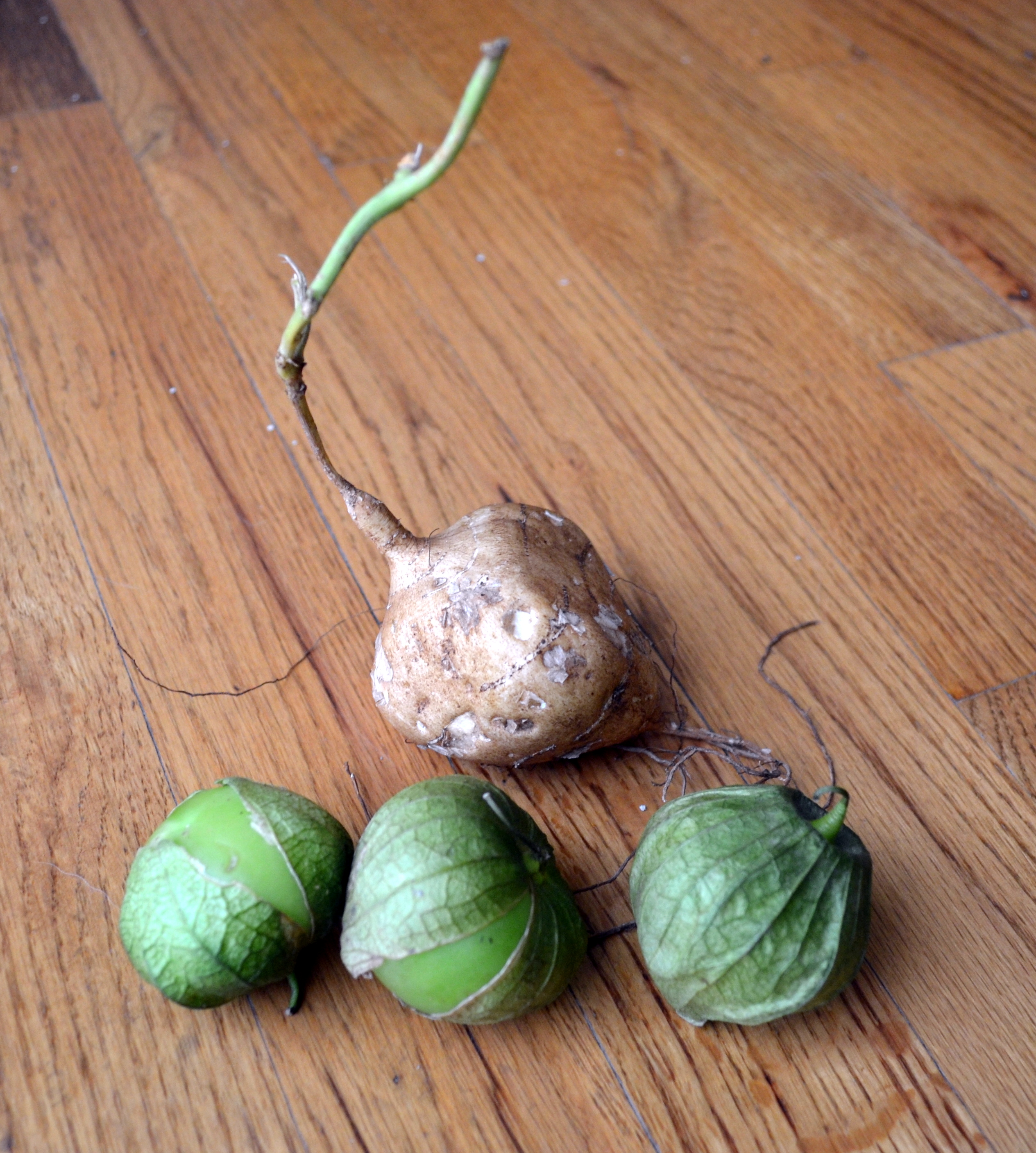
This sounded like a good late summer/early fall salad.  I found tomatillos at the grocery store, but no jicama, no daikon, and no kohlrabi.  And then we went to our Farmers’ Market, and I found all three!  Huge daikons, alien baseball sized kohlrabis and, hidden between stacks of beets and the tiniest fingerling potatoes I’ve ever seen, a pile of grubby little tubers with vine-y stems still attached.  Eureka, jicama!  Back at home, I assembled the troops:

1 TB toasted sesame seeds

2 small jicama

6 medium tomatillos

(really, the number of jicama and tomatillos isn’t super important as long as the quantities are roughly equal once you’ve cut them up.  Start with maybe 1 cup of each, see what you think, and then add more if that’s what makes you happy)

2 TB chopped cilantro

1 lemon

1 lime

Olive oil

Salt

I’ve tasted jicama, but it has been a long time.  And I’ve certainly had tomatillos, but mostly only after they were roasted and processed into salsa.  I wasn’t sure how they would be raw.  This – a lovely fresh slaw/salsa/salad hybrid – sounded so bright and tart and lovely that I wasn’t too nervous.

Before anything else, I toasted the sesame seeds and set them aside.  They give off such a lovely roasty scent when they are just browned and starting to release some oils.

I peeled, then sliced the jicama into rounds.  Then I stacked up the rounds and made thin slices across until my two little aliens were a pile of matchsticks across my board.  Into the bowl with you.

Next I quartered and diced the tomatillo.  Because they are still underripe when green (apparently they can turn purple and get very sweet when they ripen, but I’ve never seen them in that state), their skins were quite resilient – it took some pressure to get my knife through them.  Carefully chunked into miniscule cubes, they joined the white confetti in my bowl.

A quick squeeze of lemon and lime, a whisking pour of olive oil, and a handful of chopped cilantro feathers later, and the dressing was done.  And then a sprinkle of salt, and it was perfect.  It was a little more than needed to moisten the salad, but it’s hard to know how much juice citrus will have secreted away inside it, so it’s always going to be a guessing game.

I mounded the white and green on my plate, then added a generous scoop of Mexican rice and a quartered cheddar cheese quesadilla.  Simple simple.  At this point, you should ideally sprinkle the sesame seeds you so carefully toasted atop the salad, but I forgot until after I’d already subjected it to a photo shoot.

I was surprised and pleased by the flavor of this dish.  I can’t imagine eating it as a Thanksgiving side dish, but it was a bright burst of summer on a day that began in drizzly autumnal terms.  Jicama is crisp and juicy with the barest hint of starchiness, and its flavor reminds me most closely of an Asian pear.  The tomatillos were very tart, but the pairing tamed them.  Imagine a granny smith apple crossed with an underripe tomato and you’re approaching the brightness we experienced.

This was good as a salad, though its tartness necessitates a small portion.  It was also good heaped atop our quesadillas, like a raw salsa.  It contrasted nicely against the melted cheddar and the just crisped corn tortillas.  But where it would really shine, N. and I agreed, would be as a kind of mirepoix for guacamole.  Dicing the jicama instead of leaving it in strips and folding the whole salad gently into chunks of ripe, buttery avocado would make for the perfect chip dip.  Tart, creamy, crunchy, with the right kind of salty sourness from the dressing, and all you’d need was a frosted Corona and a pool to dip your toes into.  Summer.

But things never end there.  At least we hope not!  Days of sweating and hiding inside and waiting till after sunset to go out always, inevitably (even if it’s taking FOREVER, Los Angeles…) relax and cool and crystallize into Autumn.

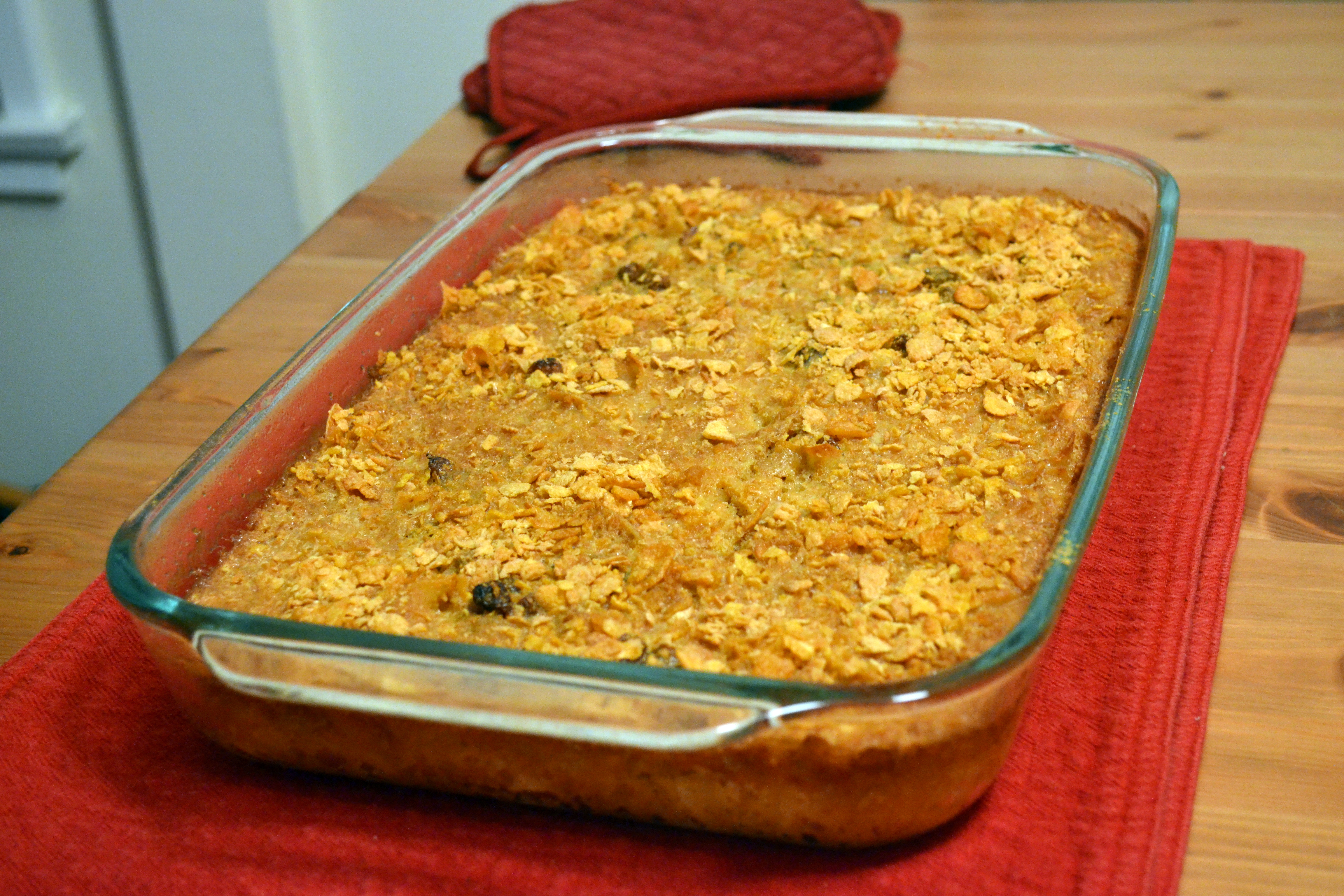
35. Pumpkin-Noodle Kugel: Cook a half-pound of egg noodles in salted water until not quite done; drain and put them into a buttered baking dish. Whisk together 4 cups milk, 4 eggs, 1 cup pureed cooked pumpkin (canned is fine), ¼ cup melted butter and a pinch each of cinnamon and salt. Pour over the noodles and sprinkle with bread crumbs (or, for added kitsch, corn flake crumbs). Bake 45 minutes to an hour, or until a knife inserted into the middle comes out clean.

I had no idea how to serve this dish.  I’ve heard of kugels, but I’ve never even eaten one, let alone made one.  I wasn’t sure, as usual, what to serve it with, so I asked a few friends and did some research on the good ol’ internet.  At the point that I read Smitten Kitchen’s version (okay, so this one is written by her mom, but seriously, that woman has cooked everything, and all of it sounds and looks outrageously delicious), this sounded more like a dessert than a dinner side dish.  It would be, I decided, dessert and weekend breakfast.  Sweet, autumnal, nicely spiced, and custardy.  “It’s going to be like a rice pudding but with noodles.  And pumpkin,” I told N.  He still wasn’t sure.

8 oz. egg noodles 

4 cups milk

4 eggs

1 cup pumpkin puree (I used Libby’s)

¼ cup melted butter (I put this in, but I’m not sure it was really necessary)

¾ cups sugar

¾ cups golden raisins

½ tsp cinnamon

½ tsp salt

2 cups corn flakes, well crunched (who am I to pass up added kitsch?!)

It wasn’t until I had collected ingredients that I realized Bittman’s recipe doesn’t call for sugar.  But I was already on the dessert/breakfast kick, and I couldn’t quite envision this as a savory dish, so I dumped in my sugar estimation anyway, along with the golden raisins that aren’t part of the original.

I cooked my noodles for 5 minutes and then let them cool for 10.  They probably needed to be cooked for only 4 minutes, because they keep on cooking not only while they are in the oven, but on the counter as they cool as well.

Yes, I take these photos from the floor. But it’s a nice wood floor, and the light is so good, and I promise Lucy stayed on the other side of the room the whole time…

With the custard whisked together and the noodles evenly spread in a buttered 9×13” glass baking dish, I preheated my oven to 375F and assessed the corn flakes situation.  Whenever an ingredient needs to be crushed, crunched, or pulverized on Chopped, I yell at the chefs for using their hands, knives, or a rolling pin instead of just bringing over the food processor.  But they don’t have to wash all the dishes they make, and I do, so my pretty little scarlet processor stayed on its shelf.  I crushed up the cereal with my hands, feeling a kind of satisfaction as the flakes became bits and then powder.  I topped the noodly custard with a generous layer of crumbs and carefully slid it into the oven.

An hour later, the custard had set and the smell flashed me forward to Thanksgiving.  I’m convinced we as a society don’t really know what pumpkin tastes like, because what we experience is texture and spices.  If this kugel didn’t have a sprinkle of cinnamon in it, I’m not sure I would know it had pumpkin either.

Dinner came and went, the kugel cooled a bit, and I dug out a too-big portion for myself, and neglected to feel any kind of remorse about it.  It was too good for that.  The noodles had melded together as the pumpkin infused liquid cooked, making a solid, scoopable, sliceable custard.  The corn flakes on top were perfect: aggressively crunchy against the soft interior.  I wouldn’t omit the golden raisins either; they were a really nice textural contrast to both the softness of the noodles and the crunchy crumbs, and their complex sweetness added some depth to my dessert casserole.  It was warm, and sweet, and perfectly comforting as I tucked my feet under me on the couch and waiting for the approach of Project Runway (don’t judge, every girl needs a little reality TV now and then).

The leftovers are delicious too, though the dish does lose something in relinquishing its crunch to the microwave.  In another universe where I’m a Southern cook, I could see doing crazy things like frying squares of this in butter and then drizzling hot maple syrup over the top.  But I’ll refrain.  Because from my window, I can see my basil wilting beneath the curiously, cruelly hot-for-mid-October sun: back to summer, so it seems!  And here I was considering making soup…

Swing season indeed.

Snakes and Ladders

It’s a classic children’s game.  Climb a ladder: advance!  Land on a snake: tumble backwards.  And so it goes with most ventures.  Last week newness delighted me.  This week I’m plodding a bit, experiencing not setbacks, exactly, but settling for lackluster(ness?)(ocity?).  I’m discovering things I don’t love about my syllabus.  I’m wading through class prep.  Students are still (still!  The third week is about to start!  Papers will be due soon!) adding my classes, which means I am overenrolled and there are new faces every day.  And though I’m mostly inspired in my kitchen, not every dish is a triumph.  Some slip a little.  Some slither into lackluster.  But it’s our job, as cooks, as experimenters, as eaters, as humans – and pardon me while I get a bit metaphorical – it’s our job to take this as a challenge.  Make it work, as Tim Gunn continually reminds us.  So we squirm ourselves around and push back toward the ladders.  And sometimes, even after a devastating slide, we climb a few steps.

70. Blanch, shock in cold water, then julienne green beans, daikon and carrots, chill. Whisk soy sauce with honey and lemon to taste; pour over vegetables.”

The most important thing to note about this particular Bittman combo is to leave yourself enough time, particularly if your knife skills are not perfect.  It is not possible to concoct this dish in anything but a zone of utter frustration and simmering disappointment if you only have twenty minutes until dinnertime.  Here’s what I did:

3 carrots, peeled and cut into thick sticks

1 6-inch chunk daikon, peeled and cut into thick sticks

½ lb. green beans, rinsed and stemmed

3 TB soy sauce

2 TB lemon juice

1-2 TB honey

I dropped the carrot and daikon sticks into a big pot of boiling, salted water and let them cook for 2-3 minutes, until they had give between my teeth but still put up a bit of resistance.  I plunged them into ice water and put the tailed green beans into the boil.  This was the point at which I ran into trouble.  Performing a nice julienne on a pile of veg takes some time and some patience, and on this particular day I lacked both.

Nevertheless, cut each thick stick of carrot and daikon into thin slices (Food Network calls them panels), then turn those slices to cut long, thin vertical strips.  You want uniformity but also thinness, since these are only partially cooked, and you want even quantities of carrot slivers and daikon slivers.

At this point the green beans were overboiled and the sausages – the other component of our meal – were almost done on the grill, so I shifted into I-don’t-care-how-it-comes-out-just-get-it-done overdrive.  It happens.  You should julienne the green beans.  I just sliced them into strange vertical halves.  You should chill the whole salad until nice and crisp – probably at least half an hour – after lovingly tossing the thin sticks of orange, white and green together.  I shoved the bowl in the freezer for five minutes while I made the dressing.

I whisked the soy, honey, and lemon together and was satisfied with the flavor.  Were I making this again, I would definitely increase the quantity of lemon juice and maybe even add some zest, but I say it’s up to you.  Play with the combination until you like the ratios.

Dressed, the vegetables had a pleasant texture and tasted well seasoned, but the salad as a dish was missing something.  N. and I agreed that the dressing was a little one-note, and that note was soy sauce.  Flavorwise, things were also a bit on the dull side.  Red pepper flakes or raw garlic, we decided, or more or different acid, would have helped things along.  Maybe some chives or lemongrass or ginger or cilantro, and certainly pairing this Asian-flavored dressing with something other than Italian sausages, would have been the right move.

And so, in my attempts to slither back into success, I considered the leftovers.  They weren’t stars, but they could perhaps be supporting players.  In fact, though they were not the traditional combination, they seemed not so different from the vegetables that go into a bahn mi sandwich.  Setting off to work a morning or two later, therefore, I slathered a crisp roll with mayonnaise, piled up a good portion of drained veggie slivers and, lacking lunchmeat, topped the whole thing with slices of pepperjack cheese.  I know.  Cheese is not part of bahn mi either.  But jalapeño slices usually are, and the vegetables were crying for spice anyway.  It wasn’t the best sandwich I’ve ever had.  But it wasn’t a disaster either.  It was a few steps forward.  Keep moving forward.  On to the next ladder!

Relishing

I can’t remember the last time Labor Day was a holiday for me.  I mean, I haven’t worked on Labor Day in a long time – perhaps ever.  But I spent the past eleven years or so attending universities organized around the quarter system: school starts in late September and ends in mid June.  That means when this magical Monday hit and working stiffs got to switch off their alarms, I was still on summer vacation.

Boo hoo, you say, poor thing!  You had to suffer through a non-holiday because you were on holiday!  But I’d remind you that for a graduate student, even allotted holidays don’t read as such.  A Monday is another toil-on-the-dissertation day.

And yet, today, with one week of class behind me at my new job, I did not have to make the pilgrimage to Burbank.  I did not have to spend the weekend lesson planning.  Ahead of me spans a week with one (one!) day of class.  It’s enough to make a girl sob with joy!

And then there are onions.  Which are enough to make a girl sob as well, though the accompanying emotion differs a little.

These are two Bittman “recipes.”  I realized recently that, as usual, my Bittman project has fallen by the wayside.  A brief count reveals that, of the list of 82 with which I began (the whole collection has 101 items, but I knew there were some N. and I would just never eat), 34 still remain unmade.  Most are soups.  That sounds like decent progress, until I remind you that I began this project 2 years ago.  But this year, beginning for me – as for every eternal academic – at the end of summer, is a year of renewed possibility.  It’s a year of everything refreshed: new home, new jobs, new opportunities.  It’s a year to relish.

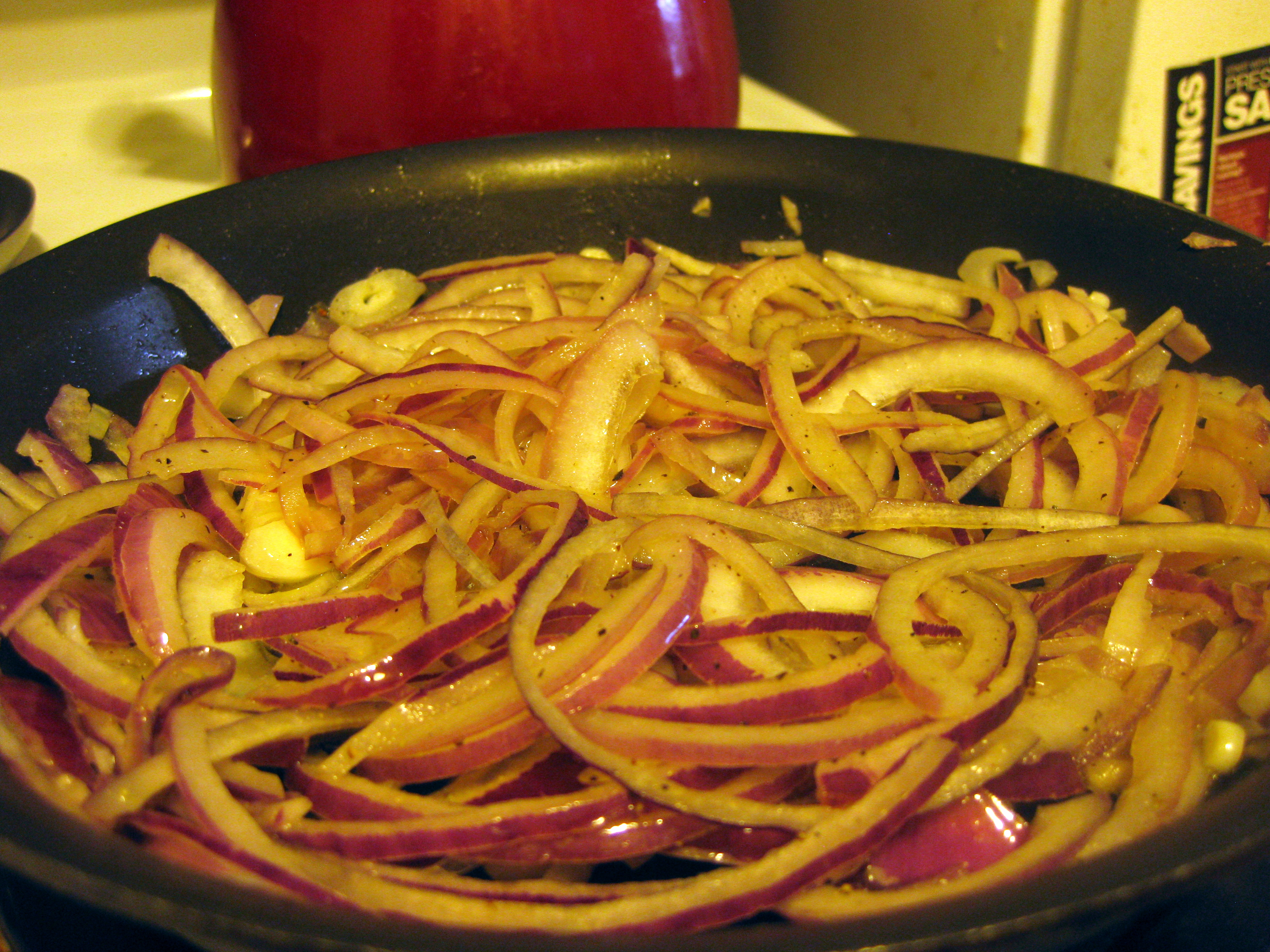
3. Red Onion with Red Wine and Rosemary: Thinly slice red onions and cook them in olive oil until very soft.  Add chopped rosemary and red wine, and cook until the jam thickens.

I used:

1 big red onion, halved, peeled, and cut into thin half-moons

1 TB olive oil

Salt and pepper to taste

2 TB rosemary, finely chopped

1-2 cups red wine

1 TB brown sugar

Onions take a long time to cook down the way I suspected they needed to for this recipe.  High heat makes for crumpled, browned, crispy-edged rings.  Delicious in their own right, but not for jam.  I baby-sat the onions over medium-low heat for at least half an hour.  Their pearly-white interiors turned fragile gold as if stained by the olive oil, and their textures changed, gaining an unctuous flexibility.

I added the salt and pepper, the rosemary, the red wine and the brown sugar and stirred together carefully to dissolve the sugar.  This simmered for another half hour until the wine, sugar, and onions came together into a sticky heady mahogany swamp in the pan.  As the wine reduced, I lowered the temperature to prevent any burning.

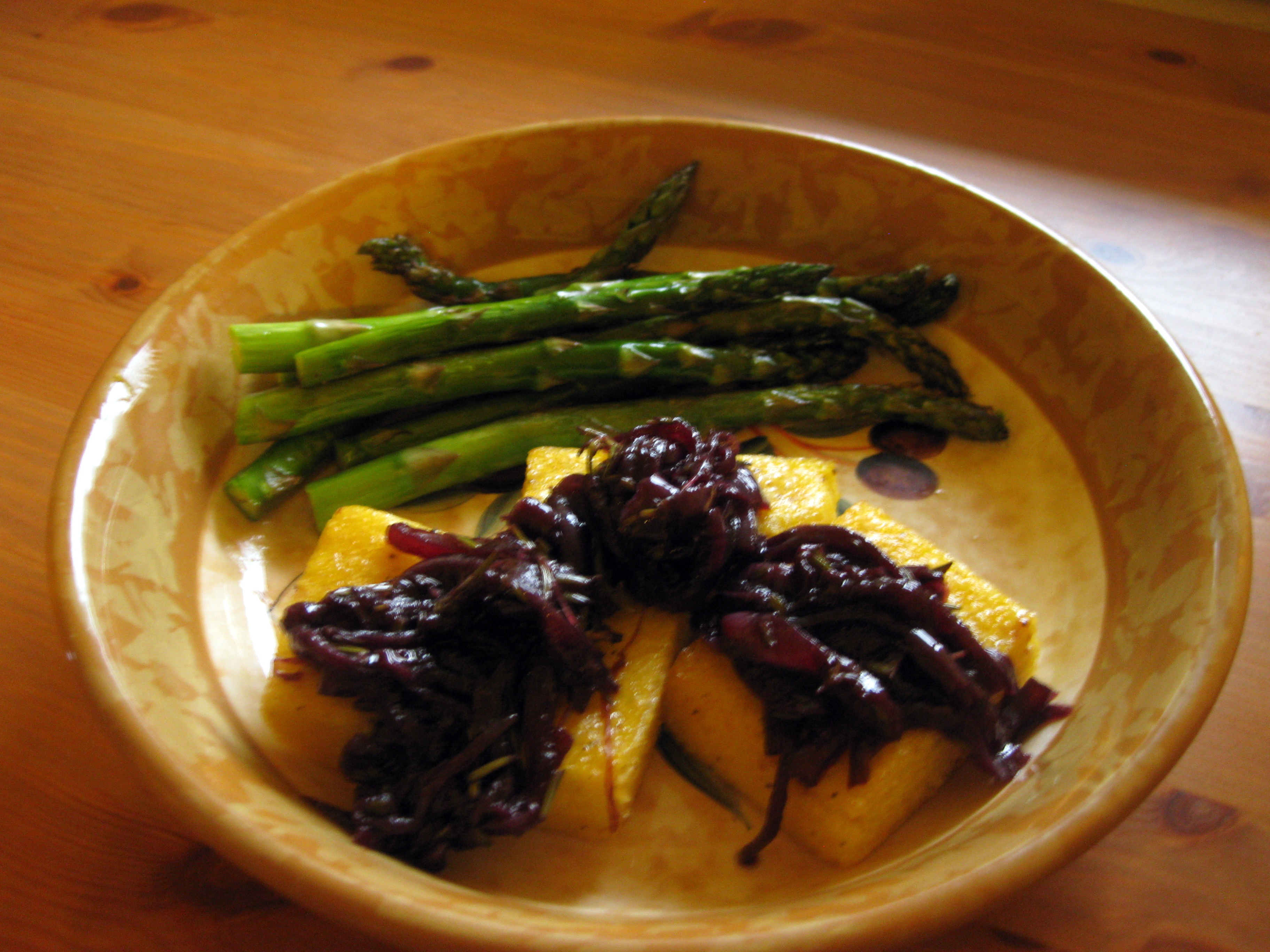
The finished jam slumped wonderfully over baked squares of polenta, providing contrast in all the best ways: the colors were sharp, the textures played together, the flavors were rich and lovely.  The onion jam was sweet with the tang of wine and the pine-forest warmth of rosemary.  The polenta was comforting and even flavored, and it needed the sharp sweetness the jam provided.  Steamed asparagus finished out the meal.

It sounds crazy, but the next morning I had the urge to drape some of this sticky, savory jam over a piece of whole-grain toast smeared with cream cheese.  It would also, I suspect, serve well spread over a turkey burger.

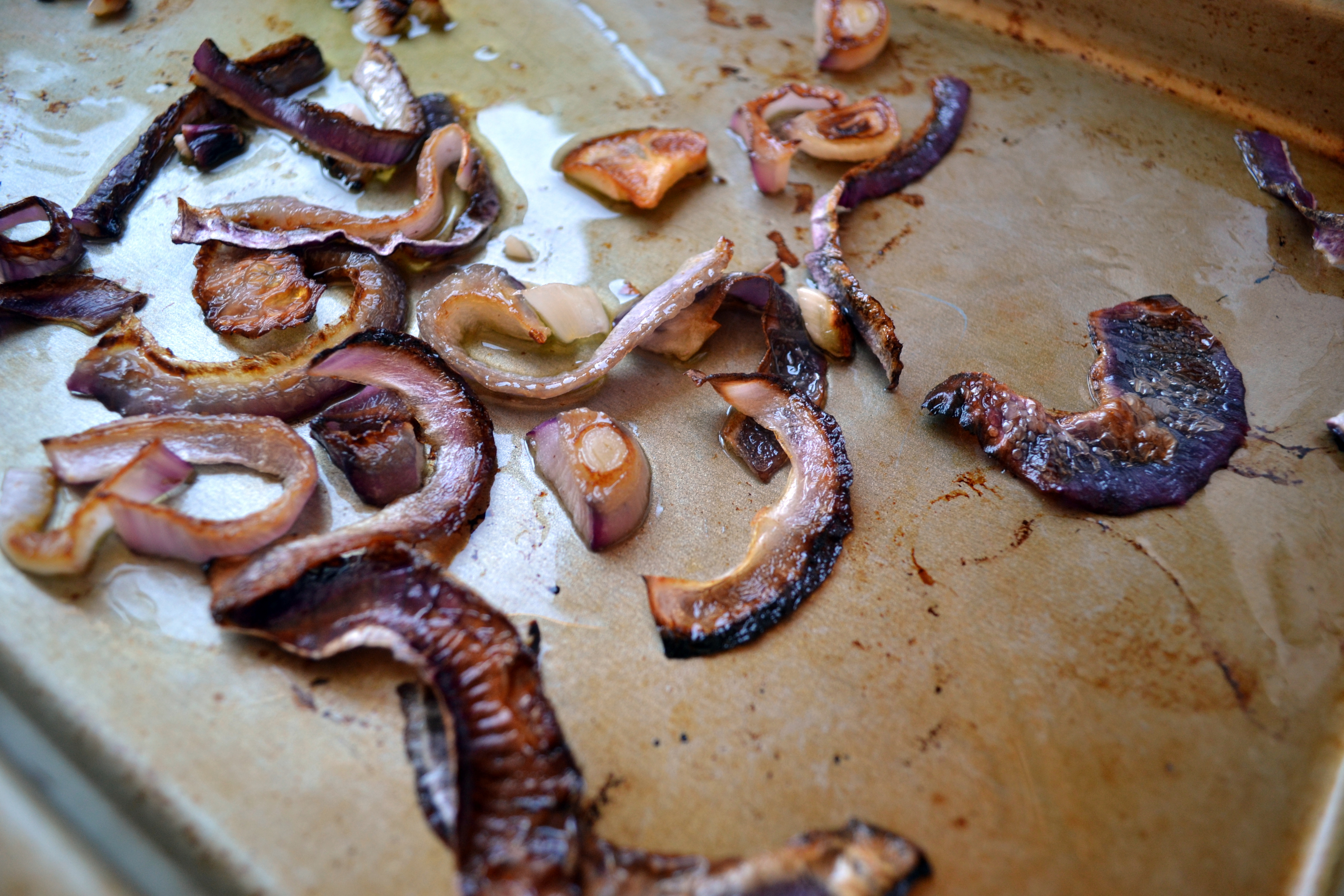
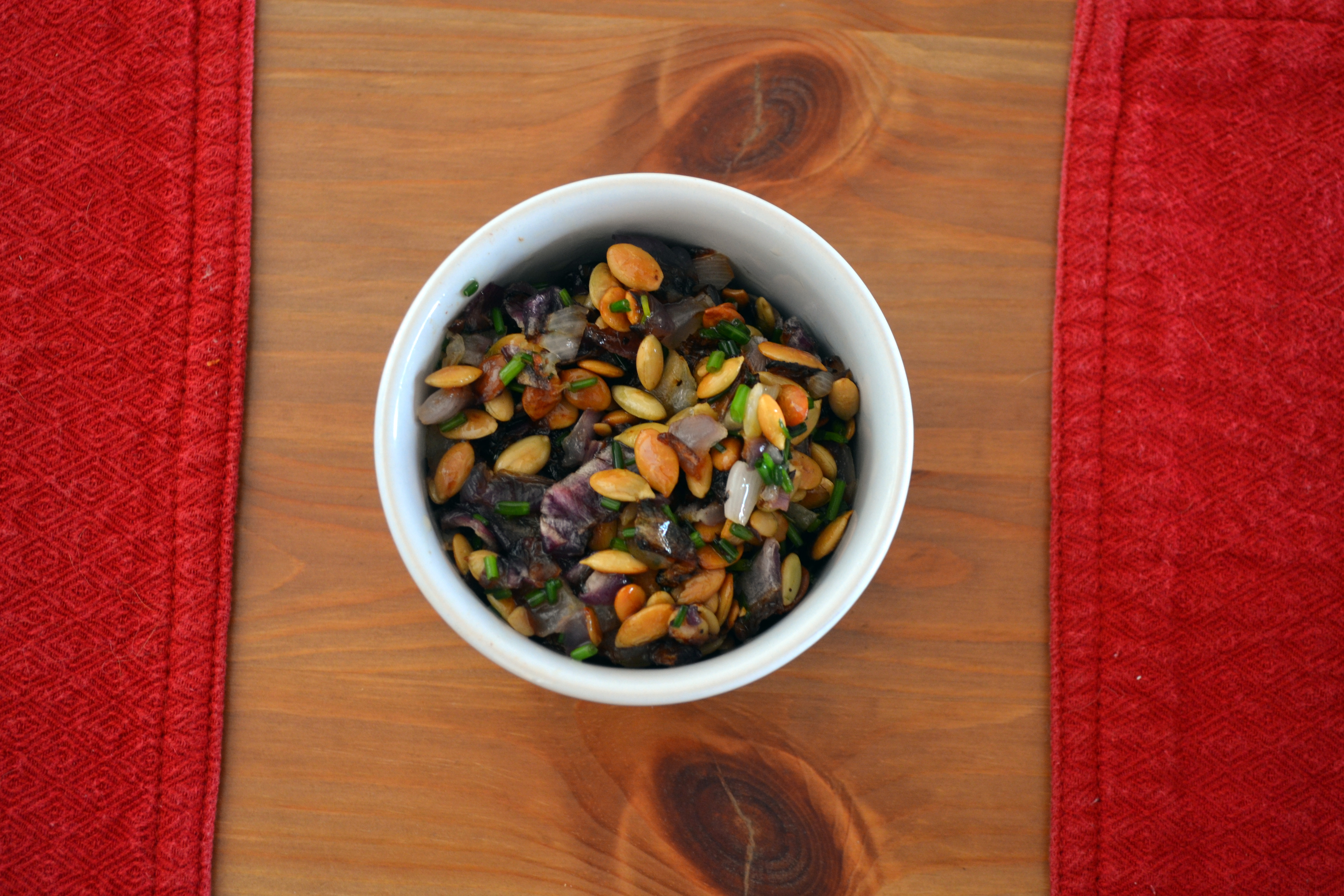
1. Onion-Pumpkinseed Relish: Roast thick slices of red onion with olive oil until softened and nicely browned.  Chop, then toss with minced chives, toasted pumpkinseeds and a little more olive oil.

A number of circumstances divide these two onion concoctions.  One was made in Oregon, one was made in California.  One was made in the cold drear of an oppressively long winter, one was made on a day of endless sun as August closed.  One was slowly reduced over an electric stove, one was browned in a gas oven, and though both were shot with digital cameras, you’re seeing one through the lens of an everything-automatic Canon PowerShot, and the other through a Nikon DSLR.  Changes to relish.

½ a huge red onion

3 TB olive oil

3-4 TB pumpkinseeds, toasted in a dry pan until they are flushed with brown and starting to pop

2 TB fresh chives

In a 400F oven, I roasted the olive oil coated onion slices until they collapsed, taking on a lovely burnished crispness.  This took probably 10-20 minutes.  Check often after 10 minutes, depending upon how hot your oven runs.  Liberate the toasty onion slices and let them cool.

When onions are cool, chop them finely and toss them with the other ingredients.  I had plenty of olive oil in my baking pan to coat all the ingredients so the relish glistened, but if you need it, feel free to add another glug or two.

I served lovely little spoons of this mixture over black bean cakes.  We traded tastes, taking in the relish in one bite and an avocado tomato salad in the next.  It was a nice pairing: the relish was moist and crunchy and savory, with the right kind of nutty richness to complement the dense potential blandness of the beans.

But I don’t think this relish ends as a condiment for beans.  It would be a spectacular topping for lamb.  Spiced with a little chili powder, it would fit perfectly atop pumpkin enchiladas.  It might even be a good garnish for butternut squash soup: a small heap of confetti in a velvet orange sea, interrupting the endless smoothness with a well-oiled crunch.

Will I finish this Bittman project by the end of the calendar year?  I don’t know.  But I’m enjoying it again, whereas during the last few months of dissertating I was finding it burdensome.  The thrill of guessing quantities, rather than being annoyed by lack of specificity, is returning.  The intuition about temperature and time is audible again.  And now, on this holiday that has never felt like a holiday before, I’m relishing it all.

Chicken’n’chutney

We’ve become huge fans of roast chicken this year. I rub a mix of herbs, salt, pepper, garlic, lemon zest and olive oil under its skin, and stuff it full of the same herbs, a few cloves of garlic, and half a lemon. The lemon is, I think, the secret weapon. It gives the finished meat a really nice light suggestion of citrus. I’ve also started creating my own rack in the cheap metal rectangular baking pan that subs in for a roasting pan in my kitchen: on Kelsey Nixon’s suggestion, I make a triangle in the bottom of the pan out of a few carrots, a few sticks of celery, and a halved onion. This gives the chicken a nice platform to sit on so it doesn’t steam in the juices it exudes. Plus, I like to think the extra vegetables impart a nice, delicate flavor into the meat as well. (Plus plus, the vegetables roast down and caramelize in the chicken fat and juices, and you can extract them from the pan and gobble them as an extra veggie with your dinner, as you can see I’ve done with the carrots below. Their skins maintain the tiniest resistance to the teeth, and they taste like all the goodness of chicken skin, but really you’re just eating a roasted carrot!) I roast breast side down, always, to keep the white meat as juicy as possible. I’ve done this vegetable trick with our Thanksgiving turkey the last two years as well and I’m ridiculously pleased with the results.

But this isn’t about Bittman, is it? To go with this chicken, I decided to go with one of his chutney ingredient combinations:

“5. Apple Chutney: Cook big chunks of peeled, cored apple with a little apple cider, Dijon or whole-grain mustard and chopped sage until the chutney thickens. Don’t cook it until it becomes apple sauce unless you want to.”

Between that day and this moment, I lost the small square of paper onto which I scribble quantities. Alas. So what follows are approximations from memory, but I think this is really a “how you like it” sort of dish, so you’d be using my values only as approximations anyway.

3 crisp, tart apples, peeled, cored, and cut into large chunks (I had Fujis, but Granny Smith or similar would also be delicious)

¼- ½ cup Gravenstein apple juice

1 generous TB whole grain mustard

1 TB finely minced sage

I tumbled these together in a small saucepan and cooked it over medium heat for fifteen minutes or so, stirring infrequently and gently, until the apples became soft but still resistant, and the juice had somehow thickened into what was not quite chunky applesauce, but was securely on its way.

We ate this draped over juicy, moist hunks of chicken, and while not the same perfect pairing as I think it would be with a well breaded and deeply fried pork chop, it was pretty delicious. I liked the combination of apples and mustard: they added a tart sweetness that balanced well with the sharp spice and the deep earthy flavor of the sage.

With this, in what must be one of the more monochromatic plates ever made, we had parsnip “puree.” I place this descriptor in quotations because my results were less than smooth. I didn’t core the parsnips or roast them long enough to make them sufficiently tender for my immersion blender. Alas. They were delicious, however, and they are a commodity I plan to revisit. Once I get the specs correct, I will certainly share the recipe here. It involved butter, and heavy cream, and roasted garlic, all in embarrassingly large quantities. But once you swirl them together you can’t see how much there ever was, which means it doesn’t count, right?


Spic(k)ed apple cider

No photos tonight, just a quick question:

What do you get when you combine

16 oz. Trader Joe’s Gravenstein apple juice

2 shots Kraken black rum

2 cinnamon sticks, broken in half

4 whole cloves

1 liberal squeeze of honey

and simmer slowly for about 15 minutes?

The perfect winter warmer for two on a cozy little evening at home.

Yes, that.