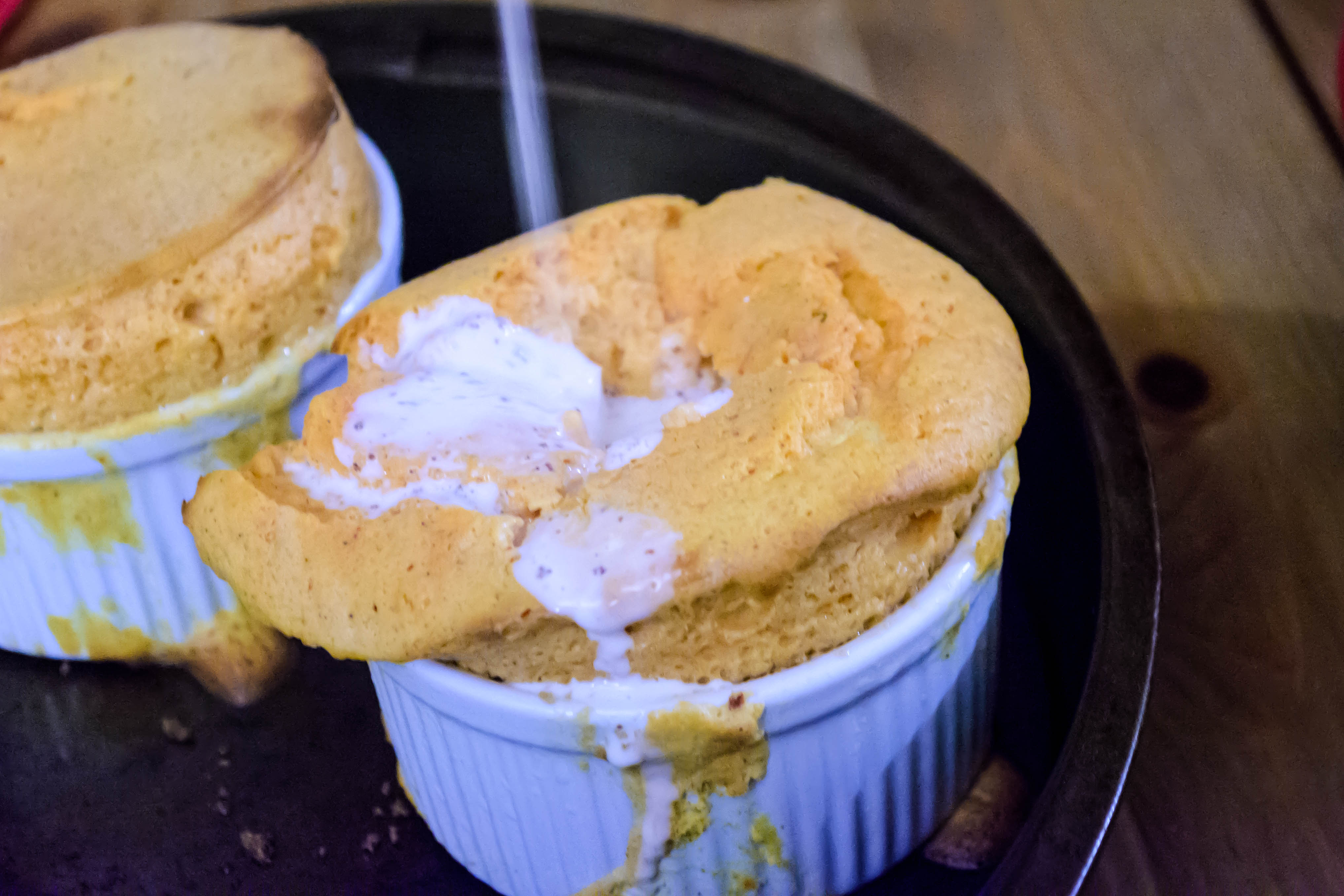
Chipotle and Cinnamon Sweet Potato Soufflés

I realize it might be a bit late for me to convince you, at this point, to make significant changes to your Thanksgiving menu.  If you are anything like me, you’ve had the whole meal planned out for several weeks now, including possibly which serving dishes you’ll be using for which dish (speaking of which, have you seen this?).

But if you are undecided, or if you still aren’t sure what you are doing with sweet potatoes, may I make a humble suggestion?  Put down the marshmallows.  Okay, give them one final squeeze and then put them down.  You don’t need that stuff.  Instead, may I offer you the promise of spiced velvet? Puffy, smooth, decadent-but-light velvet, spicy and sweet, rising up from its dish like some gravity-defying magic trick.
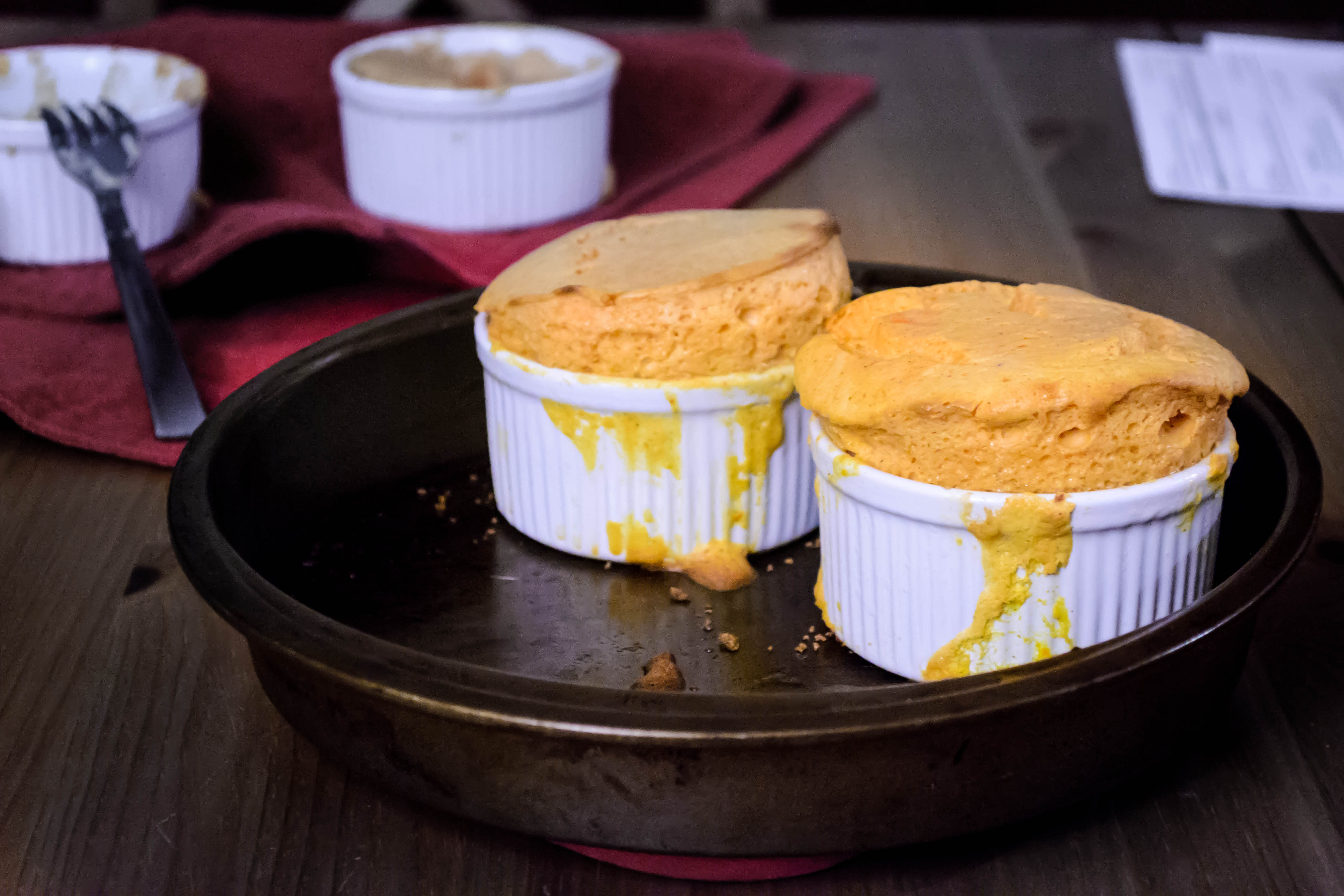
Food Blog November 2013-2841Yes, I’m talking about soufflé

Food Blog November 2013-2843I know, I know. Just want you want to worry about on one of the biggest food days of the year is the notoriously fussy, egg white driven glorious strangeness that is soufflé. You don’t want to worry about whisking, or folding, or, heaven forbid, fallen puffs that are competing with the turkey for oven space anyway.
Food Blog November 2013-2818But as it turns out, at least in my experience, soufflé isn’t really that hard if you are a tiny bit patient and a tiny bit brave. And this one, with the beautiful pumpkin color of the sweet potatoes mellowed and enriched with heavy cream, brown sugar, and cinnamon, and lent a bit of extra pizzazz from a sparing dose of chipotle pepper and a fizz of lime juice, is a delightful choice. The base, lightened with three egg whites, climbs determinedly into large mushrooming domes, and the mixture conveniently uses three egg yolks as well, so you aren’t left with any extra yolks hanging around (though if you are, this is a great resource).

Food Blog November 2013-2819Food Blog November 2013-2821The thing about soufflés is, they depend on the expansion power of aerated egg whites. That’s what you are doing when you beat them to soft or even medium peaks: filling them with air. Bubbles form and stabilize, and so long as you aren’t too rough with them, they continue to expand in the oven, creating that otherwordly dome of perfect, velvety lightness. This is why soufflé recipes are so fussy about being sure you fold the whites into the flavor base: you don’t want to deflate them. This tutorial gives some helpful suggestions about this process, if you need a refresher or you’ve never been sure. And even that thing about not opening the oven door lest they collapse mid-bake is an exaggeration; though you don’t want to be swinging open and slamming shut the door every five minutes, I tentatively peeked inside once during my baking process, and no holiday-destroying collapse resulted.
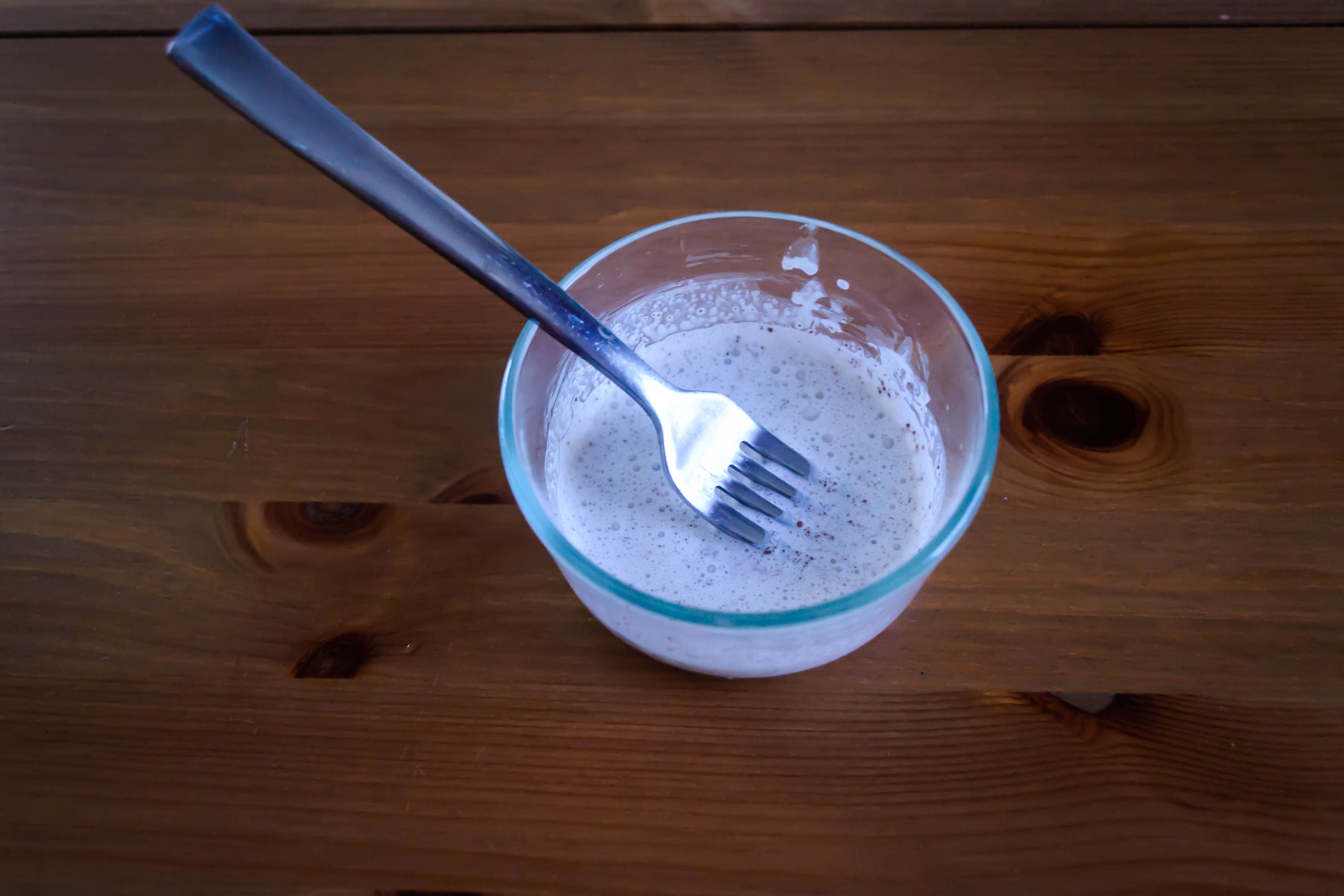
Food Blog November 2013-2825When you dig tentatively into these delicate, reality-bending puffs, they sigh and fold inward just a touch, the dry, slightly meringue toasted tops crease slightly, and you are free to dig out piping hot, fluffy forkfuls and jam them into your mouth with no further ceremony. Or, if you feel fancy (or if you have more than one gravy boat and you’re dying to take multiples for a spin), make some cinnamon cream to drizzle over the top: whisk about ½ teaspoon of cinnamon into a ½ cup or so of heavy cream (estimate 2 tablespoons of cream per diner), and you’ve got a simple and luscious sauce to add to your fluffy masterpieces. This also cools the heat, if you have diners with delicate tongues or you’ve gone a little heavy on the chipotle.
Food Blog November 2013-2827Soufflés may sound scary, and you may think Thanksgiving is no time to experiment, but I’ve got faith. I think you can do it. And when your mother-in-law, or your best friend, or your fussy aunt looks impressed, you can lie and say it was really hard but you’re so glad it came together as beautifully as it did. I won’t tell a soul. You can save the marshmallows for some hot cocoa, where they belong.

Food Blog November 2013-2839* Alternatives: if you don’t like spicy, take out the chipotle and add a few generous grinds of black pepper instead.  If you want this for dessert, add an extra 2 tablespoons of sugar to the souffle base itself, and maybe a teaspoon of vanilla, and top the baked soufflés with a sweeter version of the cinnamon cream referenced above: 1/2 cup heavy cream (estimate about 2 tablespoons per person), 1/2 tsp cinnamon, 2 teaspoons sugar, lightly, lightly whipped until only just barely thickened. If you want to booze it up, add a tablespoon or two of rum or bourbon.

If soufflé is just not going to happen but you still want marshmallow-free sweet potatoes, may I humbly suggest this as another option?

Food Blog November 2013-2831

Cinnamon and Chipotle Sweet Potato Soufflé
Hugely adapted from Cooking Light
Makes 6 servings
2 tablespoons butter, for ramekins
2 tablespoons brown sugar, for ramekins
2 cups sweet potato cubes, from 1 large peeled, orange-fleshed sweet potato
½ cup heavy cream
¼ cup brown sugar
2 teaspoons lime juice
½ a chipotle pepper from a can of chipotles in adobo (or more, if you like it spicy)
½ teaspoon salt
½ teaspoon cinnamon
3 egg yolks
3 egg whites
¼ teaspoon cream of tartar


  • Preheat the oven to 375F.
  • Butter and sugar six single-serving ramekins (mine fit a little more than ½ a cup), then stow in the freezer. The sugar sanding creates texture to help the soufflé climb the walls of the container, and freezing it makes it take longer to dissolve in the heat of the oven, so you’re giving your puff a head start.
  • Drop your peeled sweet potato cubes in boiling salted water and cook until they are very tender but not yet falling apart. Drain and set aside to cool.
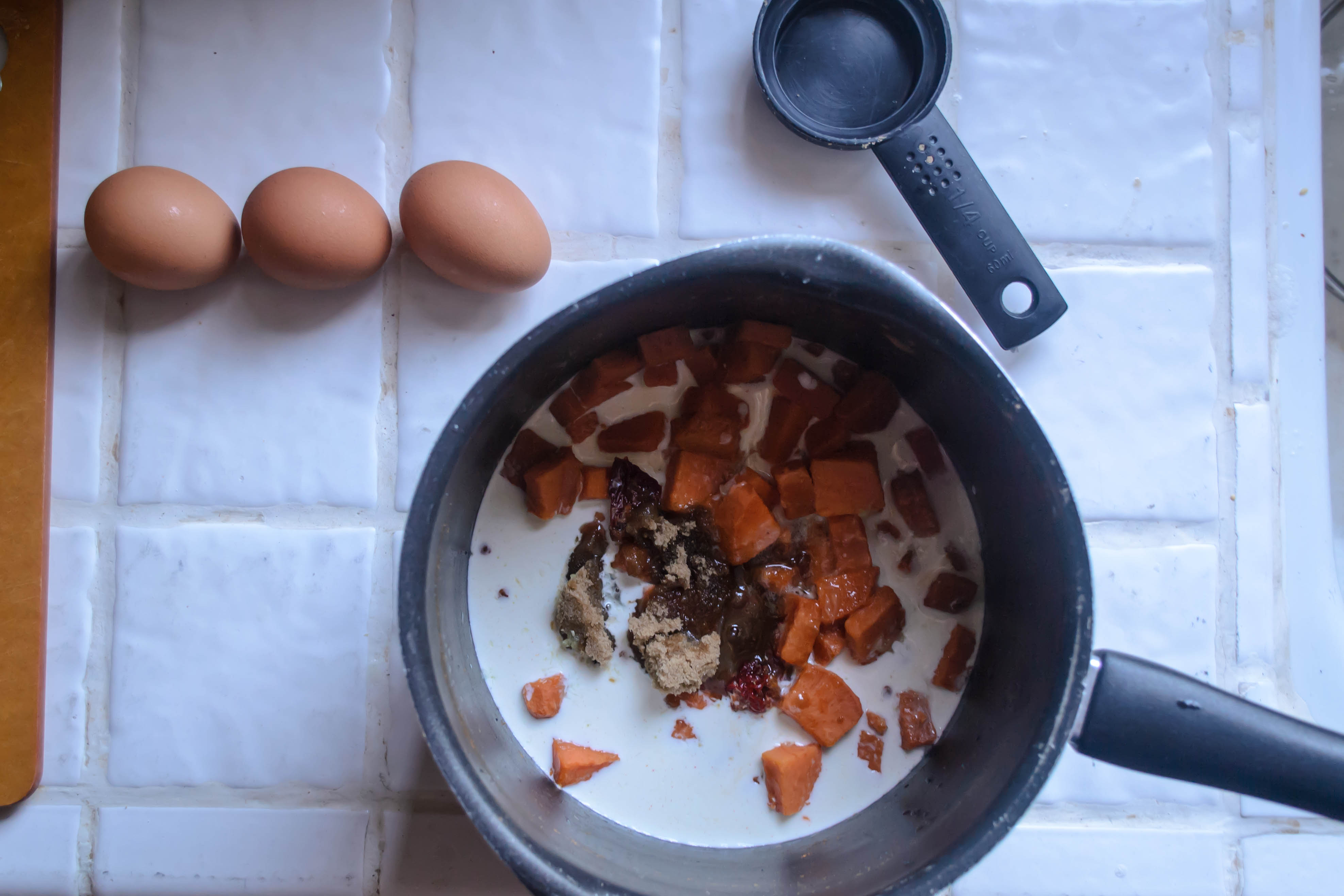
  • In a large bowl (or the same pot you used to cook the sweet potatoes), combine the heavy cream, ¼ cup brown sugar, lime juice, chipotle pepper, salt, and cinnamon. Add the sweet potato cubes and mash, whisk, or otherwise blend into a smooth, thick soup. I used my immersion blender, which worked very well. You could also use a regular blender or a food processor. The key here is that you want a scrupulously smooth mixture.
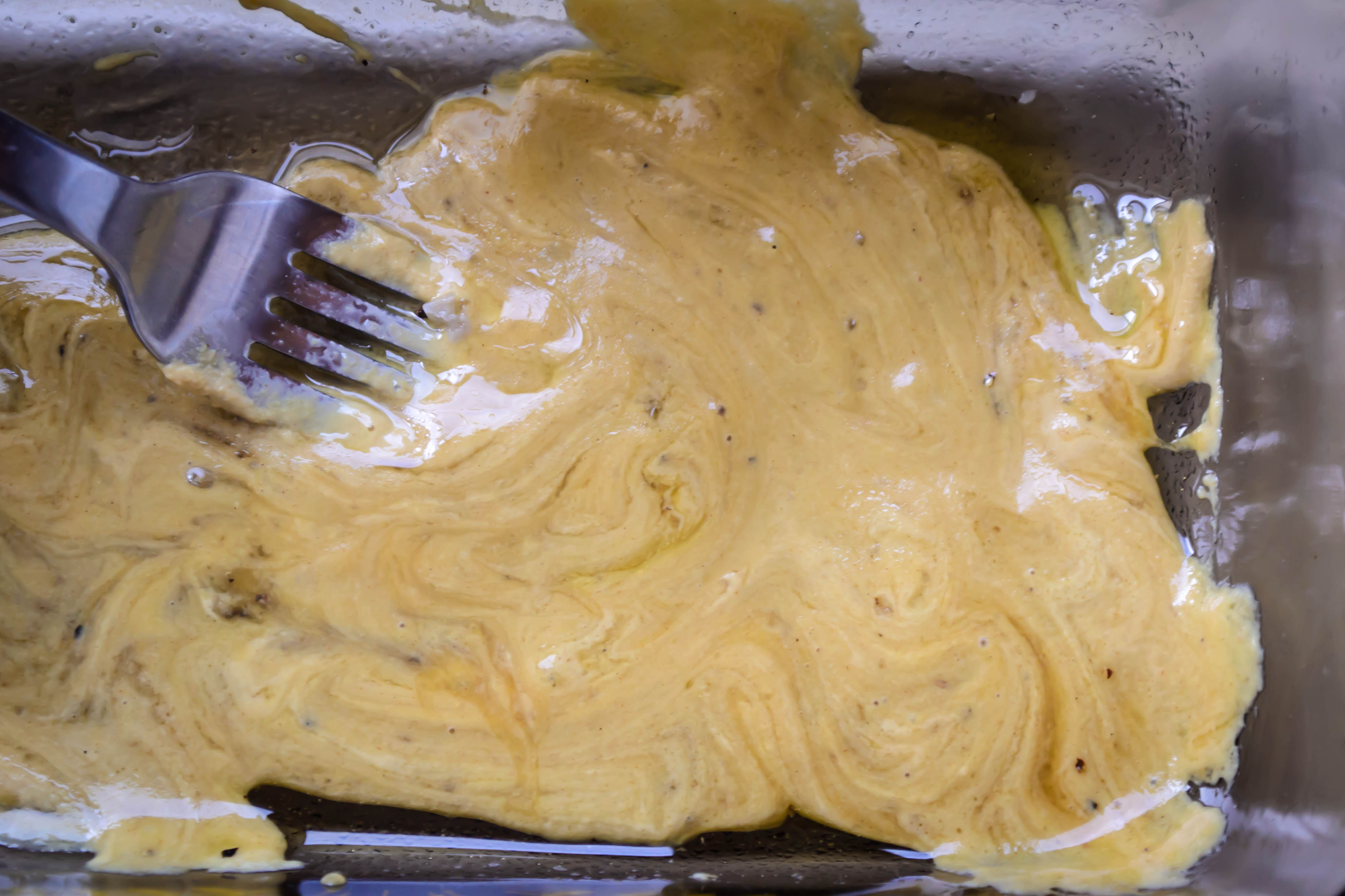
  • Separate the three eggs, dropping the whites into a clean, dry, medium mixing bowl and the yolks into the sweet potato mixture. Take care not to get even a trace of yolk into the whites, or they will not whip into peaks. Whisk or blend the yolks into the sweet potato mixture until no streaks of yellow remain.
  • Add the cream of tartar to the egg whites. Using a handheld electric mixture (or a whisk, if you need to work on your arms), beat the whites at first over medium, then high speed until medium peaks form. The whites will foam, and then become pure white, and finally begin to stiffen like a good whipped cream. To determine the stiffness of your peaks, turn off the beaters and lift them straight out of the whites. If you get little hills that collapse back into the mixture, you have soft peaks. If you get little tips that fold over just a bit when you pull the beaters away, you are looking at medium to stiff peaks, which is what we want.
  • Using a rubber spatula, deposit ⅓ of your whites into the sweet potato and egg yolk mixture and stir until no white streaks remain. No need to be careful with this part – full integration is just fine.
  • Now, slide the other 2/3 of the whites into the sweet potato mixture and fold in gently until just combined – some white streaks may remain and that’s fine. I like to fold by drawing my spatula around the edge of the bowl in a horseshoe shape, then pulling it back toward me in a straight line.
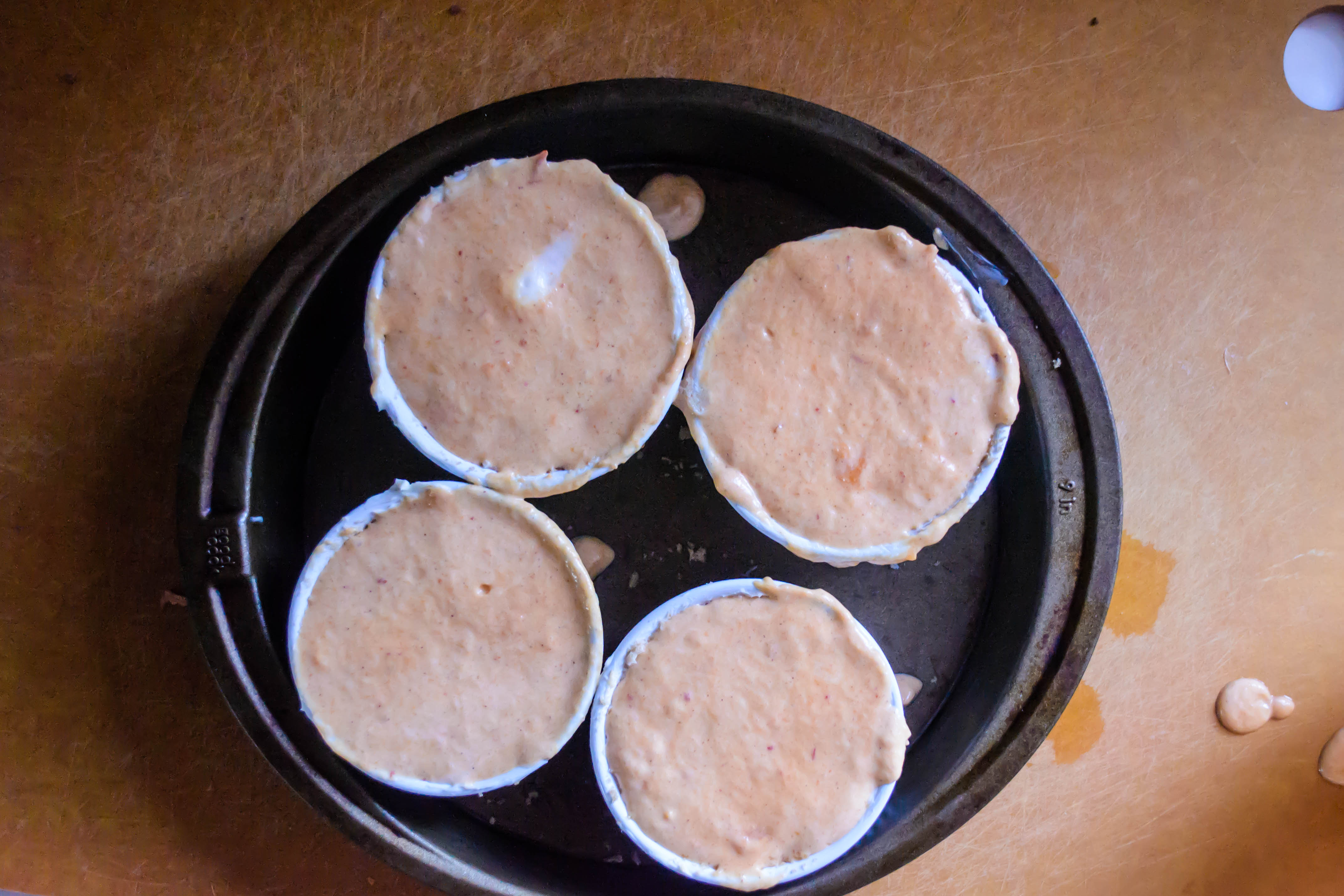
  • Retrieve your frozen ramekins and fill each with the soufflé mixture, being careful not to let it plop from too high (in case of deflation). When each cup is full, smooth off the top – this seems fussy, but it will aid in even rising.
  • Bake in a preheated 375F oven for 25-30 minutes, until the soufflés have puffed up at least an inch or two above the top rim of the ramekins. Nearly half an hour seems like a long time, and indeed, I was worried mine were overcooked because some of the edges took on a toasty golden color, but I found this contributed a delightful flavor, and was reminiscent of a perfect campfire marshmallow.
  • Serve immediately, plain or topped with cinnamon cream.

Honey Mustard Roasted Carrots

If you’re frequenting your Farmers’ Market this spring, you have probably seen the amazing bundles of carrots cropping up everywhere.  Some are knobbly and stubby and round, like little turnips, some are almost wispy-thin and well-whiskered.  The ones that drew me, and made last week’s side dish for our biscuits, were the rainbow bunches: orange and yellow, but also the vibrant, veiny purple that was probably the original color of these funny, beloved roots (orange carrots were reputedly a Dutch development: in the 17th century the color was cultivated to celebrate William of… wait for it… Orange. Harold McGee agrees on the date and location, but he doesn’t mention political motivations).
Food Blog April 2013-0986
The treatment I subjected these little bolts of spring to was so good that rather than dawdling through a lengthy bread recipe, I wanted to share these instead.  I can’t stop thinking about them (we’re probably having them with dinner again tonight), and since it is the perfect season for it, I can’t really fault us for that.
Carrots sometimes seem too straightforward: sweet and crisp, made only marginally complex by a mild grassiness.
Food Blog April 2013-0987
Liberally slicked with a mixture of honey, mustard, and olive oil, then roasted until their skins almost blackened under the heat, ours became intensely savory and yet also caramelized, homely to the eye but stunners on our tongues.  Their taut skins, lacquered with crackly coating, retained a barest crunch while the interiors just slid down our teeth like cold butter.
Food Blog April 2013-0997
(Admission: I did make bread this week: my first attempt at baguettes.  They were okay, but nothing amazing – the interior had a nice spongy crumb but the crust was a bit thicker than I like, with none of the shattering crispness that makes a really good French loaf.  They were bumpy in shape and the deep scores I made across their surface didn’t puff the way they do in bakery cases.  They were far from shameful, and tasty sliced, toasted and spread with salted butter, but still. So pedestrian. You deserved something more exciting.)
 Food Blog April 2013-1015
Honey Mustard Roasted Carrots
Serves 1-2 as a side dish


This is almost too simple to be a real recipe, but a few of those are nice to have in your repertoire.  Note: cooking time and ingredient quantities may differ depending on the number and thickness of the carrots you are using.  Start with these amounts, then adjust as suits your palate and pantry.


2 bunches (12-15 individual) rainbow carrots (though I suspect any carrots would be great). If you are using a Farmers’ Market variety, you won’t even need to peel them.  The skin will caramelize beautifully, and any wispy roots clinging on will gain an addictive roasty crunch.
2 TB dijon mustard
2 TB honey
2 TB olive oil
pinch freshly ground black pepper
scant sprinkle of sea salt
  • Preheat the oven to 400F and line a baking sheet with aluminum foil.
  • To prepare your carrots, remove the greens, scrub them well (if they are dirty), and roll them around on a clean kitchen towel to dry.
  • In a shallow dish, use the tines of a fork to combine the honey, mustard, and olive oil.  If the honey refuses to play nicely, send the mixture through 10-15 seconds in the microwave.  Add salt and pepper to taste, though I recommend under-salting just a tad.  The flavors intensify so much after roasting that you’ll only need a tiny hit of salt.
  • Toss the cleaned, dry carrots in the honey mustard mixture, then tumble them onto your baking sheet and spread them out so none are touching.  If you have too many carrots for that, at least be sure they are in a single layer.  We want as much surface area to be heat blasted as possible.
  • Place the loaded baking sheet in the oven and roast for 30-45 minutes, or until carrots are well-caramelized and tender.  This is a wide range of time, I know, but everything depends upon the size and thickness of your carrots.  Plunge the tines of a fork into your thickest specimen.  If you meet with considerable resistance, leave it in the oven for another 10-15 minutes before checking again.  If the tines slide in easily, or you get only a bit of push back from the flesh of the carrot, it’s probably ready.  Your own preferences also play a role here: roast them until they have the texture you like best.
They will be amazingly hot when they first emerge from the oven, so if they sit for a minute or two before serving, all the better.  But once you start tasting, don’t expect them to last long.

Cold Comfort

Tragedy, when it strikes, whether it be national and sweeping or personal and held tight against you – and I have experienced both this week – plunges you into strangeness.  There is shock, there is disbelief, there are weighty moments of contemplation, there is knowledge of helplessness.  There is the feeling of being alone.

When I feel the chill and the incomprehensible wounding of tragedy, I want my belly full of warmth and familiarity and comfort.  And while it may seem trivial or even juvenile to want to write about food in the aftermath of gut-twisting pain, I think there is an important connection to be made.  As Shauna said shortly after Hurricane Sandy, one of the ways food is important is that it brings us together.  Her post moved me deeply, and made me feel that it’s not trivial or disrespectful to feel the need to talk about humble little food in the aftermath of disaster.  The loneliness and helplessness of pain can be beaten back by community.  When we come together, we are able to offer one another comfort, even if it is slight, and the metaphorical warmth of our togetherness can often eclipse physical heat.  Food bridges that gap.  It offers a physical warming, yes, in that it nurtures us and fills us and helps us carry on as individuals.  But it also links us – we eat together, we break bread, and in eating together we share ourselves with each other in meaningful ways, even if we didn’t realize that sharing took place.  It binds us in communities, however small, and having fellows in a bad situation, whether they are fellow mourners or whether they are comforters and supporters, gives us the opportunity for light and warmth, if we are able to feel that connection.

So when I talk about food today, I want to talk about food that warms us.  I want the fullness of soup and the richness of dessert.  I want the clinking of spoons and the sprinkling of spice that stabilizes and relaxes and envelopes us.  I want us to be able to feel the warmth of love which, to me, is most easily expressed through a transfer of food: if I feed you, it’s a good bet I care about you.  It’s a small thing, and you may think it’s a silly thing or an unimportant thing, but it is perhaps the only thing I can do in this moment to reach across the feeling-less blips of the net-scape and offer you warmth.  But I mean it.  Take this warmth.

“95. Indian Pudding: Combine 3 cups of milk and 1/3 cup of cornmeal in a saucepan over medium heat. Bring to a simmer; stir in 1/3 cup of molasses, 1 tablespoon sugar, ¼ teaspoon salt, 1 teaspoon ginger and ½ teaspoon cinnamon and simmer, stirring occasionally, until thick. Add 1 tablespoon of butter and stir until melted. Pour pudding into buttered baking dish and bake at 300 degrees for about 2 hours, uncovered, until golden brown and set in the middle. Serve with ice cream or whipped cream.

Food Blog 2011-2013-0169

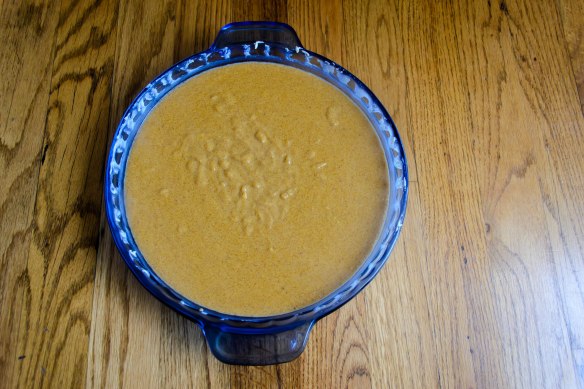
Stirred sternly, this mixture took on the texture and the color of pumpkin pie filling.  It began to spit and burble like a pot of grits (which, in a somewhat removed way, it was), and I decided it had done its time.  Into the oven with it.

I think I overbaked this.  Just the barest firmness across the top, like a good cheesecake, is what is needed.  Mine was stiffly set.  I also think I chose the wrong cooking vessel.  I used a glass pie dish.  Serviceable, sturdy, but too wide.  The pudding came out an odd inch or so thick.  A deep mass of wobbly richness would have been preferable.

Food Blog 2011-2013-0172

Despite these fallbacks, it was still very, very good.  Perhaps it was the color and the texture, but it really did remind me of crustless pumpkin pie.  The cornmeal and milk became a custard, and the rich deepness of molasses and autumnal spices left me wanting to douse this with a healthy dollop of Reddi-whip.  I settled for vanilla ice cream instead.

Food Blog 2011-2013-0174

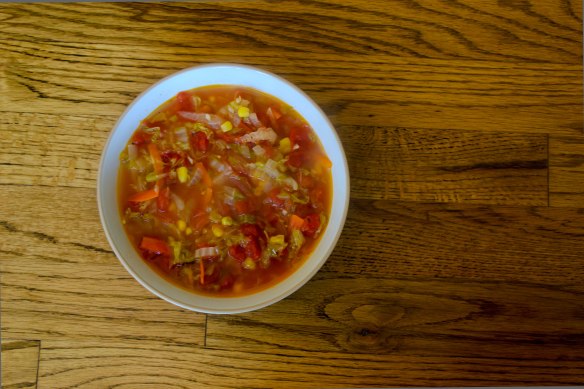
“18. Hot and Sour Vegetable Soup: Sauté chopped onions and garlic in vegetable oil until soft. Add chopped or shredded carrots, cabbage, and daikon or turnip, frozen corn, chopped boxed tomatoes with their juice and stock to cover; bring to a boil. Simmer for 15 minutes, then finish with about a tablespoon of rice wine vinegar per 2 cups of soup and loads of black pepper.”

Soup warms the belly like very little else.  This one, with the copious quantities of black pepper and the inevitable sour burn of the rice vinegar, promised a cauldron of comfort.  Quantities listed here make enough for two large bowls – quite enough for a deep December lunch.

2 TB vegetable oilFood Blog 2011-2013-0179

¼ large onion, diced

4 cloves garlic, minced

1 carrot

½ medium turnip

8 napa cabbage leaves

½ cup frozen corn kernels

14.5 oz can of petite diced tomatoes

2-3 cups chicken or vegetable broth

2 TB rice vinegar

½ tsp salt

½ pepper to start – add more to your liking

Heat the vegetable oil over medium heat and sauté the onion and garlic for a few minutes, until the onions just begin to pick up color.

Meanwhile (or beforehand, if you are not speedy with your vegetable prep), peel the carrot and turnip.  Once you have disposed of the scraps, continue to peel the carrot into thin strips with your vegetable peeler.  Cut the pile of ribbons in half or in quarters to create bite-sized pieces.

Cut the turnip in half from root to tip, then crosswise into thin slices.  Julienne each thin slice so you have slim matchstick pieces.

Stack the napa cabbage leaves, then roll into a thick cigar and slice as thinly as possible.

Add the vegetables to the onion and garlic.

Add the corn kernels and the broth and simmer the whole pot for 15-20 minutes, or until all vegetables are tender and everything is warmed through.

Add the rice vinegar, salt, and pepper, stir gently, and serve.

I loved everything about this soup except the tomatoes.  They weren’t a bad addition, there were just too many of them.  Were I making this again, I might decrease the quantity, or just drain the can and add only the liquid for the color and acidity.  The strings of carrot and turnip kept a minimal bite, and the combination of vinegar and pepper was near perfect.  The puckering sourness played against and contributed to the bland crunch of the vegetables, and alongside a hastily prepared hunk of garlic toast, this was a satisfying lunch on a chill day: it was heat, and comfort, where both were needed.

Food Blog 2011-2013-0178

Be well, all.

Veganize it!

I must admit to getting nervous.  Counting this week’s offerings, I’m down to 8 Bittman selections, and just over 3 weeks in which to complete them all.  If I face the honest fact that it’s unlikely I will attempt any of these concoctions during Christmas or the days that surround it, as family and I insist on old familiar dishes, reality tells me I in fact have just over 2 weeks left.

But I have a determined set to my jaw, sometimes, and I can feel it approaching.  This must be done.  It can be done.  It may mean making soup for lunch from scratch sometimes, but as I’m learning, soup doesn’t have to be something that simmers all day long.  It can be a quick meal.

It can be delicious, too.  This week’s selection is proof positive.

Food Blog 2011-2013-0168

“Thai Squash Soup: Simmer cubed winter squash, minced garlic, chili and ginger in coconut milk, plus stock or water to cover, until soft. Puree if you like. Just before serving, add chopped cilantro, lime juice and zest, and toasted chopped peanuts.”

This was a lunchtime experiment, because N., in one of his tragic shortcomings, doesn’t like coconut.  At first I thought it was something I could break him of.  I have, after all, in under a decade, convinced him to eat everything from sushi to quinoa to kale chips.  He is, as an eater, unrecognizable as the man I met in college.  But the coconut sensitivity is the food analogue to ESP.  He can eat a granola bar with coconut oil hidden deep in the ingredient list and say “I’m not sure I like this.”  If I don’t choose my sunscreen carefully and it happens to have that delightful coconut aroma that means it’s well and truly summer, N. tells me I smell funny.  So a coconut milk based soup had to be consumed in his absence.

Food Blog 2011-2013-0160

½ big butternut squash, peeled, seeded, and cut into small cubes

1 13.5 oz. can coconut milk

½-1 cup water or vegetable stock

½ tsp red chili flakes

3-5 cloves garlic, minced

1-2 tsp ginger, minced

salt to taste

2-3 TB cilantro, roughly chopped

2-3 TB peanuts (if you have a nut allergy, consider using the butternut squash seeds instead), toasted and chopped.  I used dry roasted peanuts for mine.

zest and juice of ½ a lime

Put the squash, chili, garlic, and ginger into a pot.  Add the coconut milk and, if necessary to cover the chunks of squash, water or stock.  Bring to a boil, then simmer over medium heat for 20-25 minutes, or until the squash is tender.

During this simmering process, don’t forsake your kitchen completely.  Coconut milk boils over, just like regular milk.  If you leave to, say, comb out your hair, do your makeup, and put a few things away, you might return to a stove swimming in chili infused coconut milk sludge sitting underneath your burners.  One of which isn’t working anymore.  Just saying…

Once the squash cubes are tender, you can choose to puree or not to puree.  I, feeling lazy, took my potato masher to them and ended up with a slightly chunky, rough textured soup that I liked the look and feel of.

Food Blog 2011-2013-0164

Top with garnishes and eat!

Alternative: I liked this, and the simmered squash had a nice, fresh flavor.  But I missed the caramelized depth you get when you roast it.  Were I making this again, I would roast the squash with olive oil and salt until it was tender.

While the squash roasted, I would add the spices to the coconut milk and simmer for 10-15 minutes.  Then, when the squash was cooked and the milk was hot and flavorful, I would add the chunks of squash and proceed as above.

This bowl of soup was surprising.  It awoke flavors of sweet, sour, spicy, and bitter.  The squash was tender and freshly vegetal.  The coconut milk added this incredible unctuous creaminess that felt round and thick against my tongue, but the squash itself and the lime flavor kept it light and fresh and delicate at the same time.  The peanuts were the right crunch, and I surprised myself by finished an enormous bowl and feeling quite satisfied but not overly full.

 Food Blog 2011-2013-0167

The soup wouldn’t have been right without the lime juice.  I’m learning, as I continue to cook, that acid is a seasoning just like salt or nutmeg.  This new understanding, and a little bit of experimentation, saved the next dish from being muddy and boring.

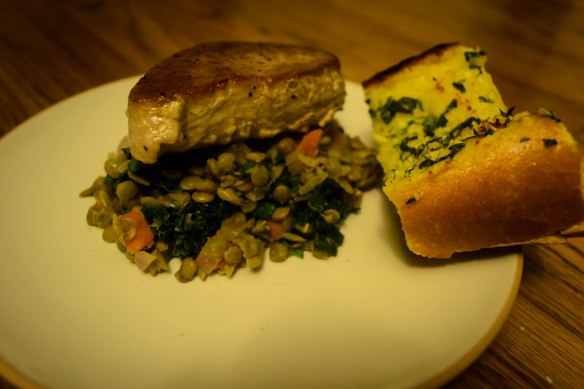
“56. Cook lentils, thyme sprigs and chopped carrots in a pot with water to cover until tender; drain and remove thyme. Cook chopped onions in oil until soft; add chopped kale and allow to wilt. Add lentils, stir to combine and cook until kale is tender. Add chopped parsley.”

With the holiday season practically upon us, this seemed like a sobering, “healthy” dinner choice which would, against all the logical reasons for eating healthy, permit us to have cake for dessert.

1 cup lentils

12-15 baby carrots, quartered lengthwise, chopped into small rounded triangles

6 sprigs thyme

4 small whole cloves garlic

½ red onion, chopped

2 cups kale

2 TB parsley

sprinkle of red wine vinegar to taste

I put the lentils, carrots, thyme, and – in a flash of inspiration – garlic in a pot and added water according to the lentil package directions (depending upon what color lentils you use, you may need more or less water).  I added a bit extra, since I realized the carrots might benefit from some bubbling too.  I let them simmer for about 35 minutes, at which point the lentils were just barely still resistant between my teeth.

Never enthusiastic about using multiple pots, I dumped the lentil mixture into a strainer and then, with a bit of olive oil to lubricate the surface, sauteed the chopped onions in the same, now-empty pot.  When they were just beginning to turn golden around the edges, I added the kale and a sprinkle of salt.  Softening the onions and wilting the kale took about ten minutes.

After the kale had collapsed a bit, I dumped the lentil mixture back in, folded it gently in with the greenery, and let them stew over low heat until the kale was the texture I like.  I tasted and felt the muddiness of the lentils and carrots: winter vegetables are wonderful, but sometimes the heaviness they impart is reminiscent of the dirt from which they were pulled.  Lentils, though they aren’t root vegetables at all, tend to have a similar effect.

This was my inspiration point.  Only a few drops of red wine vinegar pulled the flavors up out of the garden ditch they’d been wallowing in and made them interesting and individual again.  Add the vinegar and chopped parsley at the last moment.

Food Blog 2011-2013-0157

I mounded this on our plates and topped it with a tuna steak (I know, that’s not vegan.  But the Bittman is, and that’s what matters here!).  It would have been better with salmon – the more delicate meatiness would have contrasted nicely against the lentils and carrots.  The tuna was almost too dense a pairing, calling back to the muddiness of the pre-vinegared dish.  Lamb rubbed with harissa, or maybe even a grilled portobello or a big steak of tofu, pressed, dried, and rubbed with a marinade that involved roasted red peppers, are other potentially promising pairings.

 Food Blog 2011-2013-0155


* As the year draws to a close, I’m thinking a lot about friends I’m now physically far from.  This title celebrates two of them: M. and Ph.  Both became unintentional vegans due to food allergies, and M. is fond of exclaiming, of dishes she likes the sound of but cannot eat thanks to its animal product ingredients, “I’m going to try to veganize it!”  So here you go, ladies: these are pre-veganized.  And gluten-free.  And yummy.  What more could you ask for?!

Last salad

I think Fall has finally found Los Angeles, and only a week and a half to go before Thanksgiving.  Within a week, we went from temperatures in the mid-80s to a high of barely 70F.  My living room went from a comfortable lounging 75F to barely hitting 70 despite blinds wide open to catch the sun all day.  Thankfully, the items I have left on my Bittman list accommodate this weather change.  Today I have to report the last salad of the list, and a foray back into desserts.  Both have decidedly autumnal collections of flavors (I wrote “flavor profile” first, and then I thought, “who do you think you are?”).  Many of the food blogs I read have been reporting for the past week or two on Thanksgiving recipes, and I thought about doing that too.  But then I remember that Bittman’s entire list is conceived as Thanksgiving sides, so if you’ve been following this little blog for any length of time, you’ve been seeing Thanksgiving options – with only a few disruptions – for the past two years!

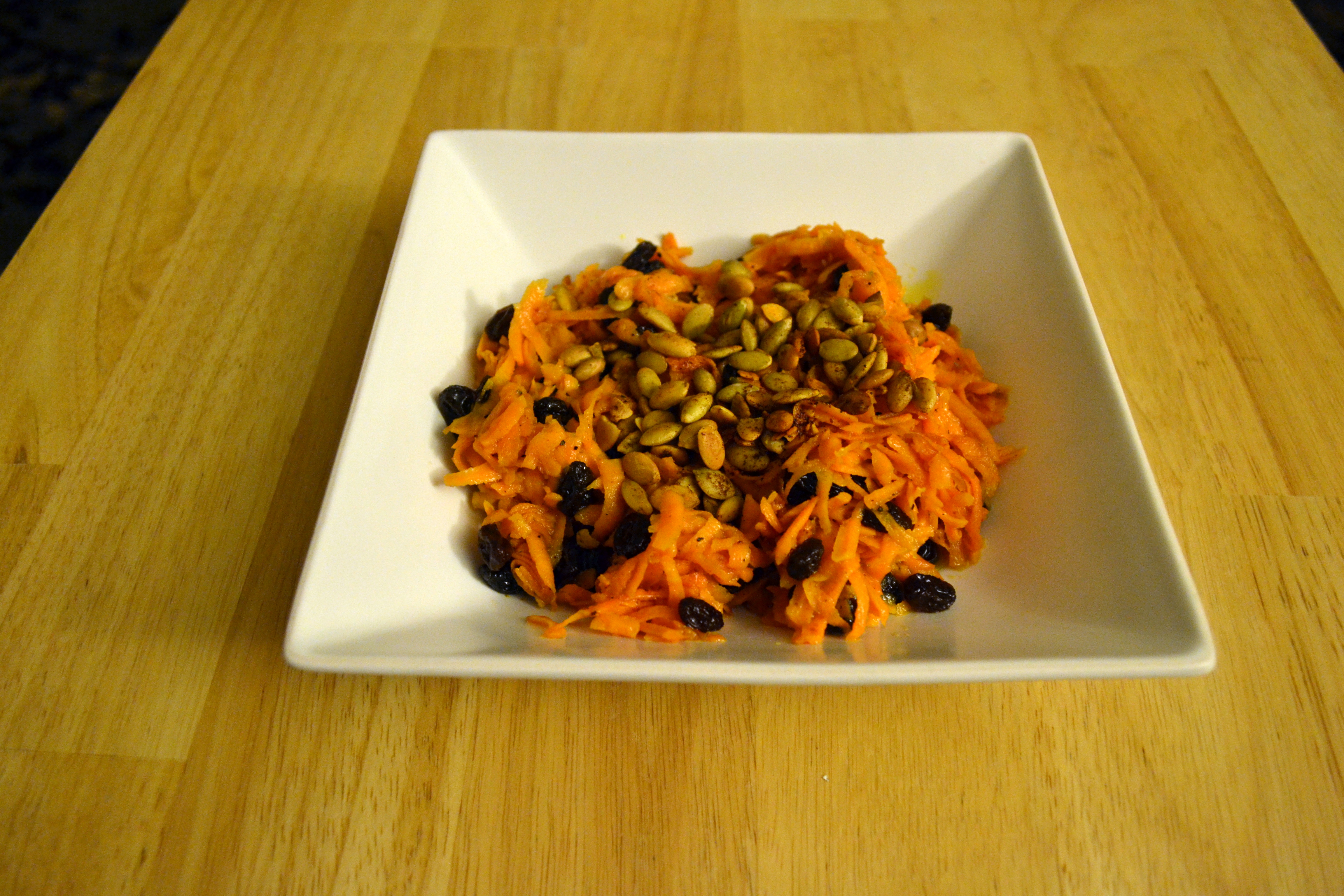
“67. Sprinkle shelled pumpkin or squash seeds with a little chili powder; roast, shaking occasionally, until lightly browned. Combine with grated sweet potatoes (raw or lightly sautéed in butter or oil), raisins and a vinaigrette made with red wine vinegar, olive oil, Dijon mustard, a touch of honey and maybe a little more chili powder.

I gathered:

1 small sweet potato

1 TB pumpkin seeds

chili powder to taste (mine is really mild – I probably used about a teaspoon)

2 TB butter

2-3 TB raisins

These measurements look small, but I was planning this for just the two of us and didn’t want any leftovers.

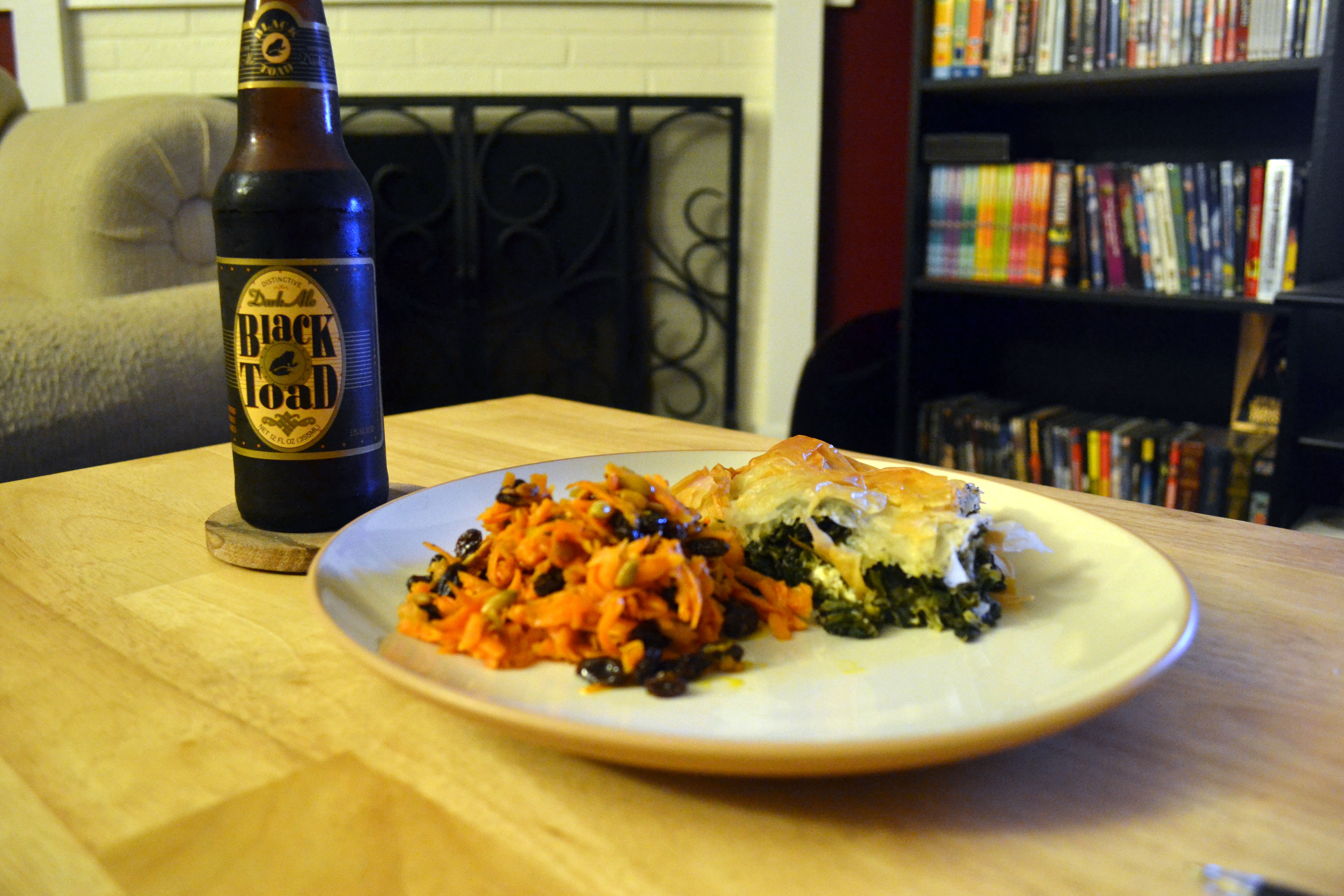
We were having this “salad” with spanakopita, so I decided to capitalize on the heat of its baking.  I popped the pumpkin seeds onto a baking tray, drenched them with chili powder, and tucked them into the oven for a few minutes.  When you hear the first couple of pops, they are done.  Don’t leave them too long – not only will they burn, they will propel themselves all over your oven.

I set aside the lightly toasted seeds and turned to the sweet potato.  N. and I proved in earlier experiments that we don’t like it raw – the starchy feel when you chew is just too much – so I was glad Bittman allowed for a cooked option.  I melted the butter while I grated the sweet potato, and tossed the shreds of bright orange onto the fizzing fat.  If you have more patience than I do, you might wait for the butter to brown a bit to add nuttier, deeper flavor to the sweet potatoes.

I let the little ribbons of sweet potato cook for a few minutes over medium heat.  The goal was not to brown them, just to lightly cook them through.  When I estimated them to be two minutes from done, I tossed in the raisins and folded the mix together.  This gave the raisins time to match the sweet potatoes in temperature, and it allowed them to plump up and take in some buttery flavor.

Heat off, I turned to the dressing.  Whisk together:

1 TB red wine vinegar

1 tsp honey

1 tsp dijon mustard

sprinkle of chili powder

2 TB olive oil

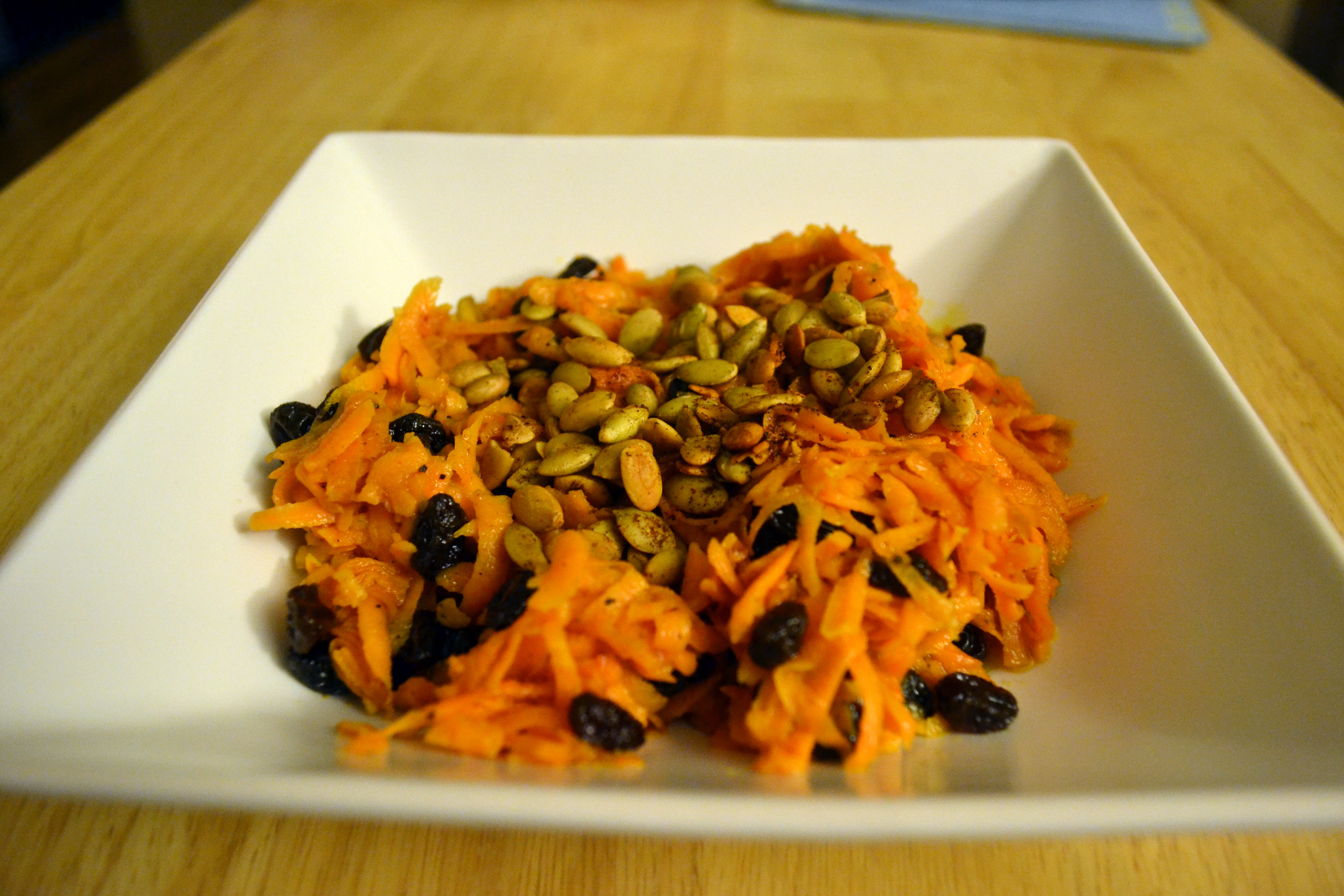
I tossed this lightly with the sweet potatoes and raisins, then topped them with the pumpkin seeds (which I almost forgot AGAIN!  What is it with me and missing the crunch?) and it was ready for tasting.

We liked this.  I’m not sure it read as a salad – in fact I’m not sure what it read as at all.  At once, it was not quite a salad, but also not quite a vegetable side, and not quite a chutney.  But it was tasty.  The red wine vinegar was acidic enough to counter the sweetness of the potato and raisins nicely.  It was a refreshing bite against the richness of our spanakopita.  The crumbling cubes of feta hidden in the spinach blend imparted the final necessary taste: a briny saltiness so welcome to the rest of this sweet and butter-drenched meal.

I took my next choice (partly made because it sounded delicious, but partly to use up the phyllo) to an election party.

“93. Pumpkin-Raisin-Ginger Turnovers: Mix pureed cooked pumpkin, raisins, chopped crystallized ginger and sugar.  Brush a sheet of phyllo with melted butter and cut lengthwise into thirds. Put a spoonful of the filling at the top of each strip. Fold down to make a triangle and repeat, like folding a flag. Repeat with remaining filling. Brush the tops with butter and bake 20 to 30 minutes. Dust with powdered sugar.

Whether you are elated, distraught, or ambivalent about the results of the vote, these little turnovers were worth celebrating over.

1 15 oz. can pumpkin puree

½ cup sugar

½ cup raisins

¼ cup finely minced crystallized ginger (or you could try grating this on your microplane.  I’m not sure how that would work, but since candied ginger is gummy and hard to chop, it might be helpful)

butter

phyllo dough

I couldn’t resist adding about a teaspoon of cinnamon.

First, I preheated my oven to 375F and put the butter into a small pan, which I set over low heat so it would melt but not brown.

I shlooped the pumpkin from the can to a bowl and whisked in the sugar and fruit.  I suggest you use a fork for this, not a traditional whisk.  The mixture clumps and sticks in the slender spokes and results, if you are at all like me, in cranky frustration.

When everything is well mixed, turn to the phyllo.  If you’ve never worked with it before, don’t be afraid.  The amazing way it changes from dry papery sheets to flaky, buttery pastry is worth the challenge.  Here’s what I do:

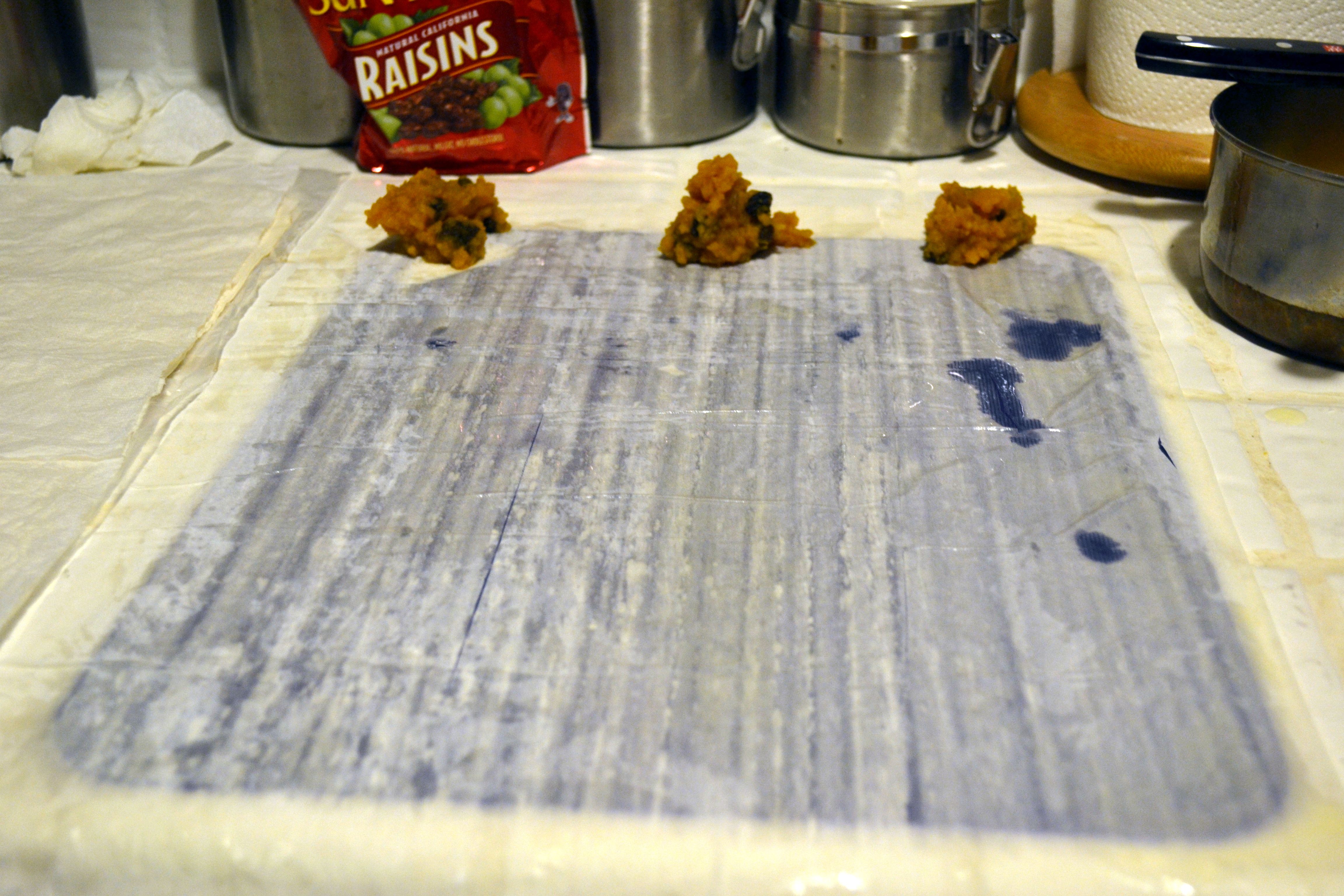
Set up an assembly line on your counter.  At one end, unroll the phyllo and set a just-damp kitchen towel (or couple of paper towels) over the top.  This will help, if you are a slow worker, to prevent it from drying out and breaking.  Next to that, you need a board big enough to accommodate one sheet of phyllo.  Next to that, place your butter, followed by your filling, followed by the final resting place for your wrapped confections.

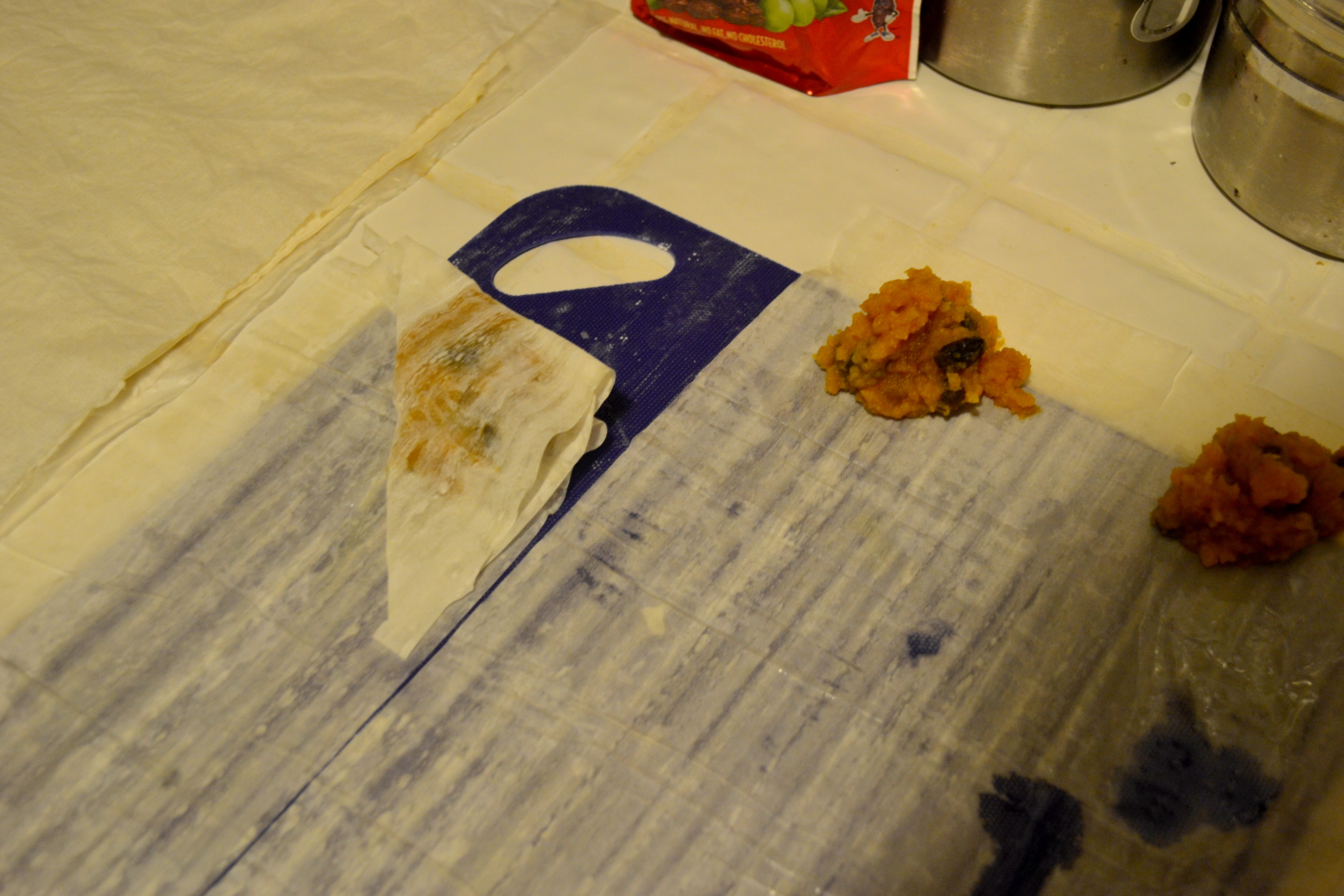
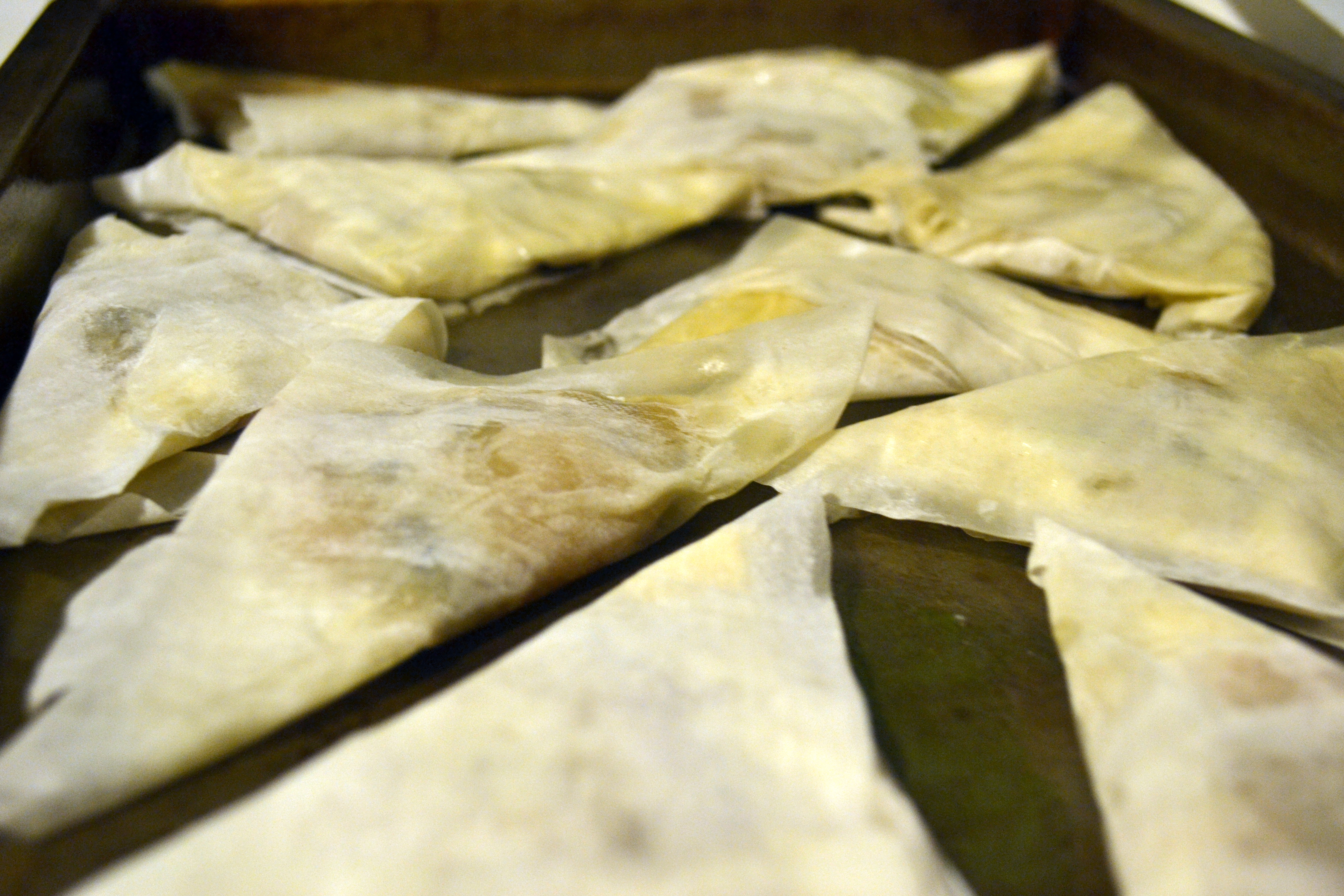
Carefully peel off one sheet of phyllo and place it on your board with the shorter end facing you.  Recover the remaining stack with the damp towel.  Using a pastry brush, brush the whole sheet with butter.  Cut it in long thirds (you’ll begin your cuts on the short edge of the rectangle, so that you create three long, thin strips, as opposed to three short, squat strips).  Then, place about two tablespoons of filling at the top of each strip, and begin to fold in triangles.

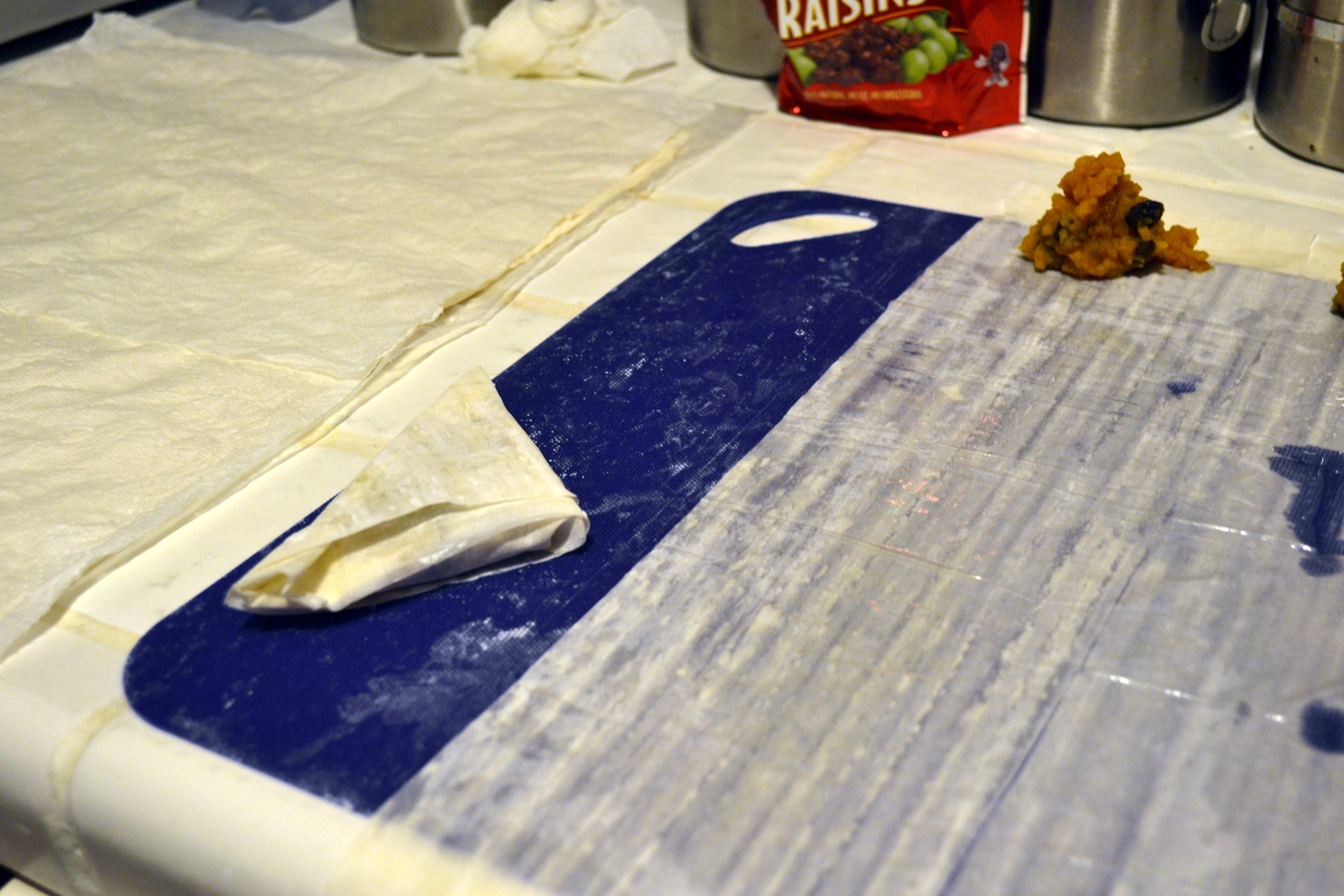
To make the first fold, bring one corner down to the opposite edge of the strip.  Don’t press too hard, or the filling will ooze out everywhere.  The second fold will be straight down: the remaining corner (now doubled because you’ve folded over your first triangle) folded down onto the same edge.  Continue to fold, keeping your filling in the center of a triangle, until you reach the end of the strip of phyllo.

Place that on a parchment-lined or greased baking sheet and brush the top with a little more melted butter.  Repeat until you run out of filling.  Since these won’t rise or spread, you can place them quite close to one another on the baking sheet.  Don’t overlap them, though, because only the dough exposed to the air will brown.

This sounds complicated, but once you get into a rhythm it’s relatively easy and quite satisfying.  You end up with two trays of sweet little parcels that you can stow in the oven for 20-30 minutes until they become magically golden and flaky.

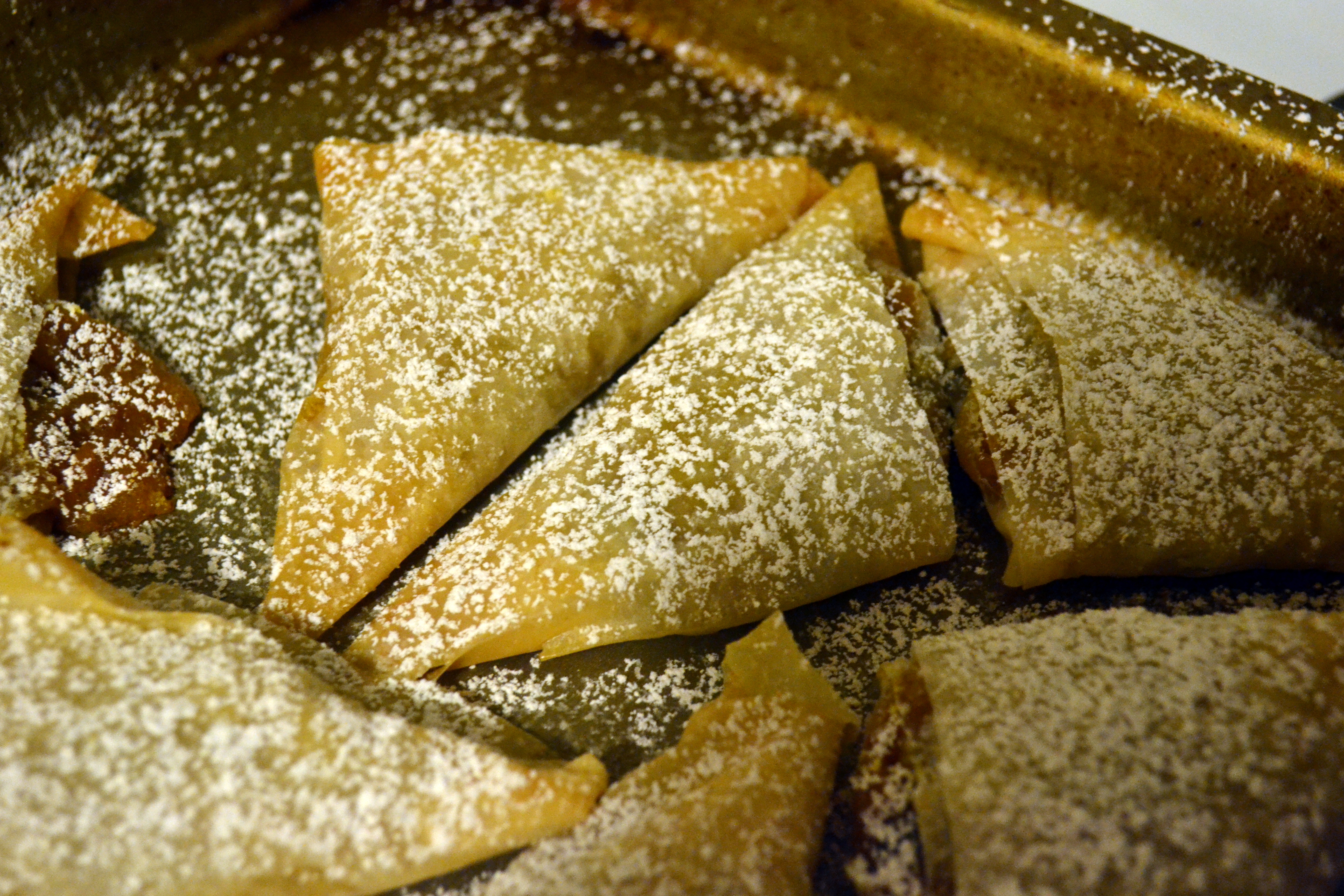
When they were done, I dusted them liberally with powdered sugar and tented them with aluminum foil to take to the party.  I brought home an empty, sugar dusted tray with a lone raisin abandoned in one corner.

They were so tasty.  The pumpkin-raisin-ginger combo was insane: earthy and sweet and, with the addition of the cinnamon, warmly spiced.  Inside the phyllo, it was a contest of texture too: unremittingly soft pumpkin with the occasional chewy juicy punch of raisin, against sharp flaky crunch of sugar-dusted pastry.  We couldn’t resist tasting a few before dinner, and then we had to revisit them again for dessert.  These will, I suspect, make repeat appearances in my kitchen.  They could probably be made a few hours ahead as well, or transported and baked on location: wrap them up, dredge them with butter, and store them under a damp towel or some plastic wrap until ready to bake.  If you don’t like pumpkin pie, or you’re tired of it (I know, heresy!), these might be a fun alternative Thanksgiving dessert option.

Swing

Summer into fall into summer.  Salads and grilled vegetables into casseroles dabbled with cream into fresh raw dips.  Luxurious stretches into curled legs under blankets into stressed grading sessions into sampling new half-fizzed white wine.

Sometimes this is called Indian Summer.  I like to think of it as Swing Season.

Two Bittmans for you this week.

77. Trim and dice fresh tomatillos; peel and julienne jicama (or daikon or kohlrabi). For dressing, combine lemon and lime juices, olive oil and chopped cilantro. Pour over salad, top with toasted sesame seeds.

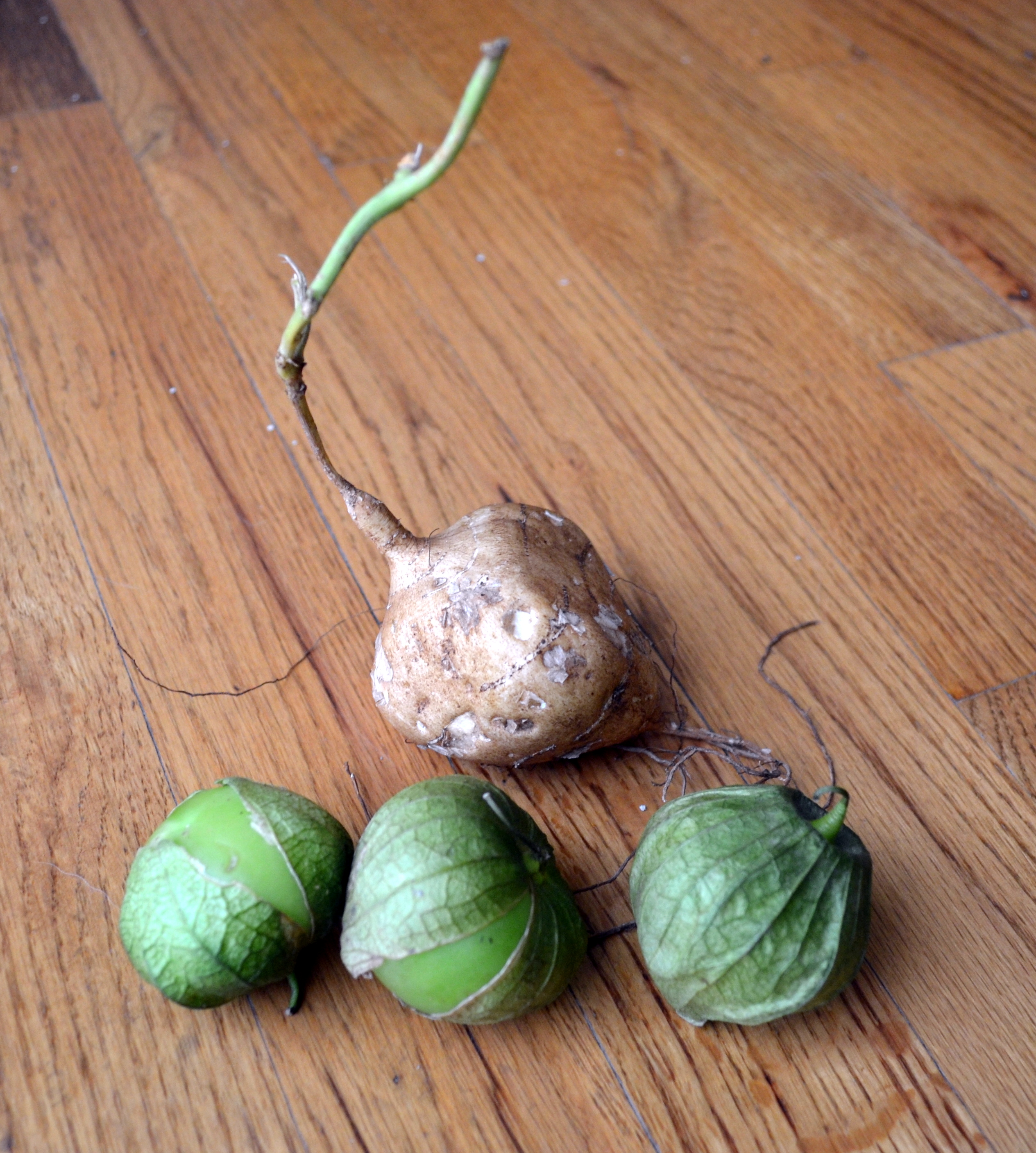
This sounded like a good late summer/early fall salad.  I found tomatillos at the grocery store, but no jicama, no daikon, and no kohlrabi.  And then we went to our Farmers’ Market, and I found all three!  Huge daikons, alien baseball sized kohlrabis and, hidden between stacks of beets and the tiniest fingerling potatoes I’ve ever seen, a pile of grubby little tubers with vine-y stems still attached.  Eureka, jicama!  Back at home, I assembled the troops:

1 TB toasted sesame seeds

2 small jicama

6 medium tomatillos

(really, the number of jicama and tomatillos isn’t super important as long as the quantities are roughly equal once you’ve cut them up.  Start with maybe 1 cup of each, see what you think, and then add more if that’s what makes you happy)

2 TB chopped cilantro

1 lemon

1 lime

Olive oil

Salt

I’ve tasted jicama, but it has been a long time.  And I’ve certainly had tomatillos, but mostly only after they were roasted and processed into salsa.  I wasn’t sure how they would be raw.  This – a lovely fresh slaw/salsa/salad hybrid – sounded so bright and tart and lovely that I wasn’t too nervous.

Before anything else, I toasted the sesame seeds and set them aside.  They give off such a lovely roasty scent when they are just browned and starting to release some oils.

I peeled, then sliced the jicama into rounds.  Then I stacked up the rounds and made thin slices across until my two little aliens were a pile of matchsticks across my board.  Into the bowl with you.

Next I quartered and diced the tomatillo.  Because they are still underripe when green (apparently they can turn purple and get very sweet when they ripen, but I’ve never seen them in that state), their skins were quite resilient – it took some pressure to get my knife through them.  Carefully chunked into miniscule cubes, they joined the white confetti in my bowl.

A quick squeeze of lemon and lime, a whisking pour of olive oil, and a handful of chopped cilantro feathers later, and the dressing was done.  And then a sprinkle of salt, and it was perfect.  It was a little more than needed to moisten the salad, but it’s hard to know how much juice citrus will have secreted away inside it, so it’s always going to be a guessing game.

I mounded the white and green on my plate, then added a generous scoop of Mexican rice and a quartered cheddar cheese quesadilla.  Simple simple.  At this point, you should ideally sprinkle the sesame seeds you so carefully toasted atop the salad, but I forgot until after I’d already subjected it to a photo shoot.

I was surprised and pleased by the flavor of this dish.  I can’t imagine eating it as a Thanksgiving side dish, but it was a bright burst of summer on a day that began in drizzly autumnal terms.  Jicama is crisp and juicy with the barest hint of starchiness, and its flavor reminds me most closely of an Asian pear.  The tomatillos were very tart, but the pairing tamed them.  Imagine a granny smith apple crossed with an underripe tomato and you’re approaching the brightness we experienced.

This was good as a salad, though its tartness necessitates a small portion.  It was also good heaped atop our quesadillas, like a raw salsa.  It contrasted nicely against the melted cheddar and the just crisped corn tortillas.  But where it would really shine, N. and I agreed, would be as a kind of mirepoix for guacamole.  Dicing the jicama instead of leaving it in strips and folding the whole salad gently into chunks of ripe, buttery avocado would make for the perfect chip dip.  Tart, creamy, crunchy, with the right kind of salty sourness from the dressing, and all you’d need was a frosted Corona and a pool to dip your toes into.  Summer.

But things never end there.  At least we hope not!  Days of sweating and hiding inside and waiting till after sunset to go out always, inevitably (even if it’s taking FOREVER, Los Angeles…) relax and cool and crystallize into Autumn.

35. Pumpkin-Noodle Kugel: Cook a half-pound of egg noodles in salted water until not quite done; drain and put them into a buttered baking dish. Whisk together 4 cups milk, 4 eggs, 1 cup pureed cooked pumpkin (canned is fine), ¼ cup melted butter and a pinch each of cinnamon and salt. Pour over the noodles and sprinkle with bread crumbs (or, for added kitsch, corn flake crumbs). Bake 45 minutes to an hour, or until a knife inserted into the middle comes out clean.

I had no idea how to serve this dish.  I’ve heard of kugels, but I’ve never even eaten one, let alone made one.  I wasn’t sure, as usual, what to serve it with, so I asked a few friends and did some research on the good ol’ internet.  At the point that I read Smitten Kitchen’s version (okay, so this one is written by her mom, but seriously, that woman has cooked everything, and all of it sounds and looks outrageously delicious), this sounded more like a dessert than a dinner side dish.  It would be, I decided, dessert and weekend breakfast.  Sweet, autumnal, nicely spiced, and custardy.  “It’s going to be like a rice pudding but with noodles.  And pumpkin,” I told N.  He still wasn’t sure.

8 oz. egg noodles 

4 cups milk

4 eggs

1 cup pumpkin puree (I used Libby’s)

¼ cup melted butter (I put this in, but I’m not sure it was really necessary)

¾ cups sugar

¾ cups golden raisins

½ tsp cinnamon

½ tsp salt

2 cups corn flakes, well crunched (who am I to pass up added kitsch?!)

It wasn’t until I had collected ingredients that I realized Bittman’s recipe doesn’t call for sugar.  But I was already on the dessert/breakfast kick, and I couldn’t quite envision this as a savory dish, so I dumped in my sugar estimation anyway, along with the golden raisins that aren’t part of the original.

I cooked my noodles for 5 minutes and then let them cool for 10.  They probably needed to be cooked for only 4 minutes, because they keep on cooking not only while they are in the oven, but on the counter as they cool as well.

Yes, I take these photos from the floor. But it’s a nice wood floor, and the light is so good, and I promise Lucy stayed on the other side of the room the whole time…

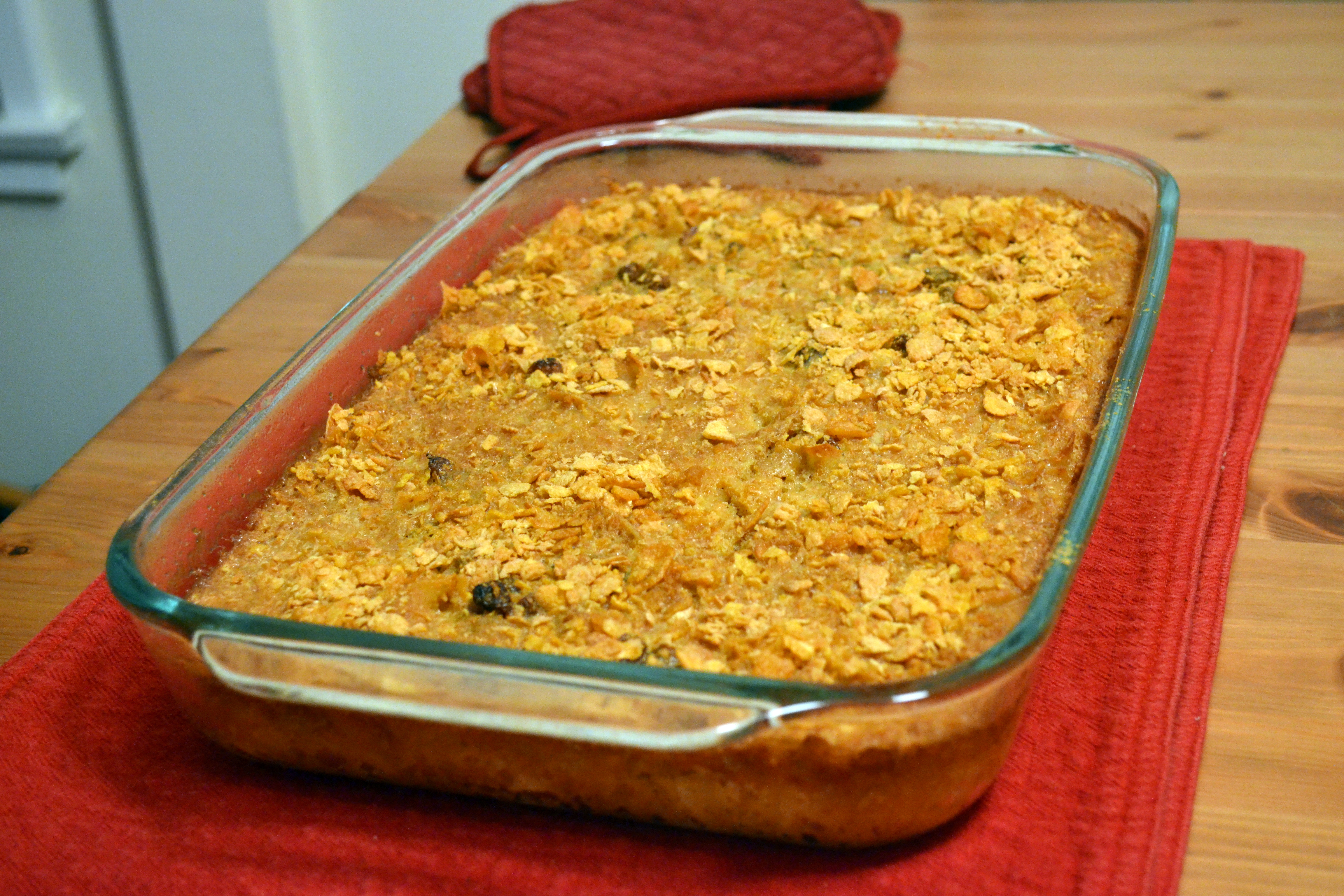
With the custard whisked together and the noodles evenly spread in a buttered 9×13” glass baking dish, I preheated my oven to 375F and assessed the corn flakes situation.  Whenever an ingredient needs to be crushed, crunched, or pulverized on Chopped, I yell at the chefs for using their hands, knives, or a rolling pin instead of just bringing over the food processor.  But they don’t have to wash all the dishes they make, and I do, so my pretty little scarlet processor stayed on its shelf.  I crushed up the cereal with my hands, feeling a kind of satisfaction as the flakes became bits and then powder.  I topped the noodly custard with a generous layer of crumbs and carefully slid it into the oven.

An hour later, the custard had set and the smell flashed me forward to Thanksgiving.  I’m convinced we as a society don’t really know what pumpkin tastes like, because what we experience is texture and spices.  If this kugel didn’t have a sprinkle of cinnamon in it, I’m not sure I would know it had pumpkin either.

Dinner came and went, the kugel cooled a bit, and I dug out a too-big portion for myself, and neglected to feel any kind of remorse about it.  It was too good for that.  The noodles had melded together as the pumpkin infused liquid cooked, making a solid, scoopable, sliceable custard.  The corn flakes on top were perfect: aggressively crunchy against the soft interior.  I wouldn’t omit the golden raisins either; they were a really nice textural contrast to both the softness of the noodles and the crunchy crumbs, and their complex sweetness added some depth to my dessert casserole.  It was warm, and sweet, and perfectly comforting as I tucked my feet under me on the couch and waiting for the approach of Project Runway (don’t judge, every girl needs a little reality TV now and then).

The leftovers are delicious too, though the dish does lose something in relinquishing its crunch to the microwave.  In another universe where I’m a Southern cook, I could see doing crazy things like frying squares of this in butter and then drizzling hot maple syrup over the top.  But I’ll refrain.  Because from my window, I can see my basil wilting beneath the curiously, cruelly hot-for-mid-October sun: back to summer, so it seems!  And here I was considering making soup…

Swing season indeed.