Veganize it!

I must admit to getting nervous.  Counting this week’s offerings, I’m down to 8 Bittman selections, and just over 3 weeks in which to complete them all.  If I face the honest fact that it’s unlikely I will attempt any of these concoctions during Christmas or the days that surround it, as family and I insist on old familiar dishes, reality tells me I in fact have just over 2 weeks left.

But I have a determined set to my jaw, sometimes, and I can feel it approaching.  This must be done.  It can be done.  It may mean making soup for lunch from scratch sometimes, but as I’m learning, soup doesn’t have to be something that simmers all day long.  It can be a quick meal.

It can be delicious, too.  This week’s selection is proof positive.

Food Blog 2011-2013-0168

“Thai Squash Soup: Simmer cubed winter squash, minced garlic, chili and ginger in coconut milk, plus stock or water to cover, until soft. Puree if you like. Just before serving, add chopped cilantro, lime juice and zest, and toasted chopped peanuts.”

This was a lunchtime experiment, because N., in one of his tragic shortcomings, doesn’t like coconut.  At first I thought it was something I could break him of.  I have, after all, in under a decade, convinced him to eat everything from sushi to quinoa to kale chips.  He is, as an eater, unrecognizable as the man I met in college.  But the coconut sensitivity is the food analogue to ESP.  He can eat a granola bar with coconut oil hidden deep in the ingredient list and say “I’m not sure I like this.”  If I don’t choose my sunscreen carefully and it happens to have that delightful coconut aroma that means it’s well and truly summer, N. tells me I smell funny.  So a coconut milk based soup had to be consumed in his absence.

Food Blog 2011-2013-0160

½ big butternut squash, peeled, seeded, and cut into small cubes

1 13.5 oz. can coconut milk

½-1 cup water or vegetable stock

½ tsp red chili flakes

3-5 cloves garlic, minced

1-2 tsp ginger, minced

salt to taste

2-3 TB cilantro, roughly chopped

2-3 TB peanuts (if you have a nut allergy, consider using the butternut squash seeds instead), toasted and chopped.  I used dry roasted peanuts for mine.

zest and juice of ½ a lime

Put the squash, chili, garlic, and ginger into a pot.  Add the coconut milk and, if necessary to cover the chunks of squash, water or stock.  Bring to a boil, then simmer over medium heat for 20-25 minutes, or until the squash is tender.

During this simmering process, don’t forsake your kitchen completely.  Coconut milk boils over, just like regular milk.  If you leave to, say, comb out your hair, do your makeup, and put a few things away, you might return to a stove swimming in chili infused coconut milk sludge sitting underneath your burners.  One of which isn’t working anymore.  Just saying…

Once the squash cubes are tender, you can choose to puree or not to puree.  I, feeling lazy, took my potato masher to them and ended up with a slightly chunky, rough textured soup that I liked the look and feel of.

Food Blog 2011-2013-0164

Top with garnishes and eat!

Alternative: I liked this, and the simmered squash had a nice, fresh flavor.  But I missed the caramelized depth you get when you roast it.  Were I making this again, I would roast the squash with olive oil and salt until it was tender.

While the squash roasted, I would add the spices to the coconut milk and simmer for 10-15 minutes.  Then, when the squash was cooked and the milk was hot and flavorful, I would add the chunks of squash and proceed as above.

This bowl of soup was surprising.  It awoke flavors of sweet, sour, spicy, and bitter.  The squash was tender and freshly vegetal.  The coconut milk added this incredible unctuous creaminess that felt round and thick against my tongue, but the squash itself and the lime flavor kept it light and fresh and delicate at the same time.  The peanuts were the right crunch, and I surprised myself by finished an enormous bowl and feeling quite satisfied but not overly full.

 Food Blog 2011-2013-0167

The soup wouldn’t have been right without the lime juice.  I’m learning, as I continue to cook, that acid is a seasoning just like salt or nutmeg.  This new understanding, and a little bit of experimentation, saved the next dish from being muddy and boring.

“56. Cook lentils, thyme sprigs and chopped carrots in a pot with water to cover until tender; drain and remove thyme. Cook chopped onions in oil until soft; add chopped kale and allow to wilt. Add lentils, stir to combine and cook until kale is tender. Add chopped parsley.”

With the holiday season practically upon us, this seemed like a sobering, “healthy” dinner choice which would, against all the logical reasons for eating healthy, permit us to have cake for dessert.

1 cup lentils

12-15 baby carrots, quartered lengthwise, chopped into small rounded triangles

6 sprigs thyme

4 small whole cloves garlic

½ red onion, chopped

2 cups kale

2 TB parsley

sprinkle of red wine vinegar to taste

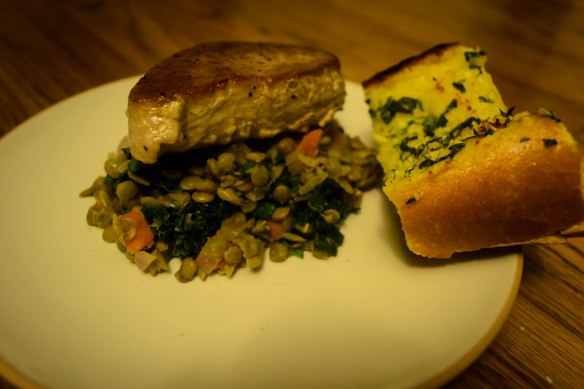
I put the lentils, carrots, thyme, and – in a flash of inspiration – garlic in a pot and added water according to the lentil package directions (depending upon what color lentils you use, you may need more or less water).  I added a bit extra, since I realized the carrots might benefit from some bubbling too.  I let them simmer for about 35 minutes, at which point the lentils were just barely still resistant between my teeth.

Never enthusiastic about using multiple pots, I dumped the lentil mixture into a strainer and then, with a bit of olive oil to lubricate the surface, sauteed the chopped onions in the same, now-empty pot.  When they were just beginning to turn golden around the edges, I added the kale and a sprinkle of salt.  Softening the onions and wilting the kale took about ten minutes.

After the kale had collapsed a bit, I dumped the lentil mixture back in, folded it gently in with the greenery, and let them stew over low heat until the kale was the texture I like.  I tasted and felt the muddiness of the lentils and carrots: winter vegetables are wonderful, but sometimes the heaviness they impart is reminiscent of the dirt from which they were pulled.  Lentils, though they aren’t root vegetables at all, tend to have a similar effect.

This was my inspiration point.  Only a few drops of red wine vinegar pulled the flavors up out of the garden ditch they’d been wallowing in and made them interesting and individual again.  Add the vinegar and chopped parsley at the last moment.
Food Blog 2011-2013-0157

I mounded this on our plates and topped it with a tuna steak (I know, that’s not vegan.  But the Bittman is, and that’s what matters here!).  It would have been better with salmon – the more delicate meatiness would have contrasted nicely against the lentils and carrots.  The tuna was almost too dense a pairing, calling back to the muddiness of the pre-vinegared dish.  Lamb rubbed with harissa, or maybe even a grilled portobello or a big steak of tofu, pressed, dried, and rubbed with a marinade that involved roasted red peppers, are other potentially promising pairings.

 Food Blog 2011-2013-0155


* As the year draws to a close, I’m thinking a lot about friends I’m now physically far from.  This title celebrates two of them: M. and Ph.  Both became unintentional vegans due to food allergies, and M. is fond of exclaiming, of dishes she likes the sound of but cannot eat thanks to its animal product ingredients, “I’m going to try to veganize it!”  So here you go, ladies: these are pre-veganized.  And gluten-free.  And yummy.  What more could you ask for?!

Fading light. And bourbon.

My home office – the room where grading, blogging, photo editing, and general work happens – has the most wonderful light in our house.  A huge sliding glass door lets sunlight pour in during the morning hours, and in the afternoon I get brightness mediated by the roof of the house.  Even when it’s overcast, there is still so much natural light that it makes for wonderful food shots.

But winter is a problem.  I’m discovering that if I make a dish for dinner, I’m not going to be able to photograph it from my office because it’s too dark by 5pm.  And wedded to this blog and this project as I am, there’s no way we’re having dinner at 4:30 in the afternoon just so I can get the best light in the house.  So I’m trying out new angles, and new placement, and new adjustments.  I’m learning more about artificial light: which arrangements I find glaring and which I find acceptable.  Bear with me, and look forward to the return of Daylight Savings Time!

“17. Sauté chopped onion in butter, then chunks of sweet potato and stock or water to cover. Simmer until the sweet potatoes can be pierced with a knife, then add chopped kale and cook until wilted.”

This was easy, and quick, and tasty.  I made a few additions to Bittman’s recommendations and think the soup really benefited from them.  I used:

4 TB butter Food blog 2011-0133

½ a medium onion (mine was yellow)

1 big sweet potato, peeled and cut into small chunks (the smaller the chunks, the faster they will cook, so make your decision based on how much time you have and what size is most pleasing to you)


Salt, pepper, ground nutmeg to taste

4 cups broth – vegetable or chicken, depending on your preference

6 oz. kale

1 tsp red wine vinegar

Heat the butter in a pot over medium heat.  When it has melted, add the onion and cook gently, stirring occasionally, until the onion is soft and translucent but not bronzed.

Add the sweet potatoes and seasoning, stir to combine for a minute or two, then add the broth.  The quantity of liquid you need will depend entirely upon the size of your sweet potato.  You may need more or less than the 4 cups listed here.

Let the soup simmer until the sweet potatoes are tender but not falling apart.  Mine took about 15 minutes.

Add the kale and stir to combine.  You will be bewildered by how quickly it collapses on itself, wilting from smoky green to a brighter, more vibrant hue as it is immersed in the liquid.  Cook just until it reaches the texture you like against your tongue – I let it simmer for about 5 minutes, because I like my kale to still put up some resistance and retain its bright color.

I tasted and thought this needed something.  Extra salt to heighten the flavor of the kale, certainly, but there was a kind of dullness about the whole concoction.  Remembering my soup lessons from Alton Brown, I sprinkled in just a hint of red wine vinegar, and the difference was amazing.  The whole thing was brighter, somehow, even though you couldn’t taste anything harsh or stringent.

We consumed this happily with freshly toasted, garlic-rubbed slices of pugliese.  It was good, but could have been stuffed with even more flavor: I’d consider adding garlic, ginger, maybe even rice or ramen noodles.

Food blog 2011-0137

“4. Onion jam with bacon and bourbon: Thinly slice red onions and cook in olive oil with chopped bacon until soft. Add a little bourbon and brown sugar to taste and cook until the jam thickens.”

Bourbon is new for me.  N. has been enjoying the occasional scotch for a few years now, but we recently acquired a bottle of Knob Creek and I’ve been appreciating the floral notes of it – so much less musty and boggy than its British cousin.

4 slices thick-cut bacon, halved lengthwise into long strips, then sliced into small rectangles

½ large red onion, thinly sliced

¼ cup bourbon

2 TB brown sugar

Freshly ground black pepper

1 small sprig rosemary

Food blog 2011-0144

I used about a tablespoon of olive oil to start the pan, but I don’t think you really need it.  Just toss in the bacon slices over medium heat and let them work for about 5 minutes.  You will get a shimmer of fat across the bottom of the pan that is more than enough to start the onions sizzling in.

Add the onions and cook over medium or medium-low for at least ten minutes, until the onions soften and the bacon is mostly cooked.  Stir with some frequency to ensure even cooking.

Off the heat (especially if you are using a gas stove) add the bourbon and the brown sugar.  Stir to combine, then return to medium heat and simmer slowly for about 20 minutes, to let the flavors mingle and the bourbon soak into the onions and bacon.

After a few minutes of cooking, I added pepper and rosemary for additional flavor components, and I think they were a good choice.  The rosemary’s woodsy flavor was a nice contrast to the fatty bacon and sweet onions.  Everything cooked down into a sticky, caramelized jam that I draped across some baked rounds of polenta.

Food blog 2011-0148

This was delicious, but misplaced.  The meaty, smoky bacon was intensified by the bourbon, and the brown sugar and onions had a nice note of molasses.  It didn’t belong on polenta.  It belonged, I think, on a freshly toasted piece of crostini, possibly smeared with a thick slice of brie.  The funkiness of the cheese could stand up nicely to the sweet smoky strength of this jam.

We paired our misguided polenta with green beans, lightly blanched and then seared in a hot pan and deglazed with a bit of red wine.  These, too, were delicious, but not the ideal pairing for the sweet saltiness of my jam.  Apples, maybe, or red grapes would make better pairings.  Regardless, we ate with joy and returned to the pan once or twice for a final sweet chunk of sticky, gooey jammy bacon to sweeten our palates, even though dessert was still to come.


“91. Pears in Red Wine: Simmer 2 cups red wine with ½ cup sugar, 2 cloves, a cinnamon stick and a few slices of ginger in a pot for a few minutes, then gently poach peeled and cored pears (use a spoon to hollow them from bottom), until soft. Cool or chill, and serve with a bit of the poaching liquid.”

This is supposed to be one of the most sophisticated desserts you can offer: not overly sweet, laden with mulled flavor, perfect for a gourmet adult party in celebration of autumn.  Pears, with their temperamental habits and signature grainy texture, are perhaps the same kind of acquired taste as wine or coffee or any of those other “adult” tastes.  As dessert for our onion-jam-crusted dinner, I decided to attempt these.

Food blog 2011-0140

I used 2 pears, but followed the rest of Bittman’s quantities exactly.

Food blog 2011-0142Well, one exception to note: I thought about getting fancy and adding things like citrus peel or rosemary (apparently I’m hooked on the stuff these days).  But in the end, I just splashed in a bit of bourbon to link the flavor profile back to our dinner: red wine from the beans, bourbon from the jam, and this dessert would fit right in.

After the first simmer, in which I stirred gently to let the sugar dissolve and the spices mull gently into the wine, I prepared the pears.

The issue with pears is that inside their tender skins they are slippery little beasts.  You can’t grasp them too firmly or they sigh into bruises.  You can’t hold them too delicately or they slide out of your hands and threaten to slip from the edge of the kitchen counter.

I dove into my attempt to core the pears only after peeling them.  This, and the attempt to do so with a spoon, may have been a mistake.  The spoon tore through the tender flesh of the pear but was too wide to remove only the core.  Further, I wasn’t sure how much core I was supposed to be removing, so I ended up with two pale, naked, slightly mutilated pears, which I slid into their (hopefully) healing bath of alcohol.

I let them simmer, turning them occasionally to dye all sides a lovely burgundy, for about 15 minutes.  Then I turned off the heat and let them sit a further 20 minutes until we were ready for dessert.

Surrounded by a moat of spiced wine, these were achingly tender and nicely flavored.  I would choose pears that were less ripe if I attempted this dessert again, because a bit of additional texture might have done them good.  As it was, though, much of the graininess disappeared in the poaching, and the soft floral flavor was really nice against the wine and assertive spices.  A scoop of vanilla ice cream on the side would have made this a richer endeavor, but I think the creaminess would have matched well with the fruit and the wine.   Or maybe I just need the extra comfort as we roll into December…

Food blog 2011-0150

Chatterbox

I’ve just begun rereading Neil Gaiman and Terry Pratchett’s genius collaboration Good Omens for perhaps the sixth or seventh time.  One of the characters introduced early in the novel is a Satanic nun named Sister Mary Loquacious from the Chattering Order of St. Beryl.  In looking back through some recent posts, I’ve noticed myself falling a bit on the loquacious side, with posts extending perhaps a bit longer than you’d like for a casual evening read.  So today, with three Bittmans to report on, I’m going to try to keep this brief.

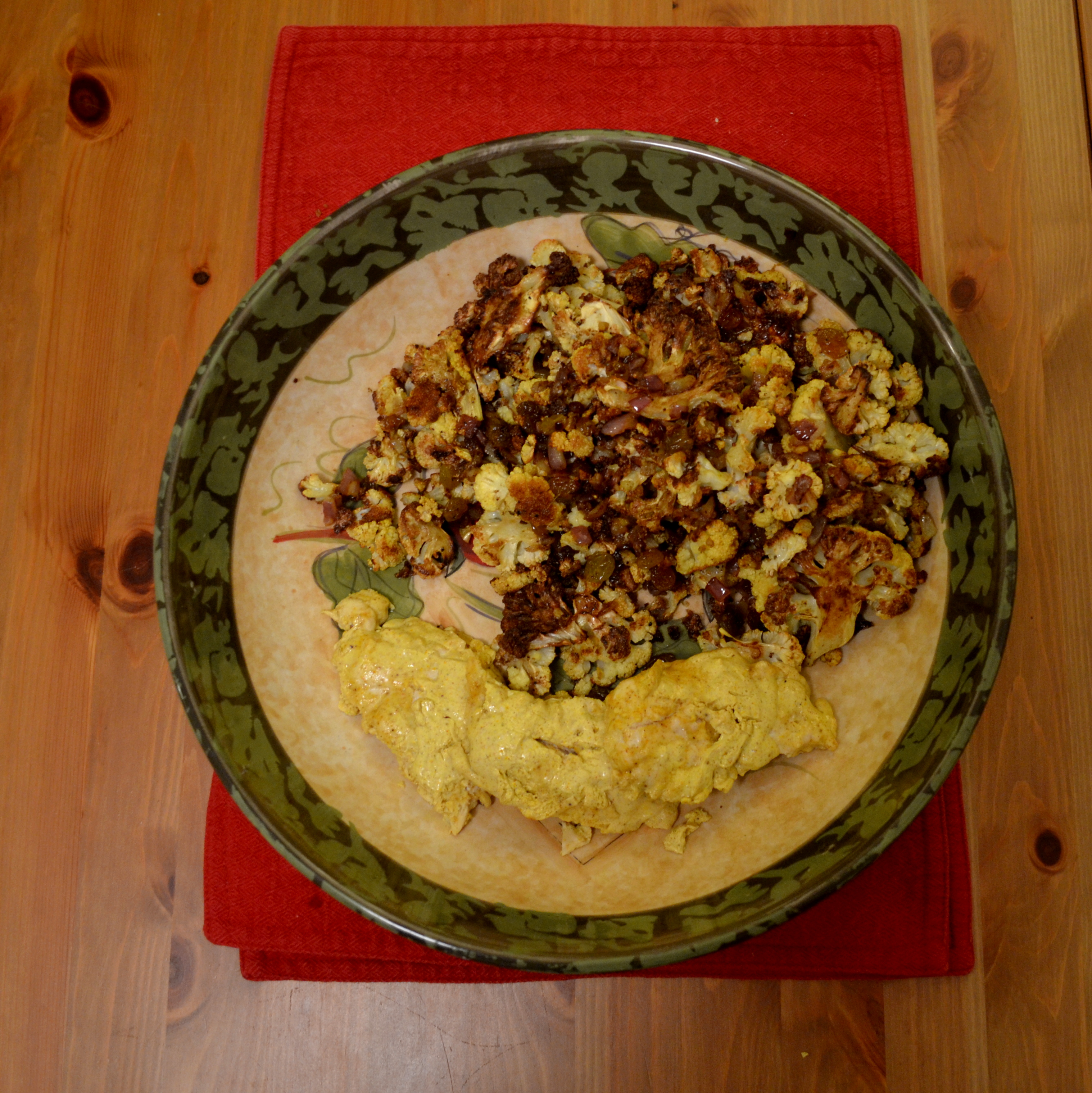
54. Cook onion, curry powder and chopped ginger in oil until onion is soft; meanwhile, steam cauliflower florets until nearly tender. Add cauliflower to onion mixture, along with raisins; cover and cook until the cauliflower softens.

Two of my most hated food items as a child were cauliflower and curry.  Cauliflower was drab and slightly bitter – worthless unless smothered in sharp cheese sauce, and even then a bit suspect.  Curry powder was musty and unpleasant, and the two of them together sound like one of my youthful nightmares.  I kept this selection on the list because N. loves the flavor of curry.  But I knew that I would have to doctor up Bittman’s procedure to give this dish even a fighting chance.

1 head cauliflower

1 tsp curry powder, divided

½ tsp salt

½ tsp black pepper

generous glugs of olive oil (quantity will depend upon the size of your cauliflower)

¼ of a red onion

¼ cup golden raisins

2 TB fresh ginger, grated (this is easiest to do while it is mostly frozen; you keep your ginger in the freezer, don’t you?)

Brush a layer of olive oil on each of two cookie sheets and preheat the oven to 400F.

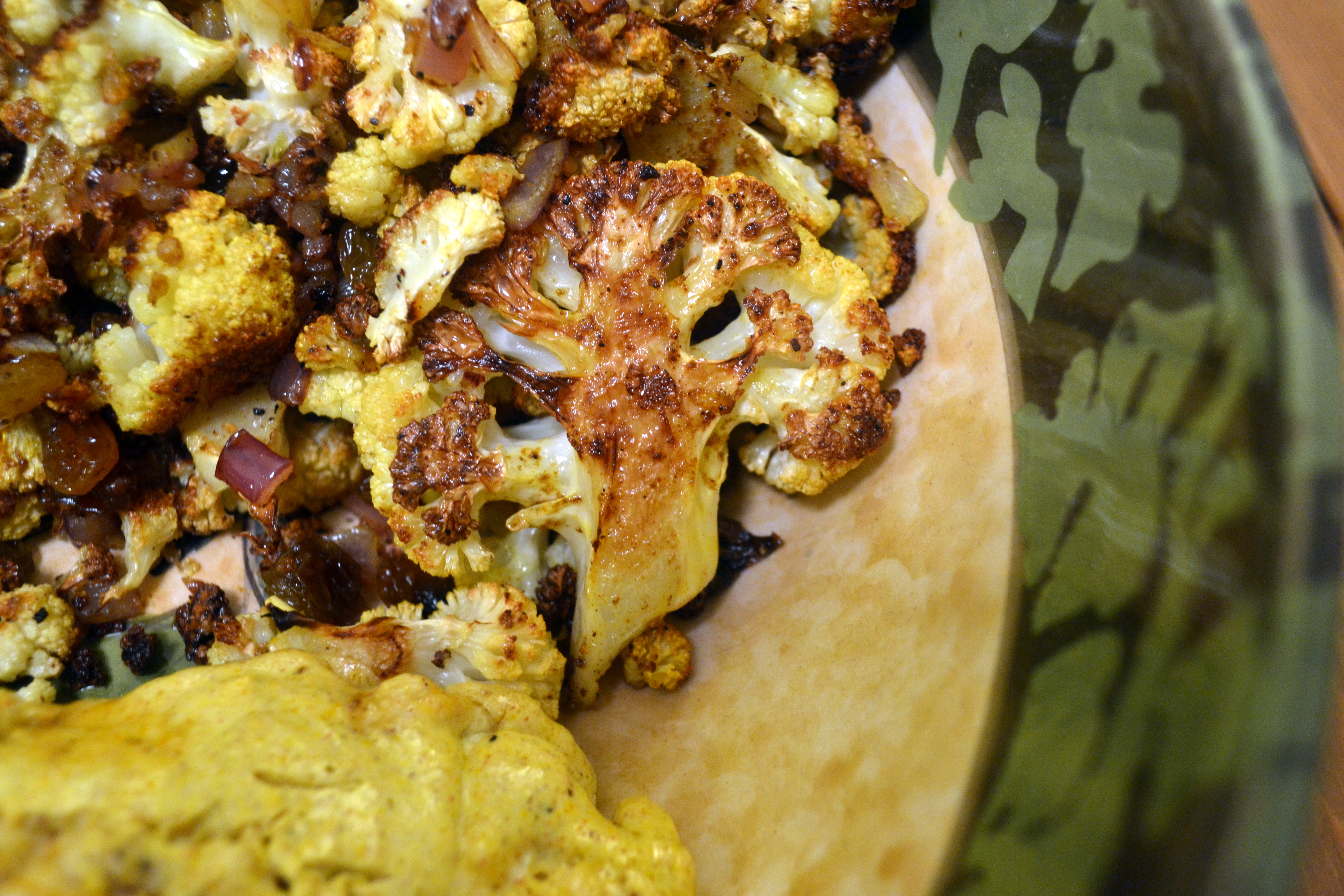
Core the cauliflower and slice it across into flat steaks of about ½ inch thick.  Some will collapse into florets.  That’s okay, but ideally you want nice long, horizontal pieces of cauliflower.  They look like flattened sprigs of Queen Anne’s Lace.  Toss the cauliflower with ½ tsp of the curry, salt, pepper, and more olive oil, then place on the tray in a single layer.  Don’t crowd them too much – the more space they have, the better they will brown.  Roast for 40 minutes, pausing at the 20 minute mark to flip each piece.

While the cauliflower roasts and caramelizes and browns, sauté the red onion in a little more olive oil.  When it begins to brown, toss in the raisins, the ginger, and the other ½ tsp of curry powder.  Cook together for another 2-3 minutes until the raisins plump and the curry aroma mellows a bit.

When the cauliflower is just tender and darkly golden, take it out of the oven and toss it with the onion and raisin mixture.

We had ours alongside some roasted chicken breasts I’d marinated in yogurt and garam masala.  It was delightful – if you favor a strong curry flavor, add more to both the cauliflower and the onions.  I was happy to have just a mild hint of earthy spiciness, and the unexpected sweetness of the raisins cut even this dankness in a very pleasant way.

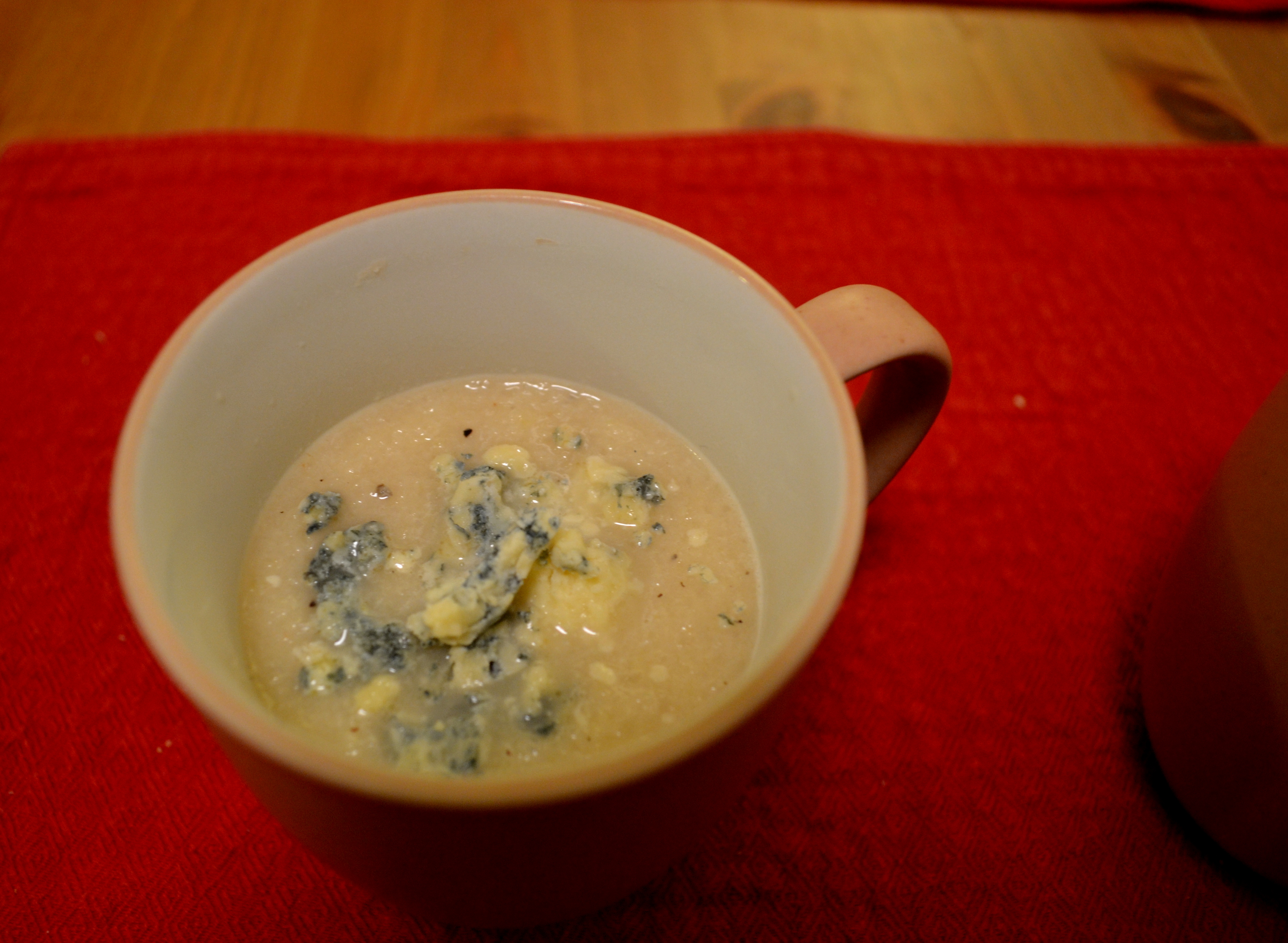
16. Sauté equal amounts chopped, peeled apples and onions in butter until soft. Add stock or water to cover, then simmer for 10 minutes. Cool and puree. Serve sprinkled with Stilton or other blue cheese.

We weren’t sure about this one.  Nevertheless, we bravely decided to make just a small portion and see what happened.  These quantities will serve two.

1 medium apple, peeled and cored

1 medium onion

salt and pepper to taste

2 TB butter

1 ½ cups chicken stock

blue cheese

Melt the butter in a small pot over medium heat.  When it foams, it’s ready.

Meanwhile, dice the apple and onion into small chunks.  You want equal sized piles – we probably ended up with just over a cup of each.  Add them to the pot and cook over medium, stirring occasionally, for 10-15 minutes.  You want softening and tenderizing, not aggressive browning.

When the apples are tender and the onions soft and translucent, add the broth and seasoning (though we didn’t make any additions, some thyme or sage might be very nice here – try 1 tsp of finely minced fresh herbs) and simmer for 10 minutes.

Remove from heat and cool slightly, then puree and serve with 1-2 TB blue or gorgonzola cheese sprinkled on top.  We had a nice blue stilton.

It wasn’t that we didn’t like this, it was that it seemed odd as a soup.  It was slightly reminiscent of a butternut squash soup, but the apples were slightly sweeter than a squash, and the combination of their sweetness with the sharpness of the onion made this seem like an applesauce with too many ingredients.  Left chunkier, this might be nice draped over a roasted pork tenderloin – a meat that goes nicely with both sweet and sharper, savory flavors.  It might also be a good base for a butternut squash soup – the one additional player in this game could be the additional complexity it might have needed.


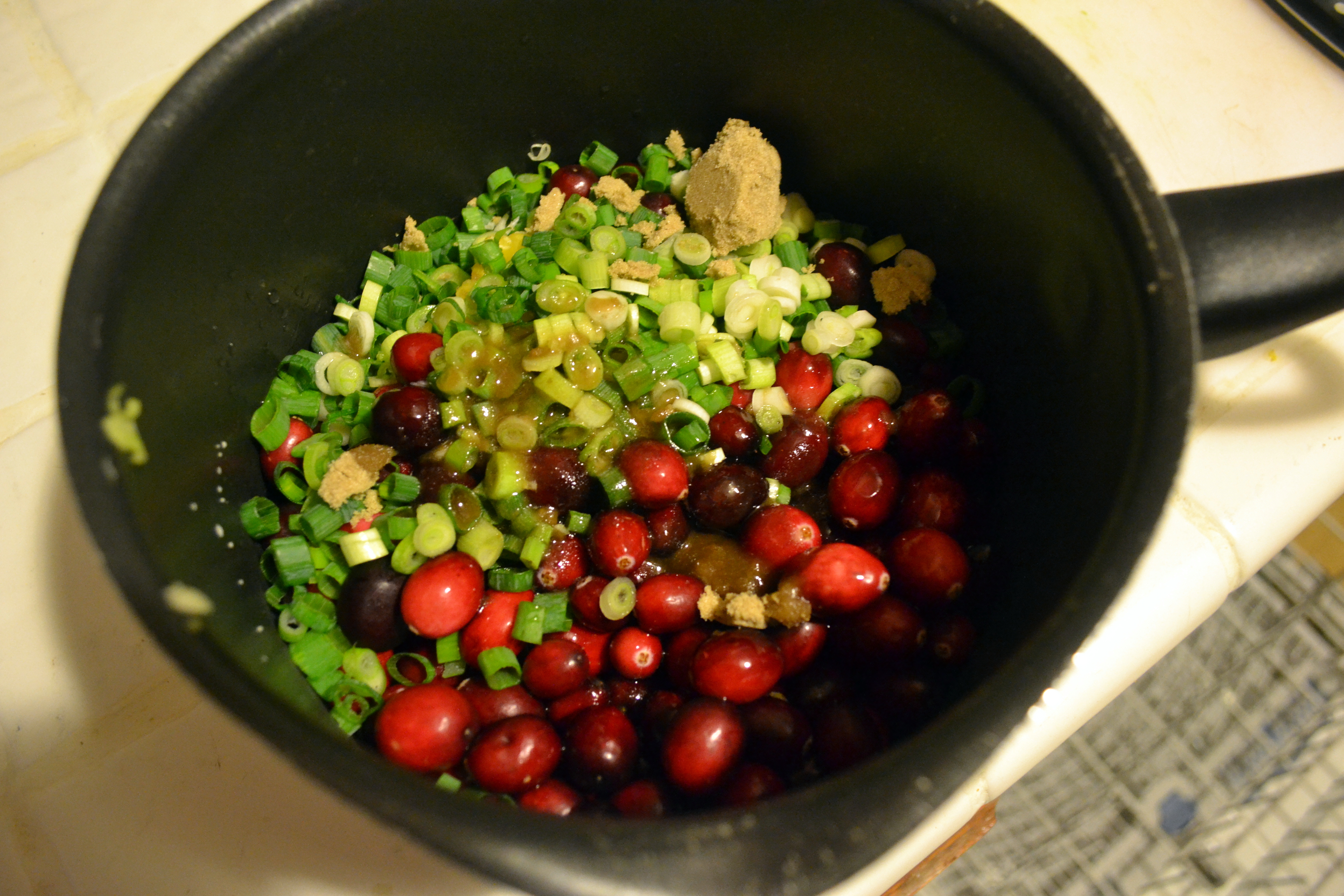
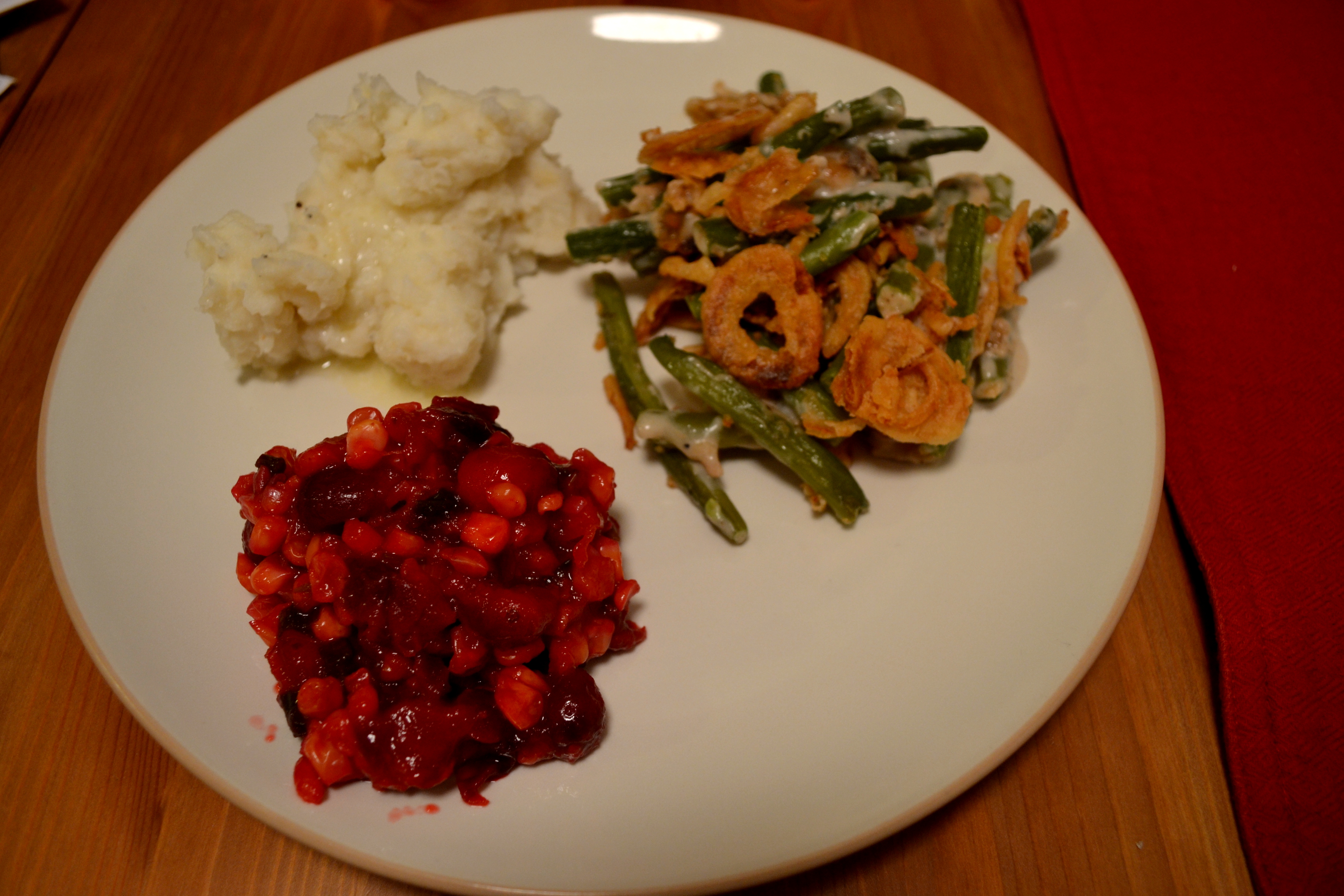
6. Cranberry-Corn Sauce: Cook a bag of fresh cranberries with about a cup of corn kernels, some chopped scallions, ¼ cup brown sugar (or to taste) and a splash of water, just until thick.

Our third Bittman this week was part of a pre-Thanksgiving Thanksgiving dinner.  When you grow up with a set collection of dishes that come to equate to this holiday, it can be hard to make a change.  When N. started having Thanksgiving dinner with my family, he missed his mashed potatoes and green bean casserole.  So I try, in the weeks that surround the holiday, to make up for these omissions. I make several smaller dinners featuring the dishes that don’t quite fit onto our holiday menu.  This seemed like the perfect side – not traditional enough for our Thanksgiving table, but satisfying in the mean time.

1 bag cranberries

1 cup fresh or frozen corn

3 green onions, thinly sliced

¼ cup brown sugar

¼ cup water

I tossed the cranberries, corn, water, and brown sugar together in a saucepan and set them over medium heat.  I added the green onions at this point too, but were I making this again I would add them later – the 15-20 minute simmering time resulted in a slightly adulterated color, and the fresh greenness would be so much nicer.  I advise adding them during the last five minutes of cooking time.

I let this simmer for about 20 minutes, until most of the cranberries had popped and the whole pot was a sticky, almost syrupy texture.  I let them cool off the heat with the pot uncovered for a few minutes, both because I like the flavor of cranberry sauce better the cooler it is, and because I wanted to let it gel up a bit further.

These weren’t as sweet as your typical cranberry sauce.  At least, they were not as sugary sweet.  The corn added a beautiful vegetal sweetness that seemed at once the perfect fit and a strange accompaniment.  We talked through this dish as we ate it, appreciating the maple overtones of the brown sugar and the tender crunch of the sweet corn, but thrown off slightly by the same qualities.  What we finally decided, as we sampled second helpings, was that they were a delicious side dish, but they didn’t feel like Thanksgiving.  Since the rest of the meal (garlic mashed potatoes and the old standard green bean casserole, slathered with cream of mushroom soup and the salty, salty crunch of french fried onions) was so traditional, having this difference, even in its subtlety, felt wrong.  If you’re a stickler for tradition, this cranberry dish would have a better chance as a chutney for grilled pork or maybe even lamb.

Next week is the big feast.  Oddly (odd because the entire Bittman list was conceived for this single day), I had some trouble figuring out where to fit his ideas in.  I’ve come up with a pair of selections to try out, and I will report back.  In the mean time, what dishes will grace your menu on Thursday?

Counting Down

It’s interesting that as I left my 20s behind chronologically, I entered my 20s in this Bittman project.  As of this moment, on this particular Sunday afternoon, I have 25 Bittman concoctions left to make, most of them soups and desserts.  At a rate of two per week, I will finish by the end of this year.  This means we’re getting toward some major milestones, some very big deals, some lasts on the list.

The first of this pair is one such last.

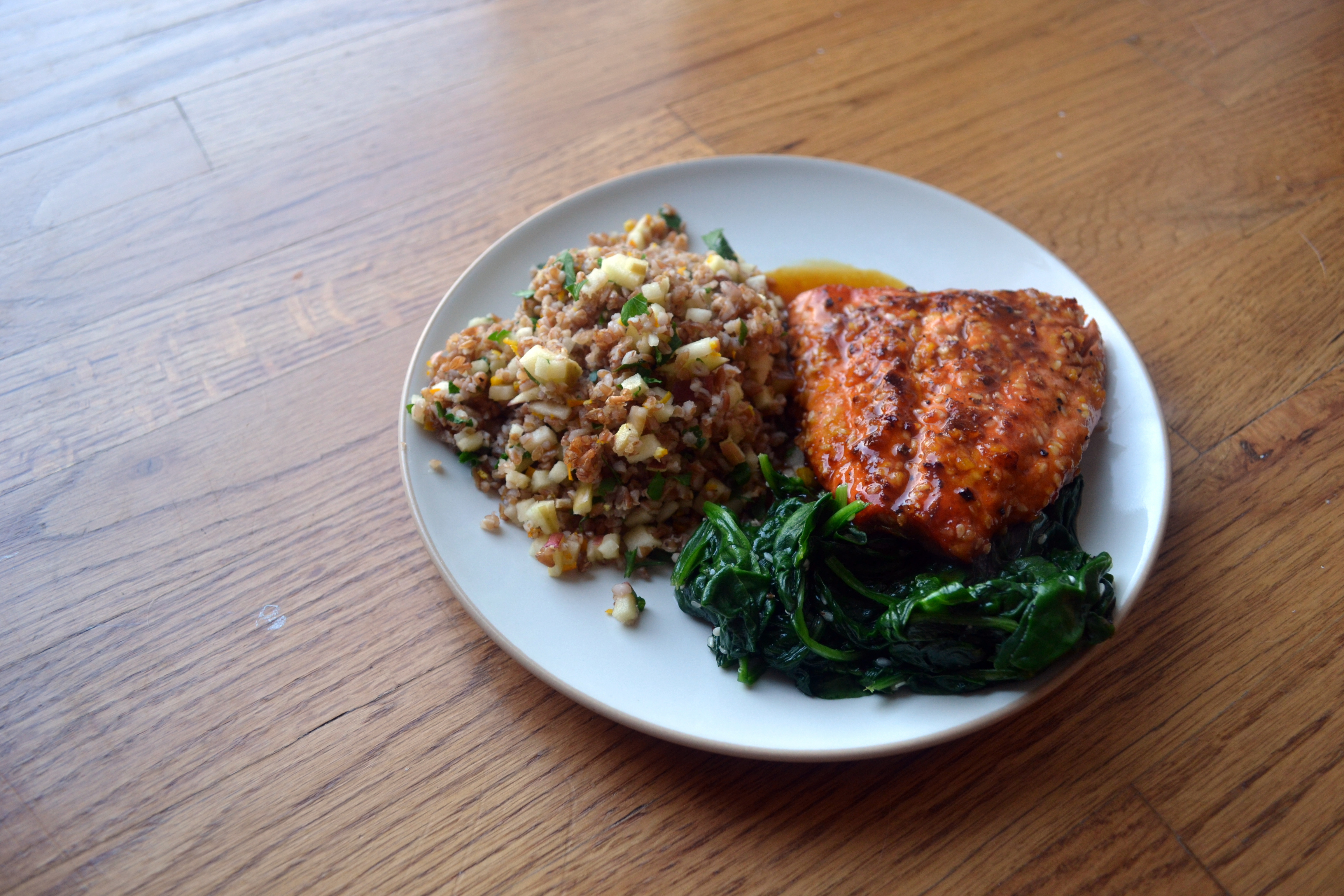
“34. Combine cooked bulgur with chopped or grated apple, minced orange rind, grated ginger and chopped parsley. Back in an oiled dish, use as stuffing or serve as a salad.”

This was the final remaining entry on the “Stuffings and Grains” list. We left it till last for no particular reason, but during a week in which a collection of Valencia oranges sat languishing in our fruit bowl, it seemed like the right thing to do.

I’ve been fairly good lately about writing down ingredient quantities as I add them, but for this entry I never even lifted a pen.  It happens.  I can own up to it.  A week of non-stop grading, perhaps, made me leery of that inky instrument.  Or maybe it was our relative rush: leave it to me to design a complex, glaze-bearing dinner on a night we needed to eat early.  Some things must get sacrificed, and it turns out it’s not the glaze, it’s the notations.

Here are my approximations:

1 cup bulgur wheat

2 cups water, stock, or a combination of the two

1 large fuji apple, diced into small squares

2-3 TB finely minced orange rind

1 TB grated ginger (this is really easy to do when the ginger is frozen)

¼ cup chopped parsley

salt and pepper to taste

Cooking bulgur is very similar to cooking rice.  I poured the wheat and the water into a pot and let it come to a boil before simmering for 15 minutes or so while I prepped my other ingredients.

After dicing the apple, grating the ginger, and chopping the parsley, I turned to the oranges.  Since Bittman specified “rind” and not “zest,” I used a y-shaped potato peeler to remove long, brilliant segments of rind.  I slid a sharp knife carefully between the rind and any white pith that got caught in the peeling, and then sliced into very thin strips, rotated them 90 degrees, and sliced again so I was left with tiny squares.

Before these happy bright piles all nestling on my cutting board got too comfortable, I tipped them into the pot of bulgur and carefully folded them in for even distribution with some salt and pepper to taste.  The experience of the still-chilly ginger hitting the hot bulgur was sinus-clearingly intense, but lovely.  An aroma-only aperitif.

With everyone incorporated, I dumped the pot’s contents into a greased baking dish and stowed it in a 350F oven for half an hour.

Orange and ginger suggested an Asian flavor profile, even though apples and parsley didn’t.  I decided to work with the dominant elements, though, and so I paired the bulgur with salmon and spinach.  The salmon would be rubbed with sesame seeds, powdered ginger, and orange rind bits before receiving a heavy sear and then an orange-juice glaze.  The spinach would be sauteed with garlic chips and sesame oil.

As with all things, this didn’t happen exactly as imagined.  It takes a long time, as it turns out, to simmer the juice of six oranges down into a thick glaze without burning their sugars.  Similarly, it takes time and babysitting to ensure garlic chips that are crisp, not charred.  And when you are trying to do all this on the same night as a homecoming football game you’ve promised to attend, certain shortcuts must be taken.

The salmon, while it seared beautifully, received not so much a glaze as a flood of boiled, ginger infused orange juice.  Still, when this liquid hit the hot salmon pan, it did bubble down into something thick and rich (if a little darker than intended).

The spinach, rather than the crunchy, spicy accoutrements I intended, had to settle for a last-minute sprinkle of sesame seeds to keep it company.

Still, the meal was overwhelmingly successful.  The salmon was outrageously delicious, and I’m going to have to make it again, writing down the procedure this time so I can share it with you.  The orange sauce perfumed the fish and kept it moist and buttery and tender.  Even though it was a bit darker than I’d planned for, the sauce took on caramel notes that seemed utterly intentional.

The bulgur was lovely.  It was toasty and fluffy and well seasoned.  The apple had cooked lightly as the dish baked, leaving it just softened but not without resistance.  The orange rind was delightfully not overpowering, but gave a warm spiciness to the grain.  It was good with the salmon, but would also be delicious with pork chops (playing on the traditional applesauce pairing) or, if you replaced the parsley with mint, a lovely side for leg of lamb.

In summary, a triumphant triumph: not only is the Stuffings category successfully completed, but it was completed with a success.


With the weather cooling (finally!) and the Soups category still looming largely untasted before me, I decided to try one to close out the week.

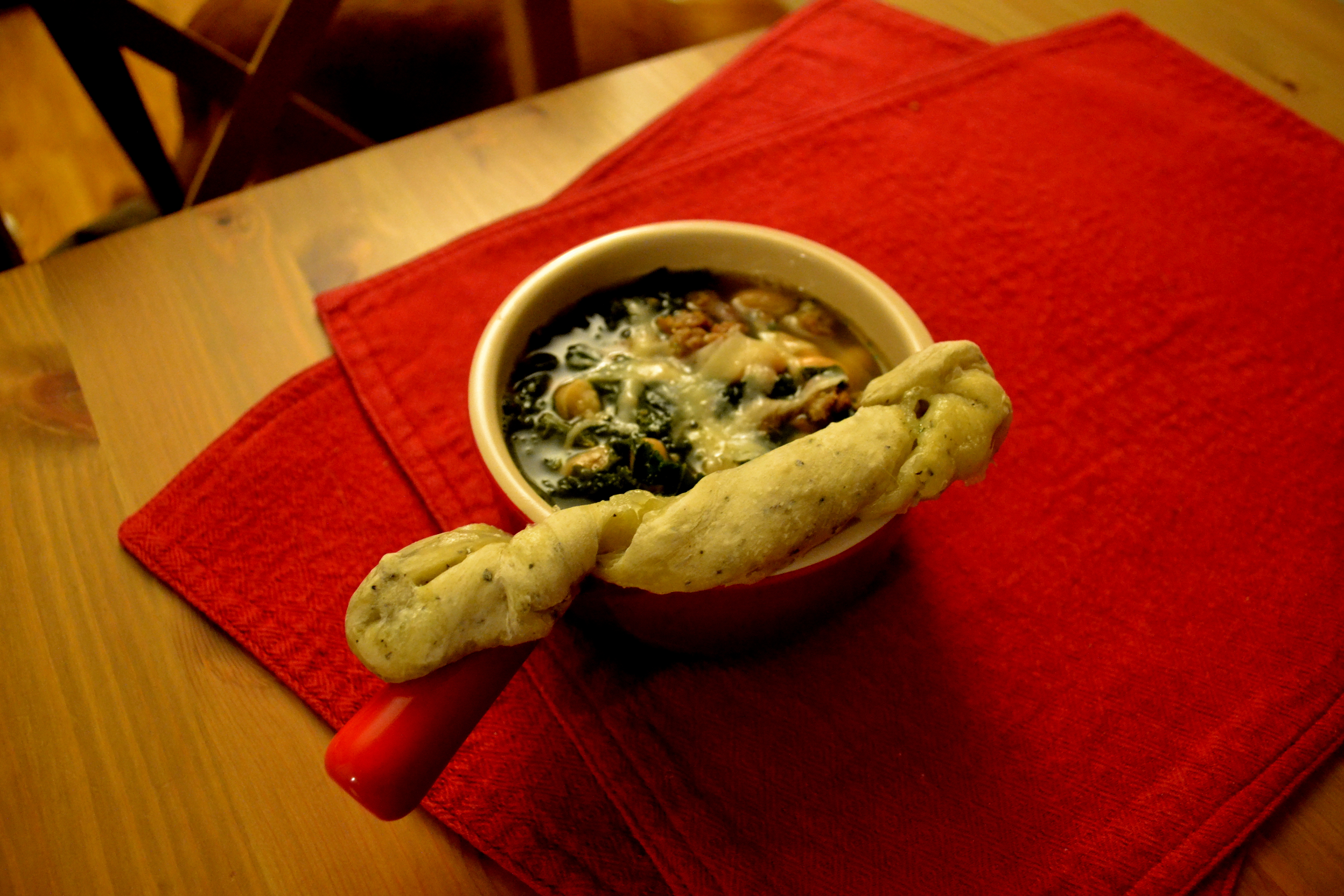
“21. Brown a little crumbled or sliced sausage in olive oil; a sprinkle of fennel seeds is good, too. Add chopped escarole, cooked white beans with their juice, and stock or water to cover. Simmer until the greens are tender and the beans are warmed through. Garnish with olive oil or Parmesan.”

I must admit I made some changes to these directions based on availability and personal taste.  I don’t like fennel.  It’s one of a very few spice flavors I just can’t take.  Over-fennel-ed sausage – like the kind that appears on many chain pizza restaurant pies – just doesn’t appeal to me, and the idea of fennel seeds crunching between my teeth and filling a mouthful of soup with their anise awfulness made their addition out of the question.

As for the escarole, I could find none.  I searched through mountains of salad greens at several local markets and this particular strain was resolutely absent.  But I did find a really beautiful bunch of kale and decided it would be a satisfactory substitute.

So here’s what I ended up with:

8 oz. bulk sausage

1 big bunch kale (chopped, this was probably 6-8 cups)

3 cloves garlic (some spice to replace the abhorred fennel seemed appropriate)

1 15 oz. can white beans with their liquid

2 cups chicken broth

salt and pepper to taste

Eschewing olive oil, I squeezed the sausage into a pan and let it brown over medium heat, separating and crumbling it as it cooked with a flat-sided wooden spoon.

I rinsed, stemmed, and chopped the kale into manageable pieces, and when the sausage was cooked through, I tossed in the mountain of greens.  No, that’s not true.  I inserted handfuls carefully so they wouldn’t spill all over the stove, and ran out of room with only half my kale added.  N. came into the kitchen when he heard me laughing hysterically, and stared in amazement at the mound of kale pieces sitting inches above the top of my pot.  I had to press it down with my hand, compacting the frilled, tough leaves down toward the bottom of the pot.  It always looks like too much.  It’s always not.  In the time it took me to mince the garlic, the kale had already begun to wilt and settle more comfortably into the confines of the pot.

When I could barely smell the garlic and the kale was level with the sides of the pot (as opposed to threatening to spill over them) I added the white beans, their juice, and barely two cups of low sodium chicken broth.  One of the things I’ve discovered about myself is that when it comes to soups and salads, I like them to be full of, well, stuff.  Lettuce with the odd crouton is no good.  I want dried cranberries, and walnuts, and avocado, and gorgonzola.  Thin, brothy soups don’t please me either.  Give me big chunks of vegetables, or slurpable noodles, or rich shreds of meat.  In the days when I’d indulge in the occasional Cup’o’noodle, I always drank the broth out first so I could concentrate on the important part: the just dripping mounds of noodles left behind.

So this soup, for true enjoyment, needed only enough broth to make its categorization accurate.  A scant two cups and we were assured plenty of “stuff” in every spoonful.

While the soup simmered, I stretched, sliced, and sprinkle mozzarella onto some pre-made pizza dough.  Twisted and snuggled on a baking sheet, these when into the oven to become bread sticks.  Fifteen minutes later when they were sizzling and firm, the soup was done.

This is not a soup you want to let simmer for hours.  The beans, especially if you are using canned like I did, will eventually become mealy and then disintegrate.  The kale begins to lose its emerald brilliance after a while, and though it will still taste good, it won’t be as pleasing to consume.  Simmer for fifteen to twenty minutes max.

Then you get to shave on some parmesan and eat it.

Neither of us was sure we would like this soup.  But we shouldn’t have been so foolish.  N. has placed the products of this project on a pass/fail system.  This is what happens, I suspect, when you have two teachers in the family.  He announces his verdicts after dinner, and he treats them as though Mr. Bittman has just submitted an exam or a paper assignment.  “Bittman passes on this one,” he told me last night as we cleaned up.  It wasn’t just his happiness at pairing his dinner with the first Jubelale of the season.  He really did like the soup.  And I think he was right.  This was a fast, easy, delicious little warmer.  Cooking the kale in the sausage grease gave it some additional flavor and took away that raw bitterness dark leafy greens can sometimes have.  The beans got creamy and delicate, and the starch from their liquid thickened up the minimal broth I used.  Even without the broth, these ingredients seem like a stellar combination that should be taken advantage of at many opportunities.  Sautéed together, perhaps with the addition of chopped onion and maybe butternut squash or sweet potato, they could be a nice little hash.  Wrapped in pastry with some thickened gravy, they could be a pot pie.  Folded with some grated mozzarella and enclosed in pizza dough, they become a perfect calzone.  And as the weather continues to cool (I hope, I hope, I hope), gravies and pot pies and warm cheesy casseroles are exactly what I want to pair my remaining Bittman dishes with.

It seems a bit stress-inducing to start with a countdown.  It’s a looming certainty of what must be achieved.  “That’s a lot,” N. said when I told him how many were left.  But after tonight’s dinner, it will be 24.  And by the end of next week, it will be 23.  And by having you out there reading, it means I must achieve, yes, but it also means I’m promising something to you.  Food.  Words.  Proof of my experiments.  And stress-inducing or not, that’s a kind of accountability I like having.

25 to go…

Blowing Hot and Cold

I’ve been uninspired to write this post, mostly because the weekend we just experienced made Punxsutawney Phil into a fat little liar.  And then today came, with a promise of freezing temperatures tonight and the specter of snow.  This is perversely appropriate then, because this Bittman recipe for Potato Leek soup is essentially vichyssoise, one of the best known chilled soups (along with Borscht and gazpacho). We had ours hot, but it is often chilled and served in small, sippable portions.

“22. Sauté leeks in butter until soft but not browned, then add cubed waxy potatoes, a little sage and stock or water to cover. Simmer until tender, puree and finish with about a cup of cream for every 6 cups of soup. Serve hot or cold, garnished with chives (if cold, call it vichyssoise).”

Here’s the line-up:

¼ cup butter

at least 3 leeks, maybe more, halved lengthwise, rinsed well to remove sand and dirt wedged between the layers, then sliced thinly into little crescent moon shapes

8 medium yukon gold potatoes, diced in smallish cubes

6 cups chicken or vegetable stock

salt and pepper to taste

6-8 sage leaves, torn or chopped

1 cup heavy cream

I can say right away that I wish I’d had more leeks for this.  My meager supply was just not enough for that unique, sweet garlic/onion flavor.  Nevertheless, I sliced them up and sautéed them in butter for that springy wonderful pale green aroma.  A tub of homemade chicken broth, the sage, and the diced potatoes followed, burbling together and permeating each other with flavor.

I let the pot simmer until a tentative fork prod proved the potatoes were tender – probably fifteen minutes – then seasoned with salt, pepper and, on a whim, a few taps of garlic powder.

I switched the heat off and let the pot cool off just until it wasn’t boiling anymore before taking my immersion blender to it.  Have you used an immersion blender?  I love mine.  It is a bright red Kitchen Aid model and I use it for blending soups and salad dressings.  I know it could also be used to whip cream or maybe even make hummus, though I haven’t yet put it through all its paces.

A few long dunks and careful swirls of the immersion blender and the chunks of potatoes became more of a mash.  Another few sessions and they transformed into a velvety soup.  Even the torn sage leaves were obliterated, leaving only a few shreds of potato skin (I never peel yukon golds) to disrupt the ivory smoothness.

When everything was well blended, I put the pot back on the heat, poured in a cup of cream, and stirred the swirls of white until the whole thing paled ever so slightly in color and the cream was completely incorporated.  It only took a few moments for the pot to rise back up to serving temperature, at which point we dipped it into bowls and sipped away.

It was smooth and hearty and rich.  It’s hard to make potatoes taste like anything but potatoes, but the additions of sage and cream and the barest onion-y flavor from the leeks came through.

I served this with a lovely loaf of dimpled rosemary foccaccia and a glass of white wine.  A thoroughly beige looking meal, but a satisfying one nonetheless.

But satisfying isn’t always enough.  This soup lacked intensity and freshness.  It was a winter meal, and my stomach, along with my skin and heart and brain, is craving spring.  So when I faced the leftovers, I felt the need for a pick-me-up.  The addition of a tablespoon or so of pesto stirred gently into the soup woke up the flavor considerably but somehow didn’t overwhelm the wholesome starchy creaminess of the potatoes.  Were I to make this soup again, pesto might become a required addition.  Or perhaps a gentle, fluffy layer of extra sharp white cheddar to blanket the top like the snow I hope does not fall on us tonight.  This was good, but it’s time for hot soup season to be over, and not yet time for cold soup season to begin.

Sick soup

Clearly the past week did not go as planned. No Bittman posts appeared here, and no new recipes were made. Until today at lunch.

I don’t get sick very often. When I do, it’s usually a head cold that lasts mayyyyybe three or four days until I get frustrated with it and flood myself with so much liquid that the cold just gets flushed right out of me. This week was different. I don’t know whether this thing that hit me was cold or flu, but it knocked me over, dragged me around for a while, and then pummeled me almost senseless.

My wonderful husband has been nursing me on simple, nutritious dinners and generally keeping me out of the kitchen, which has been a strange experience. But as this morning wound to a close, with husband and dog-daughter out on a walk, I was suddenly struck with a craving for – of all things – Cup’o’noodle soup. You know, the kind in the styrofoam cup with the peel-back paper top, packed with noodles and freeze-dried vegetables and crusty little shrimp? Yeah, I wanted that for the first time in probably ten years. Maybe more.

Of course we don’t have Cup’o’noodle in the house. But we did have frozen turkey broth, made from the carcass of our Thanksgiving turkey. And I had the memory of my friend M.’s suggestion for “garlic tea” as a cold remedy. I went to work in slow, hobbling steps.

In a pot, I put:

3 cups turkey broth (shlooped out of a freezer container in one icy cylinder)

6-10 cloves of garlic, well smashed

2-inch knob of ginger

½ tsp red chili flakes

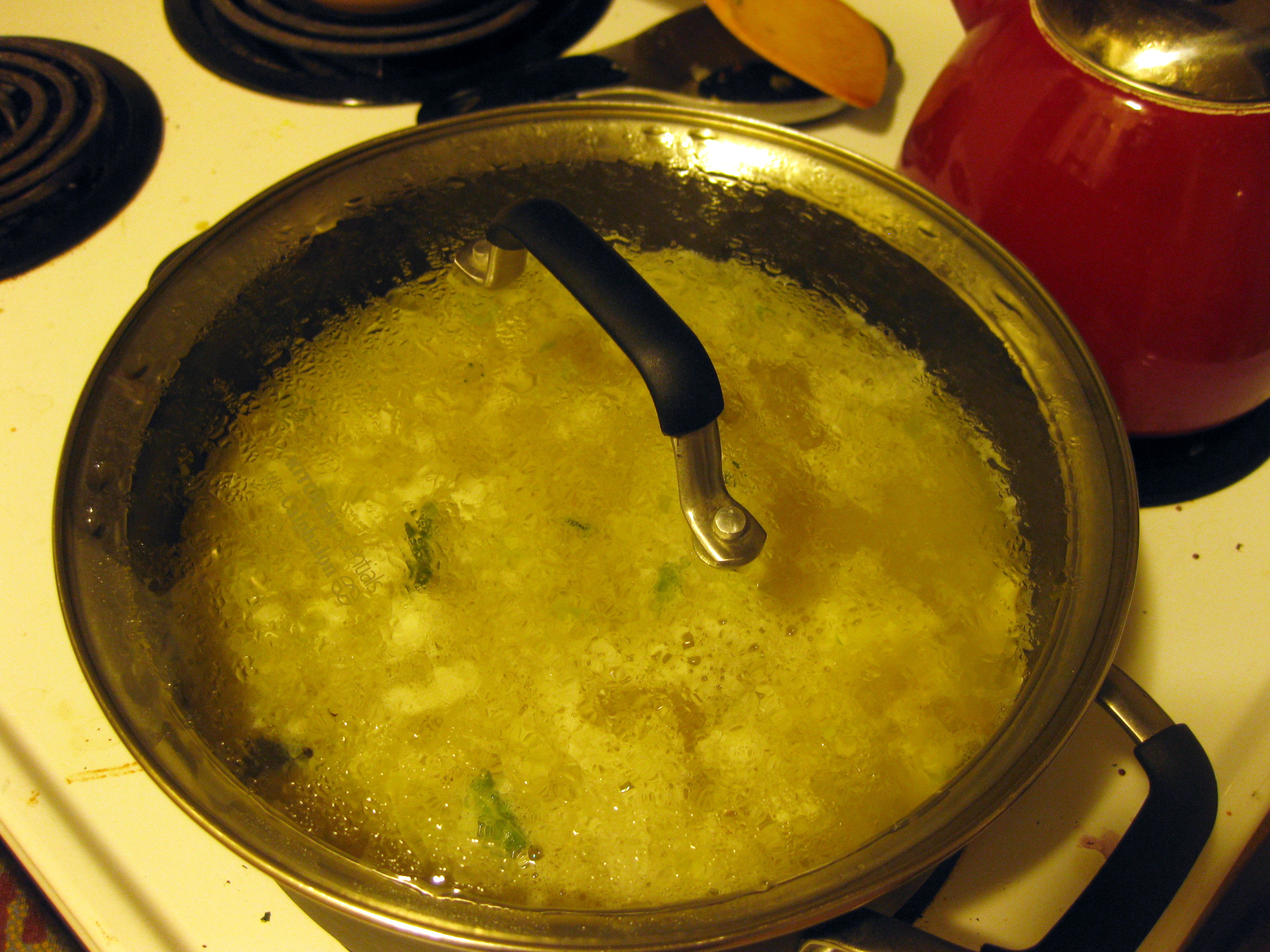
I turned the heat up and let this come to a boil, where I left it rolling for about 10 minutes to let the garlic and ginger flavors really permeate the broth.*  Then I added:

1 cup loosely packed torn kale leaves

1-2 TB soy sauce

¼ lemon (I squeezed out the juice and then added the wedge of lemon as well)

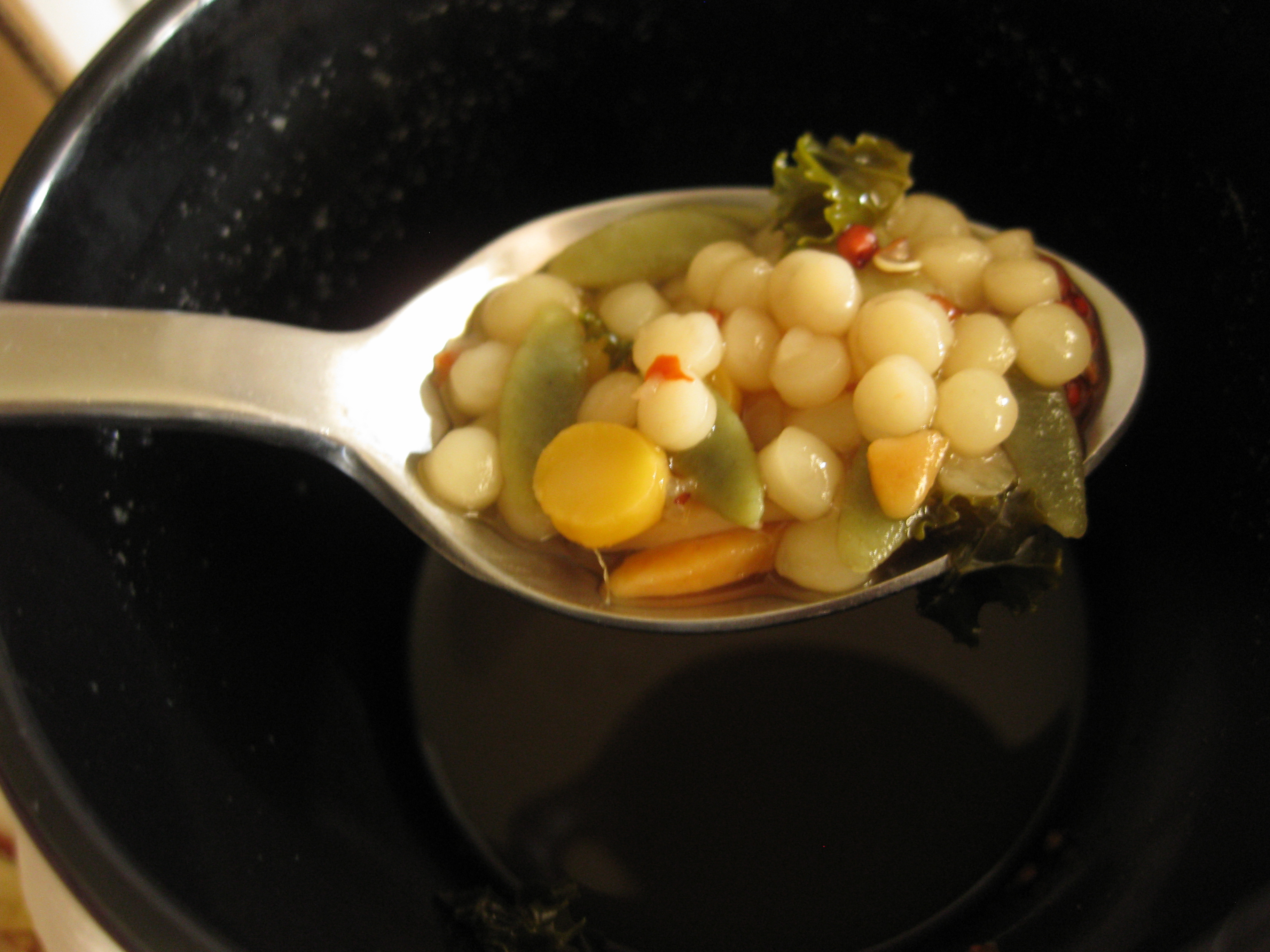
½ cup Trader Joe’s harvest blend (Israeli couscous, split peas, red quinoa, and orzo)

I let this simmer away for 10-15 minutes, until the kale was wilted and the grains were cooked.

Then I ate the whole pot. 

It was delicious. It wasn’t the over-salted, noodle-y guilty-awesome of Cup’o’noodle, but it was comforting and satisfying and spicy and rich and felt healthy. The lemon juice added a necessary brightness, and the grains blend made it filling enough for lunch. The garlic, the ginger and the chili flakes all have their own kind of spiciness, and all were welcome and throat-soothing and tummy-warming.

If you’re not feeling well (or even if you are!), make yourself a pot of this. To bulk it up, add more grains, or sub that out for noodles, or add some pre-cooked shredded chicken or squares of tofu. If you don’t like kale, add some spinach in the last five minutes instead. Using vegetable broth would easily make this vegetarian and vegan, and using tofu or rice noodles instead of the grains blend would easily make this gluten-free.


* At this point, you could strain out the garlic and ginger, and add the vegetables and grains to a clear broth. I didn’t, but then again, I’m the sicko.