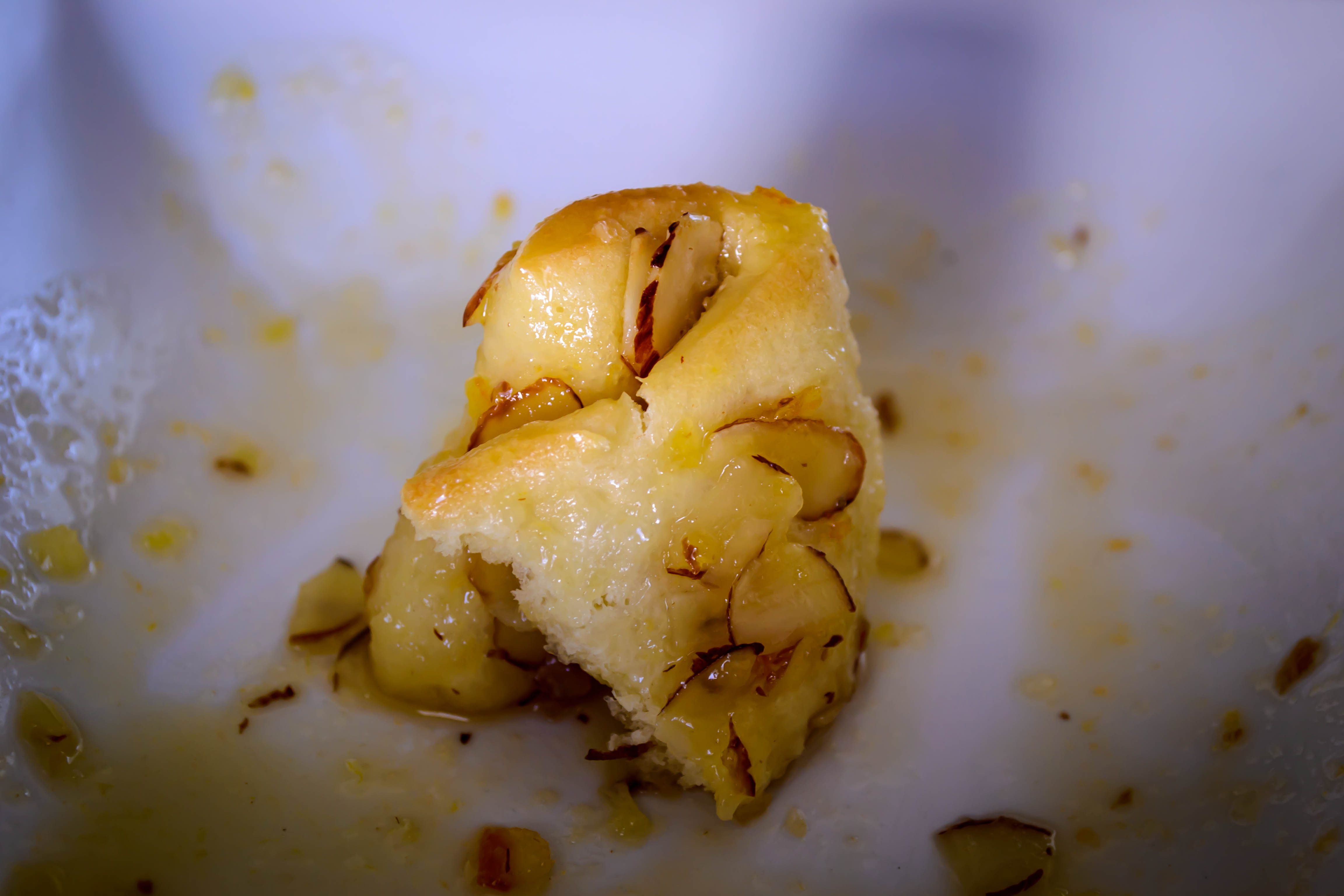
Cranberry and White Chocolate Sweet Rolls

When I read this month’s Twelve Loaves premise of holiday breads, I was stumped for a few days. To me, and to my family, holiday bread means challah, and not only have I done that one here, but I’ve done it for another Twelve Loaves challenge! I certainly couldn’t reprise it. “Holiday” would have to mean “in the spirit of,” and not “in my own traditions.” I’d been kicking around the idea of pairing fresh cranberries and hunks of white chocolate in a cookie for some time, and somehow* this flavor combination morphed into the conception for a sweet roll. Softly sweet, chewy and rich, embracing a sweet tart filling, and drizzled all over with a white chocolate and cream cheese glaze, and the holidays are basically accounted for.

Food Blog December 2013-2912I used my Nana’s sweet dough again – it is proving to be such a reliable and user friendly recipe that I see no reason to change it. The dough comes together into an almost play-dough consistency when it’s been kneaded enough, and it rises, slow and steady, tender but elastic, easily rollable, and neutral enough in flavor to accept any filling you throw at it. I opted to dress it up for the season with a touch of vanilla. A grating of orange peel would probably be lovely as well.

Food Blog December 2013-2886Food Blog December 2013-2891Food Blog December 2013-2894Food Blog December 2013-2900These take two rises – one to let the dough expand and form gluten chains, and one after rolling out, filling, and slicing, to redistribute the yeast and develop the flavor a bit more – before a quick 20 minutes in the oven. I went for mini sized rolls, so I could have more of them, which entailed dividing my dough in two.
Food Blog December 2013-2898Food Blog December 2013-2899Food Blog December 2013-2902You could certainly also do full-sized rolls, which might require a slightly longer baking time. While they are still hot, golden and just crusty on top, but bubbling around the sides with the escaped gush of cranberries, you tip a smooth, ivory stream of melted cream cheese and white chocolate over them, and let them cool as long as you can stand it before serving. The brightness of the cranberries peeking out from under the frosting makes a nice contrast that does reference the Christmas holiday, especially if you really go for the obvious and serve it on a green plate. Not that I would ever do such a thing.
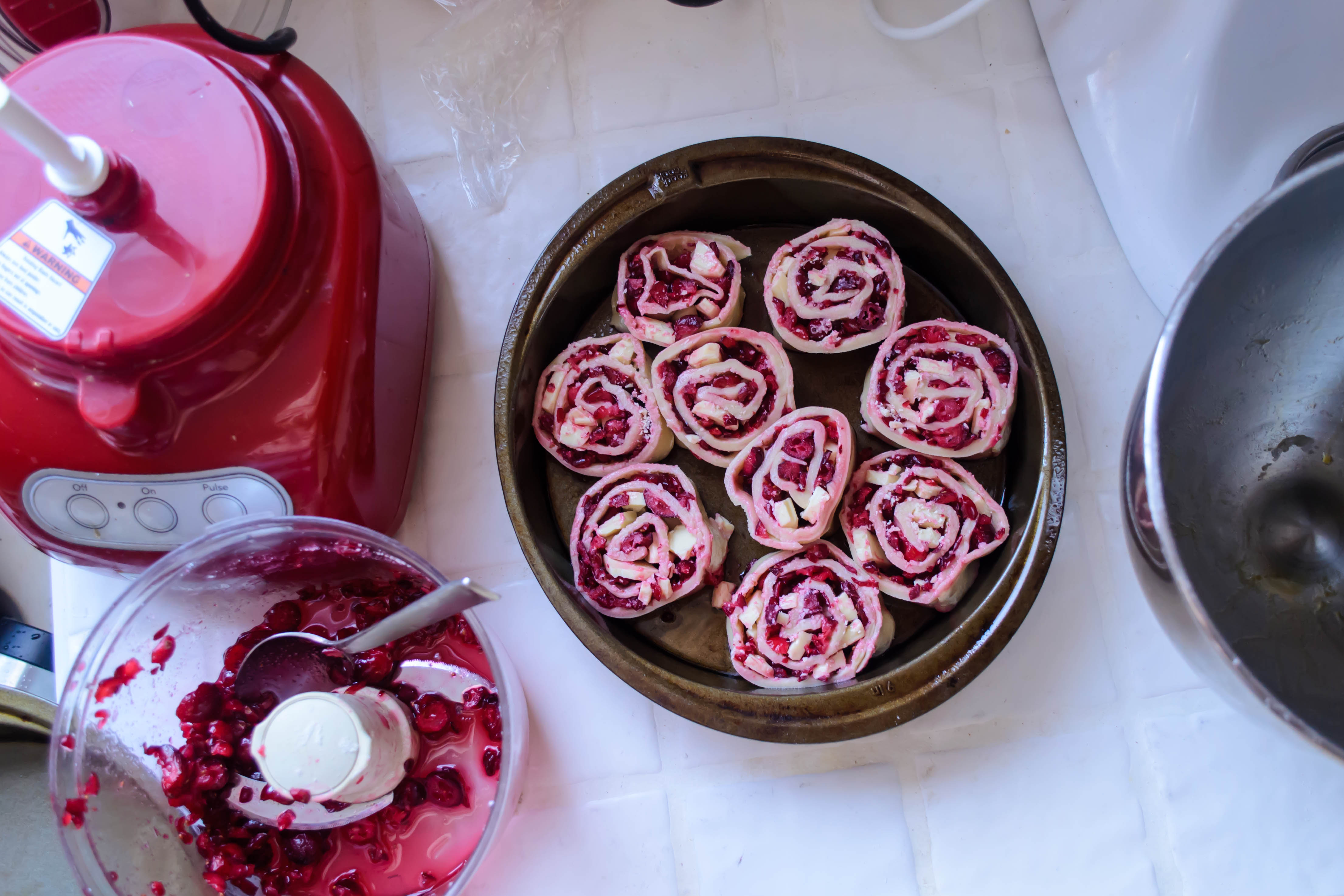
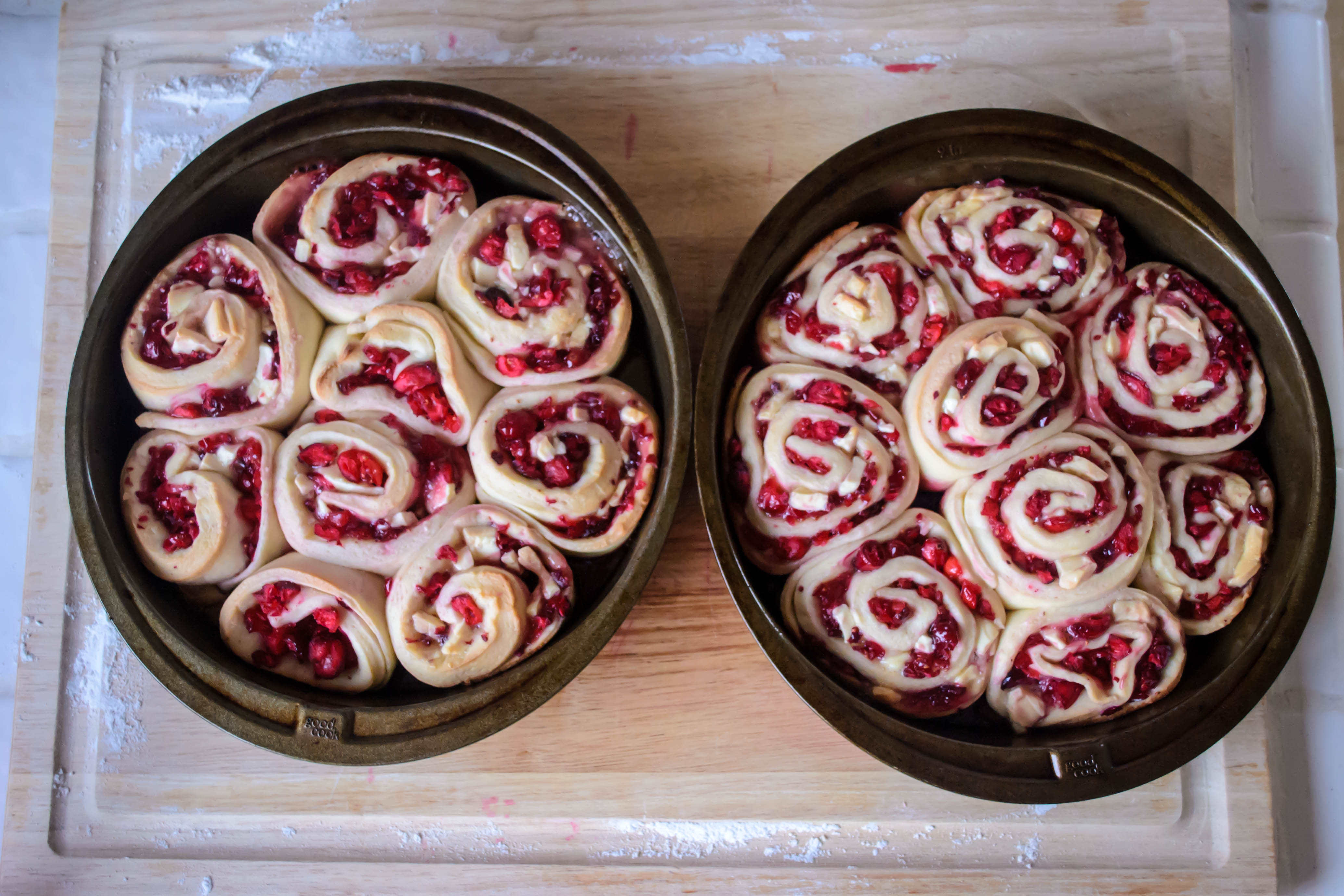
Food Blog December 2013-2901Food Blog December 2013-2904We thought these were quite tasty, and a refreshing twist; certainly worthy of ending up in my department mailroom as a last-week-of-school treat, but if I’m honest, they are not the “match made it heaven” combination I had thought they would be. Cranberries and white chocolate are a holiday fling – experimenting, having fun, but they know it won’t last. They will probably break up come January, and cranberry might skitter home to orange to make amends. White chocolate, on the other hand, stimulated by cranberry’s tartness, might shack up with raspberries for a while, and you guys, what about tender raspberries and shards of white chocolate all wrapped up in a soft, champagne cake roulade? I think I just made you a come-summer promise…

Food Blog December 2013-2907* “Somehow” probably means Deb, whose recent post on cranberry sweet rolls could just possibly have kicked my brain into this direction.

Food Blog December 2013-2916

Cranberry and white chocolate sweet rolls
Makes 18 mini sweet rolls
For the dough:
2 teaspoons yeast
½ cup warm milk
1 egg
1 teaspoon vanilla
¼ cup softened butter
1 teaspoon salt
¼ cup sugar
2 ¼ cups bread flour
For the filling:
12 ounces fresh cranberries
½ cup sugar
8 ounces white chocolate, broken into small pieces (or you can use white chocolate chips)
¼ cup melted butter
For the icing:
4 ounces cream cheese
4 ounces white chocolate, broken into small pieces (don’t use chips here – they contain a stabilizer that prevents them from melting silky smooth)
1 tablespoon milk or cream


  • In the bowl of a stand mixer, combine the warm milk and the yeast and let them stand for five minutes while the yeast wakes up. It will begin to smell bready and bubble slightly.
  • Add the ¼ cup softened butter, the egg, and the vanilla to the yeast and milk combination and mix with the paddle attachment just until combined.
  • Add the sugar, salt and two cups of the flour to the wet ingredients and mix with the paddle attachment just until a wet, softly shaggy dough forms. Switch to the dough hook attachment and knead for 6-8 minutes or until the dough comes together into a firm ball and is somewhere around the consistency of play-dough. If the dough is extremely sticky, add the additional ¼ cup of flour, 2 tablespoons at a time, just until the dough is workable again.
  • After 6-8 minutes of kneading, place your ball of dough in a buttered or oiled bowl (I just lift it out of the stand mixer bowl, spray it with non-stick spray, and put the dough back in), cover with plastic wrap, and let it rise until doubled – usually about 90 minutes. My house was on the chilly side on the day I made this, so it took me more like two hours.
  • While the dough rises, make the filling components: place the cranberries and the ½ cup of sugar in a food processor and pulse three times for three seconds each. This sounds fussily precise, but you don’t want to decimate the cranberries; just break them up a bit so they will cook faster. Chop the white chocolate and melt the butter, and you are ready to go.
  • Punch down the dough by depressing your fist gently into the center of it to release the trapped gasses. Let it sit for five minutes to get its breath back.
  • If you are making mini rolls, divide the dough in half. Place the half you are going to work with on a floured board, and reserve the other half in the bowl you let it rise in.
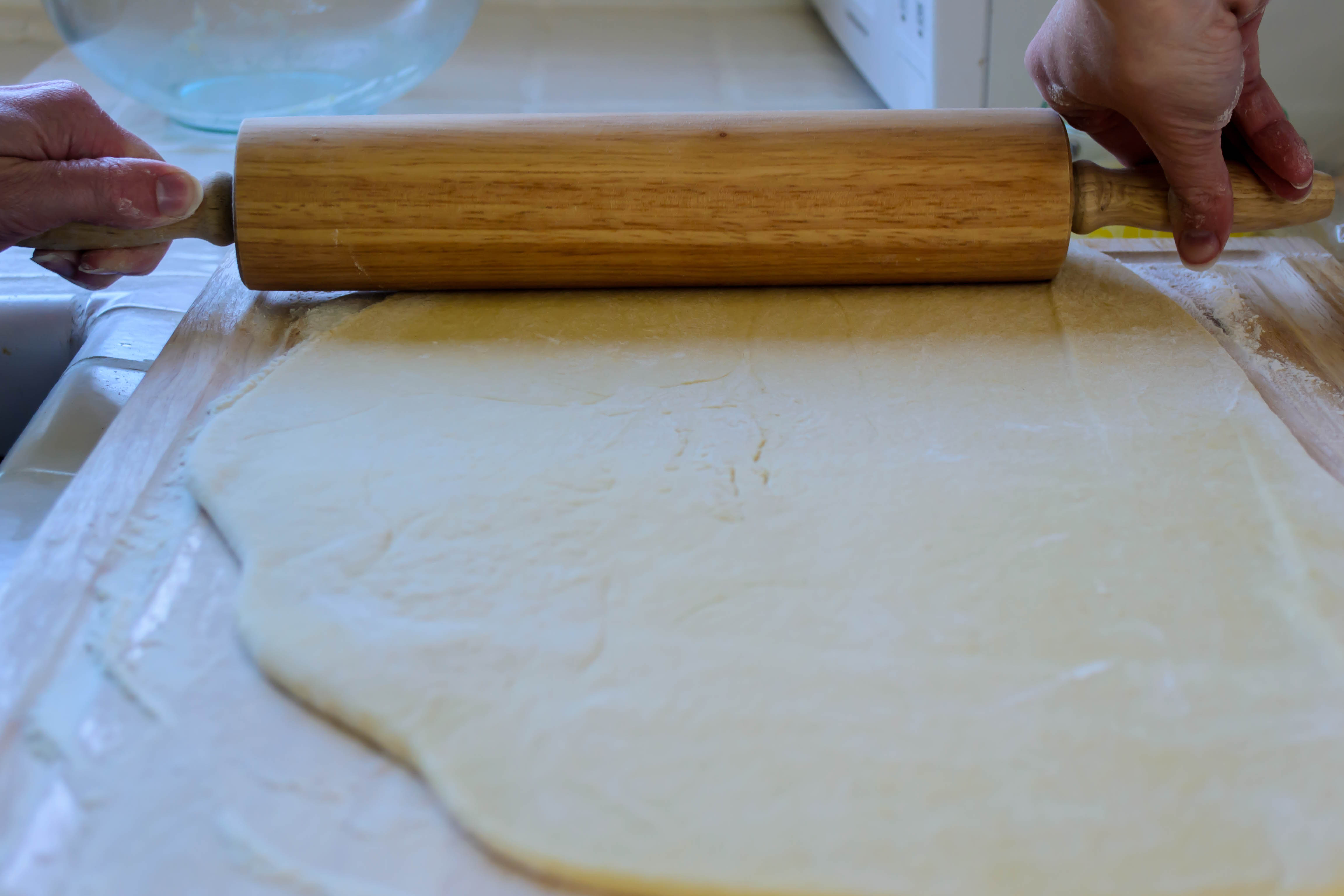
  • Using a floured rolling pin, roll out the dough into a rectangle of about 9×12 inches, or as close as you can get. It will be quite thin, but that’s okay. It’s going to expand when it rises again on the counter and in the oven.
  • Brush the rectangle of dough with the melted butter, leaving at least a ½ inch margin on all sides. Then, respecting the same margin, sprinkle on half of your cranberry mixture and half of your chopped white chocolate.
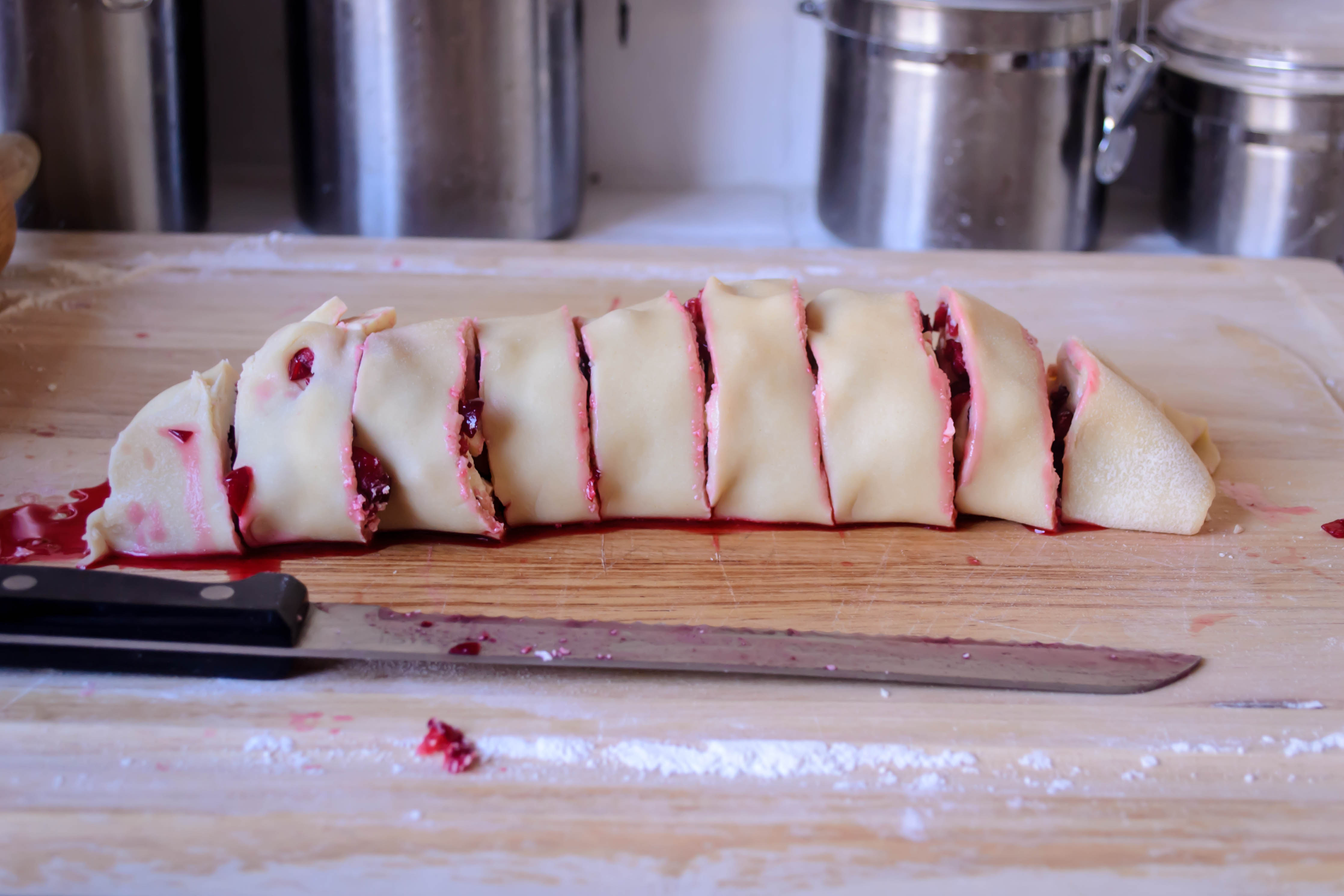
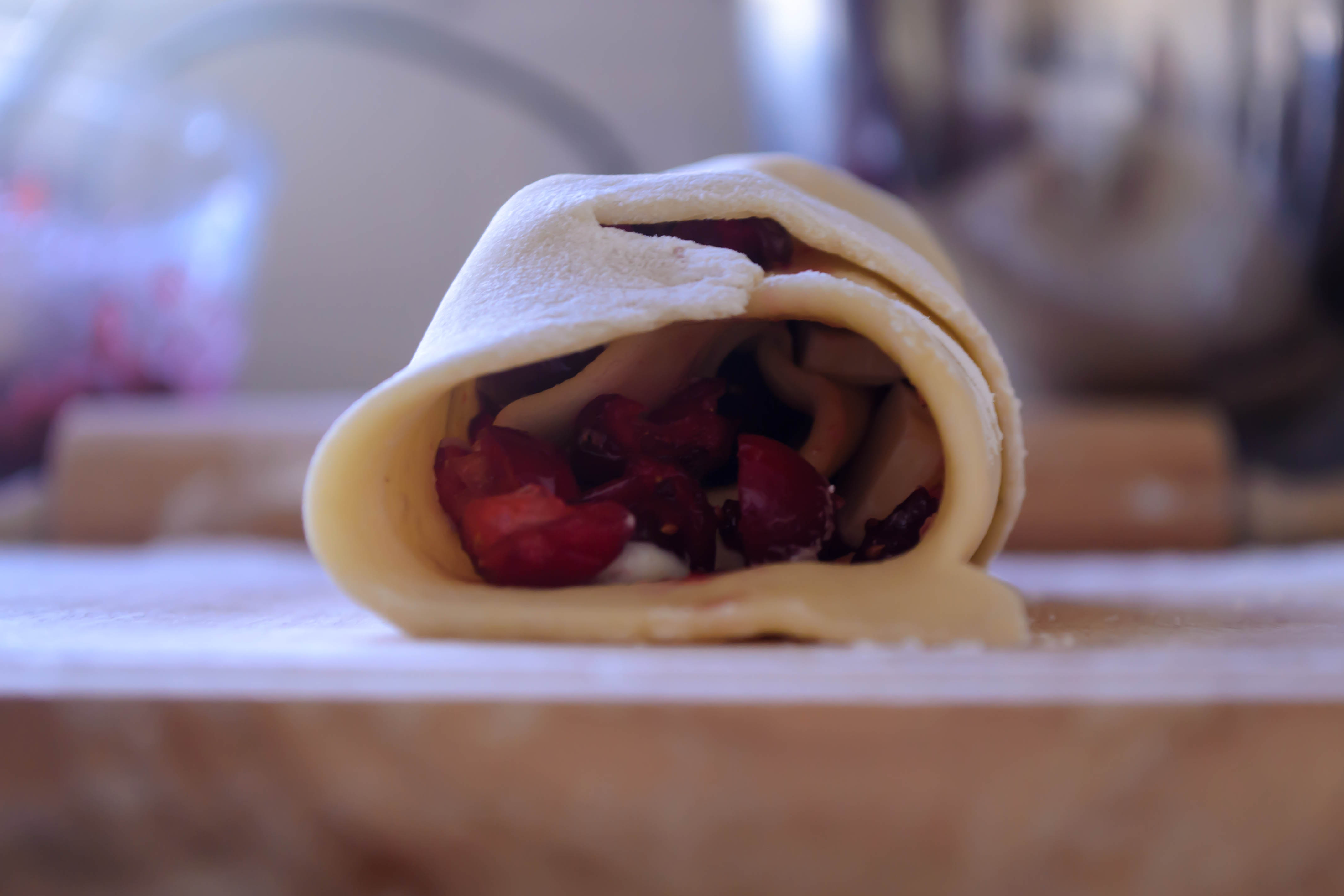
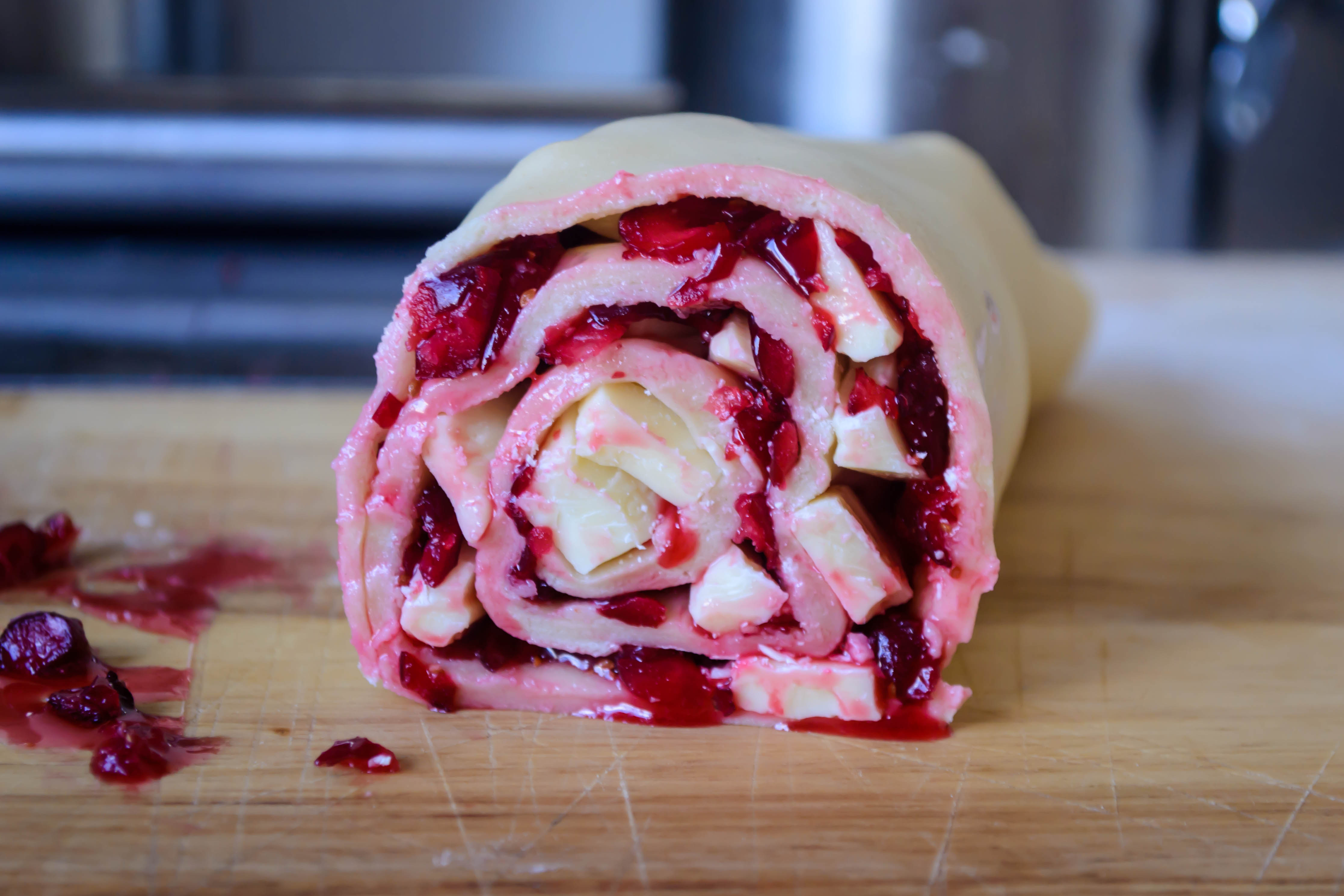
  • Now roll up the dough: starting with the long edge closest to you, begin rolling in the middle, then moving out evenly to each side, to create a long log. Crimp the long edge on the other side firmly to the roll itself to prevent deconstruction later. A few cranberry bits may fall out as you do this; that’s okay. Just stuff them back in.
  • Slice the log into 1-inch slices with a sharp serrated knife, moving the knife back and forth across the surface but applying very little pressure. This will produce truly round sweet rolls, rather than smashed, oddly-shaped ones.
  • Place the slices cut side up, so the red-spiked spiral shows, in each of two greased 9-inch cake pans. They should be spaced evenly, and don’t worry if there is room in between them, since they are going to rise again.
  • Cover each pan with plastic wrap and let rise again in a warm place for 30-45 minutes. Meanwhile, preheat the oven to 375F.
  • Once the rolls have puffed again, jostling and pressing against each other in the pan, stow them in the preheated oven for 18-20 minutes, or until lightly browned on top and cooked through. Remove from oven and set on wire racks to cool.
  • While the rolls bake, you can make the icing. In a small pot, combine the cream cheese, white chocolate chunks, and milk or cream. Over low heat, stir constantly until everything has melted together into a velvety, smooth sauce (I mean it – if you step away, this is almost guaranteed to seize, getting grainy and unsalvageable). Once you have liberated the sweet rolls from the oven, pour the sauce liberally over them, using a spatula to spread it around evenly, if needed. Let everything cool before serving, so the sauce can solidify into icing, and the rolls themselves can firm up and stay together better.
  • These taste just as good straight out of the refrigerator as they do warm in the pan. Store them in the fridge covered with foil or in an airtight container for two to three days.

Gingerbread spiced sweet bread with pumpkin pastry cream

Sometimes I agonize over what I’m going to cook. I leaf listlessly through cookbooks and batter my keyboard with demands of something new and fresh and better and, dare I say it? Original. But this month, faced with the Twelve Loaves challenge of baking bread with spices, I knew almost immediately what I wanted to do. I don’t know where the idea came from, but I knew it was going to be a variation on my Nana’s sweet roll dough, stuffed with luscious swirls of pumpkin pastry cream and baked into a decadent loaf.

Food Blog November 2013-2810The problem with this idea, as I started to do some research, turned out to be that no one had done it. I’m not saying this is a bad thing; it’s tough to think you’ve invented something, and then Google it, only to find dozens hundreds probably billions of results that are either more amazing-sounding than you’d imagined, or more beautifully photographed than you have the ability to do.

Food Blog November 2013-2781This one came up with nothing. I started wondering: can you bake pastry cream? If you can, why has no one done this? I tried multiple searches, I leafed through my cookbook collection again, feverishly this time; I even polled friends to see whether this was a thing. One foodie friend speculated unpleasant melting would result. Baking forums promised curdling. Every recipe I located for something remotely similar advocated baking the dough and then piping chilled pastry cream into it. I was contemplating using Nana’s old cream horn molds to wrap little crescents of bread and then shoot pumpkin pastry cream into them, and then I found this. It’s a recipe for something called Torta Della Nonna, which translates to “grandmother’s cake,” and consists of a lovely tender dough, filled sometimes with sweetened ricotta, sometimes with mascarpone, but sometimes with a layer of vanilla or lemon pastry cream!

Food Blog November 2013-2785Victory, if not ensured, at least not a total shot in the dark, I got to work. Pastry cream, if you’ve never made it, is one of those projects that sounds terrifying – hot milk, egg yolks sure to curdle, frantic whisking with scalding and scrambling around every corner – but isn’t really that tricky. It’s another one of those “read ALL the directions first and have your ingredients prepped” kinds of recipes, and suddenly the milk and eggs you were whisking away at thicken into this magical, glossy, extravagant slosh of something an éclair would beg to be filled with. And when you finish eating half of it tasting it to make sure it’s edible, you have only to strain it (in case of accidental scrambled bits), refrigerate it, and then decide what to do with it.

Food Blog November 2013-2790I opted, to be sure the Italian grandmothers I was never lucky enough to have knew what they were doing, to bake up just a little custard cup of it. If it was going to melt all over the place, I’d take a new direction. It didn’t. The top layer formed a thin skin, like custard or pudding left to set without a layer of plastic wrap pressed over it, but below that exposed skin (which, if I’m honest, I don’t really mind) was a tiny vat of this stuff, rich, creamy, better-than-pudding, and I knew we were on our way to great things.

Food Blog November 2013-2783From there, it was a matter of making up a batch of dough, a little more decadent than usual thanks to the addition of an extra egg and a few extra tablespoons of butter (hey, if you’re going to pack it with pastry cream anyway, you might as well go whole hog), and spicing the whole thing with the flavors of the winter holidays: cinnamon, ginger, nutmeg, cloves.

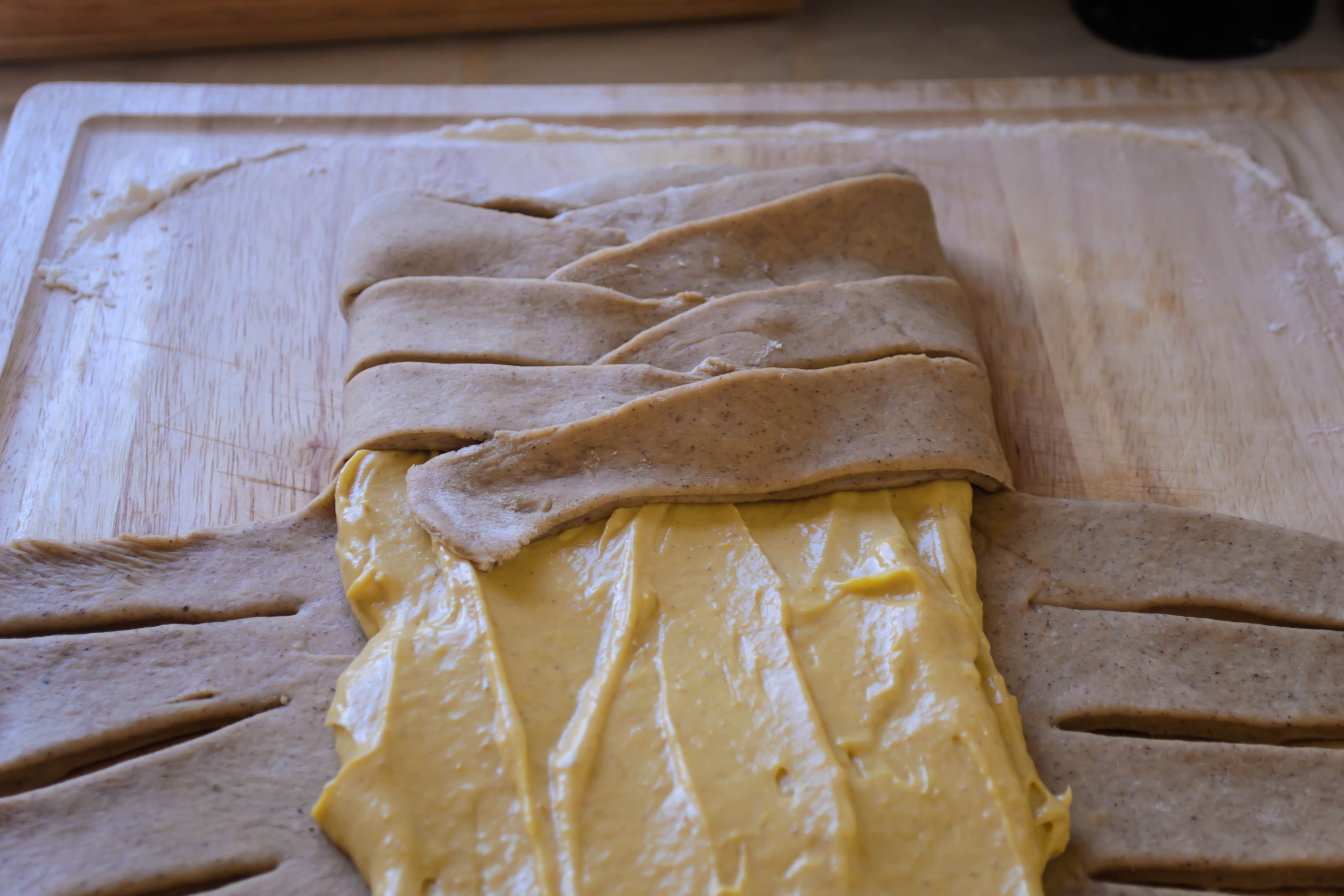
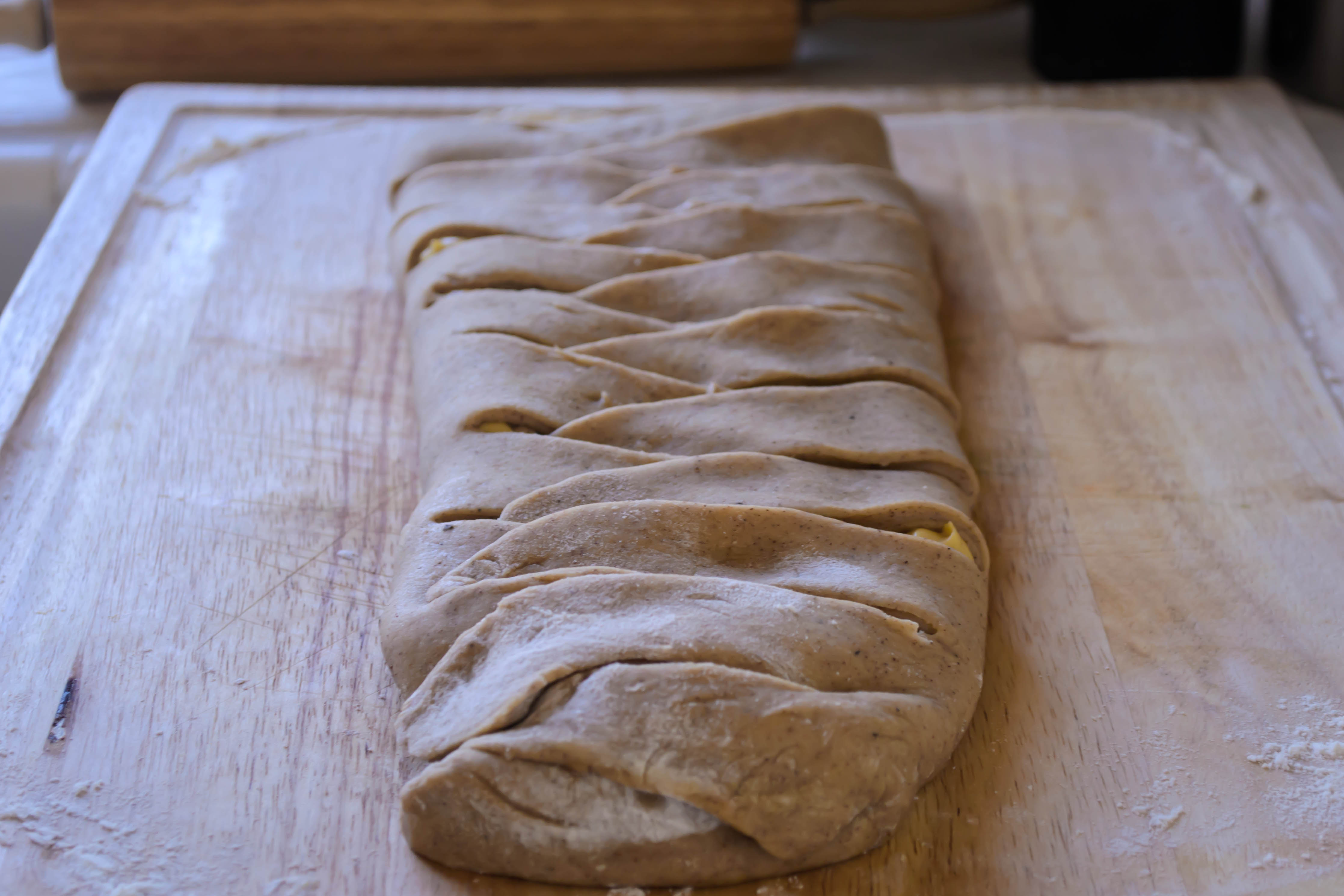
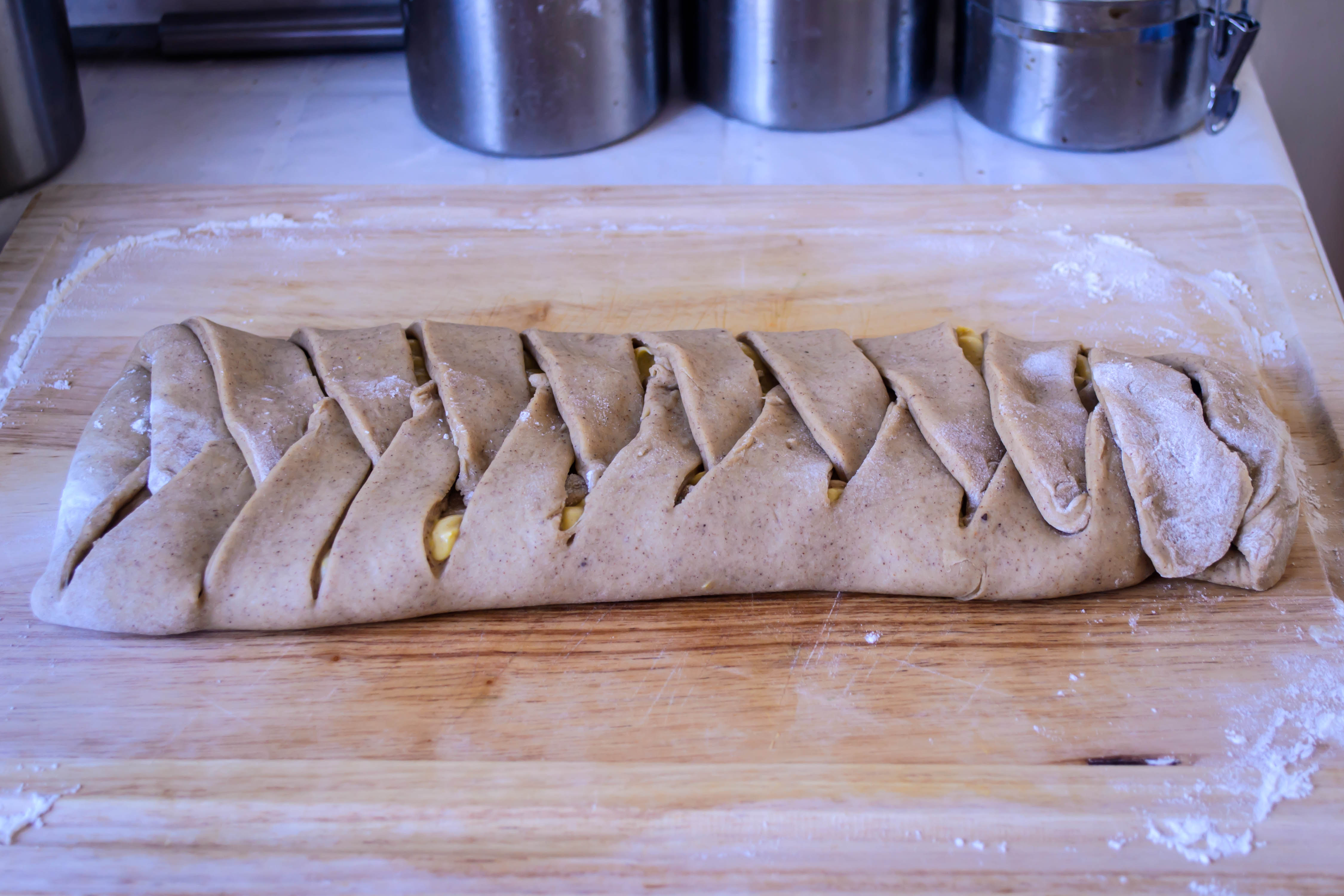
Food Blog November 2013-2788Food Blog November 2013-2791I decided to make a lattice-top loaf, which entailed rolling, slicing strips along both edges of the dough, spreading the glossy, velvet perfect orange cream inside, and weaving the whole thing together. However, I did this on my bread board (it made sense at the time), not considering that the dough, flexible and buttery already, was about to double or triple in weight thanks to the addition of the cream, and be unwilling to transfer to my baking sheet. Thus, after considerable hand-wringing and fancy spatula work, I ended up with something like a horseshoe, only slightly structurally compromised. I suggest filling and finalizing your loaf on the greased baking tray you’ll be putting into the oven.

Food Blog November 2013-2793Food Blog November 2013-2794Food Blog November 2013-2795Food Blog November 2013-2797My god, this was good. The pastry cream oozed out of the caverns and crevices left by inexperienced and impatient lattice-work, and these parts gained the same skin as my experiment. This is, if we’re going to be picky, perhaps of a slightly compromised texture – it gets slightly grainy and thick – but it’s not enough to be a bother. Because once you get beneath the outer layer and your teeth sink into the delicately sweetened, pumpkin lushness below, you won’t ever want to eat anything again. And the dough itself is no slouch either. It bakes up warm with spices and beautifully textured. The combination is like… well… it’s like nothing I can really think of. The bread is like a sweet roll or a yeasted coffeecake; not as light as a doughnut, but not as heavy as your standard loaf of bread. The cream inside makes it (almost) too decadent to be a breakfast, but it’s a more than suitable dessert or afternoon pick-me-up. To make it even better, this bread actually tastes better the second or third day after you bake it (or even the seventh… I’ve kept our leftovers wrapped in plastic wrap and in the fridge, and a week later it is still moist and perfect).

Food Blog November 2013-2798Food Blog November 2013-2808

Gingerbread spiced sweet bread with pumpkin pastry cream
Makes one 14-16 inch lattice-top loaf (and about 2 ½ cups pastry cream to fill)
For pumpkin pastry cream:
2 cups half and half (or, if you’re me, nearly 1 cup heavy cream and a little over 1 cup whole milk)
½ cup sugar, divided
Pinch salt
4 egg yolks
3 tablespoons cornstarch
½ cup pumpkin puree (not pumpkin pie filling)
½ teaspoon cinnamon
1 teaspoon vanilla
2 tablespoons cold butter
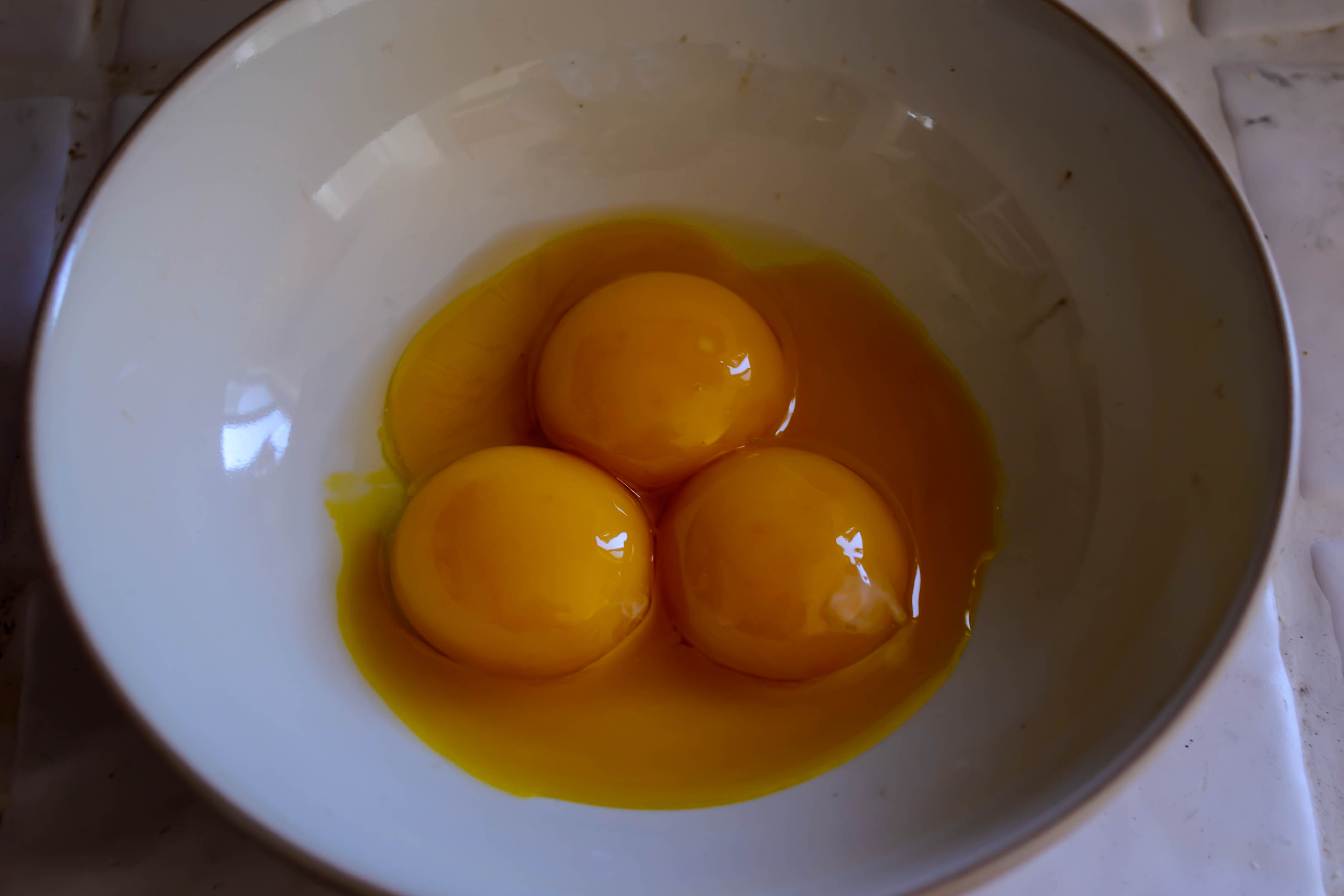
  • In a medium saucepan, heat the half and half, 6 tablespoons of the sugar, and the salt to a bare simmer over medium heat. Separate the eggs and mix the yolks with 2 tablespoons of the sugar, beating until you can only feel a slight graininess from the sugar in the mixture. Whisk in the cornstarch until combined. The mixture will become pale yellow in color and thicken noticeably.
  • Dribble about two tablespoons of the simmering half and half mixture into the egg yolks, whisking quickly as you go. This tempers the yolks, warming them up just enough to prevent them from scrambling when they hit the heat of the milk.
  • Add the yolk mixture to the half and half in the saucepan, whisking constantly as it returns to a simmer over medium heat. The whole mixture will become thick and glossy, and a few reluctant bubbles may sputter to the surface.
  • Turn off the heat and add the pumpkin, cinnamon, vanilla, and butter. Whisk until incorporated and smooth.
  • Position a wire or mesh sieve over a medium glass bowl and dump in the hot pastry cream. Using a spatula, stir and push the cream through the sieve down into the bowl. If there are any scrambled bits or undissolved material, this will catch it and prevent anything from marring the divinely perfect texture.
  • Place a layer of plastic wrap flat against the pastry cream and refrigerate until cold. This thickens the cream and lets it achieve its most glorious texture.
  • While it chills, make the bread dough.
For dough:
2 teaspoons yeast
½ cup warm milk
Pinch sugar
¼ cup brown sugar
½ teaspoon salt
2 eggs
6 tablespoons room temperature butter
2 teaspoons cinnamon
1 teaspoon ginger
1 teaspoon nutmeg
½ teaspoon cloves
3 – 4 cups flour (all-purpose or bread flour both work well)
  • Combine the yeast, ½ cup warm milk, and a pinch of granulated sugar in a small bowl. Let sit for 5 minutes while the yeast wakes up a bit.
  • Meanwhile, add the brown sugar, salt, and eggs to the bowl of a stand mixer and beat with the paddle attachment into a sludgy homogenous mixture. Add the yeast mixture and the butter and mix again until mostly combined.
  • Add the spices and 3 cups of the flour, and mix with the paddle attachment just until a wet dough comes together.
  • Switch from the paddle to the whisk attachment and knead 6 – 8 minutes, adding more flour, if needed, in ¼ cup increments. Try not to add too much flour, as with each addition the dough becomes a bit denser and tougher.
  • After 6 – 8 minutes of kneading, the dough will still be sticky and loose. Cover it with plastic wrap and let it sit in a warm place for 90 minutes, or until it has doubled in volume.
  • Punch down the dough by depressing your knuckles gently into its center to release the accumulated gases.
  • Turn out the dough onto a well floured board (I did this by just inverting my mixer bowl and letting it sit until the dough flopped out). Flour the dough lightly as well, and roll with a rolling pin into a 12 x 16 inch rectangle. If the dough springs back on itself immediately, let it sit for 5 minutes and then try again.
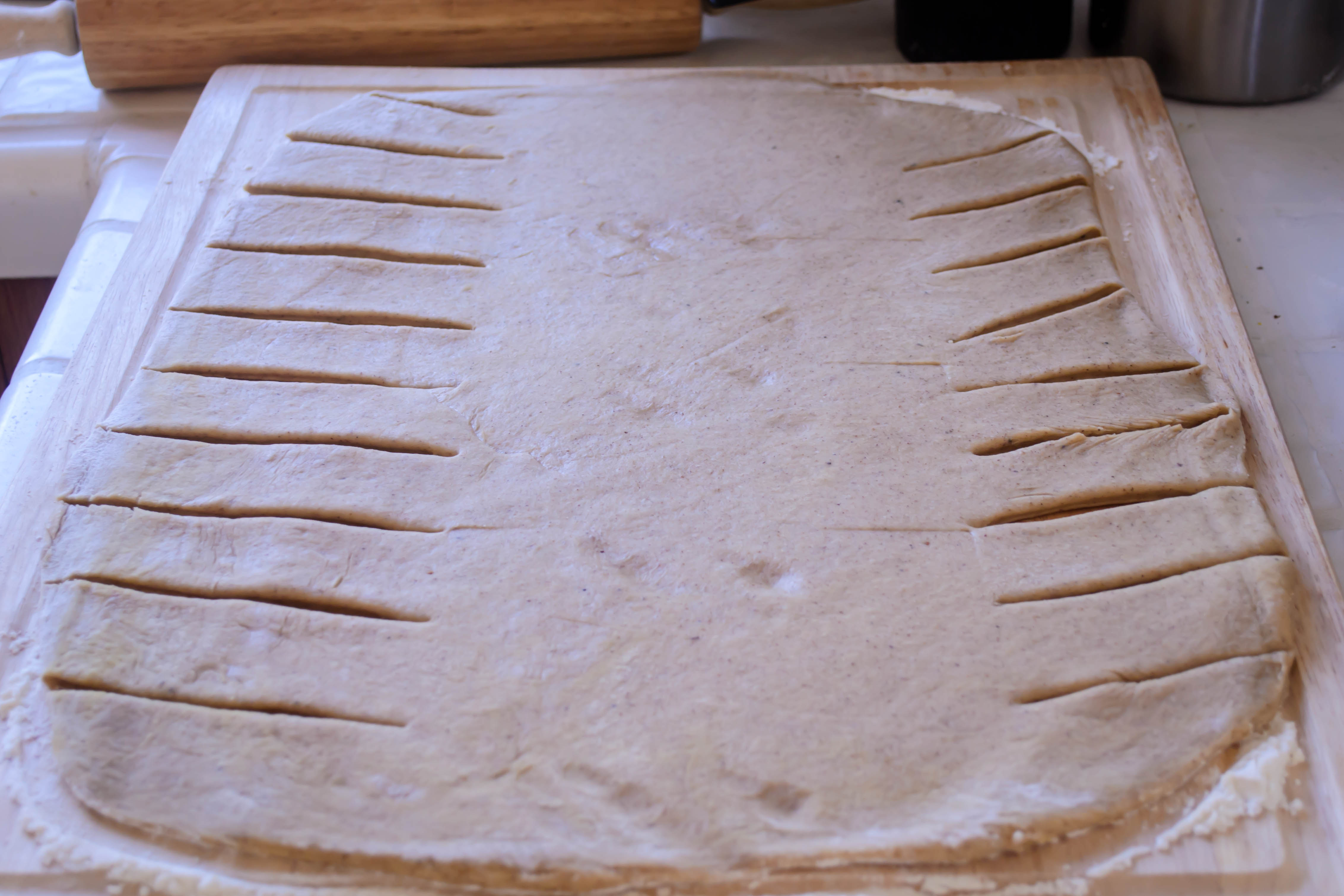
  • To create the lattice-top look, use a sharp knife to cut slits at a slight angle in the outer edges of dough at 1 inch intervals. Each slit should only be about 2 inches in – you need plenty of room in the center for the pastry cream, and the dough will stretch as you weave it. See photo above for a visual.
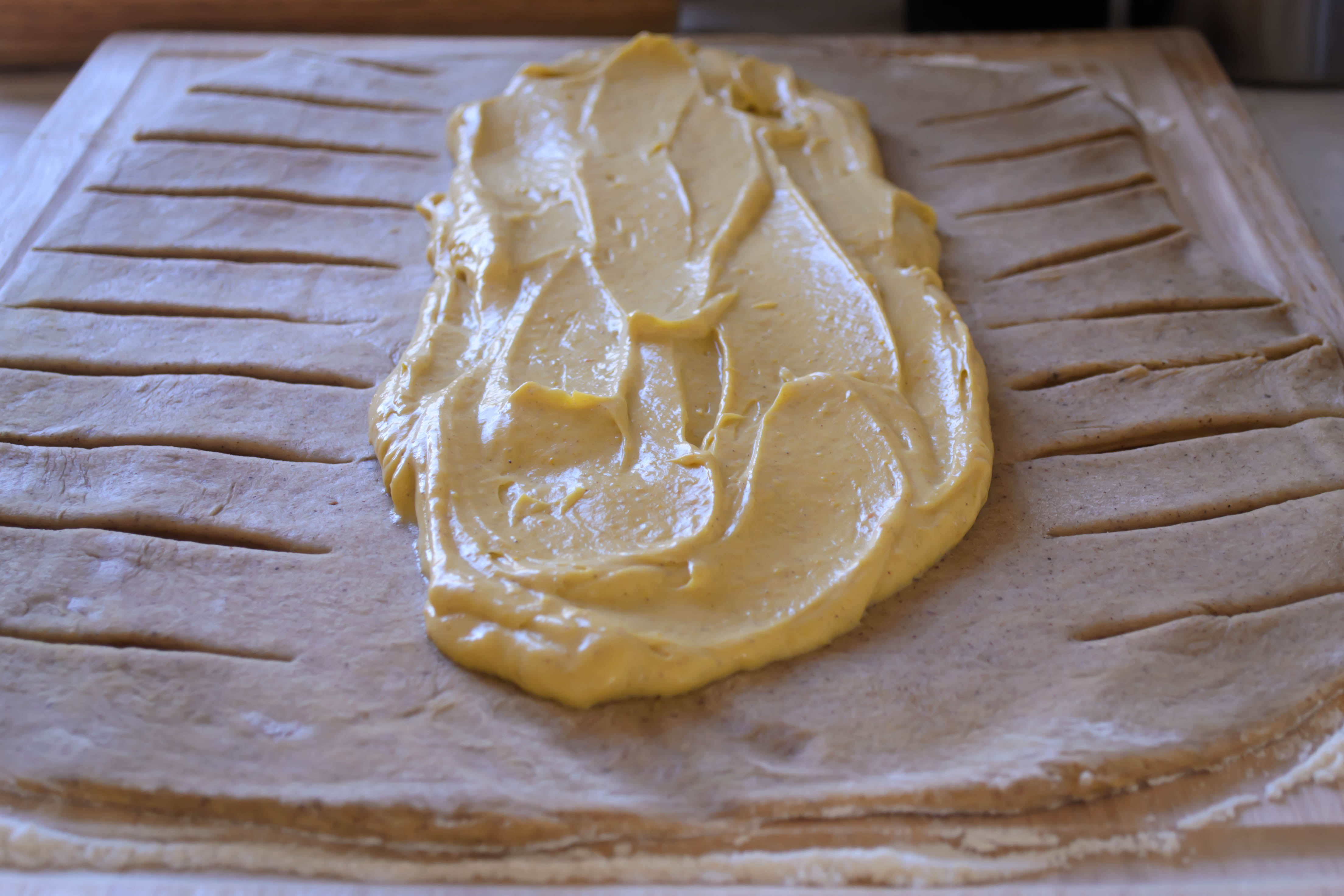
  • Transfer your dough to a lightly greased cookie sheet so you can shape it without having to move it again. Spread about 2 cups of the pastry cream onto the uncut center panel of dough, leaving about a ½ inch margin on all sides (what you do with the remaining cream is up to you. I won’t tell anyone). Then, fold up one of the end pieces over the top of the pastry cream and start weaving: fold up one dough strip at a time, taking one from one side and one from the other in turns, the way you would lace a shoe. Fold over the center gently – if you push down too much, pastry cream will go everywhere.
  • When you get to the end of the latticework, fold up the remaining edge and pinch it with the final set of folded strips to seal it. Cover it with plastic wrap and let it rise for 30 minutes.
  • During this final rise, preheat the oven to 350F.  Now, here’s where I must be honest. In the excitement of how firmly I believed this was going to be the best loaf of sweet bread ever, I failed to write down how long I baked this for. But I’m going to say you should start with 20 minutes, and see how things look. The top should get dusty and browned and feel slightly hollow when you knock against it. If it isn’t browned at all or still looks conspicuously raw, give it another ten minutes.
  • When done, remove from oven and cool completely before slicing. To store, wrap in plastic wrap and keep in the refrigerator. To snack, I preferred my slices straight out of the fridge, where the cream was cold and glossy and the bread was chewy and thick.

Beer Batter Waffles with Bourbon Caramel Sauce

It’s getting dark.

I told N., as he stood over the sink sampling a triangle of hot waffle and I finagled my plate of stacked waffle pieces around the counter searching for more light, any light, that I’m going to have to start making blog-worthy meals as weekend lunches. He shrugged, swallowed, and reached for another piece of waffle. I don’t think he’s averse to this idea.

Food Blog November 2013-2756The cat-like, dozy, quilt-loving part of me worships autumn’s time change day. An extra hour of sleep, waking to find it light out but there’s still plenty of time for grading chores whatever (but if we’re honest, probably grading), and the following few blissful weekdays when getting up at 6am doesn’t feel like masochism. But the blogger in me dreads its coming. Most of what I post here – the savory stuff, anyway – is planned and eaten as our evening meal. Amidst getting home from work, walking the dog, and catching up with each other, by the time I start cooking I’m chasing daylight. When we turn back the clocks and darkness creeps ever earlier, the little amateur photographer in me wails with despair. The light! Where is the light?! It’s a cruel trick, made crueler by the enjoyment the non-blog-obsessed part of me reaps from it.

Food Blog November 2013-2740Speaking of tricks, let’s talk Halloween. What did you do? Who (or what) did you dress as? We did not have a single trick-or-treater, which devastated me, but delighted my students, who received the candy I didn’t give out (or eat myself, but who’s counting?). To fill my costume yen, I had to turn to Facebook stalking, and my easy favorite was a former colleague’s daughter, who dressed as a jellyfish. They fitted a clear plastic umbrella with a jumble of LED lights, and she wore a frilly tutu and held the umbrella over her head to emulate those weird, beautiful, alien creatures. Genius.

Food Blog November 2013-2736On the treats front, aside from the Almond Joys I compulsively scarfed as the afternoon went on (reminding myself they were “fun size” totally assuages my guilt), I decided Halloween dinner should be special. A few months ago we gorged ourselves on beer batter waffles during an unexpected brunch at a little cerveteca in Venice and were delighted by the incredible yeasty flavor. I decided this was the night to do some recreating.

Food Blog November 2013-2743I started with a recipe for maple bacon yeast waffles in a King Arthur Flour catalog, trimmed down the ingredient list, and replaced the called-for milk with beer and the maple syrup with barley malt syrup to emphasize the malty flavor even more. The batter is a floppy, burpy, smelly sourdough sponge sort of concoction, which burbles sullenly for an hour or two before you ladle it by half-cups or so into a waffle iron and sizzle it into solidity. It’s easy, for a yeast-laden item, and as long as you think about the rising time before you suddenly decide you’re starving and dinner needs to happen NOW, it’s doable for a weeknight.

Food Blog November 2013-2745The thing about a recipe like this, though, is that the rising time gives you time to think. If you’re a normal person, you might use this blessed extra hour to catch up on housework or relax and watch television. If you’re me, you start thinking about sauces. I like maple syrup, but I get tired of it. These waffles, with their yeasty aroma and almost savory flavor, needed something special. As a salute to Halloween, I decided to make a quick bourbon caramel drizzle to top them. I mean, why not? It was a holiday, after all.  Butter, brown sugar, bourbon, and salt, bubbles stacking up on themselves in a tiny pot, and a swig of milk (or cream) to thicken and mellow and relax everyone.

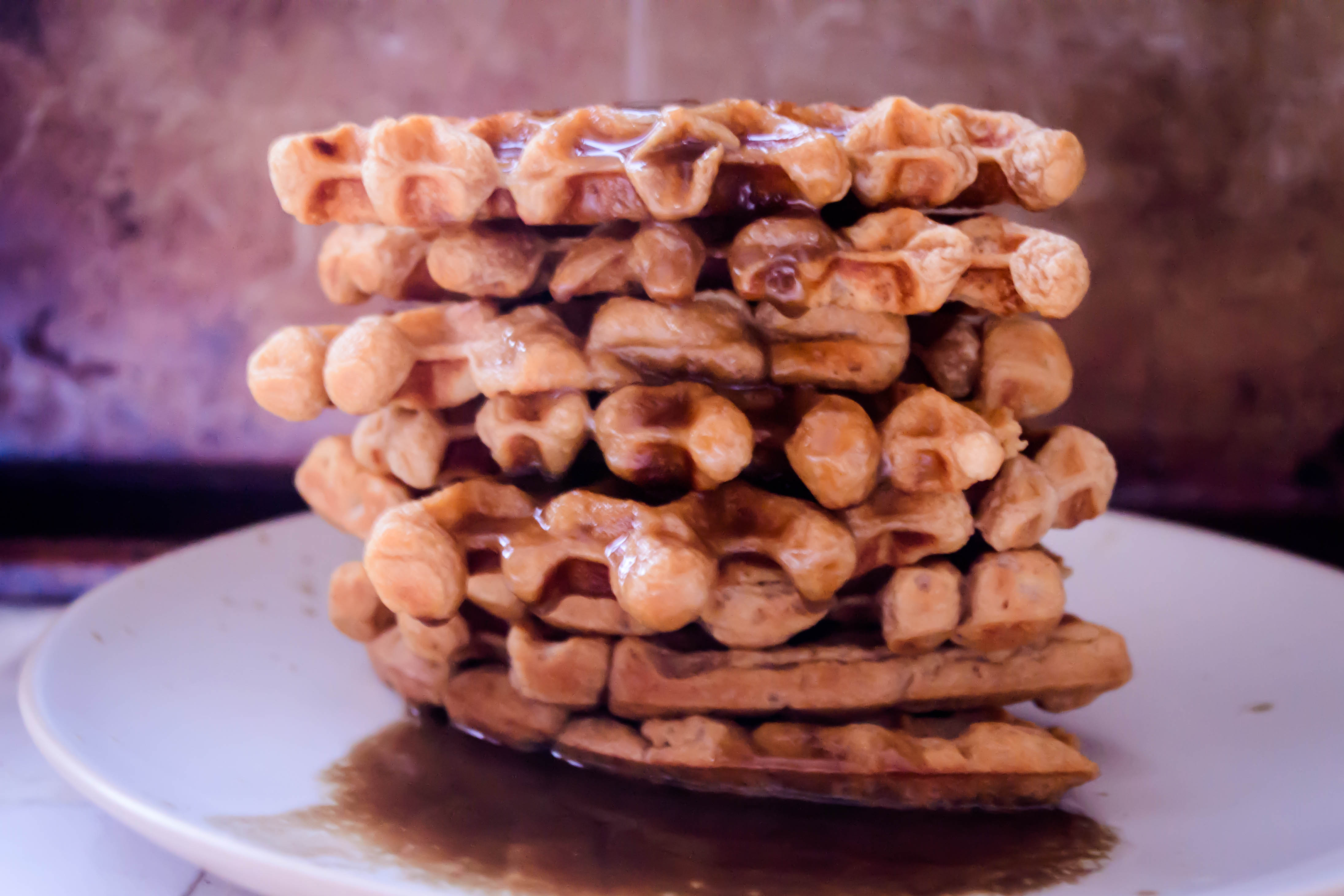
Food Blog November 2013-2749So back to the darkness problem. Usually, when I arrange a plate of dinner to photograph it, N. waits until I’m done to serve himself and head in to the table to eat. On Halloween, as I angled and shimmied and adjusted, trying to catch the last glimmers of fading light and listening to my shutter speed get slower and slower, he stacked waffles onto his plate, drenched them with the caramel sauce, and disappeared around the corner to start his dinner. That, to me, proves its deliciousness beyond all doubt.

Total treat. No tricks. Food Blog November 2013-2755

Beer Batter Waffles
Adapted from King Arthur Flour
Makes about six 7-inch waffles
1½ cups (12 ounces) lukewarm beer (I used a nice roasty porter, heated in the microwave about 30 seconds)
1½ teaspoons active dry yeast
3 tablespoons barley malt syrup (you could likely replace this with maple syrup or honey, but I haven’t tried it. If you do, let me know!)
6 tablespoons (3 ounces) melted butter, cooled
1 teaspoon salt
2 large eggs
2 cups all-purpose flour
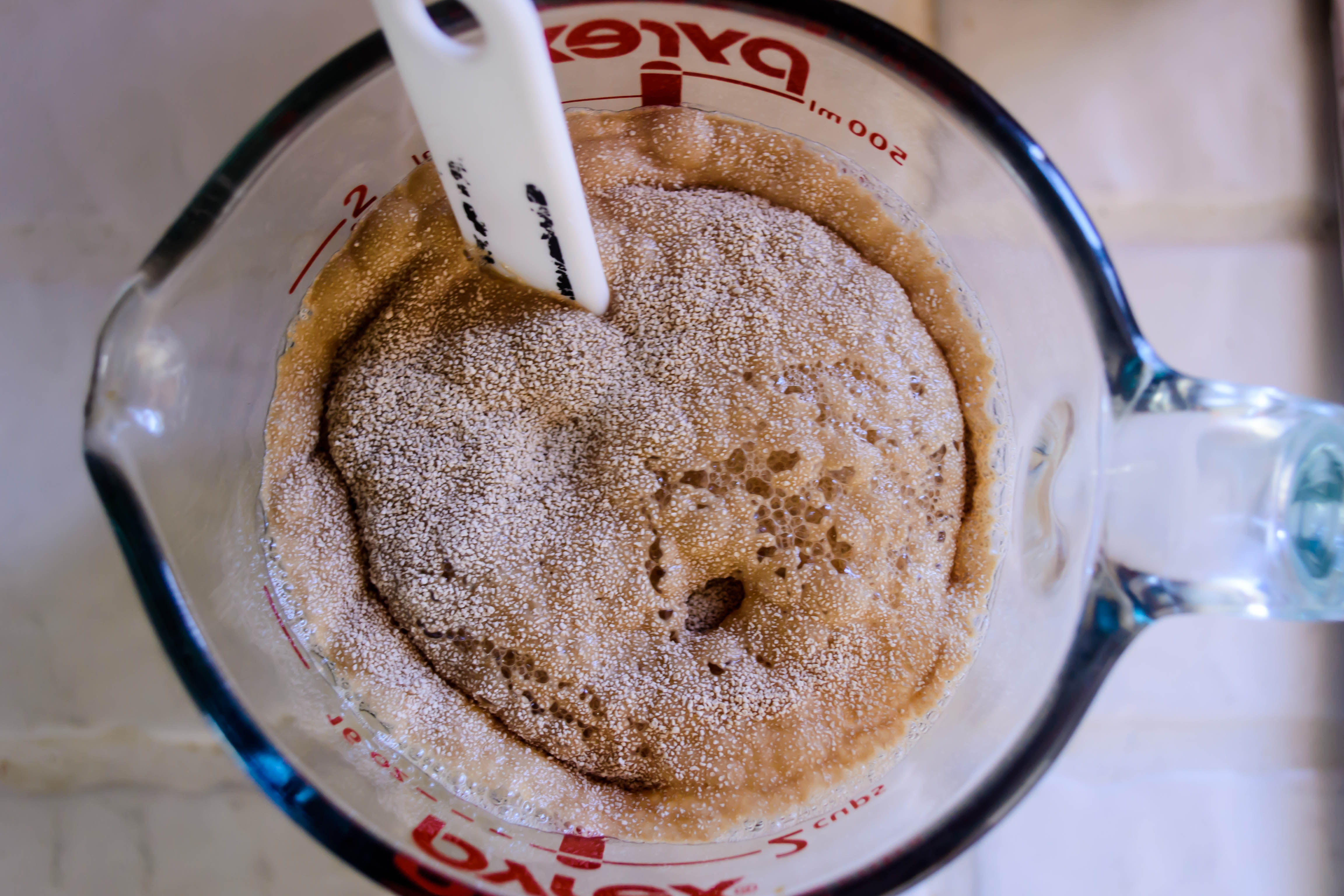
  • In a 2 cup glass measuring cup, or a small microwave safe bowl, heat the beer until just warm to the touch. Add yeast and the barley malt syrup (or whatever sort of sweetener you are using) and let them mingle for 5-10 minutes. The yeast will foam up considerably, thanks to the extra sugars and yeast already in the beer.
  • While the yeast proofs, whisk together the cooled melted butter, the salt, and the eggs in a large bowl. Be sure there’s room for the batter to expand.
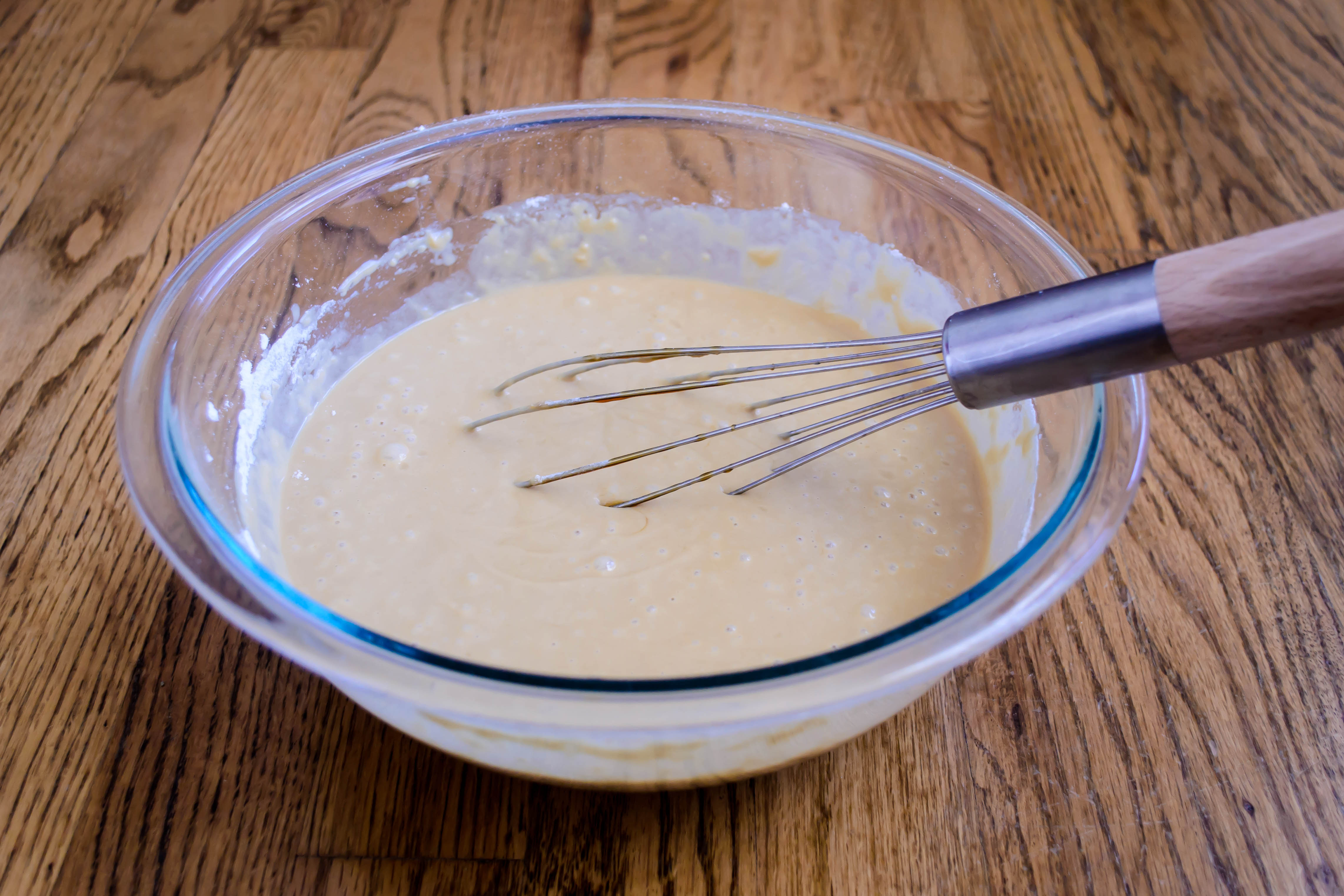
  • Add the beer and yeast mixture and whisk to combine, then add the flour 1 cup at a time, whisking to combine thoroughly.
  • When the flour is fully incorporated and no lumps remain, cover the bowl with plastic wrap and set it on the counter for 1-2 hours.  The mixture will slowly develop lethargic bubbles and begin to smell quite bready.
  • Once it has had a chance to rise for an hour or two, either stow in the refrigerator overnight, or preheat your waffle iron!
  • Drop the batter in generous ½ cup batches (or more, if your waffle iron can take it) onto a preheated, greased waffle iron. Close the lid and cook for the recommended amount of time, or until the waffle is crisp on the outside and deeply golden.
  • Serve hot with bourbon caramel syrup. If you need to keep the waffles warm, stow them on a wire rack over a baking sheet in a 250F oven until you are ready to eat.


Bourbon caramel sauce
Makes about ¾ cup
2 tablespoons butter
½ cup packed brown sugar
½ cup bourbon (I like Knob Creek myself)
1 teaspoon salt
¼ cup whole milk or cream (cream will make for a thicker, more luscious end product)
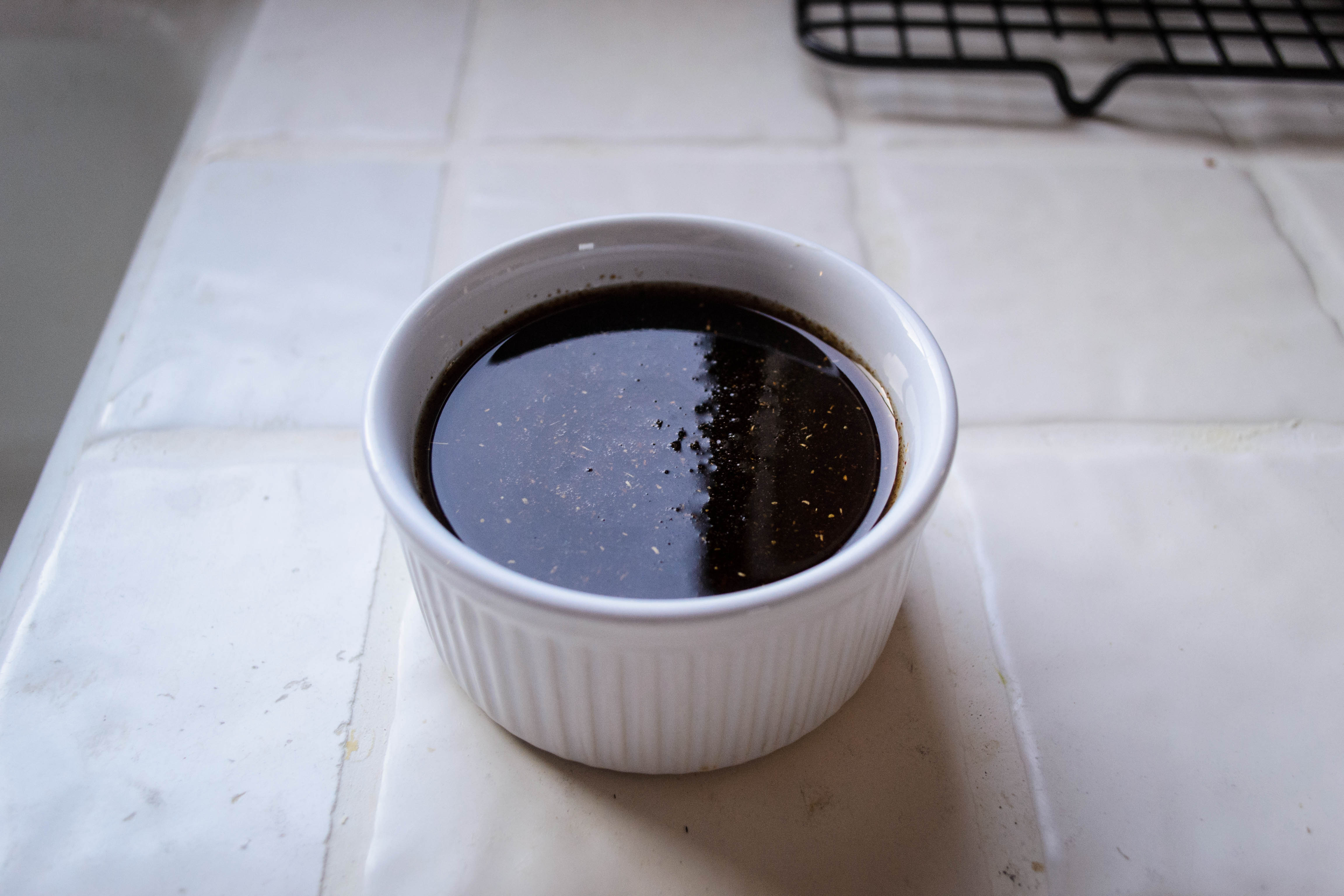
  • Combine the butter, brown sugar, bourbon, and salt in a small saucepan over medium-low heat. Stir to combine as the butter and sugar melt.
  • Continue to stir frequently as the mixture comes to a simmer. Bubbles will begin stacking up on themselves, and you want to prevent both the sugar from burning and the bubbles from climbing too far up the sides.
  • Let the mixture reduce a bit – it will thicken and some of the alcohol will burn off.
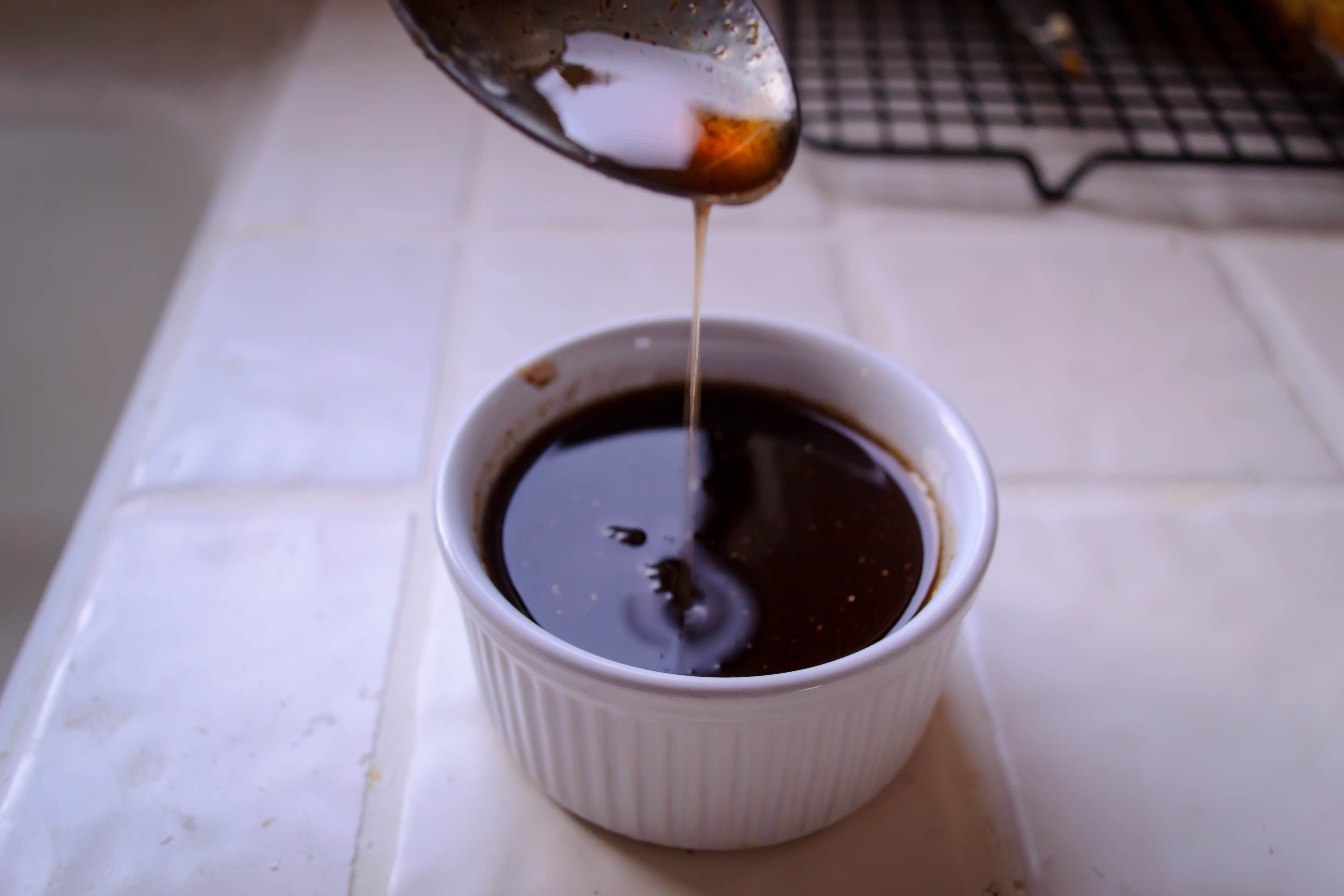
  • Just before you are ready to serve, add the milk or cream and stand back, as the caramel may bubble up furiously.  Stir to combine and keep over low heat just to warm the mixture through. Drizzle generously and enjoy.

Coconut Bread Pudding with Rum Caramel

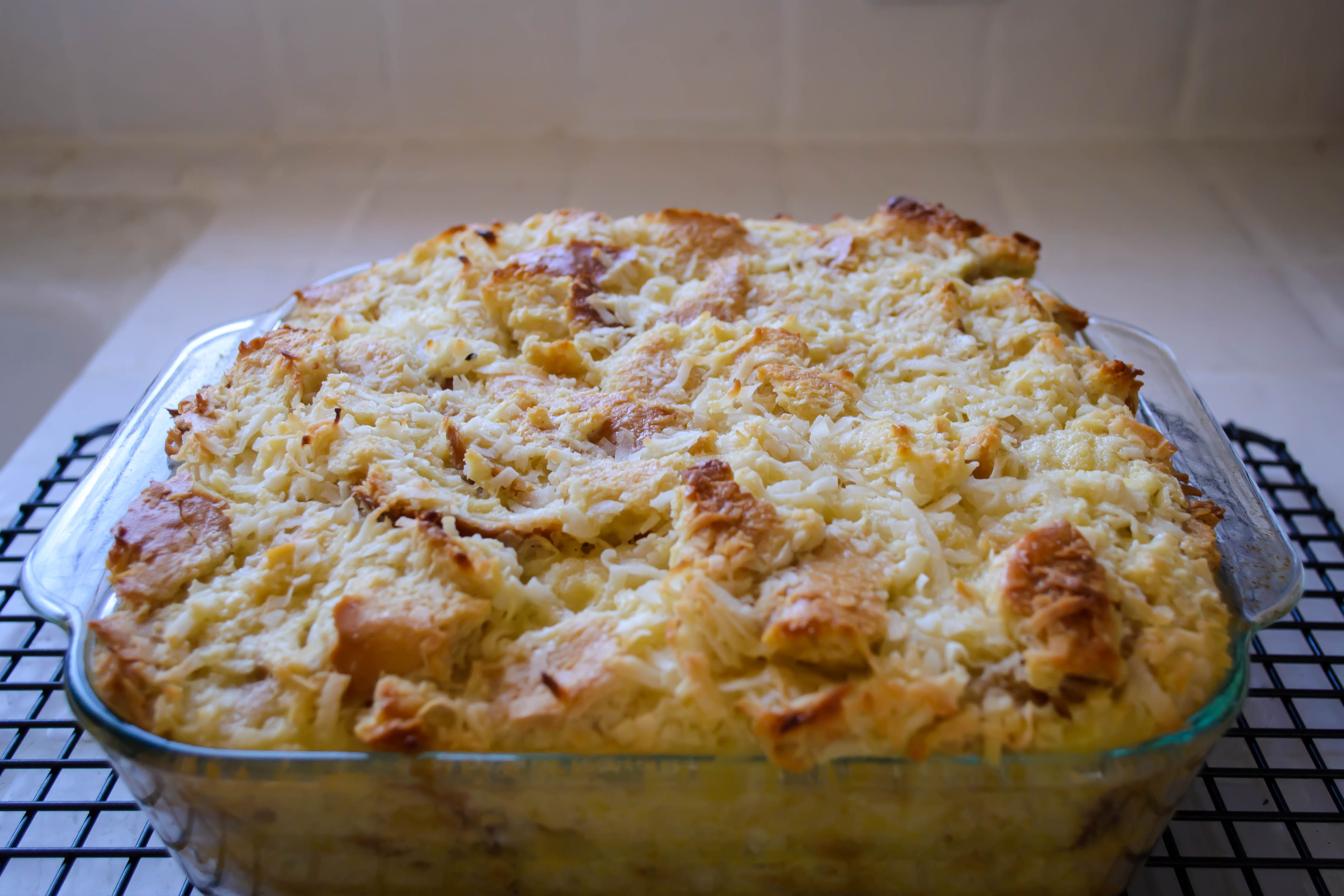
Food Blog May 2013-1375When I’m not frying in the summer time, it seems like I’m baking.  But in the on-and-off foggy uncertainty of June gloom, sometimes you need a little baking.  Of course, now it’s July and the whole West Coast is panting and dreaming of snow drifts so, as usual, I’m behind.  This dessert, though, plush with custard and drenched in rum caramel, is worth it.

Food Blog May 2013-1368Food Blog May 2013-1369Food Blog May 2013-1372Bread pudding is an old dish and, like so many of the “comfort foods” we’ve embraced and raised to new levels of trendiness sophistication (I’m looking at you, French onion soup…), it began as a way to use up aging products in a way that made them still taste good.  In this case, it’s combining cubes of stale bread with milk, eggs, sugar, and whatever else you think is particularly delicious, whether that be fruits, nuts, or chocolate.  Savory as well as sweet iterations exist, and though the dish possibly has European origins, versions now exist in Cuba, the Philippines, Argentina, and in probably every gastropub in the U.S. playing the amped-up-comfort-food angle.

Food Blog May 2013-1366For me, bread pudding is a godsend, because N. loves toast, which means we end up with a lot of crusts.  It seems such a shame to throw them away that I forestall the problem by jamming them in the freezer.  At the point that they fill up a shelf all on their own, it’s time to make bread pudding, a dish that I see as appropriate for a steaming dessert, warm breakfast, straight-from-the-fridge-3pm-snack, or even lunch on a day that I’m feeling particularly lazy.

This iteration, though, I wanted to be special.  I wanted something comforting and homey and rich and delicious, but I wanted a twist.  And that’s where summertime, and N., and my dad, all come in.

Husbands are great, aren’t they?  But most of them (sorry, guys) aren’t perfect.  N. is no exception.  He’s close, oh he’s close, but here’s the thing: he doesn’t. like. coconut.  I know.  And it’s not one of those “no thanks on the coconut cream pie, not a fan” kinds of dislikes.  It’s deep.  It’s subconscious.  The man can tell if a granola bar has coconut in it with one bite.  He once declared that a cookie we were sharing tasted “odd,” and sure enough, down at the bottom of the ingredient list was ground coconut.  Curries at Thai restaurants are dangerous business.  And summer, this glorious season, is a hazardous time of year for N. thanks to sunscreen.  Once, decked out for a gardening session, I gave him a kiss and he told me my face smelled funny.  SPF coconut.

Food Blog May 2013-1353But I adore coconut.  It means vacation and swimming and luxury.  It smacks of the tropics: rum-laced drinks.  Shave ice.  Coconut shrimp (N.’s ultimate nightmare).  And, oddly enough, French toast.  When my sister and I were little, every once in a while my dad would pull down the electric skillet from some cabinet too high for anyone else in the family to reach and make coconut French toast for breakfast.  After dredging the bread in milk and eggs, he dipped each side in coconut before subjecting it to the buttery-slicked heat.

The result was a revelation.  The coconut caramelized into a crunchy, lacy, almost-burned web of texture on the outside of the bread, and its flavor made the addition of syrup all but unnecessary.  This, then, was the mission.  I set out to create my own version of this childhood memory.

Food Blog May 2013-1355Food Blog May 2013-1356Generally I soak my bread puddings before cooking them.  I load my baking dish with stale crusty cubes, mix in whatever bits and bobs I want to add (craisins are a frequent suspect), then pour the custard mixture over the top and set a heavy dish on top to press the bread sponges down into the drink.  And then I shove the whole thing into the fridge for a few hours to promote full incorporation.

This time, though, I decided to employ a different method.  I mixed up the custard with coconut milk and coconut cream instead of regular dairy, and dumped in the bread and, after a moment’s consideration, most of a bag of sweetened shredded coconut.  Thorough mixing followed, and the result – a bowl of creamy soft crumbles of bread and the heady smell of the Hawaiian vacation I wish I were on – spoke summer.  All I could think of, while I pushed the baking dish into the oven, was a piña colada.

Food Blog May 2013-1361Food Blog May 2013-1364The problem with piña coladas, though, is that pesky piña part.  I’ve got no hatred for pineapples, don’t get me wrong, but their aggressive tartness sometimes overpowers the gentle, creamy sweetness of coconut and the spicy complexity of the rum.  A bread pudding sodden with coconut and no pineapple to be found seemed like the perfect excuse for, let’s say, a rum caramel sauce.  Why not?  It’s summer… Dark rum.  Sugar.  A daring sprinkle of garam masala.  Bubbled away in a tiny pot until barely thickened, and the dessert went from homey and comforting to decadent and warming and, oddly enough, somehow reminiscent of camping.  I swear my parents didn’t give us rum when we sat around the fire toasting marshmallows, so all I can figure is that the sweet spiciness reminded me of gingersnaps or molasses cookies or some other well-spiced treat.

Food Blog May 2013-1386Once this heat wave breaks, I think you should make this bread pudding, with or without the sauce.  You won’t, unless you are like my coconut-hating husband, be disappointed.  And if you are, well, someone in your family will be glad they don’t have to share.  Food Blog May 2013-1388

Coconut bread pudding
Serves 8-10
4 eggs
½ cup sugar
14 oz. coconut cream
14 oz. coconut milk
1 tsp vanilla
2 cups shredded coconut – mine was sweetened.  If yours was not, you might add up to 1 cup of sugar above.
10-12 slices sourdough bread, cut or torn into cubes
  • Preheat your oven to 350F and spray or oil a 9 inch square baking dish.
  • To measure how much bread you will need, tear the slices directly into the baking dish.  Press them down once or twice, packing them until they mound up just a little over the edge of the dish in the center.  This gives you the right amount of bread to mix into the custard.
  • In a large bowl, beat the eggs and sugar together for a minute or two, until the mixture is homogenized.
  • Add the coconut milk, cream, and vanilla, and whisk until well blended.
  • Tumble the shredded coconut and torn or cut pieces of bread into the custard and mix well, ensuring that every bread cube is well moistened and the sticky clumps of coconut loosen and disperse through the mixture.  I used a wide bladed spatula and it seemed to do the job well.
  • Carefully relocate the custard-soaked bread to your prepared baking dish, pushing it down if needed to fit everything in.
  • Bake at 350F for 45-60 minutes.  This seems like a wide range of time, but depending on your oven and the relative staleness of your bread (which will determine how much custard it soaks up) your cooking time may vary a bit.
  • To determine doneness, check to see that the center of the pudding has puffed up, and the top is nicely browned.  Some of the coconut shreds will toast to a dark gold.
  • When done, let it sit for 10-15 minutes to allow the custard to firm up a bit.  This will make it easier to cut or spoon out.
  • For an elegant presentation, cut into squares and set on a puddle of rum caramel, or drizzle the caramel liberally over the top.  Or forgo elegance, and scoop out big spoonfuls to pile into your bowl or plate.


Rum caramel sauce
Makes a scant ½ cup
½ cup sugar
½ cup dark rum
½ tsp garam masala (or more to taste – I used a full teaspoon and it was quite strong)
2 TB cream, optional
  • Combine the sugar, rum, and garam masala in a small saucepan and cook over medium low heat for 10-15 minutes, until sugar is dissolved and sauce thickens and becomes slightly syrupy.  Stir or swirl frequently to prevent sugar from burning.
  • If you want your caramel thicker or more luscious, stir in the optional 2 TB cream.  Stand back as you add the cream, as the caramel may bubble up upon contact.
  • Cool slightly before serving.

This is dynamite with coconut bread pudding, but would be equally delicious dribbled over ice cream, or mixed into a milkshake, or maybe even as a puddled base for your 4th of July slice of apple pie.

Dried Fruit and Ginger Scones

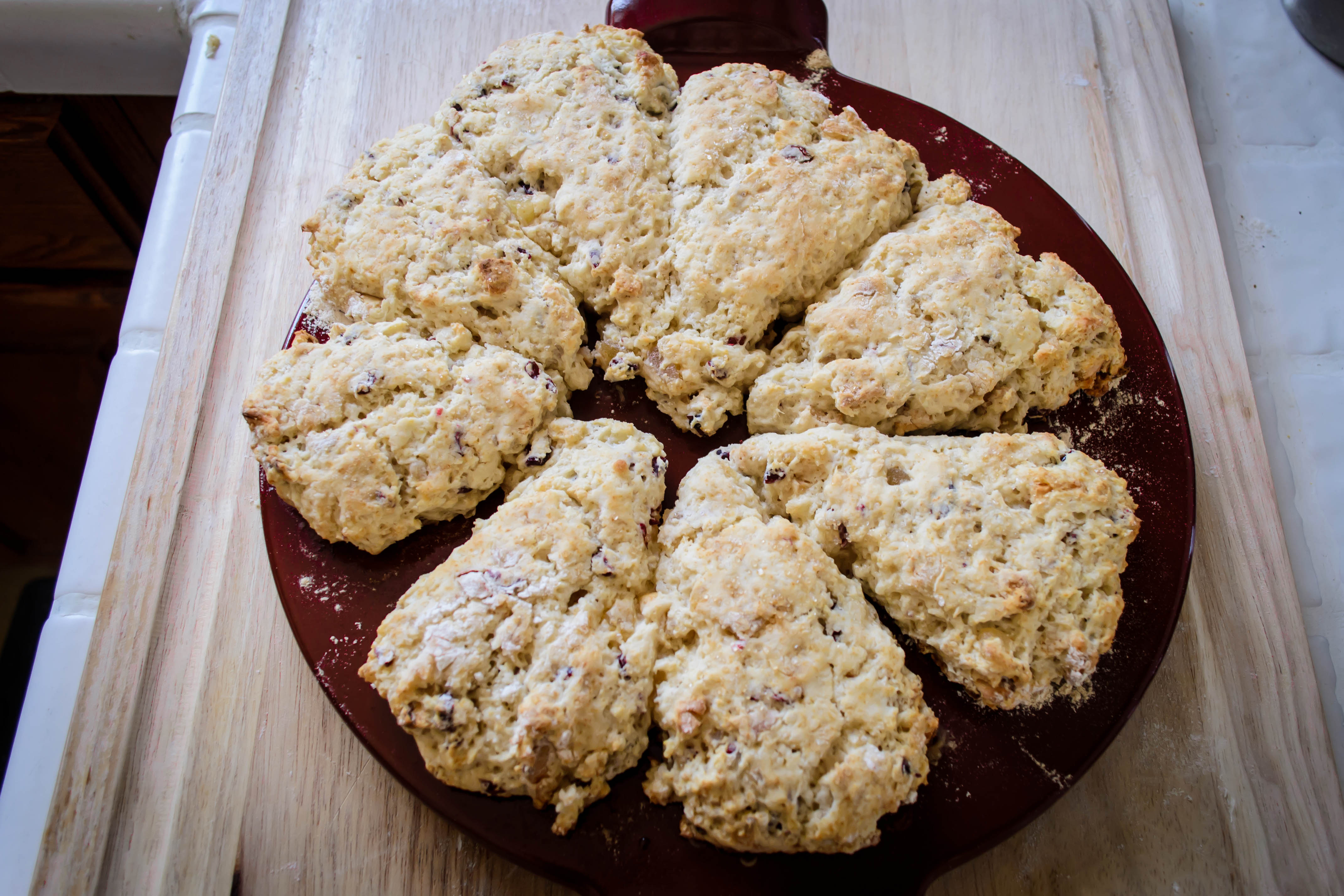
Food Blog April 2013-1194

This month’s archive makes it look like I’m harboring a bit of a sweet tooth.  Nothing wrong with that, necessarily, but I should tell you this week’s entry is actually at N.’s (indirect) request.  A month or two ago, my beloved aunt sent me some specialty King Arthur flour, and along with the packages of semolina and European style AP blend came a catalog.  Naturally, this has become my bedtime reading (what, you don’t read cookbooks and kitchen magazines in bed?), and on Monday night as I dawdled longingly over a blurb about Double Devon Cream, N. surfaced from internet-land and glanced at the facing page.  “That,” he said, and pointed at a photograph of some cranberry orange scones.  “You want scones?”  A silly question, apparently.  “That.”  So here they are.

Food Blog April 2013-1189

I did some research (i.e. food blogs and recipe comparisons from the other cookbooks stacked on my nightstand) and found, as usual, that Deb has all the answers.  Seriously, is there anything the woman hasn’t made?  I adore you, Deb, but really – a person can only repress the green-eyed monster for so long…   This adapts her recipe for “Creamy, Dreamy Scones,” which she got from the America’s Test Kitchen Cookbook.  I’ve used a combination of cake flour and all purpose flour for a lighter texture, allowed turbinado sugar to stand in for the regular sugar, and replaced some (okay, most) of the cream with whole milk, because I lost my mind this week and, forgetting the intended use of that little container, dumped most of it into an unholy-but-oh-so-heavenly conglomeration of chard, bacon, and bourbon.

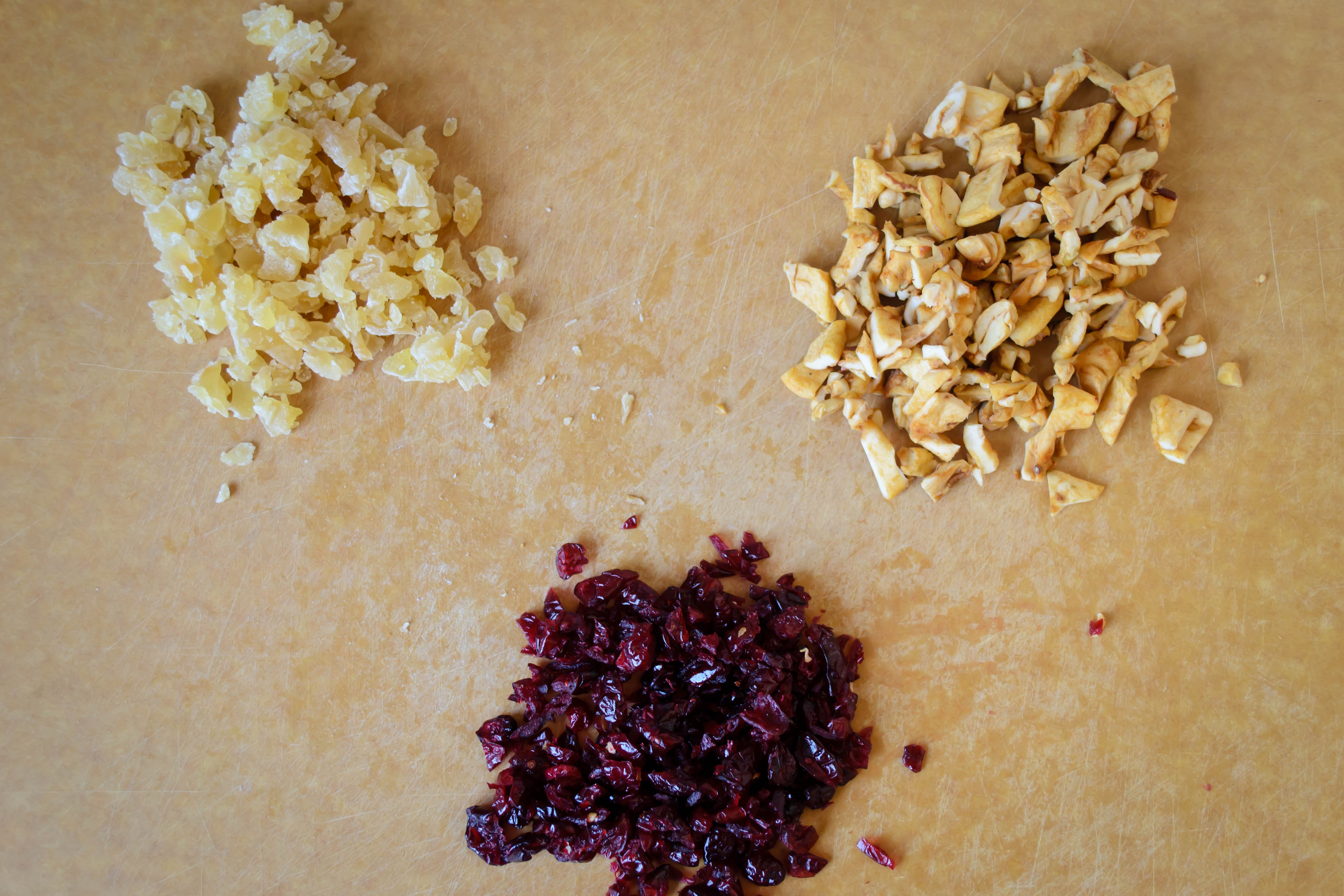
These scones take advantage of the bags and bags of dried fruit that inevitably collect in my pantry.  You could probably add other flavors as well, but I thought apples and cranberries, and the candied ginger I’ve been obsessed with for at least a year now, would play well together.  Apricots would probably be beautiful too (unless you are, like one of my family members who shall remain nameless to protect familial harmony, freaked out by dried apricots because they apparently bear an uncomfortable resemblance to mouse ears).

Food Blog April 2013-1170

Scones come together much like biscuits: whisk the dry ingredients, cut in the butter, stir the milk/cream/buttermilk and flavor additions in with a fork.  But then, and this is where things can go awry, you have to pat it into a circle and either punch out rounds with a biscuit cutter, or slice the whole thing into triangles.  I chose the latter.

Food Blog April 2013-1177Food Blog April 2013-1182

This dough is, if we’re honest with each other, an almost unmanageably sticky mess.  Resist the temptation to mix more flour into the dough, because the more flour you add, the less tender the finished scones will be.  But do be prepared to sprinkle flour over everything it will come in contact with.  I used a floured pizza cutter to slice it into eight pieces, which tore up edges and corners even while the dough clung fiercely to the board below.

Food Blog April 2013-1178

Food Blog April 2013-1180

Food Blog April 2013-1185

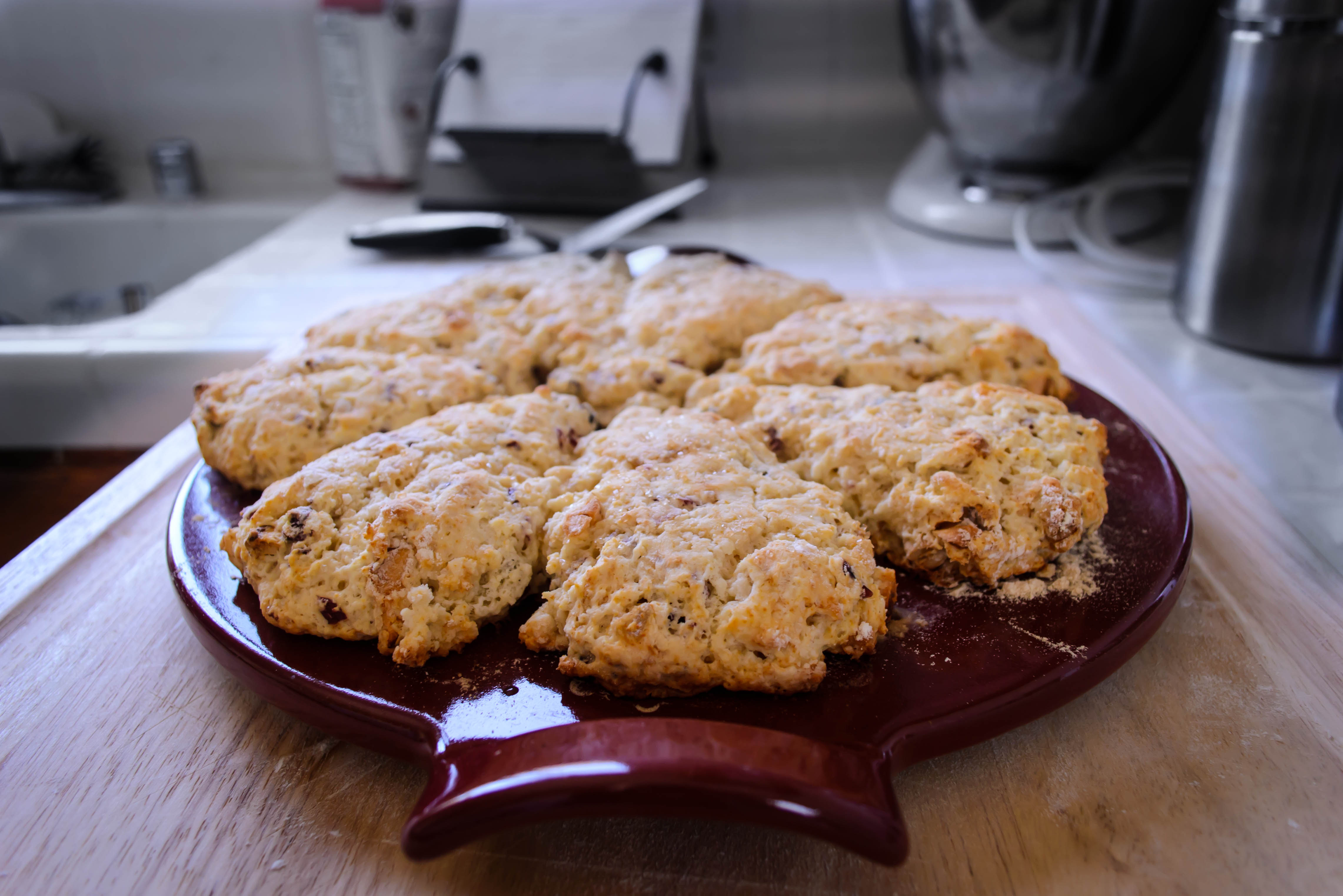
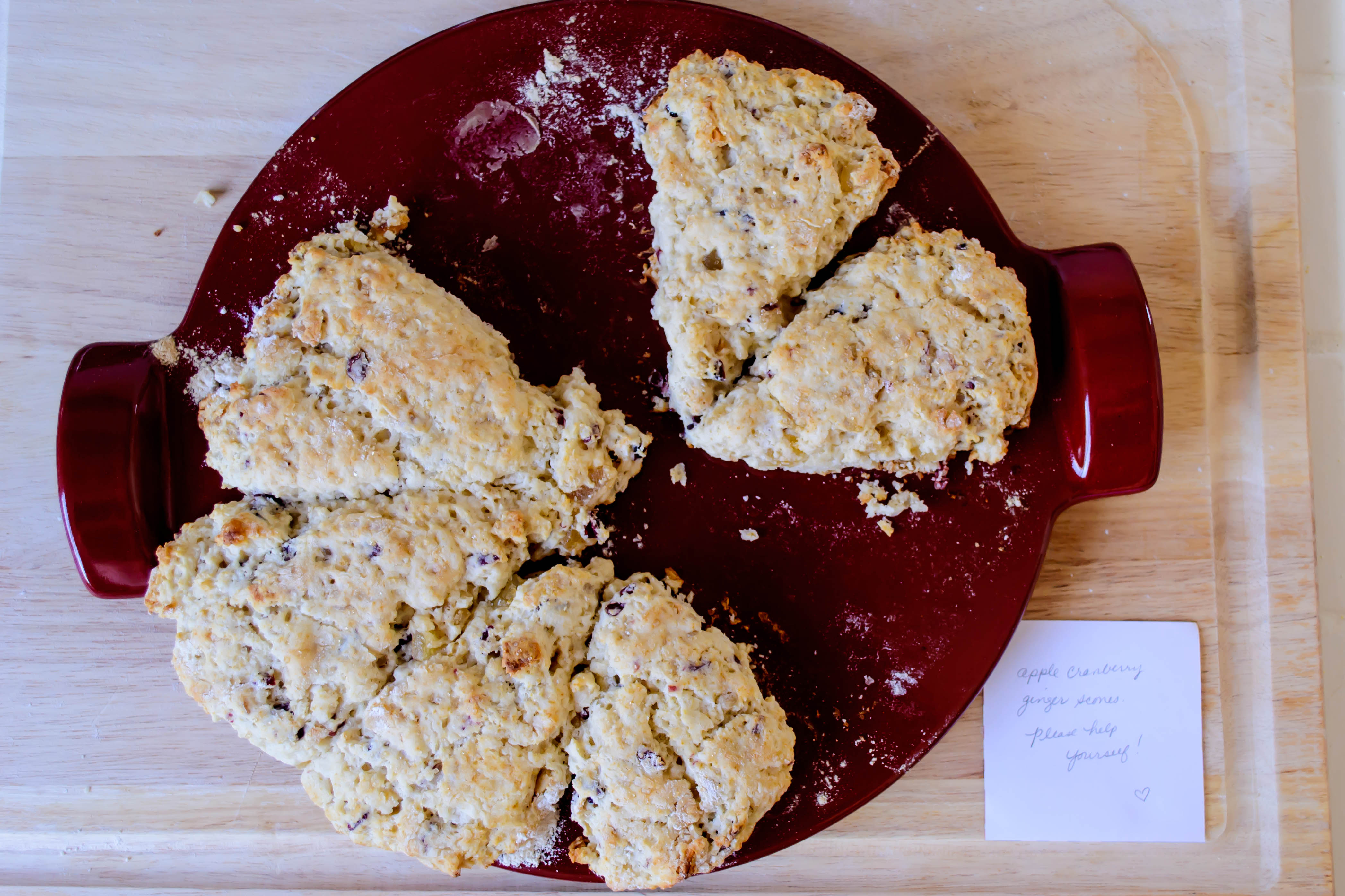
A bench scraper tool is really helpful for transferring your scones to their cooking vessel – a parchment lined baking sheet would be fine, but I used my brand new enameled pizza stone because I’m so jazzed about it.  This, because I preheated it along with the oven, made the scones sizzle as I levered each one onto its surface, and rather than sticking (which I was dreading, since I realized only after they’d been in the oven for five minutes that I hadn’t greased or floured the cooking surface AT ALL), produced a crisp bottom crust.

Food Blog April 2013-1190

I left my offering on the pizza stone to cool while I took the dog for a walk, and returned to find it had been accepted.

Food Blog April 2013-1191

An hour or so later, it had been accepted again.

Food Blog April 2013-1192

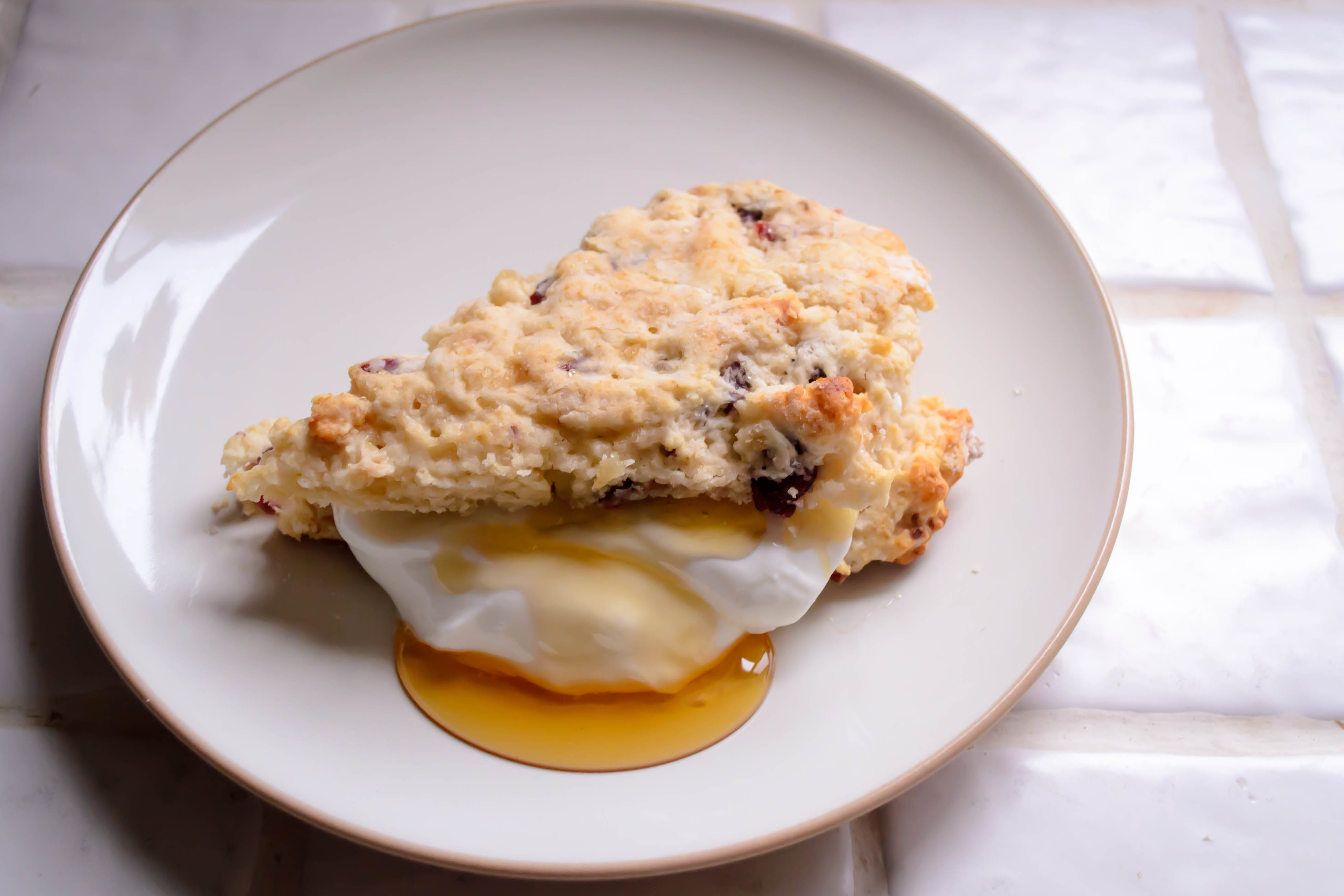
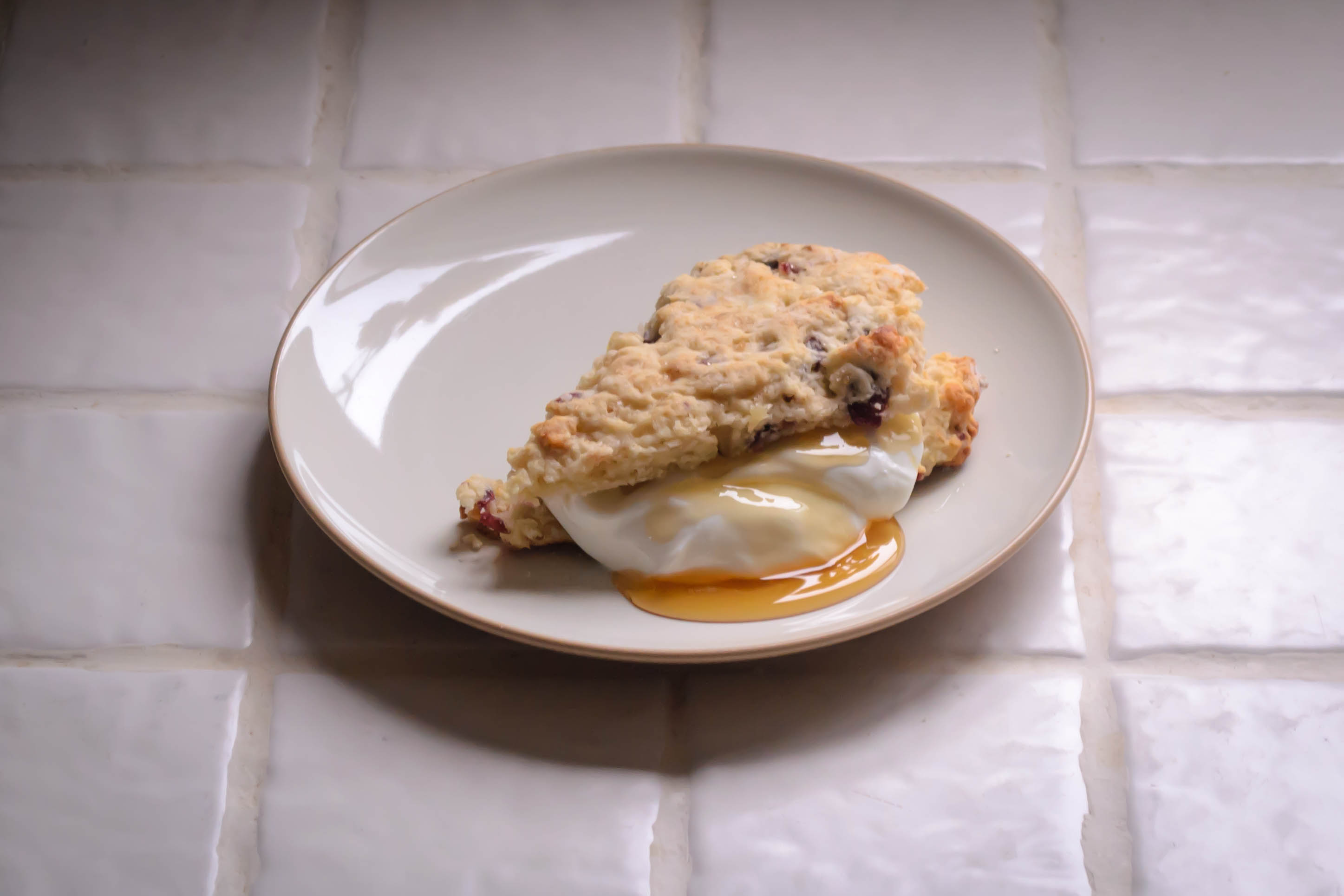
These are best on the first day, but will keep acceptably for two or three days if they are well wrapped in aluminum foil and stored at room temperature.  Chances are – if your family is anything like mine – this short storage period won’t be an issue.  Still warm, these make perfect hand-held afternoon pick-me-ups (the ginger really zings you out of the 3 o’clock slump), but if you want to go the extra mile, I recommend slicing them in half so you have two triangles, stuffing them with Greek yogurt and a decadent ooze of local honey, and attacking with a fork for breakfast.

Food Blog April 2013-1197

Apple Cranberry Ginger Scones

Adapted from Smitten Kitchen, who used America’s Test Kitchen Cookbook. 

1 cup all-purpose flour

1 cup cake flour

1 TB baking powder

4 TB coarse sugar, divided (I used turbinado because that’s what was in my baking cupboard)

½ tsp salt

5 TB butter, cut into cubes

¼ each chopped dried apples, chopped dried cranberries, and chopped candied ginger

¼ cup heavy cream

¾ cup whole milk

  • Position a rack in the middle of your oven and preheat to 425F.  If you will be baking on a pizza stone, put it in the oven to preheat as well.  If you will be using a cookie sheet, line it with parchment paper and set it aside.
  • Whisk together the flours, baking powder, 3 TB of the sugar, and salt in a medium bowl.
  • Cut in the butter using a pastry blender, two knives, or your fingers, until the largest chunks of butter are the size of small peas (sidenote: “peas” seems the universal size for butter chunks – why is that?  Is there no other pea-sized object so regular and recognizable in size that we could call upon?  Ball-bearings?  Corn kernels?  Canine teeth?).
  • Pour in the cream and milk (or just use all cream, if you have it) and mix it around with a fork until an evenly hydrated, extremely sticky dough forms.
  • Add the fruits and mix again until evenly distributed (you may have to work a bit to break up the ginger pieces).
  • Dump the sticky mass out onto a well-floured board.  Sprinkle a little flour on top as well, then pat the dough out into a circle about 1-inch thick.  Try not to add too much flour, lest they become dense and tough.
  • Dip a pizza cutter or other thin, sharp knife into flour, then cut the circle into 8 equal sized pieces.  You may need to scrape off and re-flour your slicing instrument between slices.
  • Using a bench scraper, a thin spatula, or (if you are brave) your hands, relocate your 8 scones to your prepared baking vessel, spacing them a half inch or so apart (they will puff and rise a little bit, but not tremendously).  Sprinkle the tops with the remaining 1 TB of sugar.
  • Bake for 13-15 minutes, or until lightly golden on top and cooked through.
  • Cool at least 10 minutes before removing to a wire rack.  Eat warm or cool.

Orange Marmalade and Almond Sweet Rolls

Food Blog February 2013-0720
Guys, I’m pretty excited about this one.  It’s a mile marker for me in a couple of ways.  One, it’s a sweet application of yeast dough, which I’ve never tried before.  Two, I’m well into the second month of this project and I haven’t had any true disasters yet or fallen off the horse, which buoys my confidence.  Three, except for temperature and cooking time, which I had no idea about, I didn’t consult the internet a single time for clues about how to make this.  But four, and unquestionably most important, this is an adaptation of one of my Nana’s recipes, and I made it successfully.
Food Blog February 2013-0632
Nana was a cook.  She was an old-fashioned, from home, meat/starch/veg-that-sometimes-came-from-a-can kind of cook.  She was a clean-your-plate-before-you-can-have-dessert and sometimes a there-are-starving-children-out-there kind of cook.  But that was her era.  She raised her three kids on three square meals a day plus cookies.  She taught my two aunts how to cook, she cooked for our Pap almost up until the day he died, and she sent out a yearly box of Christmas cookies until I was almost through college.  My freshman year I remember getting a slip in my mailbox that meant I had a package to pick up, and finding, after returning to my room and tearing at it feverishly, that it was filled with sweets.  Chocolate dipped apricots, cream horns, which we called ladylocks, nut rolls, seven layer bars, pizzelle; these were how Nana sent us her love.  I always meant to send one back to her, when I was “grown up.”  It tugs at me a little that I never did.
Food Blog February 2013-0648
When she heard I was learning how to cook, she gave me my first cookbook: The Complete Guide to Country Cooking, along with a subscription to Taste of Home magazine.  One summer when we came to visit, I offered to help with the menu and she told her friends her granddaughter was going to be her cook for the week.  She said it was good, too.
In 2007, when I was about to get married, I received a large red photo album from my female relatives, featuring favorite recipes from their own kitchens.  Nana couldn’t attend my wedding – she was on oxygen and too weak for the plane ride across the country from Pennsylvania – but she had contributed recipes to this book, and even as I cherished her contributions I never thought I would make most of them myself: I was too inexperienced to try these dishes she had clearly mastered – lemon meringue pie and yeasted sweet dough were beyond my capabilities.
Food Blog February 2013-0628
But when I thought about cooking this past week, I thought about that stretch of dough from my dill bread and in its place saw cinnamon rolls.  They are, after all, filled and constructed in a similar way.    I love cinnamon rolls, but sometimes the dripping gush of cinnamon pooled in pounds of sugared butter is just too sweet for me.  Orange marmalade came into my mind, and with it, almonds.  They seemed like such a nice pairing, and as I wondered how to make them I found myself back in Nana’s section of my big red cookbook, staring at directions that now seemed less intimidating than they did six years ago.
Food Blog February 2013-0657
This is a beautiful, elastic, slightly sweet dough.  It is smooth and rich and expansive, and it makes a glorious roll.  It sighs like a feather pillow when you punch it down.  It wants very little from you – just a massage with melted butter, a liberal smear of marmalade and almonds, and gentle, careful rolling.  Inside, after baking, the orange and almond marry well, since the jammy part of the marmalade pools against the dough, but the zest and the almonds retain texture for the teeth to play with.
I doused one pan with a glaze made from fresh orange juice and powdered sugar, but I think that overdid the sweetness factor a bit too much: the glaze tasted like liquified orange Pez.  Better, I would say, would be a slick of soft cream cheese, perhaps whipped with a little brown sugar if you absolutely must.  But plain, browned, warm out of the oven, and a little sticky with its own sweetness, is just perfect all by itself for breakfast, for dessert, for mid-morning snack.  For any time that is right now, really.  Thanks, Nana.
Food Blog February 2013-0697
Orange Marmalade and Almond Sweet Rolls
Dough:
¼ cup warm water
2 tsp yeast
¼ cup scalded whole milk (heated to just below boiling – 45 seconds in the microwave does the trick)
¼ cup sugar
½ tsp salt
1 egg
¼ cup soft or melted butter
2 ¼ cups flour (you probably won’t need all of it – I ended up using a total of 1 ¾ cups)
Filling:
¼ cup melted butter
1 cup orange marmalade, warmed slightly
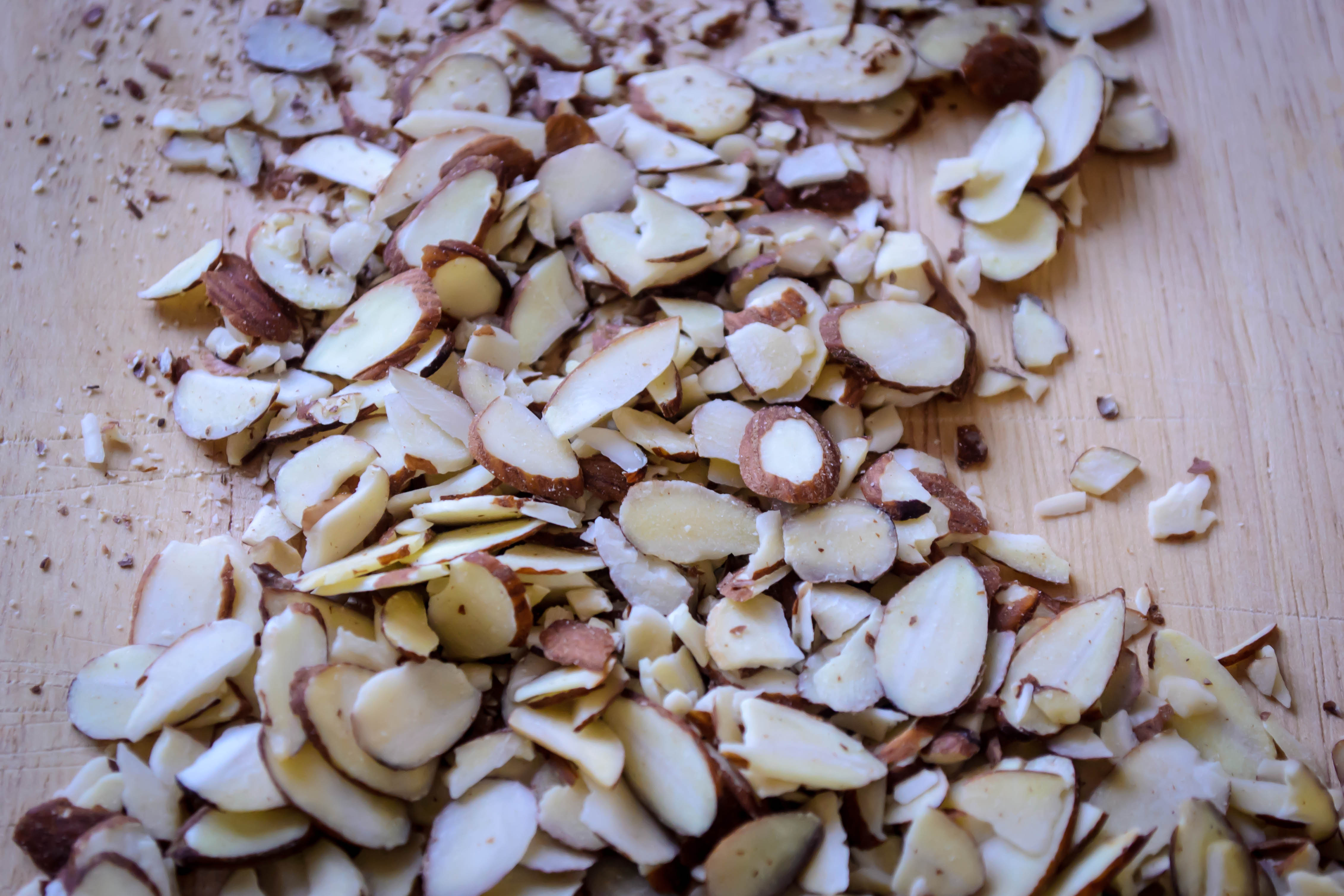
1 cup sliced almonds
Food Blog February 2013-0682
In the bottom of your mixing bowl, combine the yeast and water and stir gently.  Let it sit for at least 5 minutes so the yeast wakes up a bit.
Meanwhile, heat your milk, then cool it down.  You can hasten the cooling process if you forgot to soften your butter: just drop the still-cold stick right into your warm milk and swirl.  You’ll cool the milk and soften the butter simultaneously.
When the yeast bubbles and smells bready, add the cooled milk, softened or melted butter, sugar, and egg.  Stir to combine.  When the mixture has homogenized a bit, add 1 cup of the flour and the salt and stir again.  You will have a soggy, unworkable mixture.
Continue to add the flour ¼ cup at a time, stirring after each addition (if you are using a stand mixer, use the paddle attachment and just keep it on low speed until things come together).  When it starts to look like bread dough – pieces begin to have that floured, torn texture and hold together – and becomes just workable, don’t add any more flour to the mix.  Switch to your dough hook or a well floured board, and knead until smooth and elastic, about 5 minutes.
Once kneaded, put your shiny, smooth ball of dough in a lightly greased bowl and roll it over so all sides are moistened by the oil.  Let it rise in a warm place until it doubles – at least an hour and a half.  I like to heat my oven to 200F (my lowest setting) for a few minutes, then turn it off and let it cool for another few minutes before stowing my dough inside.
Food Blog February 2013-0658
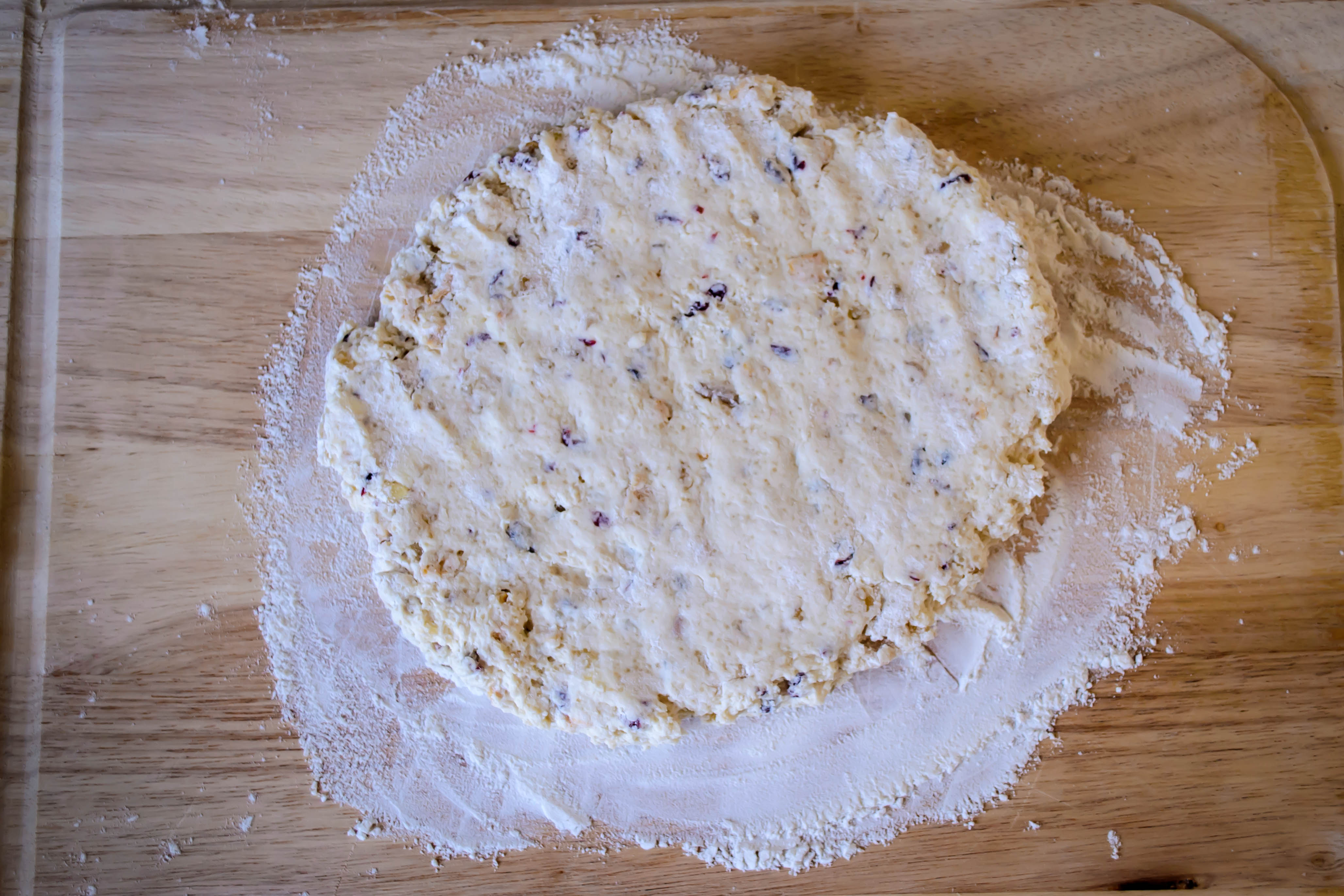
When the dough is ready, it will have doubled in size, and the bottom will be covered with puffy little bubbles like the ones that let you know your pancake is ready to flip.  Punch it down by pushing your fist gently into the middle to let the gas escape.  Turn it out onto a floured board and roll gently, forming a rectangle of probably 2 feet by 3 feet.  Maybe 3 by 3, if it seems willing.  It should be ¼ – ½ inch all the way around.  My board was, clearly, a bit on the small side for this undertaking.
Food Blog February 2013-0663
Food Blog February 2013-0664
Give your layer of dough a massage with the ¼ cup melted butter, spreading it evenly over the surface until it’s gleaming, but leaving an inch or so margin around the edges.  This will help prevent spillage of the inevitable ooze when you start rolling.
Food Blog February 2013-0666
Spread the warmed marmalade over the buttered dough, again respecting the inch margin.  Warming it up by microwaving it for just 30 seconds or so helps it spread more evenly.  Sprinkle on the sliced almonds and get ready to roll.
Food Blog February 2013-0668
Food Blog February 2013-0675Food Blog February 2013-0677You have to do the rolling in small stages, I found.  Begin at the middle of the longer edge of your dough rectangle and make a few tight rolls, but then move to the edges and help them catch up.  They don’t roll on their own, since the piece of dough you are working with is so big, so your fingers will be busy (and no doubt sticky) flying from side to middle to side again.  Continue this process until you have created a long, tight roll of dough.  Some filling will unavoidably ooze out the ends, but if you’ve left a margin around all sides this should be minimal.  Turn the tube gently so the outer edge faces up, then pinch it gently into the next layer to create a seam so your rolls don’t become unrolls.
Food Blog February 2013-0679
Food Blog February 2013-0680
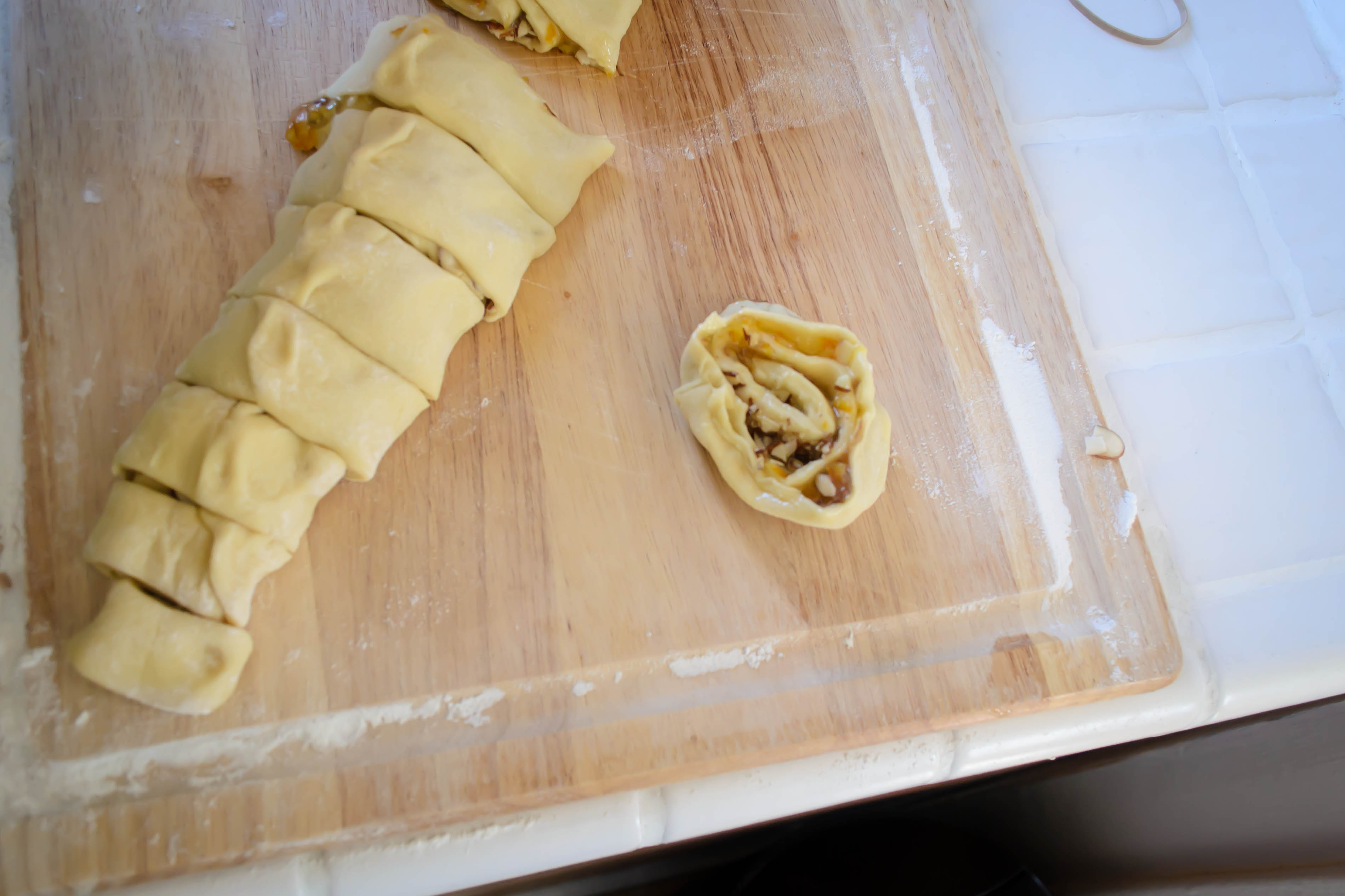
Carefully slice your rolled tube into individual portions.  I ended up with about a dozen squashy, messy, less-than-round offerings.  Deb at Smitten Kitchen suggests using a serrated knife and sawing gently, letting only the weight of the knife move down through the dough, to prevent the squashing I experienced.
Food Blog February 2013-0684Food Blog February 2013-0687Food Blog February 2013-0691
Nestle your rolls filling side up in greased baking trays – I used 9 inch cake pans – and let them rise again for 30 minutes.  This would also be a good time to preheat your oven to 375F.
Food Blog February 2013-0702Food Blog February 2013-0706
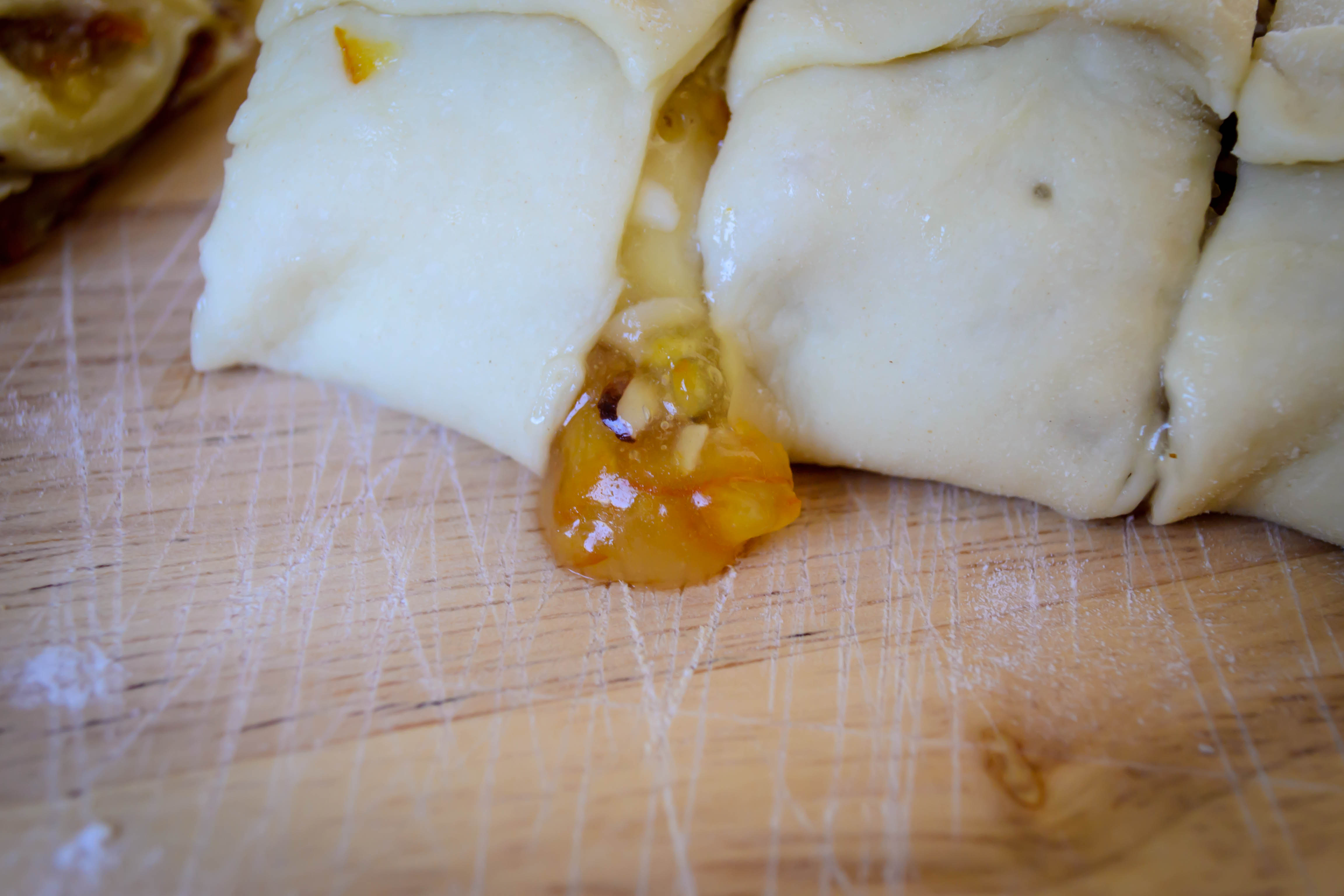
Stow your pans in the preheated oven for about 18 minutes, at which point the tops will be golden, the exposed marmalade will be somewhere between dripping and caramelizing, and the edges of each roll will have puffed against each other, some adhering thanks to the sticky filling.
Food Blog February 2013-0708
While they are warm, you can drench them in glaze or icing if you wish, or you can just gently liberate them from their pans and eat them with fork or fingers.  I like to unroll mine as I eat, saving the extra buttery, extra jammy middle bit – which everyone knows is the best part – for absolutely last.
Food Blog February 2013-0714Food Blog February 2013-0725
Most of the photo credit on this one goes to N., who got really into his job as stand-in photographer this week!  Thanks, honey.