Reflecting

The Bittman project is done.  I did it!  I took a list of 101 side dishes conceived to accompany a Thanksgiving turkey, whittled it down a bit into dishes N. and I would actually eat (this left us with a total of 82) and, over the course of two years, made and ate each one.  Before moving on to my next project, I wanted to stop and consider a bit.  This project was valuable in many ways and I don’t think it should be pushed aside like a last gasping bite before launching into the next thing.  I learned a lot about cooking, I think, both from the mistakes I made and from the little triumphs and successes I achieved.


The Mistakes:

Measuring is important.  If you don’t measure, if you don’t have the correct ratios, things don’t bake up the way they are supposed to.

Follow directions.  Roasting can’t happen with waterlogged ingredients, and adding items in the wrong order produces unintended results.  Of course, this is challenging with Bittman’s suggestions because they don’t always have exact directives.  But it has taught me a lot about how a recipe fits together, and how to organize and present information in a way that works – at least for me.

Pairings matter.  Learning how to cook a dish is one thing.  But you’re probably always going to be serving it to someone (or multiple someones) as part of a meal.  Crossing flavors in strange ways – Italian sausage with soy-glazed vegetables, Southwestern spices with Middle Eastern preparations, too much sweet with too little savory – doesn’t produce a very satisfying eating experience.

I just don’t like yellow curry.  I can tolerate it, but I’d much rather have garam masala, or tumeric, or cumin, or just straight black pepper.

Give yourself time.  Charging headfirst into an unfamiliar recipe with only twenty minutes until dinnertime is almost always going to lead to frustration, mistakes, and unsatisfying results.  This sounds very preachy, but read the recipe beforehand, make sure you understand what it is asking, and budget your time accordingly.

WRITE THINGS DOWN!  This isn’t the first – or the only – time I will make this mistake.  But I’m trying.  If you don’t write it down, chances are good you won’t remember it.  And then that perfect amount of nutmeg, or salt, or the temperature you used, is lost.  And that makes it unrepeatable.


The Triumphs:

Repurposing works.  If something doesn’t come out right – or to your liking – there is no sense in throwing it away if you can imagine transforming it into something better.  If that means adding booze and wrapping it in pie dough, then so be it!

Acid saves.  If your dish is missing something but you don’t want to add more salt and you’re not sure about upping the spice quotient, try a squeeze of lemon juice or a dash of red wine vinegar.  There’s something about the brightness and verve this brings to a dish that really changes it.  (Hell, it even tones down the overbearing sweetness of buttercream. )

I can, if I take my time and don’t freak out, make a successful dough.  It’s not pretty yet, and it’s not error-free, but it comes together and rolls out and tastes pretty good too.  That’s something.  That’s more than I expected.

Soup is easy.  I grew up on two kinds of soup: the overprocessed, condensed kind that came in cans, and the long-simmering stew and chili kind.  This led me to believe that homemade soup was a time consuming process.  Watching cooking shows that talk about extracting flavors from bones and babysitting a stock for hours furthered this assumption.  But since I’ve started making my own chicken stock from the carcasses of roast chickens, and since I realized that Bittman’s soup recipes mostly go the same way (sweat vegetables, add flavoring, add broth and heat through), soup became a quick and simple venture.  Onions, garlic, carrots, celery, and chicken broth, and you’re 75% there already.  During the year I even invented my own, which N. and I will be having again next week with the addition of ramen noodles.


The Favorites:

As seems inevitable with a project like this, there are some ingredient combinations N. and I will never have the desire to return to.  But there are some that we will crave again and again.  Some, in fact, have already graced our table on multiple occasions.  I just want to point out a few of these.

Sweet.  This combo of sweet potatoes and green onions, roasted until caramelized and perfectly salted, is an achingly beautiful side dish still in search of the perfect accompaniment.  But it dances solo just fine.  I’d have these for lunch any day.  I’d have them for dessert too.

Sausage, kale, and white beans (and cheddar cheese or Parmesan rind, too, if you really want to comfort it up) are a beautiful combination that deserve revisiting.  This soup is warm and satisfying and should be eaten at least once per winter.  Nicely spiced tempeh crumbles might make an adequate substitution for the sausage, if you aren’t into pig.

Herbed buttermilk biscuits, especially with the addition of lemon zest, are all I want in the biscuit world right now.  They are crisp and tender and have just the right crunch.  They are breakfast ready.  They would accept cream gravy.  They would mop up a savory sauce.  They would provide the perfect vehicle for jam or honey or sweetened goat cheese.  They freeze perfectly and, frozen solid and plopped onto parchment paper, require only a few extra minutes in the oven to cook.

Ginger-Apricot Chutney.  This spicy-sweet condiment would be a suitable topper for the Herbed Buttermilk Biscuits I just got weak-kneed over.  But it also pairs well with grilled or roasted chicken, and would probably be delectable as a fresh take on a Christmas ham glaze.  Or, you know, on sandwiches with lunchmeat or cream cheese, or as an interesting filling for chocolate truffles.  Now I want to make this again immediately.  I wonder if I have any ginger in the freezer…

Perhaps the crowning glory of the whole project, the beer-y cornbread stuffing laced with tomatoes, green onions, and corn kernels is a genius combination I have already revisited on multiple occasions.  My sister has used this as a Thanksgiving stuffing alternative for her celery-hating boyfriend (seriously, almost every stuffing I’ve ever made has a base of onions and celery.  Hit the shelves.  Look for one without that notorious stringy green stalk).  It’s yeasty and deep and golden and glorious, and it gives you an excuse to toast and taste a few cubes of cornbread along the way.  It is, even if you don’t like beer, not to be missed.


The News:

I have a few things planned for the year on which we’ve just embarked.  First, we need a new project.  I’ve decided.  It’s going to be bad for my waistline but good for my confidence in the kitchen.  I hope you’ll like it.  I’ll get to that next week.

Second, I think we need a new place to meet each week.  I started this blog intending to write about fancy things I’d made.  I didn’t know how much I would enjoy sharing even my mistakes.  I didn’t know how much I was going to learn about cooking and photography and writing about food.  “shornrapunzel,” a moniker picked up from my last days in college when I went from three feet of hair to less than one (I’m back in the three feet range now), was the username on my first blog – a livejournal I used as a writing exercise and an attempt to stay in touch with friends pre-Facebook.  Eventually, all I was posting there were long, drippy descriptions of food I had eaten or wanted to eat, and I decided to start this little venture as a more appropriate way of addressing this obsession.  So “shornrapunzel” was an easy name to saddle a url with because it was familiar and connected with me, but it never really had any relevance to this blog or its topics.  Blackberries, given their literary suggestions of adventure and unexpectedness, still seem to fit well the kind of cooking and sharing I’m doing here.  So they get to stay.  In this next week, I’m moving this little kitchen corner to a new domain for continued blackberrying.  I hope everything transfers over okay.  I’ve never done this before.  But then, that’s nothing new.

See you on the other side!

Happy New Year!

Food Blog 2011-2013-0362

Oh friends, it happened.  I made it.  Yesterday I made the last two Bittmans on my list and completed, albeit a year later than I’d originally intended, my project.  I have reflections to share, certainly, and I have changes and excitement and promises for the new year, but first, I think, let’s work with the program.  Two Bittmans.  Two reports:

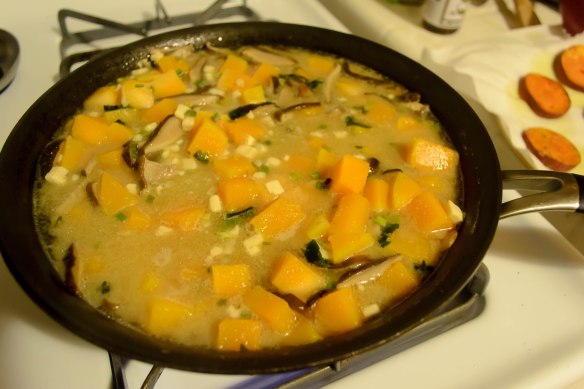
“14. Steam or poach 2 cups of pumpkin cubes until tender. Meanwhile, sauté 1 cup sliced shiitake mushroom caps in vegetable oil with a few drops of sesame oil. Boil 4 cups water and whisk some of it with ⅓ to ½ cup of miso. Stir miso mixture, pumpkin and mushrooms into water and heat everything through, then serve, drizzled with more sesame oil.”

Because we were planning to reach midnight by eating as many snacks as possible eating our way to midnight snacking, I wanted a light dinner to precede the countdown.  This seemed to fit the bill.  And it had to, after all, since it was the only soup left and the calendar was screaming December 31st.

2 cups peeled, cubed butternut squash (I had some in the fridge, and suspected pumpkin would be hard to find)

1 1 oz. package dried shiitake mushrooms

1 TB vegetable oil

¼ tsp (or to taste) toasted sesame oil, plus some for drizzling

3 packets instant tofu miso soup mix (all I could find at my grocery store)

water

white wine

To reconstitute my shiitake mushrooms, I soaked them in a mixture of white wine and almost boiling water for 15-20 minutes, until they were plump and soft.

While the mushrooms soaked, I cubed up my butternut squash and submerged the pieces in a pan of salted water.  I brought this to a bare simmer and cooked it just until the squash pieces were tender – 10-15 minutes – then drained the pieces in a colander.  Don’t overcook them, because they will start to fall apart.  Set the squash pieces aside.

When the mushrooms were tender, I scooped them out of their bath and decided the remnants shouldn’t go to waste.  I poured the soaking broth into a little pot to bring to a boil, so I could use this already flavored liquid as the base for my soup.  While it heated, I stemmed and sliced the mushrooms.

Since the shiitakes were now basically cooked, I probably could have skipped Bittman’s sautéing step.  But honestly, I’m not one to pass up the opportunity to ingest sesame oil, so I dutifully dribbled vegetable oil with a few (or a few more than a few) drops of sesame oil in the (drained and dried) pan I’d used to simmer my squash and sautéed the mushroom slices over medium heat until they dried out a bit and started to take on some color.

While this colorization happened, slowly and so aromatically, I made the broth.  I poured all three miso soup seasoning packets – tofu and seaweed and all – into a small dish, then mixed in about ½ cup of my heated mushroom soaking liquid and whisked gently to dissolve the powdery soup mix.  This created a slightly thickened slurry, which I poured with the rest of the liquid and the butternut squash cubes into the mushroom pan.

Food Blog 2011-2013-0341

After a few moments of reheating, we dipped up bowlfuls and ate.

Food Blog 2011-2013-0343

N. wasn’t sure (he sometimes takes issue with the texture of reconstituted mushrooms), but I inhaled it with devotion.  I love the flavor of miso soup, and the mild sweetness of butternut squash against the salty umami and fleshy squish of the mushrooms was lovely.

Food Blog 2011-2013-0347

It was light but still satisfying, and the tofu and vegetables from the soup mix were so welcome that I’d advise you, if you are using straight miso rather than a pre-mixed, additive laden packet, to consider adding some tofu or seaweed or green onion just to contribute a little substance and contrast to the soup.

Food Blog 2011-2013-0348

Dinner done, we moved on to the second stage of the evening.

“89. Vegetable crackers: Slice beets, sweet potatoes, plantains or parsnips or all of the above into 1/8-inch disks (a mandoline is helpful) and toss lightly in olive oil. Spread the slices on baking sheets, sprinkle with salt, pepper and, if you like, other seasonings and bake at 400 degrees for 10 to 12 minutes. When browned, flip the chips over and bake for another 10 minutes or so.”

This sounded tasty, and I’d always intended to make it for a party.  With a dear friend coming over to ring in the new year with us, and since hunks of cheese alone might be deemed a slightly imbalanced offering (though so, so delicious…), this seemed like a perfect opportunity.  Beets were out of the question (N.’s nemeses since childhood), and I couldn’t find plantains in my grocery store’s produce section, so we were left with the nutty herbiness of parsnips and the always dependable earthy sweetness of sweet potato.

3 medium parsnips, peeled

½ large sweet potato, peeled

generous dose of olive oil (maybe ¼ cup?), plus more to grease the cookie sheets

1 tsp each (or to taste) salt, pepper, and garam masala

To prepare for roasting, preheat the oven to 400F and line two cookie sheets with aluminum foil.  Drizzle with olive oil and spread to cover the surface of the foil evenly.

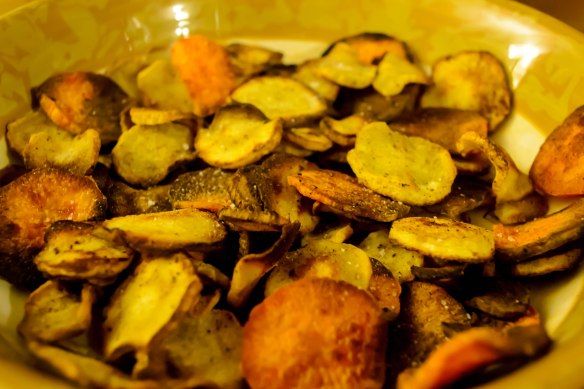
While the oven preheats, tackle the vegetables.  I don’t have a mandoline, but I do have a ruler, and I must confess I did bring it to the kitchen to give myself a better idea of what 1/8 inch looks like.  My slices were not quite even, but they did verge on passable.  I tossed them – big coins of harvest orange and speckled white – in a glass bowl with the olive oil and the spices until they were evenly coated.

Food Blog 2011-2013-0339

Spread the vegetable coins across the cookie sheets in a single layer, not overlapping, not in piles.  If they cook in a stack, they will soften but not brown or crisp.  Stow them in the oven for 12-15 minutes, or until they are just beginning to brown.

This next step is a true exercise in patience.  Unless you are far more talented with a spatula than I, you will have to flip each piece over individually.  You have to, because otherwise one side will burn and the other side will flutter limply into cooked-but-not-crisp status.  Trust me on this one.  When you have laboriously flipped each coin, shove the tray back into the oven for another 10-12 minutes.

Food Blog 2011-2013-0342

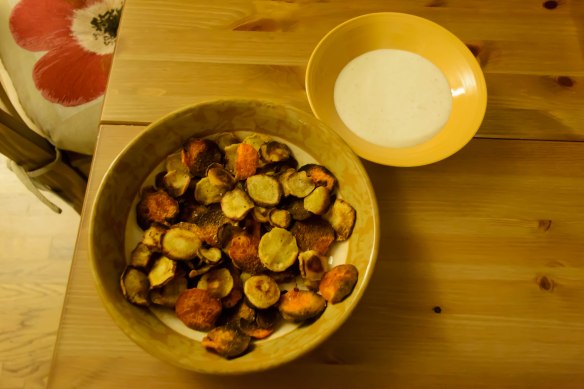
At this point, you’ll have to use your judgment.  My offerings were, after this additional time, cooked through but not remotely cracker-like in texture.  Another five minutes in the oven might have done the trick.  Putting them back in, failing to set a timer, and heading to the couch to eat dinner (I was trying to multitask) is not advisable.  I didn’t remember them until I smelled the slightly spicy aroma of parsnips, and by then it was too late – many of the little coins had gone from crackers to briquets.

I decided to pick out the worst offenders – Lucy reports that she didn’t mind a bit of charred flavor – and eat the salvageable ones anyway.

Food Blog 2011-2013-0356

To make them a bit more exciting (and disguise any lingering burned taste) I made a little dipping sauce.  You’ll need:

juice from 1 lime

2 TB honey

1 tsp garam masala

½ – 1 cup Greek yogurt

Whisk the first three ingredients together with a fork until they are smooth.  In increments, add Greek yogurt until your sauce reaches the desired thickness.  Mine was about the consistency of ranch dressing, but much more interesting in flavor.

Food Blog 2011-2013-0349

These crackers (with and without the sauce) were – if you were able to overlook the overcooking – a nice alternative to crudites or store-bought crackers.  They weren’t quite as crispy (except the ones that were too crispy), but they had a lovely deep flavor and none of the powdery, processed taste some crackers can have.  They are also a gluten-free offering and, minus the yogurt and honey sauce, vegan as well.

Food Blog 2011-2013-0350

I served them alongside a cheese platter,

Food Blog 2011-2013-0353

Food Blog 2011-2013-0354

Joy the Baker’s chili spiced sharp cheddar cheese crackers,

Food Blog 2011-2013-0352

assorted sweets,

Food Blog 2011-2013-0355

and my appetizer version of Bittman’s “Marshmallow Topping for Adults” dish: thick discs of sweet potato roasted until tender, topped with a dollop of cream cheese and sprinkled with a pecan brown sugar blend before being broiled until the sugar bubbles and the cheese slackens toward melting.

Food Blog 2011-2013-0357

Food Blog 2011-2013-0359

And champagne, of course.

Food Blog 2011-2013-0361

Happy New Year.  I hope you celebrate your achievements, meet your goals, and find happiness in your own self.  I’ll be checking in again later this week with some reflections and announcements.  Welcome to 2013.

Giving thanks

The house feels empty.  Wednesday through Saturday, my family visited for Thanksgiving.  This morning, with them on the road home, fog hovering sticky in the sky, the cheery burgundy tablecloth in the washing machine, and a stack of lingering dishes I’m trying to ignore proclaiming themselves from the sink, our little home was stark and cold.  I could say that the memories of the holiday will keep me warm, but that would only be true in a metaphorical sense.  What I really want is another baked apple.

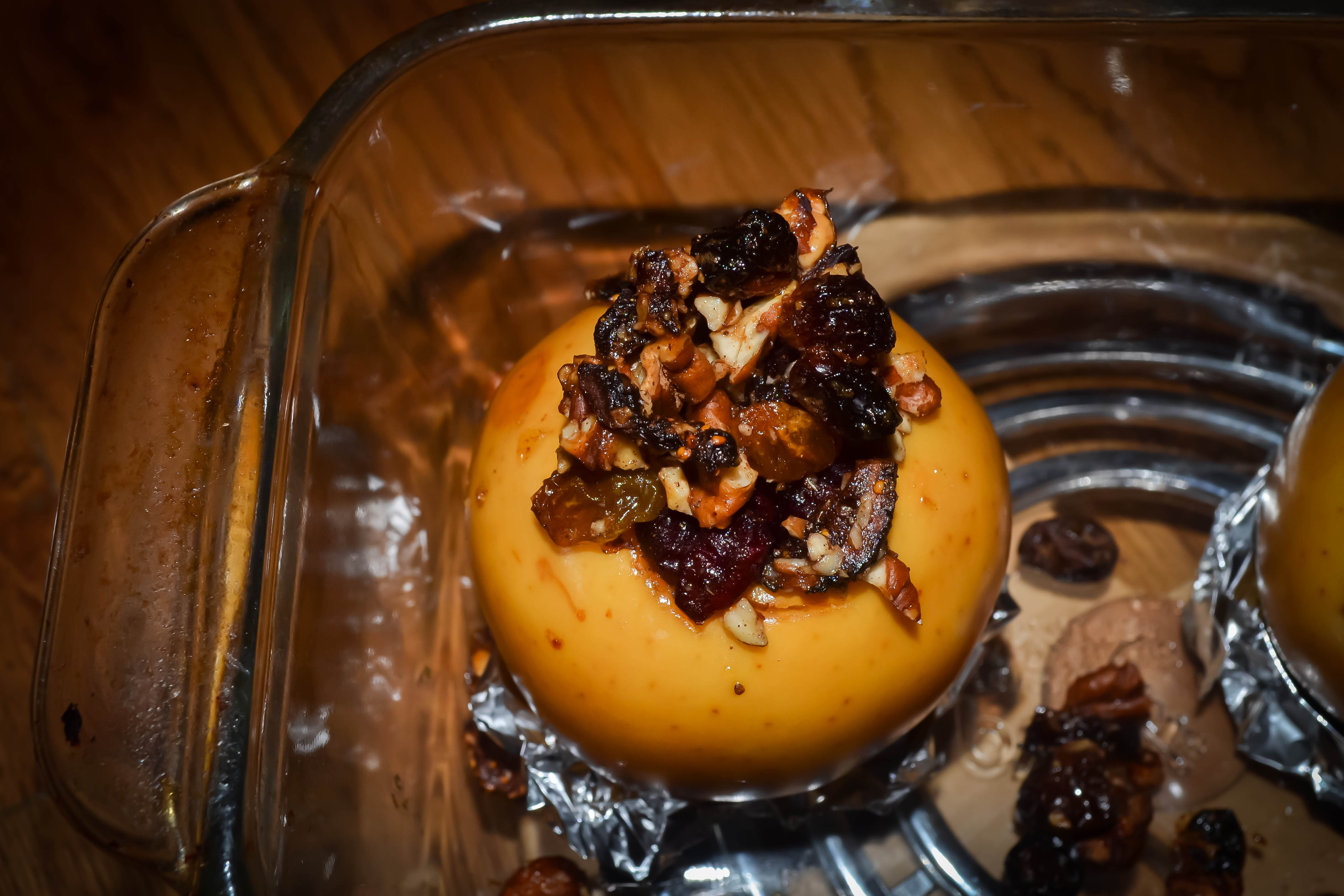
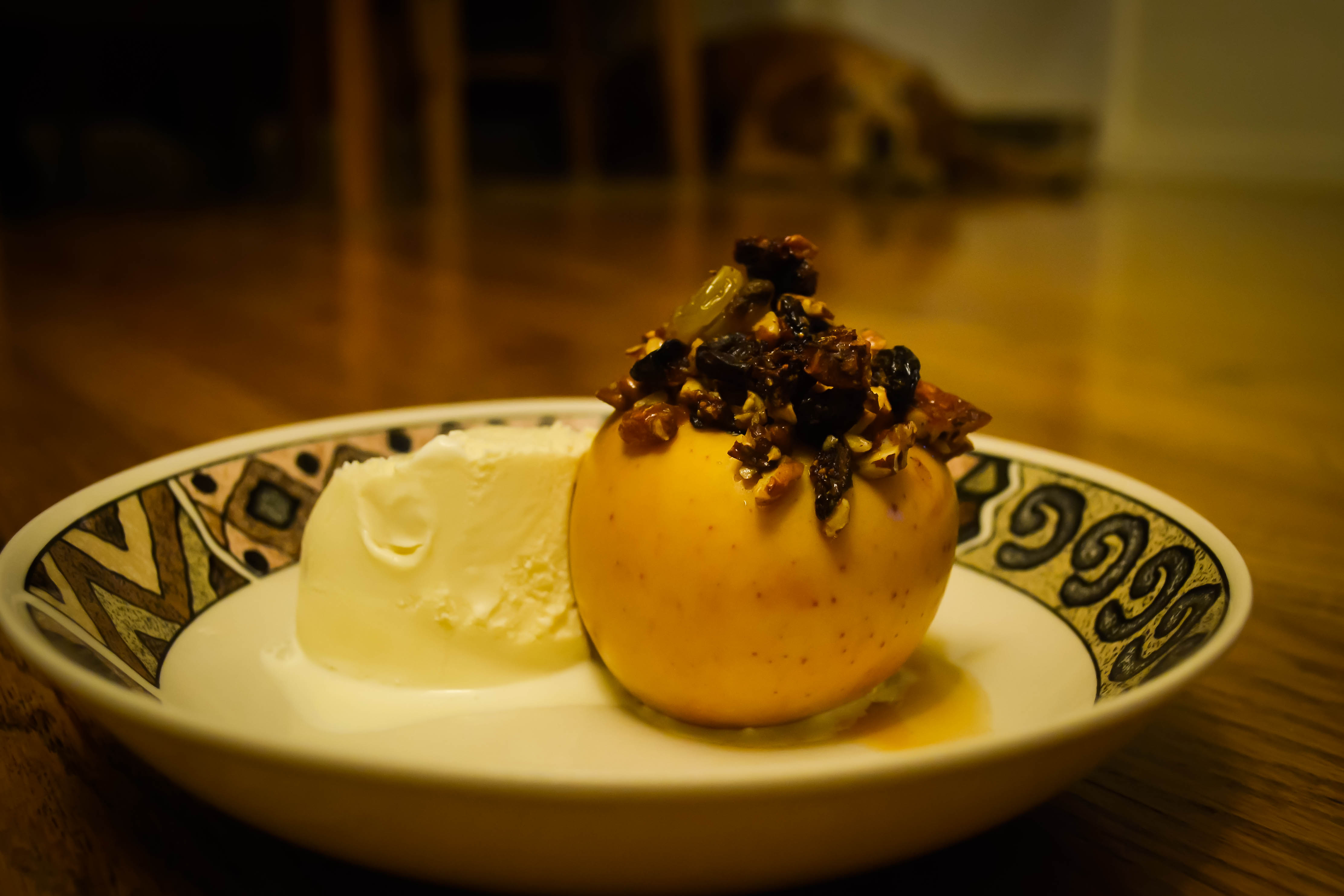
90. Baked Apples: Combine chopped pecans and chopped dried fruit (raisins, dates, figs, cranberries all work) and toss with maple syrup and a sprinkle of cinnamon, allspice or nutmeg or all three. Fill the cavities of cored apples with the fruits and nuts, dot each with butter, put into a baking dish and roast about 30 minutes, until tender. Better with vanilla ice cream.”

We had a few small apples from our local Farmers’ Market waiting for attention in the fruit bowl, so I set about collecting partners for them to make a dessert for two.

2 small apples

¼ cup chopped pecans

¼ tsp pumpkin pie spice (I agree with Joy the Baker that we should probably just make our own, but if you, like me, purchased some in a moment of confused weakness, this seems a harmless way to put it to use)

1-2 TB each:

chopped dried figs (I used black Mission, my current favorite)

craisins

golden raisins

3 TB maple syrup

Preheat the oven to 350F.

Core the apples, keeping the bottoms intact if you can.  If you can’t, just wrap the bottom quarter or so in aluminum foil and set them in a baking dish.  This will keep the filling from escaping.

In a small bowl, combine the nuts, fruit, and spice(s).  Drizzle in the maple syrup and stir gently to combine – you want even stickiness throughout.

Using a small spoon, or your fingers, insert as much filling as you can into the cored apples.  You will notice that this quantity makes about twice as much as you need for 2 small apples.  That’s okay.  The leftovers are a fantastic topping for oatmeal the next morning.

Once full, stow your apples in the oven for 30 minutes, or until they are tender when pierced with a knife.  Liberate, evacuate to a dessert plate, and pair with vanilla ice cream.

These were a lovely dessert.  They felt light, because they were primarily fruit, but were still sweet enough to satisfy that after-dinner craving.  The apples still had some resistance, but were warmed through and starting to collapse into themselves.  The ice cream was a perfect accompaniment – I wouldn’t want this dessert without it.  I might ideally have chosen an apple with more tartness to contrast against the sweetness of the syrup and dried fruit, but in such a case, especially if the apple were on the large size, I would advocate a longer baking time.  If the fruit and nuts protruding from the top of the apple start to brown too much, give them a tinfoil hat to hide beneath.


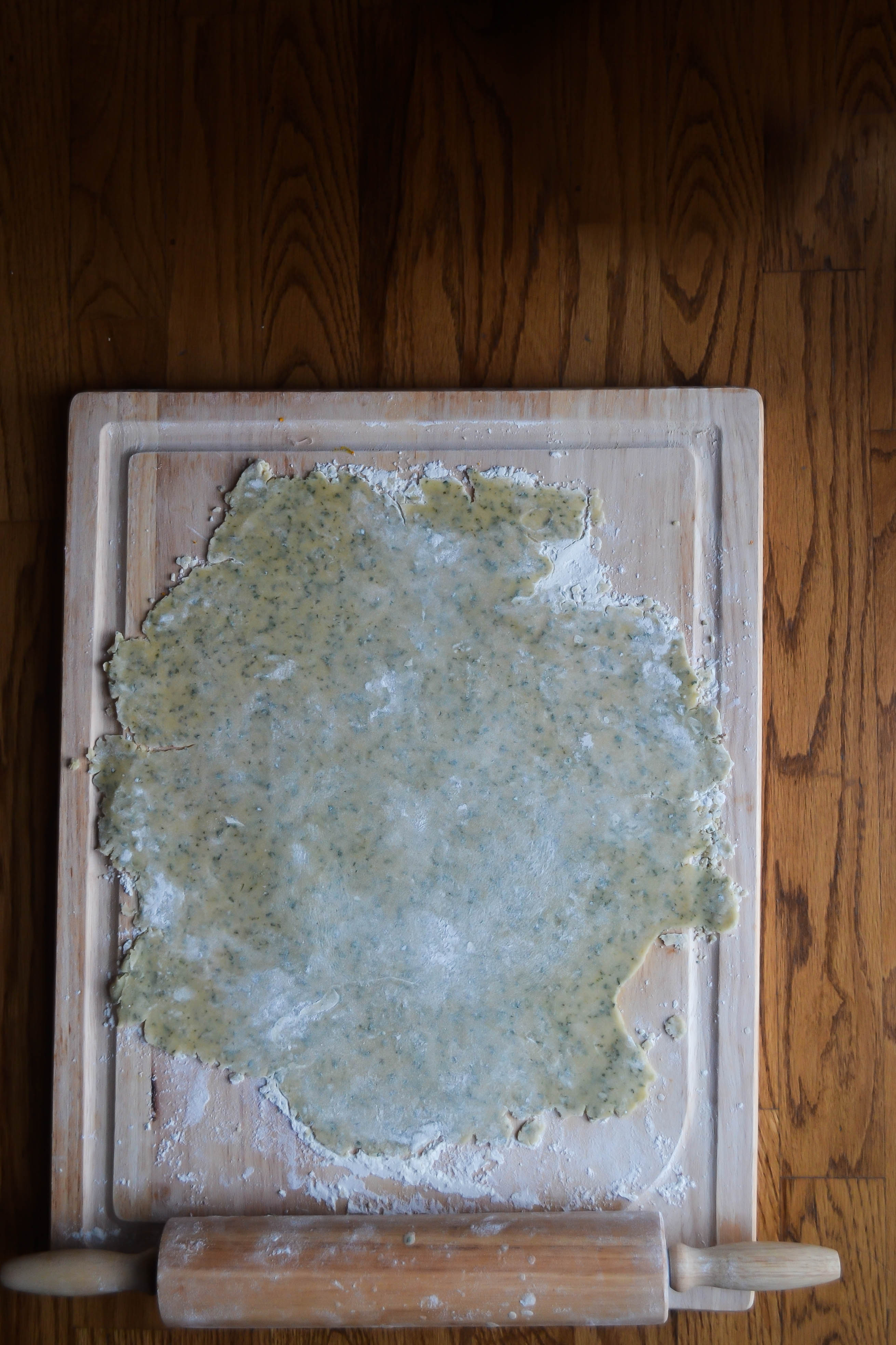
“84. Sage Crackers: Pulse 1 cup flour, 1 teaspoon salt, ½ cup Parmesan and 4 tablespoons cold butter in a food processor. Add ¼ cup cream and 1 tablespoon finely chopped sage.  When just combined, roll as thinly as possible, score into squares, sprinkle with salt and bake at 400 degrees until golden.  Let cool, then break into pieces.”

I’ve always liked a nice cheese-and-crackers platter as an appetizer option, and these seemed like a good option to lead into the big Thanksgiving meal: relatively easy to make, but impressive – who wouldn’t be staggered by the effort of making homemade crackers even with a homemade feast to produce as well?

Bittman’s directions and quantities here are pretty specific, so I just followed his directions.  I omitted the salt, because Parmesan carries so much of its own tangy hit, and my parents are not big salt eaters.  It should also be noted that pulsing this mixture until just combined does not create a rollable dough, unless my idea of “just combined” is different from Bittman’s.  However, turning out the just-clinging crumbs onto a floured board and kneading for only a minute or two does produce a nice textured ball of dough that can be rolled out with minimal sticking.

I’d recommend aiming for a shape as close to a rectangle as possible.  Further, roll that rectangle to the size of your biggest cookie sheet.  That way you can carefully transport onto the greased or parchment-lined sheet tray by draping the dough loosely over the rolling pin.  Score it very gently into rectangles or squares of your chosen size (cut halfway through the dough with a knife, not all the way through), and into the oven with it!

When I checked these 20 minutes later, they were a little more golden than I wanted.  They were, in fact, heading toward a burnished bronze (is that not the kindest way ever of saying they were all-but-burned?).

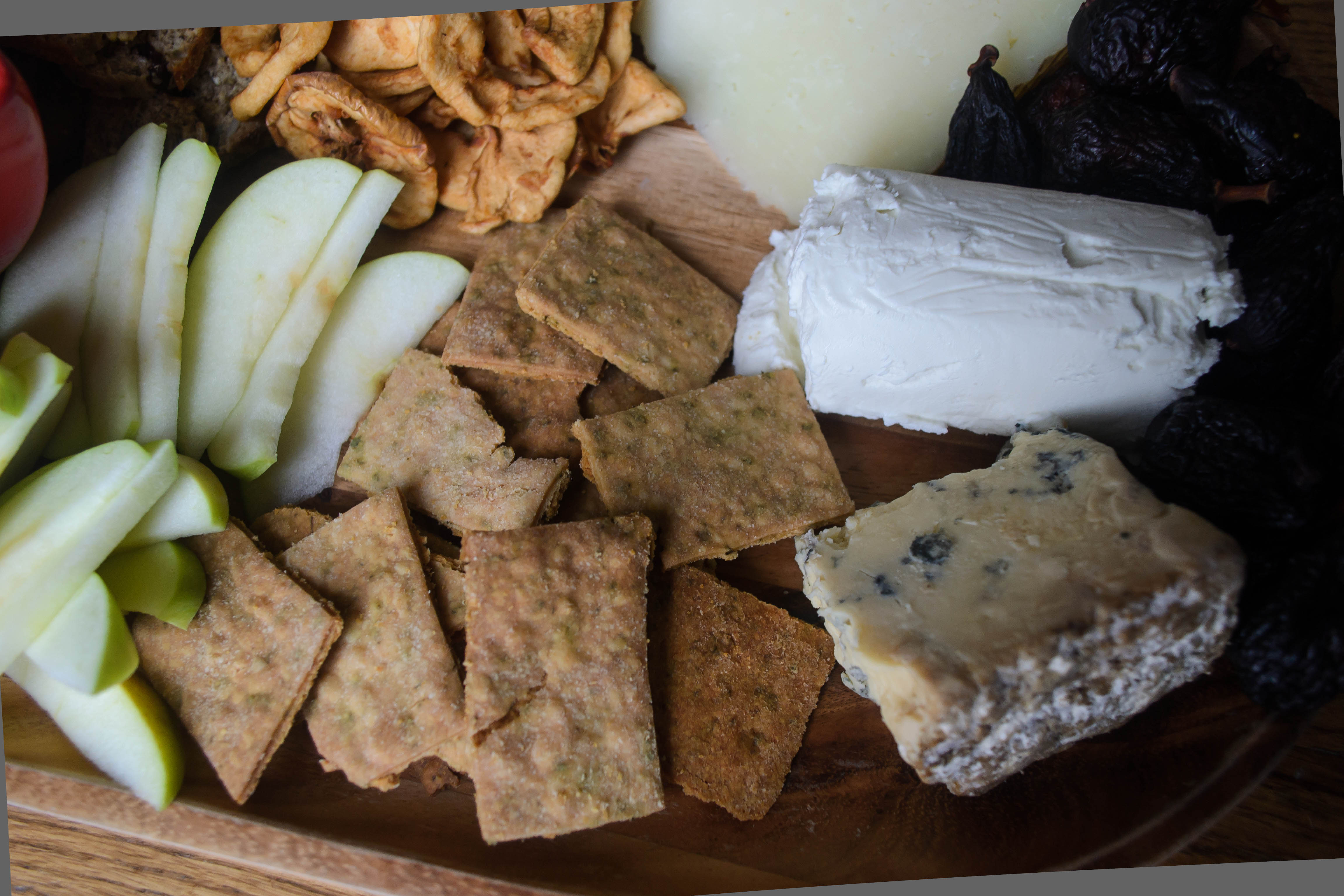
After the cracker sheet had cooled for a few minutes, I broke it along the scored lines into neat (mostly) rectangles and we passed around a few samples.  The outside edges, which were thinner, had a slightly over-toasted flavor we didn’t love.  The inside rectangles, though, were crisp and flavorful, with a flaky – almost chalky – texture reminiscent at once of pie crust and shortbread.  My dad in particular, who enjoys this texture, thought they were great.

And now the confession: my final Bittman for this week is a bit of a cheat.  But I’m okay with that, because I also think it was a bit of a cheat for him, though in the best and most useful way.

“101. Buy some cheese. Unwrap it and put it on a plate with some walnuts and fruit; let come to room temperature. Serve with good bread.”

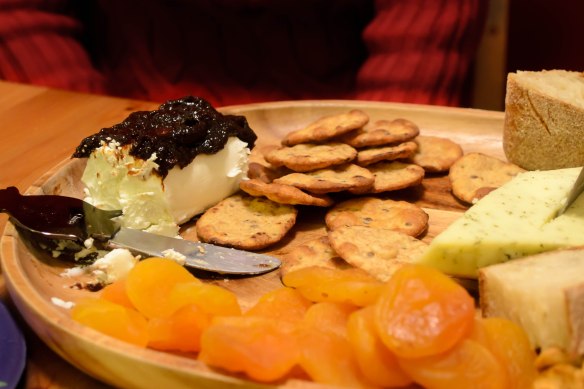
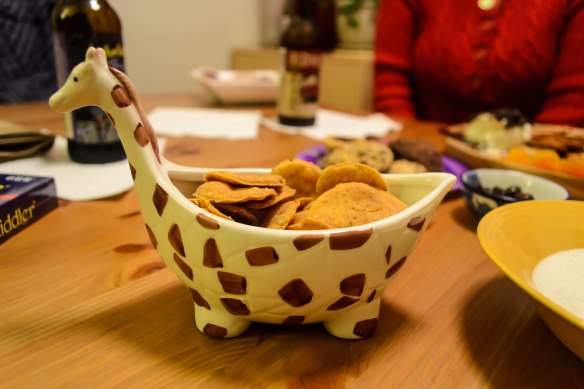
This is the final numerical entry of the list, and that means it’s in the dessert category.  While I accept that some people prefer a cheese course to dessert, I’m not sure I consider this an acceptable option for Thanksgiving.  It is, however, acceptable as an appetizer idea, as I mentioned above.  So that’s what I did.  In addition to the sage parmesan crackers above, I made my favorite craisin rosemary biscotti-style crackers with white bean and almond dip, and set them all out with some creamy Stilton, a nice rich chevre, and a wedge of Manchego obtained from a stand at the Farmers’ Market where we finally decided we’d had too many samples to feel right about not purchasing.  Surrounding these, I added dried apple rings, black Mission figs, and a fresh Granny Smith cut into slim slices.  The walnuts, which I was ready to add as well after a brief toasting, were subjected instead to accidental scorching, and had to be sacrificed.  We will speak of them no further.

What can you say about a cheese platter, besides that it was delicious?  We adored the Manchego, and soft crumbles of Stilton paired well with the fresh apples.  I tried fig and goat cheese together, and now I think chevre-stuffed-figs sounds like an amazing experiment.  We decimated the platter in little over ten minutes, but thankfully were not too stuffed to take full advantage of the turkey dinner that followed.

With Thanksgiving handled, that leaves only five weeks of 2012, and only twelve Bittman selections to go!  New Year’s Eve is on a Monday, but that still counts as this year if I need to jam in a few final selections, right?

I think I can, I think I can, I think I can…

Last salad

I think Fall has finally found Los Angeles, and only a week and a half to go before Thanksgiving.  Within a week, we went from temperatures in the mid-80s to a high of barely 70F.  My living room went from a comfortable lounging 75F to barely hitting 70 despite blinds wide open to catch the sun all day.  Thankfully, the items I have left on my Bittman list accommodate this weather change.  Today I have to report the last salad of the list, and a foray back into desserts.  Both have decidedly autumnal collections of flavors (I wrote “flavor profile” first, and then I thought, “who do you think you are?”).  Many of the food blogs I read have been reporting for the past week or two on Thanksgiving recipes, and I thought about doing that too.  But then I remember that Bittman’s entire list is conceived as Thanksgiving sides, so if you’ve been following this little blog for any length of time, you’ve been seeing Thanksgiving options – with only a few disruptions – for the past two years!

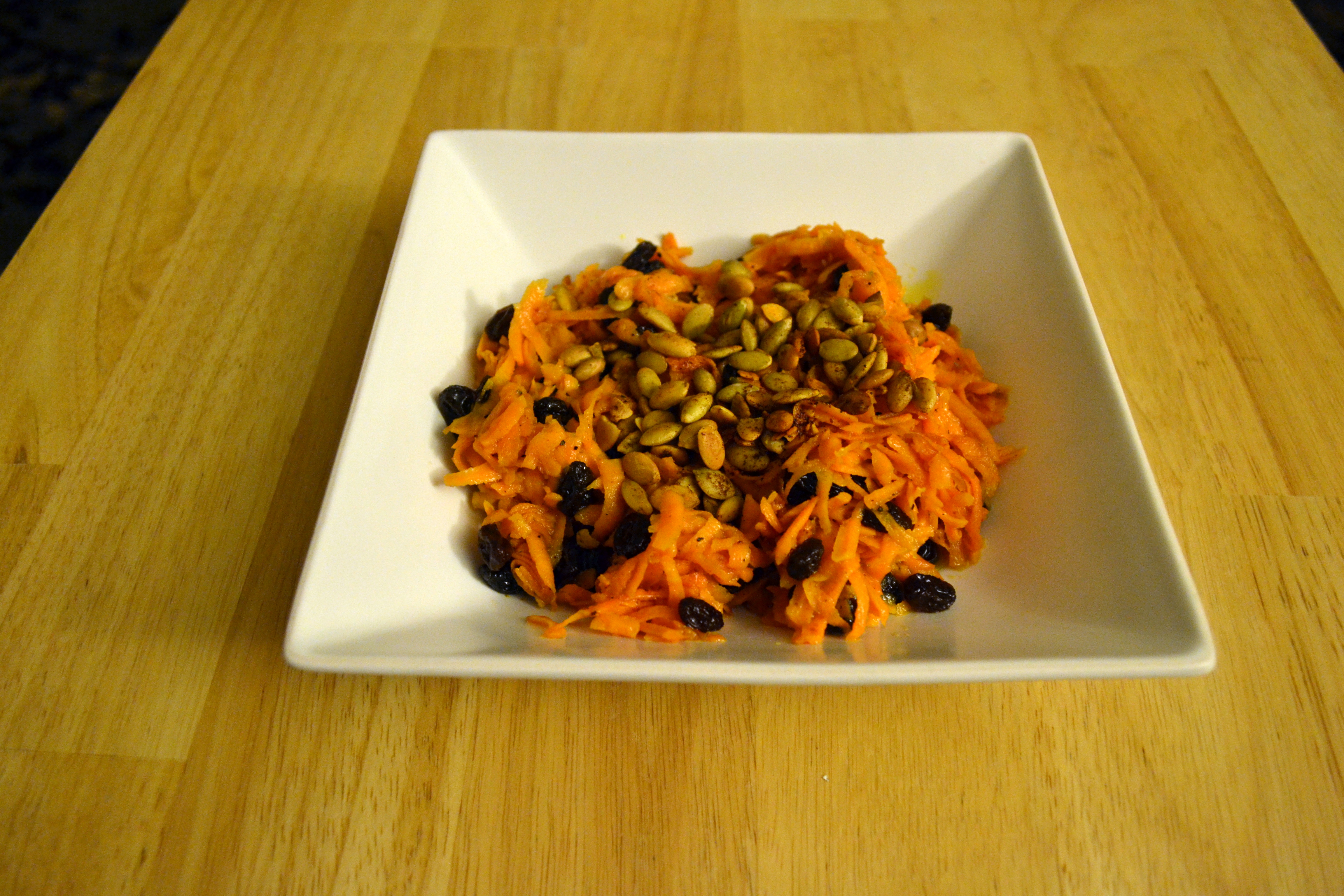
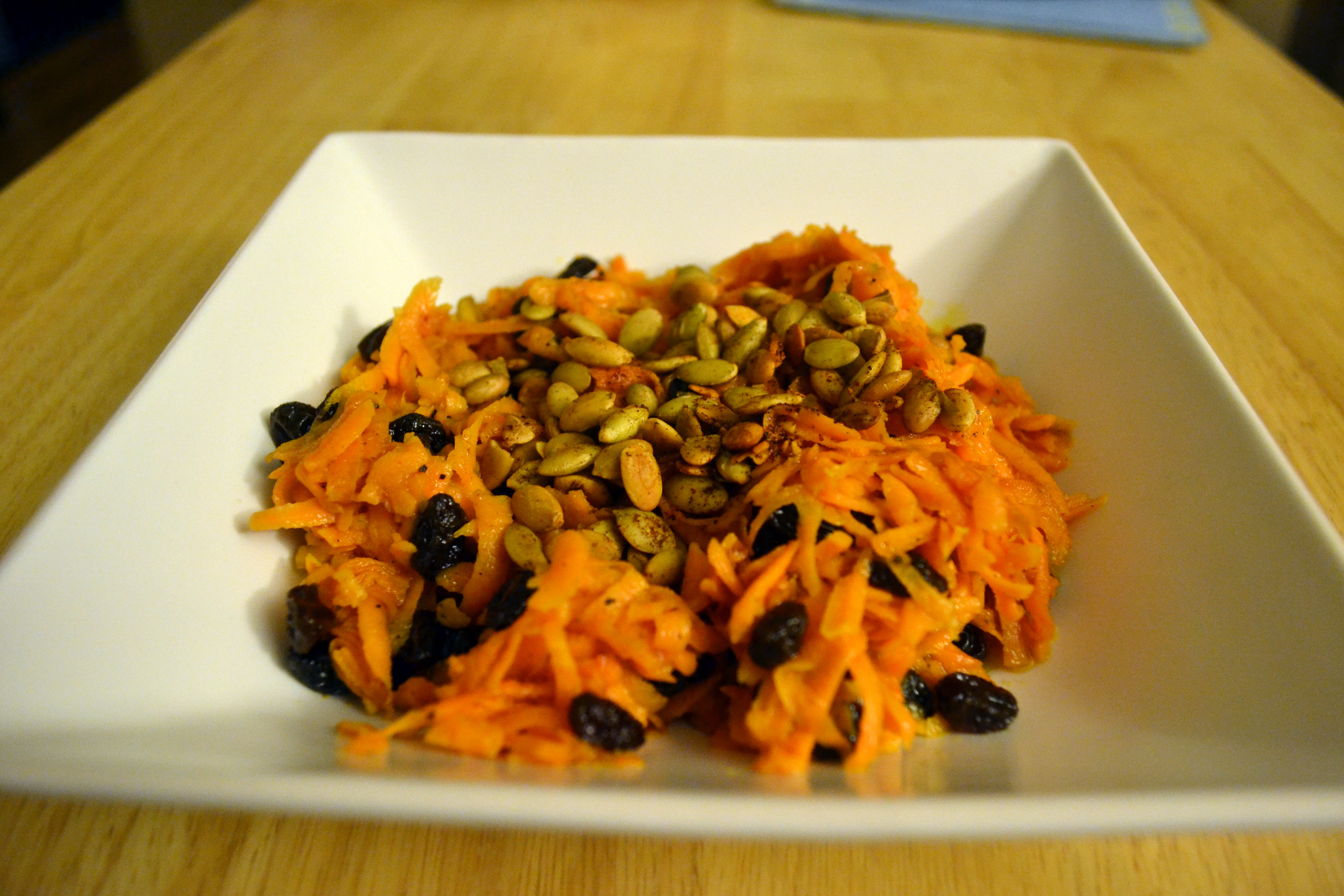
“67. Sprinkle shelled pumpkin or squash seeds with a little chili powder; roast, shaking occasionally, until lightly browned. Combine with grated sweet potatoes (raw or lightly sautéed in butter or oil), raisins and a vinaigrette made with red wine vinegar, olive oil, Dijon mustard, a touch of honey and maybe a little more chili powder.

I gathered:

1 small sweet potato

1 TB pumpkin seeds

chili powder to taste (mine is really mild – I probably used about a teaspoon)

2 TB butter

2-3 TB raisins

These measurements look small, but I was planning this for just the two of us and didn’t want any leftovers.

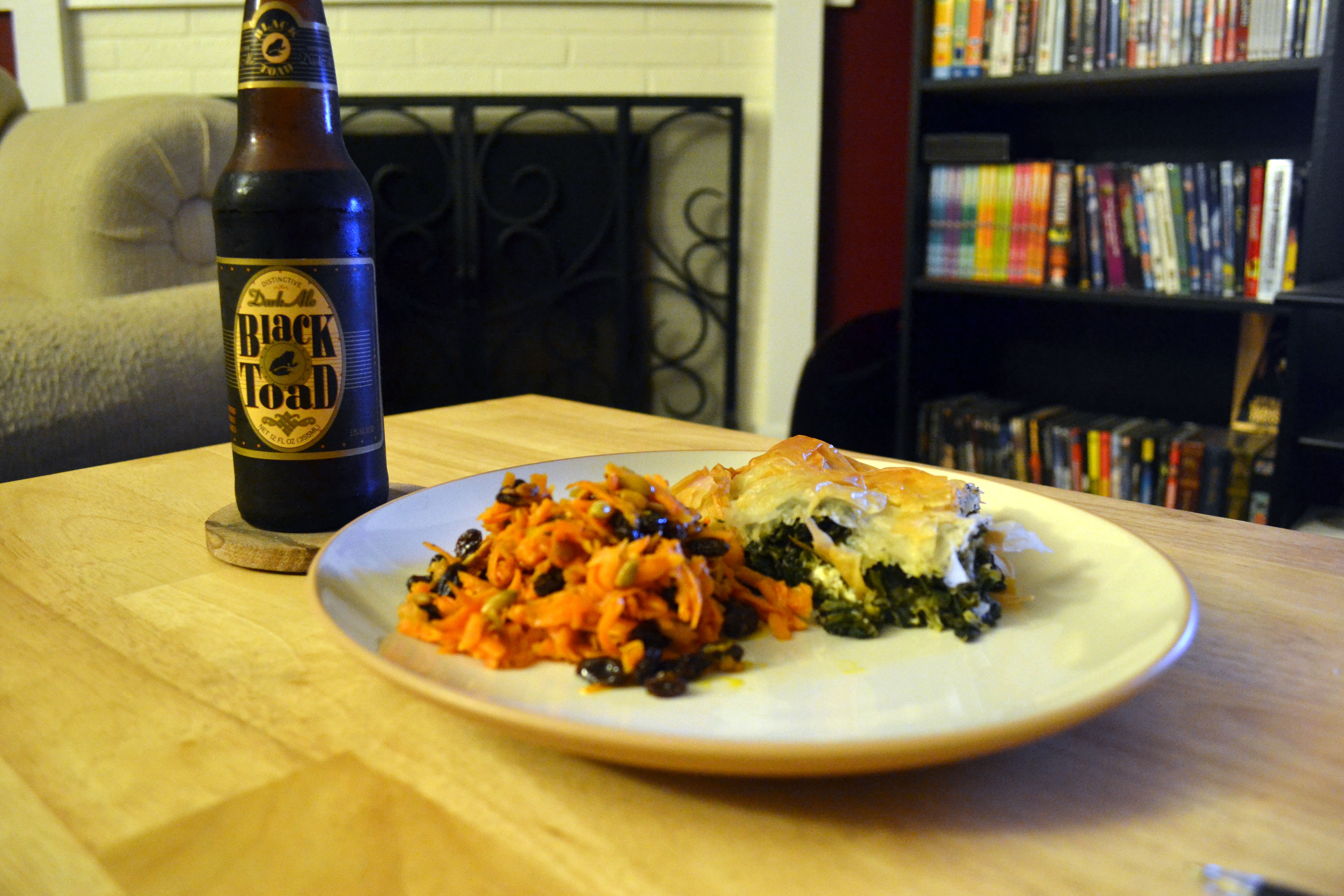
We were having this “salad” with spanakopita, so I decided to capitalize on the heat of its baking.  I popped the pumpkin seeds onto a baking tray, drenched them with chili powder, and tucked them into the oven for a few minutes.  When you hear the first couple of pops, they are done.  Don’t leave them too long – not only will they burn, they will propel themselves all over your oven.

I set aside the lightly toasted seeds and turned to the sweet potato.  N. and I proved in earlier experiments that we don’t like it raw – the starchy feel when you chew is just too much – so I was glad Bittman allowed for a cooked option.  I melted the butter while I grated the sweet potato, and tossed the shreds of bright orange onto the fizzing fat.  If you have more patience than I do, you might wait for the butter to brown a bit to add nuttier, deeper flavor to the sweet potatoes.

I let the little ribbons of sweet potato cook for a few minutes over medium heat.  The goal was not to brown them, just to lightly cook them through.  When I estimated them to be two minutes from done, I tossed in the raisins and folded the mix together.  This gave the raisins time to match the sweet potatoes in temperature, and it allowed them to plump up and take in some buttery flavor.

Heat off, I turned to the dressing.  Whisk together:

1 TB red wine vinegar

1 tsp honey

1 tsp dijon mustard

sprinkle of chili powder

2 TB olive oil

I tossed this lightly with the sweet potatoes and raisins, then topped them with the pumpkin seeds (which I almost forgot AGAIN!  What is it with me and missing the crunch?) and it was ready for tasting.

We liked this.  I’m not sure it read as a salad – in fact I’m not sure what it read as at all.  At once, it was not quite a salad, but also not quite a vegetable side, and not quite a chutney.  But it was tasty.  The red wine vinegar was acidic enough to counter the sweetness of the potato and raisins nicely.  It was a refreshing bite against the richness of our spanakopita.  The crumbling cubes of feta hidden in the spinach blend imparted the final necessary taste: a briny saltiness so welcome to the rest of this sweet and butter-drenched meal.

I took my next choice (partly made because it sounded delicious, but partly to use up the phyllo) to an election party.

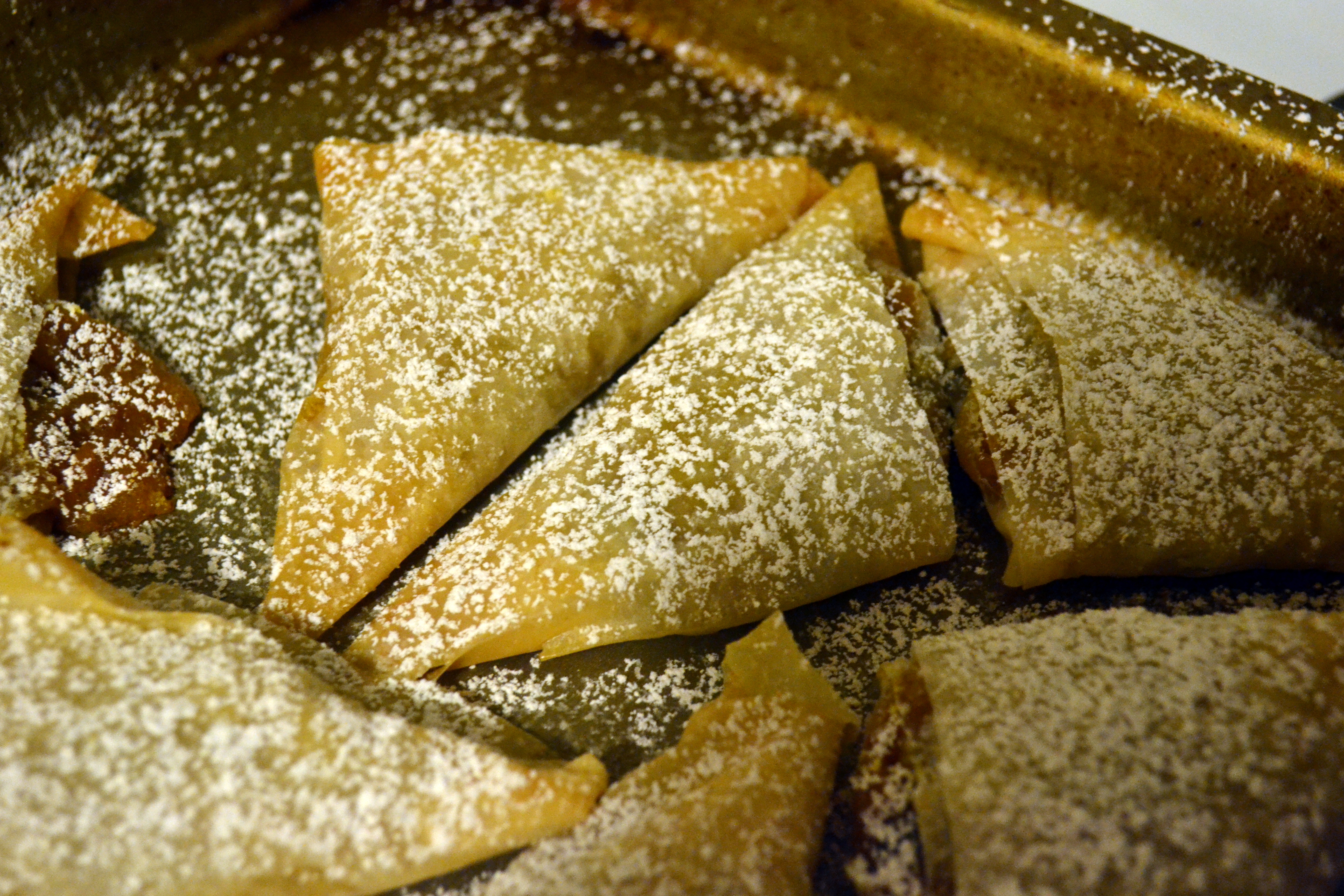
“93. Pumpkin-Raisin-Ginger Turnovers: Mix pureed cooked pumpkin, raisins, chopped crystallized ginger and sugar.  Brush a sheet of phyllo with melted butter and cut lengthwise into thirds. Put a spoonful of the filling at the top of each strip. Fold down to make a triangle and repeat, like folding a flag. Repeat with remaining filling. Brush the tops with butter and bake 20 to 30 minutes. Dust with powdered sugar.

Whether you are elated, distraught, or ambivalent about the results of the vote, these little turnovers were worth celebrating over.

1 15 oz. can pumpkin puree

½ cup sugar

½ cup raisins

¼ cup finely minced crystallized ginger (or you could try grating this on your microplane.  I’m not sure how that would work, but since candied ginger is gummy and hard to chop, it might be helpful)

butter

phyllo dough

I couldn’t resist adding about a teaspoon of cinnamon.

First, I preheated my oven to 375F and put the butter into a small pan, which I set over low heat so it would melt but not brown.

I shlooped the pumpkin from the can to a bowl and whisked in the sugar and fruit.  I suggest you use a fork for this, not a traditional whisk.  The mixture clumps and sticks in the slender spokes and results, if you are at all like me, in cranky frustration.

When everything is well mixed, turn to the phyllo.  If you’ve never worked with it before, don’t be afraid.  The amazing way it changes from dry papery sheets to flaky, buttery pastry is worth the challenge.  Here’s what I do:

Set up an assembly line on your counter.  At one end, unroll the phyllo and set a just-damp kitchen towel (or couple of paper towels) over the top.  This will help, if you are a slow worker, to prevent it from drying out and breaking.  Next to that, you need a board big enough to accommodate one sheet of phyllo.  Next to that, place your butter, followed by your filling, followed by the final resting place for your wrapped confections.

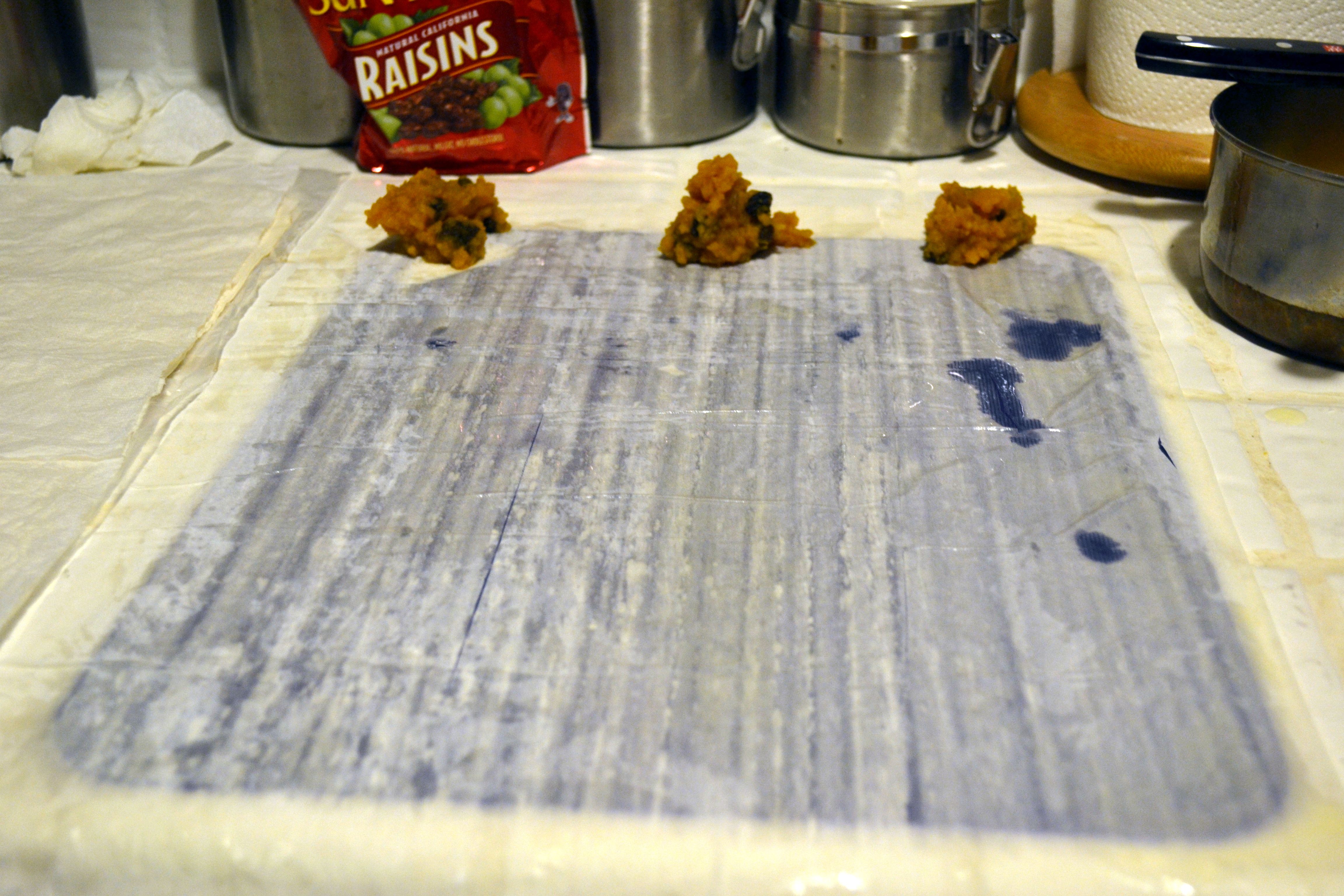
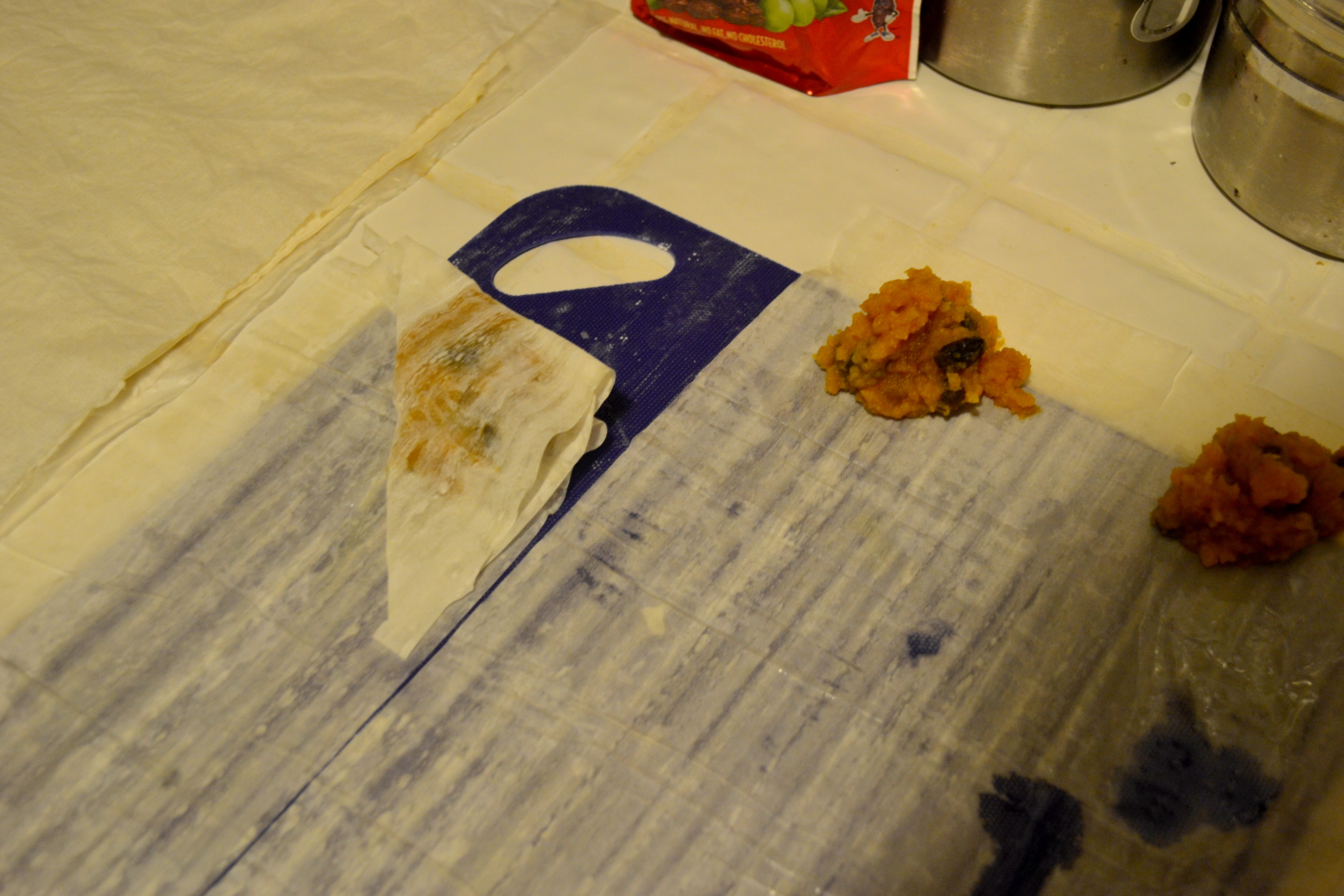
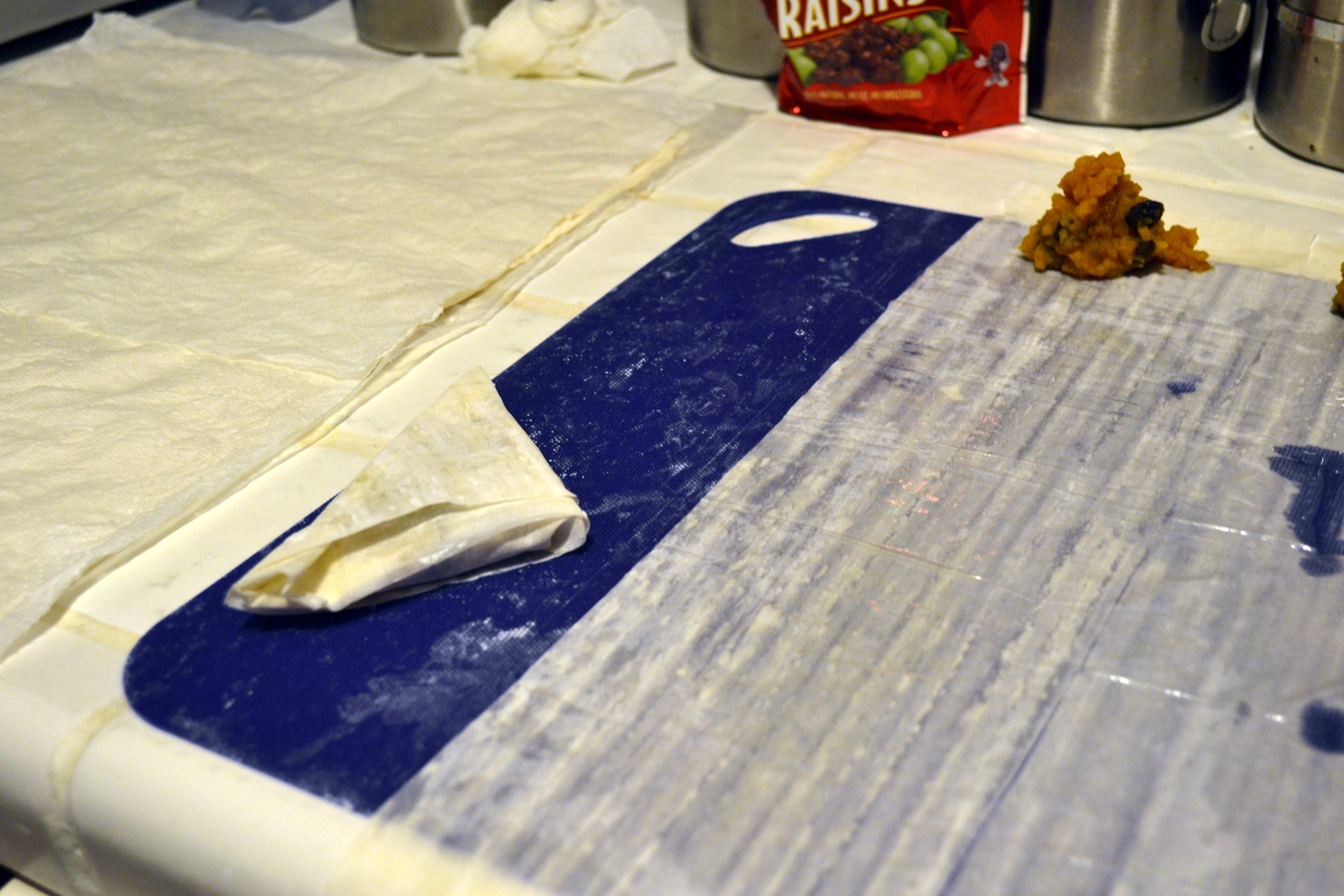
Carefully peel off one sheet of phyllo and place it on your board with the shorter end facing you.  Recover the remaining stack with the damp towel.  Using a pastry brush, brush the whole sheet with butter.  Cut it in long thirds (you’ll begin your cuts on the short edge of the rectangle, so that you create three long, thin strips, as opposed to three short, squat strips).  Then, place about two tablespoons of filling at the top of each strip, and begin to fold in triangles.

To make the first fold, bring one corner down to the opposite edge of the strip.  Don’t press too hard, or the filling will ooze out everywhere.  The second fold will be straight down: the remaining corner (now doubled because you’ve folded over your first triangle) folded down onto the same edge.  Continue to fold, keeping your filling in the center of a triangle, until you reach the end of the strip of phyllo.

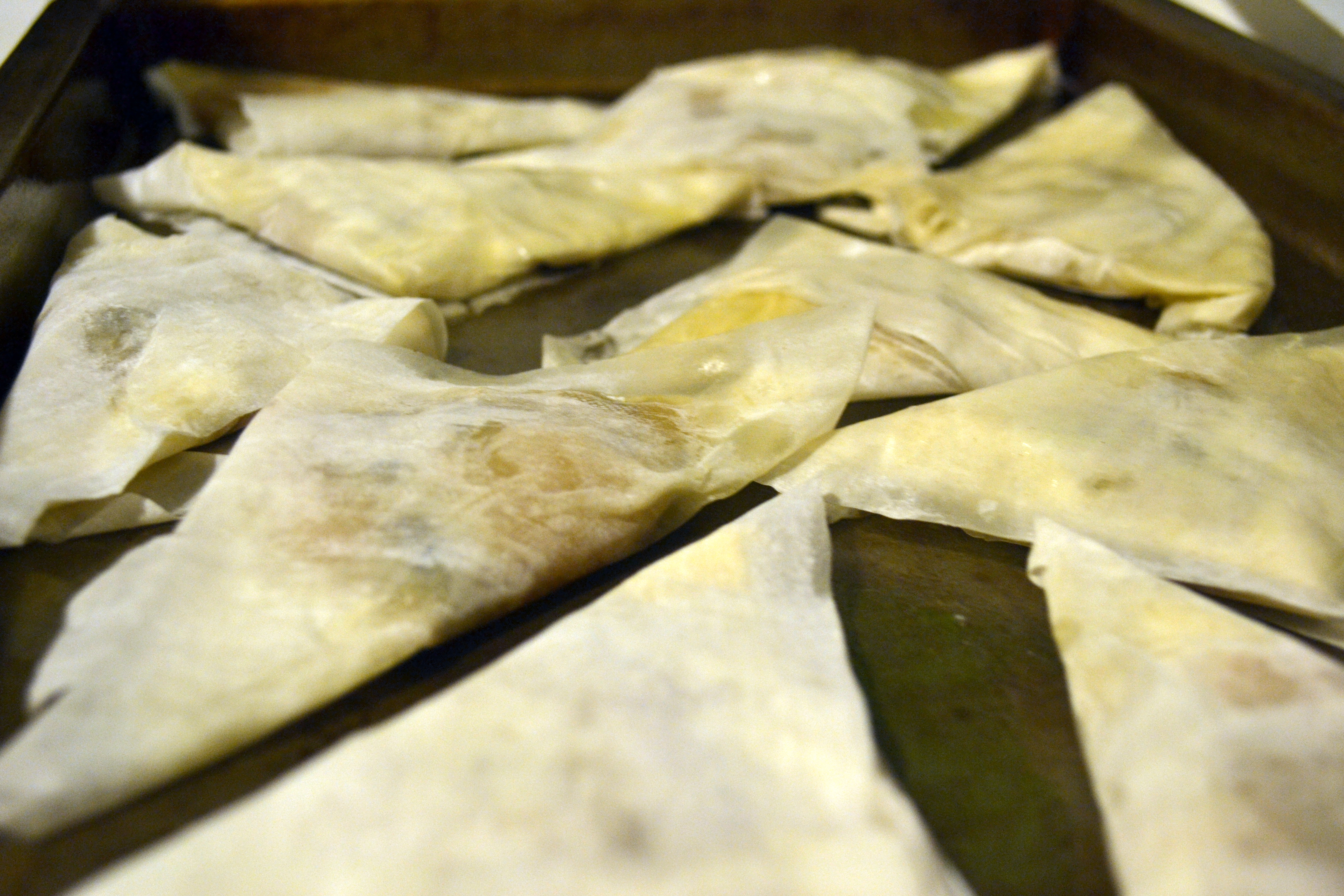
Place that on a parchment-lined or greased baking sheet and brush the top with a little more melted butter.  Repeat until you run out of filling.  Since these won’t rise or spread, you can place them quite close to one another on the baking sheet.  Don’t overlap them, though, because only the dough exposed to the air will brown.

This sounds complicated, but once you get into a rhythm it’s relatively easy and quite satisfying.  You end up with two trays of sweet little parcels that you can stow in the oven for 20-30 minutes until they become magically golden and flaky.

When they were done, I dusted them liberally with powdered sugar and tented them with aluminum foil to take to the party.  I brought home an empty, sugar dusted tray with a lone raisin abandoned in one corner.

They were so tasty.  The pumpkin-raisin-ginger combo was insane: earthy and sweet and, with the addition of the cinnamon, warmly spiced.  Inside the phyllo, it was a contest of texture too: unremittingly soft pumpkin with the occasional chewy juicy punch of raisin, against sharp flaky crunch of sugar-dusted pastry.  We couldn’t resist tasting a few before dinner, and then we had to revisit them again for dessert.  These will, I suspect, make repeat appearances in my kitchen.  They could probably be made a few hours ahead as well, or transported and baked on location: wrap them up, dredge them with butter, and store them under a damp towel or some plastic wrap until ready to bake.  If you don’t like pumpkin pie, or you’re tired of it (I know, heresy!), these might be a fun alternative Thanksgiving dessert option.

Smitten

There were always only two marginally clever possible titles for this post.  I chose this one for several reasons.

One.


Two.


Three.

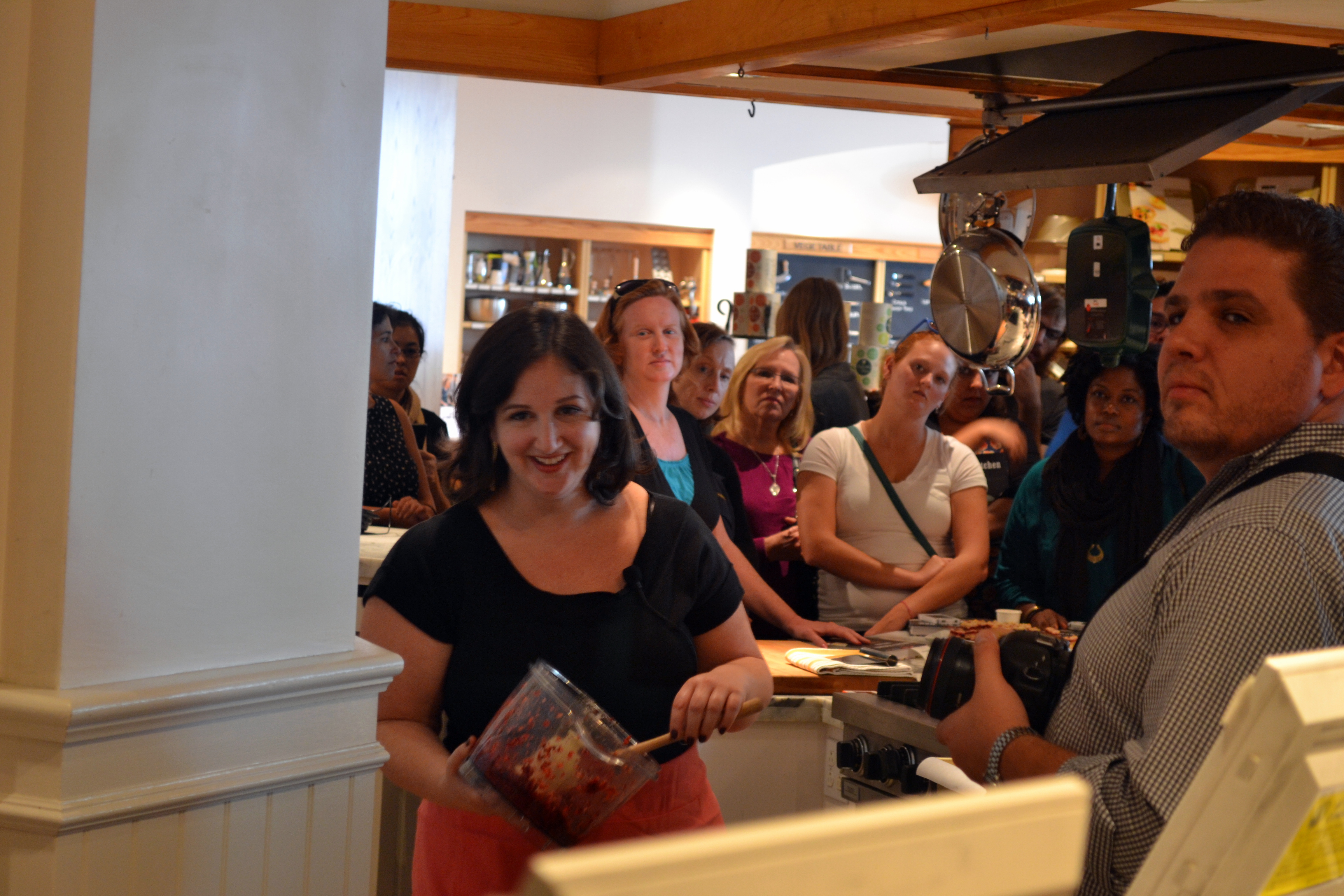
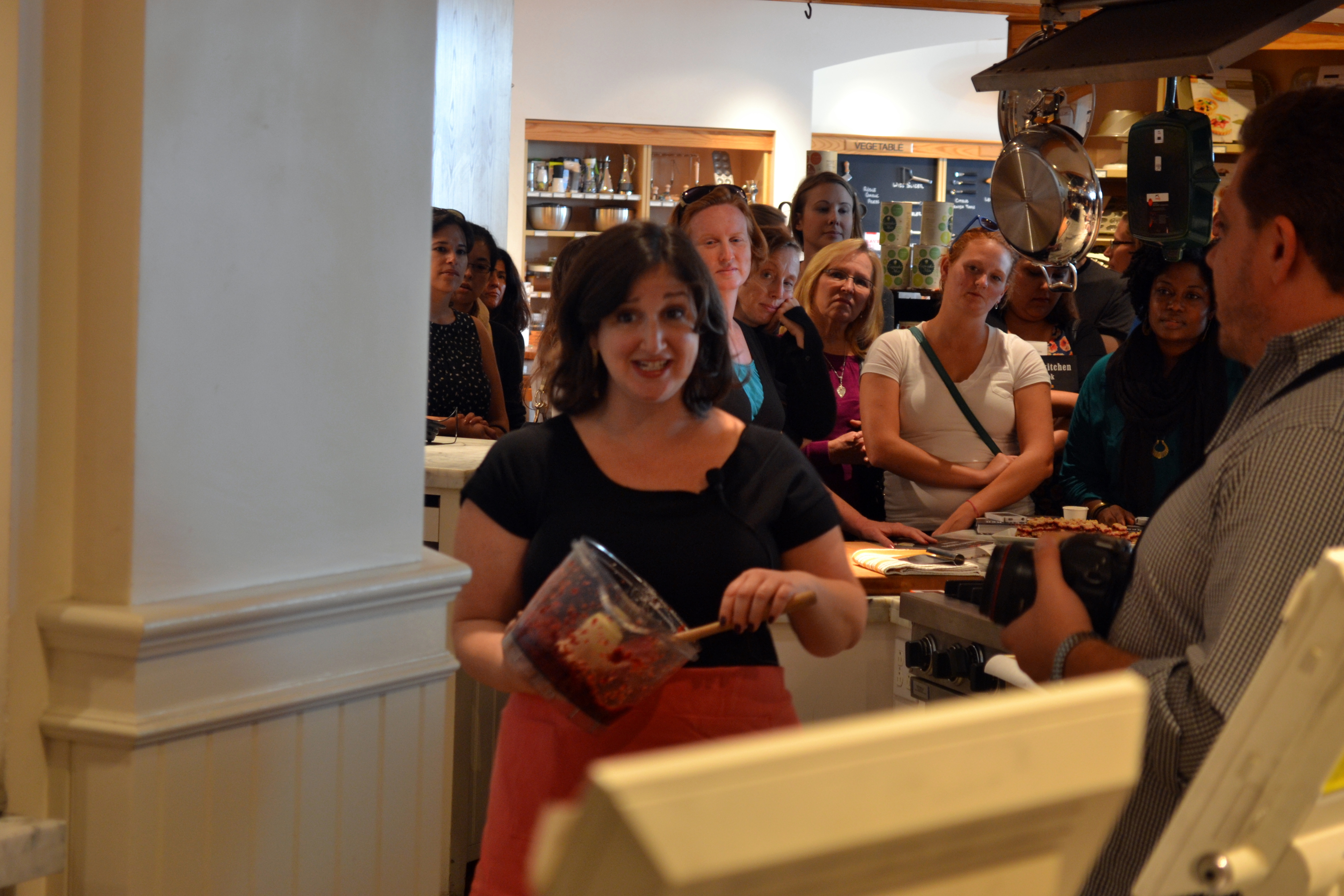
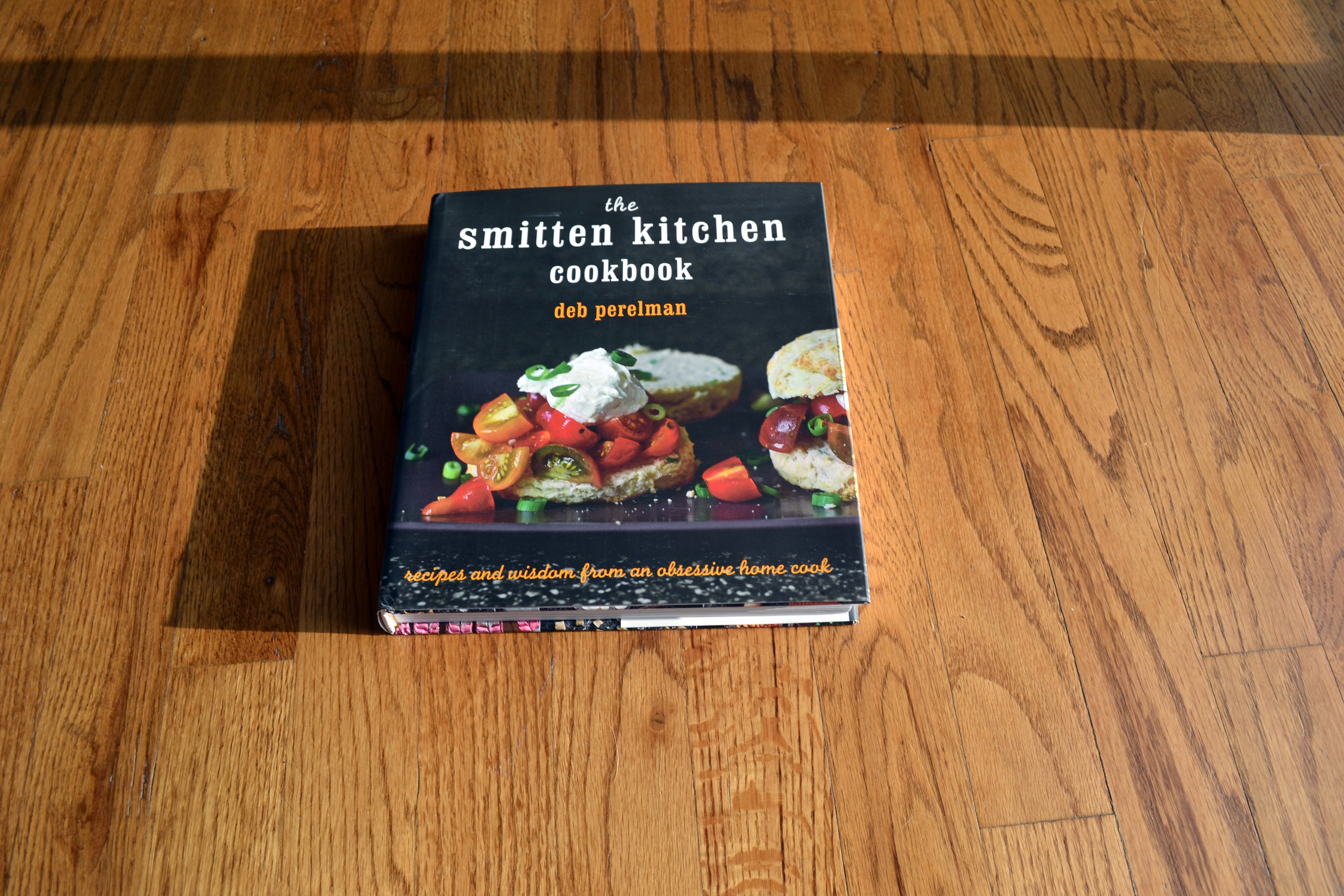
This week Deb Perelman’s “The Smitten Kitchen Cookbook” arrived to me, unceremoniously dumped in its delivery box over my porch railing (our mail carrier is not the most careful, as the wads of advertisements half-shoved into our mail slot prove).  That was the last blasphemous treatment it received, however.  I went through it page by page, almost shouting at nearly every recipe, because all sound delicious, and many are simply brilliant.  Her combinations are unexpected but make complete sense, and her writing is so human and real and honest – on the site as well as in the book – that I can’t stop picking it up and flipping through it again.  It doesn’t matter which page I open to.  I’m drawn in by the food but also by the language, and together they make me want to run to the kitchen every time.

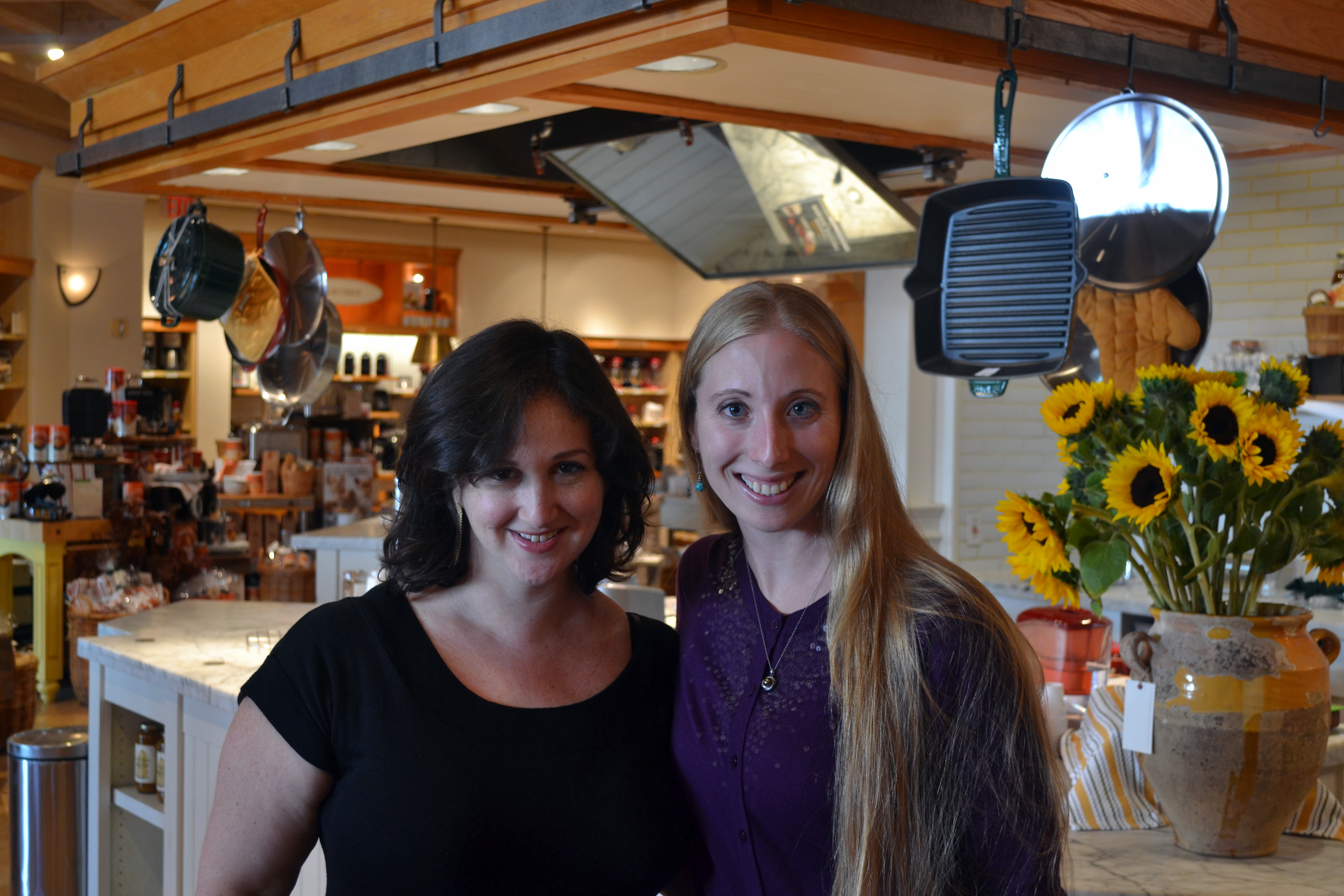
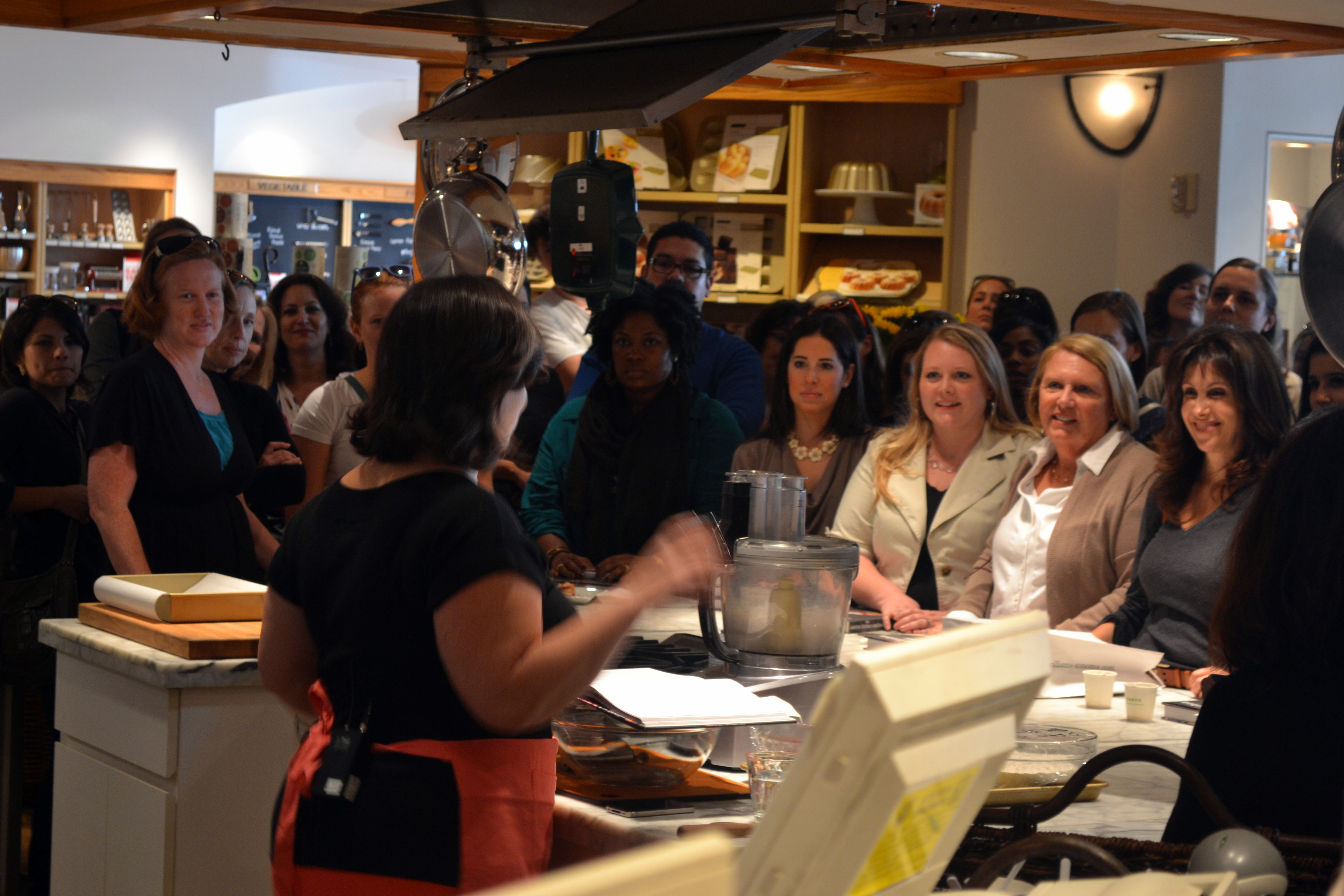
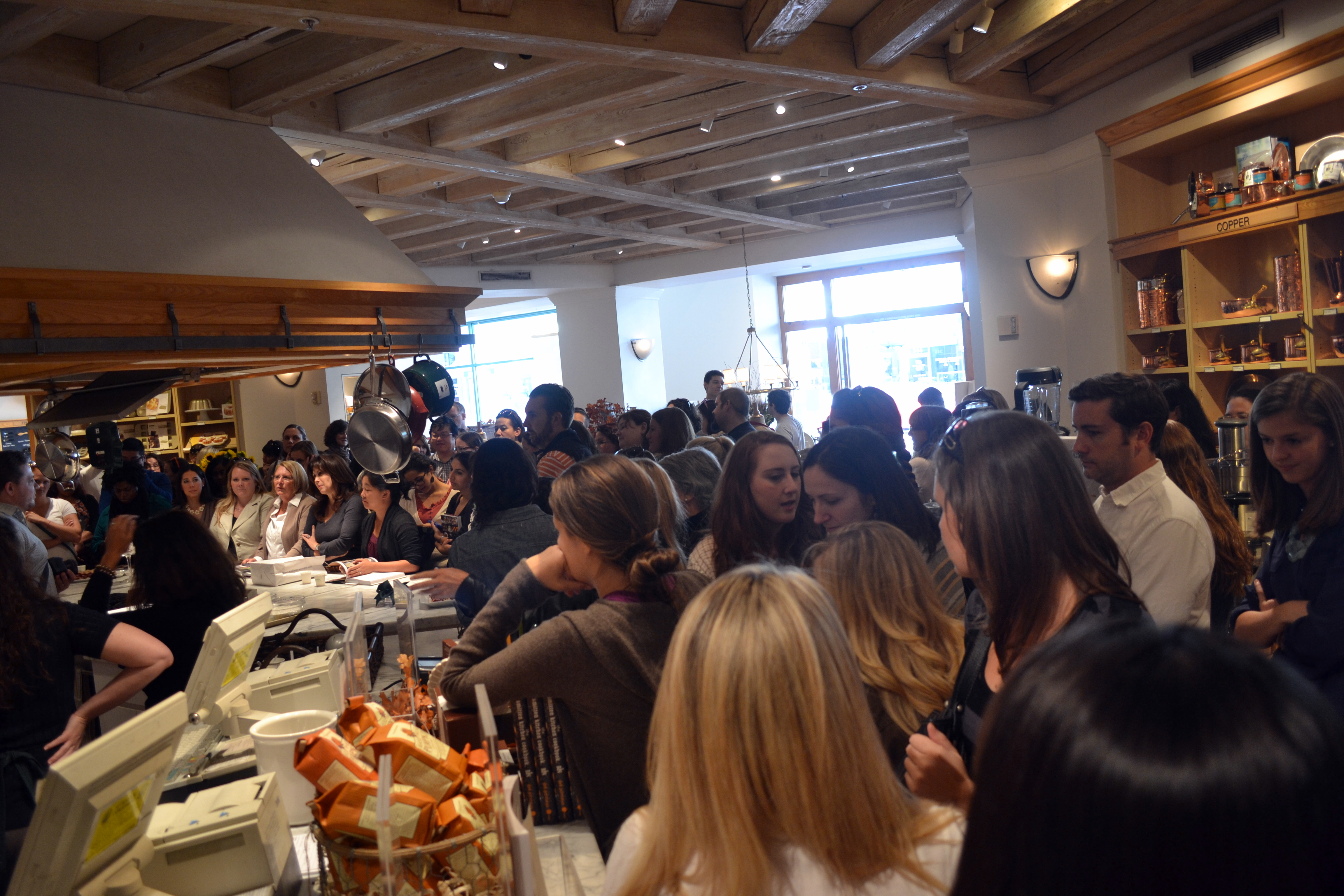
That was Tuesday.  By Friday, I already had a plan to make every last thing in that cookbook (my first choice involves eggplant, and chickpeas, and tahini, and cumin…), and after a quick round of grading and laundry, I was in the car on my way to Beverly Hills, where Deb was doing a cooking demo and cookbook signing at Williams-Sonoma.

Without having this sound weird and stalker-ish (I’ve apparently become a fan-girl, what can I say?), Deb is lovely and I’m so glad I had a chance to meet her.  (I also spotted Joy the Baker in the larger-than-Williams-Sonoma-anticipated crowd, and eventually awkwardly introduced myself.  She was lovely as well).  I got to ask a question that came out somewhat awkwardly and – I think, though N. keeps telling me this is silly – sounded like I was asking how much I would have to adapt a recipe in order to avoid plagiarizing someone else, which by extension (only in my over-analytical brain, I suspect) sounded like a passive-aggressive suggestion that no one is capable of original recipes, no matter how they might try.  Sigh.  Not what I meant, of course.  What I was trying to ask was motivated by the teacher and scholar in me: we are taught simultaneously that there is nothing new under the sun, AND that we must be original in our thoughts and products.  But chocolate cake isn’t new.  There’s a formula for it that, yes, can be tweaked and fiddled and caressed into something a bit new, but at what point does that start being yours, instead of the recipe you learned from?  I suppose it comes down to a question of copyright, and I don’t know how that works in the world of food.

Talking AND stirring

Concerned or confused by our questions?

Despite my clumsy question, which came out sounding – at least to me – somewhat combative, Deb said she thought it was more about technique and writing style than about complete recreation.  If you introduce a helpful method within the confines of the recipe, or if you write the directions or description in your own fresh way, the dish becomes yours through your additions to the conversation.  You become, I suppose, an author rather than a reader.  It’s very medieval, in a way: authors were “auctors,” or authorities, but to gain that authority they pulled from other sources.  Only God was the true, original creator.  Men could only imitate and produce imperfect copies.  That’s why I think the combination of cooking and literary studies meshes well for me: it’s all about reading, or chewing, mulling things over in your mind (and mouth) to see what you think of them.  Once you have had some thoughts of your own, once you have digested your meal, you have an opportunity to create: writing becomes cooking becomes writing.  You string carefully chosen words together and cultivate them into the form you want before sending them off to be read – consumed by your audience.

Deb made cranberry crumble bars, one of the recipes in her new book, before stationing herself at a little table to sign book after book after book.  One of the WS employees made rounds sharing samples of three different recipes from Deb’s book.  These sustained us during the 90 minute line snaking (or snailing?) through the store, passing walls of such debatably ingenious gadgets as a banana slicer, a juice squeezer for single slices of lemon, and a coil potato masher (this one was pretty cool, though.  I must admit to wanting one).

And then we were around the corner and Deb was signing my little placard from WS (they ran out of books long before the event started, and this was their work-around: order a copy, get a placard, stick it into the book yourself when copies arrive.  I already had a copy, but I wanted a signature, so it looks like someone’s getting a tasty Christmas gift…) and chatting, and asking me the name of my blog(!), and then N. and I were tasting apple cider caramels and glowing back into the sunlight of Beverly Drive.

I have Bittman reports to share with you – figs and orange juice and sweet potatoes and bourbon – but I think this deserves to exist on its own.  More tomorrow.

Lucy is unimpressed by my new acquisition, unwilling to look at the camera, but still insistent to get my attention in any way possible.  Sometimes I wonder whether she’s actually part feline.  Don’t tell her I said that. 

Swing

Summer into fall into summer.  Salads and grilled vegetables into casseroles dabbled with cream into fresh raw dips.  Luxurious stretches into curled legs under blankets into stressed grading sessions into sampling new half-fizzed white wine.

Sometimes this is called Indian Summer.  I like to think of it as Swing Season.

Two Bittmans for you this week.

77. Trim and dice fresh tomatillos; peel and julienne jicama (or daikon or kohlrabi). For dressing, combine lemon and lime juices, olive oil and chopped cilantro. Pour over salad, top with toasted sesame seeds.

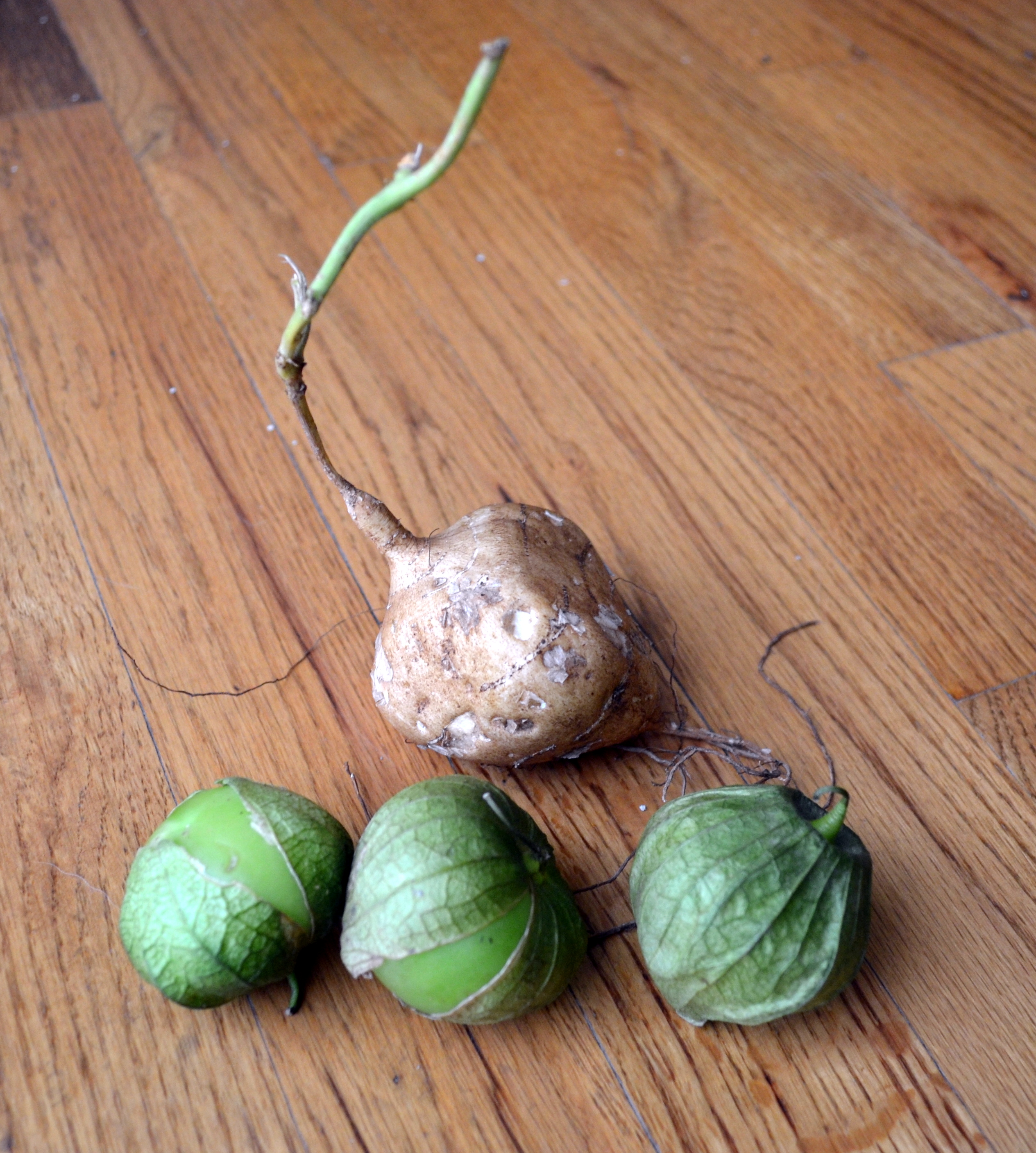
This sounded like a good late summer/early fall salad.  I found tomatillos at the grocery store, but no jicama, no daikon, and no kohlrabi.  And then we went to our Farmers’ Market, and I found all three!  Huge daikons, alien baseball sized kohlrabis and, hidden between stacks of beets and the tiniest fingerling potatoes I’ve ever seen, a pile of grubby little tubers with vine-y stems still attached.  Eureka, jicama!  Back at home, I assembled the troops:
1 TB toasted sesame seeds

2 small jicama

6 medium tomatillos

(really, the number of jicama and tomatillos isn’t super important as long as the quantities are roughly equal once you’ve cut them up.  Start with maybe 1 cup of each, see what you think, and then add more if that’s what makes you happy)

2 TB chopped cilantro

1 lemon

1 lime

Olive oil

Salt

I’ve tasted jicama, but it has been a long time.  And I’ve certainly had tomatillos, but mostly only after they were roasted and processed into salsa.  I wasn’t sure how they would be raw.  This – a lovely fresh slaw/salsa/salad hybrid – sounded so bright and tart and lovely that I wasn’t too nervous.

Before anything else, I toasted the sesame seeds and set them aside.  They give off such a lovely roasty scent when they are just browned and starting to release some oils.

I peeled, then sliced the jicama into rounds.  Then I stacked up the rounds and made thin slices across until my two little aliens were a pile of matchsticks across my board.  Into the bowl with you.

Next I quartered and diced the tomatillo.  Because they are still underripe when green (apparently they can turn purple and get very sweet when they ripen, but I’ve never seen them in that state), their skins were quite resilient – it took some pressure to get my knife through them.  Carefully chunked into miniscule cubes, they joined the white confetti in my bowl.

A quick squeeze of lemon and lime, a whisking pour of olive oil, and a handful of chopped cilantro feathers later, and the dressing was done.  And then a sprinkle of salt, and it was perfect.  It was a little more than needed to moisten the salad, but it’s hard to know how much juice citrus will have secreted away inside it, so it’s always going to be a guessing game.

I mounded the white and green on my plate, then added a generous scoop of Mexican rice and a quartered cheddar cheese quesadilla.  Simple simple.  At this point, you should ideally sprinkle the sesame seeds you so carefully toasted atop the salad, but I forgot until after I’d already subjected it to a photo shoot.

I was surprised and pleased by the flavor of this dish.  I can’t imagine eating it as a Thanksgiving side dish, but it was a bright burst of summer on a day that began in drizzly autumnal terms.  Jicama is crisp and juicy with the barest hint of starchiness, and its flavor reminds me most closely of an Asian pear.  The tomatillos were very tart, but the pairing tamed them.  Imagine a granny smith apple crossed with an underripe tomato and you’re approaching the brightness we experienced.

This was good as a salad, though its tartness necessitates a small portion.  It was also good heaped atop our quesadillas, like a raw salsa.  It contrasted nicely against the melted cheddar and the just crisped corn tortillas.  But where it would really shine, N. and I agreed, would be as a kind of mirepoix for guacamole.  Dicing the jicama instead of leaving it in strips and folding the whole salad gently into chunks of ripe, buttery avocado would make for the perfect chip dip.  Tart, creamy, crunchy, with the right kind of salty sourness from the dressing, and all you’d need was a frosted Corona and a pool to dip your toes into.  Summer.

But things never end there.  At least we hope not!  Days of sweating and hiding inside and waiting till after sunset to go out always, inevitably (even if it’s taking FOREVER, Los Angeles…) relax and cool and crystallize into Autumn.

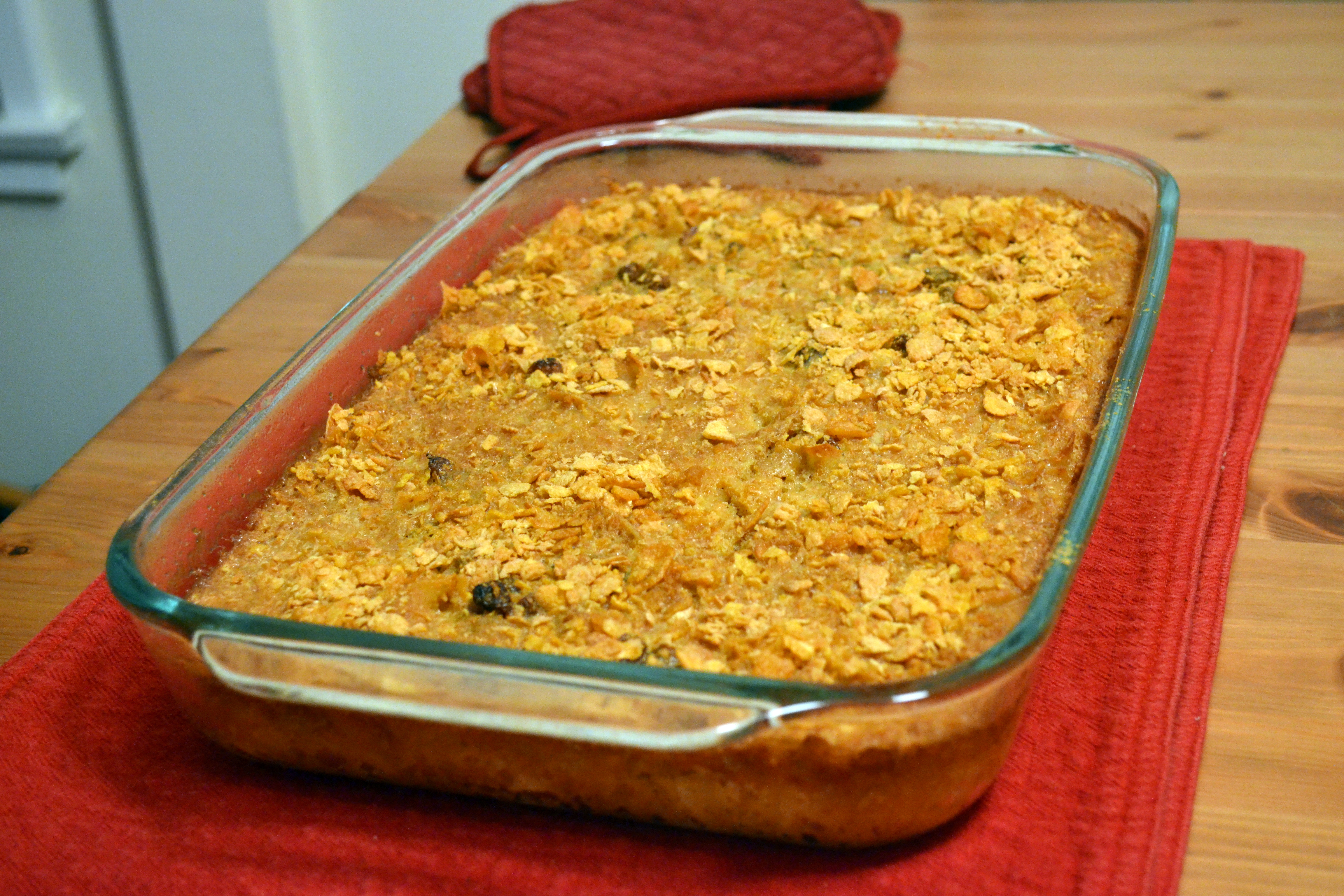
35. Pumpkin-Noodle Kugel: Cook a half-pound of egg noodles in salted water until not quite done; drain and put them into a buttered baking dish. Whisk together 4 cups milk, 4 eggs, 1 cup pureed cooked pumpkin (canned is fine), ¼ cup melted butter and a pinch each of cinnamon and salt. Pour over the noodles and sprinkle with bread crumbs (or, for added kitsch, corn flake crumbs). Bake 45 minutes to an hour, or until a knife inserted into the middle comes out clean.

I had no idea how to serve this dish.  I’ve heard of kugels, but I’ve never even eaten one, let alone made one.  I wasn’t sure, as usual, what to serve it with, so I asked a few friends and did some research on the good ol’ internet.  At the point that I read Smitten Kitchen’s version (okay, so this one is written by her mom, but seriously, that woman has cooked everything, and all of it sounds and looks outrageously delicious), this sounded more like a dessert than a dinner side dish.  It would be, I decided, dessert and weekend breakfast.  Sweet, autumnal, nicely spiced, and custardy.  “It’s going to be like a rice pudding but with noodles.  And pumpkin,” I told N.  He still wasn’t sure.

8 oz. egg noodles 

4 cups milk

4 eggs

1 cup pumpkin puree (I used Libby’s)

¼ cup melted butter (I put this in, but I’m not sure it was really necessary)

¾ cups sugar

¾ cups golden raisins

½ tsp cinnamon

½ tsp salt

2 cups corn flakes, well crunched (who am I to pass up added kitsch?!)

It wasn’t until I had collected ingredients that I realized Bittman’s recipe doesn’t call for sugar.  But I was already on the dessert/breakfast kick, and I couldn’t quite envision this as a savory dish, so I dumped in my sugar estimation anyway, along with the golden raisins that aren’t part of the original.

I cooked my noodles for 5 minutes and then let them cool for 10.  They probably needed to be cooked for only 4 minutes, because they keep on cooking not only while they are in the oven, but on the counter as they cool as well.

Yes, I take these photos from the floor. But it’s a nice wood floor, and the light is so good, and I promise Lucy stayed on the other side of the room the whole time…

With the custard whisked together and the noodles evenly spread in a buttered 9×13” glass baking dish, I preheated my oven to 375F and assessed the corn flakes situation.  Whenever an ingredient needs to be crushed, crunched, or pulverized on Chopped, I yell at the chefs for using their hands, knives, or a rolling pin instead of just bringing over the food processor.  But they don’t have to wash all the dishes they make, and I do, so my pretty little scarlet processor stayed on its shelf.  I crushed up the cereal with my hands, feeling a kind of satisfaction as the flakes became bits and then powder.  I topped the noodly custard with a generous layer of crumbs and carefully slid it into the oven.

An hour later, the custard had set and the smell flashed me forward to Thanksgiving.  I’m convinced we as a society don’t really know what pumpkin tastes like, because what we experience is texture and spices.  If this kugel didn’t have a sprinkle of cinnamon in it, I’m not sure I would know it had pumpkin either.

Dinner came and went, the kugel cooled a bit, and I dug out a too-big portion for myself, and neglected to feel any kind of remorse about it.  It was too good for that.  The noodles had melded together as the pumpkin infused liquid cooked, making a solid, scoopable, sliceable custard.  The corn flakes on top were perfect: aggressively crunchy against the soft interior.  I wouldn’t omit the golden raisins either; they were a really nice textural contrast to both the softness of the noodles and the crunchy crumbs, and their complex sweetness added some depth to my dessert casserole.  It was warm, and sweet, and perfectly comforting as I tucked my feet under me on the couch and waiting for the approach of Project Runway (don’t judge, every girl needs a little reality TV now and then).

The leftovers are delicious too, though the dish does lose something in relinquishing its crunch to the microwave.  In another universe where I’m a Southern cook, I could see doing crazy things like frying squares of this in butter and then drizzling hot maple syrup over the top.  But I’ll refrain.  Because from my window, I can see my basil wilting beneath the curiously, cruelly hot-for-mid-October sun: back to summer, so it seems!  And here I was considering making soup…

Swing season indeed.