Chatterbox

I’ve just begun rereading Neil Gaiman and Terry Pratchett’s genius collaboration Good Omens for perhaps the sixth or seventh time.  One of the characters introduced early in the novel is a Satanic nun named Sister Mary Loquacious from the Chattering Order of St. Beryl.  In looking back through some recent posts, I’ve noticed myself falling a bit on the loquacious side, with posts extending perhaps a bit longer than you’d like for a casual evening read.  So today, with three Bittmans to report on, I’m going to try to keep this brief.

54. Cook onion, curry powder and chopped ginger in oil until onion is soft; meanwhile, steam cauliflower florets until nearly tender. Add cauliflower to onion mixture, along with raisins; cover and cook until the cauliflower softens.

Two of my most hated food items as a child were cauliflower and curry.  Cauliflower was drab and slightly bitter – worthless unless smothered in sharp cheese sauce, and even then a bit suspect.  Curry powder was musty and unpleasant, and the two of them together sound like one of my youthful nightmares.  I kept this selection on the list because N. loves the flavor of curry.  But I knew that I would have to doctor up Bittman’s procedure to give this dish even a fighting chance.

1 head cauliflower
1 tsp curry powder, divided

½ tsp salt

½ tsp black pepper

generous glugs of olive oil (quantity will depend upon the size of your cauliflower)

¼ of a red onion

¼ cup golden raisins

2 TB fresh ginger, grated (this is easiest to do while it is mostly frozen; you keep your ginger in the freezer, don’t you?)

Brush a layer of olive oil on each of two cookie sheets and preheat the oven to 400F.

Core the cauliflower and slice it across into flat steaks of about ½ inch thick.  Some will collapse into florets.  That’s okay, but ideally you want nice long, horizontal pieces of cauliflower.  They look like flattened sprigs of Queen Anne’s Lace.  Toss the cauliflower with ½ tsp of the curry, salt, pepper, and more olive oil, then place on the tray in a single layer.  Don’t crowd them too much – the more space they have, the better they will brown.  Roast for 40 minutes, pausing at the 20 minute mark to flip each piece.

While the cauliflower roasts and caramelizes and browns, sauté the red onion in a little more olive oil.  When it begins to brown, toss in the raisins, the ginger, and the other ½ tsp of curry powder.  Cook together for another 2-3 minutes until the raisins plump and the curry aroma mellows a bit.

When the cauliflower is just tender and darkly golden, take it out of the oven and toss it with the onion and raisin mixture.
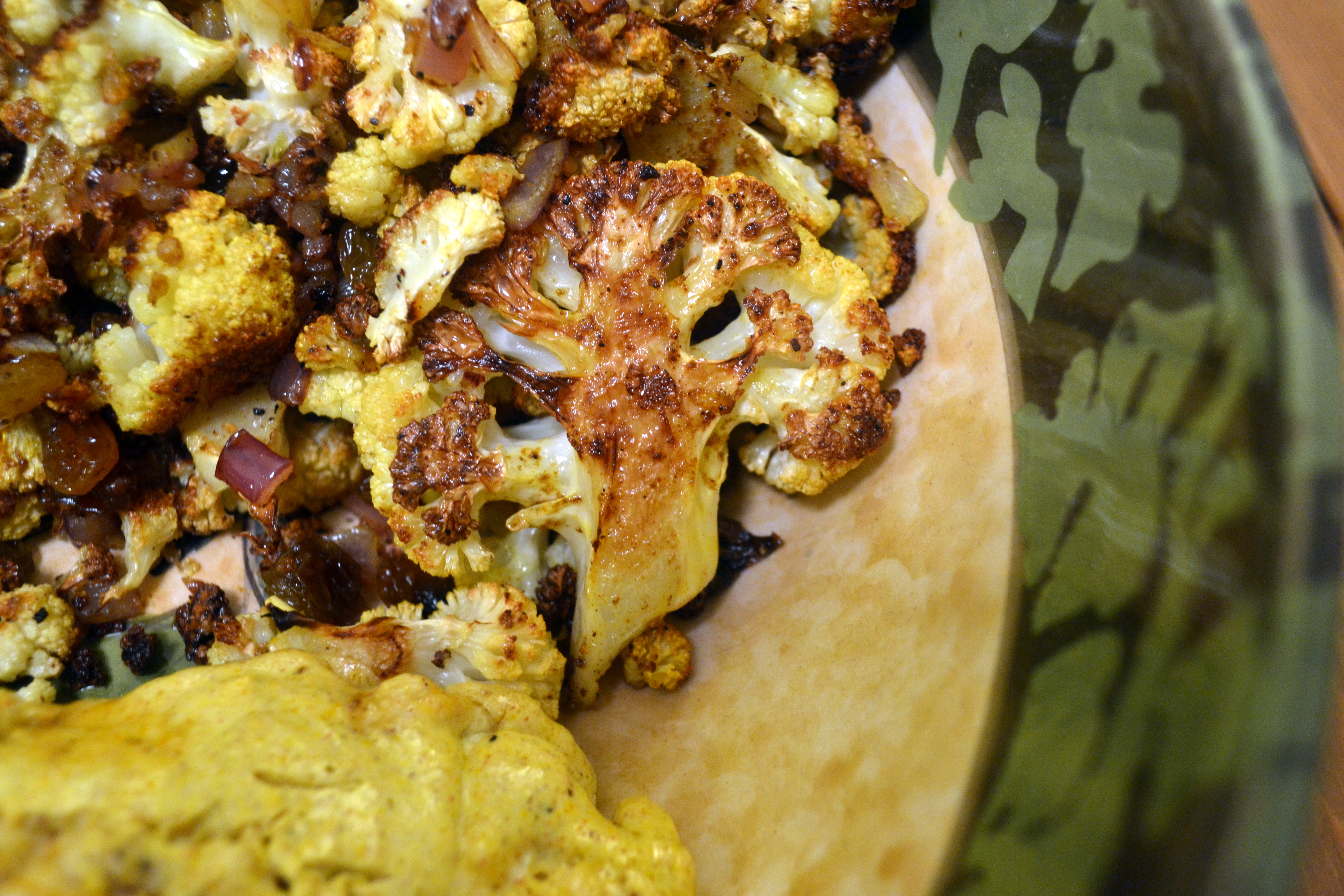
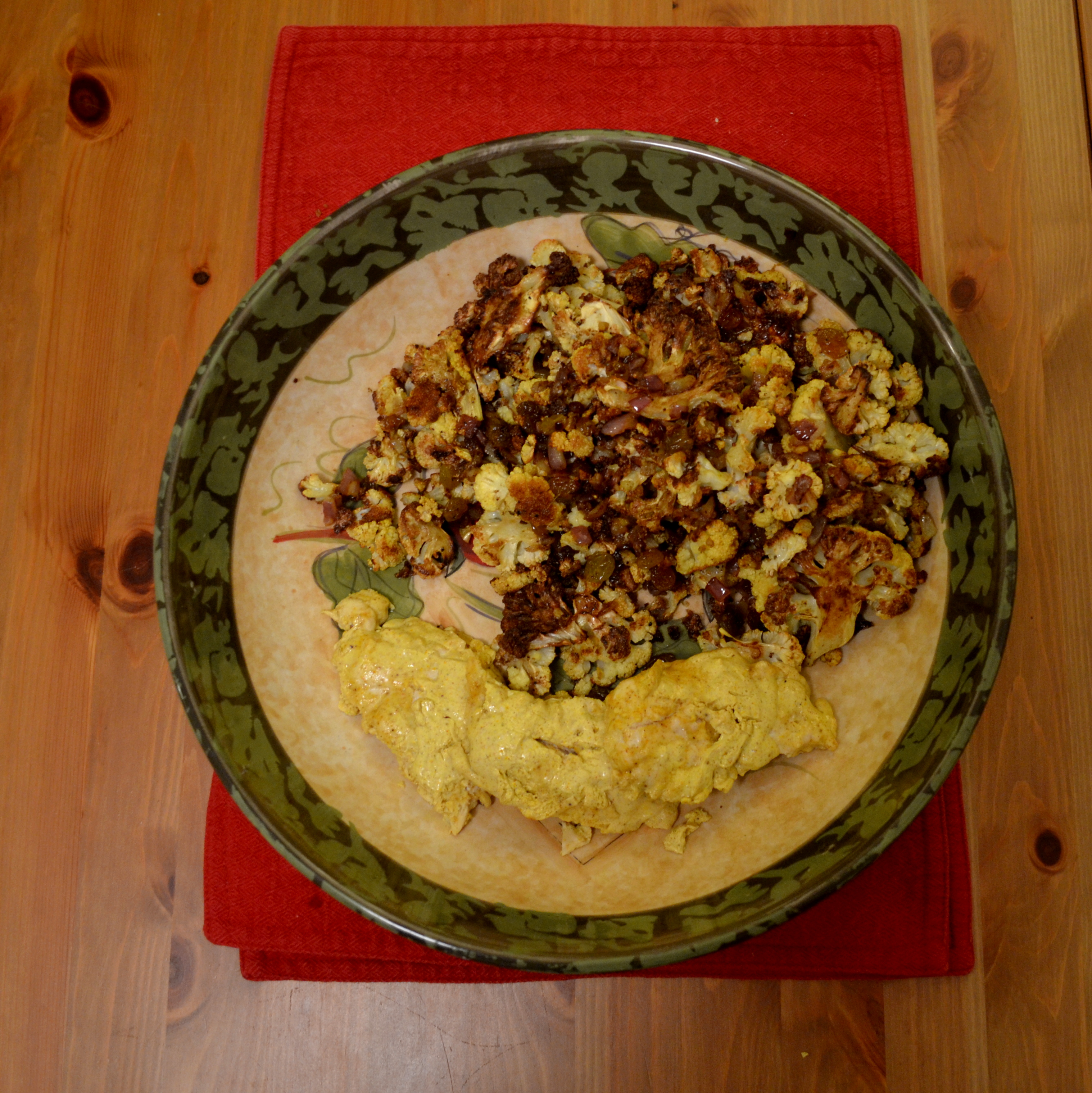
We had ours alongside some roasted chicken breasts I’d marinated in yogurt and garam masala.  It was delightful – if you favor a strong curry flavor, add more to both the cauliflower and the onions.  I was happy to have just a mild hint of earthy spiciness, and the unexpected sweetness of the raisins cut even this dankness in a very pleasant way.

16. Sauté equal amounts chopped, peeled apples and onions in butter until soft. Add stock or water to cover, then simmer for 10 minutes. Cool and puree. Serve sprinkled with Stilton or other blue cheese.

We weren’t sure about this one.  Nevertheless, we bravely decided to make just a small portion and see what happened.  These quantities will serve two.

1 medium apple, peeled and cored

1 medium onion

salt and pepper to taste

2 TB butter

1 ½ cups chicken stock

blue cheese
Melt the butter in a small pot over medium heat.  When it foams, it’s ready.

Meanwhile, dice the apple and onion into small chunks.  You want equal sized piles – we probably ended up with just over a cup of each.  Add them to the pot and cook over medium, stirring occasionally, for 10-15 minutes.  You want softening and tenderizing, not aggressive browning.

When the apples are tender and the onions soft and translucent, add the broth and seasoning (though we didn’t make any additions, some thyme or sage might be very nice here – try 1 tsp of finely minced fresh herbs) and simmer for 10 minutes.

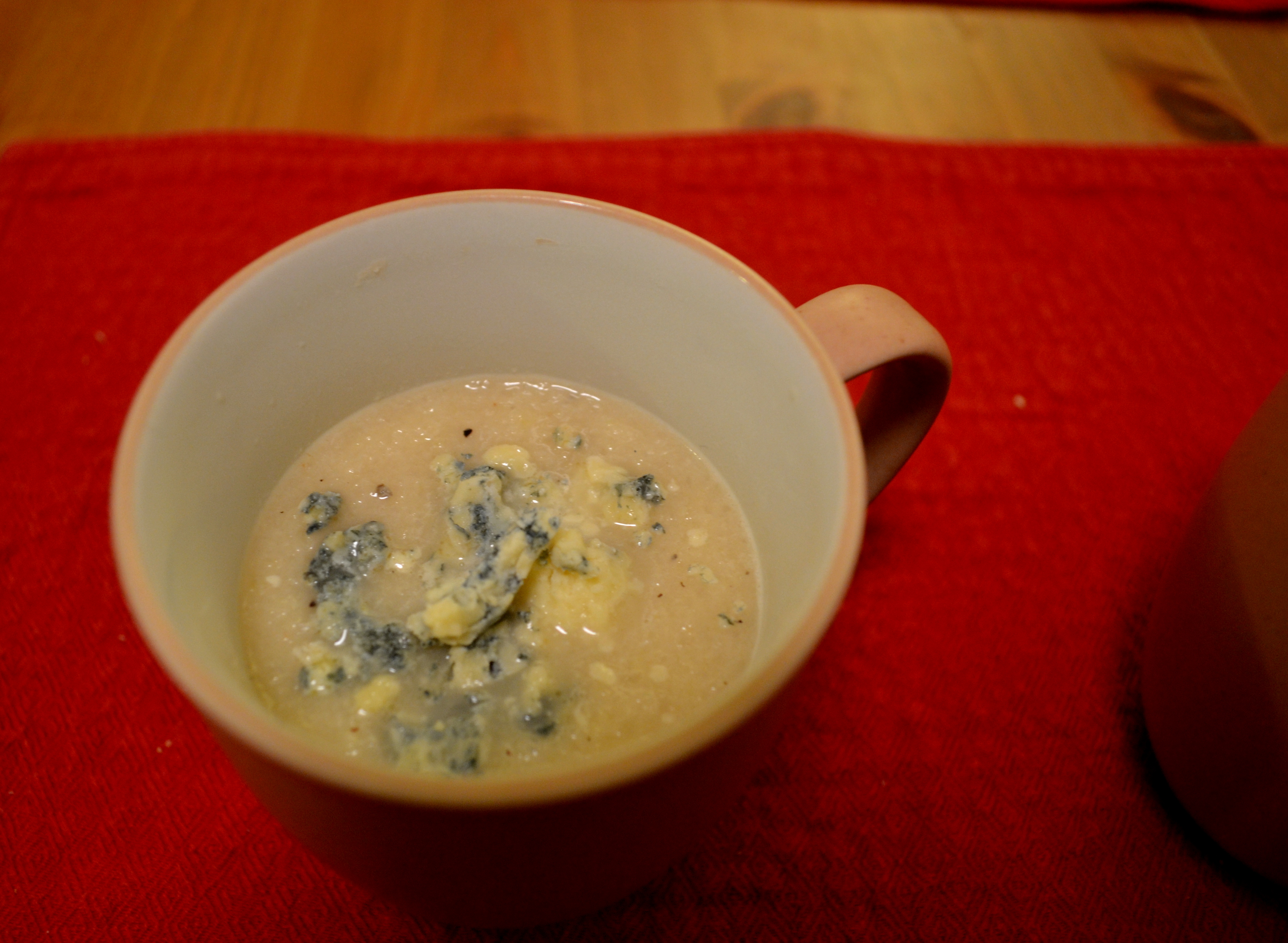
Remove from heat and cool slightly, then puree and serve with 1-2 TB blue or gorgonzola cheese sprinkled on top.  We had a nice blue stilton.

It wasn’t that we didn’t like this, it was that it seemed odd as a soup.  It was slightly reminiscent of a butternut squash soup, but the apples were slightly sweeter than a squash, and the combination of their sweetness with the sharpness of the onion made this seem like an applesauce with too many ingredients.  Left chunkier, this might be nice draped over a roasted pork tenderloin – a meat that goes nicely with both sweet and sharper, savory flavors.  It might also be a good base for a butternut squash soup – the one additional player in this game could be the additional complexity it might have needed.


6. Cranberry-Corn Sauce: Cook a bag of fresh cranberries with about a cup of corn kernels, some chopped scallions, ¼ cup brown sugar (or to taste) and a splash of water, just until thick.

Our third Bittman this week was part of a pre-Thanksgiving Thanksgiving dinner.  When you grow up with a set collection of dishes that come to equate to this holiday, it can be hard to make a change.  When N. started having Thanksgiving dinner with my family, he missed his mashed potatoes and green bean casserole.  So I try, in the weeks that surround the holiday, to make up for these omissions. I make several smaller dinners featuring the dishes that don’t quite fit onto our holiday menu.  This seemed like the perfect side – not traditional enough for our Thanksgiving table, but satisfying in the mean time.
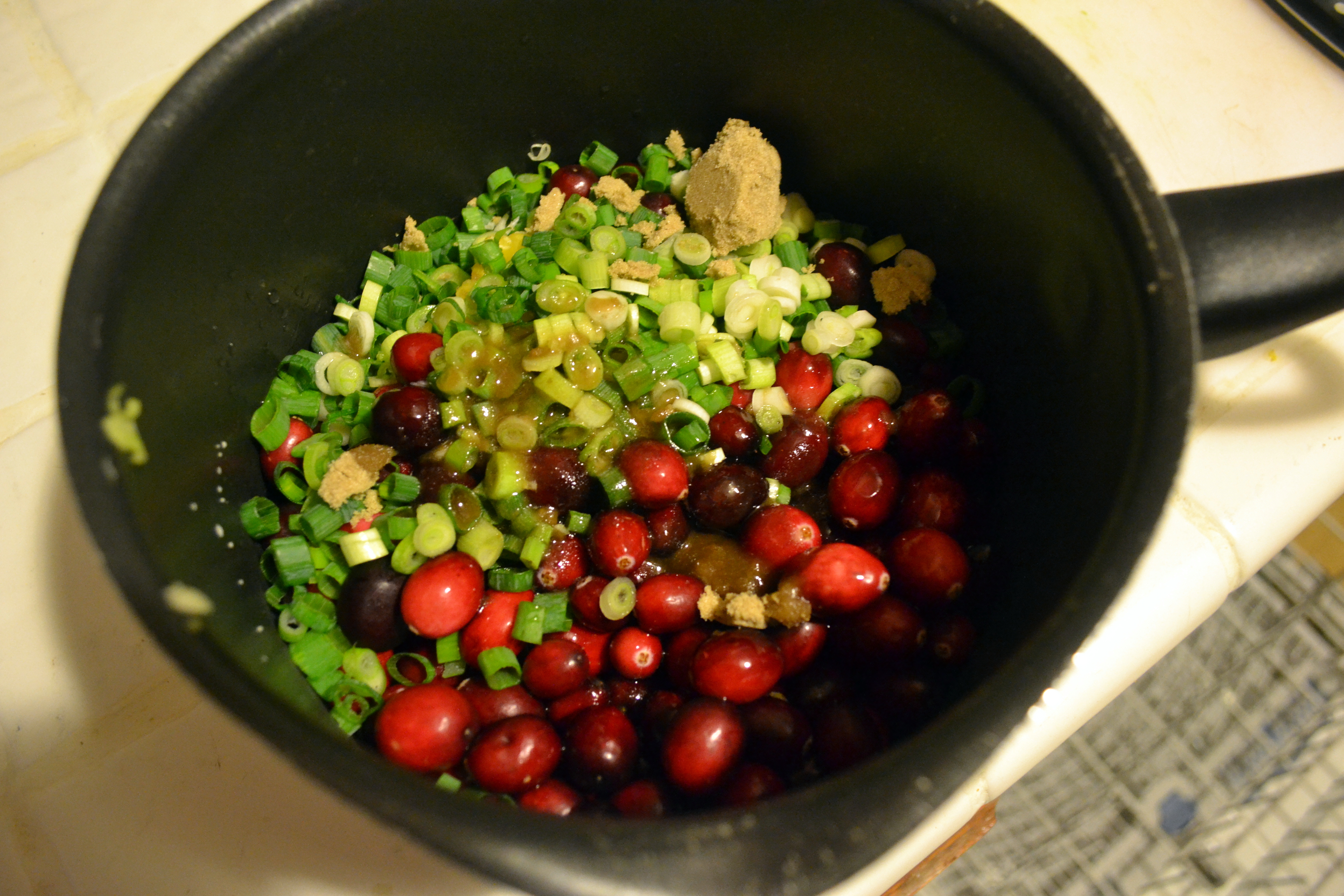
1 bag cranberries

1 cup fresh or frozen corn

3 green onions, thinly sliced

¼ cup brown sugar

¼ cup water

I tossed the cranberries, corn, water, and brown sugar together in a saucepan and set them over medium heat.  I added the green onions at this point too, but were I making this again I would add them later – the 15-20 minute simmering time resulted in a slightly adulterated color, and the fresh greenness would be so much nicer.  I advise adding them during the last five minutes of cooking time.

I let this simmer for about 20 minutes, until most of the cranberries had popped and the whole pot was a sticky, almost syrupy texture.  I let them cool off the heat with the pot uncovered for a few minutes, both because I like the flavor of cranberry sauce better the cooler it is, and because I wanted to let it gel up a bit further.

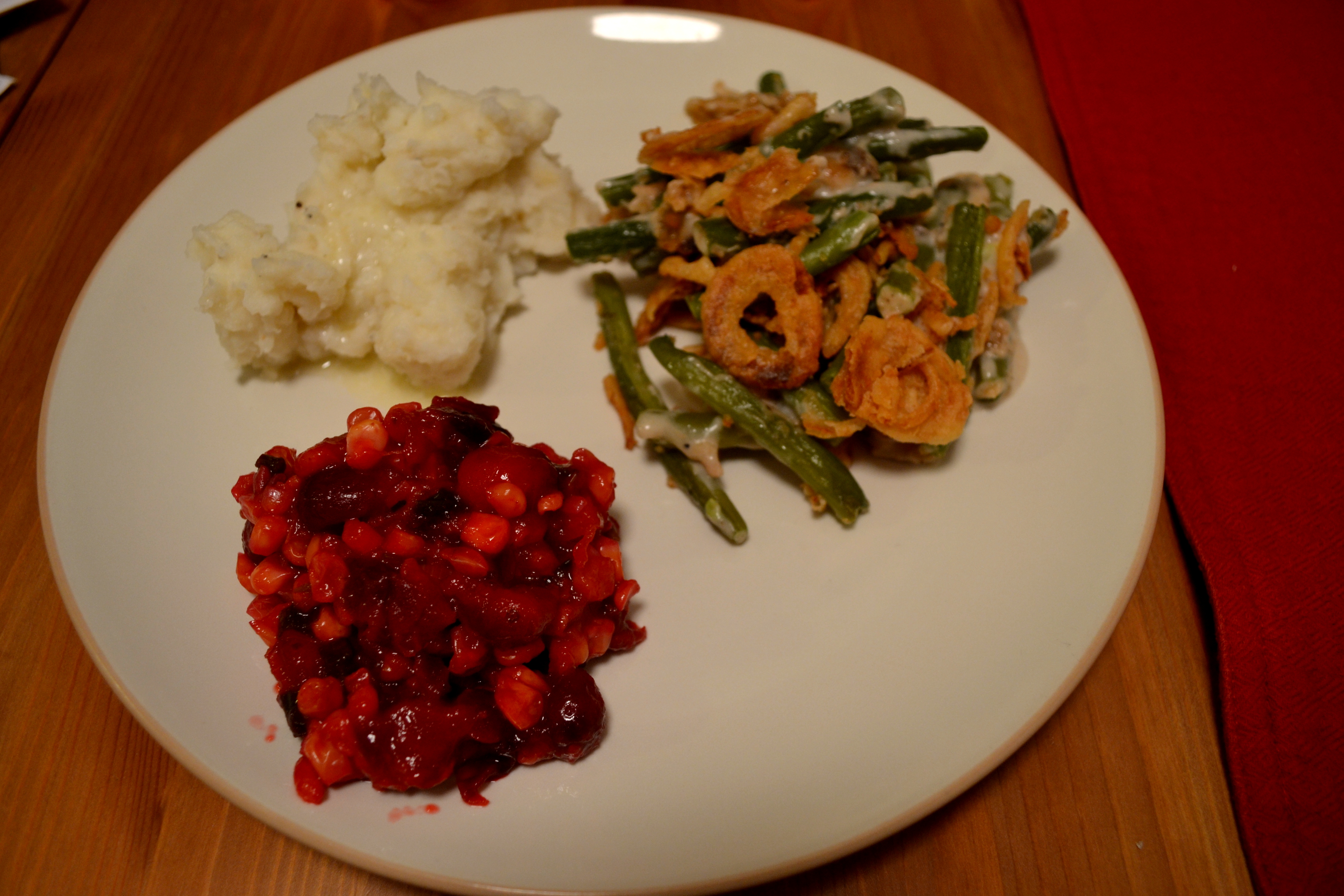
These weren’t as sweet as your typical cranberry sauce.  At least, they were not as sugary sweet.  The corn added a beautiful vegetal sweetness that seemed at once the perfect fit and a strange accompaniment.  We talked through this dish as we ate it, appreciating the maple overtones of the brown sugar and the tender crunch of the sweet corn, but thrown off slightly by the same qualities.  What we finally decided, as we sampled second helpings, was that they were a delicious side dish, but they didn’t feel like Thanksgiving.  Since the rest of the meal (garlic mashed potatoes and the old standard green bean casserole, slathered with cream of mushroom soup and the salty, salty crunch of french fried onions) was so traditional, having this difference, even in its subtlety, felt wrong.  If you’re a stickler for tradition, this cranberry dish would have a better chance as a chutney for grilled pork or maybe even lamb.
Next week is the big feast.  Oddly (odd because the entire Bittman list was conceived for this single day), I had some trouble figuring out where to fit his ideas in.  I’ve come up with a pair of selections to try out, and I will report back.  In the mean time, what dishes will grace your menu on Thursday?

Counting Down

It’s interesting that as I left my 20s behind chronologically, I entered my 20s in this Bittman project.  As of this moment, on this particular Sunday afternoon, I have 25 Bittman concoctions left to make, most of them soups and desserts.  At a rate of two per week, I will finish by the end of this year.  This means we’re getting toward some major milestones, some very big deals, some lasts on the list.

The first of this pair is one such last.

“34. Combine cooked bulgur with chopped or grated apple, minced orange rind, grated ginger and chopped parsley. Back in an oiled dish, use as stuffing or serve as a salad.”

This was the final remaining entry on the “Stuffings and Grains” list. We left it till last for no particular reason, but during a week in which a collection of Valencia oranges sat languishing in our fruit bowl, it seemed like the right thing to do.

I’ve been fairly good lately about writing down ingredient quantities as I add them, but for this entry I never even lifted a pen.  It happens.  I can own up to it.  A week of non-stop grading, perhaps, made me leery of that inky instrument.  Or maybe it was our relative rush: leave it to me to design a complex, glaze-bearing dinner on a night we needed to eat early.  Some things must get sacrificed, and it turns out it’s not the glaze, it’s the notations.

Here are my approximations:

1 cup bulgur wheat

2 cups water, stock, or a combination of the two

1 large fuji apple, diced into small squares

2-3 TB finely minced orange rind

1 TB grated ginger (this is really easy to do when the ginger is frozen)

¼ cup chopped parsley

salt and pepper to taste

Cooking bulgur is very similar to cooking rice.  I poured the wheat and the water into a pot and let it come to a boil before simmering for 15 minutes or so while I prepped my other ingredients.

After dicing the apple, grating the ginger, and chopping the parsley, I turned to the oranges.  Since Bittman specified “rind” and not “zest,” I used a y-shaped potato peeler to remove long, brilliant segments of rind.  I slid a sharp knife carefully between the rind and any white pith that got caught in the peeling, and then sliced into very thin strips, rotated them 90 degrees, and sliced again so I was left with tiny squares.

Before these happy bright piles all nestling on my cutting board got too comfortable, I tipped them into the pot of bulgur and carefully folded them in for even distribution with some salt and pepper to taste.  The experience of the still-chilly ginger hitting the hot bulgur was sinus-clearingly intense, but lovely.  An aroma-only aperitif.

With everyone incorporated, I dumped the pot’s contents into a greased baking dish and stowed it in a 350F oven for half an hour.

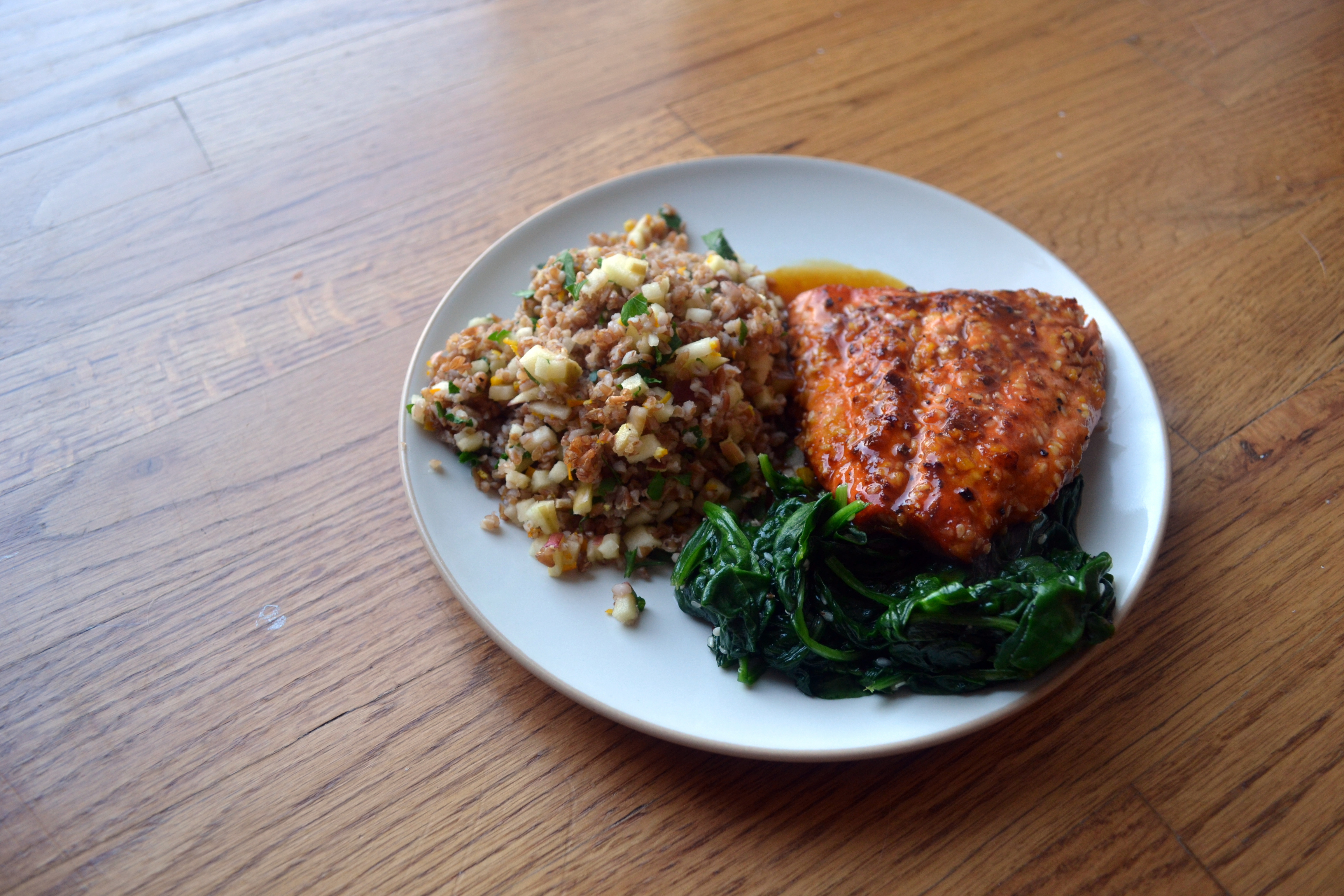
Orange and ginger suggested an Asian flavor profile, even though apples and parsley didn’t.  I decided to work with the dominant elements, though, and so I paired the bulgur with salmon and spinach.  The salmon would be rubbed with sesame seeds, powdered ginger, and orange rind bits before receiving a heavy sear and then an orange-juice glaze.  The spinach would be sauteed with garlic chips and sesame oil.

As with all things, this didn’t happen exactly as imagined.  It takes a long time, as it turns out, to simmer the juice of six oranges down into a thick glaze without burning their sugars.  Similarly, it takes time and babysitting to ensure garlic chips that are crisp, not charred.  And when you are trying to do all this on the same night as a homecoming football game you’ve promised to attend, certain shortcuts must be taken.

The salmon, while it seared beautifully, received not so much a glaze as a flood of boiled, ginger infused orange juice.  Still, when this liquid hit the hot salmon pan, it did bubble down into something thick and rich (if a little darker than intended).

The spinach, rather than the crunchy, spicy accoutrements I intended, had to settle for a last-minute sprinkle of sesame seeds to keep it company.

Still, the meal was overwhelmingly successful.  The salmon was outrageously delicious, and I’m going to have to make it again, writing down the procedure this time so I can share it with you.  The orange sauce perfumed the fish and kept it moist and buttery and tender.  Even though it was a bit darker than I’d planned for, the sauce took on caramel notes that seemed utterly intentional.

The bulgur was lovely.  It was toasty and fluffy and well seasoned.  The apple had cooked lightly as the dish baked, leaving it just softened but not without resistance.  The orange rind was delightfully not overpowering, but gave a warm spiciness to the grain.  It was good with the salmon, but would also be delicious with pork chops (playing on the traditional applesauce pairing) or, if you replaced the parsley with mint, a lovely side for leg of lamb.

In summary, a triumphant triumph: not only is the Stuffings category successfully completed, but it was completed with a success.


With the weather cooling (finally!) and the Soups category still looming largely untasted before me, I decided to try one to close out the week.

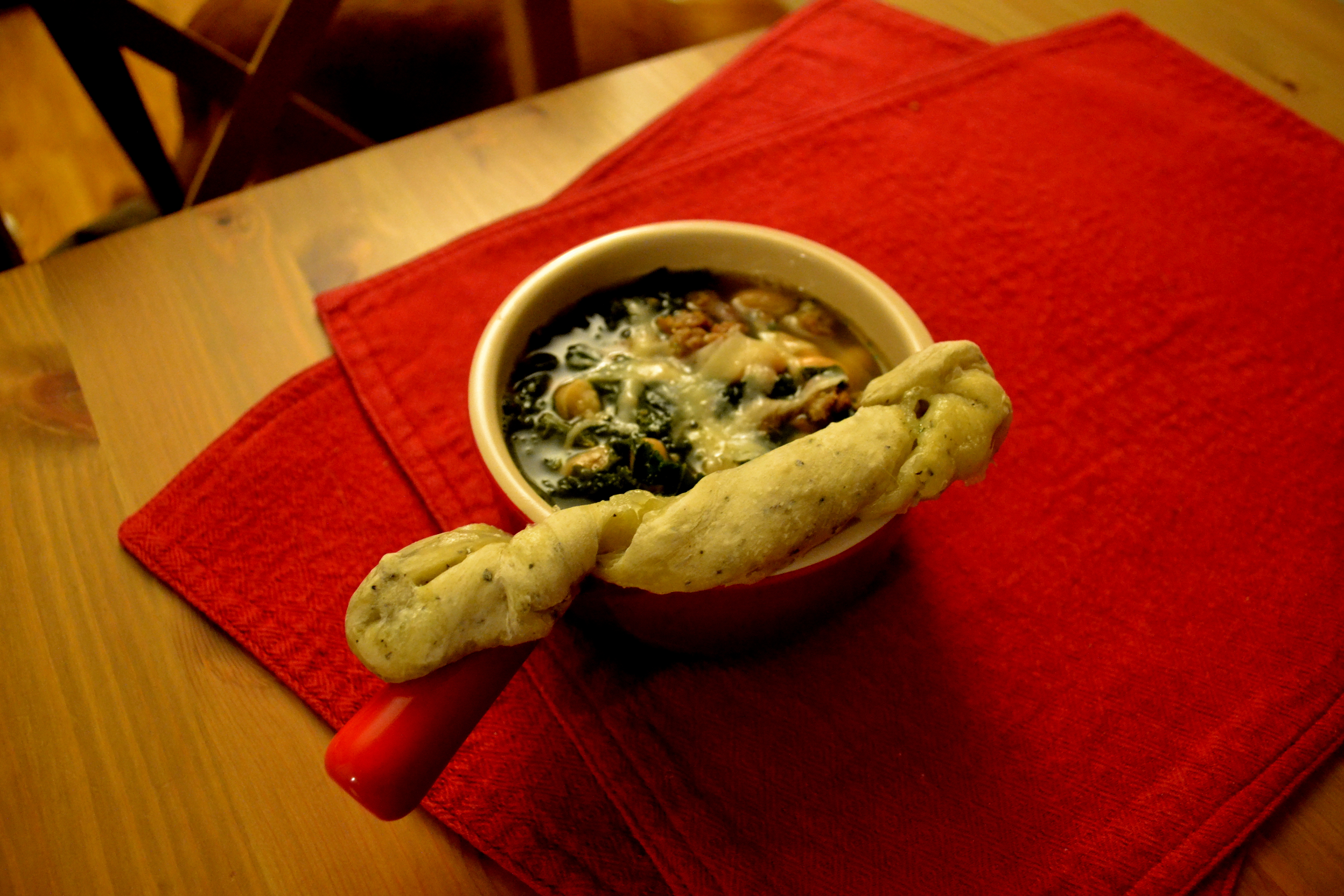
“21. Brown a little crumbled or sliced sausage in olive oil; a sprinkle of fennel seeds is good, too. Add chopped escarole, cooked white beans with their juice, and stock or water to cover. Simmer until the greens are tender and the beans are warmed through. Garnish with olive oil or Parmesan.”

I must admit I made some changes to these directions based on availability and personal taste.  I don’t like fennel.  It’s one of a very few spice flavors I just can’t take.  Over-fennel-ed sausage – like the kind that appears on many chain pizza restaurant pies – just doesn’t appeal to me, and the idea of fennel seeds crunching between my teeth and filling a mouthful of soup with their anise awfulness made their addition out of the question.

As for the escarole, I could find none.  I searched through mountains of salad greens at several local markets and this particular strain was resolutely absent.  But I did find a really beautiful bunch of kale and decided it would be a satisfactory substitute.

So here’s what I ended up with:

8 oz. bulk sausage

1 big bunch kale (chopped, this was probably 6-8 cups)

3 cloves garlic (some spice to replace the abhorred fennel seemed appropriate)

1 15 oz. can white beans with their liquid

2 cups chicken broth

salt and pepper to taste

Eschewing olive oil, I squeezed the sausage into a pan and let it brown over medium heat, separating and crumbling it as it cooked with a flat-sided wooden spoon.

I rinsed, stemmed, and chopped the kale into manageable pieces, and when the sausage was cooked through, I tossed in the mountain of greens.  No, that’s not true.  I inserted handfuls carefully so they wouldn’t spill all over the stove, and ran out of room with only half my kale added.  N. came into the kitchen when he heard me laughing hysterically, and stared in amazement at the mound of kale pieces sitting inches above the top of my pot.  I had to press it down with my hand, compacting the frilled, tough leaves down toward the bottom of the pot.  It always looks like too much.  It’s always not.  In the time it took me to mince the garlic, the kale had already begun to wilt and settle more comfortably into the confines of the pot.

When I could barely smell the garlic and the kale was level with the sides of the pot (as opposed to threatening to spill over them) I added the white beans, their juice, and barely two cups of low sodium chicken broth.  One of the things I’ve discovered about myself is that when it comes to soups and salads, I like them to be full of, well, stuff.  Lettuce with the odd crouton is no good.  I want dried cranberries, and walnuts, and avocado, and gorgonzola.  Thin, brothy soups don’t please me either.  Give me big chunks of vegetables, or slurpable noodles, or rich shreds of meat.  In the days when I’d indulge in the occasional Cup’o’noodle, I always drank the broth out first so I could concentrate on the important part: the just dripping mounds of noodles left behind.

So this soup, for true enjoyment, needed only enough broth to make its categorization accurate.  A scant two cups and we were assured plenty of “stuff” in every spoonful.

While the soup simmered, I stretched, sliced, and sprinkle mozzarella onto some pre-made pizza dough.  Twisted and snuggled on a baking sheet, these when into the oven to become bread sticks.  Fifteen minutes later when they were sizzling and firm, the soup was done.

This is not a soup you want to let simmer for hours.  The beans, especially if you are using canned like I did, will eventually become mealy and then disintegrate.  The kale begins to lose its emerald brilliance after a while, and though it will still taste good, it won’t be as pleasing to consume.  Simmer for fifteen to twenty minutes max.

Then you get to shave on some parmesan and eat it.

Neither of us was sure we would like this soup.  But we shouldn’t have been so foolish.  N. has placed the products of this project on a pass/fail system.  This is what happens, I suspect, when you have two teachers in the family.  He announces his verdicts after dinner, and he treats them as though Mr. Bittman has just submitted an exam or a paper assignment.  “Bittman passes on this one,” he told me last night as we cleaned up.  It wasn’t just his happiness at pairing his dinner with the first Jubelale of the season.  He really did like the soup.  And I think he was right.  This was a fast, easy, delicious little warmer.  Cooking the kale in the sausage grease gave it some additional flavor and took away that raw bitterness dark leafy greens can sometimes have.  The beans got creamy and delicate, and the starch from their liquid thickened up the minimal broth I used.  Even without the broth, these ingredients seem like a stellar combination that should be taken advantage of at many opportunities.  Sautéed together, perhaps with the addition of chopped onion and maybe butternut squash or sweet potato, they could be a nice little hash.  Wrapped in pastry with some thickened gravy, they could be a pot pie.  Folded with some grated mozzarella and enclosed in pizza dough, they become a perfect calzone.  And as the weather continues to cool (I hope, I hope, I hope), gravies and pot pies and warm cheesy casseroles are exactly what I want to pair my remaining Bittman dishes with.

It seems a bit stress-inducing to start with a countdown.  It’s a looming certainty of what must be achieved.  “That’s a lot,” N. said when I told him how many were left.  But after tonight’s dinner, it will be 24.  And by the end of next week, it will be 23.  And by having you out there reading, it means I must achieve, yes, but it also means I’m promising something to you.  Food.  Words.  Proof of my experiments.  And stress-inducing or not, that’s a kind of accountability I like having.

25 to go…

Starstruck

As I mentioned a few weeks ago, it hasn’t fully sunk in yet that I live in Los Angeles now. Funny little happenstances keep reminding me, and I’m stunned into bemused awareness. This didn’t happen when I lived in Orange County as a teenager. We were far enough from the big city with its food, music and fame scene, and I was distant enough in age to care, or even be aware of, what living near LA could mean.

Now that I’m a bit closer physically and chronologically, what it mostly means to me is food. Yesterday as I sat cloistered in my home office, commenting on what seemed like an endless stream of papers, my phone gave that delightfully insistent buzz that means someone from the outside world has contacted me. It was our friend J., asking if we wanted to go and grab burgers with him and one of his local friends. Dinner out? On a Friday? Meaning I wouldn’t have to tackle the embarrassing state of my kitchen just yet? Not to mention another culinary and – what would be the right word, perhaps libationary? – joyride around our new city? Yes, please.

J. showed up at our house around six and whisked us off to Plan Check Kitchen and Bar, a new-ish little burger and brew style gastropub in the Little Osaka area of West LA, where we would have dinner with him and his friend T. They have a short menu, mostly meat, but with interesting Asian flavor accents – wasabi, yuzu, and dashi creeping up in unexpected places.

I ordered the Bleuprint Burger, a patty of wagyu beef piled with smoked bleu cheese, brown sugar baked bacon they call, perfectly, “pig candy,” fried onions, roasted garlic steak sauce, and peppercress. My dining mates all got the standard: the Plan Check Burger, featuring a curious substance Plan Check calls “ketchup leather,” and a dashi-infused “Americanized” cheese, which I think meant cheddar mixed with garlic and some fish stock to smooth it out and add extra umami flavor. On the side, the table shared sweet potato fries cooked in beef tallow, served with a sweet peach ketchup, and veggie chips – perfectly crispy wafer thin slices of yam and yucca and who knows what else, paired with a slightly spicy, velvet smooth avocado cream.

Dinner was fantastic. I haven’t had a really good, moist burger cooked at an actual medium (the temperature I requested) in a long time. I drank a tangerine wheat beer with it (the name of the brewery escapes me, but somewhere in California), and it was a nice accompaniment.

While I was away from the table for a moment, somehow the conversation changed from food to, well, food. But virtual food. In fact, televised food. T., through a previous job, knows one of the guys from the company and food truck project Seoul Sausage, currently being featured on The Great Food Truck Race.

“I think they are opening a storefront,” he said, while my eyes bugged out of my head. “It’s just on Mississippi. We should go see if they’re open.”

Bye-bye, burger.  It’s sausage time.

We ambled the blocks along Sawtelle separating us from Mississippi. T. pointed out which restaurants along the way were worth checking out which, as it turns out, is most of them. I tried to make mental notes but I was feeling overwhelmed by the amount of delicious knowledge I was receiving. N. and I will just have to go back. Many times.

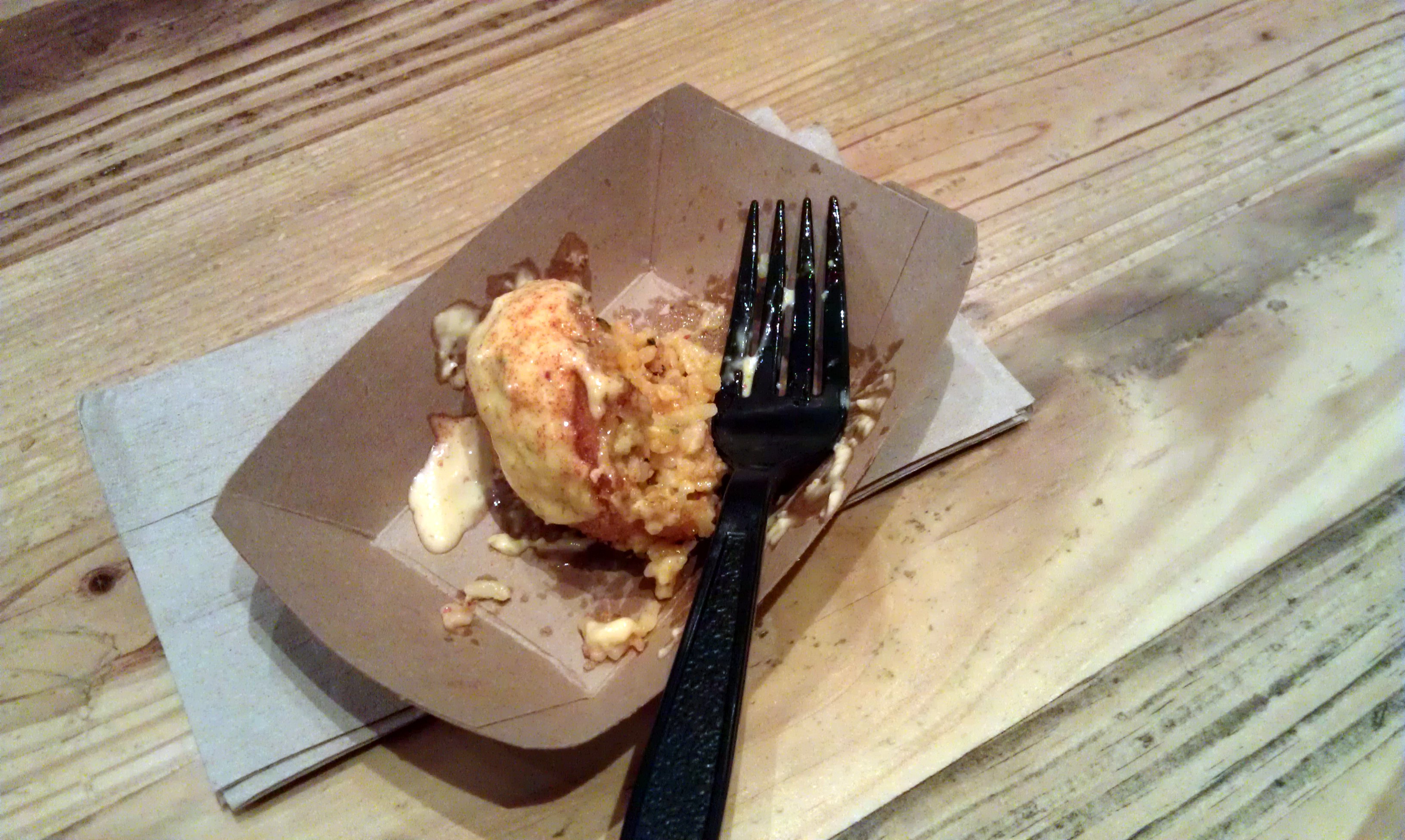
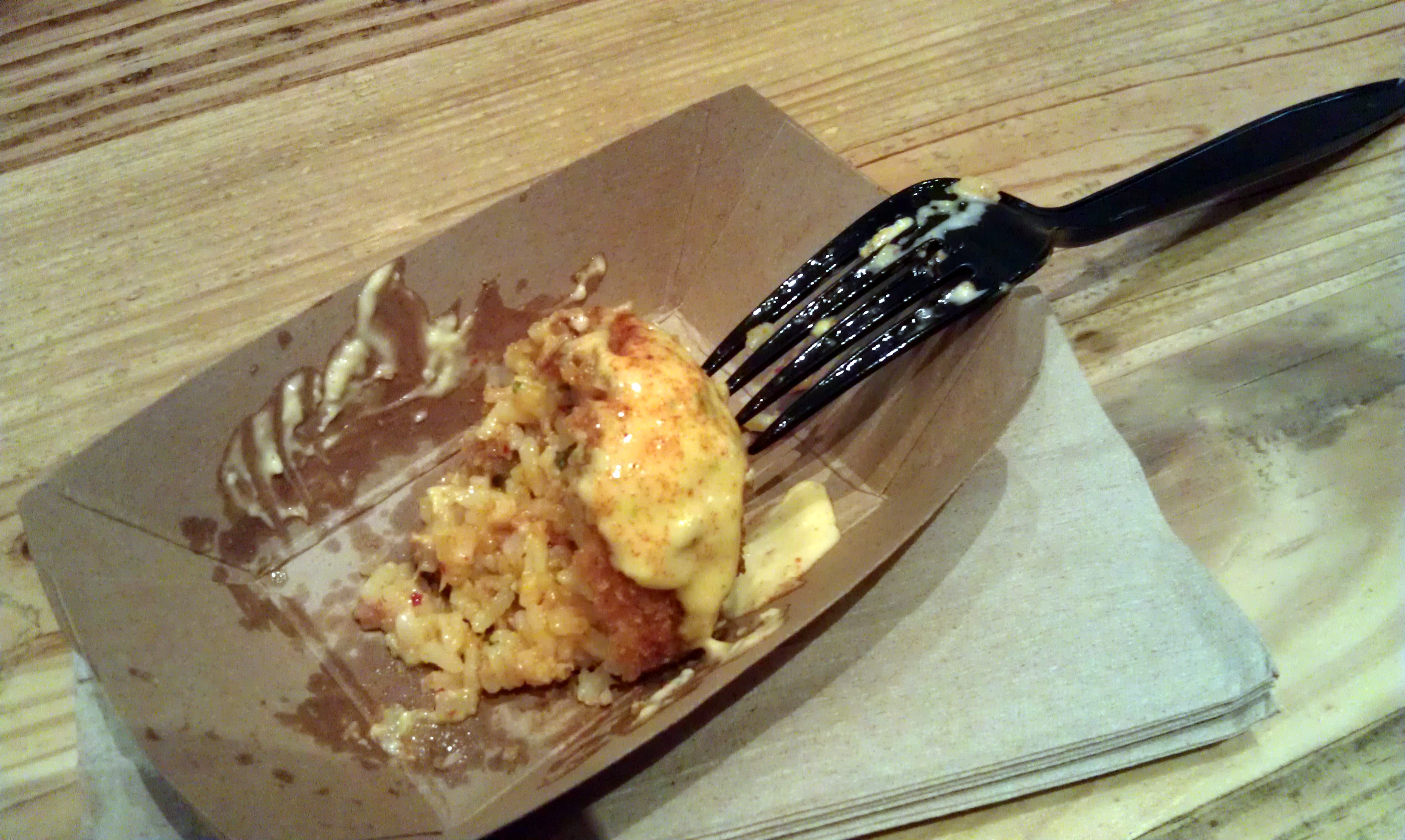
We turned the corner onto Mississippi and there, at the end of a short collection of shops, was Seoul Sausage Co. And it was open. Without knowing it, we had stumbled across a secret mini launch they had announced only on their website and on Twitter, and there were all three of the boys behind the counter, and suddenly I was being introduced and ordering one of the flaming fried balls they developed on the show.

I know I should be talking about the food here, but I was so starstruck I couldn’t stop grinning my way around the little space. The guys were, as I had imagined but never even hoped to find out, super friendly and happy to see us – and everyone else who stopped in – and being very properly and apologetically closed-mouthed about the results of the show (the finale is tomorrow – Sunday, at 9pm). N. chatted them up about beer, encouraging them to carry Ninkasi if it ever appeared on their radars. I couldn’t help but mumble something about how I hoped they would/had/did/whatever-it-is-taped-tv-is-so-confusing win before I gave into the beautiful, sizzling-hot fried riceball they handed me.

It was delightful. Delicate rice in the middle mixed with cheese, spices, and who knows what else. Crisp breaded crust around the outside, and a slightly spicy sauce squeezed over the top. It reminded me of the kind of sauce you get on certain spicy sushi rolls, and it paired so nicely with the rice. This is an excellent late night snack, and N. and I assured them we would be back again after their official opening next week. I was halfway through my little after-dinner snack before I remember that, despite my unwise choice to venture out on a Los Angeles food adventure without my camera, I do have a smart phone fully capable of capturing an image.

Flaming fried balls conquered, and me still in some disbelief that we had just been to Seoul Sausage and met the guys in charge (I wanted to know everything but asked nothing: what was Tyler Florence like? Were you getting all those truck stop phone calls at once, or did he call each truck one at a time? What did you think of Nonna’s Kitchenette? Did you win? Did you win? Did you win?) we stepped back out into the night (which we were surprised to learn was still so young – only 8pm yet) and resurfaced at the Formosa Café in West Hollywood to share a round of drinks. I asked for a lemon drop, but the bartender mixed me a vodka daisy instead because he likes the flavor better, and so did I. Vodka daisy with a sugared rim is apparently my new cocktail of choice.

As we belted ourselves into J.’s car again, he asked if we minded swinging by Canter’s delicatessen on Fairfax. He wanted a pastrami sandwich for the road back to Orange County, and of course we obliged. Once inside, I was attracted not to the sandwiches, but to the bakery counter, where my taste buds immediately performed their own version of the honey bee’s waggle dance to communicate a single word: éclair. N. wandered up behind me and asked if I was going to get anything, and as I gazed at the shelves packed with donuts, cookies, babka, danishes, chocolate studded croissants, cheesecakes, a big layer cake with the word “rum” frosted in chocolate across the top, all I could think about was an éclair.

And there they were. On the bottom shelf. Thick, ganache-glossed masterpieces. My eyes were bugging out again, I could feel it. With my new little treasure safely enclosed in a pink bakery box and tucked under my arm, all was right with the world. When I dug in, gentle fork pressure forcing the thick, sweet pastry cream out across my plate, the world was more than right. The dough was tender-crisp, and if I’m honest it may have been moving a bit toward staleness after a day on the shelf, but the flavor of the custard and the ganache more than made up for it. It was a stellar dessert for a starstruck evening.

Milestones. And Cake. And Salad.

This September has been a big one for me.  New home (okay, so we technically moved in July), new job (okay, so school started in August), and new decade!  I’ve finally hit my 30s, and I like what I see so far (though admittedly I’ve only been stationed in this new world for two weeks).

Given my fanciful proclivities for putting food in my mouth, then, N. knows that my birthday must involve a restaurant in some form.  Since we are only just beginning to explore our new culinary surroundings, this was a perfect opportunity to embark on our adventures.  I started with Culver City which, delightfully, has a whole webpage devoted to its downtown restaurants, including (in most cases) links to each restaurant’s website.  This was almost too much.  I spent the better part of an evening cruising through online menus, imagining what kind of mood I might be in on the big day and what I might want to order and what, if the restaurant I ultimately chose should happen to be out of my top choice, I would order instead.

Based on menus and Yelp reviews, I decided on Fords Filling Station (FFS), whose upscale comfort food and wide range of offerings sounded promising.  I tend to like mid-range restaurants: not too fancy, where a prix fixe menu or outstandingly high prices make me feel like a grubby graduate student out of place (I know, I’m not anymore.  But it’s a hard habit to break in this new world of adulthood and employment), but not too casual either, where the food is sub-par or inconsistent and the wait staff makes no pretense of caring about our presence.  A gastropub – a self-proclaimed innovative collection of food, decor, and atmosphere – seemed like the right fit.

FFS is a fun spot.  It’s centrally located downtown, and the dining room is a big open space with a bar to one side, traditional tables, and long narrow two-tops where the couple sits on a bench next to one another looking out at the other diners, rather than across from each other.  N. and I were seated at one of these bench seats, and it was fun to sit side by side for a change in a restaurant setting.  Brick walls, big barrels, and warm colors make it inviting and, I thought, pretty unpretentious.

Our server, who was the perfect balance of informative and attentive, sold me on one of the night’s cocktail specials: citrus vodka, house made lemonade, and a little float of chambord.  It was nice – punchy and bright and sweet-tart, but oddly similar to a Rennie’s Lemonade from our erstwhile happy hour hangout in Eugene, and therefore it felt drastically overpriced at $12. 

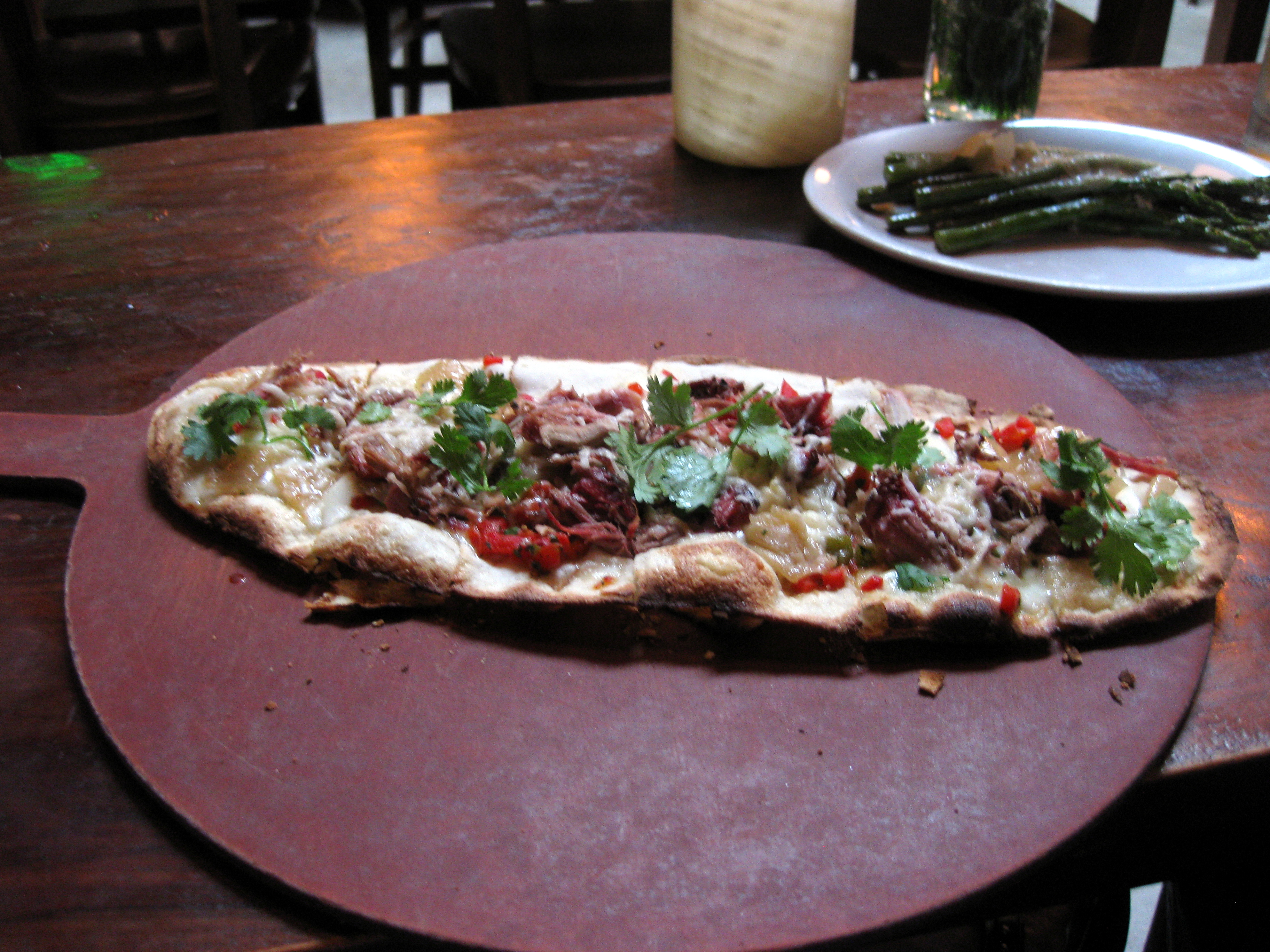
We opted to share entrees so we could order a few things, and got a Cuban flatbread with smoked pork pieces, cilantro, mozzarella, and some kicky little red chilis; grilled asparagus blanketed in shaved parmesan,; and a flattened half chicken with amazing garlic mashed potatoes and succotash.

N. was most attracted to the chicken (as is often the case when we dine out), and here he was clearly right to be.  Flattened, the bones were gone, the meat was compressed, flavorful, and intensely juicy, and the skin was crunchy and buttery and tender and perfectly unctuous.  Because he is fonder of white meat, it was also a perfect dish for us to share, because N. left me the thigh, with its dark, meatiness pleasantly encased in a crisp layer of fatty crunch.  Beside the chicken, the mashed potatoes swam in a sauce of garlic confit, which was rich and intense: the best gravy I’ve had in a long time.

The flatbread, which would have been just delightful on its own, paled a bit in comparison to this chicken.  The crust was cracker-like in texture, and the pork pieces paired nicely with the pepper and cilantro, but together the dish was a little bit dry.  It needed – perhaps – some herb oil drizzled over the top, or maybe 45 seconds less in the oven.  Tasty, but not the star of the show by any means.

The asparagus was excellent: nicely flavorful and light, well cooked and, aside from the piece I dropped on myself (grace embodied, truly), a nice vegetal accompaniment to our meal.

Since I didn’t get any dessert that night (I was full but not overstuffed, and didn’t want to tempt myself by even glancing at a dessert menu), I was still longing for birthday cake a few days later.  Fortunately for me A., who blogs from the other side of the world at Over and Under, had told me about Porto’s – a Cuban bakery in Burbank that turns out to be right on my route to and from work.  I had to drive up to the school for a Friday meeting, and as I headed toward the freeway to come home, I decided to stop in and treat myself.

Inspired by the flatbread we’d shared at FFS, and because I thought it would be a good benchmark for a Cuban bakery, I got the Cubano.  Then, because it was still my birthweek (I’m big on extending the celebration as long as seems rationally possible), I picked out two tiny cakes to share with N.: flourless chocolate, and tres leches.

The sandwich was good.  Ham and pork packed tightly onto a fresh bakery roll with cheese, sharp mustard, and a pickle.  A simple sandwich, but a delicious one.

My dessert selections, though, were fantastic.  The tres leches was rich and light at once, not overly sweet but dripping with cream, like a well soaked angelfood cake topped with toasted marshmallow cream.  The flourless chocolate selection was less cake than a giant chocolate truffle: impossibly rich solidified ganache inside a thin shell of cake-like crumb.  N. was only able to eat two or three bites before declaring it too rich for his tummy.  I had no such trouble, but did talk myself into enjoying only half at that sitting, and saving the other half for another night when chocolate felt mandatory.

Indulgent?  Certainly.  But (at least in the case of the desserts) at $2-3 each, a reasonable indulgence.  Still, when one is a responsible adult (as I suppose some might now imagine me), one must temper such indulgences.  In this case, that means salad.

80. Trim and coarsely chop chard (rainbow makes for a gorgeous salad) and combine with white beans and chopped scallions. Dressing is minced ginger, a suspicion of garlic, olive oil and cider vinegar. 

I collected:

½ huge bunch red chard, thick stems removed

1 15 oz. can white kidney beans

5 green onions, finely sliced

1/2 inch knob of ginger

2 garlic cloves

1/4 tsp coarse salt

1/4 cup each cider vinegar and olive oil

1 TB honey

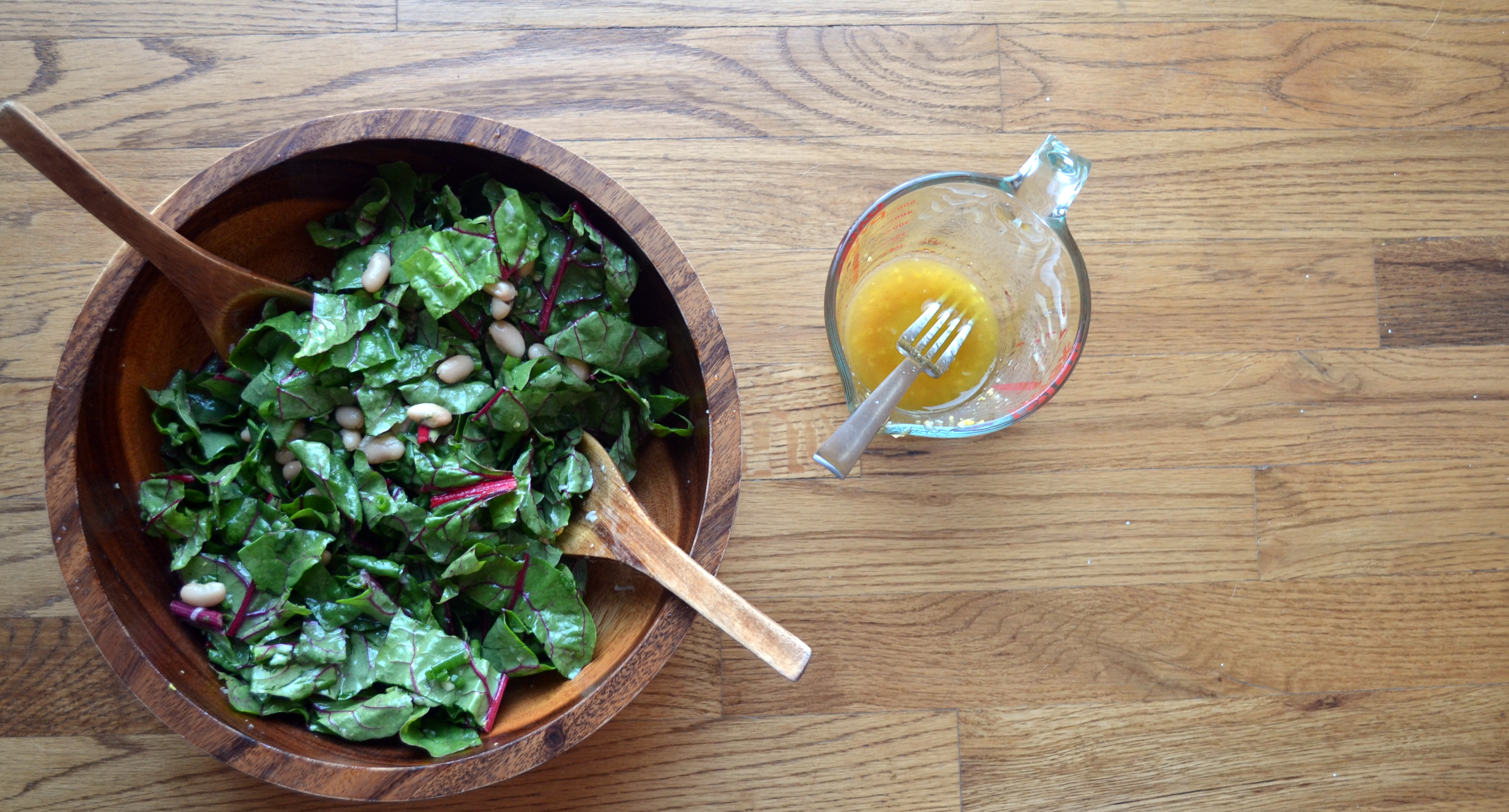
I tossed together the chard, beans, and green onions and set them aside in a big salad bowl.  To make sure the ginger and garlic were fine enough, I minced them by hand, then sprinkled them with coarse salt and dragged the flat of my knife across them until they turned into a thick, aromatic paste.  I scraped the paste into a glass measuring cup and whisked it up with cider vinegar and olive oil.  A taste of this was a cheek puckering revelation, so I added a healthy squeeze of honey to make it less astringent.

Aside from spinach, raw bitter greens are not always N.’s cup of tea.  Because I feared this might be the case with this combination, I decided to treat this more like a slaw than a salad.  I combined the main ingredients early and doused them in dressing a good fifteen minutes before dinnertime.  This would, I hoped, give the acidic dressing time to wilt the chard a bit, much like the vinegar in coleslaw dressing does for the cabbage.

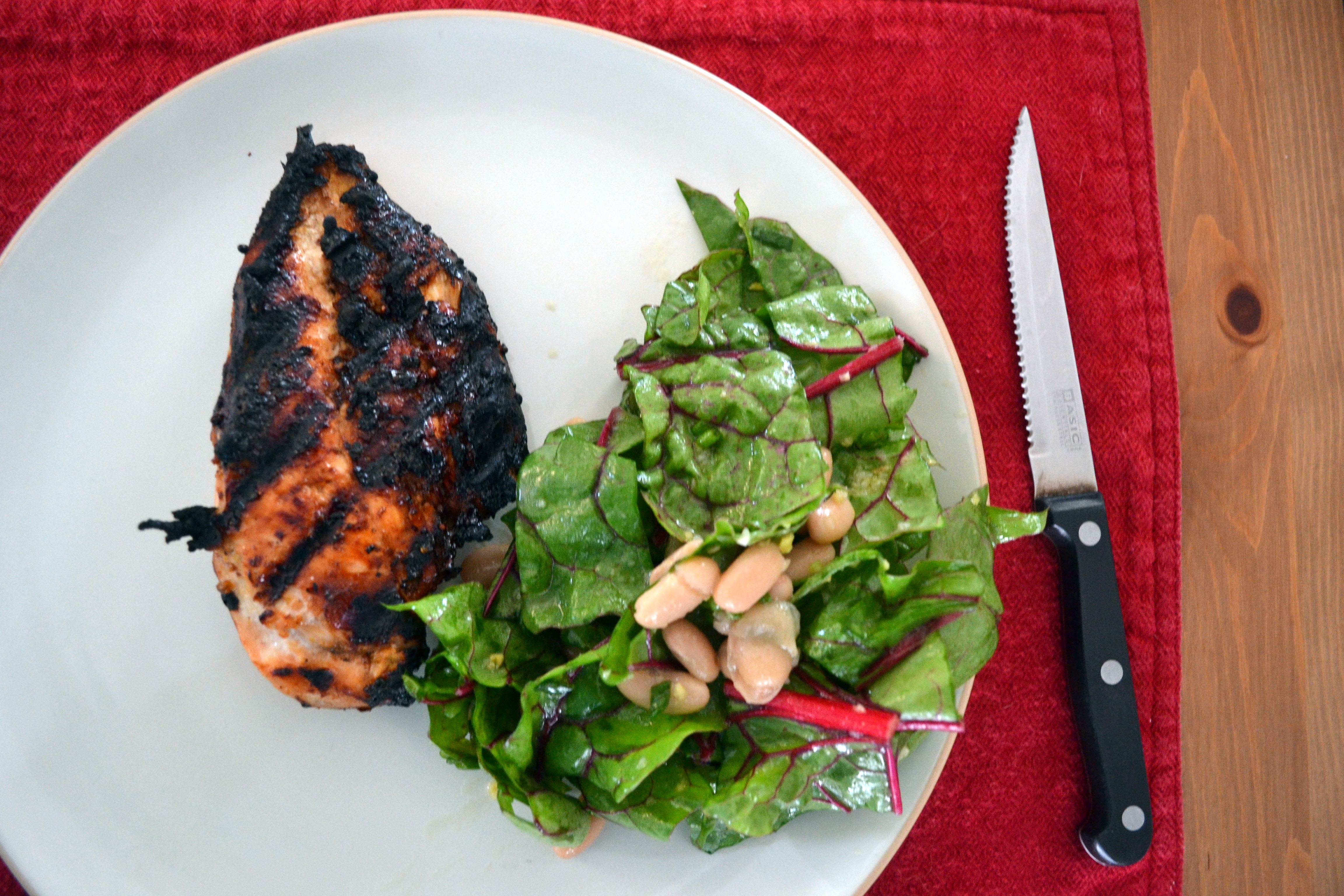
It worked well.  By the time we ate (grilled chicken breasts sauced with equal parts whole grain mustard and apricot jam), the chard had lost just a bit of its aggressive bite but its freshness was not compromised.  The beans, sometimes bland customers, had soaked up a bit of flavor from the tangy bright dressing, and so while they were a steady, creamy counterpoint to the earthy-fresh chard, they weren’t at all boring.  We were both surprised by how well we liked this simple little salad.

Success, then, and balance: excitement and indulgence followed and tempered by stability.  If this is what the 30s are like, I’m ready.  Bring it on.  I’ll just be 30 forever.

The Buttercream Project: Wedding day, part two

Saturday morning – Wedding day! – was beautiful and bright and promising.  Our now-from-Seattle friends had arrived the night before, we’d all slept, the cakes had chilled, and now after a brief wedding day breakfast with the bride and groom’s families and out of town guests, I’d be on to decorating.  When I settled in to the buttercream production this time, I had an epiphany.  At Mom’s house, I had used an electric hand mixer instead of a stand mixer, and the buttercream had been fluffy and smooth and glorious.  What if, instead of using the paddle attachment on my stand mixer, I used the whisk?

This was, finally, the right thing to do.  I wish fervently I had thought of it the first day.  The frosting came together faster, and whipped up a bit smoother.  It was, I perhaps imagined, brighter ivory than the previous batches, and there were no chunks of butter to cause me piping distress.  If only, if only, the day before… but that is immaterial (and perhaps inaccurate too, since there were other factors, other differences, like the temperature of the butter, the temperature of the cheese, the amount of time spent whipping, the quantity of lime juice, etc) .

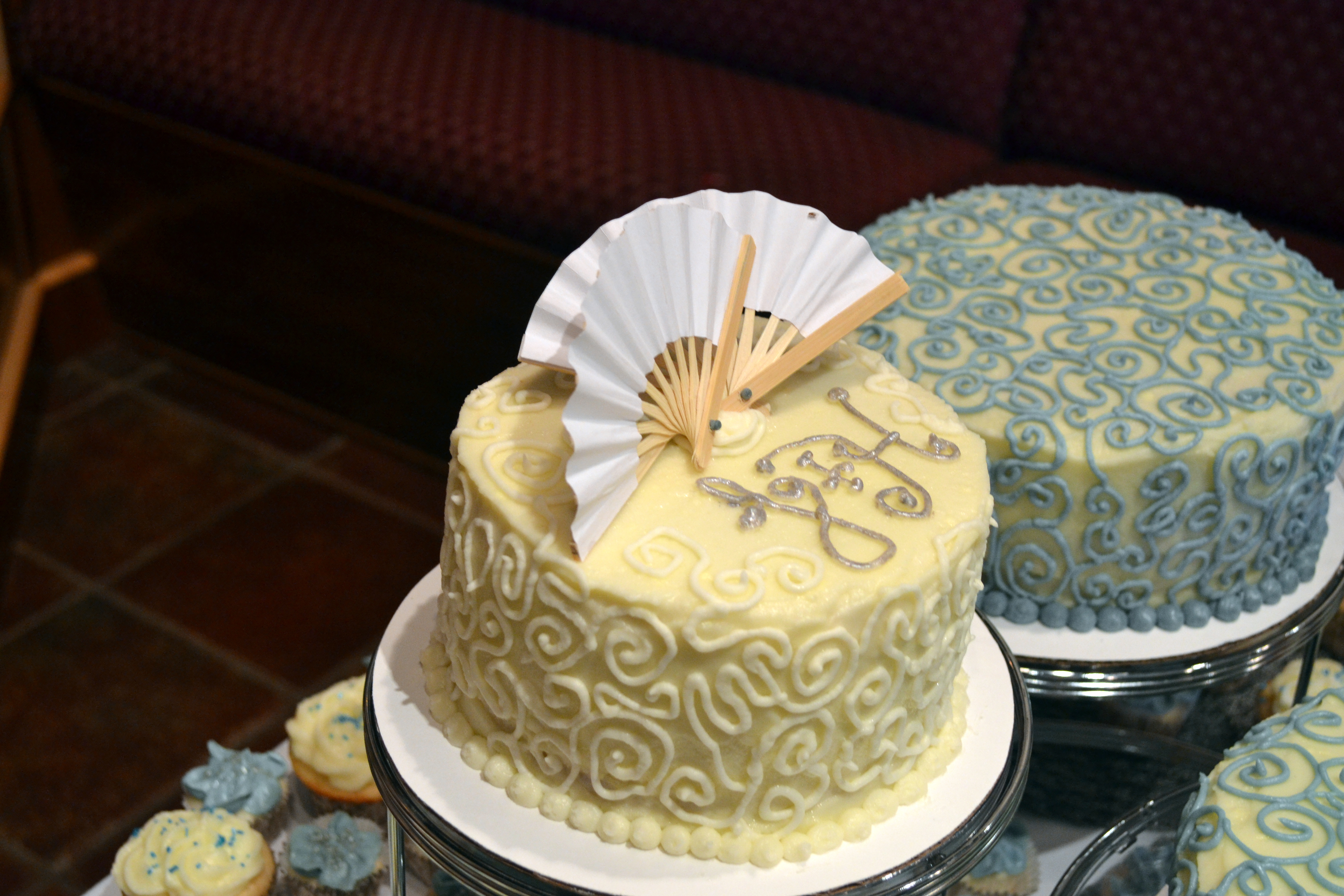
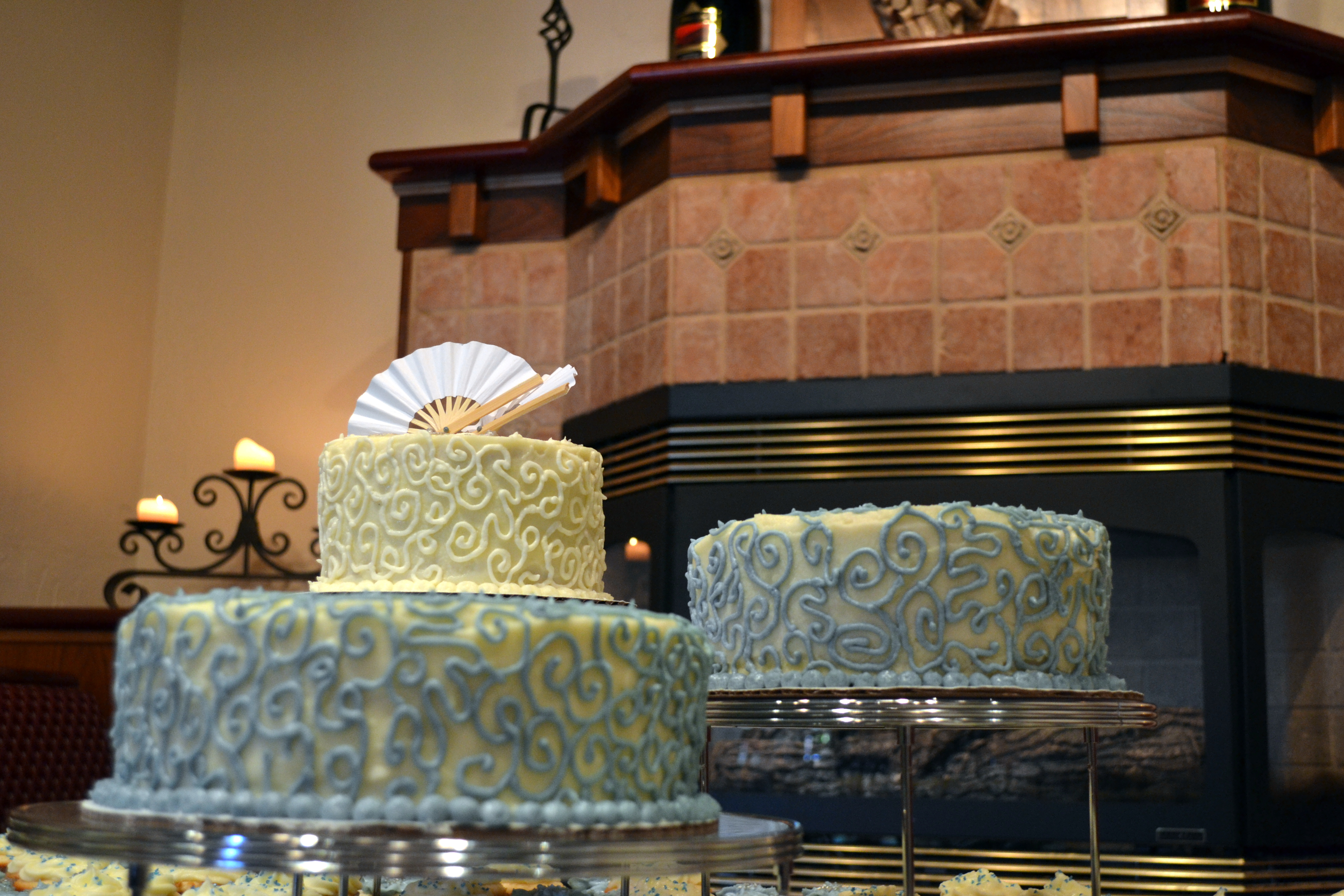
I piped.  I piped and I piped.  And things started to look better.  A lot better.  Most of the worst imperfections were hidden under the ivory and then delicate blue swirls and scrolls I snaked onto the cakes.  They actually started to look nice.  This might not be a disaster after all.  When I added a ring of round, pearl-like blobs to the bottom border of each, I started to feel happy with my project.

With the cakes done, all that remained were 92 miniature cupcakes.  All.  Right.  I had half a bowl of perfectly blue frosting.  Against my own better judgment (hey, it had worked out okay the day before with the gelatin in the filling), instead of starting over with a brand new batch, I decided to add more butter and more powdered sugar to the bowl, and try to tint it to match what I had already done as I went.  It worked.  I wanted a slightly thicker consistency of frosting for the flowers I planned to pipe so this mixture had to be more butter than mascarpone.  That worked out well, really, because I was out of mascarpone again anyway.

With time ticking, I filled up another piping bag with one of the new rose petal tips H. had bought me and went to work, remembering what I’d learned months ago about which way to swivel the cupcake as I frosted.  It took me a handful to get into a groove, remembering when to apply pressure and when to release, but once I got going I was making beautiful little horseshoe movements that resulted in sugary flower petals!  To perfect the color (not baby blue, but not dark blue either), I’d mixed a tiny bit of black gel dye in with the blue.  This resulted in a lovely periwinkle with just a hint of gray, matching almost exactly the blue on the couple’s save-the-date cards.  The exact blue of the wedding.  Boom.

N. would probably like me to add here that as I finished each handful of minis, he deliberately drizzled on a small quantity of silver-gray sprinkles.  My dear friend M., who arrived in mid-afternoon to coo over the product and do my hair for the event, would probably also like me to add that she took over sprinkling duties for the last dozen or so.  In fact, it was M. and S. who saw me through the last sheet tray of minis as, hand aching from the constant pressure and odd angle, I suddenly realized I was going to finish.

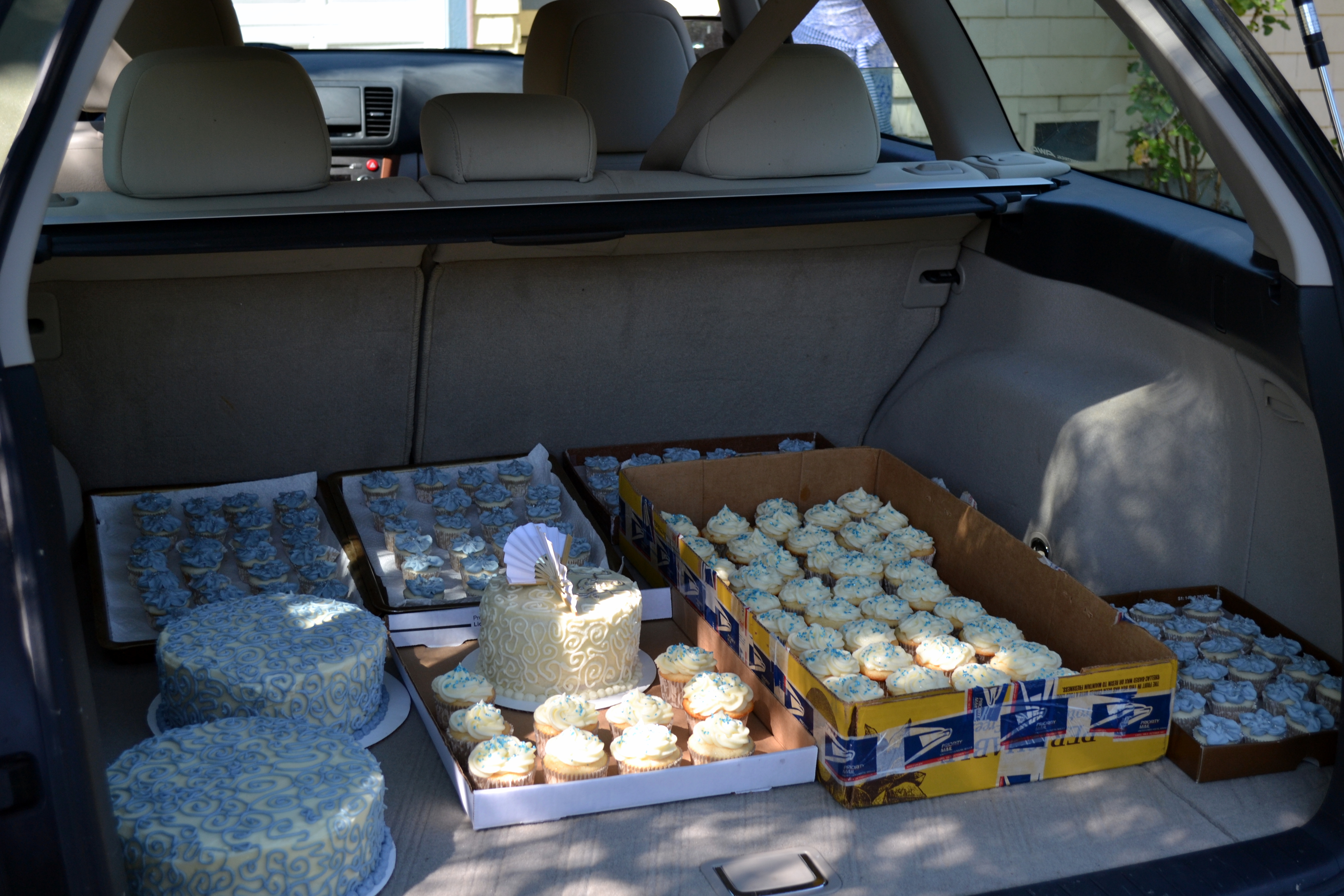
The winery where the wedding took place was a half hour drive from town on winding and sometimes roughly surfaced roads.  Though we positioned the cakes and cupcakes carefully in the back of our Subaru, I still got a little white-knuckled every time N. drove around the bend.  What if, after all that work, we got going a little too fast and one of the cakes slid into the side of the car?  What if, despite the air conditioning running at full blast, it was too hot in the car and the frosting started to slump off?  What if we did get there safely, but I dropped a cake on the way from the parking lot into the building?  I had packed flats as well as a bag of white frosting and a bag of blue in case of an emergency, but I’m not sure I was emotionally prepared to fix any problems that might happen on the way.  Not in a busy winery with the bride and groom’s families darting around setting things up.

Fortunately I didn’t have to.  Three or four of the minis fell over during our ride, but because I’d stuck them in the freezer for a few minutes while I got dressed, their frosting remained hard enough that it didn’t crumple much.

Setup was easy and disaster free.  Some of the wedding party helped carry the precious cargo in from the car, and when every last cupcake was situated on the table, I have to say it looked pretty fantastic.  I made a wedding cake.  And people liked it.

Final thoughts on this massive saga: I will not be going into the wedding cake business.  I would happily make another cake or three for friends who requested it, but I think I’d want to go to at least one cake decorating class first.  I will also not use American buttercream again, except for petal work like I did on the minis.  It’s just too sweet.  I loved the taste of the cakes I made, and the filling was a wonderful, bright tartness (the color contrast was great too), but the buttercream was just achingly sweet, even with the addition of lime juice to the mix.  For my sophomore performance, if I ever have such an opportunity, I would try an Italian or Swiss buttercream instead, relying on cooked egg whites for structure rather than powdered sugar.  As a thank you, J. and H. let me keep all the baking and decorating equipment they bought for the project (thanks again, you two!), so I’m set for all kinds of future practice.

I have to say, though, despite all my moaning and complaining and anxiety, I was really happy with how the cakes looked, and delighted with the reactions I received.  The bride and groom took home the leftovers and ate them the next day, and the one after that.  They were still good.  N. and I ate the trimmings and cupcake guts smothered in leftover filling, and they were delicious.  It was, regardless of the exhaustion and concern during the journey, a monumental success.  I can only thank J. and H. for letting me be such a big part of their day, and wish them all the joy in the world – joy like clouds of powdered sugar, perhaps – for the rest of their lives together.  N. and I love you both.

The Buttercream Project: Wedding Day, part one!

So…

I made a wedding cake.  For a wedding.  And it was served.  At a wedding.  And no one threw anything at me, or snickered behind my back, or insinuated the bride and groom would have made a better choice by hiring a professional baker.

In fact, several guests, and a few of the employees at the winery where the event was held asked me where I worked, or whether I had a business, or how many wedding cakes I had made before.  I was forced to respond to these questions thusly: my kitchen, no, none.  And they were surprised!  And I, still struggling with the sickeningly sweet baggage of failed buttercreams weighing down my memory, was surprised they were surprised.

But there we were!

Deep breath; here’s how we got there, in two parts:

The wedding took place on a Saturday.  After consulting a professional baker through a friend who is also her sister, I decided to do all the baking on Thursday, the majority of the frosting on Friday, and the detailed decorations and mini cupcake flowers on Saturday morning.  The cakes would still taste fine, she said, and the rewards of working with day-old rather than freshly baked cake are staggering.

My biggest comment about the whole process is that everything takes longer than you expect it to.  And it “takes a village,” as they say.  I knew approximately how much cake I was going to make, but I didn’t really stop and think about how much time it would take to bake, or how much space it would require, or what 36 egg yolks looks like (6 egg whites in each batch of batter = 36 unused yolks).

Anyway, I baked on Thursday, and despite my naïve assumption that I would bake in the morning, tidy up the kitchen and rest in the afternoon, I baked almost all day.  See, butter takes time to come to room temperature, and egg whites take a while to whip to soft peaks, and when you only have one muffin tin you can only make 12 full size cupcakes at a time!  My friend J. joined me for lunch, which was a welcome break (relatedly, crisp, juice-laden pink spears of watermelon are incredible when you don’t have to slice them up yourself, and Stash’s pomegranate raspberry green tea makes a wonderful iced tea that requires zero sweetener), and a bit later M. came by to keep me company while I scooped and poured and measured and mixed and sweated and burned myself only twice!  The entire day!

Completion of the day’s project took some finagling, because as much as we tried to use up perishables to create fridge space, it hadn’t occurred to me how much room it would take to fit one 9”, one 8”, and one 6” cake in there along with 52 cupcakes and 90-something mini cupcakes.  There weren’t enough shelves!  We improvised by double stacking the cupcakes and minis on sheet trays, separating each with upside down drinking glasses to keep them from squashing each other.

Thursday night, I was exhausted.

But that was nothing.

Friday, I got up with excited anticipation and set a pot of water to boil so I could peel the apricots for the filling.  Once the raspberry apricot compote was cooked down to a thick, sticky jam and nearly ready to chill, I would set out the butter.  I knew now it didn’t take an eternity to soften.  This was going to be a breeze.  It would be my best buttercream ever.  Well, as these things often go, it wasn’t, and it wasn’t.  

Apricots don’t like losing their skins.  They hang onto them like some living thing.  By scoring an x in the bottom of each and plunging them into a boiling bath for a minute or so, I thought I would be able to slip them free and naked, like peaches.  Instead, the skin came off in little peels as though they’d been sunburned, and sometimes it wouldn’t come off at all, unless attached to chunks of flesh.  This, then, took longer than I’d anticipated.

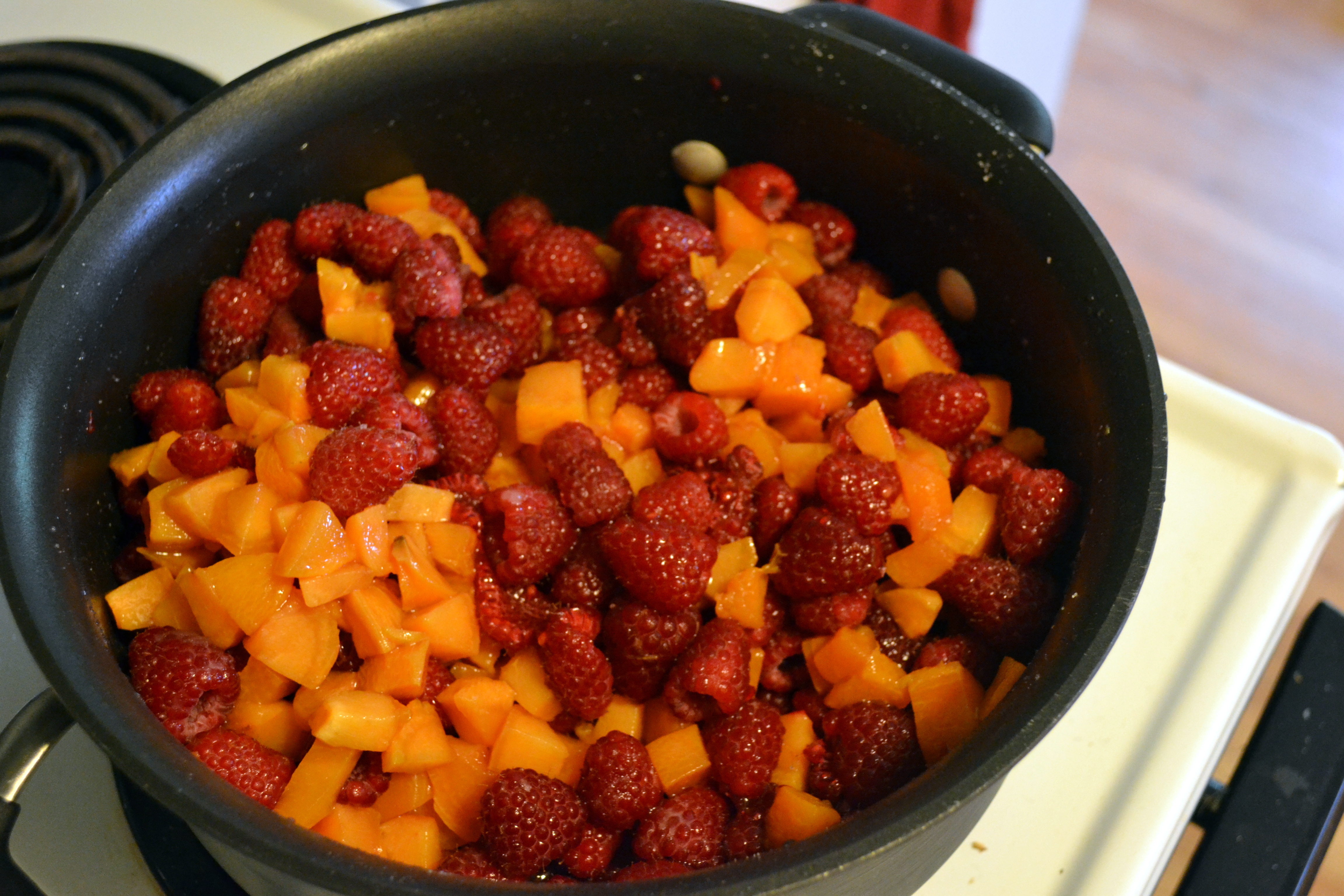
When the apricots were finally mostly nude, slippery chunks of ruddy gold, I flopped them into a big stock pot with 3 pints of dewy, just-rinsed raspberries, a light sprinkling of sugar (maybe ½ cup?), and the leftover champagne from the previous day’s baking.  There was maybe a cup of liquid when I began, and I worried this would not be enough.  Half an hour later, as the raspberries broke into fragrant, molten juice, I worried there was too much liquid.

I’ve never made jam, so I don’t know how long it really takes for fruit to boil off its liquid, but at an hour into the process, when I still wasn’t mixing up a batch of buttercream, I panicked and poured off about half the compote into a colander, making the sink look like a murder had been committed.  Too afraid to pour off any more lest I lose the flavor, I plopped the sodden fruit bits back into the pot and boiled a bit longer.  Then, when things still weren’t thickening and I was despairing for time (morning was already almost gone), I made a daring, despairing, hand-wringing choice of desperation and poured two packets of gelatin powder into some water, sloshed it about to combine, and tipped it into my steaming, bubbling, red gold concoction.  Alchemy, do your magic!  I bubbled the whole thing on the stove for a minute or two longer, then turned off the heat, held my breath, squeezed my eyes almost shut, and poured the whole thing into a glass bowl which I topped with plastic wrap and shoved into the freezer.  Now it just needed to chill, and we’d be back in business.  I’d be done by mid-afternoon with plenty of time to tidy up before the rehearsal dinner (I should add that during all the hand-wringing and the despair and the certainty that accepting J&H’s desire to have me bake for their wedding was a mistake, N. was very supportive.  He helped me monitor the pot while I showered and cleaned the bathroom in preparation for out of town guests staying with us while they attended the wedding.  He’s a dream).

My sense of timing, ever prescient, was of course wrong again.

It was 6-8 cups of boiling hot near-liquid.  Cooling takes time!  Cooling takes, as it turns out, a lot of time.

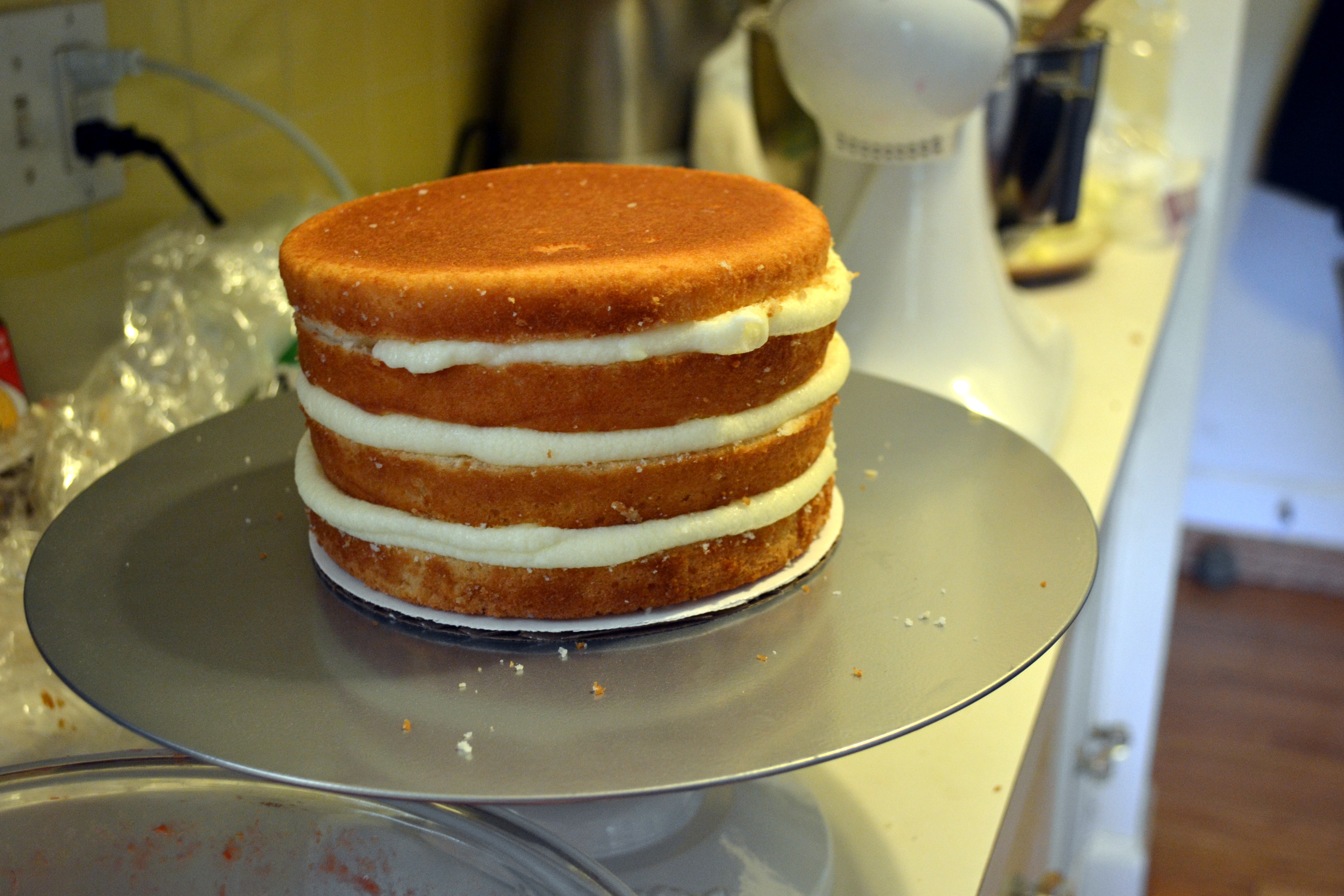
No matter.  In the meantime, I hollowed out the cupcakes to receive the (hopefully eventually) cool filling, and trimmed and halved each pale gold circle of cake so there would be four approximately even layers to each one.  Unable to stand it any longer, I took the butter and mascarpone cheese out of the refrigerator to soften.

What I made, when I made it, was not my best batch of buttercream.  Remember the one from June that I made at my mom’s house?  Remember the sharp edges and beautiful, smooth consistency?  This one was a step backward.  It was clumpy.  It was grainy.  It was so, so sweet.  If I were a professional baker, I would have thrown out the whole thing and started again.  But I’m not.  I’m a home-trained amateur, and though I took into account everything I’d taught myself over the past six months and continued to beat and beat and add more lime juice and beat, at a certain point I had to frost something.  No worries, I thought, it’s just the crumb coat.  Just do the crumb coat, and it’ll be fine.  It was.  It worked exactly like a crumb coat should.  After piping a generous circle of frosting around the top edge of each layer and spooning in a nice puddle of filling, I stacked the cakes as evenly as I could.  I scraped on the crumb coat, catching moist, delicate, champagne-flavored bits, and as I finished each cake I returned them carefully to the fridge so this first all-important layer of icing could harden. 

In the meantime, I filled and frosted the cupcakes with careful swirls.  Contrary to my most recent performance, these did not come out in sharp rosettes.  In fact, a few of them threatened to plump into blobs.  But I administered a careful sprinkling of blue sugar anyway, and shoved them, too, into the fridge to think about what they’d done.

A new batch of buttercream was now required.  And I was out of mascarpone cheese.  As always, this was more of a challenge than I’d anticipated.  It was nearing 4pm, the rehearsal dinner was in less than 3 hours, and I wasn’t done yet.  Okay, just go and buy some more mascarpone.  The grocery store two blocks from us didn’t have any.  The grocery store on the south side of town did, but it was a different brand, a higher price, and a looser consistency.  And cold.  Deep breath.  Beat its brains out.  This batch was, admittedly, a bit better than the first, but still not the smooth creamy perfection I’d achieved in June.  But it was what I had.  I would deal.  It was just frosting.  I could conquer it.

When I finished the first cake – the 8” one, I think – I called N. in to have a look.  “Be honest,” I said to him, “does this look decent?”  We agreed that while it wasn’t great, it was probably passable.  I pressed on to the 9”.  When this one was done, I felt my stomach sinking.  Yes, I had carefully covered the crumb coat, and yes, I had dipped my spatula in hot water and let it glide carefully and quickly over the surface when I was finished to smooth things out, but I could see tiny chunks of butter in the mixture.  I could see where the icing wasn’t absolutely smooth.  There were dents and cracks and, inevitably, the indentation of my knuckle from a moment of carelessness.  I filled that one in.  By the time the 6” cake was done, I was almost ready to cry.  It looked the best of the three (practice is important, people), but I was tired and disappointed with myself and worried that the bride and groom would second-guess their choice.  Still, all that could be done was to carefully deposit them back into the fridge, try in vain to scrub the blue dye from the blue sprinkles off my hands, and go to the rehearsal dinner.  The detail work, which I’d never had time to practice, would have to wait until morning…