Trick or Treat

Halloween is easily in my top three holidays.  I have to give the prize to Christmas, because it means family and love and sweaters, but Thanksgiving and Halloween chase each other in circles to gain second place.  Despite that love (overwhelming in some cases, especially if you, like N., are not invested in costuming yourself at every possible occasion), this is the first year in almost a decade that I’ve done nothing to celebrate.  No costume.  No party.  No decorations.  We bought candy for the six kids that showed up (only six!  The whole evening!  Was it just because it was a Wednesday, or do kids not trick or treat like they once did?) and I definitely listened to the Halloween party mix my friend D. made for me a few years ago, but it felt a bit like a lost holiday.

I did embrace the season, though, the following day.  Having Thursdays off gave me the opportunity to do something I’ve been wanting to do for years: pillage Target’s day after Halloween sale for leftover clearance items (read: treats!).

The tricks began when I began work on the evening’s dinner.  It was, I realize in retrospect, a bit of a Chopped style enterprise: appetizer, entree, and dessert, each made with ingredients I’d not expected to meld.  In each case, however, the “trick” aspect of the dish was my doing, not the recipe’s.

“12. Garlic-Rosemary Figs: Soak dried figs, stems removed, in warm water until plump; drain and halve. Heat rosemary and lightly smashed (and peeled) garlic with olive oil on medium-low heat, until softened. Add figs, along with some fresh orange juice. Cook until saucy.

Pairing figs, garlic, and orange juice seemed odd.  Nevertheless, I collected enough for one portion (this was not N.’s kind of dish):

6 dried black mission figs

1-2 tsp fresh rosemary

2 smashed, peeled garlic cloves

1 TB olive oil

juice from 1 small orange (⅓ – ½ cup juice)

I heated some water in my teakettle and poured it over the figs (which I’d halved prematurely.  Apparently paying attention to the directions is kind of important), which I let stew on the counter for half an hour.

Figs vaguely plumped, I drained them and set them aside, then put the garlic cloves, rosemary, and oil into a cold pan.  I heated it over medium for five minutes or so – just until the rosemary started to sizzle and the garlic turned a little blonde.  Then I added the figs and orange juice, and simmered for fifteen minutes or so, until the orange juice had reduced considerably.

I plated, I ate, and I considered.  This didn’t taste bad, but it didn’t marry absurdly well either.  The rosemary and the figs were lovely.  The orange juice and figs were fine (though the orange was a bit overpowering).  The garlic and figs were… unobjectionable.  They just weren’t my favorite.

I must say, though, I recalled while I was cleaning up after dinner that this entry was in the “Sauces and Relishes” category.  I had eaten it straight.  This was, perhaps, why I wasn’t enamored of it.  Therefore, I’d recommend spooning this over lamb chops, or pork tenderloin, either of which would add some savory notes to make the garlic feel less anomalous.

Though this “appetizer” wasn’t fantastic, I ate it with a fantastic grain-salad-turned-hash inspired by Smitten Kitchen.  I want to revisit this hash, because I think it could use some additions, but here are the basics:

Line a baking sheet with aluminum foil.  Set it in the oven and preheat to 400F.  Yes, you are preheating the pan along with the oven.

Peel and halve a butternut squash.  Seed half of it and cut that half into small cubes.  In a bowl, toss the cubes with salt, pepper, and olive oil, then tumble onto the baking sheet (where they will sizzle immediately – this is a good thing) and stow back in the oven for 35-45 minutes, or until they have golden edges and creamy soft middles. 

During the last ten minutes of squash roasting, push the squash to the sides of the pan (or just grab another pan, if you aren’t invested in avoiding dishes, like me) and stack 4 cups or so of trimmed, cut kale that has also been tossed in olive oil, salt, and pepper.  The kale and squash will cook down a little more together, and you will be left with something not quite like kale chips, but a bit more textured than if you’d boiled or steamed it.

While the squash and kale roast, cook 1 cup of bulgur wheat in chicken (or vegetable) broth.  When done, fluff gently with a fork and toss with squash and kale.

During the last few minutes of roasting time, toast 2 TB pumpkin seeds in a dry pan until they begin to snap and crack.*  Be careful not to burn them.  Toss with bulgur and vegetable mixture.

In the pumpkin seed pan (again, avoiding dishes), heat an egregious quantity of butter until foamy and crack in an egg to fry until the edges frizzle and brown and crackle.  Despite a few careful taps, on this egg of all eggs – the egg I wanted to photograph quivering atop my hash, the egg I wanted to show just cut and lusciously runny – I somehow shoved my thumb through the yolk and it broke all over the pan.  Nasty trick, egg.

Nevertheless, I piled my hash up on my plate, carefully laid the fried egg over it, and dug in.  It was a hearty, pretty, perfectly autumnal dish.  It needs some tweaking before I’m thrilled with it – perhaps some sautéed leeks folded into the bulgur, or some light spices on the butternut squash – but this was a delightful start.

I turned to dessert:

“96. Sweet Autumn Gratin: Combine cubed pumpkin or sweet potato with cranberries and hazelnuts in a buttered baking dish. Sprinkle with brown sugar and toss. Drizzle cream all over, dot with butter and bake until soft, bubbly and browned, 50 to 60 minutes. Re-warm before serving if you like.

I’m going to give you a list not of my ingredients and procedure, but of what I should have used and done.

1 big sweet potato, peeled and diced

½ cup dried cranberries (I didn’t have fresh, so I don’t know what they would be like.  Presumably more successful because they would emit, not swallow, liquid)

½ cup walnuts, coarsely chopped (I couldn’t find hazelnuts anywhere – who would have thought this would be the food item I would miss most from Oregon?!)

¼ – ½ cup brown sugar, depending on how sweet you like it

¼ cup heavy cream

¼ cup butter

Preheat the oven to 400F.  Butter a 9×13 inch pan (my round, much smaller dish was a poor choice).

Toss the sweet potato chunks, cranberries, and walnuts with brown sugar.  Spread them out in the pan in an even layer.  Pour on the cream, then pinch off pieces of butter and dot them over the top.

Bake for an hour, or until the sweet potato pieces are fully cooked.

I did few of these things.  My sweet potatoes were in bigger-than-they-should-have-been chunks, piled up in a small casserole dish, starving for cream (I only had a tablespoon or two) and shorted on sugar.  As a result, at the end of an hour they were hot but still resistant in texture.  I think what you want is melting, creamy softness.

Tricked again.

To remedy this problem, I tried several things.  First, I made a bourbon hard sauce (equal parts sugar and water, stir to melt.  Add ¼ cup butter, stir carefully until it melts.  Add a shot or two of bourbon, cook just a minute or two to take the edge off) to pour over the top.  This helped, and I willingly ate a serving, but it was lacking whipped cream or ice cream or, bizarrely, pie crust.


I didn’t figure out the pie crust thing until the next day when I was making empanadas for dinner.  As I pressed my fork into the edge of the dough to crimp it, I was flooded with the right answer: tiny hand pies stuffed with my sweet potato mixture!

This was clearly the right thing to do.  Saturday afternoon, I unrolled a pie crust on my counter, cut out 3 inch circles, and proceeded to fill them with a teaspoon or two each of the gratin, which I’d mashed with a fork to make smoother and therefore more manageable.

Once filled, fold in half, press and then crimp with a fork, and brush with egg wash (1 egg yolk + 1 TB water).  Sprinkle with turbinado or other raw, chunky sugar, and bake in a preheated 400F oven for 15 minutes, or until the tops are golden brown and the dough is flaky.

These make lovely, tiny snacks.  The craisins give a punch of tartness to the sweet, earthy, almost heavy sweet potato and walnut pairing.  There are subtle floral hints in there, because before putting it away that first night I admit to dumping the bourbon sauce over the whole thing, but this adds a flavor I wouldn’t change.  The dough is buttery and flaky and collapses easily around the filling, and it’s difficult to prevent yourself from standing over the pan as it comes steaming out of the oven and eating four or five in a row, scalding your tongue and not caring at all.

Perfect November treat.


* You could, I suppose, use butternut squash seeds, if you are the sort of person with the forethought to save, rinse, and dry the seeds while you clean your squash.  I, clearly, am not.

Counting Down

It’s interesting that as I left my 20s behind chronologically, I entered my 20s in this Bittman project.  As of this moment, on this particular Sunday afternoon, I have 25 Bittman concoctions left to make, most of them soups and desserts.  At a rate of two per week, I will finish by the end of this year.  This means we’re getting toward some major milestones, some very big deals, some lasts on the list.

The first of this pair is one such last.

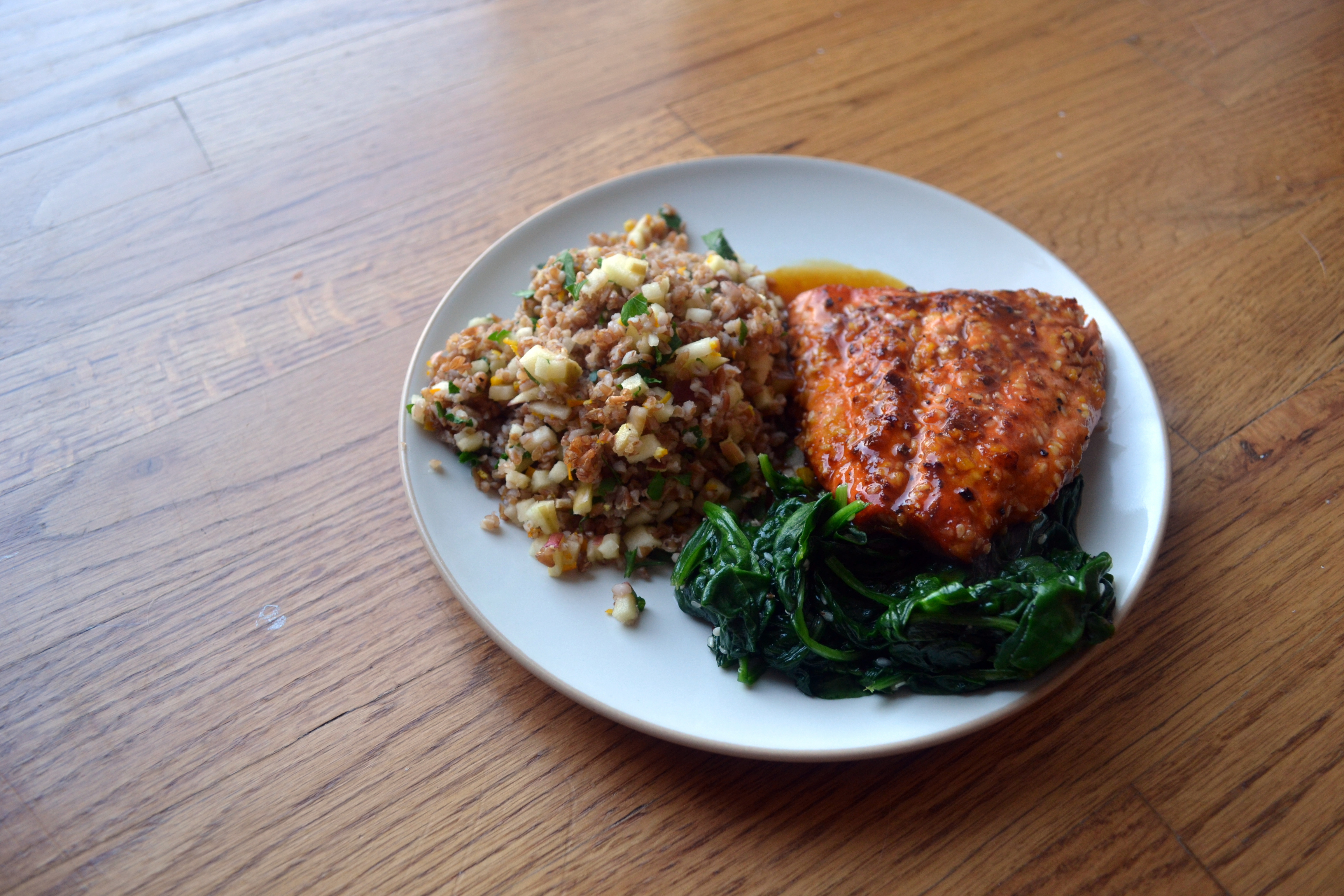
“34. Combine cooked bulgur with chopped or grated apple, minced orange rind, grated ginger and chopped parsley. Back in an oiled dish, use as stuffing or serve as a salad.”

This was the final remaining entry on the “Stuffings and Grains” list. We left it till last for no particular reason, but during a week in which a collection of Valencia oranges sat languishing in our fruit bowl, it seemed like the right thing to do.

I’ve been fairly good lately about writing down ingredient quantities as I add them, but for this entry I never even lifted a pen.  It happens.  I can own up to it.  A week of non-stop grading, perhaps, made me leery of that inky instrument.  Or maybe it was our relative rush: leave it to me to design a complex, glaze-bearing dinner on a night we needed to eat early.  Some things must get sacrificed, and it turns out it’s not the glaze, it’s the notations.

Here are my approximations:

1 cup bulgur wheat

2 cups water, stock, or a combination of the two

1 large fuji apple, diced into small squares

2-3 TB finely minced orange rind

1 TB grated ginger (this is really easy to do when the ginger is frozen)

¼ cup chopped parsley

salt and pepper to taste

Cooking bulgur is very similar to cooking rice.  I poured the wheat and the water into a pot and let it come to a boil before simmering for 15 minutes or so while I prepped my other ingredients.

After dicing the apple, grating the ginger, and chopping the parsley, I turned to the oranges.  Since Bittman specified “rind” and not “zest,” I used a y-shaped potato peeler to remove long, brilliant segments of rind.  I slid a sharp knife carefully between the rind and any white pith that got caught in the peeling, and then sliced into very thin strips, rotated them 90 degrees, and sliced again so I was left with tiny squares.

Before these happy bright piles all nestling on my cutting board got too comfortable, I tipped them into the pot of bulgur and carefully folded them in for even distribution with some salt and pepper to taste.  The experience of the still-chilly ginger hitting the hot bulgur was sinus-clearingly intense, but lovely.  An aroma-only aperitif.

With everyone incorporated, I dumped the pot’s contents into a greased baking dish and stowed it in a 350F oven for half an hour.

Orange and ginger suggested an Asian flavor profile, even though apples and parsley didn’t.  I decided to work with the dominant elements, though, and so I paired the bulgur with salmon and spinach.  The salmon would be rubbed with sesame seeds, powdered ginger, and orange rind bits before receiving a heavy sear and then an orange-juice glaze.  The spinach would be sauteed with garlic chips and sesame oil.

As with all things, this didn’t happen exactly as imagined.  It takes a long time, as it turns out, to simmer the juice of six oranges down into a thick glaze without burning their sugars.  Similarly, it takes time and babysitting to ensure garlic chips that are crisp, not charred.  And when you are trying to do all this on the same night as a homecoming football game you’ve promised to attend, certain shortcuts must be taken.

The salmon, while it seared beautifully, received not so much a glaze as a flood of boiled, ginger infused orange juice.  Still, when this liquid hit the hot salmon pan, it did bubble down into something thick and rich (if a little darker than intended).

The spinach, rather than the crunchy, spicy accoutrements I intended, had to settle for a last-minute sprinkle of sesame seeds to keep it company.

Still, the meal was overwhelmingly successful.  The salmon was outrageously delicious, and I’m going to have to make it again, writing down the procedure this time so I can share it with you.  The orange sauce perfumed the fish and kept it moist and buttery and tender.  Even though it was a bit darker than I’d planned for, the sauce took on caramel notes that seemed utterly intentional.

The bulgur was lovely.  It was toasty and fluffy and well seasoned.  The apple had cooked lightly as the dish baked, leaving it just softened but not without resistance.  The orange rind was delightfully not overpowering, but gave a warm spiciness to the grain.  It was good with the salmon, but would also be delicious with pork chops (playing on the traditional applesauce pairing) or, if you replaced the parsley with mint, a lovely side for leg of lamb.

In summary, a triumphant triumph: not only is the Stuffings category successfully completed, but it was completed with a success.


With the weather cooling (finally!) and the Soups category still looming largely untasted before me, I decided to try one to close out the week.

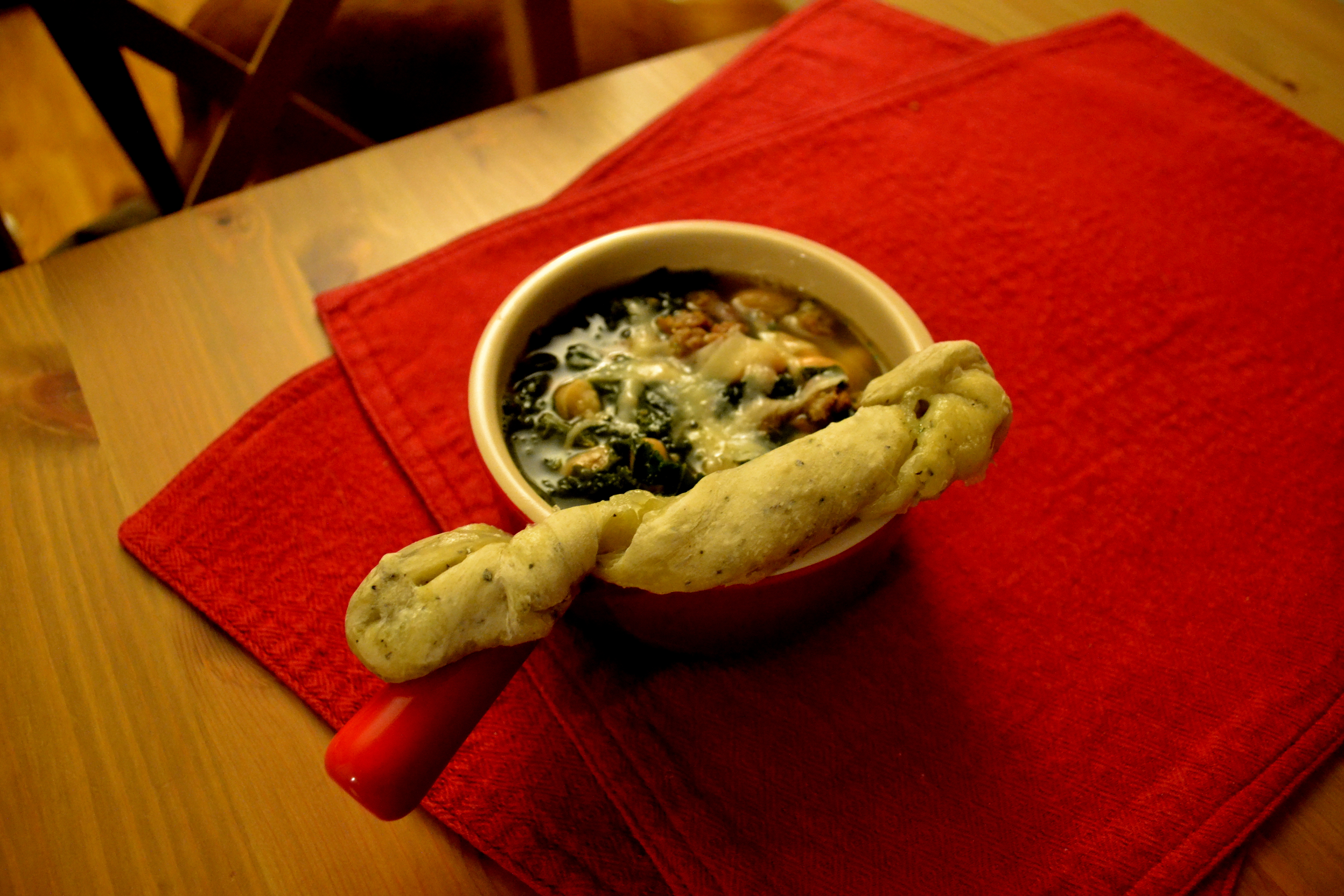
“21. Brown a little crumbled or sliced sausage in olive oil; a sprinkle of fennel seeds is good, too. Add chopped escarole, cooked white beans with their juice, and stock or water to cover. Simmer until the greens are tender and the beans are warmed through. Garnish with olive oil or Parmesan.”

I must admit I made some changes to these directions based on availability and personal taste.  I don’t like fennel.  It’s one of a very few spice flavors I just can’t take.  Over-fennel-ed sausage – like the kind that appears on many chain pizza restaurant pies – just doesn’t appeal to me, and the idea of fennel seeds crunching between my teeth and filling a mouthful of soup with their anise awfulness made their addition out of the question.

As for the escarole, I could find none.  I searched through mountains of salad greens at several local markets and this particular strain was resolutely absent.  But I did find a really beautiful bunch of kale and decided it would be a satisfactory substitute.

So here’s what I ended up with:

8 oz. bulk sausage

1 big bunch kale (chopped, this was probably 6-8 cups)

3 cloves garlic (some spice to replace the abhorred fennel seemed appropriate)

1 15 oz. can white beans with their liquid

2 cups chicken broth

salt and pepper to taste

Eschewing olive oil, I squeezed the sausage into a pan and let it brown over medium heat, separating and crumbling it as it cooked with a flat-sided wooden spoon.

I rinsed, stemmed, and chopped the kale into manageable pieces, and when the sausage was cooked through, I tossed in the mountain of greens.  No, that’s not true.  I inserted handfuls carefully so they wouldn’t spill all over the stove, and ran out of room with only half my kale added.  N. came into the kitchen when he heard me laughing hysterically, and stared in amazement at the mound of kale pieces sitting inches above the top of my pot.  I had to press it down with my hand, compacting the frilled, tough leaves down toward the bottom of the pot.  It always looks like too much.  It’s always not.  In the time it took me to mince the garlic, the kale had already begun to wilt and settle more comfortably into the confines of the pot.

When I could barely smell the garlic and the kale was level with the sides of the pot (as opposed to threatening to spill over them) I added the white beans, their juice, and barely two cups of low sodium chicken broth.  One of the things I’ve discovered about myself is that when it comes to soups and salads, I like them to be full of, well, stuff.  Lettuce with the odd crouton is no good.  I want dried cranberries, and walnuts, and avocado, and gorgonzola.  Thin, brothy soups don’t please me either.  Give me big chunks of vegetables, or slurpable noodles, or rich shreds of meat.  In the days when I’d indulge in the occasional Cup’o’noodle, I always drank the broth out first so I could concentrate on the important part: the just dripping mounds of noodles left behind.

So this soup, for true enjoyment, needed only enough broth to make its categorization accurate.  A scant two cups and we were assured plenty of “stuff” in every spoonful.

While the soup simmered, I stretched, sliced, and sprinkle mozzarella onto some pre-made pizza dough.  Twisted and snuggled on a baking sheet, these when into the oven to become bread sticks.  Fifteen minutes later when they were sizzling and firm, the soup was done.

This is not a soup you want to let simmer for hours.  The beans, especially if you are using canned like I did, will eventually become mealy and then disintegrate.  The kale begins to lose its emerald brilliance after a while, and though it will still taste good, it won’t be as pleasing to consume.  Simmer for fifteen to twenty minutes max.

Then you get to shave on some parmesan and eat it.

Neither of us was sure we would like this soup.  But we shouldn’t have been so foolish.  N. has placed the products of this project on a pass/fail system.  This is what happens, I suspect, when you have two teachers in the family.  He announces his verdicts after dinner, and he treats them as though Mr. Bittman has just submitted an exam or a paper assignment.  “Bittman passes on this one,” he told me last night as we cleaned up.  It wasn’t just his happiness at pairing his dinner with the first Jubelale of the season.  He really did like the soup.  And I think he was right.  This was a fast, easy, delicious little warmer.  Cooking the kale in the sausage grease gave it some additional flavor and took away that raw bitterness dark leafy greens can sometimes have.  The beans got creamy and delicate, and the starch from their liquid thickened up the minimal broth I used.  Even without the broth, these ingredients seem like a stellar combination that should be taken advantage of at many opportunities.  Sautéed together, perhaps with the addition of chopped onion and maybe butternut squash or sweet potato, they could be a nice little hash.  Wrapped in pastry with some thickened gravy, they could be a pot pie.  Folded with some grated mozzarella and enclosed in pizza dough, they become a perfect calzone.  And as the weather continues to cool (I hope, I hope, I hope), gravies and pot pies and warm cheesy casseroles are exactly what I want to pair my remaining Bittman dishes with.

It seems a bit stress-inducing to start with a countdown.  It’s a looming certainty of what must be achieved.  “That’s a lot,” N. said when I told him how many were left.  But after tonight’s dinner, it will be 24.  And by the end of next week, it will be 23.  And by having you out there reading, it means I must achieve, yes, but it also means I’m promising something to you.  Food.  Words.  Proof of my experiments.  And stress-inducing or not, that’s a kind of accountability I like having.

25 to go…

Milestones. And Cake. And Salad.

This September has been a big one for me.  New home (okay, so we technically moved in July), new job (okay, so school started in August), and new decade!  I’ve finally hit my 30s, and I like what I see so far (though admittedly I’ve only been stationed in this new world for two weeks).

Given my fanciful proclivities for putting food in my mouth, then, N. knows that my birthday must involve a restaurant in some form.  Since we are only just beginning to explore our new culinary surroundings, this was a perfect opportunity to embark on our adventures.  I started with Culver City which, delightfully, has a whole webpage devoted to its downtown restaurants, including (in most cases) links to each restaurant’s website.  This was almost too much.  I spent the better part of an evening cruising through online menus, imagining what kind of mood I might be in on the big day and what I might want to order and what, if the restaurant I ultimately chose should happen to be out of my top choice, I would order instead.

Based on menus and Yelp reviews, I decided on Fords Filling Station (FFS), whose upscale comfort food and wide range of offerings sounded promising.  I tend to like mid-range restaurants: not too fancy, where a prix fixe menu or outstandingly high prices make me feel like a grubby graduate student out of place (I know, I’m not anymore.  But it’s a hard habit to break in this new world of adulthood and employment), but not too casual either, where the food is sub-par or inconsistent and the wait staff makes no pretense of caring about our presence.  A gastropub – a self-proclaimed innovative collection of food, decor, and atmosphere – seemed like the right fit.

FFS is a fun spot.  It’s centrally located downtown, and the dining room is a big open space with a bar to one side, traditional tables, and long narrow two-tops where the couple sits on a bench next to one another looking out at the other diners, rather than across from each other.  N. and I were seated at one of these bench seats, and it was fun to sit side by side for a change in a restaurant setting.  Brick walls, big barrels, and warm colors make it inviting and, I thought, pretty unpretentious.

Our server, who was the perfect balance of informative and attentive, sold me on one of the night’s cocktail specials: citrus vodka, house made lemonade, and a little float of chambord.  It was nice – punchy and bright and sweet-tart, but oddly similar to a Rennie’s Lemonade from our erstwhile happy hour hangout in Eugene, and therefore it felt drastically overpriced at $12. 

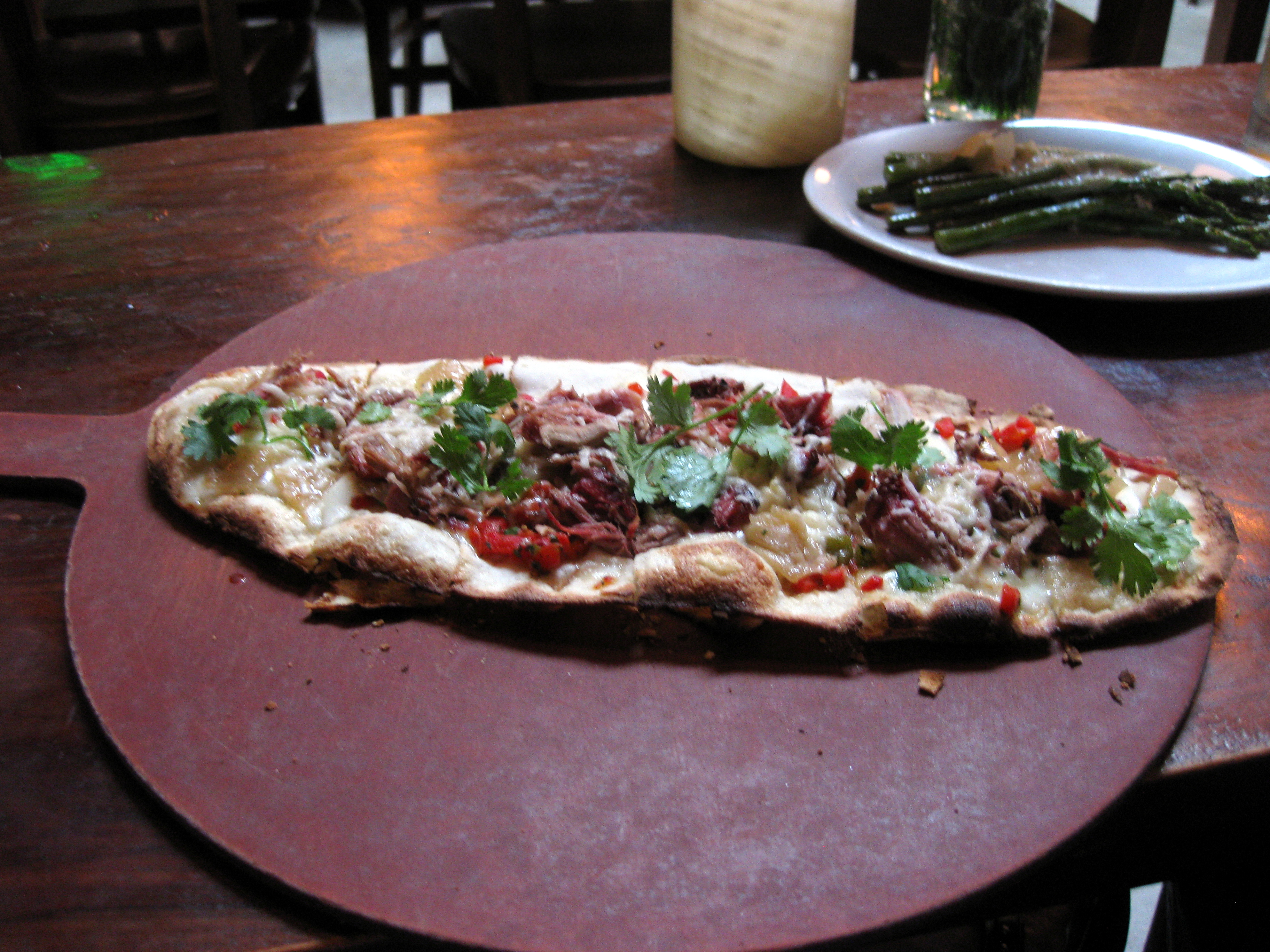
We opted to share entrees so we could order a few things, and got a Cuban flatbread with smoked pork pieces, cilantro, mozzarella, and some kicky little red chilis; grilled asparagus blanketed in shaved parmesan,; and a flattened half chicken with amazing garlic mashed potatoes and succotash.

N. was most attracted to the chicken (as is often the case when we dine out), and here he was clearly right to be.  Flattened, the bones were gone, the meat was compressed, flavorful, and intensely juicy, and the skin was crunchy and buttery and tender and perfectly unctuous.  Because he is fonder of white meat, it was also a perfect dish for us to share, because N. left me the thigh, with its dark, meatiness pleasantly encased in a crisp layer of fatty crunch.  Beside the chicken, the mashed potatoes swam in a sauce of garlic confit, which was rich and intense: the best gravy I’ve had in a long time.

The flatbread, which would have been just delightful on its own, paled a bit in comparison to this chicken.  The crust was cracker-like in texture, and the pork pieces paired nicely with the pepper and cilantro, but together the dish was a little bit dry.  It needed – perhaps – some herb oil drizzled over the top, or maybe 45 seconds less in the oven.  Tasty, but not the star of the show by any means.

The asparagus was excellent: nicely flavorful and light, well cooked and, aside from the piece I dropped on myself (grace embodied, truly), a nice vegetal accompaniment to our meal.

Since I didn’t get any dessert that night (I was full but not overstuffed, and didn’t want to tempt myself by even glancing at a dessert menu), I was still longing for birthday cake a few days later.  Fortunately for me A., who blogs from the other side of the world at Over and Under, had told me about Porto’s – a Cuban bakery in Burbank that turns out to be right on my route to and from work.  I had to drive up to the school for a Friday meeting, and as I headed toward the freeway to come home, I decided to stop in and treat myself.

Inspired by the flatbread we’d shared at FFS, and because I thought it would be a good benchmark for a Cuban bakery, I got the Cubano.  Then, because it was still my birthweek (I’m big on extending the celebration as long as seems rationally possible), I picked out two tiny cakes to share with N.: flourless chocolate, and tres leches.

The sandwich was good.  Ham and pork packed tightly onto a fresh bakery roll with cheese, sharp mustard, and a pickle.  A simple sandwich, but a delicious one.

My dessert selections, though, were fantastic.  The tres leches was rich and light at once, not overly sweet but dripping with cream, like a well soaked angelfood cake topped with toasted marshmallow cream.  The flourless chocolate selection was less cake than a giant chocolate truffle: impossibly rich solidified ganache inside a thin shell of cake-like crumb.  N. was only able to eat two or three bites before declaring it too rich for his tummy.  I had no such trouble, but did talk myself into enjoying only half at that sitting, and saving the other half for another night when chocolate felt mandatory.

Indulgent?  Certainly.  But (at least in the case of the desserts) at $2-3 each, a reasonable indulgence.  Still, when one is a responsible adult (as I suppose some might now imagine me), one must temper such indulgences.  In this case, that means salad.

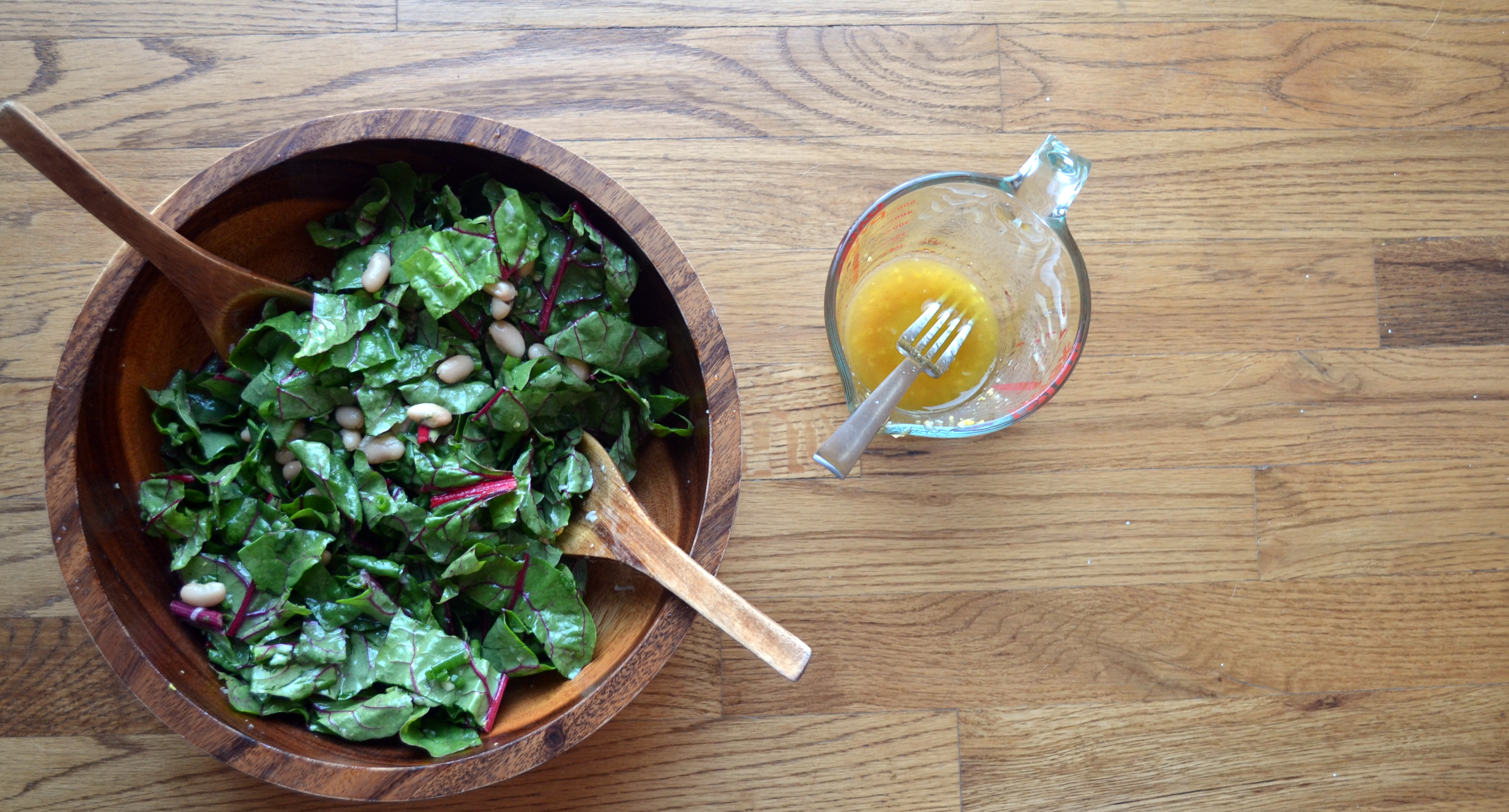
80. Trim and coarsely chop chard (rainbow makes for a gorgeous salad) and combine with white beans and chopped scallions. Dressing is minced ginger, a suspicion of garlic, olive oil and cider vinegar. 

I collected:

½ huge bunch red chard, thick stems removed

1 15 oz. can white kidney beans

5 green onions, finely sliced

1/2 inch knob of ginger

2 garlic cloves

1/4 tsp coarse salt

1/4 cup each cider vinegar and olive oil

1 TB honey

I tossed together the chard, beans, and green onions and set them aside in a big salad bowl.  To make sure the ginger and garlic were fine enough, I minced them by hand, then sprinkled them with coarse salt and dragged the flat of my knife across them until they turned into a thick, aromatic paste.  I scraped the paste into a glass measuring cup and whisked it up with cider vinegar and olive oil.  A taste of this was a cheek puckering revelation, so I added a healthy squeeze of honey to make it less astringent.

Aside from spinach, raw bitter greens are not always N.’s cup of tea.  Because I feared this might be the case with this combination, I decided to treat this more like a slaw than a salad.  I combined the main ingredients early and doused them in dressing a good fifteen minutes before dinnertime.  This would, I hoped, give the acidic dressing time to wilt the chard a bit, much like the vinegar in coleslaw dressing does for the cabbage.

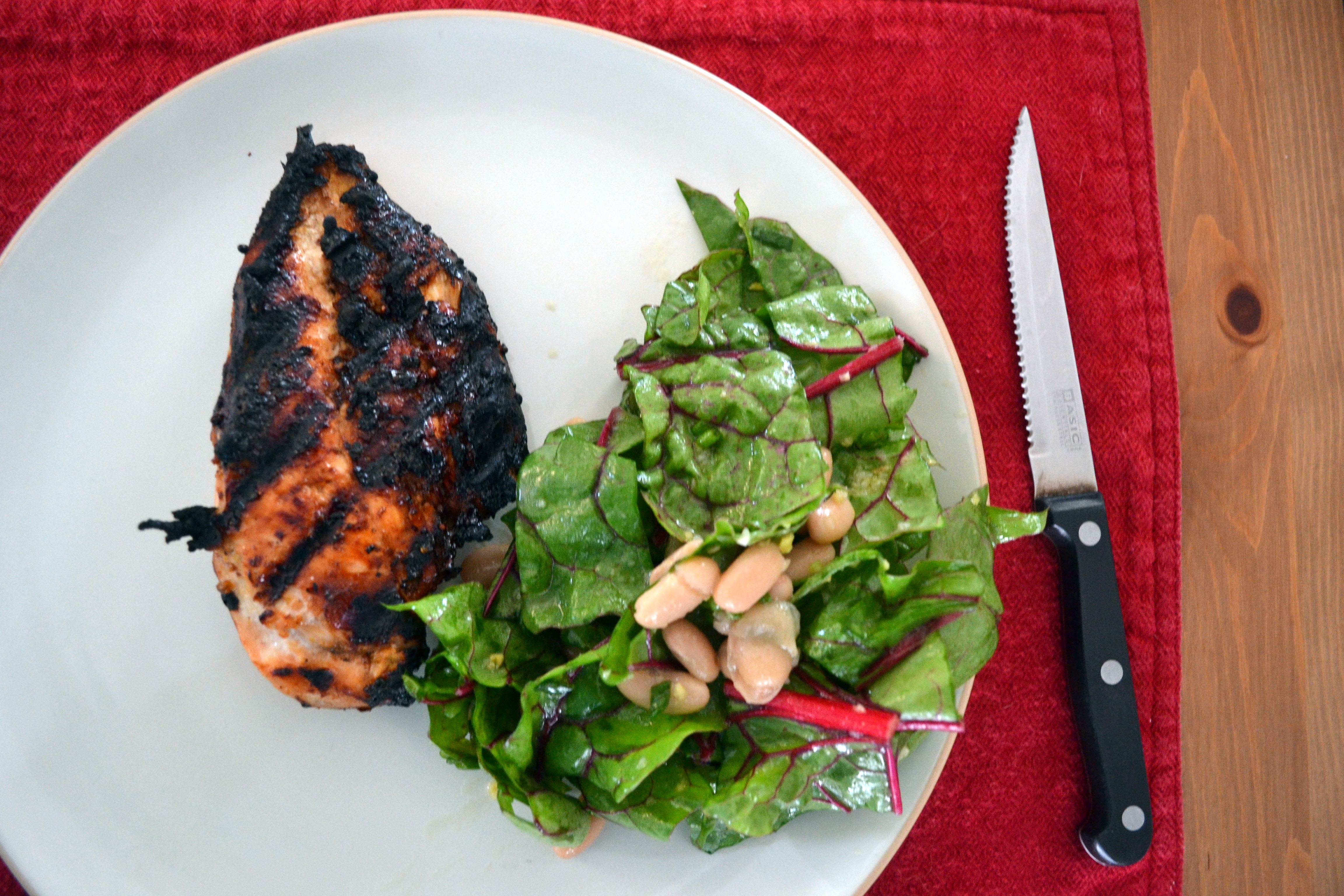
It worked well.  By the time we ate (grilled chicken breasts sauced with equal parts whole grain mustard and apricot jam), the chard had lost just a bit of its aggressive bite but its freshness was not compromised.  The beans, sometimes bland customers, had soaked up a bit of flavor from the tangy bright dressing, and so while they were a steady, creamy counterpoint to the earthy-fresh chard, they weren’t at all boring.  We were both surprised by how well we liked this simple little salad.

Success, then, and balance: excitement and indulgence followed and tempered by stability.  If this is what the 30s are like, I’m ready.  Bring it on.  I’ll just be 30 forever.

Emptying the Fridge

Big news, oh friends: come July, N. and I are moving.  We’re leaving Eugene, OR and heading south for Los Angeles, where N. landed a great job.

I’m sad about this, of course.  I love Eugene.  I love its beauty, and I’ve made some of the best friends and eaten some of the best food of my life here.  I don’t love the way the weather lately has been playing winter/spring/winter/spring/summer/winter on us, and I’m terrified it will pour on graduation day in a week or so.  But mostly I love it.

Yet this move presents the potential for plenty of new delights.  LA is a foodie paradise.  A quick search on Yelp for our new area revealed restaurants serving every kind of food I could possibly crave, and some I’ve never tried before.  Ethiopian will be new to me, as will Caribbean (outside of the ubiquitous and usually inauthentic jerk [insert your protein of choice here]).  The idea of being back in a place with excellent Chinese and Mexican food is overwhelming.  But it’s not just restaurant food that I’m looking forward to.  The Willamette Valley in Oregon boasts great growing conditions for lots of foods, including berries of all kinds, hazelnuts, and plenty of local produce.  But Southern California has so much, given its balmy temperatures year round, that buying and eating local food will suddenly become much easier – not even from farmers’ markets and farm stands, but even from the grocery store.  Avocados, citrus, grapes, all no longer destroy the locavore dream.  Even the backyard of the house we will be moving into has a lemon tree.  A lemon tree!  This excites me almost more than anything else about the whole situation!

Our upcoming relocation also presents a challenge.  N. and I have lived in our current home for four years.  We have lived in Eugene for six.  Over that much time, things accumulate.  Not just house things, like forgotten books and extra sweaters and skillets I shoved in the back of that cabinet N. hates when I replaced them with Circulon non-stick wonders.  Food things.  We have so many half-empty jars of condiments.  So many bags of frozen vegetables bought on a buy-one-get-one sale.  Blackberries from last summer and cranberries from Thanksgiving, carefully preserved on the shelves of my freezer.  Canisters of rice, and brown rice, and millet, and dried beans, and barley, and noodles in the pantry.  It’s a lot of stuff.

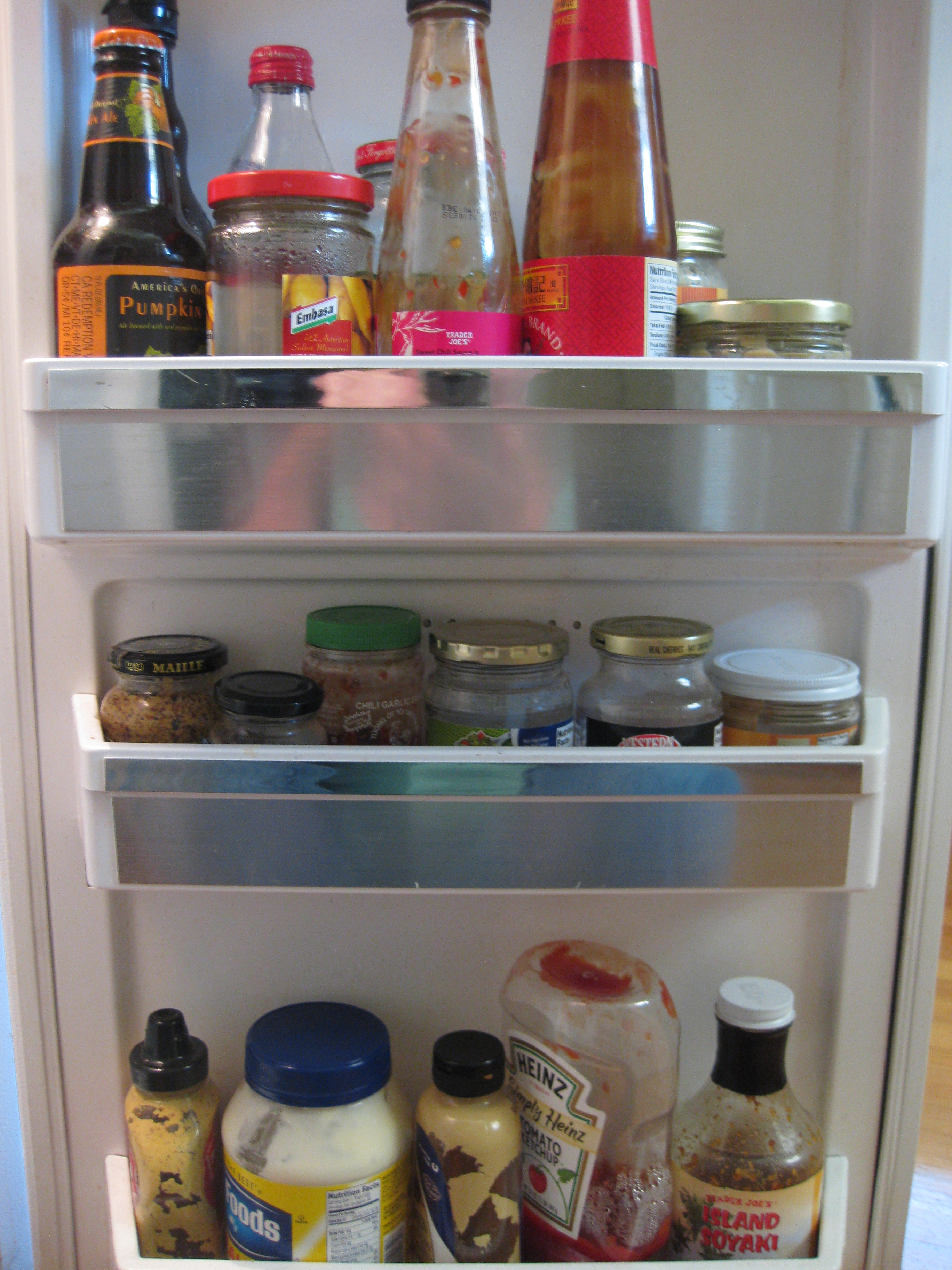
So here comes the challenge: interspersed with regular food posts and wedding cupcake practice and the occasional, still-kicking-because-I-can’t-bear-to-abandon-it Bittman dish, I will be instituting a new project.  I’m calling it “Emptying the Fridge.”  Each week when I make our menu plan, I’m going to try to incorporate at least one dish that requires the remnants – or a good quantity – of at least one refrigerator, freezer, or pantry item.  I’m not talking about things we use all the time, like yogurt or bread or eggs.  I’m talking about the minimal use items, like anchovy paste, or capers, or champagne honey mustard, or chili garlic paste.

This week, I have plans for several items, and though I may not eliminate them, I will at least make a dent in several jars.  After a barbeque a few weeks ago featuring a peanut noodle side dish, I decided I want to make Ina Garten’s Szechuan Noodles.  This requires a whole cadre of ingredients including peanut butter, soy sauce, rice vinegar, and various vegetables.  It also, of importance to this project, requires hot chili sauce and tahini.  Both of these items currently languish on my refrigerator door, awaiting stir-fries and hummus.  But this week, they will shine and diminish simultaneously. 

Other plans include a white bean puree I will invent (and post the recipe for, if it turns out well) to work on using up the four cans (four?  How can I possibly have four?) of white beans in my pantry, and peanut butter energy bars, which will help eliminate the giant canister of oats I’ve gotten too stubborn to turn into oatmeal.  At a certain point, you have to eat like it’s summer, even if the sky says it isn’t, don’t you?  But snack bars are a worthy and not-un-spring-like application.

This project is, I think, a combination of homestyle Iron Chef and Chopped.  Not only are there feature or star ingredients, but after a while the pairings of available options will become unusual and require a certain amount of ingenuity to use up.  I like this, because it prepares me for the Food Network show I will never have, which I would call “Empty Fridge.” EF would consist of me trying to use limited pantry and refrigerator items to create something delicious without having to make an extra trip to the store, so in essence it’s Chopped-at-Home.  The difference with my current project, though, is that I am not prohibited from shopping, and am in fact planning ahead based on the contents of my condiment collection to determine our dinners.

Come August, you can expect an abundance (after a short hiatus, most likely – moving and blogging don’t necessarily mesh well) of drooling and groveling over our new location and its diverse and numerous highlights.  But until then, you can look forward to quarter jars of mustard, forgotten marinated artichoke hearts, and hidden canned peaches in various applications.  Hopefully, in this case, not in the same meal…

Food from Fiction Potluck

So what does one do, you might ask, as a newly minted Doctor of Literature, unfettered from the everyday proletariat academic concerns?  Well, one grades, and one line edits, and one revises frantically, and frankly, one feels completely different and not different at all.  The school year isn’t over, even though (as of Tuesday, when I upload my “completed” dissertation to our Graduate School’s website) my degree is.  So my daily duties no longer include anxious preparing for the big day, but they still include student emails and lesson planning and reading.

But because they don’t include anxious preparation and last minute rethinking and nail biting about what the committee will think, these days can also include celebrations.  Last night was one such celebration: a party I’ve wanted to have for several years now.  The style: potluck.  The theme: “Food in Fiction.”  Interpretation: bring a dish inspired by or mentioned in a book.  That’s it.  There are so many vivid options in novel, drama and film, and our guests had only to choose one and recreate it in the material, taste-bud-bearing world.

We had tremendous fun, in brainstorming, in cooking, and in sharing the variety of dishes from books we love.  As I mentioned to one friend who thanked N. and I for the great party on his way out the door, this is a party we had to have before parting ways as many of us graduate this June, because only in this company could we feel so self-congratulatory and so excited about immersing ourselves in something so nerdy.

Here are a few of the dishes we enjoyed.  I suggested to folks that they provide the description of the food in question from its source text so guests would know what they were eating and which world it was taking them to.  We had Victorian sandwiches and High Modernism Stew nestling next to a magical realist chutney and a warm wassail of fantasy.  What wandering, all in one house…

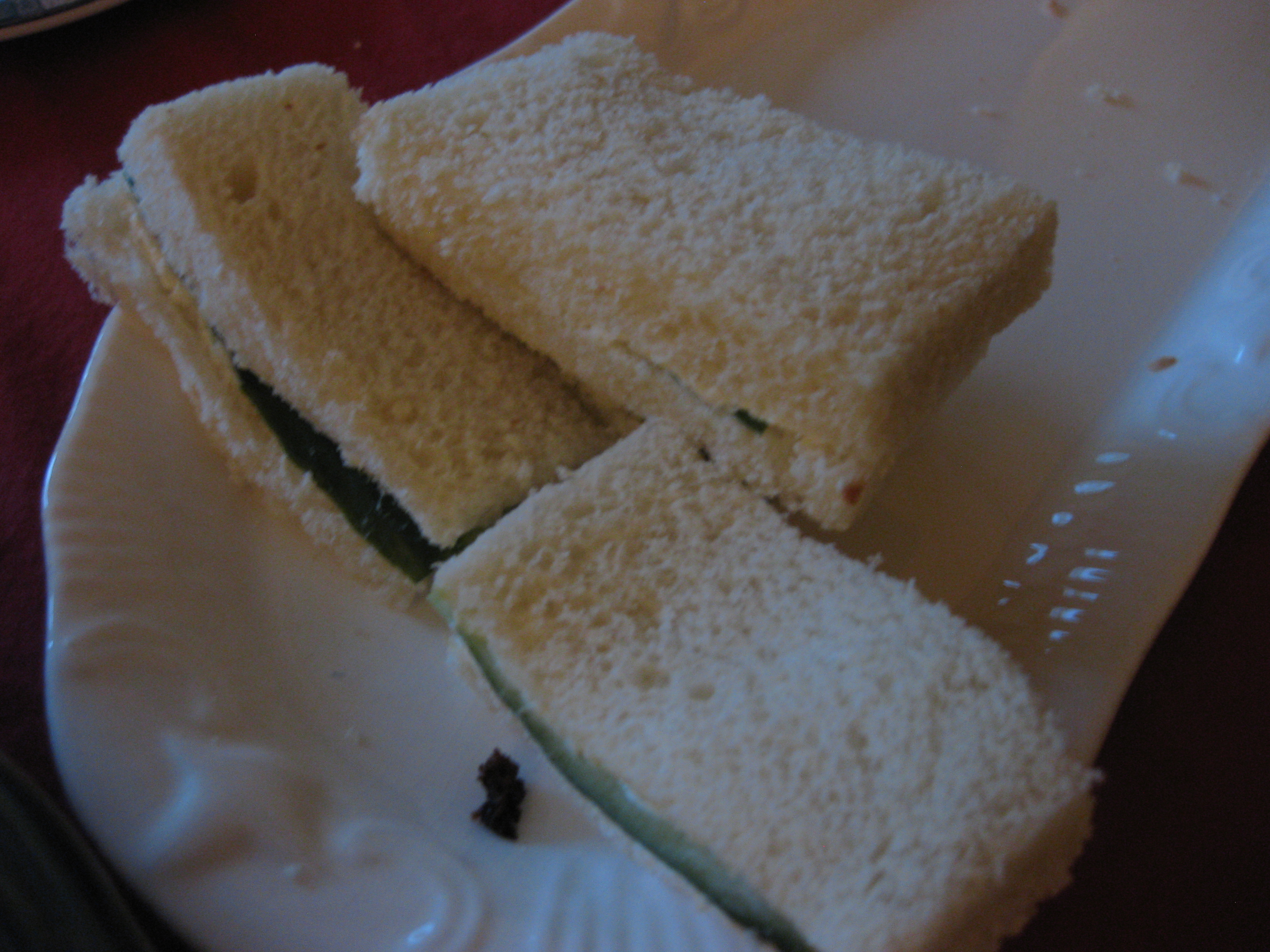
Cucumber sandwiches from Oscar Wilde’s “The Importance of Being Earnest.”

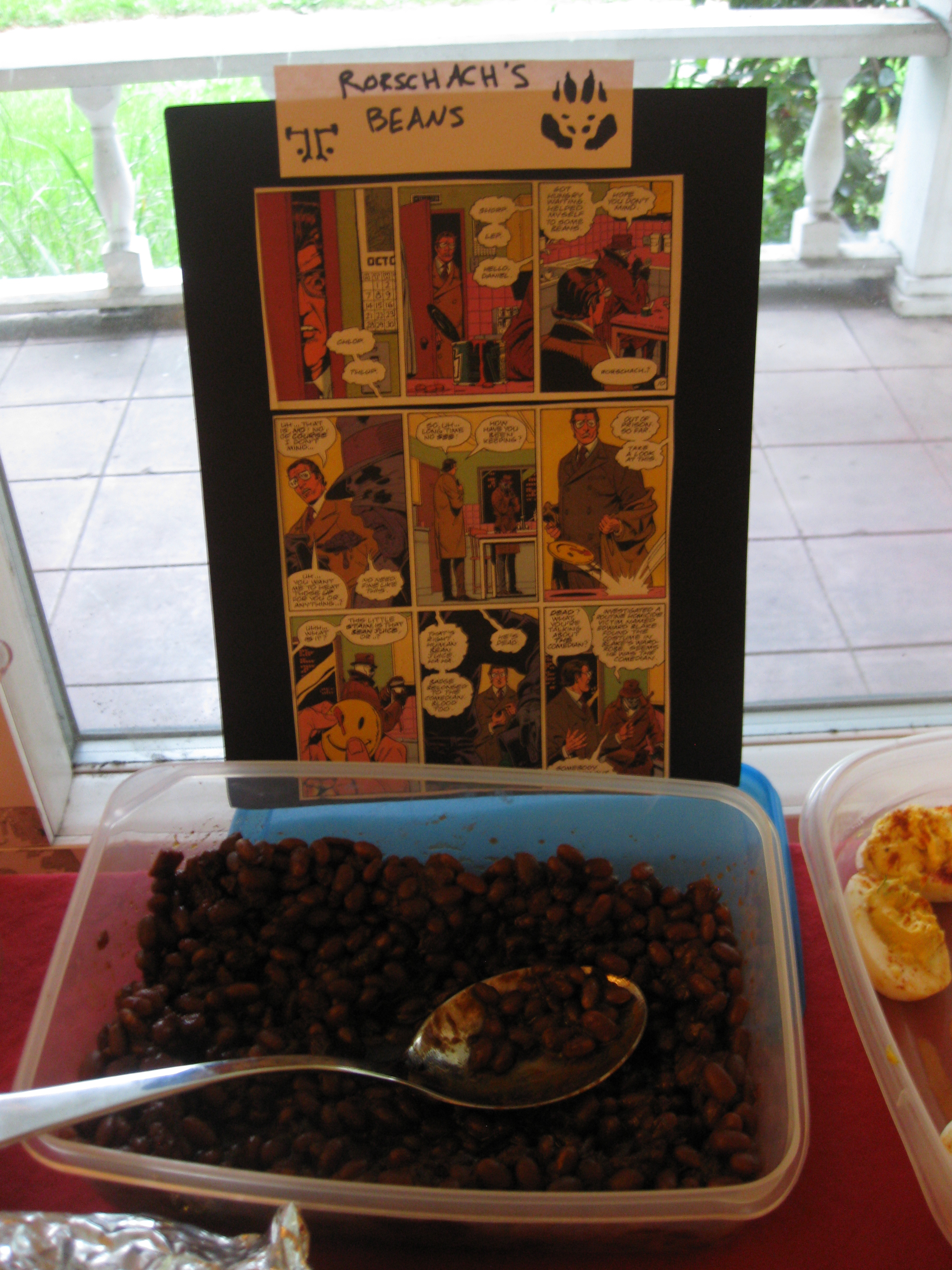
Rorschach’s beans from the graphic novel “Watchmen.”

Boeuf en daube from Virginia Woolf’s To the Lighthouse.

A trio of deviled eggs to breathe life into Hemingway’s thoughts on being hard boiled in The Sun Also Rises.

A wonderfully smoky molasses cake inspired by the molasses-drenched dinner scene in Harper Lee’s To Kill A Mockingbird.

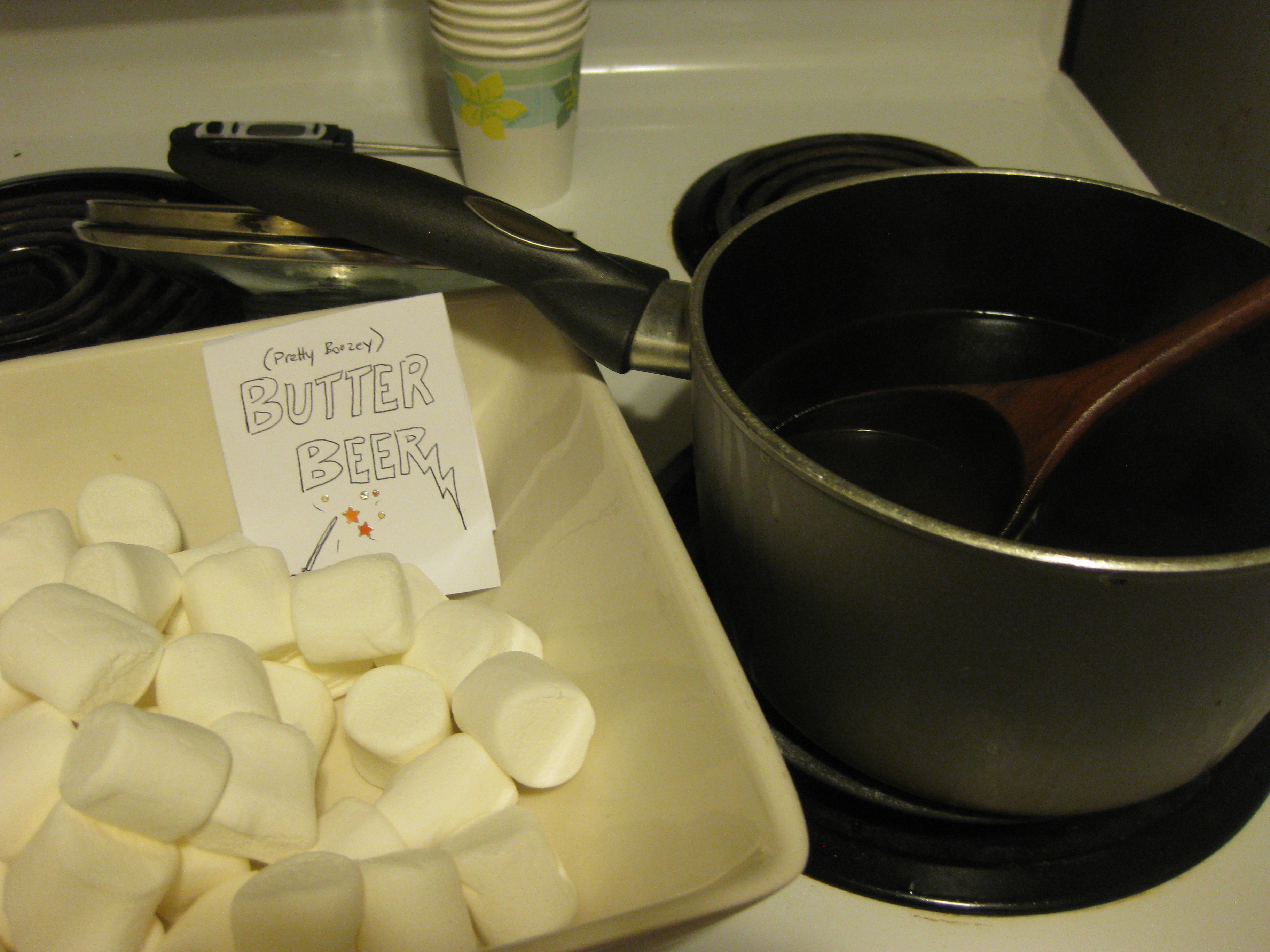
Well spiked butterbeer (you drop in a few marshmallows which, as they melt, mimic the foamy head on the beer) from J. K. Rowling’s Harry Potter series.

Not pictured: (more!) deviled eggs, from Toni Morrison’s Song of Solomon, sautéed marinated mushrooms inspired by Lewis Carroll’s Alice in Wonderland, raspberry cordial from L. M. Montgomery’s Anne of Green Gables, and a few sourceless delights: meatballs (Cloudy with a chance of, perhaps?), and a bread, cheese, and hard salami platter.  These were justified by their authors with the claims that “surely there must be moments of literary eating that include these items,” which I was quite willing, given their deliciousness, to accept.  And of course, wine.  If we were picky, we could call this an homage to Hemingway, whose characters “get tight” with abandon, or to Carroll’s Alice, who does imbibe from the mysterious bottle demanding she “drink me.”

I made two offerings: a take on the “green as grasshoppers” chutney so adored by Saleem in Salman Rushdie’s Midnight’s Children, and a pork pie stuffed with hard boiled eggs from Roald Dahl’s Danny the Champion of the World.  Both turned out extremely well, but I want to talk about the pie first.

Danny the Champion of the World is the story of a boy and his father.  Without giving too much away, I will only say that Danny’s father suffers an injury almost halfway into the book, and when Doc Spencer, the family physician, brings him home from the hospital to the gypsy caravan in which he and Danny live, Doc also brings Danny a package from his wife:

“Very carefully, I now began to unwrap the waxed paper from around the doctor’s present, and when I had finished, I saw before me the most enormous and beautiful pie in the world.  It was covered all over, top, sides, and bottom, with rich golden pastry.  I took a knife from beside the sink and cut out a wedge.  I started to eat it in my fingers, standing up.  It was a cold meat pie.  The meat was pink and tender with no fat or gristle in it, and there were hard-boiled eggs buried like treasures in several different places.  The taste was absolutely fabulous.  When I had finished the first slice, I cut another and ate that, too.  God bless Doctor Spencer, I thought.  And God bless Mrs. Spencer as well” (Dahl 85-86).

Since my first trip through Danny, I salivated over this savory pie Danny enjoys.  And this party was the perfect excuse to attempt my own.

I found a perfect (and much prettier) base recipe for my pie in the archives of the blog Married… With Dinner.  Though I followed their basic instructions, I made a few amendments for ease and expense.  The key points are as follows:

Use a springform pan.  That way the pie is tall and regal and can sit magically outside a pie plate all on its own.

Roll the bottom crust out large enough to come almost all the way up the sides of the springform (I used storebought crust and it work out just fine), so you can connect top and bottom more easily.

I squashed together a mixture of ground pork, pork sausage, finely chopped ham from a ham slice, salt, cayenne pepper, ground cloves, and black pepper.  I pressed a thin layer of the meat mixture onto the bottom of the pie crust, then laid six hard boiled eggs in a circle through the middle of the pie (regrettably, with ham-covered hands, I did not get a photo of this).  Then I lightly packed the rest of the meat mixture around and over the eggs and sank a bay leaf deep into the very center of the pie.

A traditional English pork pie has warm pork stock poured into a hole in the crust just after baking, which turns into a thick jelly as the pie cools.  This did not sound particularly delicious to me, though I did like the idea of a rich layer of something atop my pork.  I decided on cheese.  I grated about a cup of sharp cheddar and sprinkled it lightly on top of the meat before draping the top pie crust over it.  I cut a little hole in the center of the crust and sliced some steam vents for additional release before baking.

It’s a long baking process (almost two hours), but you are dealing with raw pork, so the cooking time needs to be sufficient.  When the pie is almost done, Married… With Dinner recommends you carefully release the spring on the pan and brush an egg wash all over the top and sides of the pie.  Fifteen minutes more in the oven and this results in a beautiful, shiny golden glaze all over the pie.  It also, in case you are lazy like me and didn’t brush an egg wash over the top edge of the bottom crust to help the lid adhere, creates an after-the-fact glue to hold base and lid together.

I let my pie cool on the counter for an hour or so, then tented it with aluminum foil and stowed it in the fridge until the party started.  It did, after all, have to be a cold meat pie.

It was fabulous.  The meat was nicely spiced and the ham bits shredded in added some smoky, salty variety.  The hard boiled eggs were, indeed, delightful treasures to find, though I admit to over-boiling them slightly so their yolks were not as bright as they could have been.  Still, this is hardly a complaint.  It was like a meatloaf wrapped in flaky, buttery crust, and the cheese was a nice additional flavor and richness.  I suspect this could have been just as good warm as it was cold, but the pie might not have held together quite as nicely.

My second offering was a cilantro coconut chutney.  Saleem, as Midnight’s Children comes to a close, receives a meal from a blind waitress.  He lists:

“On the thali of victory: samosas, pakoras, rice, dal, puris; and green chutney.  Yes, a little aluminum bowl of chutney, green, my God, green as grasshoppers… and before long a puri was in my hand; and chutney was on the puri; and then I had tasted it, and almost imitated the fainting act of Picture Singh, because it had carried me back to a day when I emerged nine-fingered from a hospital and went into exile at the home of Hanif Aziz, and was given the best chutney in the world… the taste of the chutney was more than just an echo of that long-ago taste – it was the old taste itself, the very same, with the power of bringing back the past as if it had never been away…” (Rushdie 525).

I found a recipe for a coriander chutney replete with tart lemon juice, lip puckering spice from serrano chiles, and bright, bright green cilantro, tempered by shredded coconut.  The recipe called for unsweetened coconut but I, in my haste, having only sweetened, forgot to rinse it to get some of the sugar off before dropping it into my food processor.  As a result, my chutney was lightly sweetened, but no one seemed to mind that, especially when it was spread onto the pakoras I made.

I searched around online and made a master recipe from a combination of ideas for these pakoras.  Mine included:

4 cloves garlic, smashed and finely minced

2 tsp. each:

Garam masala

Turmeric

Chili powder

Salt

2 cups Bob’s Red Mill gluten-free all-purpose flour (pakoras are made with garbanzo bean flour, and though the Bob’s Red Mill mix is a blend including potato starch, it is composed mostly of garbanzo and fava bean flours, so since I had it, I decided a little break from tradition would be okay.  This is literature, after all.  It’s all interpretation anyway!)

1 ½ cups water

½ head cauliflower, diced

¾ large onion, diced

1 small sweet potato, diced

1 quart vegetable oil

Heat the vegetable oil to 375F in a large, sturdy pot.  I used my dutch oven.

While the oil heats, whisk together the dry ingredients and garlic until well combined, then slowly whisk in the water to form a thick, smooth batter.

Add the diced vegetables and stir to combine.

Drop spoonfuls of the batter (ever so carefully!  Watch out for splashes!) into the hot oil and fry for 5-6 minutes, or until the batter is deeply golden and the vegetables inside have magically cooked.

I got to taste one of these.  It was crunchy and starchy and slightly spicy and wholesome and delicious.  It was vegan.  It was gluten-free.  Topped with the chutney it was fresh and springy and spicy and then gone.  By the time I went back to have another, the giant platter I’d made was empty, and only a spoonful or two of chutney remained.  Pride overwhelms disappointment, in moments like these.  My little experiment was so successful it prohibited me from tasting further.  So I had another deviled egg instead.

Full and happy, we fell into bed at midnight with a sinkful of dishes and a fridge-full of leftovers to look forward to.  It’s like reopening a book to your favorite chapter: whose world will I lunch from, dine from, be returned to today?

Thanksgiving veg 2010

My family always argues over a Thanksgiving vegetable dish.  My dad doesn’t like the classic green bean casserole made with Cream of Mushroom Soup and crispy fried onion ring crumbles.  He can’t get past the condensed soup flavor.  When I asked him last year what vegetable I should make instead, he suggested lima beans.  We made green bean casserole anyway.

One year my Mom and I tried making this dish from scratch.  We figured, fresh green beans lightly steamed, thick chunks of mushrooms, a silky white sauce, and what could be better?  That was the year I determined that part of what I like so much about the classic green bean casserole is… the taste of processed condensed soup.  I can’t help it.  I love the savory, umami saltiness of it, and the homemade substitute was just not an acceptable replacement for me.

One year at Thanksgiving with some family friends, they brought a big salad to supplement our carbohydrate-rich, overloaded plates.  The bowl was passed around the table.  No one took any salad except L, who had made it in the first place.  When she protested, her husband uttered the truest words anyone has ever spoken: “Thanksgiving is not about lettuce.”  So salad, too, failed the test.

Now that October is over, the challenge again rears its head: which vegetables can I dress up to complement the comforting classics we always serve?  While N. was gone at a conference recently, I fiddled around with some trial dishes and voila, Thanksgiving Veg 2010 was born: creamed spinach and artichoke bake.  It’s the comfort and familiarity of creamed spinach, with the flavors and reminiscence of spinach artichoke dip.  Perfection, no?

Here’s what you need:

4 TB butter

4 cloves garlic, crushed and minced

1 – 2 leeks, white and pale green parts only, chopped fine

4 TB flour

Generous grating of fresh nutmeg

2 cups milk or cream

4 oz. cream cheese

At least 10 oz. spinach (that’s the amount in one frozen box, but I used fresh because I prefer it)

16 oz. can of artichoke hearts in water, drained and quartered

Salt and pepper to taste

Topping:

2 TB butter

½ cup or more of Panko bread crumbs

2-3 TB parmesan cheese, grated

Melt the butter in a large skillet over medium heat.  When it is nearly all melted, add the garlic and sauté for just a minute or two, until the aroma is enticing.  Add the leeks and sauté until they are softened.  Leeks are a new love of mine.  They are the least aggressively flavored members of the onion family, and I think they taste like a cross between a sweet onion and garlic.  They don’t have that astringency onions sometimes do, and I think they are like a stalk of springtime.  I’ve started putting them in frittatas, and when I had one left over on the night I made this little concoction, it seemed like the perfect thing to add in.

When the leeks are tender but not browned, add the flour and nutmeg.  Add some pepper too, if you like.  Stir in until well incorporated with no huge floury lumps, and cook for a minute or two until the flour is pale golden in color.  Then add the milk, slowly, whisking the entire time.  I added it in installments of probably half a cup each, stirring until the milk was fully integrated into the flour mixture.  I found this helped avoid lumps, making a smoother base overall.  Add the cream cheese and mix in.  Whisking fairly constantly, let the milk come to a boil.  It will thicken as it heats.

When the milk is quite thick, add the spinach and artichoke hearts.  The spinach will wilt quickly, and as soon as it is looking soft, kill the heat.  Since this is going to bake for a while, you don’t want to overcook the spinach because it will lose its beautiful color and begin to look muddy.

Salt and pepper to taste.  You could stop here and eat this whole delectable mess right out of the skillet, but I wasn’t ready to quit yet.  After all, it takes my dad about half an hour to carve a turkey, so the oven is (mostly) free.  Why not take advantage of that?

With your oven at a preheated 350F, carefully dump the spinach and artichoke mixture into a baking dish (I used a glass nine-inch pie pan).  Set it aside for a moment while you make the topping.

Mix together the Panko bread crumbs and parmesan cheese with the softened butter.  Drop the buttery crumbs in little clumps all over the top of the spinach and artichoke mixture.  If you don’t get the vegetables completely covered, that’s okay.  In fact, it’s good, because it means any exposed edges of leeks or artichokes will get a little toasty and golden.  More texture = more exciting to eat!

Bake the whole thing for about half an hour at 350F, or until the crumbs on top are browned and the sauce is bubbling at the edges.  Remove and consume.

What I liked about this dish was… well, innumerable.  But the basics: I love creamed spinach, and this was a more extravagant, luxurious take on it.  I also love spinach dip, and this reminded me of it, but without the excessive mayonnaise, the MSG-laced spice mixture, or the pounds of parmesan that go into a hot artichoke version.  The bread crumbs on top were a welcome textural element, especially for a Thanksgiving table, where stuffing, mashed potato, and even the tender juicy turkey, all lack an essential crunchiness.  Not that you would want your mashed potatoes to be crunchy, but it is a sensation for your mouth often missing from this meal.

I told my mom about this dish when I spoke to her on the phone this weekend, and before I could finish explaining what it was, she had already confirmed that this, indeed, would be our Thanksgiving vegetal offering.  Challenge met, and challenge exceeded!  Now I just have to wait for the end of November…