Vegetable Pakoras with Cilantro Mint Chutney

Why, I thought, as a rivulet of sweat coursed from neck to waist, do I insist on frying in the summer?  The instant read thermometer I was using to check the temperature of the oil sat next to the stove, registering 91F.  Normal people wait for summer and then anxiously stuff themselves on grilled meats, fresh salads, wedges of cool melon.  Foods that don’t make your back bead up.  But here I am, on my first real day of summer vacation, celebrating by standing over a pot of shimmering heat, making pakoras for lunch.

Food Blog June 2013-1613Maybe it’s a cultural thing.  I don’t mean the pakoras.  I mean frying.  Fried foods are a treat frequently enjoyed during the summer months; Americans + carnivals or county fairs = frying anything we can think of.  Depending on where you are in the country, corn dogs, funnel cake, hush puppies, twinkies, tortillas, even oreos, all get dunked into vats of hot oil and floated cautiously around until they transform into variously shaped clumps of deep, crispy gold.

So to bring summer traditions like sweating and eating fatty foods and looking at award-winning livestock and riding in twirling cars where the metal shrieks and you smell the grease with every turn into my own kitchen, I’m making pakoras for a weekday lunch?

Partly.  But not all.

I’ve talked before about my friend Ph., who even has a whole category on this little site dedicated to her (Phoebe-Phriendly, if you’re interested).  Ph. is gluten-intolerant, can’t eat dairy or tree nuts, and is no longer able to process corn or rice.  This makes cooking for her a challenge.  However, she is one of the reasons I started stretching my food boundaries and knowledge; we became close friends in graduate school, and I wanted to be able to make food that she could eat!  We got into a conversation in the comments of her blog the other day, and I brought up pakoras because she was playing with garbanzo bean flour.  She had never made them, so we decided I should come up with a recipe she could use.  That’s where you, my friends, luck out.

Food Blog June 2013-1603Pakoras are an Indian street food: assorted vegetables (or paneer, or bread, or apparently sometimes even chicken) dredged in a well-spiced batter of besan or gram flour (which is made with garbanzo beans) and water.  I added some baking powder to my mix as well, for fluff and lightness.  Most often the vegetables are cut into manageable pieces and dipped into the batter individually before they are fried, resulting in something I’ve been thinking about as essentially an Indian spiced tempura.*   Sometimes, though, they are cut into smaller pieces, tossed together in the batter, then levered carefully into the oil in chunky mixed fritters.  I chose the first of these methods for our lunch, so we could have the fun of mixing and matching which vegetables we crunched our way through.  We chose cauliflower, potatoes, and onions.  My favorite ended up being the cauliflower, while N. couldn’t get enough of the puffy potato slices.

Food Blog June 2013-1607Though they are eaten year round (depending on where you are), I discovered during my research about this delightful little snack that they are particularly popular during monsoon season, dipped into or sauced with a variety of chutneys, and served alongside a cup of chai.  This makes sense – a warm treat to enjoy when it is wet and booming with storms outside – and though the weather in my California kitchen is far (far, far, far) from identical, it is currently monsoon season in India, so it turns out this was, after all, a timely choice.

We had ours with a cilantro mint chutney – lightly spicy, fresh, grassy from the herbs, and bright from the addition of lime juice.  I’ve included that recipe here as well.

Food Blog June 2013-1610Pakoras are best served as hot as your mouth can handle them.  They are crispiest that way.  As they sit, the batter loses its magnificent crunch.  They are acceptable reheated in a 400F oven the next day, but, as with all fried foods (with perhaps the magical exception of a really good fried chicken), they are best eaten immediately.

Food Blog June 2013-1614Food Blog June 2013-1615Food Blog June 2013-1616

* I realize tempura is quite different: rice flour is typical, for one, and the liquid used is often carbonated water to make the batter even lighter.  But the essentials – vegetables coated in batter and fried – are the same.


Vegetable Pakoras and Cilantro Mint Chutney
serves 6-8 as an appetizer or snack, or 4 as an embarrassingly indulgent lunch
Pakora batter:
2 cups garbanzo bean flour (I used Bob’s Red Mill Gluten-Free mix, which is mostly bean flours)
2 cloves garlic, grated
1 small knuckle of ginger, grated (about a ½ inch piece)
1 tsp ground turmeric
1 tsp ground cumin
1 tsp ground coriander
¼ tsp cayenne pepper, or more to taste
1 tsp salt
2 tsp baking powder
1 cup cold water
  • Whisk together the flour, grated garlic and ginger, and all the spices until evenly combined.
  • Whisk in the water until a thick but smooth batter forms.
  • Set it aside for 30 minutes.  This is conveniently enough time to prep the vegetables, heat the oil, and make the chutney.
Pakora vegetables:
1 small head cauliflower, cut into bite-sized pieces
2 medium Yukon gold potatoes, sliced thin (1/8 inch slices seemed ideal)
½ large red onion, cut into chunks or thick rings
  • To prepare for frying, heat 1-2 quarts of oil (I used vegetable oil) in a large, heavy, steep-sided pot over medium heat, until it reaches about 350F.  Put on some closed-toed shoes to keep yourself safe, just in case you have drips or your oil bubbles over.
  • Working in small batches (5-6 pieces at a time), dip the vegetables into the batter, retrieve one at a time with long handled tongs and let the excess batter drip back into the bowl for a few moments before carefully lowering each into the hot oil.  They should sizzle as they are immersed, but not spit or foam up wildly.
  • Cook each batch of vegetables for 4-5 minutes, carefully turning each one halfway through the cooking time, until they are golden and crispy.
  • As each batch finishes, fish the pieces out one at a time and set them on a wire rack over a cookie sheet.  This will allow excess oil to drip off.  Salt them lightly as soon as they come out of the oil.
  • Take the temperature of the oil before adding a new batch of vegetables, to ensure that it returns to right around 350F, the optimal temperature for frying.
  • Continue until all vegetables are golden, crispy, and cooked!

Pakoras are best consumed as soon as they are cool enough for your mouth to handle.  As they sit, the batter gets soggy.  It’s still tasty, but not as triumphantly crunchy.

Cilantro mint chutney:
2 bunches cilantro, bottom 3 inches or so of stems removed
1 bunch mint, stemmed (you will be using leaves only)
Zest and juice of 1 lime
1 jalapeño, stem removed and sliced in half longitudinally (if you are concerned about the chutney being too spicy, remove some or all of the seeds and inner white membrane, where most of the heat is concentrated)
¼ cup water
2 TB olive oil
1 tsp garam masala
Salt to taste
  • Add all ingredients to a food processor and pulse in 3-5 second intervals until everything comes together as a loose, chunky sauce.  The resulting mixture should be thinner in consistency than a pesto, and will not remain emulsified for very long.
  • Scrape into a serving dish and eat with the pakoras.
Breaking Bread

Last week I tallied up what remained on my Bittman Sides project and discovered, through careful calculations that included pointing to my calendar and counting on my fingers, that if I make two selections from the list every week, I will be finished with the whole thing at the end of the year.  And I mean the end.  The very last week.  Ambitious, yes?  I decided I could do it.

Guess how many I made this week?

Yeah.

One.

So I’m not starting out well with this, but I’m going to try anyway.  I’m years overdue from my original goal anyway.  And in my own kind of backwards reverse engineering, I try to make up for this how?  By posting twice in one week.  So it goes, I suppose…

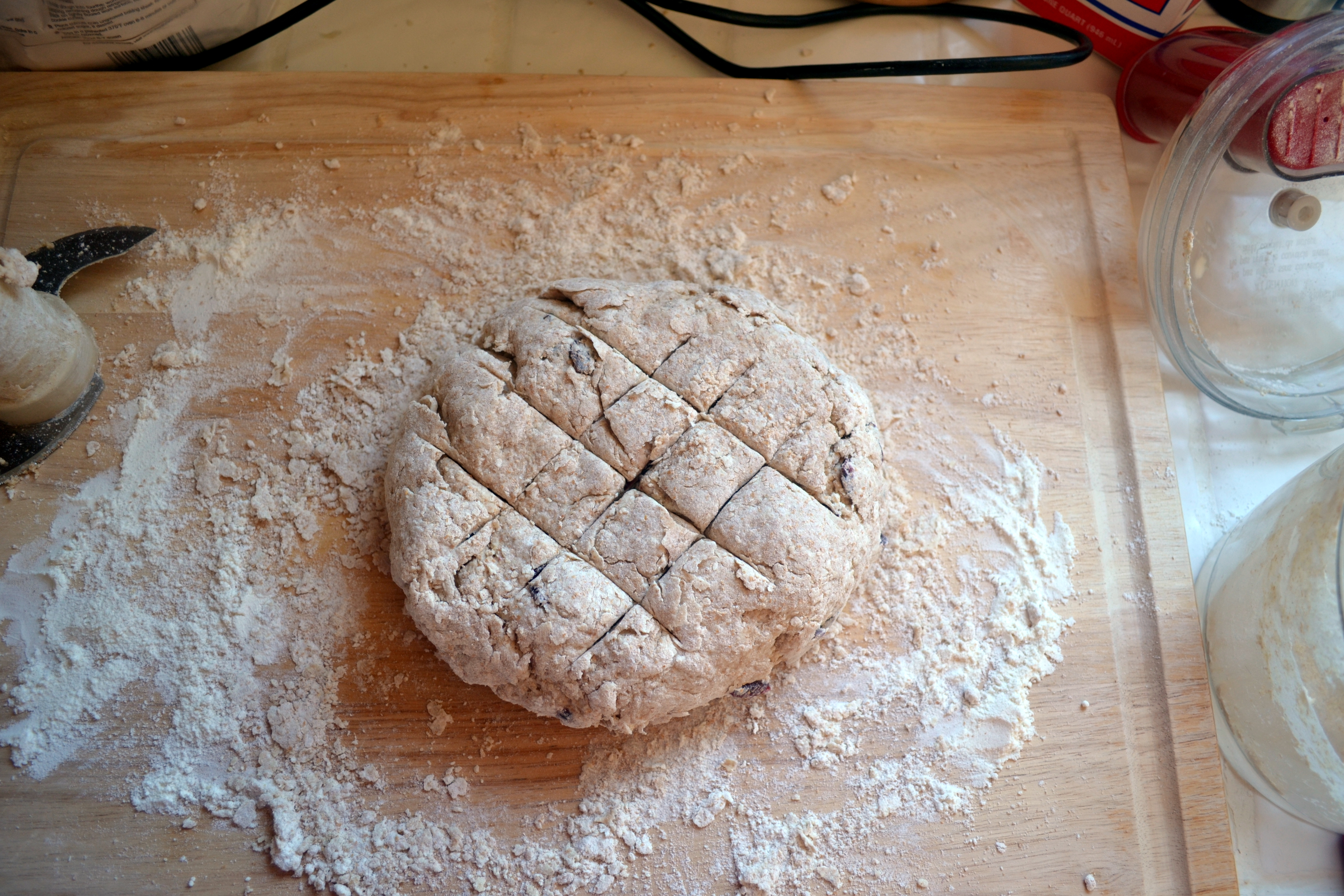
87. Combine 2 cups whole wheat flour with 2 cups white flour and 1 teaspoon each baking powder, baking soda and salt in a food processor. Pour in 1½ cups buttermilk or thin yogurt, and pulse until a ball is formed. Knead for a minute (fold in ½ cup raisins or currants if you like), shape into a round loaf, slash the top in a few places and bake on a greased sheet for about 45 minutes, or until the bottom sounds hollow when you thump it.

I’ve tried bread in the food processor before and it didn’t go very well (what does “when the dough is shaggy” mean anyway?), but I was willing to give this a shot.  It looked like a basic Irish soda bread recipe, and though I’ve never put that in the food processor, I have made it with success on multiple occasions.  So, I pulled down my food processor, opened my pantry, and collected

2 cups wheat flour

2 cups white flour

1 teaspoon baking powder

1 teaspoon baking soda

½ cup Greek yogurt whisked with 1 cup whole milk (I had neither buttermilk nor thin yogurt – this seemed like a happy medium)

½ cup craisins

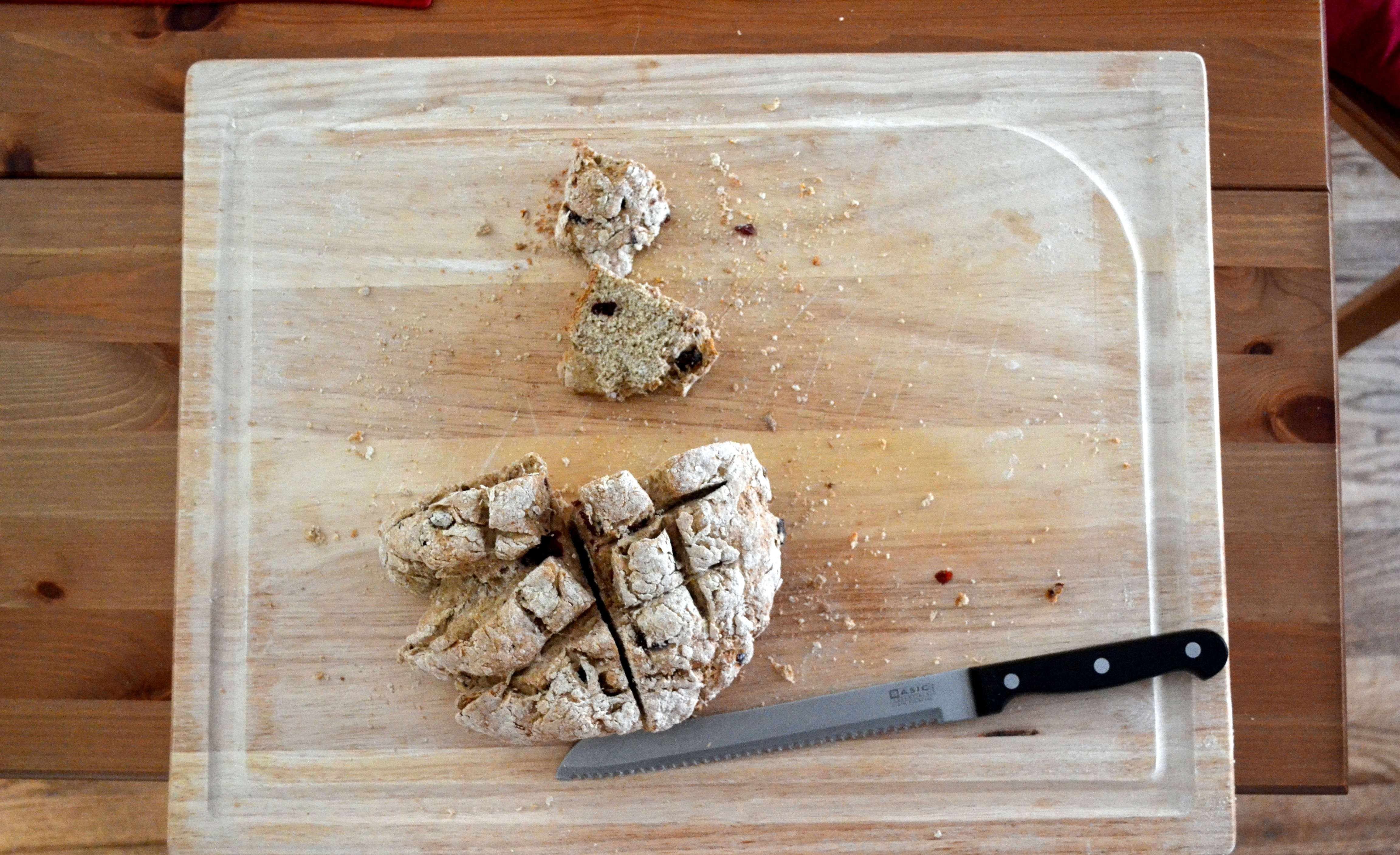
I followed Bittman’s directions to near disaster.  Either my food processor is too small, or this method isn’t all that reliable, because the dough never formed a ball.  Half of it just clumped into a solid mass in one side of the processor bowl and refused to budge.  I said some words in the quiet of my own brain and then held my breath while I tumbled the half-mixed contents out onto a floured board.

This is certainly not a ball.  But I sprinkled on half a cup of craisins and started kneading anyway, trying to ignore the hateful feel of dry dough on my hands.  After a minute or two I determined that things were just not coming together.

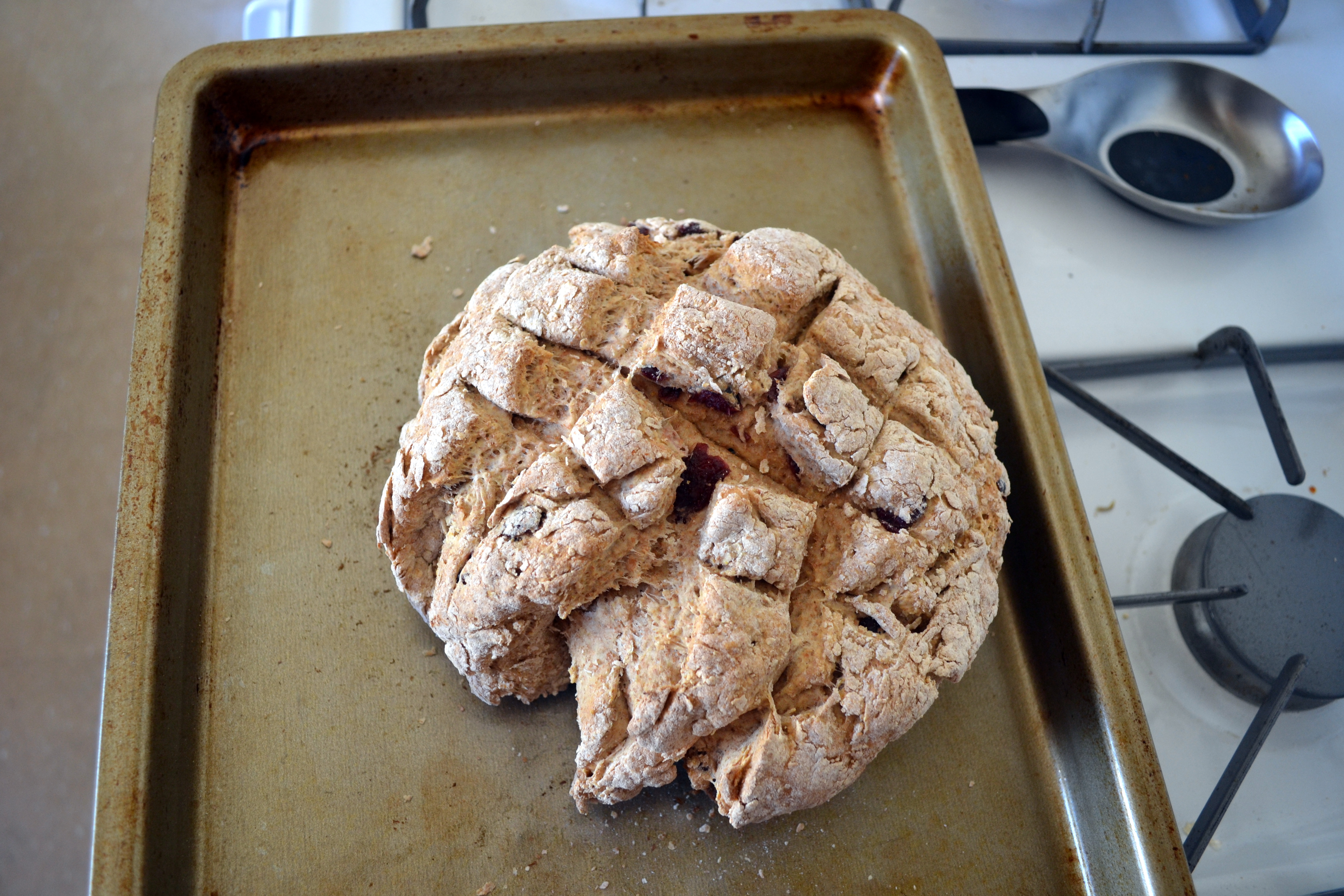
Flour-streaked hands reached into the refrigerator and pulled out the milk, dribbled a few tablespoons into a hollow in the dough, and tried again.  This time, things started to stick, to smooth, to pull into a ball.  I patched, I patted, I pushed and knuckled, and finally plopped one of the homeliest loaves ever made onto a greased baking sheet.  Slashed, scored, and enclosed in a warm oven, and I’d done all I could.

Bittman didn’t specify a temperature, but I estimated 375F and returned to grading papers for the better part of an hour.  The timer’s buzz 45 minutes later called me back to a crusty, mottled, flour-speckled loaf that sounded empty when I thumped the bottom, and smelled like humble sour sweetness.

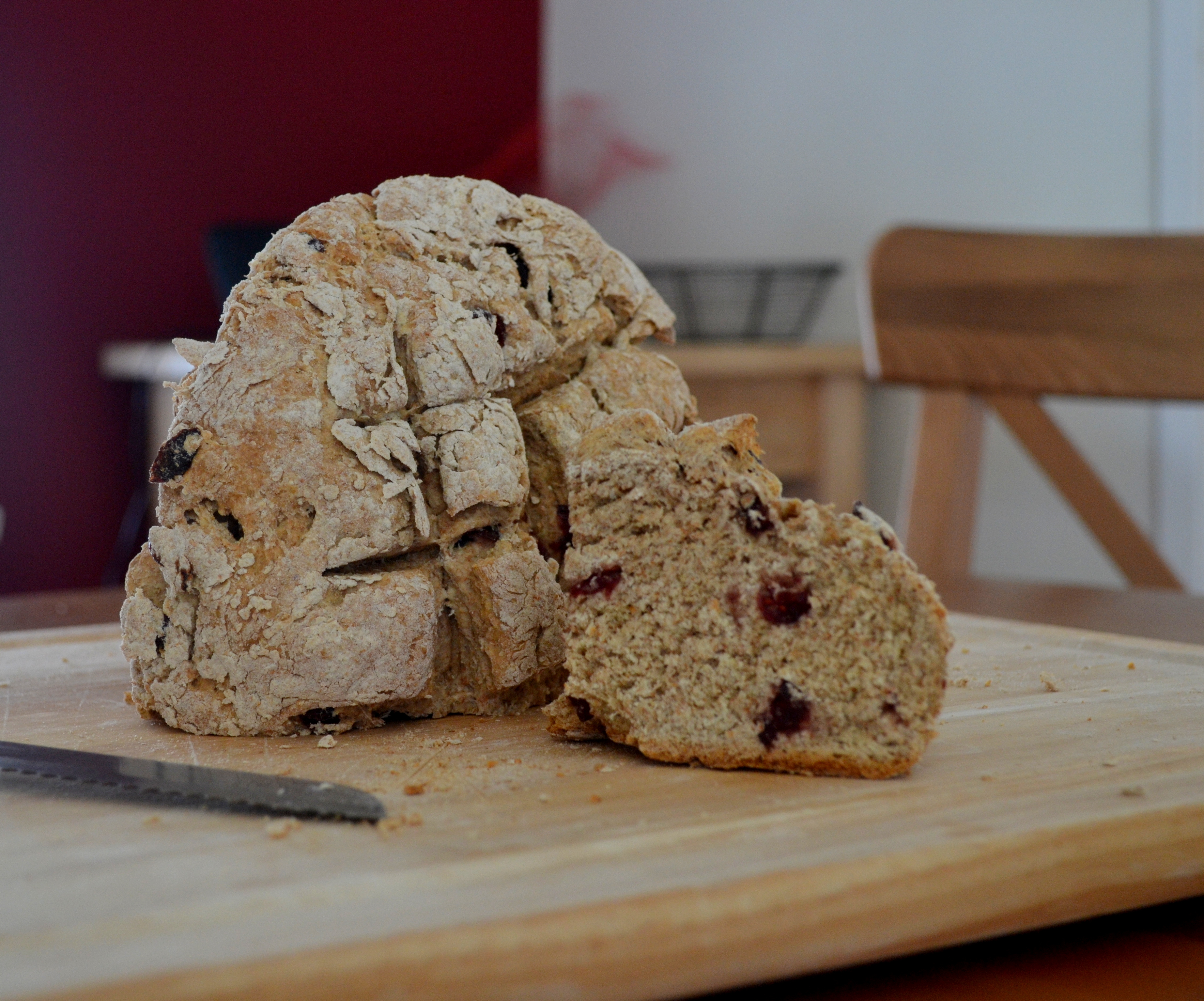
I waited a few hours to try some.  When I cut into it, my knife scraping through the crust and scattering crumbly bits across the board, the interior was dense and moist and still just warm.

It tasted good.  A bit heavy, from the whole wheat flour, and not suitable for eating in large chunks like the one I’d carved off for myself.  But the craisins added a welcome punch, and I think if I’d used all buttermilk instead of my odd mixture of milk and yogurt, the tang would have come through and broken some of the one-note density of the texture.  This would be good, I suspect, toasted and buttered, or maybe – if you’re the daring type – transformed into French toast.  It might also be good made with 3 cups of white and 1 cup of wheat flour, rather than equal parts.

Both N. and I have some Irish blood, and although it doesn’t show too often (unless you count his beard and my very occasional temper), by strange coincidence we ended up eating this bread as part of an accidentally, avant-garde-ly “Irish” dinner: pan fried gnocchi and sauteed cabbage.  Potatoes, cabbage, and Irish soda bread.  If only we’d had corned beef, I told N., and a horseradish sauce to moisten it.

But here’s the good news: smeared with cream cheese, the bread was tasty and chewy and wholesome, with bright pops of cranberry sweetness here and there.  Shallow fried in a mixture of butter and olive oil, the gnocchi were amazing.  Tongue searingly hot, their exteriors crisped and browned like the perfect roasted potato.  Their interiors remained soft and creamy and rich, but the contrast of crusty brown outside to creamy chewy perfection inside was unbelievable.  I could eat these every day.  I could eat them for every meal.  Fried and rolled, still blisteringly hot, in cinnamon sugar, I would scarf these for breakfast alongside a glass of milk like tiny churros.  Tossed with pesto or roasted red pepper sauce, I would gulp them for lunch.  Folded into a mornay sauce with too much extra cheese, I would sub these for pasta in a beautiful perversion of oven-baked macaroni and cheese.  And well salted and perhaps tossed in garlic powder or red pepper flakes, I would happily substitute these for popcorn during a movie.  I might be obsessed.

So with one Bittman down for the week and an intense regimen in store for the rest of the year, it turns out I’m more interested in fried potatoes.  And I’m tempted to ask: who wouldn’t be?  But then I wonder… is that just the Irish in me talking?

Starstruck

As I mentioned a few weeks ago, it hasn’t fully sunk in yet that I live in Los Angeles now. Funny little happenstances keep reminding me, and I’m stunned into bemused awareness. This didn’t happen when I lived in Orange County as a teenager. We were far enough from the big city with its food, music and fame scene, and I was distant enough in age to care, or even be aware of, what living near LA could mean.

Now that I’m a bit closer physically and chronologically, what it mostly means to me is food. Yesterday as I sat cloistered in my home office, commenting on what seemed like an endless stream of papers, my phone gave that delightfully insistent buzz that means someone from the outside world has contacted me. It was our friend J., asking if we wanted to go and grab burgers with him and one of his local friends. Dinner out? On a Friday? Meaning I wouldn’t have to tackle the embarrassing state of my kitchen just yet? Not to mention another culinary and – what would be the right word, perhaps libationary? – joyride around our new city? Yes, please.

J. showed up at our house around six and whisked us off to Plan Check Kitchen and Bar, a new-ish little burger and brew style gastropub in the Little Osaka area of West LA, where we would have dinner with him and his friend T. They have a short menu, mostly meat, but with interesting Asian flavor accents – wasabi, yuzu, and dashi creeping up in unexpected places.

I ordered the Bleuprint Burger, a patty of wagyu beef piled with smoked bleu cheese, brown sugar baked bacon they call, perfectly, “pig candy,” fried onions, roasted garlic steak sauce, and peppercress. My dining mates all got the standard: the Plan Check Burger, featuring a curious substance Plan Check calls “ketchup leather,” and a dashi-infused “Americanized” cheese, which I think meant cheddar mixed with garlic and some fish stock to smooth it out and add extra umami flavor. On the side, the table shared sweet potato fries cooked in beef tallow, served with a sweet peach ketchup, and veggie chips – perfectly crispy wafer thin slices of yam and yucca and who knows what else, paired with a slightly spicy, velvet smooth avocado cream.

Dinner was fantastic. I haven’t had a really good, moist burger cooked at an actual medium (the temperature I requested) in a long time. I drank a tangerine wheat beer with it (the name of the brewery escapes me, but somewhere in California), and it was a nice accompaniment.

While I was away from the table for a moment, somehow the conversation changed from food to, well, food. But virtual food. In fact, televised food. T., through a previous job, knows one of the guys from the company and food truck project Seoul Sausage, currently being featured on The Great Food Truck Race.

“I think they are opening a storefront,” he said, while my eyes bugged out of my head. “It’s just on Mississippi. We should go see if they’re open.”

Bye-bye, burger.  It’s sausage time.

We ambled the blocks along Sawtelle separating us from Mississippi. T. pointed out which restaurants along the way were worth checking out which, as it turns out, is most of them. I tried to make mental notes but I was feeling overwhelmed by the amount of delicious knowledge I was receiving. N. and I will just have to go back. Many times.

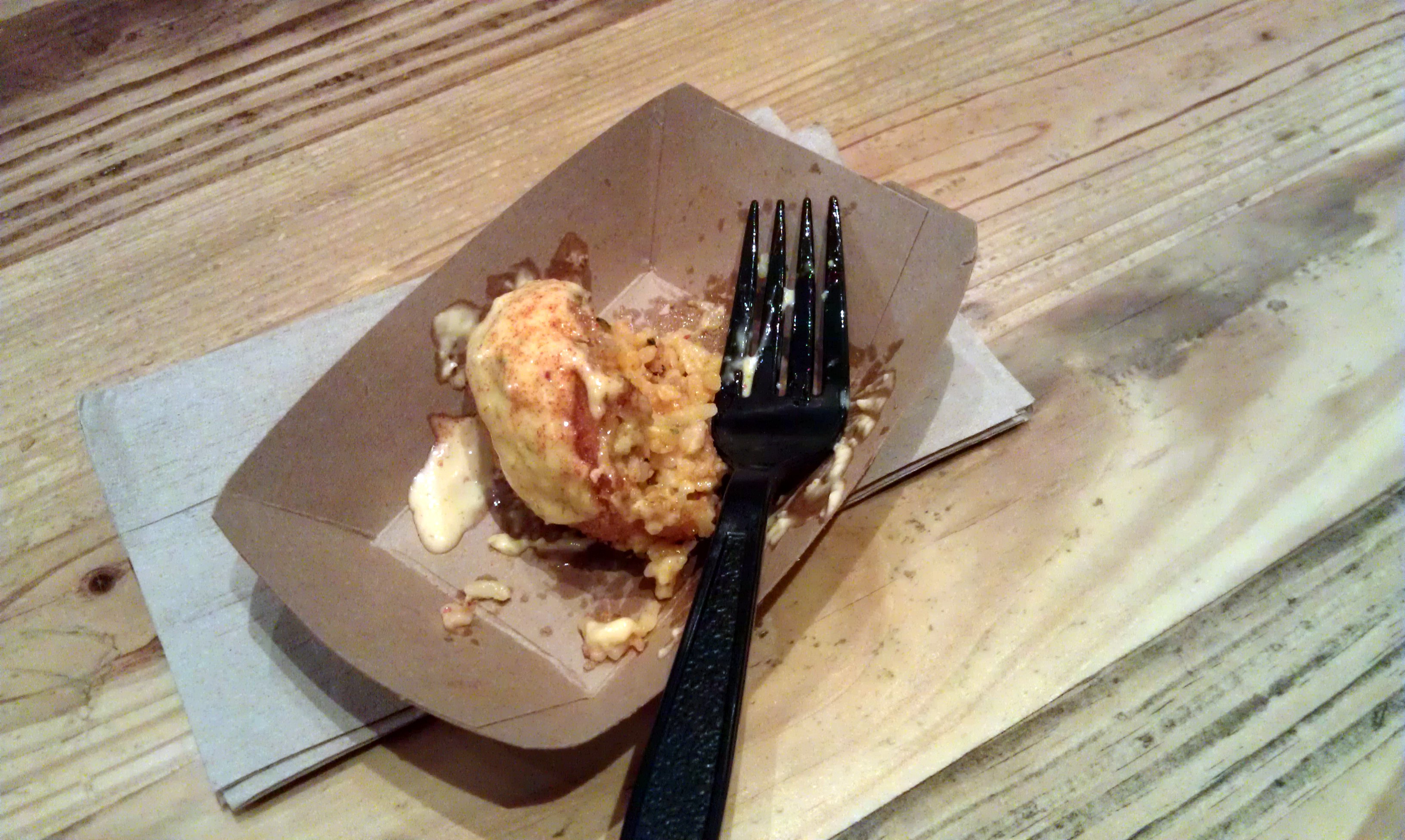
We turned the corner onto Mississippi and there, at the end of a short collection of shops, was Seoul Sausage Co. And it was open. Without knowing it, we had stumbled across a secret mini launch they had announced only on their website and on Twitter, and there were all three of the boys behind the counter, and suddenly I was being introduced and ordering one of the flaming fried balls they developed on the show.

I know I should be talking about the food here, but I was so starstruck I couldn’t stop grinning my way around the little space. The guys were, as I had imagined but never even hoped to find out, super friendly and happy to see us – and everyone else who stopped in – and being very properly and apologetically closed-mouthed about the results of the show (the finale is tomorrow – Sunday, at 9pm). N. chatted them up about beer, encouraging them to carry Ninkasi if it ever appeared on their radars. I couldn’t help but mumble something about how I hoped they would/had/did/whatever-it-is-taped-tv-is-so-confusing win before I gave into the beautiful, sizzling-hot fried riceball they handed me.

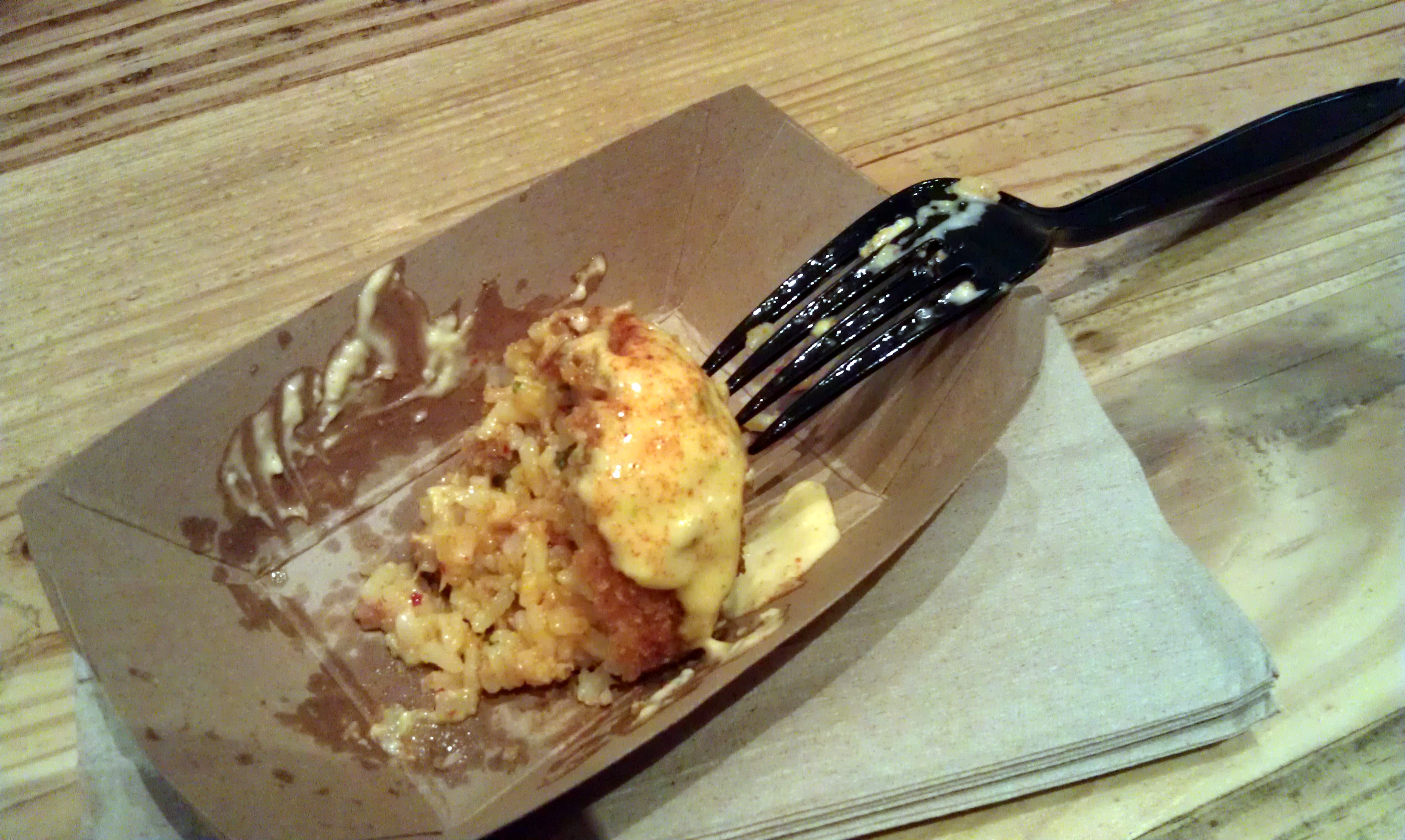
It was delightful. Delicate rice in the middle mixed with cheese, spices, and who knows what else. Crisp breaded crust around the outside, and a slightly spicy sauce squeezed over the top. It reminded me of the kind of sauce you get on certain spicy sushi rolls, and it paired so nicely with the rice. This is an excellent late night snack, and N. and I assured them we would be back again after their official opening next week. I was halfway through my little after-dinner snack before I remember that, despite my unwise choice to venture out on a Los Angeles food adventure without my camera, I do have a smart phone fully capable of capturing an image.

Flaming fried balls conquered, and me still in some disbelief that we had just been to Seoul Sausage and met the guys in charge (I wanted to know everything but asked nothing: what was Tyler Florence like? Were you getting all those truck stop phone calls at once, or did he call each truck one at a time? What did you think of Nonna’s Kitchenette? Did you win? Did you win? Did you win?) we stepped back out into the night (which we were surprised to learn was still so young – only 8pm yet) and resurfaced at the Formosa Café in West Hollywood to share a round of drinks. I asked for a lemon drop, but the bartender mixed me a vodka daisy instead because he likes the flavor better, and so did I. Vodka daisy with a sugared rim is apparently my new cocktail of choice.

As we belted ourselves into J.’s car again, he asked if we minded swinging by Canter’s delicatessen on Fairfax. He wanted a pastrami sandwich for the road back to Orange County, and of course we obliged. Once inside, I was attracted not to the sandwiches, but to the bakery counter, where my taste buds immediately performed their own version of the honey bee’s waggle dance to communicate a single word: éclair. N. wandered up behind me and asked if I was going to get anything, and as I gazed at the shelves packed with donuts, cookies, babka, danishes, chocolate studded croissants, cheesecakes, a big layer cake with the word “rum” frosted in chocolate across the top, all I could think about was an éclair.

And there they were. On the bottom shelf. Thick, ganache-glossed masterpieces. My eyes were bugging out again, I could feel it. With my new little treasure safely enclosed in a pink bakery box and tucked under my arm, all was right with the world. When I dug in, gentle fork pressure forcing the thick, sweet pastry cream out across my plate, the world was more than right. The dough was tender-crisp, and if I’m honest it may have been moving a bit toward staleness after a day on the shelf, but the flavor of the custard and the ganache more than made up for it. It was a stellar dessert for a starstruck evening.

Vacation fried

Nothing says vacation like fried food.  Of course, for me, nothing says vacation like fried-food-I-didn’t-have-to-fry-myself-that-comes-in-achingly-bad-for-the-environment-but-when-I’m-on-vacation-I-might-not-care-styrofoam-containers. So at the Farmers’ Market near my parents’ home in California’s East Bay Area, I fought with my compunction about collecting a lunch made at an event celebrating freshness and organics and the products of the earth in a container that will last longer than my own body will. Compunction lost.

Because inside that container were two items: a chicken tamale and a spinach and cheese empanada.  I bought them from a stand advertising Panamanian food – the boy and the man in charge webbed within unexplained netting. The tamale was largely unremarkable; steamed in a banana leaf instead of a corn husk, filled generously with a mixture of moist, shredded chicken and kick-less tomato based sauce, I ate it with enjoyment but not gusto. The empanada was a different story.

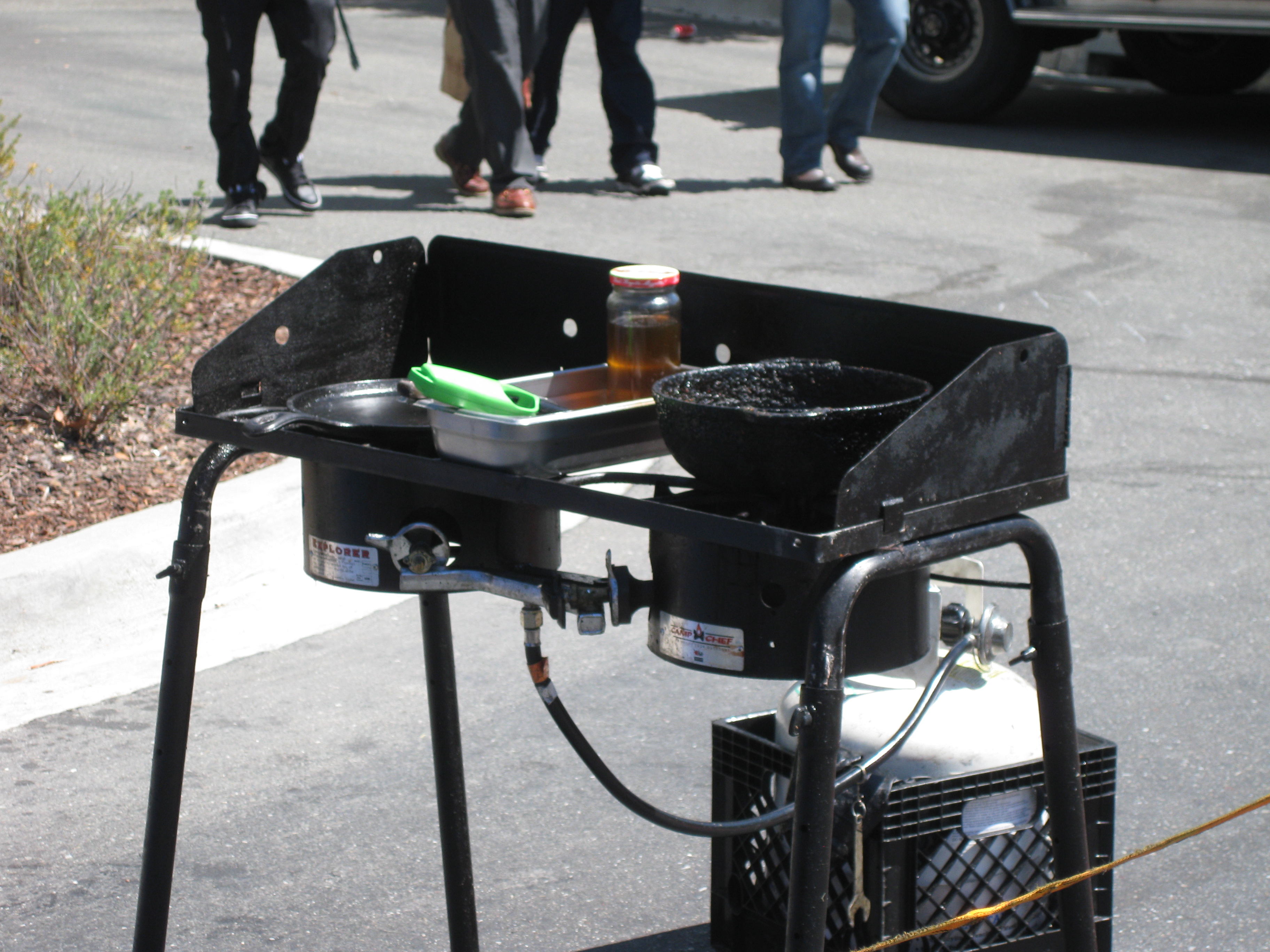
When my mom and I approached this stand, it was barely 11am. While the tamales had been pre-steamed and just needed to be heated up to be ready to eat, the empanadas did not yet exist in finished form. As I ordered, the older man doing the cooking ambled toward a small outdoor fryer consisting of a coal-black bowl full of questionable oil and turned on the gas.

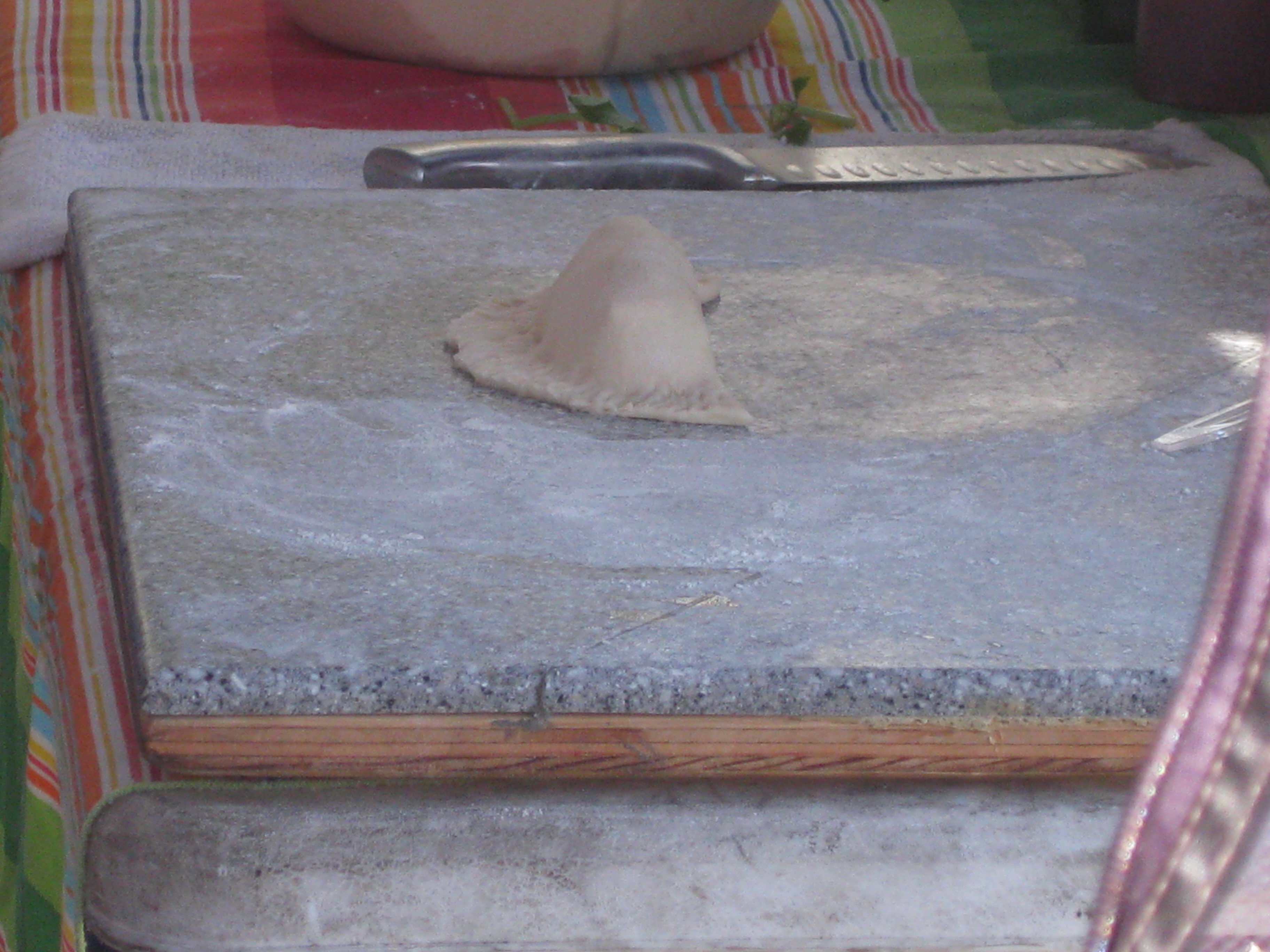
He ambled back to the netted tent and pulled a ball of smooth, elastic dough from under plasticwrap and, easily and lovingly, rolled it into a six or seven inch circle with almost no extra flour (if you’ve read about my troubles with dough, you understand why this amazed and alarmed me). He layered on some spinach and a big chunk of cheese, dribbled egg wash, then casually folded the dough, pressing the edges first with floured fingers and then with the tines of a fork, leaving even indentations all around the outside to seal in the goodness.

As he carried my lunch over to the warming oil, he told us there were two ways to make an empanada: baked or fried. Then he added, “but really, there’s only one way,” and we agreed that fried is always better. Tipping the little pastry into its bath and carefully manipulating its floating orientation with his fingers, he said he likes to fry his empanadas in oil rather than lard, because lard makes the exterior too dark too fast.

My mom was surprised by the time and low temperature this fry required. The oil did not sizzle and leap furiously, but simmered warmly around the edges of the pastry. This was necessary, we were told, because time was needed to thoroughly heat the filling and cook the dough all the way through. The empanada, with help from our new friend’s careful, gloved prods, swam its way around the oil bath into a state of deep golden crispness before extraction and enclosure within baneful Styrofoam.

Too many minutes later, we were home and I was investigating my purchase more personally. The dough, fried so carefully and attentively, parted with a raspy flaky tear between my teeth, quickly revealing moist, almost dense chewiness. The cheese had cooled only slightly and now maintained all the delightful elasticity of a taffy-pull. But it was the pastry I couldn’t get enough of. Because it was stuffed, the central, puffed area containing the spinach and cheese was a slightly different texture than the crisp pressed edges – softer, chewier. The edges, almost completely crisp, still had a slight interior tenderness to squash pleasingly between eager teeth. The closest comparison I can imagine, though I’ve never eaten it, would be fried pie dough.


I dispatched the whole thing in a time embarrassingly less than five minutes. I tried to savor, I really did. But isn’t that just like vacation? No matter what you do, it’s gone too quickly…

Food from Fiction Potluck

So what does one do, you might ask, as a newly minted Doctor of Literature, unfettered from the everyday proletariat academic concerns?  Well, one grades, and one line edits, and one revises frantically, and frankly, one feels completely different and not different at all.  The school year isn’t over, even though (as of Tuesday, when I upload my “completed” dissertation to our Graduate School’s website) my degree is.  So my daily duties no longer include anxious preparing for the big day, but they still include student emails and lesson planning and reading.

But because they don’t include anxious preparation and last minute rethinking and nail biting about what the committee will think, these days can also include celebrations.  Last night was one such celebration: a party I’ve wanted to have for several years now.  The style: potluck.  The theme: “Food in Fiction.”  Interpretation: bring a dish inspired by or mentioned in a book.  That’s it.  There are so many vivid options in novel, drama and film, and our guests had only to choose one and recreate it in the material, taste-bud-bearing world.

We had tremendous fun, in brainstorming, in cooking, and in sharing the variety of dishes from books we love.  As I mentioned to one friend who thanked N. and I for the great party on his way out the door, this is a party we had to have before parting ways as many of us graduate this June, because only in this company could we feel so self-congratulatory and so excited about immersing ourselves in something so nerdy.

Here are a few of the dishes we enjoyed.  I suggested to folks that they provide the description of the food in question from its source text so guests would know what they were eating and which world it was taking them to.  We had Victorian sandwiches and High Modernism Stew nestling next to a magical realist chutney and a warm wassail of fantasy.  What wandering, all in one house…

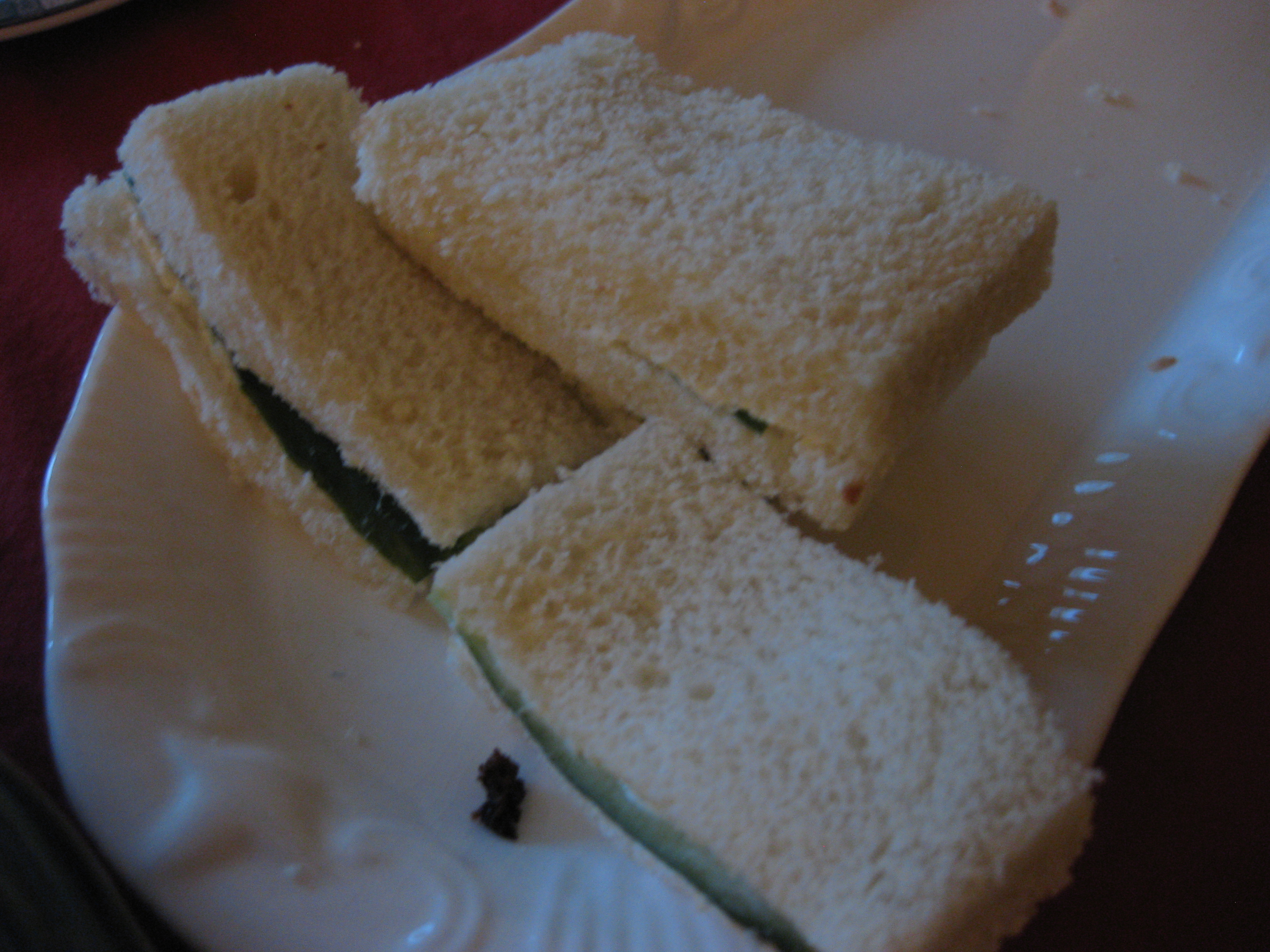
Cucumber sandwiches from Oscar Wilde’s “The Importance of Being Earnest.”

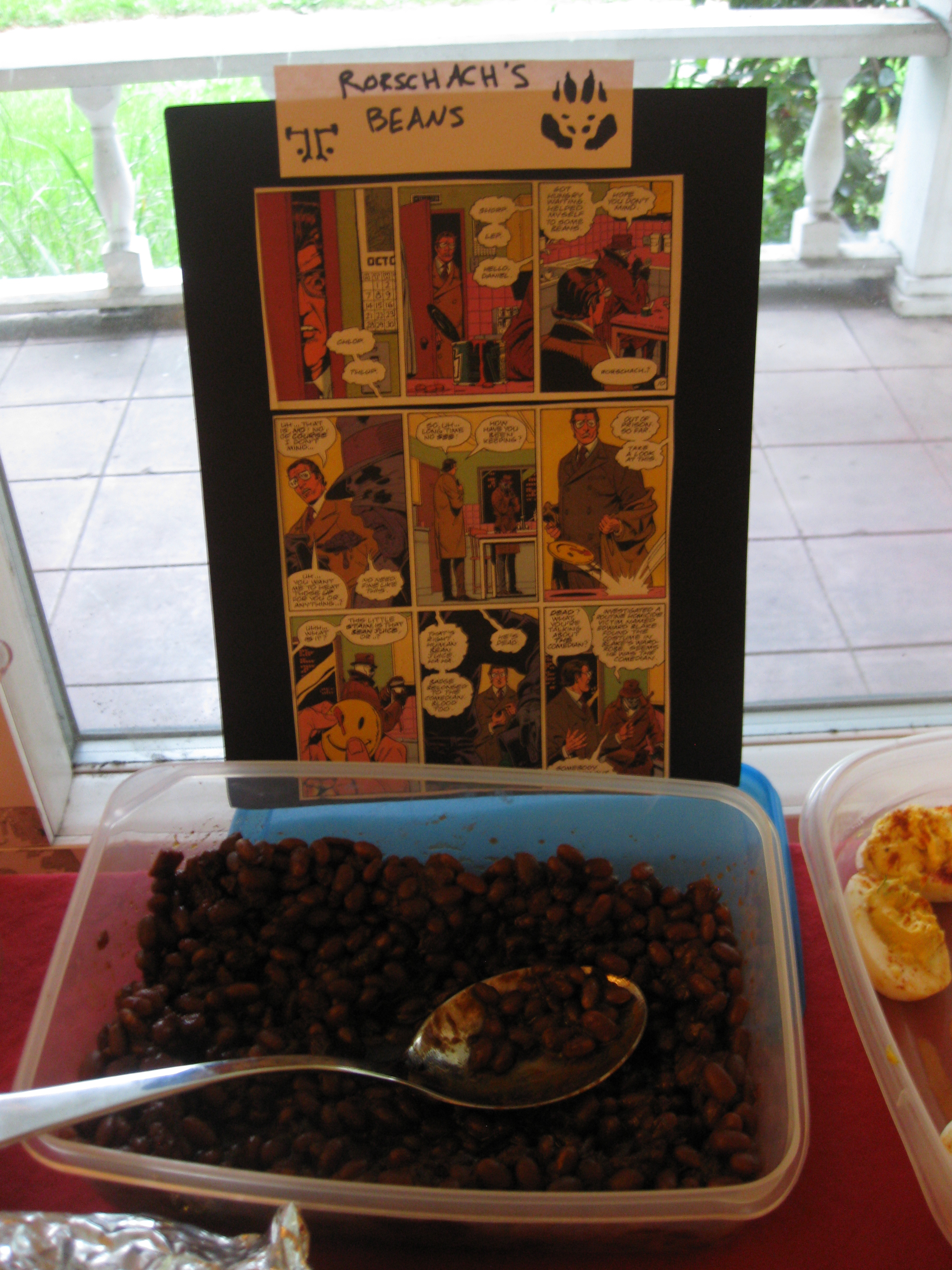
Rorschach’s beans from the graphic novel “Watchmen.”

Boeuf en daube from Virginia Woolf’s To the Lighthouse.

A trio of deviled eggs to breathe life into Hemingway’s thoughts on being hard boiled in The Sun Also Rises.

A wonderfully smoky molasses cake inspired by the molasses-drenched dinner scene in Harper Lee’s To Kill A Mockingbird.

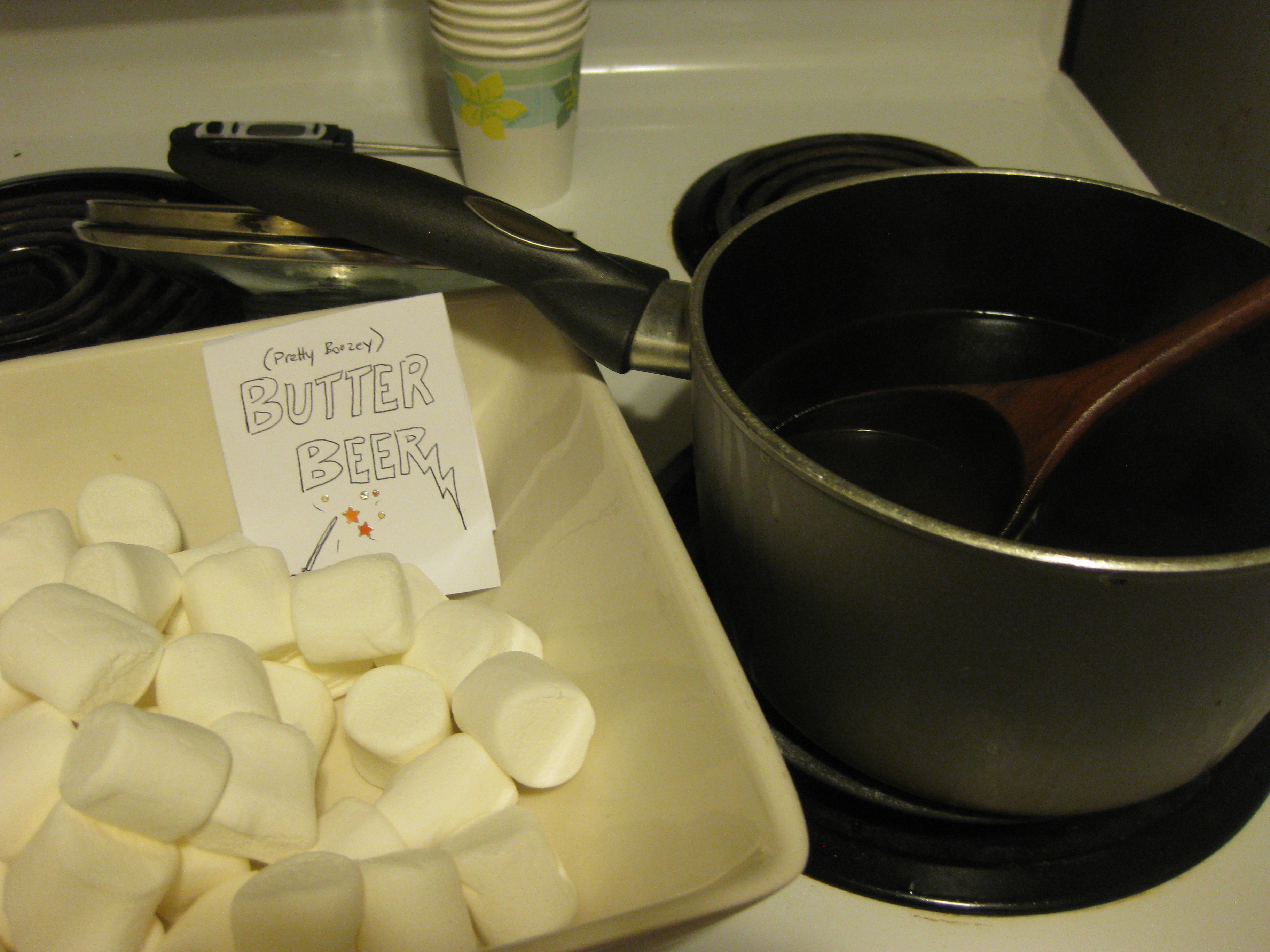
Well spiked butterbeer (you drop in a few marshmallows which, as they melt, mimic the foamy head on the beer) from J. K. Rowling’s Harry Potter series.

Not pictured: (more!) deviled eggs, from Toni Morrison’s Song of Solomon, sautéed marinated mushrooms inspired by Lewis Carroll’s Alice in Wonderland, raspberry cordial from L. M. Montgomery’s Anne of Green Gables, and a few sourceless delights: meatballs (Cloudy with a chance of, perhaps?), and a bread, cheese, and hard salami platter.  These were justified by their authors with the claims that “surely there must be moments of literary eating that include these items,” which I was quite willing, given their deliciousness, to accept.  And of course, wine.  If we were picky, we could call this an homage to Hemingway, whose characters “get tight” with abandon, or to Carroll’s Alice, who does imbibe from the mysterious bottle demanding she “drink me.”

I made two offerings: a take on the “green as grasshoppers” chutney so adored by Saleem in Salman Rushdie’s Midnight’s Children, and a pork pie stuffed with hard boiled eggs from Roald Dahl’s Danny the Champion of the World.  Both turned out extremely well, but I want to talk about the pie first.

Danny the Champion of the World is the story of a boy and his father.  Without giving too much away, I will only say that Danny’s father suffers an injury almost halfway into the book, and when Doc Spencer, the family physician, brings him home from the hospital to the gypsy caravan in which he and Danny live, Doc also brings Danny a package from his wife:

“Very carefully, I now began to unwrap the waxed paper from around the doctor’s present, and when I had finished, I saw before me the most enormous and beautiful pie in the world.  It was covered all over, top, sides, and bottom, with rich golden pastry.  I took a knife from beside the sink and cut out a wedge.  I started to eat it in my fingers, standing up.  It was a cold meat pie.  The meat was pink and tender with no fat or gristle in it, and there were hard-boiled eggs buried like treasures in several different places.  The taste was absolutely fabulous.  When I had finished the first slice, I cut another and ate that, too.  God bless Doctor Spencer, I thought.  And God bless Mrs. Spencer as well” (Dahl 85-86).

Since my first trip through Danny, I salivated over this savory pie Danny enjoys.  And this party was the perfect excuse to attempt my own.

I found a perfect (and much prettier) base recipe for my pie in the archives of the blog Married… With Dinner.  Though I followed their basic instructions, I made a few amendments for ease and expense.  The key points are as follows:

Use a springform pan.  That way the pie is tall and regal and can sit magically outside a pie plate all on its own.

Roll the bottom crust out large enough to come almost all the way up the sides of the springform (I used storebought crust and it work out just fine), so you can connect top and bottom more easily.

I squashed together a mixture of ground pork, pork sausage, finely chopped ham from a ham slice, salt, cayenne pepper, ground cloves, and black pepper.  I pressed a thin layer of the meat mixture onto the bottom of the pie crust, then laid six hard boiled eggs in a circle through the middle of the pie (regrettably, with ham-covered hands, I did not get a photo of this).  Then I lightly packed the rest of the meat mixture around and over the eggs and sank a bay leaf deep into the very center of the pie.

A traditional English pork pie has warm pork stock poured into a hole in the crust just after baking, which turns into a thick jelly as the pie cools.  This did not sound particularly delicious to me, though I did like the idea of a rich layer of something atop my pork.  I decided on cheese.  I grated about a cup of sharp cheddar and sprinkled it lightly on top of the meat before draping the top pie crust over it.  I cut a little hole in the center of the crust and sliced some steam vents for additional release before baking.

It’s a long baking process (almost two hours), but you are dealing with raw pork, so the cooking time needs to be sufficient.  When the pie is almost done, Married… With Dinner recommends you carefully release the spring on the pan and brush an egg wash all over the top and sides of the pie.  Fifteen minutes more in the oven and this results in a beautiful, shiny golden glaze all over the pie.  It also, in case you are lazy like me and didn’t brush an egg wash over the top edge of the bottom crust to help the lid adhere, creates an after-the-fact glue to hold base and lid together.

I let my pie cool on the counter for an hour or so, then tented it with aluminum foil and stowed it in the fridge until the party started.  It did, after all, have to be a cold meat pie.

It was fabulous.  The meat was nicely spiced and the ham bits shredded in added some smoky, salty variety.  The hard boiled eggs were, indeed, delightful treasures to find, though I admit to over-boiling them slightly so their yolks were not as bright as they could have been.  Still, this is hardly a complaint.  It was like a meatloaf wrapped in flaky, buttery crust, and the cheese was a nice additional flavor and richness.  I suspect this could have been just as good warm as it was cold, but the pie might not have held together quite as nicely.

My second offering was a cilantro coconut chutney.  Saleem, as Midnight’s Children comes to a close, receives a meal from a blind waitress.  He lists:

“On the thali of victory: samosas, pakoras, rice, dal, puris; and green chutney.  Yes, a little aluminum bowl of chutney, green, my God, green as grasshoppers… and before long a puri was in my hand; and chutney was on the puri; and then I had tasted it, and almost imitated the fainting act of Picture Singh, because it had carried me back to a day when I emerged nine-fingered from a hospital and went into exile at the home of Hanif Aziz, and was given the best chutney in the world… the taste of the chutney was more than just an echo of that long-ago taste – it was the old taste itself, the very same, with the power of bringing back the past as if it had never been away…” (Rushdie 525).

I found a recipe for a coriander chutney replete with tart lemon juice, lip puckering spice from serrano chiles, and bright, bright green cilantro, tempered by shredded coconut.  The recipe called for unsweetened coconut but I, in my haste, having only sweetened, forgot to rinse it to get some of the sugar off before dropping it into my food processor.  As a result, my chutney was lightly sweetened, but no one seemed to mind that, especially when it was spread onto the pakoras I made.

I searched around online and made a master recipe from a combination of ideas for these pakoras.  Mine included:

4 cloves garlic, smashed and finely minced

2 tsp. each:

Garam masala

Turmeric

Chili powder

Salt

2 cups Bob’s Red Mill gluten-free all-purpose flour (pakoras are made with garbanzo bean flour, and though the Bob’s Red Mill mix is a blend including potato starch, it is composed mostly of garbanzo and fava bean flours, so since I had it, I decided a little break from tradition would be okay.  This is literature, after all.  It’s all interpretation anyway!)

1 ½ cups water

½ head cauliflower, diced

¾ large onion, diced

1 small sweet potato, diced

1 quart vegetable oil

Heat the vegetable oil to 375F in a large, sturdy pot.  I used my dutch oven.

While the oil heats, whisk together the dry ingredients and garlic until well combined, then slowly whisk in the water to form a thick, smooth batter.

Add the diced vegetables and stir to combine.

Drop spoonfuls of the batter (ever so carefully!  Watch out for splashes!) into the hot oil and fry for 5-6 minutes, or until the batter is deeply golden and the vegetables inside have magically cooked.

I got to taste one of these.  It was crunchy and starchy and slightly spicy and wholesome and delicious.  It was vegan.  It was gluten-free.  Topped with the chutney it was fresh and springy and spicy and then gone.  By the time I went back to have another, the giant platter I’d made was empty, and only a spoonful or two of chutney remained.  Pride overwhelms disappointment, in moments like these.  My little experiment was so successful it prohibited me from tasting further.  So I had another deviled egg instead.

Full and happy, we fell into bed at midnight with a sinkful of dishes and a fridge-full of leftovers to look forward to.  It’s like reopening a book to your favorite chapter: whose world will I lunch from, dine from, be returned to today?

Brecht’s Restaurant

I have a Bittman success story to share with you, and I will.  Soon.  But first, in a continuation of last week’s celebratory post, I have a birthday restaurant review.

Yesterday, N. took me to Portland to celebrate my birthday.  Because I’m so sophisticated and urban, of course what I wanted to do most was go to the zoo.  Only after we’d seen every animal (and returned to a few exhibits on the way out to see if anyone had decided to come outside yet) did we embark on the more culinary aspects of our voyage.  We spent close to an hour in Sur le Table, a store that makes me swell simultaneously with desire, longing, and anxiety.  It is bright and beautiful and artistically merchandised, and I can’t help but want everything in it (do I need a handheld KitchenAid electric mixer in every color of the rainbow?  Of course not.  But do I want them, after seeing them lined up and shining prismatically on the shelf?  Yes I do).  I imagine the fantastic food projects I could embark on, the dinner parties I could have, the appetizers I could construct (the tiny tart tins only big enough to hold a tomato tart made from a single slice of tomato, the edible silver pearls for cupcakes, the souffle dishes… oh the souffle dishes…), and there’s where the anxiety sets in.  Yesterday, I had a gift card to spend.  I needed to be careful and thrifty and try to not to exceed the card’s value by too much, because beauty doesn’t come cheap.  That meant excruciatingly rigorous examination of everything. in. the. store.  I ended up with equipment that fills several notable gaps in my kitchen repertoire, and that was good.  I was practical.  But it still didn’t quell my girlish longing for cookie cutters in the shape of a crab, a cupcake, or a golden retriever, or a spring-loaded icing syringe, or a huge octagonal serving platter.

And yet we pressed on.  On several trusted friends’ recommendations, we went to Montage for dinner.  Located under a bridge on the east side of the river, it was hard to find (thanks, road construction), but clearly well loved, as at least a dozen people were waiting outside for the restaurant to open when we arrived at 5:55pm.

When we went inside and the hostess showed us to a table set with pristine white linens and folded, creased paper menus, my impression was of a Brechtian dreamscape.  If Bertolt Brecht had designed a restaurant, it might be something like this.  In French, “montage” means “assembly” (roughly, forgive my linguistic impreciseness, amis).  Here, “assembly” took the form of a collage of high and low.  From my seat at our table, when I looked to the left I could see long, long shelves against the far wall stocked with bottle after bottle of wine.  As their extensive wine list proved, some were good vintages and all were pretty reasonably priced.  When my eyes slid upward, however, I got a view of the wall-sized, quasi-cartoon Last Supper painted above a row of two-tops.

Looking to my right, on the deep windowsill near the entrance I could see a classical-style statue, complete with broken limbs and barely disguised indecency, standing next to the cast of an alligator’s skeletal jaws and a fully blown pufferfish, both suspended from the ceiling by fishing line.

This, then, was a conscious pastiche of high and low.  The paper menus revealed not only the lengthy wine list, but a full range of Cajun and Southern American classics.  N. ordered the jambalaya, but I couldn’t resist the call of the fryer.  I ordered “Buttermilk fried chicken hindquarters,” which were advertized to arrive with garlic mashed potatoes, seasonal vegetables, AND a salad.

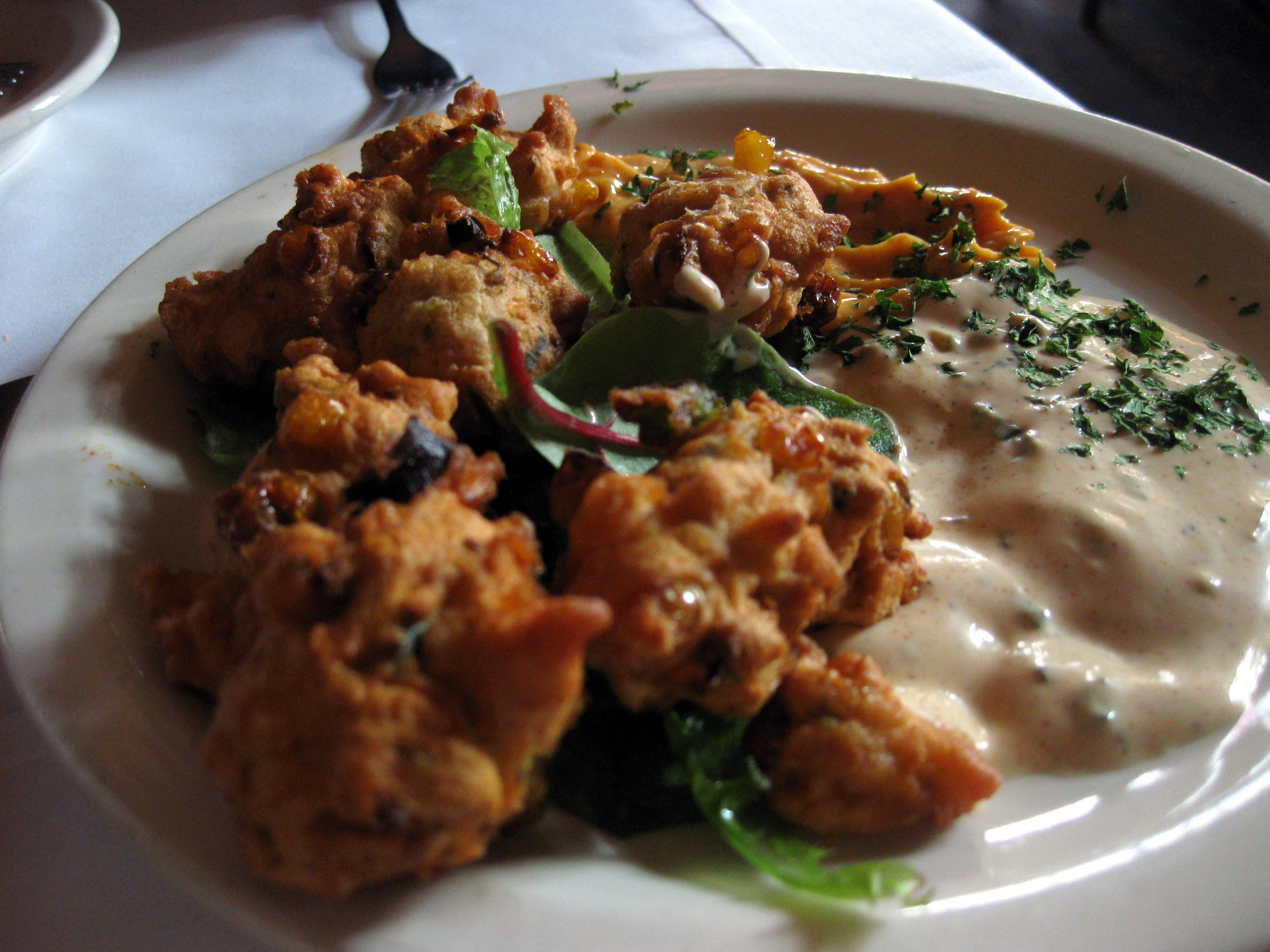
Before any of that, however, we got our beverages and shared a plate of hush puppies.  My dry Riesling was crisp and tart and just barely fruity, and our server really topped off my glass because there wasn’t enough left in the bottle for two.  I told him it was my birthday, so he could use that as an excuse and he chuckled.  Wine managed, we plowed into the hush puppies.  These were moist and chewy and had kernels of corn in the batter for that pop of sweetness and texture.  They were accompanied by two aiolis: one garlic and one red pepper (I think.  It was extremely mild and our server wasn’t sure).  The garlic aioli was delicious: slightly vinegary and herby, much more complex than a regular mayonnaise.  The fritters were not very crunchy on the outside, but their flavor more than made up for any textural shortcoming. 

While we waited for our dinner to arrive, another aspect of the Brechtian theater of the place became clear.  Behind the white, linen-clothed bar, the kitchen was partially visible, and every time a plate came out the expediter bellowed the name of the server responsible for it.  After an initial surprise, no one in the restaurant seemed put off by this practice, and it started to blend into the clatter of dishes, happy conversation, and David Bowie’s vocals soaring effortlessly up into the background.

Dinner arrived on white dishes, but it didn’t smell highbrow.  It smelled homey and warm and wonderful.  N.’s jambalaya was well spiced and nicely flavored.  It was just spicy enough to merit a gulp of beer and a crumble of cornbread in between bites, and he has added this to the list of dishes he’d like me to try at home.  My plate came with its promised hindquarters still connected, dredged and crispy and beautifully caramel-brown.  A little heap of mixed sauteed vegetables nestled in the space between leg and thigh, and a mound of mashed potatoes rounded out the plate.

I started with the mash.  I think they were red potatoes because some shreds of dark mauve-y skin added an appealing squish between my teeth.  The meat of the potatoes was velvety smooth and creamy and just brushed with garlic flavor.  N. was permitted one taste and then somehow the whole mound disappeared into my stomach.

I moved on to the chicken.  I have to admit, I am pretty picky about my fried chicken.  It must be crispy, it must be just greasy enough to slick my fingers and moisten my lips, and I prefer dark meat (though that’s the case with any poultry, fried or not).  This chicken scored a two out of three.  The breading was crisp and the meat was moist and flavorful.  This breading, however, was fairy thin.  It did not have the nodules of thick crunchy fattiness I didn’t know I wanted, and as a consequence the grease factor was minimal.  It was delicious (oh was it delicious!), but it wasn’t my fantasy fried chicken. 

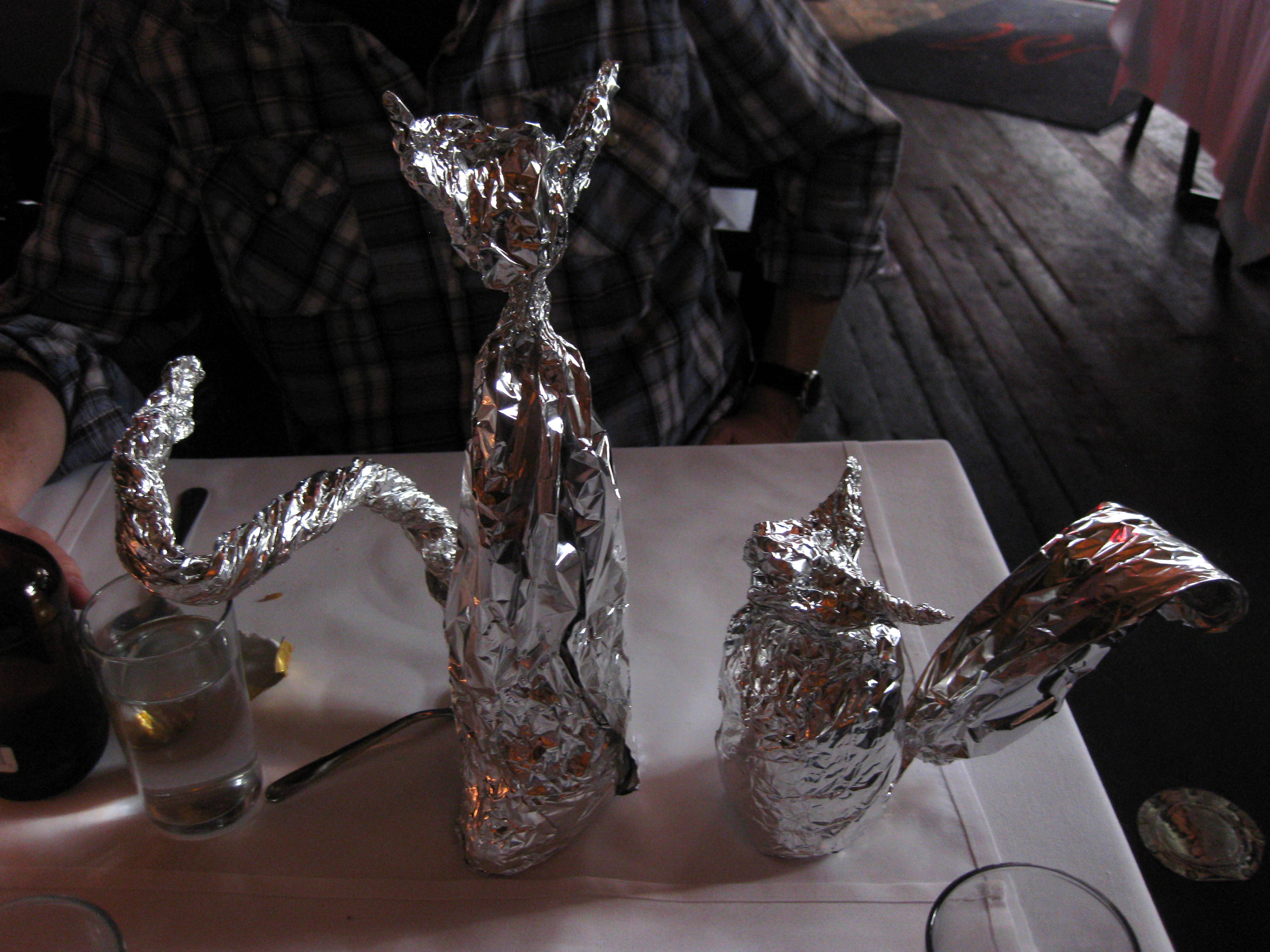
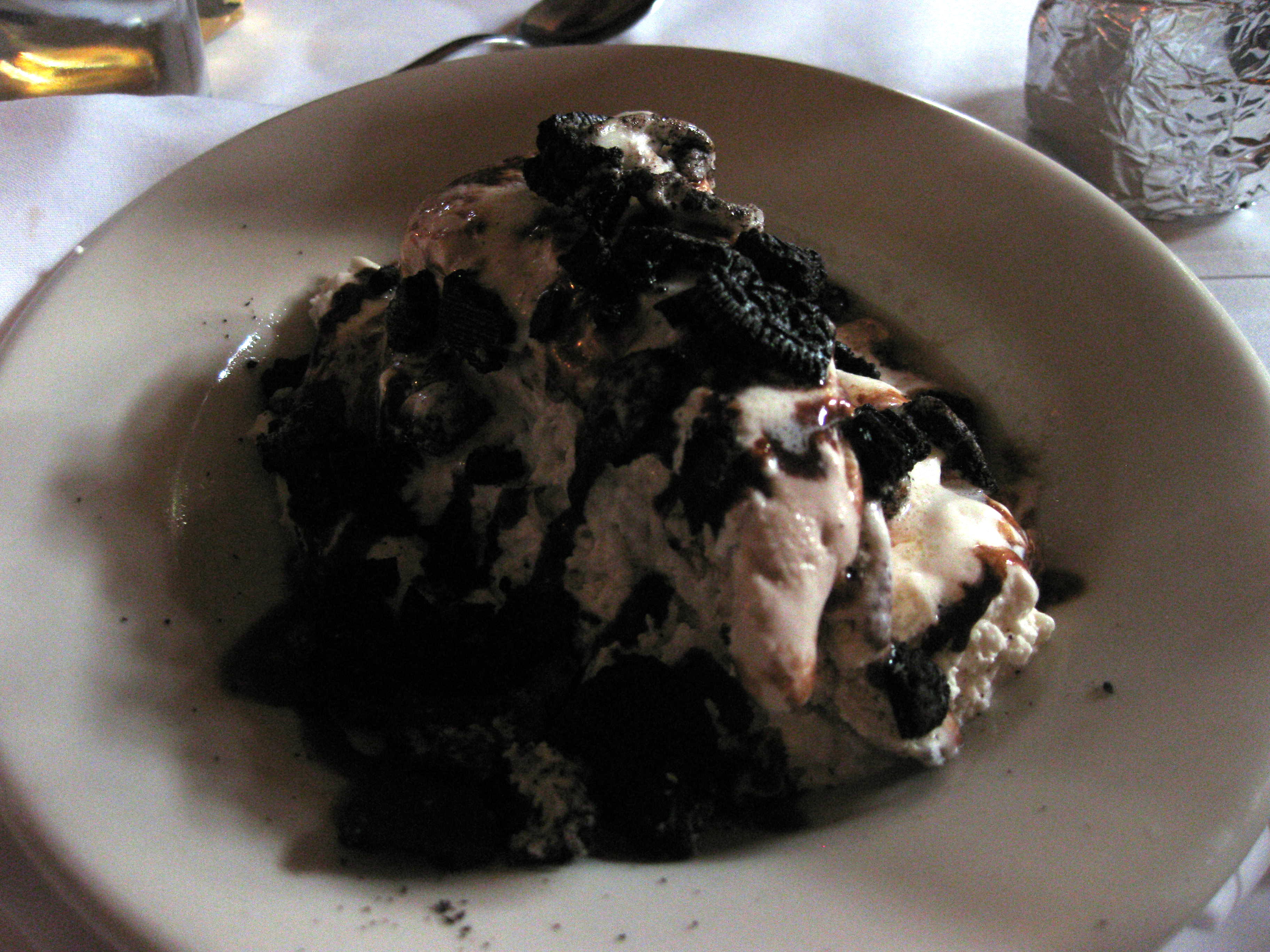
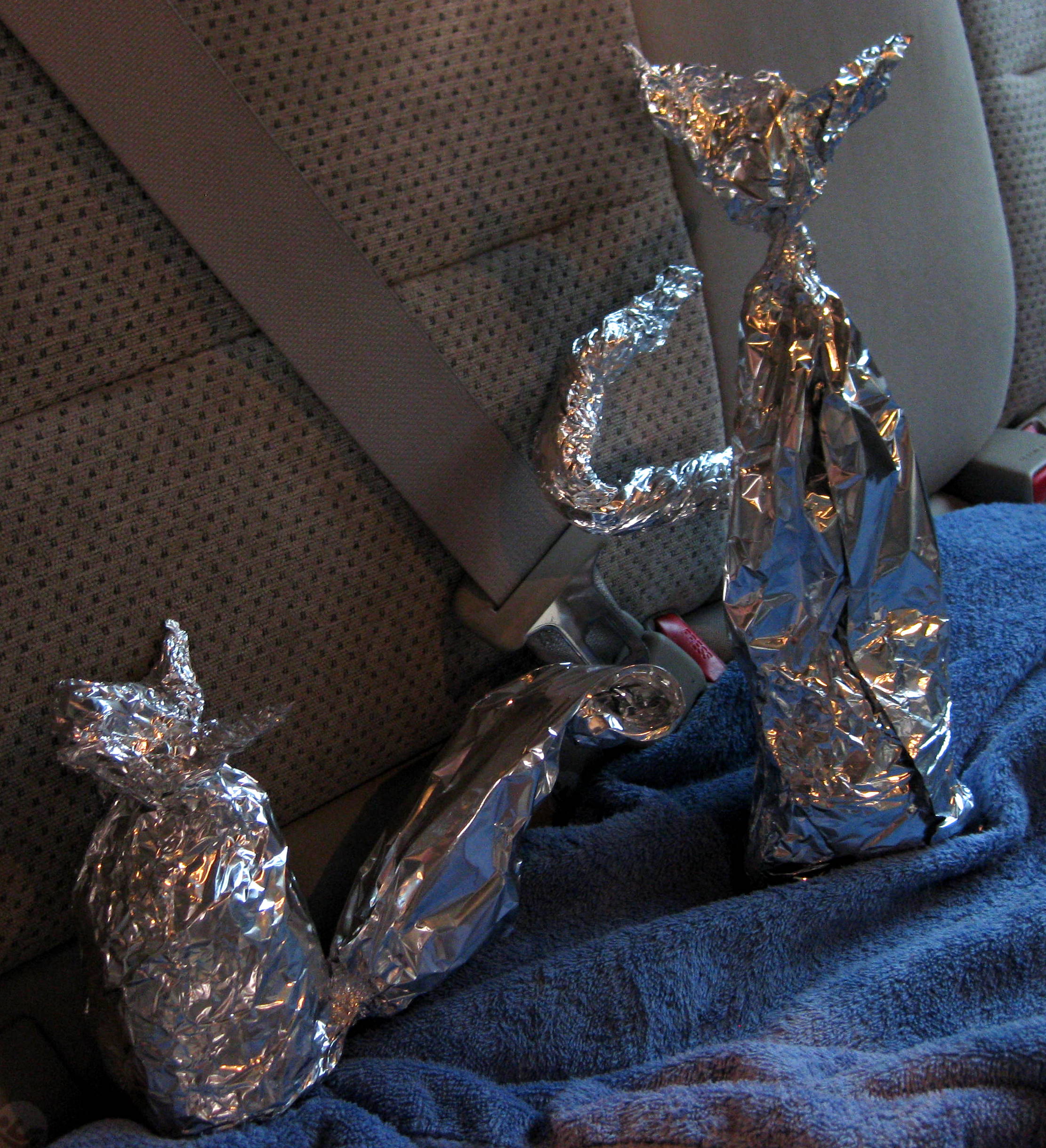
The play of culture and carnivale continued as we finished our meal.  Our server asked if we wanted our leftovers wrapped up, and when we acquiesced he disappeared with our plates and returned with a stylized cat and squirrel made of aluminum foil, holding our remaining dinners in their tin bellies.  As they faced off against one another at the table, our server walked over holding a plate leaping with orange and blue flames: dessert on fire for my birthday.  Unless N. ordered this while I was in the ladies’ room (I suspect not), this was our server’s doing alone.  I’d mentioned it was my day at the outset of the meal, but I hadn’t been expecting anything from it.  Instead, what I got was essentially ice cream pie set alight.

How do I begin to dissect this gorgeousness in words?  Writing about food is funny because so often language fails to capture taste.  I’ll go in the order my spoon went.  First, there was the ice cream.  This was either vanilla or very mild coffee, because we were getting hints of coffee flavor the whole way through.  I suspect, however, that it was vanilla ice cream, and that the spirit used to flame the dessert was Sambuca, and that’s where the coffee flavor came from.  Or else the ice cream was also drizzled with Kahlua.  Beside the slice of ice cream, there was an airy pile of whipped cream, also drizzled with chocolate/coffee sensations, and the whole dessert was topped with crushed chocolate Oreo wafers, and built upon a slab of compressed bittersweet chocolate crust.  Frozen but on fire, soft and creamy with crunchy accents, sweet but with an espresso bitterness, this captured the juxtaposition of the whole place on a single white plate.  N. is not often one for rich desserts, but this one he ate as continuously and determinedly as I did.  He laid his spoon down only two bites before I did, leaving the last swirls of melting ice cream and heavy liqueur traces to me alone.  It was, after all, my birthday.

We left satiated and impressed.  This was neither the fanciest nor the most amazing food I’ve ever had, but it was damn tasty, and the ambiance, as strange a collage as it may have first seemed, only added to the experience.  If this had been in a rundown, casually decorated diner, it would have seemed cheap and cheesy.  If it had been the same food in a “fine dining” restaurant with elegantly uniformed servers and long aprons, it would have seemed uncomfortably out of place.  But this Brechtian dance between high and low, with its conscious acceptance – nay, its intentional embrace – of both, made it a near-perfect show.  There are a lot of restaurants in Portland we want to try out, but we will almost certainly return to Montage.*

* or perhaps to its adjoining lounge which, in keeping with the play between cultured and vulgar, is delightfully titled la Merde.