Pizza Pretzels

I have these moments when I realize I’ve just said something.  I don’t mean this to sound like I’m unaware of or not in control over my own speech, but I am a classic case of speaking before I think, at least when it comes to food.
Food Blog March 2013-0882A few weeks ago, N. and I were on the verge of no longer enjoying our morning errands.  On Sundays, we frequently run errands before going to our local Farmers’ Market, and because one of us is occasionally a bit of a lazy slouch on weekend mornings (I’ll leave the guessing up to you), we often don’t hit the shops until after 10am.  This is not a huge problem, except that my body is programmed to begin its hinting that “lunch would be nice, please” at about 11:30.  By noon it’s more of a demand, and by 12:15 you’d better feed me, because I’m about to devolve into full-on hangry (which I remain convinced is one of the best portmanteaus ever invented.  It’s right up there with spork).  N. is keenly aware of this schedule, and yet for several weeks in a row we’ve found ourselves food-less during the half hour that takes me from peckish to crotchety to downright unpleasant.
Despite this, I retain a sense of snobbishness when it comes to choosing what I will eat to relieve this condition.  We play a game when it comes to choosing food, especially when the choices are undesirable; I affectionately call it the “bleh” game.  It consists of one or the other of us facetiously offering “we could eat there…” which inevitably engenders the titular response.  This game was in full effect as, plagued by my hangriness, we walked past one of those soft pretzel stands at the mall we were ambling through and N. suggested it.  I looked in at the pizza pretzels – studded with cheese that looked painted on, pepperoni grease slowly cooling and solidifying, and declared, loudly, “psssh, I could MAKE those.”
Food Blog March 2013-0904Suddenly, I was beholden to it.  N. isn’t always taken in by my crazy food schemes, but apparently the idea of a homemade pretzel masquerading as pizza was something he’d never known he always wanted.  It fell to me to create a version that wasn’t sodden with grease, wasn’t packed with questionable preservatives, and wasn’t luke-warm and pressed behind plastic with its sad, sorry brethren.  My typical response to this would be to turn to the internet.  This time, however, I had Nana’s sweet roll dough to guide me, and I wondered whether I could achieve my objective by creating a savory version of her lovely elastic dough.
Food Blog March 2013-0894
Removing the sugar and adding savory Italian herbs to the mix was a successful experiment.  The kitchen smelled like foccaccia while my dough rose, and I was thrilled with the flavor in the piece I pinched off to sample.  I divided my dough into eight little balls, rolled them into long stringy ropes, and surprised myself when careful looping and twisting resulted in a pan full of something that actually looked like pretzels.
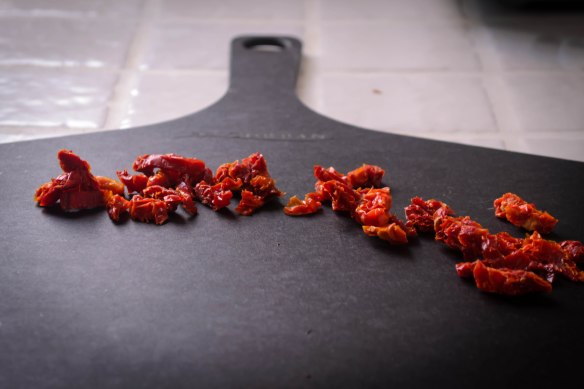
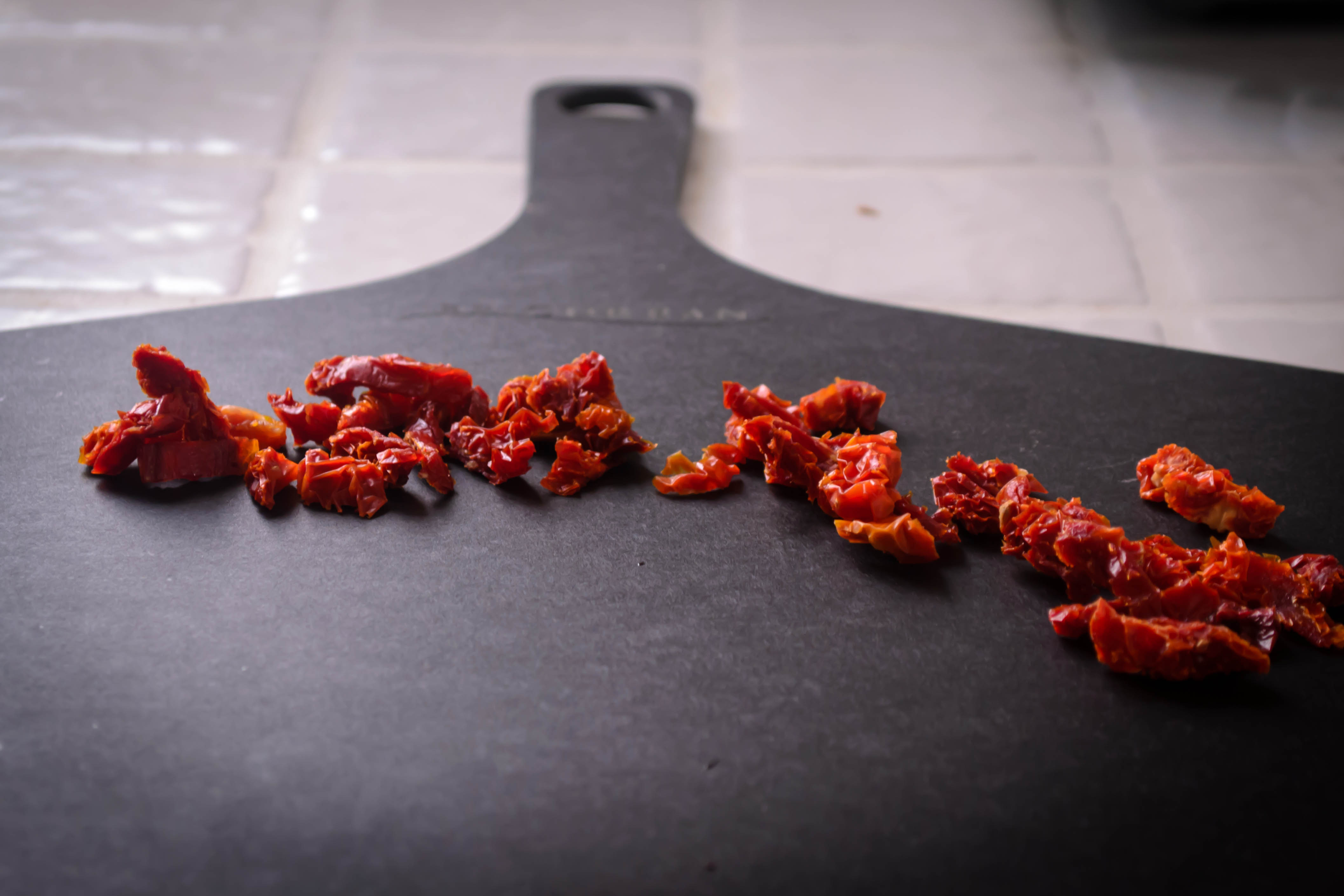
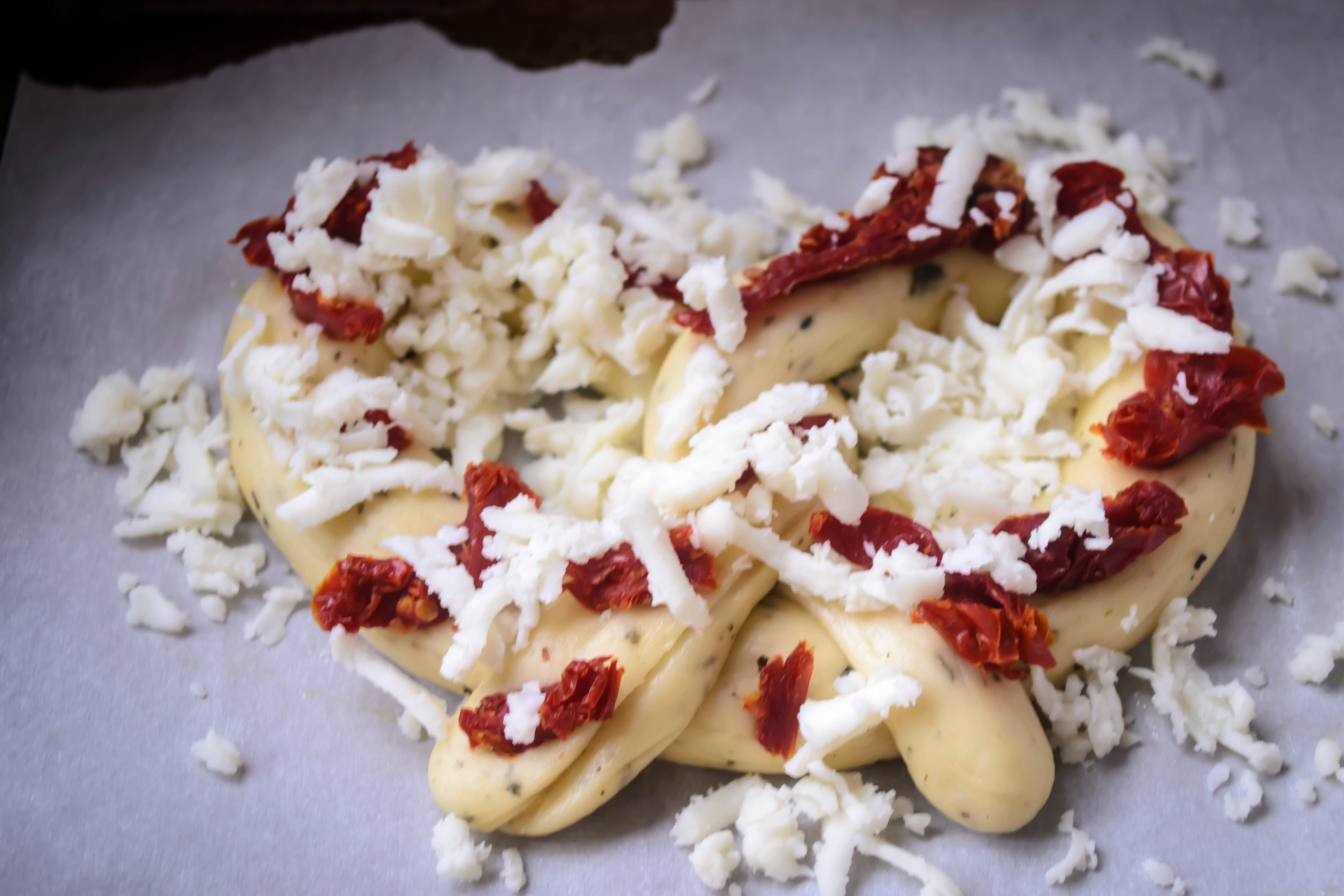
But here’s where things started to go a bit imperfectly.  I topped my plump little pretzels with chunks of sundried tomatoes, mounded them with shredded mozzarella, and draped slices of pepperoni over the top.  They lost their definition and looked more like piles of cheese than like pretzels, but that didn’t bother me much.

Food Blog March 2013-0900

Upon baking, however, a bit of their charm dissolved.  In the time it took to bake the dough, the cheese didn’t brown or bubble they way I’d hoped.  Further baking time led to overly charred edges on the tomatoes, and the cheese that had fallen onto the parchment paper I’d laid down as extra insurance went from bubbling to black.  N. ate them with gusto anyway, devouring several for dinner that night and taking foil-wrapped leftovers to work for the next few days.  But I wasn’t satisfied.  Not only were there overcooked elements, but the result didn’t taste quite like a pretzel.  It was good, but lacking in that toasty, crunchy exterior that makes a soft pretzel great.  I’m going to give you the recipe I used, but first consider these alternatives and, if you try any, let me know how they work out.
Next time, I’m going to mix the sundried tomatoes right into the dough along with the herbs.  Their flavor will still be there, but I think they will stay chewy and moist instead of burning.  I’m also toying with the idea of stuffing the pretzels with the cheese rather than sprinkling it on top – this would result in an oozing, melty, stringy core to each pretzel, and it would allow you to boil the pretzels before baking them, which contributes to the classic texture of the exterior my version was missing.  I would flatten each individual dough ball into a rectangle, sprinkle it lightly with cheese (leaving a generous border on all sides to prevent leakage), then roll and pinch tightly before making a rope and twisting as before.
I’d then boil the pretzels (Alton Brown has a recipe that looks really promising, no surprise there), drape them with pepperoni or olives or onion, and bake as before.  This would, I suspect, eliminate charring, create a better texture, and perhaps introduce a more successful alternative to the travesty that is stuffed crust pizza.*
These would be delightful dunked in some garlic butter, or basil spiked marinara, or even seasoned and pureed roasted red peppers, if you’re into any of those sorts of things.  But either way, you’ll have a remedy for the sneaky Sunday afternoon hangries that far excels anything you’ll find at a food court.
 Food Blog March 2013-0896
Pizza Pretzels
Makes 8 sweet, slightly stubby 4-inch pretzels
2 tsp active dry yeast
¼ cup warm water (stick your fingertip in; the water should be about body temperature)
1-2 tsp honey
¼ cup scalded milk, cooled
¼ cup melted or very soft butter
1 egg
1 tsp salt
1 tsp garlic powder
1 tsp dried basil
1 tsp dried oregano
2 ¼ cups bread flour
1 3oz. package sun dried tomatoes (not packed in oil – these would be, I suspect, too wet for this recipe)
½ – 1 cup shredded mozzarella cheese
24 slices pepperoni
  • Combine yeast, honey, and warm water in the bowl of your stand mixer (or in a medium bowl) and set aside for 5 minutes, or until the yeast is bubbly and smells like bread.
  • Meanwhile, heat the milk and combine with the butter, swirl until the milk is cooled and the butter is melted.
  • Add cooled milk, melted butter, and egg to the bubbling yeast and mix on low speed with the paddle attachment until the egg is broken up a bit and things are slightly combined.
  • Add flour, spices, and salt (you could probably add any combination of spices you like, including crushed red pepper for some heat, or rosemary for a woodsy flavor.  I’d stick with dry spices, though, for easier distribution and that classic pizza flavor) and mix with the paddle attachment until a wet, sticky, uneven dough forms.  You could also add the tomatoes at this point, if you want to incorporate them directly into the dough.
  • Scrape clean the paddle attachment and switch to the dough hook.  Knead at medium-low speed for 5-8 minutes or until dough is smooth, elastic, and willing, if you pinch a bit between your thumb and finger, to stretch out about an inch without tearing.
  • Dump your ball of dough into a glass or ceramic bowl greased with olive oil and turn it over once or twice until it is coated in oil, then cover with a clean kitchen towel and stow in a warm, draft-free place for 1½ hours, or until it has puffed and doubled in size.
  • When you return to your dough, after you admire its impressive swell and the way it already smells of pizza, gently deflate by pressing your knuckles into the center of the puff.  Let it sit for a few minutes to get its breath back.

Food Blog March 2013-0885

  • Turn the dough out onto a barely oiled surface (I don’t have a marble stone or anything fancy like that, but I do have a pizza peel, which was a little small but otherwise worked just fine) and divide into eight even pieces.
  • If you want to stuff the centers of your pretzels with cheese, roll each dough ball out into a thin rectangle and sprinkle a few tablespoons of mozzarella over the surface, leaving a wide margin on all edges to prevent the shreds from escaping.  Then wind it up tightly and pinch the edges to secure.

Food Blog March 2013-0888

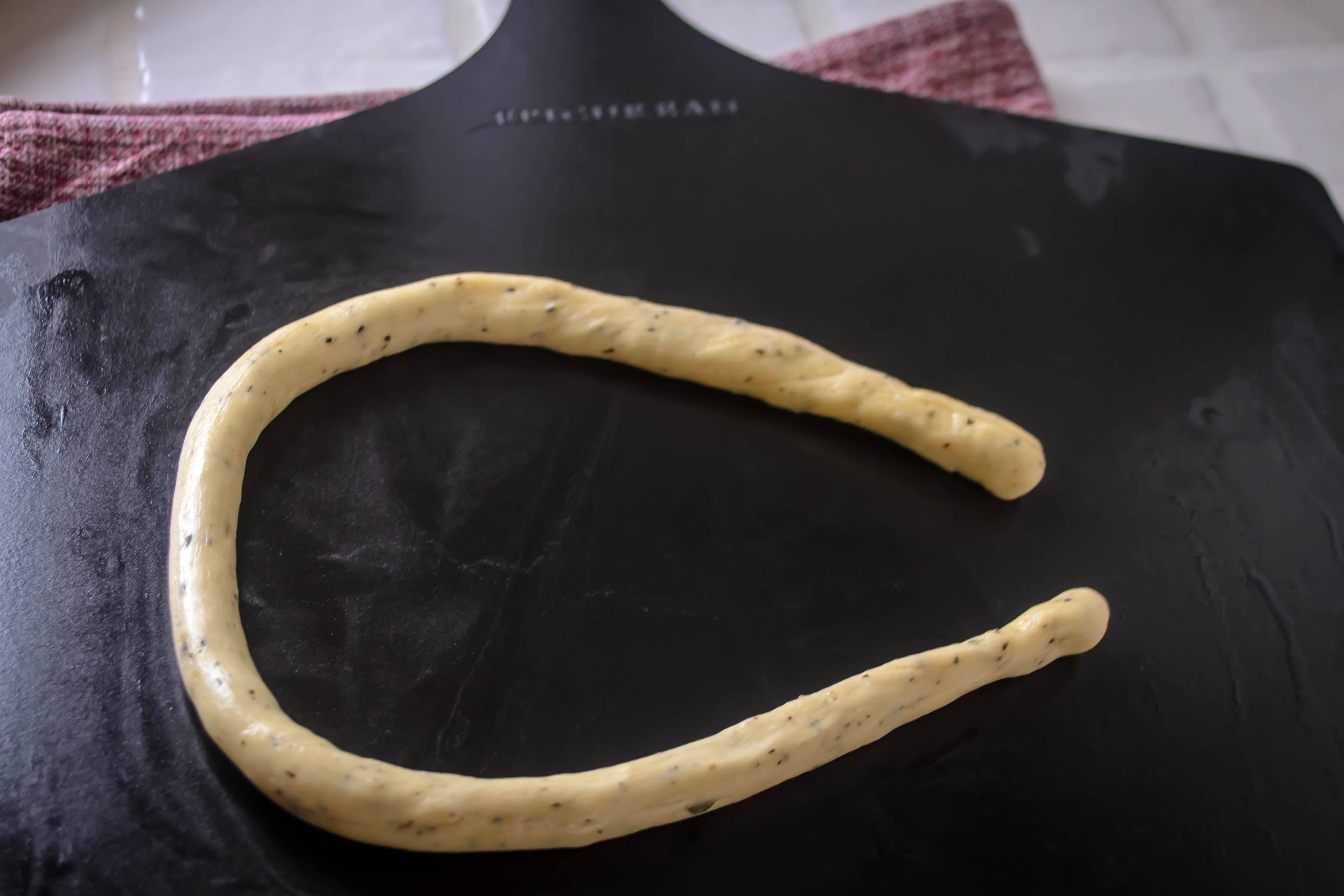
  • Whether you are stuffing with cheese or not, now is the time to roll the ball (or coil) of dough into a long skinny rope 18-24 inches in length.  The best way to do this, I found, is to use the palms of your hands and start in the middle.  Push the rope of dough firmly away from you, then back toward you, starting in the very middle and then, as the dough bulges toward the outer edges, follow it along moving outward until the rope is even in thickness and at least 18 inches long.
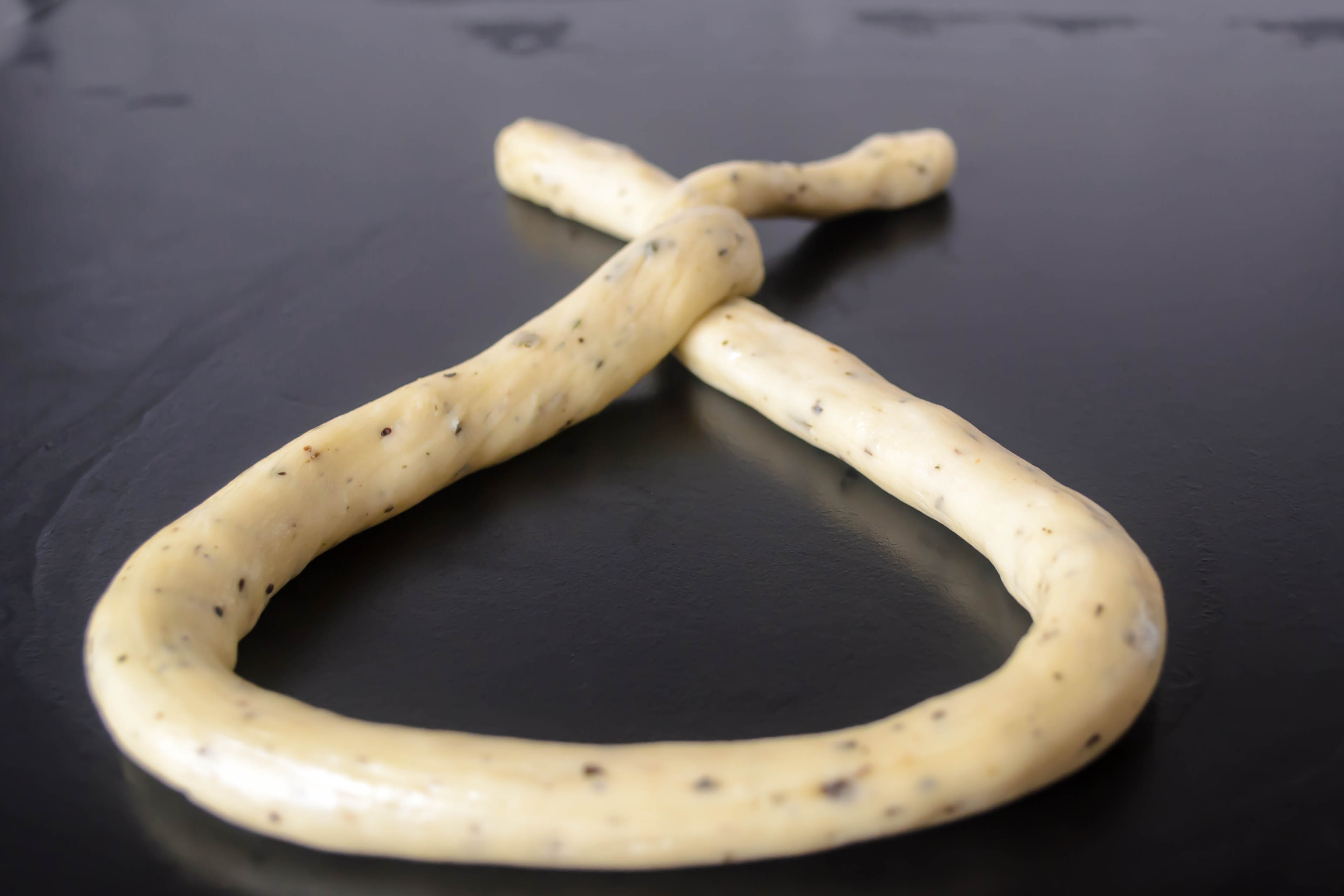
  • To form your pretzels, bring the ends of each rope toward each other into a horseshoe shape.

Food Blog March 2013-0889

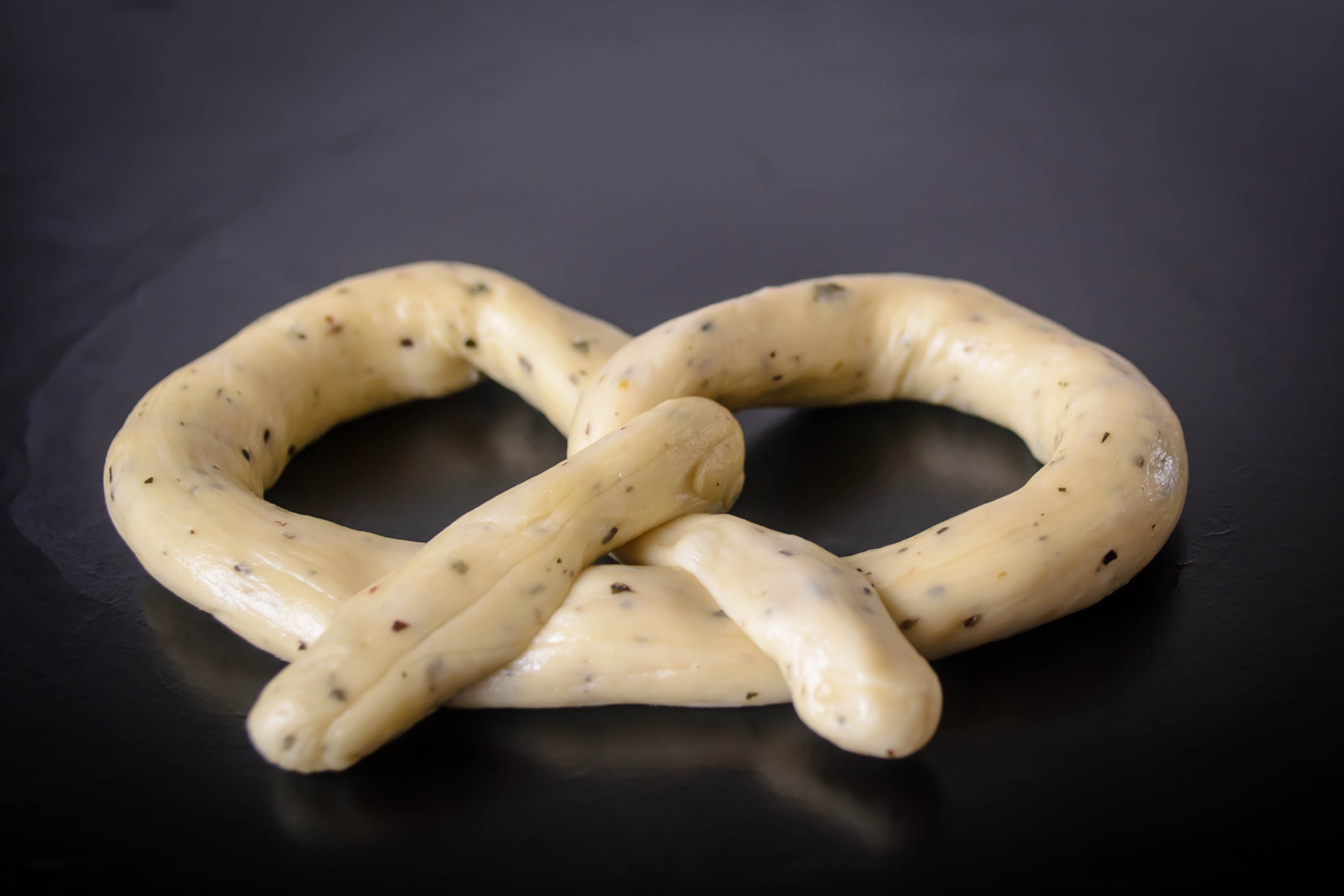
  • Then, about a third of the way down each end of the horseshoe, make a twist.  Take one end of the rope and twist it fully around the other (that is, the left side of the rope should end up back on the left side once you’ve twisted it completely around the right end).
Food Blog March 2013-0891
  • Gently grab the ends above the twist and flip them over, pressing them into the bottom of the horseshoe loop to adhere.  You’ve made a pretzel!
Food Blog March 2013-0893
  • Place all eight of your formed pretzels on parchment lined baking sheets (I found I needed two), cover them with a kitchen towel, and let rise for 30 minutes.  During this time, you should preheat your oven to 375F.
Food Blog March 2013-0895
  • When the pretzels have risen again – it won’t be a dramatic change, but they will get a bit plumper – add your toppings.  If you’ve integrated the tomatoes and cheese already, just drape a few slices of pepperoni over them and you’re done.
Food Blog March 2013-0901
  • If you haven’t integrated the tomatoes or cheese, stud the tops of each pretzel with the tomato pieces, sprinkle with cheese, and then add the pepperoni on top.  Be careful not to get too much cheese on the parchment paper, as it will burn and lend an acrid taste to your pretzels.
Food Blog March 2013-0903
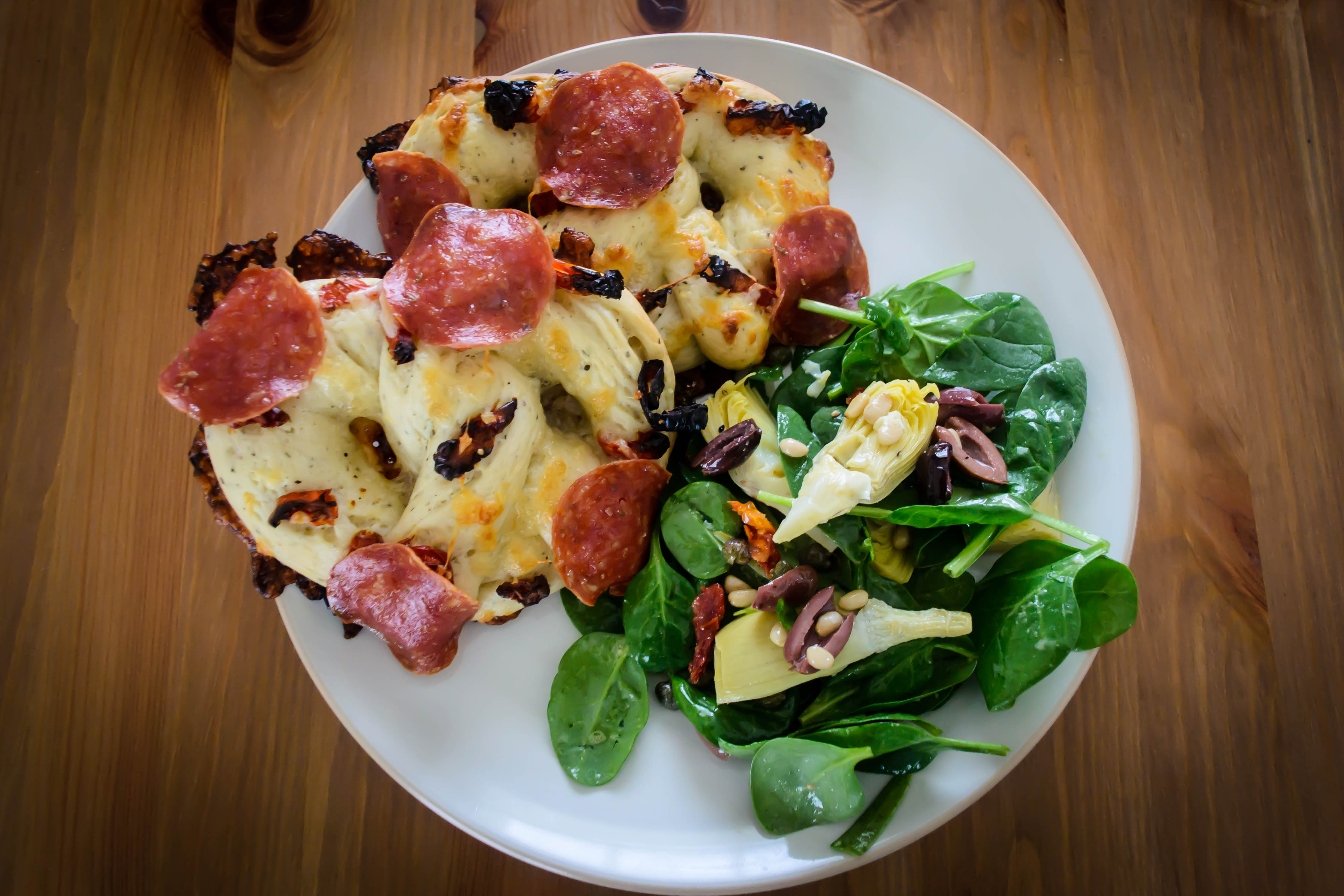
  • Bake your topped pretzels at 375F for 20-25 minutes, or until the cheese has melted and the dough is fully cooked.  The cheese won’t get quite as brown as it does on a pizza, but it will still be melty and delicious.
Food Blog March 2013-0910
  • Let cool for 5 minutes before eating, so the dough has a chance to firm slightly.
We had ours with a salad inspired by pizza toppings: spinach, artichoke hearts, olives, tomatoes, and some pine nuts for crunch, tossed with mustard lemon vinaigrette.
 Food Blog March 2013-0911
* I love, love the idea of stuffed crust pizza.  Forcing more cheese into an already cheese-laden dish?  Yes, please!  But the reality of it is so disappointing: a thick block of semi-melted sludge inside a soggy crust, like someone wrapped a stick of string cheese that had been lying in the sun for an hour in some sandwich bread and called it a day.  It’s a worthy notion, but the execution just hasn’t been perfected.

Pizza and Beer

Food Blog March 2013-0802Sometimes, a week calls for pizza.  But you don’t want the delivery variety dripping with grease and lazy with a smattering of mix-n-match toppings.  You want something fresher.  Better.  You want the feel of dough you can stretch under your hands and control over the size and shape of the pie and choice in the quality and variety of ingredients.

Homemade pizza.

N. and I have often talked about pizza memories, and how, when we were kids, pizza just wasn’t the same without a side of root beer.  It had to be in one of those hard plastic molded glasses, and it had to be with a clear straw.  And sometimes, you forgot you’d ordered root beer instead of Coke or Pepsi, and that first gulp with its spicy depth would be a tremendous surprise.

As we got older, the “root” part of the equation melted, and suddenly it was pizza and beer, plain and simple, one of the mother food and beverage combinations (is that a thing?  Like mother sauces?  It should be.  After all, beer is the third most popular beverage worldwide, and variations on pizza have been around since ancient Greece).

As I thought my way through this pizza plan this week, I wondered whether they had to be separate.  I mean, yeast makes bread dough and beer possible.  Beer is liquid, and there seemed no logical reason why it couldn’t be substituted for the water I’d ordinarily use to make a pizza crust.

Once this idea was lodged in my head, it wouldn’t go away.  This just seemed too perfect.  Beer and pizza, kneaded together – a truly complete meal.

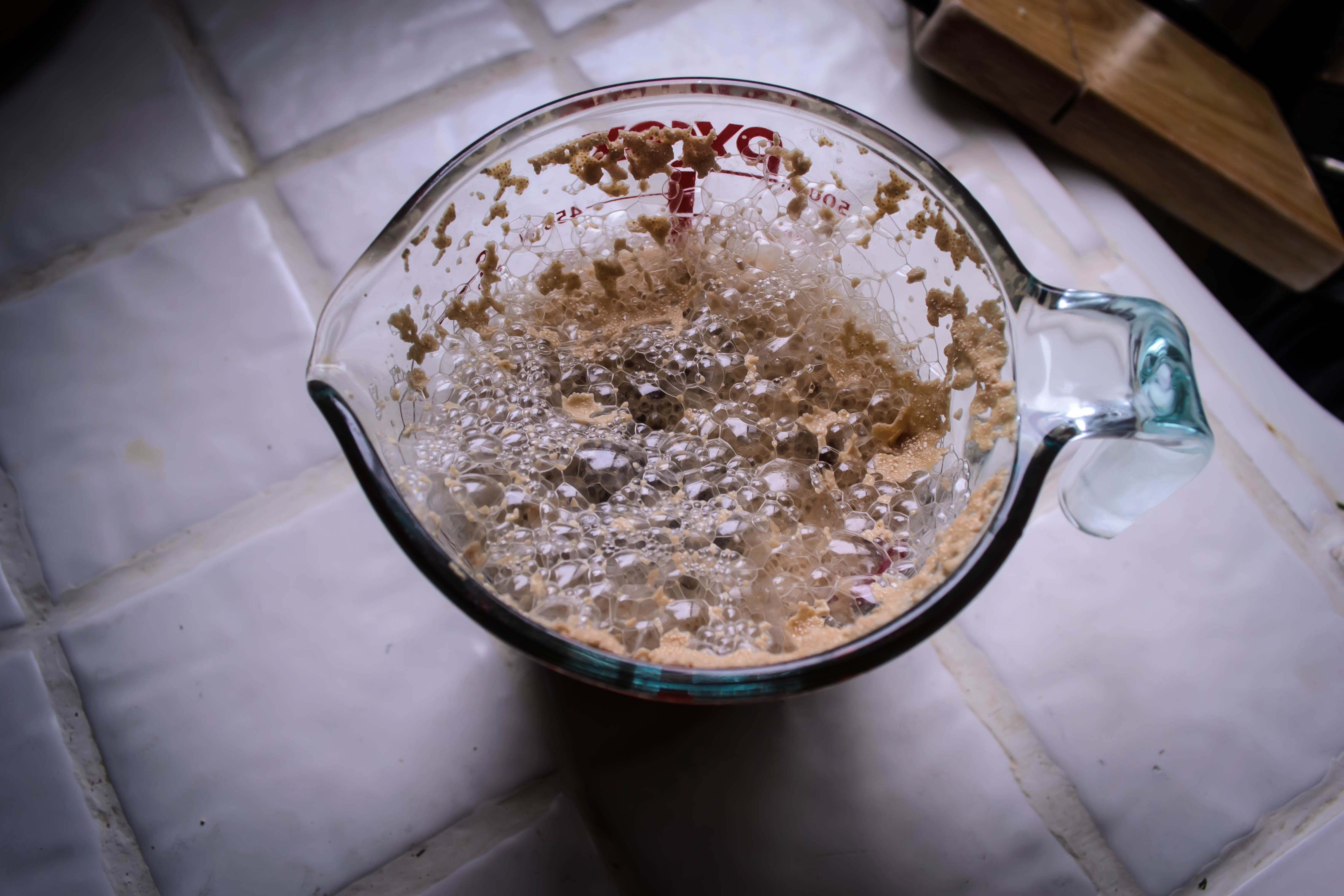
Even though beer is essentially water with yeast and flavorings, I wasn’t sure what would happen when I mixed the two.  I heated a bottle of amber ale in the microwave with a couple teaspoons of honey, just until it was body temperature.  When I added the yeast and engaged the lightest of stirs, the whole measuring cup erupted with bubbles and I had a head at least three inches high.  This slowly collapsed, but I took it to mean the yeast was satisfied with its new spa treatment.

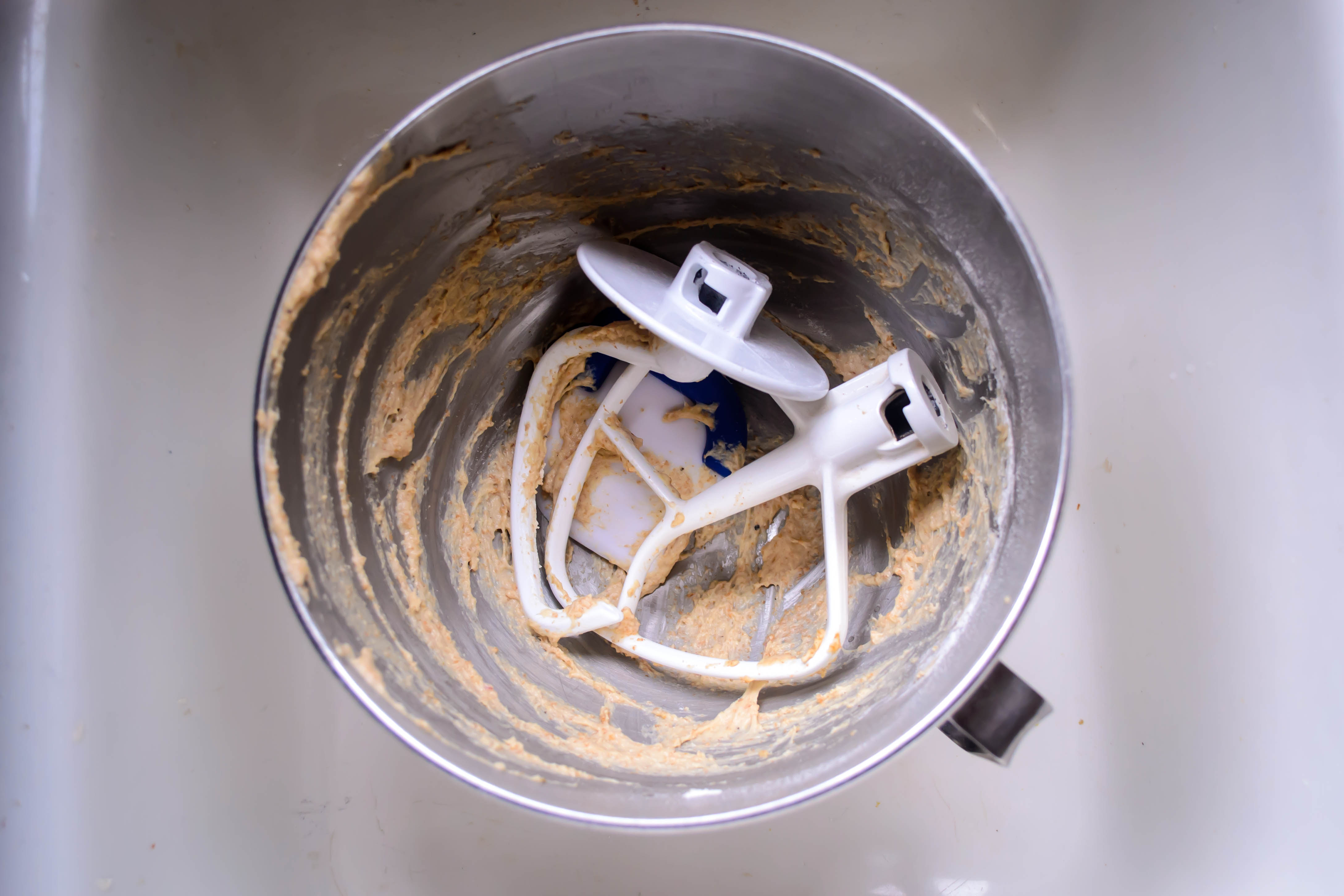
Food Blog March 2013-0772I used a combination of bread flour and whole wheat flour, and produced a spectacularly nutty tasting dough that was also the stickiest I’ve ever worked with.  It slithered and dripped off of my stand mixer’s dough hook and plopped thickly into the oiled bowl I coaxed it into, and I crossed my fingers and hoped that after its six hour chill in the fridge it turned into pizza crust.

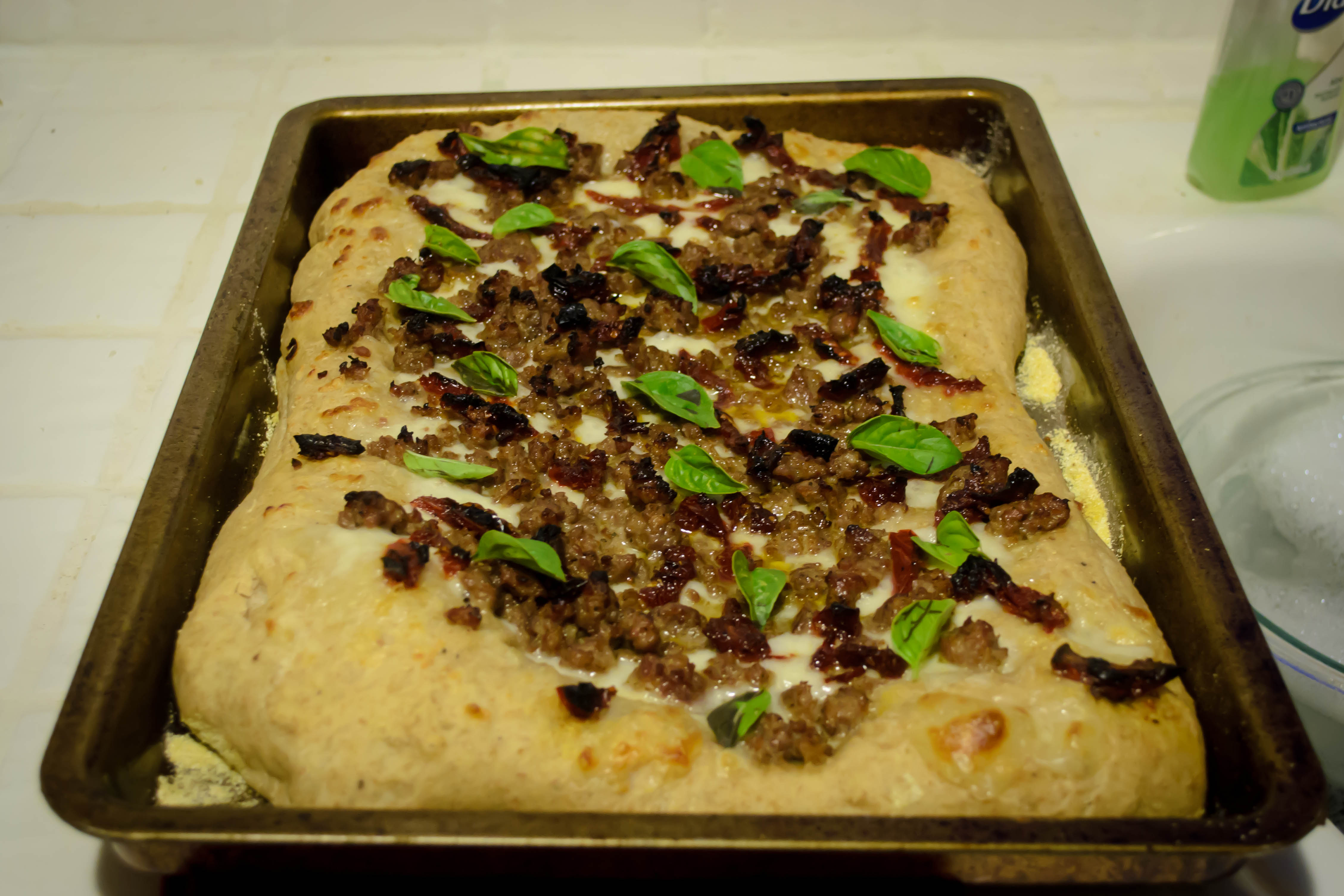
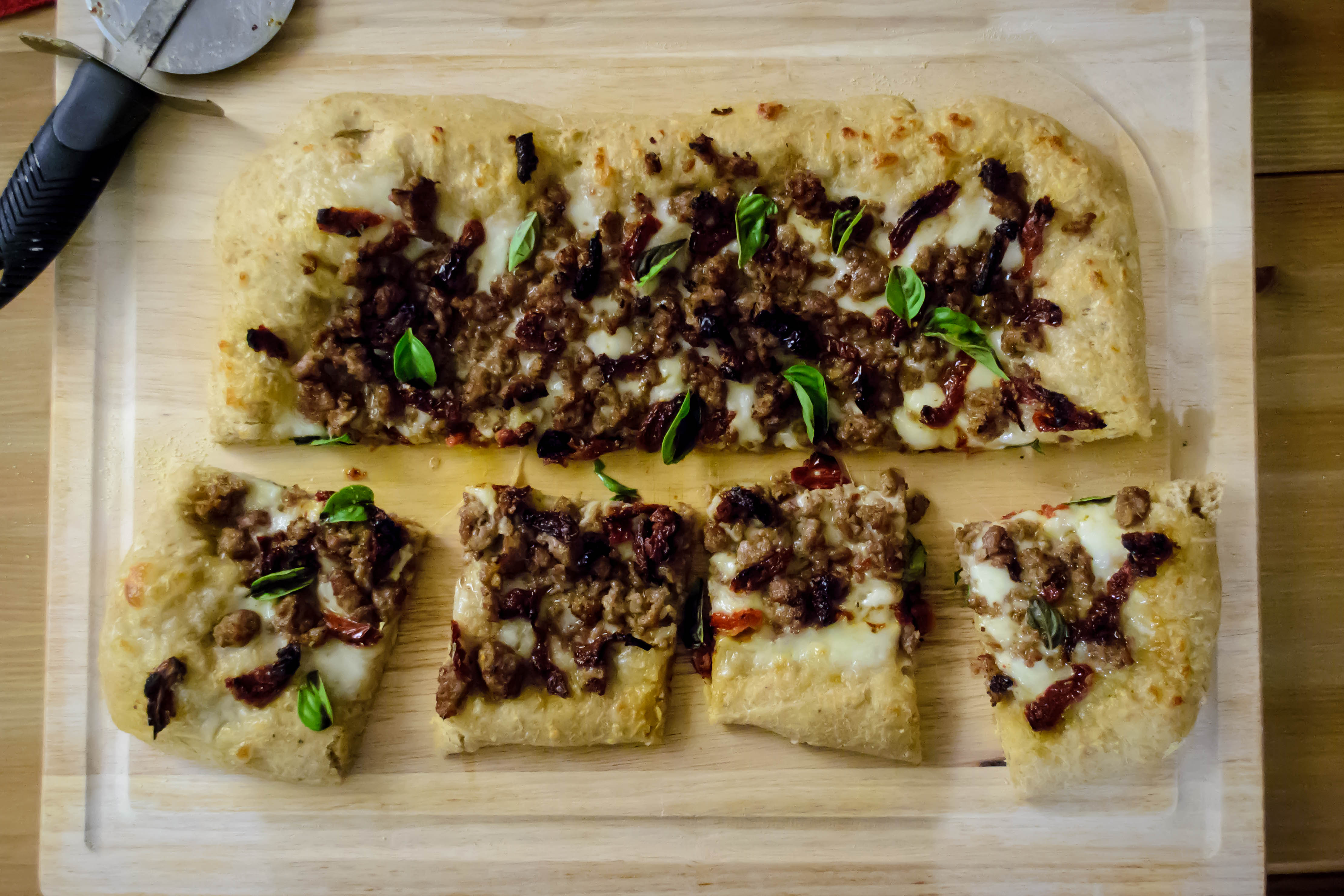
Food Blog March 2013-0777When I liberated it and faced it again, it wasn’t the easiest dough to work with, but it did work.  It wouldn’t deign to be tossed like a pizzeria pie, but I stretched and spread and pushed it across a cookie sheet liberally spread with cornmeal, and it turned into a rustic, bubbly, delicious crust.  Topped with mozzarella, sausage, and sun-dried tomatoes, it baked into a glorious symphony of assertive flavors.  We sprinkled on a few leaves of fresh basil while it was still steaming hot, and declared it one of my best homemade pizzas. Food Blog March 2013-0780This is a sticky, wet dough, but it works.  I’m going to make it again and tweak the quantities of flour and olive oil, but trust me: this is worth fooling with for the flavor alone.  The beer comes through right at the end of each bite as a deep yeasty earthiness.  It lends the tiniest bit of bitter flavor that contrasts really well with the fatty sausage and tart sun-dried tomato.  And really, why shouldn’t it?  It’s beer, and this is pizza.  They were made to be together.

Food Blog March 2013-0797

Beer-crust pizza

12 oz. beer (I used an amber ale.  I think a darker brew would be even better)

2 tsp honey

2 tsp yeast

¼ cup olive oil

2 ½ cups bread flour

1 cup whole wheat flour

2 tsp salt

¼-½ tsp black pepper Food Blog March 2013-0774

Heat the beer and honey in the microwave (or a small saucepan) until the liquid is body temperature – you should feel only the slightest heat when you dip in a curious finger.  This took about 45 seconds in the microwave for me.  It will take longer if your beer has been refrigerated.

Swirl the mixture to distribute the honey, then sprinkle the yeast over the surface and set it aside for 5 minutes.  If you stir the yeast in, you will get a tremendous amount of foam on the surface, so in case of overflow I think it’s better to just let it sit.

While you wait for the yeast to perk up, combine the flours, salt, and pepper in a mixing bowl or the bowl of your stand mixer.

When the yeast and beer have married to create a thick foam, stir in the olive oil, then add the liquid mixture to the dry ingredients.  Using the paddle attachment (if you are using a stand mixer), combine at low speed just until ingredients come together into a rough, uneven dough.  Replace the paddle attachment with the dough hook and knead on medium-low speed for 5-7 minutes.

This dough will not pass the windowpane test.  It will not even stay together particularly well.  It will seem like an exercise in futility and disaster, and you will be sorely tempted to add more flour.  But if you resist, and plop it into an oiled bowl, and cover that bowl with plastic-wrap and leave it in the refrigerator for 6-8 hours, it will turn into something more like normal pizza dough.  I promise.

Food Blog March 2013-078390 minutes before you intend to bake, take the bowl of dough out of the fridge and set it on the counter to finish rising and come to room temperature.  After this time has passed, and the dough is considerably increased in size (it may not quite double, unless your counter is quite warm), stretch it to your desired shape – it easily makes a thick 9×13” rectangular crust, and might be coaxed into 2 medium sized, somewhat thin round crusts – on a cornmeal or flour speckled board or tray.  I just doused my cookie tray with cornmeal and pressed and pushed the dough directly on it until I was happy with the shape.

Food Blog March 2013-0789Food Blog March 2013-0786Food Blog March 2013-0792When adequately stretched, add toppings and bake in a preheated 450F oven for 12-15 minutes, or until puffed, crisp, and golden.  Wait 5 minutes before you cut it, to give the cheese time to congeal just a little.

Food Blog March 2013-0804We ate this in embarrassingly large squares and left enough in leftovers to serve as lunch the next day.  Cut slightly smaller and for slightly less voracious eaters (or if you add a side salad), this would be an adequate dinner for 4.

Uncommon Brown Sugar and Cheddar Biscuits

When it rains in Los Angeles, the whole atmosphere of the city changes.  The earth sighs acceptance and glee, and the ordinary dustiness of every other person’s front yard glimmers with emerald slickness: life!  Reprieve from the desert we pretend we haven’t built over!  The roads become jagged, glistering, tar and oil stained slip’n’slides on which people drive either too slowly – avoiding disaster through excess caution – or too quickly – rushing to get off the highways as soon as possible.  The sky is unused to gray billows here, or at least it seems that way.

Food Blog January 2013-0518

But for me, the end of this week felt like home.  It was a strange mix of homesickness and invigoration.  I am accustomed to working in this climate.  It feels natural.  Habitual.  My fingers and my brain and my skin – they fit into this overcast world.

Seeking the comfort of familiarity, I decided to leave yeast alone for this week and fall back on something I know: biscuits.  Butter.  Flour.  Buttermilk.  Salt.  Baking powder.  The blessed fundamentals.  But I know the fundamentals.  I wanted more.

Food Blog January 2013-0514

In Ratio, Ruhlman calls these Chicago biscuits because their ratio 3-1-2 is Chicago’s area code.  3 parts flour, 1 part fat, 2 parts liquid.  I’m calling them Uncommon because their pairing – brown sugar and extra sharp cheddar cheese – might not be anyone’s first inclination.  It made sense to me, though, if you reinsert the missing link of apple pie in the middle.  Cheese and apples are perfect.  Brown sugar and apples are perfect.  What would happen if you took the apples out of the equation and left the savory richness of cheese chewing against the molasses-deep hum of brown sugar?  They are also Uncommon because they take a little extra time (almost 3 hours from start to finish) and produce a slightly different product than your ordinary dinner biscuit.

Adapted, obviously, from Ruhlman’s Ratio 312 Biscuits.


Uncommon Brown Sugar Cheddar BiscuitsFood Blog January 2013-0491

scant 2 cups flour (9 oz)

1 tsp salt

2 tsp baking powder

2 TB brown sugar

6 TB butter (3 oz)

½ cup ¼-inch chunks of cheddar cheese, the sharper the better

¾ cups buttermilk (6 oz)

In a medium bowl, whisk together the flour, salt, baking powder, and brown sugar.

Using a pastry blender or your fingers, cut in the butter until it is incorporated throughout in chunks the size of small peas.

Add the cheddar cheese and buttermilk and mix to combine into a rough, sticky dough.  I find using a fork works well for this step.

Food Blog January 2013-0501

Here’s where things change up a bit.  Instead of rolling this out and cutting rounds, stretch a piece of plastic wrap across your counter and dump the dough onto it.  Using the plastic wrap, form the dough into a rectangle of approximately 4×6 inches.  Mine was bigger because I am impatient.  This didn’t seem to have dire consequences.  Once the dough is shaped, wrap it in the plastic wrap and refrigerate for at least 1 hour.

Food Blog January 2013-0502

After an hour, the butter has firmed up again and the dough has relaxed.  Pull it out and free it from the plastic, plopping it carefully onto a well floured board.  It’s a very sticky dough, so flour your rolling pin and the top of the dough itself well to avoid irritation.  Roll the dough out until it is three times its original size, maintaining the rectangular shape.  Fold it into thirds, press down well, and then roll it out again.  Fold it into thirds for a second time.  I did mine in the opposite direction of the first fold, which was probably wrong, but again, produced no discernible taste consequences.  Press down firmly, wrap up the dough in plastic wrap again, and put it back into the fridge for another hour.

Food Blog January 2013-0506

While it chills, here’s what’s happening with all this bother: you are creating something akin to one of those biscuits that comes out of the tube.  You know, the cardboard tube you anxiously peel the wrapper from to reveal a twisting seam, then judiciously smack on the edge of the counter until it pops and dough appears in great bulges?  Those biscuits are composed of dozens of flaky layers, and that’s what you are doing by folding and rolling and folding and rolling.  You are, Ruhlman notes, following a similar procedure to that used for making puff pastry, except in our case the butter is irregularly placed, which results in craggy puffs, whereas puff pastry requires a smooth, even layer of butter in between each floury fold to reach its incredible signature height.

With another hour gone, liberate the dough from fridge and plastic, return it to your well floured board, and repeat the procedure: roll out, fold in thirds, roll out, fold in thirds again.  At this point, you should also preheat the oven to 400F.

Food Blog January 2013-0509

You’ve now folded your dough a total of four times, which means you’ve made twelve layers.  Now, roll it out to ½ inch thick and cut it into 6 pieces.  You could do rounds with a biscuit cutter, but it seems easier and less wasteful to just trim up the edges (which you could roll into a homely little extra biscuit to taste on the sly) and then cut into squares.

Food Blog January 2013-0511

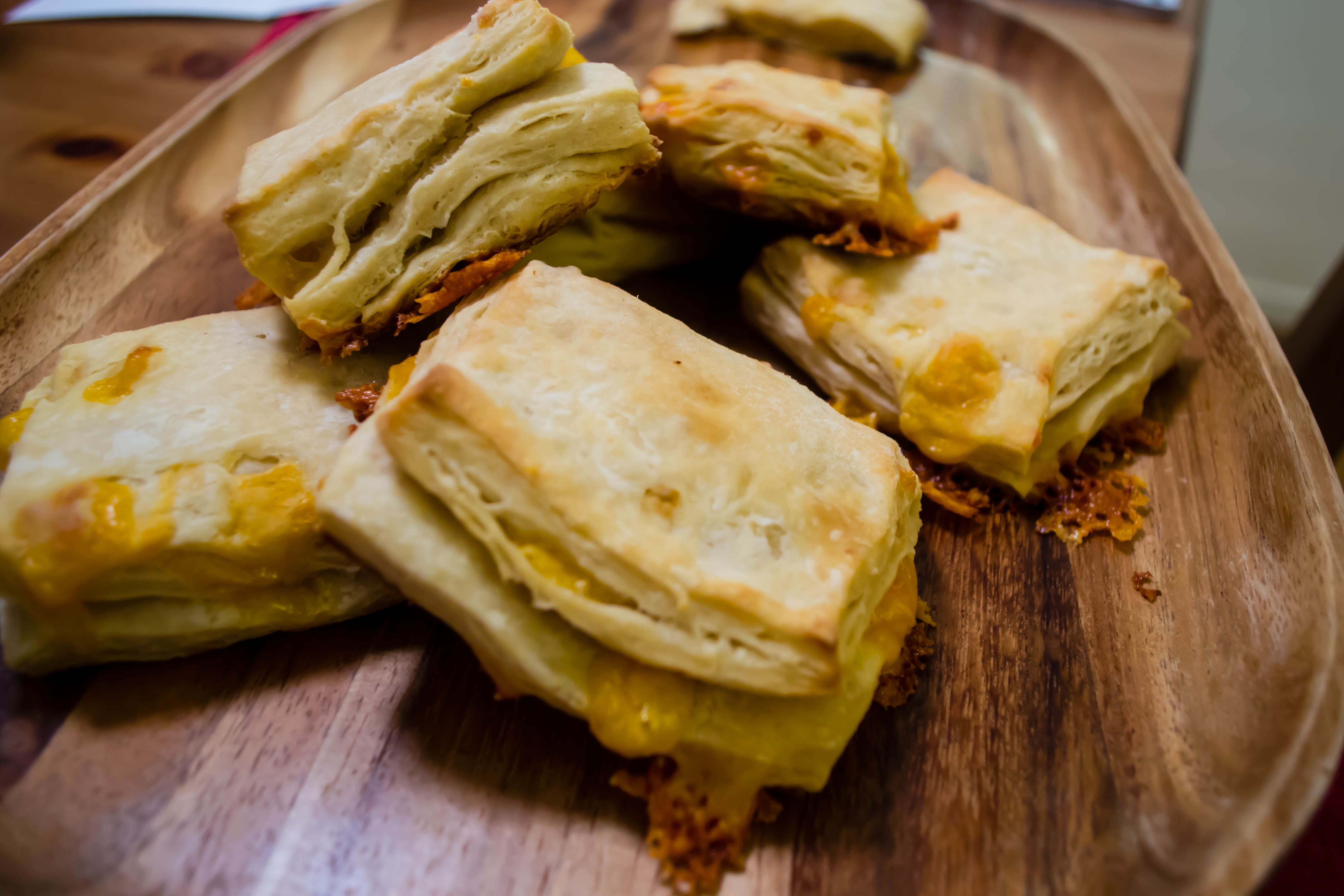
Pop these onto a greased baking sheet and into the oven for 20-25 minutes.  They will emerge lightly golden on top, with cheese oozing out from between the layers to form crispy lacy edges against the cookie sheet.

Food Blog January 2013-0517

We ate these as an accompaniment to a honey mustard roasted acorn squash and chicken apple sausages.  I know, I had to get the apple back in there somehow.  My assessment?  They were delightful.  The exterior was flaky and crisp, and I was impressed by how the layers really did make a difference in the texture of the biscuit: they were moist and chewy and distinct.  The cheese wasn’t as noticeable as I’d thought it would be, though the crispy edge bits were lovely – much like the lacy brulée that adorns the outside edges of a good cheese bagel.  At first I thought I couldn’t taste the brown sugar at all, but as I took my third and fourth bite, gasping around the steam, I realized that the complex lingering warmth at the end of each bite was probably the effect of the brown sugar.  It carried the depth and richness of a caramel without being sweet.

Food Blog January 2013-0516

So the verdict is: if you need biscuits to go with a weekday meal, these are probably not the ones for you.  It’s asking a bit much to devote three hours to six biscuits, when you could just roll, cut, and bake the same ingredients straight from the mixing bowl.  But if you are planning for something special, or if you were thinking of baking bread anyway and are willing to replace rise time with refrigeration time, try these instead.  The layers are really remarkable, they stay warm for some time, they are all kinds of tasty, and they would reheat – I suspect – very well in a toaster oven, though they are best on the day they are made.  But you probably won’t have any left over, so that’s an issue barely worth discussing.

Food Blog January 2013-0522

I hope you are warm and well, wherever you are.

Parsley Pie Crust

Food Blog January 2013-0412

I’ve never been one to start at the beginning.  Stories require backing up and wait- wait- let me explain who that was.  Dreams are recalled near the end, and only slowly do the initial details return.  Directions often skip a step or come in fuddled order.  I don’t know whether this is a consequence of a disorganized brain, or whether it’s a signal of confused genius (hah!).  The Odyssey, with its in media res trope, was an enormity to my teenage brain when I first encountered it during high school.  What a wonderful way to present information, and how validating and revelatory it was to find out that this was a classical method!

So it was no big surprise that, when facing the first week of my dough challenge, I couldn’t start at the beginning.  Ruhlman arranges Ratio with doughs first, true, but he seems to traverse the category in a solids-to-liquids order.  Bread comes first, pate-a-choux closes the chapter.  To me, this was even more intimidating than the idea of tackling dough at all.  Bread is something I want to build toward, not race into headfirst.

I flipped ahead in the book to take on my own personal Waterloo: pie crust.  Supposedly “easy as.”  But I’ve never found it that way.  My crust is somehow tough AND crumbly.  It collapses, it sticks, it refuses to roll in a smooth circle, it requires patching and crimping and pressing and it’s just easier to buy Pillsbury.  But now I’m in it, and I’ve got to conquer this thing.

Despite this personal beginning, it wasn’t enough for me to just make a pie crust.  You guys have probably all made pie crust.  How boring would it be for me to just report on the quiche I made?  At the end of the pie crust section, Ruhlman lists a number of alternatives and additions.  Ground nuts, cracked peppercorns, a dusting of spices, parmesan cheese?  I had never considered this.  I had to try it out.

Our quiche would have a parsley crust.  Coincidentally, this made my experimentation a perfect candidate for submission to Weekend Herb Blogging.

(I started with parsley, and then I started imagining adding lemon zest, and big particles of cracked black pepper, and then I realized that I just wanted some of the herbed buttermilk biscuits I so heralded when I made them for my Bittman project.  Biscuits are in our future, friends.)

The ratio for pie dough – at least this one – is 3, 2, 1.  Three parts flour, two parts fat, one part water.  This is by weight.  The problem here is, despite my desire to conquer this beast, and despite the impressive (read: verging on ridiculous) collection of kitchen tools I’ve amassed over the years (pot sticker press, anyone?), I don’t have a kitchen scale.  That makes it hard to work in weights.

Food Blog January 2013-0385

Fortunately, though he advocates it persistently, Ruhlman provides the general weight range for a cup of flour, so I worked with that.

Every pie crust recipe I’ve ever read, Ruhlman’s ratio included, calls for the water to be ice cold.  I get this: you want the fat to remain cold during this construction phase so it can melt and leave flaky pockets as it bakes.  Ice water keeps things frosty.  I decided to skip the ice cube middle man and stuck my water in the freezer for a few minutes.

Food Blog January 2013-0396

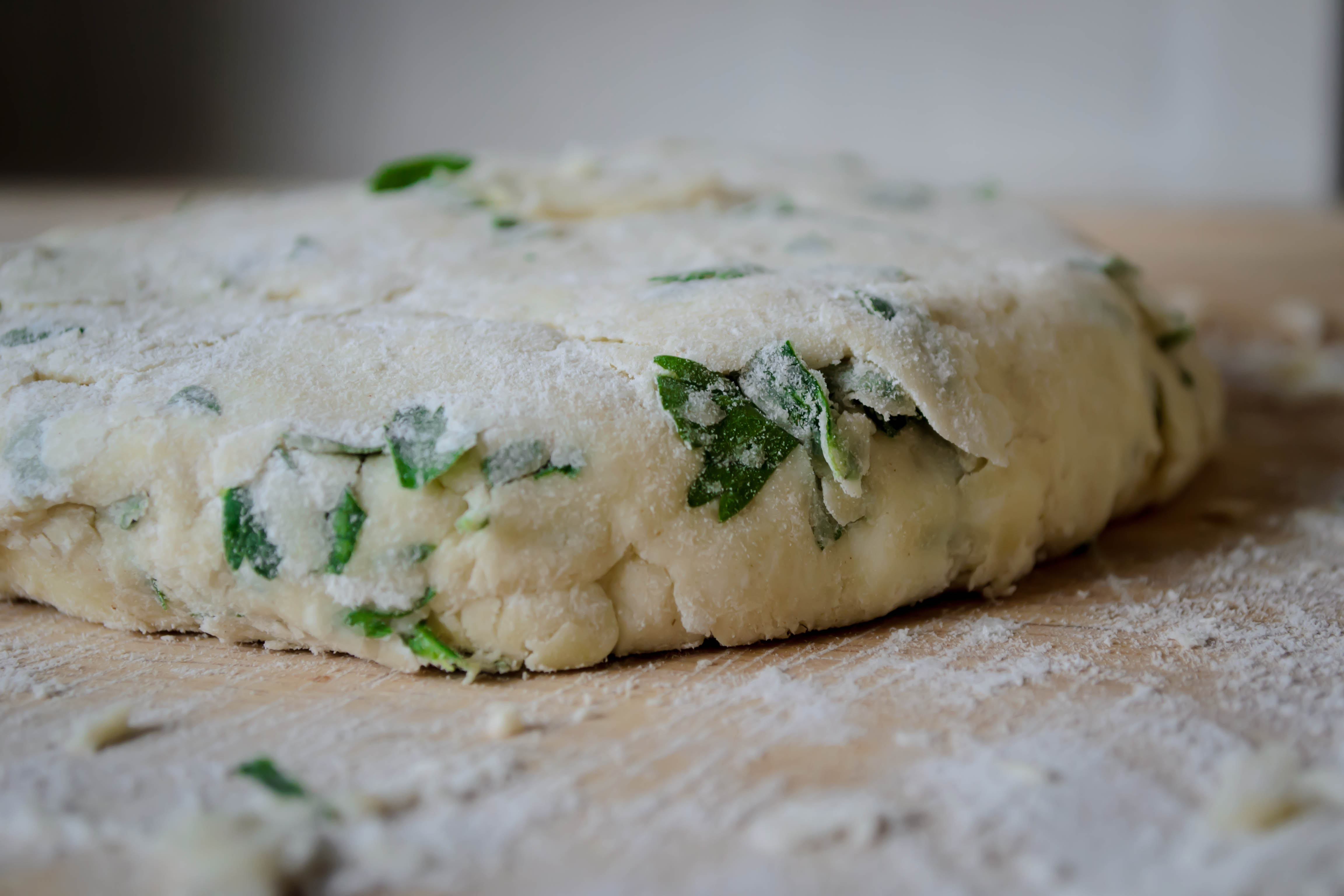
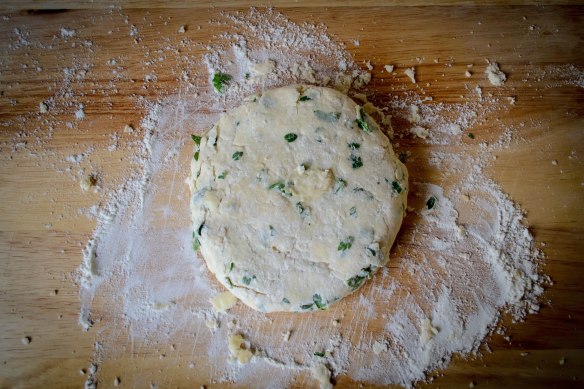
Usual procedure here: cut in the butter, add salt (and parsley, in this case), incorporate just enough water to bring things together, form into a disk and refrigerate to firm the fat back up.  Then you can roll out, fill, and bake.
Food Blog January 2013-0398

Food Blog January 2013-0401

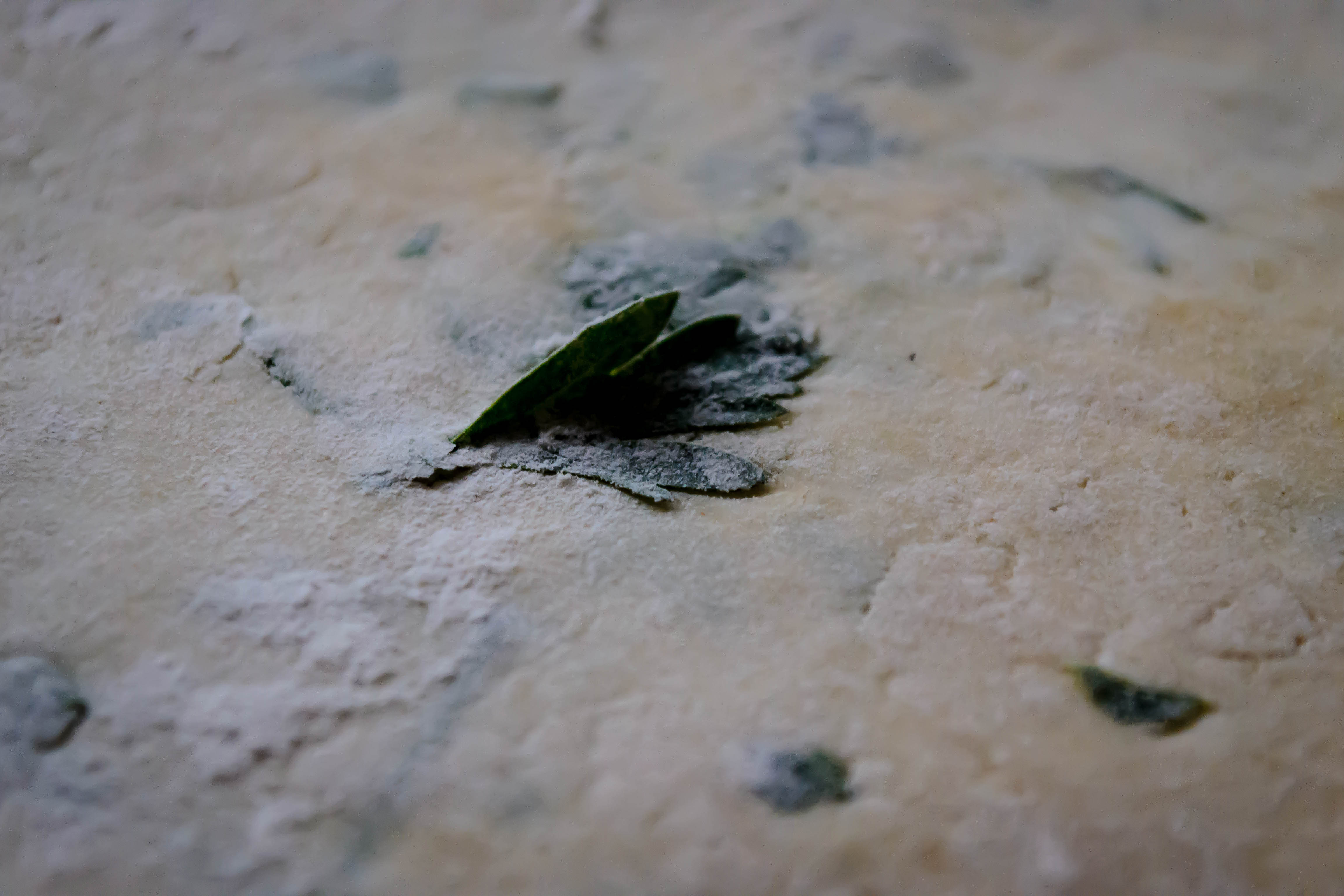
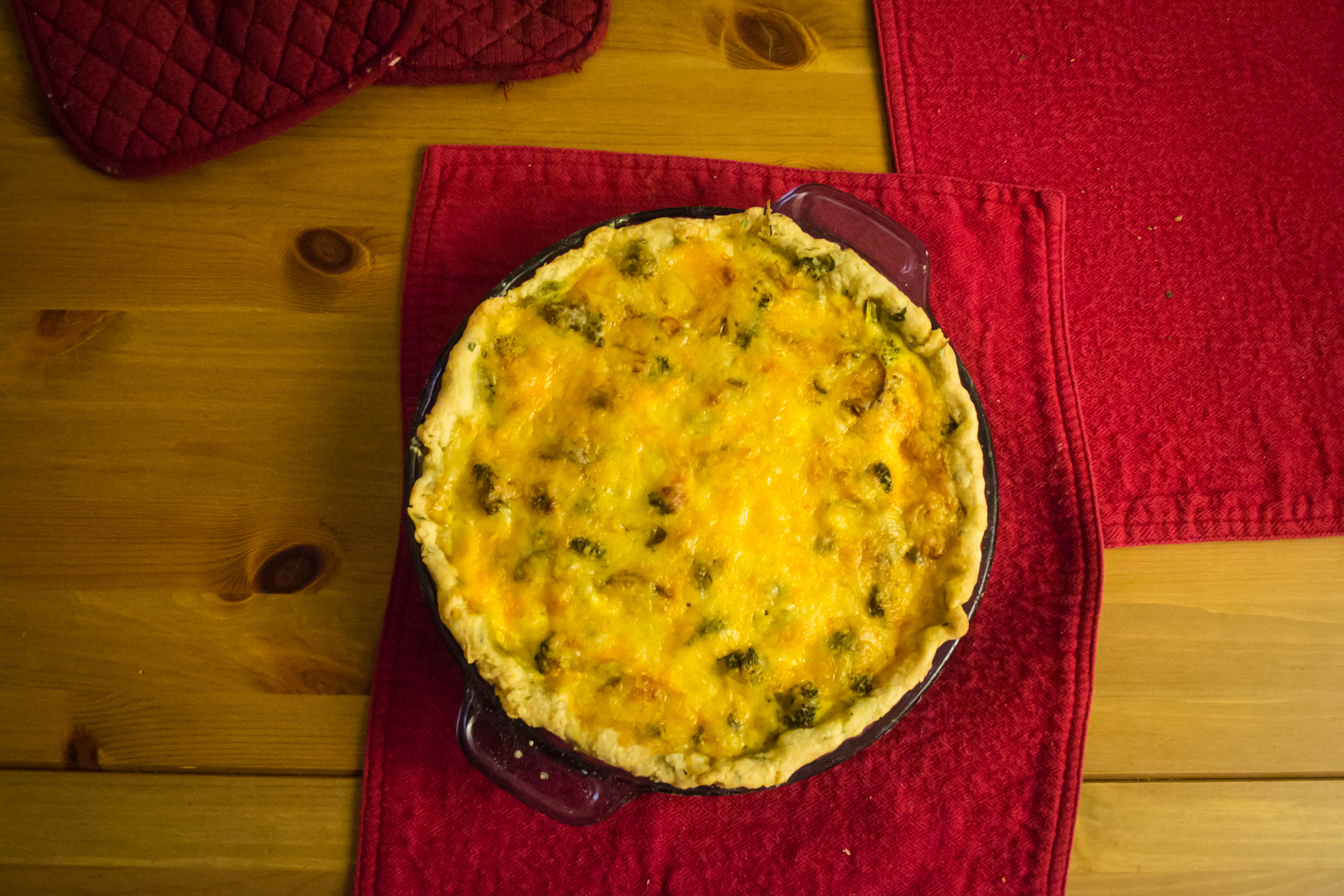
That all sounds pretty simple, but somewhere in there things tend to go wrong for me.  This crust was (relatively) easy to work with.  It didn’t disintegrate, it didn’t melt, it didn’t even crack in too many places.  I think playing with biscuit and cracker doughs this past year accustomed me to the feeling and delicacy required to not destroy a circle of dough.  It was barely moist and not exactly elastic, but it did have a bit of give.  It baked to a lovely golden color, the flecks of green were intriguing and special, and the quiche that rested just wobbling between its sturdy walls was delicious.

Food Blog January 2013-0407

But the crust was tough.

I can assume a few reasons for this.

1.) It’s possible my ratio was off.  Because I didn’t weigh my flour, I may have had too much or too little in the mix.

2.) More likely, I overworked the dough.  I pressed and kneaded and folded until the dry bits at the bottom of my mixing bowl were willing to play along, and perhaps I was too insistent about that demand for inclusion.

Food Blog January 2013-0408

Like everything else, it seems pie crust needs a revisit to get it right.  The feeling of the dough between my fingers is familiar, but I have to learn its textural intricacies.  How much water is just enough?  How crumbly can it be and still hold together?  How much of the dryness do the fat and water absorb while the wrapped disk rests?  Without another attempt or three, I won’t know.

But it tasted good.  It crunched against the quiche and while it didn’t shatter at the slightest fork pressure, it did have that dryness against the teeth you expect from crust.  The parsley contributed a grassy freshness and made the flavor more complex, especially the following day.  I could see this working similarly well with dill, or thyme, or maybe even marjoram, all of which pair nicely with broccoli and mushrooms.

Onward, then.

Food Blog January 2013-0417

Broccoli mushroom quiche with parsley pie crust

(The quiche recipe is my mom’s.  I’m sure she got it from somewhere, but I don’t know that she even knows where anymore.  I’ve changed very little here, though her version usually contains bacon instead of mushrooms)

Crust:

1 heaping, lightly fluffed cup of flour (or 6 oz., if you’re doing this properly)

1 stick (8 TB, 4 oz., etc) butter, cut into 16 or so pieces

2-4 oz. very cold water

Pinch salt

2 TB chopped parsley (or dill, or oregano, or marjoram, or thyme… whatever you like best, I expect)

Filling:

1 cup small broccoli florets

6-8 crimini mushrooms, sliced thinly

¼ cup green onions, diced

Olive oil

Salt and pepper to taste

4 eggs

1 cup milk

1 ½ cups grated extra sharp cheddar cheese

½ cup grated swiss cheese

First, make the pie crust.  Measure out your water and put it into the freezer while you assemble your other ingredients.

In a bowl, combine the flour and butter pieces.  With your hands or a pastry blender (I always use the pastry blender – I hate the too-dry feeling of slowly crusting flour on my hands), cut the butter into the flour until it is pea-sized chunks and smaller.  Add the salt and herbs and combine gently.

Dribble in some water – 2 oz. to start with – and combine.  If the dough really isn’t coming together, add more water.  When you can press a few teaspoons of the dough between your fingertips and it stays together, turn the whole mass out onto a floured board and work lightly to bring it together into a disk.

Wrap the disk in plastic wrap and stow it in the fridge for half an hour or so.

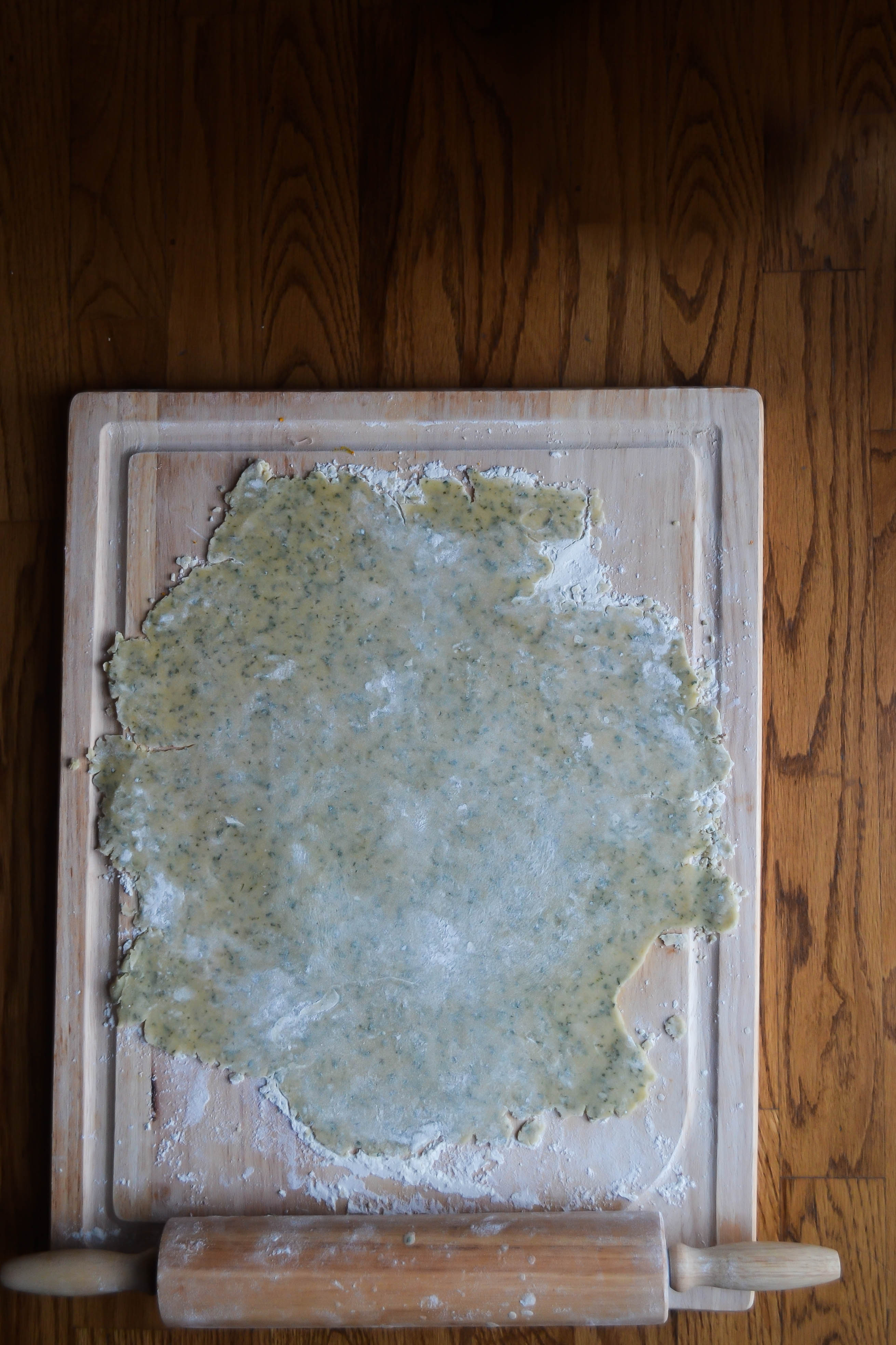
When the dough disk is cold and firm, bring it back to your floured board and remove the plastic wrap.  Roll it out, moving a rolling pin (or wine bottle) in a few strokes straight away from you and back toward you only.  Avoid diagonal movements.  The dough will become a long oval.  Then, flip the dough over and turn it 90 degrees so you are facing a fat, flour-drenched oval instead.  Roll again, still moving the rolling pin straight away from and back toward you.  Repeat this process until you have a rough circle an inch or two larger than the diameter of your pie plate.

Lightly roll half of the dough around your rolling pin and drape it loosely into the pie plate, unrolling as you go, letting the crust settle into the dish.  Trim, crimp, or fold over any dangling edges as aesthetically as you are able.

Set aside (or perhaps return to the refrigerator?) while you make the filling.

Preheat the oven to 350F.

Heat some olive oil in a skillet over medium-high heat.  When it is shimmering, add the mushrooms and give them a good stir, taking care that as many as possible have contact with the bottom of the pan (that is, don’t leave them piled atop one another if you can help it).  Then leave them alone for a good five minutes, or until they begin to develop a golden crust.

While the mushrooms are getting golden, steam or microwave the broccoli florets until they are just crisp-tender and still very bright green.  Set them aside.

Turn your mushrooms and let them sizzle for another five minutes or so.  When they are golden on both sides, turn the heat down to medium and add the onions.  Cook until soft and translucent.  Toss the broccoli in the pan, then add salt and pepper to taste.  Mom often adds tarragon or marjoram at this point as well – start with ½ tsp and see what you like.  Remove from heat and set aside to cool for a few minutes.

While the vegetables cool, beat the eggs and milk together.  Add a dash of grated nutmeg, if you like, or some cracked black pepper.  As the quiche bakes, this will become a lovely firm custard.

To assemble, fill the pie crust with the vegetables, spreading them in an even layer.  Gently pour the custard over the vegetables.  Toss the shreds of cheese together and spread them evenly across the top of the filling.

Bake for 50-60 minutes, or until the cheese is golden and the quiche has puffed in the middle.  If it’s not puffed yet, it’s not done.  The ingredients will be cooked through, but when you cut into it you will find a disappointing watery layer at the bottom.  Give it another few minutes.

With the center puffed and the cheese sizzling, remove the quiche from the oven and let it sit for 5-10 minutes so the cheese can solidify a bit and doesn’t string all over when you try to cut through it.

Slice and serve. Food Blog January 2013-0418

Happy New Year!

Food Blog 2011-2013-0362

Oh friends, it happened.  I made it.  Yesterday I made the last two Bittmans on my list and completed, albeit a year later than I’d originally intended, my project.  I have reflections to share, certainly, and I have changes and excitement and promises for the new year, but first, I think, let’s work with the program.  Two Bittmans.  Two reports:

“14. Steam or poach 2 cups of pumpkin cubes until tender. Meanwhile, sauté 1 cup sliced shiitake mushroom caps in vegetable oil with a few drops of sesame oil. Boil 4 cups water and whisk some of it with ⅓ to ½ cup of miso. Stir miso mixture, pumpkin and mushrooms into water and heat everything through, then serve, drizzled with more sesame oil.”

Because we were planning to reach midnight by eating as many snacks as possible eating our way to midnight snacking, I wanted a light dinner to precede the countdown.  This seemed to fit the bill.  And it had to, after all, since it was the only soup left and the calendar was screaming December 31st.

2 cups peeled, cubed butternut squash (I had some in the fridge, and suspected pumpkin would be hard to find)

1 1 oz. package dried shiitake mushrooms

1 TB vegetable oil

¼ tsp (or to taste) toasted sesame oil, plus some for drizzling

3 packets instant tofu miso soup mix (all I could find at my grocery store)

water

white wine

To reconstitute my shiitake mushrooms, I soaked them in a mixture of white wine and almost boiling water for 15-20 minutes, until they were plump and soft.

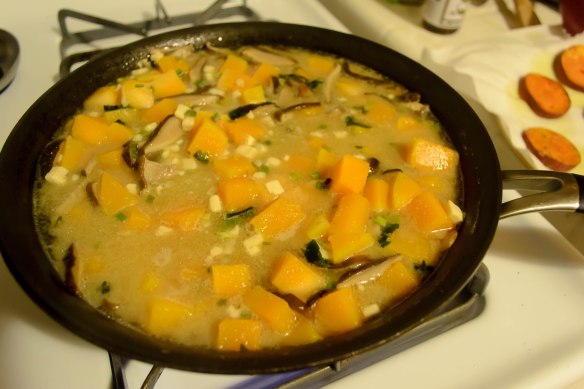
While the mushrooms soaked, I cubed up my butternut squash and submerged the pieces in a pan of salted water.  I brought this to a bare simmer and cooked it just until the squash pieces were tender – 10-15 minutes – then drained the pieces in a colander.  Don’t overcook them, because they will start to fall apart.  Set the squash pieces aside.

When the mushrooms were tender, I scooped them out of their bath and decided the remnants shouldn’t go to waste.  I poured the soaking broth into a little pot to bring to a boil, so I could use this already flavored liquid as the base for my soup.  While it heated, I stemmed and sliced the mushrooms.

Since the shiitakes were now basically cooked, I probably could have skipped Bittman’s sautéing step.  But honestly, I’m not one to pass up the opportunity to ingest sesame oil, so I dutifully dribbled vegetable oil with a few (or a few more than a few) drops of sesame oil in the (drained and dried) pan I’d used to simmer my squash and sautéed the mushroom slices over medium heat until they dried out a bit and started to take on some color.

While this colorization happened, slowly and so aromatically, I made the broth.  I poured all three miso soup seasoning packets – tofu and seaweed and all – into a small dish, then mixed in about ½ cup of my heated mushroom soaking liquid and whisked gently to dissolve the powdery soup mix.  This created a slightly thickened slurry, which I poured with the rest of the liquid and the butternut squash cubes into the mushroom pan.

Food Blog 2011-2013-0341

After a few moments of reheating, we dipped up bowlfuls and ate.

Food Blog 2011-2013-0343

N. wasn’t sure (he sometimes takes issue with the texture of reconstituted mushrooms), but I inhaled it with devotion.  I love the flavor of miso soup, and the mild sweetness of butternut squash against the salty umami and fleshy squish of the mushrooms was lovely.

Food Blog 2011-2013-0347

It was light but still satisfying, and the tofu and vegetables from the soup mix were so welcome that I’d advise you, if you are using straight miso rather than a pre-mixed, additive laden packet, to consider adding some tofu or seaweed or green onion just to contribute a little substance and contrast to the soup.

Food Blog 2011-2013-0348

Dinner done, we moved on to the second stage of the evening.

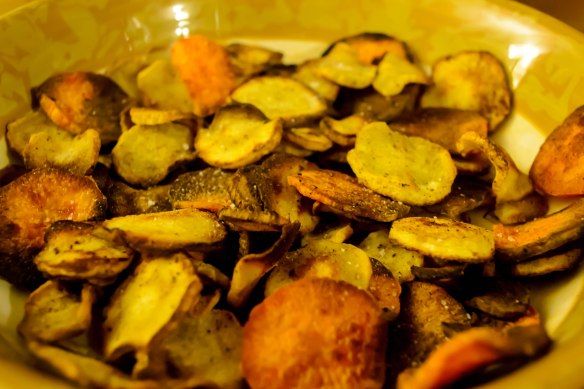
“89. Vegetable crackers: Slice beets, sweet potatoes, plantains or parsnips or all of the above into 1/8-inch disks (a mandoline is helpful) and toss lightly in olive oil. Spread the slices on baking sheets, sprinkle with salt, pepper and, if you like, other seasonings and bake at 400 degrees for 10 to 12 minutes. When browned, flip the chips over and bake for another 10 minutes or so.”

This sounded tasty, and I’d always intended to make it for a party.  With a dear friend coming over to ring in the new year with us, and since hunks of cheese alone might be deemed a slightly imbalanced offering (though so, so delicious…), this seemed like a perfect opportunity.  Beets were out of the question (N.’s nemeses since childhood), and I couldn’t find plantains in my grocery store’s produce section, so we were left with the nutty herbiness of parsnips and the always dependable earthy sweetness of sweet potato.

3 medium parsnips, peeled

½ large sweet potato, peeled

generous dose of olive oil (maybe ¼ cup?), plus more to grease the cookie sheets

1 tsp each (or to taste) salt, pepper, and garam masala

To prepare for roasting, preheat the oven to 400F and line two cookie sheets with aluminum foil.  Drizzle with olive oil and spread to cover the surface of the foil evenly.

While the oven preheats, tackle the vegetables.  I don’t have a mandoline, but I do have a ruler, and I must confess I did bring it to the kitchen to give myself a better idea of what 1/8 inch looks like.  My slices were not quite even, but they did verge on passable.  I tossed them – big coins of harvest orange and speckled white – in a glass bowl with the olive oil and the spices until they were evenly coated.

Food Blog 2011-2013-0339

Spread the vegetable coins across the cookie sheets in a single layer, not overlapping, not in piles.  If they cook in a stack, they will soften but not brown or crisp.  Stow them in the oven for 12-15 minutes, or until they are just beginning to brown.

This next step is a true exercise in patience.  Unless you are far more talented with a spatula than I, you will have to flip each piece over individually.  You have to, because otherwise one side will burn and the other side will flutter limply into cooked-but-not-crisp status.  Trust me on this one.  When you have laboriously flipped each coin, shove the tray back into the oven for another 10-12 minutes.

Food Blog 2011-2013-0342

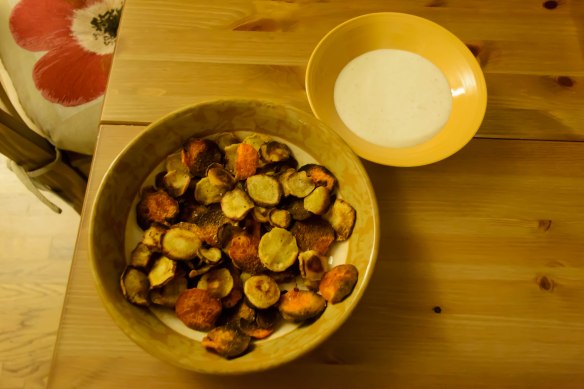
At this point, you’ll have to use your judgment.  My offerings were, after this additional time, cooked through but not remotely cracker-like in texture.  Another five minutes in the oven might have done the trick.  Putting them back in, failing to set a timer, and heading to the couch to eat dinner (I was trying to multitask) is not advisable.  I didn’t remember them until I smelled the slightly spicy aroma of parsnips, and by then it was too late – many of the little coins had gone from crackers to briquets.

I decided to pick out the worst offenders – Lucy reports that she didn’t mind a bit of charred flavor – and eat the salvageable ones anyway.

Food Blog 2011-2013-0356

To make them a bit more exciting (and disguise any lingering burned taste) I made a little dipping sauce.  You’ll need:

juice from 1 lime

2 TB honey

1 tsp garam masala

½ – 1 cup Greek yogurt

Whisk the first three ingredients together with a fork until they are smooth.  In increments, add Greek yogurt until your sauce reaches the desired thickness.  Mine was about the consistency of ranch dressing, but much more interesting in flavor.

Food Blog 2011-2013-0349

These crackers (with and without the sauce) were – if you were able to overlook the overcooking – a nice alternative to crudites or store-bought crackers.  They weren’t quite as crispy (except the ones that were too crispy), but they had a lovely deep flavor and none of the powdery, processed taste some crackers can have.  They are also a gluten-free offering and, minus the yogurt and honey sauce, vegan as well.

Food Blog 2011-2013-0350

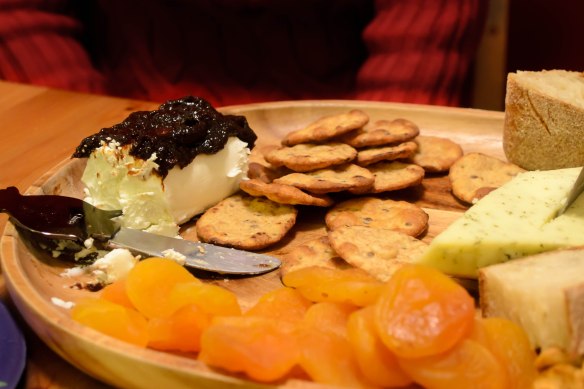
I served them alongside a cheese platter,

Food Blog 2011-2013-0353

Food Blog 2011-2013-0354

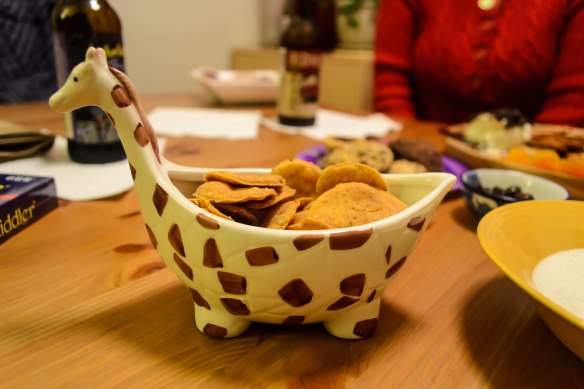
Joy the Baker’s chili spiced sharp cheddar cheese crackers,

Food Blog 2011-2013-0352

assorted sweets,

Food Blog 2011-2013-0355

and my appetizer version of Bittman’s “Marshmallow Topping for Adults” dish: thick discs of sweet potato roasted until tender, topped with a dollop of cream cheese and sprinkled with a pecan brown sugar blend before being broiled until the sugar bubbles and the cheese slackens toward melting.

Food Blog 2011-2013-0357

Food Blog 2011-2013-0359

And champagne, of course.

Food Blog 2011-2013-0361

Happy New Year.  I hope you celebrate your achievements, meet your goals, and find happiness in your own self.  I’ll be checking in again later this week with some reflections and announcements.  Welcome to 2013.

Giving thanks

The house feels empty.  Wednesday through Saturday, my family visited for Thanksgiving.  This morning, with them on the road home, fog hovering sticky in the sky, the cheery burgundy tablecloth in the washing machine, and a stack of lingering dishes I’m trying to ignore proclaiming themselves from the sink, our little home was stark and cold.  I could say that the memories of the holiday will keep me warm, but that would only be true in a metaphorical sense.  What I really want is another baked apple.

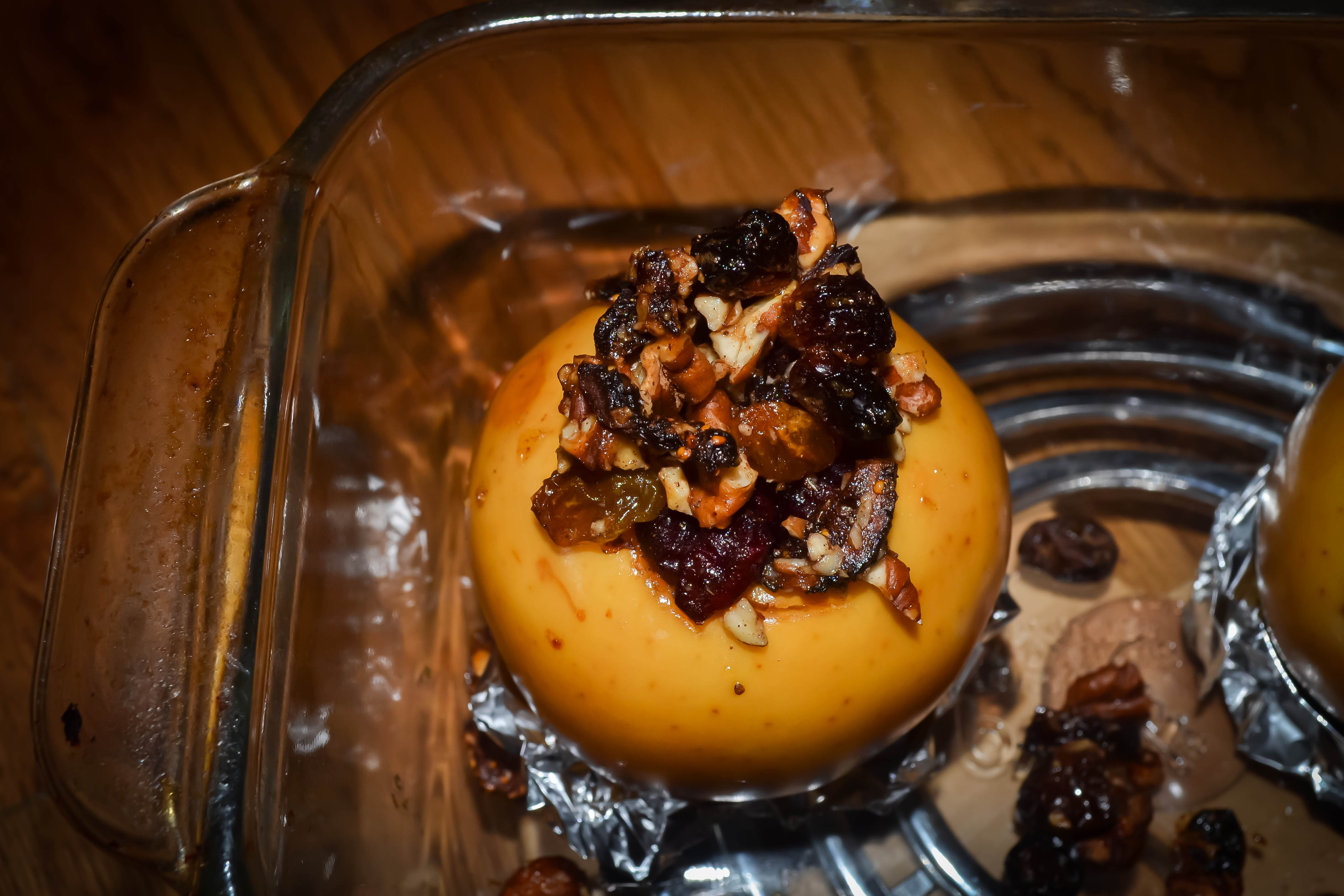
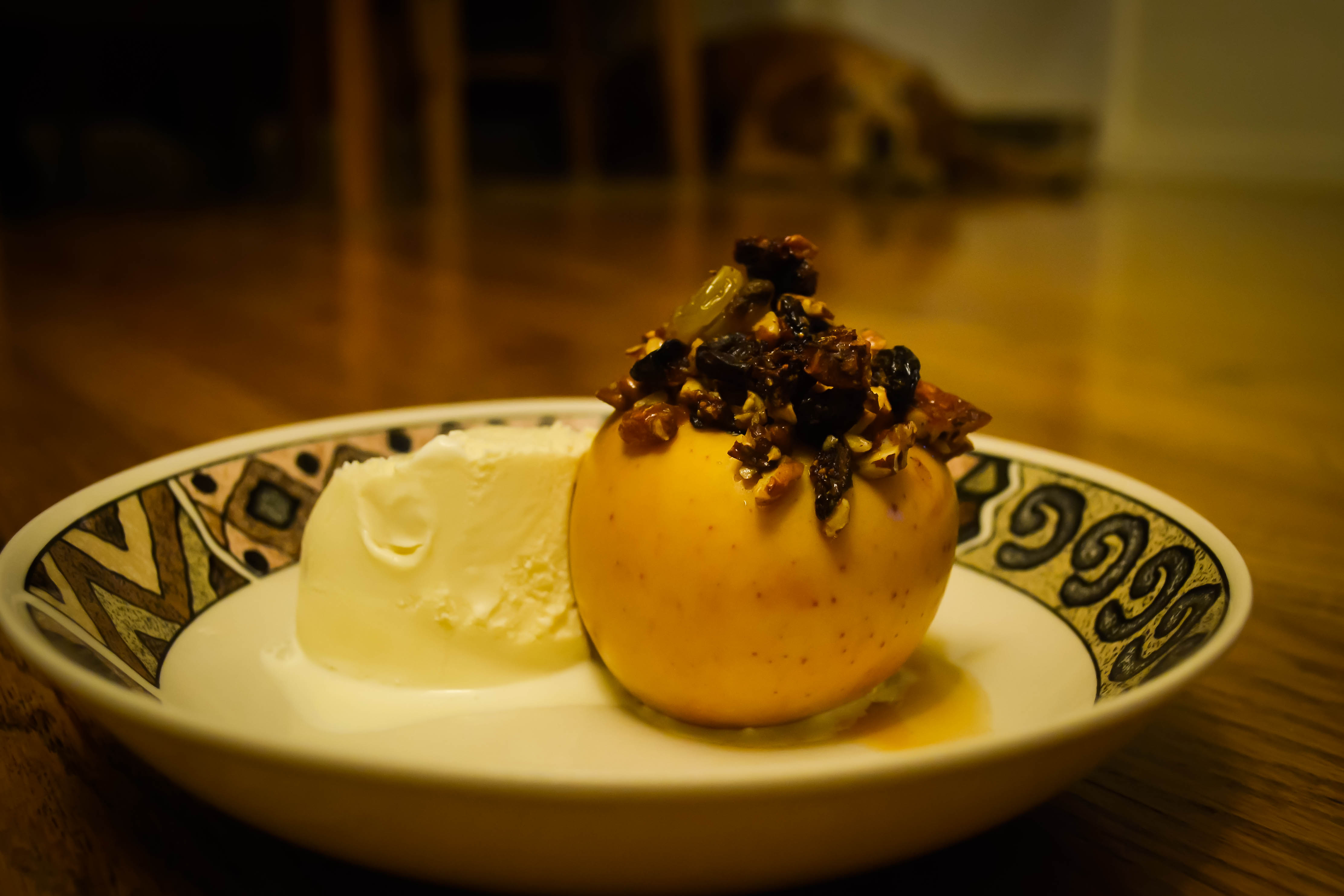
90. Baked Apples: Combine chopped pecans and chopped dried fruit (raisins, dates, figs, cranberries all work) and toss with maple syrup and a sprinkle of cinnamon, allspice or nutmeg or all three. Fill the cavities of cored apples with the fruits and nuts, dot each with butter, put into a baking dish and roast about 30 minutes, until tender. Better with vanilla ice cream.”

We had a few small apples from our local Farmers’ Market waiting for attention in the fruit bowl, so I set about collecting partners for them to make a dessert for two.

2 small apples

¼ cup chopped pecans

¼ tsp pumpkin pie spice (I agree with Joy the Baker that we should probably just make our own, but if you, like me, purchased some in a moment of confused weakness, this seems a harmless way to put it to use)

1-2 TB each:

chopped dried figs (I used black Mission, my current favorite)

craisins

golden raisins

3 TB maple syrup

Preheat the oven to 350F.

Core the apples, keeping the bottoms intact if you can.  If you can’t, just wrap the bottom quarter or so in aluminum foil and set them in a baking dish.  This will keep the filling from escaping.

In a small bowl, combine the nuts, fruit, and spice(s).  Drizzle in the maple syrup and stir gently to combine – you want even stickiness throughout.

Using a small spoon, or your fingers, insert as much filling as you can into the cored apples.  You will notice that this quantity makes about twice as much as you need for 2 small apples.  That’s okay.  The leftovers are a fantastic topping for oatmeal the next morning.

Once full, stow your apples in the oven for 30 minutes, or until they are tender when pierced with a knife.  Liberate, evacuate to a dessert plate, and pair with vanilla ice cream.

These were a lovely dessert.  They felt light, because they were primarily fruit, but were still sweet enough to satisfy that after-dinner craving.  The apples still had some resistance, but were warmed through and starting to collapse into themselves.  The ice cream was a perfect accompaniment – I wouldn’t want this dessert without it.  I might ideally have chosen an apple with more tartness to contrast against the sweetness of the syrup and dried fruit, but in such a case, especially if the apple were on the large size, I would advocate a longer baking time.  If the fruit and nuts protruding from the top of the apple start to brown too much, give them a tinfoil hat to hide beneath.


“84. Sage Crackers: Pulse 1 cup flour, 1 teaspoon salt, ½ cup Parmesan and 4 tablespoons cold butter in a food processor. Add ¼ cup cream and 1 tablespoon finely chopped sage.  When just combined, roll as thinly as possible, score into squares, sprinkle with salt and bake at 400 degrees until golden.  Let cool, then break into pieces.”

I’ve always liked a nice cheese-and-crackers platter as an appetizer option, and these seemed like a good option to lead into the big Thanksgiving meal: relatively easy to make, but impressive – who wouldn’t be staggered by the effort of making homemade crackers even with a homemade feast to produce as well?

Bittman’s directions and quantities here are pretty specific, so I just followed his directions.  I omitted the salt, because Parmesan carries so much of its own tangy hit, and my parents are not big salt eaters.  It should also be noted that pulsing this mixture until just combined does not create a rollable dough, unless my idea of “just combined” is different from Bittman’s.  However, turning out the just-clinging crumbs onto a floured board and kneading for only a minute or two does produce a nice textured ball of dough that can be rolled out with minimal sticking.

I’d recommend aiming for a shape as close to a rectangle as possible.  Further, roll that rectangle to the size of your biggest cookie sheet.  That way you can carefully transport onto the greased or parchment-lined sheet tray by draping the dough loosely over the rolling pin.  Score it very gently into rectangles or squares of your chosen size (cut halfway through the dough with a knife, not all the way through), and into the oven with it!

When I checked these 20 minutes later, they were a little more golden than I wanted.  They were, in fact, heading toward a burnished bronze (is that not the kindest way ever of saying they were all-but-burned?).

After the cracker sheet had cooled for a few minutes, I broke it along the scored lines into neat (mostly) rectangles and we passed around a few samples.  The outside edges, which were thinner, had a slightly over-toasted flavor we didn’t love.  The inside rectangles, though, were crisp and flavorful, with a flaky – almost chalky – texture reminiscent at once of pie crust and shortbread.  My dad in particular, who enjoys this texture, thought they were great.

And now the confession: my final Bittman for this week is a bit of a cheat.  But I’m okay with that, because I also think it was a bit of a cheat for him, though in the best and most useful way.

“101. Buy some cheese. Unwrap it and put it on a plate with some walnuts and fruit; let come to room temperature. Serve with good bread.”

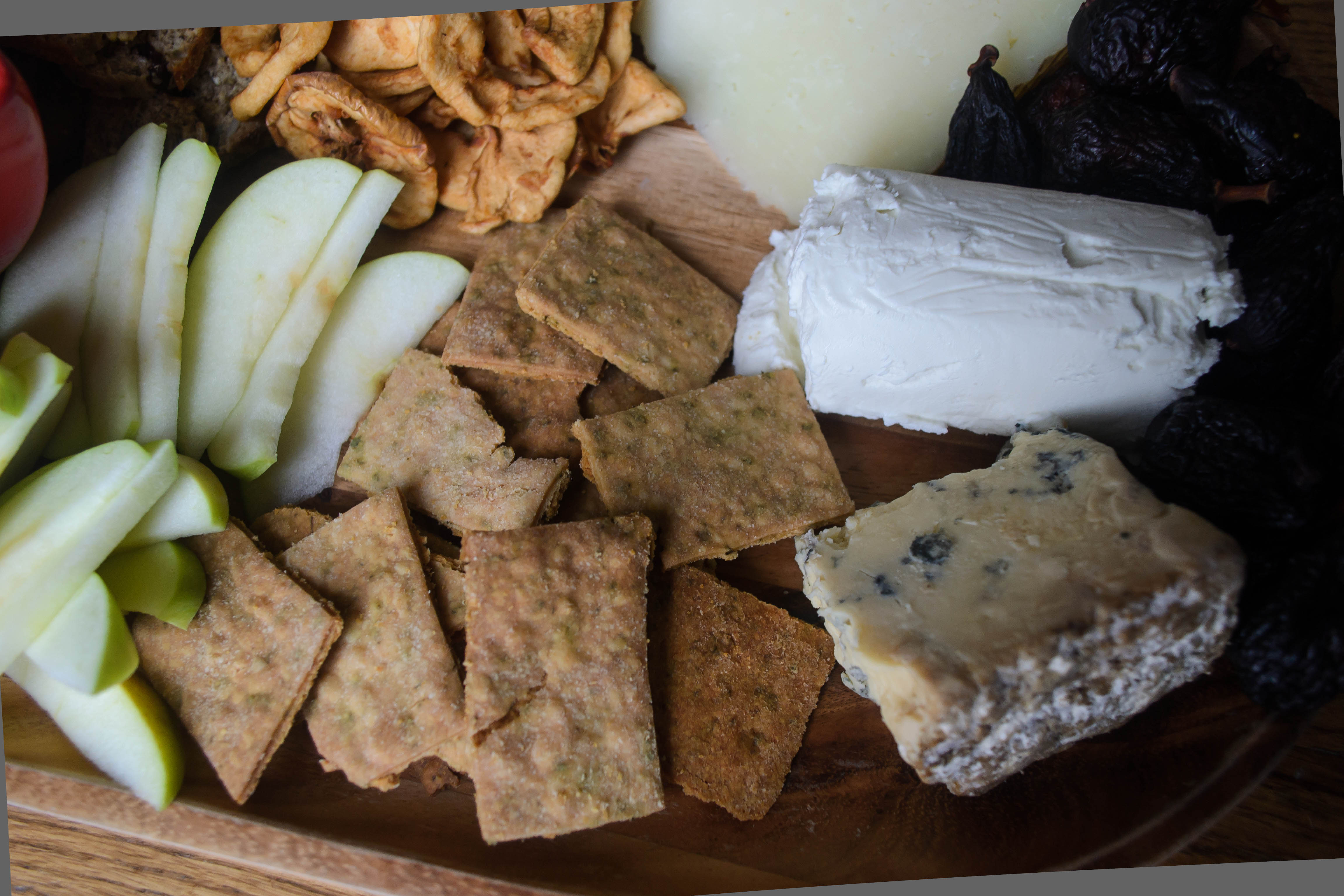
This is the final numerical entry of the list, and that means it’s in the dessert category.  While I accept that some people prefer a cheese course to dessert, I’m not sure I consider this an acceptable option for Thanksgiving.  It is, however, acceptable as an appetizer idea, as I mentioned above.  So that’s what I did.  In addition to the sage parmesan crackers above, I made my favorite craisin rosemary biscotti-style crackers with white bean and almond dip, and set them all out with some creamy Stilton, a nice rich chevre, and a wedge of Manchego obtained from a stand at the Farmers’ Market where we finally decided we’d had too many samples to feel right about not purchasing.  Surrounding these, I added dried apple rings, black Mission figs, and a fresh Granny Smith cut into slim slices.  The walnuts, which I was ready to add as well after a brief toasting, were subjected instead to accidental scorching, and had to be sacrificed.  We will speak of them no further.

What can you say about a cheese platter, besides that it was delicious?  We adored the Manchego, and soft crumbles of Stilton paired well with the fresh apples.  I tried fig and goat cheese together, and now I think chevre-stuffed-figs sounds like an amazing experiment.  We decimated the platter in little over ten minutes, but thankfully were not too stuffed to take full advantage of the turkey dinner that followed.

With Thanksgiving handled, that leaves only five weeks of 2012, and only twelve Bittman selections to go!  New Year’s Eve is on a Monday, but that still counts as this year if I need to jam in a few final selections, right?

I think I can, I think I can, I think I can…