Bars and Biscuits

Thyme for our herbed biscuits

Last week’s reflections were a bit morose: the thoughts of a person overwhelmed and trying to settle into some kind of groove.  Because while too deep grooves can become ruts, no groove at all just leaves us… squares in a hipster-filled world?  Not just squares, but squares tipping and zig-zagging confusedly over an unfamiliar landscape trying to dig a corner in here and there.  New home, new job, new routine, and no chances to explore yet.

All that has changed.  Shallow wheel marks dig in behind us.  Our adventures have begun, and they began (don’t be offended) with booze.

Last Friday, our dear friend J. appeared at the door, bearing duty-free Japanese whiskey from his time in Tokyo, and a phone full of bar recommendations from an associate.  After a quick tour of our new digs (you guys have a backyard?!), we set off into the night and ended up at Oldfield’s Liquor Room on Venice, where J. bought me a pre-birthday cocktail called the Blonde Comet.  Bourbon, crème de peach, fresh grapefruit juice, and angostura bitters.  I’m not much of a bourbon gal, but the name was too good to pass up.  I like to think of myself as something of a blonde comet every once in a while… The drink was tasty.  Strong, but tempered by the freshness of the grapefruit and the stem of fresh mint they plunged in as a garnish.

We caught up over this first round and then decided to explore further.  A quick amble down the street brought us to Bigfoot West, but it was so crowded and loud inside that not even the promise of creative whiskey cocktails could entice us.  We were back in J.’s car and rolling toward Santa Monica.

We ended up at The Daily Pint, where it smelled like peat and old shoes and yeast, and the impressive chalkboards full of beer options and the seemingly endless whiskey and scotch menu made J.’s and N.’s eyes shine suspiciously.  I got (don’t laugh) a pint of Spiced Caramel Apple Ale that was neither as sweet nor as fruity as it sounds.  J. and N. got something peaty and boggy and fiery, and I only needed a whiff to know I wasn’t interested.  We settled ourselves in at a tall table next to the pool and shuffleboard stations.  You must know this: I don’t like beer.  When I have to, I will settle for the fruitiest, sweetest, most un-beer-like option I can find, and when I do, I like it to be ice cold so it doesn’t have a chance to taste as much like beer as I know it’s going to.  As we sat and chatted and laughed, time passed and my beer warmed.  Where it tasted like yeast and carbonation to begin with, as it came to room temperature the flavors got rounder and deeper, and by the time I was sipping the last half inch or so in the glass it did have some spicy apple flavors to it.  I’m not sure I would order it again, but it wasn’t a bad beer, and the company and high energy atmosphere made it a good experiment.
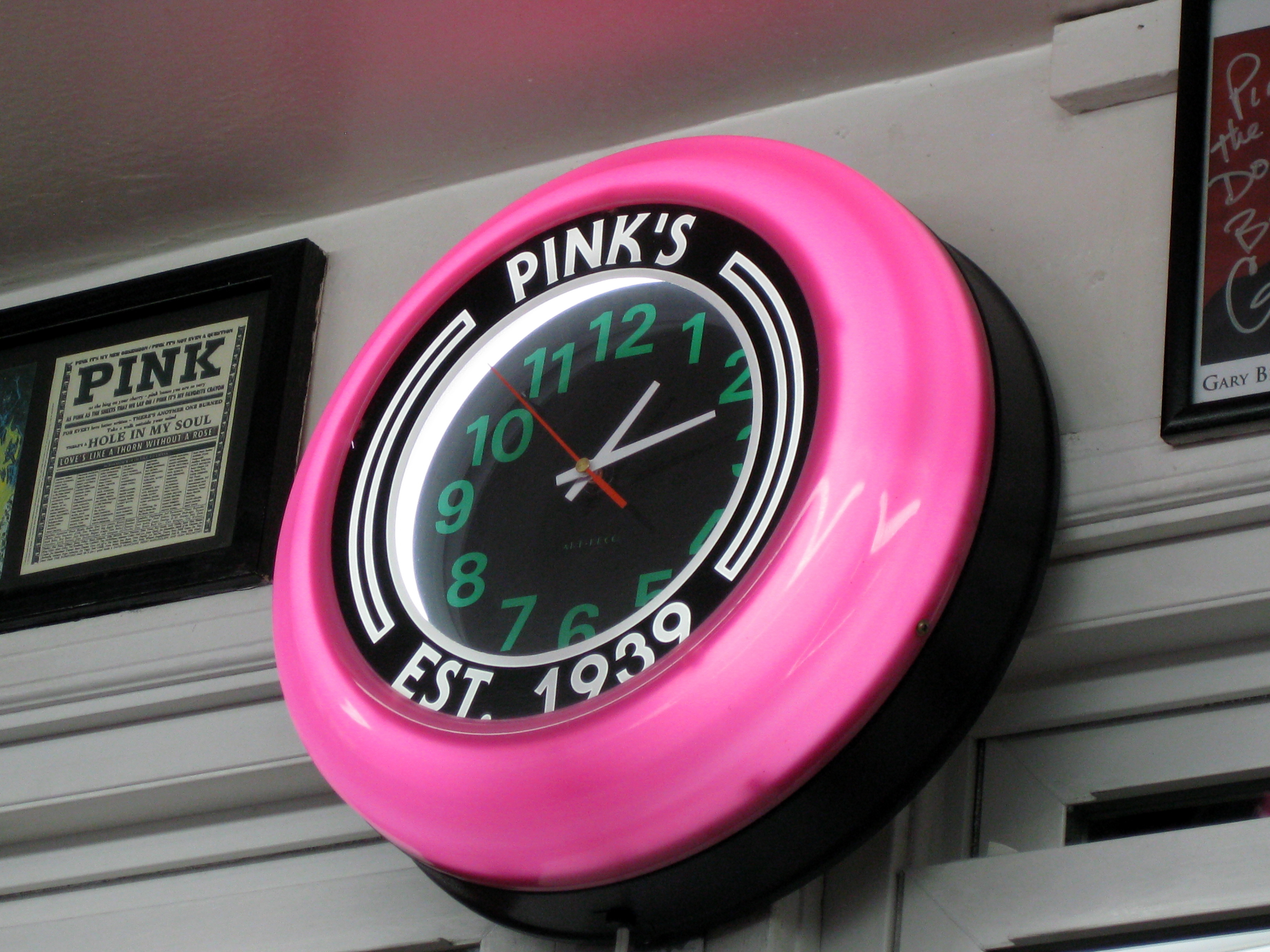
It was almost midnight when J. asked if we wanted a snack.  He was thinking, he said, hot dogs or pastrami.  I’ve been experiencing some cognitive dissonance when it comes to our new location – scoffing when I see patrol cars that say LAPD on the side: what are we, in a movie or something? – grinning with disbelief as I pass Warner Brothers studios on my drive home from work – but something about that night made me remember where we were.  I just knew he was thinking of Pink’s.  Did I want to go to the little stand with the most famous hot dogs in the state?  Yes.  Yes I did.

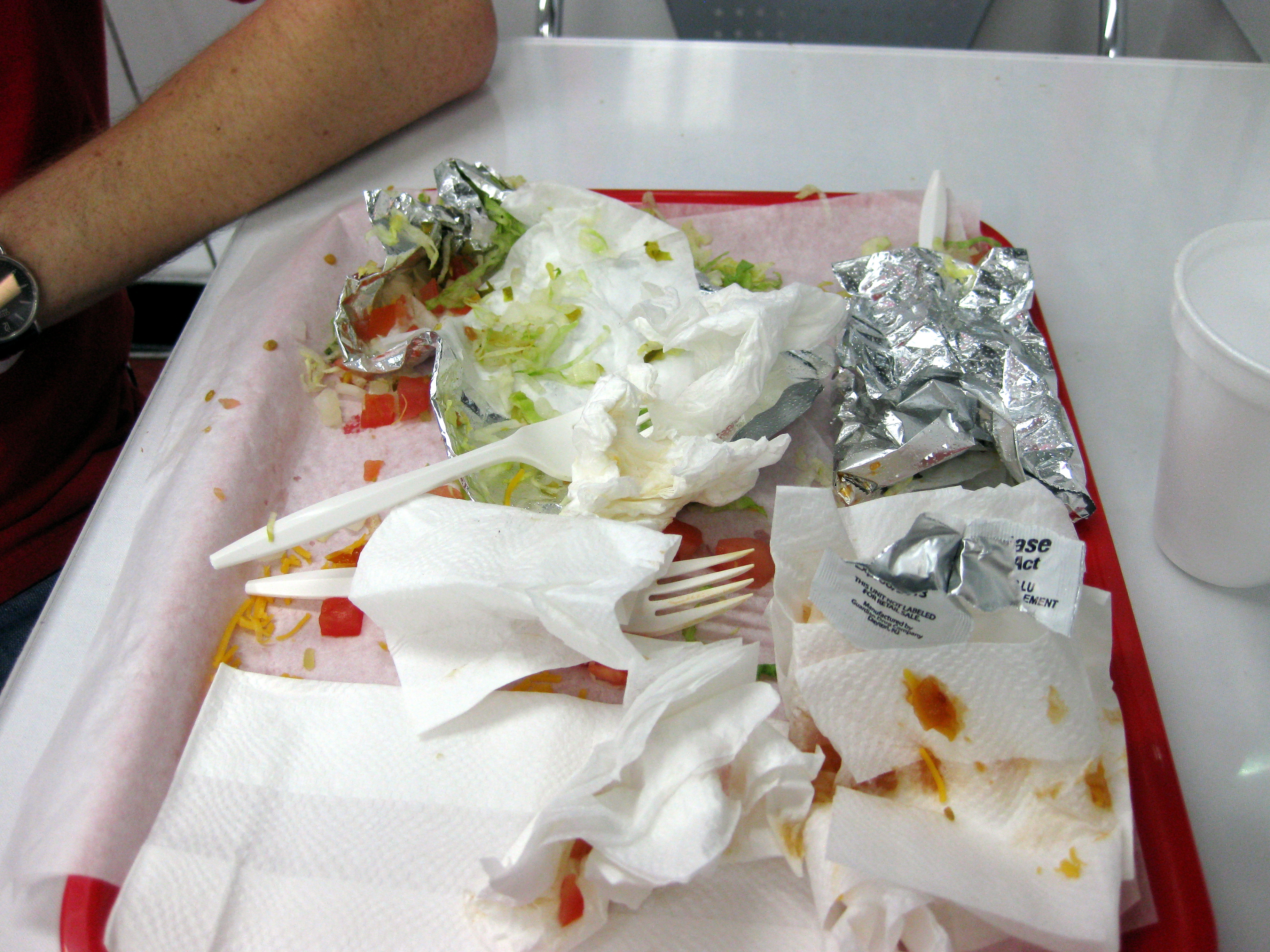
At almost 1am, as my contacts screamed and the almost-responsible-adult inside me withered and gave up, we were standing in line with at least 30 other people, waiting for a hot dog. 


I got a New York dog – traditional hot dog topped with a sweet onion sauce – and added shredded cheddar cheese.  N. and J. got Chicago dogs, loaded with lettuce, tomato, and pickle.  We sat at a crooked little table and took in the space: dozens upon dozens of signed celebrity photographs who had visited Pink’s, some of whom had given their names to a hot dog.


 

Well, N. and J. took in the space.  I took in my hot dog.  It was fantastic.  The skin was taut and crisp and snapped between my teeth.  The onion sauce was thick and sweet with hints of caramel, like the best sweet and sour sauce you’ve ever tasted, and the cheese, though it could have been melted more, added a nice mellow counterpoint to the meat and the sauce.  Delicious.  And it made me feel like a kid: I was back to the nights in high school when, after band competitions, we used to go to Denny’s and order chili cheese fries and chocolate milkshakes.  Those were the days before we knew heartburn was real…
There really is no logical transition I can make to this week’s Bittman, aside from the lame play on the White Stripes song I provided as the title of this post, so let’s stop pretending and just talk about biscuits.  And let’s not take our sweet little time about it.

85. Herbed Buttermilk Biscuits: Combine 3 cups flour, 2 tablespoons sugar, 4 teaspoons baking powder, 1 teaspoon salt, 1 teaspoon baking soda and 1 tablespoon thyme leaves.  Use your fingers to rub in 1 ½ sticks of butter until the mixture resembles small peas.  Add 1 cup buttermilk and stir until just combined.  Drop large spoonfuls onto a baking sheet and bake at 425 degrees until golden, about 15 minutes. 

With measurements and oven temp clearly provided, I had very little to guess about or change in this recipe.  Because I was using lemon in other parts of dinner, I decided on the spur of the moment to add a teaspoon or two of lemon zest to the dough to see what would happen.  You could probably change up the herb used, add cracked black pepper or flaky sea salt, or even add finely chopped raisins.  I wouldn’t change the buttermilk, though, as the tang it adds is entirely necessary.  I even got excited tasting the raw dough, with a slight crunch from the salt and a suggestion of sweetness from the tiny bit of sugar.

The bowl of dough produced 15 biscuits.  I put nine on my greased baking tray and the other 6 on a plastic-wrap-lined plate in the freezer for another occasion.  After 15 minutes in the oven, they were browned on top, slightly crunchy around the outsides, and knee-waveringly fluffy inside.  Quash your fears about the amount of butter here: it really makes a worthwhile textural difference.  It doesn’t hurt the flavor either – these were rich but light, and the buttermilk and lemon zest added intriguing sourness that brightened the mixture and made them more interesting than your standard dinner biscuit.
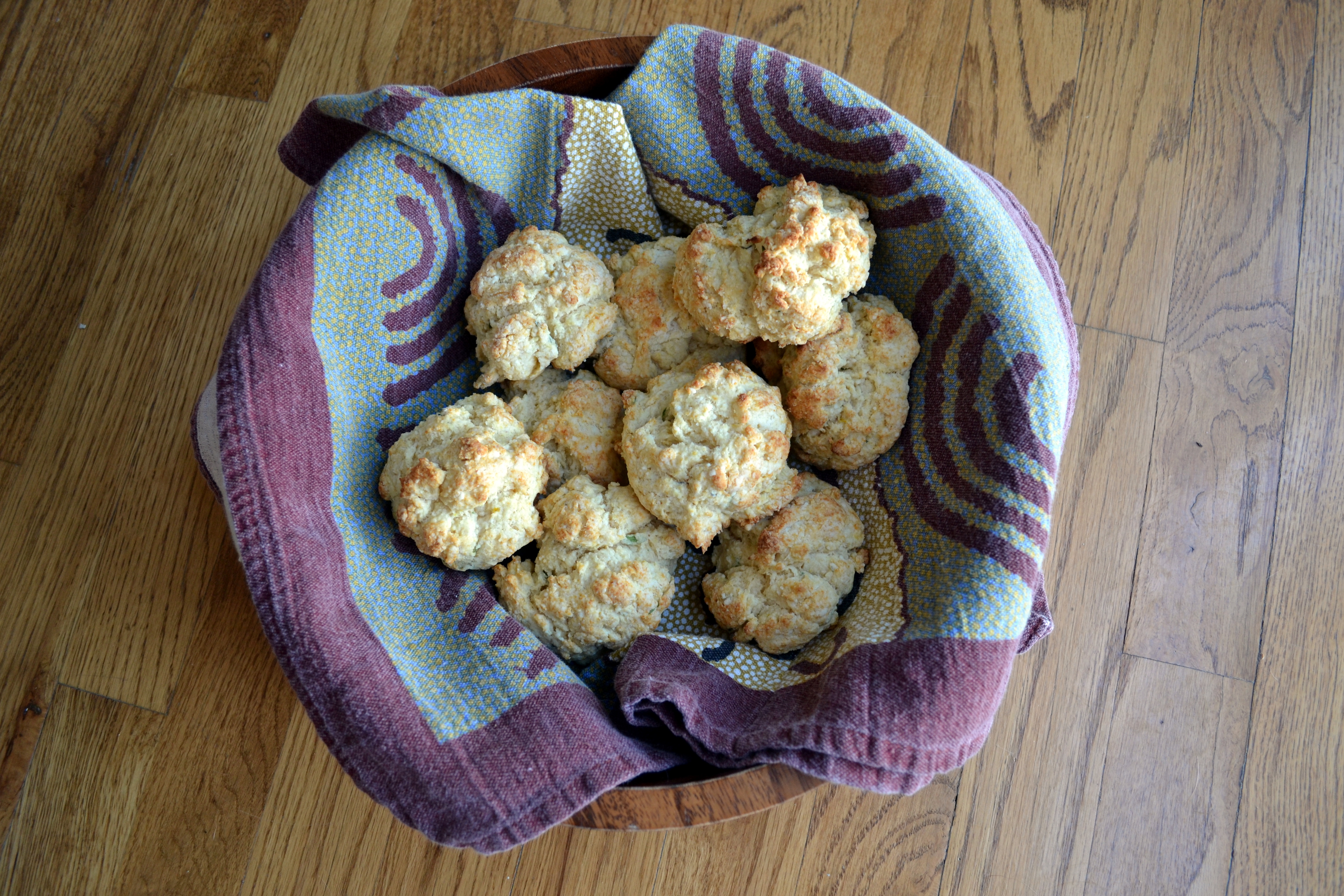
We ate these – no, that’s not right – we wolfed them down alongside grilled chicken sausages and grilled planks of zucchini wrapped around a mixture of goat cheese, lemon juice, thyme, parsley, and pepper.

It was delightful.  And here’s the delicious secret: if you end up with some leftover goat cheese mixture, and you whip in some honey, and then if you happen to split one of those fluffy delightful biscuits down the middle and perhaps toast the open sides in a toaster oven or under the broiler for a moment, and dollop a hefty tablespoon of the sweetened goat cheese on top, and eat it, you have the most delightful little end-of-summer breakfast biscuit you’ve had in years.  And if you’d been out late the night before and perhaps chased some whiskey with a hot dog, a sprinkle of extra salt in the goat cheese filling would make this a quite decent hangover breakfast too, as a cure for excessive adventuring.

Next week we settle more comfortably into this lovely little groove we’re making for ourselves: another restaurant, another Bittman, another decade(!), of our new little lives.

Snakes and Ladders

It’s a classic children’s game.  Climb a ladder: advance!  Land on a snake: tumble backwards.  And so it goes with most ventures.  Last week newness delighted me.  This week I’m plodding a bit, experiencing not setbacks, exactly, but settling for lackluster(ness?)(ocity?).  I’m discovering things I don’t love about my syllabus.  I’m wading through class prep.  Students are still (still!  The third week is about to start!  Papers will be due soon!) adding my classes, which means I am overenrolled and there are new faces every day.  And though I’m mostly inspired in my kitchen, not every dish is a triumph.  Some slip a little.  Some slither into lackluster.  But it’s our job, as cooks, as experimenters, as eaters, as humans – and pardon me while I get a bit metaphorical – it’s our job to take this as a challenge.  Make it work, as Tim Gunn continually reminds us.  So we squirm ourselves around and push back toward the ladders.  And sometimes, even after a devastating slide, we climb a few steps.

70. Blanch, shock in cold water, then julienne green beans, daikon and carrots, chill. Whisk soy sauce with honey and lemon to taste; pour over vegetables.”

The most important thing to note about this particular Bittman combo is to leave yourself enough time, particularly if your knife skills are not perfect.  It is not possible to concoct this dish in anything but a zone of utter frustration and simmering disappointment if you only have twenty minutes until dinnertime.  Here’s what I did:

3 carrots, peeled and cut into thick sticks

1 6-inch chunk daikon, peeled and cut into thick sticks

½ lb. green beans, rinsed and stemmed

3 TB soy sauce

2 TB lemon juice

1-2 TB honey

I dropped the carrot and daikon sticks into a big pot of boiling, salted water and let them cook for 2-3 minutes, until they had give between my teeth but still put up a bit of resistance.  I plunged them into ice water and put the tailed green beans into the boil.  This was the point at which I ran into trouble.  Performing a nice julienne on a pile of veg takes some time and some patience, and on this particular day I lacked both.

Nevertheless, cut each thick stick of carrot and daikon into thin slices (Food Network calls them panels), then turn those slices to cut long, thin vertical strips.  You want uniformity but also thinness, since these are only partially cooked, and you want even quantities of carrot slivers and daikon slivers.

At this point the green beans were overboiled and the sausages – the other component of our meal – were almost done on the grill, so I shifted into I-don’t-care-how-it-comes-out-just-get-it-done overdrive.  It happens.  You should julienne the green beans.  I just sliced them into strange vertical halves.  You should chill the whole salad until nice and crisp – probably at least half an hour – after lovingly tossing the thin sticks of orange, white and green together.  I shoved the bowl in the freezer for five minutes while I made the dressing.

I whisked the soy, honey, and lemon together and was satisfied with the flavor.  Were I making this again, I would definitely increase the quantity of lemon juice and maybe even add some zest, but I say it’s up to you.  Play with the combination until you like the ratios.

Dressed, the vegetables had a pleasant texture and tasted well seasoned, but the salad as a dish was missing something.  N. and I agreed that the dressing was a little one-note, and that note was soy sauce.  Flavorwise, things were also a bit on the dull side.  Red pepper flakes or raw garlic, we decided, or more or different acid, would have helped things along.  Maybe some chives or lemongrass or ginger or cilantro, and certainly pairing this Asian-flavored dressing with something other than Italian sausages, would have been the right move.

And so, in my attempts to slither back into success, I considered the leftovers.  They weren’t stars, but they could perhaps be supporting players.  In fact, though they were not the traditional combination, they seemed not so different from the vegetables that go into a bahn mi sandwich.  Setting off to work a morning or two later, therefore, I slathered a crisp roll with mayonnaise, piled up a good portion of drained veggie slivers and, lacking lunchmeat, topped the whole thing with slices of pepperjack cheese.  I know.  Cheese is not part of bahn mi either.  But jalapeño slices usually are, and the vegetables were crying for spice anyway.  It wasn’t the best sandwich I’ve ever had.  But it wasn’t a disaster either.  It was a few steps forward.  Keep moving forward.  On to the next ladder!

Emptying the Fridge

Big news, oh friends: come July, N. and I are moving.  We’re leaving Eugene, OR and heading south for Los Angeles, where N. landed a great job.

I’m sad about this, of course.  I love Eugene.  I love its beauty, and I’ve made some of the best friends and eaten some of the best food of my life here.  I don’t love the way the weather lately has been playing winter/spring/winter/spring/summer/winter on us, and I’m terrified it will pour on graduation day in a week or so.  But mostly I love it.

Yet this move presents the potential for plenty of new delights.  LA is a foodie paradise.  A quick search on Yelp for our new area revealed restaurants serving every kind of food I could possibly crave, and some I’ve never tried before.  Ethiopian will be new to me, as will Caribbean (outside of the ubiquitous and usually inauthentic jerk [insert your protein of choice here]).  The idea of being back in a place with excellent Chinese and Mexican food is overwhelming.  But it’s not just restaurant food that I’m looking forward to.  The Willamette Valley in Oregon boasts great growing conditions for lots of foods, including berries of all kinds, hazelnuts, and plenty of local produce.  But Southern California has so much, given its balmy temperatures year round, that buying and eating local food will suddenly become much easier – not even from farmers’ markets and farm stands, but even from the grocery store.  Avocados, citrus, grapes, all no longer destroy the locavore dream.  Even the backyard of the house we will be moving into has a lemon tree.  A lemon tree!  This excites me almost more than anything else about the whole situation!

Our upcoming relocation also presents a challenge.  N. and I have lived in our current home for four years.  We have lived in Eugene for six.  Over that much time, things accumulate.  Not just house things, like forgotten books and extra sweaters and skillets I shoved in the back of that cabinet N. hates when I replaced them with Circulon non-stick wonders.  Food things.  We have so many half-empty jars of condiments.  So many bags of frozen vegetables bought on a buy-one-get-one sale.  Blackberries from last summer and cranberries from Thanksgiving, carefully preserved on the shelves of my freezer.  Canisters of rice, and brown rice, and millet, and dried beans, and barley, and noodles in the pantry.  It’s a lot of stuff.

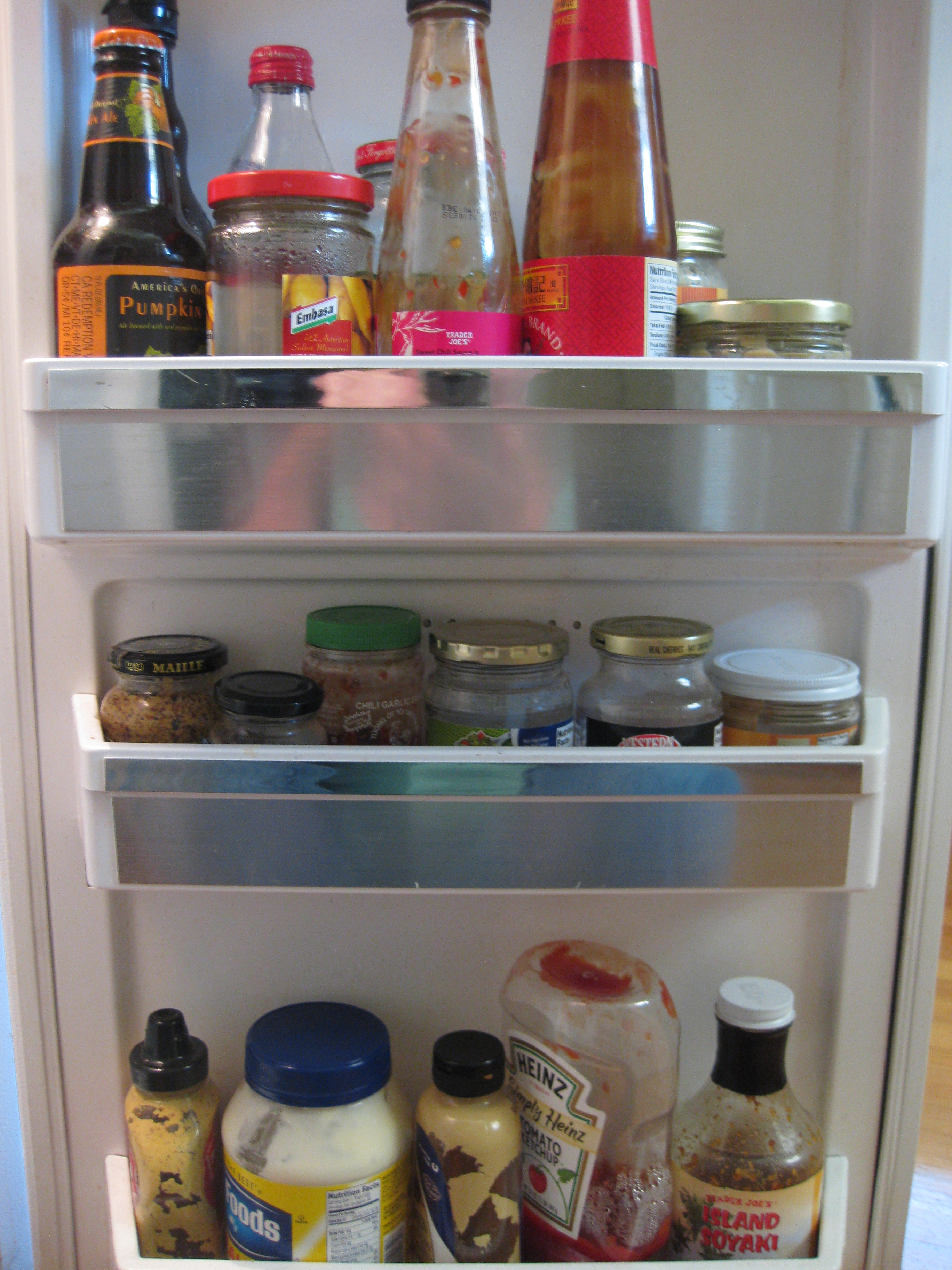
So here comes the challenge: interspersed with regular food posts and wedding cupcake practice and the occasional, still-kicking-because-I-can’t-bear-to-abandon-it Bittman dish, I will be instituting a new project.  I’m calling it “Emptying the Fridge.”  Each week when I make our menu plan, I’m going to try to incorporate at least one dish that requires the remnants – or a good quantity – of at least one refrigerator, freezer, or pantry item.  I’m not talking about things we use all the time, like yogurt or bread or eggs.  I’m talking about the minimal use items, like anchovy paste, or capers, or champagne honey mustard, or chili garlic paste.

This week, I have plans for several items, and though I may not eliminate them, I will at least make a dent in several jars.  After a barbeque a few weeks ago featuring a peanut noodle side dish, I decided I want to make Ina Garten’s Szechuan Noodles.  This requires a whole cadre of ingredients including peanut butter, soy sauce, rice vinegar, and various vegetables.  It also, of importance to this project, requires hot chili sauce and tahini.  Both of these items currently languish on my refrigerator door, awaiting stir-fries and hummus.  But this week, they will shine and diminish simultaneously. 

Other plans include a white bean puree I will invent (and post the recipe for, if it turns out well) to work on using up the four cans (four?  How can I possibly have four?) of white beans in my pantry, and peanut butter energy bars, which will help eliminate the giant canister of oats I’ve gotten too stubborn to turn into oatmeal.  At a certain point, you have to eat like it’s summer, even if the sky says it isn’t, don’t you?  But snack bars are a worthy and not-un-spring-like application.

This project is, I think, a combination of homestyle Iron Chef and Chopped.  Not only are there feature or star ingredients, but after a while the pairings of available options will become unusual and require a certain amount of ingenuity to use up.  I like this, because it prepares me for the Food Network show I will never have, which I would call “Empty Fridge.” EF would consist of me trying to use limited pantry and refrigerator items to create something delicious without having to make an extra trip to the store, so in essence it’s Chopped-at-Home.  The difference with my current project, though, is that I am not prohibited from shopping, and am in fact planning ahead based on the contents of my condiment collection to determine our dinners.

Come August, you can expect an abundance (after a short hiatus, most likely – moving and blogging don’t necessarily mesh well) of drooling and groveling over our new location and its diverse and numerous highlights.  But until then, you can look forward to quarter jars of mustard, forgotten marinated artichoke hearts, and hidden canned peaches in various applications.  Hopefully, in this case, not in the same meal…

Food from Fiction Potluck

So what does one do, you might ask, as a newly minted Doctor of Literature, unfettered from the everyday proletariat academic concerns?  Well, one grades, and one line edits, and one revises frantically, and frankly, one feels completely different and not different at all.  The school year isn’t over, even though (as of Tuesday, when I upload my “completed” dissertation to our Graduate School’s website) my degree is.  So my daily duties no longer include anxious preparing for the big day, but they still include student emails and lesson planning and reading.

But because they don’t include anxious preparation and last minute rethinking and nail biting about what the committee will think, these days can also include celebrations.  Last night was one such celebration: a party I’ve wanted to have for several years now.  The style: potluck.  The theme: “Food in Fiction.”  Interpretation: bring a dish inspired by or mentioned in a book.  That’s it.  There are so many vivid options in novel, drama and film, and our guests had only to choose one and recreate it in the material, taste-bud-bearing world.

We had tremendous fun, in brainstorming, in cooking, and in sharing the variety of dishes from books we love.  As I mentioned to one friend who thanked N. and I for the great party on his way out the door, this is a party we had to have before parting ways as many of us graduate this June, because only in this company could we feel so self-congratulatory and so excited about immersing ourselves in something so nerdy.

Here are a few of the dishes we enjoyed.  I suggested to folks that they provide the description of the food in question from its source text so guests would know what they were eating and which world it was taking them to.  We had Victorian sandwiches and High Modernism Stew nestling next to a magical realist chutney and a warm wassail of fantasy.  What wandering, all in one house…

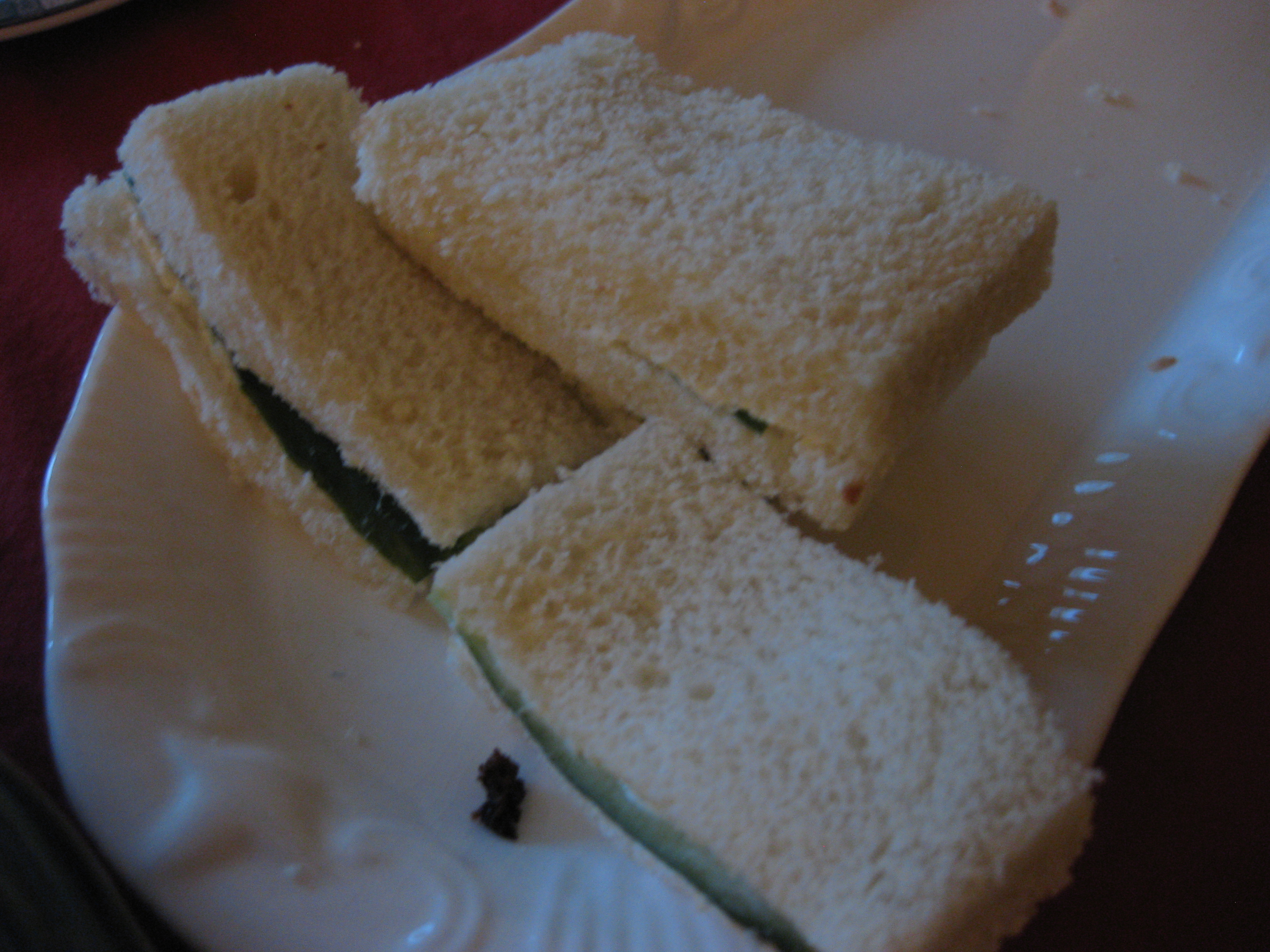
Cucumber sandwiches from Oscar Wilde’s “The Importance of Being Earnest.”

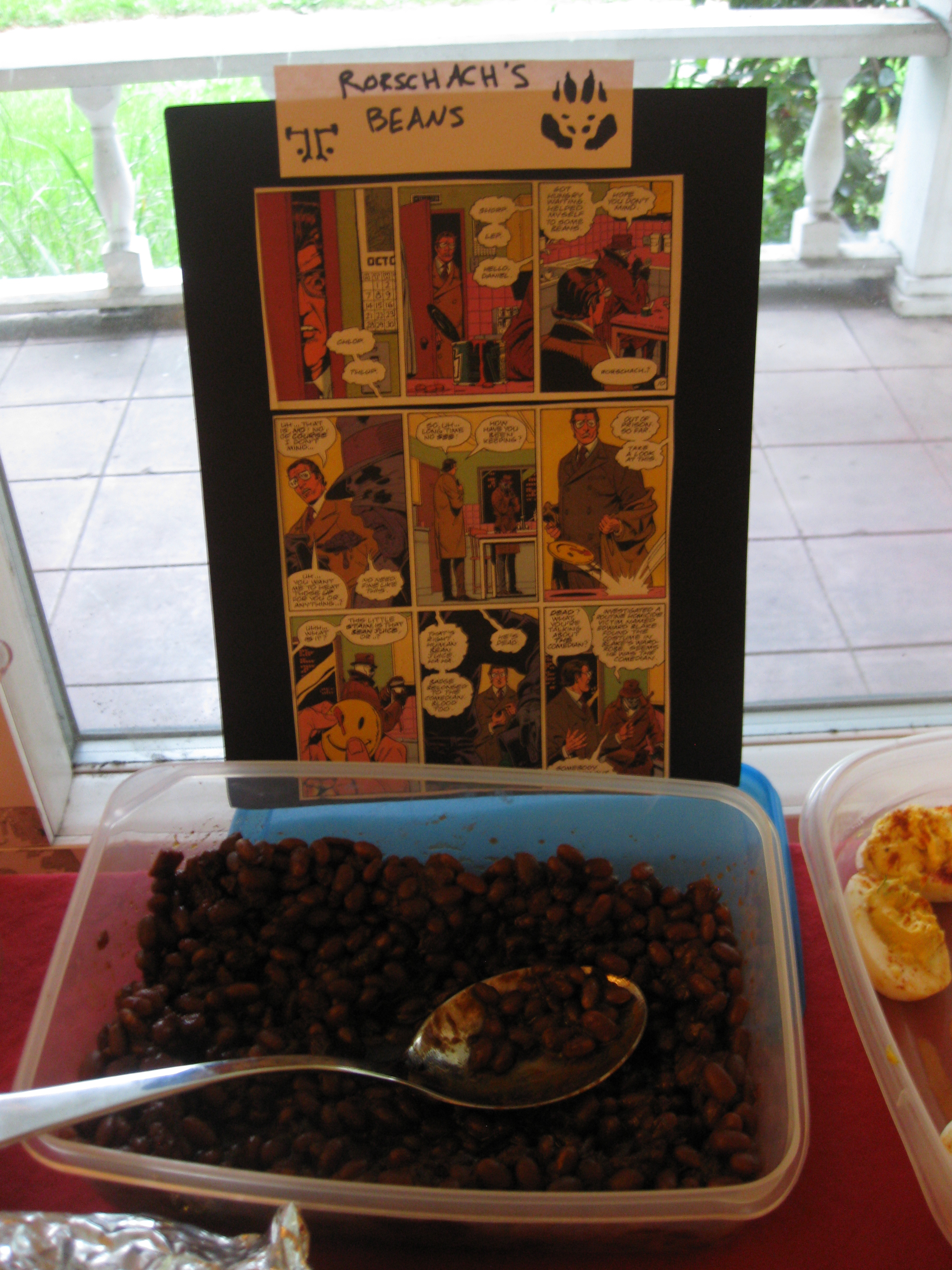
Rorschach’s beans from the graphic novel “Watchmen.”

Boeuf en daube from Virginia Woolf’s To the Lighthouse.

A trio of deviled eggs to breathe life into Hemingway’s thoughts on being hard boiled in The Sun Also Rises.

A wonderfully smoky molasses cake inspired by the molasses-drenched dinner scene in Harper Lee’s To Kill A Mockingbird.

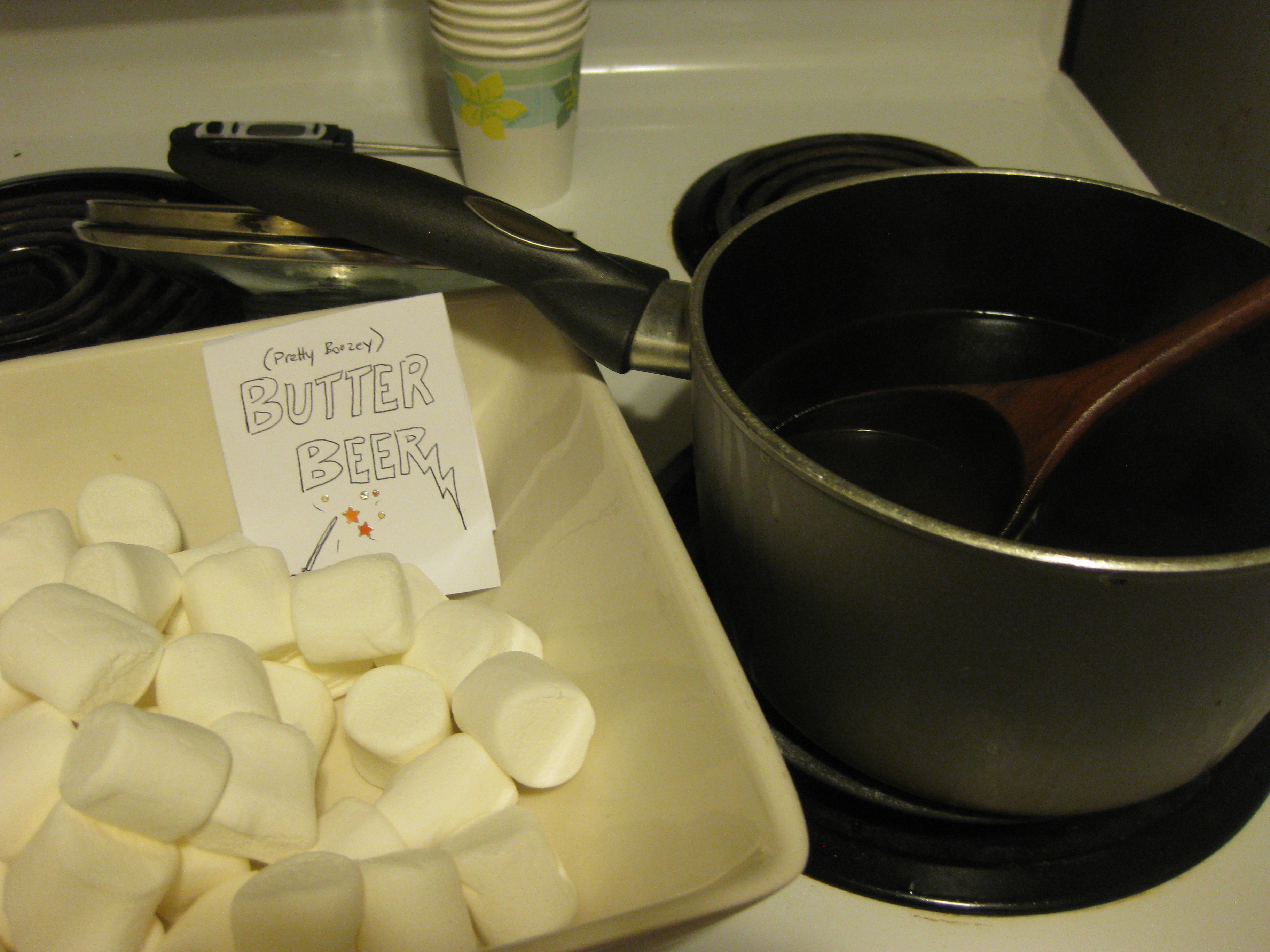
Well spiked butterbeer (you drop in a few marshmallows which, as they melt, mimic the foamy head on the beer) from J. K. Rowling’s Harry Potter series.

Not pictured: (more!) deviled eggs, from Toni Morrison’s Song of Solomon, sautéed marinated mushrooms inspired by Lewis Carroll’s Alice in Wonderland, raspberry cordial from L. M. Montgomery’s Anne of Green Gables, and a few sourceless delights: meatballs (Cloudy with a chance of, perhaps?), and a bread, cheese, and hard salami platter.  These were justified by their authors with the claims that “surely there must be moments of literary eating that include these items,” which I was quite willing, given their deliciousness, to accept.  And of course, wine.  If we were picky, we could call this an homage to Hemingway, whose characters “get tight” with abandon, or to Carroll’s Alice, who does imbibe from the mysterious bottle demanding she “drink me.”

I made two offerings: a take on the “green as grasshoppers” chutney so adored by Saleem in Salman Rushdie’s Midnight’s Children, and a pork pie stuffed with hard boiled eggs from Roald Dahl’s Danny the Champion of the World.  Both turned out extremely well, but I want to talk about the pie first.

Danny the Champion of the World is the story of a boy and his father.  Without giving too much away, I will only say that Danny’s father suffers an injury almost halfway into the book, and when Doc Spencer, the family physician, brings him home from the hospital to the gypsy caravan in which he and Danny live, Doc also brings Danny a package from his wife:

“Very carefully, I now began to unwrap the waxed paper from around the doctor’s present, and when I had finished, I saw before me the most enormous and beautiful pie in the world.  It was covered all over, top, sides, and bottom, with rich golden pastry.  I took a knife from beside the sink and cut out a wedge.  I started to eat it in my fingers, standing up.  It was a cold meat pie.  The meat was pink and tender with no fat or gristle in it, and there were hard-boiled eggs buried like treasures in several different places.  The taste was absolutely fabulous.  When I had finished the first slice, I cut another and ate that, too.  God bless Doctor Spencer, I thought.  And God bless Mrs. Spencer as well” (Dahl 85-86).

Since my first trip through Danny, I salivated over this savory pie Danny enjoys.  And this party was the perfect excuse to attempt my own.

I found a perfect (and much prettier) base recipe for my pie in the archives of the blog Married… With Dinner.  Though I followed their basic instructions, I made a few amendments for ease and expense.  The key points are as follows:

Use a springform pan.  That way the pie is tall and regal and can sit magically outside a pie plate all on its own.

Roll the bottom crust out large enough to come almost all the way up the sides of the springform (I used storebought crust and it work out just fine), so you can connect top and bottom more easily.

I squashed together a mixture of ground pork, pork sausage, finely chopped ham from a ham slice, salt, cayenne pepper, ground cloves, and black pepper.  I pressed a thin layer of the meat mixture onto the bottom of the pie crust, then laid six hard boiled eggs in a circle through the middle of the pie (regrettably, with ham-covered hands, I did not get a photo of this).  Then I lightly packed the rest of the meat mixture around and over the eggs and sank a bay leaf deep into the very center of the pie.

A traditional English pork pie has warm pork stock poured into a hole in the crust just after baking, which turns into a thick jelly as the pie cools.  This did not sound particularly delicious to me, though I did like the idea of a rich layer of something atop my pork.  I decided on cheese.  I grated about a cup of sharp cheddar and sprinkled it lightly on top of the meat before draping the top pie crust over it.  I cut a little hole in the center of the crust and sliced some steam vents for additional release before baking.

It’s a long baking process (almost two hours), but you are dealing with raw pork, so the cooking time needs to be sufficient.  When the pie is almost done, Married… With Dinner recommends you carefully release the spring on the pan and brush an egg wash all over the top and sides of the pie.  Fifteen minutes more in the oven and this results in a beautiful, shiny golden glaze all over the pie.  It also, in case you are lazy like me and didn’t brush an egg wash over the top edge of the bottom crust to help the lid adhere, creates an after-the-fact glue to hold base and lid together.

I let my pie cool on the counter for an hour or so, then tented it with aluminum foil and stowed it in the fridge until the party started.  It did, after all, have to be a cold meat pie.

It was fabulous.  The meat was nicely spiced and the ham bits shredded in added some smoky, salty variety.  The hard boiled eggs were, indeed, delightful treasures to find, though I admit to over-boiling them slightly so their yolks were not as bright as they could have been.  Still, this is hardly a complaint.  It was like a meatloaf wrapped in flaky, buttery crust, and the cheese was a nice additional flavor and richness.  I suspect this could have been just as good warm as it was cold, but the pie might not have held together quite as nicely.

My second offering was a cilantro coconut chutney.  Saleem, as Midnight’s Children comes to a close, receives a meal from a blind waitress.  He lists:

“On the thali of victory: samosas, pakoras, rice, dal, puris; and green chutney.  Yes, a little aluminum bowl of chutney, green, my God, green as grasshoppers… and before long a puri was in my hand; and chutney was on the puri; and then I had tasted it, and almost imitated the fainting act of Picture Singh, because it had carried me back to a day when I emerged nine-fingered from a hospital and went into exile at the home of Hanif Aziz, and was given the best chutney in the world… the taste of the chutney was more than just an echo of that long-ago taste – it was the old taste itself, the very same, with the power of bringing back the past as if it had never been away…” (Rushdie 525).

I found a recipe for a coriander chutney replete with tart lemon juice, lip puckering spice from serrano chiles, and bright, bright green cilantro, tempered by shredded coconut.  The recipe called for unsweetened coconut but I, in my haste, having only sweetened, forgot to rinse it to get some of the sugar off before dropping it into my food processor.  As a result, my chutney was lightly sweetened, but no one seemed to mind that, especially when it was spread onto the pakoras I made.

I searched around online and made a master recipe from a combination of ideas for these pakoras.  Mine included:

4 cloves garlic, smashed and finely minced

2 tsp. each:

Garam masala

Turmeric

Chili powder

Salt

2 cups Bob’s Red Mill gluten-free all-purpose flour (pakoras are made with garbanzo bean flour, and though the Bob’s Red Mill mix is a blend including potato starch, it is composed mostly of garbanzo and fava bean flours, so since I had it, I decided a little break from tradition would be okay.  This is literature, after all.  It’s all interpretation anyway!)

1 ½ cups water

½ head cauliflower, diced

¾ large onion, diced

1 small sweet potato, diced

1 quart vegetable oil

Heat the vegetable oil to 375F in a large, sturdy pot.  I used my dutch oven.

While the oil heats, whisk together the dry ingredients and garlic until well combined, then slowly whisk in the water to form a thick, smooth batter.

Add the diced vegetables and stir to combine.

Drop spoonfuls of the batter (ever so carefully!  Watch out for splashes!) into the hot oil and fry for 5-6 minutes, or until the batter is deeply golden and the vegetables inside have magically cooked.

I got to taste one of these.  It was crunchy and starchy and slightly spicy and wholesome and delicious.  It was vegan.  It was gluten-free.  Topped with the chutney it was fresh and springy and spicy and then gone.  By the time I went back to have another, the giant platter I’d made was empty, and only a spoonful or two of chutney remained.  Pride overwhelms disappointment, in moments like these.  My little experiment was so successful it prohibited me from tasting further.  So I had another deviled egg instead.

Full and happy, we fell into bed at midnight with a sinkful of dishes and a fridge-full of leftovers to look forward to.  It’s like reopening a book to your favorite chapter: whose world will I lunch from, dine from, be returned to today?

Blowing Hot and Cold

I’ve been uninspired to write this post, mostly because the weekend we just experienced made Punxsutawney Phil into a fat little liar.  And then today came, with a promise of freezing temperatures tonight and the specter of snow.  This is perversely appropriate then, because this Bittman recipe for Potato Leek soup is essentially vichyssoise, one of the best known chilled soups (along with Borscht and gazpacho). We had ours hot, but it is often chilled and served in small, sippable portions.

“22. Sauté leeks in butter until soft but not browned, then add cubed waxy potatoes, a little sage and stock or water to cover. Simmer until tender, puree and finish with about a cup of cream for every 6 cups of soup. Serve hot or cold, garnished with chives (if cold, call it vichyssoise).”

Here’s the line-up:

¼ cup butter

at least 3 leeks, maybe more, halved lengthwise, rinsed well to remove sand and dirt wedged between the layers, then sliced thinly into little crescent moon shapes

8 medium yukon gold potatoes, diced in smallish cubes

6 cups chicken or vegetable stock

salt and pepper to taste

6-8 sage leaves, torn or chopped

1 cup heavy cream

I can say right away that I wish I’d had more leeks for this.  My meager supply was just not enough for that unique, sweet garlic/onion flavor.  Nevertheless, I sliced them up and sautéed them in butter for that springy wonderful pale green aroma.  A tub of homemade chicken broth, the sage, and the diced potatoes followed, burbling together and permeating each other with flavor.

I let the pot simmer until a tentative fork prod proved the potatoes were tender – probably fifteen minutes – then seasoned with salt, pepper and, on a whim, a few taps of garlic powder.

I switched the heat off and let the pot cool off just until it wasn’t boiling anymore before taking my immersion blender to it.  Have you used an immersion blender?  I love mine.  It is a bright red Kitchen Aid model and I use it for blending soups and salad dressings.  I know it could also be used to whip cream or maybe even make hummus, though I haven’t yet put it through all its paces.

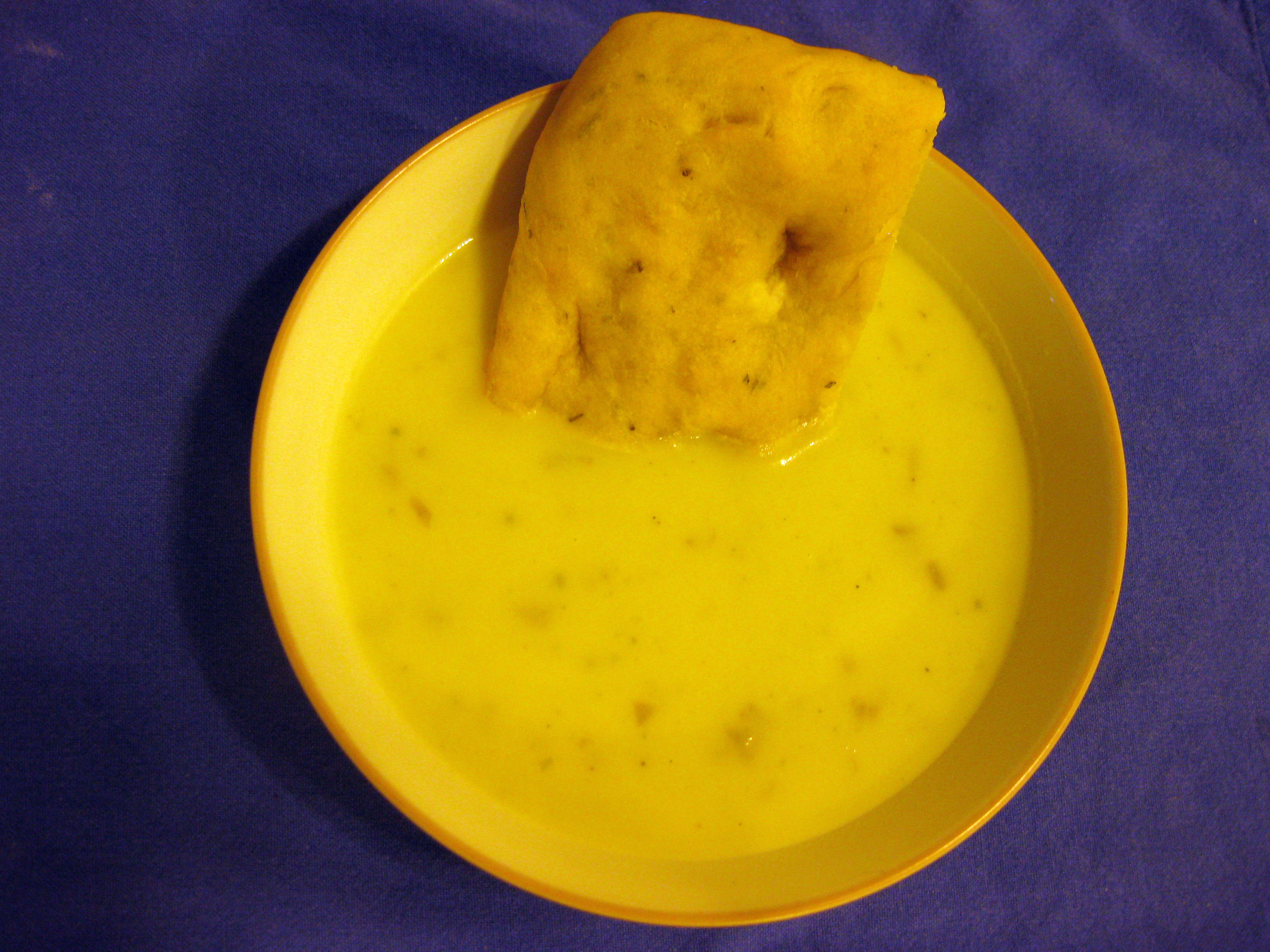
A few long dunks and careful swirls of the immersion blender and the chunks of potatoes became more of a mash.  Another few sessions and they transformed into a velvety soup.  Even the torn sage leaves were obliterated, leaving only a few shreds of potato skin (I never peel yukon golds) to disrupt the ivory smoothness.

When everything was well blended, I put the pot back on the heat, poured in a cup of cream, and stirred the swirls of white until the whole thing paled ever so slightly in color and the cream was completely incorporated.  It only took a few moments for the pot to rise back up to serving temperature, at which point we dipped it into bowls and sipped away.

It was smooth and hearty and rich.  It’s hard to make potatoes taste like anything but potatoes, but the additions of sage and cream and the barest onion-y flavor from the leeks came through.

I served this with a lovely loaf of dimpled rosemary foccaccia and a glass of white wine.  A thoroughly beige looking meal, but a satisfying one nonetheless.

But satisfying isn’t always enough.  This soup lacked intensity and freshness.  It was a winter meal, and my stomach, along with my skin and heart and brain, is craving spring.  So when I faced the leftovers, I felt the need for a pick-me-up.  The addition of a tablespoon or so of pesto stirred gently into the soup woke up the flavor considerably but somehow didn’t overwhelm the wholesome starchy creaminess of the potatoes.  Were I to make this soup again, pesto might become a required addition.  Or perhaps a gentle, fluffy layer of extra sharp white cheddar to blanket the top like the snow I hope does not fall on us tonight.  This was good, but it’s time for hot soup season to be over, and not yet time for cold soup season to begin.

Quick, quick!

So I’m behind again.  I have been cooking, I just haven’t been posting.  It’s funny, the cooking part feels necessary and timely because hey, it’s dinner!  But the posting part – if I’m typing something these days, it had better be either my dissertation or a PowerPoint slideshow for the class I’m teaching.  If it’s something else, Puritan guilt sets in.

But I have so much to share that I had to start working through the backlog.

“32. Cook couscous in stock or water. With a fork, stir in cinnamon, chopped mint, lightly sauteed pine nuts and melted butter.  Bake in an oiled dish or use as stuffing.”

The players:

1 box plain couscous

2 cups water

pinch salt

¼ cup pine nuts

¼ cup butter

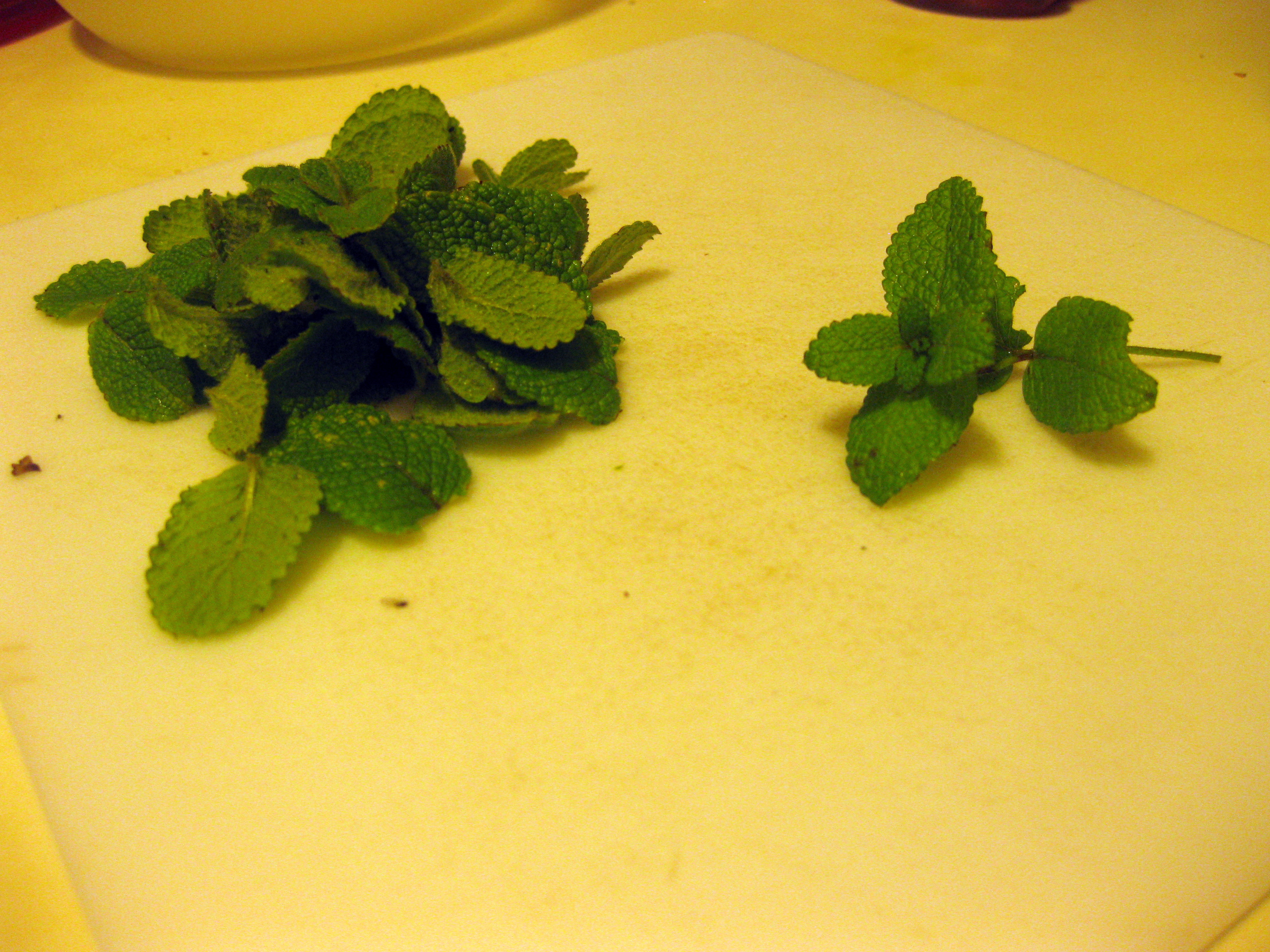
¼ cup chopped mint

2 tsp cinnamon

salt and pepper to taste

The process:

Preheat the oven to 375F

Cook couscous in water with a pinch of salt according to package directions.  If you have vegetable broth or chicken broth, use that.   

While the couscous cooks, chop the mint, melt the butter in a small skillet and add the pine nuts.  Sizzle over medium-low until the pine nuts are barely browned.

When the couscous is done, fluff it with a fork, toss in remaining ingredients, and stir together.  Transfer to your oiled baking dish and bake for 25-30 minutes, or until the top is just crunchy and golden.

We had this with smoked apple and chardonnay chicken sausages and some steamed broccolini and it was tasty, but not stellar.  The pine nuts were roasty and delicious, and the cinnamon added a nice flavor twist, but it seemed to be missing something.

My theories are as follows:

1.)    This would be better as a stuffing than as a side; I’m thinking stuffed pork chops or turkey.

2.)    It would be an awesome base for a tagine of chicken or lamb.

3.)    Dried fruit mixed into the couscous blend would add a sweetness for the cinnamon to play with.

I did only one of these things to the leftovers, and it made a definite improvement.  Diced dried apricots rounded out the flavors nicely and made it seem almost like a pilaf.  Chopped dried figs, dates, or currants would also be delightful.


I have so much more to tell you.  Cross your fingers I can make it through enough of my academic work to check in again next week!