Coconut Bread Pudding with Rum Caramel

Food Blog May 2013-1375When I’m not frying in the summer time, it seems like I’m baking.  But in the on-and-off foggy uncertainty of June gloom, sometimes you need a little baking.  Of course, now it’s July and the whole West Coast is panting and dreaming of snow drifts so, as usual, I’m behind.  This dessert, though, plush with custard and drenched in rum caramel, is worth it.
Food Blog May 2013-1368Food Blog May 2013-1369Food Blog May 2013-1372Bread pudding is an old dish and, like so many of the “comfort foods” we’ve embraced and raised to new levels of trendiness sophistication (I’m looking at you, French onion soup…), it began as a way to use up aging products in a way that made them still taste good.  In this case, it’s combining cubes of stale bread with milk, eggs, sugar, and whatever else you think is particularly delicious, whether that be fruits, nuts, or chocolate.  Savory as well as sweet iterations exist, and though the dish possibly has European origins, versions now exist in Cuba, the Philippines, Argentina, and in probably every gastropub in the U.S. playing the amped-up-comfort-food angle.

Food Blog May 2013-1366For me, bread pudding is a godsend, because N. loves toast, which means we end up with a lot of crusts.  It seems such a shame to throw them away that I forestall the problem by jamming them in the freezer.  At the point that they fill up a shelf all on their own, it’s time to make bread pudding, a dish that I see as appropriate for a steaming dessert, warm breakfast, straight-from-the-fridge-3pm-snack, or even lunch on a day that I’m feeling particularly lazy.

This iteration, though, I wanted to be special.  I wanted something comforting and homey and rich and delicious, but I wanted a twist.  And that’s where summertime, and N., and my dad, all come in.

Husbands are great, aren’t they?  But most of them (sorry, guys) aren’t perfect.  N. is no exception.  He’s close, oh he’s close, but here’s the thing: he doesn’t. like. coconut.  I know.  And it’s not one of those “no thanks on the coconut cream pie, not a fan” kinds of dislikes.  It’s deep.  It’s subconscious.  The man can tell if a granola bar has coconut in it with one bite.  He once declared that a cookie we were sharing tasted “odd,” and sure enough, down at the bottom of the ingredient list was ground coconut.  Curries at Thai restaurants are dangerous business.  And summer, this glorious season, is a hazardous time of year for N. thanks to sunscreen.  Once, decked out for a gardening session, I gave him a kiss and he told me my face smelled funny.  SPF coconut.

Food Blog May 2013-1353But I adore coconut.  It means vacation and swimming and luxury.  It smacks of the tropics: rum-laced drinks.  Shave ice.  Coconut shrimp (N.’s ultimate nightmare).  And, oddly enough, French toast.  When my sister and I were little, every once in a while my dad would pull down the electric skillet from some cabinet too high for anyone else in the family to reach and make coconut French toast for breakfast.  After dredging the bread in milk and eggs, he dipped each side in coconut before subjecting it to the buttery-slicked heat.

The result was a revelation.  The coconut caramelized into a crunchy, lacy, almost-burned web of texture on the outside of the bread, and its flavor made the addition of syrup all but unnecessary.  This, then, was the mission.  I set out to create my own version of this childhood memory.

Food Blog May 2013-1355Food Blog May 2013-1356Generally I soak my bread puddings before cooking them.  I load my baking dish with stale crusty cubes, mix in whatever bits and bobs I want to add (craisins are a frequent suspect), then pour the custard mixture over the top and set a heavy dish on top to press the bread sponges down into the drink.  And then I shove the whole thing into the fridge for a few hours to promote full incorporation.

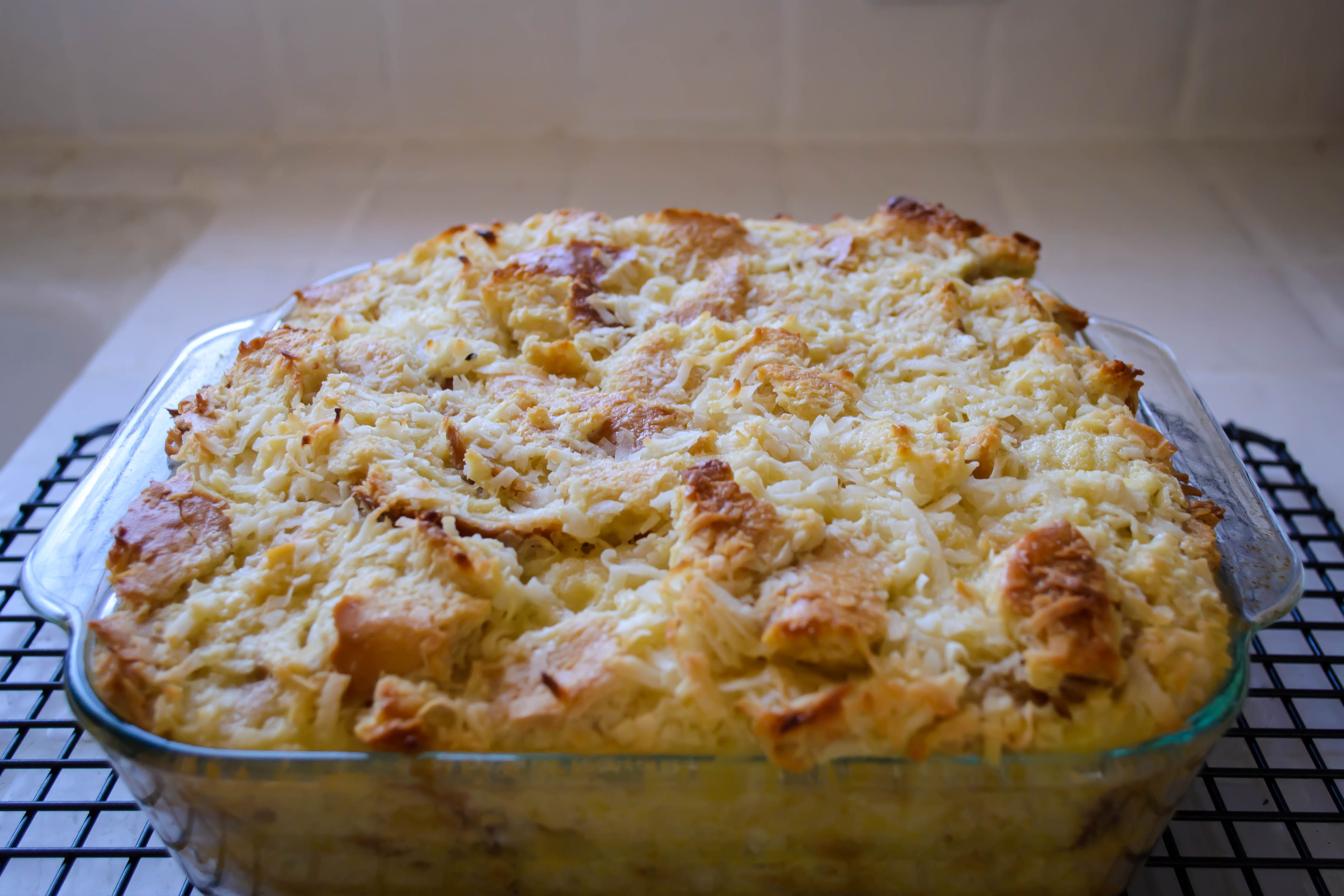
This time, though, I decided to employ a different method.  I mixed up the custard with coconut milk and coconut cream instead of regular dairy, and dumped in the bread and, after a moment’s consideration, most of a bag of sweetened shredded coconut.  Thorough mixing followed, and the result – a bowl of creamy soft crumbles of bread and the heady smell of the Hawaiian vacation I wish I were on – spoke summer.  All I could think of, while I pushed the baking dish into the oven, was a piña colada.

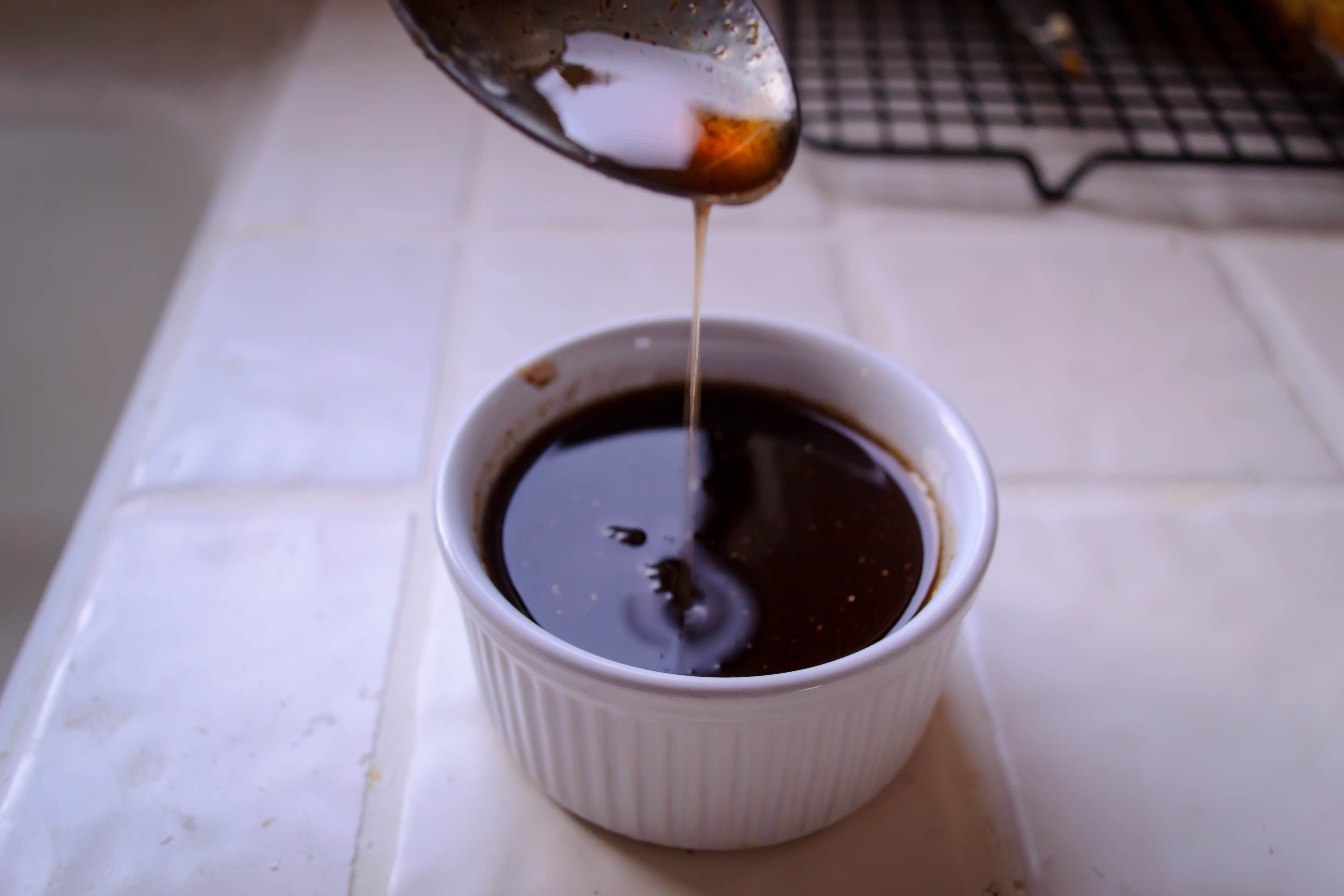
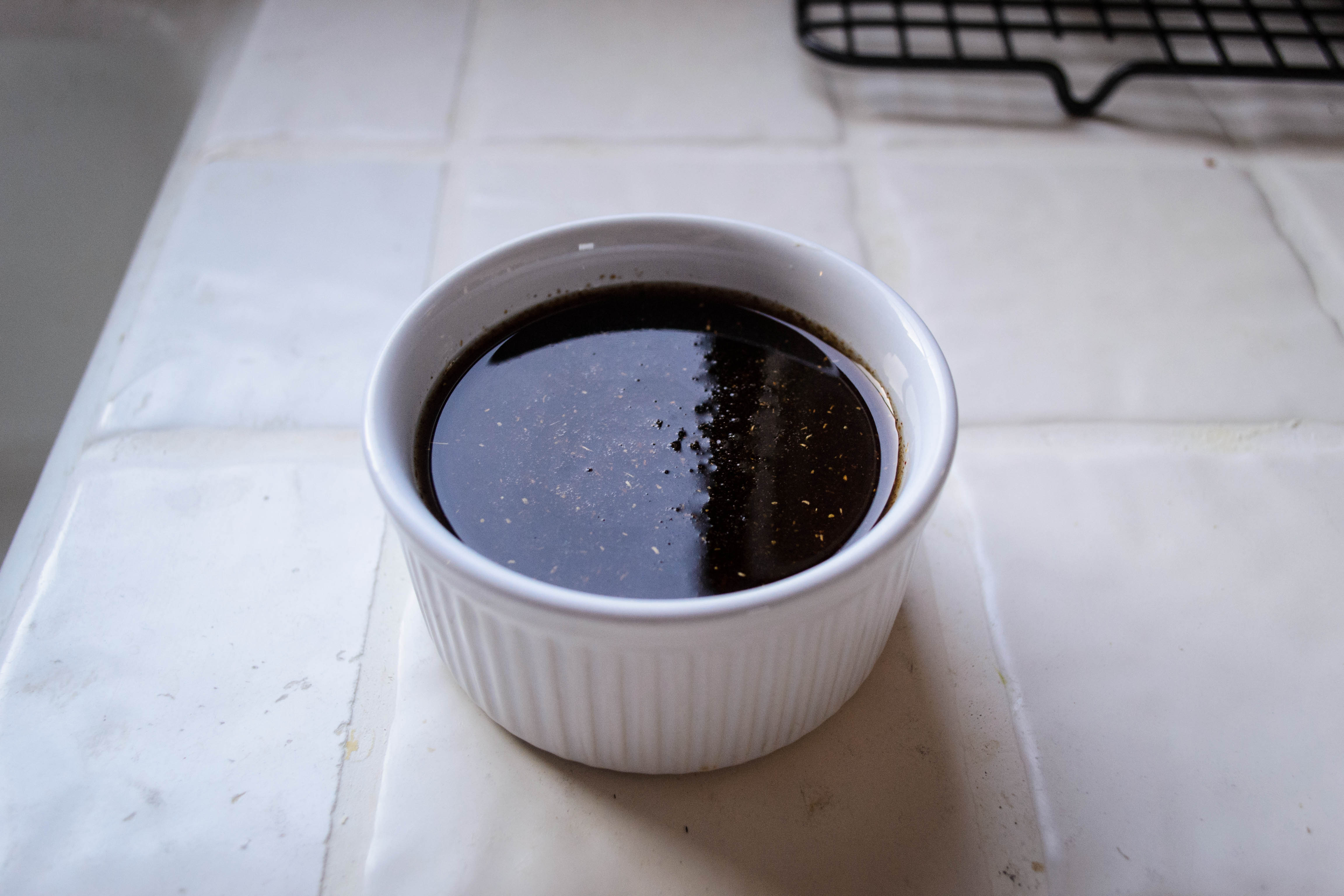
Food Blog May 2013-1361Food Blog May 2013-1364The problem with piña coladas, though, is that pesky piña part.  I’ve got no hatred for pineapples, don’t get me wrong, but their aggressive tartness sometimes overpowers the gentle, creamy sweetness of coconut and the spicy complexity of the rum.  A bread pudding sodden with coconut and no pineapple to be found seemed like the perfect excuse for, let’s say, a rum caramel sauce.  Why not?  It’s summer… Dark rum.  Sugar.  A daring sprinkle of garam masala.  Bubbled away in a tiny pot until barely thickened, and the dessert went from homey and comforting to decadent and warming and, oddly enough, somehow reminiscent of camping.  I swear my parents didn’t give us rum when we sat around the fire toasting marshmallows, so all I can figure is that the sweet spiciness reminded me of gingersnaps or molasses cookies or some other well-spiced treat.

Food Blog May 2013-1386Once this heat wave breaks, I think you should make this bread pudding, with or without the sauce.  You won’t, unless you are like my coconut-hating husband, be disappointed.  And if you are, well, someone in your family will be glad they don’t have to share.  Food Blog May 2013-1388

Coconut bread pudding
Serves 8-10
4 eggs
½ cup sugar
14 oz. coconut cream
14 oz. coconut milk
1 tsp vanilla
2 cups shredded coconut – mine was sweetened.  If yours was not, you might add up to 1 cup of sugar above.
10-12 slices sourdough bread, cut or torn into cubes
  • Preheat your oven to 350F and spray or oil a 9 inch square baking dish.
  • To measure how much bread you will need, tear the slices directly into the baking dish.  Press them down once or twice, packing them until they mound up just a little over the edge of the dish in the center.  This gives you the right amount of bread to mix into the custard.
  • In a large bowl, beat the eggs and sugar together for a minute or two, until the mixture is homogenized.
  • Add the coconut milk, cream, and vanilla, and whisk until well blended.
  • Tumble the shredded coconut and torn or cut pieces of bread into the custard and mix well, ensuring that every bread cube is well moistened and the sticky clumps of coconut loosen and disperse through the mixture.  I used a wide bladed spatula and it seemed to do the job well.
  • Carefully relocate the custard-soaked bread to your prepared baking dish, pushing it down if needed to fit everything in.
  • Bake at 350F for 45-60 minutes.  This seems like a wide range of time, but depending on your oven and the relative staleness of your bread (which will determine how much custard it soaks up) your cooking time may vary a bit.
  • To determine doneness, check to see that the center of the pudding has puffed up, and the top is nicely browned.  Some of the coconut shreds will toast to a dark gold.
  • When done, let it sit for 10-15 minutes to allow the custard to firm up a bit.  This will make it easier to cut or spoon out.
  • For an elegant presentation, cut into squares and set on a puddle of rum caramel, or drizzle the caramel liberally over the top.  Or forgo elegance, and scoop out big spoonfuls to pile into your bowl or plate.


Rum caramel sauce
Makes a scant ½ cup
½ cup sugar
½ cup dark rum
½ tsp garam masala (or more to taste – I used a full teaspoon and it was quite strong)
2 TB cream, optional
  • Combine the sugar, rum, and garam masala in a small saucepan and cook over medium low heat for 10-15 minutes, until sugar is dissolved and sauce thickens and becomes slightly syrupy.  Stir or swirl frequently to prevent sugar from burning.
  • If you want your caramel thicker or more luscious, stir in the optional 2 TB cream.  Stand back as you add the cream, as the caramel may bubble up upon contact.
  • Cool slightly before serving.

This is dynamite with coconut bread pudding, but would be equally delicious dribbled over ice cream, or mixed into a milkshake, or maybe even as a puddled base for your 4th of July slice of apple pie.

Pizza and Beer

Food Blog March 2013-0802Sometimes, a week calls for pizza.  But you don’t want the delivery variety dripping with grease and lazy with a smattering of mix-n-match toppings.  You want something fresher.  Better.  You want the feel of dough you can stretch under your hands and control over the size and shape of the pie and choice in the quality and variety of ingredients.

Homemade pizza.

N. and I have often talked about pizza memories, and how, when we were kids, pizza just wasn’t the same without a side of root beer.  It had to be in one of those hard plastic molded glasses, and it had to be with a clear straw.  And sometimes, you forgot you’d ordered root beer instead of Coke or Pepsi, and that first gulp with its spicy depth would be a tremendous surprise.

As we got older, the “root” part of the equation melted, and suddenly it was pizza and beer, plain and simple, one of the mother food and beverage combinations (is that a thing?  Like mother sauces?  It should be.  After all, beer is the third most popular beverage worldwide, and variations on pizza have been around since ancient Greece).

As I thought my way through this pizza plan this week, I wondered whether they had to be separate.  I mean, yeast makes bread dough and beer possible.  Beer is liquid, and there seemed no logical reason why it couldn’t be substituted for the water I’d ordinarily use to make a pizza crust.

Once this idea was lodged in my head, it wouldn’t go away.  This just seemed too perfect.  Beer and pizza, kneaded together – a truly complete meal.

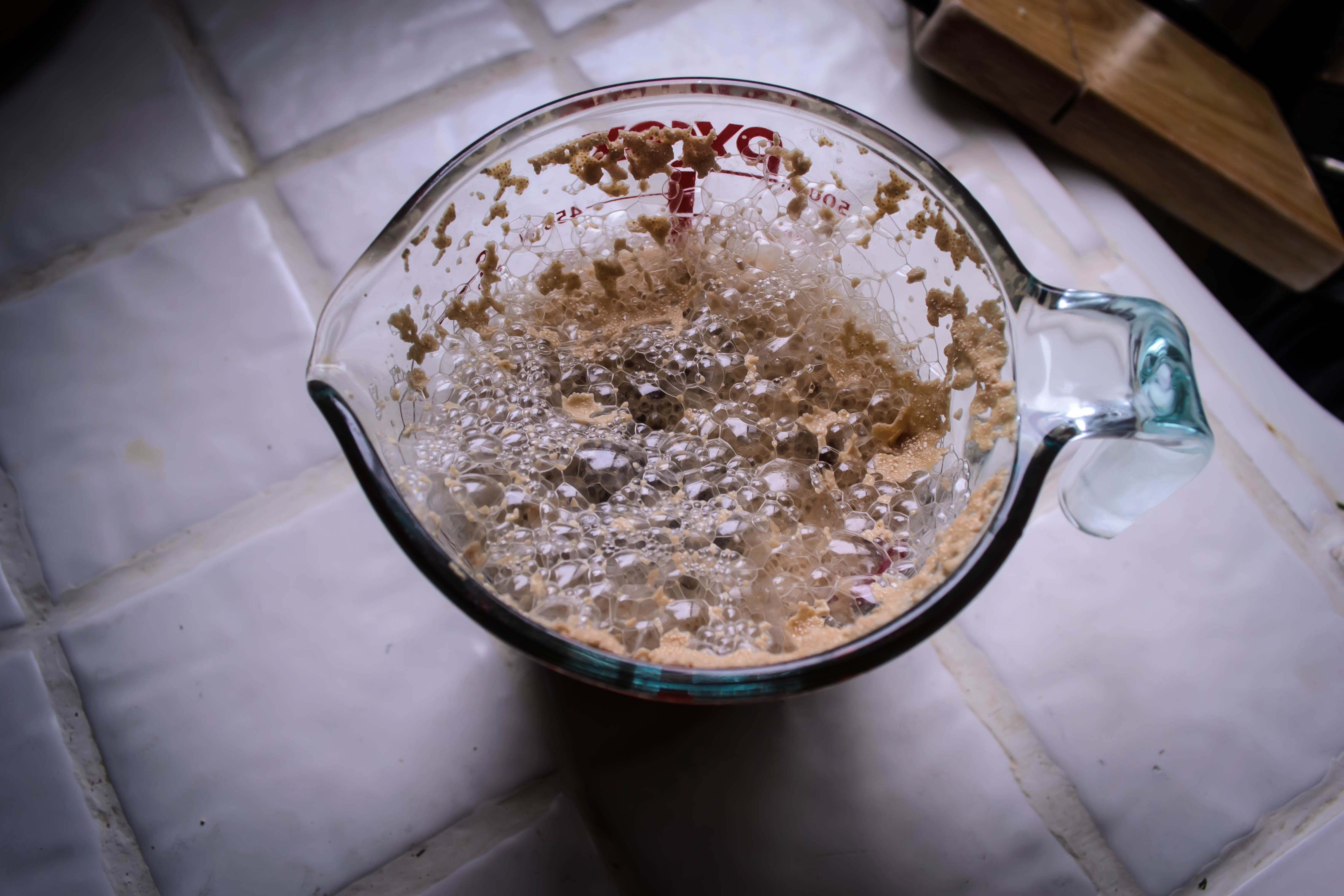
Even though beer is essentially water with yeast and flavorings, I wasn’t sure what would happen when I mixed the two.  I heated a bottle of amber ale in the microwave with a couple teaspoons of honey, just until it was body temperature.  When I added the yeast and engaged the lightest of stirs, the whole measuring cup erupted with bubbles and I had a head at least three inches high.  This slowly collapsed, but I took it to mean the yeast was satisfied with its new spa treatment.

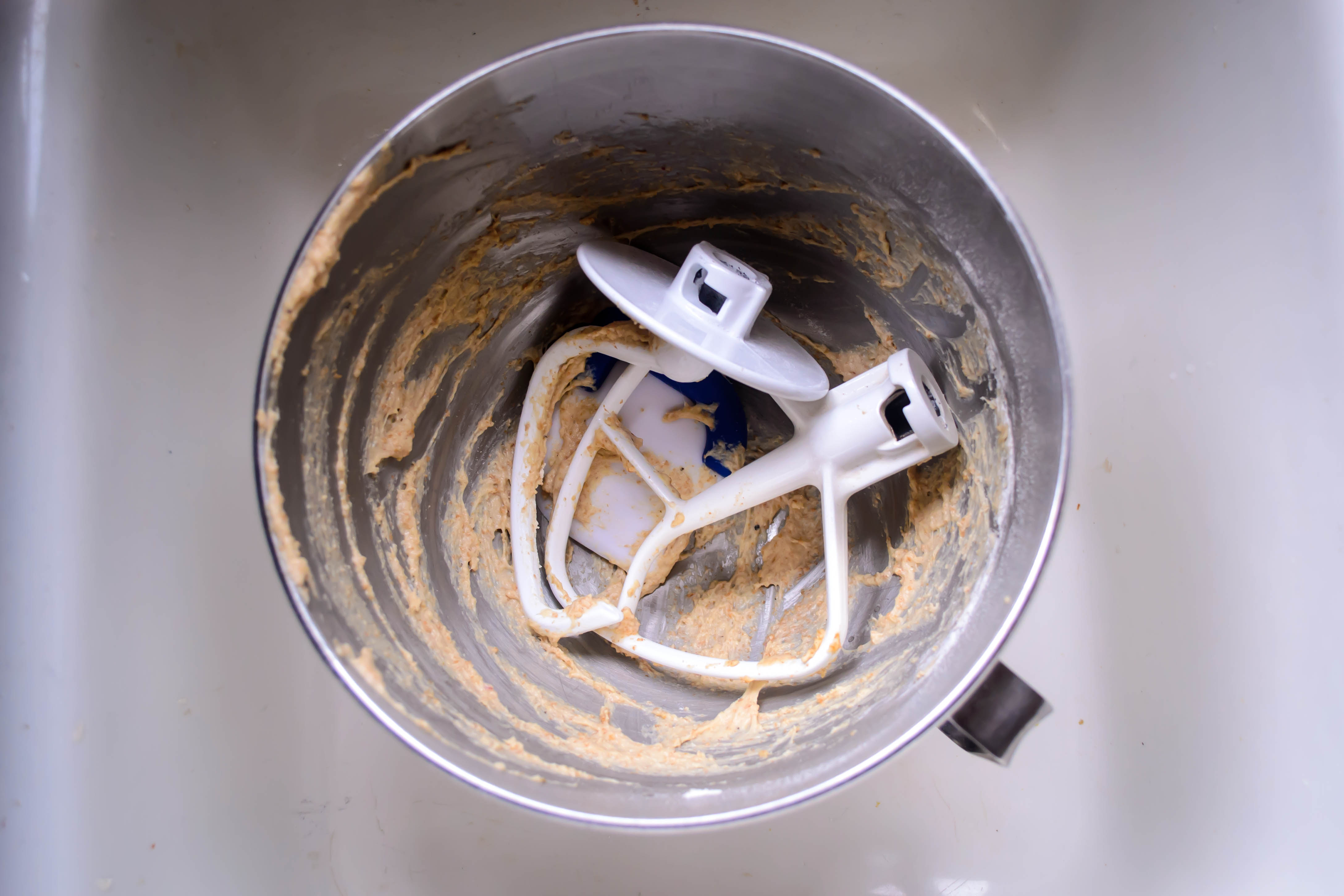
Food Blog March 2013-0772I used a combination of bread flour and whole wheat flour, and produced a spectacularly nutty tasting dough that was also the stickiest I’ve ever worked with.  It slithered and dripped off of my stand mixer’s dough hook and plopped thickly into the oiled bowl I coaxed it into, and I crossed my fingers and hoped that after its six hour chill in the fridge it turned into pizza crust.

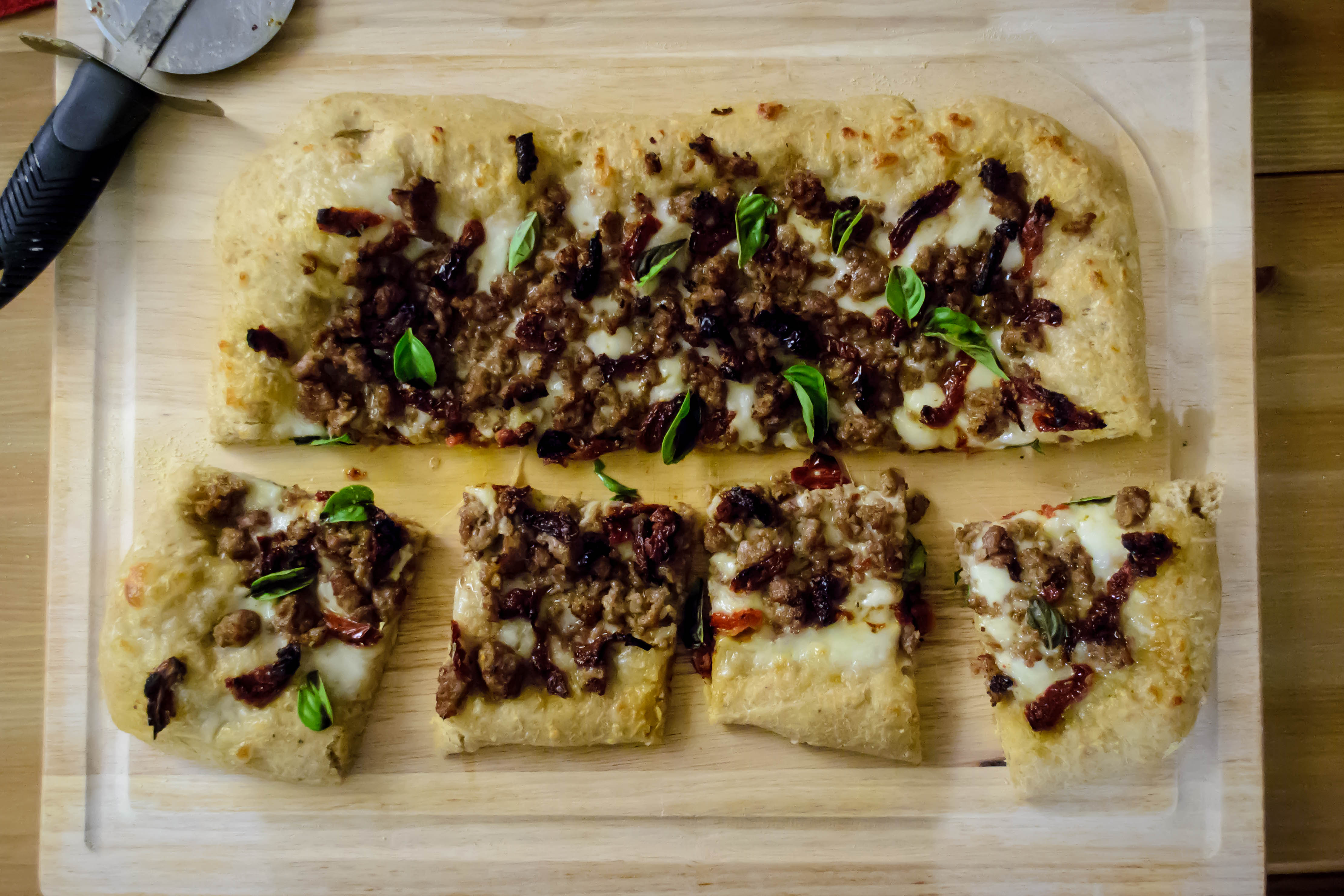
Food Blog March 2013-0777When I liberated it and faced it again, it wasn’t the easiest dough to work with, but it did work.  It wouldn’t deign to be tossed like a pizzeria pie, but I stretched and spread and pushed it across a cookie sheet liberally spread with cornmeal, and it turned into a rustic, bubbly, delicious crust.  Topped with mozzarella, sausage, and sun-dried tomatoes, it baked into a glorious symphony of assertive flavors.  We sprinkled on a few leaves of fresh basil while it was still steaming hot, and declared it one of my best homemade pizzas. Food Blog March 2013-0780This is a sticky, wet dough, but it works.  I’m going to make it again and tweak the quantities of flour and olive oil, but trust me: this is worth fooling with for the flavor alone.  The beer comes through right at the end of each bite as a deep yeasty earthiness.  It lends the tiniest bit of bitter flavor that contrasts really well with the fatty sausage and tart sun-dried tomato.  And really, why shouldn’t it?  It’s beer, and this is pizza.  They were made to be together.

Food Blog March 2013-0797

Beer-crust pizza

12 oz. beer (I used an amber ale.  I think a darker brew would be even better)

2 tsp honey

2 tsp yeast

¼ cup olive oil

2 ½ cups bread flour

1 cup whole wheat flour

2 tsp salt

¼-½ tsp black pepper Food Blog March 2013-0774

Heat the beer and honey in the microwave (or a small saucepan) until the liquid is body temperature – you should feel only the slightest heat when you dip in a curious finger.  This took about 45 seconds in the microwave for me.  It will take longer if your beer has been refrigerated.

Swirl the mixture to distribute the honey, then sprinkle the yeast over the surface and set it aside for 5 minutes.  If you stir the yeast in, you will get a tremendous amount of foam on the surface, so in case of overflow I think it’s better to just let it sit.

While you wait for the yeast to perk up, combine the flours, salt, and pepper in a mixing bowl or the bowl of your stand mixer.

When the yeast and beer have married to create a thick foam, stir in the olive oil, then add the liquid mixture to the dry ingredients.  Using the paddle attachment (if you are using a stand mixer), combine at low speed just until ingredients come together into a rough, uneven dough.  Replace the paddle attachment with the dough hook and knead on medium-low speed for 5-7 minutes.

This dough will not pass the windowpane test.  It will not even stay together particularly well.  It will seem like an exercise in futility and disaster, and you will be sorely tempted to add more flour.  But if you resist, and plop it into an oiled bowl, and cover that bowl with plastic-wrap and leave it in the refrigerator for 6-8 hours, it will turn into something more like normal pizza dough.  I promise.

Food Blog March 2013-078390 minutes before you intend to bake, take the bowl of dough out of the fridge and set it on the counter to finish rising and come to room temperature.  After this time has passed, and the dough is considerably increased in size (it may not quite double, unless your counter is quite warm), stretch it to your desired shape – it easily makes a thick 9×13” rectangular crust, and might be coaxed into 2 medium sized, somewhat thin round crusts – on a cornmeal or flour speckled board or tray.  I just doused my cookie tray with cornmeal and pressed and pushed the dough directly on it until I was happy with the shape.

Food Blog March 2013-0789Food Blog March 2013-0786Food Blog March 2013-0792When adequately stretched, add toppings and bake in a preheated 450F oven for 12-15 minutes, or until puffed, crisp, and golden.  Wait 5 minutes before you cut it, to give the cheese time to congeal just a little.

Food Blog March 2013-0804We ate this in embarrassingly large squares and left enough in leftovers to serve as lunch the next day.  Cut slightly smaller and for slightly less voracious eaters (or if you add a side salad), this would be an adequate dinner for 4.

Happy New Year!

Food Blog 2011-2013-0362

Oh friends, it happened.  I made it.  Yesterday I made the last two Bittmans on my list and completed, albeit a year later than I’d originally intended, my project.  I have reflections to share, certainly, and I have changes and excitement and promises for the new year, but first, I think, let’s work with the program.  Two Bittmans.  Two reports:

“14. Steam or poach 2 cups of pumpkin cubes until tender. Meanwhile, sauté 1 cup sliced shiitake mushroom caps in vegetable oil with a few drops of sesame oil. Boil 4 cups water and whisk some of it with ⅓ to ½ cup of miso. Stir miso mixture, pumpkin and mushrooms into water and heat everything through, then serve, drizzled with more sesame oil.”

Because we were planning to reach midnight by eating as many snacks as possible eating our way to midnight snacking, I wanted a light dinner to precede the countdown.  This seemed to fit the bill.  And it had to, after all, since it was the only soup left and the calendar was screaming December 31st.

2 cups peeled, cubed butternut squash (I had some in the fridge, and suspected pumpkin would be hard to find)

1 1 oz. package dried shiitake mushrooms

1 TB vegetable oil

¼ tsp (or to taste) toasted sesame oil, plus some for drizzling

3 packets instant tofu miso soup mix (all I could find at my grocery store)

water

white wine

To reconstitute my shiitake mushrooms, I soaked them in a mixture of white wine and almost boiling water for 15-20 minutes, until they were plump and soft.

While the mushrooms soaked, I cubed up my butternut squash and submerged the pieces in a pan of salted water.  I brought this to a bare simmer and cooked it just until the squash pieces were tender – 10-15 minutes – then drained the pieces in a colander.  Don’t overcook them, because they will start to fall apart.  Set the squash pieces aside.

When the mushrooms were tender, I scooped them out of their bath and decided the remnants shouldn’t go to waste.  I poured the soaking broth into a little pot to bring to a boil, so I could use this already flavored liquid as the base for my soup.  While it heated, I stemmed and sliced the mushrooms.

Since the shiitakes were now basically cooked, I probably could have skipped Bittman’s sautéing step.  But honestly, I’m not one to pass up the opportunity to ingest sesame oil, so I dutifully dribbled vegetable oil with a few (or a few more than a few) drops of sesame oil in the (drained and dried) pan I’d used to simmer my squash and sautéed the mushroom slices over medium heat until they dried out a bit and started to take on some color.

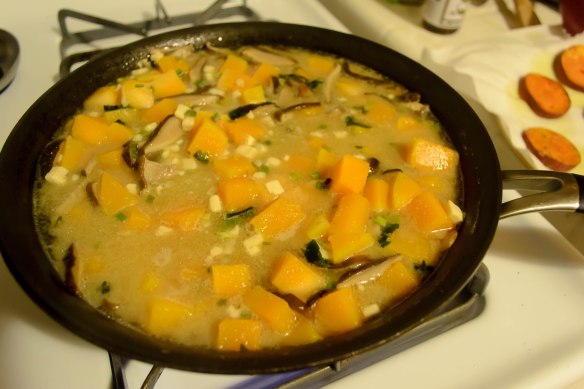
While this colorization happened, slowly and so aromatically, I made the broth.  I poured all three miso soup seasoning packets – tofu and seaweed and all – into a small dish, then mixed in about ½ cup of my heated mushroom soaking liquid and whisked gently to dissolve the powdery soup mix.  This created a slightly thickened slurry, which I poured with the rest of the liquid and the butternut squash cubes into the mushroom pan.

Food Blog 2011-2013-0341

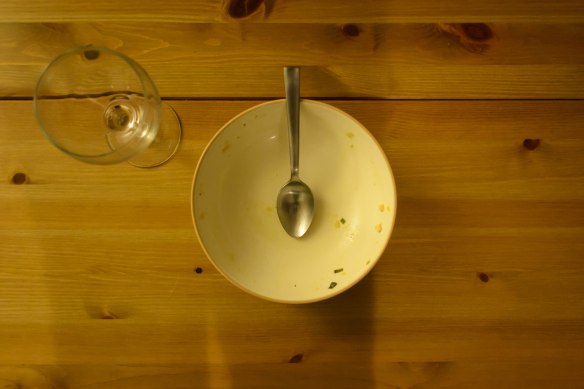
After a few moments of reheating, we dipped up bowlfuls and ate.

Food Blog 2011-2013-0343

N. wasn’t sure (he sometimes takes issue with the texture of reconstituted mushrooms), but I inhaled it with devotion.  I love the flavor of miso soup, and the mild sweetness of butternut squash against the salty umami and fleshy squish of the mushrooms was lovely.

Food Blog 2011-2013-0347

It was light but still satisfying, and the tofu and vegetables from the soup mix were so welcome that I’d advise you, if you are using straight miso rather than a pre-mixed, additive laden packet, to consider adding some tofu or seaweed or green onion just to contribute a little substance and contrast to the soup.

Food Blog 2011-2013-0348

Dinner done, we moved on to the second stage of the evening.

“89. Vegetable crackers: Slice beets, sweet potatoes, plantains or parsnips or all of the above into 1/8-inch disks (a mandoline is helpful) and toss lightly in olive oil. Spread the slices on baking sheets, sprinkle with salt, pepper and, if you like, other seasonings and bake at 400 degrees for 10 to 12 minutes. When browned, flip the chips over and bake for another 10 minutes or so.”

This sounded tasty, and I’d always intended to make it for a party.  With a dear friend coming over to ring in the new year with us, and since hunks of cheese alone might be deemed a slightly imbalanced offering (though so, so delicious…), this seemed like a perfect opportunity.  Beets were out of the question (N.’s nemeses since childhood), and I couldn’t find plantains in my grocery store’s produce section, so we were left with the nutty herbiness of parsnips and the always dependable earthy sweetness of sweet potato.

3 medium parsnips, peeled

½ large sweet potato, peeled

generous dose of olive oil (maybe ¼ cup?), plus more to grease the cookie sheets

1 tsp each (or to taste) salt, pepper, and garam masala

To prepare for roasting, preheat the oven to 400F and line two cookie sheets with aluminum foil.  Drizzle with olive oil and spread to cover the surface of the foil evenly.

While the oven preheats, tackle the vegetables.  I don’t have a mandoline, but I do have a ruler, and I must confess I did bring it to the kitchen to give myself a better idea of what 1/8 inch looks like.  My slices were not quite even, but they did verge on passable.  I tossed them – big coins of harvest orange and speckled white – in a glass bowl with the olive oil and the spices until they were evenly coated.

Food Blog 2011-2013-0339

Spread the vegetable coins across the cookie sheets in a single layer, not overlapping, not in piles.  If they cook in a stack, they will soften but not brown or crisp.  Stow them in the oven for 12-15 minutes, or until they are just beginning to brown.

This next step is a true exercise in patience.  Unless you are far more talented with a spatula than I, you will have to flip each piece over individually.  You have to, because otherwise one side will burn and the other side will flutter limply into cooked-but-not-crisp status.  Trust me on this one.  When you have laboriously flipped each coin, shove the tray back into the oven for another 10-12 minutes.

Food Blog 2011-2013-0342

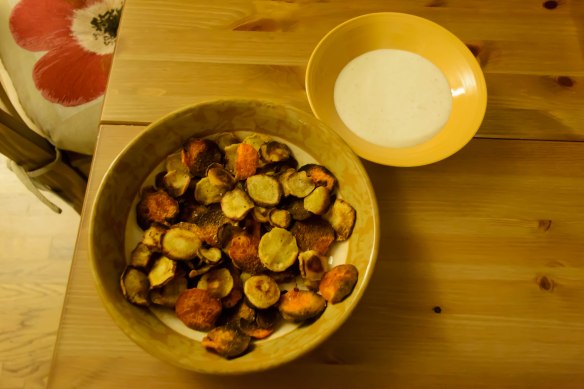
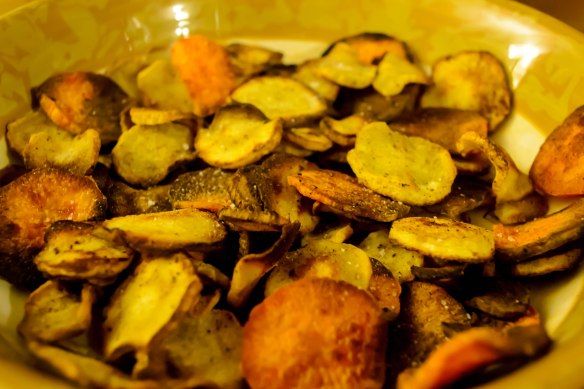
At this point, you’ll have to use your judgment.  My offerings were, after this additional time, cooked through but not remotely cracker-like in texture.  Another five minutes in the oven might have done the trick.  Putting them back in, failing to set a timer, and heading to the couch to eat dinner (I was trying to multitask) is not advisable.  I didn’t remember them until I smelled the slightly spicy aroma of parsnips, and by then it was too late – many of the little coins had gone from crackers to briquets.

I decided to pick out the worst offenders – Lucy reports that she didn’t mind a bit of charred flavor – and eat the salvageable ones anyway.

Food Blog 2011-2013-0356

To make them a bit more exciting (and disguise any lingering burned taste) I made a little dipping sauce.  You’ll need:

juice from 1 lime

2 TB honey

1 tsp garam masala

½ – 1 cup Greek yogurt

Whisk the first three ingredients together with a fork until they are smooth.  In increments, add Greek yogurt until your sauce reaches the desired thickness.  Mine was about the consistency of ranch dressing, but much more interesting in flavor.

Food Blog 2011-2013-0349

These crackers (with and without the sauce) were – if you were able to overlook the overcooking – a nice alternative to crudites or store-bought crackers.  They weren’t quite as crispy (except the ones that were too crispy), but they had a lovely deep flavor and none of the powdery, processed taste some crackers can have.  They are also a gluten-free offering and, minus the yogurt and honey sauce, vegan as well.

Food Blog 2011-2013-0350

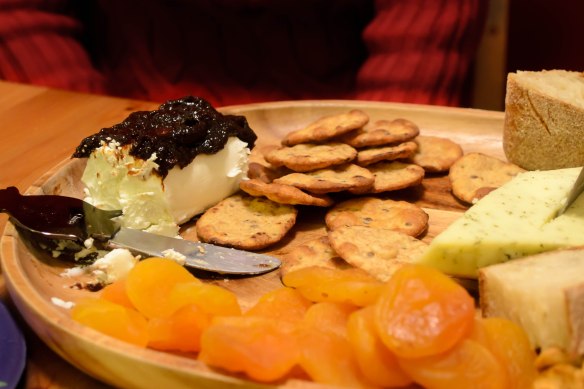
I served them alongside a cheese platter,

Food Blog 2011-2013-0353

Food Blog 2011-2013-0354

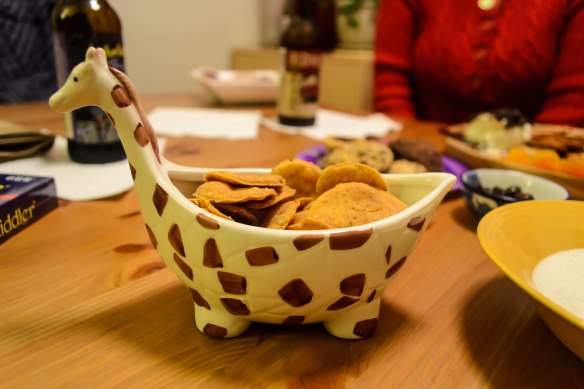
Joy the Baker’s chili spiced sharp cheddar cheese crackers,

Food Blog 2011-2013-0352

assorted sweets,

Food Blog 2011-2013-0355

and my appetizer version of Bittman’s “Marshmallow Topping for Adults” dish: thick discs of sweet potato roasted until tender, topped with a dollop of cream cheese and sprinkled with a pecan brown sugar blend before being broiled until the sugar bubbles and the cheese slackens toward melting.

Food Blog 2011-2013-0357

Food Blog 2011-2013-0359

And champagne, of course.

Food Blog 2011-2013-0361

Happy New Year.  I hope you celebrate your achievements, meet your goals, and find happiness in your own self.  I’ll be checking in again later this week with some reflections and announcements.  Welcome to 2013.

Truffling

At our house, a box of See’s chocolates was standard holiday fare. They were special – the white box, the ruffled, rustling brown wraps that made it all but impossible to sneak a selection without someone overhearing – and all too quickly gone. But they were special for good and for bad reasons. As Forrest Gump so wisely told us, you never knew what you were going to get. It might be a luscious square of soft, fudgy dark chocolate studded with walnuts, or it might be the dreaded maple nougat. My cousin J. loves caramel, and when she was little she developed a surefire way to determine which mysterious See’s square to choose: bite the bottoms off, and if you don’t like the filling inside, put it back in the box. No one could see the intrusion, at least not until that piece was selected again.

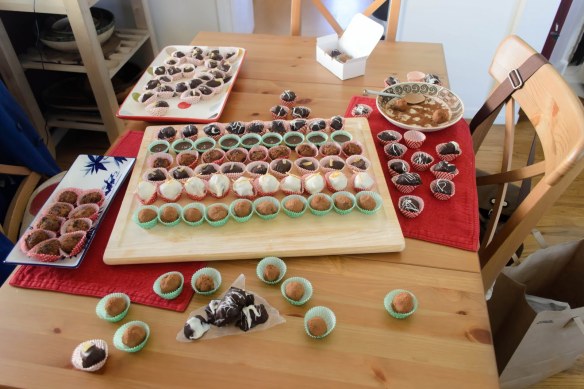
For the past few years, I’ve made truffles for my officemates at the end of the term. Squares of ganache flavored with fruits, nuts, and liqueurs, robed lovingly in melted chocolate and stuffed carefully into pretty little boxes make excellent, always well-received holiday gifts. I’ve experimented with ginger, apricots, amaretto, peppermint, almond butter, dark, white, and bittersweet chocolate. To my delight, Bittman has a truffle (or at least a truffle-like) recipe among his 101. With no officemates to share with this year, I decided to make a selection of truffles for my husband to give his department at his school.

I went a little overboard.

Food%2520Blog%25202011-2013-0195

Cranberry Truffles: Heat ½ cup simple syrup and ½ cup bourbon or water; add 2 cups dried cranberries and steep until soft, 10 to 15 minutes. Drain, reserving the liquid. Pulse the fruit in a food processor, adding just enough liquid so the mixture comes together. Roll spoonfuls of the cranberry filling into balls, then roll them in cocoa, mixed with pulverized nuts if you like.”

This sounded decadent and very adult – an excellent addition to truffle flavor combinations I was planning like Chambord with dried raspberries and Grand Marnier with candied orange peel. I used:

Food%2520Blog%25202011-2013-0182½ cup bourbon (I used Knob Creek)

½ cup simple syrup (I had some ginger syrup kicking around, so why not?)

2 cups dried cranberries (use reduced sugar, if you can find them)

½ cup cocoa powder

½ cup hazelnuts (optional)

I was pleased to find reduced sugar Craisins to use here – the bourbon has its own kind of sweetness, and the ginger syrup I was using instead of a simple syrup was tooth-twingingly sweet. I heated the liquids together in a small pot over medium heat until they came to the barest simmer.

As Bittman directs, I steeped the Craisins in the bourbon and syrup for fifteen minutes or so. I wasn’t sure what temperature “steeping” actually is, so I decided on a barely bubbling simmer. The syrup seeped into the cranberries, giving them a slightly fleshy texture. The bourbon wafted headily through my kitchen, making me think 10am might have been on the early side to take on this project so clearly meant for a Friday evening.

Food%2520Blog%25202011-2013-0184

Fifteen minutes of simmering down, and I dumped my swelling craisins into a strainer over a pot to catch the liquid. Don’t lose all the liquid; you’re going to need a tablespoon or two of it later. Let the craisins drain and cool for at least ten or fifteen minutes. While they cooled, I put half a cup of hazelnuts in my food processor and let it rip until they were almost all pulverized into a powder.

When they were cool and had (emitted) plenty of bourbon infused syrup, I moved the craisins to the clean-scraped food processor and let it run. The little ruby jewels came together into a whirring relish of red, and as the bits began to clump in the bowl of my food processor, I added a tablespoon of the bourbon syrup, and then another. The cranberry bits now clung stickily together and I decided they were stable enough to scoop.

Food%2520Blog%25202011-2013-0186

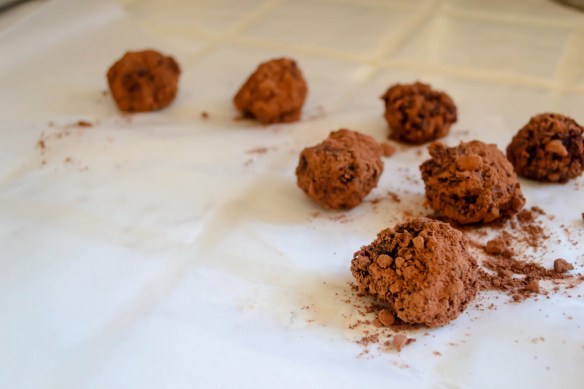
I mixed my powdered hazelnuts with cocoa powder in a shallow bowl, then laid out a piece of wax paper for the finished balls. I spooned out rounds slightly smaller than ping-pong balls and rolled them gently in the nut and cocoa mixture, then set them gently on the wax paper to set or firm up or whatever it was they were going to decide to do.

Food%2520Blog%25202011-2013-0187

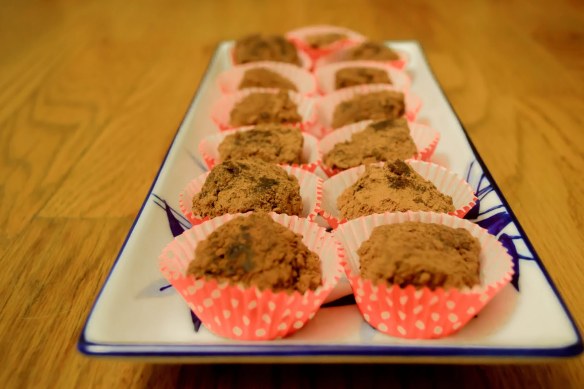
When I let myself taste one (I waited until after lunch, out of respect for the bourbon), I was glad to have waited. These, folks, are strong. They are utterly delicious, but extremely intense. The cranberries absorb all the flavor and warmth and musty floral overtones of the alcohol, and the cocoa adds just the right hint of matte bitterness to combat the sweetness and tartness of the cranberries. I set them gently in mini cupcake wrappers.

Food%2520Blog%25202011-2013-0191

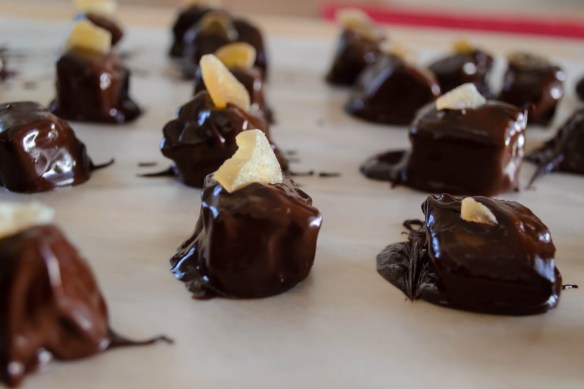
Once completed, the bourbon balls joined the rest of the bejeweled collection, which consisted of:

Apricot and almond bits in white chocolate, spiked with amaretto and then dipped in dark chocolate.

Bittersweet ganache with orange liqueur, threaded with candied orange peel, dunked in white chocolate and garnished with a piece of sugared rind.

Dark chocolate with candied ginger and ginger syrup, dressed with semi-sweet chocolate and topped with a piece of ginger.

Food%2520Blog%25202011-2013-0194

Chocolate ganache flavored with chambord and studded with freeze dried raspberries, which contributed a really intriguing crunchy intensity.

Crunchy flaxseed and almond butter cups, topped with a sprinkle of sea salt.

Food%2520Blog%25202011-2013-0197

Happy Holidays!

Food%2520Blog%25202011-2013-0198

Fading light. And bourbon.

My home office – the room where grading, blogging, photo editing, and general work happens – has the most wonderful light in our house.  A huge sliding glass door lets sunlight pour in during the morning hours, and in the afternoon I get brightness mediated by the roof of the house.  Even when it’s overcast, there is still so much natural light that it makes for wonderful food shots.

But winter is a problem.  I’m discovering that if I make a dish for dinner, I’m not going to be able to photograph it from my office because it’s too dark by 5pm.  And wedded to this blog and this project as I am, there’s no way we’re having dinner at 4:30 in the afternoon just so I can get the best light in the house.  So I’m trying out new angles, and new placement, and new adjustments.  I’m learning more about artificial light: which arrangements I find glaring and which I find acceptable.  Bear with me, and look forward to the return of Daylight Savings Time!

“17. Sauté chopped onion in butter, then chunks of sweet potato and stock or water to cover. Simmer until the sweet potatoes can be pierced with a knife, then add chopped kale and cook until wilted.”

This was easy, and quick, and tasty.  I made a few additions to Bittman’s recommendations and think the soup really benefited from them.  I used:

4 TB butter Food blog 2011-0133

½ a medium onion (mine was yellow)

1 big sweet potato, peeled and cut into small chunks (the smaller the chunks, the faster they will cook, so make your decision based on how much time you have and what size is most pleasing to you)


Salt, pepper, ground nutmeg to taste

4 cups broth – vegetable or chicken, depending on your preference

6 oz. kale

1 tsp red wine vinegar

Heat the butter in a pot over medium heat.  When it has melted, add the onion and cook gently, stirring occasionally, until the onion is soft and translucent but not bronzed.

Add the sweet potatoes and seasoning, stir to combine for a minute or two, then add the broth.  The quantity of liquid you need will depend entirely upon the size of your sweet potato.  You may need more or less than the 4 cups listed here.

Let the soup simmer until the sweet potatoes are tender but not falling apart.  Mine took about 15 minutes.

Add the kale and stir to combine.  You will be bewildered by how quickly it collapses on itself, wilting from smoky green to a brighter, more vibrant hue as it is immersed in the liquid.  Cook just until it reaches the texture you like against your tongue – I let it simmer for about 5 minutes, because I like my kale to still put up some resistance and retain its bright color.

I tasted and thought this needed something.  Extra salt to heighten the flavor of the kale, certainly, but there was a kind of dullness about the whole concoction.  Remembering my soup lessons from Alton Brown, I sprinkled in just a hint of red wine vinegar, and the difference was amazing.  The whole thing was brighter, somehow, even though you couldn’t taste anything harsh or stringent.

We consumed this happily with freshly toasted, garlic-rubbed slices of pugliese.  It was good, but could have been stuffed with even more flavor: I’d consider adding garlic, ginger, maybe even rice or ramen noodles.

Food blog 2011-0137

“4. Onion jam with bacon and bourbon: Thinly slice red onions and cook in olive oil with chopped bacon until soft. Add a little bourbon and brown sugar to taste and cook until the jam thickens.”

Bourbon is new for me.  N. has been enjoying the occasional scotch for a few years now, but we recently acquired a bottle of Knob Creek and I’ve been appreciating the floral notes of it – so much less musty and boggy than its British cousin.

4 slices thick-cut bacon, halved lengthwise into long strips, then sliced into small rectangles

½ large red onion, thinly sliced

¼ cup bourbon

2 TB brown sugar

Freshly ground black pepper

1 small sprig rosemary

Food blog 2011-0144

I used about a tablespoon of olive oil to start the pan, but I don’t think you really need it.  Just toss in the bacon slices over medium heat and let them work for about 5 minutes.  You will get a shimmer of fat across the bottom of the pan that is more than enough to start the onions sizzling in.

Add the onions and cook over medium or medium-low for at least ten minutes, until the onions soften and the bacon is mostly cooked.  Stir with some frequency to ensure even cooking.

Off the heat (especially if you are using a gas stove) add the bourbon and the brown sugar.  Stir to combine, then return to medium heat and simmer slowly for about 20 minutes, to let the flavors mingle and the bourbon soak into the onions and bacon.

After a few minutes of cooking, I added pepper and rosemary for additional flavor components, and I think they were a good choice.  The rosemary’s woodsy flavor was a nice contrast to the fatty bacon and sweet onions.  Everything cooked down into a sticky, caramelized jam that I draped across some baked rounds of polenta.

Food blog 2011-0148

This was delicious, but misplaced.  The meaty, smoky bacon was intensified by the bourbon, and the brown sugar and onions had a nice note of molasses.  It didn’t belong on polenta.  It belonged, I think, on a freshly toasted piece of crostini, possibly smeared with a thick slice of brie.  The funkiness of the cheese could stand up nicely to the sweet smoky strength of this jam.

We paired our misguided polenta with green beans, lightly blanched and then seared in a hot pan and deglazed with a bit of red wine.  These, too, were delicious, but not the ideal pairing for the sweet saltiness of my jam.  Apples, maybe, or red grapes would make better pairings.  Regardless, we ate with joy and returned to the pan once or twice for a final sweet chunk of sticky, gooey jammy bacon to sweeten our palates, even though dessert was still to come.


“91. Pears in Red Wine: Simmer 2 cups red wine with ½ cup sugar, 2 cloves, a cinnamon stick and a few slices of ginger in a pot for a few minutes, then gently poach peeled and cored pears (use a spoon to hollow them from bottom), until soft. Cool or chill, and serve with a bit of the poaching liquid.”

This is supposed to be one of the most sophisticated desserts you can offer: not overly sweet, laden with mulled flavor, perfect for a gourmet adult party in celebration of autumn.  Pears, with their temperamental habits and signature grainy texture, are perhaps the same kind of acquired taste as wine or coffee or any of those other “adult” tastes.  As dessert for our onion-jam-crusted dinner, I decided to attempt these.

Food blog 2011-0140

I used 2 pears, but followed the rest of Bittman’s quantities exactly.

Food blog 2011-0142Well, one exception to note: I thought about getting fancy and adding things like citrus peel or rosemary (apparently I’m hooked on the stuff these days).  But in the end, I just splashed in a bit of bourbon to link the flavor profile back to our dinner: red wine from the beans, bourbon from the jam, and this dessert would fit right in.

After the first simmer, in which I stirred gently to let the sugar dissolve and the spices mull gently into the wine, I prepared the pears.

The issue with pears is that inside their tender skins they are slippery little beasts.  You can’t grasp them too firmly or they sigh into bruises.  You can’t hold them too delicately or they slide out of your hands and threaten to slip from the edge of the kitchen counter.

I dove into my attempt to core the pears only after peeling them.  This, and the attempt to do so with a spoon, may have been a mistake.  The spoon tore through the tender flesh of the pear but was too wide to remove only the core.  Further, I wasn’t sure how much core I was supposed to be removing, so I ended up with two pale, naked, slightly mutilated pears, which I slid into their (hopefully) healing bath of alcohol.

I let them simmer, turning them occasionally to dye all sides a lovely burgundy, for about 15 minutes.  Then I turned off the heat and let them sit a further 20 minutes until we were ready for dessert.

Surrounded by a moat of spiced wine, these were achingly tender and nicely flavored.  I would choose pears that were less ripe if I attempted this dessert again, because a bit of additional texture might have done them good.  As it was, though, much of the graininess disappeared in the poaching, and the soft floral flavor was really nice against the wine and assertive spices.  A scoop of vanilla ice cream on the side would have made this a richer endeavor, but I think the creaminess would have matched well with the fruit and the wine.   Or maybe I just need the extra comfort as we roll into December…

Food blog 2011-0150

Trick or Treat

Halloween is easily in my top three holidays.  I have to give the prize to Christmas, because it means family and love and sweaters, but Thanksgiving and Halloween chase each other in circles to gain second place.  Despite that love (overwhelming in some cases, especially if you, like N., are not invested in costuming yourself at every possible occasion), this is the first year in almost a decade that I’ve done nothing to celebrate.  No costume.  No party.  No decorations.  We bought candy for the six kids that showed up (only six!  The whole evening!  Was it just because it was a Wednesday, or do kids not trick or treat like they once did?) and I definitely listened to the Halloween party mix my friend D. made for me a few years ago, but it felt a bit like a lost holiday.

I did embrace the season, though, the following day.  Having Thursdays off gave me the opportunity to do something I’ve been wanting to do for years: pillage Target’s day after Halloween sale for leftover clearance items (read: treats!).

The tricks began when I began work on the evening’s dinner.  It was, I realize in retrospect, a bit of a Chopped style enterprise: appetizer, entree, and dessert, each made with ingredients I’d not expected to meld.  In each case, however, the “trick” aspect of the dish was my doing, not the recipe’s.

“12. Garlic-Rosemary Figs: Soak dried figs, stems removed, in warm water until plump; drain and halve. Heat rosemary and lightly smashed (and peeled) garlic with olive oil on medium-low heat, until softened. Add figs, along with some fresh orange juice. Cook until saucy.

Pairing figs, garlic, and orange juice seemed odd.  Nevertheless, I collected enough for one portion (this was not N.’s kind of dish):

6 dried black mission figs

1-2 tsp fresh rosemary

2 smashed, peeled garlic cloves

1 TB olive oil

juice from 1 small orange (⅓ – ½ cup juice)

I heated some water in my teakettle and poured it over the figs (which I’d halved prematurely.  Apparently paying attention to the directions is kind of important), which I let stew on the counter for half an hour.

Figs vaguely plumped, I drained them and set them aside, then put the garlic cloves, rosemary, and oil into a cold pan.  I heated it over medium for five minutes or so – just until the rosemary started to sizzle and the garlic turned a little blonde.  Then I added the figs and orange juice, and simmered for fifteen minutes or so, until the orange juice had reduced considerably.

I plated, I ate, and I considered.  This didn’t taste bad, but it didn’t marry absurdly well either.  The rosemary and the figs were lovely.  The orange juice and figs were fine (though the orange was a bit overpowering).  The garlic and figs were… unobjectionable.  They just weren’t my favorite.

I must say, though, I recalled while I was cleaning up after dinner that this entry was in the “Sauces and Relishes” category.  I had eaten it straight.  This was, perhaps, why I wasn’t enamored of it.  Therefore, I’d recommend spooning this over lamb chops, or pork tenderloin, either of which would add some savory notes to make the garlic feel less anomalous.

Though this “appetizer” wasn’t fantastic, I ate it with a fantastic grain-salad-turned-hash inspired by Smitten Kitchen.  I want to revisit this hash, because I think it could use some additions, but here are the basics:

Line a baking sheet with aluminum foil.  Set it in the oven and preheat to 400F.  Yes, you are preheating the pan along with the oven.

Peel and halve a butternut squash.  Seed half of it and cut that half into small cubes.  In a bowl, toss the cubes with salt, pepper, and olive oil, then tumble onto the baking sheet (where they will sizzle immediately – this is a good thing) and stow back in the oven for 35-45 minutes, or until they have golden edges and creamy soft middles. 

During the last ten minutes of squash roasting, push the squash to the sides of the pan (or just grab another pan, if you aren’t invested in avoiding dishes, like me) and stack 4 cups or so of trimmed, cut kale that has also been tossed in olive oil, salt, and pepper.  The kale and squash will cook down a little more together, and you will be left with something not quite like kale chips, but a bit more textured than if you’d boiled or steamed it.

While the squash and kale roast, cook 1 cup of bulgur wheat in chicken (or vegetable) broth.  When done, fluff gently with a fork and toss with squash and kale.

During the last few minutes of roasting time, toast 2 TB pumpkin seeds in a dry pan until they begin to snap and crack.*  Be careful not to burn them.  Toss with bulgur and vegetable mixture.

In the pumpkin seed pan (again, avoiding dishes), heat an egregious quantity of butter until foamy and crack in an egg to fry until the edges frizzle and brown and crackle.  Despite a few careful taps, on this egg of all eggs – the egg I wanted to photograph quivering atop my hash, the egg I wanted to show just cut and lusciously runny – I somehow shoved my thumb through the yolk and it broke all over the pan.  Nasty trick, egg.

Nevertheless, I piled my hash up on my plate, carefully laid the fried egg over it, and dug in.  It was a hearty, pretty, perfectly autumnal dish.  It needs some tweaking before I’m thrilled with it – perhaps some sautéed leeks folded into the bulgur, or some light spices on the butternut squash – but this was a delightful start.

I turned to dessert:

“96. Sweet Autumn Gratin: Combine cubed pumpkin or sweet potato with cranberries and hazelnuts in a buttered baking dish. Sprinkle with brown sugar and toss. Drizzle cream all over, dot with butter and bake until soft, bubbly and browned, 50 to 60 minutes. Re-warm before serving if you like.

I’m going to give you a list not of my ingredients and procedure, but of what I should have used and done.

1 big sweet potato, peeled and diced

½ cup dried cranberries (I didn’t have fresh, so I don’t know what they would be like.  Presumably more successful because they would emit, not swallow, liquid)

½ cup walnuts, coarsely chopped (I couldn’t find hazelnuts anywhere – who would have thought this would be the food item I would miss most from Oregon?!)

¼ – ½ cup brown sugar, depending on how sweet you like it

¼ cup heavy cream

¼ cup butter

Preheat the oven to 400F.  Butter a 9×13 inch pan (my round, much smaller dish was a poor choice).

Toss the sweet potato chunks, cranberries, and walnuts with brown sugar.  Spread them out in the pan in an even layer.  Pour on the cream, then pinch off pieces of butter and dot them over the top.

Bake for an hour, or until the sweet potato pieces are fully cooked.

I did few of these things.  My sweet potatoes were in bigger-than-they-should-have-been chunks, piled up in a small casserole dish, starving for cream (I only had a tablespoon or two) and shorted on sugar.  As a result, at the end of an hour they were hot but still resistant in texture.  I think what you want is melting, creamy softness.

Tricked again.

To remedy this problem, I tried several things.  First, I made a bourbon hard sauce (equal parts sugar and water, stir to melt.  Add ¼ cup butter, stir carefully until it melts.  Add a shot or two of bourbon, cook just a minute or two to take the edge off) to pour over the top.  This helped, and I willingly ate a serving, but it was lacking whipped cream or ice cream or, bizarrely, pie crust.


I didn’t figure out the pie crust thing until the next day when I was making empanadas for dinner.  As I pressed my fork into the edge of the dough to crimp it, I was flooded with the right answer: tiny hand pies stuffed with my sweet potato mixture!

This was clearly the right thing to do.  Saturday afternoon, I unrolled a pie crust on my counter, cut out 3 inch circles, and proceeded to fill them with a teaspoon or two each of the gratin, which I’d mashed with a fork to make smoother and therefore more manageable.

Once filled, fold in half, press and then crimp with a fork, and brush with egg wash (1 egg yolk + 1 TB water).  Sprinkle with turbinado or other raw, chunky sugar, and bake in a preheated 400F oven for 15 minutes, or until the tops are golden brown and the dough is flaky.

These make lovely, tiny snacks.  The craisins give a punch of tartness to the sweet, earthy, almost heavy sweet potato and walnut pairing.  There are subtle floral hints in there, because before putting it away that first night I admit to dumping the bourbon sauce over the whole thing, but this adds a flavor I wouldn’t change.  The dough is buttery and flaky and collapses easily around the filling, and it’s difficult to prevent yourself from standing over the pan as it comes steaming out of the oven and eating four or five in a row, scalding your tongue and not caring at all.

Perfect November treat.


* You could, I suppose, use butternut squash seeds, if you are the sort of person with the forethought to save, rinse, and dry the seeds while you clean your squash.  I, clearly, am not.