Mom’s Challah

Friends, this is the motherlode.  Or, if you’ll forgive the terrible pun, the Mother loaf.*  In that same red binder of recipes I received as a wedding gift that contains my Nana’s sweet roll dough recipe, my mom included her “secret” recipe for challah (in my recipe collection, Mom promises that she’s only given this challah recipe to one other person.  This, as it turns out, has become a lie.  Both my Aunt Nancy and my cousin Julie have this recipe.  Who knows how many other people do too, by now!).  When she was much younger (read: before two children kept her waking hours a blur of busy), Mom baked bread a lot.  I don’t know where she got this recipe for challah, that wonderful, doughy, braided loaf of egg bread traditionally prepared for Jewish holidays and the sabbath, but even in our gentile household it became a holiday essential for us.
Food Blog March 2013-0971
For the past few years, my sister has taken up the challah mantle and has been preparing it, with Mom’s help, on Christmas Eve so we could slather it with apple butter or cinnamon sugar or honey to enjoy on Christmas morning.  It’s not an easy bread (are any of them, really?).  With an incredibly sticky dough, not one or two, but three rises, and a tendency to overbake, it has always intimidated me.  At any phase of the process, something could go wrong!  If I could master challah, I thought privately, I would really have a handle on this bread thing.
So, a number of loaves under my belt, with Easter coming up, and this month’s Twelve Loaves challenge of holiday breads, it seemed like the right time.  Friday morning, after quizzing my mom on a few details, I pushed my sleeves up, swallowed the disparaging warnings of that little gargoyle of doubt who often sits on my shoulder, and dove into Mom’s recipe.
Food Blog March 2013-0920Food Blog March 2013-0930Food Blog March 2013-0932
This is, as I mentioned above, a sticky dough.  After kneading it becomes elastic and smooth, but there is still a tackiness about it that leaves your bowl streaked with gummy strands and your hands, if not well floured, stringy with delicious remnants.  It takes a long time – with three rises averaging over an hour each, you aren’t starting this loaf in mid afternoon and expecting it to be ready for dinner.
Food Blog March 2013-0933Food Blog March 2013-0935
I’ve seen plenty of recipes suggesting overnight refrigeration time – Michael Ruhlman’s blog, in fact, has a guest post on challah by Marlene Newell that begins the night before it is baked – but Mom has never done it that way.  If you’ve scheduled a lazy day at home, or perhaps a day punctuated by laundry, tidying up, and the odd brief errand carefully placed during a rise, this could just become your best friend.  It’s soft, it’s rich and tasty, it looks impressive (even if, like me, you only do a three strand braid instead of the more traditional six strand), and it keeps fairly well, provided you wrap it well in aluminum foil.  I find plastic storage gives the crust an unpleasing texture.  Of course, it’s so tasty that I can’t imagine it needing to keep well – it will be gone within a day or two.  On that topic, I’ve never understood the comments that it makes wonderful french toast.  In our house, the full loaf has dwindled to half by lunch time, and as the afternoon wears on slice after slice seemingly evaporate, until the bread board contains only a lonely half heel and a small pile of crumbs.  This is the first time I can remember, with only N. and me indulging (Lucy asked with pleading eyes of liquid velvet, but it’s too good to share), that the loaf has made it to day three of existence.
DSC_0910
Despite my lingering doubt, I had only a few moments of anxiety as I put together this loaf.  The stickiness of the dough stressed me out a little – even after adding the full amount of flour in the recipe (as I will note again below, you only incorporate part of the flour at first, adding in additional ¼ cups at a time as needed to work the dough), thick gobbets clung to the sides of my mixing bowl, my dough hook, and my fingers.  One rise down, however, and the stickiness diminished.
Food Blog March 2013-0937Food Blog March 2013-0940Food Blog March 2013-0943
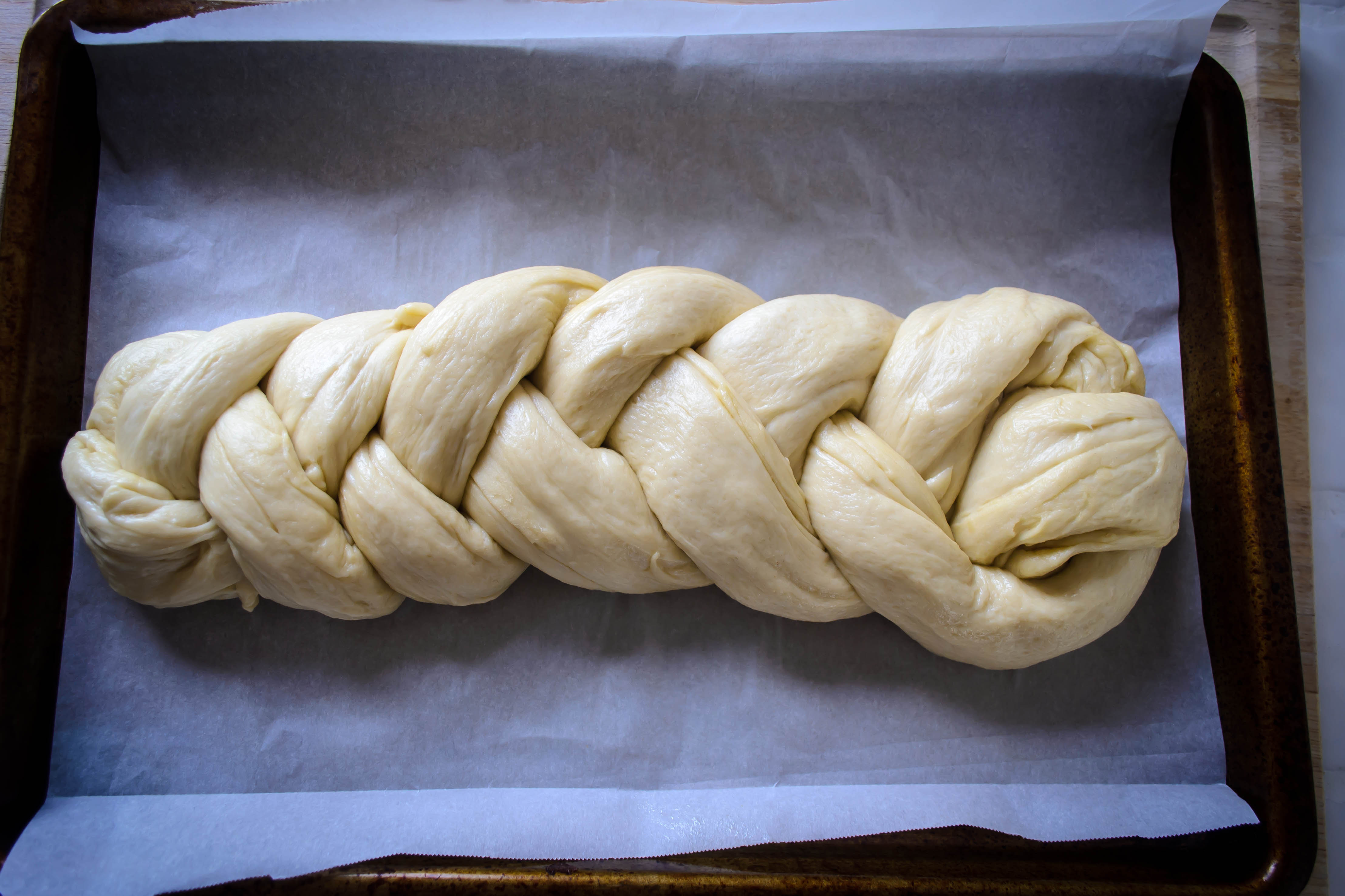
Faced with three thick strands of dough, I forgot how to braid for a moment.  Heavy, stretchy worms of raw dough are a far cry from pigtails or Barbie hair, my braid targets in a past life.  But braid made and ends tucked under, I had something that actually looked like my mom’s longed for loaf.
Food Blog March 2013-0944Food Blog March 2013-0949
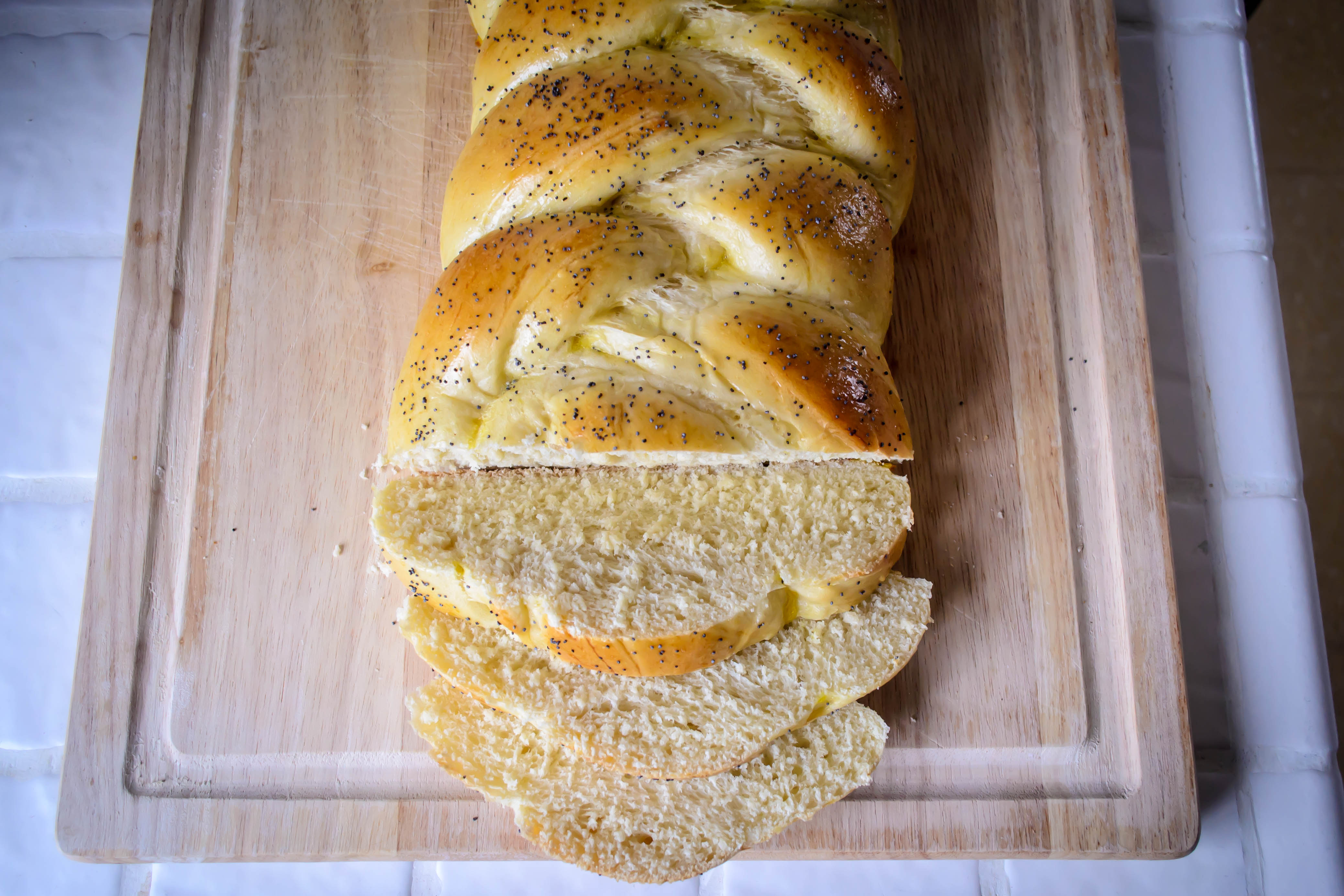
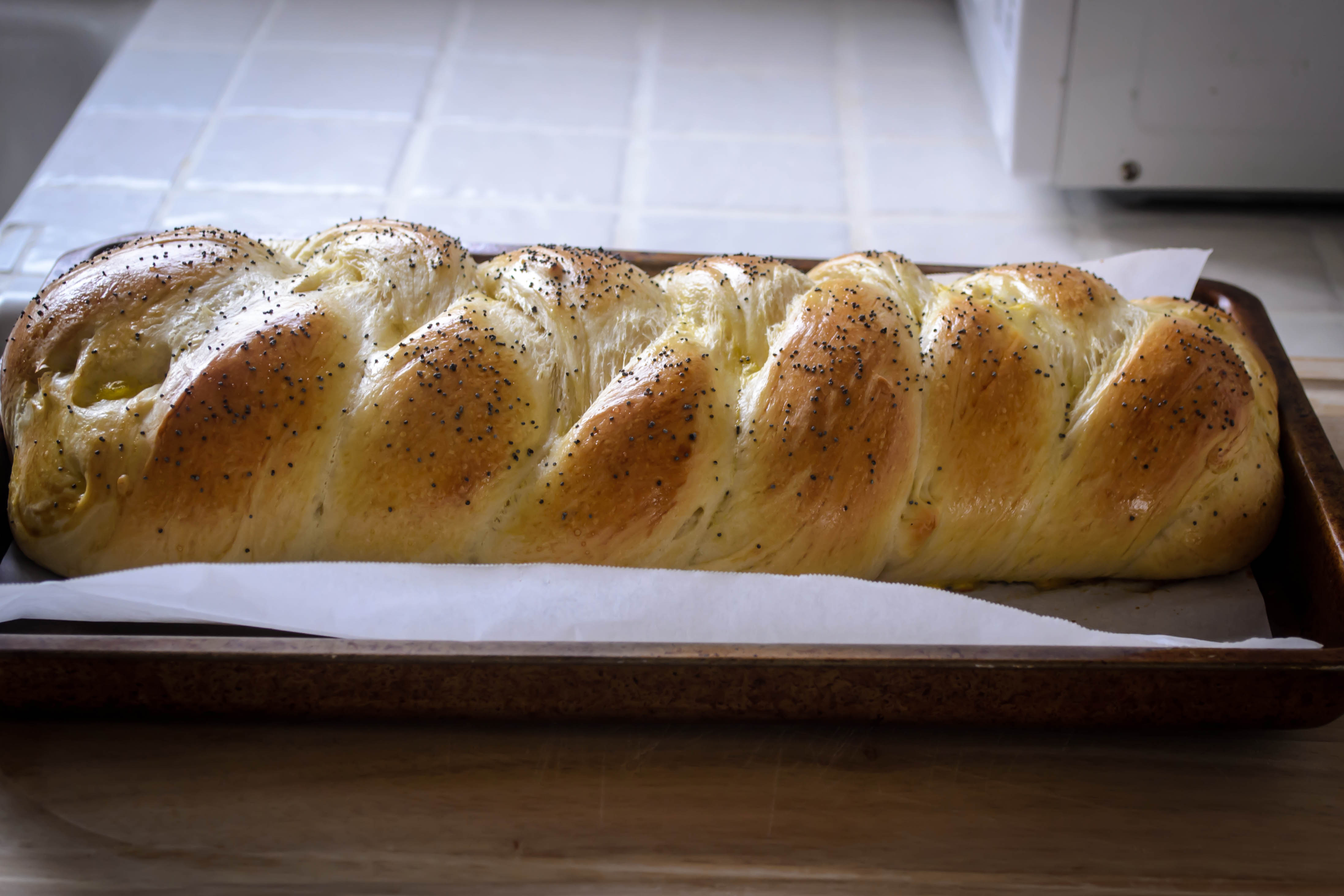
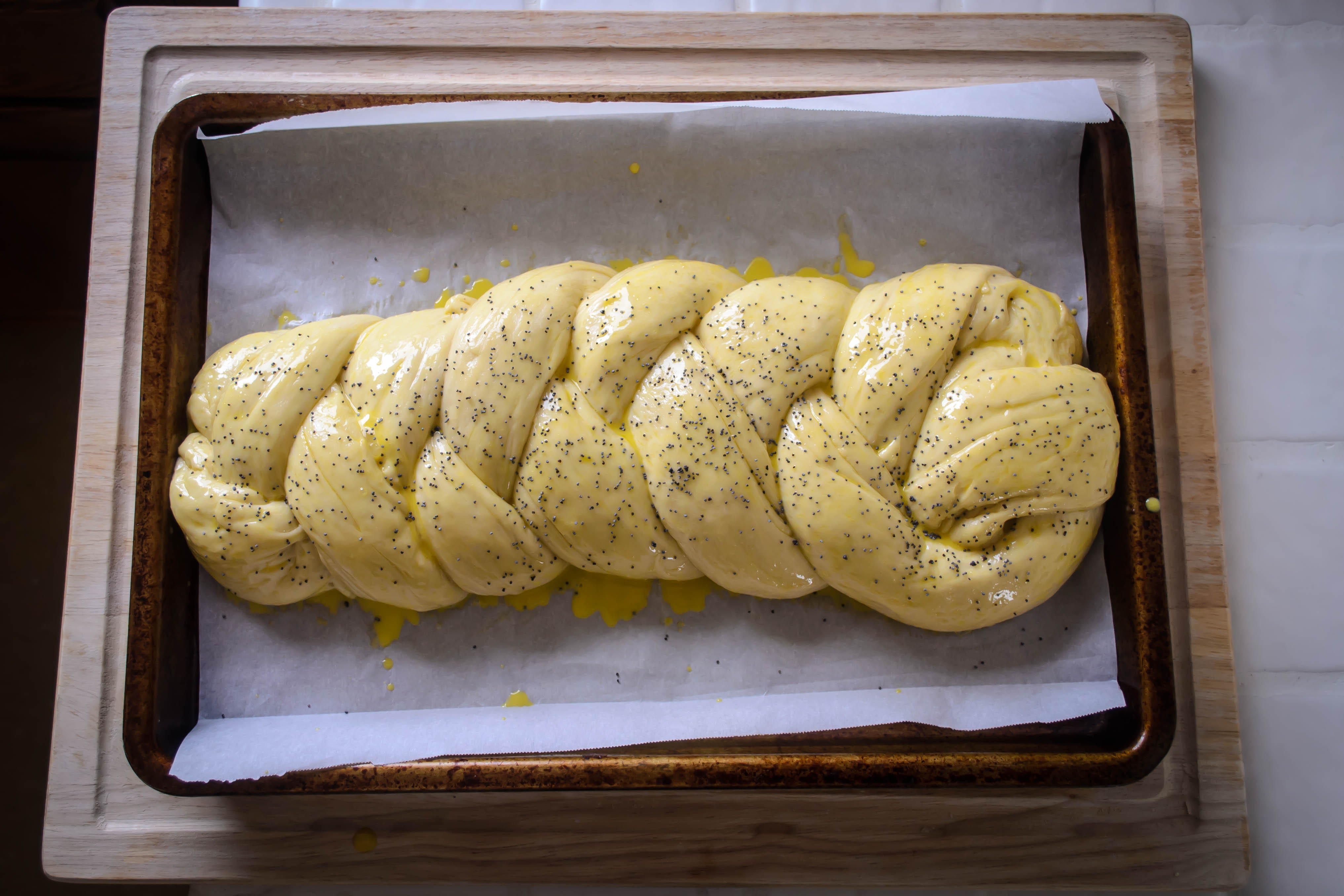
A quick glaze of egg wash and a generous sprinkle of poppy seeds, and I started getting excited.  A quick, almost half hour in the oven later (the loaf goes from moist and springy to overbaked in what feels like an instant), and I was staring at a near perfect replica of Mom’s bread.
Food Blog March 2013-0958
It’s hard to wait the requisite 15-20 minutes to let the bread cool and the internal structure solidify, but you should.  It makes slicing much more successful.  And once you have waited, you should cut thick slices, and garnish them with butter or jam or just your own teeth and tongue.  Happy Sunday, whatever you might be celebrating.
Food Blog March 2013-0966
Mom’s Challah
1 tsp + 1/4 cup sugar, divided
½ cup warm water
2 tsp active dry yeast (or 1 package, which contains 2 ¼ tsp)
½ cup vegetable oil
½ cup warm water (again)
2 tsp salt
2 eggs, lightly beaten
3 ¾ – 4 cups flour (I used bread flour, but Mom has always used all-purpose)
Poppy seeds or sesame seeds for sprinkling
1 egg yolk beaten with 1 TB water


  • Dissolve the sugar in the first ½ cup warm water in a large bowl (or the bowl of your stand mixer, if you are using one).  Sprinkle yeast on top and let it stand to burble and breathe for about 10 minutes.
  • When your yeast has woken, and smells like bread and beer, use your paddle attachment (if you are using a stand mixer) to incorporate the oil, second ½ cup of warm water, sugar, salt, and beaten eggs.
Food Blog March 2013-0928
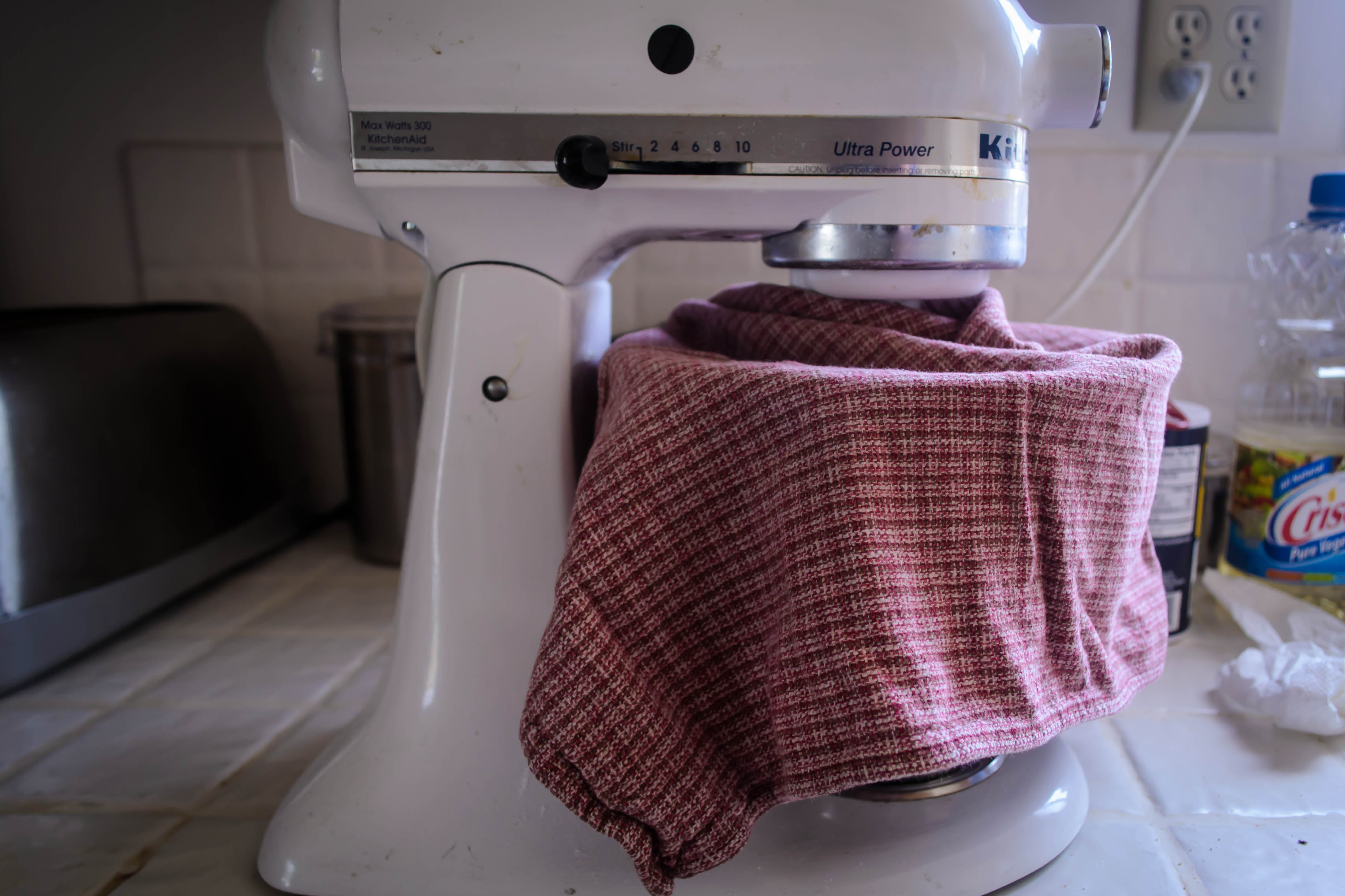
  • Add 3 cups of the flour and beat well.  The dough will be very sticky, but as Mom says, that’s okay.  Cover the sticky mass with a cloth and let it rest for 10-20 minutes.
  • If you are using a stand mixer, exchange your paddle attachment for the dough hook and begin kneading at low to medium speed.  As needed, add the additional flour by ¼ cups at a time.  Knead for 8-10 minutes or until the dough passes the windowpane test.  When I asked Mom about this, she looked at me like I was speaking a different language, then said “I always use the baby’s bottom test,” which got the same look back from me.  She was talking about smoothness and texture, but considering she often gives the dough a little smack when she’s done kneading it, I wondered about the ethics of this measuring device…
  • If you are kneading by hand, turn the sticky mass out onto a well floured board.  With equally well-floured hands, knead for 10 minutes, incorporating more flour as needed, until the dough is smooth and has a shiny surface (and feels, apparently, like a baby’s bottom).
  • In either case, now is the time to place the ball of dough into a lightly oiled bowl and stow it in a warm place to rise for 1-2 hours.  I like to use my oven, letting it heat for 5 minutes and then turning it off for 5 minutes before putting the dough inside.
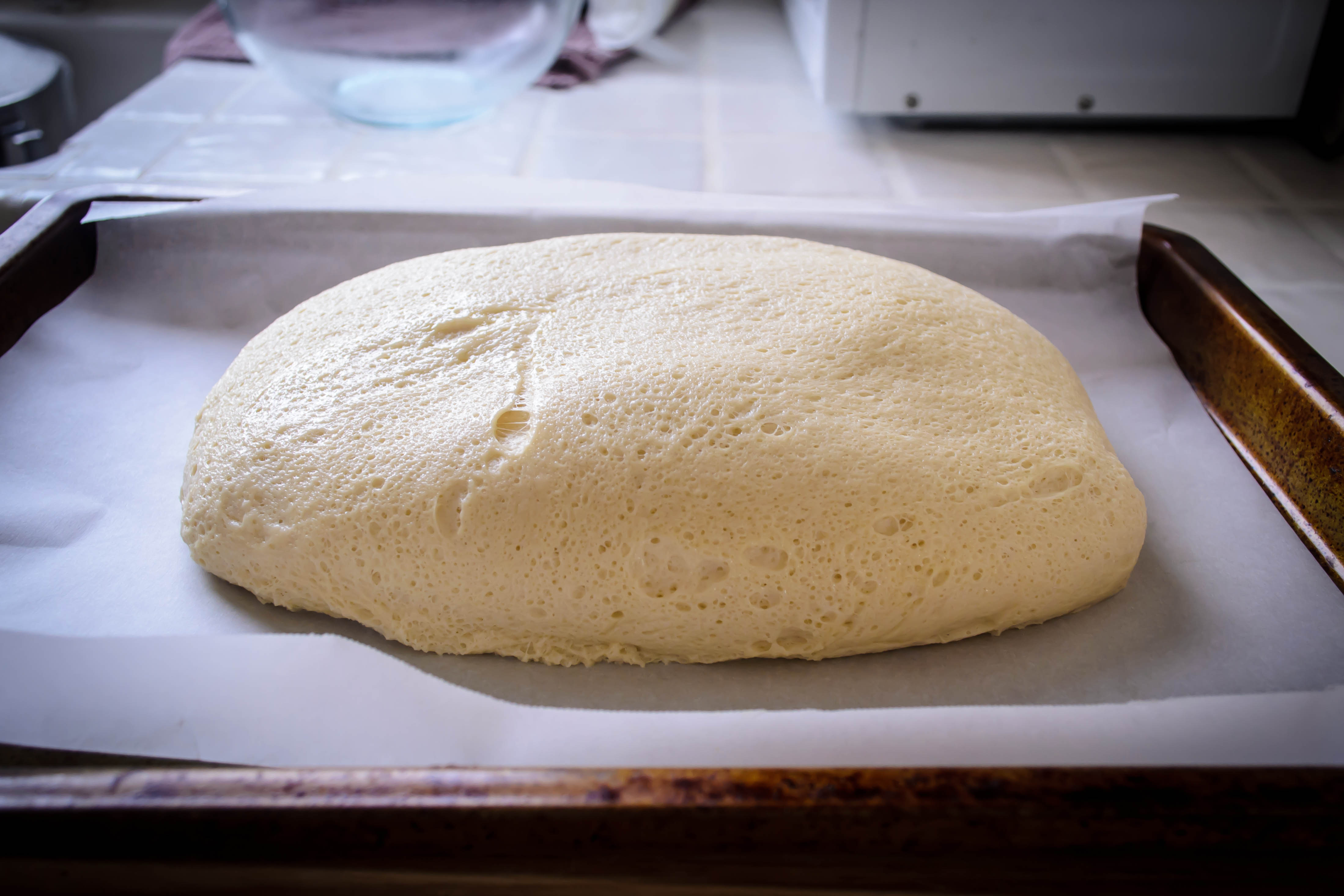
  • After the dough has risen to double in size, punch it down (Mom notes “this is fun!”), cover it with a clean cloth, and let it rise again until doubled again – about 45 minutes.
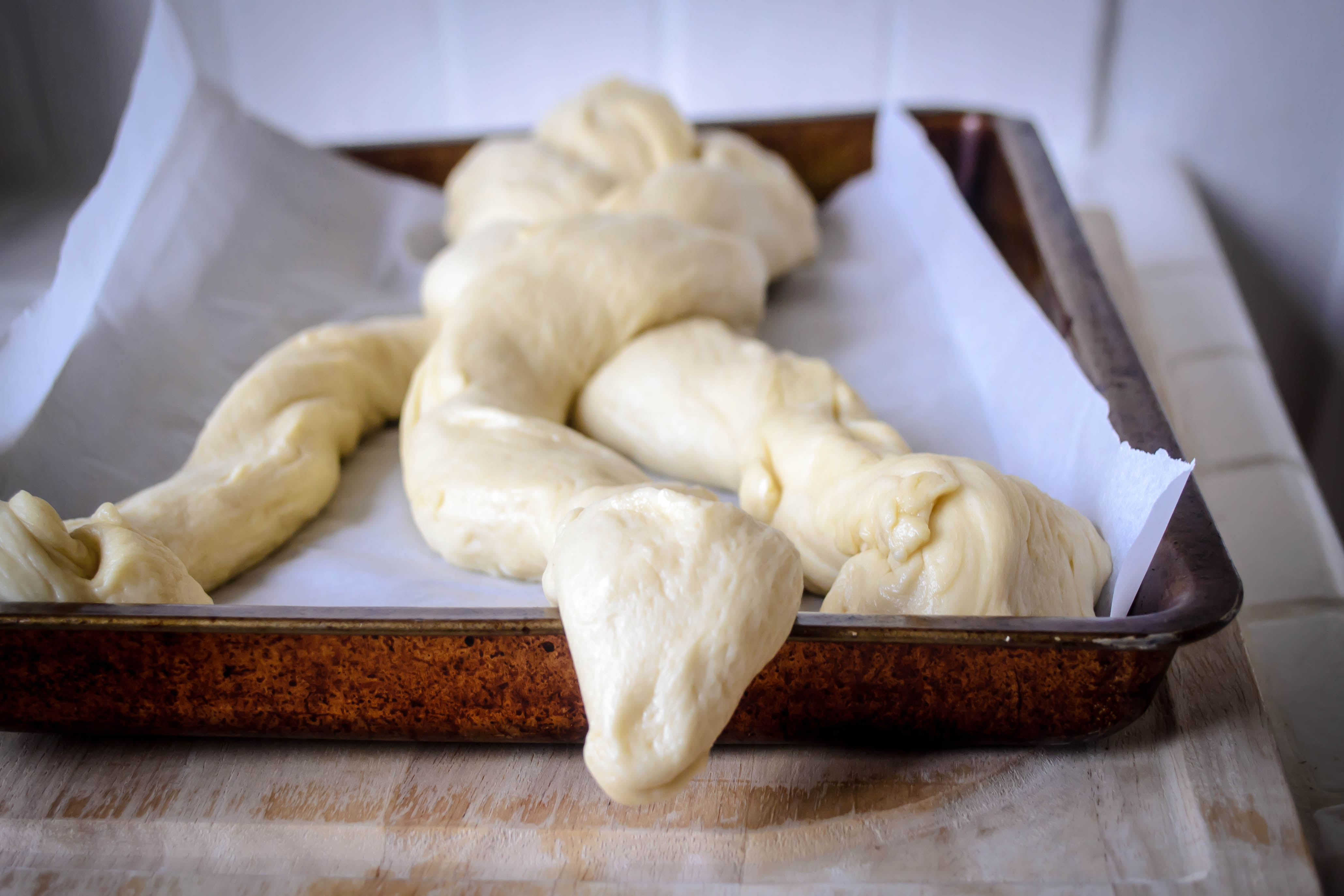
  • Divide the dough into three equal parts.  Shape each third into a long rope, place on a greased or parchment lined baking sheet and braid together loosely, pinching the ends firmly and tucking them under on each side.  Cover with a cloth or kitchen towel and, once again, let it rise for 45 minutes to an hour.  See why you need all day for this loaf?
Food Blog March 2013-0947
  • When the braid has swollen again, preheat the oven to 350F.  While you wait, beat an egg yolk with about a tablespoon of water to make an egg wash.  Brush the top and sides of the braid with your egg wash, then sprinkle with poppy or sesame seeds (we prefer poppy, in our house).
Food Blog March 2013-0951
  • Bake in your preheated oven for 30 minutes, or until the internal temperature of the bread is 180-190F.  The top will be golden brown and the bottom will feel delicately hollow when thumped.  Hot ovens tend to overbake this bread, so be sure to check at 30 minutes, or even just before.
  • When the bread tests done, take it out of the oven and let it cool on its baking sheet for 15-20 minutes, to allow the delicate internal crumb structure to firm up a bit.  This will make for easier slicing.
 Food Blog March 2013-0965
Thanks, Mom!

DSC_9042

* still not as bad as N.’s pun: he keeps saying “holla for challah!” and even though he admits this is neither in good taste nor particularly funny, finds he can’t stop doing it…

Swing

Summer into fall into summer.  Salads and grilled vegetables into casseroles dabbled with cream into fresh raw dips.  Luxurious stretches into curled legs under blankets into stressed grading sessions into sampling new half-fizzed white wine.

Sometimes this is called Indian Summer.  I like to think of it as Swing Season.

Two Bittmans for you this week.

77. Trim and dice fresh tomatillos; peel and julienne jicama (or daikon or kohlrabi). For dressing, combine lemon and lime juices, olive oil and chopped cilantro. Pour over salad, top with toasted sesame seeds.

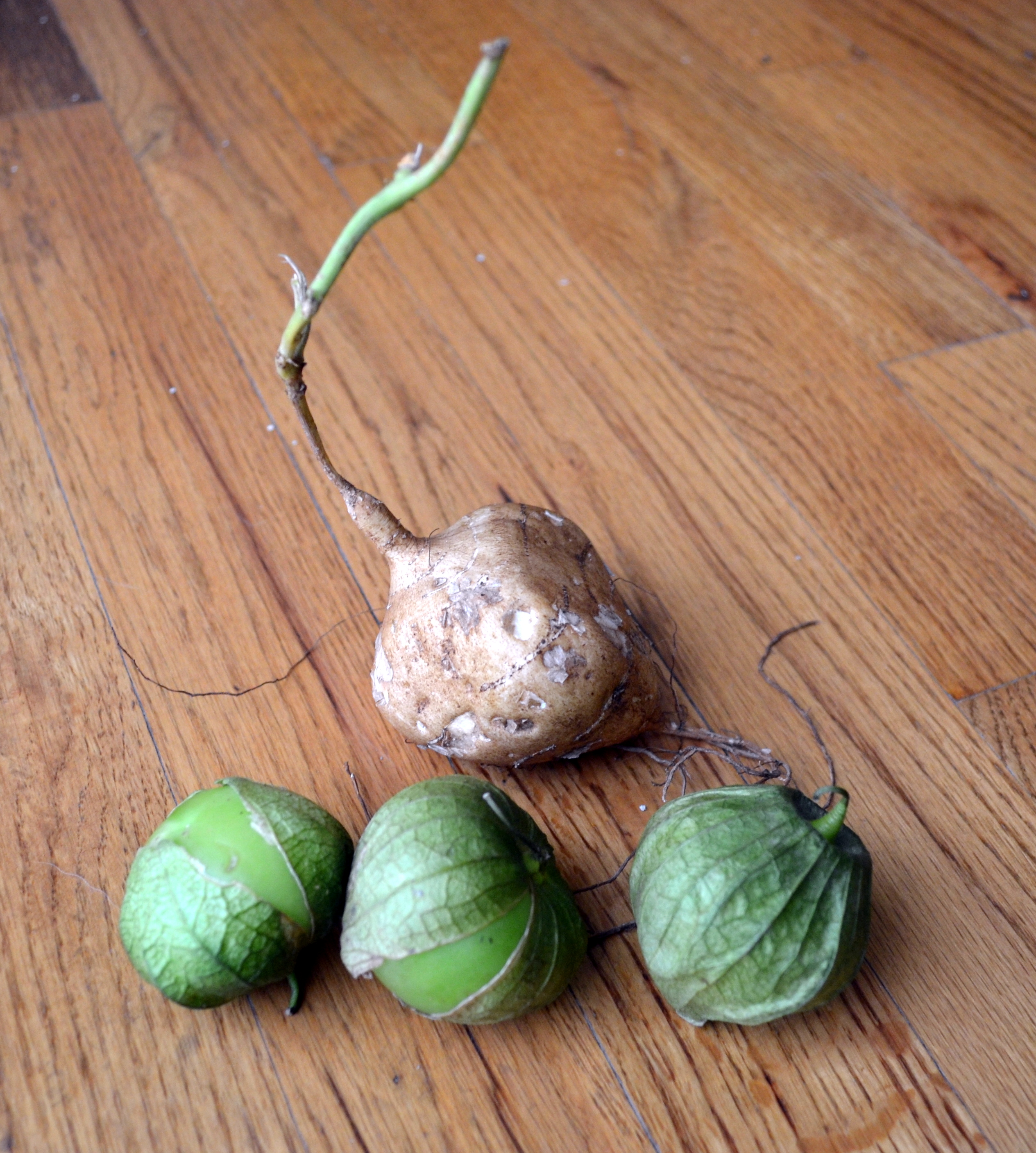
This sounded like a good late summer/early fall salad.  I found tomatillos at the grocery store, but no jicama, no daikon, and no kohlrabi.  And then we went to our Farmers’ Market, and I found all three!  Huge daikons, alien baseball sized kohlrabis and, hidden between stacks of beets and the tiniest fingerling potatoes I’ve ever seen, a pile of grubby little tubers with vine-y stems still attached.  Eureka, jicama!  Back at home, I assembled the troops:

1 TB toasted sesame seeds

2 small jicama

6 medium tomatillos

(really, the number of jicama and tomatillos isn’t super important as long as the quantities are roughly equal once you’ve cut them up.  Start with maybe 1 cup of each, see what you think, and then add more if that’s what makes you happy)

2 TB chopped cilantro

1 lemon

1 lime

Olive oil

Salt

I’ve tasted jicama, but it has been a long time.  And I’ve certainly had tomatillos, but mostly only after they were roasted and processed into salsa.  I wasn’t sure how they would be raw.  This – a lovely fresh slaw/salsa/salad hybrid – sounded so bright and tart and lovely that I wasn’t too nervous.

Before anything else, I toasted the sesame seeds and set them aside.  They give off such a lovely roasty scent when they are just browned and starting to release some oils.

I peeled, then sliced the jicama into rounds.  Then I stacked up the rounds and made thin slices across until my two little aliens were a pile of matchsticks across my board.  Into the bowl with you.

Next I quartered and diced the tomatillo.  Because they are still underripe when green (apparently they can turn purple and get very sweet when they ripen, but I’ve never seen them in that state), their skins were quite resilient – it took some pressure to get my knife through them.  Carefully chunked into miniscule cubes, they joined the white confetti in my bowl.

A quick squeeze of lemon and lime, a whisking pour of olive oil, and a handful of chopped cilantro feathers later, and the dressing was done.  And then a sprinkle of salt, and it was perfect.  It was a little more than needed to moisten the salad, but it’s hard to know how much juice citrus will have secreted away inside it, so it’s always going to be a guessing game.

I mounded the white and green on my plate, then added a generous scoop of Mexican rice and a quartered cheddar cheese quesadilla.  Simple simple.  At this point, you should ideally sprinkle the sesame seeds you so carefully toasted atop the salad, but I forgot until after I’d already subjected it to a photo shoot.

I was surprised and pleased by the flavor of this dish.  I can’t imagine eating it as a Thanksgiving side dish, but it was a bright burst of summer on a day that began in drizzly autumnal terms.  Jicama is crisp and juicy with the barest hint of starchiness, and its flavor reminds me most closely of an Asian pear.  The tomatillos were very tart, but the pairing tamed them.  Imagine a granny smith apple crossed with an underripe tomato and you’re approaching the brightness we experienced.

This was good as a salad, though its tartness necessitates a small portion.  It was also good heaped atop our quesadillas, like a raw salsa.  It contrasted nicely against the melted cheddar and the just crisped corn tortillas.  But where it would really shine, N. and I agreed, would be as a kind of mirepoix for guacamole.  Dicing the jicama instead of leaving it in strips and folding the whole salad gently into chunks of ripe, buttery avocado would make for the perfect chip dip.  Tart, creamy, crunchy, with the right kind of salty sourness from the dressing, and all you’d need was a frosted Corona and a pool to dip your toes into.  Summer.

But things never end there.  At least we hope not!  Days of sweating and hiding inside and waiting till after sunset to go out always, inevitably (even if it’s taking FOREVER, Los Angeles…) relax and cool and crystallize into Autumn.

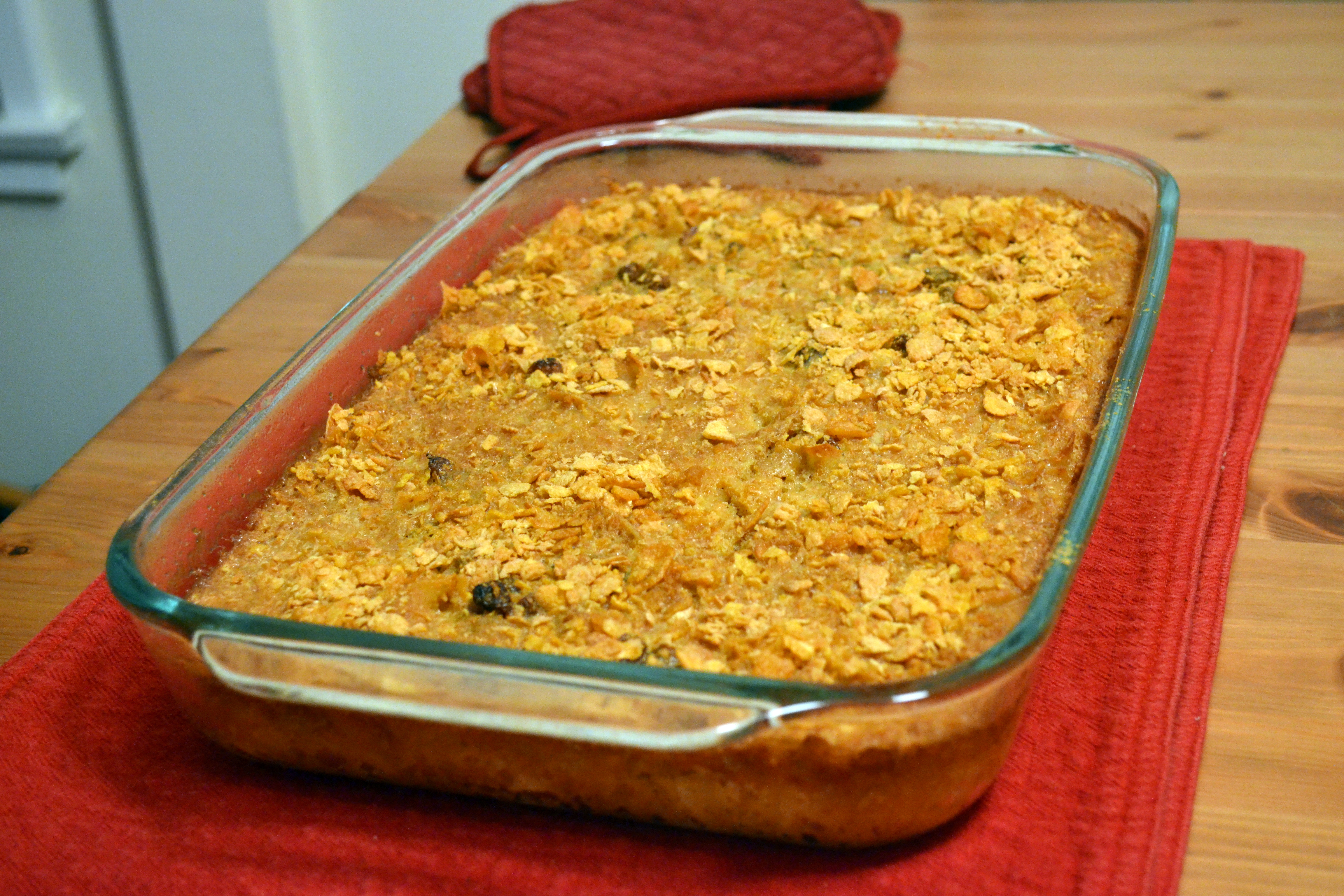
35. Pumpkin-Noodle Kugel: Cook a half-pound of egg noodles in salted water until not quite done; drain and put them into a buttered baking dish. Whisk together 4 cups milk, 4 eggs, 1 cup pureed cooked pumpkin (canned is fine), ¼ cup melted butter and a pinch each of cinnamon and salt. Pour over the noodles and sprinkle with bread crumbs (or, for added kitsch, corn flake crumbs). Bake 45 minutes to an hour, or until a knife inserted into the middle comes out clean.

I had no idea how to serve this dish.  I’ve heard of kugels, but I’ve never even eaten one, let alone made one.  I wasn’t sure, as usual, what to serve it with, so I asked a few friends and did some research on the good ol’ internet.  At the point that I read Smitten Kitchen’s version (okay, so this one is written by her mom, but seriously, that woman has cooked everything, and all of it sounds and looks outrageously delicious), this sounded more like a dessert than a dinner side dish.  It would be, I decided, dessert and weekend breakfast.  Sweet, autumnal, nicely spiced, and custardy.  “It’s going to be like a rice pudding but with noodles.  And pumpkin,” I told N.  He still wasn’t sure.

8 oz. egg noodles 

4 cups milk

4 eggs

1 cup pumpkin puree (I used Libby’s)

¼ cup melted butter (I put this in, but I’m not sure it was really necessary)

¾ cups sugar

¾ cups golden raisins

½ tsp cinnamon

½ tsp salt

2 cups corn flakes, well crunched (who am I to pass up added kitsch?!)

It wasn’t until I had collected ingredients that I realized Bittman’s recipe doesn’t call for sugar.  But I was already on the dessert/breakfast kick, and I couldn’t quite envision this as a savory dish, so I dumped in my sugar estimation anyway, along with the golden raisins that aren’t part of the original.

I cooked my noodles for 5 minutes and then let them cool for 10.  They probably needed to be cooked for only 4 minutes, because they keep on cooking not only while they are in the oven, but on the counter as they cool as well.

Yes, I take these photos from the floor. But it’s a nice wood floor, and the light is so good, and I promise Lucy stayed on the other side of the room the whole time…

With the custard whisked together and the noodles evenly spread in a buttered 9×13” glass baking dish, I preheated my oven to 375F and assessed the corn flakes situation.  Whenever an ingredient needs to be crushed, crunched, or pulverized on Chopped, I yell at the chefs for using their hands, knives, or a rolling pin instead of just bringing over the food processor.  But they don’t have to wash all the dishes they make, and I do, so my pretty little scarlet processor stayed on its shelf.  I crushed up the cereal with my hands, feeling a kind of satisfaction as the flakes became bits and then powder.  I topped the noodly custard with a generous layer of crumbs and carefully slid it into the oven.

An hour later, the custard had set and the smell flashed me forward to Thanksgiving.  I’m convinced we as a society don’t really know what pumpkin tastes like, because what we experience is texture and spices.  If this kugel didn’t have a sprinkle of cinnamon in it, I’m not sure I would know it had pumpkin either.

Dinner came and went, the kugel cooled a bit, and I dug out a too-big portion for myself, and neglected to feel any kind of remorse about it.  It was too good for that.  The noodles had melded together as the pumpkin infused liquid cooked, making a solid, scoopable, sliceable custard.  The corn flakes on top were perfect: aggressively crunchy against the soft interior.  I wouldn’t omit the golden raisins either; they were a really nice textural contrast to both the softness of the noodles and the crunchy crumbs, and their complex sweetness added some depth to my dessert casserole.  It was warm, and sweet, and perfectly comforting as I tucked my feet under me on the couch and waiting for the approach of Project Runway (don’t judge, every girl needs a little reality TV now and then).

The leftovers are delicious too, though the dish does lose something in relinquishing its crunch to the microwave.  In another universe where I’m a Southern cook, I could see doing crazy things like frying squares of this in butter and then drizzling hot maple syrup over the top.  But I’ll refrain.  Because from my window, I can see my basil wilting beneath the curiously, cruelly hot-for-mid-October sun: back to summer, so it seems!  And here I was considering making soup…

Swing season indeed.

Three for One

Sometimes you are faced with not enough: not enough time, not enough money, not enough to do…

And sometimes you are faced with too much: too much bounty, too much responsibility, too much joy.  These are both their own kind of problem.  And if I have to choose, faced with these Januses, I will always go for too much.  Even if I fall short.
Last week I only managed one Bittman.  This week, in a startling display of ambition and motivation, I did three.

One of the biggest challenges of this project (aside from cooking, photographing, and writing about the food… you know… actually doing it…) has been deciding what to serve these dishes with.  I’m not up for roasting a chicken or a turkey every week to emulate the Thanksgiving spirit of the project, so I try to piece them together with other entrees.  As you’ve seen, if you’ve been following the project for any length of time, sometimes I choose well, and sometimes I decidedly don’t.

This week, riffling through the slowly diminishing options, it occurred to me for the first time that I could serve them as complements to each other.  They were all, after all, conceived for the same imagined table.  They should work together quite nicely.

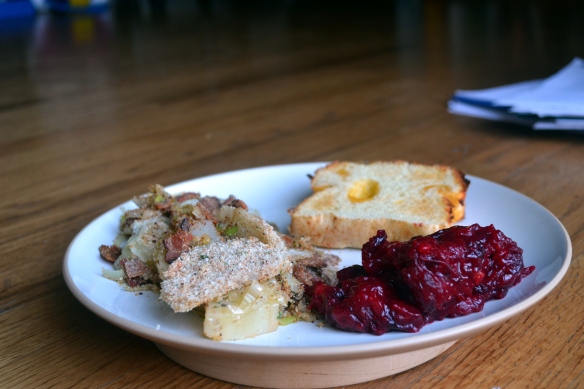
“7. Cranberry-Orange Sauce: Cook a bag of fresh cranberries with orange and lemon zest, cut up (peeled) orange segments, ¼ cup sugar (or to taste) and a bit of minced jalapeño or chipotle.”

This sounded good and, with the slightly cooler temperatures we’ve been privileged to receive lately, a nice symbol of our entry into Fall.  Cranberries and oranges are a frequent couple – almost too expected – but there’s a reason they appear together so frequently.  And with the addition of lemon juice and some spice, this seemed far enough from traditional to avoid being boring.

1 bag cranberries (probably 1 pound?)

Zest of 1 lemon

Zest of 1 large or two small oranges (mine were little Valencias from our Farmers’ Market)

Segments of 1 large or two small oranges

¼ – ½ cup sugar, depending on your taste and the tartness of your berries

Dash of spice, depending on your taste

I bounced the cranberries into a pot, zested the lemon and oranges over them, and then cut the peel from the orange and sliced out supremes.  For good measure, I squeezed as much juice from the wasted scraps of orange as I could, then topped the mix with sugar and a dusting of cayenne (I had neither jalapeno or chipotle available) and pushed it onto the back burner.

I let the pot come to a boil over medium heat, stirring occasionally to melt the sugar evenly and prevent it from burning until the cranberries released some juice to protect the mixture.  Once it boiled, I lowered the heat and let the whole thing simmer for about 20 minutes.  At one point I tasted, decided there wasn’t enough sugar or cayenne, and added more of both.  The addition of sugar was a good thing.  The addition of more cayenne was less so.  I’d caution you to start with less than you think you will want.  The mixture does not taste at all spicy while it’s hot.  When it cools, though, it becomes fiery.  It was still tasty, though.  We ate it sticky and thick and room temperature, dabbing up popped clusters of ruby and letting it linger on our tongues – but not too long – enough to wake our taste buds from the spice.  As an autumnal side, this works very well and is a pleasant update to the traditional cranberry sauce.  It would also make a glorious topping for a baked brie, perhaps with some rosemary or red wine glugged in for good measure.

While the cranberry sauce was heating, I turned my attention to its companion.

“59. Blanch thinly sliced potato and leeks until tender but not mushy; drain well. Layer the vegetables in an oiled or buttered baking dish, then top with a mixture of bread crumbs and lightly sautéed chopped bacon (some cheese mixed in is pretty good, too). Broil until golden brown.”

Potatoes and leeks are a combination that, a mere year or so ago, I didn’t realize existed.  Now it’s such a natural pairing I can’t believe I never knew about it before.  Sliced blanched potatoes and sautéed leeks now fill every frittata I make.  I collected:

2 russet potatoes, peeled

1 massive leek, tough tops and root ends removed, halved vertically (rinse it out well at this point) and sliced into slim, slim, oh-so-slim half moons

1 lb. bacon

½ – 1 cup bread crumbs (I used Italian seasoned)

Knowing how good leeks can be when they are sweated and barely brown, and conscious that the beauty of bacon grease shouldn’t go to waste, I made a few changes to Bittman’s directions.

First I cooked the bacon.  You likely don’t need a whole pound of it, but this guaranteed an appetizer: one still sizzling slice each for N. and for me.  If you aren’t cooking for or with someone else, go wild and have two all by your lonesome.

While the bacon cooked and the cranberries simmered and popped, I put a pot of water on to boil.  When its aggressive bubbling demanded attention, I carefully lowered in the potato slices and gave them free reign for five or ten minutes.

When it was edging toward crisp, I set the bacon aside to cool and drain a bit on a paper towel lined plate.  I dumped the potatoes into a colander when they were barely cooked through.

Time for the leeks.  I scraped my board free of the slender, just green shards, capturing a satisfying fizz as the vegetation hit the pan.  You want to stir with some frequency here, and not raise the heat above medium; we’re looking for a light sauté, not a heavy brown.

The shards collapsed into resistant-less ribbons, and I pushed them to one side to add the drained, cooling potatoes.  With adept wooden spoon manipulation, I managed to achieve something like layering: half the potatoes flat on the bottom of the pan, the leeks draped across them, and the rest of the potato slices on top.

I turned on my broiler, and while it heated I crumbled the bacon, tossed it with bread crumbs, and dusted the potatoes with the mixture.  But dust wasn’t enough.  They required a landslide.  I drizzled the top with olive oil, knowing the bread crumbs would need it to brown, and slid the whole pan into the broiler (note: if you use a skillet or pan for this, rather than a casserole dish, be sure you wrap any plastic or rubber with aluminum foil before you put it into the broiler.  We don’t want your nice pan handles to melt…).

Five minutes later, the parts of the crumble I had oiled were beautiful brown (the other parts remained sandy and unaltered, much to my chagrin) and the dog was close by, nose moist with curiosity and the urge to assist.

We loaded our plates, completing the meal with a completely unnecessary slice of toasted jalapeno cheese bread, and ate.

As has proved often the case with Bittman’s layered vegetable dishes, I expected this one to be a gratin, and it just wasn’t.  Some cream, some cheddar cheese, some binding between the vegetables, would have been ideal.  But not crucial.  They weren’t supposed to be scalloped potatoes, after all.  The bacon and bread crumbs made them exciting, and the leeks were almost creamy nestled between the thick slices.  Honestly, forgetting to salt the water I boiled the potatoes in was the only real unfortunate mistake.  Two down, with only one mistake (two, I suppose, if you count the overly spicy cranberries, which I suppose I do), is pretty promising.


To make this a trifecta, on another night I chose another autumnal option.

“64. Mushroom Bread Pudding: Put 6 cups of good bread (day-old is best) cut into 1-inch chunks into a buttered baking dish. Beat 4 eggs with 2 cups of milk and ½ cup grated Parmesan and pour over the bread. Sauté 4 cups of sliced mushrooms until tender with a teaspoon or two fresh thyme leaves and mix into the bread. Bake until just set, about 40 minutes.”

Mushrooms and thyme are so nice together.  They are earthy and deep and musty, like the back of a dark pantry into which no anxious hands have reached for some time.  Since they were more precise than usual, I followed Bittman’s ingredient quantities almost to the letter.

I sautéed the mushrooms and thyme in butter, taking time to let the slices soak up the butter, then expel their own liquid.  Only after that, as the moisture from the mushrooms evaporates from the pan, can the mushrooms take on the same kind of crisp brown sear as a steak pressed into a screamingly hot pan.

While the mushrooms cooled, I tore up the crusts of a month’s worth of sourdough bread (I keep them in the freezer for just these sorts of occasions) and pressed them gently into a buttered square glass baking dish.  I grated cheese – swiss and parmesan – and cracked eggs from the Farmers’ Market into a bowl, marveling at the rich orange yolks you just can’t get in the grocery store.  I stabbed them, flooded them with milk, and whisked in the cheese.

I turned to assembly.  First, mushrooms must be tossed with bread.  Attempt even distribution.  Then, a careful, rich pour of the dairy component, taking care to attend to the corners, until the bread almost floated in a puddle of would-be custard.


One of the things I’ve learned in my years of bread pudding production is that pressure and soaking time yield the best results.  I carefully pressed a layer of plastic wrap over the top of my pudding and set it in the fridge for an hour, while N. and I answered the velvet brown eyes begging for “walkies.”

Upon our return, it was as simple as preheating the oven to 375F (pull the pudding out of the fridge and let it approach room temperature as your oven heats), sliding the baking dish onto a rack, and reluctantly grading a paper or two as 45 minutes ticked by (I like my bread pudding a little more than “just” set).

A puff in the center signifies doneness.  Mine levitated just barely in the middle, but the custard was set and the edges of bread not submerged were crisp and darkly golden.

The serving spoon broke sharply through the crisp top but then exhaled through the custard underneath.  Piled on our plates next to an amazing skillet casserole of deeply browned sautéed Brussels sprouts and chopped walnuts drizzled with a balsamic glaze, we accepted its golden softness.  With a higher ratio of eggs to milk than most bread puddings I’ve made, this had almost a soufflé quality, though vastly more substantial.  It was rich and earthy and savory, and I suspect it will be just as good for breakfast as it was for dinner. 

Three more down.  This can be done.  2012 has already been a year of many accomplishments.  Why not go for too many, rather than hesitating at not enough?
The Buttercream Project: Wedding day, part two

Saturday morning – Wedding day! – was beautiful and bright and promising.  Our now-from-Seattle friends had arrived the night before, we’d all slept, the cakes had chilled, and now after a brief wedding day breakfast with the bride and groom’s families and out of town guests, I’d be on to decorating.  When I settled in to the buttercream production this time, I had an epiphany.  At Mom’s house, I had used an electric hand mixer instead of a stand mixer, and the buttercream had been fluffy and smooth and glorious.  What if, instead of using the paddle attachment on my stand mixer, I used the whisk?

This was, finally, the right thing to do.  I wish fervently I had thought of it the first day.  The frosting came together faster, and whipped up a bit smoother.  It was, I perhaps imagined, brighter ivory than the previous batches, and there were no chunks of butter to cause me piping distress.  If only, if only, the day before… but that is immaterial (and perhaps inaccurate too, since there were other factors, other differences, like the temperature of the butter, the temperature of the cheese, the amount of time spent whipping, the quantity of lime juice, etc) .

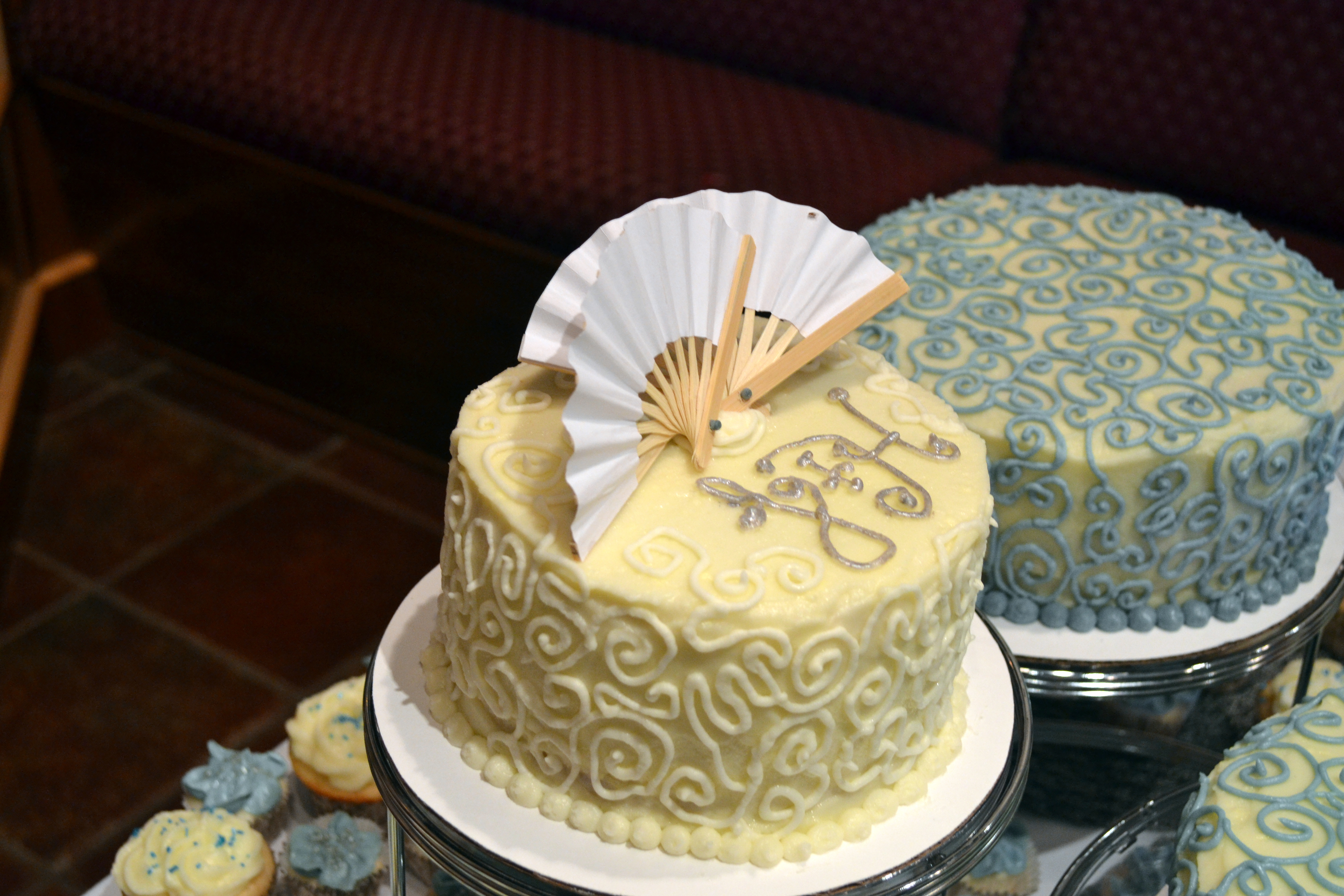
I piped.  I piped and I piped.  And things started to look better.  A lot better.  Most of the worst imperfections were hidden under the ivory and then delicate blue swirls and scrolls I snaked onto the cakes.  They actually started to look nice.  This might not be a disaster after all.  When I added a ring of round, pearl-like blobs to the bottom border of each, I started to feel happy with my project.

With the cakes done, all that remained were 92 miniature cupcakes.  All.  Right.  I had half a bowl of perfectly blue frosting.  Against my own better judgment (hey, it had worked out okay the day before with the gelatin in the filling), instead of starting over with a brand new batch, I decided to add more butter and more powdered sugar to the bowl, and try to tint it to match what I had already done as I went.  It worked.  I wanted a slightly thicker consistency of frosting for the flowers I planned to pipe so this mixture had to be more butter than mascarpone.  That worked out well, really, because I was out of mascarpone again anyway.

With time ticking, I filled up another piping bag with one of the new rose petal tips H. had bought me and went to work, remembering what I’d learned months ago about which way to swivel the cupcake as I frosted.  It took me a handful to get into a groove, remembering when to apply pressure and when to release, but once I got going I was making beautiful little horseshoe movements that resulted in sugary flower petals!  To perfect the color (not baby blue, but not dark blue either), I’d mixed a tiny bit of black gel dye in with the blue.  This resulted in a lovely periwinkle with just a hint of gray, matching almost exactly the blue on the couple’s save-the-date cards.  The exact blue of the wedding.  Boom.

N. would probably like me to add here that as I finished each handful of minis, he deliberately drizzled on a small quantity of silver-gray sprinkles.  My dear friend M., who arrived in mid-afternoon to coo over the product and do my hair for the event, would probably also like me to add that she took over sprinkling duties for the last dozen or so.  In fact, it was M. and S. who saw me through the last sheet tray of minis as, hand aching from the constant pressure and odd angle, I suddenly realized I was going to finish.

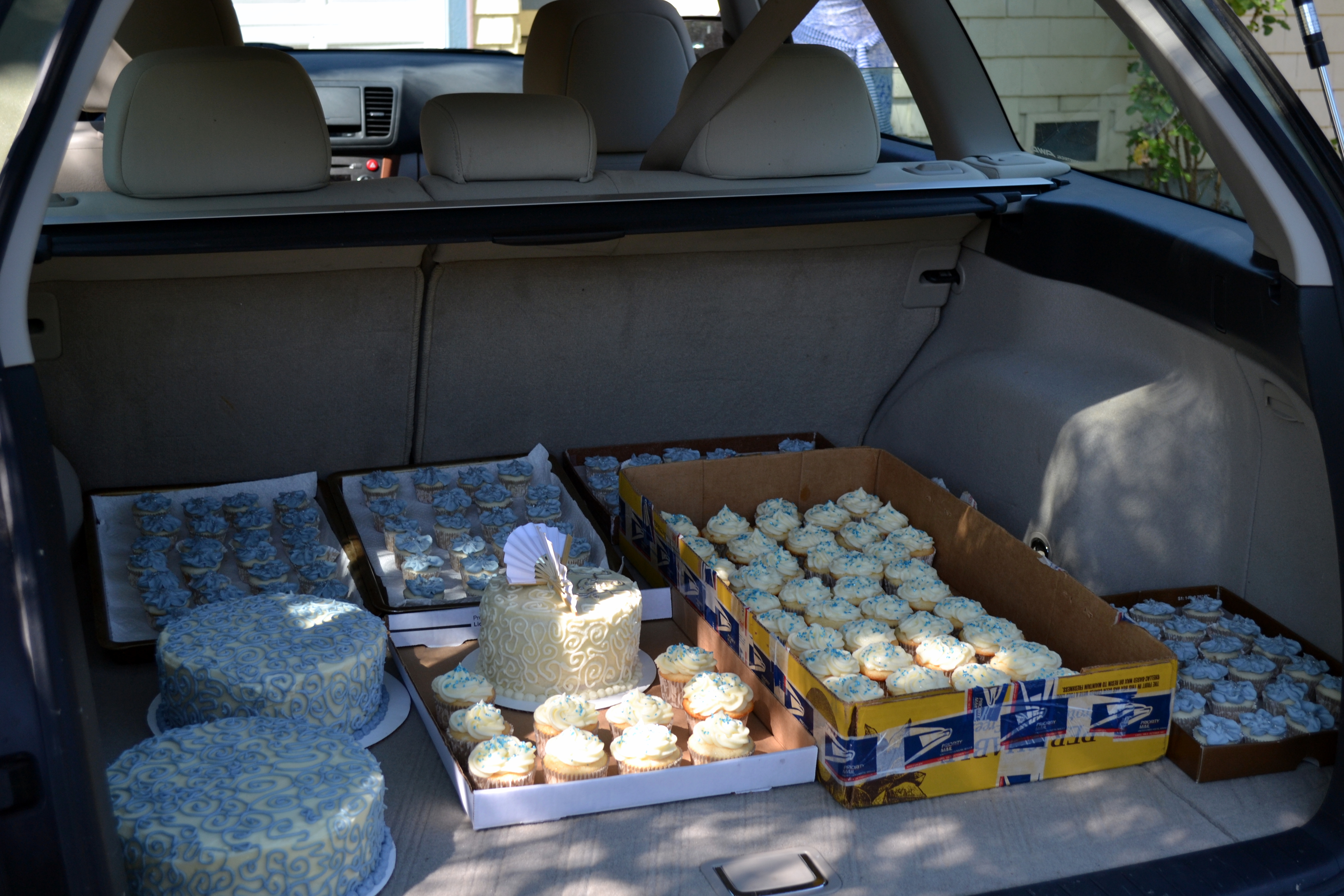
The winery where the wedding took place was a half hour drive from town on winding and sometimes roughly surfaced roads.  Though we positioned the cakes and cupcakes carefully in the back of our Subaru, I still got a little white-knuckled every time N. drove around the bend.  What if, after all that work, we got going a little too fast and one of the cakes slid into the side of the car?  What if, despite the air conditioning running at full blast, it was too hot in the car and the frosting started to slump off?  What if we did get there safely, but I dropped a cake on the way from the parking lot into the building?  I had packed flats as well as a bag of white frosting and a bag of blue in case of an emergency, but I’m not sure I was emotionally prepared to fix any problems that might happen on the way.  Not in a busy winery with the bride and groom’s families darting around setting things up.

Fortunately I didn’t have to.  Three or four of the minis fell over during our ride, but because I’d stuck them in the freezer for a few minutes while I got dressed, their frosting remained hard enough that it didn’t crumple much.

Setup was easy and disaster free.  Some of the wedding party helped carry the precious cargo in from the car, and when every last cupcake was situated on the table, I have to say it looked pretty fantastic.  I made a wedding cake.  And people liked it.

Final thoughts on this massive saga: I will not be going into the wedding cake business.  I would happily make another cake or three for friends who requested it, but I think I’d want to go to at least one cake decorating class first.  I will also not use American buttercream again, except for petal work like I did on the minis.  It’s just too sweet.  I loved the taste of the cakes I made, and the filling was a wonderful, bright tartness (the color contrast was great too), but the buttercream was just achingly sweet, even with the addition of lime juice to the mix.  For my sophomore performance, if I ever have such an opportunity, I would try an Italian or Swiss buttercream instead, relying on cooked egg whites for structure rather than powdered sugar.  As a thank you, J. and H. let me keep all the baking and decorating equipment they bought for the project (thanks again, you two!), so I’m set for all kinds of future practice.

I have to say, though, despite all my moaning and complaining and anxiety, I was really happy with how the cakes looked, and delighted with the reactions I received.  The bride and groom took home the leftovers and ate them the next day, and the one after that.  They were still good.  N. and I ate the trimmings and cupcake guts smothered in leftover filling, and they were delicious.  It was, regardless of the exhaustion and concern during the journey, a monumental success.  I can only thank J. and H. for letting me be such a big part of their day, and wish them all the joy in the world – joy like clouds of powdered sugar, perhaps – for the rest of their lives together.  N. and I love you both.

The Buttercream Project: Wedding Day, part one!

So…

I made a wedding cake.  For a wedding.  And it was served.  At a wedding.  And no one threw anything at me, or snickered behind my back, or insinuated the bride and groom would have made a better choice by hiring a professional baker.

In fact, several guests, and a few of the employees at the winery where the event was held asked me where I worked, or whether I had a business, or how many wedding cakes I had made before.  I was forced to respond to these questions thusly: my kitchen, no, none.  And they were surprised!  And I, still struggling with the sickeningly sweet baggage of failed buttercreams weighing down my memory, was surprised they were surprised.

But there we were!

Deep breath; here’s how we got there, in two parts:

The wedding took place on a Saturday.  After consulting a professional baker through a friend who is also her sister, I decided to do all the baking on Thursday, the majority of the frosting on Friday, and the detailed decorations and mini cupcake flowers on Saturday morning.  The cakes would still taste fine, she said, and the rewards of working with day-old rather than freshly baked cake are staggering.

My biggest comment about the whole process is that everything takes longer than you expect it to.  And it “takes a village,” as they say.  I knew approximately how much cake I was going to make, but I didn’t really stop and think about how much time it would take to bake, or how much space it would require, or what 36 egg yolks looks like (6 egg whites in each batch of batter = 36 unused yolks).

Anyway, I baked on Thursday, and despite my naïve assumption that I would bake in the morning, tidy up the kitchen and rest in the afternoon, I baked almost all day.  See, butter takes time to come to room temperature, and egg whites take a while to whip to soft peaks, and when you only have one muffin tin you can only make 12 full size cupcakes at a time!  My friend J. joined me for lunch, which was a welcome break (relatedly, crisp, juice-laden pink spears of watermelon are incredible when you don’t have to slice them up yourself, and Stash’s pomegranate raspberry green tea makes a wonderful iced tea that requires zero sweetener), and a bit later M. came by to keep me company while I scooped and poured and measured and mixed and sweated and burned myself only twice!  The entire day!

Completion of the day’s project took some finagling, because as much as we tried to use up perishables to create fridge space, it hadn’t occurred to me how much room it would take to fit one 9”, one 8”, and one 6” cake in there along with 52 cupcakes and 90-something mini cupcakes.  There weren’t enough shelves!  We improvised by double stacking the cupcakes and minis on sheet trays, separating each with upside down drinking glasses to keep them from squashing each other.

Thursday night, I was exhausted.

But that was nothing.

Friday, I got up with excited anticipation and set a pot of water to boil so I could peel the apricots for the filling.  Once the raspberry apricot compote was cooked down to a thick, sticky jam and nearly ready to chill, I would set out the butter.  I knew now it didn’t take an eternity to soften.  This was going to be a breeze.  It would be my best buttercream ever.  Well, as these things often go, it wasn’t, and it wasn’t.  

Apricots don’t like losing their skins.  They hang onto them like some living thing.  By scoring an x in the bottom of each and plunging them into a boiling bath for a minute or so, I thought I would be able to slip them free and naked, like peaches.  Instead, the skin came off in little peels as though they’d been sunburned, and sometimes it wouldn’t come off at all, unless attached to chunks of flesh.  This, then, took longer than I’d anticipated.

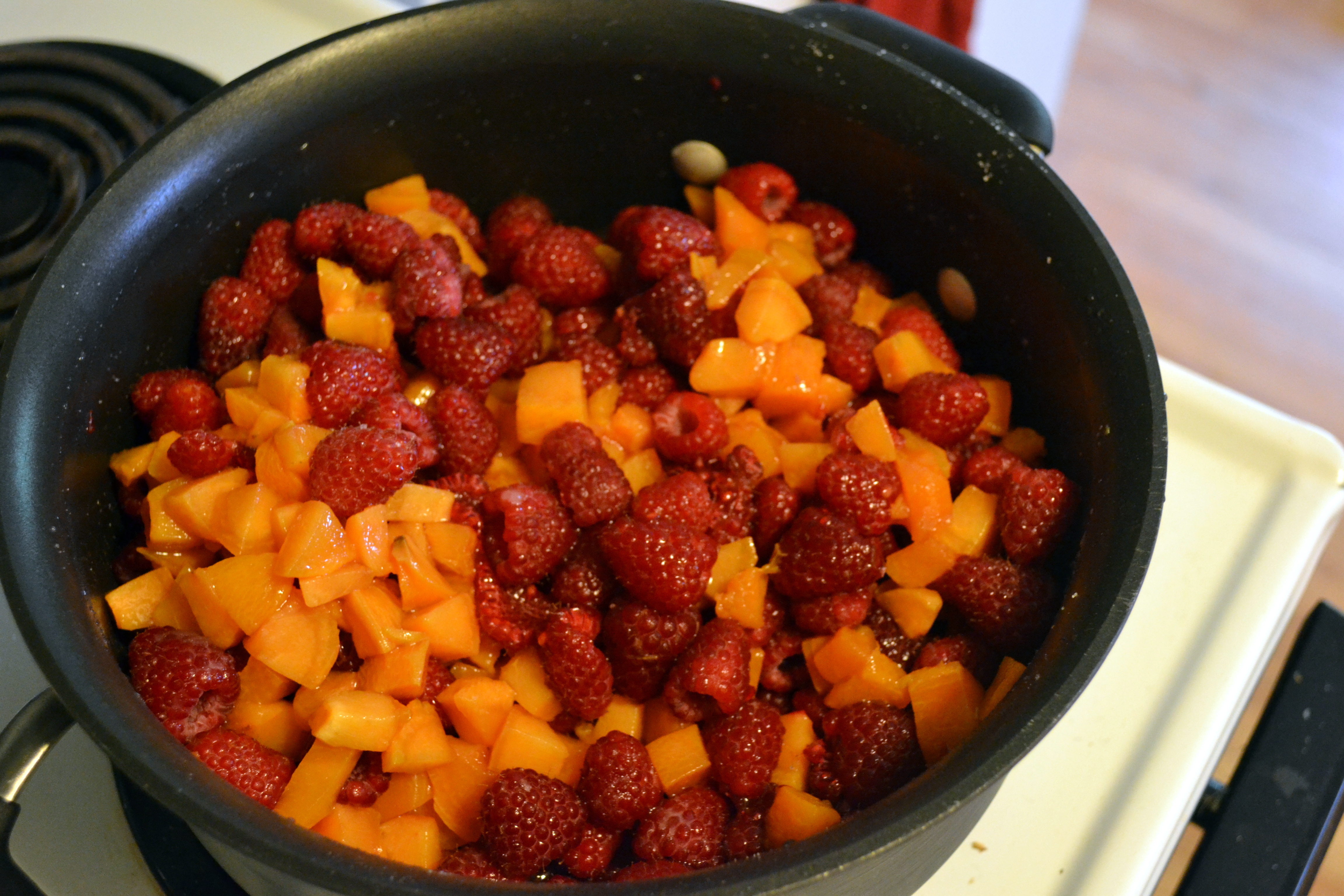
When the apricots were finally mostly nude, slippery chunks of ruddy gold, I flopped them into a big stock pot with 3 pints of dewy, just-rinsed raspberries, a light sprinkling of sugar (maybe ½ cup?), and the leftover champagne from the previous day’s baking.  There was maybe a cup of liquid when I began, and I worried this would not be enough.  Half an hour later, as the raspberries broke into fragrant, molten juice, I worried there was too much liquid.

I’ve never made jam, so I don’t know how long it really takes for fruit to boil off its liquid, but at an hour into the process, when I still wasn’t mixing up a batch of buttercream, I panicked and poured off about half the compote into a colander, making the sink look like a murder had been committed.  Too afraid to pour off any more lest I lose the flavor, I plopped the sodden fruit bits back into the pot and boiled a bit longer.  Then, when things still weren’t thickening and I was despairing for time (morning was already almost gone), I made a daring, despairing, hand-wringing choice of desperation and poured two packets of gelatin powder into some water, sloshed it about to combine, and tipped it into my steaming, bubbling, red gold concoction.  Alchemy, do your magic!  I bubbled the whole thing on the stove for a minute or two longer, then turned off the heat, held my breath, squeezed my eyes almost shut, and poured the whole thing into a glass bowl which I topped with plastic wrap and shoved into the freezer.  Now it just needed to chill, and we’d be back in business.  I’d be done by mid-afternoon with plenty of time to tidy up before the rehearsal dinner (I should add that during all the hand-wringing and the despair and the certainty that accepting J&H’s desire to have me bake for their wedding was a mistake, N. was very supportive.  He helped me monitor the pot while I showered and cleaned the bathroom in preparation for out of town guests staying with us while they attended the wedding.  He’s a dream).

My sense of timing, ever prescient, was of course wrong again.

It was 6-8 cups of boiling hot near-liquid.  Cooling takes time!  Cooling takes, as it turns out, a lot of time.

No matter.  In the meantime, I hollowed out the cupcakes to receive the (hopefully eventually) cool filling, and trimmed and halved each pale gold circle of cake so there would be four approximately even layers to each one.  Unable to stand it any longer, I took the butter and mascarpone cheese out of the refrigerator to soften.

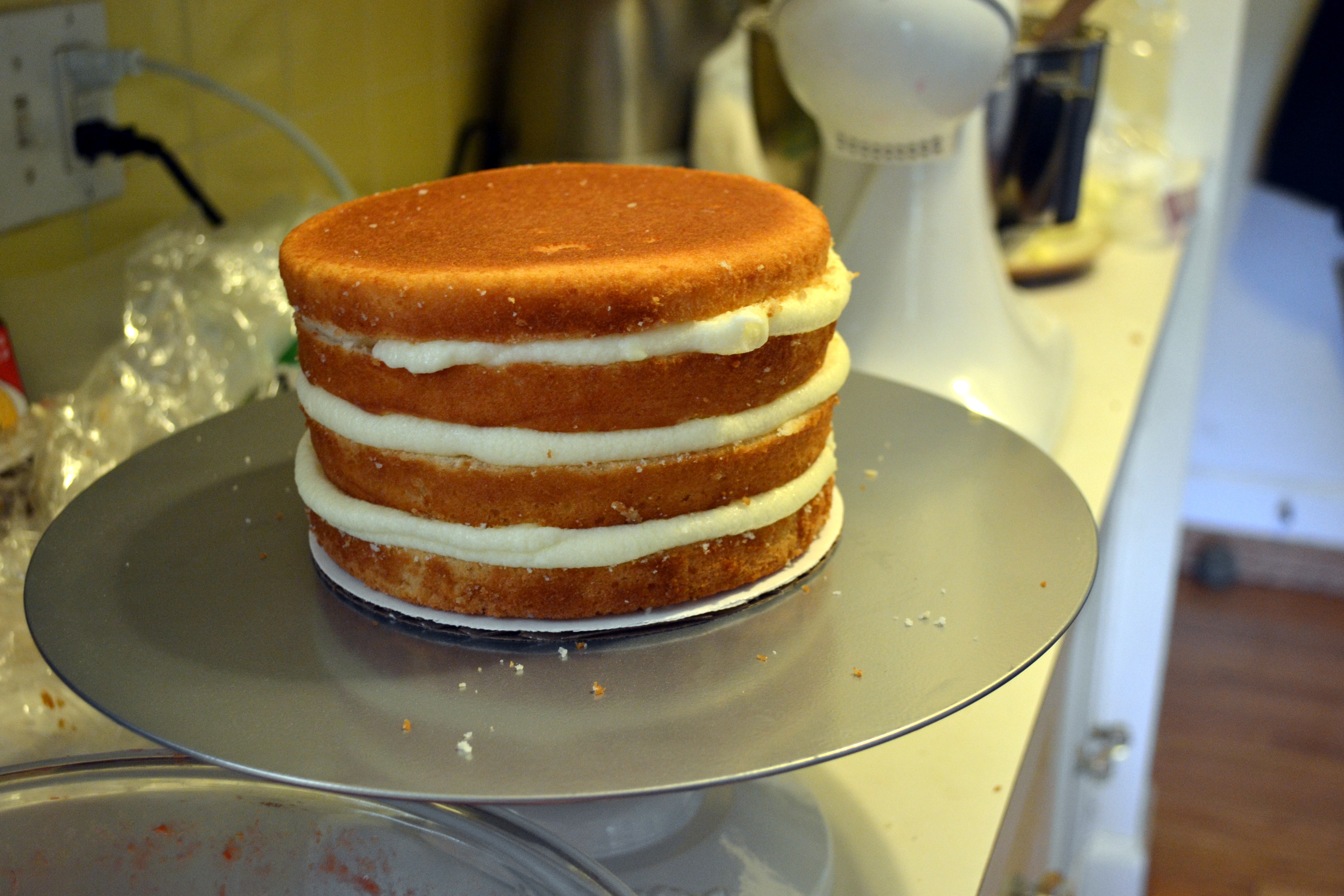
What I made, when I made it, was not my best batch of buttercream.  Remember the one from June that I made at my mom’s house?  Remember the sharp edges and beautiful, smooth consistency?  This one was a step backward.  It was clumpy.  It was grainy.  It was so, so sweet.  If I were a professional baker, I would have thrown out the whole thing and started again.  But I’m not.  I’m a home-trained amateur, and though I took into account everything I’d taught myself over the past six months and continued to beat and beat and add more lime juice and beat, at a certain point I had to frost something.  No worries, I thought, it’s just the crumb coat.  Just do the crumb coat, and it’ll be fine.  It was.  It worked exactly like a crumb coat should.  After piping a generous circle of frosting around the top edge of each layer and spooning in a nice puddle of filling, I stacked the cakes as evenly as I could.  I scraped on the crumb coat, catching moist, delicate, champagne-flavored bits, and as I finished each cake I returned them carefully to the fridge so this first all-important layer of icing could harden. 

In the meantime, I filled and frosted the cupcakes with careful swirls.  Contrary to my most recent performance, these did not come out in sharp rosettes.  In fact, a few of them threatened to plump into blobs.  But I administered a careful sprinkling of blue sugar anyway, and shoved them, too, into the fridge to think about what they’d done.

A new batch of buttercream was now required.  And I was out of mascarpone cheese.  As always, this was more of a challenge than I’d anticipated.  It was nearing 4pm, the rehearsal dinner was in less than 3 hours, and I wasn’t done yet.  Okay, just go and buy some more mascarpone.  The grocery store two blocks from us didn’t have any.  The grocery store on the south side of town did, but it was a different brand, a higher price, and a looser consistency.  And cold.  Deep breath.  Beat its brains out.  This batch was, admittedly, a bit better than the first, but still not the smooth creamy perfection I’d achieved in June.  But it was what I had.  I would deal.  It was just frosting.  I could conquer it.

When I finished the first cake – the 8” one, I think – I called N. in to have a look.  “Be honest,” I said to him, “does this look decent?”  We agreed that while it wasn’t great, it was probably passable.  I pressed on to the 9”.  When this one was done, I felt my stomach sinking.  Yes, I had carefully covered the crumb coat, and yes, I had dipped my spatula in hot water and let it glide carefully and quickly over the surface when I was finished to smooth things out, but I could see tiny chunks of butter in the mixture.  I could see where the icing wasn’t absolutely smooth.  There were dents and cracks and, inevitably, the indentation of my knuckle from a moment of carelessness.  I filled that one in.  By the time the 6” cake was done, I was almost ready to cry.  It looked the best of the three (practice is important, people), but I was tired and disappointed with myself and worried that the bride and groom would second-guess their choice.  Still, all that could be done was to carefully deposit them back into the fridge, try in vain to scrub the blue dye from the blue sprinkles off my hands, and go to the rehearsal dinner.  The detail work, which I’d never had time to practice, would have to wait until morning…

Food from Fiction Potluck

So what does one do, you might ask, as a newly minted Doctor of Literature, unfettered from the everyday proletariat academic concerns?  Well, one grades, and one line edits, and one revises frantically, and frankly, one feels completely different and not different at all.  The school year isn’t over, even though (as of Tuesday, when I upload my “completed” dissertation to our Graduate School’s website) my degree is.  So my daily duties no longer include anxious preparing for the big day, but they still include student emails and lesson planning and reading.

But because they don’t include anxious preparation and last minute rethinking and nail biting about what the committee will think, these days can also include celebrations.  Last night was one such celebration: a party I’ve wanted to have for several years now.  The style: potluck.  The theme: “Food in Fiction.”  Interpretation: bring a dish inspired by or mentioned in a book.  That’s it.  There are so many vivid options in novel, drama and film, and our guests had only to choose one and recreate it in the material, taste-bud-bearing world.

We had tremendous fun, in brainstorming, in cooking, and in sharing the variety of dishes from books we love.  As I mentioned to one friend who thanked N. and I for the great party on his way out the door, this is a party we had to have before parting ways as many of us graduate this June, because only in this company could we feel so self-congratulatory and so excited about immersing ourselves in something so nerdy.

Here are a few of the dishes we enjoyed.  I suggested to folks that they provide the description of the food in question from its source text so guests would know what they were eating and which world it was taking them to.  We had Victorian sandwiches and High Modernism Stew nestling next to a magical realist chutney and a warm wassail of fantasy.  What wandering, all in one house…

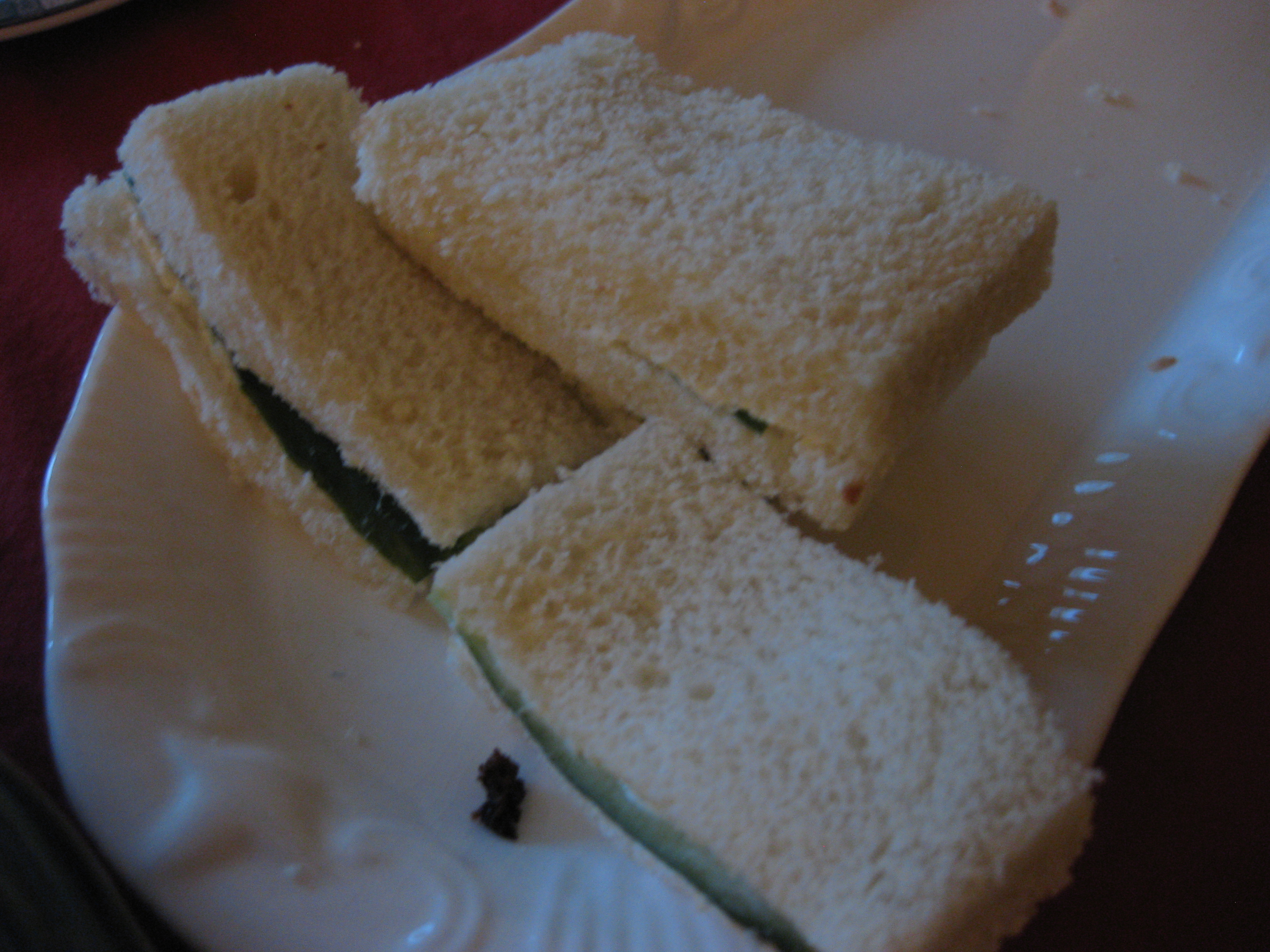
Cucumber sandwiches from Oscar Wilde’s “The Importance of Being Earnest.”

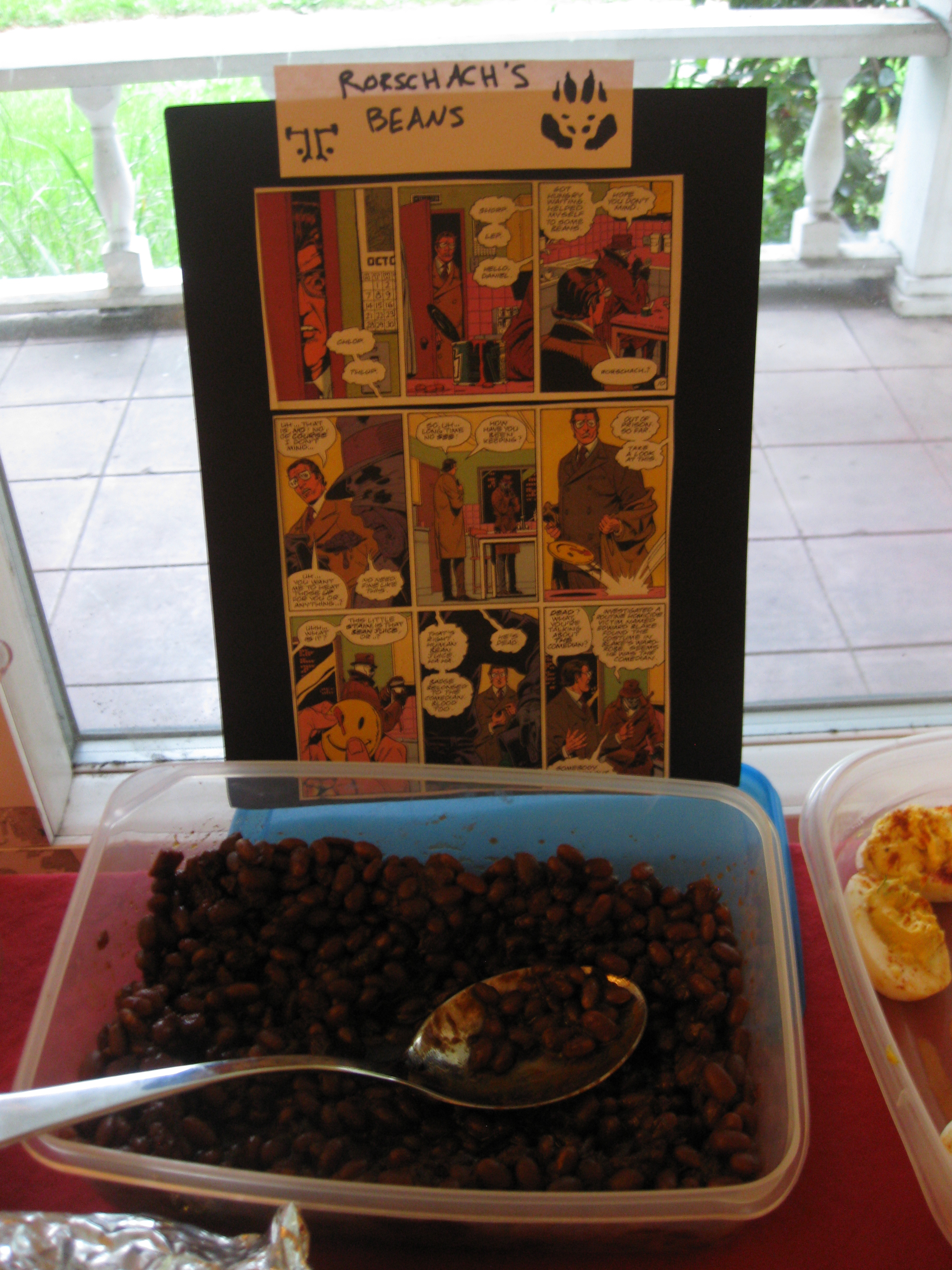
Rorschach’s beans from the graphic novel “Watchmen.”

Boeuf en daube from Virginia Woolf’s To the Lighthouse.

A trio of deviled eggs to breathe life into Hemingway’s thoughts on being hard boiled in The Sun Also Rises.

A wonderfully smoky molasses cake inspired by the molasses-drenched dinner scene in Harper Lee’s To Kill A Mockingbird.

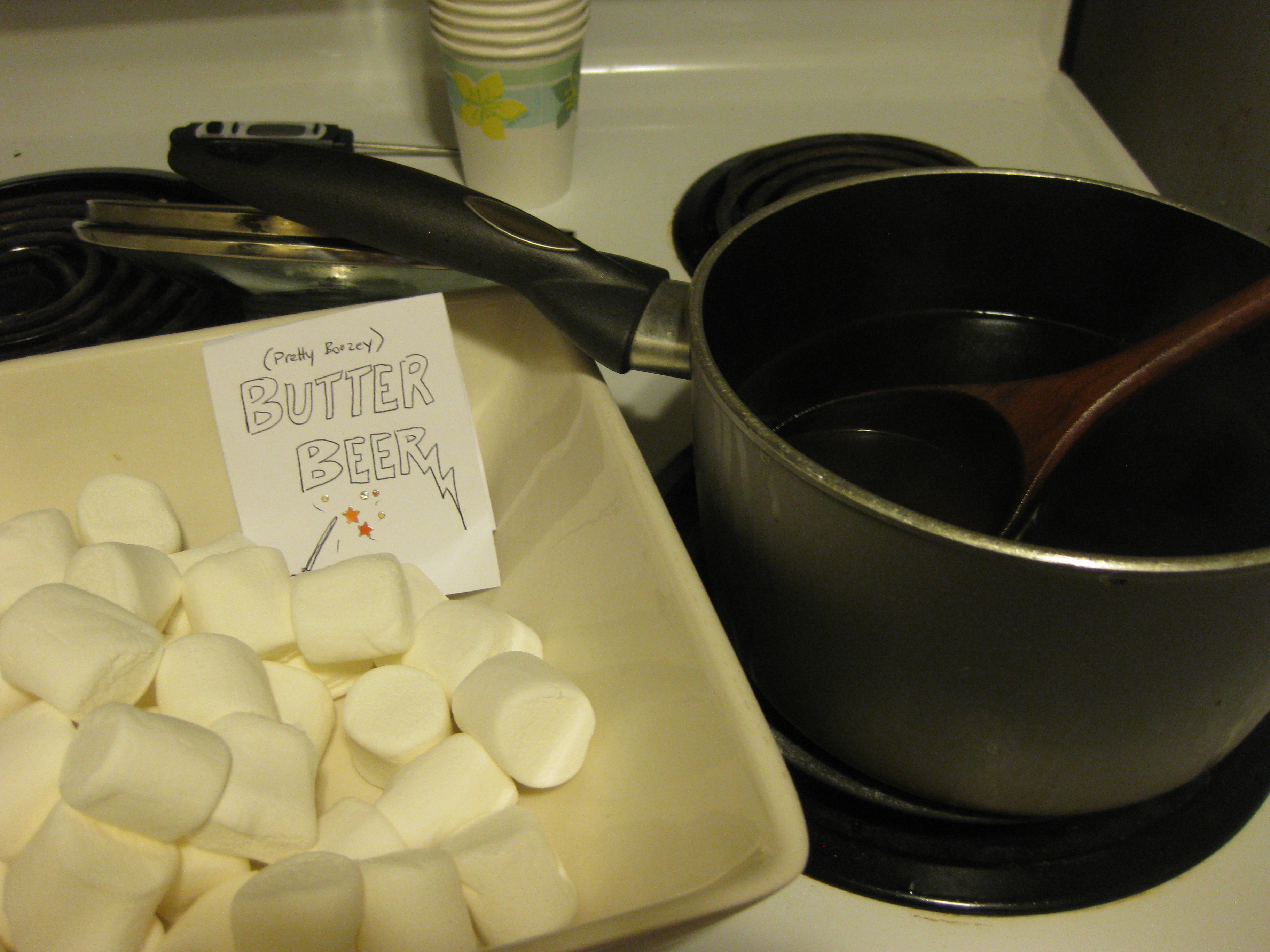
Well spiked butterbeer (you drop in a few marshmallows which, as they melt, mimic the foamy head on the beer) from J. K. Rowling’s Harry Potter series.

Not pictured: (more!) deviled eggs, from Toni Morrison’s Song of Solomon, sautéed marinated mushrooms inspired by Lewis Carroll’s Alice in Wonderland, raspberry cordial from L. M. Montgomery’s Anne of Green Gables, and a few sourceless delights: meatballs (Cloudy with a chance of, perhaps?), and a bread, cheese, and hard salami platter.  These were justified by their authors with the claims that “surely there must be moments of literary eating that include these items,” which I was quite willing, given their deliciousness, to accept.  And of course, wine.  If we were picky, we could call this an homage to Hemingway, whose characters “get tight” with abandon, or to Carroll’s Alice, who does imbibe from the mysterious bottle demanding she “drink me.”

I made two offerings: a take on the “green as grasshoppers” chutney so adored by Saleem in Salman Rushdie’s Midnight’s Children, and a pork pie stuffed with hard boiled eggs from Roald Dahl’s Danny the Champion of the World.  Both turned out extremely well, but I want to talk about the pie first.

Danny the Champion of the World is the story of a boy and his father.  Without giving too much away, I will only say that Danny’s father suffers an injury almost halfway into the book, and when Doc Spencer, the family physician, brings him home from the hospital to the gypsy caravan in which he and Danny live, Doc also brings Danny a package from his wife:

“Very carefully, I now began to unwrap the waxed paper from around the doctor’s present, and when I had finished, I saw before me the most enormous and beautiful pie in the world.  It was covered all over, top, sides, and bottom, with rich golden pastry.  I took a knife from beside the sink and cut out a wedge.  I started to eat it in my fingers, standing up.  It was a cold meat pie.  The meat was pink and tender with no fat or gristle in it, and there were hard-boiled eggs buried like treasures in several different places.  The taste was absolutely fabulous.  When I had finished the first slice, I cut another and ate that, too.  God bless Doctor Spencer, I thought.  And God bless Mrs. Spencer as well” (Dahl 85-86).

Since my first trip through Danny, I salivated over this savory pie Danny enjoys.  And this party was the perfect excuse to attempt my own.

I found a perfect (and much prettier) base recipe for my pie in the archives of the blog Married… With Dinner.  Though I followed their basic instructions, I made a few amendments for ease and expense.  The key points are as follows:

Use a springform pan.  That way the pie is tall and regal and can sit magically outside a pie plate all on its own.

Roll the bottom crust out large enough to come almost all the way up the sides of the springform (I used storebought crust and it work out just fine), so you can connect top and bottom more easily.

I squashed together a mixture of ground pork, pork sausage, finely chopped ham from a ham slice, salt, cayenne pepper, ground cloves, and black pepper.  I pressed a thin layer of the meat mixture onto the bottom of the pie crust, then laid six hard boiled eggs in a circle through the middle of the pie (regrettably, with ham-covered hands, I did not get a photo of this).  Then I lightly packed the rest of the meat mixture around and over the eggs and sank a bay leaf deep into the very center of the pie.

A traditional English pork pie has warm pork stock poured into a hole in the crust just after baking, which turns into a thick jelly as the pie cools.  This did not sound particularly delicious to me, though I did like the idea of a rich layer of something atop my pork.  I decided on cheese.  I grated about a cup of sharp cheddar and sprinkled it lightly on top of the meat before draping the top pie crust over it.  I cut a little hole in the center of the crust and sliced some steam vents for additional release before baking.

It’s a long baking process (almost two hours), but you are dealing with raw pork, so the cooking time needs to be sufficient.  When the pie is almost done, Married… With Dinner recommends you carefully release the spring on the pan and brush an egg wash all over the top and sides of the pie.  Fifteen minutes more in the oven and this results in a beautiful, shiny golden glaze all over the pie.  It also, in case you are lazy like me and didn’t brush an egg wash over the top edge of the bottom crust to help the lid adhere, creates an after-the-fact glue to hold base and lid together.

I let my pie cool on the counter for an hour or so, then tented it with aluminum foil and stowed it in the fridge until the party started.  It did, after all, have to be a cold meat pie.

It was fabulous.  The meat was nicely spiced and the ham bits shredded in added some smoky, salty variety.  The hard boiled eggs were, indeed, delightful treasures to find, though I admit to over-boiling them slightly so their yolks were not as bright as they could have been.  Still, this is hardly a complaint.  It was like a meatloaf wrapped in flaky, buttery crust, and the cheese was a nice additional flavor and richness.  I suspect this could have been just as good warm as it was cold, but the pie might not have held together quite as nicely.

My second offering was a cilantro coconut chutney.  Saleem, as Midnight’s Children comes to a close, receives a meal from a blind waitress.  He lists:

“On the thali of victory: samosas, pakoras, rice, dal, puris; and green chutney.  Yes, a little aluminum bowl of chutney, green, my God, green as grasshoppers… and before long a puri was in my hand; and chutney was on the puri; and then I had tasted it, and almost imitated the fainting act of Picture Singh, because it had carried me back to a day when I emerged nine-fingered from a hospital and went into exile at the home of Hanif Aziz, and was given the best chutney in the world… the taste of the chutney was more than just an echo of that long-ago taste – it was the old taste itself, the very same, with the power of bringing back the past as if it had never been away…” (Rushdie 525).

I found a recipe for a coriander chutney replete with tart lemon juice, lip puckering spice from serrano chiles, and bright, bright green cilantro, tempered by shredded coconut.  The recipe called for unsweetened coconut but I, in my haste, having only sweetened, forgot to rinse it to get some of the sugar off before dropping it into my food processor.  As a result, my chutney was lightly sweetened, but no one seemed to mind that, especially when it was spread onto the pakoras I made.

I searched around online and made a master recipe from a combination of ideas for these pakoras.  Mine included:

4 cloves garlic, smashed and finely minced

2 tsp. each:

Garam masala

Turmeric

Chili powder

Salt

2 cups Bob’s Red Mill gluten-free all-purpose flour (pakoras are made with garbanzo bean flour, and though the Bob’s Red Mill mix is a blend including potato starch, it is composed mostly of garbanzo and fava bean flours, so since I had it, I decided a little break from tradition would be okay.  This is literature, after all.  It’s all interpretation anyway!)

1 ½ cups water

½ head cauliflower, diced

¾ large onion, diced

1 small sweet potato, diced

1 quart vegetable oil

Heat the vegetable oil to 375F in a large, sturdy pot.  I used my dutch oven.

While the oil heats, whisk together the dry ingredients and garlic until well combined, then slowly whisk in the water to form a thick, smooth batter.

Add the diced vegetables and stir to combine.

Drop spoonfuls of the batter (ever so carefully!  Watch out for splashes!) into the hot oil and fry for 5-6 minutes, or until the batter is deeply golden and the vegetables inside have magically cooked.

I got to taste one of these.  It was crunchy and starchy and slightly spicy and wholesome and delicious.  It was vegan.  It was gluten-free.  Topped with the chutney it was fresh and springy and spicy and then gone.  By the time I went back to have another, the giant platter I’d made was empty, and only a spoonful or two of chutney remained.  Pride overwhelms disappointment, in moments like these.  My little experiment was so successful it prohibited me from tasting further.  So I had another deviled egg instead.

Full and happy, we fell into bed at midnight with a sinkful of dishes and a fridge-full of leftovers to look forward to.  It’s like reopening a book to your favorite chapter: whose world will I lunch from, dine from, be returned to today?