With or Without You

The organizer of the group I went to Senior Prom with booked us seats at Splashes, a restaurant in a Laguna Beach hotel. When we arrived, all dressed up and feeling ever so fancy, four of our party of six were surprised and distressed to discover that a restaurant called Splashes primarily served seafood.  I was delighted.  Lobster ravioli?  Yes, please!

While the majority of our party waited for their chicken and steak dishes to be prepared, my date received the first course he’d ordered: a caprese salad with balsamic dressing.  It arrived – beautifully arranged slices of bright tomato, quivering mozzarella, crisp basil leaves – and he squinted at it with confusion.  “This is not a salad,” he said.  “There’s no lettuce!”  He ate it – we all did – and thought it was good, but maintained his stance.  To be a salad, a collection of ingredients must include lettuce.  No room for experimentation there.

We were in high school, and it was only the very beginning of the new millennium.  What did we know about creative vegetable assemblages like caprese or tabbouleh or panzanella?  We were babies.  But I will say: though I recognize these popular, now fairly well known varieties of salad as such, in this project Bittman has taught me so much about what a salad can be and how widely the boundaries of its definition can be stretched.  Not a single entry, in fact, on the Salads portion of the project list, includes lettuce.  How pedestrian – how expected – that would be.

“76. Grate apples (red are nice; leave skin on), radish and celery.  Roast pistachios and chop.  Dress all with olive oil, shallots, grainy mustard, red wine vinegar and a pinch of sugar.”

This sounded like an interesting and delicious combination, but like the tomatillo and jicama combination a few weeks ago, it didn’t sound like something you could dig into a big bowl of.  I decided, therefore, to make it more like a condiment, which gave me an excellent excuse to roast a chicken.  Imagine: a steaming, crisp skinned chicken thigh topped with cool, crisp shreds of apple and peppery radish.  Like the lobster ravioli of yore, yes please!

Here’s what I used:

1 large apple (I had a honeycrisp – one of my favorite kinds)

2 stalks celery

4 small radishes

½ cup pistachios, roasted and chopped

Dressing:

2 TB olive oil

1 TB red wine vinegar

1-2 tsp sugar (depends on your taste, the sweetness of your apple, and the sharpness of your radishes)

½ TB whole grain mustard

I eliminated the shallots because, despite their lauded mildness, neither N. nor I find the flavor of raw onions particularly appealing.

During the last twenty minutes or so of the chicken’s stay in the oven, I clattered the pistachios into a small cake pan and put them on the bottom rack so they could toast.  They needed about ten minutes at 350F, and emerged browned and nutty smelling (isn’t that a silly way of describing the aroma of a nut?  Of course it was nutty smelling!  What else could it be?).  I set them aside so they could cool before being chopped and deposited into the salad mixture.

While things were roasting and toasting, I grated up the stars of the salad.  The apple became little ribbons, the radishes paper-thin shreds, and the celery turned into a pile of almost-mush.  But I decided that was okay – celery is such an assertive texture that less of its fibrous aggressiveness would actually be a benefit.

Were I making this again, at this point I would deposit the grated vegetation into a sieve for a few minutes to let the juice drip away, giving the dressing a better opportunity to cling and permeate.  My decision to plop everything right into the serving bowl resulted in slight soupiness – the apple and celery in particular gave off copious amounts of juice.

At this point, you should also chop and add your pistachios to the salad.  After all, you paid money for them and babysat them carefully to prevent burning them in the oven.  But I didn’t.  I forgot about them completely as I whisked up the dressing, tossed it with the salad, then stowed the serving dish on the table so I could have room on my kitchen counter to carve the chicken.

Piled atop carefully carved and portioned pieces of chicken, the little condiment salad warmed and released a delicious sweet-tart aroma that completely belied the bland appearance of our plates.  Though up close you could see flecks of red and green and pink in the salad from the skins of the various ingredients, from any distance it looked like pale meat with pale apple shreds on top, next to a pale pile of barley, which I’d cooked pilaf style as a starchy accompaniment.

The flavor was more like the smell than the appearance.  It was sharp and bracing – just sweet enough, but assertively vinegary.  This worked very well with our chicken because the sweet-sour crunch cut through the fatty moistness of the meat.  Halfway through dinner I sprinkled mine with a palm-full of the forgotten pistachios, and I must admit I liked it better nut free.  N., not a pistachio fan, agreed.


Despite how good a sport he has been during the years (years!) I’ve been working to accomplish this project, N. doesn’t like all foods.  I recognize that there is a time for experimentation and excited guesswork, but there is also a time to exclude him from the proceedings.  This understanding led to my original decision to make only the items from Bittman’s list that seemed reasonable.  I haven’t set out to cook all 101 sides; there were a few that just didn’t fit our palates.  However, out of my curiosity and tastes, a few items remained on the list that are just not N.’s cup of tea.  The second salad I made this week was one such dish.

“79. Cook chopped pears in a covered saucepan with a tiny bit of water until soft. Puree, but not too fine. In your smallest pan, boil a few tablespoons of balsamic vinegar with a little brown sugar; lower heat and reduce by half. Spoon the pear sauce over endive leaves and finish with toasted sliced almonds and the balsamic reduction.”

To me, this sounded delightful.  To N., it sounded weird.  So on Thursday, when he had to go back to school for an evening engagement, it became my dinner.  It consisted of:

2 TB sliced almonds

2 ripe pears, peeled and chopped into small chunks

1 TB water

3 spears endive

¼ cup balsamic vinegar

1 TB brown sugar

I must admit: I cheated on the balsamic reduction.  The quantities I listed above are falsified.  But they are estimates you might use.  I happened to have a small container of already reduced, already sweetened balsamic vinegar in my refrigerator from a previous night, and this was the perfect excuse to use it up.  I just microwaved it for a few seconds and it loosened right up from a tar to a pourable, molasses-like syrup.

I toasted the almonds in a dry pan over medium heat, tossing them frequently.  You can’t take your eyes off of these slices for very long.  In the space of twenty seconds, they go from perfectly golden to burnt.  How do I know?  How do you think?

I set aside my overly tanned almonds and added the pear chunks and water to my pan.  Bittman didn’t specify whether the pears should be peeled or not, but pears already have that dubious, potentially grainy texture, and I decided the rough and sometimes gritty skin shouldn’t have a part in this salad.  As the pears – naked, cored, and chopped – simmered and softened, I considered the pureeing instruction and rejected it.  If indeed they were still supposed to be chunky, there were other methods than dirtying my food processor or immersion blender.  I had at them with the potato masher.  This broke them into a chunky puree – some texture remained but they were definitely on the road to sauce-hood.  I turned off the heat and set them aside to cool.

All that remained was to cut and arrange the endive and drape these various accoutrements across it.  I spooned, I drizzled, I scattered, and I served.
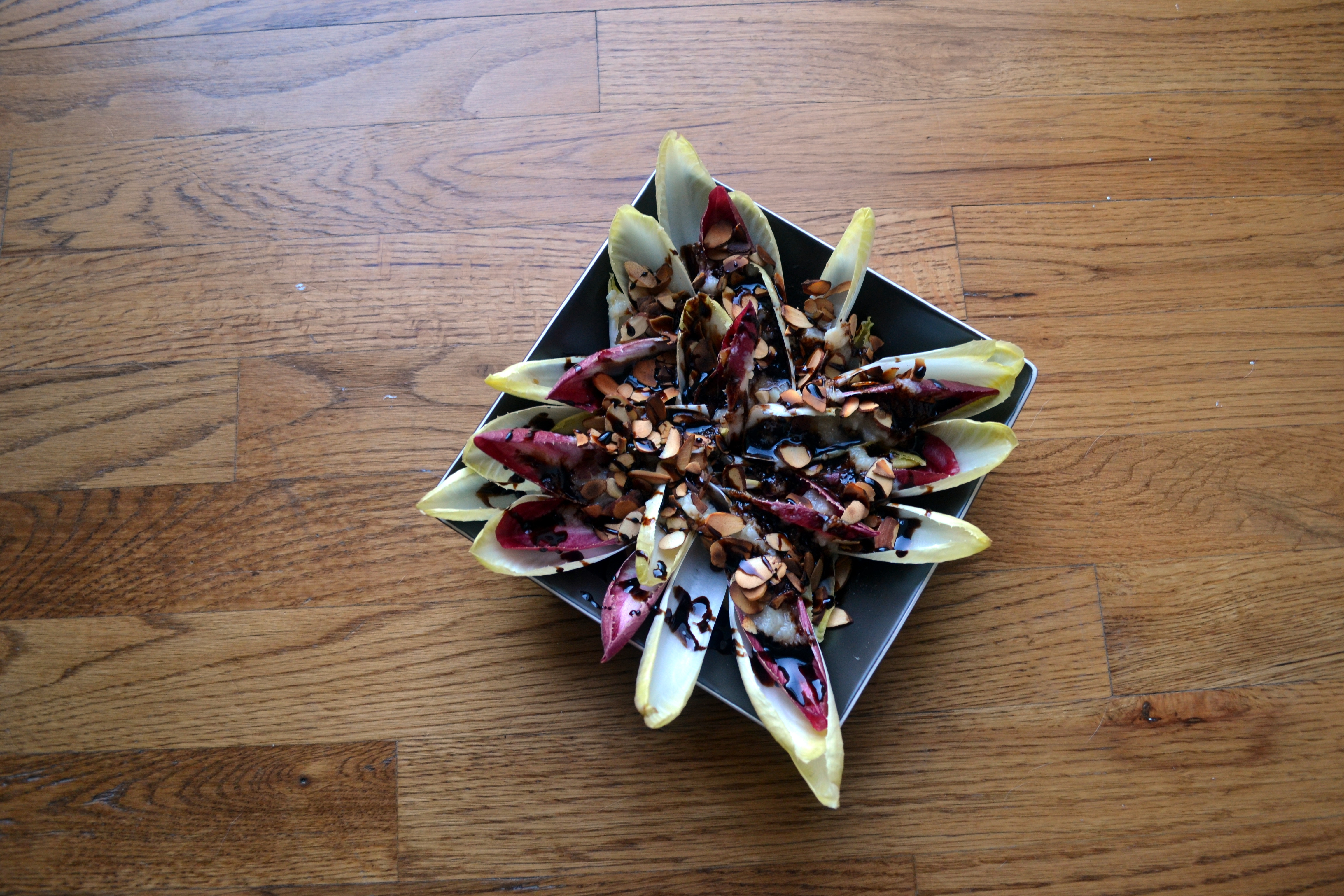
This was good, and a nice homage to fall, but it almost read like a dessert salad.  Endive has – to my palate at least – little to no discernible taste.  It is crisp and fun to eat because it has such a capable, interesting shape, but it crunches into water in your mouth and tastes like whatever you pair it with.  In this case, it tasted of earthy mild pears and glossy sweet balsamic reduction.  The crunch of the almonds and the crunch of the endive were pleasantly different: one dry, one juicy.  I ended up scooping dressing, pear puree, and almonds into each leaf and eating them out of hand rather than messing around with all that utensil business.  After all, I was seated at a table for one, and Ted Allen on the TV wasn’t going to judge me.  Besides, I was pairing this salad with shrimp (so delicious: toast mustard seeds and red pepper flakes, sear shrimp, deglaze with dry white wine, sprinkle with parsley, serve), and it’s so much easier to just pick them up by the tails.  No fuss.  Only a little mess.  Easily remedied.  Followed up, just to make it extra indulgent, with a little cup of coconut whipped cream, dried blueberries, and the rest of the toasted almonds.

N. wouldn’t have liked this dinner.  But that’s okay.  Our coupledom doesn’t require identical food preferences as I once thought it might, and I’m happy to take on all the shrimp and coconut in the world on his behalf, paired with pears and endive or not.  Call it a gift.  And in return, he lets me play with my food: not just eating with my fingers, but trusting me in my experimentation because I know what he likes.  That means when I present him with one of my Frankensteinian creations, he might raise his eyebrows, but he’s willing – and usually happy – to give it a try.  A salad doesn’t need lettuce.  What it needs, I think, are the flavors you like and the contrasting textures that make it an adventure to eat.

Three for One

Sometimes you are faced with not enough: not enough time, not enough money, not enough to do…

And sometimes you are faced with too much: too much bounty, too much responsibility, too much joy.  These are both their own kind of problem.  And if I have to choose, faced with these Januses, I will always go for too much.  Even if I fall short.

Last week I only managed one Bittman.  This week, in a startling display of ambition and motivation, I did three.

One of the biggest challenges of this project (aside from cooking, photographing, and writing about the food… you know… actually doing it…) has been deciding what to serve these dishes with.  I’m not up for roasting a chicken or a turkey every week to emulate the Thanksgiving spirit of the project, so I try to piece them together with other entrees.  As you’ve seen, if you’ve been following the project for any length of time, sometimes I choose well, and sometimes I decidedly don’t.

This week, riffling through the slowly diminishing options, it occurred to me for the first time that I could serve them as complements to each other.  They were all, after all, conceived for the same imagined table.  They should work together quite nicely.

“7. Cranberry-Orange Sauce: Cook a bag of fresh cranberries with orange and lemon zest, cut up (peeled) orange segments, ¼ cup sugar (or to taste) and a bit of minced jalapeño or chipotle.”

This sounded good and, with the slightly cooler temperatures we’ve been privileged to receive lately, a nice symbol of our entry into Fall.  Cranberries and oranges are a frequent couple – almost too expected – but there’s a reason they appear together so frequently.  And with the addition of lemon juice and some spice, this seemed far enough from traditional to avoid being boring.

1 bag cranberries (probably 1 pound?)

Zest of 1 lemon

Zest of 1 large or two small oranges (mine were little Valencias from our Farmers’ Market)

Segments of 1 large or two small oranges

¼ – ½ cup sugar, depending on your taste and the tartness of your berries

Dash of spice, depending on your taste

I bounced the cranberries into a pot, zested the lemon and oranges over them, and then cut the peel from the orange and sliced out supremes.  For good measure, I squeezed as much juice from the wasted scraps of orange as I could, then topped the mix with sugar and a dusting of cayenne (I had neither jalapeno or chipotle available) and pushed it onto the back burner.

I let the pot come to a boil over medium heat, stirring occasionally to melt the sugar evenly and prevent it from burning until the cranberries released some juice to protect the mixture.  Once it boiled, I lowered the heat and let the whole thing simmer for about 20 minutes.  At one point I tasted, decided there wasn’t enough sugar or cayenne, and added more of both.  The addition of sugar was a good thing.  The addition of more cayenne was less so.  I’d caution you to start with less than you think you will want.  The mixture does not taste at all spicy while it’s hot.  When it cools, though, it becomes fiery.  It was still tasty, though.  We ate it sticky and thick and room temperature, dabbing up popped clusters of ruby and letting it linger on our tongues – but not too long – enough to wake our taste buds from the spice.  As an autumnal side, this works very well and is a pleasant update to the traditional cranberry sauce.  It would also make a glorious topping for a baked brie, perhaps with some rosemary or red wine glugged in for good measure.

While the cranberry sauce was heating, I turned my attention to its companion.

“59. Blanch thinly sliced potato and leeks until tender but not mushy; drain well. Layer the vegetables in an oiled or buttered baking dish, then top with a mixture of bread crumbs and lightly sautéed chopped bacon (some cheese mixed in is pretty good, too). Broil until golden brown.”

Potatoes and leeks are a combination that, a mere year or so ago, I didn’t realize existed.  Now it’s such a natural pairing I can’t believe I never knew about it before.  Sliced blanched potatoes and sautéed leeks now fill every frittata I make.  I collected:

2 russet potatoes, peeled

1 massive leek, tough tops and root ends removed, halved vertically (rinse it out well at this point) and sliced into slim, slim, oh-so-slim half moons

1 lb. bacon

½ – 1 cup bread crumbs (I used Italian seasoned)

Knowing how good leeks can be when they are sweated and barely brown, and conscious that the beauty of bacon grease shouldn’t go to waste, I made a few changes to Bittman’s directions.

First I cooked the bacon.  You likely don’t need a whole pound of it, but this guaranteed an appetizer: one still sizzling slice each for N. and for me.  If you aren’t cooking for or with someone else, go wild and have two all by your lonesome.

While the bacon cooked and the cranberries simmered and popped, I put a pot of water on to boil.  When its aggressive bubbling demanded attention, I carefully lowered in the potato slices and gave them free reign for five or ten minutes.

When it was edging toward crisp, I set the bacon aside to cool and drain a bit on a paper towel lined plate.  I dumped the potatoes into a colander when they were barely cooked through.

Time for the leeks.  I scraped my board free of the slender, just green shards, capturing a satisfying fizz as the vegetation hit the pan.  You want to stir with some frequency here, and not raise the heat above medium; we’re looking for a light sauté, not a heavy brown.

The shards collapsed into resistant-less ribbons, and I pushed them to one side to add the drained, cooling potatoes.  With adept wooden spoon manipulation, I managed to achieve something like layering: half the potatoes flat on the bottom of the pan, the leeks draped across them, and the rest of the potato slices on top.

I turned on my broiler, and while it heated I crumbled the bacon, tossed it with bread crumbs, and dusted the potatoes with the mixture.  But dust wasn’t enough.  They required a landslide.  I drizzled the top with olive oil, knowing the bread crumbs would need it to brown, and slid the whole pan into the broiler (note: if you use a skillet or pan for this, rather than a casserole dish, be sure you wrap any plastic or rubber with aluminum foil before you put it into the broiler.  We don’t want your nice pan handles to melt…).

Five minutes later, the parts of the crumble I had oiled were beautiful brown (the other parts remained sandy and unaltered, much to my chagrin) and the dog was close by, nose moist with curiosity and the urge to assist.

We loaded our plates, completing the meal with a completely unnecessary slice of toasted jalapeno cheese bread, and ate.

As has proved often the case with Bittman’s layered vegetable dishes, I expected this one to be a gratin, and it just wasn’t.  Some cream, some cheddar cheese, some binding between the vegetables, would have been ideal.  But not crucial.  They weren’t supposed to be scalloped potatoes, after all.  The bacon and bread crumbs made them exciting, and the leeks were almost creamy nestled between the thick slices.  Honestly, forgetting to salt the water I boiled the potatoes in was the only real unfortunate mistake.  Two down, with only one mistake (two, I suppose, if you count the overly spicy cranberries, which I suppose I do), is pretty promising.


To make this a trifecta, on another night I chose another autumnal option.

“64. Mushroom Bread Pudding: Put 6 cups of good bread (day-old is best) cut into 1-inch chunks into a buttered baking dish. Beat 4 eggs with 2 cups of milk and ½ cup grated Parmesan and pour over the bread. Sauté 4 cups of sliced mushrooms until tender with a teaspoon or two fresh thyme leaves and mix into the bread. Bake until just set, about 40 minutes.”

Mushrooms and thyme are so nice together.  They are earthy and deep and musty, like the back of a dark pantry into which no anxious hands have reached for some time.  Since they were more precise than usual, I followed Bittman’s ingredient quantities almost to the letter.

I sautéed the mushrooms and thyme in butter, taking time to let the slices soak up the butter, then expel their own liquid.  Only after that, as the moisture from the mushrooms evaporates from the pan, can the mushrooms take on the same kind of crisp brown sear as a steak pressed into a screamingly hot pan.

While the mushrooms cooled, I tore up the crusts of a month’s worth of sourdough bread (I keep them in the freezer for just these sorts of occasions) and pressed them gently into a buttered square glass baking dish.  I grated cheese – swiss and parmesan – and cracked eggs from the Farmers’ Market into a bowl, marveling at the rich orange yolks you just can’t get in the grocery store.  I stabbed them, flooded them with milk, and whisked in the cheese.

I turned to assembly.  First, mushrooms must be tossed with bread.  Attempt even distribution.  Then, a careful, rich pour of the dairy component, taking care to attend to the corners, until the bread almost floated in a puddle of would-be custard.


One of the things I’ve learned in my years of bread pudding production is that pressure and soaking time yield the best results.  I carefully pressed a layer of plastic wrap over the top of my pudding and set it in the fridge for an hour, while N. and I answered the velvet brown eyes begging for “walkies.”

Upon our return, it was as simple as preheating the oven to 375F (pull the pudding out of the fridge and let it approach room temperature as your oven heats), sliding the baking dish onto a rack, and reluctantly grading a paper or two as 45 minutes ticked by (I like my bread pudding a little more than “just” set).

A puff in the center signifies doneness.  Mine levitated just barely in the middle, but the custard was set and the edges of bread not submerged were crisp and darkly golden.

The serving spoon broke sharply through the crisp top but then exhaled through the custard underneath.  Piled on our plates next to an amazing skillet casserole of deeply browned sautéed Brussels sprouts and chopped walnuts drizzled with a balsamic glaze, we accepted its golden softness.  With a higher ratio of eggs to milk than most bread puddings I’ve made, this had almost a soufflé quality, though vastly more substantial.  It was rich and earthy and savory, and I suspect it will be just as good for breakfast as it was for dinner. 

Three more down.  This can be done.  2012 has already been a year of many accomplishments.  Why not go for too many, rather than hesitating at not enough?

Snakes and Ladders

It’s a classic children’s game.  Climb a ladder: advance!  Land on a snake: tumble backwards.  And so it goes with most ventures.  Last week newness delighted me.  This week I’m plodding a bit, experiencing not setbacks, exactly, but settling for lackluster(ness?)(ocity?).  I’m discovering things I don’t love about my syllabus.  I’m wading through class prep.  Students are still (still!  The third week is about to start!  Papers will be due soon!) adding my classes, which means I am overenrolled and there are new faces every day.  And though I’m mostly inspired in my kitchen, not every dish is a triumph.  Some slip a little.  Some slither into lackluster.  But it’s our job, as cooks, as experimenters, as eaters, as humans – and pardon me while I get a bit metaphorical – it’s our job to take this as a challenge.  Make it work, as Tim Gunn continually reminds us.  So we squirm ourselves around and push back toward the ladders.  And sometimes, even after a devastating slide, we climb a few steps.

70. Blanch, shock in cold water, then julienne green beans, daikon and carrots, chill. Whisk soy sauce with honey and lemon to taste; pour over vegetables.”

The most important thing to note about this particular Bittman combo is to leave yourself enough time, particularly if your knife skills are not perfect.  It is not possible to concoct this dish in anything but a zone of utter frustration and simmering disappointment if you only have twenty minutes until dinnertime.  Here’s what I did:

3 carrots, peeled and cut into thick sticks

1 6-inch chunk daikon, peeled and cut into thick sticks

½ lb. green beans, rinsed and stemmed

3 TB soy sauce

2 TB lemon juice

1-2 TB honey

I dropped the carrot and daikon sticks into a big pot of boiling, salted water and let them cook for 2-3 minutes, until they had give between my teeth but still put up a bit of resistance.  I plunged them into ice water and put the tailed green beans into the boil.  This was the point at which I ran into trouble.  Performing a nice julienne on a pile of veg takes some time and some patience, and on this particular day I lacked both.

Nevertheless, cut each thick stick of carrot and daikon into thin slices (Food Network calls them panels), then turn those slices to cut long, thin vertical strips.  You want uniformity but also thinness, since these are only partially cooked, and you want even quantities of carrot slivers and daikon slivers.

At this point the green beans were overboiled and the sausages – the other component of our meal – were almost done on the grill, so I shifted into I-don’t-care-how-it-comes-out-just-get-it-done overdrive.  It happens.  You should julienne the green beans.  I just sliced them into strange vertical halves.  You should chill the whole salad until nice and crisp – probably at least half an hour – after lovingly tossing the thin sticks of orange, white and green together.  I shoved the bowl in the freezer for five minutes while I made the dressing.

I whisked the soy, honey, and lemon together and was satisfied with the flavor.  Were I making this again, I would definitely increase the quantity of lemon juice and maybe even add some zest, but I say it’s up to you.  Play with the combination until you like the ratios.

Dressed, the vegetables had a pleasant texture and tasted well seasoned, but the salad as a dish was missing something.  N. and I agreed that the dressing was a little one-note, and that note was soy sauce.  Flavorwise, things were also a bit on the dull side.  Red pepper flakes or raw garlic, we decided, or more or different acid, would have helped things along.  Maybe some chives or lemongrass or ginger or cilantro, and certainly pairing this Asian-flavored dressing with something other than Italian sausages, would have been the right move.

And so, in my attempts to slither back into success, I considered the leftovers.  They weren’t stars, but they could perhaps be supporting players.  In fact, though they were not the traditional combination, they seemed not so different from the vegetables that go into a bahn mi sandwich.  Setting off to work a morning or two later, therefore, I slathered a crisp roll with mayonnaise, piled up a good portion of drained veggie slivers and, lacking lunchmeat, topped the whole thing with slices of pepperjack cheese.  I know.  Cheese is not part of bahn mi either.  But jalapeño slices usually are, and the vegetables were crying for spice anyway.  It wasn’t the best sandwich I’ve ever had.  But it wasn’t a disaster either.  It was a few steps forward.  Keep moving forward.  On to the next ladder!

Relishing

I can’t remember the last time Labor Day was a holiday for me.  I mean, I haven’t worked on Labor Day in a long time – perhaps ever.  But I spent the past eleven years or so attending universities organized around the quarter system: school starts in late September and ends in mid June.  That means when this magical Monday hit and working stiffs got to switch off their alarms, I was still on summer vacation.

Boo hoo, you say, poor thing!  You had to suffer through a non-holiday because you were on holiday!  But I’d remind you that for a graduate student, even allotted holidays don’t read as such.  A Monday is another toil-on-the-dissertation day.

And yet, today, with one week of class behind me at my new job, I did not have to make the pilgrimage to Burbank.  I did not have to spend the weekend lesson planning.  Ahead of me spans a week with one (one!) day of class.  It’s enough to make a girl sob with joy!

And then there are onions.  Which are enough to make a girl sob as well, though the accompanying emotion differs a little.

These are two Bittman “recipes.”  I realized recently that, as usual, my Bittman project has fallen by the wayside.  A brief count reveals that, of the list of 82 with which I began (the whole collection has 101 items, but I knew there were some N. and I would just never eat), 34 still remain unmade.  Most are soups.  That sounds like decent progress, until I remind you that I began this project 2 years ago.  But this year, beginning for me – as for every eternal academic – at the end of summer, is a year of renewed possibility.  It’s a year of everything refreshed: new home, new jobs, new opportunities.  It’s a year to relish.

3. Red Onion with Red Wine and Rosemary: Thinly slice red onions and cook them in olive oil until very soft.  Add chopped rosemary and red wine, and cook until the jam thickens.

I used:

1 big red onion, halved, peeled, and cut into thin half-moons

1 TB olive oil

Salt and pepper to taste

2 TB rosemary, finely chopped

1-2 cups red wine

1 TB brown sugar

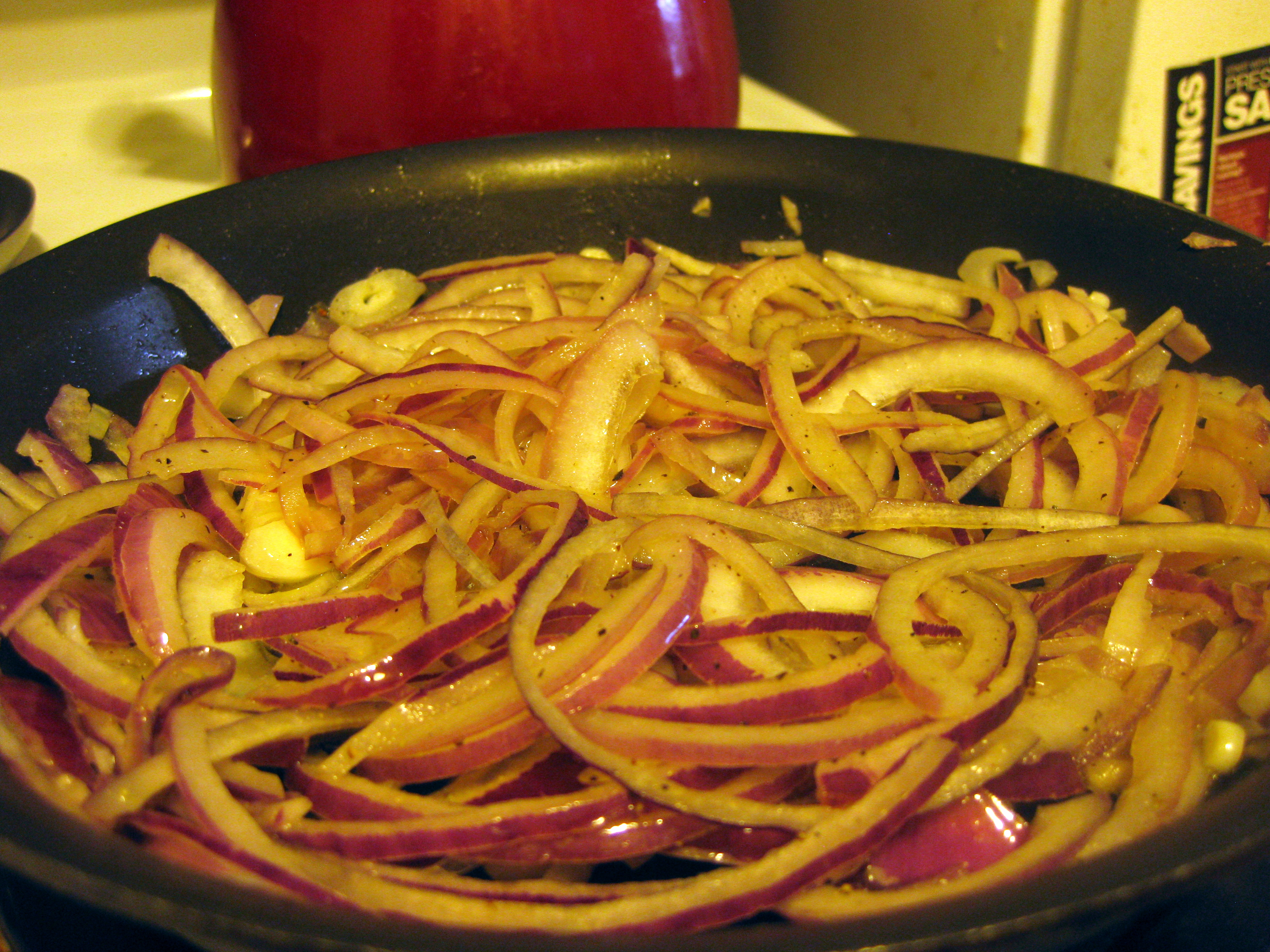
Onions take a long time to cook down the way I suspected they needed to for this recipe.  High heat makes for crumpled, browned, crispy-edged rings.  Delicious in their own right, but not for jam.  I baby-sat the onions over medium-low heat for at least half an hour.  Their pearly-white interiors turned fragile gold as if stained by the olive oil, and their textures changed, gaining an unctuous flexibility.

I added the salt and pepper, the rosemary, the red wine and the brown sugar and stirred together carefully to dissolve the sugar.  This simmered for another half hour until the wine, sugar, and onions came together into a sticky heady mahogany swamp in the pan.  As the wine reduced, I lowered the temperature to prevent any burning.

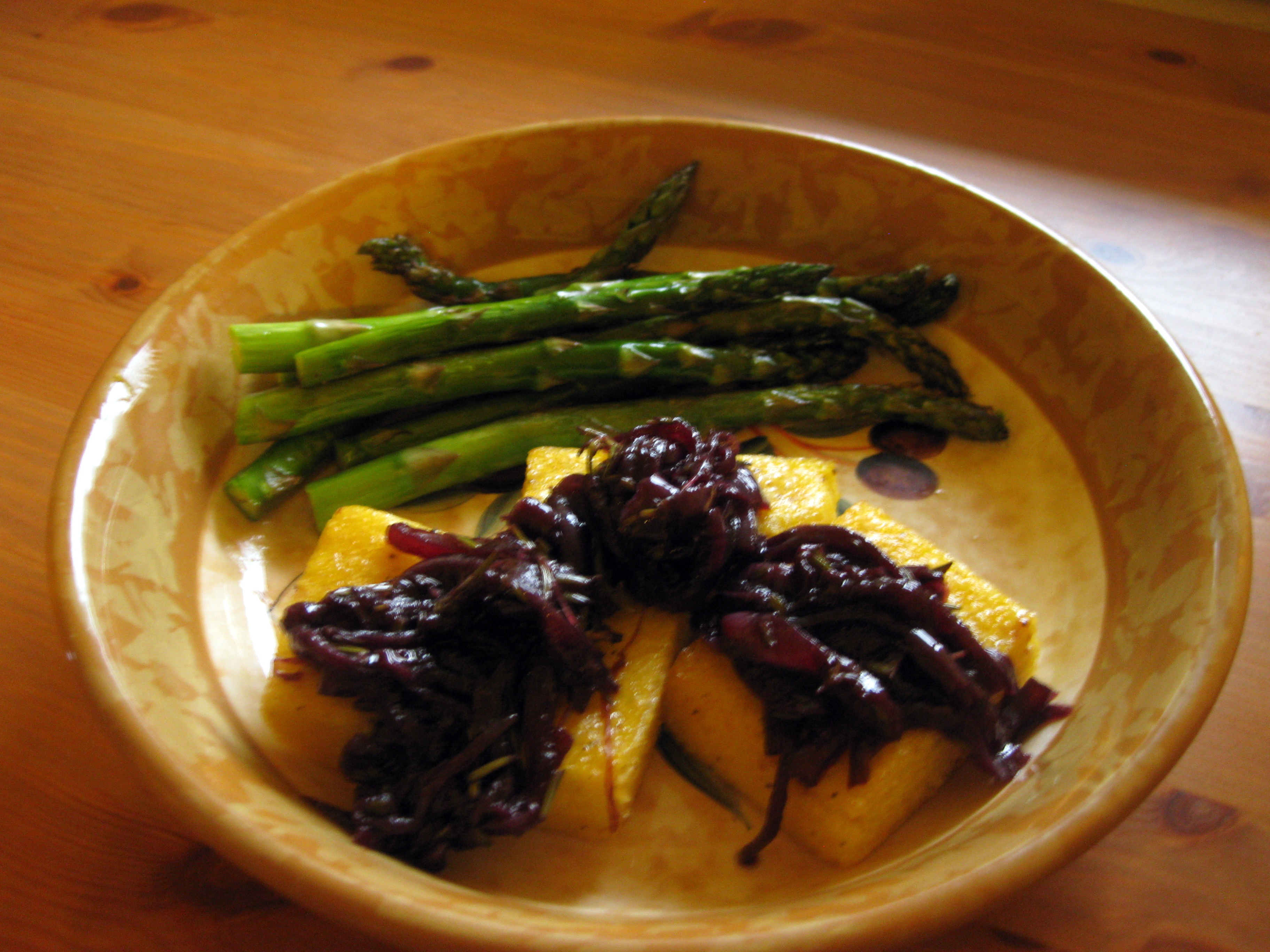
The finished jam slumped wonderfully over baked squares of polenta, providing contrast in all the best ways: the colors were sharp, the textures played together, the flavors were rich and lovely.  The onion jam was sweet with the tang of wine and the pine-forest warmth of rosemary.  The polenta was comforting and even flavored, and it needed the sharp sweetness the jam provided.  Steamed asparagus finished out the meal.

It sounds crazy, but the next morning I had the urge to drape some of this sticky, savory jam over a piece of whole-grain toast smeared with cream cheese.  It would also, I suspect, serve well spread over a turkey burger.

1. Onion-Pumpkinseed Relish: Roast thick slices of red onion with olive oil until softened and nicely browned.  Chop, then toss with minced chives, toasted pumpkinseeds and a little more olive oil.

A number of circumstances divide these two onion concoctions.  One was made in Oregon, one was made in California.  One was made in the cold drear of an oppressively long winter, one was made on a day of endless sun as August closed.  One was slowly reduced over an electric stove, one was browned in a gas oven, and though both were shot with digital cameras, you’re seeing one through the lens of an everything-automatic Canon PowerShot, and the other through a Nikon DSLR.  Changes to relish.

½ a huge red onion

3 TB olive oil

3-4 TB pumpkinseeds, toasted in a dry pan until they are flushed with brown and starting to pop

2 TB fresh chives

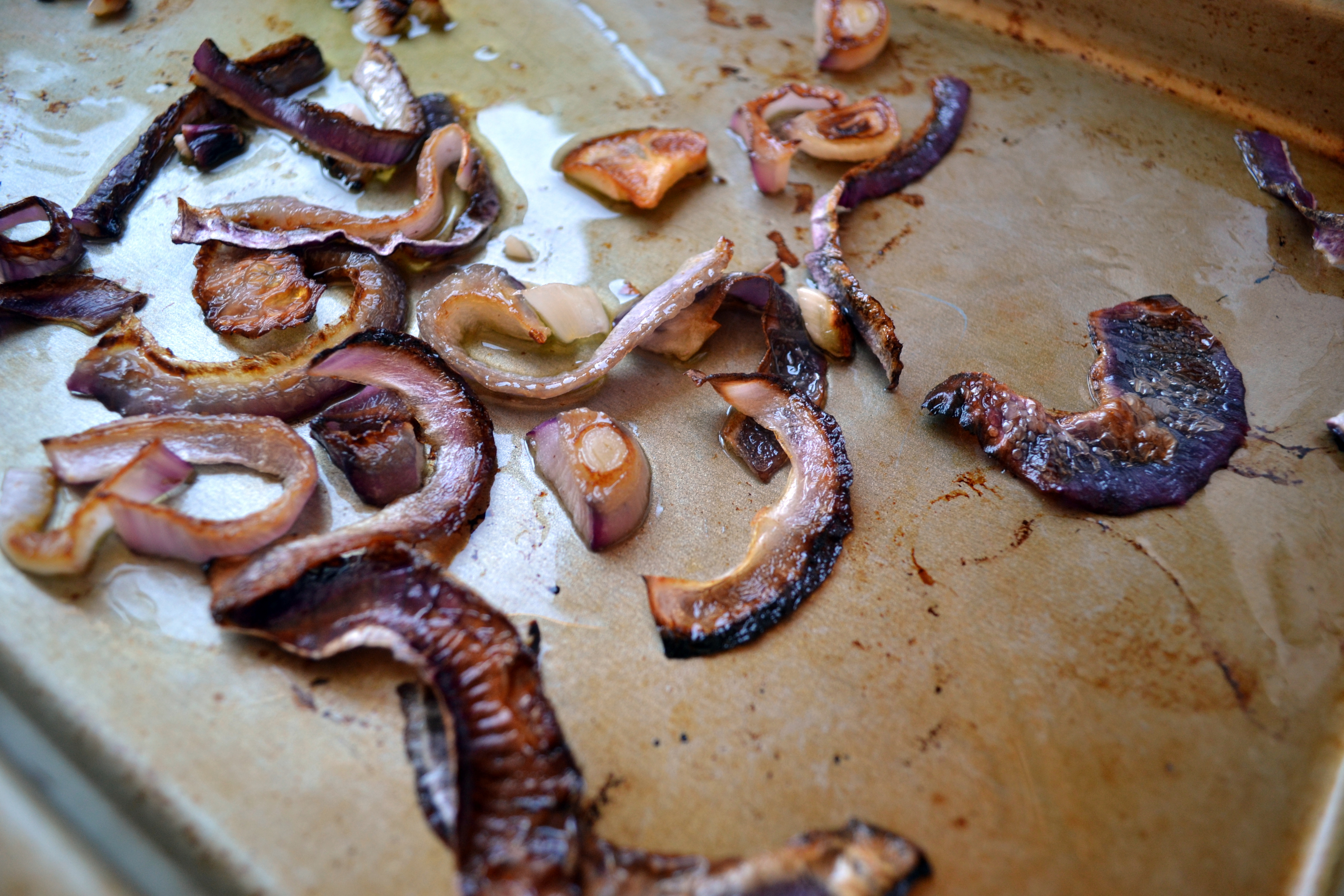
In a 400F oven, I roasted the olive oil coated onion slices until they collapsed, taking on a lovely burnished crispness.  This took probably 10-20 minutes.  Check often after 10 minutes, depending upon how hot your oven runs.  Liberate the toasty onion slices and let them cool.

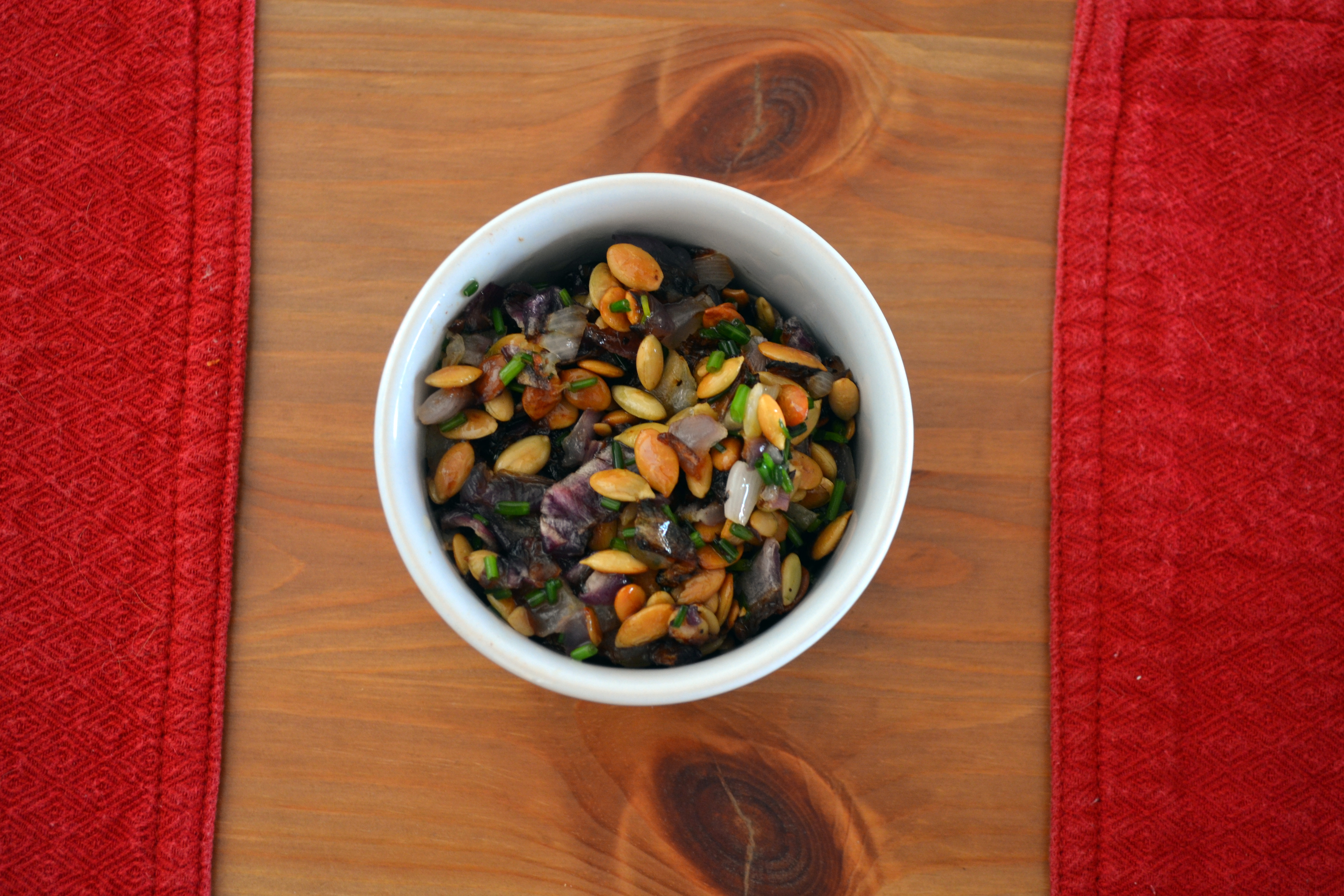
When onions are cool, chop them finely and toss them with the other ingredients.  I had plenty of olive oil in my baking pan to coat all the ingredients so the relish glistened, but if you need it, feel free to add another glug or two.

I served lovely little spoons of this mixture over black bean cakes.  We traded tastes, taking in the relish in one bite and an avocado tomato salad in the next.  It was a nice pairing: the relish was moist and crunchy and savory, with the right kind of nutty richness to complement the dense potential blandness of the beans.

But I don’t think this relish ends as a condiment for beans.  It would be a spectacular topping for lamb.  Spiced with a little chili powder, it would fit perfectly atop pumpkin enchiladas.  It might even be a good garnish for butternut squash soup: a small heap of confetti in a velvet orange sea, interrupting the endless smoothness with a well-oiled crunch.

Will I finish this Bittman project by the end of the calendar year?  I don’t know.  But I’m enjoying it again, whereas during the last few months of dissertating I was finding it burdensome.  The thrill of guessing quantities, rather than being annoyed by lack of specificity, is returning.  The intuition about temperature and time is audible again.  And now, on this holiday that has never felt like a holiday before, I’m relishing it all.

The Buttercream Project, part 6

Buttercream and I are getting more comfortable with each other (and we’d better be, since the wedding is in one week.  One week!).  To prove this to myself, and because my family was clamoring for a taste of the cake I’ve been practicing for so long, I made a batch of wedding cupcakes while visiting my parents a few weeks ago.  My mom acted as sous chef, and we produced a batch together that will, thanks to time slipping away from me, serve as my final practice before I execute the real thing at the end of this coming week.

This practice run was an exercise in slight changes.  Not only did I not have cake flour to work with, or as many raspberries as I wanted for the filling, or enough champagne to add to the fruit compote, I was also working with a new oven, new tools (my mom has an electric mixer, but not a KitchenAid stand mixer, which is what I use at home), and a new friend: I’ve upgraded cameras.  I’m now (mostly) shooting with a Nikon D3100, a fantastic graduation gift courtesy of my folks.  It’s amazing.  I love it.  But I digress…

With regular instead of cake flour, the baking time needed to be increased by a minute or two (science-types: why might this be?  Does it take longer for regular flour to absorb liquids than cake flour?), and in my impatience, a few of the cupcakes fell in the middle and remained a bit gummy.  Initially this upset me, but the wonderful thing about filling is that you hollow out the center of the cupcake, which eliminated any underbaked batter completely.

My mom dipped apricots in a boiling bath so she could slip them easily out of their skins, and she chopped them up in a medium dice to add to the mush of raspberries we had available, water, a small drift of sugar, and a generous splash of dry white wine.  We cooked this down for at least half an hour, then poured off some of the remaining liquid and cooked it a bit more. What was left was the consistency of loose jam, and pleasantly melon-colored.  To be honest, though the combination was nice and the filling tasted fine with the cupcakes, I think it could have benefited from less cooking time and less sugar.

Baked, cooled, hollowed and filled, the cupcakes just needed their final element: perhaps the tastiest nemesis anyone has ever had.  I only let the butter and mascarpone cheese soften for half an hour or so.  In my mom’s summer kitchen, it was in the low 70s and the butter had a slight give at the press of a finger, but was not as achingly soft as it would be for chocolate chip cookies.  This seemed to be the right move.  It whipped together with the cheese easily and well – no large clumps of butter, no separation of fat from liquid.  I added powdered sugar a half cup at a time, as I’ve been doing, this time through my mom’s sifter, an ancient, squeaky-creaky crank-powered tube of tin.  Only one tablespoon of milk trickled in, and then I had a stroke of genius.  The problem with this frosting – the problem I’ve been searching in vain for ways to combat without compromising the texture – is that it’s too sweet.  Sitting in a wicker basket on the counter next to me was a large, juicy lime.  What would happen if we whipped a little lime juice into the frosting?

Revelation.  The good kind.  Just a tablespoon of lime juice and the frosting already tasted less sweet.  Another tablespoon and it was markedly less saccharine, but still no citrus flavor overwhelmed it, and it piped on beautifully in both swirls and curlie-cues.  This is an experiment to be repeated.  In a week.  One week.

Food from Fiction Potluck

So what does one do, you might ask, as a newly minted Doctor of Literature, unfettered from the everyday proletariat academic concerns?  Well, one grades, and one line edits, and one revises frantically, and frankly, one feels completely different and not different at all.  The school year isn’t over, even though (as of Tuesday, when I upload my “completed” dissertation to our Graduate School’s website) my degree is.  So my daily duties no longer include anxious preparing for the big day, but they still include student emails and lesson planning and reading.

But because they don’t include anxious preparation and last minute rethinking and nail biting about what the committee will think, these days can also include celebrations.  Last night was one such celebration: a party I’ve wanted to have for several years now.  The style: potluck.  The theme: “Food in Fiction.”  Interpretation: bring a dish inspired by or mentioned in a book.  That’s it.  There are so many vivid options in novel, drama and film, and our guests had only to choose one and recreate it in the material, taste-bud-bearing world.

We had tremendous fun, in brainstorming, in cooking, and in sharing the variety of dishes from books we love.  As I mentioned to one friend who thanked N. and I for the great party on his way out the door, this is a party we had to have before parting ways as many of us graduate this June, because only in this company could we feel so self-congratulatory and so excited about immersing ourselves in something so nerdy.

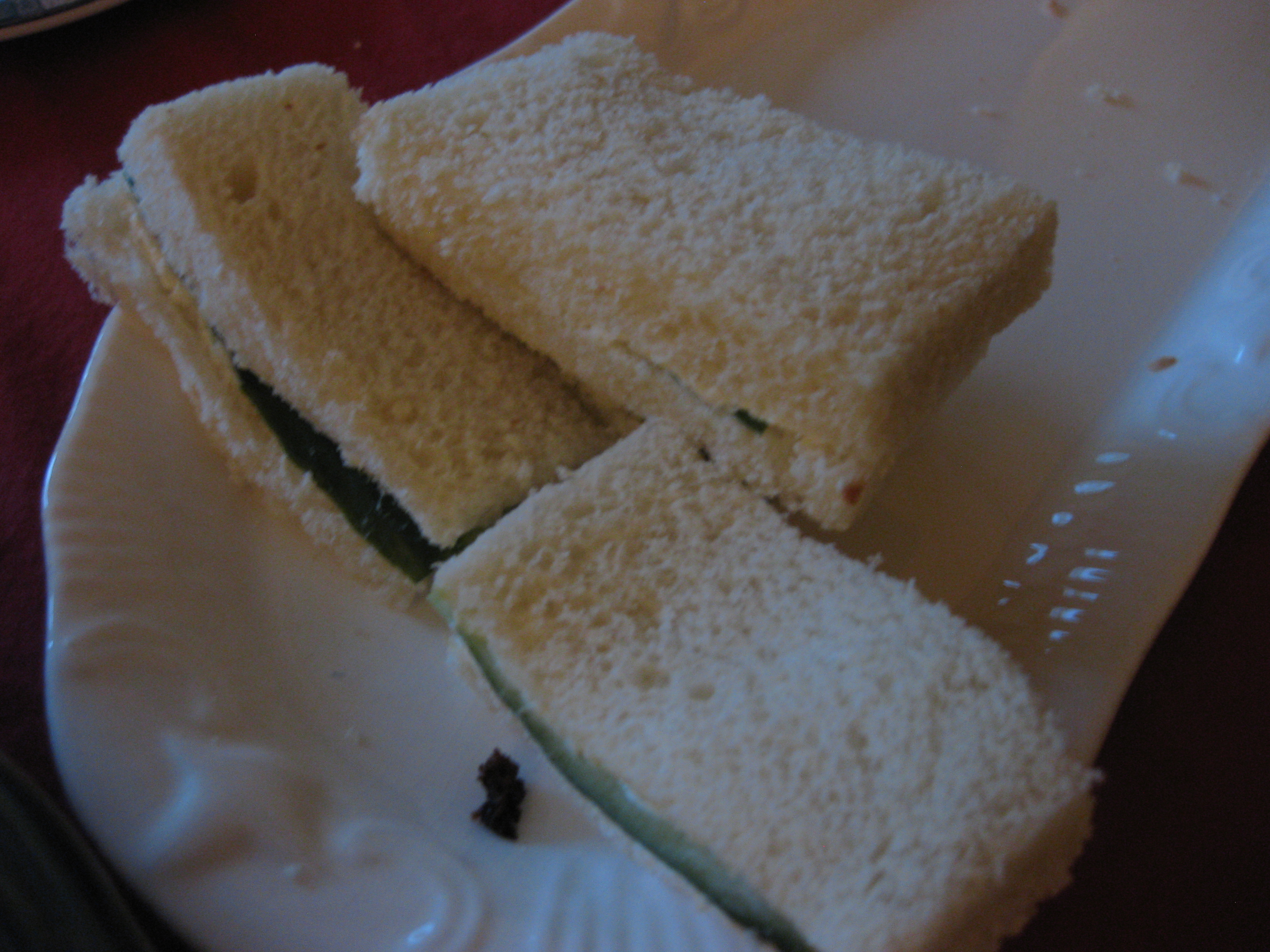
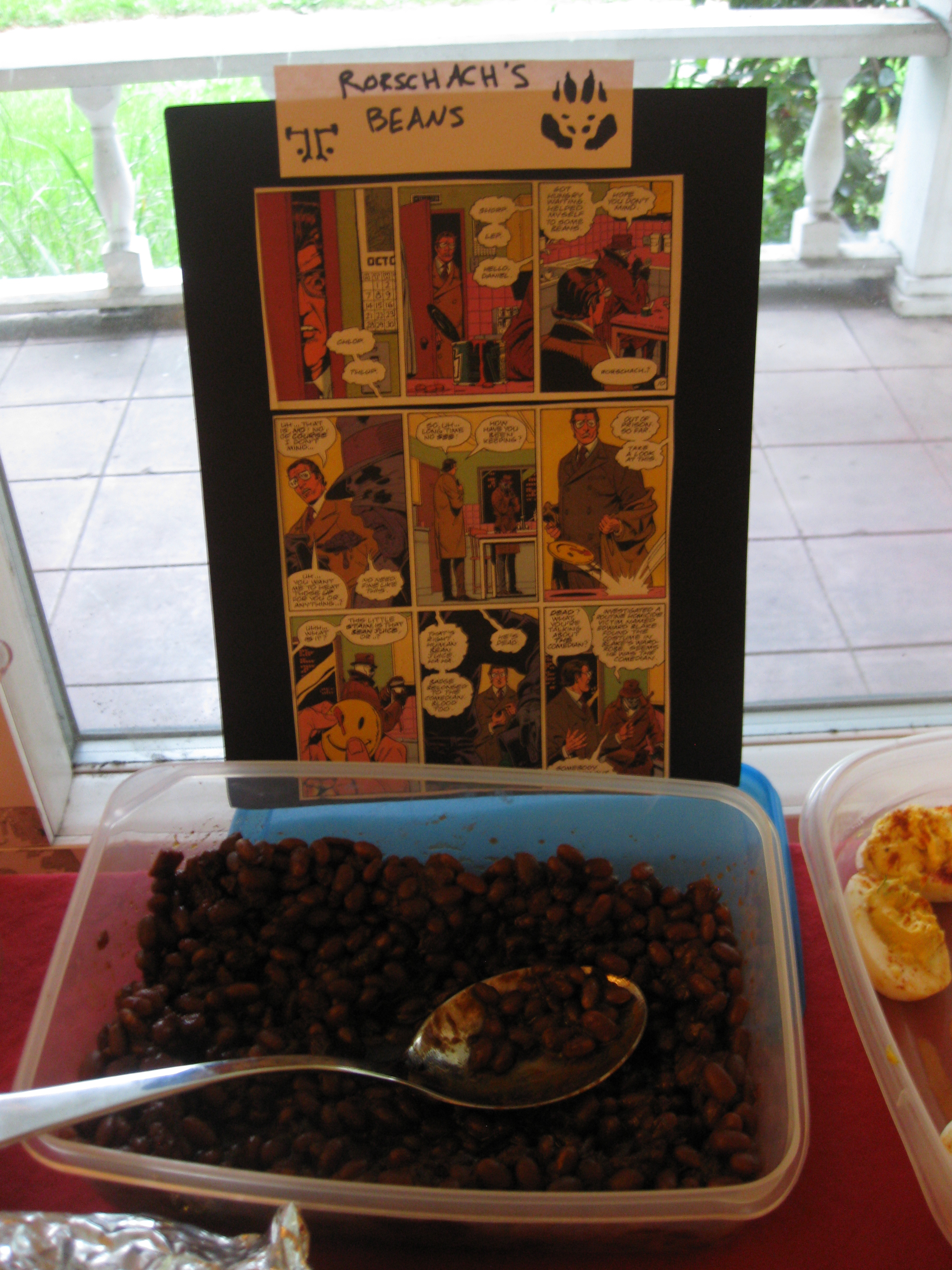
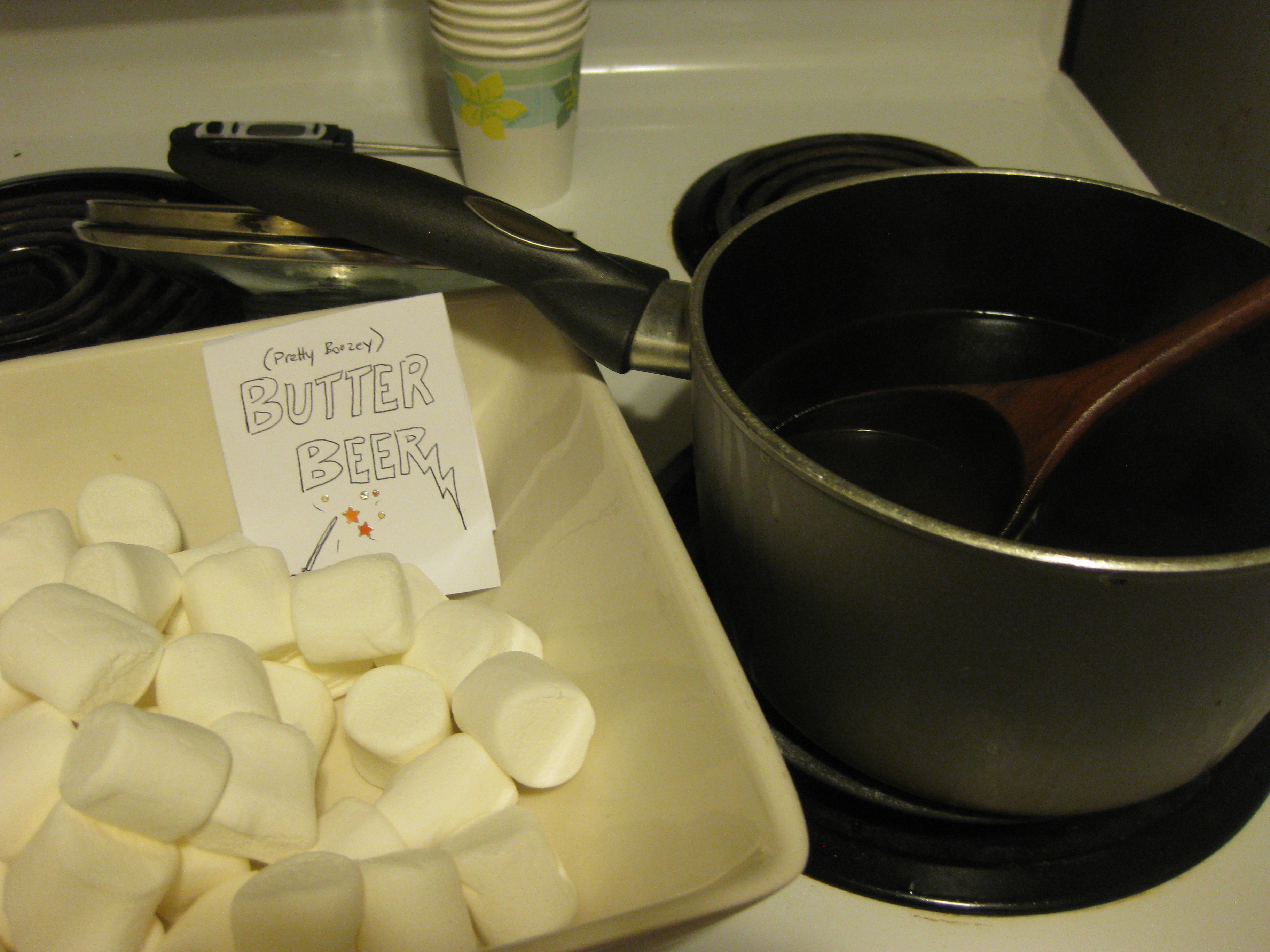
Here are a few of the dishes we enjoyed.  I suggested to folks that they provide the description of the food in question from its source text so guests would know what they were eating and which world it was taking them to.  We had Victorian sandwiches and High Modernism Stew nestling next to a magical realist chutney and a warm wassail of fantasy.  What wandering, all in one house…

Cucumber sandwiches from Oscar Wilde’s “The Importance of Being Earnest.”

Rorschach’s beans from the graphic novel “Watchmen.”

Boeuf en daube from Virginia Woolf’s To the Lighthouse.

A trio of deviled eggs to breathe life into Hemingway’s thoughts on being hard boiled in The Sun Also Rises.

A wonderfully smoky molasses cake inspired by the molasses-drenched dinner scene in Harper Lee’s To Kill A Mockingbird.

Well spiked butterbeer (you drop in a few marshmallows which, as they melt, mimic the foamy head on the beer) from J. K. Rowling’s Harry Potter series.

Not pictured: (more!) deviled eggs, from Toni Morrison’s Song of Solomon, sautéed marinated mushrooms inspired by Lewis Carroll’s Alice in Wonderland, raspberry cordial from L. M. Montgomery’s Anne of Green Gables, and a few sourceless delights: meatballs (Cloudy with a chance of, perhaps?), and a bread, cheese, and hard salami platter.  These were justified by their authors with the claims that “surely there must be moments of literary eating that include these items,” which I was quite willing, given their deliciousness, to accept.  And of course, wine.  If we were picky, we could call this an homage to Hemingway, whose characters “get tight” with abandon, or to Carroll’s Alice, who does imbibe from the mysterious bottle demanding she “drink me.”

I made two offerings: a take on the “green as grasshoppers” chutney so adored by Saleem in Salman Rushdie’s Midnight’s Children, and a pork pie stuffed with hard boiled eggs from Roald Dahl’s Danny the Champion of the World.  Both turned out extremely well, but I want to talk about the pie first.

Danny the Champion of the World is the story of a boy and his father.  Without giving too much away, I will only say that Danny’s father suffers an injury almost halfway into the book, and when Doc Spencer, the family physician, brings him home from the hospital to the gypsy caravan in which he and Danny live, Doc also brings Danny a package from his wife:

“Very carefully, I now began to unwrap the waxed paper from around the doctor’s present, and when I had finished, I saw before me the most enormous and beautiful pie in the world.  It was covered all over, top, sides, and bottom, with rich golden pastry.  I took a knife from beside the sink and cut out a wedge.  I started to eat it in my fingers, standing up.  It was a cold meat pie.  The meat was pink and tender with no fat or gristle in it, and there were hard-boiled eggs buried like treasures in several different places.  The taste was absolutely fabulous.  When I had finished the first slice, I cut another and ate that, too.  God bless Doctor Spencer, I thought.  And God bless Mrs. Spencer as well” (Dahl 85-86).

Since my first trip through Danny, I salivated over this savory pie Danny enjoys.  And this party was the perfect excuse to attempt my own.

I found a perfect (and much prettier) base recipe for my pie in the archives of the blog Married… With Dinner.  Though I followed their basic instructions, I made a few amendments for ease and expense.  The key points are as follows:

Use a springform pan.  That way the pie is tall and regal and can sit magically outside a pie plate all on its own.

Roll the bottom crust out large enough to come almost all the way up the sides of the springform (I used storebought crust and it work out just fine), so you can connect top and bottom more easily.

I squashed together a mixture of ground pork, pork sausage, finely chopped ham from a ham slice, salt, cayenne pepper, ground cloves, and black pepper.  I pressed a thin layer of the meat mixture onto the bottom of the pie crust, then laid six hard boiled eggs in a circle through the middle of the pie (regrettably, with ham-covered hands, I did not get a photo of this).  Then I lightly packed the rest of the meat mixture around and over the eggs and sank a bay leaf deep into the very center of the pie.

A traditional English pork pie has warm pork stock poured into a hole in the crust just after baking, which turns into a thick jelly as the pie cools.  This did not sound particularly delicious to me, though I did like the idea of a rich layer of something atop my pork.  I decided on cheese.  I grated about a cup of sharp cheddar and sprinkled it lightly on top of the meat before draping the top pie crust over it.  I cut a little hole in the center of the crust and sliced some steam vents for additional release before baking.

It’s a long baking process (almost two hours), but you are dealing with raw pork, so the cooking time needs to be sufficient.  When the pie is almost done, Married… With Dinner recommends you carefully release the spring on the pan and brush an egg wash all over the top and sides of the pie.  Fifteen minutes more in the oven and this results in a beautiful, shiny golden glaze all over the pie.  It also, in case you are lazy like me and didn’t brush an egg wash over the top edge of the bottom crust to help the lid adhere, creates an after-the-fact glue to hold base and lid together.

I let my pie cool on the counter for an hour or so, then tented it with aluminum foil and stowed it in the fridge until the party started.  It did, after all, have to be a cold meat pie.

It was fabulous.  The meat was nicely spiced and the ham bits shredded in added some smoky, salty variety.  The hard boiled eggs were, indeed, delightful treasures to find, though I admit to over-boiling them slightly so their yolks were not as bright as they could have been.  Still, this is hardly a complaint.  It was like a meatloaf wrapped in flaky, buttery crust, and the cheese was a nice additional flavor and richness.  I suspect this could have been just as good warm as it was cold, but the pie might not have held together quite as nicely.

My second offering was a cilantro coconut chutney.  Saleem, as Midnight’s Children comes to a close, receives a meal from a blind waitress.  He lists:

“On the thali of victory: samosas, pakoras, rice, dal, puris; and green chutney.  Yes, a little aluminum bowl of chutney, green, my God, green as grasshoppers… and before long a puri was in my hand; and chutney was on the puri; and then I had tasted it, and almost imitated the fainting act of Picture Singh, because it had carried me back to a day when I emerged nine-fingered from a hospital and went into exile at the home of Hanif Aziz, and was given the best chutney in the world… the taste of the chutney was more than just an echo of that long-ago taste – it was the old taste itself, the very same, with the power of bringing back the past as if it had never been away…” (Rushdie 525).

I found a recipe for a coriander chutney replete with tart lemon juice, lip puckering spice from serrano chiles, and bright, bright green cilantro, tempered by shredded coconut.  The recipe called for unsweetened coconut but I, in my haste, having only sweetened, forgot to rinse it to get some of the sugar off before dropping it into my food processor.  As a result, my chutney was lightly sweetened, but no one seemed to mind that, especially when it was spread onto the pakoras I made.

I searched around online and made a master recipe from a combination of ideas for these pakoras.  Mine included:

4 cloves garlic, smashed and finely minced

2 tsp. each:

Garam masala

Turmeric

Chili powder

Salt

2 cups Bob’s Red Mill gluten-free all-purpose flour (pakoras are made with garbanzo bean flour, and though the Bob’s Red Mill mix is a blend including potato starch, it is composed mostly of garbanzo and fava bean flours, so since I had it, I decided a little break from tradition would be okay.  This is literature, after all.  It’s all interpretation anyway!)

1 ½ cups water

½ head cauliflower, diced

¾ large onion, diced

1 small sweet potato, diced

1 quart vegetable oil

Heat the vegetable oil to 375F in a large, sturdy pot.  I used my dutch oven.

While the oil heats, whisk together the dry ingredients and garlic until well combined, then slowly whisk in the water to form a thick, smooth batter.

Add the diced vegetables and stir to combine.

Drop spoonfuls of the batter (ever so carefully!  Watch out for splashes!) into the hot oil and fry for 5-6 minutes, or until the batter is deeply golden and the vegetables inside have magically cooked.

I got to taste one of these.  It was crunchy and starchy and slightly spicy and wholesome and delicious.  It was vegan.  It was gluten-free.  Topped with the chutney it was fresh and springy and spicy and then gone.  By the time I went back to have another, the giant platter I’d made was empty, and only a spoonful or two of chutney remained.  Pride overwhelms disappointment, in moments like these.  My little experiment was so successful it prohibited me from tasting further.  So I had another deviled egg instead.

Full and happy, we fell into bed at midnight with a sinkful of dishes and a fridge-full of leftovers to look forward to.  It’s like reopening a book to your favorite chapter: whose world will I lunch from, dine from, be returned to today?