Trick or Treat

Halloween is easily in my top three holidays.  I have to give the prize to Christmas, because it means family and love and sweaters, but Thanksgiving and Halloween chase each other in circles to gain second place.  Despite that love (overwhelming in some cases, especially if you, like N., are not invested in costuming yourself at every possible occasion), this is the first year in almost a decade that I’ve done nothing to celebrate.  No costume.  No party.  No decorations.  We bought candy for the six kids that showed up (only six!  The whole evening!  Was it just because it was a Wednesday, or do kids not trick or treat like they once did?) and I definitely listened to the Halloween party mix my friend D. made for me a few years ago, but it felt a bit like a lost holiday.

I did embrace the season, though, the following day.  Having Thursdays off gave me the opportunity to do something I’ve been wanting to do for years: pillage Target’s day after Halloween sale for leftover clearance items (read: treats!).

The tricks began when I began work on the evening’s dinner.  It was, I realize in retrospect, a bit of a Chopped style enterprise: appetizer, entree, and dessert, each made with ingredients I’d not expected to meld.  In each case, however, the “trick” aspect of the dish was my doing, not the recipe’s.

“12. Garlic-Rosemary Figs: Soak dried figs, stems removed, in warm water until plump; drain and halve. Heat rosemary and lightly smashed (and peeled) garlic with olive oil on medium-low heat, until softened. Add figs, along with some fresh orange juice. Cook until saucy.

Pairing figs, garlic, and orange juice seemed odd.  Nevertheless, I collected enough for one portion (this was not N.’s kind of dish):

6 dried black mission figs

1-2 tsp fresh rosemary

2 smashed, peeled garlic cloves

1 TB olive oil

juice from 1 small orange (⅓ – ½ cup juice)

I heated some water in my teakettle and poured it over the figs (which I’d halved prematurely.  Apparently paying attention to the directions is kind of important), which I let stew on the counter for half an hour.

Figs vaguely plumped, I drained them and set them aside, then put the garlic cloves, rosemary, and oil into a cold pan.  I heated it over medium for five minutes or so – just until the rosemary started to sizzle and the garlic turned a little blonde.  Then I added the figs and orange juice, and simmered for fifteen minutes or so, until the orange juice had reduced considerably.

I plated, I ate, and I considered.  This didn’t taste bad, but it didn’t marry absurdly well either.  The rosemary and the figs were lovely.  The orange juice and figs were fine (though the orange was a bit overpowering).  The garlic and figs were… unobjectionable.  They just weren’t my favorite.

I must say, though, I recalled while I was cleaning up after dinner that this entry was in the “Sauces and Relishes” category.  I had eaten it straight.  This was, perhaps, why I wasn’t enamored of it.  Therefore, I’d recommend spooning this over lamb chops, or pork tenderloin, either of which would add some savory notes to make the garlic feel less anomalous.

Though this “appetizer” wasn’t fantastic, I ate it with a fantastic grain-salad-turned-hash inspired by Smitten Kitchen.  I want to revisit this hash, because I think it could use some additions, but here are the basics:

Line a baking sheet with aluminum foil.  Set it in the oven and preheat to 400F.  Yes, you are preheating the pan along with the oven.

Peel and halve a butternut squash.  Seed half of it and cut that half into small cubes.  In a bowl, toss the cubes with salt, pepper, and olive oil, then tumble onto the baking sheet (where they will sizzle immediately – this is a good thing) and stow back in the oven for 35-45 minutes, or until they have golden edges and creamy soft middles. 

During the last ten minutes of squash roasting, push the squash to the sides of the pan (or just grab another pan, if you aren’t invested in avoiding dishes, like me) and stack 4 cups or so of trimmed, cut kale that has also been tossed in olive oil, salt, and pepper.  The kale and squash will cook down a little more together, and you will be left with something not quite like kale chips, but a bit more textured than if you’d boiled or steamed it.

While the squash and kale roast, cook 1 cup of bulgur wheat in chicken (or vegetable) broth.  When done, fluff gently with a fork and toss with squash and kale.

During the last few minutes of roasting time, toast 2 TB pumpkin seeds in a dry pan until they begin to snap and crack.*  Be careful not to burn them.  Toss with bulgur and vegetable mixture.

In the pumpkin seed pan (again, avoiding dishes), heat an egregious quantity of butter until foamy and crack in an egg to fry until the edges frizzle and brown and crackle.  Despite a few careful taps, on this egg of all eggs – the egg I wanted to photograph quivering atop my hash, the egg I wanted to show just cut and lusciously runny – I somehow shoved my thumb through the yolk and it broke all over the pan.  Nasty trick, egg.

Nevertheless, I piled my hash up on my plate, carefully laid the fried egg over it, and dug in.  It was a hearty, pretty, perfectly autumnal dish.  It needs some tweaking before I’m thrilled with it – perhaps some sautéed leeks folded into the bulgur, or some light spices on the butternut squash – but this was a delightful start.

I turned to dessert:

“96. Sweet Autumn Gratin: Combine cubed pumpkin or sweet potato with cranberries and hazelnuts in a buttered baking dish. Sprinkle with brown sugar and toss. Drizzle cream all over, dot with butter and bake until soft, bubbly and browned, 50 to 60 minutes. Re-warm before serving if you like.

I’m going to give you a list not of my ingredients and procedure, but of what I should have used and done.

1 big sweet potato, peeled and diced

½ cup dried cranberries (I didn’t have fresh, so I don’t know what they would be like.  Presumably more successful because they would emit, not swallow, liquid)

½ cup walnuts, coarsely chopped (I couldn’t find hazelnuts anywhere – who would have thought this would be the food item I would miss most from Oregon?!)

¼ – ½ cup brown sugar, depending on how sweet you like it

¼ cup heavy cream

¼ cup butter

Preheat the oven to 400F.  Butter a 9×13 inch pan (my round, much smaller dish was a poor choice).

Toss the sweet potato chunks, cranberries, and walnuts with brown sugar.  Spread them out in the pan in an even layer.  Pour on the cream, then pinch off pieces of butter and dot them over the top.

Bake for an hour, or until the sweet potato pieces are fully cooked.

I did few of these things.  My sweet potatoes were in bigger-than-they-should-have-been chunks, piled up in a small casserole dish, starving for cream (I only had a tablespoon or two) and shorted on sugar.  As a result, at the end of an hour they were hot but still resistant in texture.  I think what you want is melting, creamy softness.

Tricked again.

To remedy this problem, I tried several things.  First, I made a bourbon hard sauce (equal parts sugar and water, stir to melt.  Add ¼ cup butter, stir carefully until it melts.  Add a shot or two of bourbon, cook just a minute or two to take the edge off) to pour over the top.  This helped, and I willingly ate a serving, but it was lacking whipped cream or ice cream or, bizarrely, pie crust.


I didn’t figure out the pie crust thing until the next day when I was making empanadas for dinner.  As I pressed my fork into the edge of the dough to crimp it, I was flooded with the right answer: tiny hand pies stuffed with my sweet potato mixture!

This was clearly the right thing to do.  Saturday afternoon, I unrolled a pie crust on my counter, cut out 3 inch circles, and proceeded to fill them with a teaspoon or two each of the gratin, which I’d mashed with a fork to make smoother and therefore more manageable.

Once filled, fold in half, press and then crimp with a fork, and brush with egg wash (1 egg yolk + 1 TB water).  Sprinkle with turbinado or other raw, chunky sugar, and bake in a preheated 400F oven for 15 minutes, or until the tops are golden brown and the dough is flaky.

These make lovely, tiny snacks.  The craisins give a punch of tartness to the sweet, earthy, almost heavy sweet potato and walnut pairing.  There are subtle floral hints in there, because before putting it away that first night I admit to dumping the bourbon sauce over the whole thing, but this adds a flavor I wouldn’t change.  The dough is buttery and flaky and collapses easily around the filling, and it’s difficult to prevent yourself from standing over the pan as it comes steaming out of the oven and eating four or five in a row, scalding your tongue and not caring at all.

Perfect November treat.


* You could, I suppose, use butternut squash seeds, if you are the sort of person with the forethought to save, rinse, and dry the seeds while you clean your squash.  I, clearly, am not.

Counting Down

It’s interesting that as I left my 20s behind chronologically, I entered my 20s in this Bittman project.  As of this moment, on this particular Sunday afternoon, I have 25 Bittman concoctions left to make, most of them soups and desserts.  At a rate of two per week, I will finish by the end of this year.  This means we’re getting toward some major milestones, some very big deals, some lasts on the list.

The first of this pair is one such last.

“34. Combine cooked bulgur with chopped or grated apple, minced orange rind, grated ginger and chopped parsley. Back in an oiled dish, use as stuffing or serve as a salad.”

This was the final remaining entry on the “Stuffings and Grains” list. We left it till last for no particular reason, but during a week in which a collection of Valencia oranges sat languishing in our fruit bowl, it seemed like the right thing to do.

I’ve been fairly good lately about writing down ingredient quantities as I add them, but for this entry I never even lifted a pen.  It happens.  I can own up to it.  A week of non-stop grading, perhaps, made me leery of that inky instrument.  Or maybe it was our relative rush: leave it to me to design a complex, glaze-bearing dinner on a night we needed to eat early.  Some things must get sacrificed, and it turns out it’s not the glaze, it’s the notations.

Here are my approximations:

1 cup bulgur wheat

2 cups water, stock, or a combination of the two

1 large fuji apple, diced into small squares

2-3 TB finely minced orange rind

1 TB grated ginger (this is really easy to do when the ginger is frozen)

¼ cup chopped parsley

salt and pepper to taste

Cooking bulgur is very similar to cooking rice.  I poured the wheat and the water into a pot and let it come to a boil before simmering for 15 minutes or so while I prepped my other ingredients.

After dicing the apple, grating the ginger, and chopping the parsley, I turned to the oranges.  Since Bittman specified “rind” and not “zest,” I used a y-shaped potato peeler to remove long, brilliant segments of rind.  I slid a sharp knife carefully between the rind and any white pith that got caught in the peeling, and then sliced into very thin strips, rotated them 90 degrees, and sliced again so I was left with tiny squares.

Before these happy bright piles all nestling on my cutting board got too comfortable, I tipped them into the pot of bulgur and carefully folded them in for even distribution with some salt and pepper to taste.  The experience of the still-chilly ginger hitting the hot bulgur was sinus-clearingly intense, but lovely.  An aroma-only aperitif.

With everyone incorporated, I dumped the pot’s contents into a greased baking dish and stowed it in a 350F oven for half an hour.

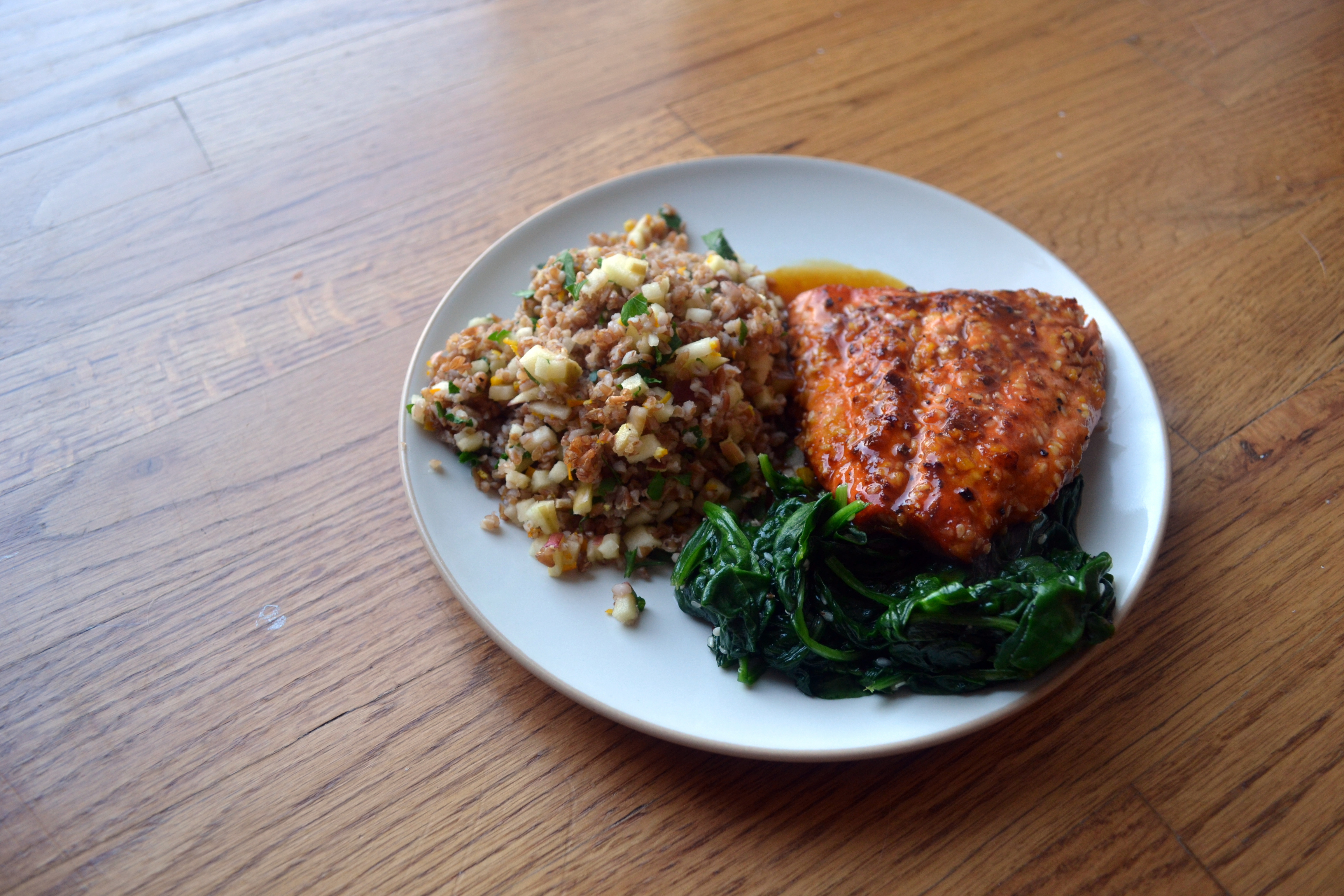
Orange and ginger suggested an Asian flavor profile, even though apples and parsley didn’t.  I decided to work with the dominant elements, though, and so I paired the bulgur with salmon and spinach.  The salmon would be rubbed with sesame seeds, powdered ginger, and orange rind bits before receiving a heavy sear and then an orange-juice glaze.  The spinach would be sauteed with garlic chips and sesame oil.

As with all things, this didn’t happen exactly as imagined.  It takes a long time, as it turns out, to simmer the juice of six oranges down into a thick glaze without burning their sugars.  Similarly, it takes time and babysitting to ensure garlic chips that are crisp, not charred.  And when you are trying to do all this on the same night as a homecoming football game you’ve promised to attend, certain shortcuts must be taken.

The salmon, while it seared beautifully, received not so much a glaze as a flood of boiled, ginger infused orange juice.  Still, when this liquid hit the hot salmon pan, it did bubble down into something thick and rich (if a little darker than intended).

The spinach, rather than the crunchy, spicy accoutrements I intended, had to settle for a last-minute sprinkle of sesame seeds to keep it company.

Still, the meal was overwhelmingly successful.  The salmon was outrageously delicious, and I’m going to have to make it again, writing down the procedure this time so I can share it with you.  The orange sauce perfumed the fish and kept it moist and buttery and tender.  Even though it was a bit darker than I’d planned for, the sauce took on caramel notes that seemed utterly intentional.

The bulgur was lovely.  It was toasty and fluffy and well seasoned.  The apple had cooked lightly as the dish baked, leaving it just softened but not without resistance.  The orange rind was delightfully not overpowering, but gave a warm spiciness to the grain.  It was good with the salmon, but would also be delicious with pork chops (playing on the traditional applesauce pairing) or, if you replaced the parsley with mint, a lovely side for leg of lamb.

In summary, a triumphant triumph: not only is the Stuffings category successfully completed, but it was completed with a success.


With the weather cooling (finally!) and the Soups category still looming largely untasted before me, I decided to try one to close out the week.

“21. Brown a little crumbled or sliced sausage in olive oil; a sprinkle of fennel seeds is good, too. Add chopped escarole, cooked white beans with their juice, and stock or water to cover. Simmer until the greens are tender and the beans are warmed through. Garnish with olive oil or Parmesan.”

I must admit I made some changes to these directions based on availability and personal taste.  I don’t like fennel.  It’s one of a very few spice flavors I just can’t take.  Over-fennel-ed sausage – like the kind that appears on many chain pizza restaurant pies – just doesn’t appeal to me, and the idea of fennel seeds crunching between my teeth and filling a mouthful of soup with their anise awfulness made their addition out of the question.

As for the escarole, I could find none.  I searched through mountains of salad greens at several local markets and this particular strain was resolutely absent.  But I did find a really beautiful bunch of kale and decided it would be a satisfactory substitute.

So here’s what I ended up with:

8 oz. bulk sausage

1 big bunch kale (chopped, this was probably 6-8 cups)

3 cloves garlic (some spice to replace the abhorred fennel seemed appropriate)

1 15 oz. can white beans with their liquid

2 cups chicken broth

salt and pepper to taste

Eschewing olive oil, I squeezed the sausage into a pan and let it brown over medium heat, separating and crumbling it as it cooked with a flat-sided wooden spoon.

I rinsed, stemmed, and chopped the kale into manageable pieces, and when the sausage was cooked through, I tossed in the mountain of greens.  No, that’s not true.  I inserted handfuls carefully so they wouldn’t spill all over the stove, and ran out of room with only half my kale added.  N. came into the kitchen when he heard me laughing hysterically, and stared in amazement at the mound of kale pieces sitting inches above the top of my pot.  I had to press it down with my hand, compacting the frilled, tough leaves down toward the bottom of the pot.  It always looks like too much.  It’s always not.  In the time it took me to mince the garlic, the kale had already begun to wilt and settle more comfortably into the confines of the pot.

When I could barely smell the garlic and the kale was level with the sides of the pot (as opposed to threatening to spill over them) I added the white beans, their juice, and barely two cups of low sodium chicken broth.  One of the things I’ve discovered about myself is that when it comes to soups and salads, I like them to be full of, well, stuff.  Lettuce with the odd crouton is no good.  I want dried cranberries, and walnuts, and avocado, and gorgonzola.  Thin, brothy soups don’t please me either.  Give me big chunks of vegetables, or slurpable noodles, or rich shreds of meat.  In the days when I’d indulge in the occasional Cup’o’noodle, I always drank the broth out first so I could concentrate on the important part: the just dripping mounds of noodles left behind.

So this soup, for true enjoyment, needed only enough broth to make its categorization accurate.  A scant two cups and we were assured plenty of “stuff” in every spoonful.

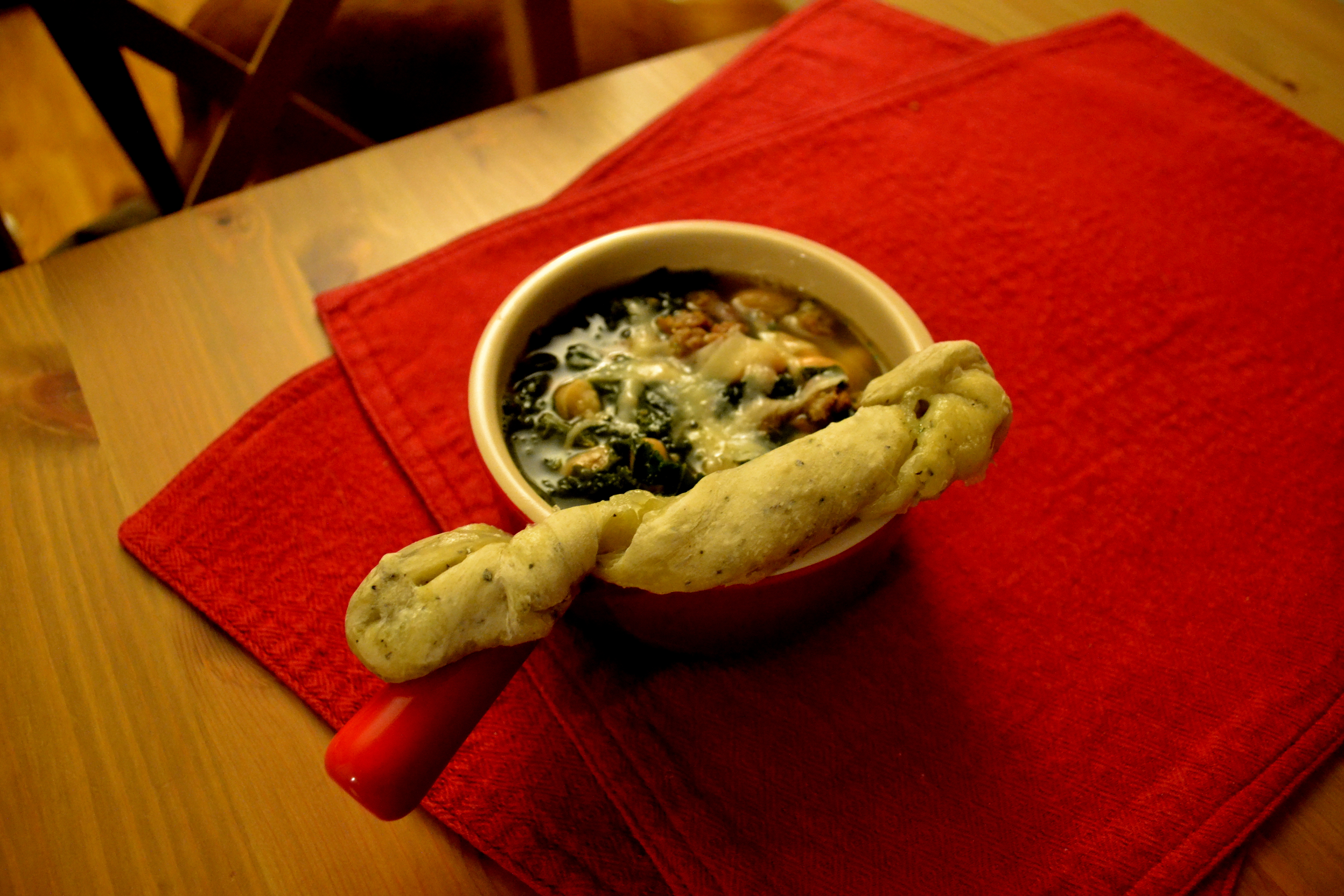
While the soup simmered, I stretched, sliced, and sprinkle mozzarella onto some pre-made pizza dough.  Twisted and snuggled on a baking sheet, these when into the oven to become bread sticks.  Fifteen minutes later when they were sizzling and firm, the soup was done.

This is not a soup you want to let simmer for hours.  The beans, especially if you are using canned like I did, will eventually become mealy and then disintegrate.  The kale begins to lose its emerald brilliance after a while, and though it will still taste good, it won’t be as pleasing to consume.  Simmer for fifteen to twenty minutes max.

Then you get to shave on some parmesan and eat it.

Neither of us was sure we would like this soup.  But we shouldn’t have been so foolish.  N. has placed the products of this project on a pass/fail system.  This is what happens, I suspect, when you have two teachers in the family.  He announces his verdicts after dinner, and he treats them as though Mr. Bittman has just submitted an exam or a paper assignment.  “Bittman passes on this one,” he told me last night as we cleaned up.  It wasn’t just his happiness at pairing his dinner with the first Jubelale of the season.  He really did like the soup.  And I think he was right.  This was a fast, easy, delicious little warmer.  Cooking the kale in the sausage grease gave it some additional flavor and took away that raw bitterness dark leafy greens can sometimes have.  The beans got creamy and delicate, and the starch from their liquid thickened up the minimal broth I used.  Even without the broth, these ingredients seem like a stellar combination that should be taken advantage of at many opportunities.  Sautéed together, perhaps with the addition of chopped onion and maybe butternut squash or sweet potato, they could be a nice little hash.  Wrapped in pastry with some thickened gravy, they could be a pot pie.  Folded with some grated mozzarella and enclosed in pizza dough, they become a perfect calzone.  And as the weather continues to cool (I hope, I hope, I hope), gravies and pot pies and warm cheesy casseroles are exactly what I want to pair my remaining Bittman dishes with.

It seems a bit stress-inducing to start with a countdown.  It’s a looming certainty of what must be achieved.  “That’s a lot,” N. said when I told him how many were left.  But after tonight’s dinner, it will be 24.  And by the end of next week, it will be 23.  And by having you out there reading, it means I must achieve, yes, but it also means I’m promising something to you.  Food.  Words.  Proof of my experiments.  And stress-inducing or not, that’s a kind of accountability I like having.

25 to go…

Breaking Bread

Last week I tallied up what remained on my Bittman Sides project and discovered, through careful calculations that included pointing to my calendar and counting on my fingers, that if I make two selections from the list every week, I will be finished with the whole thing at the end of the year.  And I mean the end.  The very last week.  Ambitious, yes?  I decided I could do it.

Guess how many I made this week?

Yeah.

One.

So I’m not starting out well with this, but I’m going to try anyway.  I’m years overdue from my original goal anyway.  And in my own kind of backwards reverse engineering, I try to make up for this how?  By posting twice in one week.  So it goes, I suppose…

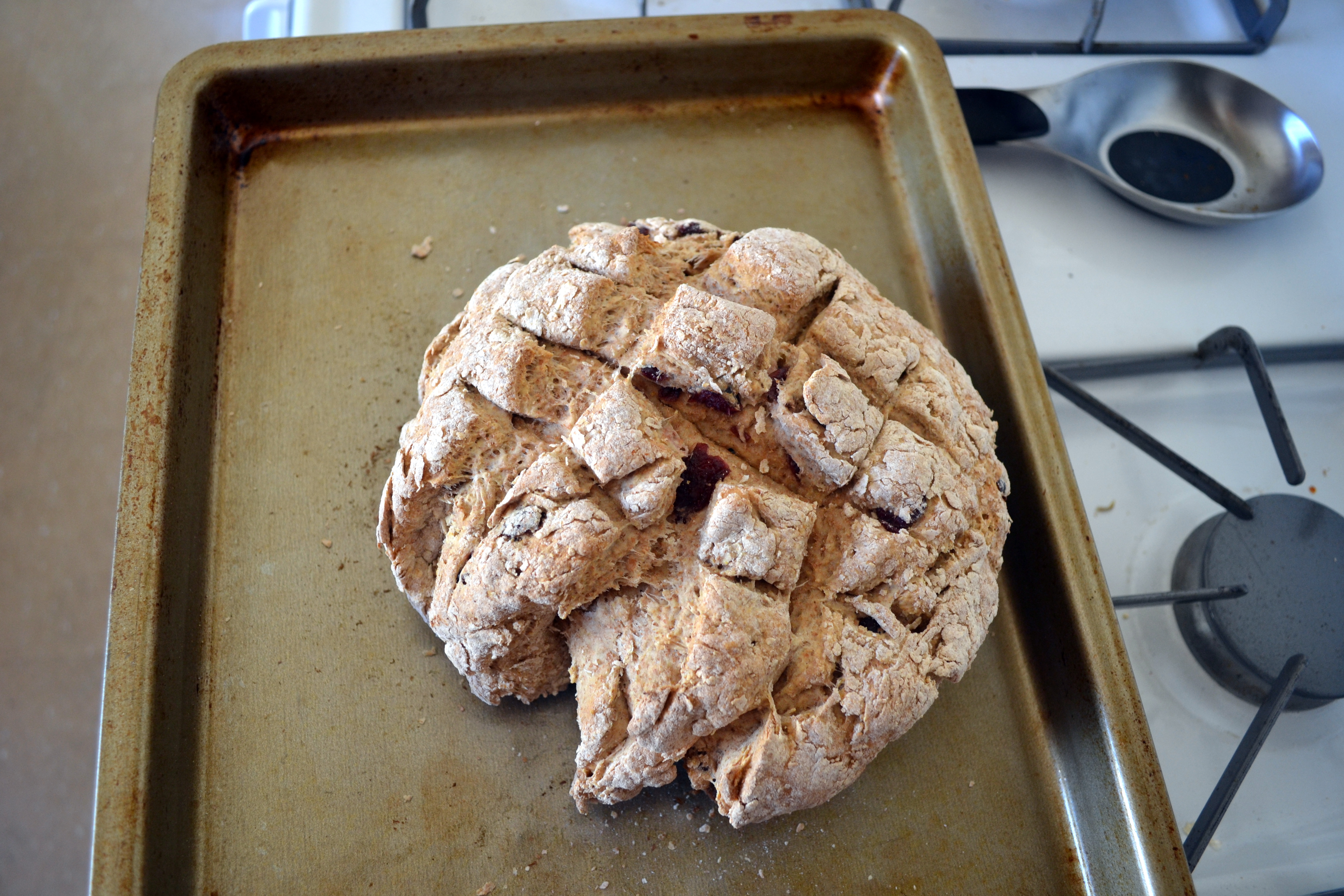
87. Combine 2 cups whole wheat flour with 2 cups white flour and 1 teaspoon each baking powder, baking soda and salt in a food processor. Pour in 1½ cups buttermilk or thin yogurt, and pulse until a ball is formed. Knead for a minute (fold in ½ cup raisins or currants if you like), shape into a round loaf, slash the top in a few places and bake on a greased sheet for about 45 minutes, or until the bottom sounds hollow when you thump it.

I’ve tried bread in the food processor before and it didn’t go very well (what does “when the dough is shaggy” mean anyway?), but I was willing to give this a shot.  It looked like a basic Irish soda bread recipe, and though I’ve never put that in the food processor, I have made it with success on multiple occasions.  So, I pulled down my food processor, opened my pantry, and collected

2 cups wheat flour

2 cups white flour

1 teaspoon baking powder

1 teaspoon baking soda

½ cup Greek yogurt whisked with 1 cup whole milk (I had neither buttermilk nor thin yogurt – this seemed like a happy medium)

½ cup craisins

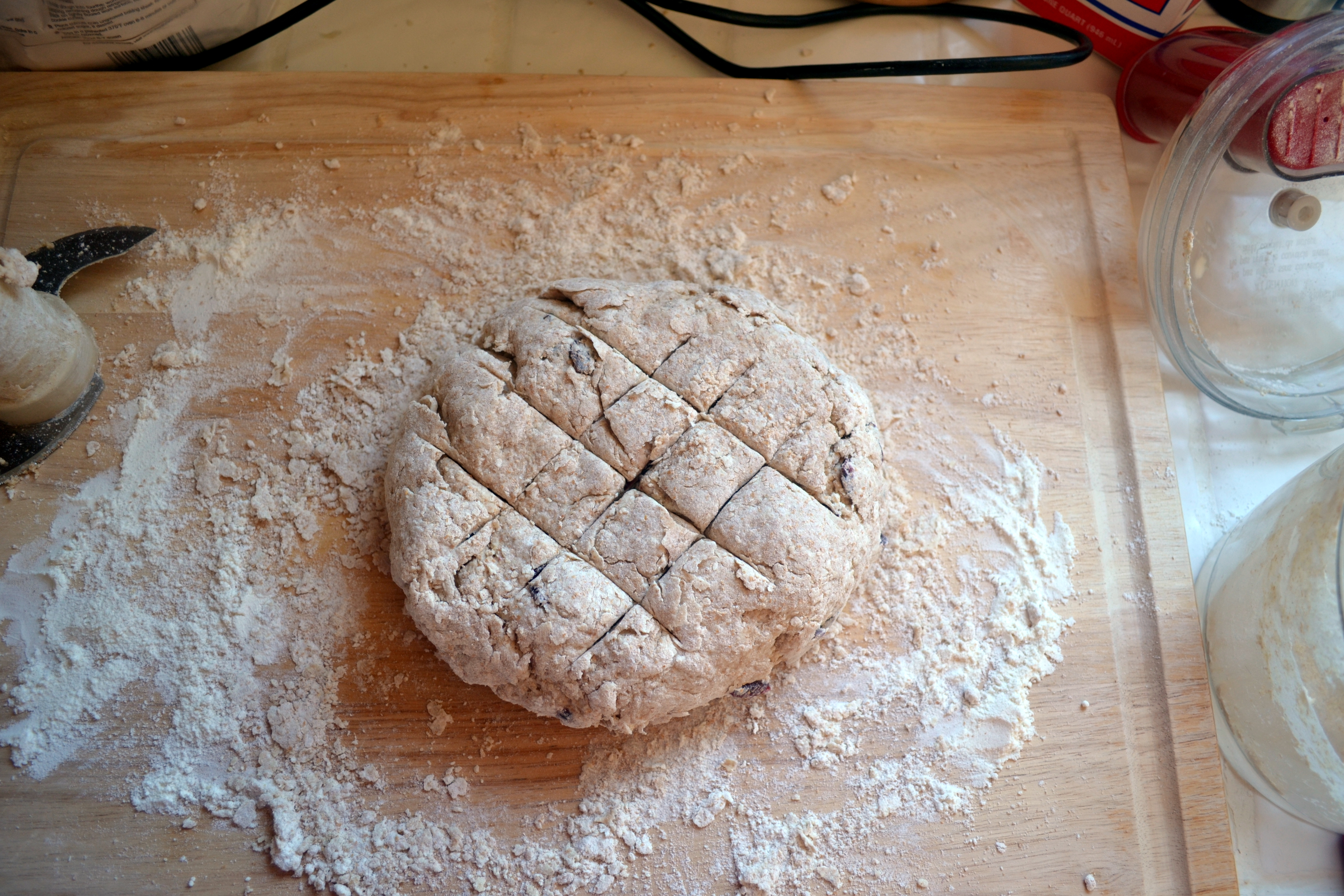
I followed Bittman’s directions to near disaster.  Either my food processor is too small, or this method isn’t all that reliable, because the dough never formed a ball.  Half of it just clumped into a solid mass in one side of the processor bowl and refused to budge.  I said some words in the quiet of my own brain and then held my breath while I tumbled the half-mixed contents out onto a floured board.

This is certainly not a ball.  But I sprinkled on half a cup of craisins and started kneading anyway, trying to ignore the hateful feel of dry dough on my hands.  After a minute or two I determined that things were just not coming together.

Flour-streaked hands reached into the refrigerator and pulled out the milk, dribbled a few tablespoons into a hollow in the dough, and tried again.  This time, things started to stick, to smooth, to pull into a ball.  I patched, I patted, I pushed and knuckled, and finally plopped one of the homeliest loaves ever made onto a greased baking sheet.  Slashed, scored, and enclosed in a warm oven, and I’d done all I could.

Bittman didn’t specify a temperature, but I estimated 375F and returned to grading papers for the better part of an hour.  The timer’s buzz 45 minutes later called me back to a crusty, mottled, flour-speckled loaf that sounded empty when I thumped the bottom, and smelled like humble sour sweetness.

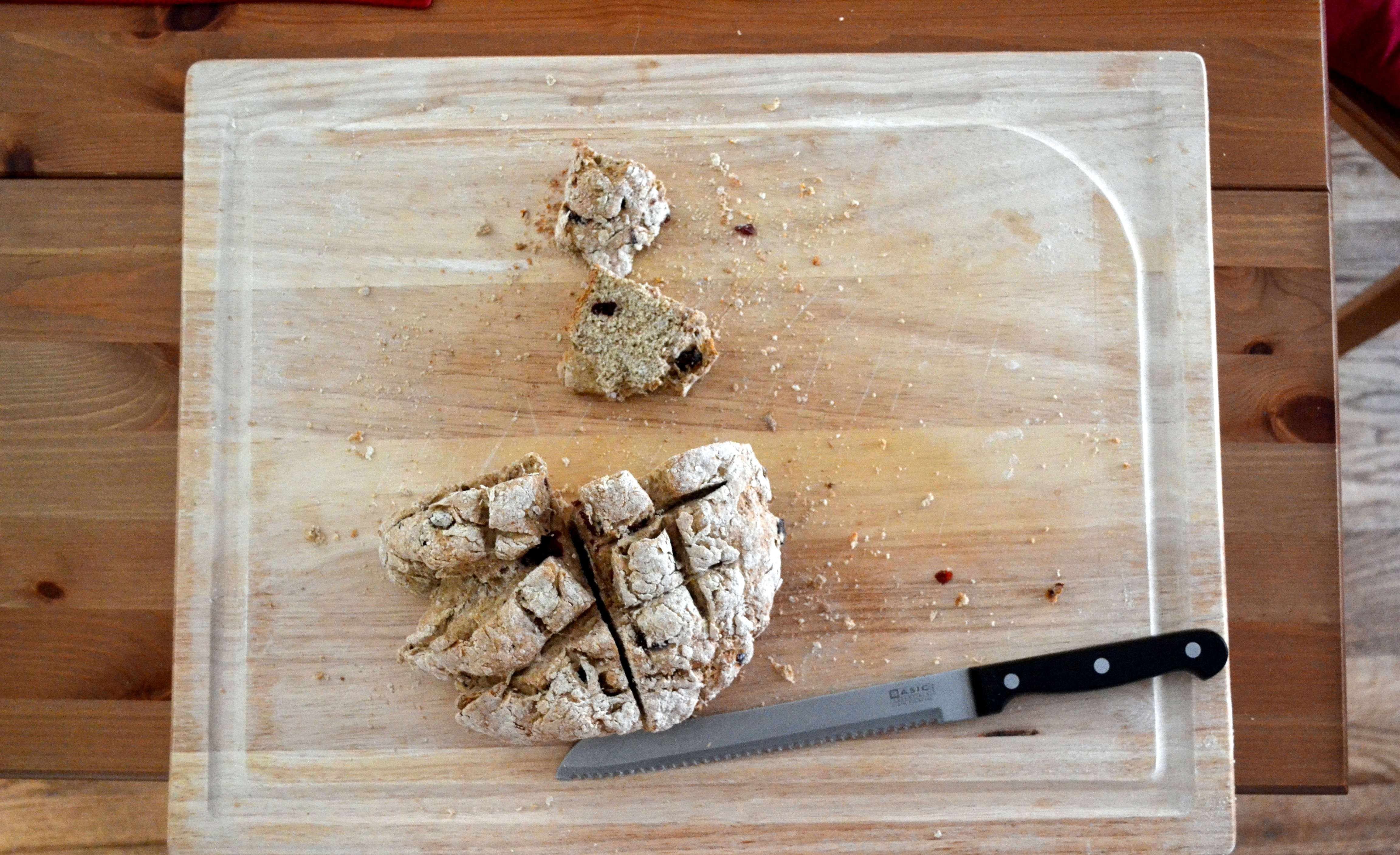
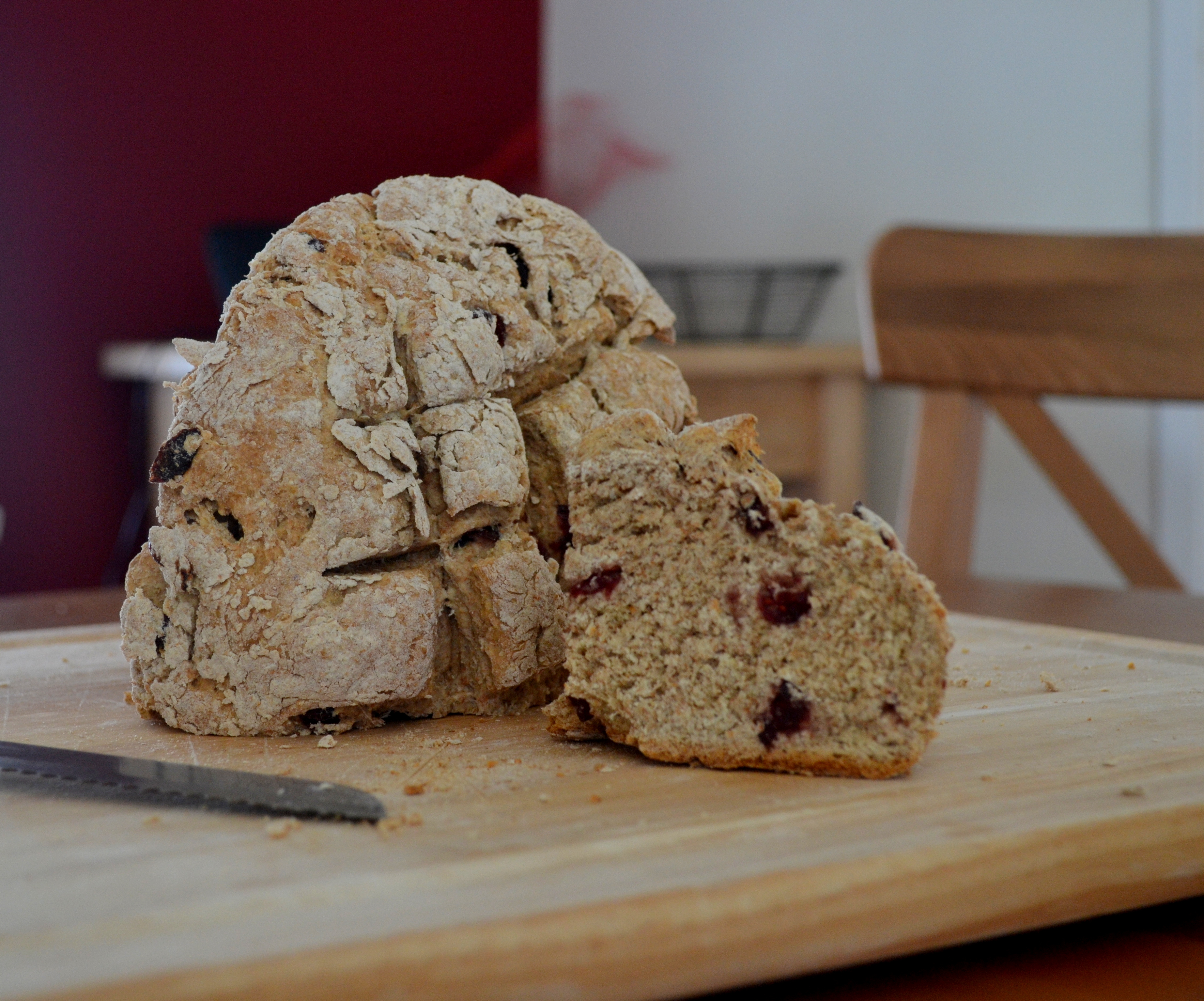
I waited a few hours to try some.  When I cut into it, my knife scraping through the crust and scattering crumbly bits across the board, the interior was dense and moist and still just warm.

It tasted good.  A bit heavy, from the whole wheat flour, and not suitable for eating in large chunks like the one I’d carved off for myself.  But the craisins added a welcome punch, and I think if I’d used all buttermilk instead of my odd mixture of milk and yogurt, the tang would have come through and broken some of the one-note density of the texture.  This would be good, I suspect, toasted and buttered, or maybe – if you’re the daring type – transformed into French toast.  It might also be good made with 3 cups of white and 1 cup of wheat flour, rather than equal parts.

Both N. and I have some Irish blood, and although it doesn’t show too often (unless you count his beard and my very occasional temper), by strange coincidence we ended up eating this bread as part of an accidentally, avant-garde-ly “Irish” dinner: pan fried gnocchi and sauteed cabbage.  Potatoes, cabbage, and Irish soda bread.  If only we’d had corned beef, I told N., and a horseradish sauce to moisten it.

But here’s the good news: smeared with cream cheese, the bread was tasty and chewy and wholesome, with bright pops of cranberry sweetness here and there.  Shallow fried in a mixture of butter and olive oil, the gnocchi were amazing.  Tongue searingly hot, their exteriors crisped and browned like the perfect roasted potato.  Their interiors remained soft and creamy and rich, but the contrast of crusty brown outside to creamy chewy perfection inside was unbelievable.  I could eat these every day.  I could eat them for every meal.  Fried and rolled, still blisteringly hot, in cinnamon sugar, I would scarf these for breakfast alongside a glass of milk like tiny churros.  Tossed with pesto or roasted red pepper sauce, I would gulp them for lunch.  Folded into a mornay sauce with too much extra cheese, I would sub these for pasta in a beautiful perversion of oven-baked macaroni and cheese.  And well salted and perhaps tossed in garlic powder or red pepper flakes, I would happily substitute these for popcorn during a movie.  I might be obsessed.

So with one Bittman down for the week and an intense regimen in store for the rest of the year, it turns out I’m more interested in fried potatoes.  And I’m tempted to ask: who wouldn’t be?  But then I wonder… is that just the Irish in me talking?

Starstruck

As I mentioned a few weeks ago, it hasn’t fully sunk in yet that I live in Los Angeles now. Funny little happenstances keep reminding me, and I’m stunned into bemused awareness. This didn’t happen when I lived in Orange County as a teenager. We were far enough from the big city with its food, music and fame scene, and I was distant enough in age to care, or even be aware of, what living near LA could mean.

Now that I’m a bit closer physically and chronologically, what it mostly means to me is food. Yesterday as I sat cloistered in my home office, commenting on what seemed like an endless stream of papers, my phone gave that delightfully insistent buzz that means someone from the outside world has contacted me. It was our friend J., asking if we wanted to go and grab burgers with him and one of his local friends. Dinner out? On a Friday? Meaning I wouldn’t have to tackle the embarrassing state of my kitchen just yet? Not to mention another culinary and – what would be the right word, perhaps libationary? – joyride around our new city? Yes, please.

J. showed up at our house around six and whisked us off to Plan Check Kitchen and Bar, a new-ish little burger and brew style gastropub in the Little Osaka area of West LA, where we would have dinner with him and his friend T. They have a short menu, mostly meat, but with interesting Asian flavor accents – wasabi, yuzu, and dashi creeping up in unexpected places.

I ordered the Bleuprint Burger, a patty of wagyu beef piled with smoked bleu cheese, brown sugar baked bacon they call, perfectly, “pig candy,” fried onions, roasted garlic steak sauce, and peppercress. My dining mates all got the standard: the Plan Check Burger, featuring a curious substance Plan Check calls “ketchup leather,” and a dashi-infused “Americanized” cheese, which I think meant cheddar mixed with garlic and some fish stock to smooth it out and add extra umami flavor. On the side, the table shared sweet potato fries cooked in beef tallow, served with a sweet peach ketchup, and veggie chips – perfectly crispy wafer thin slices of yam and yucca and who knows what else, paired with a slightly spicy, velvet smooth avocado cream.

Dinner was fantastic. I haven’t had a really good, moist burger cooked at an actual medium (the temperature I requested) in a long time. I drank a tangerine wheat beer with it (the name of the brewery escapes me, but somewhere in California), and it was a nice accompaniment.

While I was away from the table for a moment, somehow the conversation changed from food to, well, food. But virtual food. In fact, televised food. T., through a previous job, knows one of the guys from the company and food truck project Seoul Sausage, currently being featured on The Great Food Truck Race.

“I think they are opening a storefront,” he said, while my eyes bugged out of my head. “It’s just on Mississippi. We should go see if they’re open.”

Bye-bye, burger.  It’s sausage time.

We ambled the blocks along Sawtelle separating us from Mississippi. T. pointed out which restaurants along the way were worth checking out which, as it turns out, is most of them. I tried to make mental notes but I was feeling overwhelmed by the amount of delicious knowledge I was receiving. N. and I will just have to go back. Many times.

We turned the corner onto Mississippi and there, at the end of a short collection of shops, was Seoul Sausage Co. And it was open. Without knowing it, we had stumbled across a secret mini launch they had announced only on their website and on Twitter, and there were all three of the boys behind the counter, and suddenly I was being introduced and ordering one of the flaming fried balls they developed on the show.

I know I should be talking about the food here, but I was so starstruck I couldn’t stop grinning my way around the little space. The guys were, as I had imagined but never even hoped to find out, super friendly and happy to see us – and everyone else who stopped in – and being very properly and apologetically closed-mouthed about the results of the show (the finale is tomorrow – Sunday, at 9pm). N. chatted them up about beer, encouraging them to carry Ninkasi if it ever appeared on their radars. I couldn’t help but mumble something about how I hoped they would/had/did/whatever-it-is-taped-tv-is-so-confusing win before I gave into the beautiful, sizzling-hot fried riceball they handed me.

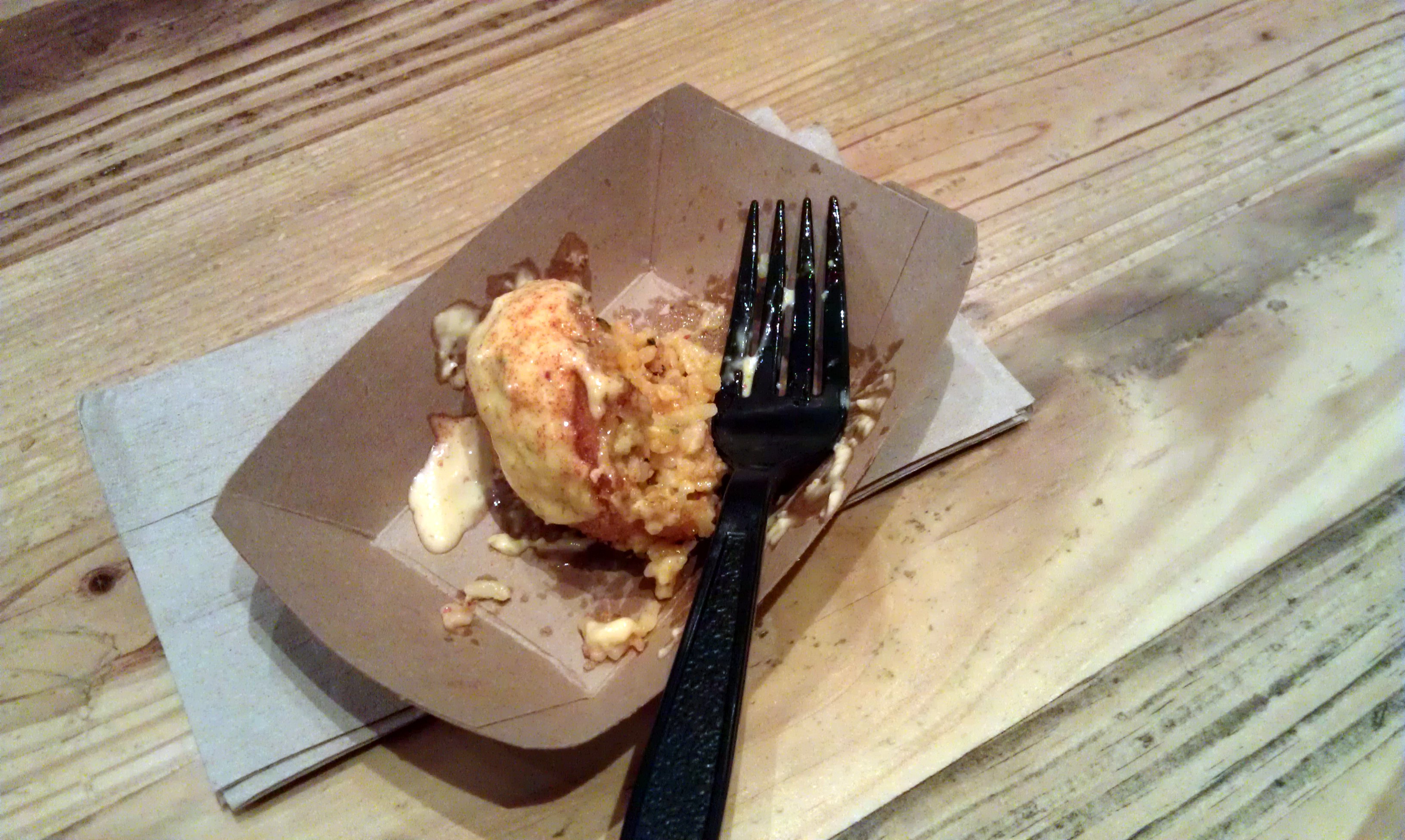
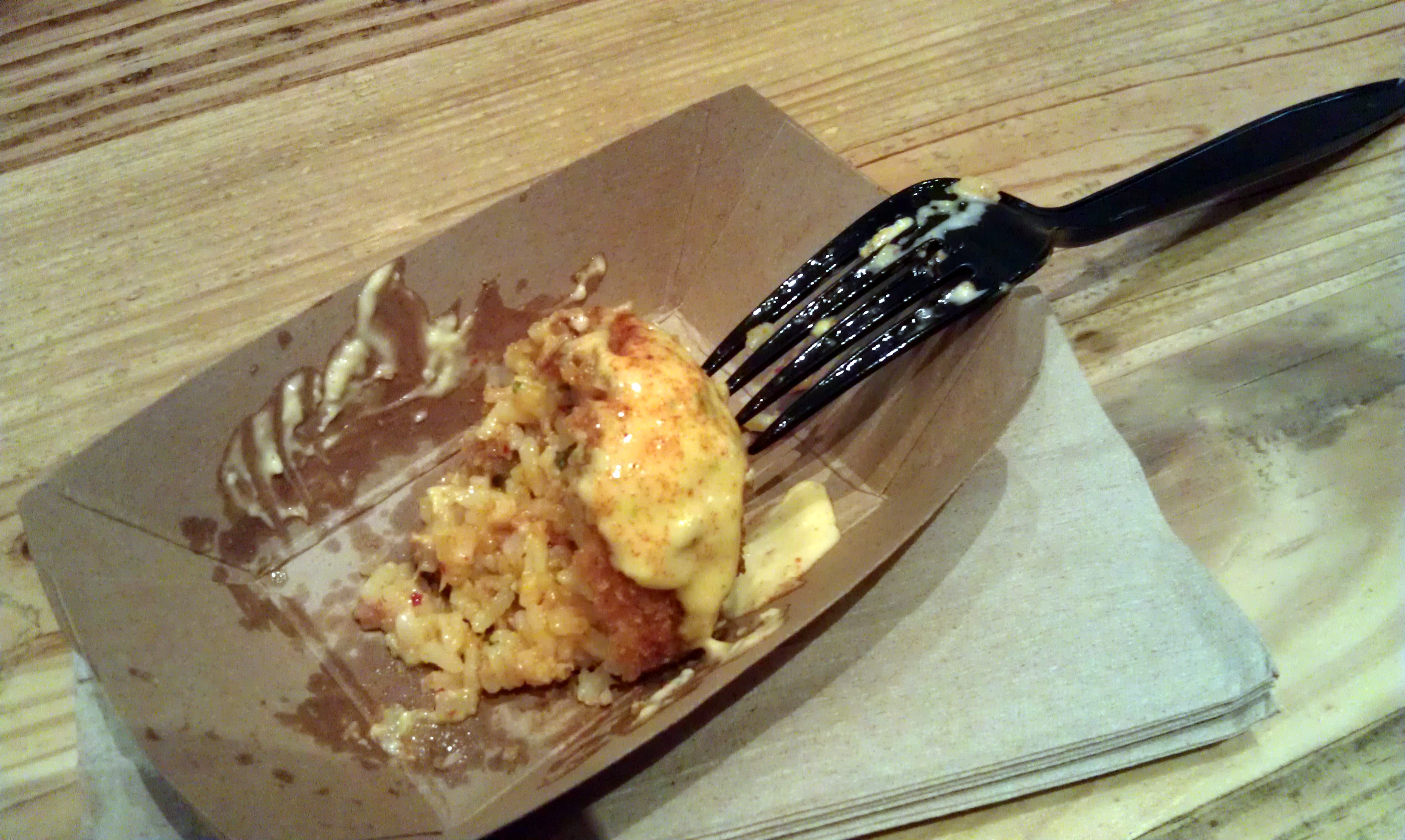
It was delightful. Delicate rice in the middle mixed with cheese, spices, and who knows what else. Crisp breaded crust around the outside, and a slightly spicy sauce squeezed over the top. It reminded me of the kind of sauce you get on certain spicy sushi rolls, and it paired so nicely with the rice. This is an excellent late night snack, and N. and I assured them we would be back again after their official opening next week. I was halfway through my little after-dinner snack before I remember that, despite my unwise choice to venture out on a Los Angeles food adventure without my camera, I do have a smart phone fully capable of capturing an image.

Flaming fried balls conquered, and me still in some disbelief that we had just been to Seoul Sausage and met the guys in charge (I wanted to know everything but asked nothing: what was Tyler Florence like? Were you getting all those truck stop phone calls at once, or did he call each truck one at a time? What did you think of Nonna’s Kitchenette? Did you win? Did you win? Did you win?) we stepped back out into the night (which we were surprised to learn was still so young – only 8pm yet) and resurfaced at the Formosa Café in West Hollywood to share a round of drinks. I asked for a lemon drop, but the bartender mixed me a vodka daisy instead because he likes the flavor better, and so did I. Vodka daisy with a sugared rim is apparently my new cocktail of choice.

As we belted ourselves into J.’s car again, he asked if we minded swinging by Canter’s delicatessen on Fairfax. He wanted a pastrami sandwich for the road back to Orange County, and of course we obliged. Once inside, I was attracted not to the sandwiches, but to the bakery counter, where my taste buds immediately performed their own version of the honey bee’s waggle dance to communicate a single word: éclair. N. wandered up behind me and asked if I was going to get anything, and as I gazed at the shelves packed with donuts, cookies, babka, danishes, chocolate studded croissants, cheesecakes, a big layer cake with the word “rum” frosted in chocolate across the top, all I could think about was an éclair.

And there they were. On the bottom shelf. Thick, ganache-glossed masterpieces. My eyes were bugging out again, I could feel it. With my new little treasure safely enclosed in a pink bakery box and tucked under my arm, all was right with the world. When I dug in, gentle fork pressure forcing the thick, sweet pastry cream out across my plate, the world was more than right. The dough was tender-crisp, and if I’m honest it may have been moving a bit toward staleness after a day on the shelf, but the flavor of the custard and the ganache more than made up for it. It was a stellar dessert for a starstruck evening.

Bars and Biscuits

Thyme for our herbed biscuits

Last week’s reflections were a bit morose: the thoughts of a person overwhelmed and trying to settle into some kind of groove.  Because while too deep grooves can become ruts, no groove at all just leaves us… squares in a hipster-filled world?  Not just squares, but squares tipping and zig-zagging confusedly over an unfamiliar landscape trying to dig a corner in here and there.  New home, new job, new routine, and no chances to explore yet.

All that has changed.  Shallow wheel marks dig in behind us.  Our adventures have begun, and they began (don’t be offended) with booze.

Last Friday, our dear friend J. appeared at the door, bearing duty-free Japanese whiskey from his time in Tokyo, and a phone full of bar recommendations from an associate.  After a quick tour of our new digs (you guys have a backyard?!), we set off into the night and ended up at Oldfield’s Liquor Room on Venice, where J. bought me a pre-birthday cocktail called the Blonde Comet.  Bourbon, crème de peach, fresh grapefruit juice, and angostura bitters.  I’m not much of a bourbon gal, but the name was too good to pass up.  I like to think of myself as something of a blonde comet every once in a while… The drink was tasty.  Strong, but tempered by the freshness of the grapefruit and the stem of fresh mint they plunged in as a garnish.

We caught up over this first round and then decided to explore further.  A quick amble down the street brought us to Bigfoot West, but it was so crowded and loud inside that not even the promise of creative whiskey cocktails could entice us.  We were back in J.’s car and rolling toward Santa Monica.

We ended up at The Daily Pint, where it smelled like peat and old shoes and yeast, and the impressive chalkboards full of beer options and the seemingly endless whiskey and scotch menu made J.’s and N.’s eyes shine suspiciously.  I got (don’t laugh) a pint of Spiced Caramel Apple Ale that was neither as sweet nor as fruity as it sounds.  J. and N. got something peaty and boggy and fiery, and I only needed a whiff to know I wasn’t interested.  We settled ourselves in at a tall table next to the pool and shuffleboard stations.  You must know this: I don’t like beer.  When I have to, I will settle for the fruitiest, sweetest, most un-beer-like option I can find, and when I do, I like it to be ice cold so it doesn’t have a chance to taste as much like beer as I know it’s going to.  As we sat and chatted and laughed, time passed and my beer warmed.  Where it tasted like yeast and carbonation to begin with, as it came to room temperature the flavors got rounder and deeper, and by the time I was sipping the last half inch or so in the glass it did have some spicy apple flavors to it.  I’m not sure I would order it again, but it wasn’t a bad beer, and the company and high energy atmosphere made it a good experiment.

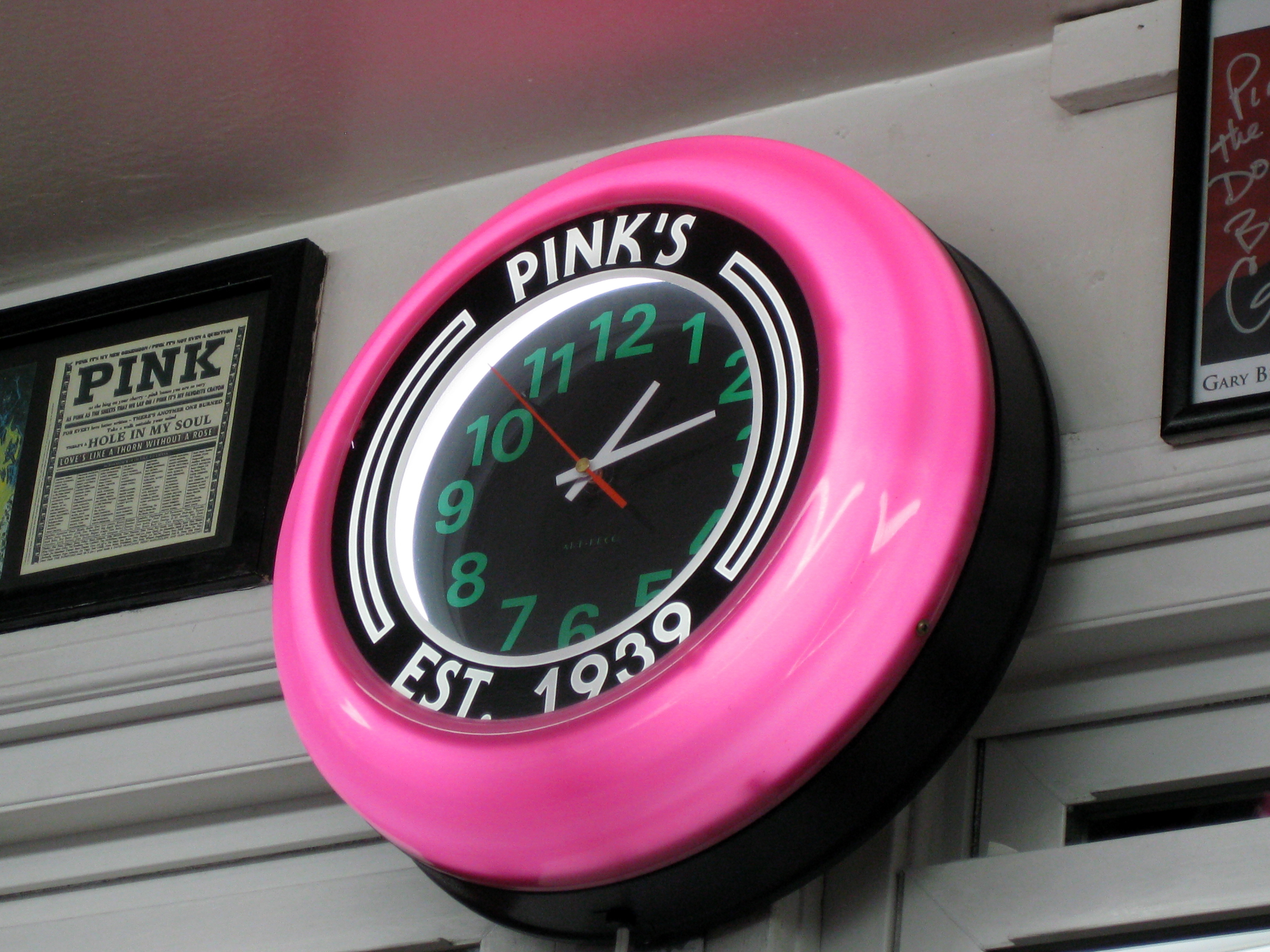
It was almost midnight when J. asked if we wanted a snack.  He was thinking, he said, hot dogs or pastrami.  I’ve been experiencing some cognitive dissonance when it comes to our new location – scoffing when I see patrol cars that say LAPD on the side: what are we, in a movie or something? – grinning with disbelief as I pass Warner Brothers studios on my drive home from work – but something about that night made me remember where we were.  I just knew he was thinking of Pink’s.  Did I want to go to the little stand with the most famous hot dogs in the state?  Yes.  Yes I did.

At almost 1am, as my contacts screamed and the almost-responsible-adult inside me withered and gave up, we were standing in line with at least 30 other people, waiting for a hot dog. 


I got a New York dog – traditional hot dog topped with a sweet onion sauce – and added shredded cheddar cheese.  N. and J. got Chicago dogs, loaded with lettuce, tomato, and pickle.  We sat at a crooked little table and took in the space: dozens upon dozens of signed celebrity photographs who had visited Pink’s, some of whom had given their names to a hot dog.


Well, N. and J. took in the space.  I took in my hot dog.  It was fantastic.  The skin was taut and crisp and snapped between my teeth.  The onion sauce was thick and sweet with hints of caramel, like the best sweet and sour sauce you’ve ever tasted, and the cheese, though it could have been melted more, added a nice mellow counterpoint to the meat and the sauce.  Delicious.  And it made me feel like a kid: I was back to the nights in high school when, after band competitions, we used to go to Denny’s and order chili cheese fries and chocolate milkshakes.  Those were the days before we knew heartburn was real…

There really is no logical transition I can make to this week’s Bittman, aside from the lame play on the White Stripes song I provided as the title of this post, so let’s stop pretending and just talk about biscuits.  And let’s not take our sweet little time about it.

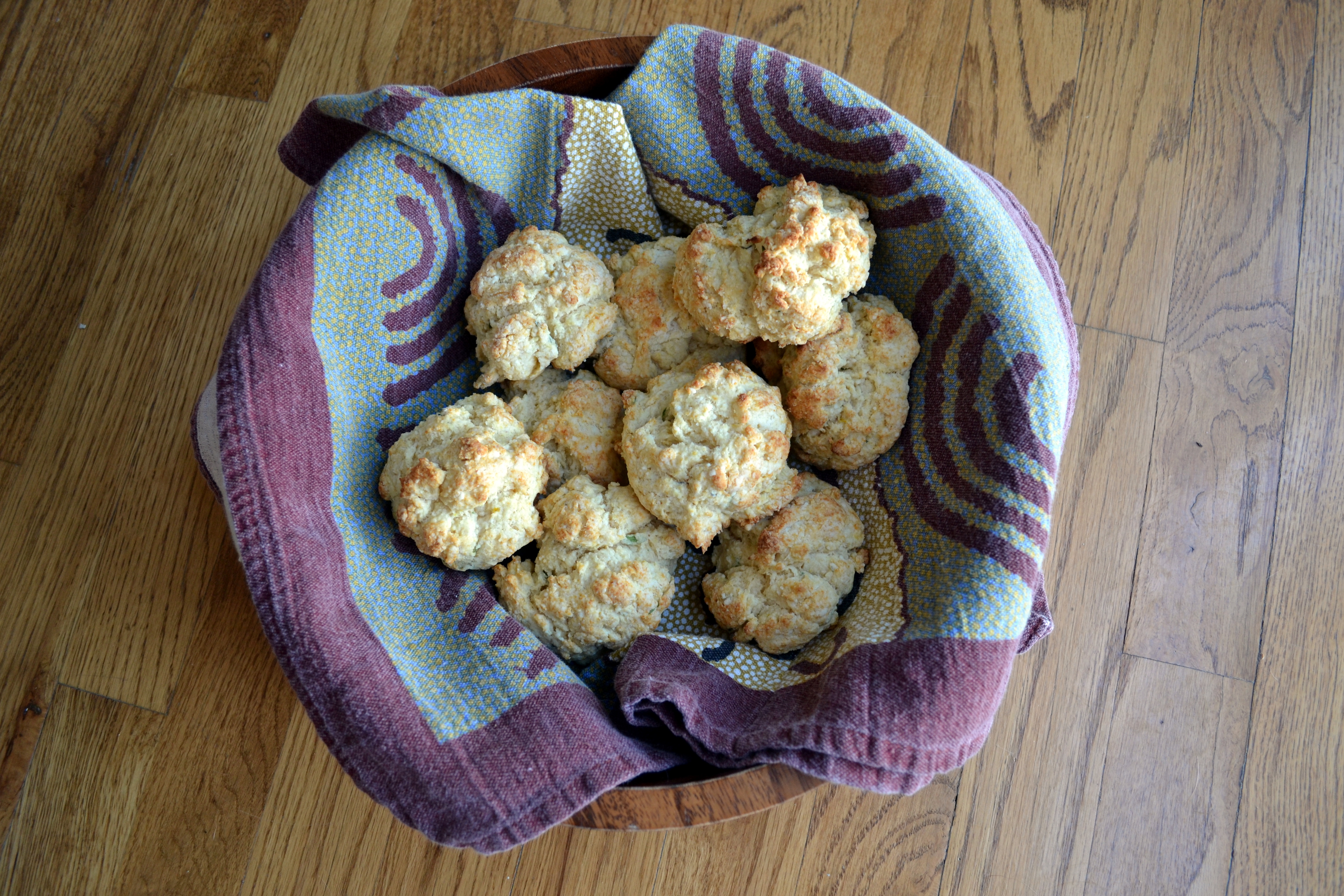
85. Herbed Buttermilk Biscuits: Combine 3 cups flour, 2 tablespoons sugar, 4 teaspoons baking powder, 1 teaspoon salt, 1 teaspoon baking soda and 1 tablespoon thyme leaves.  Use your fingers to rub in 1 ½ sticks of butter until the mixture resembles small peas.  Add 1 cup buttermilk and stir until just combined.  Drop large spoonfuls onto a baking sheet and bake at 425 degrees until golden, about 15 minutes. 

With measurements and oven temp clearly provided, I had very little to guess about or change in this recipe.  Because I was using lemon in other parts of dinner, I decided on the spur of the moment to add a teaspoon or two of lemon zest to the dough to see what would happen.  You could probably change up the herb used, add cracked black pepper or flaky sea salt, or even add finely chopped raisins.  I wouldn’t change the buttermilk, though, as the tang it adds is entirely necessary.  I even got excited tasting the raw dough, with a slight crunch from the salt and a suggestion of sweetness from the tiny bit of sugar.

The bowl of dough produced 15 biscuits.  I put nine on my greased baking tray and the other 6 on a plastic-wrap-lined plate in the freezer for another occasion.  After 15 minutes in the oven, they were browned on top, slightly crunchy around the outsides, and knee-waveringly fluffy inside.  Quash your fears about the amount of butter here: it really makes a worthwhile textural difference.  It doesn’t hurt the flavor either – these were rich but light, and the buttermilk and lemon zest added intriguing sourness that brightened the mixture and made them more interesting than your standard dinner biscuit.

We ate these – no, that’s not right – we wolfed them down alongside grilled chicken sausages and grilled planks of zucchini wrapped around a mixture of goat cheese, lemon juice, thyme, parsley, and pepper.

It was delightful.  And here’s the delicious secret: if you end up with some leftover goat cheese mixture, and you whip in some honey, and then if you happen to split one of those fluffy delightful biscuits down the middle and perhaps toast the open sides in a toaster oven or under the broiler for a moment, and dollop a hefty tablespoon of the sweetened goat cheese on top, and eat it, you have the most delightful little end-of-summer breakfast biscuit you’ve had in years.  And if you’d been out late the night before and perhaps chased some whiskey with a hot dog, a sprinkle of extra salt in the goat cheese filling would make this a quite decent hangover breakfast too, as a cure for excessive adventuring.

Next week we settle more comfortably into this lovely little groove we’re making for ourselves: another restaurant, another Bittman, another decade(!), of our new little lives.

Emptying the Fridge III: Crack(er)ing the Code

Last week I told you about my favorite new dip.  White beans, toasted almonds, the piney sharpness of rosemary, the heady perfume of orange zest… and promised to provide a vessel on which to deliver this deliciousness to your eager taste buds.  N. and I discovered shortly after my first foray into this creamy blend of balanced spice that the ideal vehicle for consumption was not in fact a spoon, but the best crackers ever: Trader Joe’s Raisin Rosemary Crisps.  In fact, these are good not just as a vehicle, but a snack in their own right.  Every time I went to the pantry to retrieve a few for dip spreading, I’d find them gone, thanks to N.’s voracious nibbling.

I wondered at one point, as I broke down yet another cracker box for recycling, how difficult they would be to make myself.  I’ve never made crackers before, but looking at the list of ingredients – sunflower seeds, millet, raisins, baking soda – it seemed doable, and further, thanks to the kind of collection that happens in established kitchens, when you don’t remember why you have something like toasted millet or roasted ground flaxseed but you just do, I had every single dry ingredient in my pantry, waiting to be used up so they didn’t have to make the move to California.  On that door dividing me from opportunity, he was pounding with a brass knocker.

So I set about experimenting, and today I can offer you not one, but two ways of making these crackers yourself.  They aren’t perfect replicas.  They will always be discernable as imitations.  But they are delicious, and they are pretty darn close.  Only a thinner knife, a bit of whole wheat flour, and patience, I suspect, separates them…

Here’s what you need:

1 ½ cups all-purpose flour

½ cup whole wheat flour (the first time I made these, I used equal parts AP and WW flour, and the result was a bit heavy.  Using 2 cups AP instead of adding the WW would probably make the crackers even lighter, and the TJ’s ingredient list doesn’t contain WW flour at all)

1 tsp baking soda

¾ tsp coarse sea salt (I used Maldon, with which I have a deep love affair)

2 TB roasted, ground flax (if you have whole flaxseeds, use them!  Just toast them in a dry pan until fragrant and beginning to darken, and whiz them in a spice grinder, or your husband’s coffee grinder, if that’s the machinery you happen to have)

1/3 cup millet

½ cup sunflower seeds, toasted or not, salted or not, just use what you can find

¼ cup brown sugar

1 TB finely chopped dried rosemary (again the spice grinder works really well for this – chopping dried rosemary with a knife is an exercise in absurdity: it flies everywhere)

½ cup craisins

¾ cup buttermilk

Whisk together all ingredients except buttermilk until seeds, nuts, and fruit are evenly distributed.

Add buttermilk and cut in with a fork or pastry blender until dough starts to lump together.  It will be roughly the consistency of biscuit or Irish soda bread dough.  At this point, switch to your hands (the best tools, really, aren’t they?) and knead the dough for three minutes or so, until it all comes together and becomes a bit less shaggy.  You can either dump the mixture onto a lightly floured board to knead it, or you can be lazy like me and knead it in the bowl.

At this point, you have a choice.  If you want flat, rectangular crackers like Ry-Krisp or Stone Ground Wheat, roll out your dough into a big thin rectangle (1/8 inch thick or even less, if you can) and cut gridlines along your dough with a pizza cutter.  Create whatever size squares, rectangles, trapezoids, or polyhedrons you desire, then place them close (but not quite touching) together on a baking sheet lined with parchment paper or sprayed with non-stick spray.  Slide them into a preheated 300F oven for 45 minutes.  You’ll end up with crunchy crackers with the slightest bit of give in the center, evenly colored with a dense crumb.  They are a little like miniature flatbreads. 

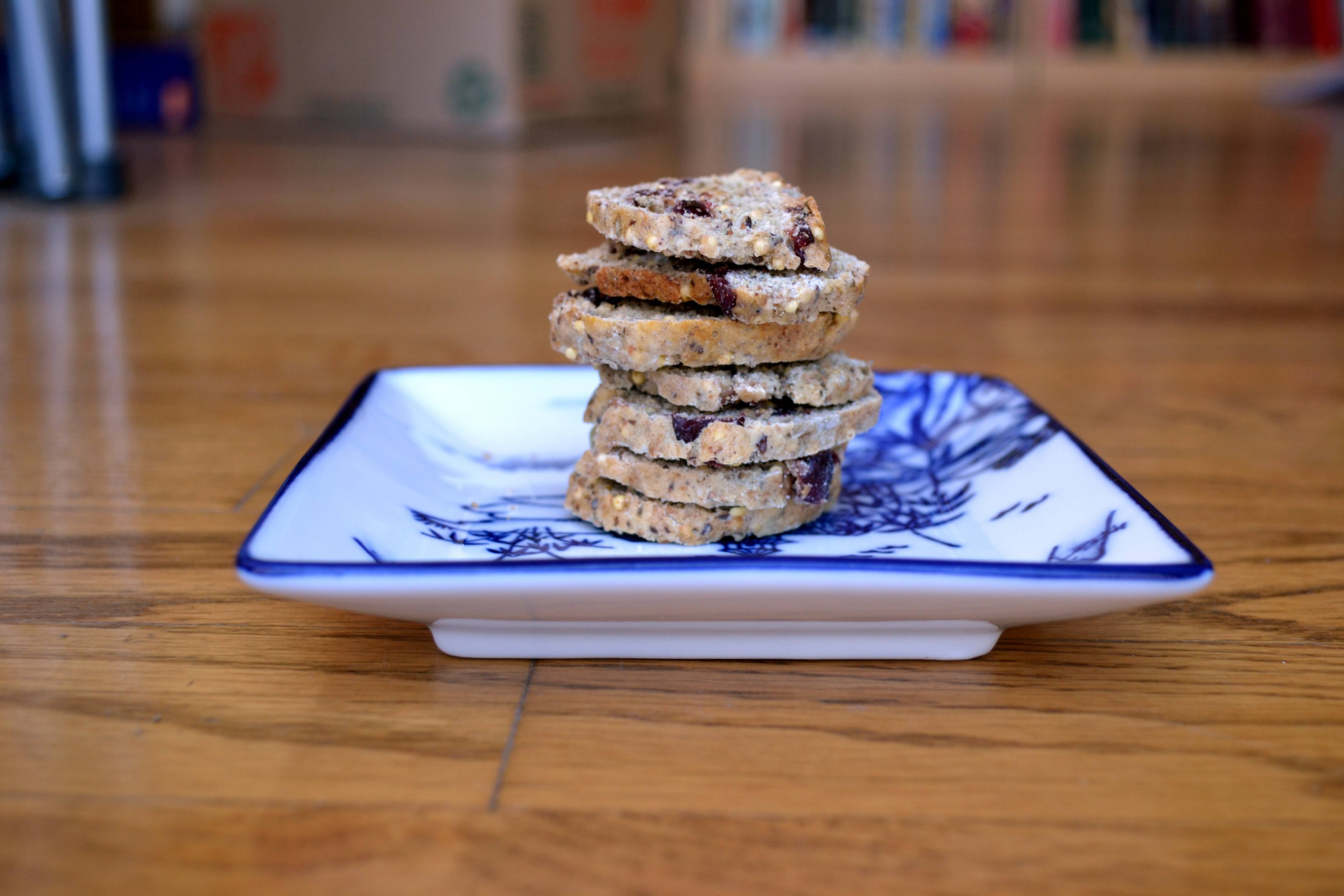
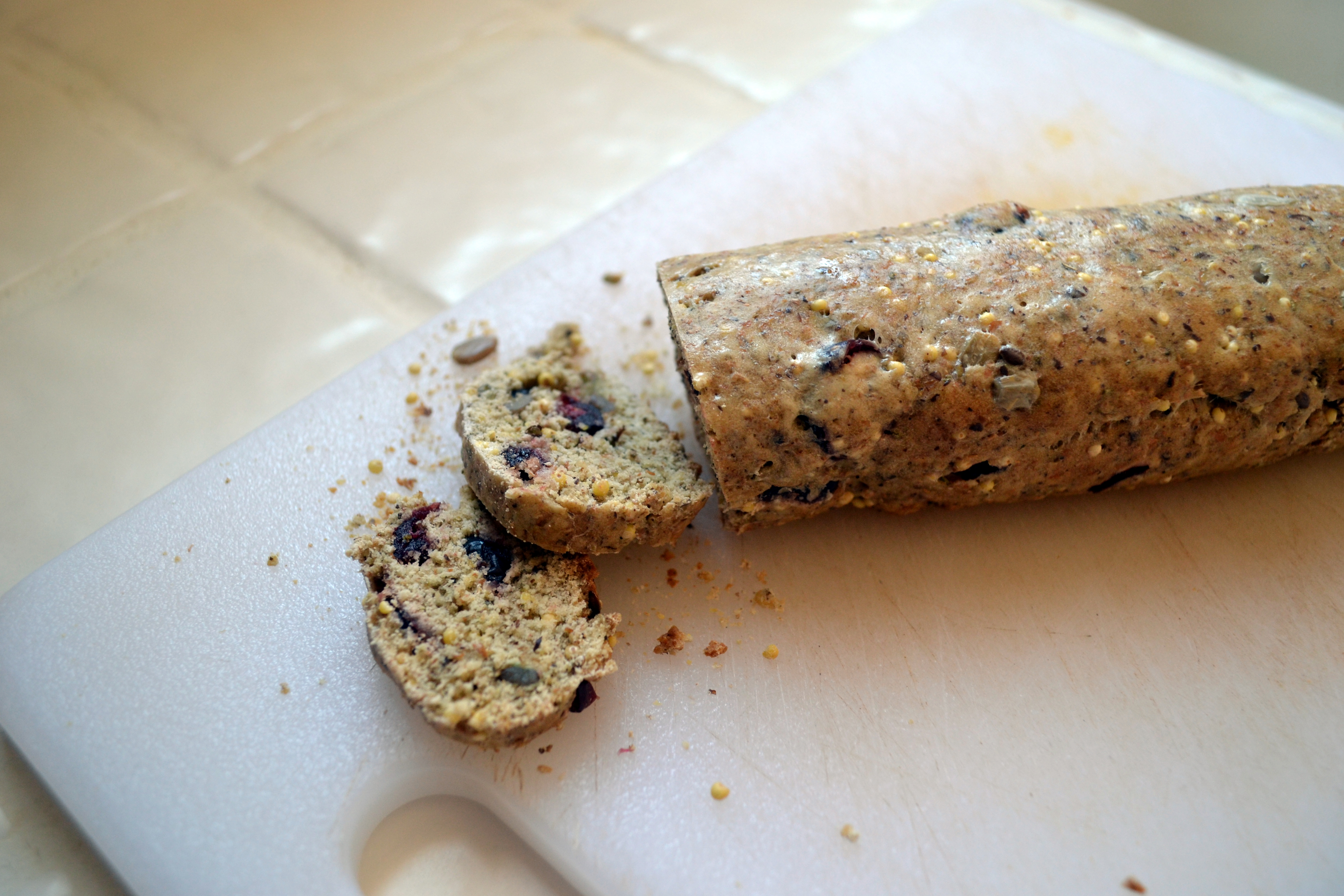
If you want slightly lighter crisps with a darker “crust” perimeter and a sprightly, Panko-like crunch, there is only one inspiration to which you can look: biscotti.  I liked the flat crackers.  I did.  They were tasty, they were good with the dip, and they were relatively quick: roll, cut, bake, done.  But they weren’t the ephemeral cracker experience I was after.

If you’re going the biscotti route, once the dough is kneaded together well, divide it in thirds.  Instead of rolling it out on a board, roll it into a long, thin “worm” of dough on some plastic wrap.  Press, squeeze, and moosh it into a log of even thickness, using the plastic wrap to help you.  Wrap up securely in the plastic, then pop it into the fridge.  Repeat with the other sections of dough, each in their own piece of plastic wrap.  Refrigerate for at least three hours (my trusty biscotti recipe from which I estimated times and temperatures says you can leave them in the fridge for up to three days). 

When you are ready to bake, take the worm/logs out of the fridge and unwrap.  Leaving them sitting on the open plastic wrap, paint them lightly with buttermilk to encourage browning.  You could probably paint them with egg wash too, but the TJ’s box doesn’t list egg as one of its ingredients… Carefully move the buttermilked logs to a baking sheet, then place in a preheated 325F oven for 30-40 minutes, or until the tops have swelled and are lightly golden.  Let them cool completely. 

You will find when you move your logs that the bottoms are browner than the tops.  I am toying with the idea of slowly rolling these logs as they bake so that each side comes in contact with the metal of the baking sheet for ten minutes or so during the baking.  This might make the finished logs a bit more rectangular (and hence capable of producing square crackers), and it might make each edge evenly brown.  Let me know if you try it out, and I’ll do likewise.

When the logs are cool, carefully cut them into thin slices with a serrated knife.  Some of mine crumbled a bit, especially when there were craisins at the edges of the log, but that just meant more sample scraps.  My ideal would be 1/8 inch thick or even thinner, if you can manage it.  But really, what you want here are crackers of the thickness you want to bite into.

Position your slices on a baking tray in a single layer (it’s fine if they touch each other, as long as they aren’t in layers) and bake in a preheated 300F oven for about 20 minutes.  The edges will bronze a bit deeper, and the centers will flush golden brown.  They won’t feel quite crunchy yet, but take them out anyway: much of the crisping happens as the crackers cool.

In an hour or so, when they are cool and crisp, I recommend you slather them with my almond white bean dip, or maybe a thick slice of rich brie, or some sharp, tangy goat cheese, and consume.  They are deep and toasty in flavor, the nuts and seeds lend appealing texture and different kinds of crunch, and they are just barely sweet from the brown sugar and the craisins.  I like the switch to cranberries as the fruit source, because they pair so nicely with the orange zest in my dip, but also because their uncompromising tartness makes these crackers interesting enough to eat all on their own.  Enjoy!