Trick or Treat

Halloween is easily in my top three holidays.  I have to give the prize to Christmas, because it means family and love and sweaters, but Thanksgiving and Halloween chase each other in circles to gain second place.  Despite that love (overwhelming in some cases, especially if you, like N., are not invested in costuming yourself at every possible occasion), this is the first year in almost a decade that I’ve done nothing to celebrate.  No costume.  No party.  No decorations.  We bought candy for the six kids that showed up (only six!  The whole evening!  Was it just because it was a Wednesday, or do kids not trick or treat like they once did?) and I definitely listened to the Halloween party mix my friend D. made for me a few years ago, but it felt a bit like a lost holiday.

I did embrace the season, though, the following day.  Having Thursdays off gave me the opportunity to do something I’ve been wanting to do for years: pillage Target’s day after Halloween sale for leftover clearance items (read: treats!).

The tricks began when I began work on the evening’s dinner.  It was, I realize in retrospect, a bit of a Chopped style enterprise: appetizer, entree, and dessert, each made with ingredients I’d not expected to meld.  In each case, however, the “trick” aspect of the dish was my doing, not the recipe’s.

“12. Garlic-Rosemary Figs: Soak dried figs, stems removed, in warm water until plump; drain and halve. Heat rosemary and lightly smashed (and peeled) garlic with olive oil on medium-low heat, until softened. Add figs, along with some fresh orange juice. Cook until saucy.

Pairing figs, garlic, and orange juice seemed odd.  Nevertheless, I collected enough for one portion (this was not N.’s kind of dish):

6 dried black mission figs

1-2 tsp fresh rosemary

2 smashed, peeled garlic cloves

1 TB olive oil

juice from 1 small orange (⅓ – ½ cup juice)

I heated some water in my teakettle and poured it over the figs (which I’d halved prematurely.  Apparently paying attention to the directions is kind of important), which I let stew on the counter for half an hour.

Figs vaguely plumped, I drained them and set them aside, then put the garlic cloves, rosemary, and oil into a cold pan.  I heated it over medium for five minutes or so – just until the rosemary started to sizzle and the garlic turned a little blonde.  Then I added the figs and orange juice, and simmered for fifteen minutes or so, until the orange juice had reduced considerably.

I plated, I ate, and I considered.  This didn’t taste bad, but it didn’t marry absurdly well either.  The rosemary and the figs were lovely.  The orange juice and figs were fine (though the orange was a bit overpowering).  The garlic and figs were… unobjectionable.  They just weren’t my favorite.

I must say, though, I recalled while I was cleaning up after dinner that this entry was in the “Sauces and Relishes” category.  I had eaten it straight.  This was, perhaps, why I wasn’t enamored of it.  Therefore, I’d recommend spooning this over lamb chops, or pork tenderloin, either of which would add some savory notes to make the garlic feel less anomalous.

Though this “appetizer” wasn’t fantastic, I ate it with a fantastic grain-salad-turned-hash inspired by Smitten Kitchen.  I want to revisit this hash, because I think it could use some additions, but here are the basics:

Line a baking sheet with aluminum foil.  Set it in the oven and preheat to 400F.  Yes, you are preheating the pan along with the oven.

Peel and halve a butternut squash.  Seed half of it and cut that half into small cubes.  In a bowl, toss the cubes with salt, pepper, and olive oil, then tumble onto the baking sheet (where they will sizzle immediately – this is a good thing) and stow back in the oven for 35-45 minutes, or until they have golden edges and creamy soft middles. 

During the last ten minutes of squash roasting, push the squash to the sides of the pan (or just grab another pan, if you aren’t invested in avoiding dishes, like me) and stack 4 cups or so of trimmed, cut kale that has also been tossed in olive oil, salt, and pepper.  The kale and squash will cook down a little more together, and you will be left with something not quite like kale chips, but a bit more textured than if you’d boiled or steamed it.

While the squash and kale roast, cook 1 cup of bulgur wheat in chicken (or vegetable) broth.  When done, fluff gently with a fork and toss with squash and kale.

During the last few minutes of roasting time, toast 2 TB pumpkin seeds in a dry pan until they begin to snap and crack.*  Be careful not to burn them.  Toss with bulgur and vegetable mixture.

In the pumpkin seed pan (again, avoiding dishes), heat an egregious quantity of butter until foamy and crack in an egg to fry until the edges frizzle and brown and crackle.  Despite a few careful taps, on this egg of all eggs – the egg I wanted to photograph quivering atop my hash, the egg I wanted to show just cut and lusciously runny – I somehow shoved my thumb through the yolk and it broke all over the pan.  Nasty trick, egg.

Nevertheless, I piled my hash up on my plate, carefully laid the fried egg over it, and dug in.  It was a hearty, pretty, perfectly autumnal dish.  It needs some tweaking before I’m thrilled with it – perhaps some sautéed leeks folded into the bulgur, or some light spices on the butternut squash – but this was a delightful start.

I turned to dessert:

“96. Sweet Autumn Gratin: Combine cubed pumpkin or sweet potato with cranberries and hazelnuts in a buttered baking dish. Sprinkle with brown sugar and toss. Drizzle cream all over, dot with butter and bake until soft, bubbly and browned, 50 to 60 minutes. Re-warm before serving if you like.

I’m going to give you a list not of my ingredients and procedure, but of what I should have used and done.

1 big sweet potato, peeled and diced

½ cup dried cranberries (I didn’t have fresh, so I don’t know what they would be like.  Presumably more successful because they would emit, not swallow, liquid)

½ cup walnuts, coarsely chopped (I couldn’t find hazelnuts anywhere – who would have thought this would be the food item I would miss most from Oregon?!)

¼ – ½ cup brown sugar, depending on how sweet you like it

¼ cup heavy cream

¼ cup butter

Preheat the oven to 400F.  Butter a 9×13 inch pan (my round, much smaller dish was a poor choice).

Toss the sweet potato chunks, cranberries, and walnuts with brown sugar.  Spread them out in the pan in an even layer.  Pour on the cream, then pinch off pieces of butter and dot them over the top.

Bake for an hour, or until the sweet potato pieces are fully cooked.

I did few of these things.  My sweet potatoes were in bigger-than-they-should-have-been chunks, piled up in a small casserole dish, starving for cream (I only had a tablespoon or two) and shorted on sugar.  As a result, at the end of an hour they were hot but still resistant in texture.  I think what you want is melting, creamy softness.

Tricked again.

To remedy this problem, I tried several things.  First, I made a bourbon hard sauce (equal parts sugar and water, stir to melt.  Add ¼ cup butter, stir carefully until it melts.  Add a shot or two of bourbon, cook just a minute or two to take the edge off) to pour over the top.  This helped, and I willingly ate a serving, but it was lacking whipped cream or ice cream or, bizarrely, pie crust.


I didn’t figure out the pie crust thing until the next day when I was making empanadas for dinner.  As I pressed my fork into the edge of the dough to crimp it, I was flooded with the right answer: tiny hand pies stuffed with my sweet potato mixture!

This was clearly the right thing to do.  Saturday afternoon, I unrolled a pie crust on my counter, cut out 3 inch circles, and proceeded to fill them with a teaspoon or two each of the gratin, which I’d mashed with a fork to make smoother and therefore more manageable.

Once filled, fold in half, press and then crimp with a fork, and brush with egg wash (1 egg yolk + 1 TB water).  Sprinkle with turbinado or other raw, chunky sugar, and bake in a preheated 400F oven for 15 minutes, or until the tops are golden brown and the dough is flaky.

These make lovely, tiny snacks.  The craisins give a punch of tartness to the sweet, earthy, almost heavy sweet potato and walnut pairing.  There are subtle floral hints in there, because before putting it away that first night I admit to dumping the bourbon sauce over the whole thing, but this adds a flavor I wouldn’t change.  The dough is buttery and flaky and collapses easily around the filling, and it’s difficult to prevent yourself from standing over the pan as it comes steaming out of the oven and eating four or five in a row, scalding your tongue and not caring at all.

Perfect November treat.


* You could, I suppose, use butternut squash seeds, if you are the sort of person with the forethought to save, rinse, and dry the seeds while you clean your squash.  I, clearly, am not.

With or Without You

The organizer of the group I went to Senior Prom with booked us seats at Splashes, a restaurant in a Laguna Beach hotel. When we arrived, all dressed up and feeling ever so fancy, four of our party of six were surprised and distressed to discover that a restaurant called Splashes primarily served seafood.  I was delighted.  Lobster ravioli?  Yes, please!

While the majority of our party waited for their chicken and steak dishes to be prepared, my date received the first course he’d ordered: a caprese salad with balsamic dressing.  It arrived – beautifully arranged slices of bright tomato, quivering mozzarella, crisp basil leaves – and he squinted at it with confusion.  “This is not a salad,” he said.  “There’s no lettuce!”  He ate it – we all did – and thought it was good, but maintained his stance.  To be a salad, a collection of ingredients must include lettuce.  No room for experimentation there.

We were in high school, and it was only the very beginning of the new millennium.  What did we know about creative vegetable assemblages like caprese or tabbouleh or panzanella?  We were babies.  But I will say: though I recognize these popular, now fairly well known varieties of salad as such, in this project Bittman has taught me so much about what a salad can be and how widely the boundaries of its definition can be stretched.  Not a single entry, in fact, on the Salads portion of the project list, includes lettuce.  How pedestrian – how expected – that would be.

“76. Grate apples (red are nice; leave skin on), radish and celery.  Roast pistachios and chop.  Dress all with olive oil, shallots, grainy mustard, red wine vinegar and a pinch of sugar.”

This sounded like an interesting and delicious combination, but like the tomatillo and jicama combination a few weeks ago, it didn’t sound like something you could dig into a big bowl of.  I decided, therefore, to make it more like a condiment, which gave me an excellent excuse to roast a chicken.  Imagine: a steaming, crisp skinned chicken thigh topped with cool, crisp shreds of apple and peppery radish.  Like the lobster ravioli of yore, yes please!

Here’s what I used:

1 large apple (I had a honeycrisp – one of my favorite kinds)

2 stalks celery

4 small radishes

½ cup pistachios, roasted and chopped

Dressing:

2 TB olive oil

1 TB red wine vinegar

1-2 tsp sugar (depends on your taste, the sweetness of your apple, and the sharpness of your radishes)

½ TB whole grain mustard

I eliminated the shallots because, despite their lauded mildness, neither N. nor I find the flavor of raw onions particularly appealing.

During the last twenty minutes or so of the chicken’s stay in the oven, I clattered the pistachios into a small cake pan and put them on the bottom rack so they could toast.  They needed about ten minutes at 350F, and emerged browned and nutty smelling (isn’t that a silly way of describing the aroma of a nut?  Of course it was nutty smelling!  What else could it be?).  I set them aside so they could cool before being chopped and deposited into the salad mixture.

While things were roasting and toasting, I grated up the stars of the salad.  The apple became little ribbons, the radishes paper-thin shreds, and the celery turned into a pile of almost-mush.  But I decided that was okay – celery is such an assertive texture that less of its fibrous aggressiveness would actually be a benefit.

Were I making this again, at this point I would deposit the grated vegetation into a sieve for a few minutes to let the juice drip away, giving the dressing a better opportunity to cling and permeate.  My decision to plop everything right into the serving bowl resulted in slight soupiness – the apple and celery in particular gave off copious amounts of juice.

At this point, you should also chop and add your pistachios to the salad.  After all, you paid money for them and babysat them carefully to prevent burning them in the oven.  But I didn’t.  I forgot about them completely as I whisked up the dressing, tossed it with the salad, then stowed the serving dish on the table so I could have room on my kitchen counter to carve the chicken.

Piled atop carefully carved and portioned pieces of chicken, the little condiment salad warmed and released a delicious sweet-tart aroma that completely belied the bland appearance of our plates.  Though up close you could see flecks of red and green and pink in the salad from the skins of the various ingredients, from any distance it looked like pale meat with pale apple shreds on top, next to a pale pile of barley, which I’d cooked pilaf style as a starchy accompaniment.

The flavor was more like the smell than the appearance.  It was sharp and bracing – just sweet enough, but assertively vinegary.  This worked very well with our chicken because the sweet-sour crunch cut through the fatty moistness of the meat.  Halfway through dinner I sprinkled mine with a palm-full of the forgotten pistachios, and I must admit I liked it better nut free.  N., not a pistachio fan, agreed.


Despite how good a sport he has been during the years (years!) I’ve been working to accomplish this project, N. doesn’t like all foods.  I recognize that there is a time for experimentation and excited guesswork, but there is also a time to exclude him from the proceedings.  This understanding led to my original decision to make only the items from Bittman’s list that seemed reasonable.  I haven’t set out to cook all 101 sides; there were a few that just didn’t fit our palates.  However, out of my curiosity and tastes, a few items remained on the list that are just not N.’s cup of tea.  The second salad I made this week was one such dish.

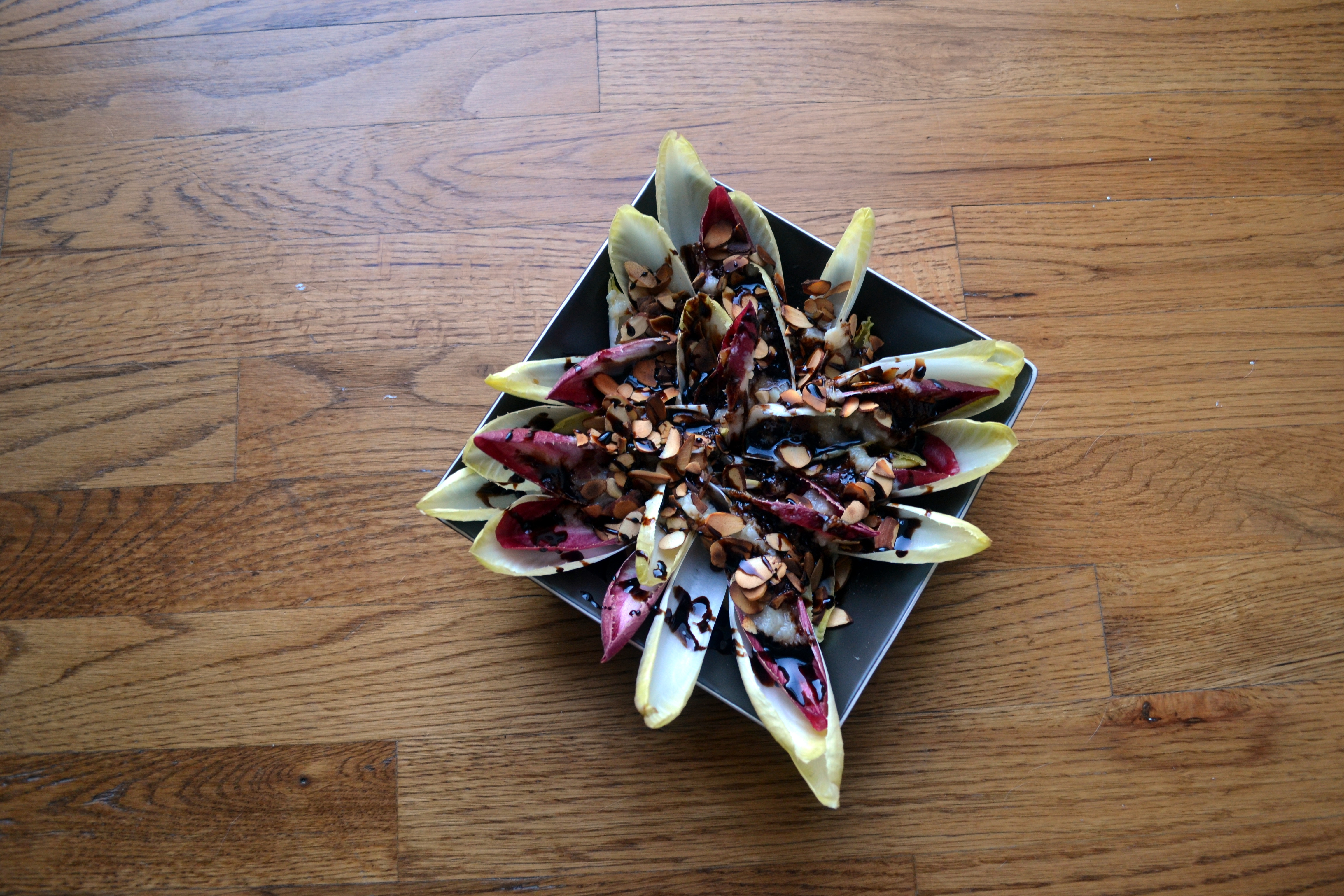
“79. Cook chopped pears in a covered saucepan with a tiny bit of water until soft. Puree, but not too fine. In your smallest pan, boil a few tablespoons of balsamic vinegar with a little brown sugar; lower heat and reduce by half. Spoon the pear sauce over endive leaves and finish with toasted sliced almonds and the balsamic reduction.”

To me, this sounded delightful.  To N., it sounded weird.  So on Thursday, when he had to go back to school for an evening engagement, it became my dinner.  It consisted of:

2 TB sliced almonds

2 ripe pears, peeled and chopped into small chunks

1 TB water

3 spears endive

¼ cup balsamic vinegar

1 TB brown sugar

I must admit: I cheated on the balsamic reduction.  The quantities I listed above are falsified.  But they are estimates you might use.  I happened to have a small container of already reduced, already sweetened balsamic vinegar in my refrigerator from a previous night, and this was the perfect excuse to use it up.  I just microwaved it for a few seconds and it loosened right up from a tar to a pourable, molasses-like syrup.

I toasted the almonds in a dry pan over medium heat, tossing them frequently.  You can’t take your eyes off of these slices for very long.  In the space of twenty seconds, they go from perfectly golden to burnt.  How do I know?  How do you think?

I set aside my overly tanned almonds and added the pear chunks and water to my pan.  Bittman didn’t specify whether the pears should be peeled or not, but pears already have that dubious, potentially grainy texture, and I decided the rough and sometimes gritty skin shouldn’t have a part in this salad.  As the pears – naked, cored, and chopped – simmered and softened, I considered the pureeing instruction and rejected it.  If indeed they were still supposed to be chunky, there were other methods than dirtying my food processor or immersion blender.  I had at them with the potato masher.  This broke them into a chunky puree – some texture remained but they were definitely on the road to sauce-hood.  I turned off the heat and set them aside to cool.

All that remained was to cut and arrange the endive and drape these various accoutrements across it.  I spooned, I drizzled, I scattered, and I served.

This was good, and a nice homage to fall, but it almost read like a dessert salad.  Endive has – to my palate at least – little to no discernible taste.  It is crisp and fun to eat because it has such a capable, interesting shape, but it crunches into water in your mouth and tastes like whatever you pair it with.  In this case, it tasted of earthy mild pears and glossy sweet balsamic reduction.  The crunch of the almonds and the crunch of the endive were pleasantly different: one dry, one juicy.  I ended up scooping dressing, pear puree, and almonds into each leaf and eating them out of hand rather than messing around with all that utensil business.  After all, I was seated at a table for one, and Ted Allen on the TV wasn’t going to judge me.  Besides, I was pairing this salad with shrimp (so delicious: toast mustard seeds and red pepper flakes, sear shrimp, deglaze with dry white wine, sprinkle with parsley, serve), and it’s so much easier to just pick them up by the tails.  No fuss.  Only a little mess.  Easily remedied.  Followed up, just to make it extra indulgent, with a little cup of coconut whipped cream, dried blueberries, and the rest of the toasted almonds.

N. wouldn’t have liked this dinner.  But that’s okay.  Our coupledom doesn’t require identical food preferences as I once thought it might, and I’m happy to take on all the shrimp and coconut in the world on his behalf, paired with pears and endive or not.  Call it a gift.  And in return, he lets me play with my food: not just eating with my fingers, but trusting me in my experimentation because I know what he likes.  That means when I present him with one of my Frankensteinian creations, he might raise his eyebrows, but he’s willing – and usually happy – to give it a try.  A salad doesn’t need lettuce.  What it needs, I think, are the flavors you like and the contrasting textures that make it an adventure to eat.
Counting Down

It’s interesting that as I left my 20s behind chronologically, I entered my 20s in this Bittman project.  As of this moment, on this particular Sunday afternoon, I have 25 Bittman concoctions left to make, most of them soups and desserts.  At a rate of two per week, I will finish by the end of this year.  This means we’re getting toward some major milestones, some very big deals, some lasts on the list.

The first of this pair is one such last.

“34. Combine cooked bulgur with chopped or grated apple, minced orange rind, grated ginger and chopped parsley. Back in an oiled dish, use as stuffing or serve as a salad.”

This was the final remaining entry on the “Stuffings and Grains” list. We left it till last for no particular reason, but during a week in which a collection of Valencia oranges sat languishing in our fruit bowl, it seemed like the right thing to do.

I’ve been fairly good lately about writing down ingredient quantities as I add them, but for this entry I never even lifted a pen.  It happens.  I can own up to it.  A week of non-stop grading, perhaps, made me leery of that inky instrument.  Or maybe it was our relative rush: leave it to me to design a complex, glaze-bearing dinner on a night we needed to eat early.  Some things must get sacrificed, and it turns out it’s not the glaze, it’s the notations.

Here are my approximations:

1 cup bulgur wheat

2 cups water, stock, or a combination of the two

1 large fuji apple, diced into small squares

2-3 TB finely minced orange rind

1 TB grated ginger (this is really easy to do when the ginger is frozen)

¼ cup chopped parsley

salt and pepper to taste

Cooking bulgur is very similar to cooking rice.  I poured the wheat and the water into a pot and let it come to a boil before simmering for 15 minutes or so while I prepped my other ingredients.

After dicing the apple, grating the ginger, and chopping the parsley, I turned to the oranges.  Since Bittman specified “rind” and not “zest,” I used a y-shaped potato peeler to remove long, brilliant segments of rind.  I slid a sharp knife carefully between the rind and any white pith that got caught in the peeling, and then sliced into very thin strips, rotated them 90 degrees, and sliced again so I was left with tiny squares.

Before these happy bright piles all nestling on my cutting board got too comfortable, I tipped them into the pot of bulgur and carefully folded them in for even distribution with some salt and pepper to taste.  The experience of the still-chilly ginger hitting the hot bulgur was sinus-clearingly intense, but lovely.  An aroma-only aperitif.

With everyone incorporated, I dumped the pot’s contents into a greased baking dish and stowed it in a 350F oven for half an hour.

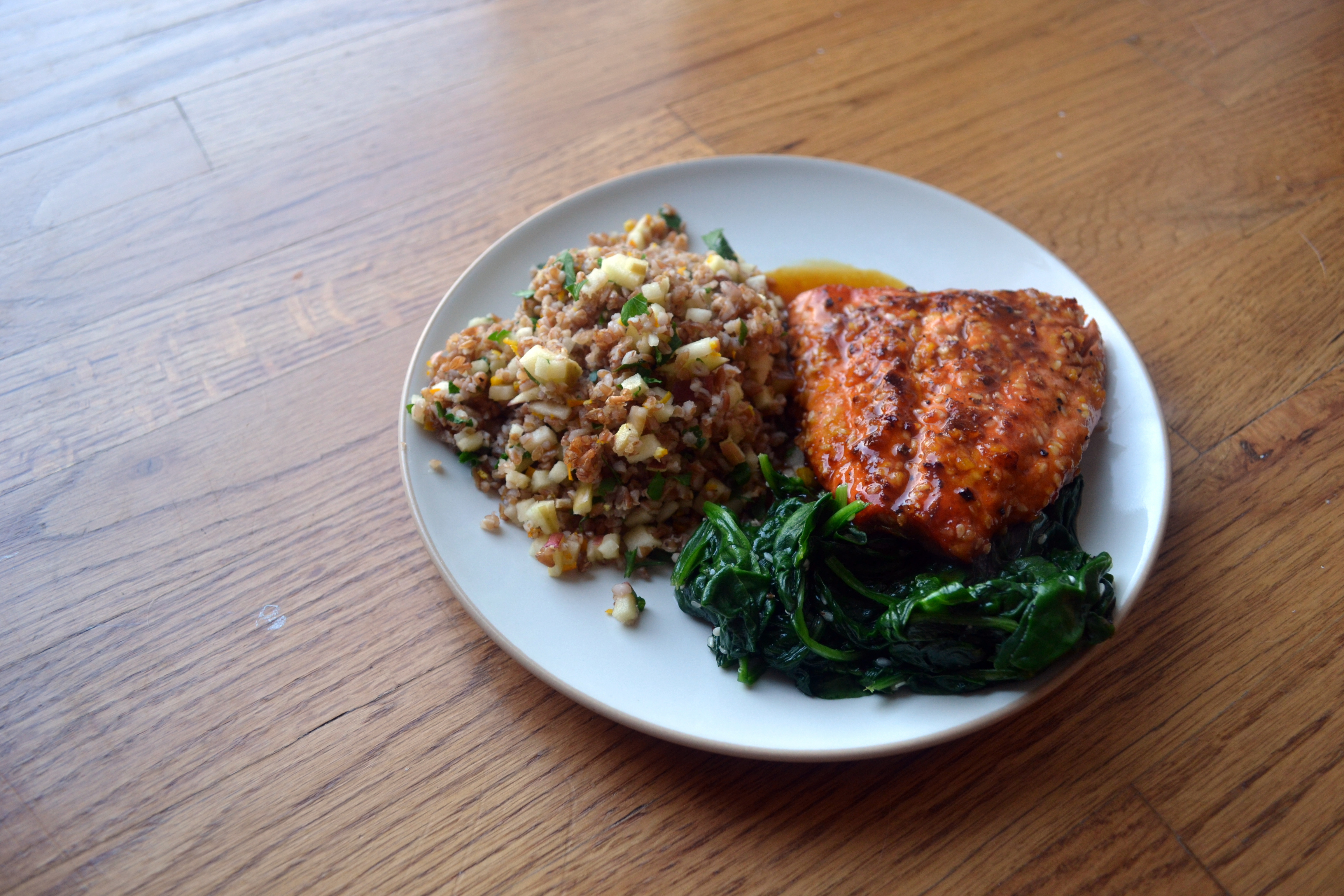
Orange and ginger suggested an Asian flavor profile, even though apples and parsley didn’t.  I decided to work with the dominant elements, though, and so I paired the bulgur with salmon and spinach.  The salmon would be rubbed with sesame seeds, powdered ginger, and orange rind bits before receiving a heavy sear and then an orange-juice glaze.  The spinach would be sauteed with garlic chips and sesame oil.

As with all things, this didn’t happen exactly as imagined.  It takes a long time, as it turns out, to simmer the juice of six oranges down into a thick glaze without burning their sugars.  Similarly, it takes time and babysitting to ensure garlic chips that are crisp, not charred.  And when you are trying to do all this on the same night as a homecoming football game you’ve promised to attend, certain shortcuts must be taken.

The salmon, while it seared beautifully, received not so much a glaze as a flood of boiled, ginger infused orange juice.  Still, when this liquid hit the hot salmon pan, it did bubble down into something thick and rich (if a little darker than intended).

The spinach, rather than the crunchy, spicy accoutrements I intended, had to settle for a last-minute sprinkle of sesame seeds to keep it company.

Still, the meal was overwhelmingly successful.  The salmon was outrageously delicious, and I’m going to have to make it again, writing down the procedure this time so I can share it with you.  The orange sauce perfumed the fish and kept it moist and buttery and tender.  Even though it was a bit darker than I’d planned for, the sauce took on caramel notes that seemed utterly intentional.

The bulgur was lovely.  It was toasty and fluffy and well seasoned.  The apple had cooked lightly as the dish baked, leaving it just softened but not without resistance.  The orange rind was delightfully not overpowering, but gave a warm spiciness to the grain.  It was good with the salmon, but would also be delicious with pork chops (playing on the traditional applesauce pairing) or, if you replaced the parsley with mint, a lovely side for leg of lamb.

In summary, a triumphant triumph: not only is the Stuffings category successfully completed, but it was completed with a success.


With the weather cooling (finally!) and the Soups category still looming largely untasted before me, I decided to try one to close out the week.

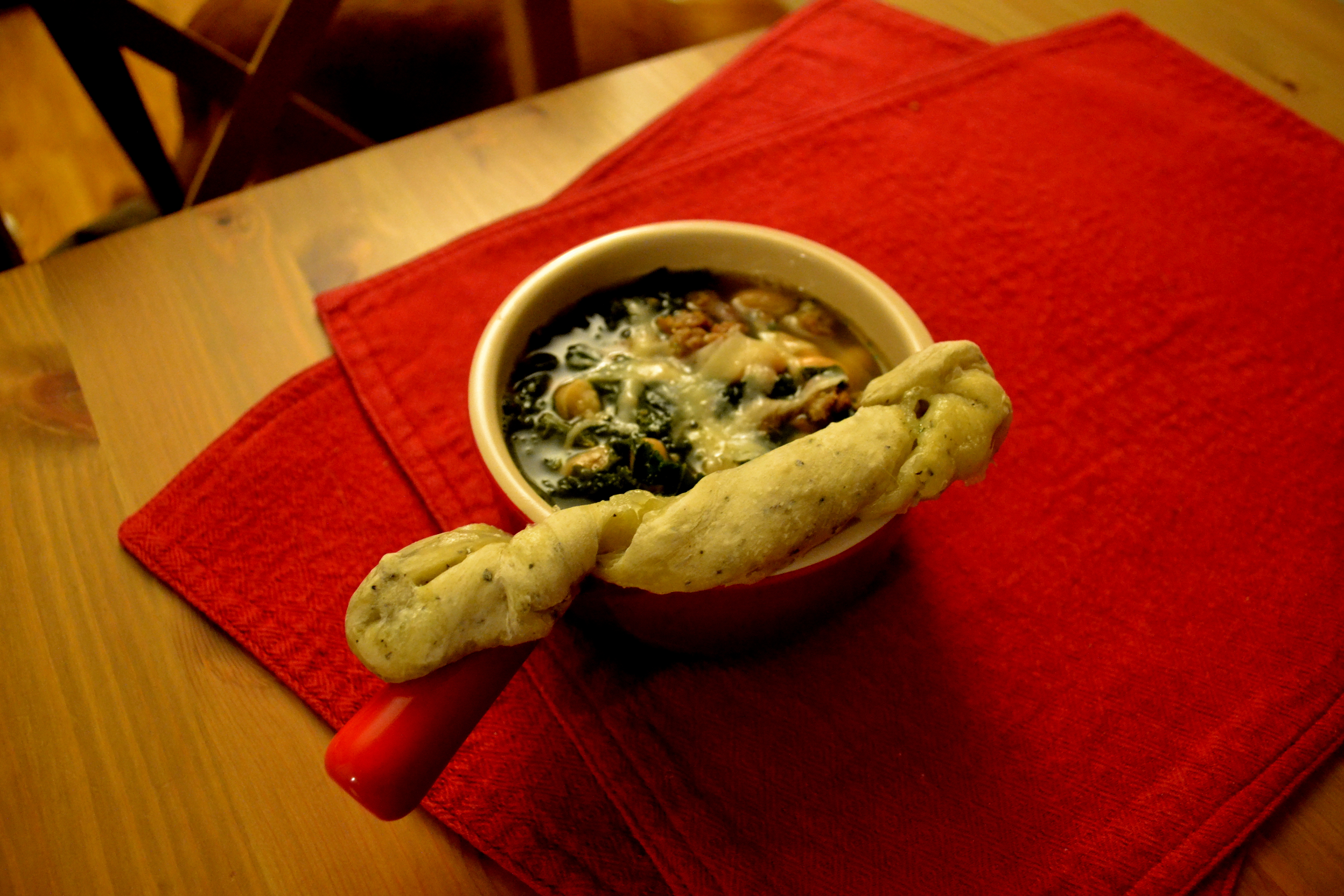
“21. Brown a little crumbled or sliced sausage in olive oil; a sprinkle of fennel seeds is good, too. Add chopped escarole, cooked white beans with their juice, and stock or water to cover. Simmer until the greens are tender and the beans are warmed through. Garnish with olive oil or Parmesan.”

I must admit I made some changes to these directions based on availability and personal taste.  I don’t like fennel.  It’s one of a very few spice flavors I just can’t take.  Over-fennel-ed sausage – like the kind that appears on many chain pizza restaurant pies – just doesn’t appeal to me, and the idea of fennel seeds crunching between my teeth and filling a mouthful of soup with their anise awfulness made their addition out of the question.

As for the escarole, I could find none.  I searched through mountains of salad greens at several local markets and this particular strain was resolutely absent.  But I did find a really beautiful bunch of kale and decided it would be a satisfactory substitute.

So here’s what I ended up with:

8 oz. bulk sausage

1 big bunch kale (chopped, this was probably 6-8 cups)

3 cloves garlic (some spice to replace the abhorred fennel seemed appropriate)

1 15 oz. can white beans with their liquid

2 cups chicken broth

salt and pepper to taste

Eschewing olive oil, I squeezed the sausage into a pan and let it brown over medium heat, separating and crumbling it as it cooked with a flat-sided wooden spoon.

I rinsed, stemmed, and chopped the kale into manageable pieces, and when the sausage was cooked through, I tossed in the mountain of greens.  No, that’s not true.  I inserted handfuls carefully so they wouldn’t spill all over the stove, and ran out of room with only half my kale added.  N. came into the kitchen when he heard me laughing hysterically, and stared in amazement at the mound of kale pieces sitting inches above the top of my pot.  I had to press it down with my hand, compacting the frilled, tough leaves down toward the bottom of the pot.  It always looks like too much.  It’s always not.  In the time it took me to mince the garlic, the kale had already begun to wilt and settle more comfortably into the confines of the pot.
When I could barely smell the garlic and the kale was level with the sides of the pot (as opposed to threatening to spill over them) I added the white beans, their juice, and barely two cups of low sodium chicken broth.  One of the things I’ve discovered about myself is that when it comes to soups and salads, I like them to be full of, well, stuff.  Lettuce with the odd crouton is no good.  I want dried cranberries, and walnuts, and avocado, and gorgonzola.  Thin, brothy soups don’t please me either.  Give me big chunks of vegetables, or slurpable noodles, or rich shreds of meat.  In the days when I’d indulge in the occasional Cup’o’noodle, I always drank the broth out first so I could concentrate on the important part: the just dripping mounds of noodles left behind.

So this soup, for true enjoyment, needed only enough broth to make its categorization accurate.  A scant two cups and we were assured plenty of “stuff” in every spoonful.

While the soup simmered, I stretched, sliced, and sprinkle mozzarella onto some pre-made pizza dough.  Twisted and snuggled on a baking sheet, these when into the oven to become bread sticks.  Fifteen minutes later when they were sizzling and firm, the soup was done.

This is not a soup you want to let simmer for hours.  The beans, especially if you are using canned like I did, will eventually become mealy and then disintegrate.  The kale begins to lose its emerald brilliance after a while, and though it will still taste good, it won’t be as pleasing to consume.  Simmer for fifteen to twenty minutes max.

Then you get to shave on some parmesan and eat it.

Neither of us was sure we would like this soup.  But we shouldn’t have been so foolish.  N. has placed the products of this project on a pass/fail system.  This is what happens, I suspect, when you have two teachers in the family.  He announces his verdicts after dinner, and he treats them as though Mr. Bittman has just submitted an exam or a paper assignment.  “Bittman passes on this one,” he told me last night as we cleaned up.  It wasn’t just his happiness at pairing his dinner with the first Jubelale of the season.  He really did like the soup.  And I think he was right.  This was a fast, easy, delicious little warmer.  Cooking the kale in the sausage grease gave it some additional flavor and took away that raw bitterness dark leafy greens can sometimes have.  The beans got creamy and delicate, and the starch from their liquid thickened up the minimal broth I used.  Even without the broth, these ingredients seem like a stellar combination that should be taken advantage of at many opportunities.  Sautéed together, perhaps with the addition of chopped onion and maybe butternut squash or sweet potato, they could be a nice little hash.  Wrapped in pastry with some thickened gravy, they could be a pot pie.  Folded with some grated mozzarella and enclosed in pizza dough, they become a perfect calzone.  And as the weather continues to cool (I hope, I hope, I hope), gravies and pot pies and warm cheesy casseroles are exactly what I want to pair my remaining Bittman dishes with.

It seems a bit stress-inducing to start with a countdown.  It’s a looming certainty of what must be achieved.  “That’s a lot,” N. said when I told him how many were left.  But after tonight’s dinner, it will be 24.  And by the end of next week, it will be 23.  And by having you out there reading, it means I must achieve, yes, but it also means I’m promising something to you.  Food.  Words.  Proof of my experiments.  And stress-inducing or not, that’s a kind of accountability I like having.

25 to go…

Swing

Summer into fall into summer.  Salads and grilled vegetables into casseroles dabbled with cream into fresh raw dips.  Luxurious stretches into curled legs under blankets into stressed grading sessions into sampling new half-fizzed white wine.

Sometimes this is called Indian Summer.  I like to think of it as Swing Season.

Two Bittmans for you this week.

77. Trim and dice fresh tomatillos; peel and julienne jicama (or daikon or kohlrabi). For dressing, combine lemon and lime juices, olive oil and chopped cilantro. Pour over salad, top with toasted sesame seeds.

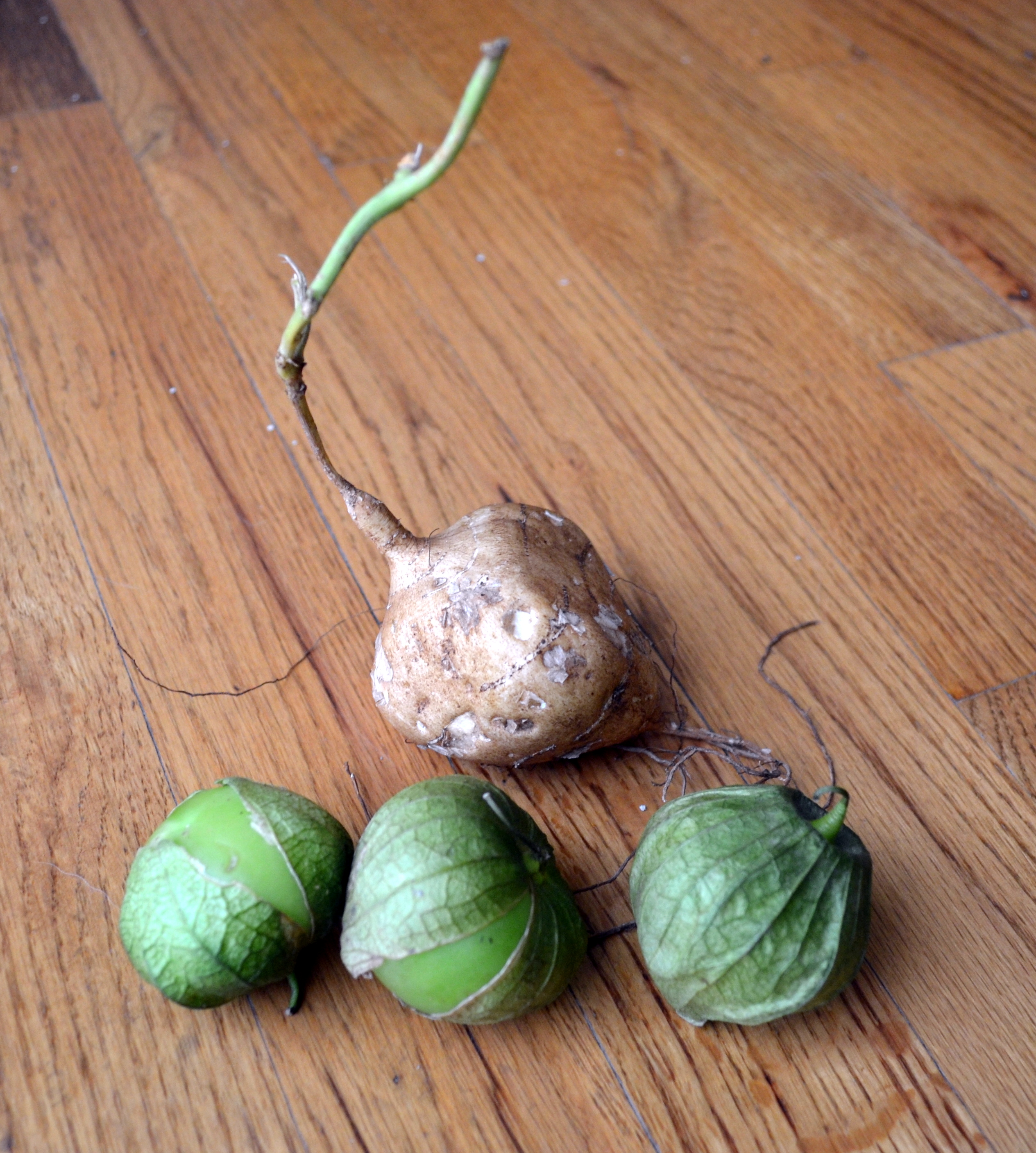
This sounded like a good late summer/early fall salad.  I found tomatillos at the grocery store, but no jicama, no daikon, and no kohlrabi.  And then we went to our Farmers’ Market, and I found all three!  Huge daikons, alien baseball sized kohlrabis and, hidden between stacks of beets and the tiniest fingerling potatoes I’ve ever seen, a pile of grubby little tubers with vine-y stems still attached.  Eureka, jicama!  Back at home, I assembled the troops:

1 TB toasted sesame seeds

2 small jicama

6 medium tomatillos

(really, the number of jicama and tomatillos isn’t super important as long as the quantities are roughly equal once you’ve cut them up.  Start with maybe 1 cup of each, see what you think, and then add more if that’s what makes you happy)

2 TB chopped cilantro

1 lemon

1 lime

Olive oil

Salt

I’ve tasted jicama, but it has been a long time.  And I’ve certainly had tomatillos, but mostly only after they were roasted and processed into salsa.  I wasn’t sure how they would be raw.  This – a lovely fresh slaw/salsa/salad hybrid – sounded so bright and tart and lovely that I wasn’t too nervous.

Before anything else, I toasted the sesame seeds and set them aside.  They give off such a lovely roasty scent when they are just browned and starting to release some oils.

I peeled, then sliced the jicama into rounds.  Then I stacked up the rounds and made thin slices across until my two little aliens were a pile of matchsticks across my board.  Into the bowl with you.

Next I quartered and diced the tomatillo.  Because they are still underripe when green (apparently they can turn purple and get very sweet when they ripen, but I’ve never seen them in that state), their skins were quite resilient – it took some pressure to get my knife through them.  Carefully chunked into miniscule cubes, they joined the white confetti in my bowl.

A quick squeeze of lemon and lime, a whisking pour of olive oil, and a handful of chopped cilantro feathers later, and the dressing was done.  And then a sprinkle of salt, and it was perfect.  It was a little more than needed to moisten the salad, but it’s hard to know how much juice citrus will have secreted away inside it, so it’s always going to be a guessing game.

I mounded the white and green on my plate, then added a generous scoop of Mexican rice and a quartered cheddar cheese quesadilla.  Simple simple.  At this point, you should ideally sprinkle the sesame seeds you so carefully toasted atop the salad, but I forgot until after I’d already subjected it to a photo shoot.

I was surprised and pleased by the flavor of this dish.  I can’t imagine eating it as a Thanksgiving side dish, but it was a bright burst of summer on a day that began in drizzly autumnal terms.  Jicama is crisp and juicy with the barest hint of starchiness, and its flavor reminds me most closely of an Asian pear.  The tomatillos were very tart, but the pairing tamed them.  Imagine a granny smith apple crossed with an underripe tomato and you’re approaching the brightness we experienced.

This was good as a salad, though its tartness necessitates a small portion.  It was also good heaped atop our quesadillas, like a raw salsa.  It contrasted nicely against the melted cheddar and the just crisped corn tortillas.  But where it would really shine, N. and I agreed, would be as a kind of mirepoix for guacamole.  Dicing the jicama instead of leaving it in strips and folding the whole salad gently into chunks of ripe, buttery avocado would make for the perfect chip dip.  Tart, creamy, crunchy, with the right kind of salty sourness from the dressing, and all you’d need was a frosted Corona and a pool to dip your toes into.  Summer.

But things never end there.  At least we hope not!  Days of sweating and hiding inside and waiting till after sunset to go out always, inevitably (even if it’s taking FOREVER, Los Angeles…) relax and cool and crystallize into Autumn.

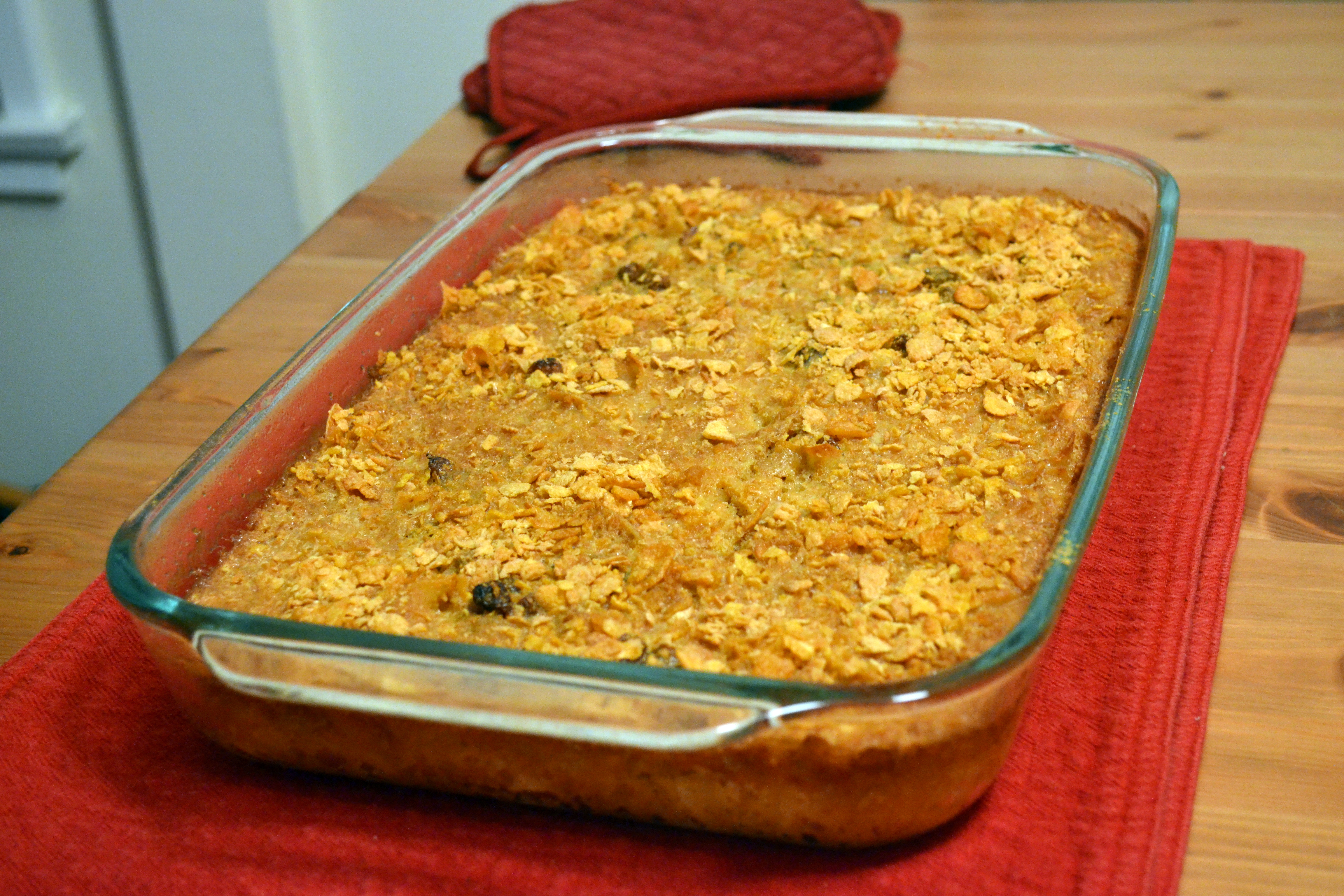
35. Pumpkin-Noodle Kugel: Cook a half-pound of egg noodles in salted water until not quite done; drain and put them into a buttered baking dish. Whisk together 4 cups milk, 4 eggs, 1 cup pureed cooked pumpkin (canned is fine), ¼ cup melted butter and a pinch each of cinnamon and salt. Pour over the noodles and sprinkle with bread crumbs (or, for added kitsch, corn flake crumbs). Bake 45 minutes to an hour, or until a knife inserted into the middle comes out clean.

I had no idea how to serve this dish.  I’ve heard of kugels, but I’ve never even eaten one, let alone made one.  I wasn’t sure, as usual, what to serve it with, so I asked a few friends and did some research on the good ol’ internet.  At the point that I read Smitten Kitchen’s version (okay, so this one is written by her mom, but seriously, that woman has cooked everything, and all of it sounds and looks outrageously delicious), this sounded more like a dessert than a dinner side dish.  It would be, I decided, dessert and weekend breakfast.  Sweet, autumnal, nicely spiced, and custardy.  “It’s going to be like a rice pudding but with noodles.  And pumpkin,” I told N.  He still wasn’t sure.

8 oz. egg noodles 

4 cups milk

4 eggs

1 cup pumpkin puree (I used Libby’s)

¼ cup melted butter (I put this in, but I’m not sure it was really necessary)

¾ cups sugar

¾ cups golden raisins

½ tsp cinnamon

½ tsp salt

2 cups corn flakes, well crunched (who am I to pass up added kitsch?!)

It wasn’t until I had collected ingredients that I realized Bittman’s recipe doesn’t call for sugar.  But I was already on the dessert/breakfast kick, and I couldn’t quite envision this as a savory dish, so I dumped in my sugar estimation anyway, along with the golden raisins that aren’t part of the original.

I cooked my noodles for 5 minutes and then let them cool for 10.  They probably needed to be cooked for only 4 minutes, because they keep on cooking not only while they are in the oven, but on the counter as they cool as well.

Yes, I take these photos from the floor. But it’s a nice wood floor, and the light is so good, and I promise Lucy stayed on the other side of the room the whole time…

With the custard whisked together and the noodles evenly spread in a buttered 9×13” glass baking dish, I preheated my oven to 375F and assessed the corn flakes situation.  Whenever an ingredient needs to be crushed, crunched, or pulverized on Chopped, I yell at the chefs for using their hands, knives, or a rolling pin instead of just bringing over the food processor.  But they don’t have to wash all the dishes they make, and I do, so my pretty little scarlet processor stayed on its shelf.  I crushed up the cereal with my hands, feeling a kind of satisfaction as the flakes became bits and then powder.  I topped the noodly custard with a generous layer of crumbs and carefully slid it into the oven.

An hour later, the custard had set and the smell flashed me forward to Thanksgiving.  I’m convinced we as a society don’t really know what pumpkin tastes like, because what we experience is texture and spices.  If this kugel didn’t have a sprinkle of cinnamon in it, I’m not sure I would know it had pumpkin either.

Dinner came and went, the kugel cooled a bit, and I dug out a too-big portion for myself, and neglected to feel any kind of remorse about it.  It was too good for that.  The noodles had melded together as the pumpkin infused liquid cooked, making a solid, scoopable, sliceable custard.  The corn flakes on top were perfect: aggressively crunchy against the soft interior.  I wouldn’t omit the golden raisins either; they were a really nice textural contrast to both the softness of the noodles and the crunchy crumbs, and their complex sweetness added some depth to my dessert casserole.  It was warm, and sweet, and perfectly comforting as I tucked my feet under me on the couch and waiting for the approach of Project Runway (don’t judge, every girl needs a little reality TV now and then).

The leftovers are delicious too, though the dish does lose something in relinquishing its crunch to the microwave.  In another universe where I’m a Southern cook, I could see doing crazy things like frying squares of this in butter and then drizzling hot maple syrup over the top.  But I’ll refrain.  Because from my window, I can see my basil wilting beneath the curiously, cruelly hot-for-mid-October sun: back to summer, so it seems!  And here I was considering making soup…

Swing season indeed.

Three for One

Sometimes you are faced with not enough: not enough time, not enough money, not enough to do…

And sometimes you are faced with too much: too much bounty, too much responsibility, too much joy.  These are both their own kind of problem.  And if I have to choose, faced with these Januses, I will always go for too much.  Even if I fall short.

Last week I only managed one Bittman.  This week, in a startling display of ambition and motivation, I did three.

One of the biggest challenges of this project (aside from cooking, photographing, and writing about the food… you know… actually doing it…) has been deciding what to serve these dishes with.  I’m not up for roasting a chicken or a turkey every week to emulate the Thanksgiving spirit of the project, so I try to piece them together with other entrees.  As you’ve seen, if you’ve been following the project for any length of time, sometimes I choose well, and sometimes I decidedly don’t.

This week, riffling through the slowly diminishing options, it occurred to me for the first time that I could serve them as complements to each other.  They were all, after all, conceived for the same imagined table.  They should work together quite nicely.

“7. Cranberry-Orange Sauce: Cook a bag of fresh cranberries with orange and lemon zest, cut up (peeled) orange segments, ¼ cup sugar (or to taste) and a bit of minced jalapeño or chipotle.”

This sounded good and, with the slightly cooler temperatures we’ve been privileged to receive lately, a nice symbol of our entry into Fall.  Cranberries and oranges are a frequent couple – almost too expected – but there’s a reason they appear together so frequently.  And with the addition of lemon juice and some spice, this seemed far enough from traditional to avoid being boring.

1 bag cranberries (probably 1 pound?)

Zest of 1 lemon

Zest of 1 large or two small oranges (mine were little Valencias from our Farmers’ Market)

Segments of 1 large or two small oranges

¼ – ½ cup sugar, depending on your taste and the tartness of your berries

Dash of spice, depending on your taste

I bounced the cranberries into a pot, zested the lemon and oranges over them, and then cut the peel from the orange and sliced out supremes.  For good measure, I squeezed as much juice from the wasted scraps of orange as I could, then topped the mix with sugar and a dusting of cayenne (I had neither jalapeno or chipotle available) and pushed it onto the back burner.

I let the pot come to a boil over medium heat, stirring occasionally to melt the sugar evenly and prevent it from burning until the cranberries released some juice to protect the mixture.  Once it boiled, I lowered the heat and let the whole thing simmer for about 20 minutes.  At one point I tasted, decided there wasn’t enough sugar or cayenne, and added more of both.  The addition of sugar was a good thing.  The addition of more cayenne was less so.  I’d caution you to start with less than you think you will want.  The mixture does not taste at all spicy while it’s hot.  When it cools, though, it becomes fiery.  It was still tasty, though.  We ate it sticky and thick and room temperature, dabbing up popped clusters of ruby and letting it linger on our tongues – but not too long – enough to wake our taste buds from the spice.  As an autumnal side, this works very well and is a pleasant update to the traditional cranberry sauce.  It would also make a glorious topping for a baked brie, perhaps with some rosemary or red wine glugged in for good measure.

While the cranberry sauce was heating, I turned my attention to its companion.

“59. Blanch thinly sliced potato and leeks until tender but not mushy; drain well. Layer the vegetables in an oiled or buttered baking dish, then top with a mixture of bread crumbs and lightly sautéed chopped bacon (some cheese mixed in is pretty good, too). Broil until golden brown.”

Potatoes and leeks are a combination that, a mere year or so ago, I didn’t realize existed.  Now it’s such a natural pairing I can’t believe I never knew about it before.  Sliced blanched potatoes and sautéed leeks now fill every frittata I make.  I collected:

2 russet potatoes, peeled

1 massive leek, tough tops and root ends removed, halved vertically (rinse it out well at this point) and sliced into slim, slim, oh-so-slim half moons

1 lb. bacon

½ – 1 cup bread crumbs (I used Italian seasoned)

Knowing how good leeks can be when they are sweated and barely brown, and conscious that the beauty of bacon grease shouldn’t go to waste, I made a few changes to Bittman’s directions.

First I cooked the bacon.  You likely don’t need a whole pound of it, but this guaranteed an appetizer: one still sizzling slice each for N. and for me.  If you aren’t cooking for or with someone else, go wild and have two all by your lonesome.

While the bacon cooked and the cranberries simmered and popped, I put a pot of water on to boil.  When its aggressive bubbling demanded attention, I carefully lowered in the potato slices and gave them free reign for five or ten minutes.

When it was edging toward crisp, I set the bacon aside to cool and drain a bit on a paper towel lined plate.  I dumped the potatoes into a colander when they were barely cooked through.

Time for the leeks.  I scraped my board free of the slender, just green shards, capturing a satisfying fizz as the vegetation hit the pan.  You want to stir with some frequency here, and not raise the heat above medium; we’re looking for a light sauté, not a heavy brown.

The shards collapsed into resistant-less ribbons, and I pushed them to one side to add the drained, cooling potatoes.  With adept wooden spoon manipulation, I managed to achieve something like layering: half the potatoes flat on the bottom of the pan, the leeks draped across them, and the rest of the potato slices on top.

I turned on my broiler, and while it heated I crumbled the bacon, tossed it with bread crumbs, and dusted the potatoes with the mixture.  But dust wasn’t enough.  They required a landslide.  I drizzled the top with olive oil, knowing the bread crumbs would need it to brown, and slid the whole pan into the broiler (note: if you use a skillet or pan for this, rather than a casserole dish, be sure you wrap any plastic or rubber with aluminum foil before you put it into the broiler.  We don’t want your nice pan handles to melt…).

Five minutes later, the parts of the crumble I had oiled were beautiful brown (the other parts remained sandy and unaltered, much to my chagrin) and the dog was close by, nose moist with curiosity and the urge to assist.

We loaded our plates, completing the meal with a completely unnecessary slice of toasted jalapeno cheese bread, and ate.

As has proved often the case with Bittman’s layered vegetable dishes, I expected this one to be a gratin, and it just wasn’t.  Some cream, some cheddar cheese, some binding between the vegetables, would have been ideal.  But not crucial.  They weren’t supposed to be scalloped potatoes, after all.  The bacon and bread crumbs made them exciting, and the leeks were almost creamy nestled between the thick slices.  Honestly, forgetting to salt the water I boiled the potatoes in was the only real unfortunate mistake.  Two down, with only one mistake (two, I suppose, if you count the overly spicy cranberries, which I suppose I do), is pretty promising.


To make this a trifecta, on another night I chose another autumnal option.

“64. Mushroom Bread Pudding: Put 6 cups of good bread (day-old is best) cut into 1-inch chunks into a buttered baking dish. Beat 4 eggs with 2 cups of milk and ½ cup grated Parmesan and pour over the bread. Sauté 4 cups of sliced mushrooms until tender with a teaspoon or two fresh thyme leaves and mix into the bread. Bake until just set, about 40 minutes.”

Mushrooms and thyme are so nice together.  They are earthy and deep and musty, like the back of a dark pantry into which no anxious hands have reached for some time.  Since they were more precise than usual, I followed Bittman’s ingredient quantities almost to the letter.

I sautéed the mushrooms and thyme in butter, taking time to let the slices soak up the butter, then expel their own liquid.  Only after that, as the moisture from the mushrooms evaporates from the pan, can the mushrooms take on the same kind of crisp brown sear as a steak pressed into a screamingly hot pan.

While the mushrooms cooled, I tore up the crusts of a month’s worth of sourdough bread (I keep them in the freezer for just these sorts of occasions) and pressed them gently into a buttered square glass baking dish.  I grated cheese – swiss and parmesan – and cracked eggs from the Farmers’ Market into a bowl, marveling at the rich orange yolks you just can’t get in the grocery store.  I stabbed them, flooded them with milk, and whisked in the cheese.

I turned to assembly.  First, mushrooms must be tossed with bread.  Attempt even distribution.  Then, a careful, rich pour of the dairy component, taking care to attend to the corners, until the bread almost floated in a puddle of would-be custard.


One of the things I’ve learned in my years of bread pudding production is that pressure and soaking time yield the best results.  I carefully pressed a layer of plastic wrap over the top of my pudding and set it in the fridge for an hour, while N. and I answered the velvet brown eyes begging for “walkies.”

Upon our return, it was as simple as preheating the oven to 375F (pull the pudding out of the fridge and let it approach room temperature as your oven heats), sliding the baking dish onto a rack, and reluctantly grading a paper or two as 45 minutes ticked by (I like my bread pudding a little more than “just” set).

A puff in the center signifies doneness.  Mine levitated just barely in the middle, but the custard was set and the edges of bread not submerged were crisp and darkly golden.

The serving spoon broke sharply through the crisp top but then exhaled through the custard underneath.  Piled on our plates next to an amazing skillet casserole of deeply browned sautéed Brussels sprouts and chopped walnuts drizzled with a balsamic glaze, we accepted its golden softness.  With a higher ratio of eggs to milk than most bread puddings I’ve made, this had almost a soufflé quality, though vastly more substantial.  It was rich and earthy and savory, and I suspect it will be just as good for breakfast as it was for dinner. 

Three more down.  This can be done.  2012 has already been a year of many accomplishments.  Why not go for too many, rather than hesitating at not enough?

Breaking Bread

Last week I tallied up what remained on my Bittman Sides project and discovered, through careful calculations that included pointing to my calendar and counting on my fingers, that if I make two selections from the list every week, I will be finished with the whole thing at the end of the year.  And I mean the end.  The very last week.  Ambitious, yes?  I decided I could do it.

Guess how many I made this week?

Yeah.

One.

So I’m not starting out well with this, but I’m going to try anyway.  I’m years overdue from my original goal anyway.  And in my own kind of backwards reverse engineering, I try to make up for this how?  By posting twice in one week.  So it goes, I suppose…

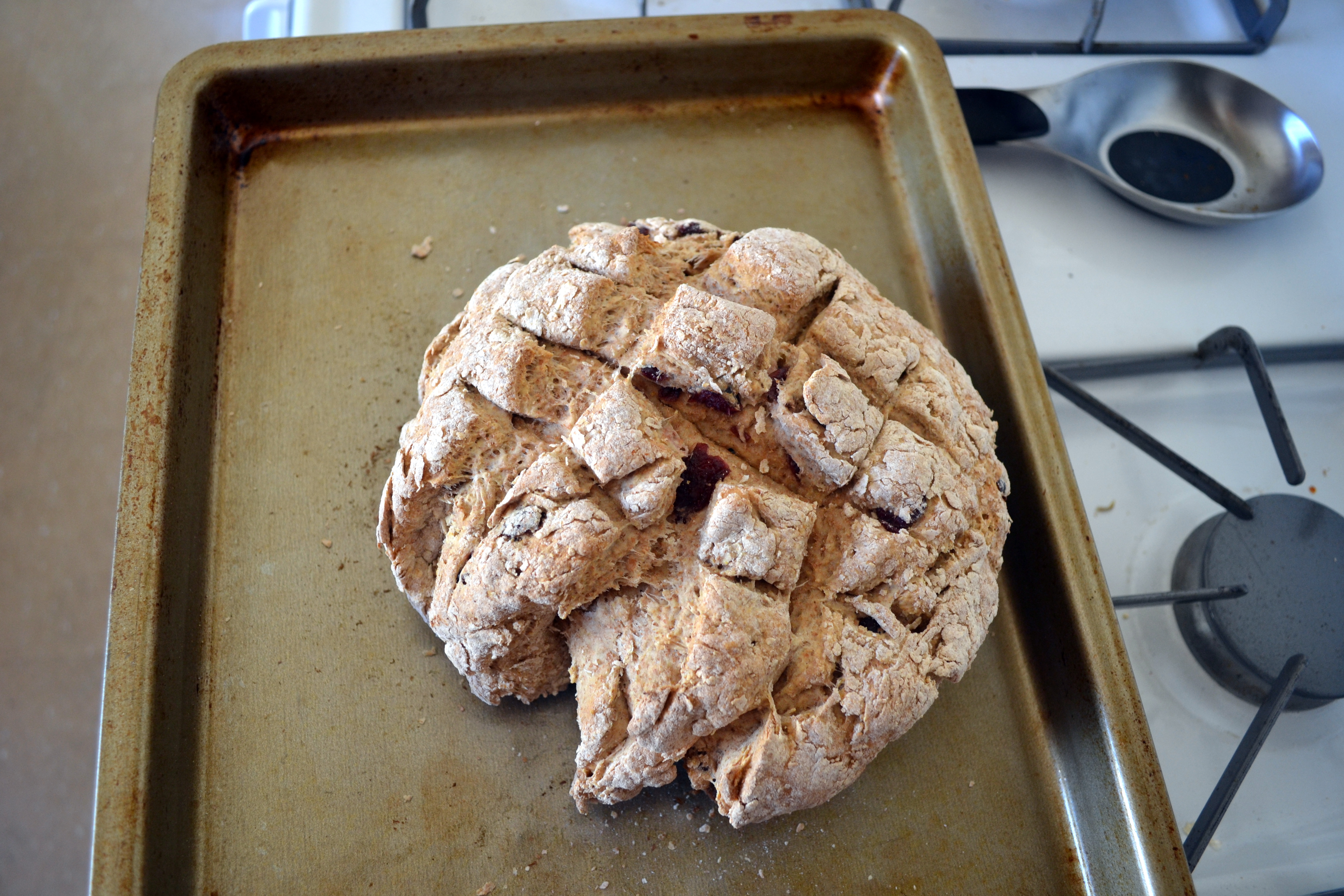
87. Combine 2 cups whole wheat flour with 2 cups white flour and 1 teaspoon each baking powder, baking soda and salt in a food processor. Pour in 1½ cups buttermilk or thin yogurt, and pulse until a ball is formed. Knead for a minute (fold in ½ cup raisins or currants if you like), shape into a round loaf, slash the top in a few places and bake on a greased sheet for about 45 minutes, or until the bottom sounds hollow when you thump it.

I’ve tried bread in the food processor before and it didn’t go very well (what does “when the dough is shaggy” mean anyway?), but I was willing to give this a shot.  It looked like a basic Irish soda bread recipe, and though I’ve never put that in the food processor, I have made it with success on multiple occasions.  So, I pulled down my food processor, opened my pantry, and collected

2 cups wheat flour

2 cups white flour

1 teaspoon baking powder

1 teaspoon baking soda

½ cup Greek yogurt whisked with 1 cup whole milk (I had neither buttermilk nor thin yogurt – this seemed like a happy medium)

½ cup craisins

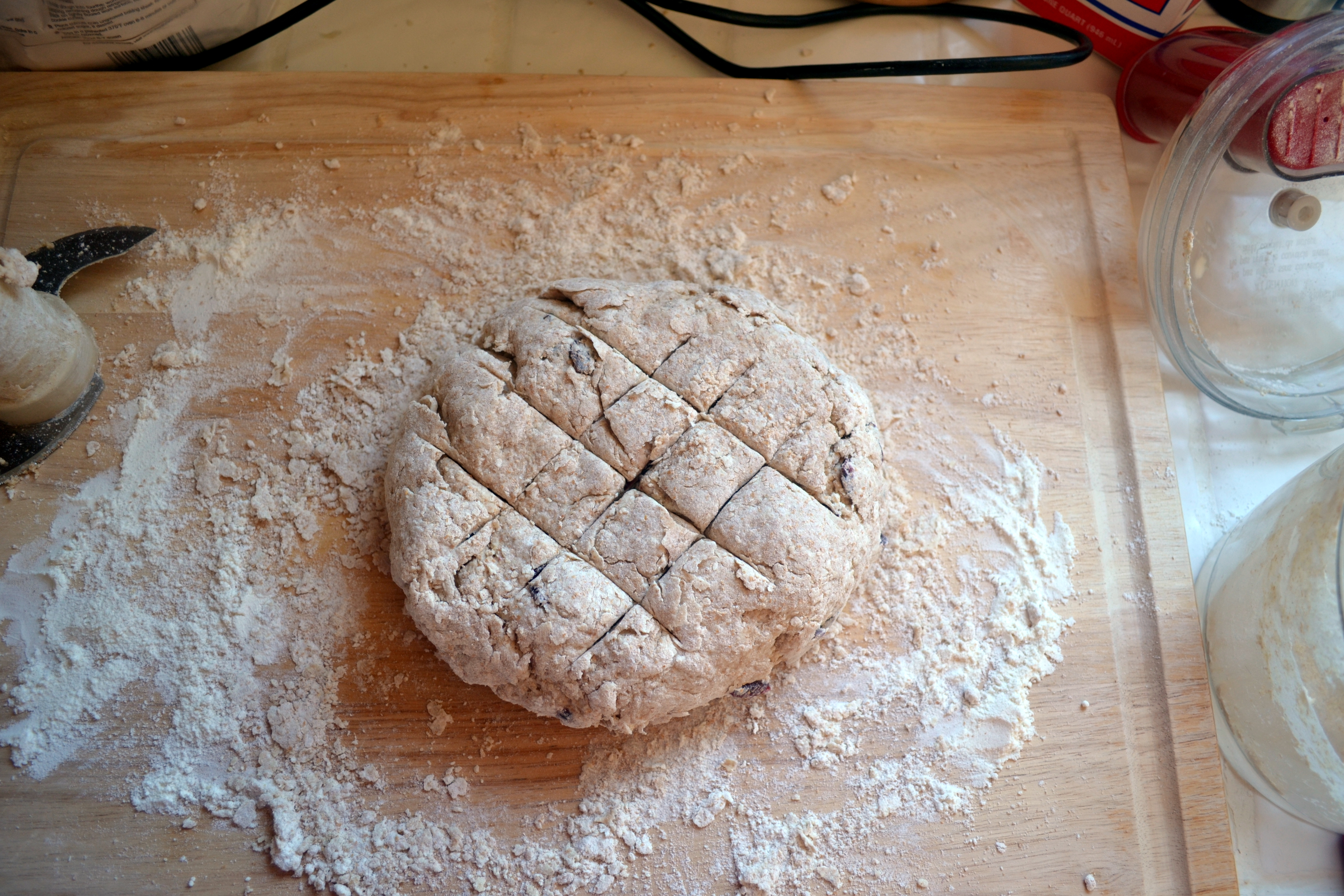
I followed Bittman’s directions to near disaster.  Either my food processor is too small, or this method isn’t all that reliable, because the dough never formed a ball.  Half of it just clumped into a solid mass in one side of the processor bowl and refused to budge.  I said some words in the quiet of my own brain and then held my breath while I tumbled the half-mixed contents out onto a floured board.

This is certainly not a ball.  But I sprinkled on half a cup of craisins and started kneading anyway, trying to ignore the hateful feel of dry dough on my hands.  After a minute or two I determined that things were just not coming together.

Flour-streaked hands reached into the refrigerator and pulled out the milk, dribbled a few tablespoons into a hollow in the dough, and tried again.  This time, things started to stick, to smooth, to pull into a ball.  I patched, I patted, I pushed and knuckled, and finally plopped one of the homeliest loaves ever made onto a greased baking sheet.  Slashed, scored, and enclosed in a warm oven, and I’d done all I could.

Bittman didn’t specify a temperature, but I estimated 375F and returned to grading papers for the better part of an hour.  The timer’s buzz 45 minutes later called me back to a crusty, mottled, flour-speckled loaf that sounded empty when I thumped the bottom, and smelled like humble sour sweetness.

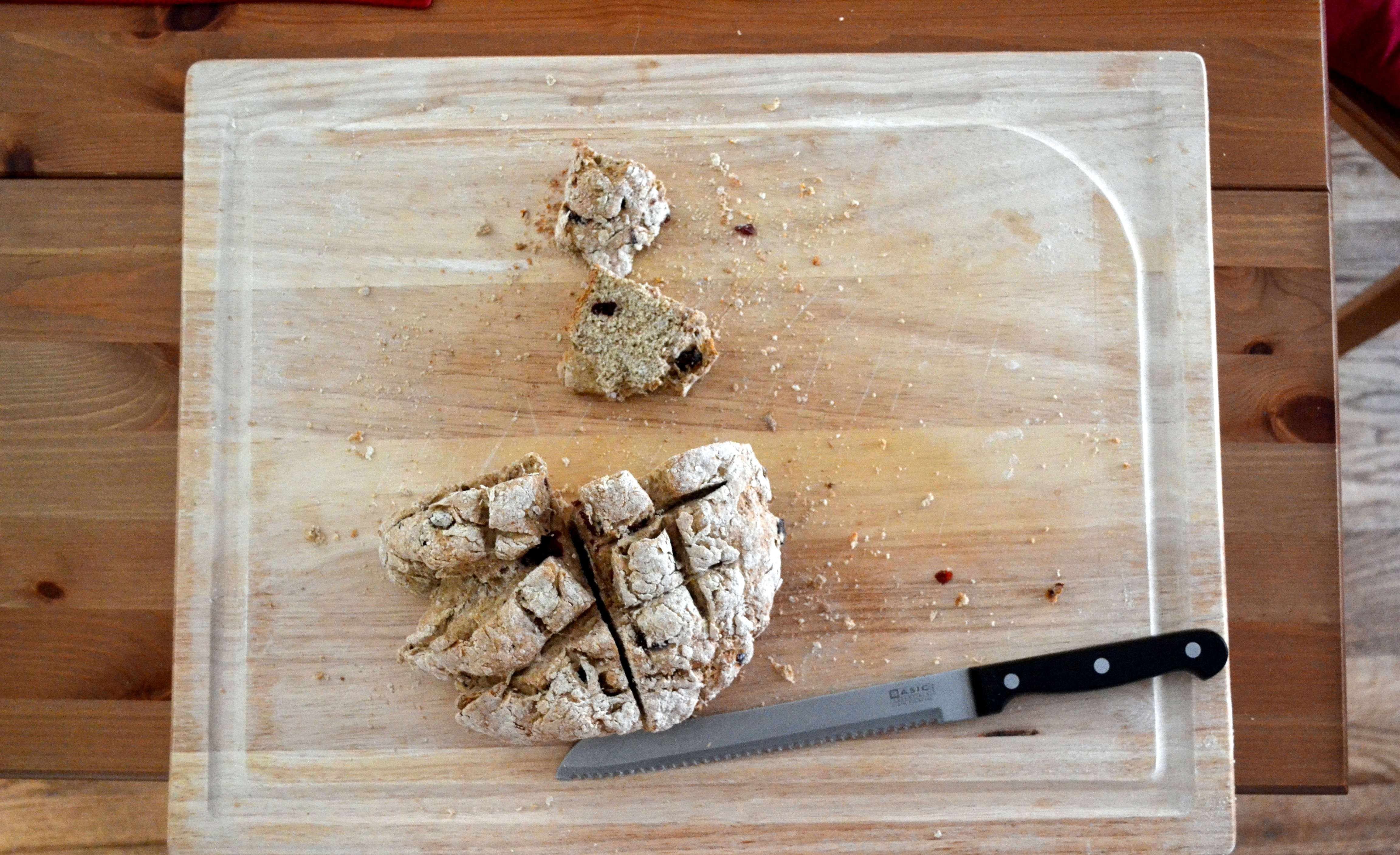
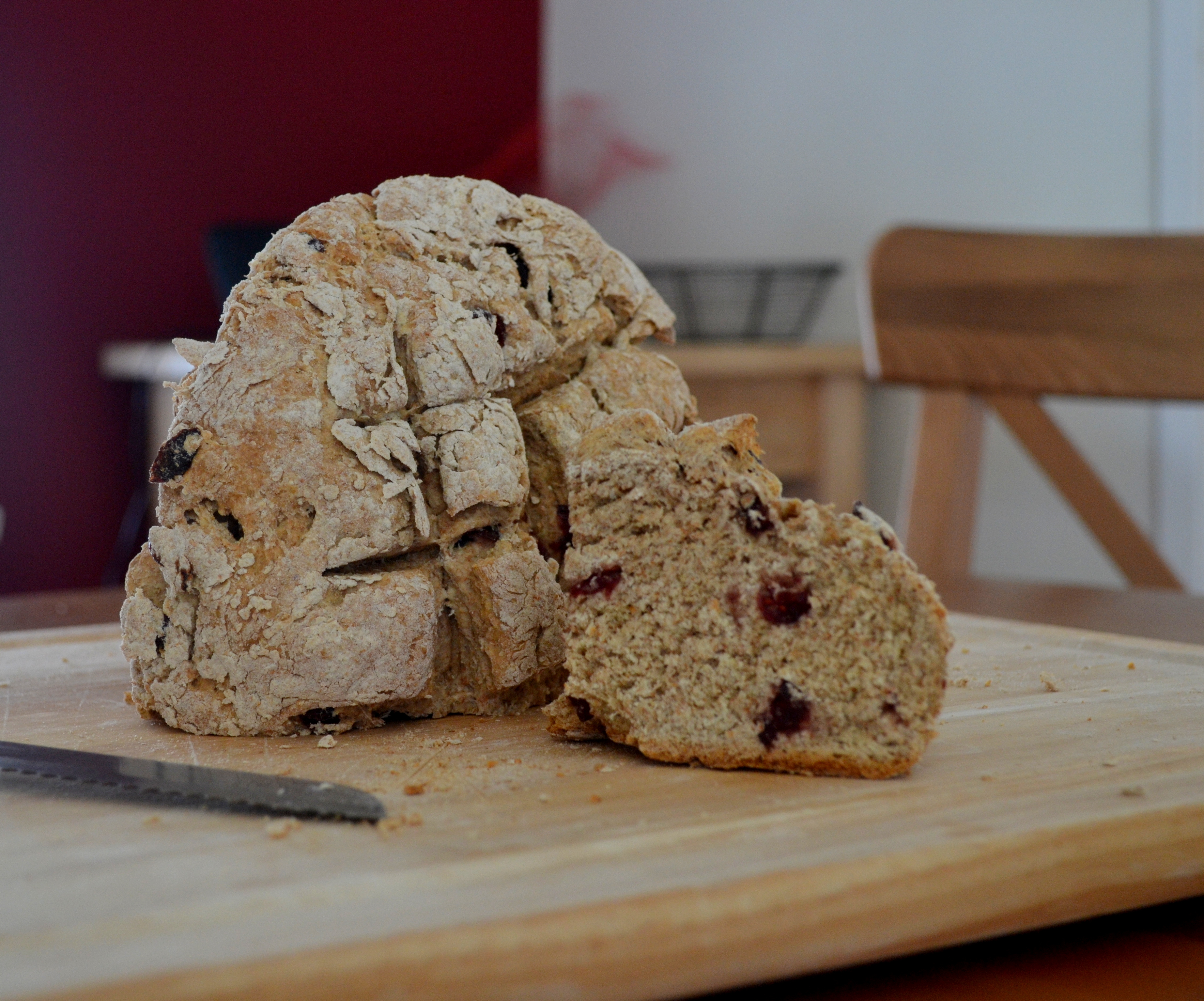
I waited a few hours to try some.  When I cut into it, my knife scraping through the crust and scattering crumbly bits across the board, the interior was dense and moist and still just warm.

It tasted good.  A bit heavy, from the whole wheat flour, and not suitable for eating in large chunks like the one I’d carved off for myself.  But the craisins added a welcome punch, and I think if I’d used all buttermilk instead of my odd mixture of milk and yogurt, the tang would have come through and broken some of the one-note density of the texture.  This would be good, I suspect, toasted and buttered, or maybe – if you’re the daring type – transformed into French toast.  It might also be good made with 3 cups of white and 1 cup of wheat flour, rather than equal parts.

Both N. and I have some Irish blood, and although it doesn’t show too often (unless you count his beard and my very occasional temper), by strange coincidence we ended up eating this bread as part of an accidentally, avant-garde-ly “Irish” dinner: pan fried gnocchi and sauteed cabbage.  Potatoes, cabbage, and Irish soda bread.  If only we’d had corned beef, I told N., and a horseradish sauce to moisten it.

But here’s the good news: smeared with cream cheese, the bread was tasty and chewy and wholesome, with bright pops of cranberry sweetness here and there.  Shallow fried in a mixture of butter and olive oil, the gnocchi were amazing.  Tongue searingly hot, their exteriors crisped and browned like the perfect roasted potato.  Their interiors remained soft and creamy and rich, but the contrast of crusty brown outside to creamy chewy perfection inside was unbelievable.  I could eat these every day.  I could eat them for every meal.  Fried and rolled, still blisteringly hot, in cinnamon sugar, I would scarf these for breakfast alongside a glass of milk like tiny churros.  Tossed with pesto or roasted red pepper sauce, I would gulp them for lunch.  Folded into a mornay sauce with too much extra cheese, I would sub these for pasta in a beautiful perversion of oven-baked macaroni and cheese.  And well salted and perhaps tossed in garlic powder or red pepper flakes, I would happily substitute these for popcorn during a movie.  I might be obsessed.

So with one Bittman down for the week and an intense regimen in store for the rest of the year, it turns out I’m more interested in fried potatoes.  And I’m tempted to ask: who wouldn’t be?  But then I wonder… is that just the Irish in me talking?