Milestones. And Cake. And Salad.

This September has been a big one for me.  New home (okay, so we technically moved in July), new job (okay, so school started in August), and new decade!  I’ve finally hit my 30s, and I like what I see so far (though admittedly I’ve only been stationed in this new world for two weeks).

Given my fanciful proclivities for putting food in my mouth, then, N. knows that my birthday must involve a restaurant in some form.  Since we are only just beginning to explore our new culinary surroundings, this was a perfect opportunity to embark on our adventures.  I started with Culver City which, delightfully, has a whole webpage devoted to its downtown restaurants, including (in most cases) links to each restaurant’s website.  This was almost too much.  I spent the better part of an evening cruising through online menus, imagining what kind of mood I might be in on the big day and what I might want to order and what, if the restaurant I ultimately chose should happen to be out of my top choice, I would order instead.

Based on menus and Yelp reviews, I decided on Fords Filling Station (FFS), whose upscale comfort food and wide range of offerings sounded promising.  I tend to like mid-range restaurants: not too fancy, where a prix fixe menu or outstandingly high prices make me feel like a grubby graduate student out of place (I know, I’m not anymore.  But it’s a hard habit to break in this new world of adulthood and employment), but not too casual either, where the food is sub-par or inconsistent and the wait staff makes no pretense of caring about our presence.  A gastropub – a self-proclaimed innovative collection of food, decor, and atmosphere – seemed like the right fit.

FFS is a fun spot.  It’s centrally located downtown, and the dining room is a big open space with a bar to one side, traditional tables, and long narrow two-tops where the couple sits on a bench next to one another looking out at the other diners, rather than across from each other.  N. and I were seated at one of these bench seats, and it was fun to sit side by side for a change in a restaurant setting.  Brick walls, big barrels, and warm colors make it inviting and, I thought, pretty unpretentious.

Our server, who was the perfect balance of informative and attentive, sold me on one of the night’s cocktail specials: citrus vodka, house made lemonade, and a little float of chambord.  It was nice – punchy and bright and sweet-tart, but oddly similar to a Rennie’s Lemonade from our erstwhile happy hour hangout in Eugene, and therefore it felt drastically overpriced at $12. 

We opted to share entrees so we could order a few things, and got a Cuban flatbread with smoked pork pieces, cilantro, mozzarella, and some kicky little red chilis; grilled asparagus blanketed in shaved parmesan,; and a flattened half chicken with amazing garlic mashed potatoes and succotash.

N. was most attracted to the chicken (as is often the case when we dine out), and here he was clearly right to be.  Flattened, the bones were gone, the meat was compressed, flavorful, and intensely juicy, and the skin was crunchy and buttery and tender and perfectly unctuous.  Because he is fonder of white meat, it was also a perfect dish for us to share, because N. left me the thigh, with its dark, meatiness pleasantly encased in a crisp layer of fatty crunch.  Beside the chicken, the mashed potatoes swam in a sauce of garlic confit, which was rich and intense: the best gravy I’ve had in a long time.

The flatbread, which would have been just delightful on its own, paled a bit in comparison to this chicken.  The crust was cracker-like in texture, and the pork pieces paired nicely with the pepper and cilantro, but together the dish was a little bit dry.  It needed – perhaps – some herb oil drizzled over the top, or maybe 45 seconds less in the oven.  Tasty, but not the star of the show by any means.
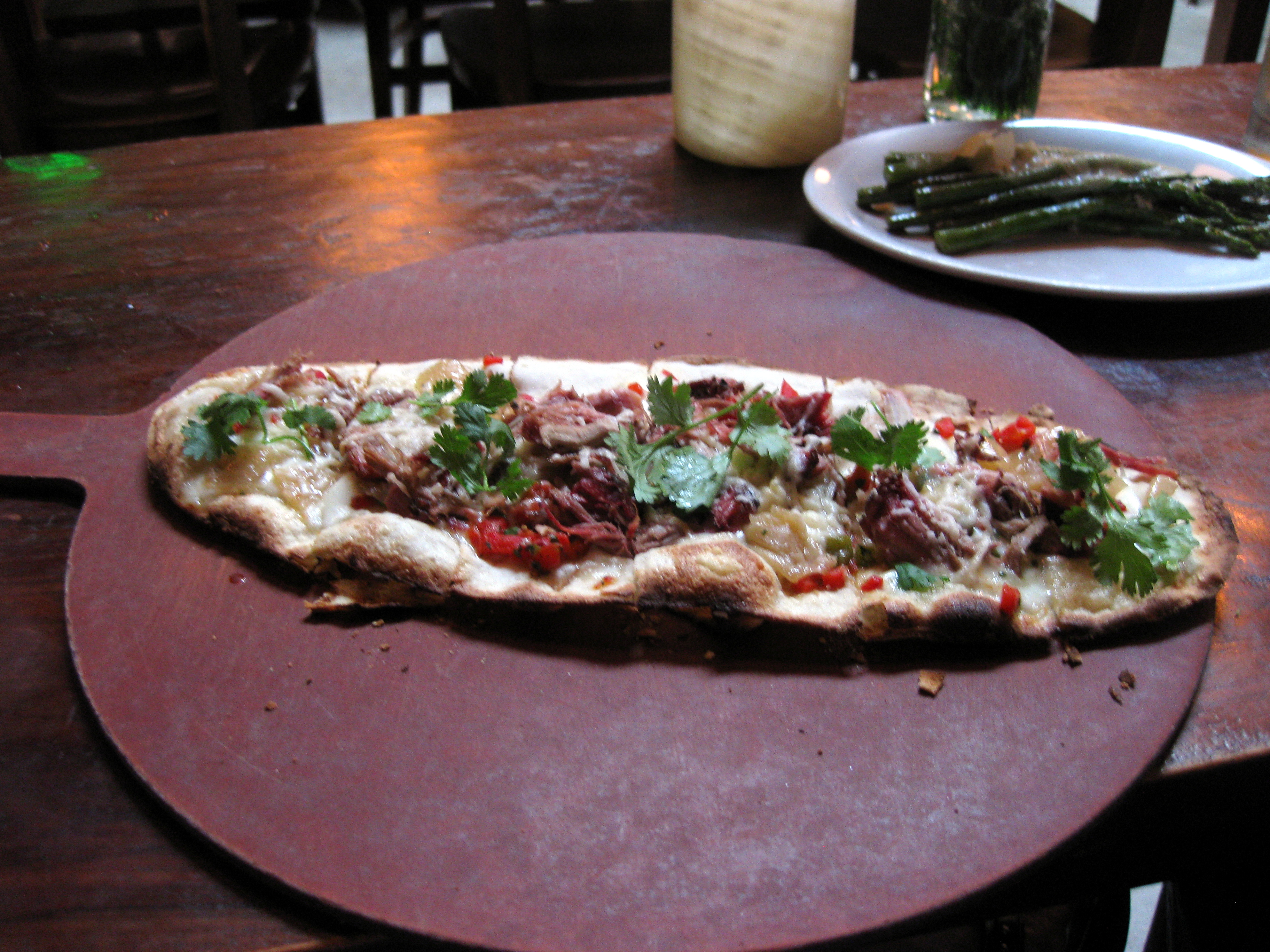
The asparagus was excellent: nicely flavorful and light, well cooked and, aside from the piece I dropped on myself (grace embodied, truly), a nice vegetal accompaniment to our meal.

Since I didn’t get any dessert that night (I was full but not overstuffed, and didn’t want to tempt myself by even glancing at a dessert menu), I was still longing for birthday cake a few days later.  Fortunately for me A., who blogs from the other side of the world at Over and Under, had told me about Porto’s – a Cuban bakery in Burbank that turns out to be right on my route to and from work.  I had to drive up to the school for a Friday meeting, and as I headed toward the freeway to come home, I decided to stop in and treat myself.

Inspired by the flatbread we’d shared at FFS, and because I thought it would be a good benchmark for a Cuban bakery, I got the Cubano.  Then, because it was still my birthweek (I’m big on extending the celebration as long as seems rationally possible), I picked out two tiny cakes to share with N.: flourless chocolate, and tres leches.

The sandwich was good.  Ham and pork packed tightly onto a fresh bakery roll with cheese, sharp mustard, and a pickle.  A simple sandwich, but a delicious one.

My dessert selections, though, were fantastic.  The tres leches was rich and light at once, not overly sweet but dripping with cream, like a well soaked angelfood cake topped with toasted marshmallow cream.  The flourless chocolate selection was less cake than a giant chocolate truffle: impossibly rich solidified ganache inside a thin shell of cake-like crumb.  N. was only able to eat two or three bites before declaring it too rich for his tummy.  I had no such trouble, but did talk myself into enjoying only half at that sitting, and saving the other half for another night when chocolate felt mandatory.

Indulgent?  Certainly.  But (at least in the case of the desserts) at $2-3 each, a reasonable indulgence.  Still, when one is a responsible adult (as I suppose some might now imagine me), one must temper such indulgences.  In this case, that means salad.

80. Trim and coarsely chop chard (rainbow makes for a gorgeous salad) and combine with white beans and chopped scallions. Dressing is minced ginger, a suspicion of garlic, olive oil and cider vinegar. 

I collected:

½ huge bunch red chard, thick stems removed

1 15 oz. can white kidney beans

5 green onions, finely sliced

1/2 inch knob of ginger

2 garlic cloves

1/4 tsp coarse salt

1/4 cup each cider vinegar and olive oil

1 TB honey

I tossed together the chard, beans, and green onions and set them aside in a big salad bowl.  To make sure the ginger and garlic were fine enough, I minced them by hand, then sprinkled them with coarse salt and dragged the flat of my knife across them until they turned into a thick, aromatic paste.  I scraped the paste into a glass measuring cup and whisked it up with cider vinegar and olive oil.  A taste of this was a cheek puckering revelation, so I added a healthy squeeze of honey to make it less astringent.

Aside from spinach, raw bitter greens are not always N.’s cup of tea.  Because I feared this might be the case with this combination, I decided to treat this more like a slaw than a salad.  I combined the main ingredients early and doused them in dressing a good fifteen minutes before dinnertime.  This would, I hoped, give the acidic dressing time to wilt the chard a bit, much like the vinegar in coleslaw dressing does for the cabbage.
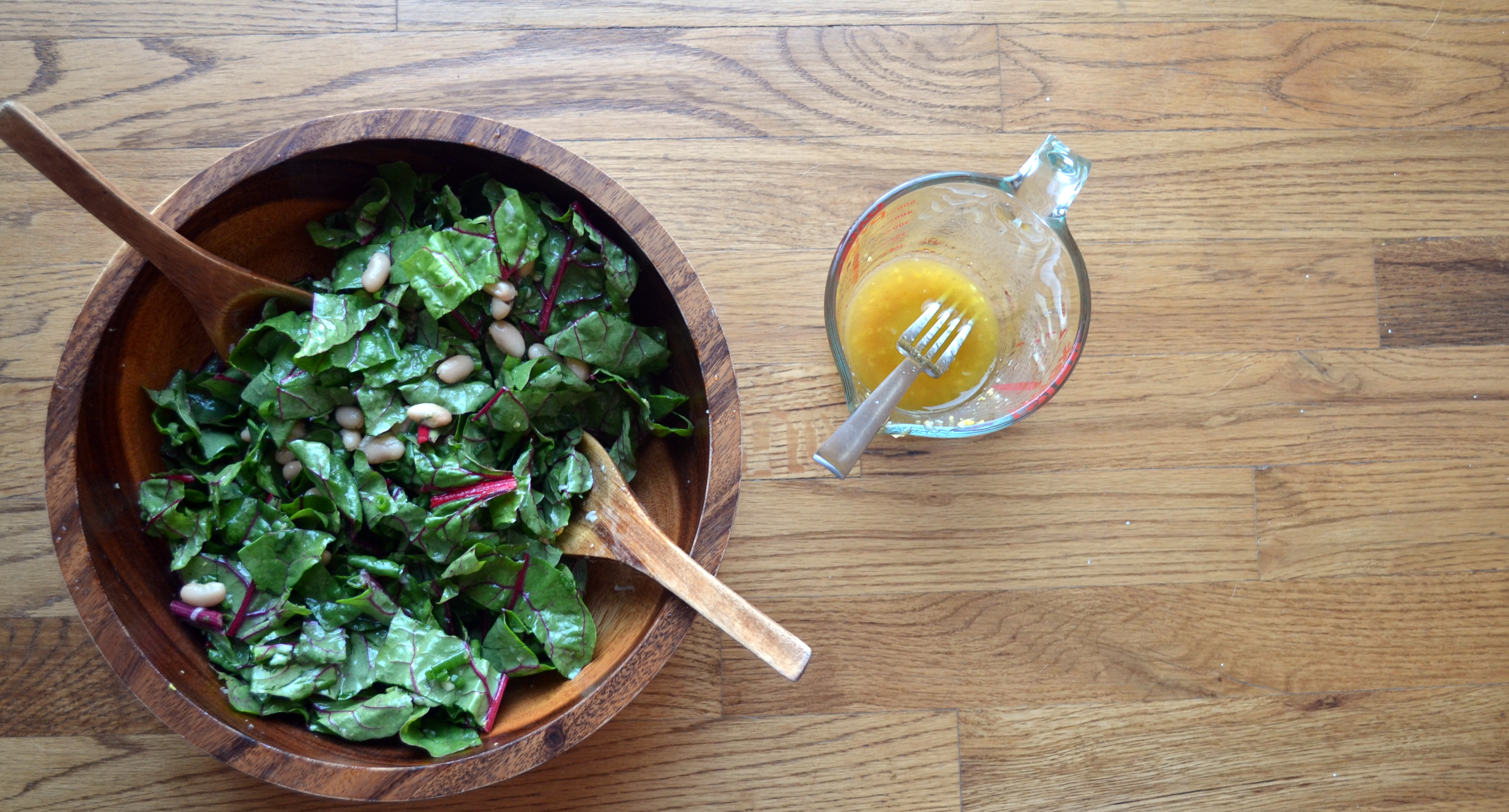
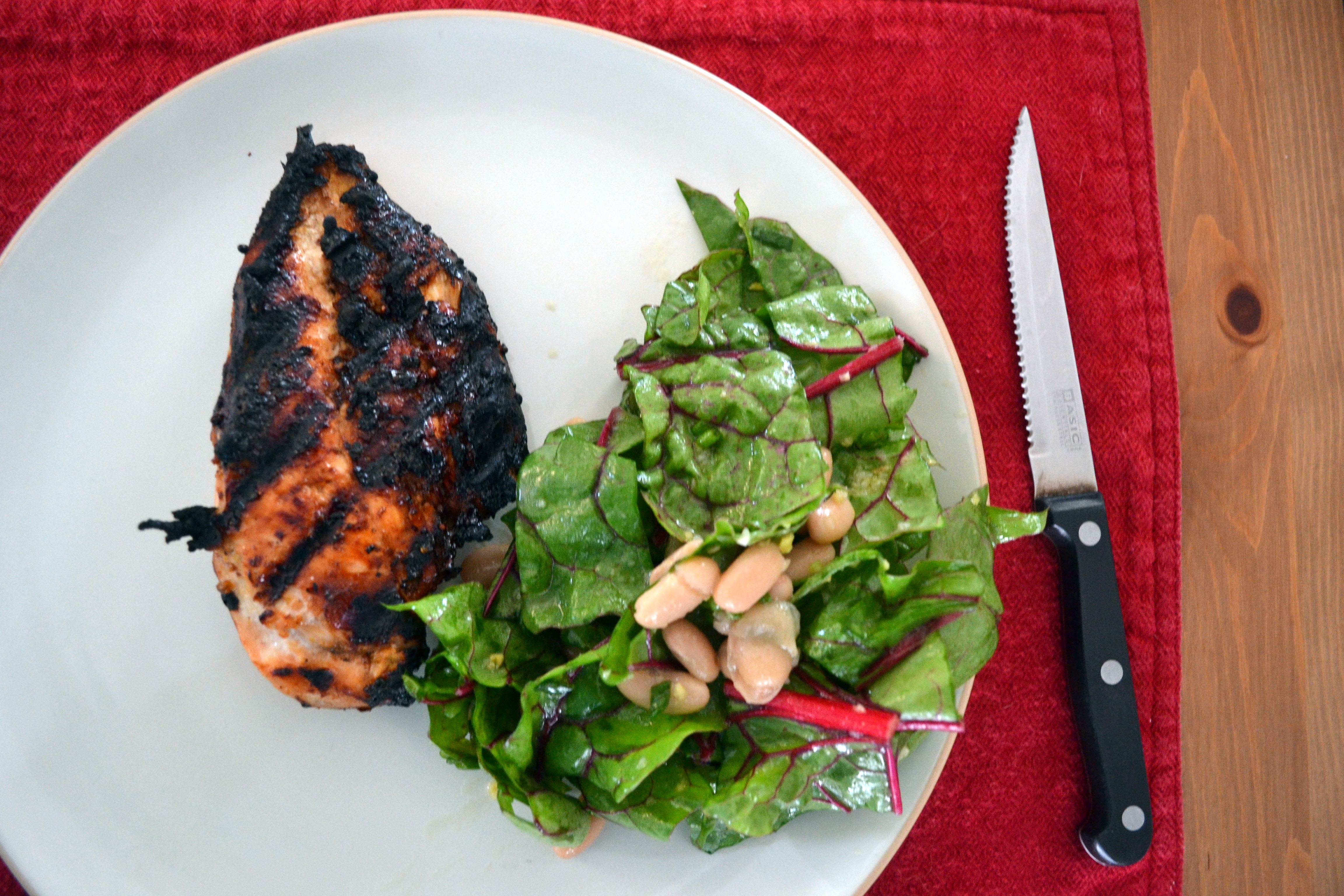
It worked well.  By the time we ate (grilled chicken breasts sauced with equal parts whole grain mustard and apricot jam), the chard had lost just a bit of its aggressive bite but its freshness was not compromised.  The beans, sometimes bland customers, had soaked up a bit of flavor from the tangy bright dressing, and so while they were a steady, creamy counterpoint to the earthy-fresh chard, they weren’t at all boring.  We were both surprised by how well we liked this simple little salad.
Success, then, and balance: excitement and indulgence followed and tempered by stability.  If this is what the 30s are like, I’m ready.  Bring it on.  I’ll just be 30 forever.

Bars and Biscuits

Thyme for our herbed biscuits

Last week’s reflections were a bit morose: the thoughts of a person overwhelmed and trying to settle into some kind of groove.  Because while too deep grooves can become ruts, no groove at all just leaves us… squares in a hipster-filled world?  Not just squares, but squares tipping and zig-zagging confusedly over an unfamiliar landscape trying to dig a corner in here and there.  New home, new job, new routine, and no chances to explore yet.

All that has changed.  Shallow wheel marks dig in behind us.  Our adventures have begun, and they began (don’t be offended) with booze.

Last Friday, our dear friend J. appeared at the door, bearing duty-free Japanese whiskey from his time in Tokyo, and a phone full of bar recommendations from an associate.  After a quick tour of our new digs (you guys have a backyard?!), we set off into the night and ended up at Oldfield’s Liquor Room on Venice, where J. bought me a pre-birthday cocktail called the Blonde Comet.  Bourbon, crème de peach, fresh grapefruit juice, and angostura bitters.  I’m not much of a bourbon gal, but the name was too good to pass up.  I like to think of myself as something of a blonde comet every once in a while… The drink was tasty.  Strong, but tempered by the freshness of the grapefruit and the stem of fresh mint they plunged in as a garnish.

We caught up over this first round and then decided to explore further.  A quick amble down the street brought us to Bigfoot West, but it was so crowded and loud inside that not even the promise of creative whiskey cocktails could entice us.  We were back in J.’s car and rolling toward Santa Monica.

We ended up at The Daily Pint, where it smelled like peat and old shoes and yeast, and the impressive chalkboards full of beer options and the seemingly endless whiskey and scotch menu made J.’s and N.’s eyes shine suspiciously.  I got (don’t laugh) a pint of Spiced Caramel Apple Ale that was neither as sweet nor as fruity as it sounds.  J. and N. got something peaty and boggy and fiery, and I only needed a whiff to know I wasn’t interested.  We settled ourselves in at a tall table next to the pool and shuffleboard stations.  You must know this: I don’t like beer.  When I have to, I will settle for the fruitiest, sweetest, most un-beer-like option I can find, and when I do, I like it to be ice cold so it doesn’t have a chance to taste as much like beer as I know it’s going to.  As we sat and chatted and laughed, time passed and my beer warmed.  Where it tasted like yeast and carbonation to begin with, as it came to room temperature the flavors got rounder and deeper, and by the time I was sipping the last half inch or so in the glass it did have some spicy apple flavors to it.  I’m not sure I would order it again, but it wasn’t a bad beer, and the company and high energy atmosphere made it a good experiment.

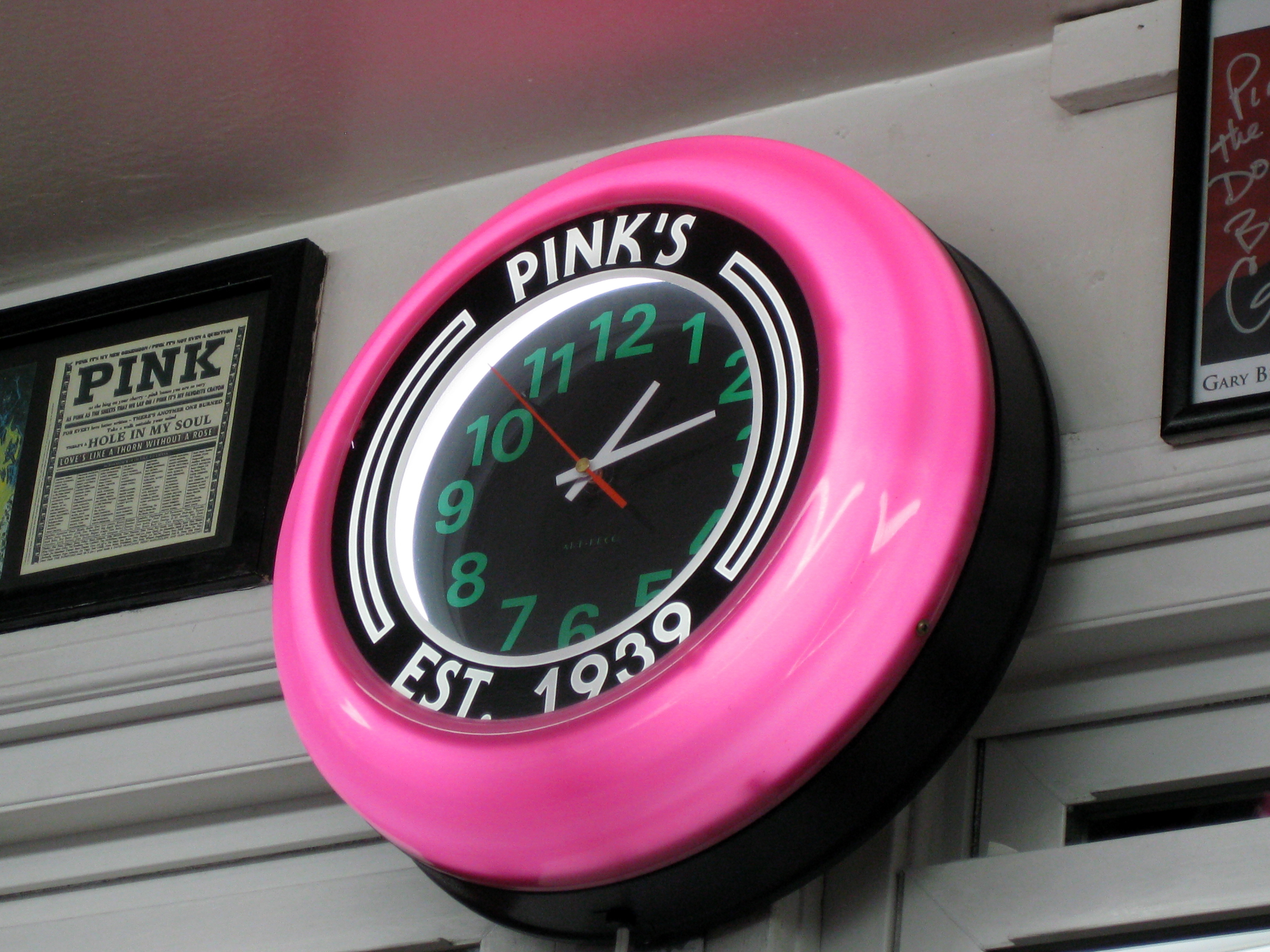
It was almost midnight when J. asked if we wanted a snack.  He was thinking, he said, hot dogs or pastrami.  I’ve been experiencing some cognitive dissonance when it comes to our new location – scoffing when I see patrol cars that say LAPD on the side: what are we, in a movie or something? – grinning with disbelief as I pass Warner Brothers studios on my drive home from work – but something about that night made me remember where we were.  I just knew he was thinking of Pink’s.  Did I want to go to the little stand with the most famous hot dogs in the state?  Yes.  Yes I did.

At almost 1am, as my contacts screamed and the almost-responsible-adult inside me withered and gave up, we were standing in line with at least 30 other people, waiting for a hot dog. 


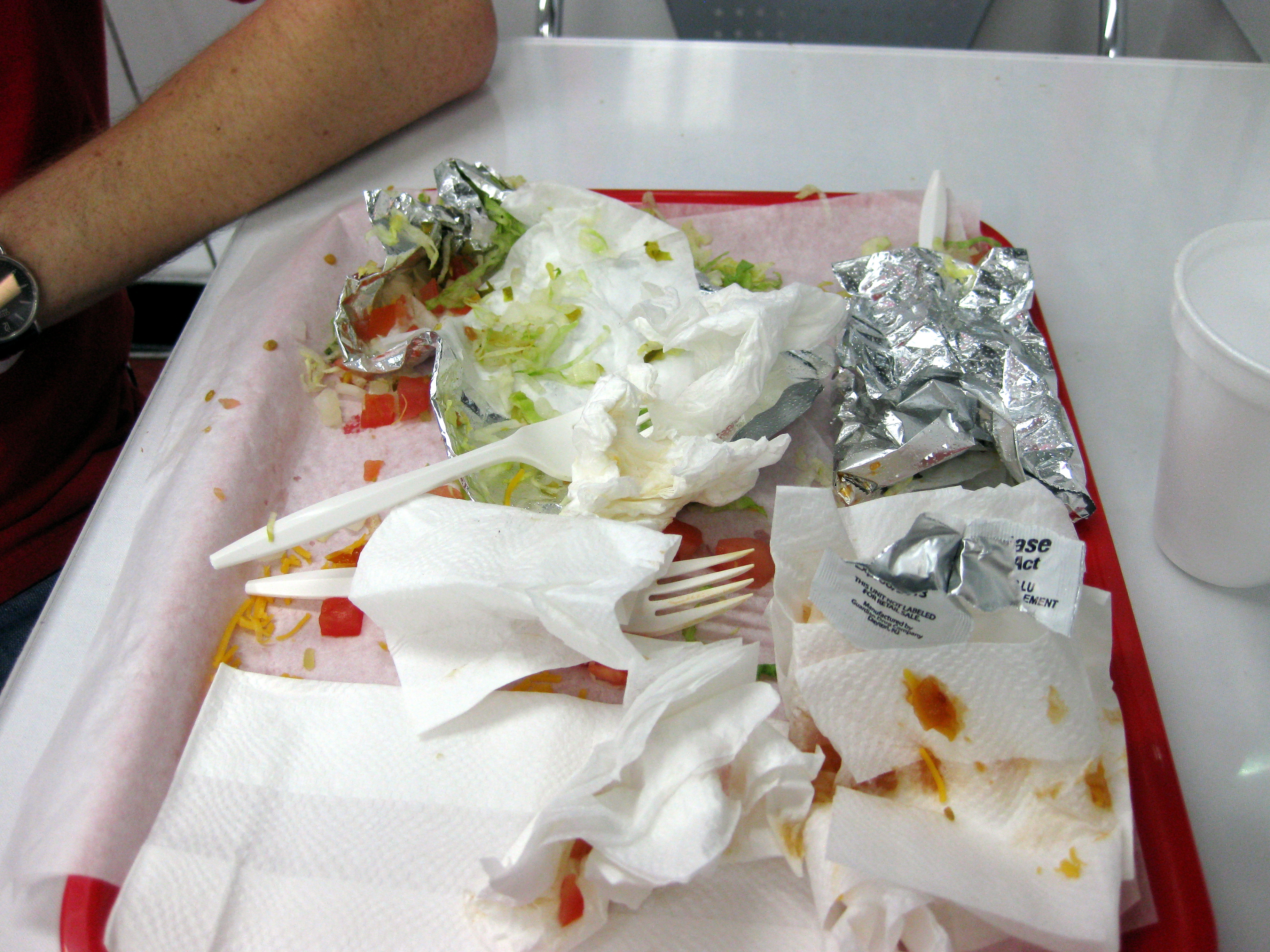
I got a New York dog – traditional hot dog topped with a sweet onion sauce – and added shredded cheddar cheese.  N. and J. got Chicago dogs, loaded with lettuce, tomato, and pickle.  We sat at a crooked little table and took in the space: dozens upon dozens of signed celebrity photographs who had visited Pink’s, some of whom had given their names to a hot dog.


Well, N. and J. took in the space.  I took in my hot dog.  It was fantastic.  The skin was taut and crisp and snapped between my teeth.  The onion sauce was thick and sweet with hints of caramel, like the best sweet and sour sauce you’ve ever tasted, and the cheese, though it could have been melted more, added a nice mellow counterpoint to the meat and the sauce.  Delicious.  And it made me feel like a kid: I was back to the nights in high school when, after band competitions, we used to go to Denny’s and order chili cheese fries and chocolate milkshakes.  Those were the days before we knew heartburn was real…

There really is no logical transition I can make to this week’s Bittman, aside from the lame play on the White Stripes song I provided as the title of this post, so let’s stop pretending and just talk about biscuits.  And let’s not take our sweet little time about it.

85. Herbed Buttermilk Biscuits: Combine 3 cups flour, 2 tablespoons sugar, 4 teaspoons baking powder, 1 teaspoon salt, 1 teaspoon baking soda and 1 tablespoon thyme leaves.  Use your fingers to rub in 1 ½ sticks of butter until the mixture resembles small peas.  Add 1 cup buttermilk and stir until just combined.  Drop large spoonfuls onto a baking sheet and bake at 425 degrees until golden, about 15 minutes. 

With measurements and oven temp clearly provided, I had very little to guess about or change in this recipe.  Because I was using lemon in other parts of dinner, I decided on the spur of the moment to add a teaspoon or two of lemon zest to the dough to see what would happen.  You could probably change up the herb used, add cracked black pepper or flaky sea salt, or even add finely chopped raisins.  I wouldn’t change the buttermilk, though, as the tang it adds is entirely necessary.  I even got excited tasting the raw dough, with a slight crunch from the salt and a suggestion of sweetness from the tiny bit of sugar.

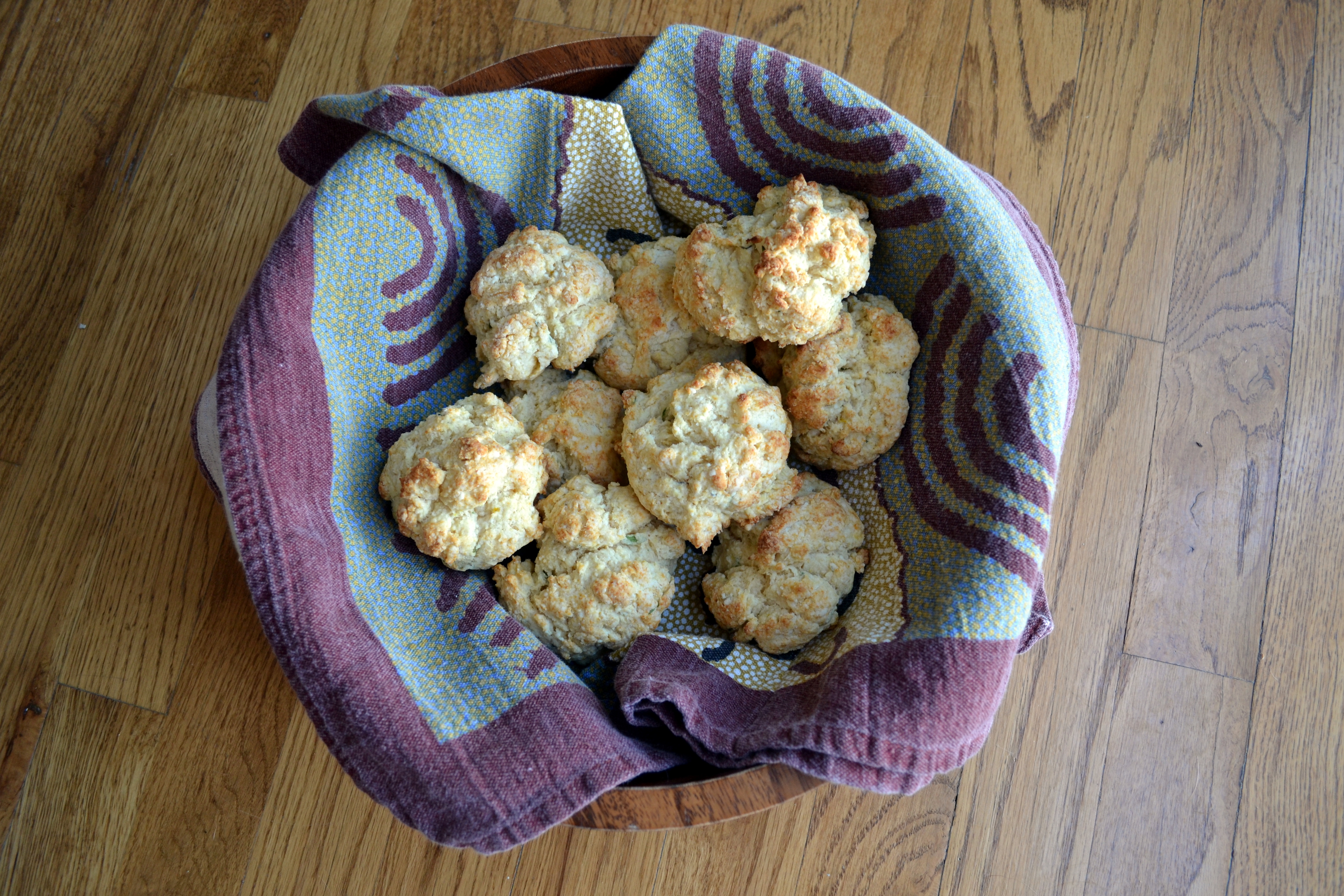
The bowl of dough produced 15 biscuits.  I put nine on my greased baking tray and the other 6 on a plastic-wrap-lined plate in the freezer for another occasion.  After 15 minutes in the oven, they were browned on top, slightly crunchy around the outsides, and knee-waveringly fluffy inside.  Quash your fears about the amount of butter here: it really makes a worthwhile textural difference.  It doesn’t hurt the flavor either – these were rich but light, and the buttermilk and lemon zest added intriguing sourness that brightened the mixture and made them more interesting than your standard dinner biscuit.

We ate these – no, that’s not right – we wolfed them down alongside grilled chicken sausages and grilled planks of zucchini wrapped around a mixture of goat cheese, lemon juice, thyme, parsley, and pepper.

It was delightful.  And here’s the delicious secret: if you end up with some leftover goat cheese mixture, and you whip in some honey, and then if you happen to split one of those fluffy delightful biscuits down the middle and perhaps toast the open sides in a toaster oven or under the broiler for a moment, and dollop a hefty tablespoon of the sweetened goat cheese on top, and eat it, you have the most delightful little end-of-summer breakfast biscuit you’ve had in years.  And if you’d been out late the night before and perhaps chased some whiskey with a hot dog, a sprinkle of extra salt in the goat cheese filling would make this a quite decent hangover breakfast too, as a cure for excessive adventuring.

Next week we settle more comfortably into this lovely little groove we’re making for ourselves: another restaurant, another Bittman, another decade(!), of our new little lives.

Snakes and Ladders

It’s a classic children’s game.  Climb a ladder: advance!  Land on a snake: tumble backwards.  And so it goes with most ventures.  Last week newness delighted me.  This week I’m plodding a bit, experiencing not setbacks, exactly, but settling for lackluster(ness?)(ocity?).  I’m discovering things I don’t love about my syllabus.  I’m wading through class prep.  Students are still (still!  The third week is about to start!  Papers will be due soon!) adding my classes, which means I am overenrolled and there are new faces every day.  And though I’m mostly inspired in my kitchen, not every dish is a triumph.  Some slip a little.  Some slither into lackluster.  But it’s our job, as cooks, as experimenters, as eaters, as humans – and pardon me while I get a bit metaphorical – it’s our job to take this as a challenge.  Make it work, as Tim Gunn continually reminds us.  So we squirm ourselves around and push back toward the ladders.  And sometimes, even after a devastating slide, we climb a few steps.

70. Blanch, shock in cold water, then julienne green beans, daikon and carrots, chill. Whisk soy sauce with honey and lemon to taste; pour over vegetables.”

The most important thing to note about this particular Bittman combo is to leave yourself enough time, particularly if your knife skills are not perfect.  It is not possible to concoct this dish in anything but a zone of utter frustration and simmering disappointment if you only have twenty minutes until dinnertime.  Here’s what I did:

3 carrots, peeled and cut into thick sticks

1 6-inch chunk daikon, peeled and cut into thick sticks

½ lb. green beans, rinsed and stemmed

3 TB soy sauce

2 TB lemon juice

1-2 TB honey

I dropped the carrot and daikon sticks into a big pot of boiling, salted water and let them cook for 2-3 minutes, until they had give between my teeth but still put up a bit of resistance.  I plunged them into ice water and put the tailed green beans into the boil.  This was the point at which I ran into trouble.  Performing a nice julienne on a pile of veg takes some time and some patience, and on this particular day I lacked both.

Nevertheless, cut each thick stick of carrot and daikon into thin slices (Food Network calls them panels), then turn those slices to cut long, thin vertical strips.  You want uniformity but also thinness, since these are only partially cooked, and you want even quantities of carrot slivers and daikon slivers.

At this point the green beans were overboiled and the sausages – the other component of our meal – were almost done on the grill, so I shifted into I-don’t-care-how-it-comes-out-just-get-it-done overdrive.  It happens.  You should julienne the green beans.  I just sliced them into strange vertical halves.  You should chill the whole salad until nice and crisp – probably at least half an hour – after lovingly tossing the thin sticks of orange, white and green together.  I shoved the bowl in the freezer for five minutes while I made the dressing.

I whisked the soy, honey, and lemon together and was satisfied with the flavor.  Were I making this again, I would definitely increase the quantity of lemon juice and maybe even add some zest, but I say it’s up to you.  Play with the combination until you like the ratios.

Dressed, the vegetables had a pleasant texture and tasted well seasoned, but the salad as a dish was missing something.  N. and I agreed that the dressing was a little one-note, and that note was soy sauce.  Flavorwise, things were also a bit on the dull side.  Red pepper flakes or raw garlic, we decided, or more or different acid, would have helped things along.  Maybe some chives or lemongrass or ginger or cilantro, and certainly pairing this Asian-flavored dressing with something other than Italian sausages, would have been the right move.

And so, in my attempts to slither back into success, I considered the leftovers.  They weren’t stars, but they could perhaps be supporting players.  In fact, though they were not the traditional combination, they seemed not so different from the vegetables that go into a bahn mi sandwich.  Setting off to work a morning or two later, therefore, I slathered a crisp roll with mayonnaise, piled up a good portion of drained veggie slivers and, lacking lunchmeat, topped the whole thing with slices of pepperjack cheese.  I know.  Cheese is not part of bahn mi either.  But jalapeño slices usually are, and the vegetables were crying for spice anyway.  It wasn’t the best sandwich I’ve ever had.  But it wasn’t a disaster either.  It was a few steps forward.  Keep moving forward.  On to the next ladder!

Relishing

I can’t remember the last time Labor Day was a holiday for me.  I mean, I haven’t worked on Labor Day in a long time – perhaps ever.  But I spent the past eleven years or so attending universities organized around the quarter system: school starts in late September and ends in mid June.  That means when this magical Monday hit and working stiffs got to switch off their alarms, I was still on summer vacation.

Boo hoo, you say, poor thing!  You had to suffer through a non-holiday because you were on holiday!  But I’d remind you that for a graduate student, even allotted holidays don’t read as such.  A Monday is another toil-on-the-dissertation day.

And yet, today, with one week of class behind me at my new job, I did not have to make the pilgrimage to Burbank.  I did not have to spend the weekend lesson planning.  Ahead of me spans a week with one (one!) day of class.  It’s enough to make a girl sob with joy!

And then there are onions.  Which are enough to make a girl sob as well, though the accompanying emotion differs a little.

These are two Bittman “recipes.”  I realized recently that, as usual, my Bittman project has fallen by the wayside.  A brief count reveals that, of the list of 82 with which I began (the whole collection has 101 items, but I knew there were some N. and I would just never eat), 34 still remain unmade.  Most are soups.  That sounds like decent progress, until I remind you that I began this project 2 years ago.  But this year, beginning for me – as for every eternal academic – at the end of summer, is a year of renewed possibility.  It’s a year of everything refreshed: new home, new jobs, new opportunities.  It’s a year to relish.

3. Red Onion with Red Wine and Rosemary: Thinly slice red onions and cook them in olive oil until very soft.  Add chopped rosemary and red wine, and cook until the jam thickens.

I used:

1 big red onion, halved, peeled, and cut into thin half-moons

1 TB olive oil

Salt and pepper to taste

2 TB rosemary, finely chopped

1-2 cups red wine

1 TB brown sugar

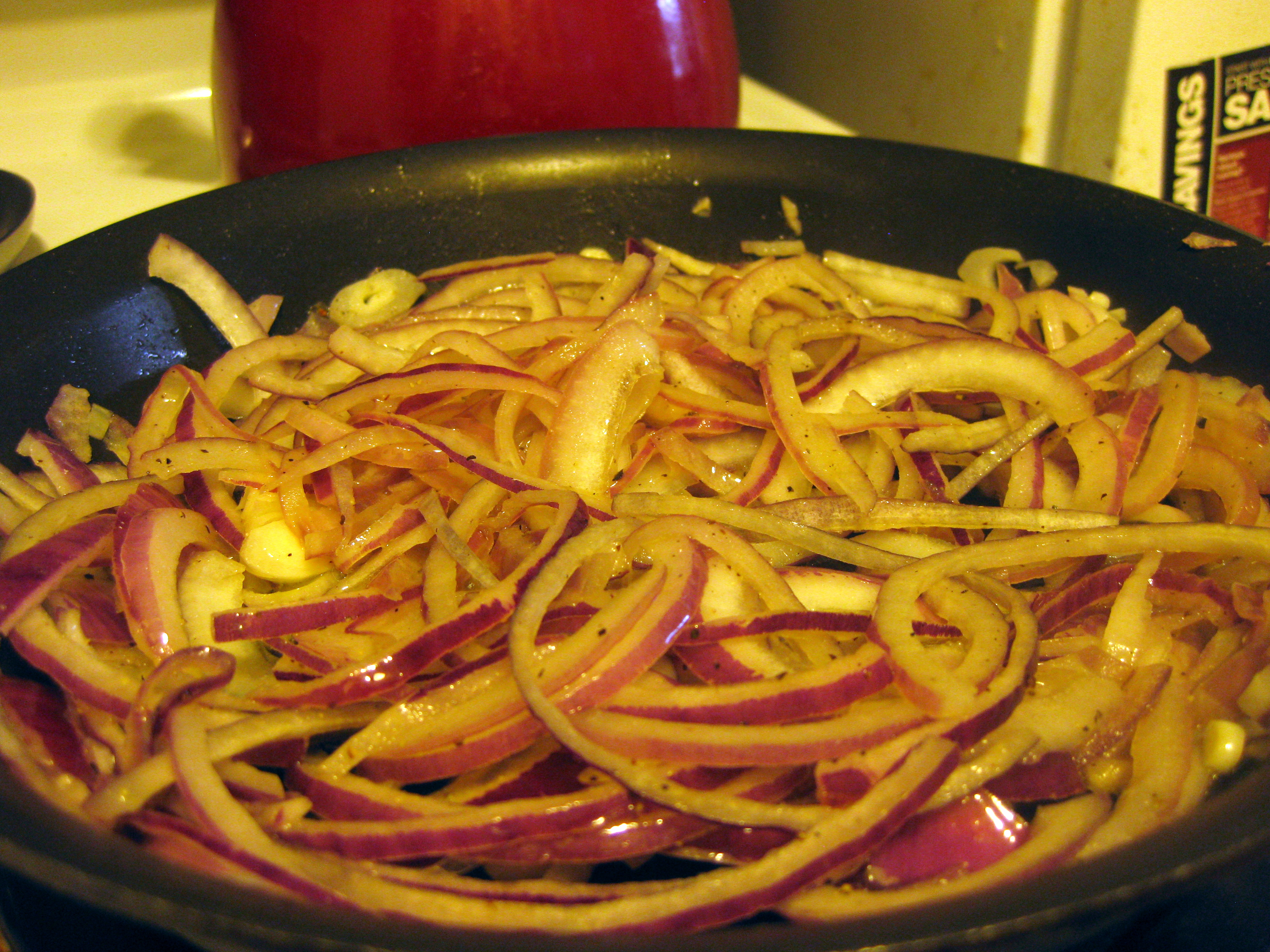
Onions take a long time to cook down the way I suspected they needed to for this recipe.  High heat makes for crumpled, browned, crispy-edged rings.  Delicious in their own right, but not for jam.  I baby-sat the onions over medium-low heat for at least half an hour.  Their pearly-white interiors turned fragile gold as if stained by the olive oil, and their textures changed, gaining an unctuous flexibility.

I added the salt and pepper, the rosemary, the red wine and the brown sugar and stirred together carefully to dissolve the sugar.  This simmered for another half hour until the wine, sugar, and onions came together into a sticky heady mahogany swamp in the pan.  As the wine reduced, I lowered the temperature to prevent any burning.

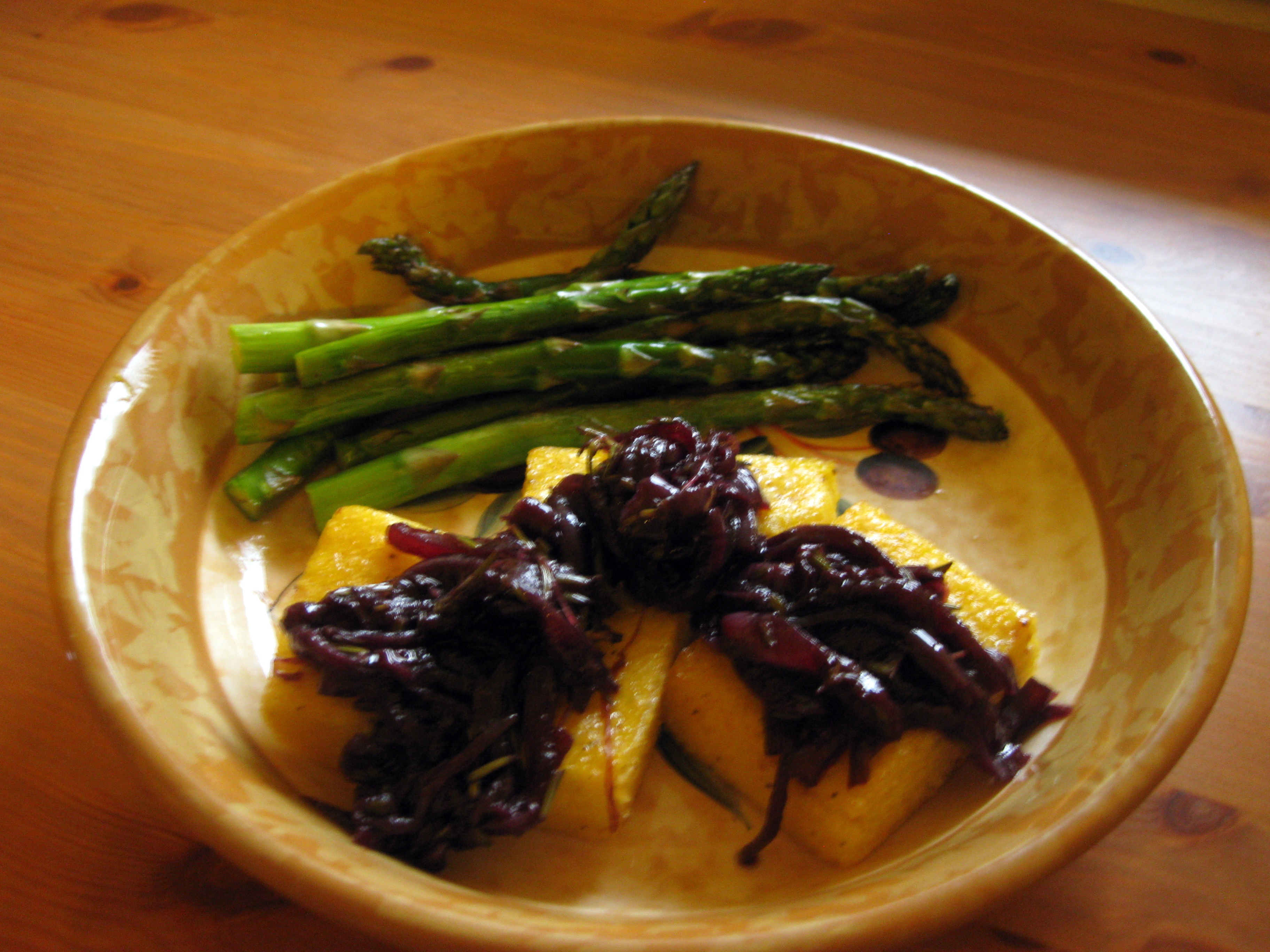
The finished jam slumped wonderfully over baked squares of polenta, providing contrast in all the best ways: the colors were sharp, the textures played together, the flavors were rich and lovely.  The onion jam was sweet with the tang of wine and the pine-forest warmth of rosemary.  The polenta was comforting and even flavored, and it needed the sharp sweetness the jam provided.  Steamed asparagus finished out the meal.

It sounds crazy, but the next morning I had the urge to drape some of this sticky, savory jam over a piece of whole-grain toast smeared with cream cheese.  It would also, I suspect, serve well spread over a turkey burger.

1. Onion-Pumpkinseed Relish: Roast thick slices of red onion with olive oil until softened and nicely browned.  Chop, then toss with minced chives, toasted pumpkinseeds and a little more olive oil.

A number of circumstances divide these two onion concoctions.  One was made in Oregon, one was made in California.  One was made in the cold drear of an oppressively long winter, one was made on a day of endless sun as August closed.  One was slowly reduced over an electric stove, one was browned in a gas oven, and though both were shot with digital cameras, you’re seeing one through the lens of an everything-automatic Canon PowerShot, and the other through a Nikon DSLR.  Changes to relish.

½ a huge red onion

3 TB olive oil

3-4 TB pumpkinseeds, toasted in a dry pan until they are flushed with brown and starting to pop

2 TB fresh chives

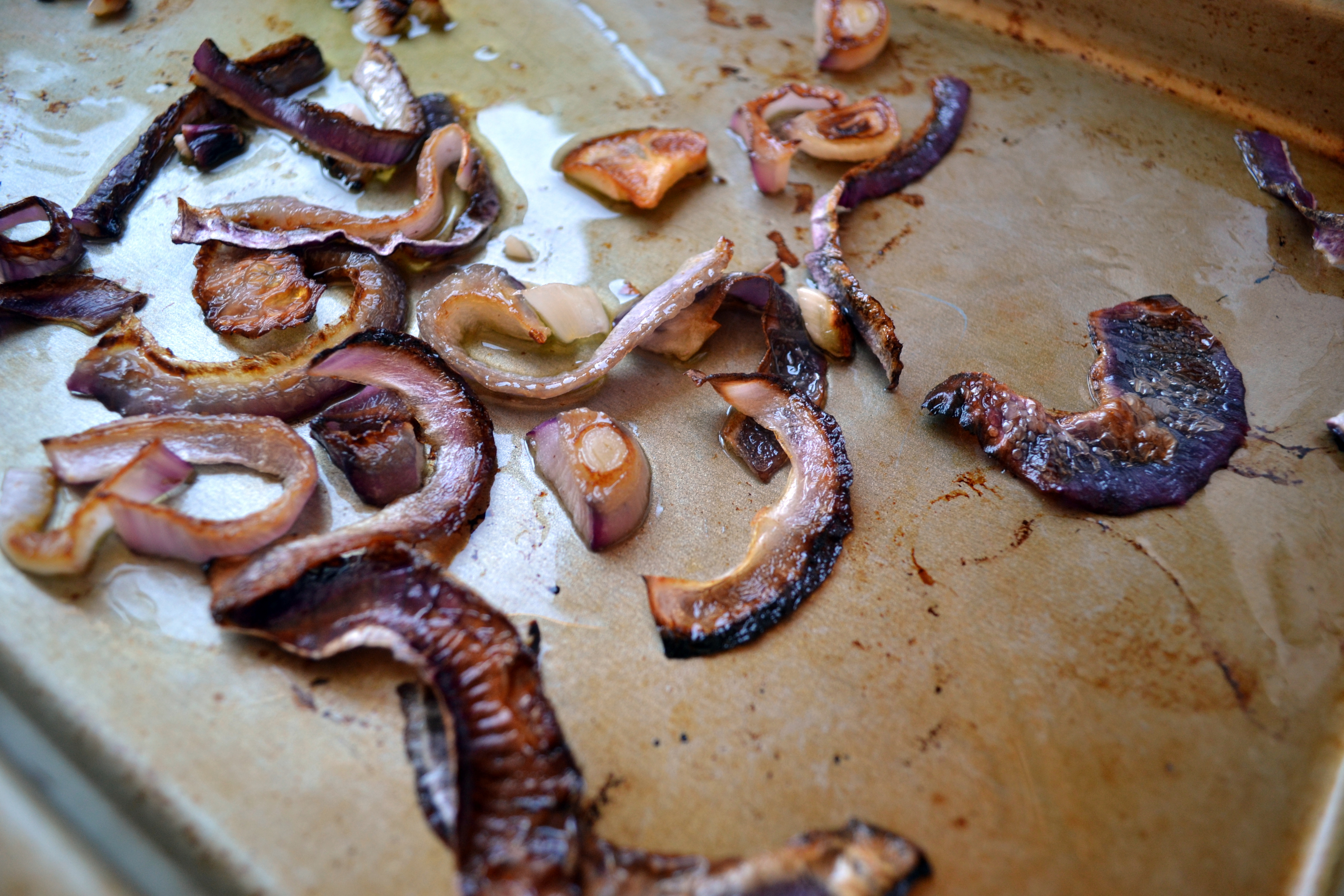
In a 400F oven, I roasted the olive oil coated onion slices until they collapsed, taking on a lovely burnished crispness.  This took probably 10-20 minutes.  Check often after 10 minutes, depending upon how hot your oven runs.  Liberate the toasty onion slices and let them cool.

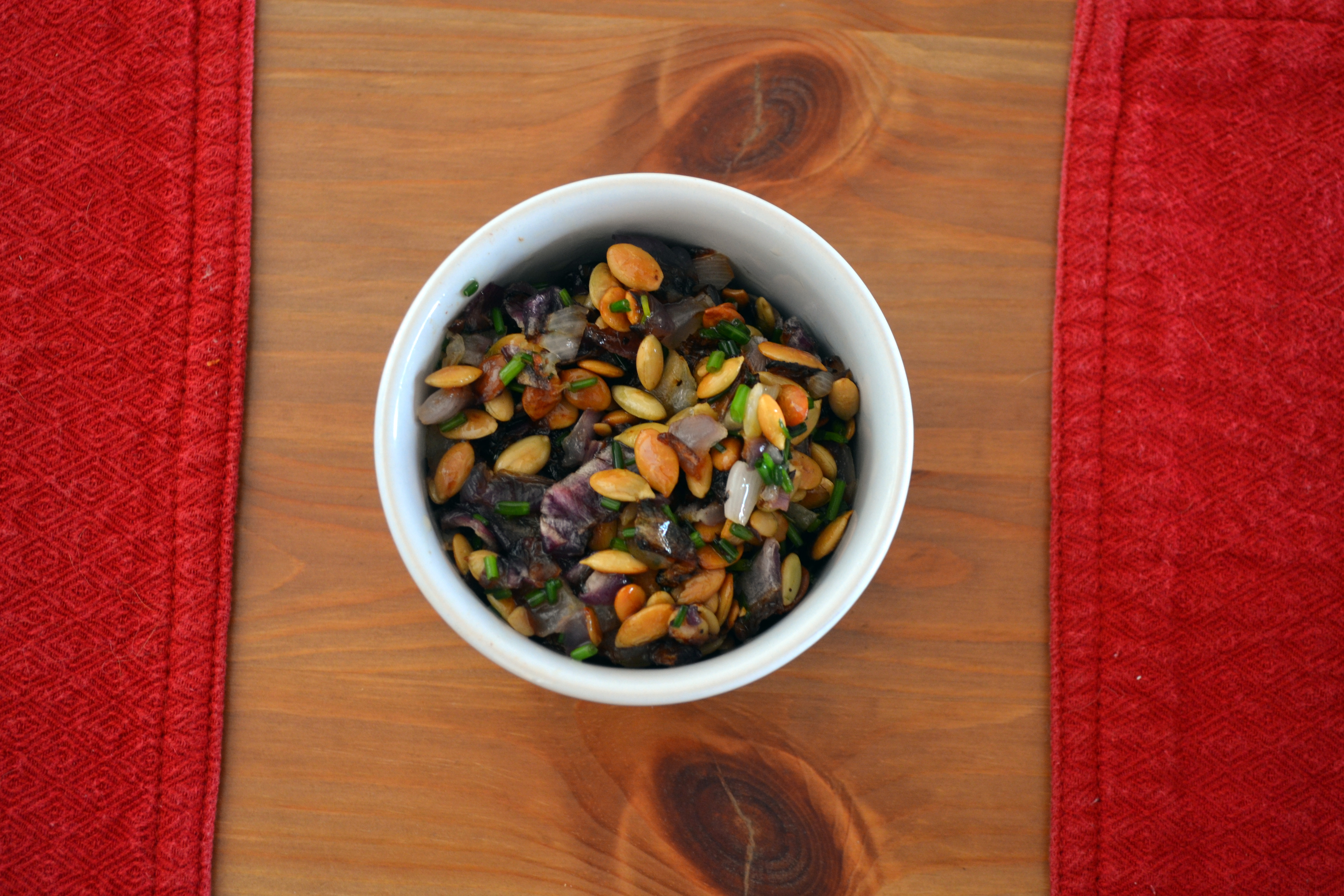
When onions are cool, chop them finely and toss them with the other ingredients.  I had plenty of olive oil in my baking pan to coat all the ingredients so the relish glistened, but if you need it, feel free to add another glug or two.

I served lovely little spoons of this mixture over black bean cakes.  We traded tastes, taking in the relish in one bite and an avocado tomato salad in the next.  It was a nice pairing: the relish was moist and crunchy and savory, with the right kind of nutty richness to complement the dense potential blandness of the beans.

But I don’t think this relish ends as a condiment for beans.  It would be a spectacular topping for lamb.  Spiced with a little chili powder, it would fit perfectly atop pumpkin enchiladas.  It might even be a good garnish for butternut squash soup: a small heap of confetti in a velvet orange sea, interrupting the endless smoothness with a well-oiled crunch.

Will I finish this Bittman project by the end of the calendar year?  I don’t know.  But I’m enjoying it again, whereas during the last few months of dissertating I was finding it burdensome.  The thrill of guessing quantities, rather than being annoyed by lack of specificity, is returning.  The intuition about temperature and time is audible again.  And now, on this holiday that has never felt like a holiday before, I’m relishing it all.

Emptying the Fridge III: Crack(er)ing the Code

Last week I told you about my favorite new dip.  White beans, toasted almonds, the piney sharpness of rosemary, the heady perfume of orange zest… and promised to provide a vessel on which to deliver this deliciousness to your eager taste buds.  N. and I discovered shortly after my first foray into this creamy blend of balanced spice that the ideal vehicle for consumption was not in fact a spoon, but the best crackers ever: Trader Joe’s Raisin Rosemary Crisps.  In fact, these are good not just as a vehicle, but a snack in their own right.  Every time I went to the pantry to retrieve a few for dip spreading, I’d find them gone, thanks to N.’s voracious nibbling.

I wondered at one point, as I broke down yet another cracker box for recycling, how difficult they would be to make myself.  I’ve never made crackers before, but looking at the list of ingredients – sunflower seeds, millet, raisins, baking soda – it seemed doable, and further, thanks to the kind of collection that happens in established kitchens, when you don’t remember why you have something like toasted millet or roasted ground flaxseed but you just do, I had every single dry ingredient in my pantry, waiting to be used up so they didn’t have to make the move to California.  On that door dividing me from opportunity, he was pounding with a brass knocker.

So I set about experimenting, and today I can offer you not one, but two ways of making these crackers yourself.  They aren’t perfect replicas.  They will always be discernable as imitations.  But they are delicious, and they are pretty darn close.  Only a thinner knife, a bit of whole wheat flour, and patience, I suspect, separates them…

Here’s what you need:

1 ½ cups all-purpose flour

½ cup whole wheat flour (the first time I made these, I used equal parts AP and WW flour, and the result was a bit heavy.  Using 2 cups AP instead of adding the WW would probably make the crackers even lighter, and the TJ’s ingredient list doesn’t contain WW flour at all)

1 tsp baking soda

¾ tsp coarse sea salt (I used Maldon, with which I have a deep love affair)

2 TB roasted, ground flax (if you have whole flaxseeds, use them!  Just toast them in a dry pan until fragrant and beginning to darken, and whiz them in a spice grinder, or your husband’s coffee grinder, if that’s the machinery you happen to have)

1/3 cup millet

½ cup sunflower seeds, toasted or not, salted or not, just use what you can find

¼ cup brown sugar

1 TB finely chopped dried rosemary (again the spice grinder works really well for this – chopping dried rosemary with a knife is an exercise in absurdity: it flies everywhere)

½ cup craisins

¾ cup buttermilk

Whisk together all ingredients except buttermilk until seeds, nuts, and fruit are evenly distributed.

Add buttermilk and cut in with a fork or pastry blender until dough starts to lump together.  It will be roughly the consistency of biscuit or Irish soda bread dough.  At this point, switch to your hands (the best tools, really, aren’t they?) and knead the dough for three minutes or so, until it all comes together and becomes a bit less shaggy.  You can either dump the mixture onto a lightly floured board to knead it, or you can be lazy like me and knead it in the bowl.

At this point, you have a choice.  If you want flat, rectangular crackers like Ry-Krisp or Stone Ground Wheat, roll out your dough into a big thin rectangle (1/8 inch thick or even less, if you can) and cut gridlines along your dough with a pizza cutter.  Create whatever size squares, rectangles, trapezoids, or polyhedrons you desire, then place them close (but not quite touching) together on a baking sheet lined with parchment paper or sprayed with non-stick spray.  Slide them into a preheated 300F oven for 45 minutes.  You’ll end up with crunchy crackers with the slightest bit of give in the center, evenly colored with a dense crumb.  They are a little like miniature flatbreads. 

If you want slightly lighter crisps with a darker “crust” perimeter and a sprightly, Panko-like crunch, there is only one inspiration to which you can look: biscotti.  I liked the flat crackers.  I did.  They were tasty, they were good with the dip, and they were relatively quick: roll, cut, bake, done.  But they weren’t the ephemeral cracker experience I was after.

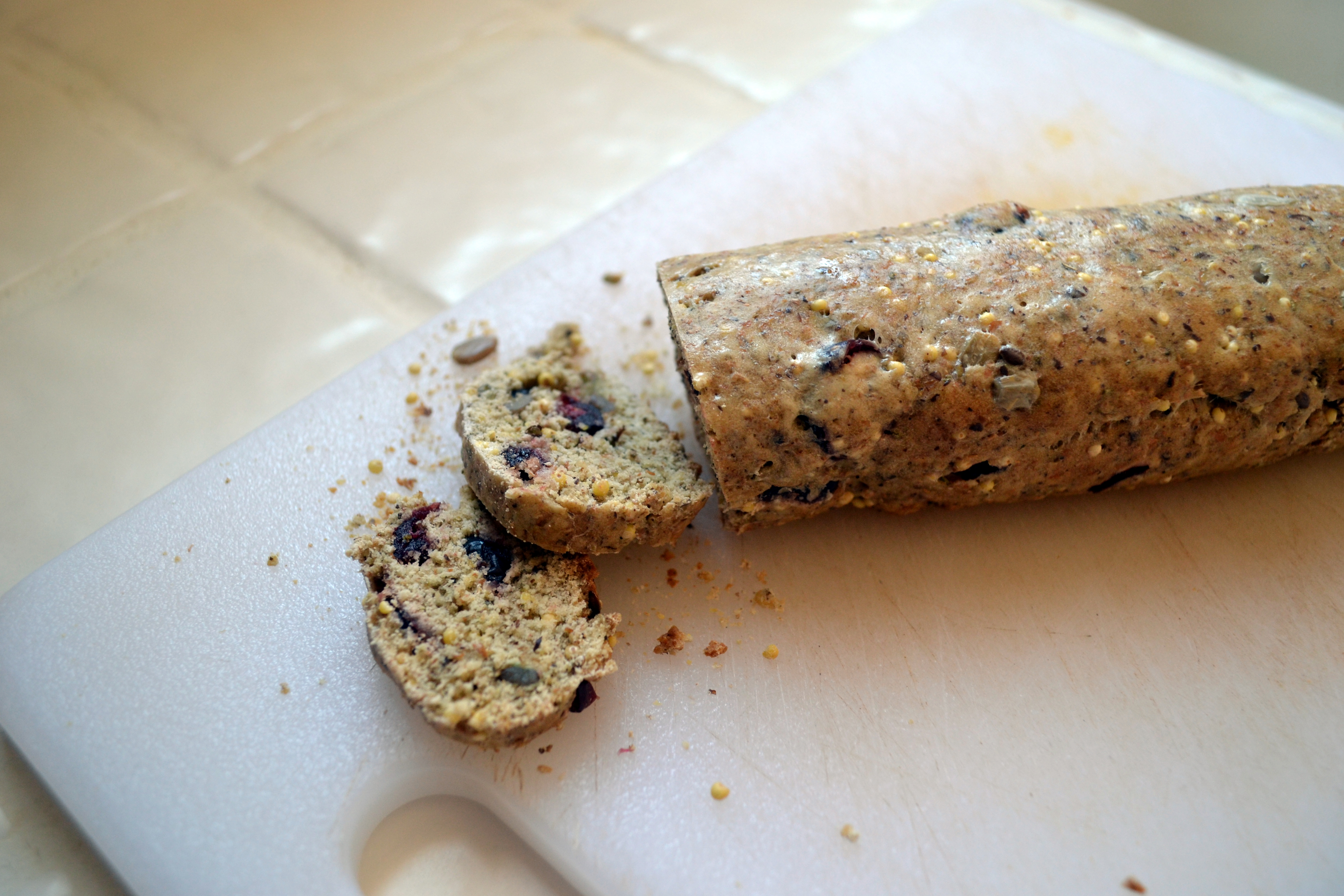
If you’re going the biscotti route, once the dough is kneaded together well, divide it in thirds.  Instead of rolling it out on a board, roll it into a long, thin “worm” of dough on some plastic wrap.  Press, squeeze, and moosh it into a log of even thickness, using the plastic wrap to help you.  Wrap up securely in the plastic, then pop it into the fridge.  Repeat with the other sections of dough, each in their own piece of plastic wrap.  Refrigerate for at least three hours (my trusty biscotti recipe from which I estimated times and temperatures says you can leave them in the fridge for up to three days). 

When you are ready to bake, take the worm/logs out of the fridge and unwrap.  Leaving them sitting on the open plastic wrap, paint them lightly with buttermilk to encourage browning.  You could probably paint them with egg wash too, but the TJ’s box doesn’t list egg as one of its ingredients… Carefully move the buttermilked logs to a baking sheet, then place in a preheated 325F oven for 30-40 minutes, or until the tops have swelled and are lightly golden.  Let them cool completely. 

You will find when you move your logs that the bottoms are browner than the tops.  I am toying with the idea of slowly rolling these logs as they bake so that each side comes in contact with the metal of the baking sheet for ten minutes or so during the baking.  This might make the finished logs a bit more rectangular (and hence capable of producing square crackers), and it might make each edge evenly brown.  Let me know if you try it out, and I’ll do likewise.

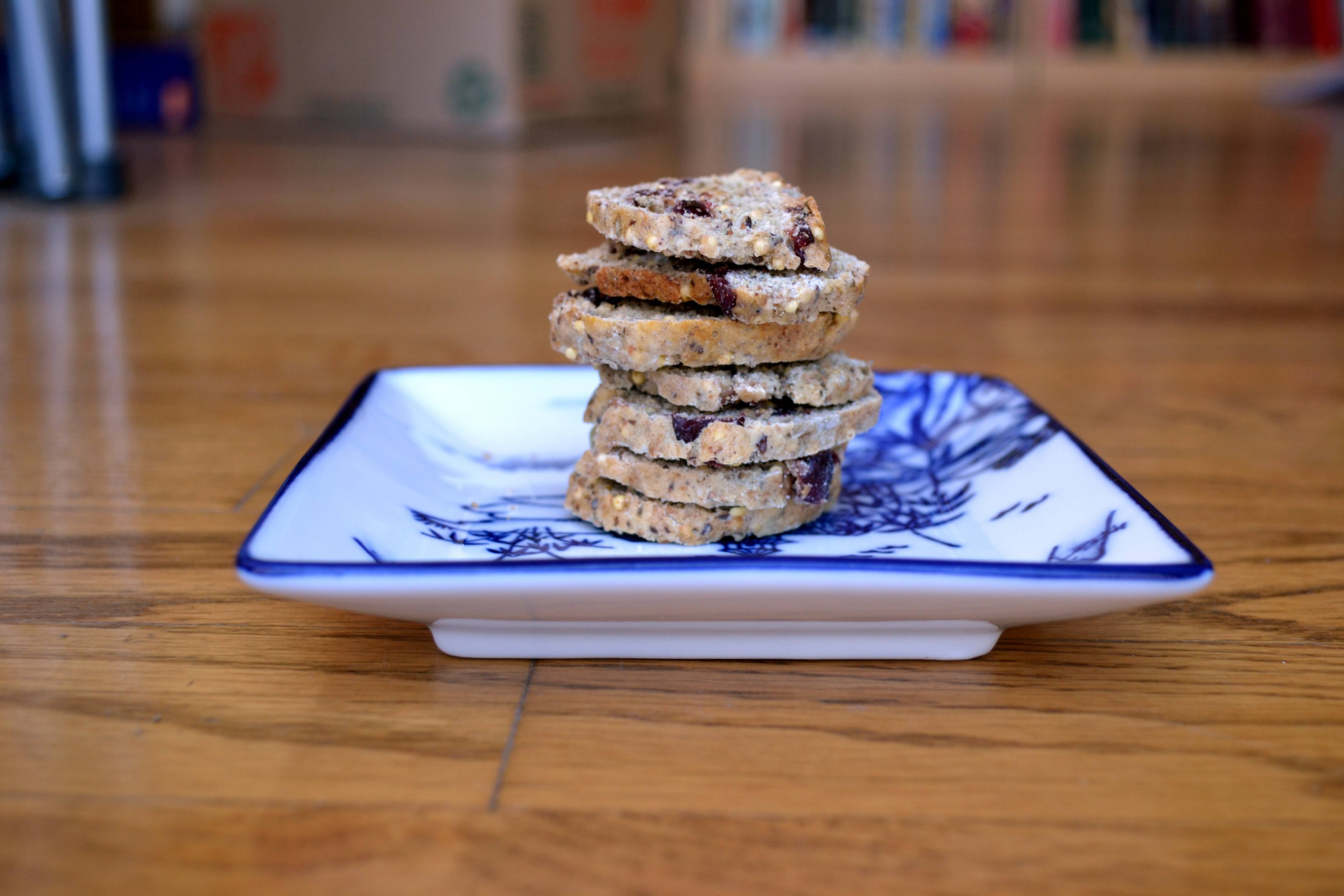
When the logs are cool, carefully cut them into thin slices with a serrated knife.  Some of mine crumbled a bit, especially when there were craisins at the edges of the log, but that just meant more sample scraps.  My ideal would be 1/8 inch thick or even thinner, if you can manage it.  But really, what you want here are crackers of the thickness you want to bite into.

Position your slices on a baking tray in a single layer (it’s fine if they touch each other, as long as they aren’t in layers) and bake in a preheated 300F oven for about 20 minutes.  The edges will bronze a bit deeper, and the centers will flush golden brown.  They won’t feel quite crunchy yet, but take them out anyway: much of the crisping happens as the crackers cool.

In an hour or so, when they are cool and crisp, I recommend you slather them with my almond white bean dip, or maybe a thick slice of rich brie, or some sharp, tangy goat cheese, and consume.  They are deep and toasty in flavor, the nuts and seeds lend appealing texture and different kinds of crunch, and they are just barely sweet from the brown sugar and the craisins.  I like the switch to cranberries as the fruit source, because they pair so nicely with the orange zest in my dip, but also because their uncompromising tartness makes these crackers interesting enough to eat all on their own.  Enjoy!

Emptying the fridge: Annotated Almond White Bean Dip

Yes, I know I’ve already moved.  Yes, I know I’m now in a pattern of filling the fridge, not emptying it.  But moving, like writing, is a process, and I have to catch you up.  And that means talking about what I’ve done before I get into what I’m doing…

This recipe fruited during a hummus drought.  I had evicted all garbanzos from my pantry – not from lack of desire, but from too much desire: hummus-hummus-all-the-time.  And at first, facing the multiple cans of cannellini beans in the cupboard, I thought I might just whip up some hummus-with-white-beans.  But beans, like chilis, seem to call for applications appropriate to their specific qualities.  No one makes poblano salsa, for example.  Jalapenos are needed.  Tabasco sauce, to no surprise, can only truly be made with tabascos.  So white beans, as adequately as they might suit, are just not destined for hummus.  And really, when you’ve been scarfing down a batch a week, it might be time to try something different anyway.

So I faced off against the white beans and thought about accompaniments.  Like most dips – hummus, pesto, artichoke (maybe?) – it would need a few players with whom to harmonize and energize.  Acid.  Herbs.  Salt, of course.  Maybe some spice.  Maybe, given the circumstances, whatever I had lying around…

Out of rosemary, which seemed like a natural pairing (check the web: white beans and rosemary are easy, well established lovers), I did have some toasted, salted, rosemary-infused marcona almonds begging to be consumed.  Almonds in bean dip?  Why not?  Pesto couldn’t operate without pine nuts, and walnuts whir excellently together with roasted red pepper.  Lemon seemed too stringent, but an aging orange called me from the fruit basket.  Like adding colors to an outfit, each ingredient meant slowly ruling out and pulling in other things.  Orange and garlic don’t fit together well, at least not across my palate.  So some other sharpness was needed, and I opted for cayenne pepper.  Almonds and beans could be a bland marriage.  Couples therapy recommends adding some spice.

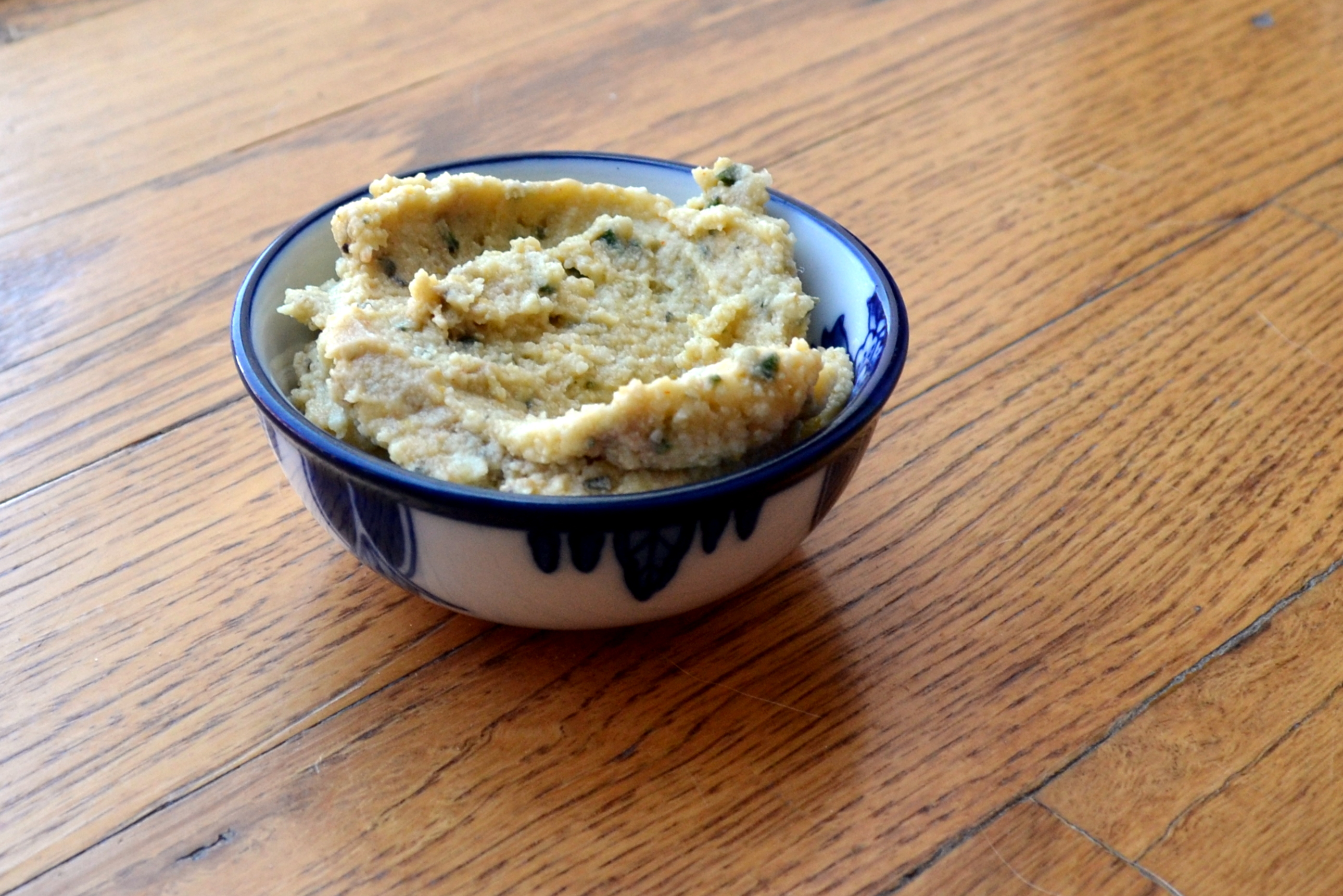
What came out of the food processor on a tentative spatula dip was a smooth creamy whisper of something amazing.  I’m not exaggerating.  It was warm, it was earthy, it was perfumed and heated and comforting.  As soon as we finished slathering this odd little puree all over crackers, and tortillas, and those amazing raisin rosemary crisps from Trader Joe’s (more on that in a bit…), we wanted more.  So I made it again.  And this time I wrote some things down and made some adjustments.  And some more adjustments.

You may have noticed, if you read this page with any frequency, that with the necessary and understandable exception of buttercream, I am not big on repeating recipes.  Most of what I post I have never made before and never made again.  It’s a shot in the dark.  It’s all experimentation.  Love it or leave it.  Or play with it yourself until it’s right for you.  But guys, I’ve worked on this one.  I’ve a real recipe to share that you can actually follow.  I’ve forced myself to note and follow my own suggested quantities to make sure yours will emerge the same way (well, sometimes my hand slipped a bit, but I’ll have you know I scolded myself resolutely for that and I won’t do it again.  This time).

So here it is, my perhaps overly-annotated almond and white bean dip.  Some of the ingredient quantities are listed in ranges.  I suggest you begin with the smaller quantity and increase as your taste buds request.

½ cup almonds, skinned and toasted.  Marcona almonds are best but most expensive, so choose as your budget permits (this doesn’t mean you have to pay top price for pre-skinned almonds, though.  To easily slip their coverings away, put your almonds in a bowl, pour boiling or near boiling water over them, and let them stew for 3-5 minutes.  Drain, and when they are cool enough to handle, you should be able to pinch them into nudity in moments.  Skinless, they are mild and meaty/fruity and ivory-pale, and you can then quickly toast them in a pan until they begin to brown and exude fragrant oil)

1 15oz. can of white beans (cannellini are creamiest, but great northern and unspecific “white beans”) will do just fine

3 TB fresh rosemary leaves (you can, if you wish, just strip them from their stems and toss them into the food processor.  This may result in larger green snippets and a dip chunkier in texture than you want, so depending upon how obsessed with smoothness you are, you can mince the rosemary finely before adding it in)

2 tsp orange zest from one large orange

¼ – ½ cup juice from the same large orange (you could use orange juice from a container, but I think it just doesn’t taste as fresh or bright)

½ – 1 tsp salt, according to your taste *

Pinch cayenne pepper, or to taste *

A generous ½ cup fruity olive oil (I use extra virgin)

In a food processor, pulse almonds until only small chunks remain (texture should be like very coarse sand, but not yet broken down into butter).

Add all remaining ingredients except olive oil and pulse three or four times, until all ingredients are mixed but large clumps resist blending.

Drizzle in olive oil slowly through your food processor’s top spout.  The mixture should whir together into a creamy and relatively homogenous spread.  Continue to process until it reaches the texture you desire.  Chunky and smooth are both fine by me.  Taste, season if desired, and taste again.  Chill for an hour or two to allow flavors to entwine, and bring to room temperature before serving.

* A note on seasoning: during the hour or two of chilling time, flavors will intensify.  Salt, spice, and sharpness will become more pronounced after allowing the dip to sit.  Therefore, it might be wise to minutely underseason the first time you make this.  If it tastes a touch bland, it might not in a few hours.  If it’s already pretty spicy, be aware it will get spicier as it sits.  This is not a bad thing, but something of which to be aware.

Now you have your dip.  Or spread.  Or puree.  Depends on how long you processed.  But dips – and spreads – all on their own are incomplete.  They need a vehicle.  And in this case, with this dip, it needs just the right vehicle.  It’s not garlic driven, it’s not overwhelmingly pungent.  It hovers on the edge of savory.  It could even, if you were feeling a deep need for warmth and comfort, take a drizzle of honey and still be delicious.  It errs toward the sweeter side.  A tortilla chip just won’t do.  A pita chip leaves something to be desired.

A rosemary raisin crisp from Trader Joe’s makes it sing.  And I was content with that.  But then I looked at the ingredient list for these crisps and saw flax, millet, sunflower seeds… all, oddly, items in my pantry that needed using up.

So another project before perfection, which I will tell you about next week: the cracker soap-box derby.  Recreating the perfect vehicle for my perfect spread.